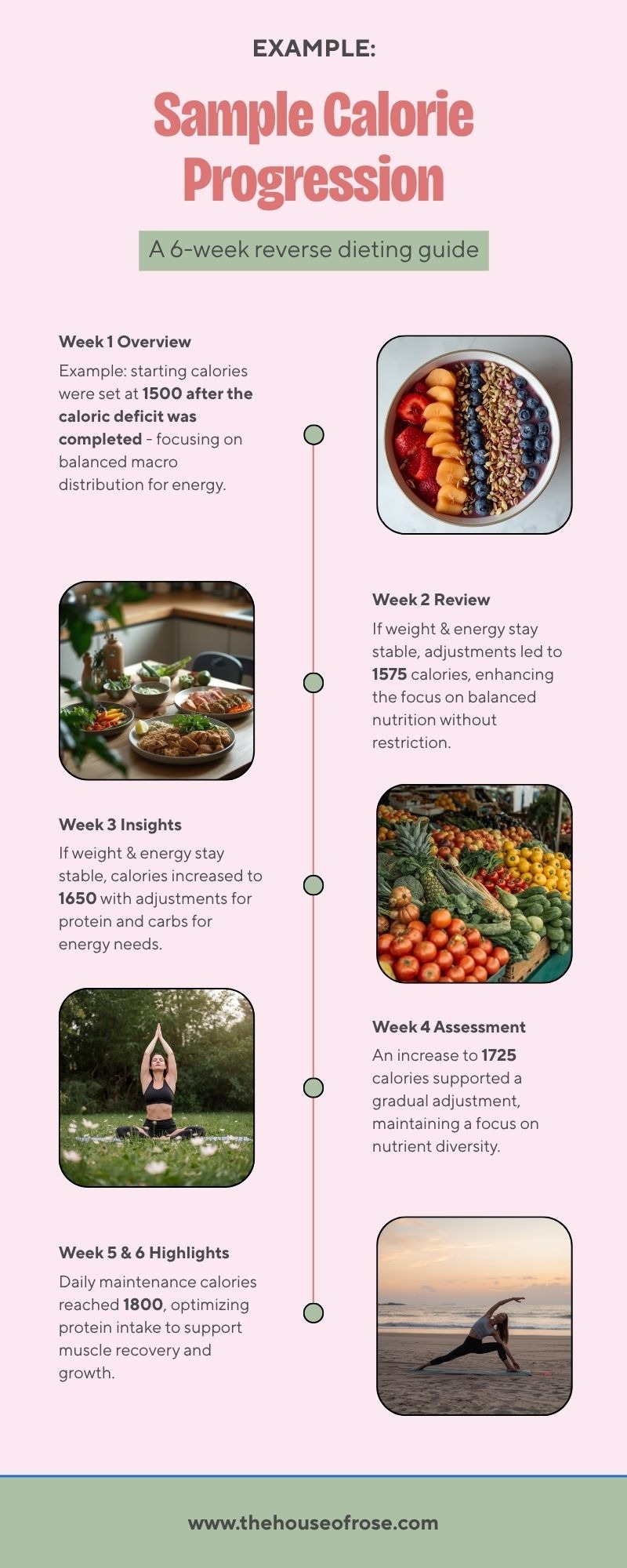
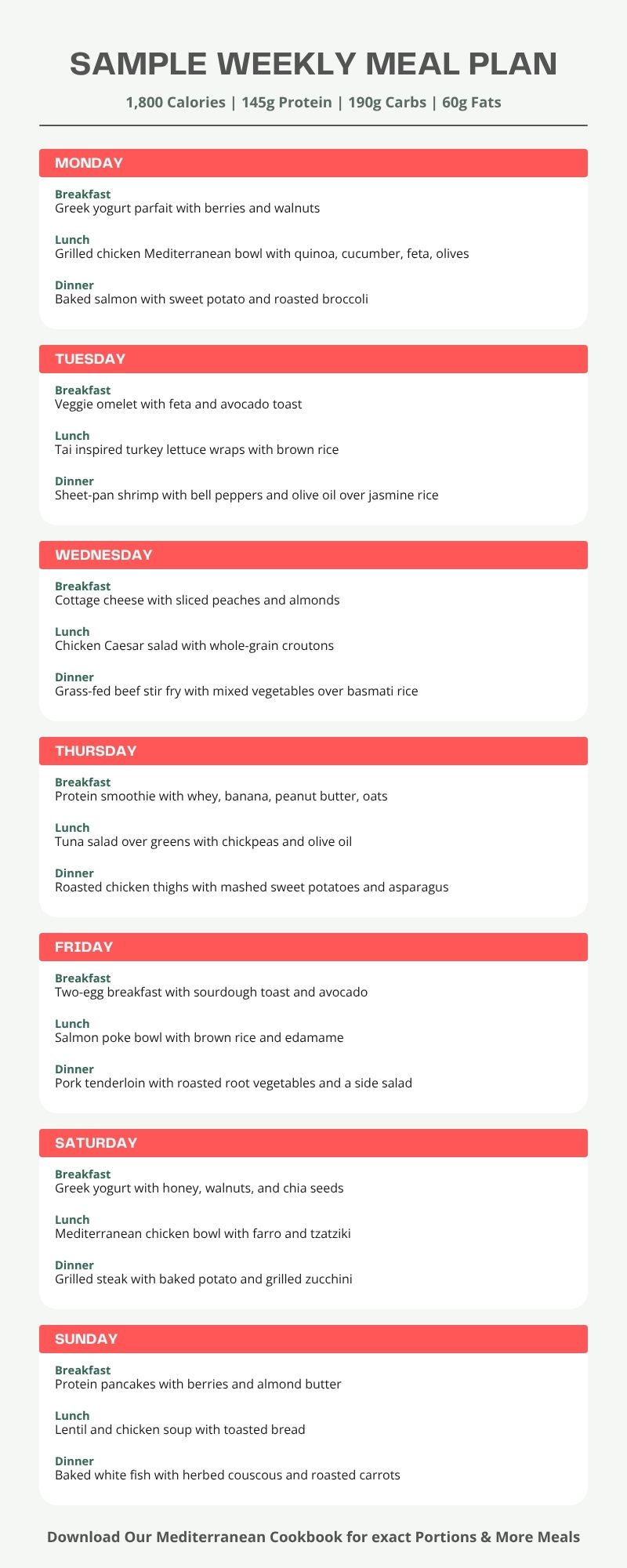
What Is Reverse Dieting? The Complete Guide for Women Who Are Done Eating Tiny and Still Not Losing Weight
Free Macro Calculator
Personalized to your body, goals, and measurements. You will receive detailed macros for meals, sample day of eating, food selection guidance, hydration + daily supplement suggestions, and more.
Here’s the pattern I see over and over. A woman comes to me in her late 40s or early 50s. She’s been “dieting” for years. She eats 1,200 calories on a good day, 1,400 on a bad one. She runs or does cardio five or six days a week. She’s diligent, she’s disciplined, she’s frustrated. The scale hasn’t budged in 18 months. Her hair is falling out. She’s always cold. Her sleep is wrecked. Her period is either erratic or gone. And the advice she keeps getting — from apps, from old trainers, from people who learned what dieting meant in 1995 — is to eat less and do more.
If that’s you, or even part of you, this article is going to challenge everything you’ve been told. Reverse dieting is the process of methodically walking yourself back up to a healthy, metabolism-supporting intake without gaining body fat. Done right, it’s one of the most transformative interventions in the midlife woman’s playbook. Done poorly, it turns into a panic weight gain that sends you running back to a low-calorie hole. The difference between the two is what this article is going to teach you.
I’ve coached hundreds of midlife women through reverse diets, and I’ll walk you through everything — what reverse dieting actually is, the science of why it works, who it’s for, who it’s NOT for, a step-by-step plan, what to expect week by week, and the mistakes that derail nearly everyone. Pull up a chair.
What Is Reverse Dieting? A Plain-English Explanation
Reverse dieting is the structured, gradual process of increasing your daily calorie intake after a sustained period of under-eating. The goal is to let your metabolism recover and it can, so that you end up eating meaningfully more food while staying at the same weight, or even losing a little. If that sounds impossible, it isn’t. It’s biology.
The practical version looks like this. If you’ve been eating 1,300 calories a day for two years, you start adding a small amount of food back each week (usually 50 to 100 calories), carefully tracked, with consistent weigh-ins and attention to hunger, energy, sleep, and body composition. Over weeks to months, you walk your intake from 1,300 up to maybe 1,900, 2,100, even higher, depending on your activity level and body size. Your metabolic rate rises to meet the new intake, your hormones re-balance, your hunger cues come back online, and you find yourself eating a completely different amount of food at the same weight you started at.
The term “reverse dieting” was popularized in physique and bodybuilding communities in the 2010s, where competitors needed a way to return to normal eating after months of aggressive cutting without immediately smashing into weight regain. The science behind it, that is: the science of metabolic adaptation and how it reverses, has been in the academic literature for decades, long before anyone called it “reverse dieting”.
For midlife women, reverse dieting is almost always a two-part goal: restore your metabolic rate so you can eat enough to feel human, and set up a future fat loss phase that will actually work. You cannot successfully lose fat from 1,200 calories. You can successfully lose fat from 1,800. That’s why reverse dieting exists.
Who Reverse Dieting Is Actually For (and Who It’s NOT For)
Reverse dieting is NOT the right tool for everyone. Let me be clear about this up front because the internet has a bad habit of recommending reverse dieting to everyone, including people who would be better served by a different approach.
You’re a good candidate for reverse dieting if:
You’ve been eating under your estimated maintenance calories for at least 6 months, your weight has plateaued despite continued dieting, you feel cold, tired, and under-fueled, your hair is thinning or your nails are brittle, your period is irregular or absent (in pre-menopause), your sleep is poor, your hunger signals are either overwhelming or gone, your workouts feel heavier than they should, and you’re already lean but not losing more.
You’re NOT a good candidate for reverse dieting if:
you haven’t actually been consistently tracking food (you don’t know what you’re eating, you just think it’s “not much”), you’re significantly above your goal weight and haven’t yet attempted a structured fat-loss phase, you have a history of restrictive-binge eating cycles that would be worsened by obsessive tracking, or you have an active eating disorder. In those cases, the better first move is usually to work with a qualified coach or dietitian on a structured approach that fits your actual situation.
The most common case is the first one: a midlife woman who’s been slowly creeping her calories down for years trying to outrun the metabolism and hormone changes of perimenopause. If that’s you, reverse dieting is probably the single most important thing you could do for your body composition over the next 12 months.
If you want to see whether your current intake is actually below maintenance, plug your numbers into our free macro calculator. It’ll give you your estimated total daily energy expenditure and a sensible macro split. That single piece of data: “your maintenance is probably around X”, is often the first aha moment.
The Science Behind Why Reverse Dieting Works
Reverse dieting isn’t a trick. It’s an application of well-documented physiology that your body does naturally when you change your energy intake.
Metabolic adaptation (aka adaptive thermogenesis).
When you eat at a sustained calorie deficit, your body adapts by reducing the energy it burns to stay alive. Your resting metabolic rate drops. Your non-exercise activity (fidgeting, temperature regulation, gesturing) drops. Your conversion of thyroid hormone T4 to the more-active T3 drops. Across enough time, a woman who “should” burn 1,900 calories at rest plus activity might be burning 1,600. Same body weight, lower metabolism. This is documented in decades of research — the famous Biggest Loser follow-up study by Fothergill and colleagues at the NIH found contestants were burning 500+ fewer calories per day six years after their weight loss than predicted.
Leptin, ghrelin, and hunger hormones.
Prolonged under-eating drops leptin (the satiety hormone) and raises ghrelin (the hunger hormone), which is why long-term dieters are often either starving or numb to hunger. Slowly restoring calories restores these signals.
Thyroid function.
Chronic under-eating suppresses thyroid hormone conversion. Women’s T3 levels drop. Symptoms: cold hands and feet, low energy, dry skin, hair thinning, constipation. Slow calorie restoration reverses most of this.
Sex hormones.
Chronic under-eating suppresses the hypothalamic-pituitary-ovarian axis. Estrogen and progesterone production drops. In younger women this can lead to missed periods (hypothalamic amenorrhea). In midlife women, it can worsen perimenopause symptoms and make menopause harder.
Cortisol and stress.
Your body interprets chronic under-eating as a threat. Cortisol rises. Elevated cortisol promotes belly fat storage, impairs sleep, and suppresses thyroid. Reverse dieting signals “safety” and the stress response de-escalates.
When you reverse diet correctly, you’re letting all five of these systems recover. The result is a body that can burn more, produce better hormone profiles, sleep better, and — critically — respond to a future fat loss phase the way dieting is supposed to work. If you want the full hormonal picture of why this matters so much in midlife, our deep dive on perimenopause weight gain covers the exact mechanisms.
Free Macro Calculator
Personalized to your body, goals, and measurements. You will receive detailed macros for meals, sample day of eating, food selection guidance, hydration + daily supplement suggestions, and more.
Signs You Need to Reverse Diet
If you’re not sure whether this applies to you, run through this checklist. If you hit four or more, reverse dieting is probably on your horizon.
You’ve been eating below 1,500 calories per day for more than 6 months. Your weight loss has stalled even though you’re “still dieting.” You feel cold all the time, especially your hands and feet. Your hair is thinning or shedding more than usual. Your nails are brittle, flaking, or slow-growing. Your sleep is poor — you wake at 3 a.m. hungry, wired, or both. Your period is irregular, lighter than usual, or has disappeared (if you’re not yet post-menopausal). Your workouts feel dramatically harder than they used to for the same weights. You can’t remember the last time you felt truly hungry. You can’t remember the last time you felt truly full. Your mood is flat, irritable, or foggy. Your libido is gone. Your digestion is sluggish or unpredictable.
Any of this can have causes beyond calorie intake — thyroid issues, nutrient deficiencies, medication, real hormonal shifts. But chronic under-eating is a common underlying or contributing factor, and it’s one of the few you can fix yourself.
Reverse Dieting vs. Diet Break vs. Maintenance: What’s the Difference?
These three terms get confused all the time. Let’s clear them up.
A diet break is a planned 1 to 2 week pause from a deficit, where you eat at maintenance (or close to it) before resuming the cut. It’s a tactical rest to blunt metabolic adaptation during an ongoing fat loss phase. The classic use case is “I’ve been in a deficit for 8 weeks, my motivation’s flagging and weight loss has slowed, I’ll take a week at maintenance and then start cutting again.” We’ve written about the diet break approach in detail if you want the long version.
Maintenance is simply eating the amount of food that keeps your body weight stable. It’s not a phase or a protocol. It’s just a level of intake.
A reverse diet is a structured, multi-week or multi-month process of gradually increasing intake above your current level — usually from a deeply depleted state — with the goal of raising your maintenance upward. A reverse diet ends with you at a higher total intake than you started, at roughly the same weight.
Put simply: a diet break is a pause. Maintenance is a place. A reverse diet is a journey upward.
The confusion matters because they get deployed in different situations. A midlife woman who’s been dieting for 8 weeks and feeling flat should probably take a diet break. A midlife woman who’s been under-eating for three years and is stuck needs a reverse diet. The strategies look similar on week one but end in completely different places.
How to Reverse Diet Step-by-Step
This is the practical section. Here’s how it actually works. I’ll walk you through the whole protocol.
Step 1: Establish your current baseline.
Track your food intake honestly for at least one week, using a food scale and a tracking app. Get an accurate average. This is not a diet phase — you’re just measuring where you are. Also: weigh yourself daily and take the 7-day average. This is your baseline weight.
Step 2: Identify your protein floor and hold it.
For midlife women, the target is roughly 0.7 to 1 gram of protein per pound of goal body weight, split across 3 or 4 meals. If that sounds like more than you’ve been eating, it probably is. Protein stays elevated throughout the reverse and beyond — it’s non-negotiable for preserving muscle while calories rise. Our nutritionist’s guide to protein sources walks through exactly how to hit those numbers with real food.
Step 3: Add food in small, tracked increments.
Each week, add 50 to 100 total calories per day, split roughly 60% from carbs and 40% from fats (not from protein — that stays fixed). For a 40-pound-above-baseline-weight midlife woman, 50 calories per week is a safer starting increment. For someone who’s less depleted or has more muscle, 100 calories per week can work.
Step 4: Weigh daily, average weekly, and compare trends.
Daily scale readings are noisy. What you care about is the 7-day rolling average. Expect a 1 to 3 pound bump in the first two weeks — that’s glycogen and water, not fat. Real fat gain would take consistent surplus beyond maintenance, which you’re not at yet.
Step 5: Watch for signals of recovery.
Better sleep. Warmer hands and feet. More hunger around meal times (in a good way). Better workouts. More mental clarity. Return of your period if it had gone missing. These are the signals you want to see. They usually start showing up in weeks 3 to 6.
Step 6: Hold or adjust based on what the scale tells you.
If your 7-day average weight is stable or trending down (which happens surprisingly often as your metabolism ramps up), keep adding. If you’re consistently gaining 0.5 pounds a week or more for three weeks in a row, hold your current intake for 2 to 4 weeks to let your metabolism catch up before adding more.
Step 7: End when your target intake is reached.
For most midlife women, the goal intake is whatever genuinely reflects maintenance for someone of your activity level and body size — usually 1,800 to 2,200 calories for a moderately active midlife woman. When you hit that number and the scale is stable, you’re done. Now you have a real maintenance to work from.
Step 8 (optional): Transition into a building phase or a structured fat-loss cut.
After a successful reverse, most women either move into a building phase to add muscle, or into a structured deficit with actual metabolic room to work with. Both are far more effective than dieting from a place of depletion.
If this feels like a lot to figure out alone, it is, and it’s the exact process we walk clients through inside our 1:1 fitness and nutrition coaching program. The calibration week-to-week is where personal support earns its keep.
Reverse Dieting After 40: The Hormonal Factors That Change the Game
Reverse dieting for a 28-year-old bikini competitor and reverse dieting for a 52-year-old woman in perimenopause are not the same process. The principles are the same; the details are different.
Your maintenance is probably lower than you think. Muscle mass matters for metabolic rate, and most midlife women have lost muscle over the years, which lowers their true maintenance by 100 to 300 calories compared to what a generic calculator might predict. This means reverse dieting gets you to a lower “top” intake than it would for a younger woman — and that’s fine.
Estrogen is a player. Low estrogen (perimenopause and beyond) affects insulin sensitivity, protein synthesis, and recovery. All of these influence how your body responds to added calories. Estrogen-supporting behaviors — strength training, adequate protein, sleep, appropriate stress management — matter more for midlife reverse diets than for younger ones.
Thyroid is a player. Thyroid function declines with age and is uniquely sensitive to chronic under-eating. Many midlife women have undiagnosed subclinical hypothyroidism on top of adaptive thermogenesis. If your reverse isn’t producing the expected metabolic recovery after 8 to 12 weeks, it’s worth having a full thyroid panel done — TSH, free T3, free T4, and reverse T3.
Recovery is slower. You can’t pound through a reverse diet the way a 25-year-old might. Slower, steadier adds (50 calories per week), longer holds, and more attention to sleep and stress tend to produce better results.
Body composition shifts favor muscle. This is the optimistic part. Midlife women who pair a reverse diet with serious strength training often find that even as their scale weight holds, their body composition improves — more muscle, less fat, clothes fitting better. This is the real win.
If you want the full step-by-step for midlife-specific reverse dieting, our detailed guide to reverse dieting after 50 goes deeper on the women-over-50 protocol specifically. Consider it a companion to this article.
Common Reverse Dieting Mistakes Women Make
I see the same mistakes over and over. Here they are, so you can skip them.
Mistake 1: Adding calories too fast.
The most common one. You feel brave after week one, you add 200 calories instead of 50, and then you panic when the scale jumps from water weight and go running back to the deficit. Slow and boring wins.
Mistake 2: Not tracking accurately.
Eyeballing portions under-counts by 20 to 50% consistently. If you’re going to reverse diet, you need a food scale and a tracking app for the duration of the process. You can ease off later. During the reverse, precision is the whole game.
Mistake 3: Dropping protein as calories rise.
People get excited about adding carbs and fats and forget protein. Keep protein anchored at 0.7 to 1 g per pound of goal body weight. Always.
Mistake 4: Stopping strength training because “I’m eating more, I don’t want to gain weight.”
The opposite — strength training is what puts the added calories toward muscle instead of fat. Keep lifting.
Mistake 5: Weighing once a week or not at all.
Too much signal gets lost in single weigh-ins. Daily with a 7-day average is the gold standard for trend data. This is especially important during the first two weeks when water weight fluctuates.
Mistake 6: Panicking at the first scale bump.
You will see the scale go up 1 to 3 pounds in the first two weeks. That is 100% glycogen and water. It is not fat. If you react to this by dropping calories, you’ve ended the reverse before it started.
Mistake 7: Not sleeping enough.
Seven to nine hours. Metabolic recovery happens in sleep.
Mistake 8: Skipping the psychological work.
After years of under-eating, many women experience real fear when they start adding food. This is normal. Having a coach, a supportive community, or at minimum an honest conversation with yourself about the difference between fat gain and food fear is part of the work.
Free Macro Calculator
Personalized to your body, goals, and measurements. You will receive detailed macros for meals, sample day of eating, food selection guidance, hydration + daily supplement suggestions, and more.
How Long Does a Reverse Diet Take? What to Expect Week by Week
Expect a reverse diet to take between 10 and 20 weeks for most midlife women, depending on how depleted you started.
Weeks 1-2: Scale bumps 1 to 3 pounds (water and glycogen). Hunger may get weirder before it gets better. Sleep may shift. This is normal.
Weeks 3-4: Scale stabilizes. You start to feel warmer during the day, especially hands and feet. Workouts feel a touch better. The craving chaos starts to settle.
Weeks 5-8: Hunger signals normalize. Energy rises. Sleep improves. Period may return if it had gone missing. Strength in the gym often jumps noticeably.
Weeks 9-12: You’re eating 300 to 500 more calories than you started, and the scale is roughly the same. This is the magic window. Mood is better, body composition often looks better even if the scale number is similar.
Weeks 13+: You’re approaching your target intake. You may choose to hold there for a few weeks to consolidate, or begin a structured building or cutting phase. The reverse is complete.
Your mileage will vary. Some women finish in 10 weeks; some take 20. Your starting depletion and consistency are the two biggest factors.
Reverse Dieting Calculator: Do You Actually Need One?
Short answer: no, not really. What you need is a maintenance calorie estimate and a way to track accurately. You don’t need a special “reverse dieting calculator.” You need a good macro calculator and a food log.
A proper free macro calculator will give you three numbers you care about: your estimated maintenance, a protein floor based on your goal weight, and a rough carbohydrate and fat split. From there, a reverse diet is simply: start where you are, add 50 to 100 calories a week (mostly carbs and fats, keeping protein fixed), and weigh yourself daily.
If you want to step through reverse dieting with a done-with-you approach that includes meal plans, tracking templates, and coaching check-ins, that’s exactly what our 1:1 coaching program was built for. It removes the guesswork.
If you want to dial in your food quality while you reverse, the Mediterranean eating pattern is ideal for this — nutrient-dense, anti-inflammatory, high-protein, and easy to adjust macros around. The Macro Miracle Mediterranean Cookbook is built exactly for this use case with macro-friendly recipes that stack up beautifully during a reverse.
Frequently Asked Questions About Reverse Dieting
Will I gain weight during a reverse diet?
Most midlife women gain 1 to 3 pounds in the first two weeks — almost entirely water and glycogen, not fat. After that, many hold their weight or even lose slightly as their metabolism ramps up. A small amount of real weight gain (1 to 2 pounds over the full reverse) is possible and is a fair trade for restoring your metabolic capacity.
How fast should I add calories?
For most midlife women, 50 to 100 calories per week. Slower is safer. Faster is riskier. If you’re very active or very lean, 100 per week is fine. If you’re more depleted, less active, or have a history of chronic dieting, stick with 50.
Should I add carbs or fat or both?
Both. A 60/40 carb-to-fat split of the added calories is a sensible default. Keep protein anchored.
Can I reverse diet forever?
No. A reverse diet has a natural endpoint — your actual maintenance intake. Once you’re there, you’re done. Staying in reverse mode forever is just “slowly eating more forever,” which is a surplus, which eventually leads to fat gain.
What if my weight keeps climbing as I add calories?
Hold your current intake for 2 to 4 weeks to let your metabolism catch up before adding more. If weight is still climbing after a hold, you may be approaching or exceeding your true maintenance. That’s useful data, and it means it’s time to stop the reverse.
Do I need to strength train during a reverse diet?
Yes. This is the single best thing you can do to put the added calories toward muscle instead of fat. Two to four lifting sessions per week, focused on compound movements, is the baseline.
Can I reverse diet while also losing weight?
Sometimes, yes. Many women see slight weight loss during a reverse as their metabolism climbs faster than their intake rises. Don’t count on it, but don’t be shocked if it happens.
I’m scared of eating more. Is that normal?
Extremely. Years of restriction tend to create genuine food fear. The fear is learned, and it’s unlearnable. A coach, a trusted friend, or a therapist who understands disordered eating patterns can help enormously with this piece.
What supplements help during a reverse diet?
Nothing magical. Protein (if you’re not hitting your target from food), creatine (5 g daily — supports strength training output and muscle retention), magnesium and zinc for recovery, vitamin D if you’re low. Browse our vitamins and supplements collection for midlife-focused options.
How do I know when my reverse is complete?
When you’re eating 1,800 to 2,200 calories (adjusted for your size and activity), you feel human again — warm hands, good sleep, normal hunger, strong workouts — and your weight is stable for at least 2 weeks. That’s your new real maintenance. From there, you can decide what comes next.
Free Macro Calculator
Personalized to your body, goals, and measurements. You will receive detailed macros for meals, sample day of eating, food selection guidance, hydration + daily supplement suggestions, and more.
The Takeaway
Reverse dieting isn’t a diet. It’s the process of slowly, methodically walking yourself out of the calorie hole that years of under-eating put you in. For midlife women who’ve been stuck on 1,200 to 1,400 calories for longer than they can remember, it’s often the single most important intervention available — not because it produces immediate weight loss (it doesn’t), but because it rebuilds the metabolic and hormonal foundation that makes every future weight and health goal actually work.
The process takes patience. It takes tracking. It takes trust that your body will do what physiology says it will do if you let it. And it takes permission to eat more than you’ve been eating, which for a lot of women is the hardest part of the whole thing.
If you need a week-long hands-on reset to kick off your reverse — strength training, mobility, whole-food macro cooking, hormone education, sleep protocols — our women’s wellness retreats are designed around exactly this kind of rebuild. And if you’d rather do it at home with personal support, our coaching program will walk you through the entire reverse week by week.
You are not broken. You are under-fueled. There’s a real difference, and once you see it, the path forward gets a whole lot clearer.
I write 3 essays per week on Lifestyle Medicine for women in midlife on what is happening in the body and what to do about it. No fluff, no hype. Free.
Sources and References
- Fothergill E, Guo J, Howard L, et al. Persistent metabolic adaptation 6 years after “The Biggest Loser” competition. Obesity. 2016;24(8):1612-1619. PubMed
- Trexler ET, Smith-Ryan AE, Norton LE. Metabolic adaptation to weight loss: implications for the athlete. Journal of the International Society of Sports Nutrition. 2014;11:7. PubMed
- Müller MJ, Bosy-Westphal A. Adaptive thermogenesis with weight loss in humans. Obesity. 2013;21(2):218-228. PubMed
- Dulloo AG, Jacquet J, Montani JP, Schutz Y. Adaptive thermogenesis in human body weight regulation: more of a concept than a measurable entity? Obesity Reviews. 2012;13 Suppl 2:105-121.
- Rosenbaum M, Leibel RL. Adaptive thermogenesis in humans. International Journal of Obesity. 2010;34(Suppl 1):S47-55.
- Martins C, Gower BA, Hill JO, Hunter GR. Metabolic adaptation is not a major barrier to weight-loss maintenance. American Journal of Clinical Nutrition. 2020;112(3):558-565.
- Hall KD, Guo J. Obesity energetics: body weight regulation and the effects of diet composition. Gastroenterology. 2017;152(7):1718-1727.
- Longo VD, Mattson MP. Fasting: molecular mechanisms and clinical applications. Cell Metabolism. 2014;19(2):181-192.
- Leidy HJ, Clifton PM, Astrup A, et al. The role of protein in weight loss and maintenance. American Journal of Clinical Nutrition. 2015;101(6):1320S-1329S.
- MacLean PS, Higgins JA, Giles ED, et al. The role for adipose tissue in weight regain after weight loss. Obesity Reviews. 2015;16 Suppl 1:45-54.
- Sumithran P, Prendergast LA, Delbridge E, et al. Long-term persistence of hormonal adaptations to weight loss. New England Journal of Medicine. 2011;365(17):1597-1604. PubMed
- Johannsen DL, Knuth ND, Huizenga R, et al. Metabolic slowing with massive weight loss despite preservation of fat-free mass. Journal of Clinical Endocrinology & Metabolism. 2012;97(7):2489-2496.
- Benton D, Young HA. Reducing calorie intake may not help you lose body weight. Perspectives on Psychological Science. 2017;12(5):703-714.
- Helms ER, Aragon AA, Fitschen PJ. Evidence-based recommendations for natural bodybuilding contest preparation: nutrition and supplementation. Journal of the International Society of Sports Nutrition. 2014;11:20.
- Hall KD, Sacks G, Chandramohan D, et al. Quantification of the effect of energy imbalance on bodyweight. Lancet. 2011;378(9793):826-837.