
 By Team THOR
What Is Reverse Dieting? The Complete Guide for Women
Most women who reach a goal weight after months of dieting are unprepared for what comes next. The diet has to end at some point, and the question of what to eat afterward is often left out of every plan, every coaching call, and every Instagram before-and-after post. This is where most weight loss is undone. The metabolism has adapted to the deficit, the appetite has built up suppressed cues, and going back to “normal eating” usually means gaining the weight back faster than it came off in the first place.
Reverse dieting is the framework that bridges the deficit and maintenance phases. It is a slow, structured increase in calories over weeks that lets the metabolism recover, the hormones rebalance, and the body settle into a higher intake without the rebound weight gain that most women have come to expect. This guide covers what reverse dieting is, why it matters specifically for women, the five benefits backed by research, a five-step protocol, a six-week calorie progression table, a seven-day sample meal plan, the mistakes to avoid, and what happens when the reverse diet is complete.
Free Macro Calculator & Lifestyle Blueprint
Personalized to your body, goals, and measurements. You will receive detailed macros for meals, sample day of eating, food selection guidance, hydration + daily supplement suggestions, and more.
What Is A Reverse Diet?
Reverse dieting is the practice of slowly increasing daily calorie intake after a period of calorie restriction, with the goal of restoring metabolic rate and hormone balance without regaining the lost weight. The increases are typically 50 to 100 calories per week, sustained over four to twelve weeks depending on the depth of the previous deficit and the individual response.
The thermostat analogy is the one I use most often with clients. Think of the metabolism as a house heating system that has been turned down to conserve energy through a long winter. Blasting the heat back on all at once shocks the system. Slowly turning the thermostat up a few degrees at a time allows the system to recalibrate without overshooting. Reverse dieting is the slow turn of the thermostat after months of running cold.
Metabolic adaptation is the underlying mechanism. When the body has been in a sustained calorie deficit, several measurable shifts happen. Thyroid hormone production decreases. Leptin (the satiety hormone) drops. Ghrelin (the hunger hormone) increases. Resting energy expenditure declines. Non-exercise activity drops, often subconsciously. The body becomes more efficient at running on less, which is a survival adaptation that worked well for our ancestors and works against most modern women trying to maintain a lower body weight. Reverse dieting addresses each of these adaptations in turn, by slowly increasing energy availability over weeks rather than days.
Why You May Need a Reverse Diet
Women have specific biological reasons to take reverse dieting seriously, and these reasons get more important after age 40.
Cortisol.
Sustained calorie restriction elevates cortisol, the body’s primary stress hormone. Chronically elevated cortisol disrupts sleep, increases abdominal fat storage, suppresses thyroid function, and contributes to insulin resistance. Coming off a deficit by slowly increasing food intake lowers the cortisol load and allows the body to begin recovering from the stress of the deficit itself.
Thyroid.
Calorie restriction reduces T3 (the active thyroid hormone) production, which directly slows metabolic rate. Most women who lose weight quickly experience some degree of T3 suppression, and the suppression can persist for months after the diet ends if the transition out of the deficit is not handled carefully. Reverse dieting allows T3 to recover gradually, which protects long-term metabolic rate.
Estrogen.
Body fat plays a role in postmenopausal estrogen production, and aggressive caloric restriction in midlife can suppress hormonal balance further at a time when the body is already navigating significant hormonal change. Coming off a deficit slowly gives the endocrine system time to adjust without compounding the stress of the perimenopausal or menopausal transition itself.
Sex differences in metabolism matter here too.
Women have lower absolute resting metabolic rates than men, more sensitivity to energy availability, and more menstrual and reproductive consequences from chronic underfeeding. The general pattern across the research is that women respond more dramatically to both deficits and surpluses than men, which means the transition out of a deficit needs to be handled with more care.
If you have not yet built the nutritional foundation that supports this work, the fundamentals of the macro diet for women over 50 is the companion piece that lays the macro framework underneath the reverse diet protocol below. The free Macro Calculator is the tool that gives you your specific starting numbers.
Free Macro Calculator
Personalized to your body, goals, and measurements. You will receive detailed macros for meals, sample day of eating, food selection guidance, hydration + daily supplement suggestions, and more.
5 Benefits of Reverse Dieting
Restores Your Metabolism
The primary benefit of reverse dieting is the recovery of resting metabolic rate. Several studies have documented that gradual increases in calorie intake after sustained deficits allow thyroid hormone production, leptin levels, and non-exercise activity to return toward pre-diet baselines. Women who go straight from a deficit back to maintenance calories often find that the maintenance calories now produce weight gain, because the metabolic rate has not recovered. Reverse dieting closes that gap.
Prevents Rebound Weight Gain
The most well-documented pattern in the weight loss literature is the rebound. Most women who lose weight on a conventional diet regain it within one to two years. The mechanism involves the metabolic adaptations described above, combined with the rapid reintroduction of higher-calorie eating that the suppressed appetite hormones make difficult to control. Reverse dieting addresses both halves of the rebound, by restoring metabolism and by giving the appetite system time to recalibrate to higher intake.
Increases Energy and Workout Performance
Energy availability for training improves as calorie intake increases. Women in deficit phases often report low workout intensity, slow recovery between sessions, and a sense of dragging through workouts that used to feel easy. As calories increase during the reverse, glycogen stores refill, recovery improves, and strength training in particular tends to feel sharply different within two to three weeks of starting the reverse.
Reduces Hunger and Cravings
Suppressed leptin and elevated ghrelin during a deficit produce the relentless hunger and food preoccupation that most women experience at the end of a successful cut. Reverse dieting raises leptin levels and lowers ghrelin gradually, which reduces the constant background hunger and food noise without flipping the switch back to full appetite all at once. Most women report a noticeable shift in cravings within the first three weeks of the reverse.
Supports Hormonal Balance
The combined effect of restored thyroid function, lowered cortisol, recovered leptin, and adequate energy availability is a more balanced overall endocrine state. This is especially valuable for women approaching, in, or past menopause, where the hormonal background is already shifting. Reverse dieting is one of the most practical nutritional interventions available for protecting hormonal health after a sustained dieting phase.
Free Macro Calculator
Personalized to your body, goals, and measurements. You will receive detailed macros for meals, sample day of eating, food selection guidance, hydration + daily supplement suggestions, and more.
How to Do a Reverse Diet
Step 1: Calculate Your Current Calorie Baseline
The starting point of any reverse diet is knowing what you are currently eating. Track your food for five to seven days at the end of your deficit phase, using a tracking app or a notebook, and calculate the average daily calorie intake. This number is your baseline. Most women coming off a successful cut are eating somewhere between 1,200 and 1,600 calories per day, and the reverse begins from wherever the deficit ended. The Macro Calculator gives you a personalized estimate of where your maintenance should ultimately land, which becomes the target endpoint of the reverse.
Step 2: Add 50 to 100 Calories Per Week
Once your baseline is established, increase total daily calories by 50 to 100 each week. Beginners and women who lost weight quickly should use the lower end (50 calories per week). Women who lost weight slowly and feel relatively recovered can use the higher end (100 calories per week). The increase comes from a combination of carbohydrates and fats, with protein staying high throughout (more on this below).
Step 3: Prioritize Protein and Fats
Protein intake should stay high throughout the reverse, in the range of 0.8 to 1.0 grams per pound of bodyweight per day. This protects lean muscle during the metabolic recovery and supports satiety. The added calories each week come primarily from carbohydrates (which refill glycogen, support thyroid recovery, and improve training performance) and fats (which support hormone production, especially in women over 40). A practical split is roughly 60 percent of the added calories from carbohydrates and 40 percent from fats, though this varies by individual.
Step 4: Track Weight & Measurements (Not Just the Scale)
The scale will fluctuate during a reverse, primarily because higher carbohydrate intake increases muscle glycogen and water retention. A 1 to 3 pound increase in the first two weeks is normal and is not fat gain. Track body measurements (waist, hips, chest) weekly alongside the scale, and take progress photos every two weeks. The combination gives a clearer picture of what is actually happening than the scale alone.
Step 5: Know When to Stop
The reverse is finished when you arrive at a sustainable maintenance calorie level where you feel strong, energetic, and stable on the scale week over week. For most women, this is roughly 200 to 500 calories above where the deficit ended, reached over 4 to 12 weeks of slow increases. The endpoint is not a specific number written in stone. It is the calorie level at which your body composition is stable, your energy is high, your training is strong, and your appetite is regulated.
Sample 6-Week Reverse Diet Calorie Progression
The table below shows a representative 6-week calorie progression for a woman who finished her deficit at 1,500 calories per day and is reverse dieting toward an estimated maintenance of approximately 1,850 calories per day.
|
Week |
Daily Calories |
Protein (g) |
Carbs (g) |
Fats (g) |
|
1 |
1,500 |
130 |
130 |
50 |
|
2 |
1,575 |
135 |
145 |
55 |
|
3 |
1,650 |
140 |
160 |
55 |
|
4 |
1,725 |
140 |
175 |
60 |
|
5 |
1,800 |
145 |
190 |
60 |
|
6 |
1,850 |
150 |
195 |
65 |
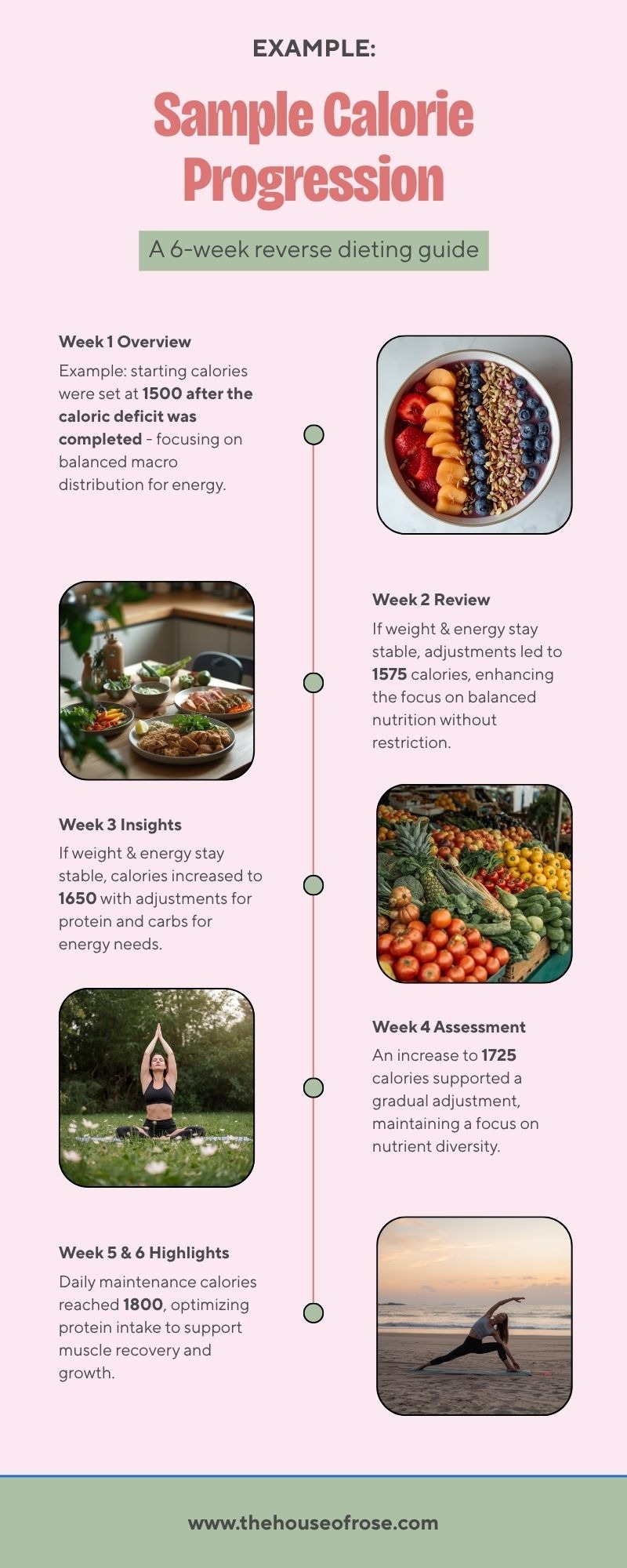
The increases are deliberately small. The protein stays anchored. The carbs and fats rise together. By week six, the same body that was running on 1,500 calories is now stable on 1,850 calories, with restored metabolism, improved energy, and no meaningful change in body composition.
Free Macro Calculator & Lifestyle Blueprint
Personalized to your body, goals, and measurements. You will receive detailed macros for meals, sample day of eating, food selection guidance, hydration + daily supplement suggestions, and more.
Sample Reverse Diet Meal Plan (7 Days)
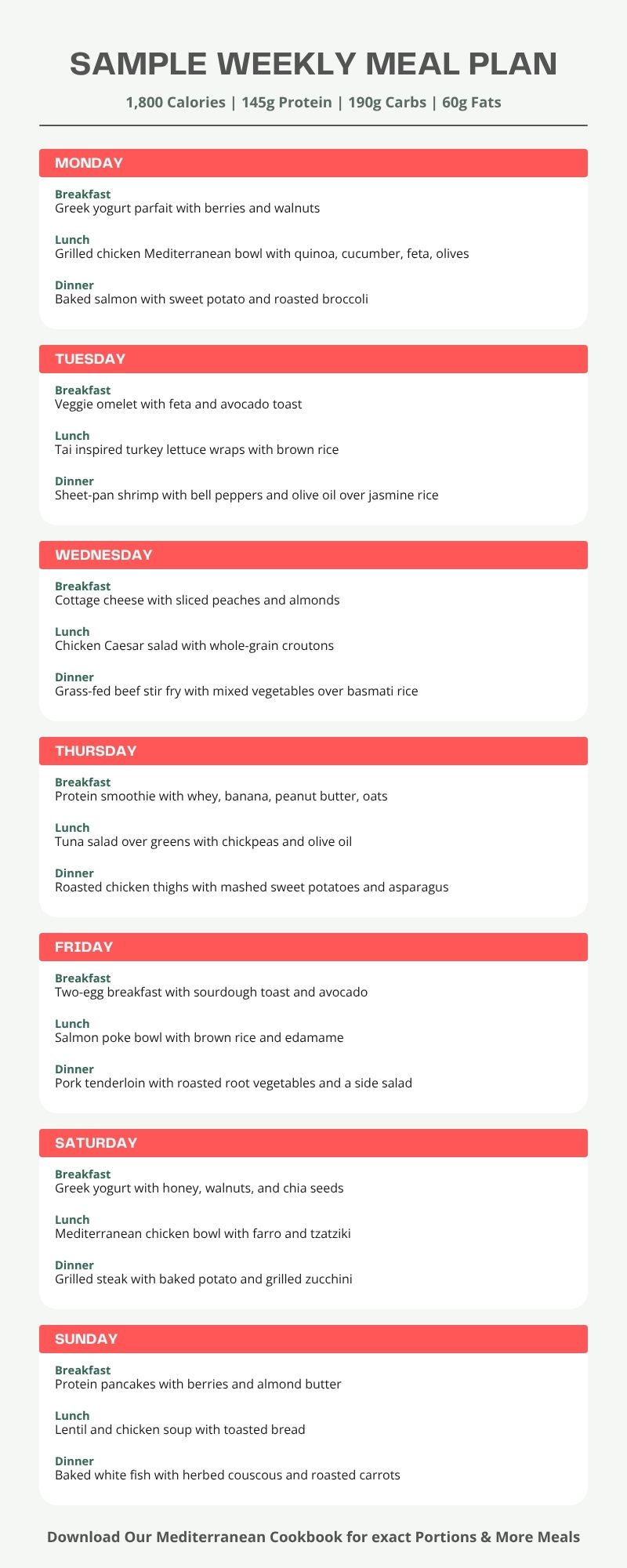
The seven-day plan below shows what a sustainable reverse diet looks like in practice, at approximately the week 5 target of 1,800 calories per day. The plan is designed around real food, midlife-appropriate protein at every meal, and the kind of slow carbohydrates and healthy fats that support hormonal recovery. Adjust portions up or down based on your specific calorie target. The Macro Miracle Mediterranean Cookbook is the kitchen-side companion if you want the full recipes for these meals.
Sample Reverse Diet Macro Breakdown Per Day (7 Days)
|
Day |
Calories |
Protein (g) |
Carbs (g) |
Fats (g) |
Sample Meals |
|
Mon |
1,800 |
145 |
190 |
60 |
Greek yogurt parfait with berries and walnuts. Grilled chicken Mediterranean bowl with quinoa, cucumber, feta, olives. Baked salmon with sweet potato and roasted broccoli. |
|
Tue |
1,800 |
145 |
190 |
60 |
Veggie omelet with feta and avocado toast. Turkey lettuce wraps with brown rice. Sheet-pan shrimp with bell peppers and olive oil over jasmine rice. |
|
Wed |
1,800 |
145 |
190 |
60 |
Cottage cheese with sliced peaches and almonds. Chicken Caesar salad with whole-grain croutons. Grass-fed beef stir fry with mixed vegetables over basmati rice. |
|
Thu |
1,800 |
145 |
190 |
60 |
Protein smoothie with whey, banana, peanut butter, oats. Tuna salad over greens with chickpeas and olive oil. Roasted chicken thighs with mashed sweet potatoes and asparagus. |
|
Fri |
1,800 |
145 |
190 |
60 |
Two-egg breakfast with sourdough toast and avocado. Salmon poke bowl with brown rice and edamame. Pork tenderloin with roasted root vegetables and a side salad. |
|
Sat |
1,800 |
145 |
190 |
60 |
Greek yogurt with honey, walnuts, and chia seeds. Mediterranean chicken bowl with farro and tzatziki. Grilled steak with baked potato and grilled zucchini. |
|
Sun |
1,800 |
145 |
190 |
60 |
Protein pancakes with berries and almond butter. Lentil and chicken soup with crusty bread. Baked white fish with herbed couscous and roasted carrots. |
The meal plan is intentionally diverse across days to support adherence and to keep micronutrient variety high. None of the meals require complex preparation. The carbohydrates lean toward slower-digesting sources (quinoa, brown rice, sweet potato, oats, lentils, sourdough) which support steadier energy and better recovery. Healthy fats come from olives, olive oil, avocado, nuts, fatty fish, and full-fat dairy, all of which are well tolerated by most women in midlife.
Reverse Dieting Mistakes to Avoid
Five mistakes show up consistently and undo otherwise good reverse diets.
- The first is adding too many calories at once. Jumping from 1,500 to 1,800 calories in week one is a recipe for fast water weight gain, blood sugar swings, and a discouraged return to restriction. The slow increase is the entire point.
- The second is ignoring protein. Protein is the anchor of the reverse. Letting it drop while carbohydrates and fats climb is the fastest way to lose lean muscle during what should be a recovery phase. Hit your protein target every day, then add the increase on top.
- The third is panicking at water weight. Carbohydrates pull water into muscle for glycogen storage. A 2-pound jump on the scale in the first ten days of a reverse is almost always water and glycogen, not fat. Track measurements and photos alongside the scale to keep the picture honest.
- The fourth is going back to old eating patterns instead of following the plan. The reverse is a structured process. Returning to whatever pattern produced the original weight gain is the most common way women undo their loss. The structure protects the result.
- The fifth is stopping the reverse too soon. Many women add 100 calories for two weeks and call the reverse complete. The full restoration of metabolism, hormones, and energy typically takes 4 to 12 weeks. Cutting the process short leaves the metabolism stuck somewhere between deficit and maintenance, which is the worst of both worlds.
The diet break framework is the related concept worth reading if you want the full picture of how strategic refeeds and longer maintenance phases fit into a sustainable approach.
Free Macro Calculator & Lifestyle Blueprint
Personalized to your body, goals, and measurements. You will receive detailed macros for meals, sample day of eating, food selection guidance, hydration + daily supplement suggestions, and more.
What Happens After a Reverse Diet?
When the reverse is complete, you arrive at maintenance. The maintenance phase is where the recovered metabolism, the restored hormones, and the rebuilt energy reserves all live, and where most of the long-term work happens.
Maintenance is not a holding pattern. It is the phase where the body composition results actually stabilize, the relationship with food becomes sustainable, and the lessons learned during the deficit become permanent.
Once you’ve successfully reversed, your calories should be back at maintenance or even higher if you’ve built lean muscle along the way. This means:
-
A faster metabolism than when you started
-
Improved energy and performance in daily life and workouts
-
Confidence in maintaining weight without constant restriction
-
The option to continue in maintenance mode or begin another fat loss phase later with a healthier, more resilient metabolism
Many women find that they can stay at maintenance indefinitely, especially if they have built a solid foundation around protein, slow carbohydrates, healthy fats, strength training, sleep, and the foundational supplement stack that supports midlife health. Some women eventually choose to enter another deficit phase after several months at maintenance, in which case the reverse becomes a regular part of their longer-term nutrition cycle. Whether to do another cut depends on your goals, your current body composition, and how your hormones are responding to the current intake.
Maintenance is also where immersive coaching environments deliver their highest value. The Deeply Restorative Yoga and Nature Retreat at our Smoky Mountains property is one of the places where women learn the maintenance phase by living inside it for five days, with the food, the movement, and the integration support all built around the body’s recovered state. If you want hands-on nutrition coaching after a reverse diet, the retreat is the most concentrated experience available. The Monthly Personal Training and Nutrition Coaching Program is the longer-arc option that gives you 1:1 support through every phase, including the reverse itself.
Final Thought
Reverse dieting isn’t about losing more—it’s about protecting the results you’ve already worked so hard for.
It’s a bridge between fat loss and maintenance that allows you to keep your progress, rebuild your metabolism, and feel stronger, healthier, and more energized in the process.
If you’re ready to navigate a reverse diet with confidence, I can design a step-by-step plan customized to your body, goals, and lifestyle in my women’s weightloss and lifestyle coaching group.
This is where true sustainability begins.
Free Macro Calculator & Lifestyle Blueprint
Personalized to your body, goals, and measurements. You will receive detailed macros for meals, sample day of eating, food selection guidance, hydration + daily supplement suggestions, and more.
FAQs: What is Reverse Dieting?
How long does reverse dieting take?
Most reverse diets run between 4 and 12 weeks. The exact duration depends on how long you spent in a deficit, how deep the deficit was, your current age and hormonal state, and how your body responds to the weekly calorie increases. Women who lost weight slowly over a few months typically need 4 to 6 weeks. Women who spent a year or more in a deficit, or who experienced significant metabolic suppression, usually need 8 to 12 weeks.
Will I gain weight while reverse dieting?
A small increase on the scale is normal in the first two weeks, typically 1 to 3 pounds, and it is almost entirely water and glycogen rather than fat. Beyond the first two weeks, a properly executed reverse diet should produce minimal or no fat gain. If the scale continues climbing significantly after the first three weeks, the calorie increases are too large or too fast, and slowing the pace usually solves the issue.
Can I reverse diet without counting macros?
Reverse dieting can be done without precise macro tracking if you build the structure around regular high-protein meals at consistent timing and gradually increase portion sizes of carbohydrates and healthy fats over weeks. The success rate is higher with tracking because the calorie increases are small and easy to miss. For women new to reverse dieting, I generally recommend tracking through at least the first month to build the felt sense of what 50 to 100 added daily calories looks like in real food.
What is the difference between reverse dieting and intuitive eating?
Reverse dieting is a structured protocol with specific calorie and macro increases week over week. Intuitive eating is a non-prescriptive approach that relies on hunger and fullness cues to guide intake without numerical tracking. The two are not opposed and can be used in sequence. Many women reverse diet with tracking through the recovery phase, then transition into intuitive eating once metabolism, appetite hormones, and the relationship with food have all stabilized.
Is reverse dieting safe during menopause?
Reverse dieting is generally safe and often particularly valuable during perimenopause and menopause. The hormonal shifts of midlife make sustained calorie restriction harder on the body, and the reverse diet protocol is one of the most evidence-supported ways to come off a deficit without further stressing the endocrine system. Women with thyroid conditions, adrenal issues, or active medical concerns should work with a qualified coach or healthcare provider during the reverse diet to make sure the pacing fits their individual situation.
I write 3 essays per week on Lifestyle Medicine for women in midlife on what is happening in the body and what to do about it. No fluff, no hype. Free.
References
- Trexler, E. T., Smith-Ryan, A. E., & Norton, L. E. (2014). Metabolic adaptation to weight loss: implications for the athlete. Journal of the International Society of Sports Nutrition, 11(1), 7.
- Müller, M. J., Enderle, J., & Bosy-Westphal, A. (2016). Changes in energy expenditure with weight gain and weight loss in humans. Current Obesity Reports, 5(4), 413–423.
- Rosenbaum, M., & Leibel, R. L. (2010). Adaptive thermogenesis in humans. International Journal of Obesity, 34(Suppl 1), S47–S55.
- Fothergill, E., Guo, J., Howard, L., et al. (2016). Persistent metabolic adaptation 6 years after “The Biggest Loser” competition. Obesity, 24(8), 1612–1619.
- Leidy, H. J., Clifton, P. M., Astrup, A., et al. (2015). The role of protein in weight loss and maintenance. American Journal of Clinical Nutrition, 101(6), 1320S–1329S.
- Phillips, S. M., & Van Loon, L. J. C. (2011). Dietary protein for athletes: from requirements to optimum adaptation. Journal of Sports Sciences, 29(Suppl 1), S29–S38.
- Bauer, J., Biolo, G., Cederholm, T., et al. (2013). Evidence-based recommendations for optimal dietary protein intake in older people: a position paper from the PROT-AGE Study Group. Journal of the American Medical Directors Association, 14(8), 542–559.
- Helms, E. R., Aragon, A. A., & Fitschen, P. J. (2014). Evidence-based recommendations for natural bodybuilding contest preparation: nutrition and supplementation. Journal of the International Society of Sports Nutrition, 11, 20.
- Maltais, M. L., Desroches, J., & Dionne, I. J. (2009). Changes in muscle mass and strength after menopause. Journal of Musculoskeletal and Neuronal Interactions, 9(4), 186–197.
- Lovejoy, J. C., Champagne, C. M., de Jonge, L., Xie, H., & Smith, S. R. (2008). Increased visceral fat and decreased energy expenditure during the menopausal transition. International Journal of Obesity, 32(6), 949–958.
- Camps, S. G., Verhoef, S. P., & Westerterp, K. R. (2013). Weight loss, weight maintenance, and adaptive thermogenesis. American Journal of Clinical Nutrition, 97(5), 990–994.
- Doucet, E., Imbeault, P., St-Pierre, S., et al. (2000). Appetite after weight loss by energy restriction and a low-fat diet-exercise follow-up. International Journal of Obesity, 24(7), 906–914.
- Sumithran, P., Prendergast, L. A., Delbridge, E., et al. (2011). Long-term persistence of hormonal adaptations to weight loss. New England Journal of Medicine, 365(17), 1597–1604.
- Boyle, N. B., Lawton, C., & Dye, L. (2017). The effects of magnesium supplementation on subjective anxiety and stress: a systematic review. Nutrients, 9(5), 429.
- Heymsfield, S. B., Aronne, L. J., Eneli, I., et al. (2021). Clinical perspectives on obesity treatment: challenges, gaps, and promising opportunities. NAM Perspectives, 21(1).
- Ravussin, E., Smith, S. R., & Ferrante, A. W. (2014). Physiology of energy intake in the regulation of energy balance. American Journal of Clinical Nutrition, 99(2), 469S–471S.
Disclaimer: Always consult with a healthcare professional before starting any new routines, programs, or nutrition plans to ensure you receive the best medical advice and strategy for your specific individual needs.

Terry Tateossian is a Menopause Lifestyle Medicine Coach, Certified Personal Trainer & Nutritionist and the Founder of THOR: The House of Rose, a wellness brand serving women over 40 through retreats, coaching, macro-nutrition and community. As 25-year founder and entrepreneur, Terry spent two and a half decades building and running successful start-up businesses, an experience that put her on the front line of founder burnout long before she could name it. After facing serious health challenges, early onset menopause, and emotional eating while running her agency and raising two children, Terry rebuilt her health in her 40s and lost more than 80 pounds through evidence-based nutrition, training, and mindset work. Today, she helps women get strong, improve confidence, support hormone health, and create a stronger second half of life. Terry has been featured in major media outlets and is available for podcasts, expert commentary, brand collaborations, and speaking engagements on midlife health, reinvention, emotional eating, menopause wellness, and strength training for longevity. Get her free macro calculator (her cookbook companion) to start your journey to back to health.