Women’s Yoga Retreats Are Changing. Here Is What to Book Now
Something is shifting in the way women over 40 talk about retreats. The pictures are still pretty. The yoga mats are still rolled out at sunrise. The juices are still cold pressed and beautifully styled. But the reason women are booking is no longer about the photo. It is about the nervous system underneath the photo.
After two and a half decades of building businesses, raising two children, running a marketing agency, and then coming out the other side of burnout, early onset menopause, and an eighty pound weight gain in my forties, I have ended up in a lot of yoga rooms. Some of them changed my life. Some of them felt like a hotel package with downward dog bolted on. The difference between the two is not the building. It is the way the work is held and the way the woman in the room is met.
This guide is for the woman who is past the phase where she just needs a break. She wants the break, yes. She also wants something to shift. She wants to leave the retreat with a more regulated body, a clearer head, and a relationship with herself that travels home with her.
Why Women Over 40 Are Booking Women’s Yoga Retreats Differently Now
The retreat industry is growing fast. Most of that growth is healthy. Some of it is noise. The women I work with are reading retreat pages with sharper eyes than they did ten years ago, and that is a good thing.
Three forces are driving the change in how women’s yoga retreats are being chosen.
The first is biology.
By the time a woman is in her forties, her estrogen and progesterone are no longer in the cycle they were in her twenties and thirties. Sleep gets thinner. Cortisol becomes louder. Strength quietly walks out the door if it is not being trained. A yoga retreat that ignores all of this and still calls itself “transformational” is not built for a midlife body. The honest woman over 40 can feel that mismatch within an hour of arriving.
The second is exhaustion with the AI feed.
The online space is now flooded with retreat marketing that all looks the same. Same drone shot of a pool. Same crop top. Same caption about “coming home to yourself.” Women are not stupid. They scroll past the polish and look for the person behind the page. They want to know who is leading the work, what training that person actually has, and whether the program is built or copied.
The third is the slow death of escape as a marketing angle.
After the years between 2020 and today, women have figured out that escape does not work. You can fly anywhere and you still pack your nervous system with you. What does work is going somewhere structured enough to do the actual repair. That is what women’s yoga retreats are starting to be sold on, and the women who book them know the difference.
Internal link opportunity inside THOR content: this same shift is unpacked from the founder perspective in the article on rewilding retreats for busy professionals and entrepreneurs and from the body perspective in the article on why so many fitness programs fail women over 40.
What Women in Midlife Actually Want From a Women’s Yoga Retreat
If you ask a woman in her forties or fifties what she wants from a yoga retreat, she will often start with the surface answer. Rest. Some yoga. Good food. Maybe a hike. Maybe a massage. If you keep asking, the real list comes out.
She wants to sleep through the night for the first time in months. She wants to remember what her body feels like when no one needs anything from her. She wants to do something physical that does not punish her. She wants to eat food that is built for her hormones, not for a twenty five year old’s metabolism. She wants to be in a room with other women who are tired in the exact same way she is tired and not have to explain it. She wants to leave with a habit or two that survives the airport.
That is the brief. And it is a real brief. Most retreat marketing tries to answer the surface list. The good retreats are built around the deeper one.
The yoga itself is only one ingredient. A women’s yoga retreat that works in midlife is built around four pillars that all reinforce each other.
Movement
The first pillar is movement that is intelligent for the body you have now. That means yoga that protects joints, builds usable strength, and supports bone health. It also means making space for strength work, walking, breath work, and recovery. A retreat that only stretches you is leaving the muscle and bone you need on the table.
Nutrition
The second pillar is nutrition that supports a midlife metabolism. Protein at every meal. Real fiber. Plants that you can identify. Less of the green smoothie theatre and more of the actual macro structure that helps a woman over 40 hold muscle, manage blood sugar, and not crash by 3 pm.
Nervous System Regulation
The third pillar is nervous system regulation. This is the part most retreats still under deliver on. Slowness, breath, sleep, and gentle social co regulation are not extras. They are the work.
Identity & Integration
The fourth pillar is identity and integration. The shift you make in the room only matters if it can come home with you. A retreat that does not give you tools for the return is a beautiful weekend, not a turning point.
When all four pillars are present, the words “women’s yoga retreats” stop being a search term and start being a place where something actually changes. You can see how these same pillars show up in our Age With Strength coaching framework and across the women’s wellness retreats we host at THOR.
How to Tell If a Women’s Yoga Retreat Is Built for Your Nervous System
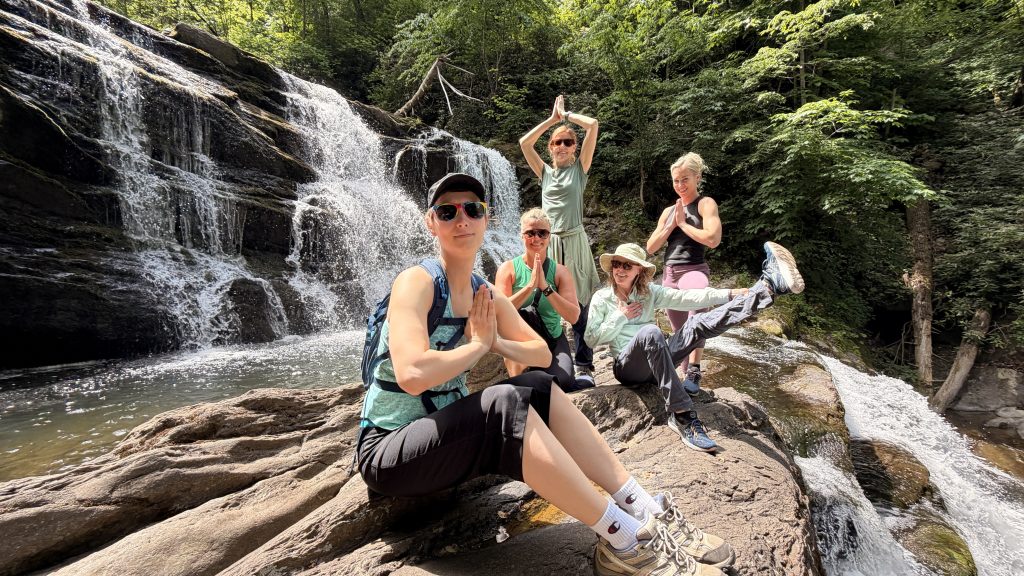
The most expensive mistake a woman over 40 can make with a retreat is booking one that is too intense for the nervous system she is bringing.
If you have been running on caffeine and adrenaline for a decade, your body is not going to respond well to a 5 am cold plunge, two ninety minute power vinyasa sessions a day, an evening breath work intensive, and a group sharing circle that runs until midnight. That schedule looks impressive on a brochure. And it will burn through a depleted woman in three days.
A women’s yoga retreat that is built for a real midlife nervous system has a few visible signals.
Space
The schedule has white space in it. There are blocks of the day that are not programmed. You are allowed to nap. You are allowed to sit by the window and stare at nothing. The retreat understands that one of the most healing things a tired woman can do is be slow without anyone needing anything from her.
Yoga
The yoga is varied across the days. There is a slow restorative or yin class somewhere in the lineup. There is a stronger vinyasa or hatha if you want it. There is breath work that is paced, not performative. There is space for women who have been in yoga for twenty years and women who are touching a mat for the first time in five.
Food
The food is real. It is built with intention, not just plated for the camera. You are not being underfed in the name of “lightness.” Lightness is not a calorie deficit. Lightness is what your body feels when it is fed properly and is not flooded with stress.
Sleep
There is sleep protection. The schedule does not pretend you can be up at dawn, in workshops all day, and at a fire circle past 10 pm without a cost. Real retreats for women over 40 protect the sleep window the way an athlete protects training recovery.
The leader is not selling intensity. Intensity is easy to sell because it photographs well. Repair is harder to sell because it looks like a woman sitting in a chair with her eyes closed.
Repair is also the work.
If you want a deeper read on why this matters in midlife, our article on being tired in ways sleep cannot fix gets into the science of nervous system exhaustion in midlife women.
The Role of Nature, Slowness and Embodiment in Women’s Yoga Retreats
The setting of a yoga retreat is not just background. Research on time spent in green and forested environments shows real measurable shifts in cortisol, blood pressure, heart rate variability, and immune markers when humans are placed in nature for sustained windows. For a woman whose system has been wired into screens, traffic, and inbox alerts for years, the setting is part of the medicine.
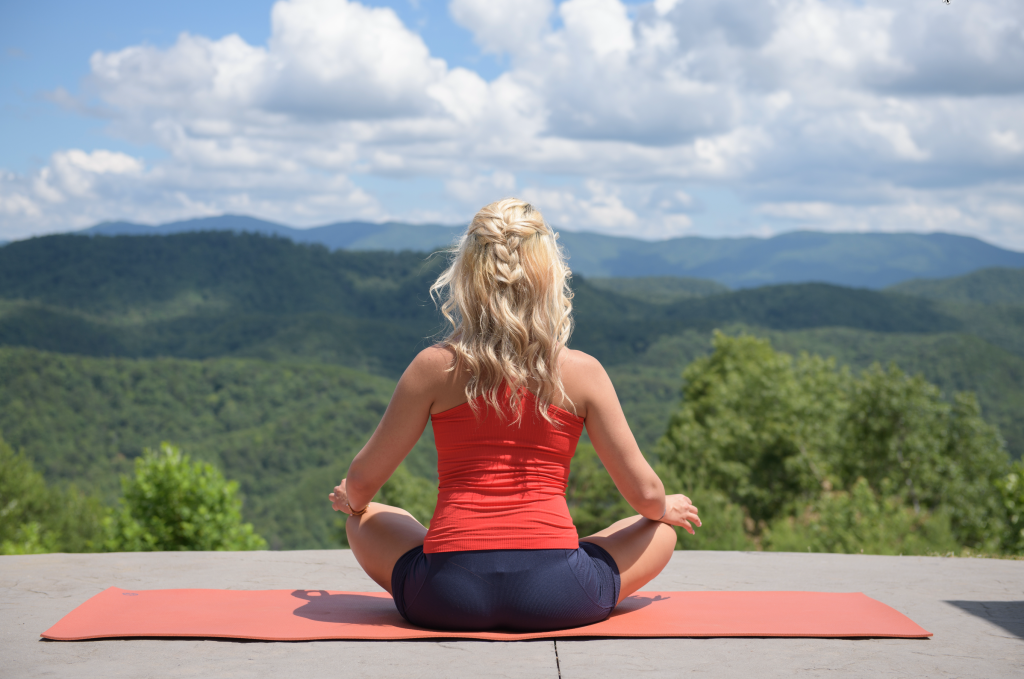
The best women’s yoga retreats are not held in places that compete with the city. They are held in places that contrast with it. Mountains. Forests. Coastlines. Old village mornings. Places where the loudest sound is wind, birds, or a stream and the night is dark enough to remind your body what dark is.
This is also where the embodiment work lives. Most women over 40 have spent two or three decades managing the world from the neck up. Brain, calendar, decisions, performance. Retreats that drop you back into a body, slowly and on purpose, are doing something the average vacation cannot. Walking on uneven ground. Bare feet on grass. Skin in cold water. Breath that is shaped instead of grabbed.
A yoga retreat in a city hotel can be useful. A yoga retreat in nature is doing something different to your physiology. The body recognizes that it is safe in a way it does not recognize next to a six lane road.
This is one of the reasons THOR’s women’s wellness retreats are set in places like the Smoky Mountains in Tennessee, Sedona in Arizona, and the South of France. Each of those settings is doing nervous system work before the first yoga class even starts.
Red Flags to Watch For When Choosing a Women’s Yoga Retreat
The retreat space is growing faster than the training and accountability structures around it. That means a beautiful page and a beautiful pool do not guarantee a safe or skilled experience. Here are the things I look at when I am vetting a women’s yoga retreat for a friend.
The first red flag is no clear person behind the brand. If you cannot find a real human with real training and real life context behind the retreat, that is a problem. Trust does not happen with a logo. Trust happens with a person you can see, hear, and ask questions of.
The second is vague language about transformation. Words like “journey,” “awakening,” and “alchemy” are fine when they are backed by structure. They are a warning sign when they are the whole offer. Ask what the actual hours of the day look like. Ask what the post retreat support is. Ask who the retreat is and is not for.
The third is no honest filter at the front. A serious retreat host will tell you who the retreat is not built for. If anyone is welcome with no questions asked, the retreat is not deeply built.
Real programs have shape.
The fourth is a leader running deep emotional or trauma based work without a credential or a referral structure for the women who need more support than a retreat can offer. If a retreat is going to open the door to grief, identity, body image, or family of origin material, there needs to be a competent person holding that and a referral plan for what happens if it goes deeper than the room can hold.
The fifth is the absence of any nutrition or strength component for a midlife audience. A retreat marketed at women over 40 that has no meaningful protein in the meals and no resistance work in the schedule is not built for the population it claims to serve. Cardio and salads are not enough for a perimenopausal or postmenopausal body. The science on this is clear and growing.
The sixth is excessive intensity sold as “doing the work.” Sleep deprivation, very low calorie eating, ice immersion as a daily requirement, and back to back deep practices are not the work. They are theater, and they can take a midlife body weeks to recover from.
If you are evaluating a retreat and any of these red flags are present, that is not a reason to never go on a yoga retreat. It is a reason to keep looking until you find one that respects the body and the nervous system you are bringing.
How to Prepare Your Body and Mind for a Women’s Yoga Retreat
A retreat does not start on arrival day. The two weeks before you leave can change what you get out of it.
The most useful preparation is not extra cardio or skipping meals to “look better in yoga clothes.” It is the opposite. You are loading your body for a meaningful experience, not trying to outrun it.
Start with protein. Most women over 40 are walking around underfed in protein. Getting closer to one gram of protein per pound of your goal body weight per day in the two weeks before a retreat will steady your blood sugar, support your muscle, and make it much harder for the retreat to wreck your energy on day two. If you want a starting point, run your numbers through the free Macro Calculator at THOR. Then build a few meals you actually like around those numbers using something like the 80 Macro Friendly Mediterranean Recipes cookbook so you arrive at the retreat with a body that is already fed and stable.
Add real movement to your week. Two strength sessions, a walk or two, and a couple of slower yoga or mobility sessions are more useful than a sudden surge of intense workouts in the days before you fly.
Bring sleep with you. Two weeks of protected sleep before a retreat is one of the strongest predictors of how much you get out of it. A retreat cannot fix months of sleep debt in five days, but it can build on a body that has started to rebuild it.
Reduce alcohol in the run up. Even one fewer drink per week in the two weeks before a retreat tends to leave women with deeper sleep, calmer mornings, and a steadier nervous system. You do not have to be a saint. You just have to give your body a smaller backlog to clear.
Pack for warmth and slowness, not photos. Layers. A real water bottle. A journal you will actually write in. A book you have been ignoring. Comfortable shoes. The clothes you already feel like yourself in.
Set one intention. Not five. One. The women who arrive with one quiet question they want to answer tend to get more out of a retreat than the women who arrive with a list of things they want to fix. The body cannot do five identity rewrites in a week. It can do one, and that one is enough.
You can support the physical side of preparation with a small set of evidence backed supplements. Magnesium glycinate at night, a quality omega 3, vitamin D if you are deficient, and creatine if you are training are common starting points for women in midlife. We carry a curated list of these at the THOR supplements page. Do not arrive on a retreat trying ten new supplements for the first time. Start them two weeks early.
What Integration Looks Like After a Women’s Yoga Retreat
The week after the retreat is where most of the value is either kept or lost. This is the part the brochure does not show.
The first 72 hours back home are emotionally tender for almost everyone. You will probably sleep hard on the first night and oddly on the second. You will probably cry at something small. You will probably feel a quiet resistance to going back to the version of your life that depleted you in the first place. None of that is a problem. It is the body doing exactly what it should be doing.
Strong integration looks like a few specific moves in that first week.
Keep one part of the retreat in your morning.
The 20 minutes that helped you most. The breath sequence. The journaling. The mobility flow. Pick one. Keep it. The retreat that ends on the airplane is the retreat that did not change you. The retreat that becomes a 20 minute morning is the one that does.
Protect a slow window in your day.
The retreat taught your nervous system that it is allowed to be slow somewhere in the day. Do not let your real life take that back from you within 48 hours. A 15 minute slow window in the morning or evening is enough to keep the work alive.
Keep one woman from the retreat in close contact.
Sometimes the most lasting outcome of a women’s yoga retreat is one woman who actually gets you. Hold onto her. A short voice note once a week is plenty.
Do not try to change everything at once.
The post retreat impulse is to come home and rebuild your whole life on Monday. That impulse burns out by Wednesday. Pick one habit. Keep it for six weeks. Then add the next.
Keep moving and keep feeding yourself well.
The most common reason women lose the gains from a retreat is that they go straight back to underfeeding themselves and to inconsistent movement. The retreat unlocked the door. Your daily protein, your strength work, and your sleep keep the door open.
If you want a structured way to keep the work alive after a retreat, this is exactly what the Age With Strength 1:1 coaching program is built for.
The Transformational Case for Women’s Yoga Retreats in Midlife
There is a reason women over 40 keep coming back to yoga retreats even after they have already been to several. The transformation is not a one event story. It is a series of resets, each one slightly deeper than the last.
The science behind why yoga and yoga adjacent retreat work has so much pull for midlife women is no longer a hunch. Studies on yoga in midlife and menopausal women have shown reductions in hot flash distress, improvements in subjective sleep quality, lower scores on self reported anxiety and depression, improvements in heart rate variability, and reductions in waking cortisol. Other research on women’s nervous systems in midlife shows that slow breath, controlled exhalation, and embodied movement directly increase vagal tone, which is the same physiological mechanism that helps a body recover faster, sleep deeper, and respond to stress with less reactivity.
Layer on top of that the bone and muscle work. Women lose lean mass and bone density faster after 40, and the loss accelerates around the menopause transition. A retreat that includes strength work alongside yoga is not just relaxing you. It is also putting load through your skeleton and your muscle in a way that protects the next twenty and thirty years of your life.
Add the nutrition piece. Most women over 40 are walking into the retreat with chronically low protein, scattered meals, and a metabolism that has been managed by anxiety and caffeine for years. Five days of structured meals built around protein, fiber, plants, and real fats can reset hunger cues, blood sugar, and energy in a way that takes weeks to do alone.
And then there is the part that does not show up in studies. The part where you sit at a table with eight other women you have only known for three days and one of them says the thing you have been quietly carrying for years. That is not a side effect of the retreat. That is the retreat.
A women’s yoga retreat at this stage of life is not a treat. It is a return. To muscle. To sleep. To breath. To the version of yourself who decides what comes next on purpose.
The most honest case for going on one is this. The next twenty years are going to ask you for more energy, more discernment, and more nervous system capacity than the last twenty did. A real retreat builds those things in you. A pretty one only photographs them.
If you have been thinking about a retreat for months and have not pulled the trigger, that is information. Not a verdict. The women I see get the most out of THOR’s women’s wellness retreats are the ones who finally treated the decision as a health decision, not a luxury one.
Frequently Asked Questions About Women’s Yoga Retreats
Are women’s yoga retreats actually different from co ed retreats, or is that just marketing?
They are different in practice when they are run properly. A women only retreat lets the schedule, the language, the food, the breath work, and the social structure be built around what a female nervous system in midlife actually needs. Conversations about hormones, body image, caregiving fatigue, identity, and burnout tend to go deeper and faster when the room is all women. The marketing is real when the program is real. Look at the actual schedule and the actual leader before you decide.
Do I need to already be a “yoga person” to go on a women’s yoga retreat?
No. Most women I meet on retreat have either fallen off their yoga practice years ago, never had one, or only ever did fitness style classes. A retreat built for women over 40 should welcome a beginner without making her feel like a beginner. If the marketing is full of advanced poses and one armed inversions, that retreat is built for a different audience.
How long should my first women’s yoga retreat be?
Three to seven nights is the sweet spot for a first retreat. Shorter than that and you barely get out of the airport version of yourself. Longer than that on a first retreat can be more emotional weight than the average woman wants to take on her first time out. Most of our guests do a four to six night retreat their first time and then often come back for a longer one.
What is the right level of physical intensity for a midlife yoga retreat?
You want a schedule that has variety. Some sessions that build strength and warmth in the body. Some sessions that are slow, restorative, or yin style. Some breath work that is paced. Some real walking or light hiking if the setting allows. If the retreat schedule is two ninety minute power flows a day and nothing else, that is not built for a midlife body unless you are already a daily practitioner.
How do I know if a women’s yoga retreat is safe for someone in perimenopause or menopause?
Look for a few specific things. The leader has training or working knowledge of midlife hormonal change and does not pretend that yoga alone solves it. The schedule includes sleep protection, not sleep deprivation. The food has real protein at every meal. There is access to cooler rooms, layers, and breath work that can help with hot flashes rather than provoking them. The marketing does not promise medical outcomes.
Should a women’s yoga retreat include nutrition, or just yoga?
For women over 40, real nutrition is part of the work, not an add on. A retreat that ignores food for midlife women is missing one of the highest impact ways to support sleep, energy, mood, and body composition during the experience. If you want a starting point at home, the free Macro Calculator is a good first step.
How much should a women’s yoga retreat cost?
Honest pricing varies based on location, length, accommodation, and what is actually included. A four to seven night retreat in a beautiful setting with curated meals, real programming, small group sizing, and skilled leadership is generally going to land in the mid four figures. If you are seeing very low pricing, look very carefully at group size, food quality, and who is actually leading the work. Real depth costs real money to deliver.
Will I lose weight on a women’s yoga retreat?
You may lose some water weight and feel lighter from sleep, protein, and reduced alcohol. Treat that as a side effect, not the goal. The women who book a retreat to lose weight tend to be disappointed. The women who book a retreat to rebuild their nervous system, eat well, sleep deeply, and walk away with a habit or two tend to keep losing weight in the months after the retreat because the underlying physiology shifted.
What should I pack for a women’s yoga retreat?
Layers for cool mornings and warm afternoons. Real shoes you can walk in. A reusable water bottle. A journal. A book. Comfortable clothes you already feel like yourself in. Skip the pressure to buy a whole new wardrobe. The retreat is not a fashion show. It is a body that finally gets to be at home in itself.
Can I bring my partner or my friend group, or should I go solo?
Both can work. The deeper personal work usually happens when you go alone or with one trusted friend who is also there to do their own work, not to manage your experience. Big group bookings can be wonderful socially and a little harder for individual depth. If you are deciding, the answer is often to go alone the first time and bring people the second time once you know what the experience is.
What is the difference between a women’s yoga retreat and a wellness retreat for women?
A women’s yoga retreat tends to put yoga at the center, with everything else built around it. A women’s wellness retreat tends to put the whole woman at the center, with yoga as one of several pillars alongside strength, nutrition, breath work, sleep, nervous system work, and community. THOR’s offerings sit in the second category by design, because the data on midlife women is very clear that a single modality is rarely enough.
What if I cry, or break down, or feel raw during the retreat?
That is part of why the structure of the retreat matters. Tears, anger, grief, and relief are all normal at any women’s yoga retreat that goes below the surface. A good retreat has the space for that to happen safely, the leadership to hold it without making it a spectacle, and the integration tools to help you bring it back home as something useful rather than something raw.
How do I know if I am ready for a women’s yoga retreat?
If you have been quietly searching for something for a while, you are ready. Readiness is not a vibe. It is a willingness to take five days and let your body, your sleep, your food, your breath, and your nervous system be supported by people who know what they are doing. The fact that you are still reading this article is part of the answer.
Can I do a retreat as a host or founder, not just as a guest?
Yes. THOR also runs a host model where founders, executives, and community leaders bring their teams or their communities into one of our properties and our team runs the experience. This is a useful model for women who have built a network or a company and want to give the women in their world the same kind of nervous system reset that changed them.
What if I want this kind of support beyond a retreat?
That is exactly what the Age With Strength 1:1 coaching program was built for. It is the longer arc of the same work. Strength, nutrition, hormones, mindset, and nervous system in one structured 16 week container so that the shift you make on a retreat keeps building once you are home.
References and Further Reading
- McKinsey & Company. “The trends defining the 1.8 trillion dollar global wellness market in 2024.” McKinsey & Company Insights.
- Skift. “Skift Trend Report. The State of Global Wellness Travel. Where the Sector Is Headed Next.”
- Deloitte. “2024 Travel and Hospitality Industry Outlook.” Deloitte Insights.
- Cramer H, Lauche R, Langhorst J, Dobos G. “Yoga for menopausal symptoms. A systematic review and meta analysis.” Maturitas, 2018.
- Avis NE, Legault C, Russell G, Weaver K, Danhauer SC. “Pilot study of integral yoga for menopausal hot flashes.” Menopause, 2014.
- Pascoe MC, Thompson DR, Ski CF. “Yoga, mindfulness based stress reduction and stress related physiological measures. A meta analysis.” Psychoneuroendocrinology, 2017.
- Tyagi A, Cohen M. “Yoga and heart rate variability. A comprehensive review of the literature.” International Journal of Yoga, 2016.
- Gerritsen RJS, Band GPH. “Breath of life. The respiratory vagal stimulation model of contemplative activity.” Frontiers in Human Neuroscience, 2018.
- Park BJ, Tsunetsugu Y, Kasetani T, Kagawa T, Miyazaki Y. “The physiological effects of Shinrin yoku. Evidence from field experiments in 24 forests across Japan.” Environmental Health and Preventive Medicine, 2010.
- Hunter MR, Gillespie BW, Chen SYP. “Urban nature experiences reduce stress in the context of daily life based on salivary biomarkers.” Frontiers in Psychology, 2019.
- Halpern J, Cohen M, Kennedy G, Reece J, Cahan C, Baharav A. “Yoga for improving sleep quality and quality of life for older adults.” Alternative Therapies in Health and Medicine, 2014.
- Lu YH, Rosner B, Chang G, Fishman LM. “Twelve minute daily yoga regimen reverses osteoporotic bone loss.” Topics in Geriatric Rehabilitation, 2016.
- Schuver KJ, Lewis BA. “Mindfulness based yoga intervention for women with depression.” Complementary Therapies in Medicine, 2016.
- Woods NF, Mitchell ES, Smith Dijulio K. “Cortisol patterns in midlife women.” Menopause, 2009.
- Gard T, Brach N, Holzel BK, Noggle JJ, Conboy LA, Lazar SW. “Effects of a yoga based intervention for young adults on quality of life and perceived stress. The potential mediating roles of mindfulness and self compassion.” Journal of Positive Psychology, 2014.
- Kirby JN, Tellegen CL, Steindl SR. “A meta analysis of compassion based interventions. Current state of knowledge and future directions.” Behavior Therapy, 2017.
- Warren JM, Smith N, Ashwell M. “A structured literature review on the role of mindfulness, mindful eating and intuitive eating in changing eating behaviors.” Nutrition Research Reviews, 2017.