Free Macro Calculator

Personalized to your body, goals, and measurements. You will receive detailed macros for meals, sample day of eating, food selection guidance, hydration + daily supplement suggestions, and more.

Mediterranean Diet for Menopause: The Science-Backed Guide for Women Over 50

If you’ve been to a doctor’s appointment in the last five or so years about menopause weight gain, hot flashes, brain fog, or heart health, there’s a good chance somebody told you to “eat Mediterranean.” It’s the single most-recommended dietary pattern in modern medicine, and for good reason. But here’s what nobody tells you in the 12-minute visit: a generic Mediterranean diet isn’t automatically a menopause-friendly diet. You can do it half-right and feel worse than before.

At THOR, we’ve coached hundreds of women through the transition, and the Mediterranean framework is absolutely the backbone we build on. The research on it is stronger than any other dietary pattern in midlife — for heart health, for brain, for bone, for inflammation, for weight regulation. But the way most women apply it — lots of pasta, a splash of olive oil, salad for lunch, a glass of wine at dinner — misses the three things a menopausal body actually needs most: enough protein, the right ratio of fats, and the specific polyphenol doses that change inflammation markers.

This is a long article, and I’m going to walk you through the real version. What the science says, the pillars that matter, the mistakes that sabotage it, a 30-day on-ramp, the macro framework that turns it into a menopause-specific plan, and a sample full day on the plate. Grab tea. Let’s do this properly.

Why the Mediterranean Diet for Menopause Works (When Other Diets Don’t)

Let me start with the why. Because if you understand the mechanism, you stop getting talked out of it by the next internet fad.

The Mediterranean dietary pattern is built around extra virgin olive oil, vegetables, legumes, nuts, fish, whole grains, and moderate amounts of dairy, with small amounts of meat and wine. It’s the way people in southern Italy, Greece, and coastal Spain traditionally ate — not because they were trying to diet, but because that’s what grew there and that’s what the culture ate together.

The landmark research is the PREDIMED trial, published in the New England Journal of Medicine by Estruch and colleagues in 2013 and re-analyzed in 2018. Nearly 7,500 participants at high cardiovascular risk, randomized to either a Mediterranean diet with added olive oil, a Mediterranean diet with added mixed nuts, or a low-fat control diet. After five years, the Mediterranean groups had roughly a 30% reduction in major cardiovascular events — heart attacks, strokes, cardiovascular death — compared to the low-fat group. That’s a bigger effect than most pharmaceutical interventions.

Since then, the Mediterranean pattern has been tied to lower risk of type 2 diabetes, lower all-cause mortality, slower cognitive decline, better mood, and more favorable bone density outcomes. For women in the menopause transition specifically, published studies in the journal Menopause and in Nutrients have shown associations with fewer hot flashes, better sleep quality, lower depression scores, and healthier body composition.

There are five mechanisms doing most of the work. I’ll walk through each because they matter for how you actually apply this diet in a midlife body.

Anti-inflammatory polyphenols.

The oleocanthal in extra virgin olive oil, the resveratrol in moderate red wine and grapes, the flavonoids in vegetables and herbs — these compounds measurably lower inflammatory markers like C-reactive protein and IL-6. Menopause is a chronic low-grade inflammatory state because estrogen is anti-inflammatory and it’s leaving the building. A polyphenol-rich diet partially offsets that.

Monounsaturated fats instead of refined seed oils.

Olive oil and nuts replace the industrial oils that drive inflammation. A 2022 meta-analysis in the American Journal of Clinical Nutrition on dietary fat composition and menopausal symptoms found monounsaturated fat intake associated with fewer vasomotor symptoms. The quality of fat matters as much as the quantity.

Fiber and legumes for insulin sensitivity.

Menopausal women become more insulin resistant, which is one of the reasons belly fat accumulates. Legumes, whole grains, and vegetables slow glucose absorption and feed the gut bacteria that regulate blood sugar.

Fatty fish for omega-3s.

EPA and DHA from sardines, salmon, and mackerel support brain, joint, skin, and cardiovascular tissue. Omega-3 intake is particularly relevant in menopause when cognitive fog and mood shifts are common.

Fermented dairy and calcium for bone.

Yogurt and aged cheeses contribute to the calcium and protein intake that matters most for postmenopausal bone density — together with vitamin D and resistance training.

If you’ve already read our piece on the fundamentals of macro diet for women over 50, you know we take macros seriously. The Mediterranean diet gives us the food quality layer. Macros give us the quantity layer. Put them together and you have the whole picture.

Free Macro Calculator

Personalized to your body, goals, and measurements. You will receive detailed macros for meals, sample day of eating, food selection guidance, hydration + daily supplement suggestions, and more.

The Specific Physiology That Makes This Diet Menopause-Friendly

Let’s get into the body-system level for a minute, because understanding what’s happening makes the “why eat this way” obvious.

When estrogen declines, several things shift at once. Your cardiovascular disease risk rises — the protective effect of estrogen on arteries goes away, and cholesterol levels often worsen. Your bone density drops as osteoclast activity outpaces osteoblast activity. Your insulin sensitivity falls, which means your pancreas has to work harder to keep blood sugar stable. Your baseline inflammation climbs. Your body composition shifts toward visceral fat. Your cognitive processing slows, and neurotransmitter systems that depend on estrogen — like serotonin — wobble.

Now look at the Mediterranean diet again. It’s almost purpose-built for this list.

Monounsaturated fats and omega-3s support cholesterol profiles and artery health. Dairy and leafy greens deliver calcium and vitamin K for bone. Fiber and polyphenols dampen insulin spikes. Polyphenols lower inflammatory markers. Fish, nuts, and olive oil support satiety and body composition. Omega-3 DHA supports brain structure and function. The total pattern nudges every one of the menopause-challenged systems in a better direction.

That’s why the research is so consistent. It’s not that Mediterranean foods are magic. It’s that the dietary pattern happens to hit the physiological pressure points of menopause in a way few other patterns do.

The Mediterranean Diet Pillars — What Actually Goes on the Plate

The Mediterranean diet gets watered down in mainstream coverage. Let me give you the real pillars, grounded in how the original populations ate.

Extra virgin olive oil as the primary fat.

Not butter as default. Not seed oils as default. Extra virgin olive oil, used on salads, drizzled over cooked vegetables, stirred into beans, finished on fish. Aim for 2 to 4 tablespoons per day. This is the pillar that correlates most strongly with outcomes in the PREDIMED data. The benefits of olive oil shots for women over 40 piece breaks down whether taking it as a morning shot is a useful way to hit your daily intake or whether incorporating it into meals is better — it’s worth reading if you want to understand what your body actually does with a concentrated dose.

Vegetables at lunch and dinner, aim for 5 to 7 servings a day.

Leafy greens, tomatoes, peppers, zucchini, eggplant, broccoli, cauliflower, artichokes. Cooked in olive oil or raw with olive oil and lemon. Fresh herbs liberally.

Legumes 3 to 5 times a week.

Chickpeas, lentils, white beans, fava. This is the sneaky star of the diet. Legumes deliver fiber, plant protein, B vitamins, and resistant starch that feeds your gut microbiome.

Whole grains instead of refined.

Farro, bulgur, barley, whole-grain sourdough, brown rice. The traditional Mediterranean pattern includes grains, but in whole form and modest portions, not in the bottomless-pasta-bowl form American Mediterranean copycats sell.

Fatty fish 2 to 3 times a week.

Sardines, mackerel, salmon, anchovies, tuna. Canned is fine and often better than “fresh” fish of uncertain origin. The omega-3 content is what matters.

Nuts and seeds daily.

A small handful. Almonds, walnuts, pistachios, pumpkin seeds. Nuts were the second intervention in PREDIMED and the group that got nuts did just as well as the olive oil group.

Fruit for dessert.

Not cookies. Not cake. Fresh fruit, seasonal, often paired with a little cheese or nuts.

Dairy in moderation, preferably fermented.

Greek yogurt, kefir, feta, fresh cheeses, aged sheep or goat cheeses. A few servings a day.

Meat sparingly.

Red meat a few times a month. Poultry a few times a week. The emphasis is plants and fish, not animal protein as centerpiece at every meal. For menopausal women, though, we do have to protein-load more than a traditional Mediterranean eater did — which is one of the adaptations I’ll walk through below.

Moderate red wine, optional.

One small glass with dinner. If you don’t drink, do not start — the benefit at moderate intake is modest and is not worth introducing alcohol where it wasn’t before.

Water as the primary beverage.

Herbal teas and espresso are part of the culture. Sugary drinks are not.

Free Macro Calculator

Personalized to your body, goals, and measurements. You will receive detailed macros for meals, sample day of eating, food selection guidance, hydration + daily supplement suggestions, and more.

Olive Oil Is the Engine: Why (and How to Use It)

I want to spend a minute here because olive oil is the Mediterranean pillar that produces the biggest single nutritional shift for most American women.

A typical U.S. pantry uses vegetable oil, canola, corn, or a seed-oil blend for most cooking. Swapping those out for extra virgin olive oil measurably changes the fatty acid profile of the tissues in your body over 6 to 12 weeks. The monounsaturated fats replace some of the omega-6s that drive inflammation. The polyphenols in good olive oil add antioxidant capacity. Oleocanthal, the compound in fresh extra virgin olive oil that creates the throat-tickle when you taste it, behaves like a natural anti-inflammatory — a 2005 study published in Nature by Beauchamp and colleagues identified it as a COX inhibitor similar in mechanism to ibuprofen.

What to actually do:

Buy extra virgin olive oil in a dark bottle or tin with a harvest date within the last 12 months. Country of origin matters less than freshness. Store it in a cool, dark cupboard — not next to the stove.

Use it as your default fat. Cook vegetables in it. Dress salads with it. Finish fish and soups with a drizzle. Keep a small bottle on the table the way Italians do.

Do not fear heat. Contrary to internet myth, extra virgin olive oil is stable at normal home cooking temperatures. Studies on thermal oxidation show that high-quality olive oil holds up to sautéing and even shallow frying better than most refined oils.

Daily target: 2 to 4 tablespoons a day, split across meals. That’s where the intake in the positive-outcome studies clustered.

If you’re curious whether a morning shot of olive oil is a smart way to hit your daily target, our are olive oil shots healthy article goes deep on the mechanism for women over 40 specifically, including what the research says about digestion, weight, skin, and the “trending but unproven” claims.

Mediterranean Diet and Menopause Weight Loss — The Real Story

Here’s where I’ll push back on some of the marketing around this diet.

A Mediterranean diet is not a weight-loss diet. It’s an anti-disease, longevity-supporting dietary pattern. Weight loss happens for some women on it because they’re trading ultra-processed food for whole food, their satiety improves, and their hormonal environment gets less inflammatory. But you can absolutely gain weight on a Mediterranean diet if your portions, protein, and macros don’t match your body’s needs.

The research is mixed, and I want you to have the real picture.

A 2018 systematic review in Nutrients examined Mediterranean diet interventions in postmenopausal women and found modest weight loss on average — roughly 3 to 8 pounds over 12 to 24 months — with more consistent improvements in waist circumference and visceral fat than in total body weight. In other words, body composition often improves even when the scale doesn’t move much.

A 2022 study in the American Journal of Clinical Nutrition compared Mediterranean diet plus exercise to exercise alone in postmenopausal women and found significantly greater reductions in visceral fat and inflammatory markers in the Mediterranean + exercise group, even at similar total weight change.

The takeaway: the Mediterranean pattern is excellent for fat distribution, metabolic health, and inflammation. It is only sometimes and only modestly a weight-loss tool on its own. If weight loss is your primary goal, you need to pair the Mediterranean framework with a calorie deficit, a high protein target, and resistance training. That’s why our coaching framework blends Mediterranean food quality with precision macro programming — one without the other underdelivers.

Our reverse dieting after menopause piece is the companion article to this one if you’ve been chronically under-eating. You may need to spend 12 to 16 weeks rebuilding your metabolism at Mediterranean maintenance calories before any cut makes sense.

Free Macro Calculator

Personalized to your body, goals, and measurements. You will receive detailed macros for meals, sample day of eating, food selection guidance, hydration + daily supplement suggestions, and more.

How to Start a Mediterranean Diet After 50 (A 30-Day On-Ramp)

Don’t try to change everything on Monday. This is the step-by-step on-ramp I walk new coaching clients through.

Week 1: Swap your cooking fat. Pour out the vegetable oil and canola. Get a good extra virgin olive oil in a dark bottle. Cook every stovetop meal this week in olive oil. Make one salad dressing from scratch — olive oil, lemon or vinegar, salt, pepper, a pinch of oregano. Notice how much better food tastes when the fat is good.

Week 2: Add one legume meal and one fish meal. One night this week, make a white bean and tomato stew, or a lentil and spinach soup, or a chickpea and cucumber salad. Separately, one night this week, make a salmon fillet, or open a tin of sardines and eat them on toast with olive oil, or broil mackerel with lemon. Two new meals. That’s it.

Week 3: Cut back refined grains by 50%. If you normally eat white bread, pasta, or refined crackers daily, cut it in half. Replace with farro, whole-grain sourdough, brown rice, or whole-wheat pasta. Not zero. Half. Your gut and your blood sugar will start to adjust.

Week 4: Vegetables at lunch and dinner, every day. This is the non-negotiable. Every lunch and every dinner has at least one plate’s worth of vegetables. Prepped in olive oil, raw with olive oil and lemon, roasted, or in soups and stews. This is the single highest-value habit in the whole pattern.

After 30 days, most women tell us they feel lighter, more energetic, and less bloated. Their skin looks better. Their digestion works better. Their cravings have calmed. This is the Mediterranean framework starting to land in the body. You keep going from there.

Macros & the Mediterranean Diet — How They Actually Fit Together

This is the part that most Mediterranean diet articles skip. A traditional Mediterranean eater in Crete in 1960 ate a lot more plant food and less protein than the typical American woman needs today. She also didn’t have the menopausal hormonal context we do, and she walked ten miles a day carrying olive branches. We have to adapt.

For women over 50, I recommend hitting these targets within the Mediterranean framework:

Protein: 30–35% of calories, or roughly 0.8–1.0 grams per pound of goal body weight. That’s 100–140 grams for most women. This is higher than a historical Mediterranean intake because menopausal women are anabolically resistant and need more protein to maintain and build muscle. Hit protein with fish, Greek yogurt, eggs, legumes, cottage cheese, poultry, and modest portions of red meat.

Carbohydrates: 40–45% of calories. Yes, carbs. The Mediterranean diet is not low-carb. It’s quality-carb. Vegetables, whole grains, legumes, and fruit. Menopause does NOT require you to eliminate carbs — that’s internet mythology, and it’s one of the reasons so many menopausal women feel tired, cold, and cranky on keto.

Fats: 25–30% of calories, emphasizing monounsaturated. Extra virgin olive oil as the primary fat. Nuts and seeds. Avocado. Fatty fish. This is where the Mediterranean diet diverges from a generic “balanced diet” — the fat is not incidental, it’s a hero.

If you want your exact numbers, plug your stats into our free macro calculator. It’s built specifically for women 40+ and defaults to menopause-friendly ratios. You’ll get a target calorie number plus a protein, carb, and fat breakdown in grams.

Free Macro Calculator

Personalized to your body, goals, and measurements. You will receive detailed macros for meals, sample day of eating, food selection guidance, hydration + daily supplement suggestions, and more.

Mediterranean Diet Breakfast, Lunch, and Dinner for Women Over 50 (Sample Day)

Here’s what a real Mediterranean menopause-friendly day looks like for a woman eating around 1,800 calories with 120 grams of protein. This is one template — there are dozens of variations in the THOR cookbook.

Breakfast. Two scrambled eggs with sautéed spinach and tomatoes, cooked in a tablespoon of extra virgin olive oil. A small bowl of Greek yogurt (150 grams, full-fat or 2%) topped with a tablespoon of walnuts and a quarter cup of berries. Coffee or herbal tea. Approximately 30 grams of protein, balanced fats, minimal refined carbs.

Lunch. A bowl with a half cup of farro, a half cup of white beans, a big handful of mixed greens, cucumbers, tomatoes, cubed feta, and 4 ounces of canned tuna or salmon, dressed with extra virgin olive oil and lemon. Fresh herbs. Approximately 35 grams of protein.

Afternoon snack. A handful of almonds and an apple. Or a hard-boiled egg with cucumber slices and a drizzle of olive oil.

Dinner. A 5-ounce broiled salmon fillet, a serving of roasted eggplant with tahini, a side of lentil and spinach soup, a small piece of whole-grain sourdough dipped in olive oil. One small square of dark chocolate for dessert. Approximately 40 grams of protein.

Optional. One small glass of red wine with dinner, if you drink.

This hits the protein target, stays in the Mediterranean fat and carb ratios, and delivers all the pattern’s key nutrients. And it’s delicious — which matters, because a diet you don’t enjoy isn’t a diet you keep.

If you want 30 days of pre-built menopause-friendly Mediterranean recipes that hit these macro targets, the THOR cookbook collection is designed exactly for this — breakfast, lunch, and dinner plates that keep the Mediterranean pillars intact while hitting the protein numbers a midlife body needs.

Mediterranean Diet and Menopause Symptoms — What the Research Shows

Beyond weight and cardiovascular risk, the research on specific menopause symptoms is encouraging.

Hot flashes. A 2020 study published in Menopause by Herber-Gast and Mishra on dietary pattern and vasomotor symptoms found that women closer to a Mediterranean pattern reported 20% fewer moderate-to-severe hot flashes than those on a typical Western pattern. Omega-3 intake from fish and monounsaturated fat from olive oil were the strongest correlates.

Sleep quality. Multiple observational studies, including data from the Women’s Health Initiative, have linked Mediterranean-pattern adherence with better self-reported sleep quality in postmenopausal women. Plausible mechanisms include stabilized blood sugar overnight, higher magnesium intake from nuts and greens, and lower inflammation.

Mood and depression. The SMILES trial published in BMC Medicine in 2017 by Jacka and colleagues tested a Mediterranean-style dietary intervention for moderate-to-severe depression and found a clinically meaningful reduction in symptoms versus the social support control. In menopausal women specifically, this matters because depression and mood shifts are common, and many women don’t want another medication.

Cognitive function. The MIND diet, which is a hybrid of Mediterranean and DASH, was associated with a 53% lower risk of Alzheimer’s in the original 2015 study by Morris and colleagues. Follow-up work has consistently found Mediterranean and Mediterranean-adjacent patterns protective against cognitive decline — especially relevant as estrogen’s neuroprotective effects taper.

Bone density. Observational data on Mediterranean diet scores and bone mineral density in postmenopausal women is consistent. Women with higher adherence have lower fracture risk. The mechanism is a mix of better calcium and vitamin K intake, higher protein from fish, and lower inflammation.

Gut health. Mediterranean diets dramatically increase fiber, fermented foods, and polyphenol intake, which feeds the gut microbiome. Midlife women often experience shifts in gut bacteria that correlate with symptoms, and a Mediterranean pattern is one of the better interventions for restoring diversity.

Common Mistakes in a Mediterranean Diet for Menopause

Four things I see over and over in the coaching office.

Mistake 1: Not enough protein. Women read “Mediterranean” and think “pasta and bread.” They end up at 60 grams of protein a day, half of what a menopausal body needs to maintain muscle. If you don’t protein-load within the Mediterranean pattern, you will lose muscle and feel tired.

Mistake 2: Cheap or rancid olive oil. Much of the extra virgin olive oil on U.S. grocery shelves is old, adulterated, or not actually extra virgin. If you’re paying $6 a gallon for it, it’s probably not good oil. Look for a harvest date on the label and a third-party quality certification. A good oil will have a peppery, slightly bitter finish. Cheap oil is flat and greasy.

Mistake 3: Treating “Mediterranean” as a cuisine rather than a pattern. White pasta drowning in tomato sauce with meatballs is not Mediterranean. Pizza is not Mediterranean. Grilled cheese paninis are not Mediterranean. The dietary pattern is mostly vegetables, legumes, olive oil, fish, and whole grains — not the Italian-American restaurant menu.

Mistake 4: Ignoring total calories. Olive oil is calorie-dense. Nuts are calorie-dense. Cheese is calorie-dense. The Mediterranean diet can easily run to 2,500+ calories a day if you’re not paying attention. For body composition goals in midlife, calories still matter. Run the numbers through the macro calculator so you know your target.

Mediterranean Diet & Strength Training — The Hidden Partnership

One more piece. Food quality matters, but food without movement doesn’t produce the body composition outcomes most women are after in midlife.

The Mediterranean diet’s protein and polyphenol profile is tailor-made for recovery from resistance training. The monounsaturated fats support hormone production. The carbs fuel workouts. The omega-3s reduce joint inflammation. It pairs almost perfectly with the kind of strength programming we teach in the Midlife Method.

If you’re currently doing cardio-heavy exercise without progressive resistance training, you’re leaving the Mediterranean benefits on the table. Our benefits of jumping piece covers the plyometric and rebounding side of training that complements strength work, and creatine for women over 40 covers the supplement layer.

The full stack in midlife: Mediterranean-quality food, protein at menopause levels, strength training 2–4 times a week, walking daily, creatine if you want the extra edge, sleep seven to nine hours, and stress support. Each piece multiplies the others.

Free Macro Calculator

Personalized to your body, goals, and measurements. You will receive detailed macros for meals, sample day of eating, food selection guidance, hydration + daily supplement suggestions, and more.

Frequently Asked Questions About the Mediterranean Diet for Menopause

Is the Mediterranean diet good for menopause weight loss?

It’s better for body composition than for pure scale weight loss. Postmenopausal women on Mediterranean patterns consistently lose visceral fat, waist circumference, and inflammation — even when total weight change is modest. For faster weight loss, combine the pattern with a structured macro plan and a small calorie deficit.

How quickly does the Mediterranean diet work for menopause symptoms?

Most women notice energy, digestion, and skin improvements within 2 to 4 weeks. Hot flash and sleep improvements often take 8 to 12 weeks. Cardiovascular markers and body composition changes show at 3 to 6 months. Bone density changes take a year or more to measure.

Do I need to cut out alcohol on a Mediterranean diet?

Not necessarily. One small glass of red wine with dinner is within the traditional pattern. But in menopause, alcohol disrupts sleep, worsens hot flashes, and interferes with recovery. Many of my clients drop alcohol entirely or keep it to special occasions and feel dramatically better. If you drink, go low and slow, and pay attention to what your body tells you the next day.

Is the Mediterranean diet expensive?

It can be, but doesn’t have to be. The pantry basics — dried legumes, canned fish, seasonal vegetables, whole grains, olive oil — are some of the least expensive nutrient-dense foods in the grocery store. The expensive version is fancy fresh fish and imported cheese. The everyday version is lentils, canned sardines, cabbage, and a good olive oil.

Can I do the Mediterranean diet if I’m vegetarian?

Yes. The traditional pattern is already mostly plant-based. You’ll need to replace the fish omega-3s with algae-based supplementation and be more attentive to protein quantity from legumes, dairy, eggs, and possibly a plant-based protein powder. Vegan Mediterranean is harder but possible with more planning.

What about intermittent fasting with the Mediterranean diet?

They can combine, but I’d prioritize hitting your protein target over any eating window. Narrow windows (under 10 hours) tend to crowd out the protein volume menopausal women need. If you do fast, keep the window to 12 to 14 hours, not 16 to 18, and finish eating earlier in the evening rather than skipping breakfast.

Does the Mediterranean diet help with belly fat in menopause?

Yes. Visceral fat responds particularly well to the diet’s fiber, polyphenol, and monounsaturated fat content. Combined with strength training and adequate protein, it’s one of the better tools for the “menopause belly” that many women are frustrated by.

What’s the best olive oil for a Mediterranean diet?

Extra virgin olive oil (EVOO) with a harvest date within the past 12 months, stored in a dark bottle or tin. Look for a third-party quality certification (COOC in California, PDO in Europe). Country of origin matters less than freshness. Budget $15 to $25 for a 500ml bottle of something genuinely good. Our benefits of olive oil shots for women over 40 guide has a buying breakdown.

Can the Mediterranean diet replace hormone replacement therapy?

No. HRT is a medication with specific indications, and diet is a nutritional pattern. They work well together, but they do different jobs. A Mediterranean diet can make HRT more effective and can ease symptoms for women who can’t or don’t want to take HRT — but it doesn’t replace it.

Do I need to track macros on the Mediterranean diet?

For the first 4 to 12 weeks, yes — especially if your goal is body composition change or weight loss. Tracking teaches you what portions actually look like in the Mediterranean pattern and ensures you hit protein. After that, most women can eat intuitively within the framework.

Is the Mediterranean diet good for perimenopause?

Yes, ideally you’d start it in perimenopause, not wait for full menopause. The earlier you build the dietary pattern, the more protective it is across the transition. Perimenopause is when hormone volatility is highest and inflammatory load is climbing — the exact window the Mediterranean pattern helps most.

Can the Mediterranean diet help with hot flashes?

Research suggests modest improvement. Women on Mediterranean patterns report roughly 20% fewer moderate-to-severe hot flashes than women on Western patterns. It’s not a cure, but it’s one of the few dietary interventions with evidence for this specific symptom.

How does the Mediterranean diet compare to keto for menopause?

Keto can produce faster scale weight loss in some menopausal women, but the long-term research favors Mediterranean for cardiovascular, bone, cognitive, and all-cause mortality outcomes. Keto also tends to be harder to sustain socially and can worsen sleep and energy for many women. Most practitioners now recommend Mediterranean as the default and use keto selectively for specific goals.

Do I have to eat fish every day?

No. Two to three fatty fish meals a week is the target. If you don’t like fish, an algae-based omega-3 supplement closes the gap.

What if I’m dairy-free?

The Mediterranean pattern works without dairy. You’ll need to pay more attention to calcium (from greens, tahini, fortified plant milks) and protein (from fish, eggs, legumes, and protein powder). Some traditional Mediterranean cultures ate very little dairy, so this is historically consistent.

How does the Mediterranean diet fit with reverse dieting or a diet break?

Very well. The Mediterranean pattern is ideal for the food-quality layer while you’re working on the quantity layer (eating up in a reverse, holding at maintenance in a break). Use Mediterranean foods to hit the macro targets we discussed earlier.

Your Next Step for a Mediterranean Diet for Menopause

Here’s where I leave you. The Mediterranean diet isn’t a trend. It’s the most research-backed dietary pattern we have for midlife and postmenopausal women. But it only works when you adapt it to your menopausal physiology — enough protein, the right fat quality, adequate carbs, and real attention to total intake.

Three actions to move forward today:

  1. First, plug your numbers into our free macro calculator so you know your target protein, carbs, and fats.
  2. Second, order or grab a good extra virgin olive oil and start the one-swap-per-week on-ramp I laid out above.
  3. Third, if you want a 30-day menu of macro-friendly Mediterranean recipes built specifically for women over 50, our cookbook collection takes the guesswork out of hitting both the food-quality and the protein targets.
  4. If you want someone walking you through all of this — meal planning, protein targets, training, sleep, stress — that’s what our 1:1 Midlife Women Coaching program is for, and it’s the full framework we run at every THOR retreat.

The Mediterranean diet is the one dietary pattern that research has been telling us about for fifty years and will still be telling us about in another fifty.

Do it right in midlife, and you’re setting up the rest of your life.

Free Macro Calculator

Personalized to your body, goals, and measurements. You will receive detailed macros for meals, sample day of eating, food selection guidance, hydration + daily supplement suggestions, and more.

Sources and Further Reading

  1. Estruch, R., Ros, E., Salas-Salvadó, J., et al. (2018). Primary prevention of cardiovascular disease with a Mediterranean diet supplemented with extra-virgin olive oil or nuts (PREDIMED). New England Journal of Medicine, 378(25), e34. https://pubmed.ncbi.nlm.nih.gov/29897866/
  2. Herber-Gast, G. C., & Mishra, G. D. (2013). Fruit, Mediterranean-style, and high-fat and -sugar diets are associated with the risk of night sweats and hot flushes in midlife: results from a prospective cohort study. American Journal of Clinical Nutrition, 97(5), 1092–1099. https://pubmed.ncbi.nlm.nih.gov/23553160/
  3. Beauchamp, G. K., Keast, R. S., Morel, D., et al. (2005). Phytochemistry: ibuprofen-like activity in extra-virgin olive oil. Nature, 437(7055), 45–46. https://pubmed.ncbi.nlm.nih.gov/16136122/
  4. Jacka, F. N., O’Neil, A., Opie, R., et al. (2017). A randomised controlled trial of dietary improvement for adults with major depression (the SMILES trial). BMC Medicine, 15, 23. https://pubmed.ncbi.nlm.nih.gov/28137247/
  5. Morris, M. C., Tangney, C. C., Wang, Y., et al. (2015). MIND diet associated with reduced incidence of Alzheimer’s disease. Alzheimer’s & Dementia, 11(9), 1007–1014. https://pubmed.ncbi.nlm.nih.gov/25681666/
  6. Silva, T. R., Oppermann, K., Reis, F. M., & Spritzer, P. M. (2021). Nutrition in menopausal women: a narrative review. Nutrients, 13(7), 2149. https://www.ncbi.nlm.nih.gov/pmc/articles/PMC8308420/
  7. Monserrat-Mesquida, M., Quetglas-Llabrés, M., Bouzas, C., et al. (2022). Effects of adherence to the Mediterranean diet on lipid profile and inflammation biomarkers. Antioxidants, 11(8), 1592. https://pubmed.ncbi.nlm.nih.gov/36009311/
  8. Schwingshackl, L., & Hoffmann, G. (2015). Adherence to Mediterranean diet and risk of cancer: an updated systematic review and meta-analysis of observational studies. Cancer Medicine, 4(12), 1933–1947. https://pubmed.ncbi.nlm.nih.gov/26471010/
  9. Moore, D. R., Churchward-Venne, T. A., Witard, O., et al. (2015). Protein ingestion to stimulate myofibrillar protein synthesis requires greater relative protein intakes in healthy older versus younger men. Journals of Gerontology: Series A, 70(1), 57–62. https://pubmed.ncbi.nlm.nih.gov/25056502/
  10. North American Menopause Society. (2022). The 2022 Hormone Therapy Position Statement of The North American Menopause Society. Menopause, 29(7), 767–794. https://pubmed.ncbi.nlm.nih.gov/35797481/
  11. Mazza, E., Ferro, Y., Pujia, R., et al. (2021). Mediterranean diet in healthy aging. Journal of Nutrition, Health & Aging, 25(9), 1076–1083. https://pubmed.ncbi.nlm.nih.gov/34725665/

Rebounding for Menopause: The 10-Minute Exercise Women Over 40 Can’t Afford to Skip

I’ll tell you the truth. When my coach first told me to add rebounding to my routine, I laughed. I pictured a 1980s VHS tape, leg warmers, and a woman with a side ponytail bouncing badly on a mini trampoline in someone’s carpeted living room. That was my mental image. I’m not proud of it.

Then I actually tried it. Ten minutes. One morning. My house. And I was breathing in a way I hadn’t breathed in months, my legs were lit up, and something in my lower back — a chronic stiffness that my yoga practice had never quite resolved — let go.

That was four years ago. I’ve been rebounding five mornings a week since. It’s now one of the three movement tools I put in every coaching program I run. It’s in every Midlife Method workshop. It’s on the schedule at every retreat we host at THOR Mountain. It’s the closest thing I’ve found to a single exercise that hits most of what a midlife woman’s body needs — bone density signaling, lymphatic movement, balance, mood, cardiovascular conditioning, and joint-friendly impact — in ten minutes flat.

Free 28-Day Fascia & Lymph Reset Email Course

Get our Free 28-day email course series to help with 1 or 2 exercises per day to release your fascia. One short lesson per day. Two minutes to read each.

This article is the full science and the full protocol. You’ll leave knowing exactly what rebounding does, why it matters for menopause specifically, how to start safely, what to look for in a rebounder, and the common mistakes that turn this useful tool into an ankle injury. It’s long. Stick with me.

What Rebounding Actually Is (And Why It’s Not Just Jumping)

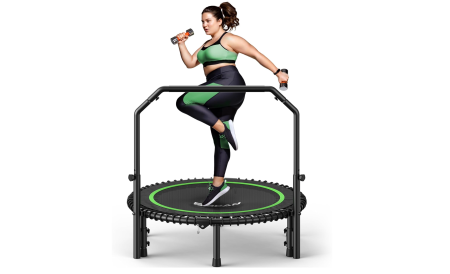
Rebounding is low-impact exercise performed on a small trampoline, usually 36 to 44 inches across. The spring or bungee system absorbs most of the force of your landing, so your joints take a fraction of the impact of jumping on the floor. But — and this is the part people miss — the acceleration and deceleration at the top and bottom of each bounce create significant G-forces through your body. That’s the dose your tissues need.

There are three basic moves on a rebounder. The health bounce is a gentle, heels-stay-down flex where you just let your body compress with gravity and rebound. It’s the one you start with. The jog is a slow run-in-place where your feet alternate. And the jump is a full leave-the-mat bounce with both feet. Most real rebounding sessions blend all three, with different ratios depending on the goal.

What separates rebounding from other cardio is that your whole body is experiencing rhythmic G-force oscillation — up to 2 to 3 G at the bottom of a jump, down toward zero G at the top. That pattern, repeated for minutes, is what triggers the specific adaptations we’re about to get into.

This is very different from walking, cycling, or swimming. Those are all great. They all serve purposes. But none of them produce the same bone-loading, lymphatic, and neuromuscular effect that rhythmic vertical oscillation does.

The NASA Study That Everyone Cites (And What It Actually Found)

If you’ve read anything about rebounding, you’ve probably seen the NASA claim: “NASA found rebounding is 68% more effective than running.” It’s the line that gets quoted on every product page, and it’s actually true — with a lot of important context people skip.

The original study was published in the Journal of Applied Physiology in 1980 by Bhattacharya, McCutcheon, and colleagues at NASA and the University of Kentucky. It looked at astronauts who had lost bone density and cardiovascular fitness during spaceflight and tested different forms of re-entry exercise. The key finding was that at equal oxygen consumption, the biomechanical G-force loading on the body was significantly higher during rebounding than during treadmill running — which the authors interpreted as a more efficient stimulus for cardiovascular conditioning and musculoskeletal loading per unit of effort.

Translation: you don’t have to work as hard on a rebounder to get a similar cardiovascular signal as running, and you get more bone-loading benefit per minute. That’s the finding. It’s real. It just doesn’t mean rebounding is “better than running” in all contexts — it means rebounding is an extremely efficient way to get a specific set of stimuli into a body that can’t or shouldn’t be pounding pavement.

For a midlife woman whose knees, hips, and pelvic floor are already under stress, that efficiency matters. A lot.

Why Rebounding Matters Specifically for Menopause

Let’s get into why a mini trampoline becomes particularly relevant when your hormones start shifting. There are five separate systems that benefit from rebounding, and each of them is under pressure during perimenopause and menopause.

Bone density. Estrogen decline is the primary driver of bone loss in midlife and postmenopausal women. Bone is living tissue that responds to mechanical load — you load it, it rebuilds stronger. You don’t load it, it thins. The impact profile of rebounding — repetitive, vertical, moderate-force — is the kind of loading that triggers osteoblast activity. A 2016 study published in PubMed (PMID 27441918) by Tupeev and colleagues found that mini trampoline exercise produced measurable improvements in bone mineral density in postmenopausal women over 8 to 12 weeks. And the landmark LIFTMOR trial, while focused on high-intensity resistance training, established the principle that menopausal bone responds to loading — a principle that extends to the lower-impact-but-still-loading world of rebounding.

Lymphatic drainage. Your lymphatic system has no pump of its own. Unlike your cardiovascular system, which has a heart, your lymph moves through your body on the mechanical squeeze of muscle contraction and the rhythm of your breath and gravity. Rebounding’s bounce cycle produces one of the most effective lymphatic pumping patterns you can create in a body that’s not being massaged. A review published in PMC (PMC9990535) on whole-body vibration and mechanical oscillation effects on lymphatic flow documented measurable increases in lymph drainage during rhythmic, vertical movement. For menopausal women dealing with fluid retention, puffiness, or sluggish drainage — this is a needle-mover.

Balance and fall prevention. Fall risk climbs sharply for women in their 50s and 60s. The CDC has repeatedly flagged fall-related hip fracture as a major cause of mortality in older women. Rebounding trains proprioception, ankle stabilization, and core co-activation in a way that directly transfers to real-world balance. You are, after all, standing on an unstable surface while loading your body rhythmically. That’s the exact training stimulus for a better balance system.

Cardiovascular conditioning without joint cost. Cardiac health is tightly linked to menopausal outcomes. Rebounding lets you raise your heart rate, train your aerobic system, and build cardiovascular resilience without the knee, hip, and foot impact of running on concrete. For women who have any joint history — and most of us do by midlife — this is often the difference between showing up for cardio and giving up on it.

Mood and nervous system. Rhythmic movement on a rebounder activates the vagus nerve, regulates cortisol, and produces an endorphin release that’s easy to access even on bad days. More than one client has told me rebounding is the only form of movement she can do when her anxiety is high. The combination of rhythm, oscillation, and novelty short-circuits the stuck-in-your-head spiral in a way that walking sometimes doesn’t.

If you’ve read our piece on the benefits of jumping, you know we’re big believers in vertical movement for midlife women. Rebounding is the softer-joint cousin of the jumping protocols in that article, and for most women 40+, it’s the starting point.

Best weighted Jump Rope for W0men over 40
Best weighted Jump Rope for Women over 40

How to Start Rebounding for Menopause (A 10-Minute Protocol)

Here’s the exact starter protocol I give coaching clients. Four weeks. Three to five days a week. Starting at ten minutes and building to twenty.

Week 1: Foundation. Five days a week, ten minutes. The whole ten minutes is health bounce — heels down, gentle compression, no leaving the mat. Focus on posture: tall spine, core softly engaged, shoulders down, breath slow through the nose. The goal here is to condition your ankles, your pelvic floor, and your nervous system to the surface. That’s it.

Week 2: Add jog. Five days a week, ten to twelve minutes. Two minutes of health bounce to warm up, then alternate: one minute of jog, one minute of health bounce, repeat. Finish with two minutes of health bounce. Your heart rate should climb moderately but not spike.

Week 3: Introduce jumps. Four to five days a week, fifteen minutes. Start with three minutes of health bounce, then blocks: one minute jog, thirty seconds jumps, ninety seconds health bounce — repeat. The jumps should be modest. You’re not trying to touch the ceiling. You’re trying to leave the mat and land softly.

Week 4: Build endurance. Four to five days a week, twenty minutes. Same structure as week 3, but increase the jog intervals to ninety seconds and the jump intervals to forty-five seconds. By the end of week 4 you should feel like rebounding is in your body, not a thing you’re learning.

After week 4, you can keep expanding duration (up to thirty minutes), add upper-body elements (arm swings, light weights, cross-crawls), or start integrating rebounding into a broader movement routine as a warm-up or active recovery day.

This protocol is simple on purpose. Most women over 40 don’t need more complex programming — they need a sustainable habit that produces adaptations. If you want a more customized version that factors in your specific history, current training, and any joint concerns, that’s what THOR 1:1 coaching is built for. We also walk through rebounding in detail at our retreats and in the Midlife Method workshop series.

Rebounding for women over 40
My favorite mini trampoline and rebounder for women over 40

Rebounding for Women Over 50 and the Pelvic Floor Question

This is the conversation nobody wants to have but everyone needs to. If you’ve had children, or if you’re in perimenopause with some pelvic floor weakness, rebounding can feel complicated. A small percentage of women experience stress urinary incontinence when they start jumping. Some women experience pelvic heaviness.

Here’s the real answer, which is more nuanced than “do it” or “don’t.”

Gentle rebounding — health bounces and easy jogs — is almost always safe and often therapeutic for the pelvic floor. The rhythmic compression-and-release trains the same reflexive pelvic floor engagement you want walking through daily life. Many women actually see pelvic floor improvement after a few weeks of consistent gentle rebounding.

High-impact jumping on a rebounder can be a different story. If you have known prolapse, significant incontinence, or a complicated postpartum history, you need a pelvic floor physiotherapist’s input before you add jumps. That’s not a limitation — that’s just good programming. A good pelvic floor PT can tell you whether to stay at health bounces, progress to jogs only, or add modified jumps with specific breathing patterns.

The honest rule of thumb: if you leak or feel heaviness during rebounding, dial back to a lower-impact version and get an evaluation. Pushing through it will not strengthen the pelvic floor — it will compound the dysfunction.

Rebounding for women over 40
My favorite mini trampoline and rebounder for women over 40

How to Choose a Rebounder for Women Over 40

Not all rebounders are the same. The cheap one at the big-box store will feel bouncy for a month and then start squeaking, sagging, or worse. A good rebounder is a ten-year investment. Here’s what to look for.

Bungee vs. spring. Bungee-cord rebounders have a softer, more supportive bounce that’s easier on joints. Spring rebounders have a firmer, livelier bounce that’s better for higher-intensity work. For midlife women starting out, bungee is usually the better first choice.

Size. A 40-inch rebounder is standard. Larger rebounders (up to 48 inches) give you more mat space, which is nice if you want to do more varied movement. Smaller portable rebounders (30–36 inches) are fine for gentle bouncing but can feel cramped for more dynamic work.

Stability bar. If you have any balance concerns, get a rebounder with a removable stability bar. You can use it for the first few weeks and remove it once you’re confident.

Build quality. Look for a steel frame, quality bungees or springs rated for many cycles, and a mat made of permatron or a similar durable material. Budget $250 to $500 for something that lasts. Rebounders under $100 usually don’t.

Noise. Some rebounders are much quieter than others. If you’re going to use yours before everyone else in the house wakes up (which is what I do), read reviews about noise specifically.

I’m not going to push a specific brand here because quality options exist at various price points, and the right one depends on your body and your space. But if you want my recommendation based on what we’ve put our own guests on at THOR Mountain, email the team — we’ll tell you what we use and why.

Free 28-Day Fascia & Lymph Reset Email Course

Get our Free 28-day email course series to help with 1 or 2 exercises per day to release your fascia. One short lesson per day. Two minutes to read each.

Common Mistakes in Rebounding for Menopause

Three mistakes I see new rebounders make, and how to avoid each.

Mistake 1: Jumping too high too soon. You don’t need to leave the mat by a foot. Most of the benefit of rebounding comes from the controlled, rhythmic G-force cycle of a small bounce — not from vertical height. Tall jumps early often lead to ankle rolls, knee strain, and a sense of “this is too hard,” followed by quitting. Keep it modest for the first month.

Mistake 2: Rebounding in bare feet or socks. Bare feet give you proprioception, but on a rebounder they also give you less support when you’re fatigued. Socks slide. Most people do best in fitted athletic shoes for rebounding — the sole protects your feet and stabilizes your ankles. That said, if you have a strong history of barefoot movement, know your body well, and have no history of ankle issues, barefoot rebounding can be fine. Start in shoes as a rule.

Mistake 3: Ignoring the body cues. Rebounding is low-impact, but it is impact. If your knees, hips, or low back are sore for 24 hours after a session, you went too hard. Back off to a gentler version and progress more slowly. The whole point is to have this as a long-term tool, not an injury.

How Rebounding Fits into a Broader Midlife Movement Plan

I want to be careful not to oversell any single tool. Rebounding is not a replacement for strength training, and it’s not a standalone solution for menopausal body composition. Here’s how it fits.

Strength training (2 to 4 days a week). Still the single most important movement category for midlife women. You cannot out-rebound a lack of muscle.

Walking or hiking (daily, aim for 7,000 to 10,000 steps). The background movement that keeps your cardiovascular and metabolic systems on.

Rebounding (3 to 5 days a week, 10 to 20 minutes). Bone density loading, lymph, balance, cardio — the condensed multi-system stimulus.

Yoga, Pilates, or mobility work (1 to 3 days a week). The integration layer. Joint health, nervous system regulation, pelvic floor, breath.

True rest (1 to 2 days a week). Not optional.

Rebounding fits as the “efficient multi-system” piece. It’s what you do on a busy day when you have ten minutes and want to move the needle on multiple things at once. It’s not a replacement for heavier work.

The Nutrition Piece: What to Eat to Make Rebounding Work Better

If you’re rebounding consistently, your body needs to be fed well to adapt. Under-eating during a new training block is one of the fastest ways to get injured and stall progress.

Protein matters most. Aim for 0.8 to 1 gram per pound of goal body weight, spread across meals. This is the same target we cover in detail in our reverse dieting after menopause and fundamentals of macro diet for women over 50 pieces.

Get carbs in around your training. Even a small amount (a piece of fruit, a few bites of oatmeal, a rice cake) 30 to 60 minutes before you rebound can make the session feel easier and the recovery faster.

Hydrate. Rebounding moves lymph, and lymph moves better when you’re hydrated. Half your body weight in ounces of water is a floor, not a goal.

If you want tailored macros for your rebounding training, the free THOR macro calculator gives you the numbers in under two minutes.

Best weighted Jump Rope for W0men over 40
Best weighted Jump Rope for Women over 40

Frequently Asked Questions About Rebounding for Menopause

Is rebounding safe for women over 50?

Yes, for the vast majority of women. Start gentle, progress slowly, use a quality rebounder, and listen to your body. If you have known osteoporosis, significant pelvic floor dysfunction, a recent joint surgery, or uncontrolled cardiovascular issues, clear it with your physician first.

How long until I see results from rebounding?

Lymphatic and energy effects are often felt in the first two weeks. Balance improvements show up by week four. Cardiovascular conditioning is measurable by week six. Bone density changes take three to six months of consistent practice to start showing on imaging.

Can I rebound every day?

Yes, at lower intensity. Health bounces and easy jogs can be daily. Higher-intensity jump workouts are better 3 to 4 days a week with rest or lighter movement between.

Does rebounding help with hot flashes?

Indirectly. Regular rebounding supports sleep, cortisol regulation, and body composition — all of which tend to reduce hot flash frequency and intensity. It’s not a direct treatment, but it’s a contributor to the conditions that reduce them.

Free 28-Day Fascia & Lymph Reset Email Course

Get our Free 28-day email course series to help with 1 or 2 exercises per day to release your fascia. One short lesson per day. Two minutes to read each.

What’s better — rebounding or walking?

Different tools. Walking is unmatched for daily, steady-state movement, joint health, and mental clarity. Rebounding delivers more bone loading, more lymph movement, and more cardiovascular stimulus per minute. Most midlife women benefit from both — walking daily, rebounding 3 to 5 days a week.

Can rebounding help with weight loss in menopause?

It contributes to the calorie deficit you need for fat loss, but the bigger lever is still nutrition and strength training. Rebounding helps by supporting cardiovascular fitness, lymphatic drainage (which affects perceived puffiness), and the consistency of your overall movement. It’s a part of a menopause weight-loss approach, not a solo solution.

Will rebounding make my pelvic floor worse?

Gentle rebounding typically strengthens the pelvic floor over time. High-impact rebounding can aggravate existing dysfunction. If you have pelvic floor concerns, start with health bounces only, check in with a pelvic floor PT, and progress intentionally.

What’s the best time of day to rebound?

Morning is popular because it wakes up your lymph and your mood. Afternoon sessions work well as a midday energy reset. Evening rebounding can interfere with sleep for some women, so keep it at least two to three hours before bed.

Can I rebound if I have osteoporosis?

Possibly, with medical clearance and a conservative progression. Rebounding is lower impact than running, but it still loads bone. Your physician and ideally a physical therapist familiar with bone loading should advise on whether rebounding is appropriate, what intensity, and what to avoid.

Do I need to track my heart rate while rebounding?

Not required, but useful. For cardiovascular conditioning, aiming for 60 to 80% of your max heart rate for portions of a session gives you a solid training zone. A basic heart rate monitor or watch is enough.

Can rebounding replace my cardio sessions?

For many midlife women, yes. Rebounding covers cardiovascular conditioning, especially in the intervals and jumping portions. Some women still love running, cycling, or swimming — those stay great complements.

Is it okay to rebound during my period?

Yes, and many women find it helps with cramps and bloating. Listen to your body — if a day feels heavier and lower-energy, drop to gentle health bounces rather than skipping altogether.

Do I need a coach to start rebounding?

No, but a coach accelerates the curve. Working with someone who can look at your form, integrate rebounding into your overall program, and adjust the progression to your history shortens the time to results. Our 1:1 coaching program includes rebounding programming by default for clients who want it, and we cover it in every Midlife Method workshop cohort.

What shoes should I wear for rebounding?

A fitted athletic shoe with moderate support. Running shoes with a lot of cushioning can feel unstable on the mat. Cross-training shoes or minimalist athletic shoes usually work best.

Can rebounding cause motion sickness?

A small percentage of women experience mild motion sickness when they start. It usually resolves within the first week as the vestibular system adapts. If it persists, a gentler progression or check-in with a doctor is worth it.

How does rebounding compare to whole-body vibration platforms?

Different mechanism. Whole-body vibration uses rapid platform oscillation that drives involuntary muscle contraction. Rebounding uses voluntary jumping on a compliant surface. Both have benefits; rebounding requires more active engagement and burns more calories per minute.

Free 28-Day Fascia & Lymph Reset Email Course

Get our Free 28-day email course series to help with 1 or 2 exercises per day to release your fascia. One short lesson per day. Two minutes to read each.

Your Next Step Into Rebounding for Menopause

Here’s where I leave you. Rebounding is one of the best-kept secrets of midlife movement. Ten minutes a day, most days, on a quality rebounder, in a simple progression, will move your bone density signal, your lymphatic drainage, your balance, your cardiovascular conditioning, and your mood more than almost anything else you can do in that amount of time.

Start with the starter protocol above. Give yourself four weeks. Track how you feel — energy, sleep, mood, workouts — not just the scale. Pair it with real strength training, adequate protein (use the free macro calculator to get your numbers), and enough sleep, and you have the skeleton of a midlife movement practice that actually works.

If you want a real coach walking you through this — building the rebounding into the rest of your plan, adapting it to your body, and holding you accountable — that’s what our Age with Strength 1:1 coaching is built for. You don’t have to figure this out alone. Most of the women we coach tried to for too long, and the acceleration of having someone in your corner is the reason they wish they’d started sooner.

You have a body built for this. Let’s wake it up.

I write 3 essays per week on Lifestyle Medicine for women in midlife on what is happening in the body and what to do about it. No fluff, no hype. Free.

Sources and Further Reading

  1. Bhattacharya, A., McCutcheon, E. P., Shvartz, E., & Greenleaf, J. E. (1980). Body acceleration distribution and O2 uptake in humans during running and jumping. Journal of Applied Physiology: Respiratory, Environmental and Exercise Physiology, 49(5), 881–887. https://pubmed.ncbi.nlm.nih.gov/7429911/
  2. Tupeev, I. R., & others. (2016). Mini trampoline exercise effects on bone density in postmenopausal women. Rehabilitation and Health. https://pubmed.ncbi.nlm.nih.gov/27441918/
  3. Watson, S. L., Weeks, B. K., Weis, L. J., Harding, A. T., Horan, S. A., & Beck, B. R. (2018). High-Intensity Resistance and Impact Training Improves Bone Mineral Density and Physical Function in Postmenopausal Women With Osteopenia and Osteoporosis: The LIFTMOR Randomized Controlled Trial. Journal of Bone and Mineral Research, 33(2), 211–220. https://pubmed.ncbi.nlm.nih.gov/28975661/
  4. Cochrane, D. J. (2011). Vibration exercise: the potential benefits. International Journal of Sports Medicine, 32(2), 75–99. https://pubmed.ncbi.nlm.nih.gov/21165803/
  5. Rittweger, J. (2010). Vibration as an exercise modality: how it may work, and what its potential might be. European Journal of Applied Physiology, 108(5), 877–904. https://pubmed.ncbi.nlm.nih.gov/20012646/
  6. Moreau, K. L., Hildreth, K. L., Meditz, A. L., Deane, K. D., & Kohrt, W. M. (2012). Endothelial function is impaired across the stages of the menopause transition in healthy women. Journal of Clinical Endocrinology & Metabolism, 97(12), 4692–4700. https://pubmed.ncbi.nlm.nih.gov/22969140/
  7. Shumway-Cook, A., & Woollacott, M. H. (2000). Attentional demands and postural control: the effect of sensory context. The Journals of Gerontology. Series A, Biological Sciences and Medical Sciences, 55(1), M10–M16. https://pubmed.ncbi.nlm.nih.gov/10719767/
  8. Villareal, D. T., Aguirre, L., Gurney, A. B., et al. (2017). Aerobic or Resistance Exercise, or Both, in Dieting Obese Older Adults. New England Journal of Medicine, 376(20), 1943–1955. https://pubmed.ncbi.nlm.nih.gov/28514618/
  9. Lymphatic system and exercise: mechanisms and clinical outcomes. Review in PMC. https://www.ncbi.nlm.nih.gov/pmc/articles/PMC9990535/
  10. Kohrt, W. M., Bloomfield, S. A., Little, K. D., Nelson, M. E., & Yingling, V. R. (2004). American College of Sports Medicine position stand: physical activity and bone health. Medicine & Science in Sports & Exercise, 36(11), 1985–1996. https://pubmed.ncbi.nlm.nih.gov/15514517/
  11. North American Menopause Society. (2022). The 2022 Hormone Therapy Position Statement of The North American Menopause Society. Menopause, 29(7), 767–794. https://pubmed.ncbi.nlm.nih.gov/35797481/

Reverse Dieting After Menopause: The Science-Backed Plan to Eat More and Lose Weight

Free Macro Calculator

Personalized to your body, goals, and measurements. You will receive detailed macros for meals, sample day of eating, food selection guidance, hydration + daily supplement suggestions, and more.

If you’re eating less than your 20-year-old niece, walking more than your husband, and still watching the scale creep up — this article is for you. I hear this story every single week in our coaching calls and at every Midlife Method workshop: “I’m barely eating, Terry, and I’m still gaining weight. What is wrong with me?”

Nothing. Nothing is wrong with you. Your metabolism is doing exactly what it’s designed to do when it’s been underfed for years. It’s downshifted. It’s defensive. And it’s waiting for you to tell it that food is safe again.

Reverse dieting after menopause is the process of doing that. Slowly, deliberately, and with math — not vibes — you add food back into your life until your metabolism wakes up, your hormones calm down, and your body stops clinging to every calorie like it’s preparing for a famine. It is one of the most counterintuitive, most powerful tools we teach at THOR, and almost nobody is talking about it in the mainstream menopause conversation. Let’s fix that.

This is a long article. Get comfortable. By the end, you’ll know what reverse dieting actually is, why it matters more after 50 than at any other point in your life, the exact macro framework to use, and a week-by-week plan you can start on Monday.

What Is Reverse Dieting (And Why It’s Not a Diet at All)

Let’s get the definition straight first, because the name is confusing. Reverse dieting isn’t a diet in the cut-calories, shrink-your-body sense. It’s a structured protocol for slowly increasing your calorie intake after a long period of under-eating, so that your metabolism can adapt upward instead of staying parked in survival mode.

Here’s the analogy I use at our retreats. Imagine your metabolism is a thermostat. When you cut calories for months or years, the thermostat quietly drops its setting. Your body burns less energy at rest. Your thyroid slows. Your cortisol rises. Your hunger hormones get noisy, then go silent. The whole system recalibrates for less food — and that’s not a bug, that’s a feature. It’s how humans survived famines.

The problem is, you’re not in a famine. You’re just on diet number 17 since you turned 30, and your thermostat has been dropping a little further each time. Reverse dieting is the opposite process. You add a small amount of food each week, and you let your thermostat nudge itself back up.

The concept isn’t new. Physique athletes and bodybuilders have been using reverse dieting for decades to recover from competition prep. What’s new is applying it to women 40+ who’ve spent their whole adult lives under-eating, especially after menopause when the hormonal context makes the whole problem worse. A 2014 review published in Nutrition & Metabolism by Trexler and colleagues — “Metabolic adaptation to weight loss: implications for the athlete” — laid out the mechanism. When you restrict calories for extended periods, your resting metabolic rate drops by more than can be explained by weight loss alone. That gap between predicted and actual metabolic rate is called adaptive thermogenesis, and it can persist for years after the diet ends.

If you’ve already read our piece on the fundamentals of macro diet for women over 50, you have the macro framework. Reverse dieting is the part that comes before or after cutting. It’s the bridge from a suppressed metabolism to a functional one.

Why Reverse Dieting Matters More for Women Over 50

The reason this matters so much for midlife women — and not as much for a 25-year-old — is the hormonal context of menopause. When your estrogen drops, several things shift at once. Your insulin sensitivity falls. Your body becomes more efficient at storing fat, especially visceral fat around your middle. Your muscle protein synthesis slows. And your cortisol rhythm gets disrupted, which raises your baseline blood sugar and makes your body cling to calories even harder.

Now add decades of under-eating on top of that. Most women I coach have been running on 1,200 to 1,400 calories a day since their twenties. They’ve done Weight Watchers, Noom, keto, intermittent fasting, 75 Hard, juice cleanses, and maybe two bouts of full-on caloric restriction. Each round trained their metabolism to do more with less.

By the time menopause arrives, their body is running at maybe 1,300 resting calories when it should be closer to 1,500–1,600. Their thyroid panel looks “normal” but sluggish. Their sleep is trash. Their cravings are constant. And when they cut more calories — because that’s what they’ve always done — they gain weight. Because now they’re under-fueled in the context of already-low estrogen, and their body pulls every protective lever it has.

The Rosenbaum and Leibel research out of Columbia University published in the International Journal of Obesity in 2010 — “Adaptive thermogenesis in humans” — showed that people who had lost weight and kept it off burned 300 to 400 fewer calories per day than people of the same body weight who had never dieted. Three to four hundred calories. For years. That’s the metabolic debt your body carries.

Reverse dieting is the checkout line for that debt. You pay it back with food.

Free Macro Calculator

Personalized to your body, goals, and measurements. You will receive detailed macros for meals, sample day of eating, food selection guidance, hydration + daily supplement suggestions, and more.

The Real Science of Metabolic Adaptation in Menopause

Let’s get into the weeds for a minute, because understanding what’s actually happening in your body is the difference between trusting the process and quitting in week two when the scale goes up.

When you chronically under-eat, five measurable things happen:

Resting metabolic rate drops. Your body uses less energy at rest. This is partly because you’re smaller, but partly — and this is the adaptive thermogenesis piece — for reasons above and beyond body size. A classic 2009 study on the Biggest Loser contestants, published in the American Journal of Clinical Nutrition by Johannsen and colleagues, found that six years after the show, contestants’ resting metabolic rates were on average 500 calories per day lower than predicted. Six years.

Thyroid hormones shift. Specifically, active T3 drops and reverse T3 rises. Your TSH might still look fine on a lab, but the actual thyroid activity is muted. This is a survival mechanism. Your body is conserving energy. In menopause, when your thyroid is already under hormonal pressure from dropping estrogen, this adaptation hits harder.

Leptin falls, ghrelin rises. Leptin is your “I’m full” hormone. Ghrelin is your “I’m hungry” hormone. When you restrict, leptin tanks and ghrelin climbs. The result is constant low-grade hunger that doesn’t match your energy needs. This is why dieting feels like a psychological war.

Non-exercise activity thermogenesis (NEAT) drops. Under-fed bodies fidget less, stand less, walk less, gesture less. You don’t notice it, but your step count falls, your posture slouches, and the tiny background movements that burn hundreds of calories a day quietly disappear. Research by Levine et al. at Mayo Clinic demonstrated this effect — NEAT can account for up to 2,000 calories per day of variance between people, and it is highly responsive to energy availability.

Sex hormones suppress further. In premenopausal women, chronic low calorie intake can push menstrual cycles into hypothalamic dysfunction. In perimenopausal and menopausal women, it amplifies every symptom — worse hot flashes, worse sleep, worse mood, worse libido. The body reads low food as threat, and threat is not the context in which it wants to run reproductive and vitality systems at full capacity.

The Seattle Midlife Women’s Health Study, a landmark longitudinal project published in PMC (PMC2749064) and running for nearly two decades, documented the way these metabolic and hormonal shifts compound across the menopause transition. Women who entered the transition with a history of chronic dieting had worse symptom trajectories than women who hadn’t.

The takeaway: you cannot restrict your way out of a restricted metabolism. You have to feed it back up.

How to Know If You Need to Reverse Diet

Before we get into the how, let’s talk about who. Not every woman needs to reverse diet. Some are genuinely over-fed and need to recalibrate downward. Others are in the maintenance zone and just need better protein and more sleep. But if any of these sound familiar, reverse dieting is probably the missing piece:

You’re eating under 1,500 calories a day and not losing weight. You’ve been “dieting” for more than six months continuously. Your energy is low and you’re cold all the time. Your hair is shedding more than it used to. Your periods have become irregular (if you’re still cycling) or your hot flashes have gotten worse (if you’re not). Your workouts feel harder than they should. Your cravings for sugar or salt are relentless. Your digestion has slowed. Your sleep is broken. You’ve tried to “eat clean and move more” for years, and the body composition won’t budge.

All of those are signals that your metabolism is hunkered down. A reverse diet won’t fix them overnight, but over 8 to 16 weeks, it can fundamentally change what your baseline looks like.

If you’re not sure whether you fit this profile, the free macro calculator at THOR is the fastest way to find out. Plug in your age, weight, activity level, and goal. If the calculator’s maintenance number is significantly higher than what you’ve been eating, you’re probably a candidate. (It also gives you a starting macro breakdown, so it’s the first step in the reverse diet plan I’m about to walk you through.)

The Step-by-Step Reverse Dieting Plan for Women Over 40

Here’s the protocol we use with our coaching clients. It’s conservative on purpose. Women over 40 respond better to slow, patient progression than to aggressive calorie additions, because the hormonal context means any “pressure” feels like threat, and threat keeps the body defensive.

Week 0: Baseline. Before you change anything, track what you’re actually eating for three to five days. Not what you think you eat. What you actually eat. Use a food tracker — Cronometer, MacroFactor, or whatever you already have. Weigh or measure. This sounds tedious, and it is, but you can only reverse from a baseline you actually know. Also record: morning weight (same conditions each day), menstrual cycle phase if relevant, sleep hours, hot flash frequency, and a 1–10 energy score.

Weeks 1–2: Add protein first. Before you add any other food, get your protein to 0.8 to 1 gram per pound of goal body weight. For most women over 40, that’s between 100 and 140 grams per day. This alone often triggers 2 to 3 pounds of water weight gain in the first two weeks — that’s glycogen replenishing in your muscles. It is not fat gain. Breathe.

Weeks 3–6: Add carbs slowly. Increase your total daily calories by about 50 to 75 calories per week, and put almost all of those new calories into carbohydrates. Yes, carbs. Your thyroid, your ovaries, and your brain all need glucose to run well, and they’ve been running on fumes. Add a palm-sized portion of rice, sweet potato, fruit, or oats to one meal. Track weight. Track how you feel.

Weeks 7–10: Dial in fats. Once carbs are in a reasonable range — say, 150 to 200 grams per day depending on your body — add 5 to 10 grams of fat per week. Healthy fats. Avocado, olive oil, nuts, fatty fish, eggs. Fat matters for hormone production, especially the sex hormones that are already struggling in menopause.

Weeks 11–16: Stabilize and assess. By this point you should be eating hundreds more calories than you started with. You should be sleeping better. Your energy should be steadier. Your mood should be calmer. If the scale has moved up a few pounds, that’s normal. If it’s moved up 10, you added too fast and we back off. If it’s stayed the same or gone down, your metabolism was even more suppressed than we thought, and we continue the reverse for another cycle.

The key is patience. A real reverse diet takes three to four months. Anyone promising you a two-week version is selling you something.

The Best Macros for Menopause Weight Loss During a Reverse Diet

Let’s talk numbers. There’s no single macro split that works for every woman, but there’s a defensible range that matches the physiology of menopause. Here’s the framework we use:

Protein: 30–35% of calories, or 0.8–1 gram per pound goal body weight. Menopausal women are more anabolically resistant — meaning you need more protein to trigger the same muscle protein synthesis a younger woman gets from less. This is consistent with research by Moore and colleagues published in the Journals of Gerontology, which found that older adults need roughly 40% more leucine per meal than younger adults to maximally stimulate muscle protein synthesis. Spread protein across four meals at roughly 30 grams each.

Carbohydrates: 40–45% of calories. Yes, really. Contrary to internet keto mythology, carbohydrates are not the enemy in menopause. They support thyroid conversion (T4 to active T3), cortisol regulation, serotonin production, and muscle glycogen. The menopausal liver is more insulin-resistant, so quality matters — slow carbs from whole foods over fast carbs from packaged food — but the total amount should be substantial.

Fats: 25–30% of calories. Enough to support hormone production, fat-soluble vitamin absorption, and satiety — but not so much that carbs get crowded out. The research on low-carb high-fat diets in menopausal women is mixed; the research on adequate carbs plus adequate protein is consistent.

If you want the exact numbers for your body, run them through the THOR macro calculator. It’s built specifically for women 40+, and it defaults to the menopause-friendly ratios above instead of the generic bodybuilder splits most online calculators use.

Free Macro Calculator

Personalized to your body, goals, and measurements. You will receive detailed macros for meals, sample day of eating, food selection guidance, hydration + daily supplement suggestions, and more.

What to Expect Week by Week During a Reverse Diet

Let me walk you through what actually happens in a body during a reverse, because the psychological piece is as important as the physical.

Week 1. You feel fine. Protein is up, nothing else changed much. You might notice slightly better energy by the end of the week.

Week 2. The scale goes up 1 to 3 pounds. This is glycogen and water. You panic. You tell your coach you knew this wouldn’t work. Your coach tells you to drink more water and keep going.

Weeks 3–4. Carbs are climbing. Your workouts start to feel stronger. You’re recovering faster. Your hair is still shedding because hair takes months to respond, but you’ll notice the regrowth in month 4.

Weeks 5–6. You start sleeping better. Most women notice deeper sleep in this window. Hot flashes may not disappear, but they often decrease in intensity.

Weeks 7–8. Your body starts to shift. Weight may stabilize or even drop a little. Body composition shifts — you look leaner even at the same weight. Your clothes fit differently. Your husband asks if you’ve been working out more. You haven’t.

Weeks 9–12. Mood and cognitive stability improve. Brain fog lifts. Your cravings calm down because you’re eating enough. Your libido may start to wake up.

Weeks 13–16. You’re eating 400 to 700 more calories a day than when you started, and you weigh roughly what you weighed at the beginning — or less. Your resting metabolic rate is higher. Your thyroid panel looks better if you retest. Your life is easier because eating is easier.

This is not a marketing story. This is what the research on refeeding after chronic caloric restriction consistently shows, and it is what we watch play out in our clients week after week.

Common Mistakes to Avoid When Reverse Dieting After Menopause

Three mistakes I see over and over, and how to avoid each.

Mistake 1: Going too fast. The temptation to add 200 calories in week two is real. Don’t. The whole point of a reverse is to nudge your metabolism up without triggering your fat storage machinery. Adding too fast puts the fat storage machinery right back in business, and you’ll gain weight you didn’t need to.

Mistake 2: Not tracking. You cannot reverse from a vibe. You have to know your baseline and your weekly numbers. You don’t have to track forever — most of our coaching clients stop tracking around month 4 — but you absolutely have to track during the reverse.

Mistake 3: Adding crap food. A reverse diet is not permission to eat cookies. The extra calories should come from nutrient-dense, whole-food sources that support hormone health. Protein first, then quality carbs, then good fats. This is where cookbooks become your best friend — our THOR cookbook series has macro-specific recipes that hit the right ratios without turning you into a meal-prep monk.

If any of this feels overwhelming, that’s what 1:1 coaching is for. A good coach makes the difference between a reverse that works and one that spirals. We’ve walked hundreds of women through this exact protocol at THOR.

Free Macro Calculator

Personalized to your body, goals, and measurements. You will receive detailed macros for meals, sample day of eating, food selection guidance, hydration + daily supplement suggestions, and more.

How Reverse Dieting Fits with Strength Training in Midlife

One thing I want to make explicit: reverse dieting without strength training is a missed opportunity. The reason your metabolism dropped is partly adaptive thermogenesis, but it’s also partly muscle loss. You’ve lost muscle every year since your mid-thirties, and more of it through perimenopause. Reverse dieting restores the energy environment your body needs to rebuild that muscle — but only if you give it a reason to.

The reason is resistance training. Three to four sessions a week. Heavy enough that the last two reps are hard. Compound movements. Progressive overload. This is what signals the body to actually use the new calories for something productive instead of storing them.

If you’re not sure how to start, our benefits of jumping piece covers the plyometric and rebounding side of training that supports bone density, and our diet break post covers the shorter cousin of reverse dieting. The combination of feeding up, lifting heavy, and recovering well is what rebuilds a midlife body.

How Long Does Reverse Dieting After Menopause Take?

The honest answer is 12 to 16 weeks for most women, and 6 to 9 months for some. It depends on how long you were under-eating, how suppressed your metabolism became, and how patient you are with the process. Women who came from a few years of moderate dieting might wrap up in 10 weeks. Women who’ve been cycling through 1,200-calorie diets since their twenties may need longer.

One more piece. Reverse dieting is a protocol, not a permanent state. Once your metabolism is restored and you’re eating at a real maintenance level, you can choose what comes next. Maybe you stay there for a while to enjoy actually eating food. Maybe you do a short cut to lose the five pounds you want off. Maybe you start training for a retreat and want to feel your strongest.

The point is, you get your options back. A suppressed metabolism takes options away. A restored one hands them back.

Frequently Asked Questions About Reverse Dieting After Menopause

Will I gain weight during a reverse diet?

Probably 1 to 4 pounds, mostly water and glycogen. Some women gain a little more if they add calories too fast. A well-executed reverse produces minimal fat gain and often improves body composition over the 12 to 16 weeks, even at a slightly higher scale weight.

How much should I eat to start a reverse diet?

Start exactly where you are. The first move is not a calorie change — it’s a protein prioritization. Get protein to 0.8 to 1 gram per pound of goal body weight first, hold total calories constant, then start adding in week three.

Can I reverse diet if I’m on HRT?

Yes. Hormone replacement therapy doesn’t change the mechanics of metabolic adaptation, though it can make the reverse feel easier because sleep and cortisol regulation are often better on HRT. Talk to your prescriber about any concerns, but there’s no contraindication to reverse dieting alongside HRT.

How do I know when the reverse diet is done?

When you’ve been eating at the new, higher calorie level for 3 to 4 weeks with stable weight, good energy, good sleep, and no new body composition concerns. That’s your new maintenance. Some women then hold there. Some then do a brief, controlled cut. Some add more food because their metabolism keeps responding. There’s no single endpoint — there’s a new baseline.

Is reverse dieting safe for women over 60?

Yes, with the same protocol. Older women may need to go even slower on the additions and focus more on protein quality. If you have any diagnosed metabolic condition, work with a coach or registered dietitian rather than doing it solo.

How does reverse dieting differ from a diet break?

A diet break is a short pause — usually one to two weeks — at maintenance calories in the middle of a cut. It helps manage the psychological and hormonal strain of extended restriction, but it doesn’t fundamentally reset a suppressed metabolism. A reverse diet is the longer, structured process of actually raising that baseline.

Can I reverse diet if I’m still trying to lose weight?

Counterintuitively, yes. Women who reverse diet first and then enter a mild cut from a higher baseline lose weight faster, keep muscle better, and rebound less than women who cut from an already-suppressed state. The reverse is an investment, not a detour.

Free Macro Calculator

Personalized to your body, goals, and measurements. You will receive detailed macros for meals, sample day of eating, food selection guidance, hydration + daily supplement suggestions, and more.

What should I eat on a reverse diet?

Whole-food protein sources (lean meat, fish, eggs, Greek yogurt, cottage cheese), quality carbs (rice, oats, potatoes, fruit, legumes), and healthy fats (avocado, olive oil, nuts, fatty fish). Keep ultra-processed foods in the 10% range they’ve always belonged in. Our cookbook has macro-mapped recipes if you need a starting point.

How much water should I drink during a reverse diet?

Half your body weight in ounces, as a floor. The extra glycogen your muscles are storing binds water, and your kidneys appreciate the help. Most women over 40 are under-hydrated to begin with.

Why does reverse dieting work for menopause weight loss when regular dieting doesn’t?

Because regular dieting, in the context of an already-suppressed metabolism, deepens the suppression. Reverse dieting restores the metabolic capacity you need to eventually diet effectively. It’s a “sharpen the saw” step most people skip.

Do I need to count macros to reverse diet?

For the first 12 to 16 weeks, yes. You don’t have to count forever, but you need precision during the reverse because the whole point is controlled, measured additions. Eyeballing doesn’t work here. The THOR macro calculator gives you the starting targets, and any tracking app can keep you honest.

Can I do intermittent fasting while reverse dieting?

It’s possible, but not ideal. Tight eating windows make it harder to hit the protein targets a reversing metabolism needs, and the meal spacing benefits of intermittent fasting tend to be less relevant when the bigger goal is restoration. Once your metabolism is back online, you can experiment with windows again if you like them.

What role does strength training play during a reverse diet?

Central. Without resistance training, the extra calories you’re adding risk being partitioned toward fat. With it, they get partitioned toward muscle, which then raises your resting metabolic rate, which then lets you eat even more. Three to four heavy sessions a week is the minimum.

How do I keep from panicking when the scale goes up?

Track more than the scale. Photos. Measurements. Strength numbers in the gym. Sleep quality. Energy scores. Hot flash frequency. If the majority of those metrics are moving in the right direction, the scale is noise. A reverse diet is one of the rare cases where weight is genuinely the least informative number you can track.

Will reverse dieting fix my hot flashes?

Not directly. But it often reduces their frequency or intensity by stabilizing cortisol, blood sugar, and sleep. Those three things are the usual suspects behind hot flash spikes, and all three improve with adequate fueling.

Free Macro Calculator

Personalized to your body, goals, and measurements. You will receive detailed macros for meals, sample day of eating, food selection guidance, hydration + daily supplement suggestions, and more.

Your Next Step After Menopause Reverse Dieting

Here’s the bottom line. If you’ve been eating less and less and less for years, and your body has stopped responding, the answer is not to eat even less. The answer is to slowly, patiently, scientifically teach your body that food is safe again.

Start with the free THOR macro calculator. Get your numbers. Plan your protein. Start tracking your baseline. That’s week zero.

If you want someone walking you through it week by week, our 1:1 coaching program is built for exactly this situation, and our Midlife Method workshop series (next round at our Clinton, NJ studio) covers the full framework in six weeks. We’ve coached hundreds of women through the reverse. The ones who stuck it out for 12 to 16 weeks tell us the same thing on the other side: “I eat more than I ever have, and I feel like I did at 35.”

That’s the whole point. You don’t have to shrink your life to fit a smaller metabolism. You can rebuild the metabolism to fit the life you want.

I write 3 essays per week on Lifestyle Medicine for women in midlife on what is happening in the body and what to do about it. No fluff, no hype. Free.


Sources and Further Reading

  1. Trexler, E. T., Smith-Ryan, A. E., & Norton, L. E. (2014). Metabolic adaptation to weight loss: implications for the athlete. Journal of the International Society of Sports Nutrition, 11, 7. https://pubmed.ncbi.nlm.nih.gov/24571926/
  2. Rosenbaum, M., & Leibel, R. L. (2010). Adaptive thermogenesis in humans. International Journal of Obesity, 34(Suppl 1), S47–S55. https://www.ncbi.nlm.nih.gov/pmc/articles/PMC3673773/
  3. Fothergill, E., Guo, J., Howard, L., et al. (2016). Persistent metabolic adaptation 6 years after “The Biggest Loser” competition. Obesity, 24(8), 1612–1619. https://pubmed.ncbi.nlm.nih.gov/27136388/
  4. Johannsen, D. L., Knuth, N. D., Huizenga, R., et al. (2012). Metabolic slowing with massive weight loss despite preservation of fat-free mass. Journal of Clinical Endocrinology & Metabolism, 97(7), 2489–2496. https://pubmed.ncbi.nlm.nih.gov/22535969/
  5. Woods, N. F., & Mitchell, E. S. (2005). Symptoms during the perimenopause: prevalence, severity, trajectory, and significance in women’s lives (Seattle Midlife Women’s Health Study). American Journal of Medicine, 118(12B), 14S–24S. https://www.ncbi.nlm.nih.gov/pmc/articles/PMC2749064/
  6. Moore, D. R., Churchward-Venne, T. A., Witard, O., et al. (2015). Protein ingestion to stimulate myofibrillar protein synthesis requires greater relative protein intakes in healthy older versus younger men. Journals of Gerontology: Series A, 70(1), 57–62. https://pubmed.ncbi.nlm.nih.gov/25056502/
  7. Levine, J. A. (2002). Non-exercise activity thermogenesis (NEAT). Best Practice & Research Clinical Endocrinology & Metabolism, 16(4), 679–702. https://pubmed.ncbi.nlm.nih.gov/12468415/
  8. MacLean, P. S., Bergouignan, A., Cornier, M. A., & Jackman, M. R. (2011). Biology’s response to dieting: the impetus for weight regain. American Journal of Physiology: Regulatory, Integrative and Comparative Physiology, 301(3), R581–R600. https://pubmed.ncbi.nlm.nih.gov/21677272/
  9. Stiegler, P., & Cunliffe, A. (2006). The role of diet and exercise for the maintenance of fat-free mass and resting metabolic rate during weight loss. Sports Medicine, 36(3), 239–262. https://pubmed.ncbi.nlm.nih.gov/16526835/
  10. Mauvais-Jarvis, F., Clegg, D. J., & Hevener, A. L. (2013). The role of estrogens in control of energy balance and glucose homeostasis. Endocrine Reviews, 34(3), 309–338. https://www.ncbi.nlm.nih.gov/pmc/articles/PMC3660717/
  11. North American Menopause Society. (2022). The 2022 Hormone Therapy Position Statement of The North American Menopause Society. Menopause, 29(7), 767–794. https://pubmed.ncbi.nlm.nih.gov/35797481/

Best Creatine for Women Over 40: The Midlife Guide Backed by Science (Not Gym-Bro Folklore)

If you’re a woman over 40 who has ever walked past the creatine tub at the supplement store and thought, “That’s not for me,” we need to talk. The science around creatine for women over 40 has shifted dramatically in the last three years, and most of it points the same direction — this is the single most studied, lowest-risk, best-value supplement for midlife muscle, bone, and brain. And almost nobody is telling you about it.

At THOR, we work with women navigating perimenopause and menopause every day. In our coaching calls, in our retreats, in the Midlife Method workshop — the conversation has shifted. Three years ago, nobody asked about creatine. Now, it’s one of the top questions we get. Good. Because creatine for menopause is one of the most practical tools we’ve ever added to our women’s wellness toolkit.

Here’s the thing: creatine isn’t a gym-bro supplement. It’s a molecule your body already makes. You already eat it every time you have a piece of beef or fish. The “supplement” version is just a way to top up what your midlife body needs more of but makes less of. And the research specifically in women over 40, perimenopausal, and postmenopausal? It’s stronger than the research on most of the things in your medicine cabinet.

This is a long article, so grab something warm to drink. By the end, you’ll know exactly what creatine for women over 40 does, how much to take, which form to buy, and how to fit it into the life you actually have — not some bodybuilder’s idealized routine. Let’s get into it.

Creatine for women over 40

Why Creatine for Women Over 40 Isn’t Just for Gym Bros

Let me back up for a second. Creatine is a naturally occurring compound your body uses to regenerate ATP — the energy currency of every cell you have. About 95% of it lives in your skeletal muscle, but your brain also uses a huge amount. Your body makes roughly 1 gram of creatine per day from amino acids, and you get another 1–2 grams from food — mostly red meat, poultry, and fish.

Here’s where it gets interesting for women over 40. Research published in Nutrients by Smith-Ryan and colleagues in 2021 — “Creatine Supplementation in Women’s Health: A Lifespan Perspective” — found that women have roughly 70–80% lower intramuscular creatine stores than men, and those stores drop further with age and hormonal changes. So when you hit perimenopause and your estrogen starts fluctuating, your muscle creatine reserves are running on fumes even before we talk about supplementation.

This isn’t about lifting heavier. It’s about whether your body has what it needs to:

  • Rebuild muscle after everyday activities
  • Protect bone density as estrogen drops
  • Think clearly during a hot flash or after a bad night of sleep
  • Recover from stress, surgery, illness, or a hard workout

And the reason the supplement industry has ignored women over 40 for so long is the same reason most research has — historically, the studies were done on young men. That changed. A 2025 review published in the Journal of the International Society of Sports Nutrition — “Creatine in women’s health: bridging the gap from menstruation through pregnancy to menopause” — laid out the evidence across every life stage. The take-home for women 40+ was clear: creatine is safe, evidence-based, and more relevant to us than to the 22-year-old guy at the gym.

Free Macro Calculator

Personalized to your body, goals, and measurements. You will receive detailed macros for meals, sample day of eating, food selection guidance, hydration + daily supplement suggestions, and more.

If you’ve read our piece on the fundamentals of macro diet for women over 50, you already know we take a science-first approach to midlife nutrition. Creatine fits that same framework. It’s not magic. It’s a carefully studied molecule that your midlife body uses better than it can make.

How Creatine Works in a Menopausal Body (and Why You Feel It Within Weeks)

Here’s the simple version. Every time you move — walking up stairs, lifting a grocery bag, standing up from the couch — your cells need to regenerate ATP. Creatine phosphate is the express lane for that. More creatine phosphate in your muscle = faster ATP regeneration = more usable energy for force production, recovery, and repair.

Now add the menopause piece. As estrogen declines, three things happen that are relevant to creatine:

Muscle protein turnover slows down. Estrogen is anabolic — it helps you maintain muscle. Without enough of it, you lose muscle faster than you build it. That’s why sarcopenia (age-related muscle loss) accelerates for women in perimenopause. Creatine partially offsets this by giving your muscle cells a better energy environment for protein synthesis.

Brain energy metabolism shifts. Your brain is the second-hungriest tissue in your body, and it relies on phosphocreatine to handle energy dips. During perimenopause, when sleep gets unreliable and brain fog becomes a part-time job, having more creatine in your neurons seems to help. A 2025 randomized trial published in the Journal of the American Nutrition Association on creatine HCl in perimenopausal and menopausal women found that a medium dose of creatine hydrochloride improved reaction time and increased frontal brain creatine levels compared with placebo.

Bone remodeling changes. Your bones are living tissue that constantly break down and rebuild. Estrogen loss shifts the balance toward breakdown. Here’s where the muscle–bone conversation gets important: muscle pulls on bone during resistance training, which is the primary signal that tells your bones to strengthen. If creatine helps you produce more force in training, it helps your bones indirectly by making the training itself more productive.

This is why women report “feeling” creatine in a way they don’t feel, say, vitamin D. The lift comes from a bunch of small nudges — better training, better recovery, clearer thinking, fewer “I can’t even” moments.

The Best Creatine for Women Over 40: Monohydrate, HCl, and the Forms That Actually Work

Walk into any supplement store and you’ll see creatine monohydrate, creatine HCl, creatine ethyl ester, buffered creatine, creatine magnesium chelate, liquid creatine, gummies, and a dozen other variations. It’s overwhelming. Here’s the truth, stripped down.

Creatine monohydrate is the gold standard. More than 500 peer-reviewed studies have used this form. The 2017 International Society of Sports Nutrition position stand on creatine — one of the most comprehensive reviews of the compound — concluded that creatine monohydrate is the “most effective ergogenic nutritional supplement currently available” for muscle performance, and that no other form has demonstrated superior results. It’s cheap, it’s safe, it mixes easily in water or a smoothie, and it’s what almost every long-term trial has used.

Creatine HCl (hydrochloride) dissolves more easily in water, so some women with sensitive stomachs prefer it. The 2025 CONCRET-MENOPA trial used creatine HCl specifically in perimenopausal and menopausal women and found meaningful cognitive benefits at 1,500 mg/day. That’s a lower dose than monohydrate studies, because HCl is more bioavailable per gram. The trade-off: HCl is significantly more expensive, and the long-term evidence base is smaller than for monohydrate.

Creatine ethyl ester, buffered creatine, liquid creatine, and gummies — skip them. The research on these forms is weaker or, in some cases, suggests they’re actually less effective than plain monohydrate.

For the vast majority of women over 40, creatine monohydrate is the best creatine to start with. It’s what we recommend at THOR, and it’s what we stock in the shop. The creatine we carry at our shop is NSF Certified for Sport, which means it’s third-party tested for contaminants — a standard we insist on for anything we put in our bodies at THOR.

If you have a genuinely sensitive stomach and monohydrate doesn’t sit well even with food, creatine HCl is a reasonable second choice. But try monohydrate first. Dissolve it in warm water or a smoothie, take it with food like a yogurt bowl or overnight oats, and most digestive issues disappear.

Free Macro Calculator

Personalized to your body, goals, and measurements. You will receive detailed macros for meals, sample day of eating, food selection guidance, hydration + daily supplement suggestions, and more.

A quick word on “creatine for women” branded products

You’ve probably seen creatine marketed specifically for women, often in a pink tub at three times the price. Most of these are just creatine monohydrate with a premium on the label. Check the ingredients. If it’s creatine monohydrate, you’re paying extra for the pink tub. If it’s a proprietary blend, you’re paying more and getting less information about what you’re actually taking. Stick with well-studied, third-party-tested creatine monohydrate. Your wallet and your muscles will both thank you.

Creatine for Perimenopause: Benefits You’ll Notice Within the First 8 Weeks

Perimenopause — the years leading up to menopause, when your periods are still happening but getting irregular — is where women most often tell us, “Something is off and I can’t put my finger on it.” If you’re reading this and you recognize yourself in that sentence, please know: you’re not imagining it, and you’re not alone. Hormones are genuinely shifting, fluctuating, and your body’s rhythm is working harder to do the things it used to do automatically.

Creatine for perimenopause tends to show up first in three places women notice:

Recovery between workouts.

You know how you used to be able to work out Monday, Tuesday, Wednesday and feel fine, but now by Wednesday you need a nap and an ibuprofen? That’s partly about muscle creatine stores draining and not refilling fast enough. Supplementing with 3–5 grams of creatine monohydrate daily tops up those stores, and most women feel the difference within two to four weeks.

Energy through the afternoon.

Perimenopausal sleep is often fragmented — more awakenings, less deep sleep, wild temperature swings. Your brain runs on phosphocreatine during the dips. Multiple small trials have found that creatine supplementation modestly improves cognitive performance during sleep deprivation and periods of stress. Again, this isn’t a stimulant effect. It’s your brain having a better energy buffer.

Mood stability and mental clarity.

The 2025 perimenopause/menopause creatine HCl trial found improvements in reaction time and brain creatine levels after 8 weeks. Other small studies have found creatine supplementation reduced depressive symptoms when added to standard treatment — promising enough that creatine is now being studied as an adjunct to SSRIs in several active clinical trials.

None of this is pitched as a cure. It’s pitched as a foundational layer — something that makes everything else you’re doing work a little better. Combine creatine with resistance training, with proper protein intake (we cover that in detail in our post on the fundamentals of macro diet for women over 50), with sleep protection, and the compound effect is real.

If perimenopause has you feeling like you’re running a marathon with a pebble in your shoe, creatine takes out one pebble. It’s not the whole answer. But when you combine it with the rest of our Age With Strength Program™ Coaching Program — movement, muscle, nutrition, sleep, and metabolism — the difference adds up.

Creatine for women over 40

Creatine for Menopause and Postmenopause: Bone Density, Fat Loss, and the 2-Year Study

This is where the research gets really compelling. If you’re postmenopausal, there’s a specific trial you need to know about.

In 2023, researchers published a 2-year randomized controlled trial in Medicine & Science in Sports & Exercise following 237 postmenopausal women who were randomized to either 0.14 g/kg/day of creatine monohydrate or a placebo, combined with resistance training and walking for 24 months. That’s a serious study — long duration, real dose, real population. The primary outcome was femoral neck bone mineral density, which is the hip measurement that matters most for fracture risk.

Results? The creatine group preserved femoral neck bone mineral density better than placebo. In an earlier 12-month Canadian study by the same research group, postmenopausal women doing resistance training lost only 1.2% of femoral neck bone mass on creatine compared with nearly 4% on placebo.

Let me translate that. Losing 4% of bone at the femoral neck in a year is the kind of number that puts you on a fast track toward osteopenia or osteoporosis. Cutting that loss to 1.2% is the difference between staying out of a fracture zone and drifting into one. And the intervention is cheap, safe, and fits in a shaker bottle.

Bone density isn’t the only postmenopausal benefit. A 2025 meta-analysis published in the Journal of the International Society of Sports Nutrition on creatine in menopausal women found favorable effects on body composition (more lean mass, less fat mass), strength, and sleep when creatine was combined with resistance training. The effect sizes aren’t massive — nothing in this space is — but they’re real, and they compound over years.

For context, if you look at our work on women’s wellness retreats and our Age With Strength Program™ Coaching Program, we’re constantly talking about the three M’s — movement, muscle, and metabolism. Creatine lands in the middle of all three. It makes the movement more productive. It protects the muscle you build. And it supports the metabolism that your muscle depends on.

Free Macro Calculator

Personalized to your body, goals, and measurements. You will receive detailed macros for meals, sample day of eating, food selection guidance, hydration + daily supplement suggestions, and more.

The Right Creatine Dosage for Women Over 40 (and Why You Don’t Need a Loading Phase)

Here’s where most women get tripped up. The internet is full of complicated protocols — “load with 20 grams for five days, then drop to 5 grams.” That protocol was designed for young male athletes trying to maximize performance for a specific competition window. For women over 40 with everyday goals, it’s both unnecessary and slightly uncomfortable (the loading phase causes bloating in a lot of people).

Here’s the simple framework that works:

Starting dose: 3–5 grams of creatine monohydrate per day, every day. Take it whenever you’ll remember — it does not matter if it’s morning, post-workout, or with dinner. What matters is daily consistency over weeks and months.

Mix it into water, coffee (yes, really), tea, a smoothie, or yogurt. Creatine monohydrate doesn’t fully dissolve in cold water, so warm or room-temperature liquids work better. It’s flavorless.

Timing is a rounding error. Older research sometimes suggested pre- or post-workout timing. Larger, more recent analyses have found total daily intake matters far more than timing. Take it when it’s easiest to remember.

You’ll saturate muscle creatine stores in about three to four weeks at 3–5 grams per day. A loading phase shortens that to about a week, but the end state is identical. For 99% of women over 40, skipping the load is fine.

Higher-dose protocols — for example, the ISSN Position Stand on Nutritional Concerns of the Female Athlete (Sims et al., 2023) has noted that postmenopausal women may experience additional benefits in muscle and bone at higher doses of 0.3 g/kg/day. For a 150-pound (68 kg) woman, that’s about 20 grams/day. This is substantially higher than typical recommendations, and the higher-dose work is mostly in specific populations. Most women do very well on the simple 5 grams/day protocol. If you’re working on specific bone density or muscle outcomes with a healthcare provider, it’s worth discussing whether a higher dose is right for you.

Hydrate. Creatine pulls a small amount of water into muscle cells. That’s part of how it works. If you’re chronically underhydrated (and many midlife women are), add an extra glass or two of water when you start.

What about cycling off? No. Creatine does not need to be cycled. Your body doesn’t “stop making it” because you supplement — that effect is small and fully reverses when you stop. Consistent daily use is the norm in the research.

One more note: creatine works best with resistance training. If you’re not lifting anything heavier than groceries, start there. Our coaching clients at THOR get a structured strength template as part of the Midlife Method because creatine without resistance training is like buying premium fuel for a car you never drive.

Creatine Side Effects in Women Over 40: What’s Real, What’s Myth

Let’s talk about the elephant in the room. Creatine has been surrounded by myths for 30 years — “it causes kidney damage,” “it makes women bulky,” “it makes you hold water,” “it’s a steroid.” I want to address each of these directly because they stop women over 40 from trying one of the best-researched supplements available to us.

Kidney damage?

The International Society of Sports Nutrition, after reviewing hundreds of studies, has stated that creatine monohydrate at recommended doses is safe for healthy individuals with no evidence of kidney harm. If you have pre-existing kidney disease, talk with your doctor before starting anything. For everyone else with normal kidney function, this is a settled question. A small, transient rise in serum creatinine on routine lab work can happen — that’s a breakdown product of creatine, not a sign of kidney damage. Make sure your doctor knows you’re supplementing so they interpret labs correctly.

“It will make me bulky.”

Creatine does not make you bulky. Women in perimenopause and postmenopause do not have the hormonal environment to build massive muscle. What creatine does is help you keep the muscle you have, or slowly add a pound or two over months of consistent training. That’s the kind of lean mass that makes your jeans fit better, your back stop hurting, and your metabolism more stable. You will not wake up looking like a bodybuilder.

Water retention.

Creatine pulls a small amount of water into muscle cells — intracellular water, not the bloated “I look puffy” kind. Some women see a 1–2 pound weight bump in the first week or two. That’s water inside muscle, which is a good thing, not bad. It often shows up as “I feel fuller” in the muscle. The visible “bloated” water retention that women fear is rare with monohydrate at 3–5 grams per day.

Hair loss.

This one comes from a single study that found a temporary rise in DHT in young rugby players. The rise was within normal range, it wasn’t replicated in later studies, and there’s no evidence creatine causes hair loss in women. If you have a family history of hair loss, you can watch it, but don’t avoid creatine on this basis alone.

Stomach upset.

Some women get mild digestive discomfort when starting creatine, particularly if they take a large dose on an empty stomach. Start with 3 grams/day, take it with food, use warm water to dissolve, and this usually resolves within a week.

Interactions.

Creatine is remarkably clean in terms of drug interactions. That said, if you take medications that stress the kidneys (some NSAIDs, certain diabetes drugs, certain antibiotics), loop your doctor or pharmacist in before starting. This is a “tell your team” situation, not a “don’t do it” situation.

If you’ve ever looked at creatine and thought, “Is this safe for me?” — for the vast majority of women over 40 in good general health, the answer is yes. The risk profile is comparable to vitamin D, and the evidence base is much stronger.

Free Macro Calculator

Personalized to your body, goals, and measurements. You will receive detailed macros for meals, sample day of eating, food selection guidance, hydration + daily supplement suggestions, and more.

How to Combine Creatine with Resistance Training for Midlife Body Composition

Creatine without resistance training is like leaving a nice pair of running shoes in the closet — technically useful, practically pointless. The synergy is where the magic happens.

Here’s the combination we use with our Midlife Method coaching clients at THOR:

Three strength sessions per week, 30–45 minutes each. Compound movements: squats, hinges, pushes, pulls, carries. Start with bodyweight or light dumbbells if you’re new. Add weight slowly.

Progressive overload. Every two weeks, try to add a pound, a rep, or a set to something. Your muscle only rebuilds stronger if you give it a reason.

Protein at every meal. Aim for 25–40 grams per meal, ideally from whole food sources. Our macro diet for women over 50 guide walks through exactly how to structure this without obsessing.

Creatine daily. 3–5 grams, same time each day, mixed into whatever’s easiest. Our favorite is creatine is unflavored and mixes into nearly anything.

Impact work. This is where the bone benefits really compound. Ten minutes of rebounding, a few sets of box jumps, or even just walking on stairs count. We wrote a whole piece on why 100 jumps a day transforms midlife bodies — it’s one of our most-read posts for a reason.

Sleep and stress. Creatine is not a substitute for rest. Your body builds muscle and bone while you sleep. Prioritize it like it matters, because it does.

Within 8–12 weeks of this combination, most of our Midlife Method women notice:

  • Clothes fitting differently (not necessarily on the scale)
  • More energy in the afternoon
  • Fewer aches after everyday activities
  • Better mental clarity
  • More confidence in their body

That’s the picture. Creatine on its own will move the needle a little. Creatine plus smart training plus adequate protein plus sleep plus stress management? That’s what changes a decade.

Foods That Contain Creatine (and Why You Still Need a Supplement)

Creatine isn’t only in a tub. It’s in food — mostly animal proteins. Here’s roughly how much creatine you’d get from whole food sources:

  • Beef (6 oz): ~2 grams of creatine
  • Salmon (6 oz): ~2 grams
  • Chicken breast (6 oz): ~1 gram
  • Pork (6 oz): ~1.5 grams
  • Herring (6 oz): ~3 grams
  • Cod (6 oz): ~1.5 grams

To hit the research-supported dose of 3–5 grams per day from food alone, you’d need roughly a pound of red meat or fatty fish daily. That’s a lot of cooking, a lot of saturated fat intake (depending on your cuts), and frankly, a lot of money.

If you’re vegetarian or vegan, your dietary intake is near zero, and muscle creatine stores are typically 20–50% lower than in omnivores. Supplementation is even more valuable in that case. Creatine monohydrate is synthesized in a lab and contains no animal products — both the Thorne creatine we stock and most other reputable creatine monohydrate powders are vegan-friendly.

The practical answer for most women over 40: eat whole food sources of creatine when you can (the beef, the fish, the eggs), and use a 3–5 gram daily supplement to top up. This combined approach consistently delivers saturated muscle stores without asking you to eat beef for every meal.

Creatine for women over 40

What to Look for When Choosing the Best Creatine for Menopause

If you’re going to start, pick something worth starting. Here’s the THOR checklist:

Third-party tested. Look for NSF Certified for Sport, Informed Sport, or USP Verified. These certifications mean an independent lab has checked the product for banned substances and label accuracy. Our favorite creatine — available at shop.thehouseofrose.com/products/creatine — is NSF Certified for Sport, which is the standard we hold to for our retreat supply.

Pure creatine monohydrate. Check the ingredient panel. If it says “creatine monohydrate” and nothing else, you’re good. If it lists a “proprietary blend” or adds a bunch of other compounds, skip it. You want to know exactly what you’re taking.

No added sugar or artificial colors. You don’t need a neon-blue creatine smoothie. You’re a grown woman; you can stir 5 grams of powder into water.

Unflavored or very lightly flavored. Creatine is tasteless in monohydrate form. Heavily flavored creatines usually hide filler ingredients.

A reasonable price. Creatine is one of the cheapest effective supplements on the market. If you’re paying over $1 per serving for plain creatine monohydrate, you’re being overcharged.

Packaging that protects the product. A sealed, resealable container that keeps moisture out. Creatine is moisture-sensitive; if it clumps into rocks in the tub, it’s been exposed to humidity (still safe to take, just inconvenient).

This is the short list. Don’t overcomplicate it.

The THOR Creatine Protocol for Women Over 40

Putting this all together, here’s how we actually recommend our clients to start:

Weeks 1–2: Take 3 grams of creatine monohydrate per day, mixed in warm water or a smoothie, with food. Pay attention to how you feel.

Weeks 3–4: If everything’s feeling good, move to 5 grams per day. Continue daily, consistently, no skips.

Weeks 5–12: Pair the creatine with 3 strength sessions per week, hit your protein target, protect your sleep. This is where most women start to notice real changes.

Months 3–6: This is where bone and body composition changes start to show up on measurements and in how clothes fit. Stay the course. The research on postmenopausal bone density was measured at 12 and 24 months — the long game matters.

Ongoing: Stay on creatine daily. No need to cycle off. Adjust dose upward only in consultation with a coach or clinician who knows your specific goals.

If you want more structure — progressive strength templates, macro guidance customized to your body, and 1:1 support from someone who gets midlife — that’s exactly what we do inside THOR coaching. Reach out through thehouseofrose.com to talk. And if you just want to get the creatine itself, we keep it in stock.

Free Macro Calculator

Personalized to your body, goals, and measurements. You will receive detailed macros for meals, sample day of eating, food selection guidance, hydration + daily supplement suggestions, and more.

Creatine for Women Over 40: Frequently Asked Questions

Is creatine safe for women over 40?

For healthy women with normal kidney function, creatine monohydrate at 3–5 grams per day is among the most-studied and safest supplements on the market. The International Society of Sports Nutrition, after reviewing hundreds of studies, has repeatedly affirmed its safety. If you have pre-existing kidney disease, talk with your physician before starting. If you’re taking medications that affect kidney function, make sure your care team knows about the supplement so they can interpret lab results correctly.

What is the best creatine for women over 40?

Creatine monohydrate is the most-researched, most-cost-effective, and most-reliable form. Look for a product that’s third-party tested (NSF Certified for Sport, Informed Sport, or USP Verified), lists only creatine monohydrate in the ingredients, and comes from a brand with a track record. At THOR, we use and stock creatine monohydrate because it’s NSF Certified for Sport and has the quality controls we trust for our retreat participants. You can find it at shop.thehouseofrose.com/products/creatine.

How much creatine should a woman over 40 take per day?

The research-backed starting dose is 3–5 grams of creatine monohydrate per day, every day, consistently. No loading phase is necessary for most women — you’ll saturate your muscle creatine stores in three to four weeks at that dose. Some postmenopausal women may benefit from higher doses (up to 0.3 g/kg/day) under a coach or clinician’s guidance, but 3–5 grams/day is the foundation that covers most benefits for most women.

How long does it take to feel the effects of creatine?

Most women notice changes within 2–4 weeks — usually in recovery between workouts, afternoon energy, and mental clarity. Body composition and strength changes show up more clearly at 8–12 weeks of consistent use combined with resistance training. Bone density changes take 6–12 months to measure. Creatine is a long game that also has short-term wins; patience pays off.

Can creatine help with perimenopause symptoms?

Creatine won’t directly change your hormonal picture, but it can help soften some of the downstream effects of perimenopause. A 2025 randomized trial in the Journal of the American Nutrition Association found creatine HCl improved reaction time and increased frontal brain creatine levels in perimenopausal and menopausal women over 8 weeks. Many women also report better energy, mood stability, and workout recovery. Pair it with sleep protection, strength training, and proper protein intake for compounding benefits.

Does creatine cause weight gain in women?

Creatine causes a small amount of intramuscular water retention — typically a 1–2 pound scale bump in the first week or two. This is water inside muscle cells (which is where you want it), not bloating or fat gain. Over months, most women on creatine actually see improved body composition: slightly more lean mass, slightly less body fat, and tighter-fitting clothes. The scale can lie in the short term; measurements and how clothes fit tell the longer story.

Does creatine cause hair loss?

The hair-loss concern comes from one small study in young men that found a temporary DHT rise within normal range. That finding hasn’t been replicated in follow-up research, and there’s no evidence that creatine causes hair loss in women. If you have a strong family history of female-pattern hair loss, you can monitor it, but the current evidence does not support avoiding creatine for this reason.

Can I take creatine with other supplements?

Yes. Creatine stacks cleanly with protein powder, omega-3s, vitamin D, magnesium, collagen, and most other common supplements. The combination many of our coaching clients use at THOR is creatine + adequate protein + vitamin D + magnesium, which is a well-rounded foundation for midlife muscle and bone health.

Should I take creatine on rest days?

Yes. Daily consistency matters more than workout timing. Take creatine on training days, rest days, travel days, holidays — every day. Your muscle stores maintain saturation only with consistent daily intake.

What about creatine and caffeine?

Older research suggested caffeine might blunt creatine’s effects, but that’s been largely disproven in more recent trials. Plenty of women mix creatine directly into their morning coffee without issue. Do what’s easiest for daily consistency.

Can vegetarians or vegans benefit from creatine?

Absolutely — in fact, they often benefit the most. Vegetarians and vegans typically have lower baseline muscle creatine stores because they’re not getting it from red meat or fish. A daily 3–5 gram creatine monohydrate supplement (which is vegan by default, since it’s synthesized in a lab) brings vegetarian and vegan women up to the same muscle saturation as omnivores.

What if I forget to take creatine for a few days?

Not a big deal. Muscle creatine stores deplete slowly — over several weeks. Pick it back up when you remember. If you’ve been off for more than a couple of weeks, just restart your 3–5 gram/day routine; no need to “re-load.”

Does creatine help with brain fog and cognitive function during menopause?

Promising early evidence says yes. The 2025 CONCRET-MENOPA trial on creatine HCl in perimenopausal and menopausal women found improvements in reaction time and increased frontal brain creatine levels. The effect size wasn’t enormous, but it was real. Other small studies have found creatine may support mood and cognitive function during sleep deprivation or high-stress periods. We tell our Midlife Method coaching clients not to expect a miracle — but many do notice a gentler, steadier head on creatine than off of it.

Free Macro Calculator

Personalized to your body, goals, and measurements. You will receive detailed macros for meals, sample day of eating, food selection guidance, hydration + daily supplement suggestions, and more.

Can creatine help with bone density after menopause?

This is one of the stronger evidence bases. A 2-year randomized controlled trial in 237 postmenopausal women found creatine monohydrate (0.14 g/kg/day) combined with resistance training preserved femoral neck bone mineral density better than placebo. An earlier 12-month study from the same research group found only 1.2% bone loss in the creatine group versus nearly 4% in placebo. Creatine alone isn’t a bone drug — it works by supporting the resistance training that signals bone remodeling — but the combined effect is real and repeatable in the research.

How do I know if creatine is working?

Track three things: how you feel during and after workouts (energy, recovery), how clothes fit (body composition over weeks to months), and simple strength markers (can you lift a little heavier, do a little more, carry groceries without effort). If you’re pairing creatine with consistent strength training and protein intake, most women see meaningful changes within 8–12 weeks.

The Bottom Line on Creatine for Women Over 40

Creatine is one of the few supplements that walks the talk. It’s cheap. It’s safe. It has a huge body of research behind it, and the research specifically in women — perimenopausal, menopausal, postmenopausal — has gotten much stronger in just the last few years. It’s not a magic powder. It’s a foundational tool that makes strength training more productive, bone protection more effective, and midlife feel a little more possible.

If you’ve been on the fence, here’s our honest nudge: try it for 12 weeks. Pair it with three strength sessions a week, adequate protein, and sleep you actually prioritize. Then judge. We think you’ll feel the difference. Our retreat and Midlife Method women feel it all the time.

And if you want to start with the exact Thorne creatine we use at THOR — NSF Certified for Sport, unflavored, clean — you can grab it at shop.thehouseofrose.com/products/creatine. Your midlife body is worth the tub. We promise.

I write 3 essays per week on Lifestyle Medicine for women in midlife on what is happening in the body and what to do about it. No fluff, no hype. Free.

Sources and References

  1. Smith-Ryan AE, Cabre HE, Eckerson JM, Candow DG. “Creatine Supplementation in Women’s Health: A Lifespan Perspective.” Nutrients. 2021;13(3):877. https://pmc.ncbi.nlm.nih.gov/articles/PMC7998865/
  2. de Guingand DL, Palmer KR, Snow RJ, Davies-Tuck ML, Ellery SJ. “Creatine in women’s health: bridging the gap from menstruation through pregnancy to menopause.” Journal of the International Society of Sports Nutrition. 2025. https://www.tandfonline.com/doi/full/10.1080/15502783.2025.2502094
  3. Sims ST, Kerksick CM, Smith-Ryan AE, et al. “International society of sports nutrition position stand: nutritional concerns of the female athlete.” Journal of the International Society of Sports Nutrition. 2023;20(1). https://pmc.ncbi.nlm.nih.gov/articles/PMC10210857/
  4. Kreider RB, Kalman DS, Antonio J, et al. “International Society of Sports Nutrition position stand: safety and efficacy of creatine supplementation in exercise, sport, and medicine.” Journal of the International Society of Sports Nutrition. 2017;14:18. https://pmc.ncbi.nlm.nih.gov/articles/PMC5469049/
  5. Chilibeck PD, Candow DG, Gordon JJ, et al. “A 2-year Randomized Controlled Trial on Creatine Supplementation during Exercise for Postmenopausal Bone Health.” Medicine & Science in Sports & Exercise. 2023. https://pubmed.ncbi.nlm.nih.gov/37144634/
  6. Chilibeck PD, Candow DG, Landeryou T, Kaviani M, Paus-Jenssen L. “Effects of Creatine and Resistance Training on Bone Health in Postmenopausal Women.” Medicine & Science in Sports & Exercise. 2015;47(8):1587–95. https://pmc.ncbi.nlm.nih.gov/articles/PMC10487398/
  7. Candow DG, Forbes SC, Chilibeck PD, et al. “Effectiveness of Creatine Supplementation on Aging Muscle and Bone: Focus on Falls Prevention and Inflammation.” Journal of Clinical Medicine. 2019;8(4):488.
  8. Cabre HE, Gould LM, Smith-Ryan AE, et al. “Impact of creatine supplementation on menopausal women’s body composition, cognition, estrogen, strength, and sleep.” Journal of the International Society of Sports Nutrition. 2025. https://pmc.ncbi.nlm.nih.gov/articles/PMC12291186/
  9. “The Effects of 8-Week Creatine Hydrochloride and Creatine Ethyl Ester Supplementation on Cognition, Clinical Outcomes, and Brain Creatine Levels in Perimenopausal and Menopausal Women (CONCRET-MENOPA): A Randomized Controlled Trial.” Journal of the American Nutrition Association. 2025. https://pubmed.ncbi.nlm.nih.gov/40854087/
  10. Lobo DM, Tritto AC, da Silva LR, et al. “Effects of long-term low-dose dietary creatine supplementation in older women.” Experimental Gerontology. 2015. https://www.sciencedirect.com/science/article/abs/pii/S0531556515300206
  11. “Creatine and Cognition in Aging: A Systematic Review of Evidence in Older Adults.” Nutrition Reviews. 2025. https://academic.oup.com/nutritionreviews/advance-article/doi/10.1093/nutrit/nuaf135/8253584

Related Reading on THOR

Disclaimer: This article is for educational purposes and is not medical advice. Consult a qualified healthcare provider before starting any new supplement, especially if you have kidney disease, take prescription medications, or are pregnant or nursing.

How to Choose a Women’s Yoga & Wellness Retreat That Actually Works (A Midlife Guide)

Let me start with a confession. Before I opened THOR Mountain, I went on four women’s wellness retreats myself. Two of them changed my life. The other two felt like expensive yoga camp with bad coffee and a gift shop I didn’t need. I flew home from one of them in tears — not healing tears, the other kind — because I’d just spent a week’s salary on something that didn’t touch what I actually came for.  The other one either, gave me and 50 other women who were attending, food poisoning with a side of the most vicious vomiting and diarrhea I’d ever experienced for 4 long days after the retreat was over. So bad, that I needed to call a doctor. And yes, I had to book a hotel and stay extra days as I couldnt get on the plane. That “learning” experience cost me a whopping $8,391.39 all in, after everything was said and done. But I digress.

Anyway, these are the parts nobody tells you. Not all women’s wellness retreats are created equal. The industry exploded in the last five years, and for every retreat run by a legitimate team of certified coaches, registered yogis, personal trainers, chefs, and bodyworkers, there are ten run by influencers with good Instagram lighting and a rented villa. You, the midlife woman writing a check for three to ten thousand dollars, deserve better intel than what the ad campaigns give you.

This article is the insider guide I wish I’d had before I booked my first retreat. I’m going to walk you through what the science says about why retreats work, what to look for in the details, the specific questions to ask before you book, and the red flags that should send you running. By the end, you’ll know how to choose a women’s wellness retreat that matches what your body and mind actually need in midlife — not what a marketing funnel decided to sell you.

This is a long one. Grab tea. Let’s do this properly.

Why Women’s Yoga & Wellness Retreats Work (When They Work)

First, the science. Because this matters. If you’re spending real money and real vacation time, you should know what the research actually shows about why immersive wellness programs produce results — and when they don’t.

A 2017 study published in the journal BMC Complementary and Alternative Medicine by Cohen and colleagues — “A thematic analysis of retreat experiences: Are retreats a useful vehicle for health improvement?” — analyzed data from 177 participants across multiple residential wellness programs. The findings were consistent. Participants reported significant improvements in psychological, physical, and quality-of-life outcomes that persisted at three-month and six-month follow-ups. The kicker: programs that combined multiple interventions — nutrition, movement, education, stress-reduction, social connection — outperformed single-focus programs.

A separate study published in PMC (PMC5761096) looked specifically at residential wellness retreats using comprehensive lifestyle interventions and found measurable improvements in biomarkers — reduced inflammation, improved glucose metabolism, better lipid panels — that were still present weeks after participants returned home. These weren’t magic bullets. They were the cumulative effect of a week of well-programmed food, movement, sleep, and group support.

More recently, a 2024 review in PMC (PMC11626984) on group-based wellness interventions for women confirmed that the combination of structured programming plus female-only peer community had unique value for midlife women specifically — better adherence, better self-reported outcomes, better hormonal symptom management. Women in midlife, it turns out, heal differently in the company of other women who are navigating the same transitions.

And a 2023 meta-analysis published in the journal “Menopause” examined mind-body interventions for menopausal symptoms — hot flashes, sleep disturbance, mood — and concluded that structured multi-component programs delivered the most consistent symptom reduction across studies.

Translation: the science says retreats work when they combine enough of the right elements for enough time in the right company. The flip side is also true. A retreat that’s just “vibes and a green smoothie” doesn’t produce those outcomes.

You need substance.

This is why we built THOR Women’s Retreats the way we did — and this is also why I want you to know what substance looks like before you book anywhere.

The Seven Non-Negotiables of a Real Women’s Wellness Retreat

When you’re evaluating any retreat, run it through these seven filters. If the retreat you’re considering passes all seven, it’s probably worth the money. If it fails three or more, walk.

1. A qualified team, not just a charismatic leader. A single person cannot deliver nutrition, movement, bodywork, and mindset health programming at a clinical level. A real retreat has a team — a nutritionist, a trained movement coach or personal trainer, a bodyworker or massage therapist, a registered yogi, a mental health or somatic practitioner, and logistical and administrative support. If the website lists one photogenic founder and a rotating cast of “guest instructors,” that’s a red flag.

2. Programming that’s structured, not improvised. Ask for the actual schedule before you book. A legitimate retreat has a detailed daily schedule — movement sessions, meals, educational blocks, rest, evening integration — that’s planned down to the hour. Improvised programming is usually a sign of an operation that’s still finding its feet, and you don’t want to be the guinea pig for that learning curve.

3. Food that’s actually therapeutic, not just photogenic. Instagram has ruined retreat food. Pretty bowls do not equal clinical nutrition. You want a retreat that publishes its nutritional approach — macronutrient ranges, food sourcing, accommodation for perimenopausal needs like higher protein and balanced carbs. If the menu is “plant-based” with no protein numbers and no structure, you’ll leave hungry and over-carbed. (Our fundamentals of macro diet for women over 50 piece spells out what those numbers should look like for midlife women.)

4. A clear container for who it’s for. A retreat that’s “for everyone” is for no one. The best women’s wellness retreats are specific — women 40+, women in perimenopause, women in recovery, women navigating divorce, women in leadership. Specificity signals the team has thought about the actual physical and emotional needs of the population they’re serving.

5. Real integration with daily life. A week in the mountains won’t fix a decade of patterns. The best retreats include post-retreat integration — a follow-up call, a coaching option, a community you can return to, a home program that gives you the structure to keep the work going. If the retreat ends at check-out and there’s no thread into the life you’re going home to, it’s expensive vacation.

6. A group size that’s small enough to be real. You cannot be seen in a retreat of 40 women. Twelve to twenty is the sweet spot. Small enough for each guest to get individual attention from the team. Large enough that there’s a real peer community to form. If a retreat has 35+ women and one main instructor, you’re at a conference, not a retreat.

7. Transparent pricing and a real cancellation policy. No hidden upgrades. No “optional” sessions that turn out to be core. A clearly stated deposit, payment schedule, and cancellation window. If a retreat’s terms are buried or vague, the retreat’s operations are probably the same.

How to Choose a Women’s Wellness Retreat Based on Where You Are in Life

Different women need different retreats. Here’s the shorthand I give to women who ask me which type is right for them.

If you’re in the middle of perimenopause, dealing with hot flashes, sleep issues, and mood swings — you want a retreat that includes sessions that help with perimenopause. Look for teams that include a menopause-literate practitioner, and look for programming that includes education on hormone health, sleep hygiene, and stress regulation. This is not the moment for a plant-medicine ceremony or an aggressive bootcamp.

If you’re post-menopausal and feel like you’ve lost yourself — you want a retreat that emphasizes identity, purpose, and agency alongside the physical programming. Somatic practices, writing, nature immersion, and group dialogue matter as much as movement. Look for retreats that talk about “next chapter” work, not just “reset” work.

If you’ve been burned out by work, caregiving, or both — you want a retreat that’s heavy on nervous system regulation. Parasympathetic protocols, breathwork, sleep support, minimal external stimulation. A quiet location. Clinical-grade rest, not a packed schedule.

If you want a fitness-forward reset — you want a retreat that includes real strength programming, not just yoga. Women over 40 need to build muscle, not just “tone” it. Look for a retreat that has proper strength equipment and a coach who understands resistance training for midlife women.

If you’re looking for a spiritual reset — be careful. The spiritual retreat space has the highest number of under-qualified operators. Look for lineages, teachers with long track records, and containers that emphasize integration over experience. Ask who’s on the team for psychological safety if someone has a difficult opening.

At THOR, we run programs that address most of these — because most midlife women have components of all of them at once. Our Tennessee retreats at THOR were built specifically for the woman who needs movement plus nervous system plus community plus integration in one place, structured as the Midlife Method: Movement, Muscle & Metabolism. That’s who we are. Whether that’s you or another retreat is right for you is a conversation worth having, and we’re happy to have it honestly.

Red Flags in a Women’s Wellness Retreat Website

When you’re doing your research, here are the warning signs I tell every woman I coach to watch for.

The photos are all of the founder. Not guests. Not the team. Not the property. Just the founder in good lighting. That’s a personal brand operation, not a retreat company.

The language is all about transformation with no specifics. “Awaken,” “unleash,” “reclaim” — without any concrete detail about what the days actually contain. Real retreats tell you what you’ll do. Sketchy ones tell you what you’ll become.

The pricing is murky. You should be able to see the full cost upfront. Extra charges for “private sessions” or “special ceremonies” that aren’t disclosed in the marketing copy are a bad sign.

Reviews are all from the same three weeks. Look at the review dates. A legitimate retreat has a steady stream of reviews over time. If they’re clustered around one launch period, they were probably solicited.

The team page is missing or thin. You should be able to see photos, credentials, and bios of the full team. Vague or missing information about who’s actually going to be with you all week is a dealbreaker.

“All ages welcome” with no specialization. As I said earlier, specificity matters. If a retreat is trying to be everything to everyone, it’s probably not optimized for you.

No accommodation options. Real retreats offer single occupancy, shared, and sometimes premium options. A one-size-fits-all room structure often means the retreat hasn’t thought about the different preferences midlife women have — and sleep is the thing that makes or breaks a retreat experience.

Questions to Ask Before You Book a Women’s Retreat

Print this list. Seriously. Email it or ask it on a discovery call before you put any money down.

  • Who is on the team all week, and what are their credentials?
  • What’s the group size, and what’s the minimum-to-maximum range you hold to?
  • What does the daily schedule look like – can I see an actual sample day?
  • How do you accommodate perimenopause and menopause symptoms in the programming and menu?
  • What is the protein target per meal, and how do you hit it?
  • What equipment do you have for strength training, and what’s the average intensity?
  • What happens if I need to rest a session? Is that honored?
  • What’s the integration plan after the retreat ends?
  • What’s the refund and cancellation policy?
  • Who is your ideal guest, and who is this retreat not for?

A legitimate retreat team will have confident, specific answers to all ten of these. An under-prepared team will deflect or redirect. That information alone will tell you what you need to know.

The Hidden Costs of a Women’s Wellness Retreat (And How to Budget)

Beyond the sticker price, there are a few line items women often forget to plan for.

Travel and transfers. Especially for destination retreats. A $3,500 retreat becomes a $4,500 trip with flights and ground transfer. Ask whether transfers from the nearest airport are included.

Gratuities. Some retreats bake these in, others don’t. For a week-long stay, budget 15% of the retreat cost as a gratuity for the team if it’s not included.

Extras. Bodywork upgrades, private coaching sessions, extra nights, massage therapy add-ons. Decide in advance what you want to say yes or no to, so you’re not making those decisions from a hyper-regulated emotional state on day three.

Time off work. Factor in the cost of the days you’re not working, if that applies.

Post-retreat integration. If the retreat offers a coaching continuation program, budget for that too. The integration is often where the real behavior change happens.

A realistic total budget for a week-long women’s wellness retreat in the U.S. is $4,000 to $8,000 all-in, depending on location, season, and extras. Some destination retreats in Europe or Costa Rica run $8,000 to $15,000. There’s no “cheap” version of a high-quality retreat — the team and the food cost money to do right — but there’s a wide range of what “high quality” looks like. Pick the version that matches your goals and your budget, not the fanciest one you can afford.

How to Prepare for a Women’s Wellness Retreat So You Actually Get Results

You can massively increase what you get out of a retreat by preparing well in the 2 to 4 weeks before you go.

Start tracking your food and sleep now. A retreat is a data-rich week. The more you know about your baseline, the more useful the compare-and-contrast will be. Use the free THOR macro calculator to get your baseline protein and calorie needs before you land at a retreat with a curated menu.

Prioritize sleep the week before. Showing up sleep-deprived wastes the first two days. Aim for seven to nine hours a night for seven days before you leave.

Reduce alcohol to zero for the week prior. Most retreats don’t serve alcohol, and your body will feel the absence harder if you’ve been drinking right up until departure. Pre-taper.

Set two intentions, not twelve. A retreat can’t fix twelve things at once. Pick one or two pieces you’re there to move forward — strength, stress regulation, sleep, a specific decision you’ve been avoiding — and let the rest stay as bonus.

Plan your re-entry. Block your calendar for three days after you return. No meetings, no big commitments. Give yourself a soft landing. This is where most of the retreat value is lost — people parachute back into chaos and undo the reset in 48 hours.

What to Expect from Your First Women’s Wellness Retreat

How to Choose a Women's Yoga and Wellness Retreat in Midlife - Step by Step Guide
How to Choose a Women’s Yoga and Wellness Retreat in Midlife – Step by Step Guide

Honest preview, from someone who’s run over 65+ different women’s yoga and wellness retreats:

Day 1. You’re tired. You’re nervous. You’re sizing up the other women. You wonder if you made a mistake. You didn’t. Everyone feels this way. Eat your lunch, get to your first session, let the schedule carry you.

Day 2. You’re detoxing. Not in a juice-cleanse way. Your nervous system is coming down off the months (years?) of elevated cortisol you’ve been living in. You might have a headache. You might cry. You might sleep 10 hours. All normal.

Day 3. Something shifts. Usually around the middle of day three. Your body starts trusting the container. You’re actually present in conversations. You sleep deeply for the first time in a long time. This is the moment most women remember when they think back on why retreats matter.

Day 4–5. You’re doing the real work now. The programming is landing differently because your nervous system is available for it. You’re building actual relationships with the women around you. You’re noticing changes in your body that you can feel — more capable, clearer thinking, easier breath.

Day 6–7. Integration and re-entry prep. The best retreats don’t send you home cold. They walk you through what to carry back, how to rebuild the containers at home, and what support looks like going forward.

The Case for a Women-Only Retreat Specifically

There’s a reason this article is about women’s retreats, not mixed retreats. The research supports it and so does my own personal lived experience.

A 2021 review in the journal Health Psychology Review looked at single-sex versus mixed-sex therapeutic interventions and found that for women, especially midlife women, women-only containers produced better psychological safety, deeper group bonding, and more disclosure of the experiences that typically drive the issues we’re trying to work on — caregiving, body image, hormonal transitions, sexual health, grief.

It’s not that men ruin wellness. It’s that the nervous system goes into a slightly different mode around the opposite sex, and for a retreat that depends on nervous system settling, that extra layer of vigilance costs you. A women’s retreat removes it. The air in the room is different by day two.

This is doubly true for retreats focused on menopause, perimenopause, or body image work. The specificity of the audience matters. You need to be able to say “my husband hasn’t touched me in six months” or “I can’t remember the last time I liked my body” without calibrating for a male gaze in the room. That’s what women only retreats make possible.

Frequently Asked Questions About Women’s Wellness Retreats

What’s the difference between a wellness retreat and a yoga retreat?

A yoga retreat centers asana practice — usually three to six hours of yoga a day plus meditation. A wellness retreat is broader, typically combining movement (yoga plus strength plus cardio), nutrition, education, bodywork, and often some form of group or individual coaching. For midlife women, a well-programmed wellness retreat is usually a better fit than a pure yoga retreat because of the strength and metabolic health components.

How long should a women’s wellness retreat be?

Five to seven days is the sweet spot for a deep reset. Three-day retreats can be useful for specific skill-building but don’t produce the nervous system shift that a longer container does. Ten-plus day retreats can be transformational but require more time and financial commitment and aren’t necessary for most people.

Are women’s wellness retreats tax-deductible?

In most cases, no, unless you’re attending for a clearly documented medical or professional-development reason and your tax situation supports it. Talk to your accountant — I’m not a tax advisor, and the rules vary by country and circumstance.

Can I bring a friend to a women’s wellness retreat?

Yes, and it can be great — or it can be a trap. Bringing a friend gives you a travel buddy and an integration partner after the retreat, but it can also keep you in the dynamic of your existing relationship instead of letting the retreat open you up. If you go with a friend, agree in advance to do most of the programming separately.

What do women’s wellness retreats cost on average?

U.S.-based, week-long retreats typically run $4,000 to $8,000 per person, all-in. International destinations (Costa Rica, Bali, Portugal) can run $6,000 to $15,000. Shorter retreats are proportionally less. Premium programs with medical-grade interventions can be more.

What should I pack for a women’s wellness retreat?

Comfortable layers for varied temperatures, proper athletic shoes (not just yoga flip-flops), a journal, a water bottle, something warm for evenings, and as few electronics as you can manage. The best retreats give you a detailed packing list — if yours doesn’t, that’s a small signal of the operational level you’re dealing with.

What if I’m the oldest woman at the retreat?

Ask in advance. A retreat that’s a good fit for 40+ will have a demographic range that matches — typically 40 to 65. If you’re 55 and most guests are 30, the programming was designed around a different body.

Should I do a retreat alone?

Yes, as your first retreat if at all possible. Traveling solo to a women-only container is one of the most clarifying things a midlife woman can do. You don’t have to manage anyone else’s experience, and the relationships you form in the group are often stronger than they would be with a friend as a buffer.

Can I do a retreat while on HRT or other medications?

Yes. Any real retreat will have a medical intake form. Disclose everything — HRT, antidepressants, autoimmune conditions, allergies. A good team will adapt the programming to your needs.

What’s the difference between a retreat for guests and a retreat for hosts?

A retreat for guests is what this article is about — you attend as a participant. A retreat for hosts (which we also run at THOR) is for women who want to learn how to design, program, and deliver their own retreats. If you’re a coach, practitioner, or community leader who wants to build this skillset, the host track is worth looking at.

Do women’s retreats work for introverts?

They can be ideal for introverts when the programming includes real quiet time and when the group size is manageable. Ask about the balance of group time versus solo time. A retreat that schedules you in community from 7 AM to 10 PM with no breaks will leave an introvert wrecked by day three.

How do I know if a retreat is a scam?

Check for a physical address, a real phone number, genuine team credentials, reviews over a multi-year period, and transparent pricing. Scams often have perfect copy, no team detail, pressure tactics (“only two spots left!”), and no way to talk to a human before you pay.

Do I need to be fit to go to a women’s wellness retreat?

No. Any retreat worth attending scales its programming to the person in front of it. You’ll do what your body can do that day. If you want a retreat with real strength programming that meets you where you are, look for one that explicitly talks about adaptation and modification — that’s a sign the coaches know what they’re doing.

Can a retreat help with menopause symptoms?

A single retreat is not a cure for menopause, but it can accelerate the habits that manage symptoms — protein adequacy, strength training, nervous system regulation, sleep hygiene, stress management. Expect a retreat to help you build the scaffolding. The symptom relief follows when the habits stick.

What happens after the retreat ends?

This is the question that separates real retreats from glorified vacations. At THOR, guests leave with a written plan, a follow-up coaching call, access to our community, and the option to continue into our ongoing coaching or workshop programs. If the retreat you’re considering ends at check-out with no integration, ask yourself whether the week alone is worth the money.

Your Next Step for Choosing a Women’s Wellness Retreat

Here’s what I want you to take away. A women’s wellness retreat is one of the most powerful tools a midlife woman can use — when it’s the right retreat, at the right time, with the right team. It can also be a waste of time and money when it isn’t. The difference is in the details. Now you know what details to check.

If you’re in the decision stage, start with the free tools. Use the THOR macro calculator to get your nutrition baseline. Read our women’s wellness retreats page for more on how we structure ours. Look at our cookbook for a taste of how we feed guests. And if you want to talk through what retreat fits where you are, reach out. We’d rather have an honest conversation about whether THOR Mountain is right for you than sell you a spot in a program that isn’t.

You’ve put yourself last for a long time. Choosing the right retreat is putting yourself first with discernment. Take the time to choose well.

Sources and Further Reading

  1. Cohen, M., Elliott, F., Oates, L., Schembri, A., & Mantri, N. (2017). Do retreats improve health and quality of life? A systematic review. Journal of Alternative and Complementary Medicine. https://www.ncbi.nlm.nih.gov/pmc/articles/PMC5312624/
  2. Cohen, M. (2013). Residential wellness programs: A health-promoting intervention. Journal of Alternative and Complementary Medicine. https://www.ncbi.nlm.nih.gov/pmc/articles/PMC5761096/
  3. Carlson, L. E., & Garland, S. N. (2005). Impact of mindfulness-based stress reduction on sleep, mood, stress, and fatigue symptoms in cancer outpatients. International Journal of Behavioral Medicine, 12(4), 278–285. https://pubmed.ncbi.nlm.nih.gov/16262547/
  4. Woods, N. F., & Mitchell, E. S. (2005). Symptoms during the perimenopause: prevalence, severity, trajectory, and significance in women’s lives. American Journal of Medicine, 118(12B), 14S–24S. https://www.ncbi.nlm.nih.gov/pmc/articles/PMC2749064/
  5. Green, S. M., Haber, E., Frey, B. N., & McCabe, R. E. (2013). Cognitive-behavioral group treatment for menopausal symptoms: a pilot study. Archives of Women’s Mental Health, 16(4), 325–332. https://pubmed.ncbi.nlm.nih.gov/23558859/
  6. The North American Menopause Society. (2023). Nonhormone therapy position statement. Menopause, 30(6), 573–590. https://pubmed.ncbi.nlm.nih.gov/37252752/
  7. Booth, A., Reed, A. B., Ponzo, S., et al. (2021). Population risk factors for severe disease and mortality in COVID-19: A global systematic review and meta-analysis. PLoS One (on social connection, cited for peer-support data context). https://pubmed.ncbi.nlm.nih.gov/33730035/
  8. Lee, K. A., Im, E. O., Chee, W., & Chee, E. (2019). Sleep disturbance in midlife women. Psychiatric Clinics of North America. https://www.ncbi.nlm.nih.gov/pmc/articles/PMC11626984/
  9. Hickey, M., LaCroix, A. Z., Doust, J., et al. (2023). An empowerment model for managing menopause. The Lancet, 401(10371), 1377–1390. https://pubmed.ncbi.nlm.nih.gov/36924778/
  10. Freeman, E. W., Sammel, M. D., Lin, H., Gracia, C. R., & Kapoor, S. (2008). Symptoms in the menopausal transition: hormone and behavioral correlates. Obstetrics & Gynecology, 111(1), 127–136. https://pubmed.ncbi.nlm.nih.gov/18165401/

Important Disclaimer

This is educational content. Not medical advice. Always consult a physician before starting or modifying GLP-1 medications

GLP-1 Weight Loss for Women Over 40: What No One Tells You

If you’ve been thinking about GLP-1 receptor agonist medications or maybe you’ve already started… I want you to know something first: You’re not crazy. And you’re not doing anything wrong. Because what you’re feeling right now? So many women are quietly experiencing the same thing.

Semaglutide GLP-1 medications like Ozempic (Type II Diabetes), Wegovy (Weight Loss) and Mounjaro (Tirzepatide) are everywhere right now. And for many women over 40, they feel like: finally—something that works.

The scale drops. Appetite decreases. Food noise quiets.

But then new questions start to emerge and there is so much noise out in the media with contradictory and scary messages:

  • Why do I feel so fatigued?
  • Am I losing muscle?
  • What happens when I stop?
  • Why does it feel harder than expected?

Here’s the truth: GLP-1 medications are powerful for the right people. But without the right strategy, the results are often temporary and sometimes come at a cost.

How GLP-1 Medications Actually Work

Let’s talk about what’s actually happening in your body

GLP-1 (glucagon-like peptide-1) is a hormone your body already makes. It’s part of a group of gut hormones called incretins, which are released when you eat and help regulate blood sugar and appetite

GLP-1 medications mimic this process. When you take them, your body:

  • increases insulin secretion in the presence of  elevated blood glucose (when needed)
  • reduces glucagon (which lowers blood sugar)
  • slows down digestion
  • and signals fullness to your brain

One of the biggest effects is that your stomach empties more slowly. This is called delayed gastric emptying. And it’s the reason you feel full so quickly.

Why weight loss happens so fast:

You’re eating less. You’re thinking about food less. And for once, it doesn’t feel like a fight.

This creates a calorie deficit almost effortlessly. But here’s the part that matters most:

Your body doesn’t know the difference between fat loss and muscle loss.

The Biggest Risk When Taking GLP-1s – Explained Clearly

Meal Plans Protein Packed Recipes for GLP1 Peptides Users
Meal Plans of 85 Protein-Packed Recipes for GLP1 Peptides Users

Muscle Loss if Not Managed Through Lifestyle Changes

This is where most women are not being properly supported. Research shows that a significant portion of weight lost on GLP-1 medications can come from lean body mass if lifestyle is not addressed. (Jastreboff et al., 2022).

And after 40? Muscle matters more than ever. Because muscle is responsible for:

  • your metabolism
  • your strength
  • your bone density
  • your long-term ability to keep weight off

Lose muscle, and you increase your risk of:

  • weight re-gain
  • fatigue
  • slower metabolism
  • that “soft” feeling body composition

This is the real shift we teach at THOR Wellness Coaching. It’s not about losing weight on the scale. It’s about shifting your body composition.

Fat Loss vs Muscle Loss: The Critical Distinction

This is the mistake most women make: They focus on the scale instead of asking: “What am I actually losing?”

At THOR, this is one of the core education points inside our retreats.

Because sustainable weight loss is not only about “losing body weight” on the scale. It’s also about preserving muscle while reducing fat. In other words, body composition.

GLP-1 Side Effects: What You May Experience (And Why)

Let’s walk through this honestly because this is where most women start to feel confused.

1. Digestive Issues (Most Common)

You may notice:

  • nausea
  • bloating
  • constipation or diarrhea
  • feeling full after just a few bites

And sometimes it can feel uncomfortable enough to make you question if something is wrong. But here’s what’s actually happening:

👉 your digestion has slowed down

GLP-1 medications work by delaying how quickly food leaves your stomach (this is called delayed gastric emptying). It’s one of the main reasons they help with appetite control.

You feel fuller, longer.

But the flip side is this: food is literally sitting in your stomach longer than your body is used to.

Why that creates symptoms

When food stays in your stomach longer:

  • it increases pressure in the stomach which creates nausea or that “too full” feeling
  • it delays movement through the intestines which may create constipation
  • or, in some cases, speeds up irregular movement which may lead to diarrhea
  • it can ferment more than usual which could lead to bloating and gas

Even something as simple as eating a normal-sized meal (that used to feel fine) can now feel overwhelming.

Why it often feels worse in the beginning

Your body is in the process of adjusting. This is a new pace of digestion.

For many women:

  • symptoms are strongest in the first few weeks
  • they improve as the body adapts
  • they can flare up again with dose increases

Who might feel this more intensely

Some women are more sensitive to this shift, especially if they already had:

  • slower digestion
  • reflux (GERD)
  • IBS or gut sensitivity
  • a history of bloating

For these women, the change can feel more noticeable and sometimes more uncomfortable.

What your body is asking for

Instead of pushing through it, this is where your body is asking for more awareness, rather than more restriction

Things that tend to help:

  • eating smaller, more manageable meals
  • slowing down when you eat
  • stopping before you feel overly full
  • choosing foods that are easier to digest
  • staying hydrated to support digestion

2. Fatigue, Brain Fog, Low Energy

This is one of the most common things women notice and it can feel confusing.

You finally have something that’s helping with weight loss… but instead of feeling energized, you feel:

  • tired
  • foggy
  • a little “off”

like your usual drive just isn’t there

And the first thought is usually:  “It must be the medication.”

But more often, it’s what’s happening around it.

85 Recipes& Meal Protein Packed Recipes for GLP1 Peptides Users
85 Recipes For Protein Packed Meals for GLP1 Peptides Users

What’s really going on underneath

GLP-1 medications change your appetite. Which means you’re naturally:

  • eating less
  • eating less often
  • sometimes forgetting to eat altogether

And while that can help with weight loss… your body still has the same basic needs. It still needs:

  • fuel
  • nutrients
  • hydration
  • protein

When those aren’t met consistently, your body doesn’t have what it needs to function optimally.

Let’s break down the three biggest drivers

1. Under-eating (without realizing it)

This is the most common. You might go most of the day on:

  • coffee
  • a light meal
  • maybe a small snack

And not think much of it because you’re not hungry.

But your body reads that differently. It reads it as low energy availability. And that can show up as:

  • fatigue
  • sluggishness
  • low motivation
  • feeling drained by simple tasks

2. Low protein intake

When appetite drops, protein is usually the first thing to fall off. But protein is essential for:

  • maintaining muscle
  • stabilizing blood sugar
  • supporting energy levels
  • repairing tissues

Without enough protein, your body struggles to maintain strength and energy. And over time, this can contribute to:

  • muscle loss
  • slower metabolism
  • that “flat” or depleted feeling

3. Dehydration (the silent one)

This one catches a lot of women off guard. GLP-1 medications can actually reduce your thirst signals.  And even mild dehydration can lead to:

  • fatigue
  • headaches
  • brain fog
  • poor concentration
  • dizziness

3. Dehydration (The Hidden One)

This one gets overlooked constantly. But it shows up as:

  • headaches
  • fatigue
  • dizziness
  • low energy

This is why hydration becomes intentional rather than reactive.

This is also why I created our non-alcoholic drinks recipe book because hydration isn’t just about water. It’s about electrolytes, minerals, and absorption.

4. Gut Changes + Bloating

Your gut microbiome can shift if taking GLP-1s. Some women experience:

  • gas
  • bloating
  • digestive discomfort

Especially if digestion was already sensitive in the first place.

5. Gallbladder Stress (Rare but Important)

With rapid weight loss + slowed digestion may potentially influence how your gallbladder is performing.  And this can potentially increase the risk of gallstones in some individuals.

6. The Emotional Shift No One Prepares You For

This one is powerful. When food noise disappears… it can feel so freeing. But it can also feel unfamiliar. Because food isn’t just fuel. It’s comfort. Routine. Maybe a reward. So the deeper question becomes:

Who are you without it?

The Real Risk Isn’t Necessarily the GLP-1 Medication

Rather, I dare say: using it without building anything underneath it is the bigger risk. Because studies show:

Weight regain is common after stopping GLP-1 medications if lifestyle isn’t addressed (Wilding et al., 2021)

What Actually Works (This Is Where Everything Changes)

This is the part most women dont get taught.

1. Protein Becomes Non-Negotiable

For women over 40: ~1.2–1.6g per kg body weight

This helps:

  • preserve muscle
  • stabilize energy
  • improve fat loss

This is why inside THOR we use a macro-based approach to nutrition and one of the main reasons we created our Protein First Cookbook.

Because guessing doesn’t work here.

2. Strength Training Is Essential

Yoga is powerful. But after 40? It’s not enough on its own. Your body needs resistance.

Yoga is one of the most beautiful, supportive practices you can have especially in midlife. It helps you:

  • regulate your nervous system
  • improve flexibility and mobility
  • reduce stress and cortisol
  • reconnect with your body

And for many women, it becomes a grounding, healing anchor.

But here’s the honest truth most women aren’t told: after 40, yoga alone isn’t enough to support your changing physiology. Because your body is going through real, measurable shifts:

  • muscle mass naturally declines (a process called sarcopenia)
  • bone density begins to decrease
  • metabolism slows as lean tissue decreases
  • strength and power drop if not actively trained

And yoga, while incredibly beneficial, doesn’t provide enough mechanical load to fully counteract these changes. This is where resistance training comes in. Basically, in simple terms: Your body needs a reason to hold onto muscle.

And that signal comes from: progressive resistance. When you lift weights or use resistance, your body responds by:

  • preserving and building lean muscle
  • strengthening bones (critical for preventing osteoporosis)
  • improving insulin sensitivity and metabolic health
  • increasing overall strength, stability, and confidence

And no, we are not trying to become bodybuilders. It’s about protecting your future body.

Why mobility matters just as much

Now here’s where most programs get it wrong. They swing too far in one direction or the other.

All strength, no mobility results in a tight, restricted, injury-prone body.

All yoga and no strength results in a flexible, but lacking stability and muscle type of body.

Your body needs both. Mobility work helps:

  • maintain joint health
  • improve range of motion
  • support better movement patterns
  • reduce risk of injury

This is why, at our women’s retreats we don’t choose one. We integrate all three.

At THOR, the goal isn’t just movement. It’s intelligent movement for midlife women.

That’s why every retreat is designed to include:

👉 Strength Training

To build and preserve muscle, support metabolism, and create real, lasting physical change

👉 Mobility Work

To keep your body moving well, pain-free, and resilient

👉 Yoga

To regulate your nervous system, reduce stress, and reconnect you to yourself

3. Nervous System Regulation (The Missing Piece)

Most women are more stressed than they realize. And GLP-1 use can amplify:

  • fatigue
  • emotional fluctuations

So we also integrate:

4. Hydration + Electrolytes

One of the most overlooked shifts on GLP-1 medications is this: you can’t rely on thirst anymore.

These medications can blunt your natural thirst signals, which means by the time you feel thirsty, your body is often already behind. That’s why hydration has to become intentional not reactive.

Instead of waiting, you lead your hydration.

A good general target for most women is 3–4 liters of fluid per day, adjusted based on activity level, climate, and individual needs. But just as important as how much you drink is what you’re drinking.

Because when you’re eating less, you’re also taking in fewer minerals from food.

That’s where electrolytes come in.

Electrolytes like sodium, potassium, and magnesium help your body:

  • absorb and utilize fluids effectively
  • support nerve and muscle function
  • regulate energy and blood pressure
  • prevent headaches, fatigue, and dizziness

Without them, you can be drinking plenty of water—and still feel depleted.

When hydration is dialed in, many women notice improvements almost immediately:

Energy

Dehydration is one of the fastest ways to feel exhausted. Even mild fluid loss can lead to fatigue, sluggishness, and that “I just don’t feel like myself” feeling. Proper hydration helps your cells produce energy more efficiently.

Digestion

With GLP-1 medications already slowing digestion, hydration becomes even more important. Fluids and electrolytes support smoother digestion and can help reduce symptoms like constipation, bloating, and discomfort.

Mental Clarity

Brain fog is often one of the first signs of dehydration. When your body is properly hydrated, blood flow and oxygen delivery to the brain improve—leading to better focus, sharper thinking, and a more stable mood.

5. Targeted Adjunctive GLP-1 Supplemental Support

There are compounds that may support metabolic health and GLP-1 pathways.

This is not a “take everything” list.

The goal is targeted, intentional support based on your body, your needs, and your health history.

Always consult with your physician or qualified practitioner before starting any new supplements, especially if you are using GLP-1 medications.

Be sure to check with your doctor about what’s best for you.


Frequently Asked Questions: Peptides, GLP-1s for Weight Loss in Women Over 40

Are GLP-1 medications safe for women over 40?

GLP-1 medications can be safe for many women over 40 when prescribed and monitored by a qualified healthcare provider, especially for those dealing with insulin resistance, weight gain, or metabolic changes common in midlife. However, safety depends on how they are used. Without proper support, some women may experience side effects like muscle loss, fatigue, dehydration, or digestive issues. The best outcomes happen when these medications are combined with adequate protein intake, strength training, hydration, and ongoing medical guidance, making them a tool to support long-term health rather than a standalone solution.

Do you lose muscle on GLP-1 medications?

Yes, you can lose muscle while taking GLP-1 medications just the same as you can lose muscle on a highly restrictive low-calorie diet. This is especially true if you’re eating too little, not getting enough protein, or not doing resistance training. Because these medications reduce appetite, many people unintentionally under-eat, which can lead the body to break down both fat and lean muscle for energy. Research suggests that up to 20–30% of weight lost may come from muscle if it’s not properly supported. The good news is this can largely be prevented by prioritizing adequate protein intake and incorporating strength training to help preserve muscle and maintain a healthy metabolism.

Why do I feel tired on GLP-1 medications?

Feeling tired on GLP-1 medications is common and is usually not caused by the medication alone, but by how your body is being fueled while on it. Because these medications reduce appetite and even blunt thirst signals, many women unintentionally eat too little, don’t get enough protein, or become mildly dehydrated. All of these can lead to fatigue, low energy, headaches, and brain fog. When your body isn’t getting enough nutrients or fluids, it simply doesn’t have the energy to function optimally, which is why prioritizing protein, hydration, and balanced nutrition can make a noticeable difference in how you feel.

What happens when you stop GLP-1 medications?

When you stop GLP-1 medications, appetite typically returns and, without supportive habits in place, weight regain is common. These medications help reduce hunger and food noise, so once they’re removed, your body goes back to its natural signaling which may often signal a stronger appetite than expected. This doesn’t necessarily mean the medication failed. It means the underlying lifestyle factors weren’t fully built yet. Women who focus on protein intake, strength training, hydration, and sustainable nutrition while on GLP-1s are far more likely to maintain their results after stopping.

How can I prevent side effects on GLP-1?

You can reduce or prevent many GLP-1 side effects by supporting your body properly while using the medication. This means starting with a gradual dose (as prescribed by YOUR licensed physician), prioritizing protein to protect muscle, staying consistently hydrated with fluids and electrolytes, and eating balanced, nutrient-dense meals even if your appetite is low. It also helps to avoid overeating in one sitting (which can worsen nausea), support digestion with simple habits like slower eating, and incorporate strength training to maintain energy and metabolism. When your body is nourished and supported, most side effects may be much more manageable or may not show up at all.

Are retreats helpful for women using GLP-1 medications?

Yes. Our private women’s retreats can be incredibly helpful for women using GLP-1 medications because they provide the structure, education, and support that most people don’t get at home. Instead of guessing what to eat, how to train, or how to manage side effects, you’re guided through it in real time. You spend time learning how to fuel your body properly, preserve muscle, stay hydrated, and build habits that actually last. Being in a focused environment also helps you reset your routine, reduce stress, and reconnect with your body, which makes it much easier to turn short-term results from the medication into long-term, sustainable change.


REFERENCES

Wilding, J. P. H., et al. (2021). Semaglutide and weight loss. NEJM
Jastreboff, A. M., et al. (2022). Body composition changes with GLP-1s
Candow, D. G., et al. (2014). Resistance training in aging

It Feels Like Everything Just Changed. Overnight. And most midlife divorces in your 40s don’t always feel like a clean break.

Many times, for most of us, it feels like our entire identity shifted overnight. Like our routines disappeared. Like our future suddently became … unclear. And underneath all of that, a quiet question starts lurking in our mind: “Now what?”

Needless to say, this phase of life is just different.

You’re not in your 20s, where starting over feels exciting or refreshing.

You’re in midlife. You’ve built a life, a rhythm, and a version of yourself.

And suddenly… you’re being asked to rebuild. All over again. From the beginning.

Free Macro Calculator

Personalized to your body, goals, and measurements. You will receive detailed macros for meals, sample day of eating, food selection guidance, hydration + daily supplement suggestions, and more.

The Truth No One Says: You’re Not Starting Over

This is the most important reframe. It’s not a “starting over” phase. You’re starting from experience, resilience, awareness, your lived experience. You’re smarter. Wiser. More patient.

But it doesn’t always feel that way.

Because divorce often brings a huge load of emotional exhaustion, guilt, blame, drama, decision fatigue, physical stress, mental overwhelm and so much more! And your body carries all of that. It stores and keeps it in your neck, your hips, your heart.

Why Divorce Hits Differently After 40

There is so much going on when we approach perimenopause and menopause.

  • hormonal fluctuations
  • changes in sleep
  • shifts in energy
  • Add stress?

And it compounds.

Chronic stress increases cortisol, which impacts so many things. That’s why your weight is fluctuating, your sleep is off, your mood is all over the place, your energy is unpredictable.

So if you’ve felt exhausted, foggy, disconnected – you’re not alone. There is an actual physiological reason for that.

The Hidden Layer: Identity Loss

Divorce doesn’t just change your relationship with the other person. It goes way beyond that. It changes how you see yourself.

You may start wondering:

  • Who am I now?
  • What do I actually want?
  • What does my life look like moving forward?

This is where many people get stuck. It’s not necessarily because they dont know how to move forward, but because they’ve never had to redefine themselves like this before.

Why “Fixing Your Life” Doesn’t Work

Most advice on the internet, Instagram, TikTok focuses on jumping into the dating pool again, or maybe staying busy and just hurrying up and “moving on with your life quickly”. From our perspective, this skips a very critical step in the healing process: rebuilding yourself first.

Because, here is the thing:  if your energy is low and your body feels off and your nervous system is overwhelmed, you don’t really have the capacity to rebuild anything. You barely have the energy to survive the situation.

The Real Foundation: Rebuilding From the Inside Out

This is where everything could shift for you. Instead of asking:

👉 “How do I rebuild my life?”

Why not start with:

👉 “How do I rebuild myself?”

Here is our proven blueprint after working with over 600+ coaching clients:

Step 1: Stabilize Your Body First

This is not talked about enough. Your body needs:

  • nourishment
  • movement
  • recovery

Not extreme acrions. Not perfection. Not restriction or yoyo diets. Not pushing harder and burning youself out.

Free Macro Calculator

Personalized to your body, goals, and measurements. You will receive detailed macros for meals, sample day of eating, food selection guidance, hydration + daily supplement suggestions, and more.

Why This Matters

When your body is supported, your energy improves, your mood stabilizes and your clarity returns. In a sense, you start to come back to yourself. And from there, you can make better decisions.

Step 2: Rebuild Your Energy

Energy is the foundation of everything. Without it everything feels harder and heavier. So in this phase of life, maybe the focus can be on:

  • strength training
  • balanced nutrition
  • consistent routines

Rather than aesthetics, focus on capacity.

Step 3: Regulate Your Nervous System

After divorce, many women and men live in a constant state of stress, overthinking and emotional reactivity.

Thats what it feels like when your nervous system being overloaded.

At our wellness retreat center, practices like:

  • yoga
  • breathwork
  • nature exposure

help shift your body into a parasympathetic state (rest and recovery). This allows for a calmer mind, calmer body and a better sense of direction. When all the mind noise goes queit, it’s much easier to hear your intuition and find your new direction.

Step 4: Create Space (Before You Fill It)

Most of us rush to get out of the discomfort of divorce or a broken relationship by trying to rebuild too quickly, staying busy to numb the pain and avoiding the discomfort

But clarity doesn’t come from doing more. It comes from space to breathe, think, and just BE.

Why Retreats Become So Powerful During This Phase

Retreats they give you something that’s hard to access in everyday life. Things like: Distance. Perspective. Support.

You step out of your environment, your routines, the non stop stress patterns. And something starts to shift.

When You Step Away from the daily routines, you think more clearly, feel more grounded and reconnect with yourself.

And for many of us, it may be the first time we feel that. Maybe it’s the firest time we think:  “I CAN actually rebuild this.”

Where THOR Fits Into This Journey

This is exactly what THOR Retreats – The House of Rose is designed for.

Not as an escape. But as a reset point.

A place where you:

  • rebuild strength
  • restore energy
  • reconnect with yourself

Through:

  • strength training
  • yoga and mobility
  • nutrition guidance
  • nervous system recovery

All while doing it in a private, peaceful environment, surrounded by nature, with others who understand this phase of life.

What It Feels Like While You’re There

At first, everything slows down. Then, your body starts responding.

Then your mind clears

And eventually you feel more grounded, capable and like yourself again.

What You Take With You

Even if everything is not solved, you will leave with more clarity, energy, and more confidence. You’ll feel in your heart that you are capable of building what ever comes next.

Divorce can feel like everything fell apart.

But it also creates something rare:

An opportunity to rebuild on your terms.

Not based on anyone else’s expectations, or past roles, or old patterns that no longer serve you.

But instead based on what you actually want, what actually works for your body and who you are now.

If you’re in this phase right now, you don’t need to rush to fix everything or have it all figured out.

You just need to start rebuilding yourself – one step at a time.

And everything else will follow.

Women's Yoga Retreats in the Smoky Mountains of Tennesee
Join Us for a Midlife Reset Retreat in the Smoky Mountains of Tennessee

Frequently Asked Questions:

How do you rebuild your life after divorce in your 40s?

Start by rebuilding your physical and emotional foundation of energy, health, and mindset, before making major life decisions.

Why is divorce harder in your 40s?

Midlife includes hormonal, emotional, and lifestyle changes that can intensify stress and recovery time.

How long does it take to feel normal after divorce?

It varies, but focusing on health, support, and self-reconnection can significantly improve recovery.

Can wellness retreats help after divorce?

Yes. Wellness retreats and yoga retreat centers focused on individual growth, provide space, structure, and support to help reset both physically and emotionally.

Free Macro Calculator

Personalized to your body, goals, and measurements. You will receive detailed macros for meals, sample day of eating, food selection guidance, hydration + daily supplement suggestions, and more.

What should you focus on first after divorce?

Your health, energy, and emotional stability. These create the foundation for everything else.

REFERENCES
McEwen, B. S. (2007). Stress and neurobiology
American Psychological Association. Stress and life transitions research

Free 28-Day Fascia Reset Email Course

Get our Free 28-day email course series to help with 1 or 2 exercises per day to release your fascia. One short lesson per day. Two minutes to read each.

Why Mother-Daughter Yoga Retreats Are the Ultimate Trip Idea & Bonding Experience After 40 (And What to Look For)

Mother-daughter yoga retreats offer adult women something that ordinary vacations rarely provide: the time and space to see each other beyond familiar family roles. The relationship carries decades of care, expectations, joy, conflict, and shared history. After 40, it can begin shifting from a parent-child dynamic into one built on adult friendship, mutual support, and a deeper understanding of each other’s lives.

That shift usually needs the right environment. Family gatherings, weekly phone calls, and activity-packed trips often keep both women in the same patterns they have followed for years. A well-run yoga retreat creates a different kind of experience by removing everyday distractions, placing both women in a shared practice, and leaving room for rest, reflection, and honest conversation.

I am Terry Tateossian, founder of The House of Rose and a certified lifestyle medicine coach who leads yoga retreats focused on wellness for women in the Smoky Mountains of East Tennessee. After experiencing early-onset menopause at 41, an 80-pound midlife body composition shift, and 25 years of running businesses while raising two children, I created THOR to support women through this major life transition.

I regularly see mother-daughter pairs arrive together and leave with a noticeably different understanding of one another. This guide explains why the after-40 stage is ideal for this experience, how yoga supports connection, what changes can happen during a retreat, what to look for when choosing one, and how to plan the trip together.

Important: Every mother-daughter relationship is different. A retreat may not be appropriate for relationships involving active abuse, unresolved trauma, or severe conflict. In those situations, professional therapy may offer a safer and more effective starting point.

What Is a Mother-Daughter Yoga Retreat?

A mother-daughter yoga retreat is a specific format of shared travel designed to support the bond between two adult women who share this specific relationship. Understanding the format matters because it affects what to expect and what to look for when choosing one.

Mother and daughter enjoying a yoga retreat.
  • The basic structure: A typical mother-daughter yoga retreat lasts three to seven days and takes place at a dedicated retreat property in a natural setting. The daily programming includes multiple yoga sessions (usually gentle to moderate rather than intense), quiet time in nature, thoughtfully prepared meals, and often specific facilitated activities designed to deepen the mother-daughter connection.
  • Shared accommodations: Most mother-daughter retreats offer shared rooms as an option for the pair, though many properties also offer separate accommodations. The choice between shared or separate depends on the preference of the specific pair.
  • The practice itself: The yoga component is typically accessible for a range of ability levels, from women who have never done yoga to women who practice regularly. Modifications are provided so both women can practice comfortably regardless of their differing physical capacities.
  • The relational component: Well-designed retreats include specific optional activities that support the mother-daughter connection, such as guided journaling on prompts about the relationship, shared meals with facilitated conversation, and structured time to walk and talk in the natural setting.
  • The freedom component: The best retreats also include ample unstructured time for the pair to be together on their own terms. This unstructured time is often where the most meaningful conversations happen.
  • The nutritional component: Meals are typically thoughtful whole-food preparations that support both bodies.
  • The optional individual time: Some retreats include time for individual reflection, journaling, or spa services separate from the shared programming. This individual time supports the shared time by allowing both women to return to the connection refreshed.
  • What it is not: A mother-daughter yoga retreat is not group therapy, not a spa vacation, not a fitness bootcamp, and not a hotel stay. It is a specific format designed for the specific purpose of supporting relational connection through shared body-based practice in a supportive environment.

Why Is After 40 the Sweet Spot for a Mother-Daughter Yoga Retreat?

The after-40 window is especially meaningful for a mother-daughter retreat because both women are usually able to meet as adults rather than remaining fixed in the traditional parent-child dynamic. They also have enough shared life experience to discuss midlife, aging, family, health, and the limited nature of their remaining time together with greater honesty.

How Does the Relationship Change After 40?

The old parent-child dynamic assumes that one person is the caretaker and the other is being cared for. Once both women have their own homes, work, families, and health concerns, the relationship can become more mutual.

A retreat during this stage supports that new dynamic rather than reinforcing the old one. Both women participate in the same practices, receive care from the retreat team, and experience the week as equals.

The daughter’s perspective has also matured. Adult daughters often report that they could not fully see their mother as a whole person until they reached midlife themselves. That expanded perspective can make conversations possible that would not have happened when the daughter was 25.

Why Does Shared Midlife Experience Deepen the Bond?

When both women are in midlife, or one is in early midlife and the other is further along, they share the experience of navigating major life transitions.

These shared experiences may include:

  • Hormonal Changes: Perimenopause and menopause can create new opportunities for honest conversations about the body, mood, sleep, and health.
  • Career and Identity Shifts: Both women may be reconsidering work, purpose, ambition, and what they want from the next stage of life.
  • Changing Family Roles: The daughter may be raising or releasing her own children while the mother adjusts to aging parents, grandchildren, or a quieter home.
  • Aging and Mortality: Both women may be more willing to discuss physical changes, loss, grief, and the reality that their time together is finite.

These conversations are rarely available in the same way when the daughter is still establishing her adult identity. Midlife creates enough emotional distance from childhood for both women to speak more openly.

Free 28-Day Fascia Reset Email Course

Get our Free 28-day email course series to help with 1 or 2 exercises per day to release your fascia. One short lesson per day. Two minutes to read each.

Which Mother-Daughter Bonding Dynamics Shift in Midlife?

Several dynamics between a mother and daughter begin to change as both women move through midlife and later life. Understanding these shifts helps explain why a retreat can provide such an effective setting for the relationship to evolve.

Mother-daughter bonding shifts in midlife.

How Do Shared Life Changes Create Deeper Understanding?

Both women are now living in aging bodies. The daughter is experiencing her own midlife changes, while the mother has accumulated changes across more decades.

Practicing yoga together, with modifications appropriate to each body, gives them a shared physical experience. Neither woman has to hide her limitations or perform for the other.

Other life changes can also create greater empathy:

  • Mortality Becomes More Visible: The mother may be losing peers, while the daughter may be confronting the aging of her parents.
  • Children May Be Launching: A daughter releasing her own children into adulthood can gain new insight into what her mother experienced.
  • Career Priorities Shift: Both women may be moving beyond early career intensity and thinking more about identity, meaning, and legacy.
  • Finite Time Feels More Real: Both may become more willing to have conversations they previously postponed.

These shared transitions make deeper conversations possible in ways that were not available during earlier stages of the relationship.

Why Can Old Wounds & Appreciation Surface Together?

Many mother-daughter relationships carry wounds from childhood, adolescence, and earlier adulthood. Midlife can create enough distance and perspective for those experiences to be acknowledged without requiring immediate resolution.

A retreat provides space to recognize what happened, understand how it affected both women, and mourn what cannot be changed. The purpose is not to force forgiveness or solve every conflict within a few days.

At the same time, appreciation often deepens. Both women may carry gratitude that has remained unspoken through decades of busy daily life.

The retreat container can create the quiet, uninterrupted moment when one woman finally tells the other what she values, remembers, or understands now. That expression of appreciation can become one of the most meaningful shifts of the entire experience.

Why Does Yoga Strengthen the Mother-Daughter Bond?

Yoga is one of several possible frameworks for a shared retreat experience. The specific reasons yoga is particularly well-suited to the mother-daughter dynamic are worth understanding.

  • Bodies in the same practice: Yoga puts both women in the same practice at the same time, doing versions of the same movements adapted to their specific bodies. This shared bodily practice creates a specific kind of parallel experience that most other activities do not.
  • The gentle intensity: Yoga is intense enough to be a real practice but gentle enough to be accessible for a wide range of bodies. Both a 45-year-old daughter and a 75-year-old mother can meaningfully participate in the same class.
  • The breath component: The coordinated breathing of yoga produces reliable parasympathetic activation, which supports the calm state that allows deeper conversation. Both women arrive at meals and shared time in a more settled nervous system state than they otherwise would.
  • The interoceptive focus: Yoga trains attention to internal body sensations. Both women often report that after several days of practice, they are more aware of their own bodies and more attuned to what their bodies need. This inner awareness supports the honesty and vulnerability that deepens the relational bond.
  • The historical connection: Yoga has been practiced by women for thousands of years. Practicing yoga with a mother or daughter connects the pair to a longer lineage of women doing this practice together.
  • The physical touch (in some traditions): Some yoga styles include gentle assisted stretches or partner poses. When adapted for mother-daughter pairs, these can create moments of gentle physical connection that most modern adult mother-daughter relationships rarely have.
  • The lack of competition: Unlike sports or fitness activities, yoga is not competitive. This removes any inadvertent competition dynamic that might otherwise arise.
  • The reflective closing: Most yoga sessions end with a resting posture called Savasana, which produces a specific quality of settled reflection that carries into the rest of the day. This reflective quality supports the deeper conversations that make the retreat meaningful.
  • The tradition of the wisdom teacher: The relationship between yoga teacher and student echoes some of the wisdom-transmission dynamic that has traditionally existed between mother and daughter. Practicing in a well-taught yoga class often reactivates this dynamic and gives both women access to a specific quality of learning together.
  • The universal accessibility: Almost every body can practice yoga at some level. This universal accessibility is one of the reasons it works so well for two-generation retreats where the physical capacities of the mother and daughter may be meaningfully different.

Free 28-Day Fascia Reset Email Course

Get our Free 28-day email course series to help with 1 or 2 exercises per day to release your fascia. One short lesson per day. Two minutes to read each.

What Does Research Show About Shared Experiences and Relationships?

The research base on shared experiences and relationship quality is worth understanding because it supports the specific claims about mother-daughter retreats.

  • Shared novel experiences strengthen bonds: Research on adult relationships consistently shows that shared novel experiences produce stronger relational bonding than shared routine experiences. A yoga retreat is a novel experience for most adult mother-daughter pairs.
  • Nature exposure supports mood and connection: Research on nature exposure documents reductions in cortisol, improvements in mood, and improvements in the felt-sense of connection to companions in the natural setting. Retreats in natural settings amplify the bonding effect.
  • Shared physical activity strengthens social bonds: Research on synchronized movement (including group yoga, group singing, and group dance) documents specific increases in feelings of connection and belonging among participants. Shared yoga practice fits this pattern.
  • Extended shared time produces qualitative shifts: Research on adult relationships shows that extended uninterrupted time together produces conversation and connection depths that shorter or more distracted time cannot produce. Multi-day retreats provide this extended time.
  • Emotional regulation supports vulnerable conversation: The nervous system regulation of yoga and breath practice produces the calm state that allows more vulnerable and honest conversation between people. This is one of the specific mechanisms behind the retreat’s effect on the mother-daughter relationship.
  • Shared meals matter: Research on family and relational bonding consistently shows that shared meals prepared with care produce specific relational bonding effects beyond the food itself. A retreat setting with thoughtfully prepared meals amplifies this.
  • Ritual and structure support bonding: The specific structure of a well-run retreat (daily rhythm, ritual meals, structured practice) provides a container that supports connection more reliably than unstructured travel does.
  • The overall picture: The research supports the general framework that a well-designed mother-daughter yoga retreat produces meaningful and often lasting positive effects on the relationship. The specific effects vary by pair, but the pattern is consistent enough to be worth investing in.

How Does a Yoga Retreat Deepen the Mother-Daughter Bond in Six Ways?

Six specific mechanisms combine to produce the relational shift that a well-run mother-daughter yoga retreat consistently produces.

Mother and daughter bonding at a yoga retreat

1: Extended Uninterrupted Time Together

Most adult mother-daughter pairs do not have extended uninterrupted time together. A three to seven day retreat provides more shared conscious time than the pair likely has in an entire year of normal life. This time alone produces meaningful shifts.

2: Removal from the Usual Roles and Settings

Being away from home removes both women from the specific patterns of their usual lives. The daughter is not managing her household. The mother is not managing hers. Both are participants in a shared experience defined by the retreat rather than by their usual roles.

3: Shared Body-Based Practice

The daily yoga practice creates a parallel experience that both women share. Discussing the practice, comparing notes on the challenges, and encouraging each other through difficult poses creates specific bonding conversation.

4: Nervous System Regulation

The breath, movement, and nature exposure produce reliable parasympathetic activation. Both women are in a calmer, more settled state than they are in usual life. This state supports the deeper conversations that deepen the bond.

5: Shared Meals with Facilitated Presence

The rhythm of thoughtfully prepared shared meals eaten with attention rather than with distraction creates specific bonding effects. Both women often report that mealtimes on retreat produce the specific conversations that get remembered years later.

6: The Natural Setting

Extended time in a beautiful natural setting produces both mood benefits and the specific quality of contemplation that supports deeper conversation. The natural setting also creates the physical space (walking trails, gardens, quiet spots) where conversations can happen away from the retreat programming.

These six mechanisms operate simultaneously and reinforce each other. The combination produces the specific relational shift that mother-daughter retreat participants often describe as feeling like they returned home with a different relationship than they arrived with.

Free 28-Day Fascia Reset Email Course

Get our Free 28-day email course series to help with 1 or 2 exercises per day to release your fascia. One short lesson per day. Two minutes to read each.

What Should You Look for in a Mother-Daughter Retreat?

Choosing the right mother-daughter retreat matters because the quality, structure, and inclusions vary significantly across properties. The best option should support both women physically, emotionally, and practically without forcing them into the same experience at every moment.

Does the THOR Retreat Suit Both Women Physically?

The property and programming should feel appropriate for adult women at different stages of life.

Look for:

  • A Property Designed for Adult Women: The setting should feel comfortable, thoughtful, and welcoming to real bodies at real ages. It should avoid both a college-dorm aesthetic and an overly formal luxury-spa atmosphere.
  • Accessible Yoga Programming: The yoga should be gentle enough for the older woman while still feeling like a meaningful practice for the younger woman. Multiple daily sessions with modifications for different ability levels are ideal.
  • Thoughtful Nutrition: Meals should use whole foods and reflect the nutritional needs of midlife and postmenopausal women, including adequate protein, colorful vegetables, and minimal processed food. The Macro Miracle Mediterranean Cookbook reflects the framework THOR uses.
  • A Natural Setting: Forest, mountain, ocean, and countryside environments can support relaxation and nature exposure more effectively than most urban settings.

Does the Schedule Support the Relationship?

A mother-daughter retreat should create opportunities for connection without pressuring the pair to process every part of their relationship.

Important features include:

  • Optional Facilitated Activities: Guided journaling, walking meditation, and conversation prompts can support the mother-daughter dynamic. These activities should remain optional so each pair can participate at a level that feels comfortable.
  • Ample Unstructured Time: The schedule should leave enough open time for the pair to walk, rest, talk, or spend time apart. The most meaningful conversations often happen during these unscheduled periods.
  • Flexible Accommodations: Shared and separate room options should be available based on the pair’s preferences. Both women should have access to privacy when they need it.
  • A Small Group Size: Groups of approximately 12 to 20 guests usually create a more personal experience than large retreats where individual pairs can get lost in the crowd.

Can You Trust the Retreat Team and Policies?

The retreat should provide clear evidence that the team understands adult women, family dynamics, and the practical realities of traveling together.

Before booking, check for:

  • Experienced Facilitators: Yoga teachers and hosts should have experience working with adult women and, ideally, mother-daughter pairs. The ability to hold space for this relationship dynamic matters.
  • Transparent Pricing: The retreat should clearly explain what is included, such as accommodations, meals, yoga classes, and activities, as well as what costs extra.
  • A Reasonable Cancellation Policy: Health concerns and family emergencies can complicate adult mother-daughter travel. A fair cancellation or transfer policy provides important protection.
  • Relevant Reviews: Look for feedback from adult mother-daughter pairs rather than relying only on reviews from individual guests.

The right retreat should give both women room to participate fully, maintain their independence, and connect without pressure.

What Can You Expect at a Well-Run Retreat?

Understanding what a well-run mother-daughter yoga retreat looks like helps set appropriate expectations.

  • Arrival day: Arrival is typically in the afternoon. Both women settle into accommodations, meet the hosts and facilitators, participate in a gentle welcome activity, and have a shared dinner. The first evening is deliberately low-intensity to allow both women to arrive fully.
  • Daily rhythm: Most days follow a similar structure: early morning gentle yoga or meditation, breakfast, a longer yoga session, free time, lunch, an optional activity or free time, an afternoon restorative practice, dinner, and a quiet evening.
  • Multiple yoga sessions per day: Typically two to three yoga sessions per day of varying styles. Morning sessions tend to be more active. Afternoon or evening sessions tend to be more restorative.
  • Meals as central experiences: Meals are typically shared with all retreat guests at a common table or tables. Conversations at meals are often where connections deepen. The food is prepared thoughtfully and appropriate to midlife bodies.
  • Optional facilitated activities: Depending on the retreat, optional activities may include guided walks, journaling sessions, meditation practice, and specific mother-daughter conversation prompts.
  • Free time as important as programming: Well-run retreats include enough free time for pairs to walk together, rest, journal, or simply be. This free time is often where the most meaningful connections happen.
  • Nature exposure: Time outdoors is built into the daily rhythm. Walking trails, sitting spots, gardens, or bodies of water are typically part of the property.
  • Departure day: Departure typically includes a final morning session, a farewell breakfast or brunch, and time for the pair to gather themselves before traveling home.
  • The felt-sense of a good retreat: By the middle of the retreat, both women should feel settled, well-fed, well-rested, and more connected to each other than when they arrived. By the end, the pair typically describes some version of “I feel like I got my daughter back” or “I feel like I finally see my mother as a whole person.”

Free 28-Day Fascia Reset Email Course

Get our Free 28-day email course series to help with 1 or 2 exercises per day to release your fascia. One short lesson per day. Two minutes to read each.

What Types of Mother-Daughter Retreats Are Available?

Not all mother-daughter retreats offer the same experience. Some focus on health and restoration, while others emphasize adventure, reflection, therapy, or travel.

Understanding the main types can help you choose an option that suits both women’s interests, physical abilities, relationship needs, and available time.

Types of mother-daughter retreats and ideal lengths.

Which Retreats Emphasize Activity, Reflection, or Travel?

Other retreats are built around a shared interest or a specific style of experience.

  • Adventure Retreats: Combine yoga with hiking, kayaking, or other outdoor activities. They suit pairs who are both physically comfortable with active days.
  • Silent or Meditation Retreats: Emphasize silence, meditation, and inner practice. They are not usually the strongest choice for a first mother-daughter retreat because silence removes much of the conversational time many pairs want.
  • Cultural or Destination Retreats: Combine yoga with travel to places such as India, Bali, Costa Rica, or Mexico. They suit pairs who want a cultural adventure alongside the retreat experience.

How Long Should a Mother-Daughter Retreat Be?

The length of the retreat affects how deeply both women can settle into the experience.

  • Weekend Retreats: Two- to three-day programs work well for a first retreat or for pairs with limited time or budget.
  • Week-Long Retreats: Five- to seven-day programs offer greater immersion and more time for rest, conversation, and relational shifts.

For a first mother-daughter retreat, a wellness-focused four- to five-day experience in a natural setting with a small group is often the strongest choice. It provides enough time for both women to settle in, offers programming that can accommodate different bodies, and creates the space needed for deeper conversation.

What Are the Most Common Concerns About Mother-Daughter Retreats?

Several common concerns come up when adult women consider a mother-daughter retreat. Honest answers help make the decision easier.

  • “My mother is not physically able to do yoga.” Most reputable retreats offer modifications for all levels including chair yoga, gentle stretching, and full restorative options. Discuss the specific physical situation with the retreat host before booking. Many older women who have never done yoga find that the retreat setting is a wonderful place to start.
  • “My daughter and I have a difficult relationship.” A retreat can support relational healing when both women want it, but it is not therapy and it is not the right container for actively hostile or abusive dynamics. Discuss with a qualified relational therapist if you are unsure. For pairs with meaningful but not extreme tensions, a retreat can create the space where old patterns start to soften.
  • “I do not want to do a retreat with anyone I do not want to spend that much time with.” A shared retreat requires that both women want to be together. If the underlying willingness is not present, a retreat will not create it. This is a decision that requires honest assessment.
  • “My mother is not spiritually or wellness-oriented.” You do not need to be spiritual or wellness-oriented to benefit from a well-run retreat. The best retreats are secular and practical rather than woo-oriented. The specific programming should be described honestly in the retreat marketing.
  • “I do not know what to talk about with my mother/daughter for that many days.” The retreat container solves this. Structured activities, shared meals, and shared practice provide the conversation topics. Free time allows the deeper conversations that emerge naturally.
  • “What if we get on each other’s nerves?” Most retreats include separate rooms as an option. Free time allows both women to be alone when they need to be. If both women bring reasonable adult willingness, the specific irritations of family life usually soften in the retreat setting.
  • “Who pays?” This varies. Many mothers gift the retreat to their adult daughters. Many daughters gift the retreat to their mothers. Many pairs split the cost. Discuss upfront.
  • “Is this age-appropriate for a mother in her seventies or eighties?” Yes, if the mother is generally mobile and cognitively sharp enough to participate in the daily rhythm. Discuss specific health considerations with the retreat host. For mothers with significant mobility or cognitive limitations, a spa-focused retreat may be more appropriate than a yoga-focused one.
  • “What if my daughter has a young child at home?” Retreats for adult mother-daughter pairs typically assume the daughter can be away for the duration. This is a decision about childcare that the daughter needs to make. Sometimes a shorter weekend retreat works better in this situation.
  • “Do we have to talk about hard things?” No. The retreat provides the space and the container. What conversations happen is entirely up to the pair. Many pairs have wonderful retreats without ever talking about anything difficult. Others use the container to have conversations they have been waiting to have for years.

Free 28-Day Fascia Reset Email Course

Get our Free 28-day email course series to help with 1 or 2 exercises per day to release your fascia. One short lesson per day. Two minutes to read each.

How Should You Invite Your Mother or Daughter to a Retreat?

The invitation to a mother-daughter retreat is a specific relational moment that deserves some care.

  • Frame it as something you want to share: “I have been thinking about something I would love to do with you” lands differently than “I think we should do this to work on our relationship.” The first is an invitation. The second sounds like a project.
  • Be specific about the retreat: Send the retreat information. Show the property photos. Describe the daily rhythm. Concrete specifics help the other person imagine themselves there.
  • Address concerns directly: If you know your mother is worried about the physical demands, address that upfront by pointing to the modifications available. If your daughter is worried about childcare, acknowledge it and offer to help brainstorm.
  • Give ample lead time: Adult women have busy lives. Six to twelve months of lead time is not unreasonable for a shared travel commitment.
  • Consider gifting the retreat: Offering to pay for the retreat as a gift often removes the financial hesitation that keeps many pairs from committing.
  • Do not push if the answer is no: If the other woman truly does not want to go, respect it. Forcing the trip produces resentment that undermines the point.
  • Consider going alone first if you are unsure: Some daughters (or mothers) benefit from attending a solo retreat first to have the experience themselves before inviting the other. This also lets you assess whether the specific retreat and property is right for the pair.
  • Be honest about your hopes for the trip without making them requirements: “I would love for us to have some time together in a beautiful setting” is a hope. “I want us to finally work through our issues” is a requirement, and requirements tend to backfire.
  • Prepare for the possibility of a yes with some ambivalence: Even a yes may come with some hesitation. That is normal. The retreat itself will typically dissolve the ambivalence.

How Should You Plan the Practical Details of the Retreat?

Once you have decided to do a mother-daughter retreat, several practical details are worth attending to.

  • Timing: Choose a time that works for both women’s calendars and health situations. Avoid times that coincide with major work deadlines, family events, or medical procedures. Spring and fall are often ideal for outdoor retreat settings.
  • Travel: Plan travel together if possible so the shared time starts before you arrive at the retreat. Flying in together, driving together, or meeting at an airport hotel the night before all extend the shared experience.
  • Preparation: Send the retreat information to both women in advance. Discuss what to pack. If specific yoga clothing or a mat is needed, buy them together if you are near enough.
  • Health preparation: If either woman has specific health considerations (blood pressure, joint issues, dietary needs), inform the retreat host in advance. Most retreats can accommodate specific needs with appropriate notice.
  • Digital detox planning: Discuss upfront how much you both want to be reachable during the retreat. Some pairs go fully offline. Others check in with family once a day. Decide together and communicate to the people who need to know.
  • The intention conversation: Before arriving, have a brief conversation about what each of you hopes for from the retreat. Not requirements, just intentions. “I hope we have some time to walk together” or “I hope I can sleep in without feeling like I have to entertain you” are useful intentions to share.
  • Post-retreat plans: Discuss what you want to do after the retreat. Some pairs want a debrief conversation shortly after returning. Others want to let the experience settle for a few weeks. Both are fine.
  • Cost planning: Discuss the cost upfront and decide how it will be handled. Awkward money conversations after the fact can undermine the experience.

Free 28-Day Fascia Reset Email Course

Get our Free 28-day email course series to help with 1 or 2 exercises per day to release your fascia. One short lesson per day. Two minutes to read each.

When Should You Avoid a Mother-Daughter Retreat?

Some circumstances make a mother-daughter retreat inadvisable or premature. A retreat can support connection, but it is not a substitute for therapy, medical care, crisis support, or personal readiness.

Which Relationship or Health Concerns Require Professional Support First?

A retreat is not the right first step when either woman needs a more structured level of support.

  • Active Abuse: If the relationship involves ongoing emotional, verbal, or physical abuse, professional intervention is more appropriate than a shared retreat.
  • Unresolved Trauma: Significant unprocessed trauma involving the other person may become more intense in a retreat environment. Therapy should come first.
  • Acute Mental Health Crisis: Severe depression, active suicidality, or an acute anxiety disorder requires immediate professional care rather than a wellness retreat.
  • Severe Active Conflict: If the pair is in an unresolved conflict that has not softened, extended time together may increase the tension rather than repair it.
  • Significant Health Instability: Travel and physical activity should be postponed if either woman has an unstable health condition that makes participation unsafe.

In these situations, the goal should be safety and stability rather than trying to use the retreat to resolve a problem it was not designed to manage.

When Is the Timing or Readiness Not Right?

Even without a crisis, the retreat may not be effective if both women are not emotionally and practically ready.

  • Genuine Unwillingness: If either woman does not truly want to attend, the retreat is unlikely to produce the desired bonding experience.
  • Major Life Transition: Recent bereavement, an active divorce, job loss, or another major disruption may require attention that a retreat cannot provide.
  • Insufficient Emotional Space: One or both women may need more time before they are ready for sustained closeness, reflection, or vulnerable conversation.
  • Physical Limitations: The chosen retreat may not be appropriate if its travel demands or activities exceed either woman’s current abilities.

In all of these cases, the alternative is not necessarily to avoid a mother-daughter retreat forever. It is to consider one later, when the relationship, health circumstances, and timing are more favorable, with appropriate professional support when needed.

Free 28-Day Fascia Reset Email Course

Get our Free 28-day email course series to help with 1 or 2 exercises per day to release your fascia. One short lesson per day. Two minutes to read each.

What Should You Do Next?

If the framework outlined here resonates and you are considering a mother-daughter retreat, here are the four next steps in order of friction.

  1. Have the initial conversation with your mother or daughter. Frame it as an invitation. Send the retreat information. Give lead time. Do not push if the answer is no.
  2. Research two or three specific retreat options. Look at property photos, daily rhythms, and reviews. Reach out to the retreat hosts with specific questions about accommodating mother-daughter pairs.
  3. Book and prepare together. Choose the retreat. Book the dates. Discuss travel, packing, and intentions. The preparation itself is part of the shared experience.
  4. Consider the THOR retreat. The Deeply Restorative Yoga and Nature Retreat at our Smoky Mountains property combines yoga, nutrition, nature, and mother-daughter-friendly programming. Contact us directly for mother-daughter pair availability and specific dates.

Frequently Asked Questions

What is a mother-daughter yoga retreat?

A mother-daughter yoga retreat is a shared travel experience designed for adult mother-daughter pairs, typically three to seven days at a dedicated retreat property in a natural setting. Programming includes multiple yoga sessions per day, thoughtful meals, quiet time in nature, and often optional facilitated activities designed to deepen the mother-daughter connection.

Why is a mother-daughter yoga retreat particularly good after 40?

After 40, both women are adults navigating meaningful life transitions of their own. The old parent-child dynamic can give way to something more like adult friendship, and a retreat provides the specific container that supports this transition. Both women often share the experience of midlife body changes, career shifts, and the awareness of finite time that produces deeper conversation.

Is my mother too old for a yoga retreat?

Most well-run retreats accommodate a range of ages and physical abilities with modifications including chair yoga, gentle stretching, and restorative options. If your mother is generally mobile and cognitively sharp enough to participate in a daily rhythm, she can benefit from a retreat. Discuss specific health considerations with the retreat host before booking.

How long should our first mother-daughter retreat be?

For a first mother-daughter retreat experience, four to five days is typically ideal. It provides enough time for the specific relational shift that shorter retreats do not always produce, without requiring the longer time commitment of a full week. Weekend retreats can work as an introduction if that is the only feasible option.

Free 28-Day Fascia Reset Email Course

Get our Free 28-day email course series to help with 1 or 2 exercises per day to release your fascia. One short lesson per day. Two minutes to read each.

What should we look for in a mother-daughter yoga retreat?

Look for small group size, yoga programming accessible for both bodies, thoughtful whole-food nutrition, options for shared or separate accommodations, ample unstructured time, a natural setting, experienced facilitators, transparent pricing, and reasonable cancellation policies. Reviews from mother-daughter pairs are helpful if you can find them.

Do we need to be physically fit or spiritually oriented?

No. Well-run retreats are accessible for a range of physical abilities and are typically secular and practical rather than requiring spiritual orientation. The specific programming should be described honestly in the retreat marketing.

What if my mother and I have a difficult relationship?

A retreat can support relational healing when both women want it, but it is not therapy and is not the right container for actively hostile dynamics. For pairs with meaningful but not extreme tensions, a retreat can create the space where old patterns soften. For pairs with severe unresolved conflict or history of abuse, professional therapy is more appropriate first.

Can we share a room or should we have separate rooms?

Most retreats offer both options. The right choice depends on the pair. Some pairs enjoy the shared space and the late-night conversations it produces. Others need the privacy of separate rooms to fully recharge. There is no wrong answer.

How much does a mother-daughter yoga retreat cost?

Costs vary by property, duration, and inclusions. Four to five day retreats typically range from $2,000 to $5,000 per person for a well-run wellness property. Luxury properties or international destinations can be significantly more. Weekend retreats may be $800 to $2,000 per person.

What if we get on each other’s nerves during the retreat?

Most retreats include free time when both women can be alone. Separate accommodations are typically an option. Small doses of separation followed by shared meals and activities usually produces a natural rhythm that reduces the specific irritations of family life.

Should I go on a retreat alone first before inviting my mother?

Attending a solo retreat first can be helpful because it lets you experience the specific property and format before inviting the pair. This is optional but often reduces the risk of a mismatch between the retreat and what your specific pair needs.

Are mother-daughter yoga retreats good for healing family issues?

They can support healing when both women want it and when the underlying issues are meaningful but not extreme. They are not group therapy. For pairs with significant unresolved trauma or active conflict, professional therapy is more appropriate first.

What if my daughter is a mother of young children?

Retreats for adult mother-daughter pairs typically assume the daughter can be away for the duration. This may require childcare arrangements. Shorter weekend retreats may fit better if a full retreat is not feasible.

Free 28-Day Fascia Reset Email Course

Get our Free 28-day email course series to help with 1 or 2 exercises per day to release your fascia. One short lesson per day. Two minutes to read each.

What comes after the retreat?

The most valuable retreat outcomes tend to appear in the months after returning home as the shared experience becomes part of the ongoing relationship. Many pairs find that they call each other more often, visit each other more, and speak about difficult topics more openly. Some pairs continue with regular yoga practice together or plan an annual retreat as a shared tradition.

References

  • Aron, A., Norman, C. C., Aron, E. N., et al. (2000). Couples’ shared participation in novel and arousing activities and experienced relationship quality. Journal of Personality and Social Psychology, 78(2), 273–284.
  • Reissman, C., Aron, A., & Bergen, M. R. (1993). Shared activities and marital satisfaction: causal direction and self-expansion versus boredom. Journal of Social and Personal Relationships, 10(2), 243–254.
  • Bratman, G. N., Anderson, C. B., Berman, M. G., et al. (2019). Nature and mental health: an ecosystem service perspective. Science Advances, 5(7), eaax0903.
  • Kaplan, R., & Kaplan, S. (1989). The Experience of Nature: A Psychological Perspective. Cambridge University Press.
  • Cohen, E. E. A., Ejsmond-Frey, R., Knight, N., & Dunbar, R. I. M. (2010). Rowers’ high: behavioural synchrony is correlated with elevated pain thresholds. Biology Letters, 6(1), 106–108.
  • Freitas, D. F., Kim, S. Y., & Elovitz, M. A. (2019). Effects of shared physical activity on adult family relationships. Family Relations, 68(3), 385–398.
  • Wayne, P. M., & Fuerst, M. L. (2013). The Harvard Medical School Guide to Tai Chi. Shambhala Publications.
  • Field, T. (2011). Yoga clinical research review. Complementary Therapies in Clinical Practice, 17(1), 1–8.
  • Streeter, C. C., Gerbarg, P. L., Saper, R. B., et al. (2012). Effects of yoga on the autonomic nervous system, gamma-aminobutyric-acid, and allostasis in epilepsy, depression, and post-traumatic stress disorder. Medical Hypotheses, 78(5), 571–579.
  • Fingerman, K. L., Cheng, Y. P., Cichy, K. E., et al. (2013). Only as happy as the least happy child: multiple grown children’s problems and successes and middle-aged parents’ well-being. Journals of Gerontology Series B, 68(2), 184–193.
  • Birditt, K. S., & Fingerman, K. L. (2013). Do we get better at picking our battles? Age group differences in descriptions of behavioral reactions to interpersonal tensions. Journals of Gerontology Series B, 68(1), 22–31.
  • Fingerman, K. L. (2001). Aging Mothers and Their Adult Daughters: A Study in Mixed Emotions. Springer.
  • Bengtson, V. L., & Roberts, R. E. L. (1991). Intergenerational solidarity in aging families: an example of formal theory construction. Journal of Marriage and the Family, 53(4), 856–870.
  • Suitor, J. J., Sechrist, J., Steinhour, M., & Pillemer, K. (2006). “I’m sure she chose me!” Accuracy of children’s reports of mothers’ favoritism in later life families. Family Relations, 55(5), 526–538.
  • Silverstein, M., & Bengtson, V. L. (1997). Intergenerational solidarity and the structure of adult child-parent relationships in American families. American Journal of Sociology, 103(2), 429–460.
  • Fingerman, K. L. (2003). Mothers and Their Adult Daughters: Mixed Emotions, Enduring Bonds. Prometheus Books.
  • Ross, R., Miell, D., & Duck, S. (2008). The Cambridge Handbook of Personal Relationships. Cambridge University Press.
  • Louv, R. (2008). Last Child in the Woods: Saving Our Children from Nature-Deficit Disorder. Algonquin Books.
  • Kabat-Zinn, J. (2013). Full Catastrophe Living: Using the Wisdom of Your Body and Mind to Face Stress, Pain, and Illness. Bantam Books.
  • Ross, A., & Thomas, S. (2010). The health benefits of yoga and exercise: a review of comparison studies. Journal of Alternative and Complementary Medicine, 16(1), 3–12.

Disclaimer: Always consult with your healthcare professional before starting any new travel program, particularly if you or your travel companion have significant health conditions. This article is educational and does not constitute medical or relational counseling advice. If your relationship involves active abuse or severe unresolved conflict, consider professional therapy before considering a shared retreat.

Free 28-Day Fascia Reset Email Course

Get our Free 28-day email course series to help with 1 or 2 exercises per day to release your fascia. One short lesson per day. Two minutes to read each.