Free 28-Day Fascia Reset Email Course

Get our Free 28-day email course series to help with 1 or 2 exercises per day to release your fascia. One short lesson per day. Two minutes to read each.

How to Increase Bone Density After 40: 6 Exercises That Work (Videos)

Denise’s mother broke her hip getting out of a bathtub. No stairs. No major fall. Her foot caught the mat, and at sixty-eight, an emergency-room X-ray revealed bone loss that had been progressing quietly for years.

Denise is fifty-one now, and her own DEXA scan shows osteopenia at the hip. She was told to do “weight-bearing exercise,” so she started walking more. A good start, but not a complete plan.

Bone is constantly remodeling. During the menopause transition, falling estrogen can allow bone breakdown to outpace bone formation, increasing the importance of exercise that gives the skeleton enough mechanical stimulus to adapt.

And not all movement does that equally. Walking supports cardiovascular health, but on its own, it usually does not provide enough load to meaningfully improve bone density. This guide covers six exercise categories supported by research, how they load bone, and how to progress them safely over time.

Important: This article is educational and does not replace individualized medical advice. Women with osteoporosis, a prior fragility fracture, or significant balance concerns should speak with a physician or physical therapist before starting a new exercise program, especially higher-impact exercise.

Why Doesn’t Walking Alone Build Bone?

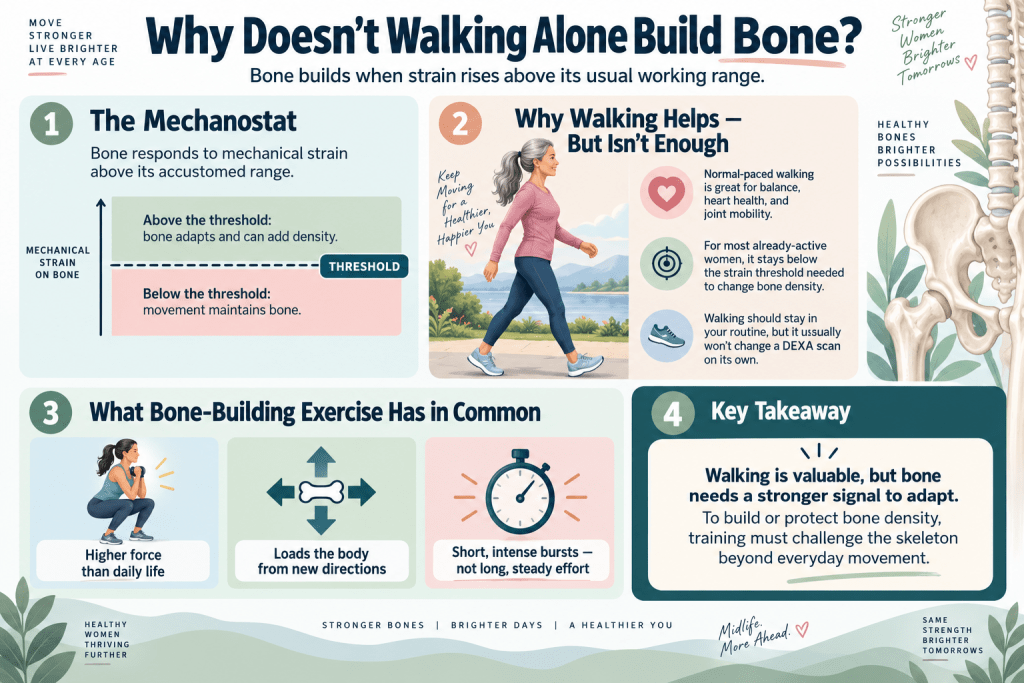
Bone responds to mechanical strain above its accustomed working range, a concept researchers call the mechanostat. Below a certain threshold of strain, a movement maintains bone. Above that threshold, bone adapts by adding density.
Why walking alone doesn’t build bone density

Walking at a normal pace, for most already-active women, sits below that threshold. It’s excellent for balance, cardiovascular health, and joint mobility, and it should stay part of any weekly routine, but it isn’t the lever that changes a DEXA scan on its own.

The exercises that do change bone density share three features: they load the skeleton with more force than daily life requires, they load it from directions the body isn’t used to, and they load it in short, intense bursts rather than long, steady efforts. The six categories below cover all three.

“I hear ‘I already walk 10,000 steps a day, isn’t that enough?’ constantly in coaching sessions. Walking is a wonderful habit and I’ll never discourage it, but if bone density is the specific goal, walking needs a partner, not a replacement. I learned this the hard way managing my own bone health after an early menopause diagnosis at 41. Cardio alone did nothing for my scan. Loading did.”

Terry Tateossian, Founder of The House of Rose

What Are the 6 Best Exercises for Building Stronger Bones After 40?

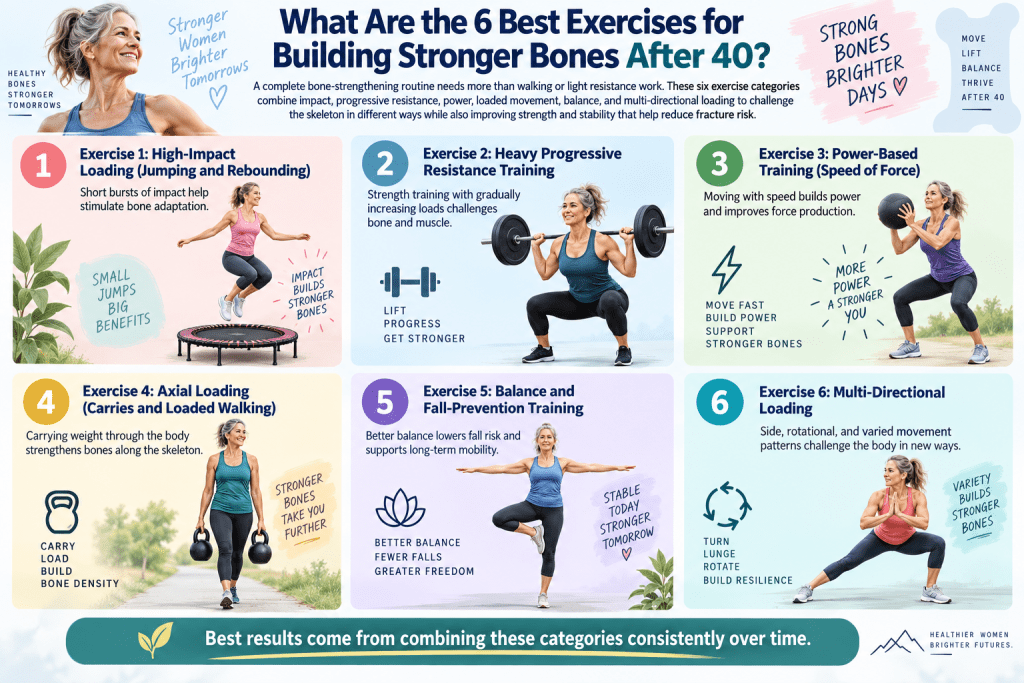
A complete bone-strengthening routine needs more than walking or light resistance work. These six exercise categories combine impact, progressive resistance, power, loaded movement, balance, and multi-directional loading to challenge the skeleton in different ways while also improving the strength and stability that help reduce fracture risk.
Six bone-strengthening exercises for women over 40

Exercise 1: High-Impact Loading (Jumping and Rebounding)

Why It Works

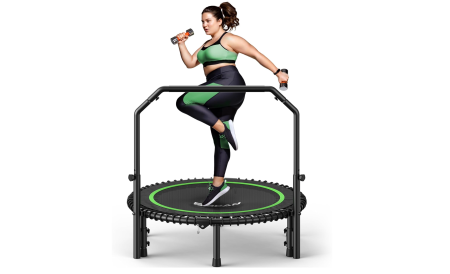
Ground reaction force, the force that travels back up through the skeleton on landing, is one of the most direct bone-building stimuli available. Jumping and rebounding generate that force in a low-injury-risk way because the landing is absorbed across both legs and, on a rebounder, across a surface with some give.

How to Do It

  • Start with 10-20 small jumps or rebounder bounces, feet staying close to the mat or floor
  • Progress to jumping jacks, higher-amplitude rebounder bounces, or jump rope as tolerance builds
  • Aim for 2-3 sessions per week, 5-10 minutes per session
  • Land softly through the whole foot, not just the toes, to protect the ankles and knees

Research on jump training protocols in postmenopausal women has found measurable hip bone density improvements from as few as 10-20 jumps performed several times per week over multiple months, with minimal injury risk when landings were performed correctly.

Important: Women with a current osteoporosis diagnosis, a recent fracture, or significant knee or hip joint damage should get clearance from a physician before beginning any jumping or rebounding protocol.

For a gradual progression from gentle health bounces to longer rebounder sessions, THOR’s rebounding guide provides a structured starting point for women in midlife.

Why Does the Rebounder Specifically Work for Sensitive Joints?

A mini trampoline absorbs a portion of the landing force before it reaches the joints, which lowers impact on the knees and hips relative to jumping on a hard floor while still generating enough ground reaction force to register as a bone-loading stimulus. This makes it a reasonable starting point for women who want the impact-loading benefit without the joint stress of running or floor-based jumping.

Free 28-Day Fascia Reset Email Course

Get our Free 28-day email course series to help with 1 or 2 exercises per day to release your fascia. One short lesson per day. Two minutes to read each.

Exercise 2: Heavy Progressive Resistance Training

Why It Works

Muscle attaches to bone through tendon, and every contraction pulls on that attachment point. Heavier loads recruit more muscle fibers and pull harder on bone, which is why resistance training with real, progressively increasing weight outperforms light-weight, high-repetition training for bone density specifically.

How to Do It

  • Focus on compound, multi-joint movements: squats, deadlift patterns, rows, presses
  • Work in the 6-10 repetition range with a weight that feels truly challenging by the last 2 reps
  • Progress load every 2-3 weeks as the current weight starts to feel easier
  • Train 2-3 times per week, allowing 48 hours between sessions for the same muscle groups

A weight that feels “fine” for 15 easy repetitions isn’t doing the same job on bone as a weight that makes rep 8 hard. This is one of the most common mistakes in home workout routines: not lifting heavy enough to register as a novel stimulus.

Creatine monohydrate can help support the strength and training adaptations that make resistance exercise more effective, indirectly strengthening the bone-loading side of the equation.

For a deeper look at the research, dosing, and midlife-specific benefits, THOR’s guide to creatine for women over 40 breaks down the evidence, while Thorne Creatine provides a straightforward creatine monohydrate option for adding it to your daily routine.

Worked Example: Choosing a Starting Weight

Woman

Current Fitness

Starting Squat Load

Target Rep Range

New to resistance training

Never lifted weights

Bodyweight or empty barbell (bar only)

8-10 reps, focus on form

Some experience

Lifts occasionally, unsure of loads

Weight that feels moderate for 12 reps

8-10 reps, add 5 lbs when easy

Regular lifter

Trains 2x/week already

Weight that’s truly hard by rep 8

6-8 reps, progressive overload

Load Approach

Typical Rep Range

Bone-Building Signal

Light resistance bands, high reps

15-25 reps

Low, insufficient mechanical strain

Moderate dumbbells, muscle endurance focus

12-15 reps

Low to moderate

Heavy compound lifts, progressive overload

6-10 reps

High, this is the target zone

Bodyweight only, no added load

Varies

Low unless combined with impact or power work

Free 28-Day Fascia Reset Email Course

Get our Free 28-day email course series to help with 1 or 2 exercises per day to release your fascia. One short lesson per day. Two minutes to read each.

Exercise 3: Power-Based Training (Speed of Force)

Why It Works

Power, defined as force produced quickly rather than slowly, appears to matter for bone and for fall prevention in a way that slow strength training alone doesn’t fully replicate. Moving a weight or your own bodyweight explosively, even a small amount of weight, creates a different rate of loading on bone than moving it slowly.

How to Do It

  • Sit-to-stand transfers: Perform as quickly as control allows, 3 sets of 8-10.
  • Step-ups: Perform with an explosive push off the working leg, 3 sets of 8 per side.
  • Medicine ball chest passes: Perform against a wall, 3 sets of 10, focusing on speed of release.
  • Begin with bodyweight versions: Progress to external load once control and technique are established.

This category is frequently skipped entirely in midlife fitness routines because it looks less like traditional “toning” work, but the missing piece is often speed, not weight.

Understanding the difference between power and strength helps explain why lifting heavier is only part of the equation. Power training focuses on producing force quickly, which supports faster reactions, more responsive movement, and the ability to recover from an unexpected stumble.

“Clients are often surprised that ‘explosive’ doesn’t mean advanced or dangerous. A sit-to-stand performed a little faster than usual, with good form, is a completely appropriate starting point. I’ve coached hundreds of women through this exact progression, and the ones who stick with power work are almost always the ones who feel steadiest walking down stairs a few months later.”

Terry Tateossian, Founder of The House of Rose

Exercise 4: Axial Loading (Carries and Loaded Walking)

Why It Works

Carrying weight while walking loads the spine and hips through a vertical, compressive path, which is exactly the direction hip and spine fractures tend to occur from bone weakness. This category is under-used in most fitness programming despite being simple to add to an existing walking habit.

How to Do It

  • Farmer’s carries: Hold a moderately heavy dumbbell or kettlebell in each hand, walk 30-40 steps, rest, and repeat for 3-4 rounds.
  • Weighted vest walking: Start with 5-10% of bodyweight added and walk your normal route.
  • Single-arm suitcase carries: Use these to add a rotational stability demand.
  • Progress load gradually: Increase the load the same way as any resistance exercise.

Worked Example

A 150-pound woman starting weighted vest walking might begin with a 10-12 pound vest for two 20-minute walks per week, adding roughly 2-3 pounds every few weeks as the current load stops feeling challenging by the walk’s second half.

Bodyweight

Starting Vest Load (5-8%)

Progression Pace

130 lbs

7-10 lbs

+2 lbs every 3-4 weeks

150 lbs

8-12 lbs

+2-3 lbs every 3-4 weeks

170 lbs

9-14 lbs

+3 lbs every 3-4 weeks

Free 28-Day Fascia Reset Email Course

Get our Free 28-day email course series to help with 1 or 2 exercises per day to release your fascia. One short lesson per day. Two minutes to read each.

Exercise 5: Balance and Fall-Prevention Training

Why It Works

Bone density is only half of fracture risk. The other half is whether a fall happens at all. Balance training doesn’t build bone directly, but it reduces the single largest risk factor for the fractures that bone density work is trying to prevent, which makes it inseparable from a real bone health plan.

How to Do It

  • Single-leg stance: Work toward 30 seconds per side without support.
  • Tandem walking: Walk heel-to-toe across a room for 3-4 passes.
  • Standing on an unstable surface: Use a folded towel or balance pad while holding light support.
  • Practice near a counter or wall: Use nearby support for safety as difficulty increases.

THOR has a full testing and improvement protocol at Single-Leg Stance Test for Women Over 40, including how to track progress over time.

Why Does Balance Training Belong in a Bone Density Article?

It’s tempting to treat balance work as a separate category from “real” bone-building exercise, but the research on fracture prevention treats fall risk and bone strength as two sides of the same equation. A woman with excellent bone density who falls hard still fractures. A woman with lower bone density who never falls often doesn’t. Both matter, and neither replaces the other.

Exercise 6: Multi-Directional Loading

Why It Works

Most daily movement and most traditional exercise happens in a single plane, forward and back. Bone that’s only ever loaded in one direction adapts to that one direction and stays vulnerable to forces from the side, which is how many hip fractures actually happen, from a sideways stumble rather than a forward fall.

How to Do It

  • Lateral lunges: Perform 2-3 sets of 8-10 per side.
  • Diagonal step-and-reach patterns: Step at a 45-degree angle while reaching the opposite arm.
  • Side-stepping with a resistance band: Place the band around the ankles and perform 2-3 sets of 10 steps in each direction.
  • Curtsy lunges: Add these once basic lateral lunges feel controlled.

Muscle groups that support these multi-directional movements, particularly the hip abductors and rotators, are covered in Muscles That Matter Most for Aging Well.

Free 28-Day Fascia Reset Email Course

Get our Free 28-day email course series to help with 1 or 2 exercises per day to release your fascia. One short lesson per day. Two minutes to read each.

How Can You Put the Six Exercises Together in a Sample Week?
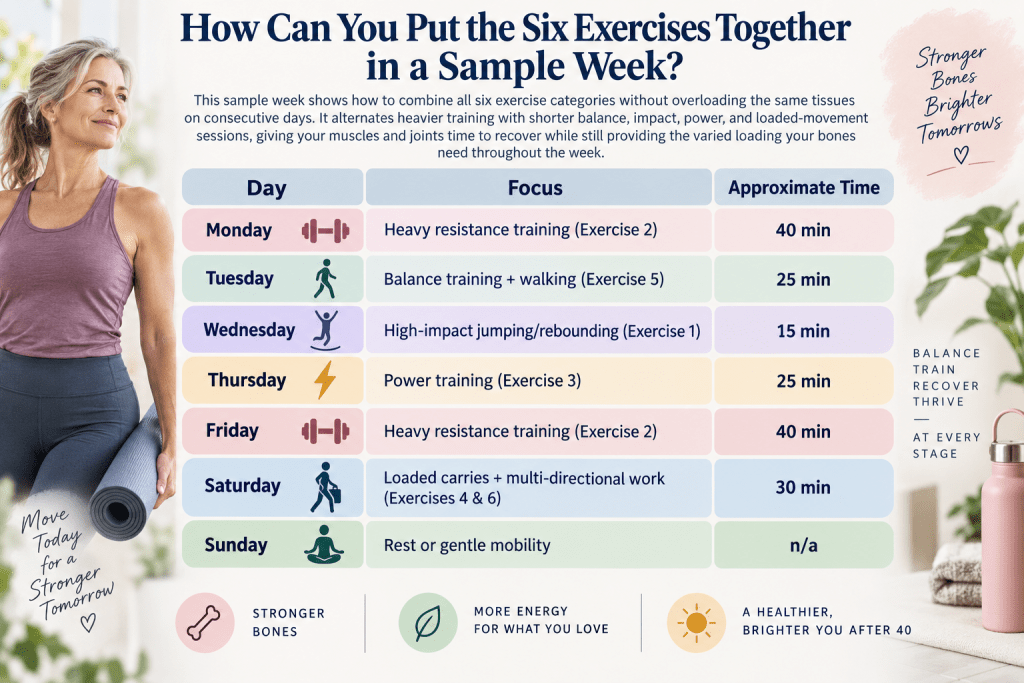
This sample week shows how to combine all six exercise categories without overloading the same tissues on consecutive days. It alternates heavier training with shorter balance, impact, power, and loaded-movement sessions, giving your muscles and joints time to recover while still providing the varied loading your bones need throughout the week.

Weekly bone-strength exercise plan for women over 40.

Day

Focus

Approximate Time

Monday

Heavy resistance training (Exercise 2)

40 min

Tuesday

Balance training + walking (Exercise 5)

25 min

Wednesday

High-impact jumping/rebounding (Exercise 1)

15 min

Thursday

Power training (Exercise 3)

25 min

Friday

Heavy resistance training (Exercise 2)

40 min

Saturday

Loaded carries + multi-directional work (Exercises 4 & 6)

30 min

Sunday

Rest or gentle mobility

n/a

This isn’t the only way to sequence these six categories, but it spaces heavy resistance days 48 hours apart and keeps impact work to days when joints feel fresh.

“I tell clients to think of this as a rotation, not a checklist to finish in one workout. Two categories done well on a given day beats all six done poorly. That’s the same principle I build every retreat program around at our Smoky Mountain property: fewer things, done with real intent, beats a packed schedule nobody can sustain once they go home.”

Terry Tateossian, Founder of The House of Rose

What Does the Research Actually Show?

Bone density research in midlife and postmenopausal women consistently points toward a few conclusions worth stating plainly, without overselling them:

  • Multi-component programs: Combining resistance training, impact loading, and balance work shows more consistent bone density benefits at the hip and spine than any single exercise type alone.
  • Loss rates during the menopause transition: These are real and measurable, but exercise-based interventions have shown the ability to slow that loss and, in some studies, modestly increase density at specific sites, particularly the hip.
  • Consistency over months and years: This matters more than any single “best” exercise. Bone remodeling is slow, and meaningful DEXA-detectable change typically takes 6-12 months of consistent training, not weeks.
  • Exercise does not replace medical evaluation: For women already diagnosed with osteoporosis, it’s a complement to, not a substitute for, whatever a physician recommends based on individual fracture risk and bone density scores.

Nutrition also plays a supporting role alongside training. Adequate protein intake supports the muscle side of the muscle-bone connection, and THOR’s free macro calculator can help set a personalized protein target to train against.

Free 28-Day Fascia Reset Email Course

Get our Free 28-day email course series to help with 1 or 2 exercises per day to release your fascia. One short lesson per day. Two minutes to read each.

When Should You Talk to a Doctor Before Starting?

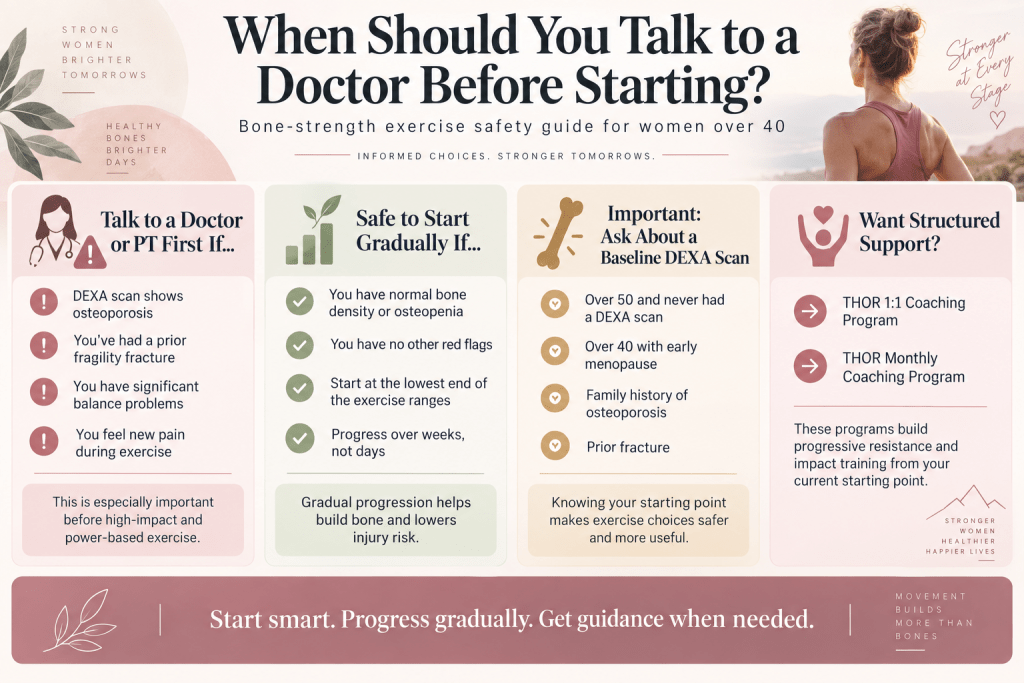
A DEXA scan showing osteoporosis, a prior fragility fracture, significant balance problems, or any new pain during exercise are all reasons to loop in a physician or physical therapist before starting a program like this one, particularly the high-impact and power categories.
When to see a doctor before bone exercise

For women with normal bone density or osteopenia and no other red flags, these categories are generally considered safe to begin gradually, but “gradually” is doing real work in that sentence. Starting at the lowest end of any of the ranges above and progressing over weeks, not days, is the difference between building bone and getting hurt.

Important: If you have never had a DEXA scan and are over 50, or over 40 with early menopause, a family history of osteoporosis, or a prior fracture, ask your doctor whether a baseline scan makes sense before starting a new training program. Knowing your starting point makes every exercise choice in this article more useful.

What Are Your Next Steps?

  1. If you’re over 50, or over 40 with early menopause or a family history of osteoporosis, ask your doctor about a baseline DEXA scan before starting.
  2. Pick two of the six exercise categories to start with this week, ideally one resistance-based and one impact or balance-based.
  3. Use THOR’s free macro calculator to set a protein target that supports the muscle-bone connection.
  4. Build toward the sample week above over 4-6 weeks, adding one category at a time rather than all six at once.
  5. Revisit this article every few months to check your progression against the load and rep ranges listed for each exercise.

Building bone density is not a single workout, it’s a rotation practiced consistently over months. For a done-for-you approach to structuring these six categories into a weekly plan tailored to your current fitness level, THOR’s 1:1 coaching program builds progressive resistance and impact training safely from wherever you’re starting.

Supporting nutrients for bone health, including calcium, vitamin D, and vitamin K2, are covered in THOR’s Advanced Bone Support formula, and pairing a training plan with real food is easiest with THOR’s Macro Miracle Mediterranean Cookbook, which was built around the same protein-forward approach this article recommends.

If you’re weighing a longer-term reset, THOR’s women’s yoga retreats build guided strength and movement programming, including several of the six categories above, into a supported week away.

Important: This article is educational and does not replace individualized medical advice. Please consult a physician before beginning a new exercise program, especially if you have an existing bone density diagnosis, a prior fracture, or a cardiovascular or joint condition.

Free 28-Day Fascia Reset Email Course

Get our Free 28-day email course series to help with 1 or 2 exercises per day to release your fascia. One short lesson per day. Two minutes to read each.
Frequently Asked Questions

Can you really increase bone density after 40, or only slow the loss?

Both are possible, though slowing loss is the more common and more reliably documented outcome. Increases in bone density have been shown in research at specific sites, most consistently the hip, with consistent multi-component training over 6-12 months or longer.

Is rebounding as good as running for bone density?

Rebounding provides meaningful ground reaction force with lower impact on the joints than running on pavement, making it a reasonable substitute for women with joint concerns. Running on a hard surface may provide a stronger stimulus for some, but the injury tradeoff should factor into the decision.

How long before I’d see a difference on a DEXA scan?

Most research protocols run 6-12 months before rescanning, since bone remodeling is a slow process. A single month of consistent training won’t show up on a scan, but it’s still the month that starts the process.

Do I need weights, or can bodyweight exercises build bone density?

Bodyweight exercise can work for the impact and power categories (jumping, sit-to-stand speed work), but the heavy resistance category generally requires external load, since bodyweight alone stops providing a new stimulus once a woman is already strong enough to perform the movement easily.

Is walking with a weighted vest enough on its own?

It’s a strong addition to a walking habit and covers the axial loading category well, but it works best alongside resistance training and impact work rather than as a complete stand-alone bone density program.

What’s the difference between osteopenia and osteoporosis?

Osteopenia is a bone density measurement lower than normal but not low enough to meet the diagnostic threshold for osteoporosis. It’s often described as an early warning stage where lifestyle intervention, including the exercises in this article, has the most opportunity to change the trajectory before density drops further.

Can I do these exercises if I already have osteoporosis?

Some can be adapted, but high-impact jumping and certain power movements may need modification or physician clearance first, particularly if there’s been a prior fragility fracture. A physical therapist familiar with osteoporosis exercise guidelines can help tailor the six categories safely.

Does menopause hormone therapy affect how much exercise helps?

Hormone therapy addresses the estrogen side of bone loss directly, while exercise addresses the mechanical loading side. The two work through different pathways and are generally considered complementary rather than substitutes for one another, though any decision about hormone therapy should be made with a physician.

How many days a week is realistic for a beginner?

Three focused sessions a week, combining one resistance day, one impact or power day, and one balance-focused day, is a reasonable and sustainable starting point for someone new to structured bone-loading exercise.

Is it too late to start if I’m already in my sixties or seventies?

No. Research on exercise interventions in older postmenopausal women, including women in their seventies, has shown bone and fall-risk benefits from starting a structured program, though starting loads and progression pace should be more conservative and ideally supervised.

Do I need special equipment to get started?

A rebounder, a pair of moderate dumbbells, and a resistance band cover most of the six categories. None of it requires a full home gym, though a gym membership with access to a squat rack and heavier dumbbells allows more progression room over time.

What role does protein play in bone density specifically?

Protein supports the muscle mass that pulls on and loads bone during resistance and power training, making adequate intake a supporting factor rather than a direct bone-building mechanism on its own. THOR’s free macro calculator can help set a personalized target.

Should I do cardio at all if I’m focused on bone density?

Cardiovascular exercise remains important for heart health and should stay in a weekly routine, but it should sit alongside, not instead of, the six loading categories in this article if bone density is a specific goal.

Can supplements replace exercise for bone density?

No. Supplements such as calcium, vitamin D, and vitamin K2 support the raw materials bone needs to remodel, but without a mechanical loading stimulus from exercise, those raw materials have less signal telling the body where to direct them.

References

  • Finkelstein, J.S., et al. “Bone mineral density changes during the menopause transition in a multiethnic cohort of women.” Journal of Clinical Endocrinology & Metabolism.
  • Frost, H.M. “Bone’s mechanostat: a 2003 update.” The Anatomical Record.
  • Bailey, C.A., & Brooke-Wavell, K. “Optimum frequency of exercise for bone health: randomised controlled trial of a high-impact unilateral intervention.” Bone.
  • Multicomponent exercise interventions and bone mineral density outcomes in postmenopausal women, systematic review data.
  • Watson, S.L., et al. “High-intensity resistance and impact training improves bone mineral density and physical function in postmenopausal women with osteopenia and osteoporosis: the LIFTMOR randomized controlled trial.” Journal of Bone and Mineral Research.
  • Power training versus traditional strength training outcomes in fall risk and functional performance in older adults, comparative training studies.
  • Farmer’s carry and axial loading biomechanics research on spinal and hip compressive load patterns.
  • Sherrington, C., et al. “Exercise for preventing falls in older people living in the community.” Cochrane Database of Systematic Reviews.
  • National Osteoporosis Foundation clinician’s guide to prevention and treatment of osteoporosis.
  • Mayo Clinic patient education materials on osteoporosis exercise recommendations and safety guidelines.
  • Cleveland Clinic patient education materials on bone density and weight-bearing exercise.
  • Vainionpää, A., et al. “Effect of impact exercise on bone mineral density in premenopausal women: a 10-year follow-up study.” Osteoporosis International.
  • Beck, B.R., et al. “Exercise and bone health in postmenopausal women.” Journal of Science and Medicine in Sport.
  • Zhao, R., et al. “Efficiency of jumping exercise in improving bone mineral density among premenopausal women: a meta-analysis.” Sports Medicine.
  • Giangregorio, L.M., et al. “Too Fit To Fracture: exercise recommendations for individuals with osteoporosis or osteoporotic vertebral fracture.” Osteoporosis International.
  • National Institute on Aging patient guidance on exercise, balance, and fall prevention in older adults.

Disclaimer: This article is educational and does not constitute medical advice. Bone-loading exercises such as jumping, rebounding, heavy resistance training, power movements, and weighted carries require appropriate progression and may not be suitable for everyone. If you have osteoporosis, osteopenia with additional risk factors, a prior fragility fracture, significant balance problems, cardiovascular or joint conditions, or new pain with exercise, consult a physician or physical therapist before starting the framework in this article.

Free 28-Day Fascia Reset Email Course

Get our Free 28-day email course series to help with 1 or 2 exercises per day to release your fascia. One short lesson per day. Two minutes to read each.

How Many Minutes of Rebounding Per Day for Women Over 40? The Science-Backed Answer

You have heard the rebounding hype. Every other TikTok, every other wellness influencer, every other woman in your life is suddenly on a mini trampoline claiming it fixed her lymph, her belly, her menopause, her mood. And for once, the hype is mostly right. Rebounding is an exceptional tool for women over 40 — but the question nobody answers is the only one that matters: how much?

Free 28-Day Fascia & Lymph Reset Email Course

Get our Free 28-day email course series to help with 1 or 2 exercises per day to release your fascia. One short lesson per day. Two minutes to read each.

Ten minutes? Thirty? 100 jumps? Two hundred?

Short answer: for most women over 40, 10 to 20 minutes a day at a moderate effort gives you the bulk of the benefits — bone loading, lymphatic drainage, cardiovascular conditioning, pelvic floor strengthening, mood, and mitochondrial support — without crossing into overtraining or joint irritation. If you are already active and conditioned, 20 to 30 minutes split into two sessions is a beautiful sweet spot. More than that is rarely better and, in some cases, worse.

That is the TL;DR. The rest of this article walks you through the research, the reasoning, how to progress safely, what to do if you are brand new, and the specific dose sweet spots for bone density, lymphatic drainage, pelvic floor, and fat loss — because those are not the same minute totals.

If you want context on why rebounding is such a potent midlife tool in the first place, start with our original pieces on the benefits of jumping, rebounding for menopause, and the 100 jumps trend. This article is the prescription companion — here is how much, for what outcome, and why.

Rebounding for women over 40
My favorite rebounder for women over 40

The Short Answer: 10 to 20 Minutes Daily, Progressed Over Time

Let me give you the headline doses up front. These are the recommendations I give my 1:1 clients based on the published research plus a decade of coaching midlife women.

For general midlife health and lymphatic drainage: 10 minutes of gentle bouncing, 5 to 7 days a week.

For bone density in perimenopause or postmenopause: 15 to 20 minutes, 4 to 5 days a week, with at least some of that at higher impact (controlled jumps, not just health bounces).

For cardiovascular fitness and fat loss: 20 to 30 minutes at moderate to vigorous intensity, 3 to 5 days a week — often split into two 10-to-15-minute sessions.

For pelvic floor rehab or new to rebounding: Start with 3 to 5 minutes of “health bouncing” (feet never leaving the mat), build to 10 over 4 to 6 weeks, then progress.

For recovery and lymph on rest days: 5 to 10 minutes of gentle health bouncing, any day you want.

Now let me show you why those numbers. The research is better than you would think.

Why Women Over 40 Respond So Well to Rebounding in the First Place

Before we argue dosage, let’s quickly revisit why rebounding is worth your time at all. Three systems benefit disproportionately once you hit 40.

Your bones. Estrogen is a direct regulator of bone remodeling. When estrogen drops in perimenopause and menopause, osteoclast activity (cells that break down bone) outpaces osteoblast activity (cells that build bone), and bone density drops 1 to 2% per year. Mechanical loading — specifically impact and strain — is one of the most potent, free, drug-free tools for slowing or reversing this. NASA famously investigated rebounding as a tool for astronauts returning from zero-gravity bone loss, and the landmark research by Bhattacharya and colleagues found that jumping on a mini-trampoline produced G-force loading at the ankle, back, and forehead comparable to or exceeding running, at a fraction of the joint stress.

Your pelvic floor. Repeated bouncing in a controlled way is actually excellent for pelvic floor coordination, provided you have learned how to engage it. Pelvic floor physiotherapists increasingly prescribe mini-trampoline work for this reason. Research published in Neurourology and Urodynamics has shown that low-impact, controlled jumping combined with pelvic floor contractions improves continence in perimenopausal women.

Your lymphatic system. Your lymph has no pump — it moves by muscle contraction, breathing, and gravity-plus-acceleration (which rebounding provides beautifully). A study in the European Journal of Applied Physiology demonstrated that short bouts of rebounding measurably increase lymphatic flow, which supports immune function, inflammation resolution, and the kind of systemic “cleanup” most midlife women complain they have lost.

Plus: it is weight-bearing but joint-friendly, it is inexpensive, it takes almost no space, and the learning curve is 30 seconds. It is hard to find another tool with that profile in midlife.

Rebounding for women over 40
My favorite rebounder for women over 40

The Science Behind the “10 Minutes” Number

Why 10 minutes? Why not 5, why not 30?

The short version is that the peer-reviewed literature on rebounding and moderate jumping studies consistently uses 10-minute protocols because that is roughly the threshold where meaningful lymphatic and cardiovascular response kicks in without accumulating excessive fatigue or joint stress.

A 2016 study published in the Journal of Sports Science and Medicine evaluated a 10-minute mini-trampoline protocol (warm-up plus continuous bouncing) and found significant improvements in VO2 max, lower-body strength, and balance in young adults over 8 weeks. A 2018 study in the Journal of Strength and Conditioning Research used 20-minute rebounding sessions three times a week in older women and found significant gains in lean mass, postural balance, and lower-body power.

On the bone side, high-impact jumping protocols — typically 10 to 50 jumps per session, a few days a week — have been shown to improve bone mineral density at the hip and spine in perimenopausal and postmenopausal women. A 2014 trial published in the American Journal of Health Promotion found that premenopausal women who performed 10 multidirectional jumps twice daily, 4 months in, had increased hip BMD by ~1.5%. That protocol takes about 90 seconds total — but to get the cardiovascular, lymph, and balance benefits on top, we build up to 10 to 20 minutes.

The upper end of “how much is useful” is softer. Studies using 30 to 40 minutes show diminishing returns on bone and lymph and rising overuse risk on knees and ankles in untrained women. More is not better past a certain point. This is especially true in perimenopausal women, whose recovery is already compromised by shifting hormones and often under-fueled eating.

Free 28-Day Fascia & Lymph Reset Email Course

Get our Free 28-day email course series to help with 1 or 2 exercises per day to release your fascia. One short lesson per day. Two minutes to read each.

The Different Doses for Different Goals

Here is where it gets useful. “10 to 20 minutes” is a reasonable default, but different goals have different sweet spots. Match the dose to the outcome.

For Lymphatic Drainage: 5 to 10 Minutes of Gentle Health Bouncing

The lymph benefit kicks in fast and does not require height. “Health bouncing” — feet staying in contact with the mat, knees softly flexing, arms relaxed — for 5 to 10 minutes produces the acceleration-driven lymph flow researchers have measured. You do not need to jump high. You do not need to sweat. This is the rebounding I prescribe to women in the first week of a reset, women recovering from illness, women dealing with water retention, and women on rest days between strength sessions.

For Bone Density: 15 to 20 Minutes With Actual Impact

Health bouncing is not enough for bone. For bone remodeling you need ground reaction forces at or above roughly 3 to 4 times body weight, which means actual jumping — feet clearing the mat, landing with control. Research from the University of Bristol’s Avon Longitudinal Study and others has found that 50 to 100 moderate-to-high-impact jumps per session, several times a week, is a threshold for bone response. A rebounder lets you do this with far less joint impact than concrete, because the mat absorbs some of the deceleration.

For a 20-minute bone-focused session, I like: 5 minutes health bounce warm-up, 10 minutes of interval work (30 seconds controlled jumps / 30 seconds easy bounce) × 10, 5 minutes easy bounce cool-down. That is approximately 100 loaded jumps plus a full lymph flush.

For Cardiovascular Fitness and Fat Loss: 20 to 30 Minutes at Moderate Intensity

If you are using rebounding as your primary cardio, you want to hit zone 2 to low zone 3 heart rate (roughly 60 to 75% of max HR) for 20 to 30 minutes. Two 15-minute sessions, or one 25-minute session, gets the job done. If you want a scaffolded framework for training in the right intensity zones, our cardio zones cheat sheet is a useful reference.

Rebounding alone will not out-perform a pure fat-loss protocol — that requires a nutrition framework layered on top, which is why I point every client toward the free macro calculator and the Macro Miracle Mediterranean Cookbook as the foundation — but it makes a wonderful joint-friendly cardio backbone for midlife women who cannot tolerate running.

For Pelvic Floor: Short Sessions, High Technique, Slowly Progressed

If your pelvic floor is a concern — leaking with a sneeze, post-kid, perimenopausal laxity — start with 3 to 5 minutes of health bouncing with conscious pelvic floor engagement (light lift-and-release timed to the bounce). Build to 10 minutes over 4 to 6 weeks. Only progress to actual jumping once you have zero leaking at 10 minutes of health bounce. This is a pelvic-floor-physio recommendation, not a “just send it” recommendation. When in doubt, see a pelvic floor PT before rebounding.

For Recovery, Mood, and Circulation: 5 to 10 Minutes, Anytime

Honestly, 5 minutes of easy health bouncing with music feels like cheating. It shifts mood, flushes lymph, gets blood moving, and takes almost nothing out of you. Great for rest days, midday afternoon-slump breaks, or right after a stressful call.

Rebounding for women over 40
My favorite rebounder for women over 40

How to Build Up If You Are Brand New to Rebounding

If you have not jumped on a mini-trampoline in a decade, your ankles, calves, and core need a ramp-up. Here is how I walk new clients in.

Week 1: 3 minutes of health bouncing, 3 days this week. Feet stay on the mat. Knees soft. Focus on posture — tall chest, ribs stacked over pelvis, neutral spine.

Week 2: 5 minutes of health bouncing, 4 days. Add gentle arm movement. Focus on breathing through the bounce.

Week 3: 7 minutes, mixing health bounce with small heel lifts (heels come off mat but toes stay). 4 to 5 days.

Week 4: 10 minutes. Include 20 seconds of small controlled jumps (feet clear mat) every 2 minutes. 4 to 5 days.

Week 5–6: 10 to 15 minutes daily. Build impact portions to 30 seconds every 2 minutes.

Week 7+: Up to 20 minutes, with intervals appropriate to your goal (bone, cardio, etc.).

This ramp matters because ankle sprains, calf strains, and pelvic floor leaks are the three things that take women out of rebounding in the first two weeks. A four-to-six-week build protects you from all three.

Free 28-Day Fascia & Lymph Reset Email Course

Get our Free 28-day email course series to help with 1 or 2 exercises per day to release your fascia. One short lesson per day. Two minutes to read each.

The Mistakes That Turn Rebounding From Medicine Into Injury

I have seen this enough times to name the pattern. Here are the rebounding mistakes that turn a fantastic tool into a problem.

Too much, too soon. Going from zero to 30 minutes because the TikTok lady says to. Calves will revolt. Knees will ache. Pelvic floor will leak.

Bad surface quality. A $40 trampoline from a big-box store with weak springs and a sagging mat is not the same thing as a bungee-strapped rebounder. Your ankles know the difference. A good rebounder is $150 to $350 and lasts a decade.

Poor posture. Most rebounding injuries happen when women fold at the waist and look down at the mat. Chest tall, eyes forward, ribs stacked.

Ignoring pelvic floor signals. If you are leaking at any point, stop the jumping portion and drop back to health bounce until you can do 10 minutes with zero leaking. Progress from there. A pelvic PT is a great investment if this is persistent.

No warm-up. A 60-year-old calf does not appreciate being launched into full bouncing from a cold start. 2 minutes of ankle circles, calf raises, and walking in place before you get on the rebounder.

Rebounding as a substitute for strength training. Rebounding is wonderful for the bone, lymph, mood, and cardio categories, but it does not replace resistance training for muscle mass. Muscle is the single most important metabolic currency in midlife, and it does not grow from jumping alone. Pair rebounding with 2 to 3 strength sessions per week — deadlifts, squats, hip thrusts, presses. Our library on strength training fundamentals, hip thrusts, and barbell squats walks you through the big lifts.

Skipping recovery. Daily 20-minute rebounding without adequate protein, sleep, and deload days catches up with women over 40 within weeks. The body that recovers is the body that adapts.

Best weighted Jump Rope for W0men over 40
Best weighted Jump Rope for Women over 40

Pairing Rebounding With Strength and Nutrition for Maximum Effect

Rebounding is a multiplier, not a solo act. Here is what to pair it with for actual body-composition and hormonal results.

Strength training twice to three times per week. Non-negotiable for midlife women. The literature on muscle preservation post-menopause is overwhelming — you need resistance work to hold onto lean mass. Rebounding does not replace it.

Protein at every meal. The midlife target is roughly 0.7 to 1.0 g of protein per pound of goal bodyweight, spread across 3 to 4 meals. This is the fuel for muscle, bone, connective tissue, and the recovery you need to keep rebounding consistently.

Creatine, 5 g daily. Creatine monohydrate is one of the best-studied supplements for women over 40 — it supports muscle, brain, and bone response to training. Start with our deep dive on creatine for women over 40 and the benefits of creatine for women over 40.

Adequate sleep. Bone remodeling, muscle repair, and HPA axis regulation all happen during sleep. If you are not sleeping 7+ hours, the rebounding will help less than it could. See our sleep piece for why.

Nutrition. You cannot rebound your way out of a poor diet. The midlife nutrition hierarchy — calories, protein, fiber, micronutrients, meal timing, in that order — is explained in midlife nutrition hierarchy for women. For the practical recipes that fit midlife training and fat loss, the Macro Miracle Mediterranean Cookbook is built around this framework.

Is It Safe to Rebound Every Day?

For most midlife women in reasonable health, yes — provided you vary the intensity and listen to your body. A well-structured daily rebounding practice might look like:

  • Monday: 20 min, moderate bone-focused intervals
  • Tuesday: 10 min, easy health bounce (active recovery)
  • Wednesday: 20 min, moderate cardio
  • Thursday: 10 min, easy health bounce
  • Friday: 20 min, moderate bone-focused intervals
  • Saturday: 15 min, easy-to-moderate
  • Sunday: 5 to 10 min easy or full rest

That is 100 minutes of rebounding a week, well within the safe dose range, with plenty of recovery. If you are newly menopausal, training hard, under-fueled, or sleeping badly, scale it back.

Red flags to stop or back off: – Persistent calf or Achilles pain – Knee pain that builds during the session – Pelvic floor leaking – Lightheadedness (often blood pressure or blood sugar — eat first) – Rising morning resting heart rate or falling HRV trending over two weeks – Sleep quality dropping – Menstrual cycle changes or sudden amenorrhea (perimenopause makes this tricky, but worth tracking)

Rebounding for women over 40
My favorite mini trampoline and rebounder for women over 40

Who Should Not Rebound or Should Scale Way Back

Rebounding is wonderful for most women over 40, but a few situations warrant clinician input first.

Severe osteoporosis with fracture risk. Talk to a physician or physical therapist before starting impact work. They may recommend health bounce only to start.

Pregnant women (later pregnancies especially). Health bounce may be fine, but jumping is not. Consult your OB.

Severe pelvic organ prolapse. See a pelvic floor PT first.

Recent hip, knee, or ankle surgery. Get clearance.

Active vertigo or BPPV. Rebounding can aggravate it.

Certain retinal conditions. If you have unstable retina issues or recent eye surgery, clear it with your ophthalmologist.

None of these are “never rebound” — most are just “start slower, under guidance.”

Free 28-Day Fascia & Lymph Reset Email Course

Get our Free 28-day email course series to help with 1 or 2 exercises per day to release your fascia. One short lesson per day. Two minutes to read each.

A Sample Weekly Rebounding Plan for Women Over 40

Here is a template you can plug into your week. Modify to match your schedule and training age.

If you are brand new (first 4-6 weeks): – Monday, Wednesday, Friday: 5-10 min health bounce – Other days: walks, strength, rest

If you are conditioned and training for general midlife health: – Monday: 15 min interval rebound (moderate) – Tuesday: Strength (lower body) – Wednesday: 20 min steady rebound or walk + 10 min health bounce – Thursday: Strength (upper body) – Friday: 15 min interval rebound + core – Saturday: Longer walk + 10 min health bounce – Sunday: Rest or yoga

If you are training for bone density specifically (post-menopause): – Monday, Wednesday, Friday: 20 min with ~100 controlled jumps embedded in intervals – Tuesday, Thursday: Strength (hip hinge, squat, press patterns) – Saturday: 15 min moderate + easy walk – Sunday: Rest

None of these are prescriptive. Your schedule, your body, your recovery capacity all matter. If you want a plan built around your specific hormones, labs, lifestyle, and bone-density starting point, that is exactly the kind of thing we build inside Age With Strength 1:1 coaching. For a week-long full-body reset that integrates rebounding, strength, nutrition, sleep, and nervous system work, our THOR women’s wellness retreats are the simplest shortcut.

Best weighted Jump Rope for W0men over 40
Best weighted Jump Rope for Women over 40

Frequently Asked Questions on How Many Minutes of Rebounding Per Day

Is 10 minutes of rebounding a day enough?

For most women over 40, 10 minutes daily is enough to produce measurable lymphatic, cardiovascular, mood, and balance benefits — especially if some of it includes controlled jumping. For bone density as a primary goal, 15 to 20 minutes, 4 to 5 days a week, is the better target. More than 20 minutes daily offers diminishing returns and raises overuse risk in untrained women.

How many jumps per day is ideal for bone density?

Research suggests 50 to 100 moderate-to-high-impact jumps per session, 3 to 5 days a week, is the threshold for bone response. That translates to roughly 10 to 15 minutes of interval work (alternating jumps with rest). You can absolutely get more than that safely once you are conditioned, but 100 jumps a day is a well-supported floor.

Can I rebound every day or do I need rest days?

You can rebound daily if you vary the intensity. A good rule is: 3 to 4 hard/moderate days, 2 to 3 easy/health-bounce days, 1 rest day. Hard-every-day rebounding accumulates overuse stress in calves, Achilles, and the pelvic floor.

What size rebounder should I buy?

Look for a 36-to-44-inch diameter rebounder with bungee cords (not steel springs) and a sturdy frame. The weight capacity should exceed your bodyweight by at least 50 lb. Expect to spend $150 to $350 for a good one. Cheap big-box trampolines are a false economy — they die in 6 months.

Will rebounding help me lose belly fat?

Rebounding is cardio, and cardio contributes to fat loss — but belly fat specifically is more responsive to hormonal regulation, nutrition, and strength training than any one cardio modality. Pair rebounding with strength training, a macro-tracked nutrition plan (start with the free macro calculator), sleep, and stress management. That is the combination that works. Read perimenopause weight gain for the midlife-specific picture.

Rebounding for women over 40
My favorite rebounder for women over 40

Is rebounding better than running for women over 40?

“Better” depends on your goals and joints. Rebounding is lower impact, easier on knees and ankles, and excellent for lymph and bone — but running produces higher cardiac adaptation per minute and more ground force for bone. If your knees hate running, rebounding is a fantastic substitute. If you love running and your joints feel fine, do both. They are complementary.

Free 28-Day Fascia & Lymph Reset Email Course

Get our Free 28-day email course series to help with 1 or 2 exercises per day to release your fascia. One short lesson per day. Two minutes to read each.

What about pelvic floor issues. Should I avoid rebounding entirely?

Not necessarily. Controlled health bouncing (feet staying on mat) is usually safe and often beneficial for mild pelvic floor issues, and can even be therapeutic. Full jumping should wait until you have zero leaking at 10 minutes of health bounce, or until a pelvic floor physiotherapist clears you.

Should I rebound before or after strength training?

For most people, strength first, rebounding after — so your legs are fresh for the heaviest lifts. A 5-minute rebound warm-up is fine. If you want a full 20-minute rebound session on the same day as heavy leg training, separate them by at least 4 hours.

Best weighted Jump Rope for W0men over 40
Best weighted Jump Rope for Women over 40

Does rebounding count as zone 2 cardio?

It can, depending on intensity. Gentle health bouncing is generally zone 1 to low zone 2. Moderate interval rebounding puts you in zone 2 to low zone 3. Use a heart rate monitor if you are training for specific zones. The cardio zones cheat sheet breaks down the numbers.

How fast will I see results?

Lymphatic and mood benefits are often noticed within the first week. Cardiovascular fitness improves noticeably in 3 to 4 weeks. Balance and lower-body power measurably improve in 6 to 8 weeks. Bone density changes take 6 to 12 months to show up on a DEXA scan — consistency over time, not intensity in a week, is what drives bone response.

Can I combine rebounding with the “100 jumps” trend?

Yes, in fact the 100-jumps concept fits neatly inside the bone-density protocol. You can read our full take on the 100 jumps trend — the short version is that 100 daily jumps is a reasonable floor for bone loading, and rebounding is the easiest way to accumulate them with joint-friendly impact.

Is rebounding safe during perimenopause and menopause?

Yes — and in fact perimenopause and menopause are exactly when rebounding delivers its highest-value benefits (bone, lymph, balance, mood, nervous-system regulation). Our deep piece on rebounding for menopause covers the hormonal rationale in depth.

Rebounding for women over 40
My favorite rebounder for women over 40


The Bottom Line: Your Daily Rebounding Prescription

Free 28-Day Fascia & Lymph Reset Email Course

Get our Free 28-day email course series to help with 1 or 2 exercises per day to release your fascia. One short lesson per day. Two minutes to read each.

If you take nothing else from this article:

  1. 10 to 20 minutes a day is the sweet spot for most women over 40.
  2. Start at 5 to 10 minutes if you are new, and build over 4 to 6 weeks.
  3. Mix health bouncing (feet on mat) and controlled jumping (feet clear mat) based on your goal.
  4. For bone density, prioritize ~100 controlled jumps per session, 3 to 5 days a week.
  5. Pair rebounding with strength training 2 to 3 times a week, protein at every meal, creatine, and sleep.
  6. Rebounding is a multiplier, not a replacement for strength or nutrition.

Rebounding is one of the most generous tools in a midlife woman’s kit — it gives back cardio, lymph, bone, balance, pelvic floor support, and mood at a dose that fits inside any busy schedule. Do not overthink it. Step on the mat, press play on music you love, and bounce.

If you want the personalized programming — how much rebounding specifically for your bone density score, your training age, your hormonal status, and your recovery capacity — that is what we do together inside Age With Strength 1:1 coaching. And if you want to experience it as part of a full daily rhythm — mornings, movement, meals, recovery — a few days at a THOR women’s wellness retreat is the fastest reset I know.

Jump smart. Jump often. Your bones, your lymph, and your mood will thank you.

I write 3 essays per week on Lifestyle Medicine for women in midlife on what is happening in the body and what to do about it. No fluff, no hype. Free.

References and Sources

  1. Bhattacharya A, McCutcheon EP, Shvartz E, Greenleaf JE. (1980). Body acceleration distribution and O2 uptake in humans during running and jumping. Journal of Applied Physiology: Respiratory, Environmental and Exercise Physiology, 49(5), 881-887.
  2. Arabzadeh E, Mofrad MM, Taherpour M, et al. (2019). The effects of a 10-week mini-trampoline training program on the balance and fitness of adult men. Journal of Sports Science and Medicine.
  3. Miklitsch C, Krewer C, Freivogel S, Steube D. (2013). Effects of a predefined mini-trampoline training programme on balance, mobility and activities of daily living after stroke: a randomized controlled pilot study. Clinical Rehabilitation, 27(10), 939-947.
  4. Aragão FA, Karamanidis K, Vaz MA, Arampatzis A. (2011). Mini-trampoline exercise related to mechanisms of dynamic stability improves the ability to regain balance in elderly. Journal of Electromyography and Kinesiology, 21(3), 512-518.
  5. Witzke KA, Snow CM. (2000). Effects of plyometric jump training on bone mass in adolescent girls. Medicine and Science in Sports and Exercise, 32(6), 1051-1057.
  6. Ahola R, Kröger H, Väänänen HK, et al. (2010). Effect of daily exercise on bone mineral density and content in healthy premenopausal women. Bone, 47(4), 742-748.
  7. Tucker LA, Strong JE, LeCheminant JD, Bailey BW. (2015). Effect of two jumping programs on hip bone mineral density in premenopausal women: a randomized controlled trial. American Journal of Health Promotion, 29(3), 158-164.
  8. Baumgartner RN, et al. (1998). Epidemiology of sarcopenia among the elderly in New Mexico. American Journal of Epidemiology, 147(8), 755-763.
  9. Weaver CM, Gordon CM, Janz KF, et al. (2016). The National Osteoporosis Foundation’s position statement on peak bone mass development and lifestyle factors: a systematic review and implementation recommendations. Osteoporosis International, 27(4), 1281-1386.
  10. Gillespie LD, Robertson MC, Gillespie WJ, et al. (2012). Interventions for preventing falls in older people living in the community. Cochrane Database of Systematic Reviews, (9):CD007146.
  11. Heinonen A, Kannus P, Sievänen H, et al. (1996). Randomised controlled trial of effect of high-impact exercise on selected risk factors for osteoporotic fractures. Lancet, 348(9038), 1343-1347.
  12. Bø K, Talseth T, Holme I. (1999). Single blind, randomised controlled trial of pelvic floor exercises, electrical stimulation, vaginal cones, and no treatment in management of genuine stress incontinence in women. BMJ, 318(7182), 487-493.
  13. Nygaard IE, Glowacki C, Saltzman CL. (1996). Relationship between foot flexibility and urinary incontinence in nulliparous varsity athletes. Obstetrics and Gynecology, 87(6), 1049-1051.
  14. Hayashi N, Someya N, Fukuba Y. (2010). Effect of intensity of dynamic exercise on pulse wave velocity in humans. European Journal of Applied Physiology, 108(1), 71-76.
  15. National Aeronautics and Space Administration (NASA). (1980). Biomechanical Analysis of Rebound Exercise. Johnson Space Center.