
 By Team THOR
Free 28-Day Fascia Reset Email Course
Get our Free 28-day email course series to help with 1 or 2 exercises per day to release your fascia. One short lesson per day. Two minutes to read each.
How To Get 10K Steps: Micro Walks for Women Over 40: The Behavioral Science Behind the Trend That Actually Works
A wellness trend called “micro walking” has moved from TikTok into mainstream awareness over the past two years, and for once the underlying science actually supports the trend. The premise is simple. Instead of trying to squeeze one long walk into your day to hit a step count target, you take several short walks (5 to 15 minutes at a time) throughout the day and let the steps accumulate naturally. At first glance it sounds almost too easy to make a difference. The published research shows the opposite. For women in perimenopause, menopause, and post-menopause specifically, this pattern may be one of the most effective and most sustainable movement interventions available.
This article is the lifestyle medicine translation of the micro walking research, written for midlife women. We are going to cover what micro walks actually are, why the 10,000-step goal backfires for so many women, the behavioral science that explains why micro walks succeed where longer workout plans fail, the metabolic case studies that document the physiological benefits, why the practice is particularly suited to women over 40, and the practical architecture for building it into your day.
I am Terry Tateossian, founder of The House of Rose and a certified lifestyle medicine coach who works with women in midlife through 1:1 coaching, group programs, and immersive wellness retreats at our Smoky Mountains property.
Important: Always consult with a healthcare professional before starting any new exercise routine, especially if you have cardiovascular conditions, joint issues, or any chronic health concerns. The recommendations below are general guidance, not individualized medical advice.
What Is a Micro Walk?
A micro walk is a short, intentional bout of walking, typically lasting 5 to 15 minutes, performed multiple times across the day. The exact length is less important than the pattern. Several short walks distributed throughout the day add up to meaningful movement volume without ever requiring the time block of a traditional walking session.
The framing change is what makes the practice work. Instead of thinking, “I need an hour to go for a walk,” you shift to, “Where can I add movement into my day?” That second question opens up dozens of small windows that the first question closes off entirely.
Common micro walk patterns:
- A 10 to 15-minute walk after each main meal (three walks, 30 minutes total)
- A quick loop around the block between meetings or work blocks
- Walking while taking a phone call
- A short stroll to reset energy when you feel an afternoon slump
- A walking break instead of a coffee break
- A walk to the mailbox at the end of the driveway and back, taken twice a day
Individually each one feels small. The accumulation across a week produces 30 to 60 minutes of daily movement that most women would never schedule as a single session.
Why the 10,000-Step Goal Backfires for Most Women in Midlife
The 10,000-step target has been around for so long that most people assume it came from medical research, but it did not. The target originated in a 1965 Japanese marketing campaign for a pedometer called the manpo-kei, which translates roughly as “10,000-step meter.” The number was chosen because the character for 10,000 in Japanese visually resembles a walking person. The science came later, and the science has been mixed about the specific target.
For most women, hitting 10,000 steps requires roughly 4 to 5 miles of walking, or 90 minutes to two hours per day of dedicated time. That is a meaningful time commitment, and when the daily target requires that much continuous time, the practice tends to fall into an all-or-nothing pattern. You either hit the target on the days when life cooperates, or you do nothing at all on the days when it does not.
The behavioral problem this creates is significant. Habit research consistently shows that consistency matters more than intensity for any lifestyle behavior. A daily practice of 15 minutes outperforms an occasional 90-minute session across nearly every measurable outcome (adherence, biological markers, sustainable behavior change, and self-reported satisfaction). When the daily target is set so high that most women miss it more days than they hit it, the all-or-nothing pattern erodes the behavioral foundation that any lasting practice depends on.
Micro walks solve this problem by lowering the threshold for what counts. A 5-minute walk after lunch counts. A 10-minute call taken while walking counts. The practice becomes accessible on every day rather than only on the days when the schedule is generous.
The Behavioral Science Behind Why Micro Walks Work
The deeper reason micro walks succeed where long structured walking plans fail comes from the behavioral science of habit formation. Several research streams converge on the same conclusion.
The friction principle.
BJ Fogg’s behavior model at Stanford established that any behavior is more likely to happen when the friction required to start it is low. Walking for 90 minutes requires clearing 90 minutes from a calendar, putting on workout clothes, often driving somewhere, mentally committing to the duration, and accepting that the rest of the day’s tasks will need to bend around the walk. Walking for 5 minutes requires standing up. The friction differential is enormous, and the daily behavior pattern follows the friction.
Implementation intentions.
Research by Peter Gollwitzer at NYU showed that linking a new behavior to a specific cue (“when X happens, I will do Y”) produces dramatically higher follow-through rates than general intentions. A 1997 meta-analysis of implementation intention research found that this single technique increased behavioral follow-through by an average of 0.65 standard deviations across many study populations. Micro walks fit this framework naturally. “When I finish lunch, I take a 10-minute walk” is an implementation intention. “I should walk more this week” is not.
Habit stacking.
James Clear’s work synthesizing decades of habit research popularized the concept of habit stacking, where a new behavior is anchored to an existing reliable behavior. Walking after meals is a textbook habit stack because meals happen on a predictable rhythm three times a day, providing an automatic cue and anchor. The new behavior (walking) inherits the consistency of the existing behavior (eating lunch).
The action threshold.
Research on exercise initiation consistently shows that the hardest part of any movement session is the first three to five minutes. Once the body is moving, the perceived effort drops, the energy increases, and the session feels easier than expected. Long walks ask the brain to overcome the activation threshold once and then sustain effort for an hour. Micro walks ask the brain to overcome a much smaller version of the same threshold five times across the day, which sounds harder but is psychologically easier because each instance involves a tiny commitment rather than a large one.
The completion effect.
Behavioral research on goal pursuit consistently shows that completed small wins produce more sustained motivation than progress toward a large goal. Five completed 10-minute walks across the day produce five distinct “I did the thing” moments. One incomplete attempt at a 90-minute walk produces a single failure marker even if 60 minutes were completed.
Taken together, these behavioral mechanisms make micro walks one of the most psychologically supported movement practices available. The practice is built around how habit formation actually works rather than around what the body theoretically needs.
“The pattern I see most often in midlife women is the all-or-nothing trap. They commit to an ambitious workout plan in January, hit it for ten days, and then life happens and they fall off completely for three weeks. The micro walks practice is the opposite of this. The threshold is so low that the day life happens, you still get the walk in between the dropoff and the next meeting. After a few months, that pattern of small daily consistency produces results the ambitious plan never would have.” ~ Terry Tateossian
The Metabolic Case Studies: What the Research Shows
The metabolic research on micro walking and its close cousin (breaking up sedentary time with short bouts of activity) is substantial and consistent. The most important studies for midlife women are summarized below.
The DiPietro post-meal walking trial.
A 2013 randomized crossover study published in Diabetes Care by DiPietro and colleagues followed older adults at risk for type 2 diabetes. Participants completed three different walking protocols on separate occasions: 45 minutes of continuous walking in the morning, 45 minutes of continuous walking in the afternoon, or three 15-minute walks performed within 30 minutes after each of three meals. The three short post-meal walks produced significantly better 24-hour glucose control than either of the longer continuous walks. The post-dinner walk in particular reduced glucose excursions by an amount comparable to several diabetes medications.
For midlife women dealing with the insulin resistance that often accompanies perimenopause and menopause, this finding has direct daily implications. Three 15-minute walks distributed across breakfast, lunch, and dinner produced better blood sugar outcomes than 45 minutes of continuous walking, with less total time investment and a much lower behavioral threshold.
Free 28-Day Fascia Reset Email Course
Get our Free 28-day email course series to help with 1 or 2 exercises per day to release your fascia. One short lesson per day. Two minutes to read each.
The Dunstan sedentary breakup study.
A 2012 study in Diabetes Care by Dunstan and colleagues at the Baker IDI Heart and Diabetes Institute investigated whether breaking up prolonged sitting with short bouts of activity would affect blood sugar and insulin responses. Participants completed three conditions: continuous sitting for five hours, the same five-hour period with 2-minute light walking breaks every 20 minutes, and the same five-hour period with 2-minute moderate walking breaks every 20 minutes. Both walking break conditions reduced post-meal blood glucose and insulin responses by 24 to 30 percent compared to continuous sitting. The total walking time was only 30 minutes broken into 15 short bouts, but the metabolic benefit was substantial.
This is the research that produced the term “active couch potato.” A person who exercises regularly but sits for most of the rest of the day still accumulates the metabolic risks associated with sedentary time. Micro walks function as a direct interruption to prolonged sitting and produce measurable benefits independent of any structured exercise.
The Paluch step count and mortality research.
A 2021 meta-analysis published in JAMA Network Open by Paluch and colleagues followed nearly 50,000 adults across multiple cohort studies to examine the relationship between daily step count and all-cause mortality. The findings nuanced the 10,000-step target significantly. Mortality risk dropped sharply between 2,500 and 7,500 steps per day. The benefit continued past 7,500 but with progressively diminishing returns. The optimal range for most middle-aged adults was 7,000 to 9,000 steps per day. Going above 10,000 produced minimal additional mortality benefit.
For midlife women specifically, this research suggests that the marginal benefit of pushing from 7,500 steps to 10,000 is small, while the behavioral cost of trying to hit 10,000 every day is large. The practical target for most women is somewhere in the 6,000 to 8,500 range, which is much more achievable through micro walks distributed across the day.
The post-meal walking and triglyceride research.
A 2009 study in Medicine and Science in Sports and Exercise found that even short walks (15 minutes) after meals reduced postprandial triglyceride concentrations by approximately 30 percent in midlife adults. This is relevant because elevated post-meal triglycerides are an independent cardiovascular risk factor that becomes more common in the menopausal transition.
The light intensity activity and mood research.
A 2018 study in the Journal of Psychophysiology found that brief bouts of low-intensity walking (5 to 10 minutes at a comfortable pace) improved energy and reduced fatigue more effectively than caffeine consumption or remaining sedentary. The effect was particularly strong in adults who reported chronic afternoon fatigue, a pattern that overlaps heavily with the perimenopausal and menopausal experience.
Why Micro Walks Are Particularly Suited for Midlife Women Over 40
The hormonal and metabolic changes of perimenopause and menopause make micro walks unusually well-matched to the midlife body. Several specific mechanisms apply.
Insulin sensitivity declines.
As estrogen drops, insulin sensitivity decreases in most women. The DiPietro post-meal walking research becomes more relevant in this phase, because the post-meal blood sugar excursions that walking suppresses are larger and more consequential than they were earlier in life.
Cortisol patterns shift.
The menopausal transition often produces extended evening cortisol elevation, which disrupts sleep, increases abdominal fat storage, and amplifies stress reactivity. Light walking has a well-documented parasympathetic activation effect that helps shift cortisol patterns back toward a healthier rhythm.
Joint and connective tissue tolerance.
Higher-intensity exercise becomes harder on midlife joints and connective tissue. Walking is one of the few movement practices that produces measurable metabolic and cardiovascular benefits without imposing significant joint stress. For women dealing with the connective tissue changes that follow estrogen decline (covered in our plantar fascia stretches article and in our fascia and lymphatic flow article), walking is often the most sustainable cardiovascular practice available.
Sleep architecture changes.
Sleep becomes more fragmented in perimenopause and menopause. A daily walking practice has been shown to improve sleep quality more reliably than most other interventions in this population, and the effect appears to be most pronounced when the walking is distributed across the day rather than concentrated into a single session.
Free 28-Day Fascia Reset Email Course
Get our Free 28-day email course series to help with 1 or 2 exercises per day to release your fascia. One short lesson per day. Two minutes to read each.
Time and energy bandwidth constraints.
Midlife is often the most demanding life stage logistically, with aging parents, late-stage parenting demands, career peaks, and the accumulated weight of years of caregiving and self-sacrifice. A movement practice that fits inside the cracks of a full day is fundamentally different from one that asks for an open 90-minute block. The accessibility of the practice is the practice’s most important property for this audience.
The Five Specific Benefits Backed by Research
The benefits of micro walking for midlife women cluster into five categories, each supported by published research.
Improved blood sugar control.
Three 15-minute walks distributed across meals produce better glucose outcomes than 45 minutes of continuous walking, per the DiPietro 2013 trial. The cumulative effect across weeks and months supports insulin sensitivity, reduces abdominal fat accumulation, and lowers the risk of progression toward type 2 diabetes that increases sharply in the menopausal transition.
Reduced sedentary damage.
The Dunstan 2012 research established that breaking up prolonged sitting with short walks produces metabolic benefits independent of structured exercise. The “active couch potato” effect describes the metabolic risks that accumulate in adults who exercise regularly but sit for most of the rest of the day. Micro walks directly interrupt this pattern.
Better energy and reduced afternoon fatigue.
Short walks increase blood flow, oxygen delivery, and mental alertness. The effect is faster and more sustainable than the caffeine response and does not produce the subsequent crash. For midlife women dealing with the chronic fatigue that often accompanies perimenopause, the afternoon micro walk is one of the most reliable energy interventions available.
Mood and stress regulation.
Light walking has documented effects on mood, anxiety, and cognitive clarity through both biochemical mechanisms (cortisol regulation, BDNF release, parasympathetic activation) and behavioral mechanisms (a sense of accomplishment from a completed action, a brief mental break from cognitive load). The effect is amplified when the walk happens outdoors with exposure to natural light, which also supports circadian rhythm regulation.
Behavioral consistency.
This is the benefit most often overlooked and the most important for long-term outcomes. Micro walks are sustainable because they remove the friction that derails larger exercise commitments. You do not need special clothes, a gym, a planned route, or a 90-minute block. You need a few minutes and a doorway. When something feels easy to start, the long-term completion rate climbs dramatically, and the accumulated benefit across years dwarfs anything an unsustainable ambitious plan can produce.
How Many Steps Per Day Do You Need (and What the Latest Research Says)
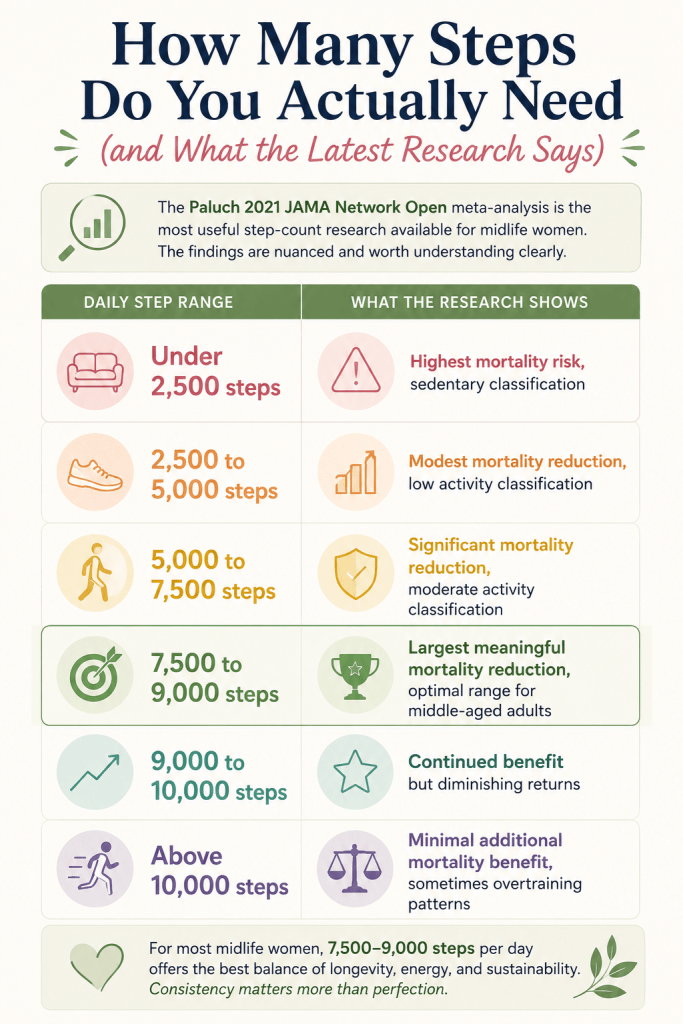
The Paluch 2021 JAMA Network Open meta-analysis is the most useful step-count research available for midlife women. The findings are nuanced and worth understanding clearly.
|
Daily Step Range |
What the Research Shows |
|
Under 2,500 steps |
Highest mortality risk, sedentary classification |
|
2,500 to 5,000 steps |
Modest mortality reduction, low activity classification |
|
5,000 to 7,500 steps |
Significant mortality reduction, moderate activity classification |
|
7,500 to 9,000 steps |
Largest meaningful mortality reduction, optimal range for middle-aged adults |
|
9,000 to 10,000 steps |
Continued benefit but diminishing returns |
|
Above 10,000 steps |
Minimal additional mortality benefit, sometimes overtraining patterns |
Free 28-Day Fascia Reset Email Course
Get our Free 28-day email course series to help with 1 or 2 exercises per day to release your fascia. One short lesson per day. Two minutes to read each.
The practical takeaway for most midlife women is that the optimal target sits in the 7,000 to 8,500 range rather than at 10,000. Hitting that range through five 15-minute walks distributed across the day is dramatically more achievable than hitting 10,000 through a single session, and the metabolic benefit at the lower target is nearly identical.
The deeper point is that focusing on a specific step number is less useful than focusing on the question: am I moving more than I was last week? Consistency of upward trend matters more than hitting any specific arbitrary number.
“When I work with coaching clients on movement, I rarely set a step number target. The number itself is not what produces the outcome. What produces the outcome is the underlying pattern of regular daily movement, and that pattern is established by lowering the threshold for what counts as movement until the daily practice is impossible to skip. Once the daily practice is in place, the step count takes care of itself. Most of my clients who stopped chasing 10,000 steps and started chasing five 10-minute walks per day are now consistently hitting 7,000 to 9,000 steps without ever counting them.” ~ Terry Tateossian
The Behavioral Architecture That Makes “Micro Walks” Stick
The research-supported tactics for building micro walks into your daily life:
Stack each walk to a meal.
The three reliable meals are the strongest anchors for habit stacking. “After breakfast, I walk for 10 minutes” inherits the consistency of breakfast itself. Use the same anchor for at least four weeks before adding additional walks.
Use implementation intentions.
Write down (or save in your notes app) the specific if-then statement for each walk. “When I finish lunch, I put on my shoes and walk for 10 minutes before sitting back down at my desk.” The specificity is what produces the behavioral lock-in.
Lower the friction.
Keep walking shoes by the door rather than in a closet. Have a podcast or music playlist queued so the start of the walk is one tap rather than five. Leave a jacket near the door so you do not have to find one when the weather turns cool. Each small friction removed makes the daily completion more likely.
Track completion, not duration.
A simple check mark on a calendar for each completed walk is more behaviorally useful than tracking minutes or steps. The completion check produces the small win that sustains motivation. Counting minutes invites comparison and underperformance feelings.
Build in walks that double up.
Phone calls, podcast listening, audiobook listening, and walking meetings all let the walk happen alongside another activity you were already going to do. The walk becomes free time rather than time taken from something else.
Start with one walk per day for two weeks.
Add a second walk only after the first has stuck. Trying to install five walks at once almost always fails because the cognitive load is too high. The slow build matches how habit formation actually works.
Spotlight: The Two-Minute Rule
For the days when even a 10-minute walk feels impossible, James Clear’s two-minute rule applies. The minimum viable version of the practice is to put on your shoes and walk to the end of the block and back, and that absolutely counts. The point is to maintain the daily completion check rather than to accumulate steps on a hard day. The brain treats the completed minimum and the completed full version as the same kind of action, which keeps the habit installed during the periods when life intervenes.
Free 28-Day Fascia Reset Email Course
Get our Free 28-day email course series to help with 1 or 2 exercises per day to release your fascia. One short lesson per day. Two minutes to read each.
What Micro Walking Looks Like in Real Life
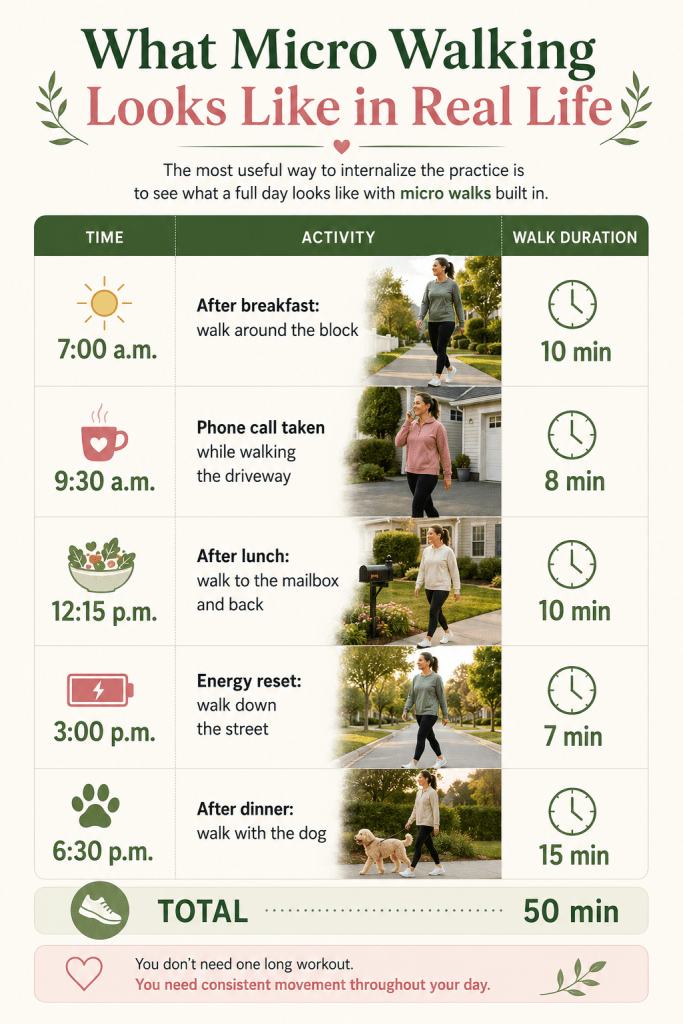
The most useful way to internalize the practice is to see what a full day looks like with micro walks built in.
|
Time |
Activity |
Walk Duration |
|
7:00 a.m. |
After breakfast: walk around the block |
10 min |
|
9:30 a.m. |
Phone call taken while walking the driveway |
8 min |
|
12:15 p.m. |
After lunch: walk to the mailbox and back |
10 min |
|
3:00 p.m. |
Energy reset: walk down the street |
7 min |
|
6:30 p.m. |
After dinner: walk with the dog |
15 min |
|
Total |
50 min |
The total movement is 50 minutes, distributed in five small sessions that fit naturally into the existing structure of the day. None of them required a workout, special clothes, or a calendar block. The total step count for a woman walking at a comfortable pace would be approximately 5,500 to 6,500 steps from just these walks, with additional steps from normal household activity bringing the daily total into the 7,000 to 9,000 range that the Paluch research identifies as optimal.
The pattern is sustainable across days when work is busy, family demands are heavy, weather is cold, or energy is low. The threshold for each individual walk is so low that even partial completion (three walks instead of five) still produces meaningful daily movement.
Common Mistakes That Undermine Micro Walking
Five mistakes consistently undermine the practice in the first 60 days.
Treating the walk as optional.
The walks need to be installed as if they were appointments, not as something to do when other things are finished. The default has to be that the walk happens unless something explicitly displaces it. The reverse default (the walk happens if there is time) almost always fails.
Trying to install five walks immediately.
Habit formation research is clear that adding one new behavior at a time produces dramatically higher success rates than adding several at once. Start with the post-lunch walk, install it for two weeks, then add a second walk.
Underestimating the impact.
Many women dismiss micro walks because they do not feel like exercise. The research shows that they produce metabolic, mood, and behavioral benefits regardless of how they feel. Trust the accumulated data rather than the felt sense of any single walk.
Skipping on days that already have structured exercise.
The Dunstan research shows that breaking up sedentary time produces metabolic benefits independent of any structured exercise. A morning workout does not replace the micro walks that interrupt the rest of the day’s sitting.
Only doing it when the weather is perfect.
Plan for the weather rather than waiting for it. Indoor walking (around the house, up and down a hallway, in a covered area) counts. Treadmill walking counts. Walking in light rain with a jacket counts. The practice needs to be weather-resilient because most weeks in most climates include at least a few imperfect days.
Free 28-Day Fascia Reset Email Course
Get our Free 28-day email course series to help with 1 or 2 exercises per day to release your fascia. One short lesson per day. Two minutes to read each.
How Micro Walks Fit Into the Broader THOR Lifestyle Framework
Micro walks are one piece of the larger lifestyle medicine framework I teach at THOR. The framework has five components, and micro walks support several of them.
Nutrition foundation.
The free Macro Calculator gives you your personalized starting numbers. The Macro Miracle Mediterranean Cookbook is the kitchen-side companion. Post-meal micro walks pair with this nutrition foundation to produce the blood sugar control that drives both energy stability and body composition outcomes.
Daily movement.
Micro walks sit alongside strength training (two to three sessions per week) as the foundation of the daily movement piece. Strength training preserves the lean muscle that protects metabolic rate. Micro walks interrupt sedentary time and produce the metabolic and mood benefits documented above. Together they form a movement pattern that fits the midlife body and the midlife schedule.
Sleep optimization.
A daily walking practice has documented effects on sleep architecture, particularly when walks happen outdoors with light exposure. Sleep is the foundation underneath every other lifestyle medicine intervention.
Nervous system regulation.
Light walking activates parasympathetic tone and supports the autonomic balance that the new research identifies as a primary driver of healthy aging in midlife. We covered this in depth in our article on the parasympathetic nervous system and aging in midlife women.
Nutrient and supplement foundation.
The foundational supplement collection supports the nutrients (magnesium, omega-3, vitamin D, B-complex) that movement, sleep, and recovery all depend on.
For women who want sustained 1:1 support on the full framework, the Monthly Personal Training and Nutrition Coaching Program provides personalized programming with the THOR team. For women who want an immersive reset that installs all five components simultaneously over five days, the Deeply Restorative Yoga and Nature Retreat at our Smoky Mountains property concentrates the practice into a structured immersion.
“I want to be honest about what micro walks can and cannot do. They will not single-handedly transform body composition, hormone levels, or sleep architecture. What they will do is install a daily movement pattern that supports every other piece of the framework. They are the connective practice. The macro calculator, the supplement stack, the strength training, and the sleep work all produce stronger results when daily walking is in place underneath them. The micro walks are the foundation that makes the rest of the work measurable.” ~ Terry Tateossian
Your Next Steps to Hitting 10K Steps Per Day
If the framework in this article resonates and you want to act on it, the four next steps in order of friction:
- Install the post-lunch walk. Tomorrow, after lunch, walk for 10 minutes. Just one walk, one day. The 14-day commitment is to install this single walk before adding anything else.
- Track completion with a simple check mark. Use a calendar, a notes app, or a sticky note on the fridge. The point is the visible accumulation of completed walks across days, not the time or step count.
- Add the post-dinner walk in week three. Only after the post-lunch walk has stuck for two weeks. Same principle of installing one anchor at a time.
- Build the broader framework underneath. The free Macro Calculator, the Macro Miracle Mediterranean Cookbook, and the foundational supplement collection are the foundation underneath the daily movement work. For sustained 1:1 support, the Monthly Coaching Program provides personalized programming.
Free 28-Day Fascia Reset Email Course
Get our Free 28-day email course series to help with 1 or 2 exercises per day to release your fascia. One short lesson per day. Two minutes to read each.
Frequently Asked Questions: How To Get 10K Steps Per Day With Micro Walks
How long should a micro walk be?
A micro walk typically lasts between 5 and 15 minutes. The exact length matters less than the consistency. A 7-minute walk completed daily outperforms a 30-minute walk completed twice a week across most metabolic, mood, and behavioral outcomes.
How many micro walks should I do per day?
Three to five micro walks distributed across the day is the target range. Most women find that three walks (after each main meal) is the most reliable starting point because the meals themselves provide the behavioral anchor. Adding a midmorning, midafternoon, and evening walk on top of meal-anchored walks brings the total to five.
Do micro walks burn as many calories as one long walk?
The total energy expenditure across five 10-minute walks is nearly identical to one 50-minute walk. The difference is the metabolic effect on blood sugar and insulin, which appears to be stronger when walking is distributed around meals than when it is concentrated in one session.
Can I do micro walks indoors?
Indoor walking works as well as outdoor walking for most of the benefits. Walking around the house, up and down a hallway, in a covered patio, on a treadmill, or in a gym all count. Indoor walking is the right backup for weather days, very cold or very hot climates, and high-pollution days. The metabolic and behavioral benefits do not require outdoor walking, although outdoor walking adds the mood, vitamin D, and circadian rhythm benefits of light exposure.
What pace should I walk at?
A comfortable pace where you can hold a conversation but feel slightly elevated breathing. This is sometimes called zone 2 cardio in fitness circles. For most midlife women, the pace works out to roughly 2.5 to 3.5 miles per hour, depending on fitness. The pace does not need to be fast for the metabolic and behavioral benefits.
Are post-meal walks better than other timing?
The DiPietro 2013 trial established that post-meal walks (within 30 minutes after eating) produce significantly better blood sugar control than the same total walking time done in the morning or afternoon outside of meal windows. For blood sugar specifically, the post-meal timing matters. For mood, energy, and behavioral consistency, any timing works.
Should I track my steps?
Tracking is optional but generally helpful in the first 30 to 60 days. Most modern smartphones and wearables count steps automatically. The point of tracking is to confirm that the daily micro walks are accumulating into the 7,000 to 9,000 step range that the research identifies as optimal. After the practice is installed, tracking can be reduced or stopped without losing the benefit.
Can micro walks replace structured exercise?
Micro walks complement structured exercise rather than replacing it. The Dunstan research is clear that breaking up sedentary time produces metabolic benefits independent of any structured exercise. Strength training two to three times per week remains essential for preserving lean muscle in midlife, and micro walks support the metabolic and recovery work that strength training depends on.
Are micro walks safe during pregnancy or with chronic conditions?
For most healthy adults, walking is one of the safest forms of physical activity available. Always consult your healthcare provider before starting any new exercise program, particularly if you have cardiovascular conditions, joint issues, balance concerns, or are pregnant. Modify pace, duration, and frequency as appropriate for your specific situation.
Do I need special shoes?
Comfortable walking shoes with reasonable support are enough. You do not need running shoes, hiking boots, or specialized walking shoes. The most important features are good fit, reasonable cushioning, and shoes that have not worn out (walking and running shoes typically lose their support at 300 to 500 miles, which is roughly 6 to 9 months of daily wear).
How long does it take to see results?
Most women notice energy and mood improvements within the first week. Blood sugar improvements show up on continuous glucose monitor readings within days for women using them. Sleep improvements typically become noticeable in the second to third week. Body composition changes (when paired with appropriate nutrition) take 6 to 12 weeks to become visible. The behavioral changes (consistent daily movement becoming automatic) typically take 30 to 60 days to fully install.
What if I miss a day?
One missed day has no meaningful effect on the practice or the outcomes. The research on habit formation is clear that missing one day does not break the habit. Missing two days in a row makes recovery harder. Missing three or more consecutive days requires deliberately restarting the practice from week one. The single most important principle is that you never miss twice in a row.
Free 28-Day Fascia Reset Email Course
Get our Free 28-day email course series to help with 1 or 2 exercises per day to release your fascia. One short lesson per day. Two minutes to read each.
Can micro walks help with menopause weight gain?
Micro walks contribute to a body composition framework rather than producing weight loss on their own. The post-meal walks improve insulin sensitivity, the cumulative daily movement supports metabolic rate, and the behavioral consistency installs the foundation for sustained body composition work. Combined with adequate protein (1.0 grams per pound of bodyweight), strength training, and good sleep, micro walks are one component of the menopause weight management framework that produces results.
How does this connect to the broader THOR framework?
Micro walks are the daily movement foundation underneath the broader five-component lifestyle framework I teach at THOR (nutrition, daily movement, sleep, nervous system regulation, supplement support). They support every other piece. The free Macro Calculator, the Mediterranean cookbook, the supplement collection, and the coaching program all work harder when daily walking is in place underneath them. The Deeply Restorative Yoga and Nature Retreat installs all five components together in a five-day immersion.
References
- DiPietro, L., Gribok, A., Stevens, M. S., Hamm, L. F., & Rumpler, W. (2013). Three 15-min bouts of moderate postmeal walking significantly improves 24-h glycemic control in older people at risk for impaired glucose tolerance. Diabetes Care, 36(10), 3262–3268.
- Dunstan, D. W., Kingwell, B. A., Larsen, R., et al. (2012). Breaking up prolonged sitting reduces postprandial glucose and insulin responses. Diabetes Care, 35(5), 976–983.
- Paluch, A. E., Bajpai, S., Bassett, D. R., et al. (2021). Daily steps and all-cause mortality: a meta-analysis of 15 international cohorts. Lancet Public Health, 7(3), e219–e228.
- Loprinzi, P. D., & Smit, E. (2014). Light-intensity activity is associated with reduced all-cause mortality among middle-aged and older adults. American Journal of Health Promotion, 29(4), 243–246.
- Fogg, B. J. (2019). Tiny Habits: The Small Changes That Change Everything. Houghton Mifflin Harcourt.
- Clear, J. (2018). Atomic Habits: An Easy and Proven Way to Build Good Habits and Break Bad Ones. Avery.
- Gollwitzer, P. M. (1999). Implementation intentions: strong effects of simple plans. American Psychologist, 54(7), 493–503.
- Gollwitzer, P. M., & Sheeran, P. (2006). Implementation intentions and goal achievement: a meta-analysis of effects and processes. Advances in Experimental Social Psychology, 38, 69–119.
- Wood, W., & Neal, D. T. (2007). A new look at habits and the habit-goal interface. Psychological Review, 114(4), 843–863.
- Lally, P., van Jaarsveld, C. H. M., Potts, H. W. W., & Wardle, J. (2010). How are habits formed: modelling habit formation in the real world. European Journal of Social Psychology, 40(6), 998–1009.
- Sjogaard, G., Sejersted, O. M., Winkel, J., et al. (2009). Effect of short-term post-meal walking on lipid metabolism in healthy adults. Medicine and Science in Sports and Exercise, 41(5), 1100–1106.
- Aibar, A., Bois, J. E., Generelo, E., & Zaragoza, J. (2018). Effects of physical activity on positive and negative affect, anxiety and depression in adolescents: a systematic review. Journal of Psychophysiology, 32(2), 53–64.
- Reynolds, A. N., Mann, J. I., Williams, S., & Venn, B. J. (2016). Advice to walk after meals is more effective for lowering postprandial glycaemia in type 2 diabetes mellitus than advice that does not specify timing: a randomised crossover study. Diabetologia, 59(12), 2572–2578.
- World Health Organization. (2020). Guidelines on physical activity and sedentary behaviour. WHO Press.
- Centers for Disease Control and Prevention. (2018). Physical Activity Guidelines for Americans, 2nd Edition. U.S. Department of Health and Human Services.
- Maltais, M. L., Desroches, J., & Dionne, I. J. (2009). Changes in muscle mass and strength after menopause. Journal of Musculoskeletal and Neuronal Interactions, 9(4), 186–197.
- Lovejoy, J. C., Champagne, C. M., de Jonge, L., Xie, H., & Smith, S. R. (2008). Increased visceral fat and decreased energy expenditure during the menopausal transition. International Journal of Obesity, 32(6), 949–958.
- Boyle, N. B., Lawton, C., & Dye, L. (2017). The effects of magnesium supplementation on subjective anxiety and stress: a systematic review. Nutrients, 9(5), 429.
Disclaimer: Always consult with a healthcare professional before starting any new routines, programs, or nutrition plans to ensure you receive the best medical advice and strategy for your specific individual needs.
Free 28-Day Fascia Reset Email Course
Get our Free 28-day email course series to help with 1 or 2 exercises per day to release your fascia. One short lesson per day. Two minutes to read each.

Terry Tateossian is a Menopause Lifestyle Medicine Coach, Certified Personal Trainer & Nutritionist and the Founder of THOR: The House of Rose, a wellness brand serving women over 40 through retreats, coaching, macro-nutrition and community. As 25-year founder and entrepreneur, Terry spent two and a half decades building and running successful start-up businesses, an experience that put her on the front line of founder burnout long before she could name it. After facing serious health challenges, early onset menopause, and emotional eating while running her agency and raising two children, Terry rebuilt her health in her 40s and lost more than 80 pounds through evidence-based nutrition, training, and mindset work. Today, she helps women get strong, improve confidence, support hormone health, and create a stronger second half of life. Terry has been featured in major media outlets and is available for podcasts, expert commentary, brand collaborations, and speaking engagements on midlife health, reinvention, emotional eating, menopause wellness, and strength training for longevity. Get her free macro calculator (her cookbook companion) to start your journey to back to health.