
 By Team THOR
Free 28-Day Fascia Reset Email Course
Get our Free 28-day email course series to help with 1 or 2 exercises per day to release your fascia. One short lesson per day. Two minutes to read each.
What Is Fascia? A Midlife Woman’s Guide to the Tissue Running Your Whole Body
You wake up, swing your legs out of bed, and the first few steps feel like you’re walking on someone else’s feet. Your hips don’t open the way they used to. Your shoulders live somewhere up near your ears. You stretch, you roll, you foam-roll, you drink water — and some days it helps, and some days nothing does. If you’re a woman in your 40s, 50s, or 60s, this is one of the most common complaints I hear from clients, and nine times out of ten the conversation ends up in the same place: we have to talk about fascia.
Most of us were never taught about fascia in school biology. We learned about muscles and bones and organs, and we were told they sat in our body like parts in a kit. Nobody mentioned that there is a living, webbing sheet of connective tissue wrapping every single one of those parts — holding them in place, transmitting force through them, and, crucially, stiffening up in predictable ways as we age and move through menopause. Once you understand what fascia is, a lot of the aches, the posture changes, and the “my body just feels different now” feelings start to make real sense. Better still, you can actually do something about them.
What Is Fascia in the Body?
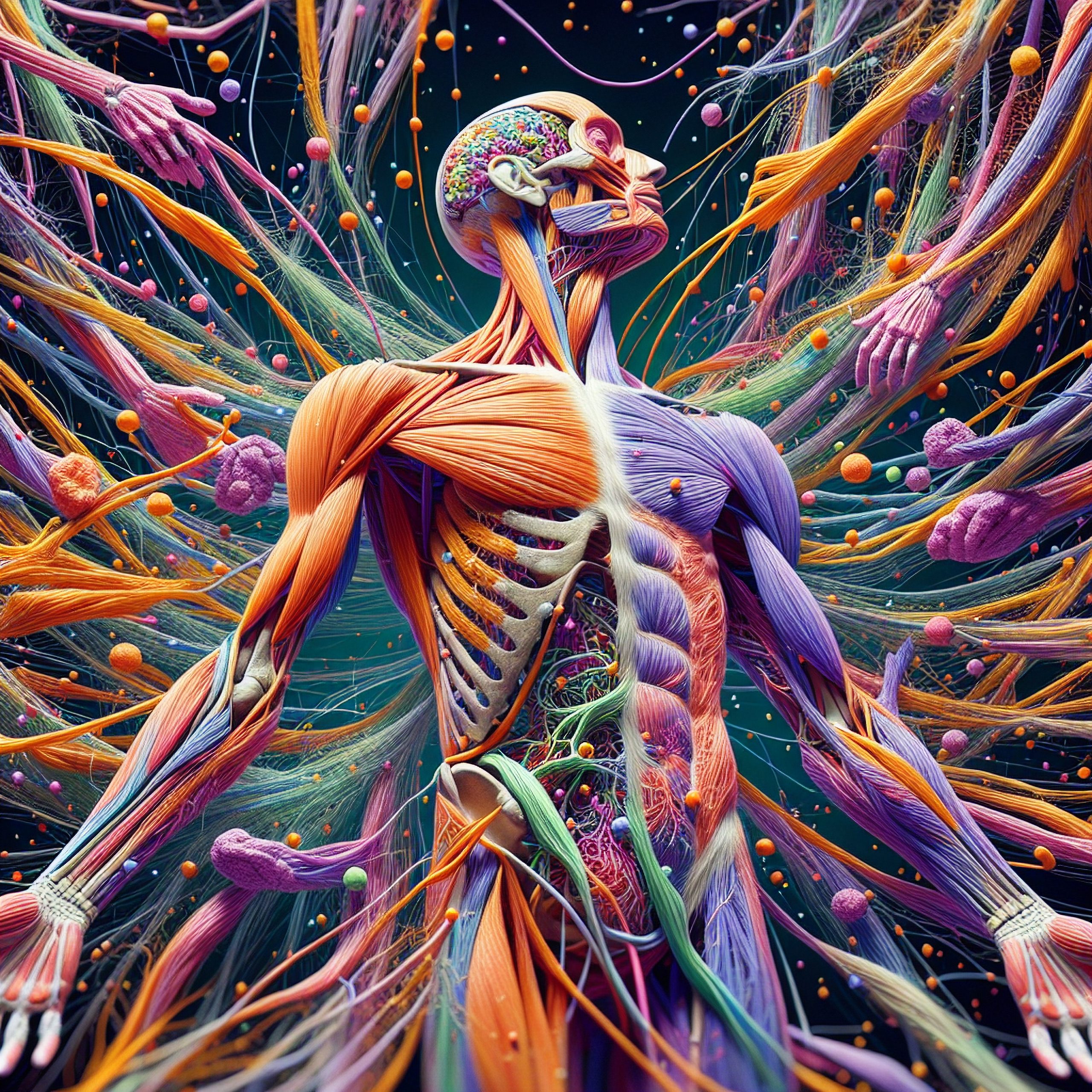
Fascia is the body’s connective-tissue network. If you’ve ever cooked a chicken breast and peeled off that thin, papery white film — that’s fascia. In a human body, that film is everywhere. It wraps each muscle fiber, groups those fibers into bundles, groups the bundles into whole muscles, then links muscles together across entire chains of the body. It also wraps your organs, your nerves, and your blood vessels. Researchers sometimes call it the “great communicator” of the body because it connects everything to everything else.
The tissue itself is made mostly of collagen and elastin fibers suspended in a jelly-like substance called the ground substance, which is rich in hyaluronic acid. When fascia is healthy, it is wet, springy, and slides smoothly against the structures it’s wrapping. When fascia is dehydrated, inflamed, or stuck, it gets grabby. It starts to tether things together that used to glide past each other. That’s when you get that “stiff, stuck, can’t loosen up” sensation that no amount of regular stretching seems to touch.
For decades, fascia was treated as packing material — something to cut through to get to the interesting stuff underneath. That changed in the early 2000s when researchers like Dr. Helene Langevin at the National Institutes of Health started documenting that fascia is densely packed with nerve endings and plays an active role in how we sense, move, and experience pain. In 2007 the first International Fascia Research Congress was held at Harvard Medical School, and fascia science has exploded since. It’s now recognized as its own organ system — the largest sensory organ in the body after the skin.
A quick way to picture it: imagine wearing a full-body catsuit made of wet silk under your skin. Every time you move your arm, that catsuit shifts from your shoulder down into your hip on the opposite side. Every time you slouch at your desk for three hours, the catsuit starts to memorize that shape. Every time you dehydrate, skip sleep, or swing through a stress week, the catsuit gets a little tighter. That’s fascia. That’s what we’re working with.
The Three Types of Fascia and Where You’ll Feel Them
Not all fascia is the same. Anatomists usually break it into three main categories, and knowing which one is giving you trouble helps you pick the right intervention.
Superficial fascia sits just below your skin. It holds your fat, houses a lot of your sensory nerves, and is the layer that feels “thick” or “cottage-cheesy” when cellulite shows up. It’s also where you tend to feel that tender-to-the-touch sensation on the outer thighs, hips, and lower abdomen that many midlife women describe.
Deep fascia wraps your muscles individually and in groups. This is the layer that gets tight in your IT band, your plantar fascia under the foot, your upper traps, and the thoracolumbar fascia across your low back. When you say “my low back is stiff,” the culprit is often deep fascia, not the muscle underneath it. Deep fascia is where most myofascial release work targets.
Visceral fascia wraps your organs — your gut, your uterus, your lungs, your heart. It’s the layer that matters after abdominal surgery, after C-sections, after endometriosis, and after chronic gut inflammation. Visceral fascial restrictions can pull on your posture and your breathing from the inside out, which is why specialized visceral manipulation therapists exist.
The three layers are supposed to glide past each other. When they don’t, you get referred pain, odd posture, and that “something’s not right but I can’t describe it” feeling. Good fascia work addresses the layer that’s actually stuck — which is why a foam roller on your outer thigh doesn’t fix a problem that’s rooted in your inner pelvis.
Why Fascia Matters More for Women Over 40
Here’s where it gets personal for midlife women. Estrogen matters for fascia — a lot. Estrogen helps regulate collagen production, hyaluronic acid content in the ground substance, and tissue hydration. As estrogen drops through perimenopause and into menopause, fascia loses some of its slip and spring. The tissue gets drier, stiffer, and slower to recover from daily mechanical stress. This is the same reason your skin gets thinner and your joints feel creakier — it’s all connective tissue, and it all responds to estrogen.
Research published in peer-reviewed journals like Climacteric and the British Journal of Sports Medicine has documented that women in perimenopause and menopause experience measurable changes in tendon stiffness, ligament laxity, and collagen turnover. One study found postmenopausal women can lose up to 30% of their skin collagen in the first five years after menopause. That collagen loss is not limited to skin — it’s body-wide. Your fascia loses density the same way your skin does, and the result is a tissue that doesn’t transmit force the way it used to. You feel weaker in your workouts even though your muscle mass hasn’t changed much. You feel more “thuddy” when you run or jump. You wake up stiff. You bruise more easily. All of it traces partly to changes in connective tissue.
On top of the hormonal changes, midlife women also tend to be in the life phase with the most seated time — desks, cars, phones, the endless evening scroll. Fascia is use-it-or-lose-it tissue. When you hold the same shape for hours at a time, fascia remodels to reinforce that shape. If you sit 10 hours a day and sleep 8, that’s 18 hours of hip-flexor-short, thoracic-rounded fascia reinforcement every day. No wonder it’s stuck.
The good news is that fascia also remodels toward health — and it does so relatively quickly. A study in the Journal of Bodywork and Movement Therapies showed measurable tissue changes after just two weeks of consistent self-myofascial release. Your fascia listens. If you’re curious about the broader hormonal shifts making all of this worse, we’ve written a whole piece on 20 signs of perimenopause and what to do about them, and it pairs really well with what we’re covering here.
What Healthy Fascia Feels Like vs. Fascia Dysfunction
Healthy fascia feels slippery, springy, and springy again. When you push into a healthy muscle, your fingers sink in and the tissue responds like a slightly firm marshmallow — it gives, it springs back, it doesn’t shout at you. You can twist and bend without hearing a bone concerto. You wake up feeling like the same body you went to bed with.
Dysfunctional fascia feels like a rope that’s been left out in the rain and then dried in the sun. It’s hard, it’s knotty, and it tethers things together that shouldn’t be tethered. Common signs: pain that moves around (“my shoulder hurt yesterday, today it’s my hip”), morning stiffness that takes more than 10 minutes to work out of, a feeling that you “can’t get a full breath,” pulls and pinches when you rotate, tender spots that hurt when you press even lightly, and that feeling of walking in a body you don’t quite recognize. If that’s you — this article is for you.
Fascia dysfunction isn’t the same thing as an injury. You can have stuck fascia without a torn anything, and the X-ray will come back clean. That’s a huge piece of why so many midlife women get brushed off at the doctor’s office when they describe stiffness, aches, and mobility issues. The structures being measured look fine. The soft tissue web connecting those structures is where the problem actually lives.
Free 28-Day Fascia Reset Course
Get our Free 28-day email course series to help with 1 or 2 exercises per day to release your fascia. One short lesson per day. Two minutes to read each.
What Causes Fascia to Get Stuck, Tight or Inflamed in Midlife
Seven things drive most fascial dysfunction, and most midlife women have at least four of them at any given time.
Dehydration. Fascia is 70% water. When you’re chronically under-hydrated (and most people are, because coffee and wine and “I’ll drink water later” are powerful), the ground substance thickens, hyaluronic acid loses its lubricating effect, and tissue layers start gluing to each other.
Sustained posture. Sitting, driving, typing, scrolling. Fascia remodels toward whatever shape you hold the longest.
Chronic inflammation. Fascia responds to systemic inflammation the same way skin does — it thickens, it stiffens, it gets tender. Diet plays a huge role here. This is also why an anti-inflammatory eating style matters for fascia health. We go deep on exactly how to build that in the fundamentals of a macro diet for women over 50.
Stress and shallow breathing. Your diaphragm is fascial tissue, and when you breathe into the top third of your lungs for weeks on end because your nervous system is in fight-or-flight, the entire diaphragmatic and pelvic fascial network tightens.
Poor sleep. Fascia remodels during deep sleep. Menopausal sleep disruption means less fascia repair.
Low estrogen. Covered above — the hormonal layer underneath all of it.
Low-grade collagen and protein intake. You cannot build connective tissue without the raw materials. Most women over 40 are under-eating protein, which limits the amino acid building blocks their fascia needs.
The protein piece is huge. Before you go buy a tool, make sure you’re eating enough. You can get a free, personalized macro target in about three minutes with our free macro calculator — it’ll give you your protein floor and a sensible carb/fat split for midlife metabolism. Fascia cannot rebuild without fuel.
The Science of Self-Myofascial Release (What Rolling Actually Does)
For years, foam rolling was explained with a handwavy “it breaks up adhesions.” That’s not really what happens, and the better explanation is more interesting.
Research, including work summarized in the British Journal of Sports Medicine by Zügel and colleagues in 2018, suggests that self-myofascial release works through several mechanisms at once. First, it mechanically squeezes the tissue, which pushes water and inflammatory metabolites out and allows fresh interstitial fluid to flow back in — basically a sponge effect. Second, it stimulates the dense network of mechanoreceptors embedded in fascia, which sends a “calm down” signal up to the central nervous system, reducing protective muscle tension. Third, sustained pressure on a restricted spot appears to trigger piezoelectric changes in collagen fibers that help tissue reorganize. Fourth, it improves local blood flow for several minutes after you stop, which supports tissue repair.
What rolling does NOT do: physically “break” adhesions. Your fascia is strong enough to survive being run over by a car. You are not going to tear it with a foam roller. What you’re doing is communicating with your nervous system and rehydrating the tissue.
This is why “release” works better when it’s slow, sustained, and breath-paced. Ten seconds of rolling at warp speed does almost nothing. Sixty to ninety seconds of sustained pressure on a tender spot, with long slow exhales, does a lot. That’s the dosage most of the research supports.
7 Ways to Keep Your Fascia Healthy in Midlife
This is the part most women are looking for, so here’s the honest, science-informed list.
1. Drink water like it’s a non-negotiable.
Half your body weight in ounces is a useful starting point (so a 150-lb woman targets 75 oz). Caffeine and alcohol don’t count. If you want a measurable fascial-hydration boost, add a pinch of salt and a squeeze of lemon to your morning water.
2. Move in multiple directions every day.
Fascia doesn’t just want you to walk in a straight line. It wants rotation, side bends, reaches, squats, and hinges. A five-minute “spine spa” in the morning — cat-cow, thread-the-needle, side bends, hip circles — does more for your fascia than a single 60-minute workout three days later.
3. Lift heavy things.
This is non-negotiable for midlife women. Strength training builds the tensioned load that healthy fascia needs to stay organized. If you haven’t started lifting yet, it’s the single best thing you can do in your 40s, 50s, and 60s.
4. Eat enough protein and support collagen synthesis.
Aim for roughly 0.7 to 1 gram of protein per pound of goal body weight, spread across 3 to 4 meals. Vitamin C, zinc, and copper support collagen assembly. If you want to go further, collagen peptides are something we’ve written about in depth — they show up consistently in midlife women’s routines for a reason.
5. Breathe into your belly for five minutes a day.
Diaphragmatic breathing releases fascial tension through the core, pelvis, and neck simultaneously. Five minutes, box breathing (4-4-4-4), hand on belly, eyes closed. Unglamorous. Powerful.
6. Use self-myofascial release 3 to 5 times a week.
Foam roller, massage ball, or a fascia tool like the FasciaBlaster. 10 to 15 minutes on whatever feels stuck. Go slow. Breathe out on tender spots. We’ll get into tools in the next section.
7. Sleep 7 to 9 hours.
Fascia repairs during deep sleep, which menopause tends to disrupt. Prioritize sleep hygiene: cool, dark, off screens, magnesium if helpful. If your sleep is a mess because of hot flashes and waking at 3 a.m., that’s its own conversation and it’s one we’ve had in our post on reversing aging in midlife women.
Fascia Tools: What Works and What’s Worth Skipping
Walk into any Target and you’ll see a wall of fascia tools. Here’s the short version of what actually works for most midlife women.
Foam roller.
The gateway tool. Dense, high-quality foam rollers (not the soft white gym ones) are excellent for large muscle groups — quads, glutes, lats, upper back. Cheap, durable, and enough for most people starting out.
Massage balls.
Lacrosse balls, peanut-shaped double balls, and soft therapy balls reach places a foam roller can’t — deep into the glutes, between the shoulder blades, along the plantar fascia of the foot. Higher precision, higher intensity.
Percussion guns.
Great for warm-ups and for specific muscle spots. Not ideal for fascia work specifically because the duration on any one spot tends to be too short to get the full nervous-system “release” effect. Useful, but not the whole answer.
Fascia tools with a hard shaft and knobs or blades.
This is the category that includes the FasciaBlaster. These tools let you reach around curves, apply targeted pressure to specific fibers, and work the layers between muscle groups in a way that a round foam roller can’t. The learning curve is steeper, and you want to start gently, but women who commit to using one for 10 minutes a day report changes in how their bodies feel within a few weeks. The FasciaBlaster we carry is the same tool I personally use on my outer thighs, glute-hamstring junction, and the stubborn IT band area — the spots that a foam roller just can’t get into. If you’re going to invest in one fascia tool beyond a basic roller, this is the one I’d pick.
A word of caution: fascia work should feel like productive discomfort, not like punishment. Bruising, trembling, or pain that lingers for days after is a sign you went too hard. Easy does it. Consistency beats intensity every single time.
Free 28-Day Fascia Reset Course
Get our Free 28-day email course series to help with 1 or 2 exercises per day to release your fascia. One short lesson per day. Two minutes to read each.
The Fascia-Hormone Connection You Never Hear About
Here’s something rarely covered in a mainstream health article. Your fascia and your hormones talk to each other in both directions.
Estrogen regulates collagen synthesis and hyaluronic acid density in fascia. Low estrogen makes fascia drier and stiffer. But fascia also influences hormones through the nervous system. Chronic fascial tension activates sympathetic (fight-or-flight) signaling, which raises cortisol, which impairs estrogen and progesterone balance, which further dries the fascia. It’s a loop. One that works against you when nothing is addressed.
This is part of why women who start regular myofascial release work in perimenopause often report a surprising side effect: better sleep, fewer hot flashes, and calmer periods. They didn’t change their hormone therapy. They changed their nervous system input by changing the information their fascia was sending upstream. It’s one of the most underappreciated tools in the midlife toolkit, and it costs nothing more than 10 minutes and a foam roller.
If the weight-and-shape changes that come with perimenopause are part of what’s driving you to read an article like this, I’d also point you to our deep dive on perimenopause weight gain — there’s a lot of crossover.
When to See a Professional for Myofascial Work
Self-care is powerful but not unlimited. There are times to hand the work to a trained set of hands. Book a professional if you have pain that’s been present for more than six weeks without changing, if you’re dealing with scar tissue from surgery (C-section, abdominal, pelvic), if you have a specific injury like plantar fasciitis that isn’t responding to self-care, or if you suspect visceral fascia is involved (chronic gut issues, post-childbirth pelvic pain, endometriosis).
Good providers to look for: a licensed physical therapist trained in myofascial release (John F. Barnes method is one of the most well-known), a certified manual therapist, a structural integration practitioner (Rolfing-style work), or a skilled sports massage therapist who specializes in connective tissue. A single session can sometimes unlock something you’ve been self-rolling for months. Often, the right pattern is a handful of professional sessions to reset, then self-care to maintain.
If you want a more personalized plan that ties fascia, strength, nutrition, and hormones together, that’s the exact thing we build inside our 1:1 fitness and nutrition coaching program. Some women prefer to learn it hands-on in a group setting, and our women’s wellness retreats fold mobility, fascia work, strength training, and anti-inflammatory eating into a single reset week. Either way, you don’t have to figure it out alone.
Frequently Asked Questions About Fascia for Women Over 40
Is fascia the same as connective tissue?
Fascia is a type of connective tissue. Connective tissue is the broader category. It includes bones, cartilage, blood, tendons, ligaments, and fascia. Fascia is specifically the fibrous, collagen-rich sheeting that wraps and connects the other structures. When someone says “connective tissue” casually, they often mean fascia.
Can you feel fascia pain separately from muscle pain?
Yes, once you know what to listen for. Fascial pain tends to be diffuse (“my whole leg feels tight”), migrating (“it was my hip yesterday and my shoulder today”), tender to light pressure across a broad area rather than in one pinpoint spot, and often worse after periods of stillness than after movement. Muscle pain is more localized, tends to have a clearer cause (a specific workout or activity), and often improves with rest. Many midlife pains are a blend of the two.
Does hormone replacement therapy (HRT) help fascia?
It can. Because estrogen supports collagen synthesis and fascial hydration, women on HRT often report less morning stiffness, fewer aches, and better skin quality. HRT is a personal medical decision that should be made with a qualified menopause provider. What we can say is that the estrogen-collagen-fascia link is well-documented in the research literature, and many women feel it in their bodies when their hormones stabilize.
How long does it take to feel a difference after starting fascia work?
Most women notice some change within two weeks of daily 10-minute sessions. Lss morning stiffness, better range of motion, a subtle feeling of “more slip” in the body. Bigger changes in chronic patterns (tight IT bands, stuck shoulders, restricted hips) typically take 6 to 12 weeks of consistent work. Fascia remodels, but it remodels on its own timeline, not yours.
Is cellulite a fascia problem?
Partly. Cellulite involves superficial fascia, fat cells, and circulation in the layer just beneath the skin. No topical cream is going to fix it because the structure lives too deep. Fascia work, strength training, adequate protein, and hydration all influence the tissue structure that creates the cellulite appearance. Expect subtle improvements, not miracles.
Can I do too much fascia work?
Yes. Over-rolling can leave you sore, bruised, and inflamed, which is the opposite of what you want. The sweet spot is 10 to 20 minutes a day, slow and breath-paced, on tissue that feels productive-uncomfortable rather than painful. If you’re bruising, back off.
What should I eat to support my fascia?
Enough protein (0.7 to 1 g per pound of goal body weight), plenty of vitamin C (bell peppers, citrus, strawberries), foods rich in collagen-building amino acids (bone broth, eggs, fish skin), anti-inflammatory fats (olive oil, fatty fish, walnuts), and 2 to 3 liters of water a day. A Mediterranean-style pattern is basically a fascia-friendly eating pattern. If you want a whole book of recipes that hit exactly this nutritional profile, The Macro Miracle Mediterranean Cookbook was built for this.
Does stretching work the same way as myofascial release?
Not quite. Traditional static stretching lengthens muscle and some fascia, but it doesn’t hydrate the tissue or address the sticky spots between layers. Myofascial release addresses the layers themselves and the nervous-system input. The combination of both — stretch plus release — is what most mobility research supports as the gold standard.
Can supplements help fascia health?
Some can. Collagen peptides (10 to 20 g per day) paired with vitamin C have research support for supporting connective-tissue synthesis. Hyaluronic acid supplementation has more mixed evidence but shows promise for joint and skin hydration. Magnesium helps with muscle-fascia interaction and sleep quality. You can browse our curated selection of vitamins and supplements for midlife women if you want somewhere to start — everything there was chosen specifically with women over 40 in mind.
Free 28-Day Fascia Reset Course
Get our Free 28-day email course series to help with 1 or 2 exercises per day to release your fascia. One short lesson per day. Two minutes to read each.
The Takeaway
Fascia is the body-wide communicator most of us were never taught to listen to. In your 40s, 50s, and 60s, it becomes impossible to ignore. Your hormones, your activity level, and your collagen supply all conspire to stiffen it up. The fix isn’t complicated. Hydrate, move in multiple directions, lift heavy, eat enough protein, roll daily, breathe deeply, sleep well, and consider a targeted fascia tool for the spots your foam roller can’t reach. Do those things for 90 days and the body you wake up in will be different in ways you can feel.
Sources and References
- Langevin HM. Connective tissue: a body-wide signaling network? Medical Hypotheses. 2006;66(6):1074-1077. PubMed
- Schleip R, Jäger H, Klingler W. What is ‘fascia’? A review of different nomenclatures. Journal of Bodywork and Movement Therapies. 2012;16(4):496-502. DOI
- Zügel M, Maganaris CN, Wilke J, et al. Fascial tissue research in sports medicine: from molecules to tissue adaptation, injury and diagnostics. British Journal of Sports Medicine. 2018;52:1497-1506. BJSM
- Stecco C, Sfriso MM, Porzionato A, et al. Microscopic anatomy of the visceral fasciae. Journal of Anatomy. 2017;231(1):121-128. PubMed
- Brincat M, Kabalan S, Studd JW, et al. A study of the decrease of skin collagen content, skin thickness, and bone mass in the postmenopausal woman. Obstetrics & Gynecology. 1987;70(6):840-845. PubMed
- Wilke J, Krause F, Vogt L, Banzer W. What is evidence-based about myofascial chains? A systematic review. Archives of Physical Medicine and Rehabilitation. 2016;97(3):454-461. PubMed
- Ahmed W, Kulikowska M, Ahlmann T, et al. A comparative multi-site and whole-body assessment of fascia in the horse. Journal of Anatomy. 2019;235(6):1064-1077.
- Behm DG, Wilke J. Do self-myofascial release devices release myofascia? Rolling mechanisms: a narrative review. Sports Medicine. 2019;49(8):1173-1181. PubMed
- Hotta K, Behnke BJ, Arjmandi B, et al. Daily muscle stretching enhances blood flow, endothelial function, capillarity, vascular volume and connectivity in aged skeletal muscle. Journal of Physiology. 2018;596(10):1903-1917.
- North American Menopause Society. The 2022 hormone therapy position statement. Menopause. 2022;29(7):767-794.
- Proksch E, Segger D, Degwert J, et al. Oral supplementation of specific collagen peptides has beneficial effects on human skin physiology. Skin Pharmacology and Physiology. 2014;27(1):47-55.
- Bordoni B, Zanier E. Clinical and symptomatological reflections: the fascial system. Journal of Multidisciplinary Healthcare. 2014;7:401-411.

Terry Tateossian is a Menopause Lifestyle Medicine Coach, Certified Personal Trainer & Nutritionist and the Founder of THOR: The House of Rose, a wellness brand serving women over 40 through retreats, coaching, macro-nutrition and community. As 25-year founder and entrepreneur, Terry spent two and a half decades building and running successful start-up businesses, an experience that put her on the front line of founder burnout long before she could name it. After facing serious health challenges, early onset menopause, and emotional eating while running her agency and raising two children, Terry rebuilt her health in her 40s and lost more than 80 pounds through evidence-based nutrition, training, and mindset work. Today, she helps women get strong, improve confidence, support hormone health, and create a stronger second half of life. Terry has been featured in major media outlets and is available for podcasts, expert commentary, brand collaborations, and speaking engagements on midlife health, reinvention, emotional eating, menopause wellness, and strength training for longevity. Get her free macro calculator (her cookbook companion) to start your journey to back to health.