
 By Team THOR
Free 28-Day Fascia Reset Email Course
Get our Free 28-day email course series to help with 1 or 2 exercises per day to release your fascia. One short lesson per day. Two minutes to read each.
The Complete Guide to Plantar Fasciitis Stretches for Lasting Heel Pain Relief
Heel pain is one of the most common reasons women over 40 stop walking, hiking, and exercising as much as they used to. The pain often starts gradually, gets blamed on a new pair of shoes or a long day on hard floors, and then settles into a chronic morning stiffness that takes the first hour of every day to work through. By the time most women search for plantar fascia stretches, the condition has been brewing for weeks or months and the connective tissue has lost the elasticity it used to take for granted.
The good news is that plantar fasciitis is one of the most consistently responsive musculoskeletal conditions to conservative treatment. Stretching, strengthening, supportive footwear, and small lifestyle adjustments resolve the symptoms in roughly 90 percent of cases without surgery or injections. The framework below is the full protocol I use with my coaching clients, structured for the midlife body and designed around how connective tissue actually responds to load and recovery after age 40.
I am Terry Tateossian, founder of The House of Rose and a certified lifestyle medicine coach who works with women in perimenopause, menopause, and post-menopause. I built this guide because plantar fasciitis is one of the most common new complaints I hear from women in their forties and fifties, often in women who never had foot pain before in their lives. The reason is not obvious to most women until they understand what is happening to connective tissue in midlife. The protocol that follows accounts for that change.
Important: This article is for educational purposes and does not replace medical advice. Persistent heel pain lasting more than four weeks despite consistent self-care, severe pain that prevents weight-bearing, swelling, numbness, redness, or pain following trauma all require evaluation by a healthcare professional. Always consult your doctor or a qualified physical therapist before starting any new exercise routine.
What Is the Plantar Fascia?
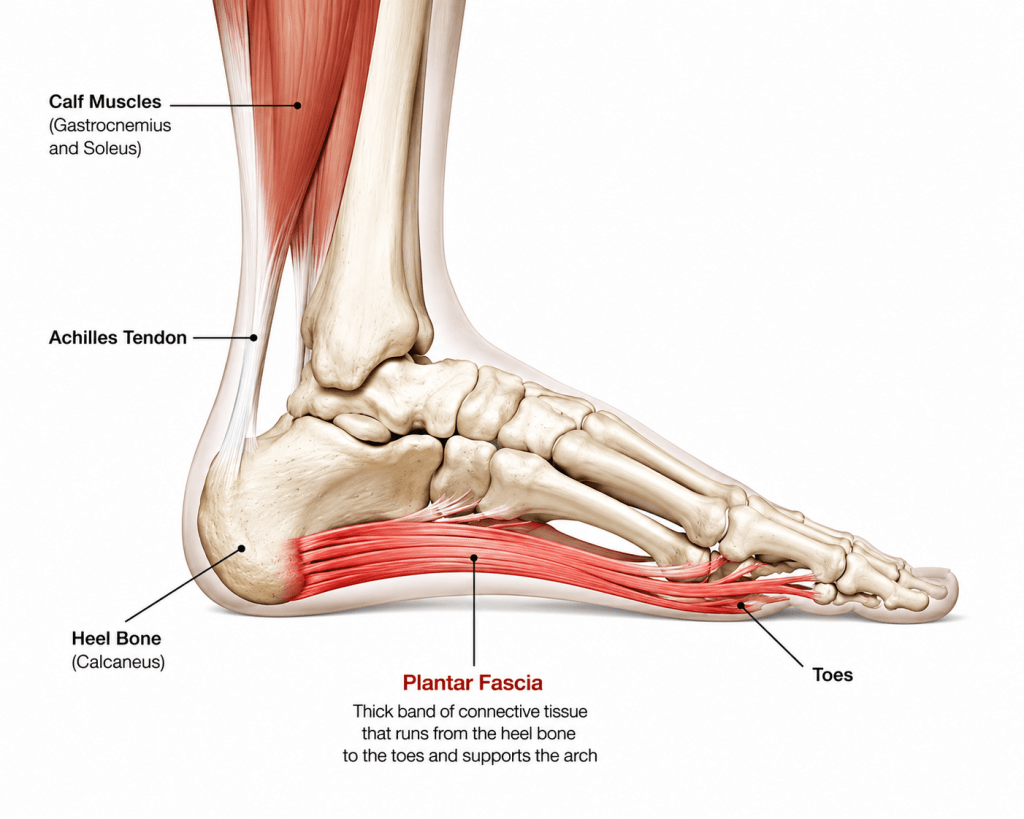
The plantar fascia is a thick band of connective tissue that runs along the bottom of the foot, from the heel bone (calcaneus) to the base of the toes. It supports the arch of the foot, stores elastic energy during each step, and helps transmit force from the calf and Achilles tendon through the foot and into the ground.
The fascia is not a muscle. It does not contract. It is a passive structure designed to handle tension, stretch slightly under load, and then return to its resting length when the load releases. A healthy plantar fascia is firm but pliable, with enough elasticity to absorb impact and enough strength to support the arch through tens of thousands of steps per day.
When the fascia becomes overloaded, the tissue develops microscopic tears at its insertion on the heel bone. The body responds with inflammation, which is what produces the characteristic sharp pain. Over weeks and months, the inflammation gives way to a more chronic degenerative state called plantar fasciopathy, where the tissue itself becomes disorganized at the cellular level. This is part of why plantar fasciitis tends to be persistent. The condition is rarely just inflammation that ice will fix. It is a structural change in the connective tissue that needs deliberate loading and recovery to resolve. If you are interested in learning more, you can read our article on 5 exercises that help with tight fascia.
Why Plantar Fascia Pain Hits Midlife Women Differently
Most content on plantar fasciitis treats it as a generic injury that responds to a generic protocol. For women in midlife, the picture is different in several important ways.
Estrogen affects connective tissue. Estrogen has receptors throughout the fascia, tendons, and ligaments. It supports collagen synthesis, maintains tissue hydration, and contributes to the elasticity of connective tissue at rest. As estrogen declines in perimenopause and drops sharply at menopause, connective tissue becomes stiffer, less hydrated, and slower to recover from microtrauma. Tissues that handled load for decades begin to fail under the same demands they always met.
Foot intrinsic muscle loss accelerates after 40. The small muscles inside the foot that support the arch and stabilize the toes weaken with age, particularly after the menopausal transition when sarcopenia accelerates. Weaker foot muscles shift more load onto the plantar fascia, which is not designed to carry that work alone.
Calf and ankle mobility decline. Reduced ankle dorsiflexion forces the foot into compensatory positions that overload the fascia. This is one of the most consistent findings in plantar fasciitis research, and it is more common in midlife women than younger ones.
Weight changes in midlife affect foot loading. The menopausal transition often produces 10 to 15 pounds of weight change in women who did not change anything about their habits. Even modest weight increases add measurable load to the plantar fascia with each step.
Sleep disruption slows tissue repair. The fragmented sleep architecture of perimenopause and menopause reduces the deep slow-wave sleep windows in which tissue remodeling happens. Injuries that healed in days at 30 take weeks to heal at 50.
The combined effect is that plantar fasciitis in midlife women is rarely a simple overuse injury. It is the visible expression of multiple changes happening underneath, and treating it well requires addressing all of them. The protocol below is built for exactly this picture.
“The pattern I see again and again in my coaching practice is a woman in her late forties or early fifties who suddenly develops foot pain after years of being on her feet without issue. She blames the new walking shoes or the long weekend at her daughter’s wedding. The deeper truth is that her connective tissue has been quietly changing for several years, and the foot was the first place that change became symptomatic. Treating just the heel without addressing the underlying tissue health, the calf mobility, the foot strength, and the daily inputs that maintain all of them is why so many women in midlife find their plantar fasciitis comes back six months after they thought it was resolved.” ~ Terry Tateossian, THOR Coach
What Causes Plantar Fascia Pain?
Most cases of plantar fasciitis develop from a combination of contributing factors rather than a single cause. Understanding which factors apply to you helps target the protocol.
Overuse. Walking more than usual, standing for long hours on hard floors, hiking on uneven terrain without conditioning, or starting a new running program too aggressively can all overload the fascia faster than it can adapt.
Footwear that does not support the foot. Completely flat shoes, worn-out running shoes that have lost their structure, unsupportive flip-flops, and high heels worn for hours all change the load on the plantar fascia in ways that contribute to injury.
Tight calves. The plantar fascia is mechanically connected to the calf muscles through the Achilles tendon. When the calves are tight, the fascia is pulled into chronic tension at its heel attachment, where most plantar fasciitis pain originates. This is one of the most consistent kinetic chain findings in foot pain research.
Limited ankle mobility. Restricted ankle dorsiflexion (the ability to bring the toes up toward the shin) forces the foot into a compensatory position that overloads the fascia. Most adults with desk-based jobs have reduced ankle mobility without knowing it.
Foot structure. Both high arches and flat feet can contribute to plantar fasciitis, although through different mechanisms. High arches concentrate load on the heel and the ball of the foot. Flat feet allow the arch to collapse, stretching the fascia beyond its comfortable range.
Weight gain. Even modest increases in body weight measurably increase the load on the plantar fascia with each step.
Sudden increases in activity. A new walking routine, a sudden hiking trip, or a fitness class that involves jumping can all overload tissue that was not gradually conditioned.
Weak foot intrinsic muscles. The small muscles inside the foot that support the arch and protect the fascia weaken with age, sedentary lifestyle, or wearing supportive shoes that do most of the stabilizing work for the foot.
Aging connective tissue. Collagen synthesis slows with age. Tissue hydration decreases. The fascia becomes stiffer and less elastic, making it more vulnerable to microtrauma at exactly the moment when recovery becomes slower.
Most women dealing with persistent plantar fasciitis have at least three of these factors at play. The protocol below addresses all of them.
Free 28-Day Fascia Reset Email Course
Get our Free 28-day email course series to help with 1 or 2 exercises per day to release your fascia. One short lesson per day. Two minutes to read each.
Common Symptoms of Plantar Fasciitis
Plantar fasciitis has a characteristic symptom pattern that makes it easier to recognize than most foot conditions.
The most distinctive symptom is sharp heel pain with the first steps in the morning. The fascia tightens overnight while you are not bearing weight, and the first steps stretch it forcibly, producing a knife-like pain at the heel that gradually eases as the tissue warms up.
Pain typically returns after sitting for long periods, particularly after a long workday at a desk or a long drive. Like the morning pattern, the pain comes from suddenly loading tissue that has shortened during the rest period.
Tenderness to direct pressure on the inside of the heel is common. The point where the plantar fascia attaches to the calcaneus is usually the most tender spot.
Pain often improves with movement but returns later in the day, particularly after standing for long periods or after exercise.
Many women describe a sensation of tightness through the arch or along the bottom of the foot, separate from the sharp heel pain. This usually reflects the chronic tension running through the fascia itself.
Tight calves often accompany plantar fasciitis. The tightness is part of the cause rather than a separate finding.
If your symptoms do not match this pattern, you may have a different foot condition (Achilles tendinopathy, tarsal tunnel syndrome, stress fracture, or other) that needs evaluation by a clinician. The protocol below is specifically for plantar fasciitis.
Why Plantar Fascia Stretches Work
The research base for stretching as a first-line treatment for plantar fasciitis is substantial. Multiple randomized controlled trials and meta-analyses have shown that consistent stretching reduces pain, improves function, and accelerates return to normal activity.
Stretching works through several converging mechanisms.
It reduces fascial tension. Direct plantar fascia stretching lengthens the tissue and reduces the chronic tension at the heel attachment where pain originates.
It improves ankle mobility. Calf stretches restore the ankle dorsiflexion that overloaded fascia depends on for relief.
It improves tissue elasticity over time. Repeated, gentle stretching over weeks and months improves the elasticity of the connective tissue itself, not just the immediate range of motion.
It restores foot mechanics. When the fascia, calves, and ankle joint all move through normal range, the foot can absorb impact and produce force the way it was designed to.
It reduces stress on the heel attachment. The point where the fascia meets the heel bone is where the chronic microtrauma happens. Stretching reduces the tension at this attachment with every step.
It improves walking mechanics. A foot with a healthy fascia, mobile ankle, and flexible calf walks differently than one with chronic tension, and the walking pattern itself becomes part of the long-term solution.
The evidence is consistent that stretching alone is rarely enough for full recovery. The most effective protocols combine stretching with strengthening, footwear changes, and gradual load progression. The full protocol below is built around this combination, not stretching in isolation.
Before You Start Stretching
A few principles apply to any stretching protocol for plantar fasciitis.
When not to stretch. Stop and seek evaluation if you have sudden severe pain following an injury, significant swelling, suspected fracture, signs of infection (warmth, redness, fever), loss of sensation in the foot, or pain that wakes you from sleep at night. These are not patterns that stretching addresses.
Never force pain. Mild discomfort during a stretch is normal. Sharp pain is not. If a stretch causes pain that lingers after you finish, you stretched too far or too fast.
Stretch slowly. Connective tissue responds to slow, sustained tension over 30 to 60 seconds, not to quick bouncing or rapid pulls. The plantar fascia in particular benefits from longer holds (60 to 90 seconds) compared to muscle stretching.
Breathe normally. Holding your breath while you stretch creates additional tension throughout the body and reduces the effectiveness of the stretch.
Consistency matters more than intensity. Stretching daily for five minutes is more effective than stretching once a week for thirty minutes. The connective tissue adapts to the repeated input, not to the depth of any single session.
Free 28-Day Fascia Reset Email Course
Get our Free 28-day email course series to help with 1 or 2 exercises per day to release your fascia. One short lesson per day. Two minutes to read each.
The 12 Best Plantar Fascia Stretches
Below are the twelve stretches I use with my coaching clients, organized by what they target. Each stretch is described with how to perform it, recommended hold time, who it works best for, and the most common mistake to avoid.
|
# |
Stretch |
Target Area |
Best Timing |
Hold Time |
Difficulty |
|
1 |
Classic Plantar Fascia Stretch |
Plantar fascia direct |
Morning, before standing |
30 sec x 3 |
Beginner |
|
2 |
Towel Stretch |
Plantar fascia and calf |
Morning, in bed |
30 sec x 3 |
Beginner |
|
3 |
Wall Calf Stretch (Gastrocnemius) |
Upper calf |
Anytime |
60 sec x 2 |
Beginner |
|
4 |
Bent-Knee Soleus Stretch |
Lower calf |
Anytime |
60 sec x 2 |
Beginner |
|
5 |
Stair Heel Drop Stretch |
Calf and Achilles |
Post-walk |
30 sec x 3 |
Intermediate |
|
6 |
Toe Extension Stretch |
Plantar fascia direct |
Morning or evening |
30 sec x 3 |
Beginner |
|
7 |
Ball Foot Roll |
Plantar fascia self-massage |
Evening |
3 to 5 min per foot |
Beginner |
|
8 |
Frozen Water Bottle Roll |
Plantar fascia and inflammation |
Evening |
5 min per foot |
Beginner |
|
9 |
Big Toe Stretch |
Great toe mobility |
Anytime |
30 sec x 3 |
Beginner |
|
10 |
Achilles Tendon Stretch |
Achilles and posterior chain |
Post-walk |
30 sec x 3 |
Beginner |
|
11 |
Foot Doming |
Intrinsic foot strength |
Daily |
10 reps x 3 |
Intermediate |
|
12 |
Downward Dog Modification |
Full posterior chain |
Yoga sessions |
30 sec x 3 |
Intermediate |
Stretch 1: Classic Plantar Fascia Stretch
Sit in a chair with the affected foot crossed over the opposite knee. Use your hand to gently pull the toes back toward the shin, holding until you feel a stretch along the arch and the bottom of the foot. Hold for 30 seconds, then repeat three times. This is the most direct stretch for the plantar fascia itself and the one most consistently supported by research for plantar fasciitis. The most common mistake is pulling only on the big toe rather than the whole forefoot, which targets the wrong area.
Stretch 2: Towel Stretch
Sit on the bed with your legs straight in front of you. Loop a long towel around the ball of the foot, holding one end in each hand. Gently pull the towel toward you while keeping the knee straight, until you feel a stretch through the arch and the calf. Hold for 30 seconds, then repeat three times. This stretch is particularly useful first thing in the morning before getting out of bed, because it warms the fascia gradually rather than asking it to absorb full body weight on the first step.
Stretch 3: Wall Calf Stretch (Gastrocnemius)
Stand facing a wall with your hands at shoulder height on the wall. Step one foot back, keeping the back leg straight and the heel pressed into the floor. Lean forward into the wall until you feel a stretch in the upper calf of the back leg. Hold for 60 seconds, then repeat twice per side. Calf flexibility is one of the most underappreciated contributors to plantar fascia recovery, and this stretch addresses the gastrocnemius, the larger of the two main calf muscles.
Stretch 4: Bent-Knee Soleus Stretch
Stand in the same position as the wall calf stretch, but bend the back knee while keeping the heel pressed into the floor. This shifts the stretch from the upper calf (gastrocnemius) to the lower calf (soleus). Hold for 60 seconds, then repeat twice per side. The soleus muscle attaches differently than the gastrocnemius and needs to be stretched with the knee bent to fully address it. Many people stretch only the gastrocnemius and miss the soleus, which limits ankle mobility almost as much as the larger muscle.
Stretch 5: Stair Heel Drop Stretch
Stand on a stair or step with the heels hanging off the back edge. Use the railing for balance. Allow the heels to drop slowly toward the floor until you feel a deep stretch through the calf and Achilles. Hold for 30 seconds, then repeat three times. This is a more advanced calf stretch that loads the tissue more aggressively. Begin gently and progress over weeks. If you have any balance concerns or significant pain, skip this one and use the wall stretches instead.
Stretch 6: Toe Extension Stretch
Sit in a chair with both feet flat on the floor. Place a rolled-up washcloth or small foam wedge under the toes of the affected foot so the toes are extended upward while the heel stays flat on the floor. Sit in this position for 30 seconds, allowing the stretch through the bottom of the foot to deepen, then repeat three times. This is a passive version of the classic plantar fascia stretch that you can do while reading, watching television, or working at a desk.
Stretch 7: Ball Foot Roll
Sit in a chair with both feet flat on the floor. Place a tennis ball, lacrosse ball, or dedicated massage ball under the arch of the affected foot. Roll the foot slowly back and forth over the ball, from the heel to the ball of the foot, for three to five minutes. Apply moderate pressure that produces a deep sensation but never sharp pain. This stretch combines self-massage with mobility work and is particularly effective in the evening after a day of weight bearing.
Stretch 8: Frozen Water Bottle Roll
Freeze a small plastic water bottle. Roll it under the arch of the foot using the same technique as the ball foot roll. The combination of cold therapy and massage addresses both inflammation and tissue mobility simultaneously. Roll for five minutes per foot. This is one of the most consistently recommended evening practices in plantar fasciitis recovery, particularly during acute flares.
Stretch 9: Big Toe Stretch
Stand near a wall for balance. Place the big toe of the affected foot against the wall while keeping the heel on the floor. Lean forward gently until you feel a stretch through the big toe and the front of the arch. Hold for 30 seconds, then repeat three times. Great toe mobility is essential for normal foot mechanics, and restricted big toe motion is one of the more common but under-recognized contributors to plantar fasciitis.
Stretch 10: Achilles Tendon Stretch
Stand facing a wall with both feet flat on the floor and the affected foot slightly behind the other. Lean forward into the wall while keeping the heel of the back foot pressed into the floor. The stretch should be felt along the Achilles tendon at the back of the lower leg. Hold for 30 seconds, then repeat three times. The Achilles tendon and the plantar fascia are mechanically connected, and addressing both together produces better results than addressing either alone.
Free 28-Day Fascia Reset Email Course
Get our Free 28-day email course series to help with 1 or 2 exercises per day to release your fascia. One short lesson per day. Two minutes to read each.
Stretch 11: Foot Doming
Sit in a chair with both feet flat on the floor. Without curling the toes, try to shorten the foot by drawing the ball of the foot toward the heel, which raises the arch off the floor slightly. This activates the intrinsic muscles of the foot. Hold for two to three seconds and release. Perform ten repetitions, three sets. This is a strengthening exercise rather than a stretch, included here because intrinsic foot strength is essential for preventing recurrence. We covered the deeper kinetic chain reasons for this work in our article on foot, hip, trunk, and shoulder stability.
Stretch 12: Downward Dog Modification
From a kneeling position, place your hands on the floor in front of you. Tuck the toes and lift the hips up and back into a modified downward dog position. Allow the heels to lower toward the floor (they do not have to touch). Hold for 30 seconds, then repeat three times. This stretches the entire posterior chain from the calves through the hamstrings and lower back. For women who already practice yoga, this is a familiar pose that doubles as plantar fasciitis treatment.
The Best Morning Plantar Fascia Stretch Routine
Morning pain happens because the fascia tightens overnight and then takes a sudden load of full body weight with your first steps. A short routine done in bed or immediately upon waking can prevent the worst of the morning pain.
The 5-Minute Morning Routine:
- Toe Pulls (1 minute): While still in bed, gently pull the toes of each foot back toward the shin and hold for 20 seconds. Repeat twice per foot.
- Foot Circles (1 minute): Rotate each ankle slowly clockwise for 10 circles, then counterclockwise for 10 circles. This warms up the joint and the surrounding tissue.
- Towel Stretch (1 minute): Sit up in bed. Loop a long towel around the ball of one foot and gently pull, holding for 30 seconds. Repeat on the other foot.
- Wall Calf Stretch (1.5 minutes): Stand up and do the wall calf stretch against the bedroom wall, 30 seconds per side. This is your first weight-bearing stretch and warms the calves before they have to support full body weight all day.
- Short Walk (30 seconds): Take a slow walk to the bathroom or kitchen. The fascia adapts faster when the warm-up is followed by gentle loading rather than sudden full weight.
This routine takes five minutes, requires no equipment, and consistently produces noticeable improvement in morning heel pain within two to three weeks of daily practice.
The Best Evening Stretch Routine
The evening routine is recovery-focused. It addresses the accumulated tension of the day, supports overnight tissue repair, and reduces the morning stiffness that returns the next day.
The 10-Minute Evening Routine:
- Ball Foot Roll (3 minutes): Three minutes per foot of slow rolling over a massage ball or tennis ball, working from the heel to the ball of the foot.
- Calf Stretch (1 minute): Wall calf stretch, 30 seconds per side.
- Soleus Stretch (1 minute): Bent-knee soleus stretch, 30 seconds per side.
- Toe Extension (1.5 minutes): Sit with the rolled-up washcloth under the toes, 30 seconds per foot, plus rest.
- Frozen Water Bottle Roll (2 minutes): One minute per foot rolling over a frozen water bottle, particularly useful during acute flares.
- Big Toe Stretch (1.5 minutes): 30 seconds per foot of big toe stretch, plus a final relaxation breath.
This routine done in the hour before bed supports overnight recovery, reduces accumulated daytime tension, and is one of the most consistently helpful tools for shortening the morning stiffness window.
Free 28-Day Fascia Reset Email Course
Get our Free 28-day email course series to help with 1 or 2 exercises per day to release your fascia. One short lesson per day. Two minutes to read each.
Plantar Fascia Strengthening Exercises
Stretching without strengthening leads to recurrence. The reason is that a fascia stretched but not supported by strong foot muscles will be re-overloaded as soon as activity resumes. Strengthening is what makes the stretching gains stick.
Towel Scrunches. Place a small towel flat on the floor. Sitting in a chair, use the toes of one foot to scrunch the towel toward you, then push it back away. Three sets of 10 per foot. This activates the intrinsic foot muscles that support the arch.
Marble Pickups. Place 10 to 15 marbles on the floor. Using only your toes, pick up each marble and place it in a small bowl. Three sets per foot. This trains fine motor control of the toes and strengthens the intrinsic foot muscles.
Heel Raises. Stand with feet hip-width apart. Slowly raise up onto the balls of the feet, hold for two seconds, and lower slowly. Three sets of 15 to 20. Progress to single-leg heel raises as strength improves. This strengthens the calves and the foot muscles together.
Single-Leg Balance. Stand on one foot for 30 seconds. Progress to 60 seconds, then to eyes-closed balance. Three sets per foot. Single-leg balance is one of the most predictive markers of foot function and one of the most rapidly responsive to training at any age.
Short Foot Exercise. Sitting in a chair, perform the foot doming movement described in Stretch 11. Three sets of 10 per foot. This directly trains the intrinsic muscles that support the arch.
Toe Yoga. Sit in a chair with feet flat on the floor. Lift only the big toe while keeping the other four toes down. Then reverse: keep the big toe down and lift the other four toes. Three sets of 10 each direction per foot. This builds the neuromuscular control of the foot that intrinsic strength depends on.
Resistance Band Foot Flexion. Loop a resistance band around the forefoot. Hold the other end with your hand. Push the forefoot down against the band’s resistance (plantarflexion), then return to neutral. Three sets of 15 per foot. This trains the muscles that produce force through the forefoot during walking.
Walking Barefoot (When Appropriate). Once acute symptoms have resolved, brief barefoot walking on safe surfaces (grass, sand, soft carpet) helps train the foot’s natural stabilization patterns. Start with five to ten minutes per day and progress slowly. Avoid barefoot walking during acute flares.
“The reason plantar fasciitis comes back for so many women is that they stop the protocol the moment the pain goes away. The pain resolves before the underlying tissue strength is rebuilt, and the stretching alone is not enough to sustain the recovery once daily life resumes. I tell every coaching client the same thing: the strengthening work is what keeps the pain from coming back. If you do nothing else, do the foot doming and the heel raises every day for the rest of your life.” ~Terry Tateossian, THOR Coach
Foam Rolling & Massage for Plantar Fasciitis
Foam rolling addresses the kinetic chain above the foot, where chronic tension often contributes to plantar fascia overload. The areas to target:
Calves. Sit on the floor with one calf placed on a foam roller. Use your hands to lift your body off the floor and slowly roll from the ankle to the back of the knee. Two minutes per side, daily.
Hamstrings. Sit with a hamstring on the roller. Roll slowly from the back of the knee to the sit bone. Two minutes per side, daily. Tight hamstrings pull on the pelvis in ways that affect foot mechanics down the chain.
Peroneals (outside of the lower leg). Lie on one side with the roller under the outside of the calf. Roll slowly from the ankle to the knee. Two minutes per side, three to four times per week.
Plantar Fascia (with a ball, not a roller). Use the ball foot roll described in Stretch 7 as the foot equivalent of foam rolling.
A typical foam rolling session for plantar fasciitis runs 8 to 10 minutes total and pairs well with the evening stretch routine.
Free 28-Day Fascia Reset Email Course
Get our Free 28-day email course series to help with 1 or 2 exercises per day to release your fascia. One short lesson per day. Two minutes to read each.
How Often Should You Stretch?
Frequency matters more than intensity for plantar fascia recovery. The protocol below is what produces the most consistent results in my coaching practice.
|
Time of Day |
Activity |
Duration |
|
First thing in the morning |
5-minute morning routine |
5 minutes |
|
Mid-morning |
Wall calf stretch |
1 minute |
|
After lunch |
Toe extension while seated at desk |
1 minute |
|
Post-exercise or post-walk |
Calf and Achilles stretch |
3 minutes |
|
Evening |
10-minute evening routine |
10 minutes |
|
Throughout the day |
Brief foot doming and toe yoga |
Varies |
The total daily time investment is about 25 minutes spread across the day rather than a single long session. The distributed pattern is more effective because the fascia is responding to consistent input throughout the day rather than to a single intense effort.
Best Shoes for Plantar Fascia Pain
Footwear is the input you live inside all day. Even the best stretching protocol cannot fully overcome shoes that work against the foot.
Features that support recovery:
A supportive midsole that maintains its structure under load. Worn-out shoes that have compressed lose their support and add stress to the fascia.
Reasonable arch support that matches your foot type. High arches need more cushioning under the arch than flat feet do.
Heel cushioning that absorbs impact at the point where plantar fasciitis pain originates.
A wide toe box that allows the toes to spread naturally and lets the foot work the way it was designed to.
A modest heel-to-toe drop (4 to 8 mm for most women) that reduces calf tension without overloading the heel.
Features to avoid during recovery:
Completely flat shoes (ballet flats, unsupportive sandals, traditional minimalist shoes if you have not gradually adapted to them).
Worn-out running shoes or walking shoes that have lost their structure.
Unsupportive flip-flops that allow the foot to over-pronate with every step.
High heels worn for hours (occasional wear is generally fine once the acute pain resolves).
Orthotics. Custom or over-the-counter orthotic inserts can be helpful during acute flares and for women whose foot structure (very high arches, severe flat feet) does not respond to footwear alone. They are not a permanent substitute for the strengthening work that builds intrinsic foot stability over time.
Free 28-Day Fascia Reset Email Course
Get our Free 28-day email course series to help with 1 or 2 exercises per day to release your fascia. One short lesson per day. Two minutes to read each.
Lifestyle Tips That Speed Recovery
Several lifestyle factors affect how quickly plantar fasciitis resolves and how durably it stays resolved.
Maintain a healthy body weight. Even modest weight changes affect plantar fascia load with each step. The Macro Calculator gives you the nutritional framework, and the Macro Miracle Mediterranean Cookbook is the kitchen-side companion for sustained body composition support.
Increase activity gradually. New walking routines, hiking trips, or fitness programs should ramp up over weeks rather than starting at full intensity. Most acute plantar fasciitis flares come from a sudden jump in activity that the tissue was not conditioned for.
Avoid prolonged standing on hard floors. If your work requires it, anti-fatigue mats and frequent micro-breaks help. Even a 30-second seated rest every hour produces measurable benefit.
Stay active rather than completely resting. Total rest causes the fascia to stiffen further and weakens the muscles around it. Modify activities to remove the highest-impact loads (jumping, running on hard surfaces) and replace them with lower-impact movement (walking on softer surfaces, swimming, cycling, strength training).
Wear supportive shoes indoors. The hardwood floor at home is one of the most common contributors to chronic plantar fasciitis. House shoes or supportive slippers protect the fascia during the hours most women spend barefoot at home.
Strength train regularly. Building lean muscle protects metabolic rate, supports bone density, and improves the kinetic chain function that the foot is part of. Three sessions per week of full-body strength training is the minimum for midlife women, and the strength training pays off in foot health alongside everything else.
Improve ankle mobility daily. The wall calf stretch, the soleus stretch, and the ankle circles from the morning routine all support the ankle dorsiflexion that the foot depends on.
Replace shoes on a schedule. Walking and running shoes lose their support at roughly 300 to 500 miles. Most women in midlife who develop plantar fasciitis are wearing shoes that lost their support months ago. Replacing shoes on a calendar (every 6 to 9 months for daily wear) is a simple preventive habit.
Support tissue health through nutrition and supplements. Collagen peptides, vitamin C, vitamin D, magnesium, and omega-3 fatty acids all support the connective tissue health that plantar fascia recovery depends on. The foundational supplement collection covers the basics most midlife women benefit from.
“Plantar fasciitis is one of the most common conditions where consistency beats intensity by a wide margin. The woman who does ten minutes a day for sixty days will heal faster than the woman who does an hour-long session twice a week for the same period. Connective tissue does not respond to heroic effort. It responds to the steady daily input that signals to the body that this load is the new normal. The protocol is not complicated. The discipline to stay with it past the point where the pain has eased is what produces lasting recovery.”
Common Stretching Mistakes
Most of the mistakes that slow plantar fasciitis recovery are predictable and avoidable.
Stretching only when painful. Pain is the late signal. The stretching protocol works best when it runs continuously, including the periods when the pain has temporarily eased. Stopping when the pain stops is the most common cause of recurrence.
Stretching too aggressively. Connective tissue responds to slow sustained tension, not to forceful pulls. A stretch that produces sharp pain is creating microtrauma rather than relieving it.
Ignoring calf tightness. The calves and the plantar fascia are mechanically connected. Treating only the foot while leaving the calves tight rarely produces lasting recovery.
Skipping the strengthening work. Stretching alone does not resolve plantar fasciitis durably. The strengthening exercises are not optional.
Skipping the warm-up before exercise. Plantar fasciitis recovery requires reintroducing activity gradually. Jumping straight into a workout without warming the calves and feet sets up another flare.
Stretching once and stopping. A single stretch session produces almost no measurable change in tissue length. Daily consistency is what produces adaptation.
Stopping when the pain goes away. This is the most consequential mistake. The pain resolves before the underlying tissue has fully remodeled. Continuing the protocol for at least four weeks beyond the disappearance of pain is what produces durable recovery.
Free 28-Day Fascia Reset Email Course
Get our Free 28-day email course series to help with 1 or 2 exercises per day to release your fascia. One short lesson per day. Two minutes to read each.
When to See a Healthcare Professional
Most cases of plantar fasciitis respond to consistent self-care within six to twelve weeks. Some situations require professional evaluation sooner.
Pain lasting longer than four to six weeks despite consistent self-care. Continued symptoms suggest something more than standard plantar fasciitis is contributing.
Inability to bear weight. A foot that cannot support body weight needs evaluation.
Night pain that wakes you from sleep. Plantar fasciitis is generally activity-related, not nocturnal. Pain at rest suggests other diagnoses.
Significant swelling, redness, or warmth in the heel or foot. These can indicate inflammation patterns that are not standard plantar fasciitis.
Numbness or tingling in the foot. Possible nerve involvement that needs evaluation.
Pain following recent trauma. A possible fracture or soft tissue injury requires imaging.
Recurring symptoms that resolve and return repeatedly. The recurrence often indicates an underlying biomechanical or structural issue that a physical therapist or podiatrist can identify.
A physical therapist, podiatrist, or sports medicine physician can offer treatments that go beyond what self-care addresses: gait analysis, custom orthotics, manual therapy, shockwave therapy, and in rare cases, injections or surgery. The conservative protocol in this article is the foundation, and professional treatment builds on top of it when needed.
A Sample 7-Day Plantar Fascia Stretch Program
The sample week below shows what a sustainable plantar fascia recovery program looks like in practice. Adjust intensity up or down based on your current symptoms.
|
Day |
Morning |
Midday |
Evening |
|
Mon |
5-min morning routine |
Wall calf stretch |
10-min evening routine + foot doming |
|
Tue |
5-min morning routine |
Toe extension at desk |
Ball foot roll + soleus stretch + heel raises |
|
Wed |
5-min morning routine |
Wall calf stretch |
10-min evening routine + toe yoga |
|
Thu |
5-min morning routine |
Toe extension at desk |
Frozen water bottle + Achilles stretch + marble pickups |
|
Fri |
5-min morning routine |
Wall calf stretch |
10-min evening routine + foot doming |
|
Sat |
5-min morning routine + walk |
Stair heel drop |
Ball foot roll + downward dog + heel raises |
|
Sun |
5-min morning routine |
Foam rolling session |
Big toe stretch + soleus stretch + toe yoga |
The total weekly time investment is roughly two and a half hours, distributed in 5 to 15 minute blocks. Women who maintain this pattern for six to eight weeks typically see resolution of acute symptoms by week 4 to 6 and durable resolution by week 8 to 12.
The Science Behind Plantar Fascia Stretching
The research evidence base for plantar fascia stretching is substantial and consistent across multiple study designs.
Plantar fascia-specific stretching versus calf stretching. A 2003 randomized trial in the Journal of Bone and Joint Surgery found that direct plantar fascia stretching produced better outcomes than calf stretching alone in patients with chronic plantar fasciitis. Both groups improved, but the plantar fascia stretch group improved more. The practical takeaway is that direct fascia stretching belongs in every protocol alongside calf work.
Combined stretching and strengthening. Multiple trials have shown that combining stretching with foot intrinsic muscle strengthening produces faster pain reduction and lower recurrence rates than stretching alone. The strengthening is not optional.
Load management in rehabilitation. Recent research has emphasized the role of gradual progressive loading in chronic plantar fasciopathy. Tissue that has degenerated needs deliberate loading to remodel, not just rest. The foot doming, heel raises, and walking progression in this protocol are based on this evidence.
Foot intrinsic muscle strengthening. The 2015 paper by McKeon and colleagues in the British Journal of Sports Medicine established the foot core paradigm, showing that intrinsic foot muscle training improves balance, reduces dynamic knee valgus, and supports recovery from foot pain conditions including plantar fasciitis.
Manual therapy and self-mobilization. Self-massage with balls and frozen water bottles, foam rolling of the calves, and instrument-assisted soft tissue mobilization all have evidence support as adjuncts to stretching.
Orthotics and supportive footwear. Both custom and over-the-counter orthotics produce modest improvements in plantar fasciitis pain, particularly during the acute phase. The evidence supports them as one component of a comprehensive protocol rather than as a stand-alone treatment.
The practical takeaway from the research is that the most effective protocols are multimodal. Stretching plus strengthening plus footwear adjustment plus gradual loading plus lifestyle support consistently outperforms any single intervention in isolation.
Free 28-Day Fascia Reset Email Course
Get our Free 28-day email course series to help with 1 or 2 exercises per day to release your fascia. One short lesson per day. Two minutes to read each.
Your Next Steps
If you have read this far and the framework resonates, here are the four next steps in order of friction.
- Start the 5-minute morning routine tomorrow. It is the lowest-friction intervention with the highest immediate return. Most women feel a difference within the first week.
- Add the 10-minute evening routine within the first week. The combination of morning and evening practice is what produces measurable change in two to three weeks rather than two to three months.
- Build the strengthening work into your week. Foot doming, heel raises, single-leg balance, and toe yoga as part of your daily rhythm. The strengthening is what prevents recurrence after the acute symptoms resolve.
- Get personalized coaching for the harder cases. If you have tried the basics and the pain has not responded, or if you have recurring plantar fasciitis that keeps coming back, the Monthly Personal Training and Nutrition Coaching Program provides 1:1 support with the full midlife picture in view. The Deeply Restorative Yoga and Nature Retreat at THOR includes foot-specific work as part of the broader fascia, lymph, and movement protocol.
Frequently Asked Questions on Plantar Fasciitis Stretches:
What is the best stretch for plantar fasciitis?
The classic plantar fascia stretch (Stretch 1) is the most consistently supported by research for direct plantar fasciitis relief. The wall calf stretch is the most important supporting stretch because the calves and the fascia are mechanically connected. Most women see the best results combining both, performed three times daily for at least four to six weeks.
How long should I hold each plantar fascia stretch?
Hold each stretch for 30 to 60 seconds. Connective tissue responds to slow sustained tension rather than brief stretches. The plantar fascia in particular benefits from holds at the longer end of this range (60 to 90 seconds) once you have built up to it.
Can stretching make plantar fasciitis worse?
Stretching that produces sharp pain or aggressive pulling can worsen plantar fasciitis by creating additional microtrauma. Gentle, sustained stretching that produces mild discomfort without sharp pain is the right intensity. If pain lingers for more than a few minutes after a stretch session, you stretched too far or too fast.
Is walking good for plantar fasciitis?
Walking is generally good for plantar fasciitis once you have appropriate footwear and have warmed up the foot. Total rest is counterproductive because it allows the fascia to stiffen further and weakens the muscles around it. The key is gradual loading, supportive shoes, and avoiding the high-impact surfaces (hard sidewalks, hot pavement) during acute flares.
Should I ice after stretching?
Ice can help during acute flares to reduce inflammation. The frozen water bottle roll combines ice with mobility work and is often the most useful application. For chronic plantar fasciopathy without acute inflammation, the evidence for icing is less strong than for the stretching and strengthening work itself.
Can running cause plantar fasciitis?
Running can contribute to plantar fasciitis, particularly with sudden increases in volume, intensity, or hill work, or with worn-out shoes that have lost their support. Most runners can return to running successfully after the acute symptoms resolve, with gradual reintroduction and proper footwear. Working with a sports medicine clinician or physical therapist for return-to-running progression is often the best approach if you are dealing with a persistent case.
Should I stretch before getting out of bed in the morning?
Yes, and this is one of the highest-impact changes most women can make. The first three stretches of the morning routine (toe pulls, foot circles, towel stretch) can all be done in bed before standing. Warming the fascia gradually rather than asking it to absorb full body weight on cold tissue significantly reduces morning heel pain.
Is yoga helpful for plantar fasciitis?
Yoga can be very helpful because many poses naturally stretch the calves, the plantar fascia, the hamstrings, and the rest of the posterior chain. Downward dog, the seated forward fold, and lunges all work plantar fascia recovery into a broader practice. Avoid poses that put aggressive direct load on inflamed tissue during acute flares, but yoga is generally a supportive practice for plantar fasciitis recovery.
Free 28-Day Fascia Reset Email Course
Get our Free 28-day email course series to help with 1 or 2 exercises per day to release your fascia. One short lesson per day. Two minutes to read each.
Do compression socks help plantar fasciitis?
Compression socks designed for plantar fascia support can reduce daytime symptoms during recovery by maintaining a small constant stretch on the fascia and supporting the arch. They are not a substitute for the stretching and strengthening work, but they can be a useful adjunct, particularly during work days when you are on your feet for extended periods.
Can plantar fasciitis go away on its own?
Mild cases sometimes resolve on their own with rest, time, and a change in footwear. Most chronic cases, particularly in midlife women, do not resolve durably without active stretching and strengthening. The pain may go away temporarily with rest only to return when activity resumes. The protocol in this article is designed to produce durable resolution rather than temporary relief.
How long does it take for plantar fasciitis to heal?
With consistent application of the protocol in this article, most women see meaningful improvement within two to three weeks, significant resolution of acute symptoms by six to eight weeks, and durable recovery (no recurrence with normal activity) by ten to twelve weeks. More severe or chronic cases can take three to six months. Continuing the strengthening work indefinitely is what prevents recurrence after the initial recovery.
Are barefoot shoes good or bad for plantar fasciitis?
Minimalist or barefoot-style shoes are not appropriate during acute plantar fasciitis flares because they remove the support the foot needs while it is healing. Once the acute symptoms have resolved and intrinsic foot strength has been built up over months of progressive work, minimalist shoes can be beneficial for many women. The transition needs to be gradual (over months) and is rarely the right starting point during active recovery.
Does menopause affect plantar fasciitis?
Yes, in several specific ways covered earlier in this article. Estrogen decline reduces connective tissue elasticity, slows tissue repair, and affects the collagen quality of the fascia itself. Combined with sarcopenia of the foot intrinsic muscles, reduced calf mobility, and the weight changes that often accompany the menopausal transition, women in perimenopause and menopause are more vulnerable to plantar fasciitis than at other life stages. Treating the condition well in midlife requires accounting for these factors, not just stretching the foot.
Should I see a doctor before starting these stretches?
Always consult your healthcare provider before starting any new exercise routine, particularly if you have chronic medical conditions, are recovering from injury or surgery, have unexplained pain, or have any concerns about your specific situation. The stretches in this article are generally safe for most adults with uncomplicated plantar fasciitis, but personalized medical guidance is the right starting point.
I write 3 essays per week on Lifestyle Medicine for women in midlife on what is happening in the body and what to do about it. No fluff, no hype. Free.
References
- DiGiovanni, B. F., Nawoczenski, D. A., Lintal, M. E., et al. (2003). Tissue-specific plantar fascia-stretching exercise enhances outcomes in patients with chronic heel pain. Journal of Bone and Joint Surgery, 85(7), 1270–1277.
- DiGiovanni, B. F., Nawoczenski, D. A., Malay, D. P., et al. (2006). Plantar fascia-specific stretching exercise improves outcomes in patients with chronic plantar fasciitis. Journal of Bone and Joint Surgery, 88(8), 1775–1781.
- McKeon, P. O., Hertel, J., Bramble, D., & Davis, I. (2015). The foot core system: a new paradigm for understanding intrinsic foot muscle function. British Journal of Sports Medicine, 49(5), 290.
- Mulligan, E. P., & Cook, P. G. (2013). Effect of plantar intrinsic muscle training on medial longitudinal arch morphology and dynamic function. Manual Therapy, 18(5), 425–430.
- Rathleff, M. S., Mølgaard, C. M., Fredberg, U., et al. (2015). High-load strength training improves outcome in patients with plantar fasciitis: a randomized controlled trial. Scandinavian Journal of Medicine and Science in Sports, 25(3), e292–e300.
- Goff, J. D., & Crawford, R. (2011). Diagnosis and treatment of plantar fasciitis. American Family Physician, 84(6), 676–682.
- Riddle, D. L., Pulisic, M., Pidcoe, P., & Johnson, R. E. (2003). Risk factors for plantar fasciitis: a matched case-control study. Journal of Bone and Joint Surgery, 85(5), 872–877.
- Lee, S. Y., McKeon, P., & Hertel, J. (2009). Does the use of orthoses improve self-reported pain and function measures in patients with plantar fasciitis? A meta-analysis. Physical Therapy in Sport, 10(1), 12–18.
- Renan-Ordine, R., Alburquerque-Sendín, F., de Souza, D. P. R., et al. (2011). Effectiveness of myofascial trigger point manual therapy combined with a self-stretching protocol for the management of plantar heel pain. Journal of Orthopaedic and Sports Physical Therapy, 41(2), 43–50.
- Saggini, R., Bellomo, R. G., Affaitati, G., et al. (2007). Sensory and biomechanical characterization of two painful syndromes in the heel. Journal of Pain, 8(3), 215–222.
- Maltais, M. L., Desroches, J., & Dionne, I. J. (2009). Changes in muscle mass and strength after menopause. Journal of Musculoskeletal and Neuronal Interactions, 9(4), 186–197.
- Sipilä, S., Törmäkangas, T., Sillanpää, E., et al. (2020). Muscle and bone mass in middle-aged women: role of menopausal status and physical activity. Journal of Cachexia, Sarcopenia and Muscle, 11(3), 698–709.
- Magnusson, S. P., & Kjaer, M. (2019). The impact of loading, unloading, ageing and injury on the human tendon. Journal of Physiology, 597(5), 1283–1298.
- Couppé, C., Hansen, P., Kongsgaard, M., et al. (2009). Mechanical properties and collagen cross-linking of the patellar tendon in old and young men. Journal of Applied Physiology, 107(3), 880–886.
- Bauer, J., Biolo, G., Cederholm, T., et al. (2013). Evidence-based recommendations for optimal dietary protein intake in older people: a position paper from the PROT-AGE Study Group. Journal of the American Medical Directors Association, 14(8), 542–559.
- Boyle, N. B., Lawton, C., & Dye, L. (2017). The effects of magnesium supplementation on subjective anxiety and stress: a systematic review. Nutrients, 9(5), 429.
- Shaw, G., Lee-Barthel, A., Ross, M. L., et al. (2017). Vitamin C-enriched gelatin supplementation before intermittent activity augments collagen synthesis. American Journal of Clinical Nutrition, 105(1), 136–143.
- Cunha, J. E., Barbosa, G. M., Castro, P. A. T. S., et al. (2020). Knee osteoarthritis induces atrophy and neuromuscular junction remodeling in the quadriceps and tibialis anterior muscles of rats. Scientific Reports, 10(1), 6478.
Disclaimer: Always consult with a healthcare professional before starting any new routines, programs, or nutrition plans to ensure you receive the best medical advice and strategy for your specific individual needs.

Terry Tateossian is a Menopause Lifestyle Medicine Coach, Certified Personal Trainer & Nutritionist and the Founder of THOR: The House of Rose, a wellness brand serving women over 40 through retreats, coaching, macro-nutrition and community. As 25-year founder and entrepreneur, Terry spent two and a half decades building and running successful start-up businesses, an experience that put her on the front line of founder burnout long before she could name it. After facing serious health challenges, early onset menopause, and emotional eating while running her agency and raising two children, Terry rebuilt her health in her 40s and lost more than 80 pounds through evidence-based nutrition, training, and mindset work. Today, she helps women get strong, improve confidence, support hormone health, and create a stronger second half of life. Terry has been featured in major media outlets and is available for podcasts, expert commentary, brand collaborations, and speaking engagements on midlife health, reinvention, emotional eating, menopause wellness, and strength training for longevity. Get her free macro calculator (her cookbook companion) to start your journey to back to health.