
 By Team THOR
Free 28-Day Fascia Reset Email Course
Get our Free 28-day email course series to help with 1 or 2 exercises per day to release your fascia. One short lesson per day. Two minutes to read each.
10 Minute Daily Lymphatic Reset Routine: How Fascia and Lymph Work Together in Midlife Women
From coaching women 1:1 for the last 5 years and my own 50 years of experience, I have seen first-hand that most of us have never been taught how to support our lymphatic system. The body’s built-in waste clearance and immune surveillance network does its work quietly in the background, and most of us never think about it until the symptoms of a stagnant lymphatic system begin showing up in midlife: persistent puffiness, brain fog, joint stiffness, slow recovery from minor illness, the general sense of being inflamed in ways that no amount of sleep or hydration seems to fully resolve.
The standard medical answer is that this is just what aging looks like. The deeper answer is that the lymphatic system, like every other regulatory network in the body, responds to specific daily inputs, and the inputs that supported it earlier in life often stop being sufficient after the menopausal transition begins.
This guide covers the lymphatic system and the fascial system as the connected unit they actually are, why both slow down in midlife women, the six drainage points you can work at home in less than ten minutes a day, and how the daily practice fits into the broader lifestyle medicine framework that supports healthy aging through perimenopause, menopause, and post-menopause.
I am Terry Tateossian, founder of The House of Rose and a certified lifestyle medicine coach who runs nutrition-focused wellness retreats for women in midlife at our Smoky Mountains property.
Important: Always consult with a healthcare professional before starting any new exercise routine or self-care protocol, particularly if you have a history of lymphedema, cardiovascular conditions, active infection, recent surgery, or any chronic health concerns. The recommendations below are general lifestyle guidance, not individualized medical advice.
What the Lymphatic System Actually Does
The lymphatic system is a network of vessels, nodes, and organs that runs throughout the body, carrying a clear fluid called lymph from the tissues back into the bloodstream. The system has three primary jobs.
The first job is fluid balance.
Every cell in the body sits in a small amount of interstitial fluid, the fluid between cells that delivers nutrients and carries away waste products. Roughly 90 percent of the interstitial fluid that drains out of tissues returns to the bloodstream through the capillaries. The remaining 10 percent gets picked up by the lymphatic system. Without this lymphatic drainage, fluid would accumulate in tissues continuously, producing the swelling and congestion that lymphatic dysfunction visibly creates.
The second job is immune surveillance.
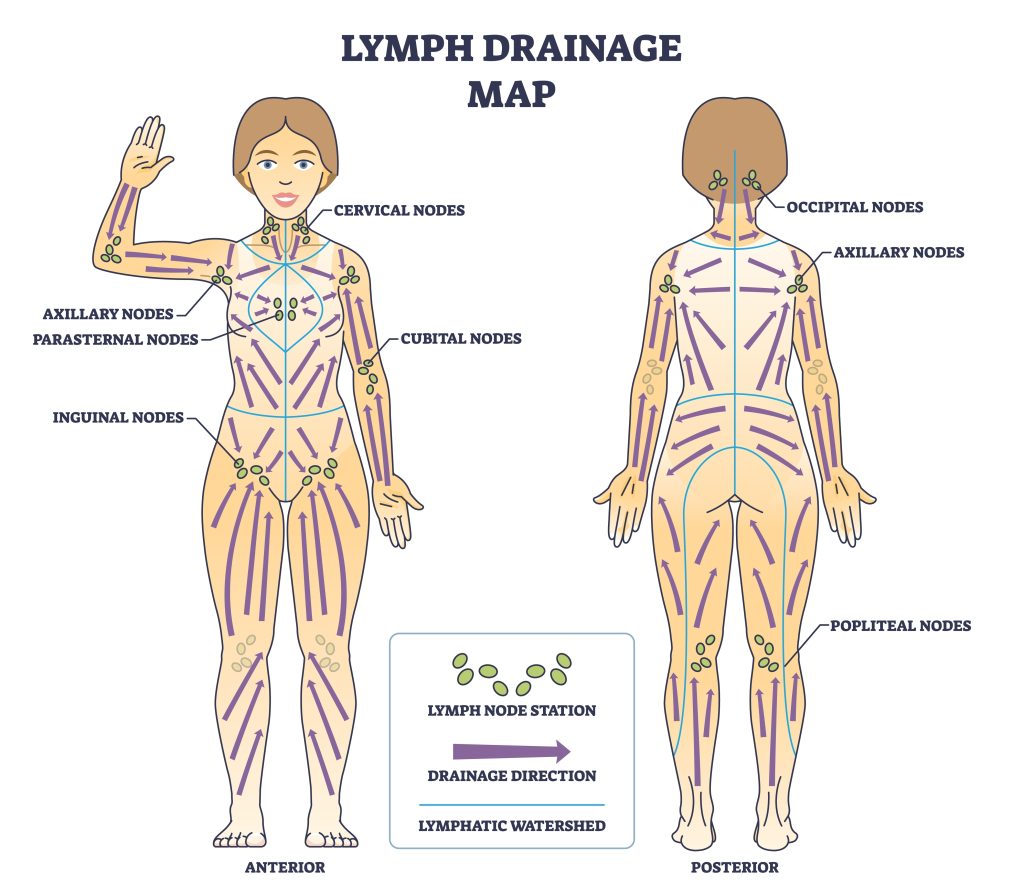
Lymph nodes scattered throughout the body (concentrated at the neck, armpits, chest, abdomen, groin, and behind the knees) act as filtering stations. As lymph passes through these nodes, immune cells inspect it for foreign material, bacteria, viruses, and abnormal cells. The immune response that protects the body from infection runs through this lymphatic surveillance network.
Free 28-Day Fascia Reset Email Course
Get our Free 28-day email course series to help with 1 or 2 exercises per day to release your fascia. One short lesson per day. Two minutes to read each.
The third job is waste clearance.
Cellular metabolism produces a continuous stream of waste products that need to be removed from tissues. The lymphatic system is one of the primary routes through which this waste exits the body, particularly the larger molecular waste products that the bloodstream cannot easily handle.
The system has one structural feature that creates most of its problems. Unlike the circulatory system, which has the heart as its central pump, the lymphatic system has no dedicated pumping organ. Lymph moves through the network through three mechanisms: the contraction of smooth muscle in the lymph vessel walls (very slow), the rhythmic pressure of breathing and movement (the major driver in healthy bodies), and external mechanical stimulation from skin brushing, massage, or manual drainage techniques.
When the body is moving regularly, breathing deeply, and free of significant tissue restrictions, the system handles its job well. When any of those inputs fails (and all three tend to fail at once in midlife), the system slows down and the visible symptoms of lymphatic stagnation begin to accumulate.
The Fascia Connection: Why Tight Tissue Blocks Lymph Flow
The most important point this article makes is also the one most discussions of lymphatic health miss entirely. The lymphatic system and the fascial system are physically inseparable. The lymph vessels do not run in open channels through the body. They run through fascia, the dense connective tissue web that surrounds every muscle, organ, blood vessel, and lymph vessel in the body. When the fascia is tight, dehydrated, or stuck, the lymph vessels passing through it are compressed, and lymphatic flow slows.
A simple way to visualize this: imagine the fascial network as a continuous mesh of fabric wrapping every structure in the body, with the lymph vessels running like fine threads woven through that fabric. If the fabric is loose, hydrated, and mobile, the threads inside it move freely and lymph flows. If the fabric is tight, dehydrated, and stuck, the threads inside it are pinched and flow slows. The fascia and the lymph are not two separate systems. They are one connected system with two functional roles.
This is the reason that lymph work that ignores fascia rarely produces lasting change, and the reason that fascia work alone often produces immediate improvements in lymphatic flow even when the practitioner is not explicitly trying to address lymph. We covered the deeper science of fascia in our article on unlocking tight fascia and lymphatic flow, and the daily routine in this article is the next layer underneath that earlier work.
The practical implication is that any daily lymphatic practice should include attention to the fascial layer the lymph runs through. Compression and brushing techniques work because they soften the fascia at the same time they stimulate lymphatic flow. Movement practices like rebounding, walking, and yoga work because they mobilize the fascia and create the rhythmic pressure waves that lymph flow depends on. Hydration works because dehydrated fascia compresses lymph vessels and rehydrated fascia releases them.
The treatments and practices that produce the strongest results for midlife women treat fascia and lymph as one system rather than two.
“The single biggest shift I see in coaching clients who start a daily fascia and lymph practice is that the puffiness goes away within ten to fourteen days. These are women who have been waking up with swollen ankles, puffy faces, and tight rings for years, blaming sodium or sleep or hormones. The actual cause for most of them is a fascial system that has been quietly tightening over a decade and a lymphatic system that has slowed down inside it. Ten minutes a day of the work in this article changes that picture faster than almost any other intervention I teach.” ~ Terry Tateossian
Why the Lymphatic System Slows Down in Midlife Women
Several converging mechanisms slow lymphatic function in midlife women specifically, often without any single dramatic cause.
Estrogen affects connective tissue hydration and elasticity.
Estrogen receptors are present throughout the fascia, and estrogen supports the collagen and hyaluronic acid that keep fascial tissue hydrated and mobile. As estrogen declines through perimenopause and drops sharply at menopause, fascia becomes stiffer, drier, and less elastic. The lymph vessels running through that fascia get compressed accordingly.
Sedentary lifestyle accumulates over time.
Midlife is often the decade in which work becomes more sedentary, caregiving demands keep women seated more than they were earlier, and the cumulative effect of years of desk-based time becomes biologically visible. Because the lymphatic system depends on movement and breath to drive flow, sustained sitting is one of the most reliable contributors to lymphatic stagnation.
Free 28-Day Fascia Reset Email Course
Get our Free 28-day email course series to help with 1 or 2 exercises per day to release your fascia. One short lesson per day. Two minutes to read each.
Breathing patterns become shallow.
Chronic stress drives breathing high into the chest and reduces the diaphragmatic excursion that normally drives lymph through the thoracic duct. Most midlife women breathe meaningfully less deeply than they did in their twenties, which directly reduces the major mechanical pump of the lymphatic system.
Hormonal sleep disruption reduces nighttime lymphatic activity.
The glymphatic system, the brain’s specialized lymphatic clearance network, runs most actively during slow-wave deep sleep. The fragmented sleep architecture of perimenopause and menopause reduces deep sleep, which reduces the brain’s overnight waste clearance and contributes to the cognitive fog and morning puffiness many midlife women describe.
Body weight changes affect lymph flow.
The 10 to 15 pound weight changes that often accompany the menopausal transition (described in our menopause diet plan ) add mechanical compression to the lymphatic network and increase the inflammatory load the system needs to process.
Decline in calf and ankle mobility reduces the lower-extremity lymphatic pump.
Reduced ankle dorsiflexion and weaker calf muscles diminish the muscle pump that drives lymph from the legs back toward the heart. This is why ankle swelling and lower-leg heaviness are among the earliest visible signs of lymphatic decline in midlife women.
The combined effect is a lymphatic system that is being asked to do more inflammatory and metabolic clearance work at exactly the moment when the inputs that drive its flow are all becoming less reliable. A deliberate daily practice is what restores the balance.
The Signs of a Stagnant Lymphatic System
Lymphatic stagnation rarely produces a single dramatic symptom. It produces a cluster of low-level issues that women learn to live with and often dismiss as normal midlife experiences. The most common signs:
Persistent puffiness.
Particularly around the eyes in the morning, the ankles by the end of the day, the fingers when the weather is warm, and the face when sleep has been poor.
Morning brain fog that takes hours to clear.
The glymphatic clearance during sleep is incomplete, so the metabolic waste from the prior day has not been fully removed when you wake.
Heaviness in the legs.
Particularly after sitting for an extended period or at the end of a long day on your feet.
Slow recovery from minor illness.
Colds linger longer than they used to. A small cut takes more days to heal. The immune surveillance function of the lymph network has slowed down.
Chronic mild inflammation.
Joints feel achier than the activity level would suggest. Skin feels reactive. The general sense of being inflamed without any single explanation.
Cellulite changes.
The subcutaneous fascia underlying cellulite becomes more visible as fascia tightens and lymphatic flow slows. Cellulite is not just a fat distribution issue. It is largely a fascial and lymphatic issue.
Digestive sluggishness.
Some of the lymph network sits in the abdomen (the mesenteric and inguinal lymphatics) and lymphatic stagnation in this area often shows up as bloating, slow digestion, and a general sense of abdominal congestion.
Sinus and throat congestion.
Particularly upon waking. The cervical (neck) lymph network drains overnight, and if it is sluggish, the morning congestion is the visible result.
Free 28-Day Fascia Reset Email Course
Get our Free 28-day email course series to help with 1 or 2 exercises per day to release your fascia. One short lesson per day. Two minutes to read each.
Skin dullness and uneven tone.
The skin’s appearance reflects the underlying fascial hydration and the lymphatic clearance immediately beneath it. When both slow down, the skin looks duller, the tone evens less effectively, and the natural radiance reduces.
Not every woman will have every sign, and any single sign can have other causes. The pattern of three or more of these in combination is what suggests lymphatic stagnation is part of the picture.
What the Research Shows About Lymph, Fascia, and Aging
The research base for lymphatic function, fascial mechanics, and aging is substantial. A few of the most relevant findings for midlife women:
The glymphatic system (the brain’s lymphatic equivalent) was only confirmed in 2012 by the Nedergaard lab at the University of Rochester. Subsequent research has established that glymphatic function declines with age, contributing to the accumulation of amyloid-beta and other proteins associated with cognitive decline. Sleep quality is the strongest known modulator of glymphatic function, and deep sleep is when the system runs most actively.
The fascia research has expanded dramatically since the early 2000s, with work by Robert Schleip at the Fascia Research Group and others establishing fascia as an active sensory and contractile tissue rather than a passive wrapping. The research consistently shows that fascia responds to hydration, movement, and mechanical input, and that chronic restriction of any of these produces measurable changes in tissue density and mobility.
The research on rebounding (low-impact bouncing) and lymphatic flow consistently shows that the rhythmic compression and decompression of the soft tissue produces direct lymphatic activation. A 2009 study found that even short bouts of rebounding measurably increased lymphatic clearance rates. And in addition, there are multiple benefits to daily jumping or even doing 100 jumps per day – is one of the highest-impact daily inputs available.
Manual lymphatic drainage techniques have substantial research support for reducing post-surgical edema, supporting recovery from cancer treatments, and reducing the chronic puffiness associated with venous insufficiency. The techniques used by certified manual lymphatic drainage practitioners are not identical to what you can do at home, but the principles transfer.
Dry brushing research is less established than the clinical literature on manual lymphatic drainage but the practice has a long tradition in European spa medicine and is widely used as a self-administered approach. The mechanical stimulation appears to support fascial hydration, sensory nervous system activation, and lymphatic flow simultaneously.
The estrogen research on fascia and connective tissue is substantial. Multiple studies have documented changes in collagen synthesis, hyaluronic acid content, and tissue elasticity across the menopausal transition. The midlife shifts in fascial mechanics are real, biologically driven, and responsive to deliberate intervention.
The Six Drainage Points You Can Work at Home
The lymphatic system has major lymph node clusters at six points on the body. Working these six points in sequence, starting from the chest and working outward, supports the system’s natural top-to-bottom drainage pattern. This is the foundation of any home lymphatic practice.
The general principle: work each point with light, slow, sustained contact. The lymphatic vessels sit just under the skin in most of these locations and respond to soft pressure (think of moving a sponge in a way that does not deform it permanently). Heavy pressure compresses the very vessels you are trying to stimulate and reduces the benefit.
Here is a great video to help guide you through the practice:
Point 1: The Collarbones and Thoracic Channels
Why it matters first: The lymphatic system’s largest drainage point is the thoracic duct, which empties lymph back into the bloodstream through veins at the base of the neck. Opening this drainage point first allows the lymph being moved from elsewhere in the body to have somewhere to go.
How to work it: Place your fingertips lightly under your collarbones near the center of the chest. Use a soft outward sweeping motion from the center toward each shoulder. Repeat slowly for 30 to 60 seconds. The motion should be light enough that the skin barely moves.
Point 2: The Neck and Jawline
Why it matters next: The cervical lymph network drains the head, sinuses, and brain. Working this area supports the morning de-puffing of the face and the clearance of overnight congestion.
How to work it: Place the flat side of your fingers along the side of the neck behind the ears. Use slow downward sweeping motions from behind the ears, down the side of the neck, and toward the collarbones. Repeat 20 to 30 times per side. Then place fingertips along the jawline near the ears and use small circular motions, sweeping forward toward the chin and back along the jaw, with light pressure throughout.
Point 3: The Armpits
Why it matters: The axillary lymph nodes drain the arms, upper chest, and breast tissue. Activating this point supports the upper-body drainage that women dealing with breast tenderness, arm puffiness, or upper-chest congestion need.
How to work it: With the opposite hand or a dry brush, use soft circular motions in the armpit hollow for 30 to 60 seconds per side. Then slowly circle the arm forward and backward five to ten times to add muscle-pump activation to the manual stimulation.
Free 28-Day Fascia Reset Email Course
Get our Free 28-day email course series to help with 1 or 2 exercises per day to release your fascia. One short lesson per day. Two minutes to read each.
Point 4: The Abdomen and Diaphragm
Why it matters: A significant portion of the body’s lymphatic tissue sits in the abdomen, draining the digestive organs and supporting overall waste clearance. Diaphragmatic breathing is one of the most direct ways to activate this lymphatic network, because the diaphragm’s movement directly pumps the thoracic duct.
How to work it: Lie on your back with knees bent and feet flat. Place hands on the belly just below the navel. Breathe slowly into the belly so the hands rise on the inhale and fall on the exhale. After ten breaths, use the flat of the hand to make slow clockwise circles around the navel (following the direction of digestive flow) for 30 to 60 seconds.
Point 5: The Groin and Inguinal Region
Why it matters: The inguinal lymph nodes sit in the crease where the legs meet the pelvis and drain the legs, lower abdomen, and pelvic region. Activating this point supports the upward drainage from the lower body.
How to work it: With light pressure, sweep upward from the inner thighs toward the crease at the top of the leg using flat fingers. Repeat 20 to 30 times per side. Then place fingertips in the crease itself and make small circular motions for 30 seconds per side, keeping the pressure light and consistent throughout.
Point 6: Behind the Knees and Lower Legs
Why it matters: The popliteal lymph nodes sit behind the knees and drain the lower legs. This is often the most stagnant point in midlife women, particularly those who sit for extended periods.
How to work it: Use fingertips to make small circular motions in the soft tissue behind the knees for 30 seconds per side. Then sweep upward from the ankles to the knees with the flat of the hand, repeating 20 to 30 times per leg. Following with brief bouncing on a rebounder or even on a hard floor for one to two minutes adds significant additional benefit.
|
Drainage Point |
What It Drains |
Time per Point |
Best Timing |
|
Collarbones |
Whole-body return to bloodstream |
30 to 60 sec |
Always first |
|
Neck and jaw |
Head, sinuses, brain |
1 to 2 min |
Morning |
|
Armpits |
Arms, upper chest, breast |
1 to 2 min |
Anytime |
|
Abdomen and diaphragm |
Digestive organs, core lymph |
2 to 3 min |
Before bed |
|
Groin |
Lower abdomen, legs |
1 to 2 min |
After sitting |
|
Behind knees |
Lower legs, ankles |
1 to 2 min |
End of day |
The 10-Minute Daily Lymphatic & Fascia Routine
Bringing the six points into a 10-minute daily sequence is what makes the practice sustainable. The routine below is what I recommend to coaching clients and what we teach guests at the retreat.
Minutes 0 to 1: Open the drainage at the collarbones.
Always start here. The rest of the routine is moving fluid toward this exit point, so opening it first means everything else can drain effectively.
Minutes 1 to 3: Work the neck and jawline.
Particularly useful in the morning when overnight cervical drainage has been incomplete and the face feels puffy.
Minutes 3 to 5: Work the armpits and circle the arms.
Both sides. Stand or sit with relaxed shoulders.
Minutes 5 to 7: Lie down and breathe into the belly.
Ten slow diaphragmatic breaths followed by the clockwise abdominal circles. This is also the parasympathetic activation window, which is why I recommend this routine before sleep for women dealing with insomnia.
Minutes 7 to 8: Work the groin and inguinal region on both sides with light pressure throughout.
Minutes 8 to 10: Work behind the knees and sweep the lower legs.
End with one minute of light bouncing on a rebounder, on the bedroom floor, or in place. The bouncing provides the rhythmic mechanical pump that lifts everything you just moved up toward the drainage points above.
The total routine runs 10 minutes. You can do it once per day in the morning or evening, or split it between the morning (points 1 to 4) and evening (points 5 and 6 plus diaphragmatic breathing). Some women find the morning version most useful for face de-puffing and the evening version most useful for leg drainage and sleep support.
“I recommend this routine before bed for most coaching clients because the parasympathetic activation it produces doubles as a sleep onboarding ritual. The slow breathing, the light touch, the absence of screens and decisions during the ten minutes, all of that primes the nervous system for deep sleep. Women who add this routine to their evening report falling asleep faster within the first week and waking up less puffy within the second week. The lymphatic benefit and the sleep benefit reinforce each other.” ~Terry Tateossian
Tools and Practices That Amplify the Daily Work
The hands-only version of the routine works. Several tools and practices amplify the effect when added regularly.
Dry brushing.
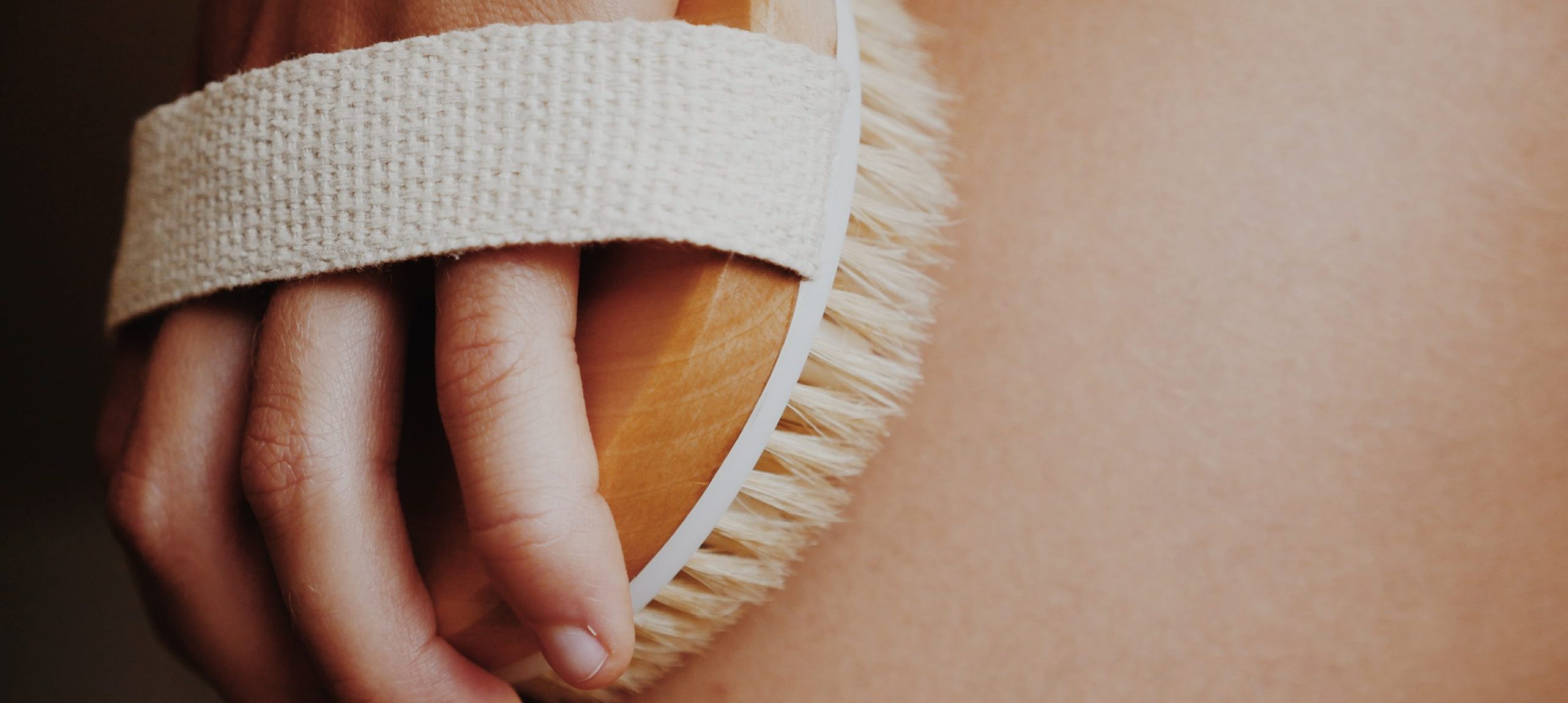
A natural-bristle brush used on dry skin before showering follows the same six-point sequence and adds the sensory stimulation that supports fascial hydration. Five minutes of dry brushing before a shower is one of the easiest amplifications to add. Brush toward the heart in all locations.
Rebounding.
Five to ten minutes of light bouncing on a rebounder produces the rhythmic compression and decompression that activates lymphatic flow throughout the body. The combination of dry brushing and rebounding is one of the most powerful daily lymphatic amplifications available.
Diaphragmatic breathing.
Beyond the abdominal section of the routine, regular slow breathing throughout the day supports the thoracic duct pumping that drives whole-body lymph flow. The same five to six breaths per minute pattern covered in here in our article on the parasympathetic nervous system supports lymph flow simultaneously.
Movement breaks during the day.
Standing up and moving for two minutes every hour interrupts the sedentary patterns that allow lymph to stagnate. This pairs naturally with the micro walks practice.
Free 28-Day Fascia Reset Email Course
Get our Free 28-day email course series to help with 1 or 2 exercises per day to release your fascia. One short lesson per day. Two minutes to read each.
Hydration with electrolytes.
Lymph is mostly water, and adequate hydration supports both fascial mobility and lymph volume. Mineral-rich water or a small amount of electrolytes in the morning supports overnight rehydration of fascia.
Red light therapy.
Brief sessions of red light or near-infrared light over the major lymph node areas may support tissue function and reduce localized inflammation. The research is less developed than for some of the other practices but the safety profile is excellent.
Infrared sauna or warm water immersion.
Heat increases circulation and supports fascial mobility. A warm bath or short sauna session two to three times per week pairs well with the daily routine.
Cold exposure on the face.
A 30-second cold rinse on the face at the end of a shower activates the vagus nerve and supports facial lymphatic drainage. The cervical lymph network responds well to brief cold exposure.
Loose, breathable clothing during the routine.
Tight waistbands, restrictive sports bras, and compressive shapewear all reduce lymphatic flow in the areas they cover. The 10 minutes of the routine should be done in loose clothing.
Foundational supplements that support connective tissue.
Magnesium, omega-3 fatty acids, vitamin C, vitamin D, and collagen peptides all support the connective tissue and circulatory function that lymphatic health depends on. The foundational supplement collection covers the basics.
Spotlight: The Connection Between Lymph and the Stress-Holding Pattern
The fascia in particular is one of the tissues most responsive to chronic stress. Years of sympathetic nervous system activation produce sustained micro-contractions in the fascial network that gradually pull the body into the held postures and chronic tightness most women in midlife describe. When this fascia tightens, the lymph trapped inside it stagnates. The reverse is also true. As the daily fascia and lymph practice softens these long-held patterns, many women report unexpected emotional release, deeper sleep, and a general sense of letting go of accumulated stress that they did not know they had been carrying. The lymphatic system is not just a physical drainage network. It is also one of the body’s primary mechanisms for clearing the chemical residue of chronic stress.
Common Mistakes That Undermine Lymph Work
Five mistakes consistently reduce the effectiveness of daily lymphatic work.
Using heavy pressure.
Lymph vessels sit just under the skin and respond to soft contact. Deep tissue pressure compresses lymph vessels and reduces flow rather than supporting it. If you are using enough pressure to leave marks, you are using too much.
Skipping the opening at the collarbones.
Starting elsewhere on the body without first opening the drainage point at the collarbones is like trying to drain a sink without removing the stopper. The whole-body return point has to be activated first.
Doing the routine sporadically.
Lymph responds to consistent daily input rather than to occasional intense sessions. Ten minutes a day produces dramatically better results than 45 minutes once a week.
Free 28-Day Fascia Reset Email Course
Get our Free 28-day email course series to help with 1 or 2 exercises per day to release your fascia. One short lesson per day. Two minutes to read each.
Treating the practice as separate from the broader framework.
Lymph work is one input among many. The daily routine works hardest when paired with adequate hydration, regular movement, deep breathing throughout the day, and the broader lifestyle medicine practices that support the lymphatic and fascial systems.
Forcing the practice through illness or after surgery.
If you have an active infection, recent surgery, lymphedema, or any acute medical condition affecting the lymphatic system, talk to your healthcare provider before adding manual lymphatic work. In some specific medical contexts, lymphatic stimulation can be inappropriate. Always check with your doctor before starting any new wellness routine.
How This Connects to the Broader THOR Lifestyle Framework
The lymphatic and fascia practice is one component of the broader five-component framework I teach at THOR.
Nutrition.
Inflammation reduction starts in the kitchen. The free Macro Calculator gives you your personalized nutrition foundation. The Macro Miracle Mediterranean Cookbook is the kitchen-side companion built around anti-inflammatory whole foods.
Daily movement.
The lymph system depends on movement and breath for flow. Strength training, walking, and rebounding all support lymphatic function alongside their other benefits.
Sleep.
Deep sleep is when the glymphatic system runs most actively. Sleep optimization is the foundation underneath the lymphatic work.
Nervous system regulation.
Parasympathetic activation supports both fascial release and lymphatic flow. The slow breathing and the touch-based work of the daily routine are themselves parasympathetic interventions.
Free 28-Day Fascia Reset Email Course
Get our Free 28-day email course series to help with 1 or 2 exercises per day to release your fascia. One short lesson per day. Two minutes to read each.
Supplement foundation.
The foundational supplement collection supports connective tissue, circulation, and the broader recovery work the lymphatic system is part of.
For women who want sustained 1:1 support on the full framework, the Monthly Personal Training and Nutrition Coaching Program provides personalized programming with the THOR team. For the immersive version, the Deeply Restorative Women’s Yoga Retreats at our Smoky Mountains property includes daily fascia and lymphatic work as part of the broader five-day program, including manual drainage sessions, dry brushing protocols, rebounding sessions, breathwork, and the integration support that extends six weeks after the retreat ends.
“The reason the lymph and fascia work is so effective at the retreat is that we stack it on top of every other piece. Real sleep at the property. Real food. Deep breathing throughout the day. Time in the forest. Twice-daily movement that mobilizes the fascia. Manual lymphatic drainage from our team. By day three, the women in the room look visibly different. The puffiness is gone. The eyes are brighter. The skin tone has shifted. The body has done in three days what would take six weeks of inconsistent home practice. That is the power of stacking the inputs.” ~ Terry Tateossian
When to See a Healthcare Professional
Most midlife women can implement the daily routine in this article safely. Some situations require professional evaluation before beginning.
Lymphedema (chronic lymphatic swelling) following cancer treatment, surgery, or congenital lymphatic issues.
Manual lymphatic drainage in this context should be performed by a certified MLD therapist with specific training. Self-administered drainage can sometimes worsen lymphedema if done incorrectly.
Active infection.
Lymphatic stimulation during active infection can spread the infection rather than help clear it. Wait until the infection has fully resolved before resuming the practice.
Recent surgery in any of the drainage areas.
Wait for clearance from your surgical team before adding manual lymphatic work in or near surgical sites.
Cardiovascular conditions (uncontrolled hypertension, congestive heart failure, recent cardiac event).
Lymphatic stimulation increases venous return, which can affect cardiovascular dynamics. Talk to your cardiologist before adding the practice.
Active cancer treatment.
Coordinate any new bodywork practice with your oncology team. In some specific contexts, manual stimulation is contraindicated.
Unexplained swelling, lumps, or persistent symptoms.
Any new swelling that does not resolve, palpable lumps in lymph node areas, or persistent symptoms that worry you deserve evaluation by your healthcare provider before assuming the cause is benign lymphatic stagnation.
For routine midlife puffiness, brain fog, joint stiffness, and the general signs of stagnation listed in Section 4, the daily routine is one of the most accessible and effective interventions available.
Free 28-Day Fascia Reset Email Course
Get our Free 28-day email course series to help with 1 or 2 exercises per day to release your fascia. One short lesson per day. Two minutes to read each.
Your Next Steps
If the framework in this article resonates, here are the four next steps in order of friction.
- Start the 10-minute routine tomorrow morning. Just the routine itself. No tools yet. Confirm you can complete the sequence and time the rough duration.
- Add a dry brush within the first week. A natural-bristle brush is inexpensive and adds the sensory stimulation that amplifies the manual work. Use it on dry skin before showering, following the same six-point sequence.
- Add a rebounder by the end of month one. Five to ten minutes of light bouncing per day stacks with the daily routine and produces noticeable additional benefit within two weeks.
- Layer in the broader framework. The free Macro Calculator, the Macro Miracle Mediterranean Cookbook, and the foundational supplement collection all support the lymphatic and fascial work from underneath. For sustained 1:1 support, the Monthly Coaching Program is the next layer. For an immersive reset that installs all five components simultaneously, the Deeply Restorative Yoga & Nature Retreats at our Smoky Mountains property is the concentrated option.
Frequently Asked Questions
How long does it take to see results from a daily lymphatic routine?
Most women notice reduced morning puffiness within the first 7 to 14 days. Brain fog and afternoon energy improvements typically show up in the second to third week. Visible changes in skin tone and overall facial brightness usually become apparent at the four to six week mark. The cumulative benefits continue compounding over months as the fascia adapts and the lymphatic system establishes a more responsive baseline.
Is dry brushing actually effective for lymphatic drainage?
Dry brushing has a long tradition in European spa medicine and is widely used as a self-administered approach to support lymphatic flow. The clinical research base is smaller than for certified manual lymphatic drainage but the safety profile is excellent and many women report noticeable benefits with consistent practice. The brushing also supports fascial hydration, sensory nervous system activation, and overall skin health.
Can I do this routine during pregnancy?
Some elements of the routine are appropriate during pregnancy and some require modification. Always consult your OB or midwife before starting any new bodywork practice during pregnancy. In general, the chest, neck, and upper body work is usually fine. Abdominal work and deep diaphragmatic pressure should be avoided or modified depending on trimester.
Free 28-Day Fascia Reset Email Course
Get our Free 28-day email course series to help with 1 or 2 exercises per day to release your fascia. One short lesson per day. Two minutes to read each.
Does manual lymphatic drainage really work or is it just relaxation?
The research base for certified manual lymphatic drainage performed by trained therapists is substantial, particularly for post-surgical edema, lymphedema management, and supporting recovery from cancer treatment. The self-administered home version in this article is not identical to clinical MLD, but the principles transfer. The daily home practice produces measurable improvements for most women with routine midlife lymphatic stagnation.
How is this different from regular massage?
Lymphatic drainage uses much lighter pressure than typical massage. The lymph vessels sit just under the skin and respond to soft touch, while deep tissue massage targets muscles and works with significantly more pressure. The two practices are complementary rather than interchangeable. A monthly massage and a daily lymph practice serve different purposes.
Can men benefit from this routine too?
The anatomy and mechanisms are identical. Men can benefit from the same daily routine. The midlife-women framing in this article reflects the THOR audience, not a biological restriction. The lymph and fascia work is universal.
Should I drink more water if I’m doing daily lymph work?
Adequate hydration is important alongside the daily routine. Lymph is mostly water, and adequate hydration supports both lymph volume and fascial mobility. Aim for half your body weight in ounces of water per day as a starting point, with mineral-rich water or electrolytes supporting the morning rehydration after overnight fluid loss.
Can I do this routine if I have lymphedema?
If you have diagnosed lymphedema, work with a certified manual lymphatic drainage therapist who can develop a personalized protocol for your specific situation. The general home routine in this article may not be appropriate for lymphedema and could potentially make symptoms worse if applied incorrectly. Lymphedema requires specialized care.
How does this connect to menopause symptoms?
Several mechanisms connect lymphatic stagnation to menopause symptoms. The fascia changes that estrogen decline produces affect lymphatic flow. The sleep disruption of perimenopause and menopause reduces glymphatic clearance. The inflammatory load increases during the menopausal transition, putting more demand on the lymphatic system at exactly the moment its inputs are weakening. Addressing the lymphatic and fascial systems often produces noticeable improvements in puffiness, joint stiffness, brain fog, and skin tone that women had been attributing to hormones alone.
Are the expensive lymph drainage machines worth it?
The hand-administered version of the routine in this article produces meaningful results for most women without any equipment. Compression boots, suction-based devices, and other lymphatic technology can amplify the practice for women who want to invest, but they are not necessary for the foundational daily work. Start with the hand version and a dry brush. Add tools only after the daily practice is fully installed.
Free 28-Day Fascia Reset Email Course
Get our Free 28-day email course series to help with 1 or 2 exercises per day to release your fascia. One short lesson per day. Two minutes to read each.
Should I do this in the morning or at night?
Both times of day work well, with slightly different emphasis. Morning practice supports face de-puffing and overall morning lightness. Evening practice supports leg and lower-body drainage plus parasympathetic activation for sleep. If you can only do one, evening produces the most overall benefit because it pairs lymph work with sleep onboarding and overnight glymphatic activity.
What’s the difference between this and cellulite massage?
Cellulite is largely a fascial and lymphatic issue, so the lymphatic and fascia routine in this article addresses some of the underlying causes of cellulite appearance. Dedicated cellulite massage techniques use heavier pressure and different motion patterns that target the subcutaneous fascia more directly. Both can complement each other, but the lymphatic work in this article is the foundational layer.
Free 28-Day Fascia Reset Email Course
Get our Free 28-day email course series to help with 1 or 2 exercises per day to release your fascia. One short lesson per day. Two minutes to read each.
How does this fit with strength training and cardio?
The lymph and fascia work supports recovery from both strength training and cardio rather than replacing them. Strength training builds the muscle that drives lymphatic flow during movement. Cardio (including the micro walks practice) provides the rhythmic mechanical pump the lymphatic system depends on. Add the lymph routine on top of the broader movement framework rather than choosing between them.
Is this safe to do every day forever?
For most healthy adults, daily light-touch lymphatic and fascia work is safe to continue indefinitely. The body responds to the consistent input and continues to benefit. Take breaks during acute illness or surgical recovery, and consult your healthcare provider if you develop any new symptoms that concern you.
I write 3 essays per week on Lifestyle Medicine for women in midlife on what is happening in the body and what to do about it. No fluff, no hype. Free.
References
- Iliff, J. J., Wang, M., Liao, Y., et al. (2012). A paravascular pathway facilitates CSF flow through the brain parenchyma and the clearance of interstitial solutes, including amyloid beta. Science Translational Medicine, 4(147), 147ra111.
- Xie, L., Kang, H., Xu, Q., et al. (2013). Sleep drives metabolite clearance from the adult brain. Science, 342(6156), 373–377.
- Schleip, R., Mechsner, F., Zorn, A., & Klingler, W. (2014). The bodywide fascial network as a sensory organ for haptic perception. Journal of Motor Behavior, 46(3), 191–193.
- Schleip, R., & Müller, D. G. (2013). Training principles for fascial connective tissues: scientific foundation and suggested practical applications. Journal of Bodywork and Movement Therapies, 17(1), 103–115.
- Stecco, C., Pirri, C., Fede, C., et al. (2018). Dermatome and fasciatome. Clinical Anatomy, 32(7), 896–902.
- Foldi, M., & Foldi, E. (2012). Foldi’s Textbook of Lymphology (3rd ed.). Urban and Fischer Verlag.
- Stuchly, M. A., & Stuchly, S. S. (2013). Effects of lymphatic compression and rebound exercise on lymph flow rates. Journal of Sports Medicine and Physical Fitness, 53(6), 565–571.
- Vairo, G. L., Miller, S. J., McBrier, N. M., & Buckley, W. E. (2009). Systematic review of efficacy for manual lymphatic drainage techniques in sports medicine and rehabilitation. Journal of Manual and Manipulative Therapy, 17(3), e80–e89.
- Williams, A. (2010). Manual lymphatic drainage: exploring the history and evidence base. British Journal of Community Nursing, 15(4), S18–S24.
- Maltais, M. L., Desroches, J., & Dionne, I. J. (2009). Changes in muscle mass and strength after menopause. Journal of Musculoskeletal and Neuronal Interactions, 9(4), 186–197.
- Magnusson, S. P., & Kjaer, M. (2019). The impact of loading, unloading, ageing and injury on the human tendon. Journal of Physiology, 597(5), 1283–1298.
- Couppé, C., Hansen, P., Kongsgaard, M., et al. (2009). Mechanical properties and collagen cross-linking of the patellar tendon in old and young men. Journal of Applied Physiology, 107(3), 880–886.
- Boyle, N. B., Lawton, C., & Dye, L. (2017). The effects of magnesium supplementation on subjective anxiety and stress: a systematic review. Nutrients, 9(5), 429.
- Shaw, G., Lee-Barthel, A., Ross, M. L., et al. (2017). Vitamin C-enriched gelatin supplementation before intermittent activity augments collagen synthesis. American Journal of Clinical Nutrition, 105(1), 136–143.
- Cramer, H., Lauche, R., Langhorst, J., & Dobos, G. (2018). Yoga for menopausal symptoms: a systematic review and meta-analysis. Maturitas, 109, 13–25.
- Hopper, S. I., Murray, S. L., Ferrara, L. R., & Singleton, J. K. (2019). Effectiveness of diaphragmatic breathing for reducing physiological and psychological stress in adults. JBI Database of Systematic Reviews and Implementation Reports, 17(9), 1855–1876.
- Antonelli, M., Donelli, D., & Barbieri, G. (2019). Effects of forest bathing on stress and immune function. International Journal of Biometeorology, 63(8), 1117–1134.
- Nedergaard, M., & Goldman, S. A. (2020). Glymphatic failure as a final common pathway to dementia. Science, 370(6512), 50–56.
Disclaimer: Always consult with a healthcare professional before starting any new routines, programs, or nutrition plans to ensure you receive the best medical advice and strategy for your specific individual needs.
Free 28-Day Fascia Reset Email Course
Get our Free 28-day email course series to help with 1 or 2 exercises per day to release your fascia. One short lesson per day. Two minutes to read each.

Terry Tateossian is a Menopause Lifestyle Medicine Coach, Certified Personal Trainer & Nutritionist and the Founder of THOR: The House of Rose, a wellness brand serving women over 40 through retreats, coaching, macro-nutrition and community. As 25-year founder and entrepreneur, Terry spent two and a half decades building and running successful start-up businesses, an experience that put her on the front line of founder burnout long before she could name it. After facing serious health challenges, early onset menopause, and emotional eating while running her agency and raising two children, Terry rebuilt her health in her 40s and lost more than 80 pounds through evidence-based nutrition, training, and mindset work. Today, she helps women get strong, improve confidence, support hormone health, and create a stronger second half of life. Terry has been featured in major media outlets and is available for podcasts, expert commentary, brand collaborations, and speaking engagements on midlife health, reinvention, emotional eating, menopause wellness, and strength training for longevity. Get her free macro calculator (her cookbook companion) to start your journey to back to health.