
 By Team THOR
Free 28-Day Fascia Reset Email Course
Get our Free 28-day email course series to help with 1 or 2 exercises per day to release your fascia. One short lesson per day. Two minutes to read each.
5 Yin Yoga Poses for Myofascial Release: A Complete Guide for Midlife Women Over 40
Yin yoga poses for myofascial release have become one of the most searched-for movement practices among midlife women, and the reason is biological. The fascia (the connective tissue web that surrounds every muscle, organ, blood vessel, and lymph vessel in the body) begins to stiffen meaningfully in the menopausal transition, and the sustained long-hold nature of yin yoga is one of the only movement modalities designed specifically to soften fascial tissue rather than to strengthen the muscles it wraps.
For a woman in her forties, fifties, or sixties dealing with the accumulated stiffness of the modern desk-based life plus the connective tissue changes of estrogen decline, yin yoga poses for myofascial release address exactly the layer of tissue that most other movement practices leave untouched.
This guide covers the five yin yoga poses I use most consistently with coaching clients and retreat guests for effective myofascial release, why yin yoga works for fascia specifically, the anatomy of the fascial lines each pose targets, and how to build a sustainable weekly practice.
I am Terry Tateossian, founder of The House of Rose and a certified lifestyle medicine coach who runs nutrition-focused wellness retreats for women in perimenopause, menopause, and post-menopause at our Smoky Mountains property in East Tennessee.
Important: This article is general educational content, not personalized medical advice. Always consult your healthcare provider before starting any new movement practice, particularly if you have recent injuries, joint replacements, active osteoporosis, disc issues, or any chronic health condition. Yin yoga is generally accessible but the long-hold nature of the poses makes proper modification essential.
What Is Myofascial Release and Why Yin Yoga Works
Myofascial release is the general term for any practice that softens the connective tissue matrix surrounding the muscles. The term covers a range of interventions: manual therapy performed by a bodyworker, self-myofascial release with foam rollers and lacrosse balls, instrument-assisted soft tissue mobilization, and passive stretching held long enough to influence the fascial layer rather than only the muscle. Yin yoga poses for myofascial release fall into this last category.
The distinguishing feature of yin yoga is the hold time. Traditional dynamic yoga styles hold poses for a few breaths at most. Yin yoga poses are held for 3 to 10 minutes each, at a range of intensity where the muscles are asked to soften rather than to work. The prolonged sustained tension is what reaches the fascial layer.
Fascia responds to load differently than muscle. Muscle responds quickly to short intense contractions.
Fascia responds slowly to sustained low-intensity tension. Research on fascial mechanics has established that meaningful changes in connective tissue properties (hydration, ground substance viscosity, collagen remodeling) require sustained tension held for at least 90 to 120 seconds. Poses held for less time influence the muscles they cross but leave the underlying fascia largely untouched.
Yin yoga poses for myofascial release use this biology directly.
The 3 to 10 minute holds allow the fascia to gradually hydrate, soften, and lengthen. The passive positioning (with the muscles deliberately relaxed) means the sustained load lands on the fascial layer rather than being absorbed by contracting muscle. The result is a movement practice that produces measurable changes in connective tissue mobility, joint range of motion, and the felt sense of tissue release that most dynamic practices cannot reach.
For midlife women, this matters because the fascia is one of the tissues most affected by the hormonal changes of the menopausal transition. We covered the deeper biology on unlocking tight fascia and lymphatic flow, and yin yoga for fascia is one of the most accessible daily practices for addressing it.
The Fascia Lines: Why Different Poses Target Different Tissues
The fascial network is not a single homogeneous tissue. It organizes into distinct functional lines that run through the body in specific patterns. The Anatomy Trains model, developed by Thomas Myers and now widely used in fascial research and manual therapy education, identifies twelve major myofascial meridians. For the purposes of yin yoga poses for myofascial release, five lines matter most.
The Superficial Back Line runs from the bottom of the feet, up the back of the calves and hamstrings, along the spine, over the top of the head, and ends at the eyebrows. Tight superficial back line tissue produces the characteristic midlife pattern of tight hamstrings, low back stiffness, and forward head posture.
The Superficial Front Line runs from the top of the feet, up the front of the shins and thighs, across the abdomen, up the chest, and ends behind the ears. Chronic desk-based sitting shortens this line significantly, producing the tight hip flexors, forward-rolled shoulders, and shortened chest tissue that most midlife women carry.
The Deep Front Line runs through the deepest core layer, connecting the inner arch of the foot, the deep hip flexors, the diaphragm, the neck, and the tongue. This is the line that carries most chronic stress-holding patterns and the line that responds most dramatically to sustained fascia release work.
The Lateral Line runs down the sides of the body, connecting the outer foot, the outer hip, the ribs, and the neck. Tight lateral line tissue contributes to the hip pain, IT band tightness, and side-body compression that many midlife women experience.
The Spiral Line wraps the body diagonally, crossing from one shoulder to the opposite hip and continuing down to the foot. This line is essential for rotation and torsion movements and is often significantly restricted in adults with limited spinal rotation.
The five yin yoga poses in this guide are chosen to address these five lines directly. A weekly practice cycling through the five poses reaches every major fascial line in the body over the course of a session.
“The women who come through our retreat in the Smoky Mountains often tell me that they have tried yoga before and found it unhelpful for the tightness they are dealing with. When we get them into a proper yin yoga sequence for fascia release, the change over three days is visible. The reason is not that they had been doing yoga wrong before. It is that the yoga styles they had been practicing were built for muscles, not for the connective tissue where midlife stiffness actually lives. Yin yoga poses for myofascial release address the layer of tissue that most vinyasa and power yoga classes leave untouched.” ~ Terry Tateossian
Free 28-Day Fascia Reset Email Course
Get our Free 28-day email course series to help with 1 or 2 exercises per day to release your fascia. One short lesson per day. Two minutes to read each.
Why Yin Yoga for Fascia Is Particularly Suited to Midlife Women
Several specific biological changes make yin yoga poses for myofascial release unusually well-aligned to the midlife body.
Estrogen & connective tissue quality changes.
Estrogen receptors are present throughout the fascia, and estrogen supports the collagen synthesis and hyaluronic acid content that keep fascial tissue hydrated and mobile. As estrogen declines through perimenopause and drops sharply at menopause, connective tissue becomes stiffer, drier, and slower to lengthen. Yin yoga for fascia is one of the few movement practices calibrated specifically to address this tissue-level change.
Recovery decreases.
High-intensity exercise becomes more costly in midlife because the body’s recovery capacity declines. Yin yoga produces meaningful benefits without imposing the recovery demand of dynamic practices, which makes it stackable with the other exercise women need without adding to the total recovery burden.
Sleep quality changes.
The fragmented sleep of perimenopause and menopause reduces the deep-sleep windows in which tissue remodeling happens. A daily or near-daily yin yoga practice can produce tissue benefits that under-slept women cannot achieve through more intense exercise alone.
Cortisol regulation matters more.
Chronic sympathetic activation drives the fascial tightening pattern most midlife women carry. Yin yoga is one of the most direct parasympathetic nervous system activation practices available.
Joint tolerance changes.
The connective tissue changes that make midlife women more vulnerable to plantar fasciiatis also apply throughout the joints. Passive stretching in yin yoga is generally more joint-tolerant than aggressive dynamic stretching, which matters more in midlife than at any earlier life stage.
Time & life constraints.
Midlife is often the most demanding life stage logistically. A movement practice that produces meaningful benefit in 20 to 40 minutes at home, with no equipment beyond a mat and a few yoga props, is fundamentally different from one requiring a studio visit, specific timing, and dedicated recovery time.
The combined effect is that yin yoga poses for myofascial release fit the midlife body and the midlife schedule better than most other movement practices available.
Before You Start: The Yin Yoga Principles That Matter
Yin yoga has three foundational principles that shape every pose in the practice. Understanding them before starting the sequence produces significantly better results.
Find your edge, then back off.
The first job in every yin pose is to find the point where you feel a sensation of stretch without pain or forceful pulling. Once you find that edge, back off slightly so you are at 80 to 90 percent of your available range rather than at 100. Sustained holds at 80 percent of range reach the fascia better than pushed holds at maximum stretch, and the reduced intensity is what allows you to hold the pose for the necessary duration.
Hold the pose without moving.
Once positioned, stay still. The stillness is what allows the fascia to soften. Small adjustments to comfort are fine but active fidgeting or repositioning breaks the sustained tension that produces the change.
Come out slowly and rest.
Exiting a yin pose too quickly can produce sharp sensations in the tissue that has just released. Move out gradually, take a brief rest position between poses, and let the body integrate the release before moving to the next pose.
Beyond these three principles, a few practical setup considerations:
Use props generously.
Bolsters, blocks, blankets, and cushions are not optional accessories. They allow the muscles to fully relax so the sustained load reaches the fascia rather than being absorbed by muscles trying to hold you up.
Hold each pose for 3 to 5 minutes minimum.
Shorter holds do not reach the fascial layer. Beginners can start at 2 minutes and build up. Experienced practitioners can hold for 8 to 10 minutes when appropriate.
Breathe slowly through the nose.
Slow diaphragmatic breathing supports the parasympathetic activation that helps the fascia soften. Fast chest breathing works against the practice.
Practice on an empty stomach when possible.
Yin yoga tends to be more comfortable and effective when the digestive system is not actively processing a large meal.
Free 28-Day Fascia Reset Email Course
Get our Free 28-day email course series to help with 1 or 2 exercises per day to release your fascia. One short lesson per day. Two minutes to read each.
Yin Pose 1: Butterfly Pose for Inner Line Fascia Release
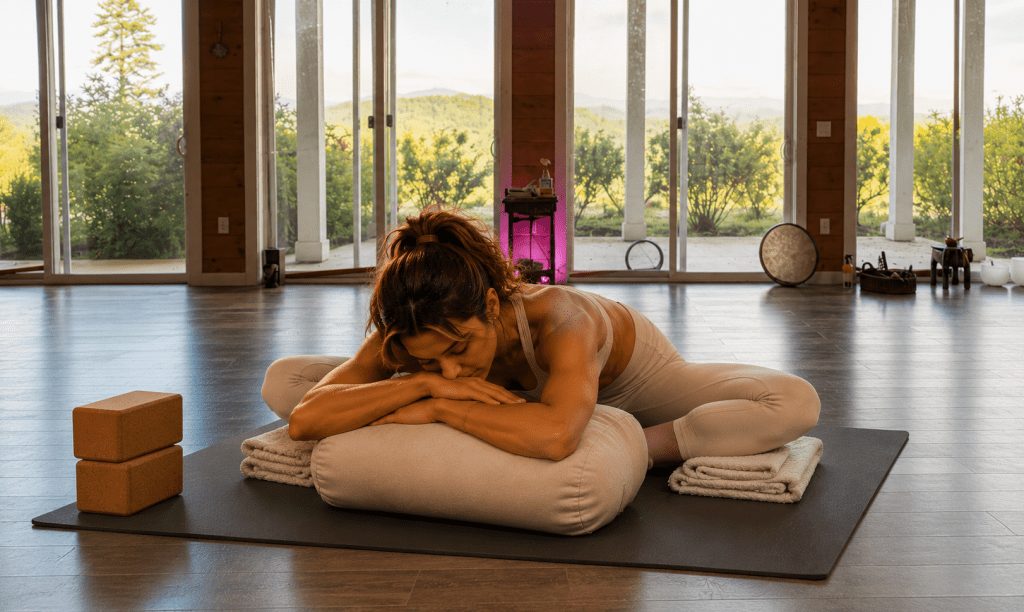
Butterfly Pose (also called Baddha Konasana or Bhekasana in some traditions) is one of the most consistently useful yin yoga poses for myofascial release in midlife women. It targets the inner thigh fascia, the groin, and the front of the hip, which is the region that often carries the accumulated tightness of years of hip-flexed sitting.
Setup: Sit on the floor with the soles of the feet together, letting the knees fall out to the sides.
The feet should sit far enough away from the body that the knees can drop naturally without forcing.
If the knees are elevated significantly off the floor, place bolsters or folded blankets under them for support.
Fold forward from the hips, allowing the spine to round gently. Rest the forearms and forehead on a bolster or stacked blankets in front of you.
Hold time: 3 to 5 minutes on the first attempt, building to 5 to 8 minutes with practice.
Target fascia lines: Deep front line through the inner thighs and groin, and the superficial back line through the lower back as it rounds.
What it addresses in midlife women: Chronic hip tightness from prolonged sitting, inner thigh fascia stiffness that contributes to lower back pain, and the general pelvic congestion that many women describe.
Common mistake to avoid: Forcing the knees toward the floor with the hands. The knees should drop only where they naturally fall. Forcing them creates joint stress that undermines the fascial release.
Best for: Women dealing with hip tightness, lower back stiffness, and chronic pelvic tension. Also excellent as a pre-sleep pose because of the parasympathetic activation it produces.
Yin Pose 2: Dragon Pose for Deep Front Line Release
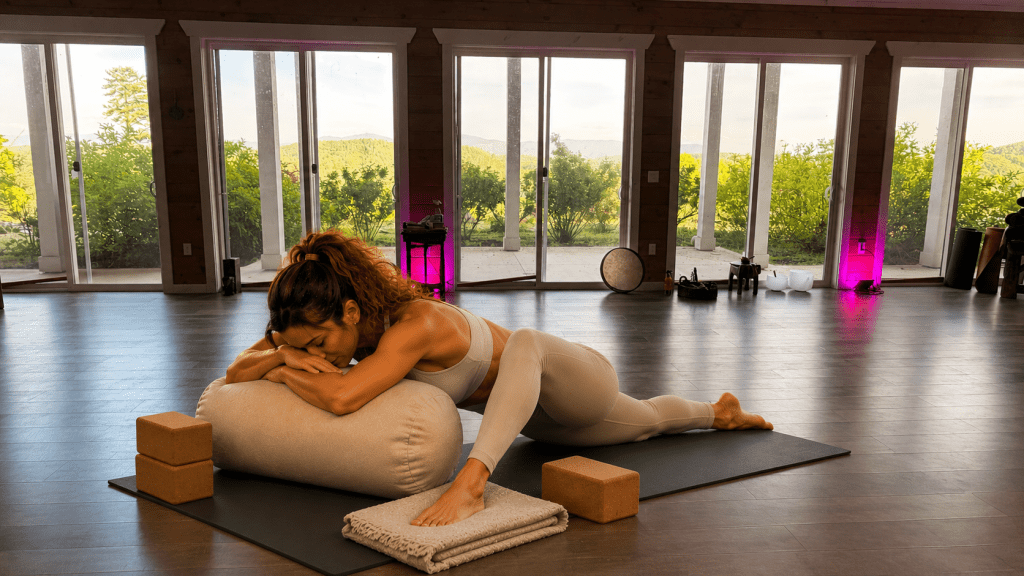
Dragon Pose is one of the most effective yin yoga poses for myofascial release when the target is the deep front line, particularly the hip flexors and the psoas. For midlife women who have spent decades in seated positions, the deep front line is often the most restricted fascial line in the body.
Setup: Start in a hands-and-knees position.
Step the right foot forward between the hands.
Lower the left knee to the floor and slide the left leg back until you feel a stretch through the front of the left hip and thigh.
Place blocks or a bolster under the hands to support the upper body if the position is difficult, or lower the forearms onto a bolster in front of the right foot.
The right knee should stack over the right ankle rather than pushing forward past it.
Hold time: 3 to 5 minutes per side, building to 5 to 8 minutes with practice.
Target fascia lines: Deep front line through the left hip flexor, psoas, and quadriceps.
What it addresses in midlife women: The tight hip flexors from prolonged sitting, the psoas restriction that contributes to lower back pain, and the anterior pelvic tilt pattern that most desk-based adults carry.
Common mistake to avoid: Letting the front knee drop inward or push past the ankle. Both compromise the joint and reduce the effectiveness of the fascial release in the hip flexor.
Best for: Women dealing with tight hip flexors, chronic lower back pain, and the anterior pelvic tilt pattern that shortens the front of the body over years of sitting.
Free 28-Day Fascia Reset Email Course
Get our Free 28-day email course series to help with 1 or 2 exercises per day to release your fascia. One short lesson per day. Two minutes to read each.
Yin Pose 3: Sphinx Pose for Anterior Fascia Line Release
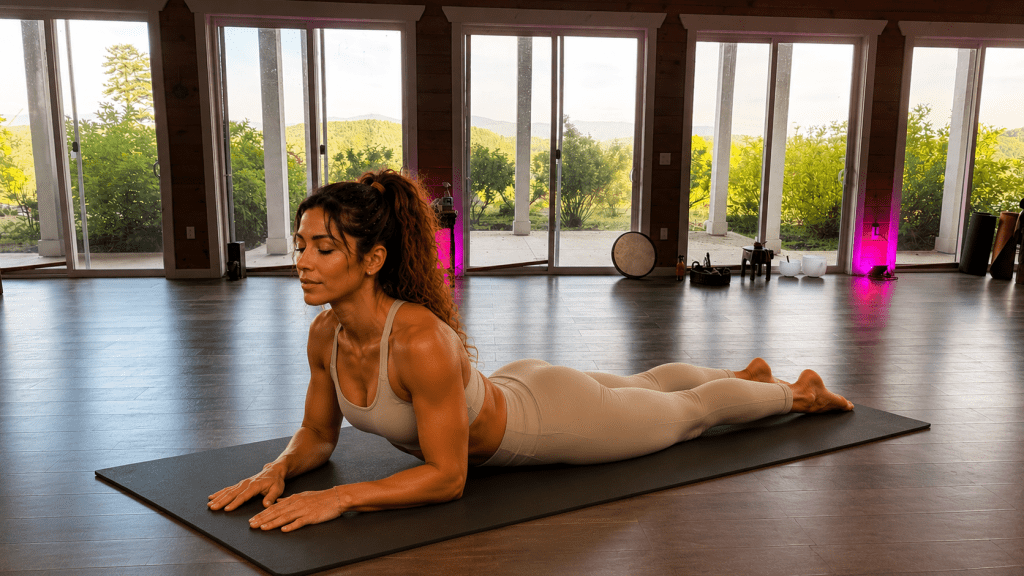
Sphinx Pose is one of the most accessible yin yoga poses for myofascial release along the anterior fascia line. Unlike more aggressive backbends, Sphinx uses the passive weight of the body to gently decompress the anterior chain while opening the front of the chest and softening the abdomen.
Setup: Lie face down on the mat.
Place the forearms on the floor with the elbows directly under the shoulders, palms flat.
Press gently into the forearms and lift the chest, allowing the pelvis and legs to stay heavy on the mat.
The lift should feel accessible and sustainable rather than strained.
If the low back is uncomfortable, place a folded blanket under the pelvis.
If the shoulders feel compressed, move the elbows slightly forward.
Hold time: 3 to 5 minutes on the first attempt, building to 5 to 8 minutes with practice.
Target fascia lines: Superficial front line through the chest, abdomen, and hip flexors, plus the deep front line as the pose gently decompresses the spine.
What it addresses in midlife women: The forward-rolled posture from years of desk work, chronic chest tightness that affects breathing, and the anterior abdominal fascia that often becomes restricted from years of guarding, pregnancy, or abdominal surgery.
Common mistake to avoid: Pressing too hard through the arms and creating tension in the neck. Sphinx should feel passive and supported, not strained.
Best for: Women dealing with forward head posture, chronic chest tightness, and the shallow breathing pattern that often accompanies chronic stress in midlife.
Yin Pose 4: Caterpillar Pose for Posterior Fascia Line Release
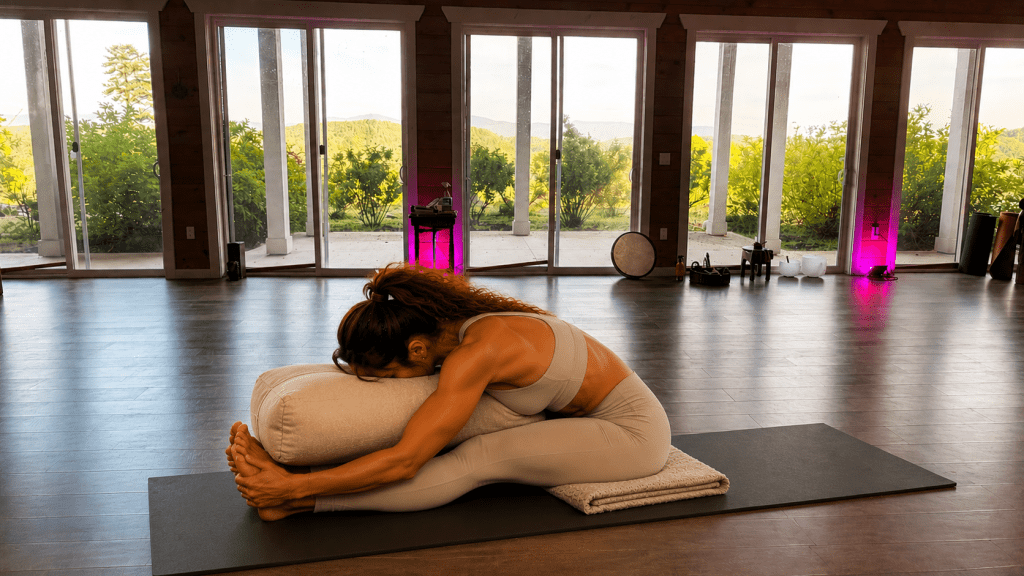
Caterpillar Pose is the classic yin yoga pose for myofascial release along the entire superficial back line. It reaches from the bottom of the feet, up through the calves, hamstrings, and along the spine, giving one of the most complete posterior chain releases available in any movement practice.
Setup: Sit on the floor with the legs extended straight in front of you.
Place a folded blanket or block under the sit bones if the pelvis tilts backward when you sit down.
Fold forward from the hips, allowing the spine to round gently rather than trying to maintain a flat back.
Rest the forehead and forearms on a bolster stacked on top of the thighs, or reach the hands loosely toward the feet.
The key point is that the muscles should be entirely relaxed so the fold happens through gravity rather than through effort.
Hold time: 3 to 5 minutes on the first attempt, building to 5 to 8 minutes with practice.
Target fascia lines: Superficial back line through the entire posterior chain from feet to head.
What it addresses in midlife women: Tight hamstrings, low back stiffness, chronic upper back tension, and the forward-flexed posture that many women fall into by their fifties and sixties.
Common mistake to avoid: Trying to reach the toes or maintain a straight back. Both convert the pose from a fascial release into a muscle stretch and reduce the depth of the release. Round the spine gently and let gravity do the work.
Best for: Women dealing with tight hamstrings, chronic low back tightness, and the overall posterior chain stiffness that most midlife bodies carry.
Free 28-Day Fascia Reset Email Course
Get our Free 28-day email course series to help with 1 or 2 exercises per day to release your fascia. One short lesson per day. Two minutes to read each.
Yin Pose 5: Twisted Roots for Spiral and Lateral Line Release
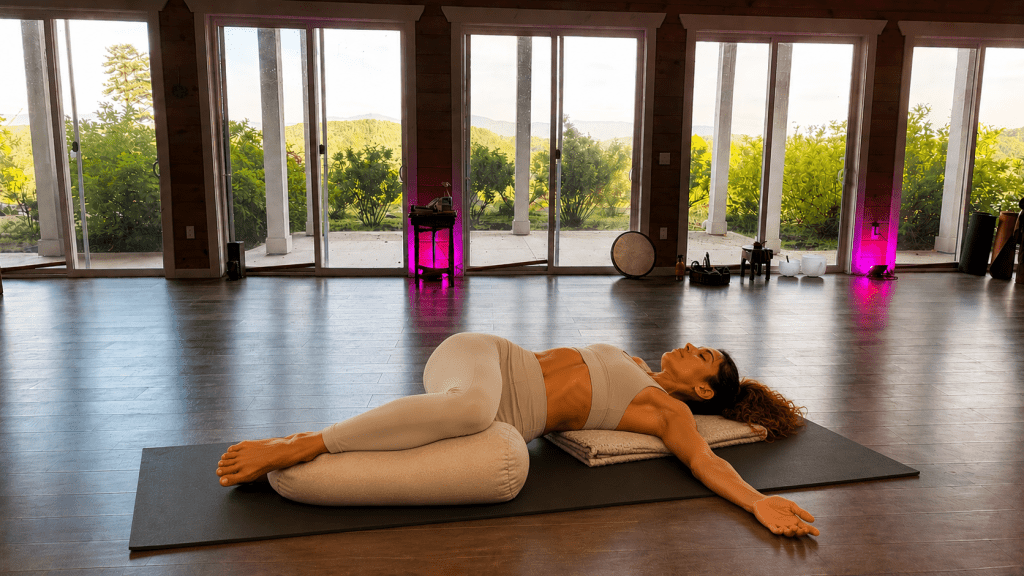
Twisted Roots (also called Supine Spinal Twist) is one of the most restorative yin yoga poses for myofascial release along the spiral and lateral lines. The passive twist decompresses the spine, releases the outer hip fascia, and produces a felt sense of internal reorganization that many practitioners describe as one of the most therapeutic poses in the yin repertoire.
Setup: Lie on your back on the mat. Draw the right knee up toward the chest, then let it fall across the body to the left. Place a bolster or stacked blankets under the right knee so it does not have to drop all the way to the floor. Extend the right arm out to the side or above the head, whichever produces the more comfortable sensation in the right shoulder. Turn the head gently to the right, or leave it neutral if the neck rotation is uncomfortable. Let the entire body settle into the twist without forcing.
Hold time: 3 to 5 minutes per side, building to 5 to 8 minutes with practice.
Target fascia lines: Spiral line across the diagonal from shoulder to opposite hip, lateral line along the outer body, and the deep spinal fascia through the twist.
What it addresses in midlife women: Rotational restriction that limits functional movement, outer hip tightness that contributes to IT band and knee issues, and the spinal compression that accumulates from years of seated work.
Common mistake to avoid: Forcing the knee toward the floor or the shoulder up off the mat. Both create strain in the tissue you are trying to release. Support the knee with a bolster and let the shoulder lift naturally if it needs to.
Best for: Women dealing with limited spinal rotation, chronic outer hip tightness, and the general compressive pattern that accumulates in the torso over decades of desk work.
Building These Poses Into a Weekly Practice
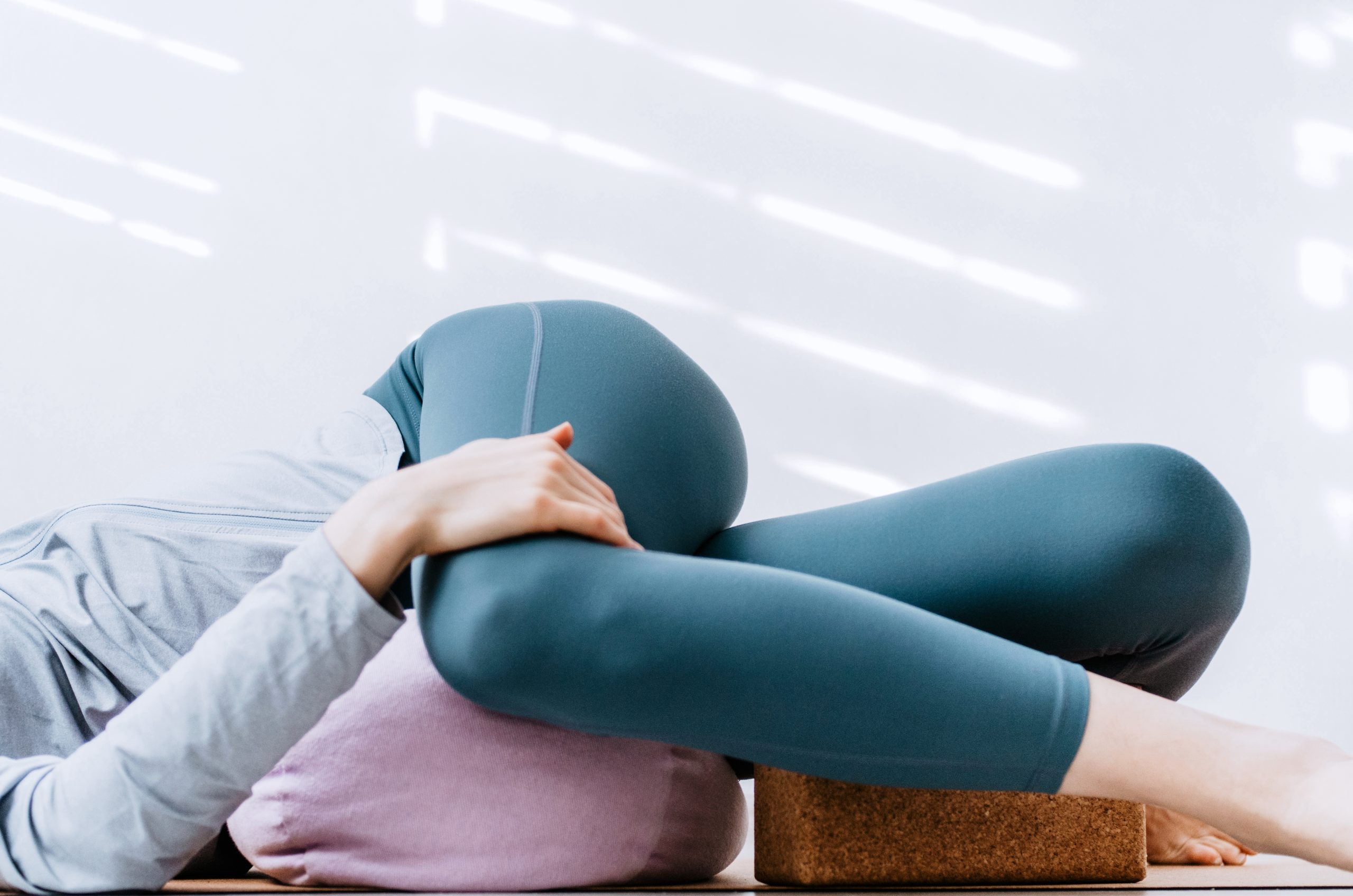
The five yin yoga poses for myofascial release above form a complete sequence when done together. A typical practice session runs 30 to 45 minutes and covers all major fascial lines. Below is the recommended structure.
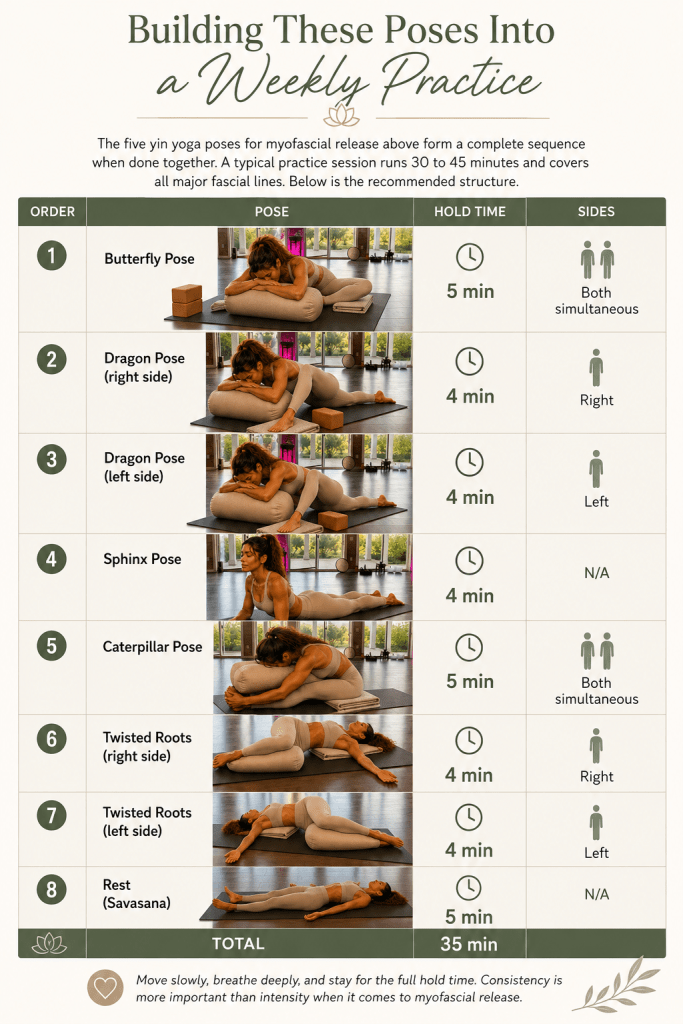
| Order | Pose | Hold Time | Sides |
| 1 | Butterfly Pose | 5 min | Both simultaneous |
| 2 | Dragon Pose (right side) | 4 min | Right |
| 3 | Dragon Pose (left side) | 4 min | Left |
| 4 | Sphinx Pose | 4 min | N/A |
| 5 | Caterpillar Pose | 5 min | Both simultaneous |
| 6 | Twisted Roots (right side) | 4 min | Right |
| 7 | Twisted Roots (left side) | 4 min | Left |
| 8 | Rest (Savasana) | 5 min | N/A |
| Total | 35 min |
Free 28-Day Fascia Reset Email Course
Get our Free 28-day email course series to help with 1 or 2 exercises per day to release your fascia. One short lesson per day. Two minutes to read each.
Ideal weekly cadence.
Three to four sessions per week produces the strongest results in most midlife women. Daily practice is fine and generally supportive, but the benefit plateaus around four to five sessions per week. Two sessions per week is the minimum for producing measurable fascial changes over months.
Time of day.
Evening practice supports sleep and pairs with the parasympathetic activation the poses produce. Morning practice can be more difficult because fascia is stiffer after overnight rest, but a shortened version (holding each pose for 3 minutes instead of 5) can work well as a morning wake-up sequence.
Progression.
The first three to four weeks focus on installing the practice as a habit. The next two months focus on gradually increasing hold times. After three months of consistent practice, most women can hold each pose comfortably for 5 to 8 minutes and are receiving the full fascial benefit.
Spotlight: The Emotional Release Pattern
Yin yoga poses for myofascial release often produce unexpected emotional release, particularly in the hip and deep front line poses. This is not a random side effect. The fascia stores the chemical residue of chronic stress patterns, and as the tissue softens during sustained holds, that residue can move through the body’s clearance systems.
Many women experience unexpected tears, sighs, or waves of emotion during their first several weeks of practice. This is normal, generally beneficial, and does not require analysis or intervention.
Simply notice, breathe, and continue the practice. The emotional layer moves through more easily when it is not resisted.
“The women in my coaching program who commit to three yin yoga sessions per week for myofascial release consistently report the same three changes within four to six weeks. Their sleep gets deeper. Their mood becomes more stable. And the chronic tightness they had been carrying for years starts to release in ways that no amount of foam rolling or vinyasa yoga had reached. The reason is that the practice is meeting the fascia at the tissue layer where midlife stiffness actually lives. Yin yoga poses for myofascial release address the tissue most other movement practices cannot reach.” ~ Terry Tateossian
How to Layer Yin Yoga for Fascia With Other Recovery Work
Yin yoga for fascia works best as one layer in a broader recovery framework. A few notes on how to combine it with the other practices that support midlife tissue health.
Foam rolling and self-myofascial release.
Foam rolling addresses fascia through active mechanical compression, which is a different mechanism than the sustained tension of yin yoga poses. The two practices are complementary rather than redundant. Foam rolling before yin yoga can help mobilize the tissue you are about to hold, and foam rolling on non-yin days keeps the mechanical input consistent.
Dry brushing and lymphatic drainage.
The daily 10-minute lymphatic and fascia routine we covered in our article on the lymphatic reset pairs naturally with yin yoga. Dry brushing before a shower, followed by a yin session in the evening, produces measurable improvements in both drainage and connective tissue mobility within two weeks.
Rebounding.
Light bouncing on a rebounder produces rhythmic compression and decompression of the fascia that supports overall connective tissue health. We covered the science in our article on rebounding for midlife women. Five to ten minutes of rebounding on non-yin days keeps the fascia responsive.
Strength training.
Yin yoga does not build muscle. Strength training two to three times per week remains essential for midlife women to preserve the lean muscle that protects metabolic rate and bone density. Yin yoga complements strength training by keeping the connective tissue mobile enough to allow the strength gains to express as functional movement rather than as tight bulk.
Cardio and walking.
The micro walks practice provides the daily light cardiovascular input that supports fascial hydration through mechanical pumping. Combined with yin yoga, walking creates a nervous system pattern of alternating gentle load and sustained release that fascia responds to particularly well.
Nutrition and hydration.
Fascia is mostly water, and dehydrated tissue does not respond well to any stretching modality. Adequate daily hydration, mineral intake, and the collagen-supporting nutrients (vitamin C, magnesium, protein) all amplify the benefit of the practice. The free Menopause Macro Calculator and Macro Miracle Mediterranean Cookbook give you the nutrition foundation. The foundational supplement collection covers the connective tissue support.
Common Mistakes That Undermine Yin Yoga for Fascia
Five mistakes consistently reduce the effectiveness of yin yoga poses for myofascial release.
Holding at maximum intensity.
Yin yoga is not about pushing to your deepest possible range. Sustained holds at 100 percent of range activate the muscles’ protective response, which prevents the fascia from softening. Hold at 80 to 90 percent and let the tissue slowly settle deeper on its own.
Holding for too short a time.
Fascial release requires sustained tension of at least 90 to 120 seconds. Poses held for 30 to 60 seconds influence the muscles but not the fascia. Three to five minute holds are the minimum for reaching the fascial layer.
Using active engagement to maintain the pose.
If you are actively holding yourself in the position through muscle contraction, the load is being absorbed by the muscles rather than reaching the fascia. Use props generously so the pose is supported and the muscles can fully relax.
Practicing sporadically.
Fascia responds to consistent input over weeks and months. Three to four sessions per week over three months produces dramatic change. One session per week produces minimal fascial adaptation regardless of how long each session is.
Ignoring the exit and integration.
Coming out of a pose too quickly and moving immediately to the next one skips the tissue integration window. Move slowly, rest briefly between poses, and let the body register each release before continuing.
Free 28-Day Fascia Reset Email Course
Get our Free 28-day email course series to help with 1 or 2 exercises per day to release your fascia. One short lesson per day. Two minutes to read each.
When Not to Do These Poses
Yin yoga poses for myofascial release are generally accessible, but a few situations require modification or professional guidance.
Acute injury. Never stretch an acutely injured area. Wait for the initial inflammatory phase to resolve (typically 5 to 7 days for minor injuries) before adding yin poses to the recovery process.
Active disc issues. Deep forward folds and twists can worsen active lumbar disc symptoms. Work with a physical therapist to determine which poses are safe for your specific condition.
Recent surgery. Wait for surgical clearance from your provider before adding yin yoga to your recovery. Different surgeries have different restrictions on stretching, and some deep poses can compromise healing tissues.
Advanced osteoporosis. Forward folds and deep twists carry vertebral compression risk in adults with significant bone density loss. Modified versions of the poses (using more prop support and reducing depth) can still be beneficial but should be developed with a physical therapist familiar with bone health.
Late-stage pregnancy. Twists and deep forward folds are generally contraindicated in the third trimester. Consult with a pregnancy-trained yoga teacher for appropriate modifications.
Active infection or fever. Skip the practice until the acute illness has fully resolved.
Unexplained joint pain or symptoms. Any new pain that has not been evaluated by a clinician deserves diagnosis before adding a new stretching practice.
How This Practice Fits the Broader THOR Framework
The daily yin yoga for fascia work is one layer in the broader lifestyle medicine framework I teach at THOR. The framework has five components that support one another.
Nutrition.
Connective tissue depends on protein, vitamin C, magnesium, and adequate hydration.
Daily movement.
Yin yoga is the connective tissue layer of the movement work. Strength training two to three times per week and daily walking (including the micro walks practice) complete the movement picture.
Sleep.
Deep sleep is when tissue remodeling happens. Yin yoga in the evening supports sleep onset and quality, and the tissue benefits compound overnight.
Nervous system regulation.
Yin yoga is itself a parasympathetic activation practice. It pairs with the broader nervous system work we covered in our article on the parasympathetic nervous system and aging.
Supplement foundation.
Vitamin C, magnesium, omega-3, and collagen peptides all support the connective tissue work. The foundational supplement collection covers the basics.
For women who want sustained 1:1 support on the full framework, the Monthly Personal Training and Nutrition Coaching Program provides personalized programming. For the immersive version, the Deeply Restorative Yoga and Nature Retreat at our Smoky Mountains property includes daily yin yoga sessions and myofascial release work as part of the broader five-day program. Retreat guests go home with the practice fully installed rather than as an idea they hope to add to their week.
“I built the retreat schedule around yin yoga specifically because it is the layer of practice that most midlife women arrive without. They have been doing vinyasa. They have been walking. They have tried Pilates. The layer that is missing is the sustained fascial work that meets the connective tissue where it actually is. Five days of daily yin yoga poses for myofascial release paired with real food and real sleep produces changes that women describe as feeling like they got their body back. The tissue softens. The mood stabilizes. The felt sense of being at home in the body returns.” ~ Terry Tateossian
Your Next Steps
If the framework in this article resonates and you want to install yin yoga poses for myofascial release into your weekly routine, here are the four next steps in order of friction.
- Set up a yin yoga space at home. A mat, a bolster (or two firm pillows stacked), two blocks, and a folded blanket are enough. The equipment investment is minimal and lasts for years.
- Start with a shortened 20-minute version. Butterfly Pose (5 min), Sphinx Pose (4 min), Caterpillar Pose (5 min), and rest (5 min). This shortened sequence covers three of the five poses and is easier to install than a full 35-minute practice on day one.
- Build to the full 35-minute practice by week three. Add Dragon Pose in week two and Twisted Roots in week three. By the end of the first month, the full sequence should feel familiar.
Free 28-Day Fascia Reset Email Course
Get our Free 28-day email course series to help with 1 or 2 exercises per day to release your fascia. One short lesson per day. Two minutes to read each.
Yin Yoga for Fascia Release – Frequently Asked Questions
How long should I hold each yin yoga pose for myofascial release?
Hold each pose for at least 3 to 5 minutes to reach the fascial layer. Poses held for less than 90 seconds influence only the muscles they cross. Beginners can start at 2 minutes and build up gradually. Experienced practitioners can hold poses for 8 to 10 minutes when appropriate. The 3 to 5 minute range is the sweet spot for most midlife women in their first six months of practice.
How often should I practice yin yoga for fascia release?
Three to four sessions per week produces the strongest results in most midlife women. Two sessions per week is the minimum for measurable fascial change. Daily practice is fine but the benefit plateaus around five sessions per week. Consistency across weeks matters more than any single session’s intensity.
Can yin yoga replace foam rolling for fascia work?
The two practices work through different mechanisms and complement rather than replace each other. Foam rolling uses active mechanical compression. Yin yoga uses sustained passive tension. Combining both produces better fascial outcomes than either alone. A typical week might include yin yoga three to four times and foam rolling on the alternate days.
Is yin yoga safe for women over 40 with joint issues?
Yin yoga is generally more joint-tolerant than dynamic yoga styles because the muscles are asked to relax rather than to work. Women with joint concerns should use extensive prop support to reduce joint stress and consider working with a yin-trained yoga teacher for personalized modifications. Always consult your healthcare provider before starting any new practice with active joint issues.
Do I need to be flexible to do yin yoga?
Flexibility is not a prerequisite. The poses are designed to meet the body where it is through generous prop support. Inflexible bodies often benefit more from yin yoga than flexible ones because the fascia has more accumulated restriction to release. Bolsters, blocks, and blankets allow anyone to access the poses regardless of starting flexibility.
What is the difference between yin yoga and restorative yoga?
Yin yoga applies sustained tension to specific fascial lines to produce release. Restorative yoga uses full prop support to eliminate tension entirely and produce nervous system rest. Both are slow-paced and hold-based, but yin applies a deliberate targeted stress load while restorative applies little to no load. Both are valuable, and many practitioners combine them.
Can yin yoga help with menopause symptoms?
Multiple mechanisms connect yin yoga poses for myofascial release to menopause symptom relief. The parasympathetic activation improves sleep. The fascial release addresses the connective tissue changes of estrogen decline. The slow breathing supports cortisol regulation. The mood-stabilizing effect helps with the emotional volatility of the menopausal transition. Research on yoga for menopausal symptoms consistently shows measurable benefit, and yin yoga specifically fits the midlife body well.
Will yin yoga help with plantar fasciitis?
Yin yoga complements the more targeted work for plantar fascia stretches. The poses in this article do not directly target the plantar fascia, but they release the calves, hip flexors, and posterior chain that contribute to plantar fascia overload. Combining yin yoga with the direct plantar fascia work produces better outcomes than either alone.
Can I do yin yoga if I have never done yoga before?
Yin yoga is one of the most accessible entry points to yoga for beginners because the pace is slow and the poses are simple. You do not need any prior yoga experience. Reading through this article and starting with the shortened three-pose sequence in Section 15 is a valid beginner path.
Should I use a specific type of yoga mat or props?
Any yoga mat with adequate padding will work. Bolsters are the most useful prop, and a good yoga bolster is worth the investment because it will last for years. Two firm pillows stacked can substitute in the beginning. Blocks and a folded blanket complete the basic prop set. Total investment for a home practice setup is typically under $150.
Free 28-Day Fascia Reset Email Course
Get our Free 28-day email course series to help with 1 or 2 exercises per day to release your fascia. One short lesson per day. Two minutes to read each.
When will I start feeling results from yin yoga for fascia?
Most women notice improved sleep quality within the first week. Reduced overall body tension typically shows up in the second to third week. Measurable improvements in flexibility and connective tissue mobility become apparent at four to six weeks. Deeper structural changes in habitual posture and joint range of motion appear over three to six months of consistent practice.
Can I do yin yoga poses for myofascial release during pregnancy?
Some poses are appropriate with modifications and some are contraindicated. Twists and deep abdominal compression are generally not appropriate after the first trimester. Butterfly and Sphinx variations can be adapted. Work with a prenatal-certified yoga teacher for personalized modifications. Always consult your OB or midwife before starting any new practice during pregnancy.
Is yin yoga good for stress?
Yin yoga is one of the most direct parasympathetic activation practices available. The combination of long-hold positions, slow diaphragmatic breathing, and the meditative quality of the practice consistently produces stress reduction, mood improvement, and improved sleep quality. Women in coaching who add yin yoga to their weekly routine report reduced anxiety and better emotional regulation within the first two to three weeks.
How does yin yoga fit with the broader THOR retreat program?
Yin yoga is one of the core daily practices at the Deeply Restorative Yoga and Nature Retreat at our Smoky Mountains property. Guests receive twice-daily yin yoga sessions targeting different fascial lines, paired with manual myofascial release work from our team, dry brushing, rebounding, and forest walks that support the broader connective tissue and lymphatic reset. Retreat guests go home with the yin practice fully installed rather than as an idea they hope to add later.
I write 3 essays per week on Lifestyle Medicine for women in midlife on what is happening in the body and what to do about it. No fluff, no hype. Free.
References
- Grieve, R., Goodwin, F., Alfaki, M., et al. (2015). The immediate effect of bilateral self myofascial release on the plantar surface of the feet on hamstring and lumbar spine flexibility: a pilot randomised controlled trial. Journal of Bodywork and Movement Therapies, 19(3), 544–552.
- Schleip, R., & Müller, D. G. (2013). Training principles for fascial connective tissues: scientific foundation and suggested practical applications. Journal of Bodywork and Movement Therapies, 17(1), 103–115.
- Schleip, R., Mechsner, F., Zorn, A., & Klingler, W. (2014). The bodywide fascial network as a sensory organ for haptic perception. Journal of Motor Behavior, 46(3), 191–193.
- Myers, T. W. (2020). Anatomy Trains: Myofascial Meridians for Manual Therapists and Movement Professionals (4th ed.). Elsevier.
- Cramer, H., Lauche, R., Langhorst, J., & Dobos, G. (2018). Yoga for menopausal symptoms: a systematic review and meta-analysis. Maturitas, 109, 13–25.
- Innes, K. E., Selfe, T. K., & Vishnu, A. (2010). Mind-body therapies for menopausal symptoms: a systematic review. Maturitas, 66(2), 135–149.
- Newton, K. M., Reed, S. D., Guthrie, K. A., et al. (2014). Efficacy of yoga for vasomotor symptoms: a randomized controlled trial. Menopause, 21(4), 339–346.
- Sherman, K. J., Cherkin, D. C., Wellman, R. D., et al. (2011). A randomized trial comparing yoga, stretching, and a self-care book for chronic low back pain. Archives of Internal Medicine, 171(22), 2019–2026.
- Cramer, H., Lauche, R., Haller, H., & Dobos, G. (2013). A systematic review and meta-analysis of yoga for low back pain. Clinical Journal of Pain, 29(5), 450–460.
- Hopper, S. I., Murray, S. L., Ferrara, L. R., & Singleton, J. K. (2019). Effectiveness of diaphragmatic breathing for reducing physiological and psychological stress in adults. JBI Database of Systematic Reviews and Implementation Reports, 17(9), 1855–1876.
- Magnusson, S. P., & Kjaer, M. (2019). The impact of loading, unloading, ageing and injury on the human tendon. Journal of Physiology, 597(5), 1283–1298.
- Couppé, C., Hansen, P., Kongsgaard, M., et al. (2009). Mechanical properties and collagen cross-linking of the patellar tendon in old and young men. Journal of Applied Physiology, 107(3), 880–886.
- Maltais, M. L., Desroches, J., & Dionne, I. J. (2009). Changes in muscle mass and strength after menopause. Journal of Musculoskeletal and Neuronal Interactions, 9(4), 186–197.
- Sipilä, S., Törmäkangas, T., Sillanpää, E., et al. (2020). Muscle and bone mass in middle-aged women: role of menopausal status and physical activity. Journal of Cachexia, Sarcopenia and Muscle, 11(3), 698–709.
- Shaw, G., Lee-Barthel, A., Ross, M. L., et al. (2017). Vitamin C-enriched gelatin supplementation before intermittent activity augments collagen synthesis. American Journal of Clinical Nutrition, 105(1), 136–143.
- Boyle, N. B., Lawton, C., & Dye, L. (2017). The effects of magnesium supplementation on subjective anxiety and stress: a systematic review. Nutrients, 9(5), 429.
- Stecco, C., Pirri, C., Fede, C., et al. (2018). Dermatome and fasciatome. Clinical Anatomy, 32(7), 896–902.
- Antonelli, M., Donelli, D., & Barbieri, G. (2019). Effects of forest bathing on stress and immune function. International Journal of Biometeorology, 63(8), 1117–1134.
Disclaimer: Always consult with a healthcare professional before starting any new routines, programs, or nutrition plans to ensure you receive the best medical advice and strategy for your specific individual needs.
Free 28-Day Fascia Reset Email Course
Get our Free 28-day email course series to help with 1 or 2 exercises per day to release your fascia. One short lesson per day. Two minutes to read each.

Terry Tateossian is a Menopause Lifestyle Medicine Coach, Certified Personal Trainer & Nutritionist and the Founder of THOR: The House of Rose, a wellness brand serving women over 40 through retreats, coaching, macro-nutrition and community. As 25-year founder and entrepreneur, Terry spent two and a half decades building and running successful start-up businesses, an experience that put her on the front line of founder burnout long before she could name it. After facing serious health challenges, early onset menopause, and emotional eating while running her agency and raising two children, Terry rebuilt her health in her 40s and lost more than 80 pounds through evidence-based nutrition, training, and mindset work. Today, she helps women get strong, improve confidence, support hormone health, and create a stronger second half of life. Terry has been featured in major media outlets and is available for podcasts, expert commentary, brand collaborations, and speaking engagements on midlife health, reinvention, emotional eating, menopause wellness, and strength training for longevity. Get her free macro calculator (her cookbook companion) to start your journey to back to health.