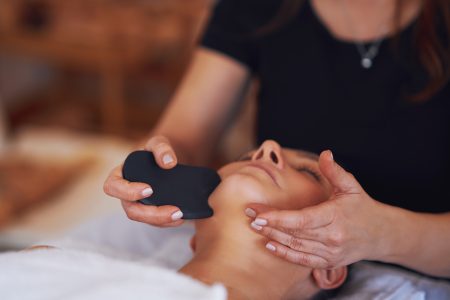

 By Team THOR
Free 28-Day Fascia Reset Email Course
Get our Free 28-day email course series to help with 1 or 2 exercises per day to release your fascia. One short lesson per day. Two minutes to read each.
The Nordic Fascia Release Method: What Midlife Women Should Know Before Booking a Session or Buying the Tools
The Nordic Fascia Release Method has emerged from the broader Scandinavian wellness tradition that includes long-standing engagement with cold exposure, sauna, massage traditions, and various body-based practices. In its contemporary form, the method combines specific myofascial manual techniques with the use of specialized wooden or ceramic tools designed to apply sustained pressure to fascial tissues. Certified practitioners in various parts of the world (concentrated primarily in Scandinavia, with expanding presence in North America and other regions) offer sessions using the method, and the developers also sell tools and training programs.
Important: Fascia bodywork including the Nordic Fascia Release Method is generally safe for most healthy midlife women. Certain conditions warrant medical clearance before starting including recent surgery, active injuries, cardiovascular concerns, and various other specific situations. Discuss with your healthcare provider if you have any concerns. This article is educational and does not constitute medical advice.
What Is the Nordic Fascia Release Method?
The Nordic Fascia Release Method is a specific proprietary bodywork approach. The general publicly available description of what the method involves helps midlife women understand what they would encounter in a session or in training.
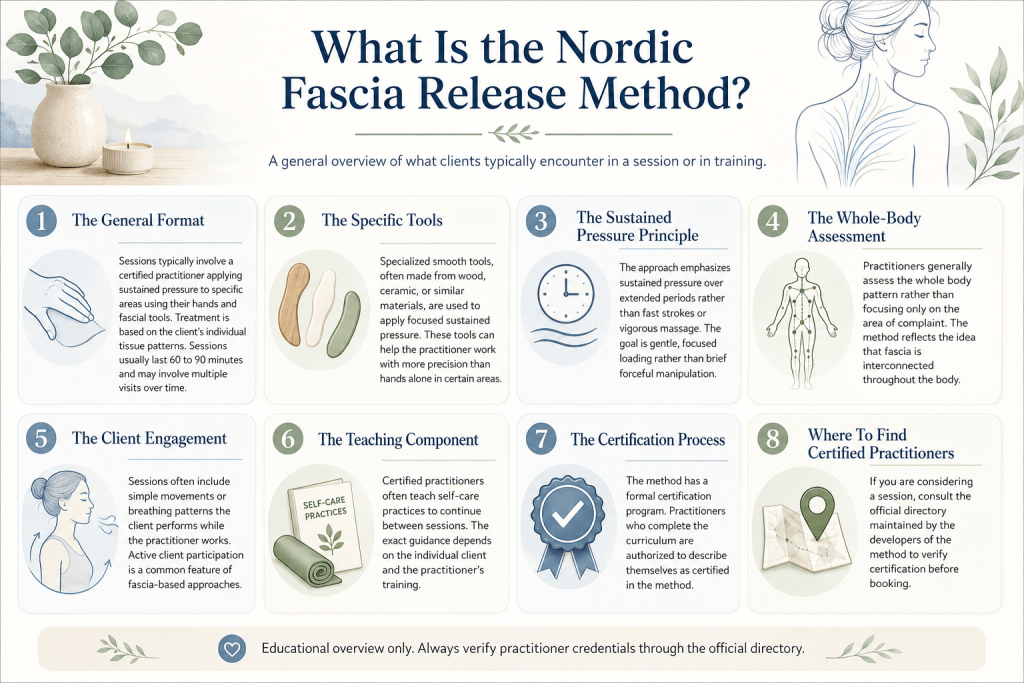
- The general format: Sessions typically involve a certified practitioner applying sustained pressure to specific areas of the client’s body using their hands and specific tools designed for fascial work. The practitioner works through specific tissue patterns based on the assessment of the individual client. Sessions typically last 60 to 90 minutes and often involve multiple visits over time for cumulative benefit.
- The specific tools: The method uses specialized smooth tools (often made from wood, ceramic, or similar materials) designed to apply focused sustained pressure to fascial tissues. The specific design and use of these tools is part of the proprietary teaching. In general terms, the tools allow the practitioner to work with more focused pressure than hands alone can provide in certain areas.
- The sustained pressure principle: The general approach emphasizes sustained pressure over extended periods rather than fast strokes or vigorous massage. This sustained approach aligns with the broader fascia research showing that fascia responds to sustained gentle loading over minutes rather than to brief vigorous manipulation.
- The whole-body assessment: Practitioners generally assess the client’s whole body pattern rather than focusing only on the specific area of complaint. Fascia is interconnected, and the general Nordic approach reflects this interconnection by treating the body as a whole.
- The client engagement: Sessions often include specific movements or breathing patterns the client is asked to perform while the practitioner works. This active engagement is a general feature of many fascia approaches.
- The teaching component: Certified practitioners in the method often teach clients specific self-care practices to continue between sessions. The specific practices taught depend on the individual and on the practitioner’s training.
- The certification process: The Nordic Fascia Release Method has a specific certification program for practitioners. Trained practitioners have completed the specific curriculum and are authorized to represent themselves as certified in the method. Uncertified practitioners who describe their work using this specific method name are misrepresenting their qualifications.
- Where to find certified practitioners: The developers of the method maintain a directory of certified practitioners. If you are considering booking a session using this specific method, consult the official directory to verify certification.
What Is the Scandinavian Wellness Tradition Context?
Understanding the broader tradition the Nordic Fascia Release Method emerges from helps contextualize the approach.
- The general Scandinavian wellness lineage: Nordic countries have long-standing wellness traditions including sauna, cold water immersion, various massage traditions, outdoor movement, and specific approaches to body work. These traditions are integrated into daily life in ways that Western wellness cultures often are not.
- The specific relationship to touch: Scandinavian bodywork traditions often emphasize deliberate touch as a specific therapeutic modality. Various forms of Swedish massage, Finnish massage traditions, and specific modern developments have contributed to this broader tradition.
- The nature-based framework: Scandinavian wellness often includes explicit connection to nature (outdoor time, natural elements, seasonal awareness) as part of the general health framework. Fascia bodywork in this tradition often reflects this broader nature-connected framing.
- The specific relationship to seasonality: Scandinavian traditions have strong seasonal awareness that shows up in wellness practices. Winter and summer practices differ. This seasonal awareness sometimes shows up in how bodywork is practiced or discussed.
- The modern development: Various contemporary Scandinavian practitioners have developed specific modern approaches that combine traditional lineage with contemporary understanding of fascia and connective tissue. The Nordic Fascia Release Method is one specific example of this modern development.
- The cultural context matters: For practitioners and clients coming from outside the Scandinavian cultural context, understanding the broader tradition helps interpret the specific practices. The method is not just a set of techniques but reflects a broader cultural approach to body work.
- The specific caution about cultural adoption: As with any cultural tradition adopted by wellness industries outside the source culture, there are specific concerns about cultural adoption, oversimplification, and commercial repackaging. Approach any specific method with appropriate cultural humility.
- The specific value of engaging with the source tradition: For those seriously interested in this specific method, engaging with practitioners trained in the source lineage produces different value than working with wellness-industry practitioners who have adopted vocabulary without the training.
Free 28-Day Fascia Reset Email Course
Get our Free 28-day email course series to help with 1 or 2 exercises per day to release your fascia. One short lesson per day. Two minutes to read each.
Why Are Midlife Women Drawn to This Method Now?
The specific interest in the Nordic Fascia Release Method among midlife women reflects broader patterns worth understanding.
Growing Awareness and Menopause-Related Interest
- The fascia awareness moment: Fascia has moved from obscure anatomical detail to mainstream wellness topic over the last several years. Midlife women who are experiencing the specific aches and stiffness of perimenopause and menopause are often actively searching for fascia-focused approaches.
- The specific menopause fascia connection: The specific fascia changes of the perimenopause and menopause transition drive real symptoms that fascia-focused bodywork approaches can help address. Midlife women searching for solutions to these symptoms often find fascia methods.
Novelty, Tools, and Deeper Engagement
- The high perceived novelty: The Nordic origin and specific tool-based approach differentiates the method from more familiar bodywork forms. This differentiation attracts women who have tried various other approaches without the results they hoped for.
- The specific tool appeal: Purchasing specific tools appeals to the same impulses that drive other wellness product purchases. The tools become both functional equipment and identifying markers of engagement with the method.
- The retreat and training appeal: Beyond individual sessions, the method offers immersive training experiences that appeal to women interested in deeper engagement or in becoming practitioners themselves.
- The cultural travel appeal: Some midlife women travel to Scandinavia to experience the method in its source culture. This travel appeal adds to the general attraction.
Influencer Visibility and the Need for Caution
- The influencer amplification: The Nordic Fascia Release Method has been promoted by various wellness influencers and podcasters, which has substantially increased visibility. This amplification is neither endorsement nor criticism of the method itself but explains its current visibility.
- The specific caution about influencer content: Wellness-influencer content about the method varies widely in accuracy and depth. Some content is thoughtful engagement with the method’s actual principles. Other content is superficial marketing that may not reflect what the method involves. Evaluate influencer content with the same critical thinking you would apply to any other wellness marketing.
“The specific question I hear from coaching clients about the Nordic Fascia Release Method is whether it is worth the specific investment of time and money required for either sessions or training. My honest answer depends on the specific client’s situation. For a woman who has already installed the foundational fascia framework (regular movement, appropriate nutrition, quality sleep, nervous system regulation, and some form of consistent self-care fascia practice) and who wants to explore deeper professional support, working with a certified practitioner in this or any specific credentialed fascia method can add meaningful value. For a woman who has not yet installed the foundational framework and who is looking for a specific method to substitute for that foundation, no proprietary bodywork method will produce the outcomes she hopes for. The method works best as a specific addition to a solid foundation, not as a replacement for the foundation. That framing is the specific consideration I recommend to clients evaluating this or any other specific proprietary approach.”
Terry Tateossian, Founder of The House of Rose
Which General Principles Align With Fascia Research?
Several of the general principles that the Nordic Fascia Release Method emphasizes align well with the broader fascia research base.
- Sustained pressure over time: The general principle of applying sustained pressure over minutes rather than brief vigorous manipulation aligns with the broader fascia research. Fascia responds to sustained loading over 90 seconds to several minutes more than to short strokes. This is a general principle that appears across many effective fascia approaches.
- Whole-body pattern assessment: The general principle of assessing the whole body rather than treating only the site of symptoms aligns with the fascia research showing that fascial restrictions in one area often refer symptoms to distant sites. Treating fascia locally without considering the whole pattern often produces incomplete results.
- The client engagement component: The general principle of involving the client actively during the session (through breathing, specific movements, or attention) aligns with the research on the neural component of fascial release. Fascia is densely innervated and responds partly through neurological rather than purely mechanical mechanisms.
- The interconnection framework: The general acknowledgment that fascia is a connected system rather than a set of separate structures aligns with modern understanding of fascial anatomy. The specific fascial lines that connect distant body regions are well-documented anatomically.
- The self-care teaching component: The general practice of teaching clients specific self-care to continue between sessions aligns with the research showing that consistent daily practice produces better outcomes than occasional intensive sessions.
- The tool-based focused pressure: The general use of tools to apply focused sustained pressure to specific areas aligns with the broader self-myofascial release research showing that focused pressure produces measurable improvements in tissue mobility and range of motion.
- The specific caveat about proprietary claims: While the general principles align with research, specific proprietary claims about how a particular method uniquely accomplishes these effects may exceed what the general research supports. The principles are broadly supported. Specific proprietary claims require separate evaluation.
Free 28-Day Fascia Reset Email Course
Get our Free 28-day email course series to help with 1 or 2 exercises per day to release your fascia. One short lesson per day. Two minutes to read each.
What Does the Broader Fascia Research Support?
The broader research on fascia release provides the context for evaluating any specific method including the Nordic approach.
- Self-myofascial release research: Multiple systematic reviews and meta-analyses document that self-myofascial release techniques using foam rollers, balls, and similar tools produce measurable improvements in range of motion, reduce delayed onset muscle soreness, and support recovery. Effect sizes are modest but consistent.
- Manual fascia therapy research: Research on manual myofascial release performed by trained practitioners documents improvements in pain, function, and range of motion across various conditions. The specific proprietary methods vary in their evidence bases.
- Fascial mobility research: Studies of fascial mobility using various imaging techniques document that fascia can be affected by manual intervention in ways that produce measurable tissue changes. The specific mechanisms include hydration changes, hyaluronic acid effects, and mechanical remodeling over time.
- The sustained pressure research: Studies of sustained pressure durations document that meaningful fascial response typically requires at least 90 seconds of sustained pressure on a specific area. Longer holds produce more response up to a point.
- The whole-body versus local research: Studies comparing whole-body versus locally-focused fascial interventions generally support the whole-body approach for outcomes beyond immediate local pain reduction.
- The self-care versus practitioner-only research: Research consistently supports the value of daily self-care practice alongside or instead of periodic practitioner sessions. Self-care practice produces meaningful cumulative benefits.
- The consistency research: Consistent daily practice over weeks produces meaningfully better outcomes than occasional intensive sessions. This applies to both self-care practice and to combined self-care plus practitioner sessions.
- What the research does not clearly show: The research generally does not clearly demonstrate that one specific proprietary method produces uniquely better outcomes than well-designed alternative approaches. Various methods produce broadly similar outcomes when practiced consistently. This does not mean specific methods have no value. It means that specific proprietary claims of unique superiority typically exceed what the comparative research supports.
Where Do Marketing Claims Sometimes Exceed the Evidence?
Being honest about where marketing claims sometimes exceed what evidence supports helps midlife women evaluate any specific method including the Nordic approach.

- Claims of unique superiority: Any specific method that claims to be uniquely superior to alternatives typically overstates what comparative research demonstrates. Various well-designed fascia approaches produce broadly similar outcomes. The specific choice among them depends on personal fit rather than on demonstrated superiority.
- Claims of specific medical outcomes: Some marketing suggests that specific fascia methods produce specific medical outcomes (reversing specific diseases, treating specific conditions). The general fascia research supports improvements in mobility, pain, and function. Claims of specific medical treatment outcomes usually exceed what evidence supports.
- Claims of anti-aging effects: Some marketing suggests that specific fascia methods produce anti-aging effects, restore youthful appearance, or reverse age-related changes. The general research supports specific improvements in tissue mobility and function. Broader anti-aging claims typically exceed what evidence supports.
- Claims of exclusive technique access: Some marketing frames specific methods as offering exclusive technique access that is not available elsewhere. The general principles of effective fascia work are well-documented in the broader research and are available through various trained practitioners.
- Claims requiring expensive proprietary tools: Some marketing suggests that specific proprietary tools are required for effective fascia work. The general principles of tool-assisted fascia work can be applied with various tools including inexpensive foam rollers and therapy balls. Specific proprietary tools may have specific advantages but are typically not uniquely required.
- Claims of dramatic single sessions: Some marketing suggests that single sessions produce dramatic outcomes. The general research supports meaningful improvements over weeks of consistent practice. Single sessions can produce immediate subjective changes but typically require follow-through for lasting effects.
- How to evaluate any specific method’s claims: Look for specific evidence citations. Distinguish between principle-level claims (which are often supported) and unique-superiority claims (which are typically not). Be skeptical of dramatic single-session promises. Approach expensive training programs, tools, or retreats with appropriate caution.
Free 28-Day Fascia Reset Email Course
Get our Free 28-day email course series to help with 1 or 2 exercises per day to release your fascia. One short lesson per day. Two minutes to read each.
What Can You Expect From a Session?
For midlife women considering booking a session with a certified practitioner in the Nordic Fascia Release Method, understanding what to expect helps set appropriate expectations.
Before and During the Session
The first part of the process focuses on understanding your needs and identifying the areas that may require the most attention.
- The intake: A first session typically begins with a thorough intake including your specific health history, current symptoms, previous injuries, current medications, and specific goals for the work. This intake is a normal part of any competent bodywork practice.
- The assessment: The practitioner typically assesses your specific body patterns through observation and palpation. This assessment guides where and how the practitioner will work during the session.
- The session itself: Sessions typically last 60 to 90 minutes. The practitioner works through various areas using their hands and specific tools. Sensation varies from mild pressure to occasionally intense sensation during focused work on specific restricted areas.
What You May Feel During and After the Work
Fascia-focused bodywork can involve physical and emotional sensations that may feel different from those experienced during familiar forms of massage.
- The specific sensations: Fascia work often produces distinctive sensations that differ from familiar massage. These can include specific burning, tingling, deep pressure, occasional sharp releases, and various other sensations. Communicate with your practitioner about specific sensations that concern you.
- The emotional component: Fascia work often produces emotional responses including spontaneous tears, feelings of grief or relief, and various other emotional experiences. This is a documented phenomenon in body-based practice and is generally considered a healthy sign of stored tension releasing. Practitioners trained in fascia work are typically prepared to support these responses appropriately.
Follow-Up, Frequency, and Investment
The work usually extends beyond the session itself through self-care, repeated sessions, and ongoing evaluation of your progress.
- The homework: Practitioners typically provide specific self-care recommendations to continue between sessions. Follow-through with the self-care matters as much as the session itself for producing lasting results.
- The frequency recommendation: Practitioners typically recommend specific frequency depending on your situation. Common patterns include weekly sessions for the first month or two followed by monthly maintenance sessions.
- The specific investment: Sessions typically cost $150 to $300 depending on the practitioner and location, with initial packages of multiple sessions often recommended.
Setting Realistic Expectations
Results can vary from person to person, so it is important to evaluate how your body responds over time rather than expecting immediate transformation.
- Realistic expectations: Meaningful improvement typically appears over multiple sessions combined with consistent self-care practice. Immediate transformation is rare. Sustained improvement over months of consistent engagement is common.
- When to reconsider: If sessions produce persistent pain, if you feel the practitioner is not listening to your feedback, if the recommendations feel excessive or expensive, or if the specific approach does not fit your body, consider changing practitioners or approaches.
What Are the Tools and Their General Functions?
The specific tools used in the Nordic Fascia Release Method deserve some discussion because they are a distinctive feature of the approach.
- The general purpose: Tools in fascia work generally allow the practitioner (or self-practitioner) to apply focused sustained pressure to specific areas in ways that hands alone cannot easily achieve. The specific shape, material, and design of tools varies by tradition.
- The Nordic-style tools: Tools used in the Nordic Fascia Release Method are typically smooth wooden or ceramic pieces designed for fascial work. The specific designs are part of the proprietary offering of the method.
- The specific tool categories: Various tools exist for different specific purposes including broad surface tools for large areas, smaller focused tools for specific spots, and tools designed for specific body regions.
- The alternative tools available: The general principles of tool-assisted fascia work can be practiced with various alternatives including foam rollers, therapy balls (tennis balls, lacrosse balls), massage sticks, and various other options. These alternatives are often significantly less expensive than proprietary tools.
- The specific value of specialized tools: Well-designed specialized tools may offer specific advantages in shape, texture, or ergonomics that generic tools do not. Whether these advantages justify significant additional cost depends on the individual and the specific tools.
- The buying question: For midlife women considering purchasing tools associated with the Nordic Fascia Release Method or any specific proprietary method, consider whether you have first established consistent practice with basic tools. If daily practice is already well-installed, upgraded tools may be worthwhile. If practice is inconsistent, better tools will not create consistency.
- The specific caution about tool marketing: As with any wellness product, tool marketing sometimes exceeds what the tools accomplish. Basic tools produce most of the fascial benefit for most people. Specific specialty tools may offer specific advantages but are typically not uniquely required.
- The DIY alternative: Some effective fascia tools can be made or improvised at home from various materials. Tennis balls in socks. Rolling pins for larger surfaces. Various other alternatives exist. The specific principles matter more than the specific tools.
Free 28-Day Fascia Reset Email Course
Get our Free 28-day email course series to help with 1 or 2 exercises per day to release your fascia. One short lesson per day. Two minutes to read each.
How Does the Method Compare to Other Fascia Approaches?
Placing the Nordic Fascia Release Method in the context of other fascia approaches helps midlife women make informed comparisons.
- The general principle: Various fascia approaches share common general principles (sustained pressure, whole-body awareness, breath integration, consistent practice) while differing in specific techniques, training lineages, and cultural contexts. The general principles matter more than the specific method for most outcomes.
- The specific choice question: The specific choice among fascia approaches depends on individual factors including personal preference, availability of trained practitioners, budget, cultural resonance, and specific goals. No single method is universally superior for all midlife women.
- The specific value of trying multiple approaches: Some midlife women find that different approaches suit them at different times or for different specific concerns. Being open to multiple approaches often produces better long-term outcomes than rigid commitment to a single method.
- The specific value of consistency within any approach: Whatever specific approach you choose, consistency over months and years produces the specific benefits that fascia work can deliver. Occasional engagement with the most sophisticated method produces less than consistent engagement with a simpler approach.
What Should You Know About Foam Rolling and Self-Myofascial Release?
Foam rolling is the most widely accessible fascia approach and provides useful context for comparing with proprietary methods.
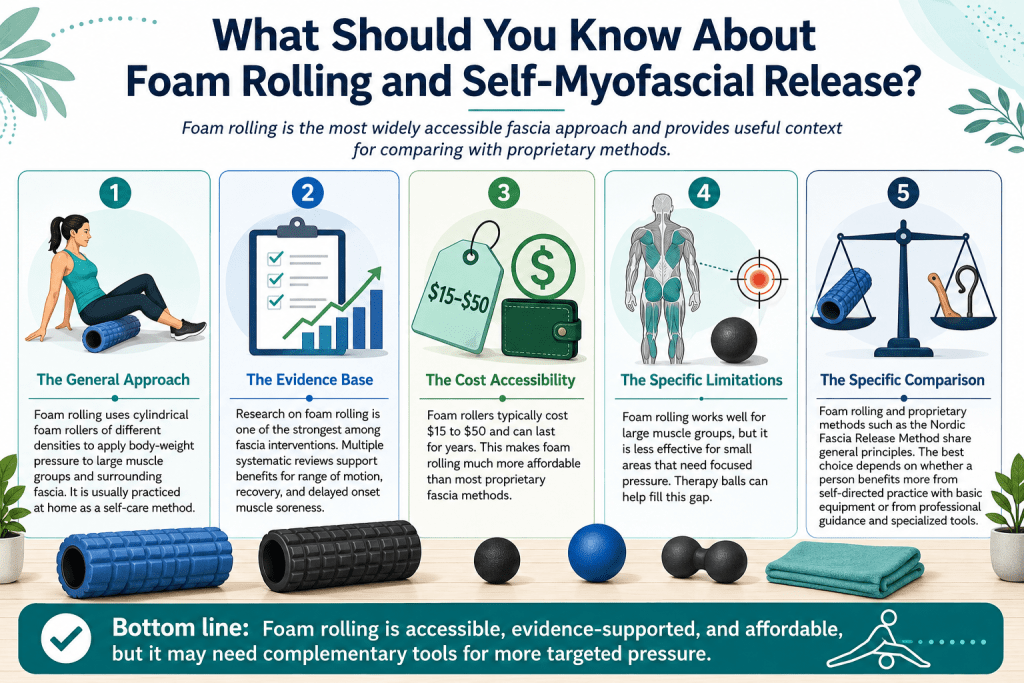
- The general approach: Foam rolling uses cylindrical foam rollers of various densities to apply body weight pressure to large muscle groups and their surrounding fascia. Self-practice at home is the standard format.
- The evidence base: The research on foam rolling is one of the more developed research bases for any fascia intervention. Multiple systematic reviews document specific benefits for range of motion, recovery, and delayed onset muscle soreness.
- The cost accessibility: Foam rollers typically cost $15 to $50 and last for years. This is dramatically less expensive than most proprietary fascia methods.
- The specific limitations: Foam rolling addresses large muscle groups well but is less effective for specific small areas that benefit from more focused pressure. Combining foam rolling with therapy balls addresses this limitation.
- The specific comparison: Foam rolling and proprietary methods like the Nordic Fascia Release Method share general principles. The specific choice depends on whether the individual benefits from professional guidance and specialized tools versus self-directed practice with basic equipment.
Free 28-Day Fascia Reset Email Course
Get our Free 28-day email course series to help with 1 or 2 exercises per day to release your fascia. One short lesson per day. Two minutes to read each.
How Does Traditional Deep Tissue Massage Compare?
Traditional deep tissue massage is another familiar bodywork approach that shares some overlap with fascia work.
Approach and Evidence
- The general approach: Deep tissue massage typically involves a trained massage therapist applying deep sustained pressure to muscles and their fascial coverings through various stroke techniques.
- The evidence base: Massage therapy has a broad evidence base supporting various outcomes including pain reduction, stress reduction, and improved recovery.
Cost and Key Differences
- The cost consideration: Traditional deep tissue massage typically costs $100 to $200 per session. This is often less expensive than specialty proprietary methods but represents ongoing cost.
- The specific comparison: Traditional deep tissue massage and specialty fascia methods share general principles. Specialty methods often offer more specific tool-based work, more explicit focus on fascial rather than muscular tissue, and specific training lineages. Traditional massage offers wider practitioner availability and typically lower cost.
Who May Find It a Better Fit?
Midlife women who benefit from general therapeutic touch and stress reduction alongside targeted body work may find traditional massage a good fit. Those specifically seeking fascia-focused technical work may prefer specialty methods.
How Does Fascial Stretch Therapy Compare?
Fascial Stretch Therapy is a specific proprietary approach that focuses on assisted stretching rather than tool-based release.
- The general approach: Fascial Stretch Therapy involves a trained practitioner passively moving the client through specific stretch patterns designed to address fascial mobility. Sessions typically use a specialized table with straps.
- The evidence base: The specific research on Fascial Stretch Therapy is more limited than for foam rolling or general massage but generally supports improvements in range of motion and function.
- The specific comparison: Fascial Stretch Therapy focuses on assisted movement and stretching while the Nordic Fascia Release Method emphasizes tool-based sustained pressure. Both address fascial mobility through different specific mechanisms.
- The specific fit: Midlife women who respond well to passive stretching and movement-based work may find Fascial Stretch Therapy a good fit. Those who respond well to focused pressure work may prefer tool-based methods.
Free 28-Day Fascia Reset Email Course
Get our Free 28-day email course series to help with 1 or 2 exercises per day to release your fascia. One short lesson per day. Two minutes to read each.
How Do Yin Yoga and Sustained Postures Support Fascia?
Yin yoga is a self-practice approach that shares many principles with proprietary fascia methods.
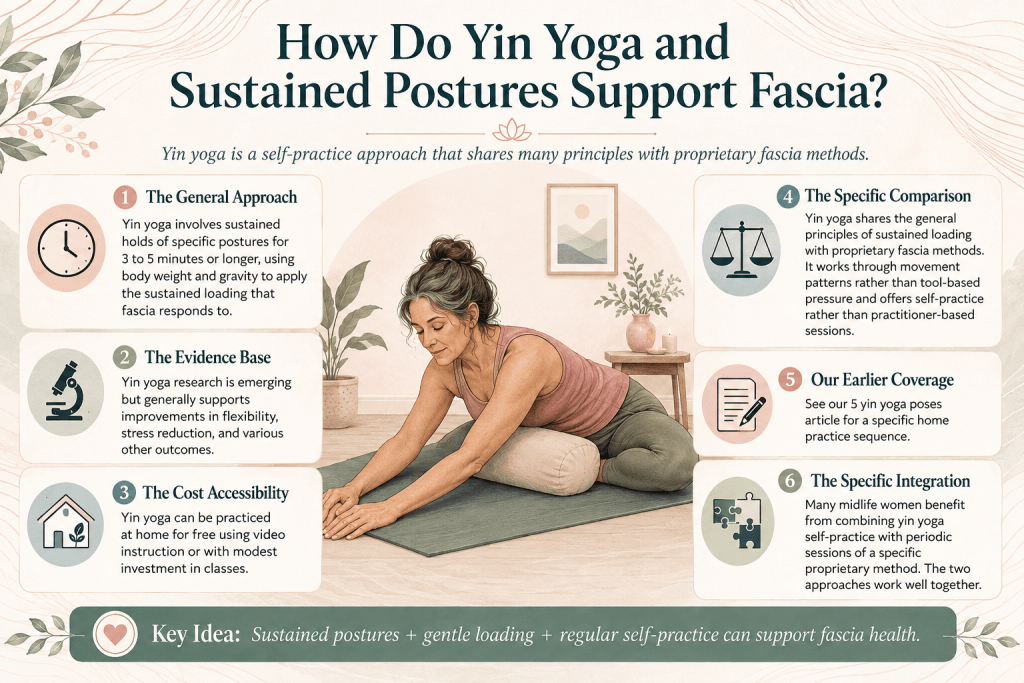
- The general approach: Yin yoga involves sustained holds of specific postures for 3 to 5 minutes or longer, using body weight and gravity to apply the sustained loading that fascia responds to.
- The evidence base: Yin yoga research is emerging but generally supports improvements in flexibility, stress reduction, and various other outcomes.
- The cost accessibility: Yin yoga can be practiced at home for free using video instruction or with modest investment in classes.
- The specific comparison: Yin yoga shares the general principles of sustained loading with proprietary fascia methods. It works through movement patterns rather than tool-based pressure and offers self-practice rather than practitioner-based sessions.
- The specific integration: Many midlife women benefit from combining yin yoga self-practice with periodic sessions of a specific proprietary method. The two approaches work well together.
How Do Cupping and Gua Sha Traditions Compare?
Cupping and gua sha are traditional East Asian bodywork approaches that share some overlap with fascia methods.
- The general approach: Cupping uses suction cups applied to the skin to lift and mobilize tissues. Gua sha uses smooth-edged tools to scrape the skin, producing what the tradition considers therapeutic effects on tissue and circulation.
- The evidence base: Both approaches have growing research bases supporting specific effects on pain, mobility, and various other outcomes.
- The specific comparison: Traditional East Asian approaches share the general principle of tool-based tissue work with the Nordic Fascia Release Method. The specific mechanisms and cultural contexts differ.
- The specific consideration: For midlife women interested in traditional lineage-based bodywork, exploring the East Asian traditions alongside or instead of Scandinavian traditions offers different specific experiences.
- The cultural respect consideration: As with any traditional practice, engaging with the source lineage rather than with commercial adaptation typically produces different value.
Free 28-Day Fascia Reset Email Course
Get our Free 28-day email course series to help with 1 or 2 exercises per day to release your fascia. One short lesson per day. Two minutes to read each.
How Should You Evaluate Practitioners?
For midlife women considering booking sessions in the Nordic Fascia Release Method or any specialty fascia approach, evaluating practitioners matters.
Check Training and Relevant Experience
- Verify certification: For proprietary methods, verify that the practitioner is certified in the specific method they claim to practice. Consult the official directory maintained by the method developers.
- Ask about training background: Beyond specific method certification, ask about the practitioner’s broader bodywork training and experience. Practitioners with strong general foundations often deliver better outcomes than those with only narrow specialty training.
- Ask about experience with your specific concerns: Different practitioners have different specific areas of experience. A practitioner experienced with midlife women, menopause-related concerns, or your specific issues typically produces better outcomes than a general practitioner.
Ask About the Session and Expected Outcomes
- Ask about session structure: A competent practitioner should be able to describe their typical session structure, intake process, and follow-up recommendations clearly. Vague answers may indicate less established practice.
- Ask about specific outcomes and expectations: A competent practitioner should offer realistic expectations rather than dramatic promises. Be skeptical of practitioners who promise dramatic outcomes.
- Ask about coordination with other care: A competent practitioner should support your continued relationship with your medical providers and should discourage substituting bodywork for appropriate medical care.
Consider Comfort, Trust, and Setting
- Trust your response to the initial consultation: Beyond specific credentials, notice how you feel during the initial consultation. Do you feel heard? Do you feel comfortable with the practitioner? Do you trust their judgment? These felt responses matter.
- Consider the setting: The physical setting should be professional, clean, and comfortable. Boundaries around the session should be clear and appropriate.
Keep Practitioner Fit in Perspective
Some practitioners in any specialty method are excellent. Others are less well-trained or less well-suited to your specific needs. Finding the right practitioner may take a few tries.
What Should You Know About Cost, Frequency, and Realistic Expectations?
Setting realistic expectations for cost, frequency, and outcomes helps midlife women evaluate whether specialty fascia methods fit their situation.
Cost and Frequency
- The typical session cost: Certified practitioners in specialty fascia methods typically charge $150 to $300 per session. Cost varies by location, practitioner experience, and specific method.
- The typical frequency recommendation: Weekly sessions for the first month or two followed by monthly maintenance is a common recommended pattern. Some practitioners recommend more frequent early work.
Timeline and Total Investment
- The typical timeline for meaningful improvement: Subjective improvements often appear within the first few sessions. Meaningful cumulative improvement typically requires consistent engagement over 2 to 3 months. Sustained transformation requires ongoing practice over 6 to 12 months or more.
- The specific total investment: For a full initial course of specialty fascia work plus monthly maintenance for a year, total investment often exceeds $3,000 to $5,000 including tools if purchased. This is a meaningful financial commitment.
- The alternative investment: For the same total investment, a midlife woman could purchase basic self-care tools, take classes in yin yoga or tai chi, join a well-run coaching program, or attend an immersive retreat. Each of these alternatives has specific value.
Evaluating the Value
- The specific value proposition: Specialty fascia methods deliver specific value including expert assessment, focused work you cannot easily do yourself, and structured programming. Whether this value justifies the cost depends on the individual.
- The specific caution about escalating recommendations: Some practitioners recommend progressively more sessions, more tools, or more training. Evaluate these recommendations carefully. Not every escalation is warranted.
Compare Specialty Work With Accessible Alternatives
Before committing to expensive specialty methods, consider whether you have exhausted the value available from more accessible alternatives. Consistent daily self-care produces meaningful outcomes. Adding specialty work on top of an established foundation produces different value than substituting specialty work for foundational practice.
Free 28-Day Fascia Reset Email Course
Get our Free 28-day email course series to help with 1 or 2 exercises per day to release your fascia. One short lesson per day. Two minutes to read each.
Who Should Consider This Method (and Who Should Not)?
Being honest about who is likely to benefit from this specific method and who may benefit more from alternatives helps midlife women make informed decisions.
Good Candidates for Exploring the Method
Good candidates for exploring the Nordic Fascia Release Method or similar specialty approaches include:
- Midlife women who have already installed a solid foundation of daily movement, nutrition, sleep, and nervous system regulation, and who want to add specific specialty bodywork to complement the foundation.
- Women who have tried general foam rolling and self-care fascia work and want more specialized professional support for specific persistent issues.
- Women who have the financial resources and time for ongoing specialty sessions plus consistent self-care.
- Women who resonate with the Scandinavian wellness tradition or with tool-based work.
- Women who have access to a well-trained certified practitioner in their geographic area.
- Women who want a specific structured program with an experienced practitioner.
Better Candidates for Alternative Approaches
Some women may benefit more from alternative approaches, depending on their current needs, resources, and priorities.
- Women who have not yet installed the foundational lifestyle medicine framework. Foundation first, specialty work after.
- Women with limited financial resources for ongoing specialty sessions. Excellent self-care outcomes are available with more accessible approaches.
- Women who prefer self-directed practice over practitioner-based work.
- Women whose primary need is general stress relief and touch rather than specific fascia-focused technical work. Traditional massage may fit better.
- Women whose primary need is movement improvement rather than tissue-focused release. Yoga, tai chi, or Pilates may fit better.
- Women who do not have access to a well-trained certified practitioner. Traveling long distances for occasional sessions typically does not produce good outcomes.
- Women dealing with significant medical conditions that require primary medical care. Bodywork can complement but cannot substitute for appropriate medical treatment.
The Honest Self-Assessment
The specific value of this or any specialty method for you depends on your specific situation. Honest assessment of where you currently are and what would produce the biggest improvement in your specific situation helps guide the decision.
Free 28-Day Fascia Reset Email Course
Get our Free 28-day email course series to help with 1 or 2 exercises per day to release your fascia. One short lesson per day. Two minutes to read each.
When Should You See a Healthcare Professional?
Specialty fascia methods and any bodywork are not substitutes for appropriate medical care. Certain situations warrant professional evaluation.
- Persistent unexplained pain: Pain that persists despite consistent bodywork warrants medical evaluation to identify underlying causes.
- Progressive symptoms: Any progressive worsening of symptoms warrants evaluation regardless of any bodywork engagement.
- Neurological symptoms: Numbness, weakness, radiating pain, or other neurological symptoms warrant medical evaluation.
- Recent injuries or surgeries: Wait for medical clearance before beginning specialty bodywork after any significant injury or surgery.
- Cardiovascular concerns: Any known cardiovascular disease warrants physician clearance before starting intensive bodywork.
- Any concerning symptoms during sessions: Chest pain, severe dizziness, or other alarming symptoms during a bodywork session warrant immediate medical evaluation.
- Mental health concerns: Some bodywork produces emotional responses that can be intense. If you have specific mental health concerns or trauma history, working with practitioners trained in trauma-informed approaches produces better outcomes than working with practitioners without this specific training.
- Pregnancy: Some bodywork approaches need modification during pregnancy. Work with practitioners with prenatal training.
What Are Your Next Steps?
If you are considering the Nordic Fascia Release Method or any specialty fascia approach, here are the four next steps in order of friction.
- Assess your foundation. Before investing in specialty methods, honestly assess whether you have installed the foundational lifestyle medicine framework. If not, the foundation produces bigger benefits than any specialty method.
- Try accessible self-care first. Basic foam rolling, therapy ball work, and yin yoga home practice using free video instruction lets you experience fascia work at minimal cost.
- If you decide to explore specialty methods, verify practitioner credentials. For any proprietary method, verify certification through the official directory. Ask about training background and experience with midlife women.
- Consider an immersive women’s yoga and wellness retreat or 1:1 online coaching
Free 28-Day Fascia Reset Email Course
Get our Free 28-day email course series to help with 1 or 2 exercises per day to release your fascia. One short lesson per day. Two minutes to read each.
Frequently Asked Questions
What is the Nordic Fascia Release Method?
The Nordic Fascia Release Method is a specific proprietary bodywork approach developed within the Scandinavian wellness tradition. Sessions typically involve a certified practitioner applying sustained pressure to specific areas of the body using their hands and specialized wooden or ceramic tools designed for fascial work. Certified practitioners work with clients through specific tissue patterns based on individual assessment.
Is the Nordic Fascia Release Method evidence-based?
The general principles the method emphasizes (sustained pressure, whole-body assessment, breath integration, client engagement) align with the broader fascia release research base. The specific proprietary techniques and specific claims of unique superiority have less specific evidence and should be evaluated with appropriate skepticism. Various well-designed fascia approaches produce broadly similar outcomes.
How much does a Nordic Fascia Release session cost?
Certified practitioners typically charge $150 to $300 per session depending on location, practitioner experience, and session length. Initial course of multiple sessions often recommended. Total investment for an initial course plus monthly maintenance can exceed $3,000 to $5,000 per year including tools if purchased.
Where can I find certified practitioners?
The developers of the method maintain an official directory of certified practitioners. If you are considering booking a session using this specific method, consult the official directory to verify certification. Uncertified practitioners representing themselves as certified in the method are misrepresenting their qualifications.
Can I learn to do this method myself?
The specific method has a certification program for practitioners. Learning to practice the specific method professionally requires completing the specific training. However, the general principles of self-care fascia work are accessible through various self-directed practices including foam rolling, therapy ball work, and yin yoga.
How does this method compare to foam rolling?
Both share the general principle of tool-assisted sustained pressure to fascia. The Nordic method offers professional guidance, specialized tools, and structured programming. Foam rolling offers self-directed practice at dramatically lower cost. Both produce meaningful outcomes with consistent practice. The specific choice depends on individual preferences and resources.
Does the Nordic method help with menopause aches and stiffness?
Fascia bodywork including the Nordic method addresses the specific fascial changes that contribute to menopause aches and stiffness. Any well-designed fascia approach can help; the specific method matters less than consistent engagement with an approach that fits you.
How often should I do fascia release?
For self-care practice, daily 10 to 15 minute sessions produce meaningful cumulative benefit. For specialty practitioner sessions, weekly for the first month or two followed by monthly maintenance is a common pattern. Consistency matters more than frequency.
Is the Nordic method safe?
For most healthy midlife women, appropriate fascia bodywork is safe. Certain conditions warrant medical clearance including recent surgery, active injuries, cardiovascular concerns, and various other specific situations. Discuss with your healthcare provider if you have concerns. Trained certified practitioners typically conduct appropriate intake to identify contraindications.
Do I need the specific tools?
The specific proprietary tools used in the method offer specific advantages in shape and design. Similar general benefits can be achieved with more accessible tools including foam rollers, therapy balls, and various other options. Whether the specialty tools justify their cost depends on individual circumstances and how established your practice is.
What are the alternatives to the Nordic method?
Alternatives with similar general principles include foam rolling, self-myofascial release with balls, traditional deep tissue massage, Fascial Stretch Therapy, yin yoga, cupping, gua sha, and various other approaches. Each has specific strengths. The best fit depends on individual preferences and specific goals.
How long before I see results?
Subjective improvements often appear within the first few sessions or first few weeks of consistent self-care. Meaningful cumulative improvement typically requires 2 to 3 months of consistent engagement. Sustained transformation requires ongoing practice over 6 to 12 months or more.
Can this method help with lymphatic drainage?
Fascia and the lymphatic system are functionally interconnected. Fascia work often produces effects on lymphatic circulation as one component of the broader effects.
Is the Nordic method better than yoga for fascia?
Neither is universally better. Yoga (particularly yin yoga) uses sustained postures and gravity to produce fascial effects through movement patterns. The Nordic method uses tool-based sustained pressure by a practitioner. Both address fascia through different mechanisms. Many midlife women benefit from combining both.
Should I take the training to become a practitioner?
The training decision depends on your specific goals. If you want to practice the method professionally, the specific certification is required. If you want deeper self-care knowledge, other more accessible training options may fit better. Evaluate the specific investment against your specific goals.
I write 3 essays per week on Lifestyle Medicine for women in midlife on what is happening in the body and what to do about it. No fluff, no hype. Free.
References
- Schleip, R., & Müller, D. G. (2013). Training principles for fascial connective tissues: scientific foundation and suggested practical applications. Journal of Bodywork and Movement Therapies, 17(1), 103–115.
- Stecco, C., Fede, C., Macchi, V., et al. (2018). The fasciacytes: a new cell devoted to fascial gliding regulation. Clinical Anatomy, 31(5), 667–676.
- Stecco, C., Stern, R., Porzionato, A., et al. (2011). Hyaluronan within fascia in the etiology of myofascial pain. Surgical and Radiologic Anatomy, 33(10), 891–896.
- Ajimsha, M. S., Al-Mudahka, N. R., & Al-Madzhar, J. A. (2015). Effectiveness of myofascial release: systematic review of randomized controlled trials. Journal of Bodywork and Movement Therapies, 19(1), 102–112.
- Beardsley, C., & Škarabot, J. (2015). Effects of self-myofascial release: a systematic review. Journal of Bodywork and Movement Therapies, 19(4), 747–758.
- Behm, D. G., & Wilke, J. (2019). Do self-myofascial release devices release myofascia? Rolling mechanisms: a narrative review. Sports Medicine, 49(8), 1173–1181.
- Cheatham, S. W., Kolber, M. J., Cain, M., & Lee, M. (2015). The effects of self-myofascial release using a foam roll or roller massager on joint range of motion, muscle recovery, and performance: a systematic review. International Journal of Sports Physical Therapy, 10(6), 827–838.
- Wiewelhove, T., Döweling, A., Schneider, C., et al. (2019). A meta-analysis of the effects of foam rolling on performance and recovery. Frontiers in Physiology, 10, 376.
- Klingler, W., Velders, M., Hoppe, K., et al. (2014). Clinical relevance of fascial tissue and dysfunctions. Current Pain and Headache Reports, 18(8), 439.
- Chaitow, L. (2020). Fascia as a sensory organ: implications for practice. Journal of Bodywork and Movement Therapies, 24(4), 3–4.
- Bordoni, B., & Zanier, E. (2013). Anatomic connections of the diaphragm: influence of respiration on the body system. Journal of Multidisciplinary Healthcare, 6, 281–291.
- Field, T. (2016). Massage therapy research review. Complementary Therapies in Clinical Practice, 24, 19–31.
- Ernst, E. (2009). Massage therapy for cancer palliation and supportive care: a systematic review of randomised clinical trials. Supportive Care in Cancer, 17(4), 333–337.
- Brincat, M. P., Baron, Y. M., & Galea, R. (2005). Estrogens and the skin. Climacteric, 8(2), 110–123.
- Thornton, M. J. (2013). Estrogens and aging skin. Dermato-endocrinology, 5(2), 264–270.
- Wright, V. J. (2023). Musculoskeletal syndrome of menopause: an emerging concept. Journal of Women’s Health Physical Therapy, 47(3), 152–159.
- Woodyard, C. (2011). Exploring the therapeutic effects of yoga and its ability to increase quality of life. International Journal of Yoga, 4(2), 49–54.
- Chang, D. G., Holt, J. A., Sklar, M., & Groessl, E. J. (2016). Yoga as a treatment for chronic low back pain: a systematic review of the literature. Journal of Orthopedics and Rheumatology, 3(1), 1–8.
- Anderson, T., & Wideman, L. (2017). Exercise and the cortisol awakening response: a systematic review. Sports Medicine Open, 3(1), 37.
- Chikly, B. J. (2005). Manual techniques addressing the lymphatic system: origins and development. Journal of the American Osteopathic Association, 105(10), 457–464.
Disclaimer: This article is educational and does not constitute medical advice. THOR is not certified in the Nordic Fascia Release Method or affiliated with the method’s developers. For specific training or professional sessions in the method, consult certified practitioners through the official directory maintained by the method’s developers. Persistent, severe, or unexplained musculoskeletal symptoms warrant medical evaluation regardless of any bodywork engagement.
Free 28-Day Fascia Reset Email Course
Get our Free 28-day email course series to help with 1 or 2 exercises per day to release your fascia. One short lesson per day. Two minutes to read each.

Terry Tateossian is a Menopause Lifestyle Medicine Coach, Certified Personal Trainer & Nutritionist and the Founder of THOR: The House of Rose, a wellness brand serving women over 40 through retreats, coaching, macro-nutrition and community. As 25-year founder and entrepreneur, Terry spent two and a half decades building and running successful start-up businesses, an experience that put her on the front line of founder burnout long before she could name it. After facing serious health challenges, early onset menopause, and emotional eating while running her agency and raising two children, Terry rebuilt her health in her 40s and lost more than 80 pounds through evidence-based nutrition, training, and mindset work. Today, she helps women get strong, improve confidence, support hormone health, and create a stronger second half of life. Terry has been featured in major media outlets and is available for podcasts, expert commentary, brand collaborations, and speaking engagements on midlife health, reinvention, emotional eating, menopause wellness, and strength training for longevity. Get her free macro calculator (her cookbook companion) to start your journey to back to health.