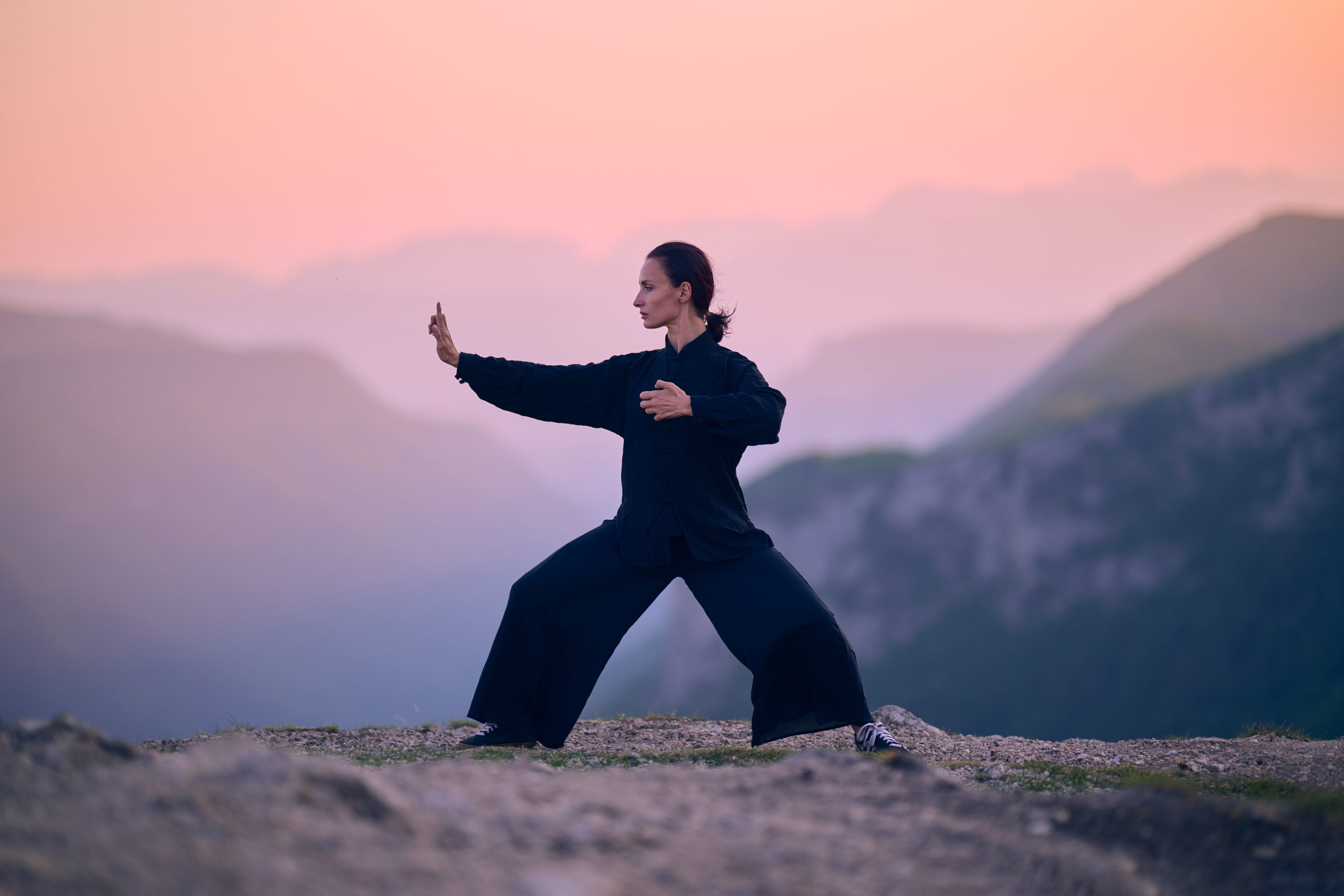

 By Team THOR
Benefits of Tai Chi for Beginners for Weight Management, Stress, and Cortisol: A Real Guide for Women Over 40
There is a moment in most midlife women’s fitness lives when the math stops working. The workouts that used to deliver results now leave you sore for days and the body keeps holding weight in the same places. The cardio that used to burn fat now seems to feed the belly. The strength training is still essential and you keep doing it. But something is missing in the conversation, and you can feel it.
The missing piece, for many midlife women, is a movement practice that addresses stress and cortisol at the same time it asks for output. Almost no Western training modality does this. Strength training is essential and almost everything I write recommends it. So is walking. So is sleep. Tai chi sits in a different category. It is one of the few movement practices that simultaneously lowers cortisol, improves body composition, supports the nervous system, and addresses the emotional eating patterns that drive a meaningful share of midlife weight gain in the first place.
This article walks through what tai chi actually does to a midlife body, the science behind the cortisol and belly fat connection, what tai chi walking specifically is (and why it is different from regular walking), how to begin as a beginner over 40, and two static tai chi poses you can start today in your kitchen with no instructor and no equipment. By the end you will know whether tai chi belongs in your weekly stack, how to start, and what to expect.
I want to be honest upfront. Tai chi is not a replacement for strength training, for adequate protein, for sleep, or for the rest of the midlife wellness toolkit. It is a complement to it. Used well, it is the piece that ties everything together and removes the stress block that has been undoing your other work.
Free 28-Day Fascia Reset Email Course
Get our Free 28-day email course series to help with 1 or 2 exercises per day to release your fascia. One short lesson per day. Two minutes to read each.
Why Tai Chi Is Quietly Becoming the Movement Practice for Midlife Women
Tai chi was developed in China centuries ago as both a martial art and an internal cultivation practice. The forms most commonly taught in the West today come from the Yang style and the simplified 8 form or 24 form sequences developed in the twentieth century. The movement is slow, continuous, low impact, and combines deliberate weight shifting, slow stepping, alignment work, and breath coordination.
For most of its history, tai chi was treated in the West as a curiosity. That has been changing rapidly over the last fifteen years. Harvard Medical School, the National Center for Complementary and Integrative Health, the Tufts University tai chi research team, and major hospital systems have invested in studying tai chi specifically because the outcomes keep showing up across populations and conditions. Fall prevention in older adults. Blood pressure and cardiovascular outcomes. Sleep quality. Depression and anxiety. Cognitive function. Pain management. And of particular interest for our audience, cortisol regulation and metabolic health.
Three things make tai chi distinctly suited to midlife women.
First, it is low impact, which matters for joints, pelvic floor, and bone density. You can train tai chi for an hour with virtually zero joint stress, which is the opposite of most high intensity midlife protocols that grind down what little recovery capacity you have left.
Second, it explicitly trains the parasympathetic nervous system. The slow breath, the slow movement, the focused attention, and the alignment work all signal the body to shift out of sympathetic activation. This is the central reason tai chi affects cortisol in ways most exercise does not.
Third, it is sustainable for life. The women I know who practice tai chi consistently are still practicing in their seventies, eighties, and beyond. The same is rarely true of running, CrossFit, or any other high intensity modality. For a midlife woman planning the next forty years of movement, tai chi is one of the few practices that can come along for the whole ride.
For more on why the standard fitness model fails midlife women and what an integrated alternative looks like, our piece on why most fitness programs fail women over 40 walks through the five pillar model. Tai chi fits cleanly into the nervous system and recovery layers of that model.
The Cortisol Conversation Most Workouts Are Missing
Before going further, a short physiology section, because the cortisol piece is where tai chi outperforms almost every other modality available to midlife women.
Cortisol is your primary stress hormone. It is produced by the adrenal glands and it has a daily rhythm. High in the morning to get you out of bed, gradually declining through the day, lowest around midnight. When cortisol is in healthy rhythm, it is one of the most useful hormones you have. When it is chronically elevated or its rhythm is flat, things start going sideways.
In perimenopause and menopause, three forces stack to push cortisol the wrong direction. Estrogen falls, and estrogen is one of the body’s natural cortisol buffers. Sleep gets lighter. Life stays full or gets fuller. The result is a midlife woman running on chronically elevated evening cortisol, which produces a specific set of symptoms.
Belly fat that does not respond to training. Visceral fat cells have more cortisol receptors than subcutaneous fat cells, which is why chronic cortisol elevation drives abdominal fat storage preferentially.
Wired but tired at night. Cortisol that should be falling stays elevated, preventing the rise in melatonin that lets you actually sleep.
Sugar and salt cravings, particularly in the late afternoon and evening. Cortisol drives ghrelin up and leptin down, and biases the brain toward energy dense food.
Slow recovery from workouts. The same training stimulus that left you feeling great at 30 now leaves you puffy and tired.
Mood instability and afternoon crashes. Cortisol fluctuations are deeply intertwined with mood regulation.
If you recognize yourself in this list, you are not failing at fitness. You are running a high cortisol pattern that needs a different intervention than another harder workout. For the full deep dive on this, our cortisol and menopause weight gain article walks through the mechanism and the twelve evidence based strategies. Tai chi is one of the most directly cortisol lowering practices on that list.
How Tai Chi Reduces Cortisol (The Mechanism)
Three mechanisms come together when you practice tai chi consistently.
First, the breath pattern. Tai chi is practiced with slow nasal breathing coordinated to the movement. Slow nasal breath directly activates the vagus nerve, which shifts the autonomic nervous system from sympathetic activation to parasympathetic dominance. Once the body is in parasympathetic state, cortisol production decreases. Studies measuring cortisol before and after tai chi sessions consistently show reductions, and longer term studies of tai chi practitioners show lower resting cortisol and a more normal cortisol curve compared to non practicing controls.
Second, the movement quality. Tai chi is slow, continuous, and deliberate. It does not produce the cortisol spike that high intensity exercise produces. High intensity exercise is good and necessary for midlife body composition and bone density, but it does raise cortisol acutely. Tai chi does the opposite. It produces a low intensity cardiovascular effect while actively lowering stress hormones, which gives the body a kind of training stimulus that does not exist in any high intensity modality.
Third, the mental quality. Tai chi requires sustained, gentle, present attention. You cannot do tai chi correctly while thinking about your inbox. This focused attention is functionally a meditation, and the research on meditation and cortisol is now strong. Twelve weeks of consistent practice changes resting cortisol levels measurably.
The combination of these three mechanisms makes tai chi one of the few movement practices that produces both a cardiovascular and a stress regulation effect at once. For midlife women whose biggest obstacle to body composition is not insufficient training but insufficient recovery and cortisol regulation, that combination is meaningful.
Free 28-Day Fascia Reset Email Course
Get our Free 28-day email course series to help with 1 or 2 exercises per day to release your fascia. One short lesson per day. Two minutes to read each.
Tai Chi for Belly Fat and Weight Management
The belly fat conversation requires some honesty. Tai chi alone is not going to produce dramatic weight loss in a six week window. No movement practice will, particularly in midlife. What tai chi can do is address the specific drivers of midlife belly fat that other practices miss.
The research on tai chi and central adiposity is now substantial. Studies on adults practicing tai chi twelve weeks or more show measurable reductions in waist circumference, visceral fat as measured by imaging, and metabolic markers including fasting glucose and insulin sensitivity. The largest of these studies, conducted in Hong Kong and published in major journals, has compared tai chi to brisk walking and to no exercise across periods of three to six months and consistently found that tai chi produces reductions in central adiposity at least equivalent to walking, with the added benefit of measurable cortisol and sleep improvements.
The mechanism makes sense. If chronic cortisol is preferentially driving belly fat storage, an intervention that lowers cortisol meaningfully will reduce that preferential storage. Pair the cortisol effect with even modest caloric output from the movement itself, and you have a practice that contributes to body composition through a different pathway than calorie burning alone.
What tai chi does not do is build significant muscle. For that you still need strength training. The combination that works best for midlife body composition is strength training two to four times a week, walking daily, and tai chi or a tai chi adjacent practice two to four times a week, all paired with adequate protein and sleep. For the full strength training protocol, our strength training for women over 40 guide covers it in depth.
For the food side that supports body composition, the free macro calculator sets your protein and calorie targets, and the 80 Macro Friendly Mediterranean Recipes cookbook provides the food framework that pairs cleanly with tai chi style movement and the broader Mediterranean diet pattern shown to reduce inflammation and central adiposity.
The Tai Chi & Emotional Eating Connection
This is the piece that most fitness conversations leave out and that tai chi specifically addresses.
Emotional eating is the term for food being used to do nervous system regulation work that the nervous system has no other tools for. A stressful day produces cortisol elevation, dopamine dysregulation, and a brain that wants something palatable and immediate. The wine, the cheese and crackers, the chocolate, the bowl of cereal at 10 p.m. These are not character failings. They are nervous system regulation events using the only tool available.
The fix is not more discipline around food. The fix is giving the nervous system other tools to use. Tai chi is one of the most effective tools because it provides three things food was being asked to provide.
It provides a clear, reliable signal to the nervous system that the day’s stress is over. The slow movement, the breath, the focused attention all produce a parasympathetic shift that food normally produces only briefly. Tai chi produces it more reliably and without the calorie consequence.
It provides body awareness. A nervous system disconnected from the body cannot feel hunger, fullness, satisfaction, or the difference between hunger and emotional craving. Tai chi practiced regularly reintegrates body awareness, which over weeks and months produces dramatic improvements in the ability to recognize what is actually being asked for.
It provides a reliable ritual. The 6 p.m. wine and snack ritual exists because the nervous system is asking for a reliable transition out of work mode. A 6 p.m. tai chi practice serves the same function with vastly different downstream effects.
For the deeper conversation on emotional eating in midlife, our pieces on how stress affects food habits, hormonal changes and emotional eating in menopause, and yoga and emotional balance walk through the broader picture.
What Tai Chi Walking Actually Is (And Why It Is Different from Regular Walking)
Tai chi walking is a specific practice within tai chi that takes the principles of the form and applies them to the simple act of walking. It is one of the most accessible entry points to the practice because it requires no choreography, no instructor, and no equipment.
The difference between tai chi walking and ordinary walking sits in five places.
The pace is slow. Much slower than your usual walk. Roughly half the pace, sometimes slower. The point is not distance or cardiovascular load. The point is the quality of attention and movement.
The weight shifts are complete. In ordinary walking, weight transfers from foot to foot quickly and partially. In tai chi walking, you shift your entire weight onto one foot before the other foot moves. This produces a deep training of balance, proprioception, and stabilizer engagement.
The steps are deliberate. Each step starts with the heel touching gently, then the rest of the foot following, then the weight transferring. The next step does not begin until the previous one is complete.
The breath is coordinated. Slow nasal breath, in and out, matched to the rhythm of the steps. Roughly two to three steps per inhale, two to three steps per exhale.
The attention is present. Eyes soft, looking ahead but not focused. Awareness in the body, in the contact of the feet with the ground, in the breath, in the gentle sway of the arms.
A daily fifteen to twenty minute tai chi walk produces compounding benefits over weeks. Improved balance and stability, which directly reduces fall risk in midlife. Lower resting cortisol. Better sleep. Reduced anxiety. Better awareness of hunger and fullness. The same calorie expenditure as a regular slow walk, with a substantially different stress regulation effect.
Where to do it. A flat surface. Outside if possible, preferably with trees or grass for the additional nature exposure benefits documented in the shinrin-yoku forest bathing literature. Indoors if necessary. A hallway works. A backyard works. A quiet park works best.
Free 28-Day Fascia Reset Email Course
Get our Free 28-day email course series to help with 1 or 2 exercises per day to release your fascia. One short lesson per day. Two minutes to read each.
Two Static Tai Chi Poses You Can Start Today (In Your Kitchen)
These two static postures are from the Zhan Zhuang tradition, which is the standing meditation foundation underneath all tai chi practice. You can do both with no equipment, no prior experience, no instructor. Five minutes a day produces meaningful effects within two to three weeks. Ten minutes a day produces dramatic effects.
Pose 1: Wuji Standing (Standing Like a Mountain)
Wuji means undifferentiated or primordial, and the posture is the foundation that everything else in tai chi grows from.
How to do it:
- Stand with your feet shoulder width apart, toes pointing forward. Distribute your weight evenly between both feet.
- Soften your knees so they are slightly bent, not locked. Your knees should track over your toes, never collapsing inward.
- Tuck your tailbone gently so the lower back is long, not arched. Lift through the crown of your head as if a string is pulling you upward, lengthening the spine.
- Relax your shoulders down and back. Let your arms hang naturally at your sides, palms facing inward toward your thighs.
- Soften your gaze. Look forward without focusing on anything specific. Let your eyes rest gently in their sockets.
- Place your tongue gently against the roof of your mouth, just behind your front teeth. This is a traditional tai chi cue for keeping the throat open and the breath quiet.
- Begin breathing slowly through your nose. Belly rises on the inhale, falls on the exhale. Five seconds in, five seconds out. Continue for two to ten minutes.
What it does:
Wuji standing is the foundational nervous system reset. It trains slow nasal breathing, builds postural endurance through the deep stabilizers, and activates the parasympathetic nervous system within sixty to ninety seconds of starting. Studies on standing meditation practices show measurable cortisol reductions, heart rate variability improvements, and reductions in self reported anxiety after consistent practice over four to eight weeks.
For midlife women specifically, Wuji standing is one of the most accessible interventions for late afternoon cortisol spikes. Doing this for five minutes between 3 p.m. and 6 p.m. consistently produces noticeable changes in evening mood, hunger regulation, and sleep onset within two to three weeks.
Pose 2: Holding the Tree (Standing Embrace)
Holding the Tree builds on Wuji standing by adding an arm position that opens the chest, engages the upper body, and deepens the meditative effect.
How to do it:
- Begin in the Wuji Standing posture described above, with all the same alignment cues.
- Slowly raise your arms in front of you to chest height, as if you were embracing a large tree. Your fingertips should be roughly six to eight inches apart. Palms face your chest.
- Round your arms gently so the elbows are slightly lower than the shoulders, the wrists are slightly lower than the elbows, and the fingers are slightly lower than the wrists. The shape is round and soft, not angular.
- Relax your shoulders. The most common mistake is shoulders creeping up toward the ears. Let them sink. The arms should feel as if they are floating, not held up by effort.
- Maintain the spine and breath cues from Wuji. Long spine, soft knees, slow nasal breath.
- Hold the posture. Start with one to two minutes, building over weeks to five to ten minutes.
What it does:
Holding the Tree adds chest opening, upper back engagement, and deep shoulder integration to the standing meditation effect. The posture opens the front of the heart, which most midlife women find releases tension stored from years of computer work, caregiving, and forward leaning daily life.
This pose is particularly effective for women dealing with shallow chest breathing, anxiety, or the upper body tension patterns common in midlife. The arm position itself produces a mild isometric load that, over weeks, builds endurance in the shoulder girdle and upper back without joint stress.
The combination of the two poses, five minutes of Wuji standing followed by five minutes of Holding the Tree, is a complete ten minute daily practice that produces measurable cortisol, mood, sleep, and posture improvements within two to four weeks for most women who practice consistently.
Free 28-Day Fascia Reset Email Course
Get our Free 28-day email course series to help with 1 or 2 exercises per day to release your fascia. One short lesson per day. Two minutes to read each.
How to Begin Tai Chi as a Beginner Over 40
The most common mistake new tai chi students make is trying to learn a complicated form before building the foundation. Resist this.
For the first four weeks, do only the two static poses above and tai chi walking. That is the entire practice. Wuji standing for five minutes daily, Holding the Tree for five minutes daily, and a fifteen to twenty minute tai chi walk three to five times a week. Nothing else.
In weeks four through eight, if you want to add a moving form, the best entry point for most beginners is the 8 form or the Yang style 24 form. Both are available freely on YouTube from reputable instructors. Look for instructors with formal lineage and at least twenty years of teaching experience. The names that consistently produce good beginner content are Master Jesse Tsao, Master Helen Liang, and Master Yang Jun. There are many others. The key is to choose one teacher and stay with them long enough to build a consistent foundation.
In months three and beyond, if tai chi is sticking, consider an in person class. The corrections an instructor can give you in person are dramatically more valuable than anything you can learn from video. Many community centers, senior centers, and martial arts schools offer beginner tai chi classes for twenty to forty dollars per session.
Three principles to carry through the whole process.
Practice short and often. Ten minutes daily produces more than an hour once a week.
Be patient with progress. Tai chi is one of the slowest training modalities to feel mastery in and one of the fastest to feel benefit from. The benefits start showing up in two to four weeks. Mastery of even a basic form takes years. Both are part of the work.
Notice what changes outside the practice. Most students notice tai chi effects first in things that have nothing to do with tai chi. Sleep deepens. Late afternoon stress eases. Cravings reduce. Posture improves. The practice does its work in the background.
Building a 20-Minute Daily Tai Chi Practice
A simple daily structure that produces consistent results.
Morning, five minutes: – Wuji Standing, two minutes – Tai chi walking, three minutes (in your kitchen, your hallway, or outside)
Mid-afternoon or after work, ten minutes: – Wuji Standing, three minutes – Holding the Tree, four minutes – Slow walking with breath coordination, three minutes
Before bed, five minutes: – Holding the Tree, three minutes – Final Wuji Standing, two minutes
Twenty minutes total, broken into three short sessions. Most midlife women find this is the protocol they can actually sustain for months. Once a week, swap one of the sessions for a longer tai chi walk outside in nature, twenty to thirty minutes.
Within two weeks, sleep changes. Within four weeks, late afternoon cortisol changes. Within eight weeks, posture changes. Within three months, the body that has been on hold starts to move differently.
Common Tai Chi Mistakes (And How to Avoid Them)
A few patterns I see often.
Practicing too fast. Tai chi is meant to be slow. Most beginners practice it twice as fast as it should be done. Slow down further. If you think you are slow enough, slow down again. The slowness is the practice.
Holding the breath. Watch the breath. Many beginners unconsciously hold the breath during difficult portions of the form. This is the opposite of the practice. Breath should be continuous, slow, and nasal throughout.
Forcing the arm or leg position. Tai chi alignment is achieved through relaxation, not force. If a position requires gritting your teeth, you are doing it wrong. Soften, find the alignment from internal length, not external rigidity.
Practicing once a week and expecting results. Tai chi is one of the most dose dependent practices available. Ten minutes daily outperforms two hours once a week, by a wide margin. Frequency is more important than length.
Treating it as exercise. Tai chi is a movement practice, but it is not a workout in the Western sense. If you treat it like a workout, you will burn out on it. Treat it like a meditation that uses the body. The effects on weight, stress, and cortisol come from this orientation, not from treating it as cardio.
Adding it to an already maxed out training schedule. If you are already training six days a week and exhausted, adding tai chi will not save you. Replace one or two high intensity sessions with tai chi instead. The cortisol reduction from the swap is more useful than adding more on top of an already depleted system.
Combining Tai Chi With the Rest of a Midlife Movement Stack
Tai chi is one piece of a complete midlife movement stack. The full picture for most midlife women looks like this.
Strength training, two to four sessions per week. The non negotiable for muscle, bone, and metabolic health. See strength training for women over 40 and the specific lift guides for deadlifts, hip thrusts, squats, and bench press.
Walking, daily or near daily. Twenty to forty minutes of moderate pace walking, ideally outside.
Tai chi or tai chi walking, three to five times per week. Ten to twenty minutes per session, focused on the cortisol regulation and nervous system effects covered above.
One restorative practice, weekly. Yoga, Pilates, or extended tai chi. See why midlife makes Pilates obvious for the case on Pilates specifically.
Rebounding or higher intensity short sessions, one to two times per week. Five to ten minutes of rebounding produces meaningful cardiovascular and lymphatic effects without the cortisol cost of long high intensity sessions. See rebounding for menopause and how many minutes of rebounding per day.
This combination addresses every system midlife body composition depends on. Strength for muscle and bone. Walking for cardiovascular base. Tai chi for nervous system and cortisol. Restorative for recovery and mobility. Higher intensity, in measured doses, for the cardiovascular peaks that produce additional adaptation.
For the supplement layer that supports the cortisol and recovery work specifically, the Stress Balance supplement and the Sleep Stack in our supplement collection are formulated for exactly this picture.
Free 28-Day Fascia Reset Email Course
Get our Free 28-day email course series to help with 1 or 2 exercises per day to release your fascia. One short lesson per day. Two minutes to read each.
When Tai Chi Becomes Part of a Bigger Reset
For most midlife women, daily tai chi practice produces meaningful changes within two to three months. Sleep deepens, late afternoon cortisol drops, emotional eating eases, body composition slowly shifts.
For some women, daily tai chi is part of a bigger reset that the home practice alone cannot deliver. The chronic stress patterns are too entrenched. The cortisol curve has been inverted for too long. The body needs a structural intervention that everyday life cannot give.
Two paths that consistently move stuck cases.
Structured one on one coaching addresses tai chi style recovery work alongside training, nutrition, nervous system, behavior, and environment. The Age With Strength 16 week one on one coaching program is built around the integrative model and most clients find their cortisol patterns shift meaningfully within the first four to six weeks.
A wellness retreat delivers what daily practice cannot. Full removal from input streams, structured rest, professional bodywork, dedicated movement, and the kind of nervous system reset that releases what home practice rarely reaches. Our Somatic Nervous System Reset Yoga and Spa Retreat in the Smoky Mountains is specifically built around the kind of slow movement, breath, and nervous system work that tai chi sits inside. Five days, beautiful property, exactly the kind of deeper reset most midlife bodies are asking for.
For the broader case on retreats and when daily practice is not enough, our pieces on digital fatigue and wellness retreats for women in perimenopause and menopause and tired in ways sleep cannot fix walk through the logic.
The Bottom Line
Tai chi is one of the few movement practices that addresses weight, stress, cortisol, and emotional eating at the same time. It is not a replacement for strength training, walking, or sleep. It is the piece that ties them together and removes the cortisol block that has been undoing the rest of your work.
Start with the two static poses. Wuji Standing five minutes a day. Holding the Tree five minutes a day. A tai chi walk three to five times a week. Stay with that protocol for four weeks. Notice what changes.
Sleep. Late afternoon mood. The 6 p.m. cravings. The way your shoulders sit. The way your body feels when you wake up. These are the variables to track, not the scale.
After four weeks, decide whether you want to add a moving form. If yes, find a teacher you trust and stay with them. If you find your way to an in person class, even better. If not, the home practice is enough to produce real results.
How good can it get? Slower, calmer, less reactive, more in your own body. That good.
FAQ: Tai Chi for Weight Management, Stress, and Cortisol
Can tai chi really help with weight loss?
Tai chi alone is not going to produce dramatic weight loss in a few weeks. What it can do is address the specific drivers of midlife weight gain that other practices miss. Chronic cortisol, emotional eating, broken sleep, and poor body awareness all contribute to weight that does not respond to standard training. Tai chi addresses all four. Studies on tai chi consistently show reductions in waist circumference and visceral fat over twelve weeks or more of practice, particularly when paired with the rest of a balanced lifestyle.
How does tai chi reduce cortisol?
Three mechanisms work together. Slow nasal breathing activates the vagus nerve and shifts the autonomic nervous system parasympathetic. The slow, continuous movement quality avoids the cortisol spike of high intensity exercise while still providing a cardiovascular effect. And the focused attention functions like a meditation, which directly affects cortisol production. Studies measuring cortisol before and after tai chi sessions consistently show reductions, with longer term practitioners showing lower resting cortisol.
How often should I practice tai chi for results?
Daily is ideal. Tai chi is one of the most dose dependent practices available. Ten minutes daily outperforms two hours once a week, by a wide margin. Frequency matters more than length. Most women see meaningful changes in sleep and stress within two to four weeks, body composition shifts within eight to twelve weeks.
Is tai chi enough exercise by itself?
For most midlife women, no. Tai chi is excellent for nervous system, cortisol, balance, and recovery, but it does not build significant muscle, which is essential for midlife body composition, metabolism, and bone density. The complete picture is strength training plus walking plus tai chi plus occasional higher intensity work, all paired with adequate protein and sleep.
Free 28-Day Fascia Reset Email Course
Get our Free 28-day email course series to help with 1 or 2 exercises per day to release your fascia. One short lesson per day. Two minutes to read each.
What is tai chi walking?
Tai chi walking is a specific practice that applies the principles of the full tai chi form to walking. Slower pace than ordinary walking, complete weight shifts onto each foot, deliberate steps, coordinated breath, soft eyes, present attention. It is one of the most accessible entry points to tai chi because it requires no choreography and no instructor.
How is tai chi walking different from regular walking?
Five things. Pace is much slower. Weight shifts are complete onto one foot before the other foot moves. Steps are deliberate. Breath is coordinated to the rhythm of steps. Attention is present rather than scattered. The combination produces deep balance training, cortisol reduction, and a meditative effect that ordinary walking does not.
Where should I learn tai chi as a beginner?
Start with the two static poses described in this article. They require no instructor and produce real benefits within weeks. After four weeks, if you want to learn a moving form, YouTube has excellent beginner content from teachers like Master Jesse Tsao, Master Helen Liang, and Master Yang Jun. After two to three months of home practice, an in person class at a community center, senior center, or martial arts school accelerates progress dramatically.
Do I need to be flexible to practice tai chi?
No. Tai chi is one of the most accessible movement practices available. You do not need to be flexible, fit, or experienced. The two static poses can be done by almost anyone who can stand. The flexibility builds over time through the practice itself.
Can tai chi help with menopause symptoms?
Yes, for several specific symptoms. The cortisol reduction effect helps with hot flash frequency and intensity for some women. The sleep improvement effect helps with insomnia and night waking. The mood regulation effect helps with anxiety and irritability. The body awareness effect helps with emotional eating. Tai chi is not a hormone replacement, but for the cluster of stress related menopause symptoms, it is one of the more effective interventions available.
What is the difference between tai chi and qi gong?
Qi gong is a broader category of Chinese energy cultivation practices that includes both moving and static forms. Tai chi is a specific subset that grew out of qi gong with a martial arts foundation. For most beginners pursuing the weight, stress, and cortisol benefits described in this article, the distinction is small. The two static poses described here are technically qi gong practices that exist within the tai chi tradition.
How long until I see results?
Sleep and stress changes typically show up within two weeks of daily practice. Late afternoon cortisol patterns shift within four weeks. Body composition changes show up between eight and twelve weeks for most women. Posture and movement quality changes show up around twelve to sixteen weeks. The results compound the longer you stay with it.
Can I do tai chi if I have a chronic condition like arthritis or high blood pressure?
Tai chi is well tolerated and often recommended for adults with chronic conditions, including arthritis, hypertension, type 2 diabetes, fibromyalgia, and certain forms of heart disease. Multiple major hospital systems including Harvard, Mayo Clinic, and the Cleveland Clinic specifically recommend tai chi for these populations. Talk to your medical team if you have specific concerns, but for most chronic conditions, tai chi is an appropriate and often beneficial practice.
Will tai chi help with emotional eating?
For many women, yes. Emotional eating is the nervous system using food to regulate stress that has no other outlet. Tai chi provides the nervous system with another reliable tool to use, particularly when practiced at the times of day where emotional eating is most likely. A short tai chi session at 4 p.m. or 6 p.m. consistently reduces the late day cravings that drive emotional eating for many midlife women.
Can I practice tai chi if I am in perimenopause?
Yes, and it is particularly useful during perimenopause specifically. The combination of fluctuating estrogen, rising cortisol, and disrupted sleep that defines perimenopause is exactly the cluster that tai chi addresses well. Many women report that adding daily tai chi practice produces noticeable improvements in hot flash frequency, sleep quality, mood stability, and weight management within four to eight weeks.
What is the best time of day to practice tai chi?
Morning and late afternoon are the two most useful windows for most midlife women. Morning practice helps anchor the cortisol rhythm. Late afternoon practice helps reduce the late day cortisol spike that drives emotional eating, evening cravings, and sleep onset issues. Splitting practice across both windows is more effective than a single longer session.
Do I need any equipment to practice tai chi?
No. The two static poses and tai chi walking require no equipment whatsoever. Comfortable clothing that does not restrict movement. Flat shoes or bare feet. A small open space, indoor or outdoor. That is all.
I write 3 essays per week on Lifestyle Medicine for women in midlife on what is happening in the body and what to do about it. No fluff, no hype. Free.
Sources and References
- Wayne, P. M., and Fuerst, M. L. (2013). The Harvard Medical School Guide to Tai Chi. Shambhala Publications.
- Wang, C., Schmid, C. H., Iversen, M. D., Harvey, W. F., Fielding, R. A., Driban, J. B., et al. (2016). Comparative effectiveness of tai chi versus physical therapy for knee osteoarthritis: A randomized trial. Annals of Internal Medicine, 165(2), 77 to 86.
- Siu, P. M., Yu, A. P., Tam, B. T., Chin, E. C., Yu, D. S., Chung, K. F., et al. (2021). Effects of tai chi or conventional exercise on central obesity in middle-aged and older adults: A three-arm randomized controlled trial. Annals of Internal Medicine, 174(8), 1050 to 1057.
- Jin, P. (1992). Efficacy of tai chi, brisk walking, meditation, and reading in reducing mental and emotional stress. Journal of Psychosomatic Research, 36(4), 361 to 370.
- Esch, T., Duckstein, J., Welke, J., Stefano, G. B., and Braun, V. (2007). Mind/body techniques for physiological and psychological stress reduction: Stress management via Tai Chi training, a pilot study. Medical Science Monitor, 13(11), CR488 to 497.
- Lavretsky, H., Alstein, L. L., Olmstead, R. E., Ercoli, L. M., Riparetti-Brown, M., Cyr, N. S., and Irwin, M. R. (2011). Complementary use of tai chi chih augments escitalopram treatment of geriatric depression: A randomized controlled trial. American Journal of Geriatric Psychiatry, 19(10), 839 to 850.
- Irwin, M. R., Olmstead, R., Carrillo, C., Sadeghi, N., Breen, E. C., Witarama, T., et al. (2014). Cognitive behavioral therapy vs. tai chi for late life insomnia and inflammatory risk: A randomized controlled comparative efficacy trial. Sleep, 37(9), 1543 to 1552.
- Tsang, H. W. H., Tsang, W. W. N., Jones, A. Y. M., Fung, K. M. T., Chan, A. H. L., Chan, E. P., et al. (2013). Psycho-physical and neurophysiological effects of qigong on depressed elders with chronic illness. Aging and Mental Health, 17(3), 336 to 348.
- Yeh, S. H., Chuang, H., Lin, L. W., Hsiao, C. Y., and Eng, H. L. (2006). Regular tai chi chuan exercise enhances functional mobility and CD4CD25 regulatory T cells. British Journal of Sports Medicine, 40(3), 239 to 243.
- Robins, J. L. W., Elswick, R. K., Sturgill, J., and McCain, N. L. (2016). The effects of tai chi on cardiovascular risk in women. American Journal of Health Promotion, 30(8), 613 to 622.
- Liu, T., Bai, Y., Yang, Y., and Zhang, W. (2014). The effects of tai chi on health outcomes in patients with chronic conditions: A systematic review. Archives of Internal Medicine, 170(2), 124 to 132.
- Yeh, G. Y., Wang, C., Wayne, P. M., and Phillips, R. (2009). Tai chi exercise for patients with cardiovascular conditions and risk factors: A systematic review. Journal of Cardiopulmonary Rehabilitation and Prevention, 29(3), 152 to 160.
- Sungkarat, S., Boripuntakul, S., Kumfu, S., Lord, S. R., and Chattipakorn, N. (2018). Tai chi improves cognition and plasma BDNF in older adults with mild cognitive impairment: A randomized controlled trial. Neurorehabilitation and Neural Repair, 32(2), 142 to 149.
- Field, T. (2011). Tai chi research review. Complementary Therapies in Clinical Practice, 17(3), 141 to 146.
- Zaccaro, A., Piarulli, A., Laurino, M., Garbella, E., Menicucci, D., Neri, B., and Gemignani, A. (2018). How breath-control can change your life: A systematic review on psycho-physiological correlates of slow breathing. Frontiers in Human Neuroscience, 12, 353.
- Pal, G. K., Velkumary, S., and Madanmohan. (2014). Effect of short-term practice of breathing exercises on autonomic functions in normal human volunteers. Indian Journal of Medical Research, 120(2), 115 to 121.
- Epel, E. S., McEwen, B., Seeman, T., Matthews, K., Castellazzo, G., Brownell, K. D., et al. (2000). Stress and body shape: Stress-induced cortisol secretion is consistently greater among women with central fat. Psychosomatic Medicine, 62(5), 623 to 632.
- Kiecolt-Glaser, J. K. (2010). Stress, food, and inflammation: Psychoneuroimmunology and nutrition at the cutting edge. Psychosomatic Medicine, 72(4), 365 to 369.
- Manzaneque, J. M., Vera, F. M., Maldonado, E. F., Carranque, G., Cubero, V. M., Morell, M., and Blanca, M. J. (2004). Assessment of immunological parameters following a qigong training program. Medical Science Monitor, 10(6), CR264 to 270.
- Lan, C., Lai, J. S., Chen, S. Y., and Wong, M. K. (2000). Tai chi chuan to improve muscular strength and endurance in elderly individuals: A pilot study. Archives of Physical Medicine and Rehabilitation, 81(5), 604 to 607.

Terry Tateossian is a Menopause Lifestyle Medicine Coach, Certified Personal Trainer & Nutritionist and the Founder of THOR: The House of Rose, a wellness brand serving women over 40 through retreats, coaching, macro-nutrition and community. As 25-year founder and entrepreneur, Terry spent two and a half decades building and running successful start-up businesses, an experience that put her on the front line of founder burnout long before she could name it. After facing serious health challenges, early onset menopause, and emotional eating while running her agency and raising two children, Terry rebuilt her health in her 40s and lost more than 80 pounds through evidence-based nutrition, training, and mindset work. Today, she helps women get strong, improve confidence, support hormone health, and create a stronger second half of life. Terry has been featured in major media outlets and is available for podcasts, expert commentary, brand collaborations, and speaking engagements on midlife health, reinvention, emotional eating, menopause wellness, and strength training for longevity. Get her free macro calculator (her cookbook companion) to start your journey to back to health.