
 By Team THOR
Rebounding for Menopause: The 10-Minute Exercise Women Over 40 Can’t Afford to Skip
I’ll tell you the truth. When my coach first told me to add rebounding to my routine, I laughed. I pictured a 1980s VHS tape, leg warmers, and a woman with a side ponytail bouncing badly on a mini trampoline in someone’s carpeted living room. That was my mental image. I’m not proud of it.
Then I actually tried it. Ten minutes. One morning. My house. And I was breathing in a way I hadn’t breathed in months, my legs were lit up, and something in my lower back — a chronic stiffness that my yoga practice had never quite resolved — let go.
That was four years ago. I’ve been rebounding five mornings a week since. It’s now one of the three movement tools I put in every coaching program I run. It’s in every Midlife Method workshop. It’s on the schedule at every retreat we host at THOR Mountain. It’s the closest thing I’ve found to a single exercise that hits most of what a midlife woman’s body needs — bone density signaling, lymphatic movement, balance, mood, cardiovascular conditioning, and joint-friendly impact — in ten minutes flat.
Free 28-Day Fascia & Lymph Reset Email Course
Get our Free 28-day email course series to help with 1 or 2 exercises per day to release your fascia. One short lesson per day. Two minutes to read each.
This article is the full science and the full protocol. You’ll leave knowing exactly what rebounding does, why it matters for menopause specifically, how to start safely, what to look for in a rebounder, and the common mistakes that turn this useful tool into an ankle injury. It’s long. Stick with me.
What Rebounding Actually Is (And Why It’s Not Just Jumping)
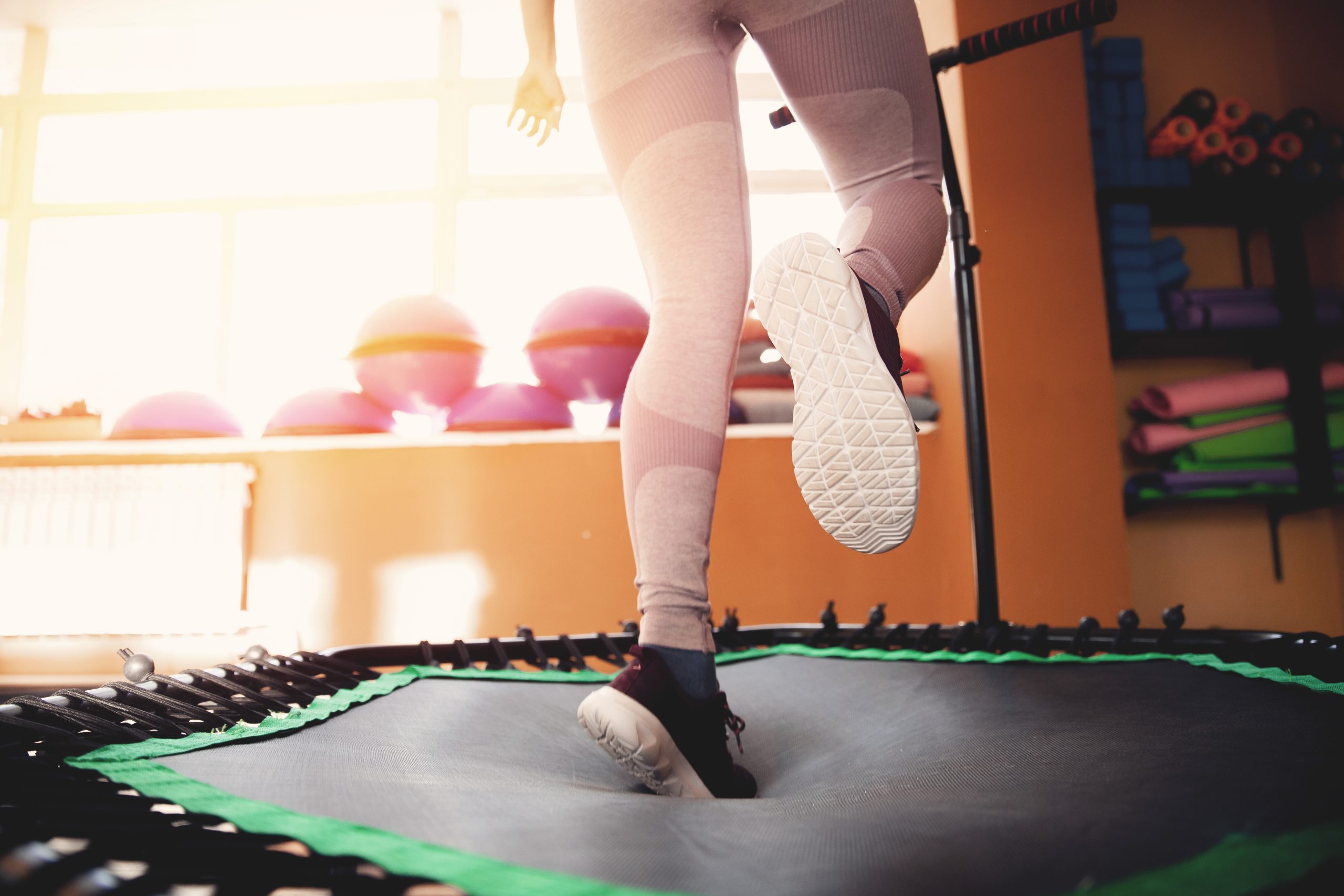
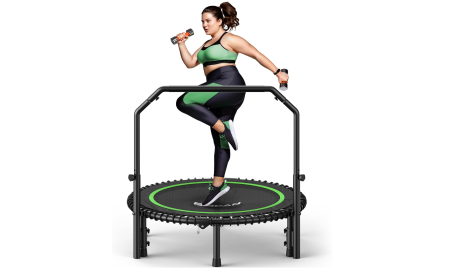
Rebounding is low-impact exercise performed on a small trampoline, usually 36 to 44 inches across. The spring or bungee system absorbs most of the force of your landing, so your joints take a fraction of the impact of jumping on the floor. But — and this is the part people miss — the acceleration and deceleration at the top and bottom of each bounce create significant G-forces through your body. That’s the dose your tissues need.
There are three basic moves on a rebounder. The health bounce is a gentle, heels-stay-down flex where you just let your body compress with gravity and rebound. It’s the one you start with. The jog is a slow run-in-place where your feet alternate. And the jump is a full leave-the-mat bounce with both feet. Most real rebounding sessions blend all three, with different ratios depending on the goal.
What separates rebounding from other cardio is that your whole body is experiencing rhythmic G-force oscillation — up to 2 to 3 G at the bottom of a jump, down toward zero G at the top. That pattern, repeated for minutes, is what triggers the specific adaptations we’re about to get into.
This is very different from walking, cycling, or swimming. Those are all great. They all serve purposes. But none of them produce the same bone-loading, lymphatic, and neuromuscular effect that rhythmic vertical oscillation does.
The NASA Study That Everyone Cites (And What It Actually Found)
If you’ve read anything about rebounding, you’ve probably seen the NASA claim: “NASA found rebounding is 68% more effective than running.” It’s the line that gets quoted on every product page, and it’s actually true — with a lot of important context people skip.
The original study was published in the Journal of Applied Physiology in 1980 by Bhattacharya, McCutcheon, and colleagues at NASA and the University of Kentucky. It looked at astronauts who had lost bone density and cardiovascular fitness during spaceflight and tested different forms of re-entry exercise. The key finding was that at equal oxygen consumption, the biomechanical G-force loading on the body was significantly higher during rebounding than during treadmill running — which the authors interpreted as a more efficient stimulus for cardiovascular conditioning and musculoskeletal loading per unit of effort.
Translation: you don’t have to work as hard on a rebounder to get a similar cardiovascular signal as running, and you get more bone-loading benefit per minute. That’s the finding. It’s real. It just doesn’t mean rebounding is “better than running” in all contexts — it means rebounding is an extremely efficient way to get a specific set of stimuli into a body that can’t or shouldn’t be pounding pavement.
For a midlife woman whose knees, hips, and pelvic floor are already under stress, that efficiency matters. A lot.
Why Rebounding Matters Specifically for Menopause
Let’s get into why a mini trampoline becomes particularly relevant when your hormones start shifting. There are five separate systems that benefit from rebounding, and each of them is under pressure during perimenopause and menopause.
Bone density. Estrogen decline is the primary driver of bone loss in midlife and postmenopausal women. Bone is living tissue that responds to mechanical load — you load it, it rebuilds stronger. You don’t load it, it thins. The impact profile of rebounding — repetitive, vertical, moderate-force — is the kind of loading that triggers osteoblast activity. A 2016 study published in PubMed (PMID 27441918) by Tupeev and colleagues found that mini trampoline exercise produced measurable improvements in bone mineral density in postmenopausal women over 8 to 12 weeks. And the landmark LIFTMOR trial, while focused on high-intensity resistance training, established the principle that menopausal bone responds to loading — a principle that extends to the lower-impact-but-still-loading world of rebounding.
Lymphatic drainage. Your lymphatic system has no pump of its own. Unlike your cardiovascular system, which has a heart, your lymph moves through your body on the mechanical squeeze of muscle contraction and the rhythm of your breath and gravity. Rebounding’s bounce cycle produces one of the most effective lymphatic pumping patterns you can create in a body that’s not being massaged. A review published in PMC (PMC9990535) on whole-body vibration and mechanical oscillation effects on lymphatic flow documented measurable increases in lymph drainage during rhythmic, vertical movement. For menopausal women dealing with fluid retention, puffiness, or sluggish drainage — this is a needle-mover.
Balance and fall prevention. Fall risk climbs sharply for women in their 50s and 60s. The CDC has repeatedly flagged fall-related hip fracture as a major cause of mortality in older women. Rebounding trains proprioception, ankle stabilization, and core co-activation in a way that directly transfers to real-world balance. You are, after all, standing on an unstable surface while loading your body rhythmically. That’s the exact training stimulus for a better balance system.
Cardiovascular conditioning without joint cost. Cardiac health is tightly linked to menopausal outcomes. Rebounding lets you raise your heart rate, train your aerobic system, and build cardiovascular resilience without the knee, hip, and foot impact of running on concrete. For women who have any joint history — and most of us do by midlife — this is often the difference between showing up for cardio and giving up on it.
Mood and nervous system. Rhythmic movement on a rebounder activates the vagus nerve, regulates cortisol, and produces an endorphin release that’s easy to access even on bad days. More than one client has told me rebounding is the only form of movement she can do when her anxiety is high. The combination of rhythm, oscillation, and novelty short-circuits the stuck-in-your-head spiral in a way that walking sometimes doesn’t.
If you’ve read our piece on the benefits of jumping, you know we’re big believers in vertical movement for midlife women. Rebounding is the softer-joint cousin of the jumping protocols in that article, and for most women 40+, it’s the starting point.

How to Start Rebounding for Menopause (A 10-Minute Protocol)
Here’s the exact starter protocol I give coaching clients. Four weeks. Three to five days a week. Starting at ten minutes and building to twenty.
Week 1: Foundation. Five days a week, ten minutes. The whole ten minutes is health bounce — heels down, gentle compression, no leaving the mat. Focus on posture: tall spine, core softly engaged, shoulders down, breath slow through the nose. The goal here is to condition your ankles, your pelvic floor, and your nervous system to the surface. That’s it.
Week 2: Add jog. Five days a week, ten to twelve minutes. Two minutes of health bounce to warm up, then alternate: one minute of jog, one minute of health bounce, repeat. Finish with two minutes of health bounce. Your heart rate should climb moderately but not spike.
Week 3: Introduce jumps. Four to five days a week, fifteen minutes. Start with three minutes of health bounce, then blocks: one minute jog, thirty seconds jumps, ninety seconds health bounce — repeat. The jumps should be modest. You’re not trying to touch the ceiling. You’re trying to leave the mat and land softly.
Week 4: Build endurance. Four to five days a week, twenty minutes. Same structure as week 3, but increase the jog intervals to ninety seconds and the jump intervals to forty-five seconds. By the end of week 4 you should feel like rebounding is in your body, not a thing you’re learning.
After week 4, you can keep expanding duration (up to thirty minutes), add upper-body elements (arm swings, light weights, cross-crawls), or start integrating rebounding into a broader movement routine as a warm-up or active recovery day.
This protocol is simple on purpose. Most women over 40 don’t need more complex programming — they need a sustainable habit that produces adaptations. If you want a more customized version that factors in your specific history, current training, and any joint concerns, that’s what THOR 1:1 coaching is built for. We also walk through rebounding in detail at our retreats and in the Midlife Method workshop series.
Rebounding for Women Over 50 and the Pelvic Floor Question
This is the conversation nobody wants to have but everyone needs to. If you’ve had children, or if you’re in perimenopause with some pelvic floor weakness, rebounding can feel complicated. A small percentage of women experience stress urinary incontinence when they start jumping. Some women experience pelvic heaviness.
Here’s the real answer, which is more nuanced than “do it” or “don’t.”
Gentle rebounding — health bounces and easy jogs — is almost always safe and often therapeutic for the pelvic floor. The rhythmic compression-and-release trains the same reflexive pelvic floor engagement you want walking through daily life. Many women actually see pelvic floor improvement after a few weeks of consistent gentle rebounding.
High-impact jumping on a rebounder can be a different story. If you have known prolapse, significant incontinence, or a complicated postpartum history, you need a pelvic floor physiotherapist’s input before you add jumps. That’s not a limitation — that’s just good programming. A good pelvic floor PT can tell you whether to stay at health bounces, progress to jogs only, or add modified jumps with specific breathing patterns.
The honest rule of thumb: if you leak or feel heaviness during rebounding, dial back to a lower-impact version and get an evaluation. Pushing through it will not strengthen the pelvic floor — it will compound the dysfunction.
How to Choose a Rebounder for Women Over 40
Not all rebounders are the same. The cheap one at the big-box store will feel bouncy for a month and then start squeaking, sagging, or worse. A good rebounder is a ten-year investment. Here’s what to look for.
Bungee vs. spring. Bungee-cord rebounders have a softer, more supportive bounce that’s easier on joints. Spring rebounders have a firmer, livelier bounce that’s better for higher-intensity work. For midlife women starting out, bungee is usually the better first choice.
Size. A 40-inch rebounder is standard. Larger rebounders (up to 48 inches) give you more mat space, which is nice if you want to do more varied movement. Smaller portable rebounders (30–36 inches) are fine for gentle bouncing but can feel cramped for more dynamic work.
Stability bar. If you have any balance concerns, get a rebounder with a removable stability bar. You can use it for the first few weeks and remove it once you’re confident.
Build quality. Look for a steel frame, quality bungees or springs rated for many cycles, and a mat made of permatron or a similar durable material. Budget $250 to $500 for something that lasts. Rebounders under $100 usually don’t.
Noise. Some rebounders are much quieter than others. If you’re going to use yours before everyone else in the house wakes up (which is what I do), read reviews about noise specifically.
I’m not going to push a specific brand here because quality options exist at various price points, and the right one depends on your body and your space. But if you want my recommendation based on what we’ve put our own guests on at THOR Mountain, email the team — we’ll tell you what we use and why.
Free 28-Day Fascia & Lymph Reset Email Course
Get our Free 28-day email course series to help with 1 or 2 exercises per day to release your fascia. One short lesson per day. Two minutes to read each.
Common Mistakes in Rebounding for Menopause
Three mistakes I see new rebounders make, and how to avoid each.
Mistake 1: Jumping too high too soon. You don’t need to leave the mat by a foot. Most of the benefit of rebounding comes from the controlled, rhythmic G-force cycle of a small bounce — not from vertical height. Tall jumps early often lead to ankle rolls, knee strain, and a sense of “this is too hard,” followed by quitting. Keep it modest for the first month.
Mistake 2: Rebounding in bare feet or socks. Bare feet give you proprioception, but on a rebounder they also give you less support when you’re fatigued. Socks slide. Most people do best in fitted athletic shoes for rebounding — the sole protects your feet and stabilizes your ankles. That said, if you have a strong history of barefoot movement, know your body well, and have no history of ankle issues, barefoot rebounding can be fine. Start in shoes as a rule.
Mistake 3: Ignoring the body cues. Rebounding is low-impact, but it is impact. If your knees, hips, or low back are sore for 24 hours after a session, you went too hard. Back off to a gentler version and progress more slowly. The whole point is to have this as a long-term tool, not an injury.
How Rebounding Fits into a Broader Midlife Movement Plan
I want to be careful not to oversell any single tool. Rebounding is not a replacement for strength training, and it’s not a standalone solution for menopausal body composition. Here’s how it fits.
Strength training (2 to 4 days a week). Still the single most important movement category for midlife women. You cannot out-rebound a lack of muscle.
Walking or hiking (daily, aim for 7,000 to 10,000 steps). The background movement that keeps your cardiovascular and metabolic systems on.
Rebounding (3 to 5 days a week, 10 to 20 minutes). Bone density loading, lymph, balance, cardio — the condensed multi-system stimulus.
Yoga, Pilates, or mobility work (1 to 3 days a week). The integration layer. Joint health, nervous system regulation, pelvic floor, breath.
True rest (1 to 2 days a week). Not optional.
Rebounding fits as the “efficient multi-system” piece. It’s what you do on a busy day when you have ten minutes and want to move the needle on multiple things at once. It’s not a replacement for heavier work.
The Nutrition Piece: What to Eat to Make Rebounding Work Better
If you’re rebounding consistently, your body needs to be fed well to adapt. Under-eating during a new training block is one of the fastest ways to get injured and stall progress.
Protein matters most. Aim for 0.8 to 1 gram per pound of goal body weight, spread across meals. This is the same target we cover in detail in our reverse dieting after menopause and fundamentals of macro diet for women over 50 pieces.
Get carbs in around your training. Even a small amount (a piece of fruit, a few bites of oatmeal, a rice cake) 30 to 60 minutes before you rebound can make the session feel easier and the recovery faster.
Hydrate. Rebounding moves lymph, and lymph moves better when you’re hydrated. Half your body weight in ounces of water is a floor, not a goal.
If you want tailored macros for your rebounding training, the free THOR macro calculator gives you the numbers in under two minutes.
Frequently Asked Questions About Rebounding for Menopause
Is rebounding safe for women over 50?
Yes, for the vast majority of women. Start gentle, progress slowly, use a quality rebounder, and listen to your body. If you have known osteoporosis, significant pelvic floor dysfunction, a recent joint surgery, or uncontrolled cardiovascular issues, clear it with your physician first.
How long until I see results from rebounding?
Lymphatic and energy effects are often felt in the first two weeks. Balance improvements show up by week four. Cardiovascular conditioning is measurable by week six. Bone density changes take three to six months of consistent practice to start showing on imaging.
Can I rebound every day?
Yes, at lower intensity. Health bounces and easy jogs can be daily. Higher-intensity jump workouts are better 3 to 4 days a week with rest or lighter movement between.
Does rebounding help with hot flashes?
Indirectly. Regular rebounding supports sleep, cortisol regulation, and body composition — all of which tend to reduce hot flash frequency and intensity. It’s not a direct treatment, but it’s a contributor to the conditions that reduce them.
Free 28-Day Fascia & Lymph Reset Email Course
Get our Free 28-day email course series to help with 1 or 2 exercises per day to release your fascia. One short lesson per day. Two minutes to read each.
What’s better — rebounding or walking?
Different tools. Walking is unmatched for daily, steady-state movement, joint health, and mental clarity. Rebounding delivers more bone loading, more lymph movement, and more cardiovascular stimulus per minute. Most midlife women benefit from both — walking daily, rebounding 3 to 5 days a week.
Can rebounding help with weight loss in menopause?
It contributes to the calorie deficit you need for fat loss, but the bigger lever is still nutrition and strength training. Rebounding helps by supporting cardiovascular fitness, lymphatic drainage (which affects perceived puffiness), and the consistency of your overall movement. It’s a part of a menopause weight-loss approach, not a solo solution.
Will rebounding make my pelvic floor worse?
Gentle rebounding typically strengthens the pelvic floor over time. High-impact rebounding can aggravate existing dysfunction. If you have pelvic floor concerns, start with health bounces only, check in with a pelvic floor PT, and progress intentionally.
What’s the best time of day to rebound?
Morning is popular because it wakes up your lymph and your mood. Afternoon sessions work well as a midday energy reset. Evening rebounding can interfere with sleep for some women, so keep it at least two to three hours before bed.
Can I rebound if I have osteoporosis?
Possibly, with medical clearance and a conservative progression. Rebounding is lower impact than running, but it still loads bone. Your physician and ideally a physical therapist familiar with bone loading should advise on whether rebounding is appropriate, what intensity, and what to avoid.
Do I need to track my heart rate while rebounding?
Not required, but useful. For cardiovascular conditioning, aiming for 60 to 80% of your max heart rate for portions of a session gives you a solid training zone. A basic heart rate monitor or watch is enough.
Can rebounding replace my cardio sessions?
For many midlife women, yes. Rebounding covers cardiovascular conditioning, especially in the intervals and jumping portions. Some women still love running, cycling, or swimming — those stay great complements.
Is it okay to rebound during my period?
Yes, and many women find it helps with cramps and bloating. Listen to your body — if a day feels heavier and lower-energy, drop to gentle health bounces rather than skipping altogether.
Do I need a coach to start rebounding?
No, but a coach accelerates the curve. Working with someone who can look at your form, integrate rebounding into your overall program, and adjust the progression to your history shortens the time to results. Our 1:1 coaching program includes rebounding programming by default for clients who want it, and we cover it in every Midlife Method workshop cohort.
What shoes should I wear for rebounding?
A fitted athletic shoe with moderate support. Running shoes with a lot of cushioning can feel unstable on the mat. Cross-training shoes or minimalist athletic shoes usually work best.
Can rebounding cause motion sickness?
A small percentage of women experience mild motion sickness when they start. It usually resolves within the first week as the vestibular system adapts. If it persists, a gentler progression or check-in with a doctor is worth it.
How does rebounding compare to whole-body vibration platforms?
Different mechanism. Whole-body vibration uses rapid platform oscillation that drives involuntary muscle contraction. Rebounding uses voluntary jumping on a compliant surface. Both have benefits; rebounding requires more active engagement and burns more calories per minute.
Free 28-Day Fascia & Lymph Reset Email Course
Get our Free 28-day email course series to help with 1 or 2 exercises per day to release your fascia. One short lesson per day. Two minutes to read each.
Your Next Step Into Rebounding for Menopause
Here’s where I leave you. Rebounding is one of the best-kept secrets of midlife movement. Ten minutes a day, most days, on a quality rebounder, in a simple progression, will move your bone density signal, your lymphatic drainage, your balance, your cardiovascular conditioning, and your mood more than almost anything else you can do in that amount of time.
Start with the starter protocol above. Give yourself four weeks. Track how you feel — energy, sleep, mood, workouts — not just the scale. Pair it with real strength training, adequate protein (use the free macro calculator to get your numbers), and enough sleep, and you have the skeleton of a midlife movement practice that actually works.
If you want a real coach walking you through this — building the rebounding into the rest of your plan, adapting it to your body, and holding you accountable — that’s what our Age with Strength 1:1 coaching is built for. You don’t have to figure this out alone. Most of the women we coach tried to for too long, and the acceleration of having someone in your corner is the reason they wish they’d started sooner.
You have a body built for this. Let’s wake it up.
Sources and Further Reading
- Bhattacharya, A., McCutcheon, E. P., Shvartz, E., & Greenleaf, J. E. (1980). Body acceleration distribution and O2 uptake in humans during running and jumping. Journal of Applied Physiology: Respiratory, Environmental and Exercise Physiology, 49(5), 881–887. https://pubmed.ncbi.nlm.nih.gov/7429911/
- Tupeev, I. R., & others. (2016). Mini trampoline exercise effects on bone density in postmenopausal women. Rehabilitation and Health. https://pubmed.ncbi.nlm.nih.gov/27441918/
- Watson, S. L., Weeks, B. K., Weis, L. J., Harding, A. T., Horan, S. A., & Beck, B. R. (2018). High-Intensity Resistance and Impact Training Improves Bone Mineral Density and Physical Function in Postmenopausal Women With Osteopenia and Osteoporosis: The LIFTMOR Randomized Controlled Trial. Journal of Bone and Mineral Research, 33(2), 211–220. https://pubmed.ncbi.nlm.nih.gov/28975661/
- Cochrane, D. J. (2011). Vibration exercise: the potential benefits. International Journal of Sports Medicine, 32(2), 75–99. https://pubmed.ncbi.nlm.nih.gov/21165803/
- Rittweger, J. (2010). Vibration as an exercise modality: how it may work, and what its potential might be. European Journal of Applied Physiology, 108(5), 877–904. https://pubmed.ncbi.nlm.nih.gov/20012646/
- Moreau, K. L., Hildreth, K. L., Meditz, A. L., Deane, K. D., & Kohrt, W. M. (2012). Endothelial function is impaired across the stages of the menopause transition in healthy women. Journal of Clinical Endocrinology & Metabolism, 97(12), 4692–4700. https://pubmed.ncbi.nlm.nih.gov/22969140/
- Shumway-Cook, A., & Woollacott, M. H. (2000). Attentional demands and postural control: the effect of sensory context. The Journals of Gerontology. Series A, Biological Sciences and Medical Sciences, 55(1), M10–M16. https://pubmed.ncbi.nlm.nih.gov/10719767/
- Villareal, D. T., Aguirre, L., Gurney, A. B., et al. (2017). Aerobic or Resistance Exercise, or Both, in Dieting Obese Older Adults. New England Journal of Medicine, 376(20), 1943–1955. https://pubmed.ncbi.nlm.nih.gov/28514618/
- Lymphatic system and exercise: mechanisms and clinical outcomes. Review in PMC. https://www.ncbi.nlm.nih.gov/pmc/articles/PMC9990535/
- Kohrt, W. M., Bloomfield, S. A., Little, K. D., Nelson, M. E., & Yingling, V. R. (2004). American College of Sports Medicine position stand: physical activity and bone health. Medicine & Science in Sports & Exercise, 36(11), 1985–1996. https://pubmed.ncbi.nlm.nih.gov/15514517/
- North American Menopause Society. (2022). The 2022 Hormone Therapy Position Statement of The North American Menopause Society. Menopause, 29(7), 767–794. https://pubmed.ncbi.nlm.nih.gov/35797481/

Terry Tateossian is a Menopause Lifestyle Medicine Coach, Certified Personal Trainer & Nutritionist and the Founder of THOR: The House of Rose, a wellness brand serving women over 40 through retreats, coaching, macro-nutrition and community. As 25-year founder and entrepreneur, Terry spent two and a half decades building and running successful start-up businesses, an experience that put her on the front line of founder burnout long before she could name it. After facing serious health challenges, early onset menopause, and emotional eating while running her agency and raising two children, Terry rebuilt her health in her 40s and lost more than 80 pounds through evidence-based nutrition, training, and mindset work. Today, she helps women get strong, improve confidence, support hormone health, and create a stronger second half of life. Terry has been featured in major media outlets and is available for podcasts, expert commentary, brand collaborations, and speaking engagements on midlife health, reinvention, emotional eating, menopause wellness, and strength training for longevity. Get her free macro calculator (her cookbook companion) to start your journey to back to health.