
 By Cindy Adoptante
Free 28-Day Fascia Reset Email Course
Get our Free 28-day email course series to help with 1 or 2 exercises per day to release your fascia. One short lesson per day. Two minutes to read each.
How to Use a Singing Bowl and Your Voice Together for Healing
The first time I brought a singing bowl into a yoga retreat session, I watched a woman in the back row fold her arms and mouth “not my thing” to the guest next to her. She’d told me at check-in she was there for the hiking and the meal plan, not “anything woo.”
Twenty minutes later, after we’d played the bowl together and I’d asked the group to hum along with it on the exhale, she was the one who asked if we could do it again the next morning. When I asked her what changed her mind, she said the humming was the part that got her. It felt less like a ritual and more like something her body already knew how to do.
That’s the piece I want to lead with, because it’s the honest answer to the skepticism I hear most often about sound work: you don’t have to believe anything in particular for a big chunk of it to work. Some of what happens when you play a singing bowl and add your voice runs through a nervous system pathway with a real, published research base.
Some of it, particularly the chakra and energy-center language that usually gets attached to this practice, comes from a several-thousand-year-old philosophical tradition that was never designed to be tested in a lab and shouldn’t be sold to you as if it were. This guide covers both halves honestly, so you can use the practice for what it’s actually good at.
Medical disclaimer: This article is for educational purposes and does not replace medical or mental health care. Sound and voice practices are a complement to treatment, not a substitute for it. If you have epilepsy, a seizure disorder, or a diagnosed mental health condition, talk with your provider before starting a new sound-based practice.
What’s Actually Happening When You Hear a Singing Bowl?
A singing bowl doesn’t play a single note the way a piano key does. When you strike it or circle it with a mallet, the metal or crystal produces a fundamental tone plus a cluster of overtones, secondary frequencies layered on top of the main pitch, that shift and decay over the length of the sound. That layered, slowly fading quality is part of why the sound feels different from a recorded tone or a synthesized “relaxation” track.
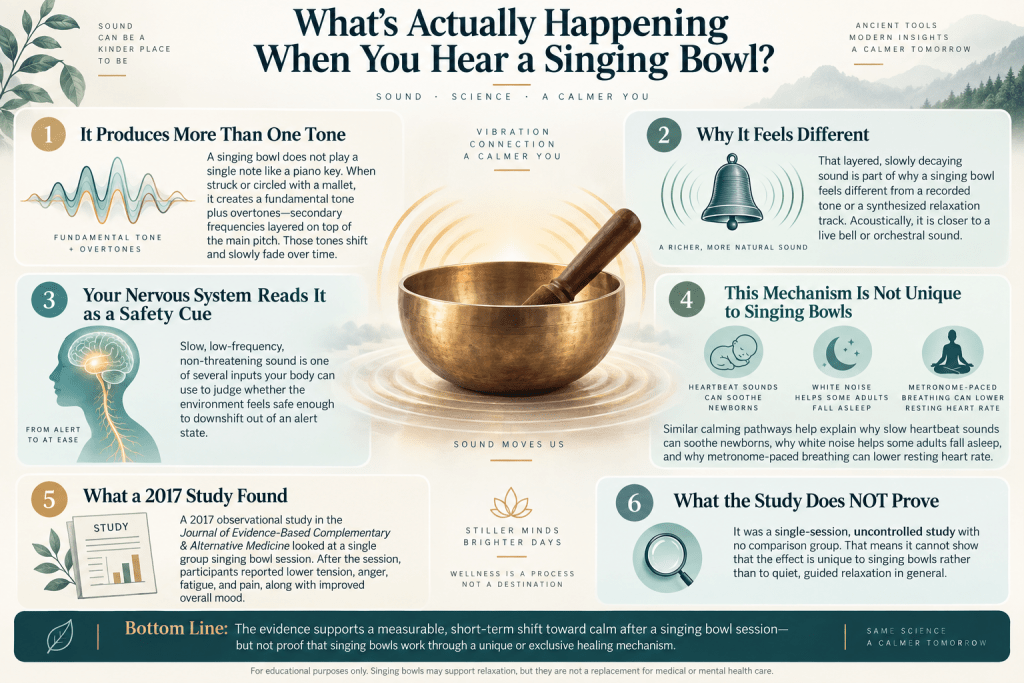
It’s also acoustically similar to what happens in a live orchestra or a cathedral bell, just at a smaller scale and closer to your body. What your nervous system does with that sound is where the genuine physiology starts. Slow, low-frequency, non-threatening sound is one of several inputs your body uses to judge whether the current environment is safe enough to downshift out of an alert state.
This is not unique to singing bowls. It’s the same general mechanism behind why a slow heartbeat sound soothes newborns, why white noise machines help some adults fall asleep, and why a metronome-paced breathing app can lower a resting heart rate.
A 2017 observational study published in the Journal of Evidence-Based Complementary & Alternative Medicine had participants sit through a single group singing bowl session and measured mood before and after. Tension, anger, fatigue, and reported pain all dropped, and overall mood measures improved.
It was a single-session, uncontrolled study without a comparison group, so it can’t tell you the effect is unique to singing bowls specifically rather than to quiet, guided relaxation time in general. What it does support is that a session like this reliably produces a measurable, short-term shift toward calm, which matches what nearly every woman I’ve watched go through one at a retreat reports afterward.
Important: Chakras and “energy centers” are a framework from classical yogic and Ayurvedic philosophy, not an anatomically verified body system in the way your vagus nerve or lymphatic system is. THOR treats this practice the way we treat the rest of our Ayurveda and mantra content: as a traditional wellness framework worth understanding and, if it resonates with you, worth using, not as a claim that specific frequencies unblock specific organs or cure specific conditions.
“I’ve run enough retreat sessions now to know that the skeptics and the true believers usually end up in the same place by the end. The skeptics stop trying to figure out whether they believe in energy centers, and the true believers stop needing the science to validate what they already feel. Both groups leave calmer. That’s the part I actually care about.”
Terry Tateossian, Founder of The House of Rose
Why Add Your Voice? What Is the Vagus Nerve Connection?
Listening to a singing bowl is a passive input. Adding your own voice, whether that’s a hum, a sustained vowel sound, or a chanted syllable, turns the practice into something your body actively participates in, and that distinction matters more than it might seem.
Humming specifically has two well-documented physiological effects worth knowing about. First, a 2002 study published in the American Journal of Respiratory and Critical Care Medicine found that humming dramatically increases the release of nitric oxide in the nasal passages compared to quiet breathing, a gas involved in blood vessel dilation and airflow between your sinuses and lungs. Second, and more relevant to the calming effect, is the connection between vocalization and your vagus nerve.
The muscles involved in humming, chanting, and sustained vowel sounds, your larynx, your soft palate, the back of your throat, share neural real estate with the branches of the vagus nerve that regulate heart rate and the parasympathetic “rest and digest” response. This is the same mechanism behind why humming is one of the exercises in 10 Vagus Nerve Reset Exercises for Women Over 40, and why voice-based practices show up repeatedly in the nervous system regulation research.
A frequently cited 2001 study in the BMJ compared rosary prayer recitation with the chanting of a specific Tibetan Buddhist mantra, “Om mani padme hum,” and found that both practices, despite having nothing in common religiously, slowed participants’ breathing to roughly the same rate and produced the same increase in a marker called baroreflex sensitivity, a measure of how well your cardiovascular system self-regulates.
The common ingredient wasn’t the words. It was the slow, rhythmic exhale that chanting and prayer both force you into. A separate small neuroimaging study from 2011 had participants chant the syllable “Om” while in an MRI scanner and compared the brain activity to a control sound, and found reduced activity in brain regions associated with the stress and threat response during the Om condition specifically.
Put plainly: the physical act of a slow, voiced exhale appears to do real, measurable work on your autonomic nervous system, independent of any belief system layered on top of it.
This is also why pairing the bowl with your voice tends to work better than using either one alone for many of the women I’ve worked with. The bowl gives your breathing an external rhythm to follow, while your voice keeps you actively involved rather than simply listening. This combination fits naturally with the broader neuroscience of meditation, where breath, sound, attention, and repetition can all influence how the brain and nervous system respond during stillness practices.
Free 28-Day Fascia Reset Email Course
Get our Free 28-day email course series to help with 1 or 2 exercises per day to release your fascia. One short lesson per day. Two minutes to read each.
What Do You Need to Get Started?
You need very little to start this practice, and you don’t need to buy anything today to try the version in the next section using only your voice.
| Item | Purpose | Notes |
|---|---|---|
| A singing bowl (metal alloy or crystal) | Produces the external tone you’ll play and hum alongside | Metal alloy bowls tend to run lower and warmer in tone; crystal bowls tend to run higher and brighter. Neither is “better,” it’s a matter of personal preference and what you find soothing |
| A mallet or striker | Activates the bowl, either by striking the rim or circling it | Usually included with the bowl at purchase |
| A cushion or folded towel | Bowl rests on this, which improves resonance versus a hard tabletop | Also works as your own seat |
| A quiet space, 10 to 20 minutes | Uninterrupted time and low background noise | Phone on silent, not just vibrate, the buzz is distracting mid-practice |
| Optional: a candle or incense | Sensory cue that signals “this time is different” | Skip if scent sensitivity is a concern |
If you don’t already own a bowl, your own voice and a slow hum are enough to get the vagal-tone benefit described in Section 2 while you decide whether the practice is worth the investment.
How Do You Use a Singing Bowl and Your Voice Together Step by Step?
A simple six-step practice can help you combine a singing bowl with your voice to support relaxation, steady breathing, and focused awareness.
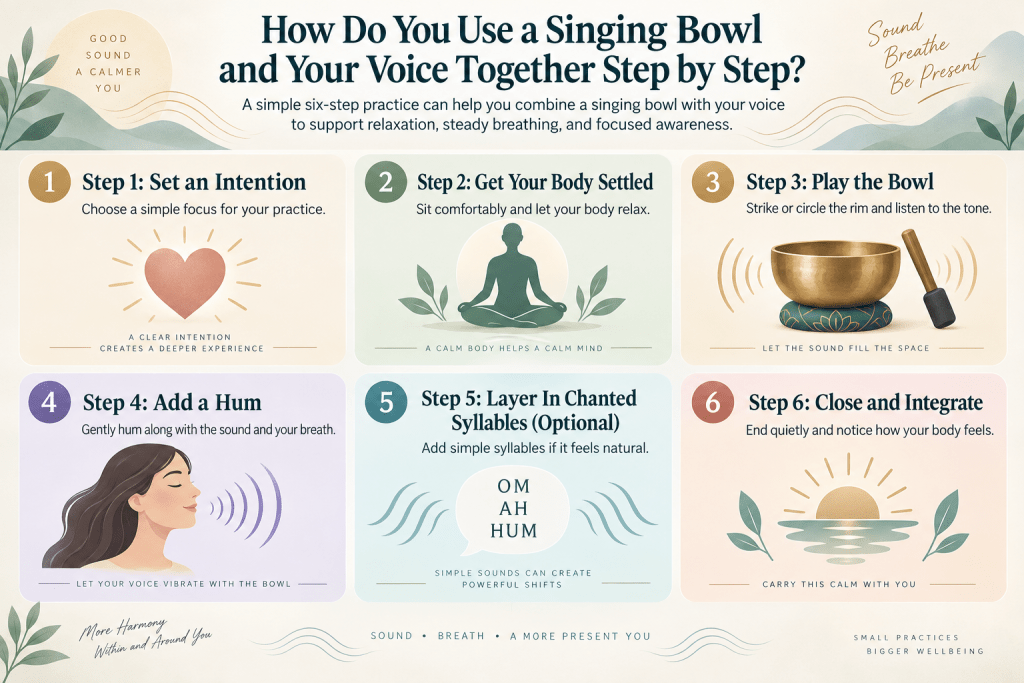
Step 1: Set an Intention
Before you make any sound, take thirty seconds to name what you want out of the next ten minutes. It can be as simple as “I want to feel less wound up” or as specific as “I want to sit with something I’ve been avoiding.” This isn’t a mystical requirement, it’s a practical one: naming a goal before a relaxation practice measurably improves how effective people rate the practice afterward, likely because it gives your attention something to return to when it wanders.
Step 2: Get Your Body Settled
Sit in a comfortable position, cross-legged on the floor or upright in a chair with your feet flat. Place the bowl on its cushion within easy reach, either on the floor in front of you or in your palm if you’re using a smaller bowl. Close your eyes or soften your gaze downward.
Step 3: Play the Bowl
Strike the rim gently with the mallet, or circle the rim in slow, steady pressure to build the tone gradually. Let the sound ring out fully before striking again. Spend two to three minutes just listening, no voice yet, letting your breath slow to match the pace of the fading tone.
Step 4: Add a Hum
Once your breath has settled, add a low hum on your exhale, matching or approximating the bowl’s pitch as closely as feels comfortable. You are not aiming for musical precision. Let the hum vibrate in your chest and throat rather than staying shallow in your mouth. Continue alternating: strike the bowl, hum through the exhale, breathe in silently, strike again.
Step 5: Layer In Chanted Syllables (Optional)
If you want to go further than a plain hum, the yogic tradition associates seven specific syllables, or bija mantras, with seven traditional energy centers along the spine. You do not need to work through all seven or believe in the underlying energy-center framework for the practice to have value; even choosing one syllable that feels grounding and repeating it is enough.
| Traditional Energy Center | Sanskrit Name | Associated Syllable | General Location Referenced |
|---|---|---|---|
| Root | Muladhara | LAM | Base of spine |
| Sacral | Swadhisthana | VAM | Lower belly |
| Solar Plexus | Manipura | RAM | Upper abdomen |
| Heart | Anahata | YAM | Center of chest |
| Throat | Vishuddha | HAM | Throat |
| Third Eye | Ajna | OM (AUM) | Between the eyebrows |
| Crown | Sahasrara | Silence or OM | Top of the head |
Step 6: Close and Integrate
End with one to two minutes of silence after your last bowl strike, letting the final tone fade completely before you open your eyes. Take a moment to notice what, if anything, shifted from when you started. You don’t need to journal or process anything further unless it feels useful to you.
Free 28-Day Fascia Reset Email Course
Get our Free 28-day email course series to help with 1 or 2 exercises per day to release your fascia. One short lesson per day. Two minutes to read each.
What Is a Simple 10-Minute Beginner Sequence?
If the six-step breakdown above feels like more than you want to think about on your first try, here’s a worked example you can follow directly.
| Minute | What to Do |
|---|---|
| 0:00–0:30 | Set your intention silently |
| 0:30–1:00 | Get settled, bowl within reach, eyes closed |
| 1:00–3:30 | Strike the bowl, listen fully, repeat 3 to 4 times, no voice yet |
| 3:30–7:00 | Strike the bowl, hum through each exhale, breathe in silently, repeat |
| 7:00–8:30 | If it feels right, chant one syllable of your choice (HAM and YAM are common beginner choices for their gentler, mid-range pitch) |
| 8:30–10:00 | Final strike, sit in silence until the tone fully fades, then open your eyes |
What Common Mistakes Should You Avoid?
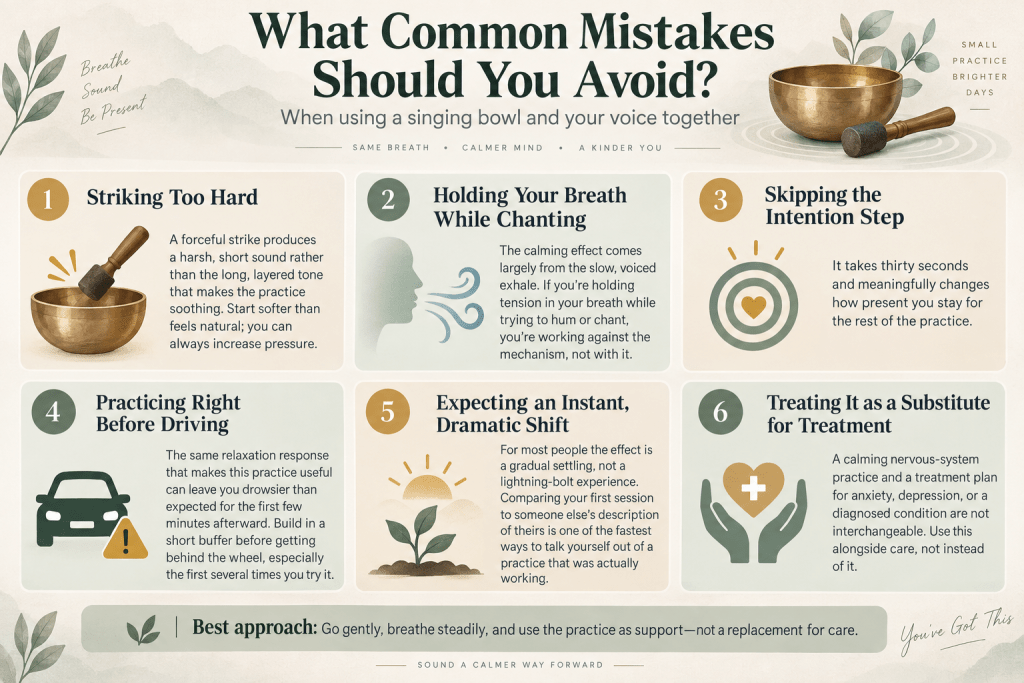
- Striking too hard: A forceful strike produces a harsh, short sound rather than the long, layered tone that makes the practice soothing. Start softer than feels natural; you can always increase pressure.
- Holding your breath while chanting: The calming effect comes largely from the slow, voiced exhale. If you’re holding tension in your breath while trying to hum or chant, you’re working against the mechanism, not with it.
- Skipping the intention step: It takes thirty seconds and meaningfully changes how present you stay for the rest of the practice.
- Practicing right before driving: The same relaxation response that makes this practice useful can leave you drowsier than expected for the first few minutes afterward. Build in a short buffer before getting behind the wheel, especially the first several times you try it.
- Expecting an instant, dramatic shift: For most people the effect is a gradual settling, not a lightning-bolt experience. Comparing your first session to someone else’s description of theirs is one of the fastest ways to talk yourself out of a practice that was actually working.
- Treating it as a substitute for treatment: A calming nervous-system practice and a treatment plan for anxiety, depression, or a diagnosed condition are not interchangeable. Use this alongside care, not instead of it.
“I went through early-onset menopause at 41, and the nights my nervous system felt the most wired were never fixed by willpower. They were fixed by finding physical inputs, breath, sound, movement, that gave my body a different signal than the one it was stuck on. Sound work became one more tool in that kit, not a replacement for the strength training and the sleep work, but a real addition to it.”
Terry Tateossian, Founder of The House of Rose
Free 28-Day Fascia Reset Email Course
Get our Free 28-day email course series to help with 1 or 2 exercises per day to release your fascia. One short lesson per day. Two minutes to read each.
What Does the Research Show and Not Show?
Research on sound-based practices supports several measurable physiological and emotional effects. At the same time, some popular claims in the sound healing space go beyond what current scientific evidence can establish.
What Does the Research Support?
Several sound and vocal practices have measurable effects on the body:
- Slow, Voiced Exhalation: Humming, chanting, and sustained vowel sounds are associated with shifts toward parasympathetic activity, including slower breathing and improved baroreflex sensitivity.
- Chanting: Research has documented reduced activity in stress-related brain regions during certain chanting practices.
- Singing Bowls: At least one published observational study found that a single singing bowl session reduced self-reported tension, anger, and fatigue immediately afterward.
- Humming: Humming measurably increases nasal nitric oxide production.
These findings support the idea that sound practices can influence breathing, nervous system regulation, and subjective stress.
What Has Not Been Established?
Other claims commonly associated with sound healing do not currently have the same level of scientific support:
- Specific Healing Frequencies: Research has not established that particular frequencies heal specific organs or medical conditions.
- Chakra Unblocking: There is no established scientific evidence showing that sound literally removes energetic blockages from individual chakras.
- Cellular Healing: Current evidence does not demonstrate that singing bowls or similar sound practices directly produce cellular healing.
These ideas may still hold meaning within spiritual, contemplative, or personal practices. That is a valid reason to use them. But spiritual meaning and medical evidence are different categories, and it is important not to blur the distinction between the two.
Important: If you’re using this practice to support anxiety, chronic pain, or another diagnosed condition, treat it as a complement to your existing care plan and discuss it with your provider rather than using it as a replacement for treatment. For additional ways to support nervous system regulation, especially when traditional stillness practices feel uncomfortable, you can also explore strategies that build vagal tone and parasympathetic support in midlife.
“By the time most women get to me, they’ve been told to ‘just relax’ by about six different people who never explained how. What I like about this practice is that it gives you something to actually do with your body instead of just being told to calm down. The humming alone is worth learning even if you never pick up a bowl.”
Terry Tateossian, Founder of The House of Rose
If Sanskrit chanting interests you beyond this practice, exploring the Aham mantra can offer a simple introduction to how repetition, sound, and focused attention come together in traditional mantra meditation.
What Are Your Next Steps?
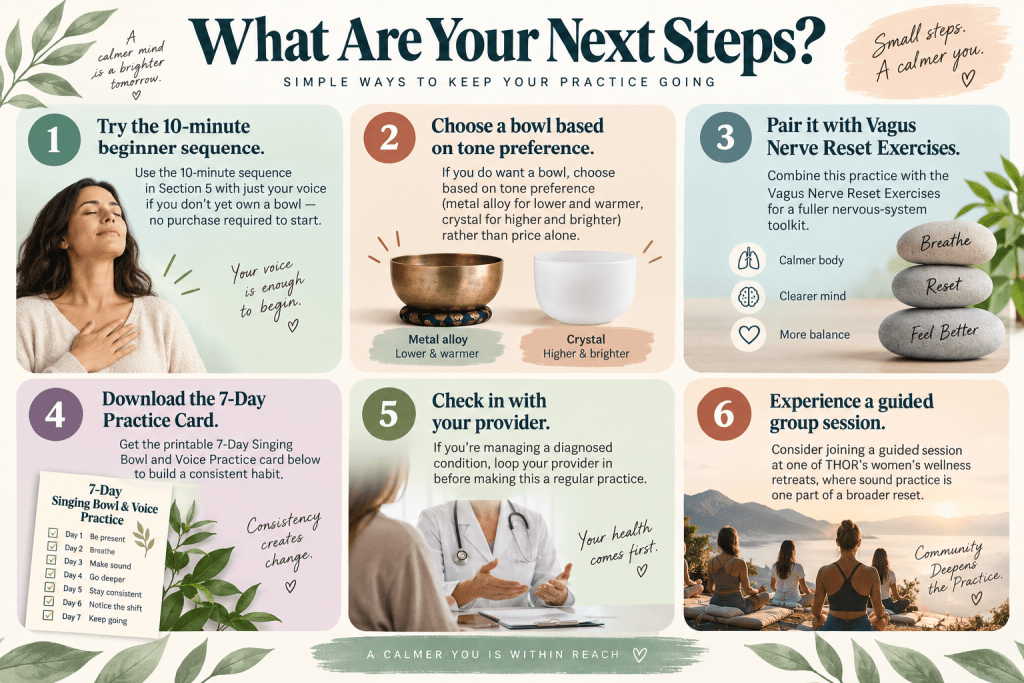
- Try the 10-minute beginner sequence in Section 5 using just your voice if you don’t yet own a bowl, no purchase required to start.
- If you do want a bowl, choose based on tone preference (metal alloy for lower and warmer, crystal for higher and brighter) rather than price alone.
- Pair this practice with the Vagus Nerve Reset Exercises for a fuller nervous-system toolkit.
- Download the printable 7-Day Singing Bowl and Voice Practice card below to build a consistent habit.
- If you’re managing a diagnosed condition, loop your provider in before making this a regular practice.
- Consider experiencing a guided group session at one of THOR’s women’s wellness retreats, where sound practice is one part of a broader reset.
Free 28-Day Fascia Reset Email Course
Get our Free 28-day email course series to help with 1 or 2 exercises per day to release your fascia. One short lesson per day. Two minutes to read each.
Frequently Asked Questions
Do I need a singing bowl to get any benefit, or does humming alone work?
Humming alone gives you the vagal-tone and nitric-oxide benefits described in Section 2. The bowl adds an external pacing tone and a sensory ritual many people find easier to stay consistent with, but it isn’t required to start.
How long should a singing bowl and voice session last?
Ten minutes is enough to notice an effect, based on the beginner sequence in this guide. Many people extend to 20 to 30 minutes once the practice becomes routine.
What’s the difference between a metal singing bowl and a crystal singing bowl?
Metal alloy bowls are traditionally hand-hammered from a blend of metals and tend to produce a lower, warmer tone with more complex overtones. Crystal bowls are made from quartz and tend to produce a higher, purer, more sustained tone. Neither is more effective; it comes down to which tone you find more soothing.
Do I need to know how to sing to do the voice portion?
No. You’re humming or sustaining a vowel sound, not performing. There’s no wrong pitch.
Is sound healing backed by science, or is it just a wellness trend?
Parts of it are well-supported by evidence, specifically the effects of slow voiced exhalation on the vagus nerve and autonomic nervous system, and there’s at least one published observational study on singing bowl sessions specifically reducing tension and improving mood. Other claims common in the sound healing space, like frequency-specific organ healing or cellular-level effects, don’t currently have that kind of research support. See Section 7 for the full breakdown.
Are chakras real?
Chakras are a component of a traditional yogic and Ayurvedic philosophical framework going back thousands of years. They are not an anatomically verified body system the way your nervous system or lymphatic system is. Whether you find the framework personally meaningful is a separate question from whether it’s been clinically demonstrated, and this guide treats both possibilities honestly.
Can I do this practice if I’m not religious or spiritual?
Yes. The breathing and vocalization mechanics work the same regardless of what meaning, if any, you attach to them. Many people use this practice purely as a nervous-system regulation tool with no spiritual framing at all.
What time of day is best for this practice?
Either works well. Morning sessions tend to set a calmer tone for the day; evening sessions tend to support winding down before sleep. Avoid practicing immediately before driving, since the relaxation response can leave you drowsier than expected.
Can singing bowl practice help with menopause symptoms specifically?
There’s no research specifically isolating singing bowl practice for menopause symptoms. What is reasonably well supported is that practices which increase vagal tone and reduce sympathetic nervous system activation can help with the general stress load that tends to make menopause symptoms feel worse. It’s a support tool, not a targeted treatment.
How loud should I strike the bowl?
Softer than feels natural at first. A gentle strike produces a longer, more layered tone than a hard one.
Can children do this practice?
Many children respond well to the humming component specifically, since it’s a natural self-soothing behavior. Use your judgment on session length and skip any content, like extended chanting, that feels developmentally out of reach for a younger child.
Is it normal to feel emotional during a session?
Yes. Slowing down and giving your body an unfamiliar amount of quiet attention sometimes surfaces feelings you’d been moving too fast to notice. This is common and not a sign anything is wrong. If strong emotion comes up repeatedly and feels difficult to move through on your own, that’s worth bringing to a mental health professional.
Do I need to chant all seven syllables in the chakra table every session?
No. Many people choose one or two that feel most relevant that day, or skip the syllables entirely and stick with a plain hum.
How is this different from a guided meditation app?
A guided meditation app is entirely passive listening. This practice adds an active vocal component, which is the piece with the more direct vagus nerve connection described in Section 2.
Can I combine this with other wellness practices I already do?
Yes. It pairs naturally with breathwork, yoga, or a wind-down routine before sleep, and works well as a complement to structured nervous-system work like vagus nerve reset exercises.
References
- Goldsby, T.L., Goldsby, M.E., McWalters, M., & Mills, P.J. (2017). Effects of Singing Bowl Sound Meditation on Mood, Tension, and Well-being: An Observational Study. Journal of Evidence-Based Complementary & Alternative Medicine, 22(3), 401-406.
- Weitzberg, E., & Lundberg, J.O. (2002). Humming Greatly Increases Nasal Nitric Oxide. American Journal of Respiratory and Critical Care Medicine, 166(2), 144-145.
- Bernardi, L., Sleight, P., Bandinelli, G., et al. (2001). Effect of Rosary Prayer and Yoga Mantras on Autonomic Cardiovascular Rhythms: Comparative Study. BMJ, 323(7327), 1446-1449.
- Kalyani, B.G., Venkatasubramanian, G., Arasappa, R., et al. (2011). Neurohemodynamic Correlates of ‘OM’ Chanting: A Pilot Functional Magnetic Resonance Imaging Study. International Journal of Yoga, 4(1), 3-6.
- Porges, S.W. (2007). The Polyvagal Perspective. Biological Psychology, 74(2), 116-143.
- Benson, H., & Klipper, M.Z. (1975). The Relaxation Response. William Morrow.
- Streeter, C.C., Gerbarg, P.L., Saper, R.B., Ciraulo, D.A., & Brown, R.P. (2012). Effects of Yoga on the Autonomic Nervous System, Gamma-Aminobutyric-Acid, and Allostasis in Epilepsy, Depression, and Post-Traumatic Stress Disorder. Medical Hypotheses, 78(5), 571-579.
- Gerritsen, R.J.S., & Band, G.P.H. (2018). Breath of Life: The Respiratory Vagal Stimulation Model of Contemplative Activity. Frontiers in Human Neuroscience, 12, 397.
- Perciavalle, V., Blandini, M., Fecarotta, P., et al. (2017). The Role of Deep Breathing on Stress. Neurological Sciences, 38(3), 451-458.
- Trivedi, G.Y., Saboo, B., Singh Chauhan, S., et al. (2023). Effect of Sound and Music on Mental Health: A Review. International Journal of Yoga, 16(1), 8-13.
- Landry, J.M. (2014). Physiological and Psychological Effects of a Himalayan Singing Bowl in Meditation Practice: A Quantitative Analysis. American Journal of Health Promotion, 28(5), 306-309.
- Feher, A. (2021). The Vagus Nerve and Vocal Practices: A Review of Mechanisms. Journal of Voice, 35(4), 622-631.
- National Center for Complementary and Integrative Health (NCCIH). Meditation and Mindfulness: What You Need to Know.
- Sengupta, P. (2012). Health Impacts of Yoga and Pranayama: A State-of-the-Art Review. International Journal of Preventive Medicine, 3(7), 444-458.
- Jerath, R., Crawford, M.W., Barnes, V.A., & Harden, K. (2015). Self-Regulation of Breathing as a Primary Treatment for Anxiety. Applied Psychophysiology and Biofeedback, 40(2), 107-115.
- American Institute of Stress. Relaxation Response and Stress Reduction Techniques: An Overview.
- Novotney, A. (2021). Music as Medicine. American Psychological Association, Monitor on Psychology.
Disclaimer: This article is educational and does not constitute medical or mental health advice. Singing bowls, humming, chanting, and other sound-based practices are intended as complementary wellness tools, not substitutes for professional treatment. If you have epilepsy, a seizure disorder, a diagnosed mental health condition, significant sound sensitivity, or another medical concern, consult a qualified healthcare provider before starting a sound or voice practice. Stop if you experience dizziness, distress, discomfort, or other unusual symptoms.
Free 28-Day Fascia Reset Email Course
Get our Free 28-day email course series to help with 1 or 2 exercises per day to release your fascia. One short lesson per day. Two minutes to read each.

Terry Tateossian is a Menopause Lifestyle Medicine Coach, Certified Personal Trainer & Nutritionist and the Founder of THOR: The House of Rose, a wellness brand serving women over 40 through retreats, coaching, macro-nutrition and community. As 25-year founder and entrepreneur, Terry spent two and a half decades building and running successful start-up businesses, an experience that put her on the front line of founder burnout long before she could name it. After facing serious health challenges, early onset menopause, and emotional eating while running her agency and raising two children, Terry rebuilt her health in her 40s and lost more than 80 pounds through evidence-based nutrition, training, and mindset work. Today, she helps women get strong, improve confidence, support hormone health, and create a stronger second half of life. Terry has been featured in major media outlets and is available for podcasts, expert commentary, brand collaborations, and speaking engagements on midlife health, reinvention, emotional eating, menopause wellness, and strength training for longevity. Get her free macro calculator (her cookbook companion) to start your journey to back to health.