
 By Cindy Adoptante
$200 Off All 2027 Early Bird Discount
Settle the mind, restore the body & soul back to health. Our deeply restorative 5-day retreat is for midlife women 40+ who are ready to receive abundance, feel rested, strong, clear & back in alignment with their intentions.
The Clairs: The Different Types of Intuition, How to Recognize Yours, and How to Awaken It
The “clairs” are a framework from spiritual and intuitive-development traditions for describing the different ways people experience intuition. They are not scientifically proven psychic abilities, and this article does not claim that anyone can see the future, read minds, or receive messages from outside themselves. What research does show is that the body and brain pick up and process far more information than we are consciously aware of, and that this information often reaches us as a feeling, an image, a sudden knowing, or a bodily signal before we can explain it.
This guide uses the language of the clairs because many women find it useful and meaningful, and pairs each one with what is actually understood about how that kind of intuition works. Intuition is a valuable input. It is never a replacement for medical care, financial advice, or evidence when the stakes are high.
You probably know the feeling.
You walk into a meeting where everyone is smiling, and something in your stomach tightens. You meet someone who says all the right things, and a quiet voice inside says, not this one. You’re driving and suddenly know, with no reason at all, that you should call your sister. Later, it turns out she needed you.
You can’t explain it. Sometimes you talk yourself out of it. And sometimes you look back and think, I knew.
Many women notice these moments more in midlife. Some call it a gut feeling. Some call it a sixth sense. Spiritual traditions have a richer vocabulary for it: the clairs, the different “clear” senses through which intuition seems to arrive. Researchers have their own language too: pattern recognition, interoception, somatic markers.
Both are useful. This guide is about holding them together. You’ll learn the six clairs, figure out which ones feel familiar, learn to tell intuition apart from anxiety, and build a simple practice to strengthen the inner signal that so many of us spent decades overriding.
What Is Intuition?
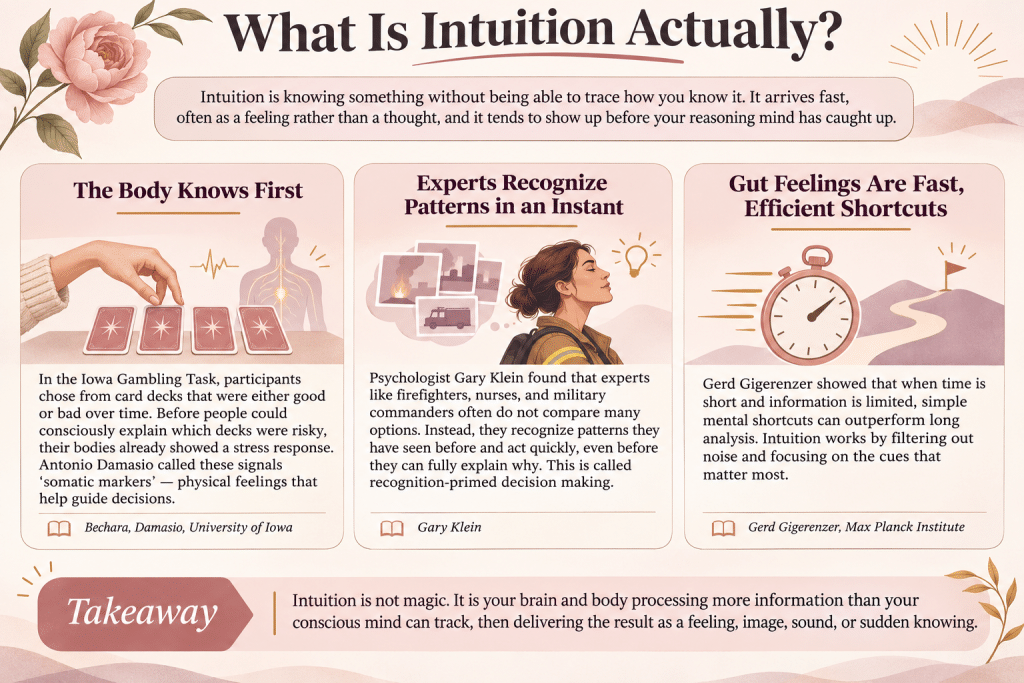
Intuition is knowing something without being able to trace how you know it. It arrives fast, it often arrives as a feeling rather than a thought, and it tends to show up before your reasoning mind has caught up.
That description can sound mystical, but some of the most interesting research on decision-making describes almost exactly this experience.
The Body Knows First
In the 1990s, neuroscientists Antoine Bechara, Antonio Damasio, and colleagues at the University of Iowa designed an experiment now called the Iowa Gambling Task. Participants drew cards from four decks. Two decks were rigged to lose money over time, and two to win. Players were not told which was which. The researchers measured skin conductance, a tiny change in sweat that rises with stress, as people played.
Healthy players began showing a stress response when their hand reached toward the bad decks before they could consciously say which decks were bad. Their bodies were signaling “careful” before their minds knew why. Damasio called these bodily signals somatic markers: physical feelings that tag options as good or bad and help steer decisions.
Experts Recognize Patterns in an Instant
Psychologist Gary Klein spent years studying firefighters, nurses, and military commanders making split-second decisions. He found they rarely compared options. Instead, they recognized a situation as a pattern they had seen before, often without being able to name the cues, and knew what to do.
One fire commander famously ordered his crew out of a building moments before the floor collapsed, and only later could piece together that the fire was too quiet and the room too hot for what he was seeing. Klein called this recognition-primed decision making.
Gut Feelings Are Fast, Efficient Shortcuts
Psychologist Gerd Gigerenzer at the Max Planck Institute has shown that simple mental shortcuts often outperform careful analysis when information is limited and time is short, because they ignore noise and lock onto the one or two cues that matter most.
Put together, these lines of research describe intuition as your brain and body processing far more information than your conscious mind can track, and delivering the result as a feeling, an image, a sound, or a sudden knowing. The clairs are one way of naming the different channels that result can arrive through.
What Are the Clairs?
“Clair” comes from the French word for clear. In intuitive-development and spiritual traditions, the clairs describe the different sensory channels through which intuitive information seems to arrive.
| Clair | Meaning | How It Tends to Show Up |
|---|---|---|
| Claircognizance | Clear knowing | A sudden, certain knowing with no clear source |
| Clairsentience | Clear feeling | Emotions or physical sensations picked up from people or places |
| Clairaudience | Clear hearing | An inner word, phrase, or sound, often in your own inner voice |
| Clairvoyance | Clear seeing | Mental images, flashes, or vivid symbolic pictures |
| Clairalience | Clear smelling | A meaningful scent with no physical source nearby |
| Clairgustance | Clear tasting | A taste that arrives with a memory or message, with nothing in your mouth |
Most people who work with this framework find that one or two clairs feel strongest, while others are quieter or absent. There is no hierarchy. Clairvoyance gets the most attention in popular culture, but many deeply intuitive people never see images at all and simply know or feel.
$200 Off All 2027 Early Bird Discount
Settle the mind, restore the body & soul back to health. Our deeply restorative 5-day retreat is for midlife women 40+ who are ready to receive abundance, feel rested, strong, clear & back in alignment with their intentions.
What Is Claircognizance: Clear Knowing?
- What it is. Claircognizance is the experience of simply knowing something, fully formed, without a feeling, image, or voice attached. The information arrives as a certainty. It is often the hardest clair to notice, because it feels like your own thought.
- How to recognize it. You may notice claircognizance when you simply “just know” things without being able to explain how or why. Answers and ideas may suddenly come to you fully formed, often while you’re in the shower, taking a walk, or waking up. You might sense that a plan won’t work before anyone else notices the problem, or somehow know who’s calling or what someone is about to say. You may also experience a strong, quiet sense of certainty about people shortly after meeting them, even when you have little information about them.
- Examples. You are reviewing a contract that looks fine, and you know, without a reason, that one clause is going to cause problems. Two years later it does. Or you wake up one morning knowing you are going to leave a job you have not consciously considered leaving.
- The grounded explanation. Claircognizance lines up closely with Klein’s research on expert pattern recognition and with the well-documented “incubation effect,” in which the mind keeps working on a problem in the background and delivers an answer after you stop consciously thinking about it. The more experience you have in an area, the more reliable this kind of knowing tends to be in that area.
- How to put it to good use. Write it down with the date the moment it arrives, before your analytical mind talks you out of it. Then check it with evidence before acting on anything important. Claircognizance is excellent at pointing you where to look. It is not a substitute for looking.
- How to strengthen it. Protect unstructured time. Walks without headphones, long showers, and the first few minutes after waking are when knowing tends to surface. Keep a notebook by the bed.
What Is Clairsentience: Clear Feeling?
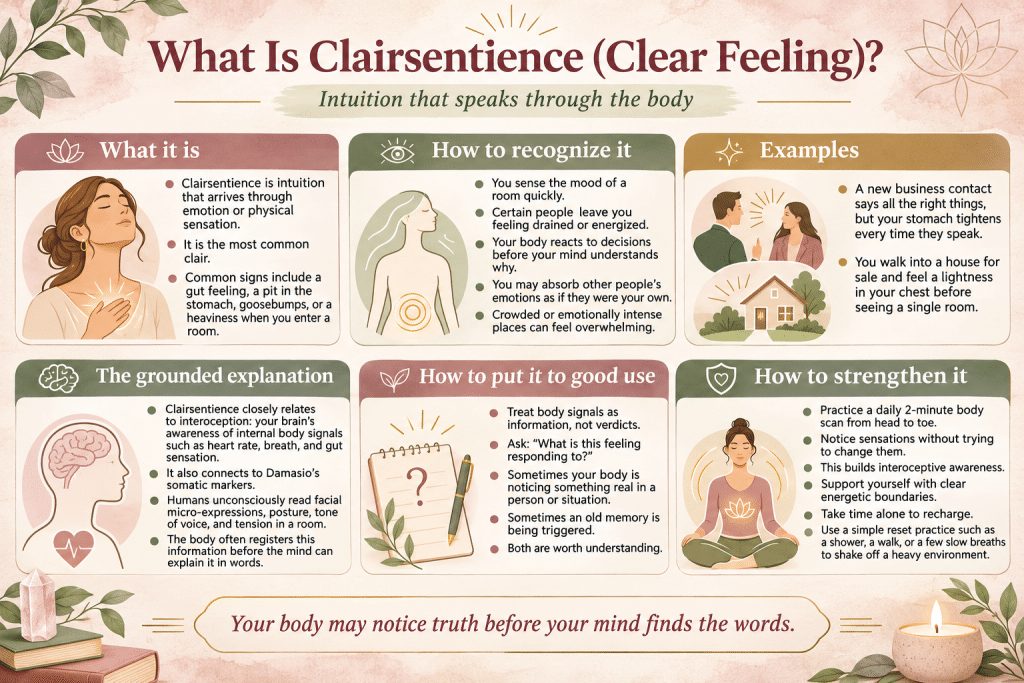
- What it is. Clairsentience is intuition that arrives through emotion or physical sensation. It is the most common clair, and the one most people already have words for: gut feeling, a pit in the stomach, the hair on your arms standing up, a heaviness when you walk into a room.
- How to recognize it. Clairsentience may show up when you sense the mood of a room, feel drained or energized by certain people, or notice physical reactions to decisions before you understand why. You might also absorb others’ emotions as your own or feel overwhelmed in crowded, emotionally intense places.
- Examples. You meet a new business contact who says all the right things, and your stomach tightens every time they speak. Or you visit a house for sale and feel a lightness in your chest the moment you walk in, before you have seen a single room.
- The grounded explanation. Clairsentience maps closely onto interoception, your brain’s ability to sense internal body signals like heart rate, breath, and gut sensation, and onto Damasio’s somatic markers. Research also shows humans are highly skilled at unconsciously reading facial micro-expressions, posture, tone of voice, and tension in a room, and that this information registers in the body before it registers in words.
- How to put it to good use. Treat body signals as information, not verdicts. When your body reacts, ask: “What is this feeling responding to?” Sometimes it is picking up something real about a person or situation. Sometimes it is an old memory being triggered. Both are worth knowing.
- How to strengthen it. A daily two-minute body scan, noticing sensation from head to toe without trying to change anything, directly trains interoceptive awareness. Clairsentient people also benefit from clear energetic boundaries: time alone to recharge, and a simple practice (a shower, a walk, a few slow breaths) to “shake off” a heavy environment.
“Clairsentience is the one I recognize most in myself, and it took me until my forties to stop overriding it. I used to talk myself out of the tight feeling in my chest because the spreadsheet said yes. Every single time I ignored it in business, I paid for it later. What changed was not that I started trusting every feeling blindly. It was that I started writing them down and checking them. That record is what taught me which signals were real and which were just me being tired or scared.”
Terry Tateossian, Founder of The House of Rose
$200 Off All 2027 Early Bird Discount
Settle the mind, restore the body & soul back to health. Our deeply restorative 5-day retreat is for midlife women 40+ who are ready to receive abundance, feel rested, strong, clear & back in alignment with their intentions.
Clairsentient, Empath, or Highly Sensitive? What’s the Difference?
If clairsentience resonates with you, you’ve probably also come across the word empath. These terms overlap, but they come from different places.
| Term | Where it comes from | What it describes |
|---|---|---|
| Clairsentient | Intuitive and spiritual traditions | Receiving intuitive information through feelings and body sensations |
| Empath | Popular psychology and spiritual communities | Someone who strongly absorbs and feels other people’s emotions |
| Highly sensitive person (HSP) | Psychology research (Elaine Aron and Arthur Aron, 1997) | A trait called sensory processing sensitivity: deeper processing of information, stronger emotional reactions, and being more easily overstimulated |
What the research says.
“Empath” isn’t a scientific category. But the highly sensitive person trait has been studied for decades. Aron’s research estimated that about 15 to 20 percent of people have this trait, which involves noticing subtleties, processing deeply, reacting strongly to emotion, and becoming overwhelmed more easily by noise, crowds, and intensity. It’s considered a normal variation in temperament, not a disorder.
Why it matters.
If you’re clairsentient, empathic, or highly sensitive, your sensitivity can be a gift: you notice what others miss. It can also be exhausting. The key is learning to tell your own feelings from what you’re picking up from others, and protecting your energy with rest, boundaries, quiet, and time in nature.
What Is Clairaudience: Clear Hearing?
- What it is. Clairaudience is intuition that arrives as sound: a word, a phrase, a name, a snippet of song, or a clear inner sentence. For most people it sounds like their own inner voice, just clearer, calmer, and more direct than ordinary thought.
- How to recognize it. Clairaudience may show up when a word or phrase suddenly comes to mind, a song’s lyrics feel relevant to your situation, or you overhear someone say exactly what you needed to hear. You might also notice subtle changes in people’s tone of voice or find that answers come naturally when you talk things through.
- Examples. You are deciding whether to call an old friend, and the words “call her today” arrive clearly in your mind. You call, and she tells you she just received difficult news. Or you are torn about a move and keep hearing a particular song whose chorus is about going home.
- The grounded explanation. Everyone has an inner voice, and research on inner speech shows it plays a real role in planning, self-regulation, and problem solving. Clairaudience in this framework describes moments when that inner voice delivers a conclusion your mind has been working toward below the surface. The mind is also very good at noticing words and lyrics that match what we are preoccupied with, which is why a stranger’s sentence can feel like a direct answer.
- How to put it to good use. Pay attention to short, calm phrases, especially ones that arrive once and clearly. In intuitive traditions, true guidance is described as calm, brief, and kind, while fearful chatter tends to be repetitive, urgent, and harsh. That distinction also matches how anxiety behaves.
- How to strengthen it. Silence. Reduce background noise for part of each day. Journaling by asking a question and writing whatever answer comes first, without editing, is a common clairaudient practice.
- An important safety note. Hearing external, commanding, frightening, or critical voices, especially alongside confusion, paranoia, or changes in sleep and daily functioning, should not be mistaken for intuition. Research shows that hearing voices is more common than many realize and does not always indicate illness, but it warrants a conversation with a doctor or mental health professional.
What Is Clairvoyance: Clear Seeing? (and What Clairvoyant Really Means)
- What does clairvoyant mean? The word comes from French: clair (clear) and voyant (seeing). In everyday use, a clairvoyant is someone believed to perceive things beyond the normal senses. In intuitive-development traditions, clairvoyance more simply describes intuition that arrives visually: a mental image, a brief flash, a symbol, a color, or a vivid picture in the mind’s eye.
- What it is. Clairvoyance is intuition that arrives visually: a mental image, a brief flash of a scene, a symbol, a color, or a vivid picture in the mind’s eye. It is the clair most associated with psychics, and the most frequently misunderstood.
- How to recognize it. Clairvoyance may show up through vivid dreams, a strong imagination, or images and symbols that suddenly appear in your mind. You might also notice small visual details others miss or easily picture how a finished project or rearranged space will look before it’s complete.
- Examples. You are deciding between two job offers and, when you think of one, you see an image of a closed door; when you think of the other, you see an open window. Or before meeting someone new, a clear picture of a particular color or object comes to mind, and it turns out to be meaningful to them.
- The grounded explanation. The brain constantly generates predictions and images, and mental imagery is a normal part of how we think, plan, and dream. Research on dreaming shows that sleep helps the brain consolidate and combine memories, which is one reason insight so often arrives through dreams and images. Clairvoyant intuition is best understood as your mind representing a conclusion symbolically, the way dreams do.
- How to put it to good use. Treat images as symbols, not literal predictions. Ask, “What does this image mean to me?” rather than, “What is this image predicting?” A closed door does not mean a job is doomed; it may mean part of you feels shut in by the idea.
- How to strengthen it. Keep a dream journal. Practice simple visualization: close your eyes and hold an image of a familiar place in detail for one minute. Many people also find that gazing softly at a candle flame or natural scene before a question helps images surface.
What Is Clairalience: Clear Smelling?
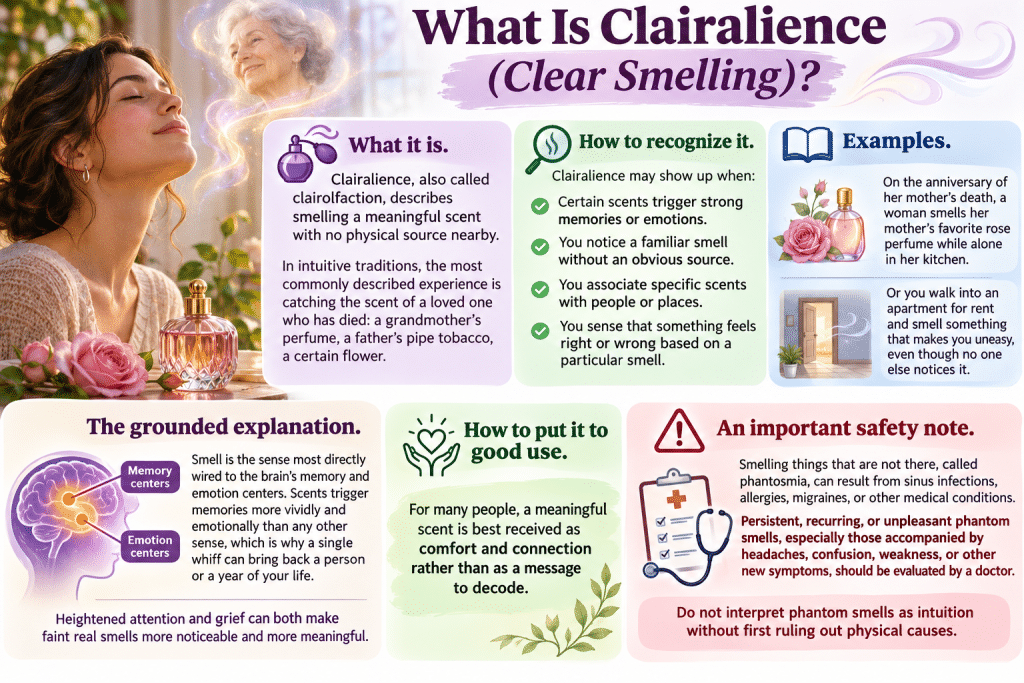
- What it is. Clairalience, also called clairolfaction, describes smelling a meaningful scent with no physical source nearby. In intuitive traditions, the most commonly described experience is catching the scent of a loved one who has died: a grandmother’s perfume, a father’s pipe tobacco, a certain flower.
- How to recognize it. Clairalience may show up when certain scents trigger strong memories or emotions, or when you notice a familiar smell without an obvious source. You might also associate specific scents with people or places or sense that something feels right or wrong based on a particular smell.
- Examples. On the anniversary of her mother’s death, a woman smells her mother’s favorite rose perfume while alone in her kitchen. Or you walk into an apartment for rent and smell something that makes you uneasy, even though no one else notices it.
- The grounded explanation. Smell is the sense most directly wired to the brain’s memory and emotion centers. Scents trigger memories more vividly and emotionally than any other sense, which is why a single whiff can bring back a person or a year of your life. Heightened attention and grief can both make faint real smells more noticeable and more meaningful.
- How to put it to good use. For many people, a meaningful scent is best received as comfort and connection rather than as a message to decode.
- An important safety note. Smelling things that are not there, called phantosmia, can result from sinus infections, allergies, migraines, or other medical conditions. Persistent, recurring, or unpleasant phantom smells, especially those accompanied by headaches, confusion, weakness, or other new symptoms, should be evaluated by a doctor. Do not interpret phantom smells as intuition without first ruling out physical causes.
$200 Off All 2027 Early Bird Discount
Settle the mind, restore the body & soul back to health. Our deeply restorative 5-day retreat is for midlife women 40+ who are ready to receive abundance, feel rested, strong, clear & back in alignment with their intentions.
What Is Clairgustance: Clear Tasting?
- What it is. Clairgustance describes tasting something meaningful with nothing in your mouth, such as the taste of a family recipe, a certain candy from childhood, or a food connected to someone you love. It is the least common clair and is traditionally paired with clairalience, since taste and smell are closely linked.
- How to recognize it. Clairgustance may show up when a taste suddenly reminds you of a specific person, place, or memory. You might also notice that your sense of taste is closely tied to your emotions or that certain foods and flavors bring back strong feelings and memories.
- Examples. While thinking about your late grandfather, you suddenly taste the peppermints he always carried. Or you get a literal bitter taste when a particular person is mentioned.
- The grounded explanation. Most of what we experience as taste actually comes through smell, and both senses are deeply tied to memory and emotion. Language like “a bad taste in my mouth” reflects how closely disgust and distrust are linked in the brain.
- Safety note. Persistent strange tastes (metallic, bitter, or salty) can have medical causes, including medications, dental issues, sinus problems, and hormonal changes, and are worth mentioning to a doctor or dentist if they last.
Which Clair Is Strongest in You?
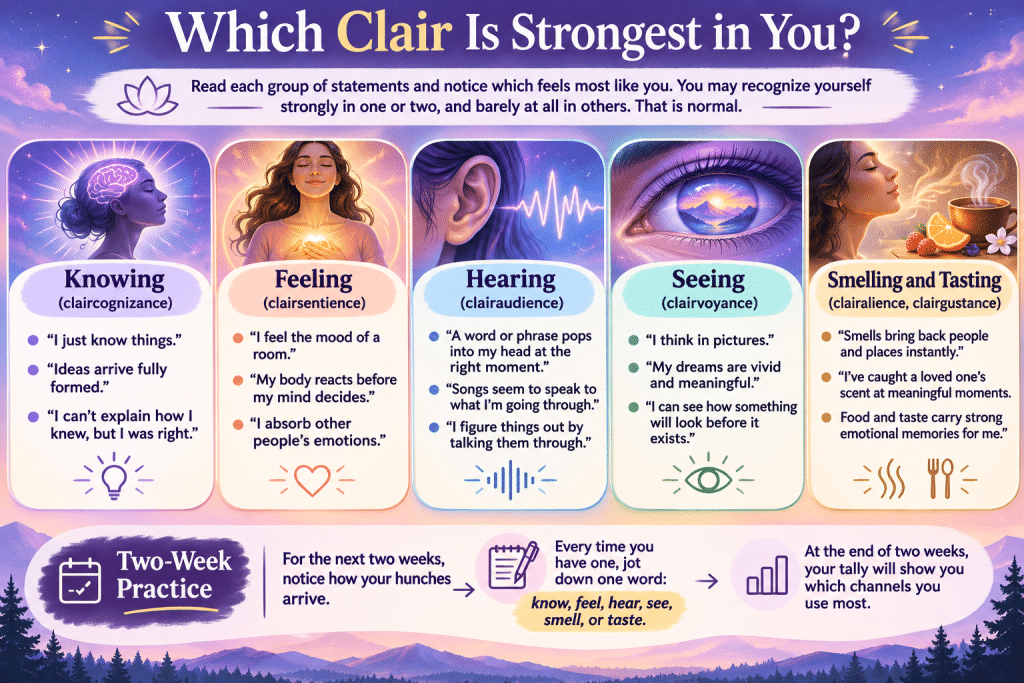
Read each group of statements and notice which feels most like you. You may recognize yourself strongly in one or two, and barely at all in others. That is normal.
- Knowing (claircognizance): “I just know things.” “Ideas arrive fully formed.” “I can’t explain how I knew, but I was right.”
- Feeling (clairsentience): “I feel the mood of a room.” “My body reacts before my mind decides.” “I absorb other people’s emotions.”
- Hearing (clairaudience): “A word or phrase pops into my head at the right moment.” “Songs seem to speak to what I’m going through.” “I figure things out by talking them through.”
- Seeing (clairvoyance): “I think in pictures.” “My dreams are vivid and meaningful.” “I can see how something will look before it exists.”
- Smelling and tasting (clairalience, clairgustance): “Smells bring back people and places instantly.” “I’ve caught a loved one’s scent at meaningful moments.” “Food and taste carry strong emotional memories for me.”
For the next two weeks, notice how your hunches arrive. Every time you have one, jot down one word: know, feel, hear, see, smell, or taste. At the end of two weeks, your tally will show you which channels you use most.
How Can You Tell the Difference Between Intuition vs Anxiety?
This is the most important section in this article, especially for women in perimenopause and menopause, when hormonal shifts can make anxiety more frequent and more physical. Anxiety and intuition can both show up as a feeling in the body, and it is easy to confuse them.
| Intuition Tends to Be | Anxiety Tends to Be |
|---|---|
| Calm, quiet, and neutral in tone | Loud, urgent, and frightening |
| Brief, often a single signal | Repetitive, looping, and circular |
| Specific to one situation | General, attaching to many things |
| Present-focused (“this isn’t right”) | Future-focused (“what if…?”) |
| Settled, even when it’s unwelcome | Agitated, and gets worse the more you think |
| Often surprising | Often predictable and familiar |
| Leaves you clearer | Leaves you more confused |
When you have a strong feeling, ask:
- Is this calm or frantic?
- Is this about this specific situation, or does this feeling show up everywhere?
- If I take three slow breaths, does it stay the same, or does it shift?
Intuition usually stays steady after you calm your body. Anxiety usually softens once your nervous system settles. Research on interoception also finds that people who experience body signals as threatening can make worse decisions when they follow those signals, which is why calming the body first matters. You can only hear intuition clearly from a regulated nervous system.
Past trauma matters here, too. A body that has lived through danger can react strongly to reminders of it. That reaction is real and protective, but it is responding to the past, not necessarily to what is in front of you. Working with a trauma-informed therapist can help you tell the two apart.
$200 Off All 2027 Early Bird Discount
Settle the mind, restore the body & soul back to health. Our deeply restorative 5-day retreat is for midlife women 40+ who are ready to receive abundance, feel rested, strong, clear & back in alignment with their intentions.
Why Does Intuition Often Get Louder in Midlife?
Many women describe their intuition getting clearer, or simply harder to ignore, in their forties and fifties. There are several grounded reasons this might be true.
- You have more patterns stored: Klein’s research shows intuition is built on experience. By midlife, you have decades of data about people, work, relationships, and your own body. Your pattern library is simply larger.
- Tolerance for self-betrayal drops: Many women describe a shift in midlife where they are less willing to override their own signals to keep the peace. Intuition does not necessarily get stronger; it gets listened to.
- The body becomes louder: Hormonal change makes the body’s signals more noticeable, from sleep disruption to heart palpitations to shifts in gut function. That can mean more interoceptive information coming in, which is useful when it is understood, and confusing when anxiety and intuition get mixed up (Section 10).
- Priorities sharpen: When you have a clearer sense of what matters, it becomes easier to feel when something is misaligned with it.
How Can You Develop & Awaken Your Intuition?
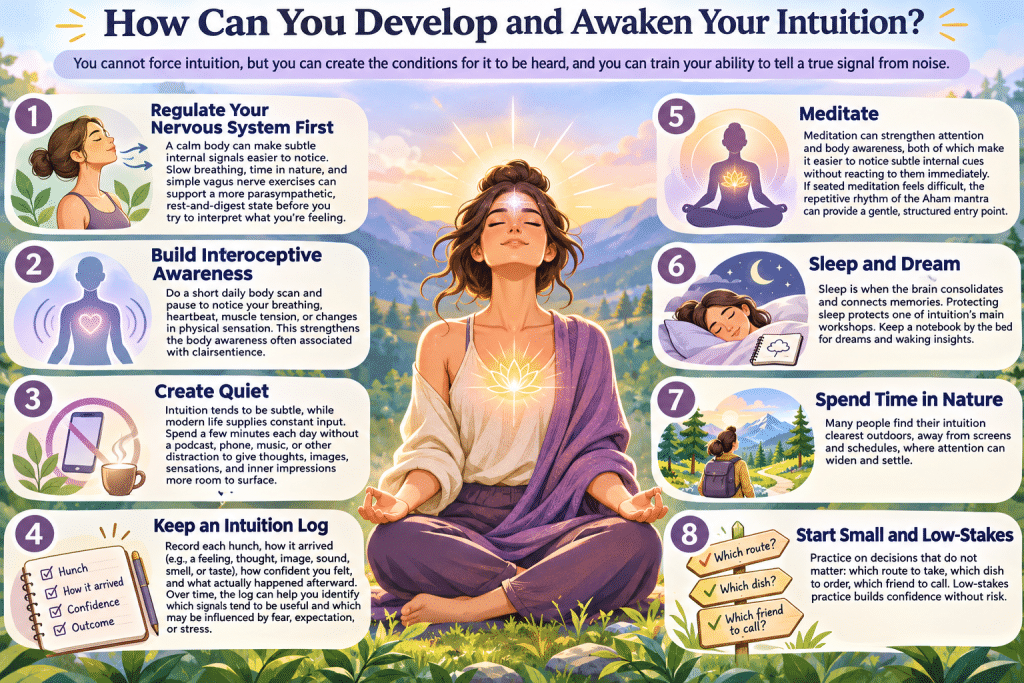
You cannot force intuition, but you can create the conditions for it to be heard, and you can train your ability to tell a true signal from noise.
- Regulate your nervous system first: A calm body can make subtle internal signals easier to notice. Slow breathing, time in nature, and simple vagus nerve exercises can support the shift toward a more parasympathetic, rest-and-digest state before you try to interpret what you’re feeling.
- Build interoceptive awareness: A short daily body scan, along with pausing to notice your breathing, heartbeat, muscle tension, or changes in physical sensation, strengthens the body awareness often associated with clairsentience.
- Create quiet: Intuition tends to be subtle, while modern life supplies constant input. Spending a few minutes each day without a podcast, phone, music, or other distraction gives thoughts, images, sensations, and inner impressions more room to surface.
- Keep an intuition log: This is one of the most useful practices for separating patterns from assumptions. Record each hunch, how it arrived, whether as a feeling, thought, image, sound, smell, or taste, how confident you felt, and what actually happened afterward. Over time, the log can help you identify which signals tend to be useful and which may be influenced by fear, expectation, or stress.
- Meditate: Meditation can strengthen attention and body awareness, both of which make it easier to notice subtle internal cues without reacting to them immediately. If seated meditation feels difficult, the repetitive rhythm of the Aham mantra can provide a gentle, structured entry point.
- Sleep and dream: Sleep is when the brain consolidates and connects memories. Protecting sleep protects one of intuition’s main workshops. Keep a notebook by the bed for dreams and waking insights.
- Spend time in nature: Many people find their intuition clearest outdoors, away from screens and schedules, where attention can widen and settle.
- Start small and low-stakes: Practice on decisions that do not matter: which route to take, which dish to order, which friend to call. Low-stakes practice builds confidence without risk.
How Can You Awaken Your Intuition in Five Days?
This practice takes 10 to 15 minutes a day. You only need a notebook.
- Day 1: Arrive in your body. Sit quietly for five minutes. Breathe slowly, making the exhale longer than the inhale. Then do a slow body scan from the top of your head to your feet, noticing sensations without changing them. Write down three things you noticed. This is the foundation for clairsentience and for telling intuition from anxiety.
- Day 2: Find your channel. Think of three times in your life your intuition turned out to be right. For each, write how it arrived: a knowing, a feeling, a word, an image, a smell, or a taste. Look for the pattern. This tells you which clairs you already rely on.
- Day 3: Ask and listen. Choose one low-stakes question, such as “What do I need more of this week?” Breathe slowly for two minutes, ask the question, and write down the first thing that comes, whether it is a word, an image, a feeling, or a knowing. Do not edit or judge it.
- Day 4: Test yourself. Make three small intuitive predictions today (who will text first, whether a meeting will run long, which checkout line will move faster). Write them down, then record the results. The point is not to be right. The point is to start noticing the difference between a hunch that feels calm and one that feels like a guess.
- Day 5: Intuition or anxiety? Think of a current worry. Run it through the check in Section 10: Is it calm or frantic? Specific or general? Does it change after three slow breaths? Write what you discover. Then start your ongoing intuition log, and keep adding to it.
After the five days, keep the two habits that matter most: the daily breath and body check, and the intuition log.
$200 Off All 2027 Early Bird Discount
Settle the mind, restore the body & soul back to health. Our deeply restorative 5-day retreat is for midlife women 40+ who are ready to receive abundance, feel rested, strong, clear & back in alignment with their intentions.
How Can You Put Your Intuition to Good Use?
You can use intuition to guide your attention, reflect on decisions, and become more aware of your own needs. Here are some practical ways to apply it while staying grounded.
- Use intuition to ask better questions: A hunch that something is off with a contract, a person, or your health is a signal to look more closely, gather information, and ask questions. It is a starting point for investigation, not the end of it.
- Pair it with evidence when stakes are high: For health, money, legal matters, and big life decisions, the best approach combines intuition and analysis. Let intuition flag concerns and point to options, then verify.
- Trust it more where you have experience: Research consistently shows intuition is most reliable in areas where you have a lot of experience and quick, clear feedback. A nurse’s intuition about patients or a parent’s intuition about their own child is built on years of patterns. Intuition about stock prices or lottery numbers is not.
- Use it for your own life, not to judge others: Intuition about whether a relationship, job, or situation is right for you is valuable. Using it to label other people as “bad energy” without evidence can quickly become unfair, and can reflect bias rather than insight.
- Use it for your health, then get it checked: Many women report “just knowing” something was wrong in their body before a diagnosis. That instinct deserves to be taken seriously and brought to a doctor. If you feel dismissed, it is reasonable to ask for further testing or a second opinion.
- Use it to protect your energy: Clairsentient people in particular can use their sensitivity to recognize environments and relationships that drain them, and make choices that protect their wellbeing.
- Be wary of anyone who wants money to interpret it for you: Your intuition is yours. Be cautious of anyone who charges large or repeated fees to tell you what your intuition “means,” creates urgency or fear, or claims to predict the future.
When Does an Experience Need a Doctor Rather Than an Interpretation?
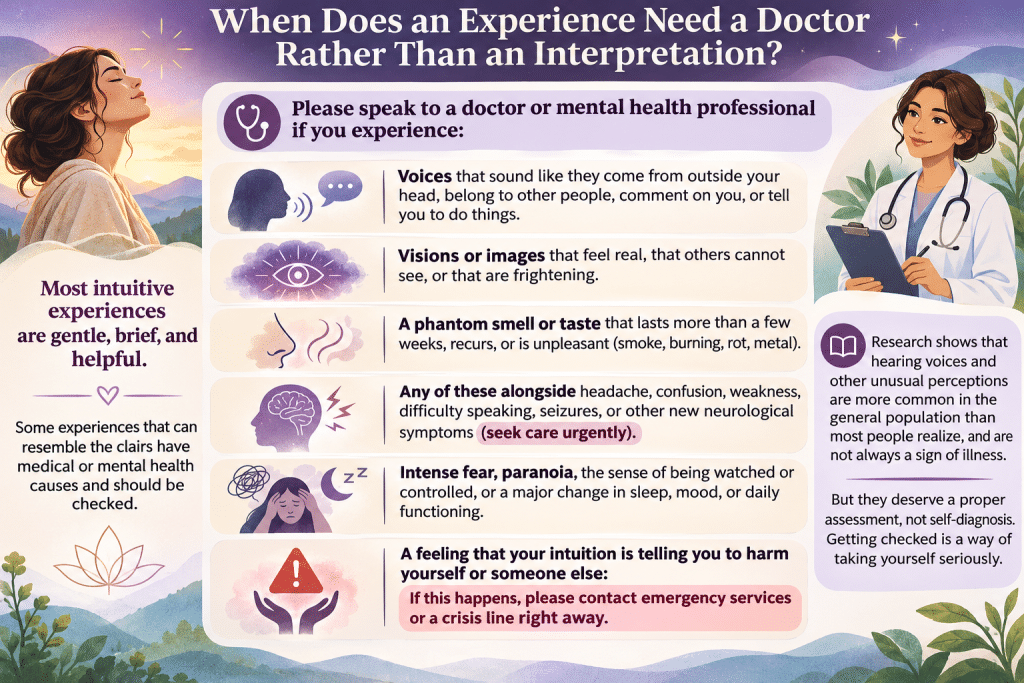
Most intuitive experiences are gentle, brief, and helpful. Some experiences that can resemble the clairs have medical or mental health causes and should be checked.
Please speak to a doctor or mental health professional if you experience:
- Voices that sound like they come from outside your head, belong to other people, comment on you, or tell you to do things:
- Visions or images that feel real, that others cannot see, or that are frightening:
- A phantom smell or taste that lasts more than a few weeks, recurs, or is unpleasant (smoke, burning, rot, metal):
- Any of these alongside headache, confusion, weakness, difficulty speaking, seizures, or other new neurological symptoms (seek care urgently):
- Intense fear, paranoia, the sense of being watched or controlled, or a major change in sleep, mood, or daily functioning:
- A feeling that your intuition is telling you to harm yourself or someone else: If this happens, please contact emergency services or a crisis line right away.
- Research shows that hearing voices and other unusual perceptions are more common in the general population than most people realize, and are not always a sign of illness. But they deserve a proper assessment, not self-diagnosis. Getting checked is a way of taking yourself seriously.
What the Evidence Supports and Doesn’t Support?
The following table compares different claims about intuition with the available research and the strength of the evidence behind them.
| Claim | Evidence | What the Research Shows |
|---|---|---|
| The body can signal danger before the mind knows why | Strong | Iowa Gambling Task: anticipatory stress responses before conscious awareness (Bechara et al., 1997) |
| Expert intuition is fast pattern recognition | Strong | Klein’s research on firefighters, nurses, and commanders |
| Simple gut-based shortcuts can outperform analysis in some situations | Moderate to Strong | Gigerenzer’s work on heuristics |
| Interoceptive awareness can be trained | Moderate | Body scan and meditation research shows improvement in body-signal awareness |
| Following gut feelings always improves decisions | Not supported | Benefits depend on experience and on not confusing anxiety with intuition |
| The body “knows” before conscious awareness (strong version) | Debated | Some researchers argue participants in the Iowa study had more conscious knowledge than first reported (Maia and McClelland, 2004) |
| Intuition works best in areas of expertise | Strong | Reliable intuition requires experience and clear feedback (Kahneman and Klein, 2009) |
| The clairs are separate psychic abilities | Not supported | No scientific evidence; best understood as a descriptive framework for how intuition is experienced |
| People can see the future or read minds | Not supported | Controlled research has not found reliable evidence |
This is worth being honest about. The clairs are a meaningful language for many people, and the underlying experiences are real. The claim that they are supernatural abilities is not supported by evidence. You do not need that claim to be true for the practices in this article to be useful.
$200 Off All 2027 Early Bird Discount
Settle the mind, restore the body & soul back to health. Our deeply restorative 5-day retreat is for midlife women 40+ who are ready to receive abundance, feel rested, strong, clear & back in alignment with their intentions.
Habits That Help Intuition Grow Stronger:
The broader THOR framework includes practices that support physical awareness, reflection, and nervous system regulation. These approaches can complement the way you explore intuition.
- Nervous system regulation: Intuition can be easier to access when the body feels settled rather than overwhelmed. Learning how to regulate your nervous system and practicing simple vagus nerve exercises can help create a calmer internal state for reflection and decision-making.
- Mantra and meditation: Repetitive sound, breath, and focused attention can provide a structured way to quiet external noise and turn inward. Exploring the Aham mantra or learning about the meaning and structure of a puja ceremony offers two different ways to deepen that contemplative practice.
- Other contemplative frameworks: Traditions such as the Seven Hermetic Principles and Jyotish and the nine grahas offer additional frameworks for reflection, symbolism, and self-inquiry when approached with curiosity and a grounded perspective.
This article is educational and reflects spiritual and intuitive-development traditions alongside current research. It does not constitute medical, psychological, financial, or religious advice. If you are experiencing unusual perceptions, distress, or changes in your mental health, please speak to a qualified healthcare provider.
$200 Off All 2027 Early Bird Discount
Settle the mind, restore the body & soul back to health. Our deeply restorative 5-day retreat is for midlife women 40+ who are ready to receive abundance, feel rested, strong, clear & back in alignment with their intentions.
Frequently Asked Questions
What are the clairs?
The clairs are a framework from intuitive and spiritual traditions describing the different sensory channels through which intuition seems to arrive: claircognizance (clear knowing), clairsentience (clear feeling), clairaudience (clear hearing), clairvoyance (clear seeing), clairalience (clear smelling), and clairgustance (clear tasting).
What is clairsentience?
Clairsentience means “clear feeling.” It describes intuition that arrives through emotions or physical sensations, such as sensing the mood of a room, feeling drained around certain people, or having a gut reaction before you can explain it. It closely matches what researchers call interoception and somatic markers.
What does claircognizant mean?
Claircognizant describes someone who experiences claircognizance, or “clear knowing”: information that arrives as a sudden certainty, without a feeling, image, or voice attached. Claircognizant people often say “I just knew.”
What is clairaudience?
Clairaudience means “clear hearing.” It describes intuition that arrives as a word, phrase, or sound, usually in your own inner voice. Voices that sound external, belong to other people, or are commanding or frightening should be discussed with a doctor rather than interpreted as intuition.
What is the meaning of clairvoyant?
Clairvoyant means “clear seeing.” In intuitive traditions, it describes receiving intuitive information as mental images, symbols, or vivid dreams. It is best understood as the mind representing insight visually, not as the ability to see the future.
What is clairalience?
Clairalience, sometimes called clairolfaction, means “clear smelling.” It describes smelling a meaningful scent, often connected to a loved one, with no physical source nearby. Persistent phantom smells can also have medical causes and should be checked by a doctor.
What is clairgustance?
Clairgustance means “clear tasting,” the experience of tasting something meaningful, often tied to a person or memory, with nothing in your mouth. It is traditionally paired with clairalience.
Which clair is the most common?
Clairsentience (clear feeling) is generally described as the most common, since nearly everyone has experienced a gut feeling or sensed the mood of a room.
Can you have more than one clair?
Yes. Most people find one or two channels feel strongest, and many people experience several. There is no hierarchy between them.
How do I know which clair I have?
For two weeks, notice how your hunches arrive and jot down one word each time: know, feel, hear, see, smell, or taste. Your tally will show your strongest channels. The self-reflection guide in Section 9 can also help.
How can I tell intuition from anxiety?
Intuition tends to be calm, brief, specific, and steady after you settle your body. Anxiety tends to be urgent, repetitive, general, future-focused, and softens once your nervous system calms. Take three slow breaths and see whether the feeling stays the same or shifts.
How can I develop my intuition?
Regulate your nervous system, build body awareness with a daily body scan, create quiet time without input, meditate, protect your sleep, practice on low-stakes decisions, and keep an intuition log that records each hunch and what actually happened.
Are the clairs scientifically proven?
No. There is no scientific evidence that the clairs are separate psychic abilities or that anyone can see the future or read minds. However, research strongly supports that the body and brain process information below conscious awareness and deliver it as feelings, images, and sudden insight, which is the experience the clairs describe.
Why does intuition seem stronger in midlife?
By midlife, you have far more experience to draw patterns from, you may be less willing to override your own signals, and hormonal change can make the body’s signals more noticeable. Learning to separate intuition from anxiety becomes especially important during this time.
Should I make big decisions based only on intuition?
For health, money, legal matters, and major life decisions, the most reliable approach combines intuition with evidence. Let intuition flag concerns and point you toward options, then check the facts.
I write 3 essays per week on Lifestyle Medicine for women in midlife on what is happening in the body and what to do about it. No fluff, no hype. Free Subscription.
References
- Bechara, A., Damasio, H., Tranel, D., & Damasio, A. R. (1997). Deciding advantageously before knowing the advantageous strategy. Science, 275(5304), 1293-1295.
- Bechara, A., Damasio, A. R., Damasio, H., & Anderson, S. W. (1994). Insensitivity to future consequences following damage to human prefrontal cortex. Cognition, 50(1-3), 7-15.
- Damasio, A. R. (1994). Descartes’ Error: Emotion, Reason, and the Human Brain. New York: Putnam.
- Maia, T. V., & McClelland, J. L. (2004). A reexamination of the evidence for the somatic marker hypothesis: What participants really know in the Iowa gambling task. Proceedings of the National Academy of Sciences, 101(45), 16075-16080.
- Klein, G. (1998). Sources of Power: How People Make Decisions. Cambridge, MA: MIT Press.
- Kahneman, D., & Klein, G. (2009). Conditions for intuitive expertise: A failure to disagree. American Psychologist, 64(6), 515-526.
- Gigerenzer, G. (2007). Gut Feelings: The Intelligence of the Unconscious. New York: Viking.
- Dunn, B. D., Galton, H. C., Morgan, R., et al. (2010). Listening to your heart: How interoception shapes emotion experience and intuitive decision making. Psychological Science, 21(12), 1835-1844.
- Beavan, V., Read, J., & Cartwright, C. (2011). The prevalence of voice-hearers in the general population: A literature review. Journal of Mental Health, 20(3), 281-292.
- Cleveland Clinic. Phantosmia (olfactory hallucinations): Causes, symptoms, and treatment.
Disclaimer: This article is for educational and informational purposes only and does not constitute medical or mental health advice. The clairs are spiritual and intuitive-development concepts, not scientifically proven psychic abilities. Intuitive feelings, images, sounds, or sensations should not be treated as definitive evidence or a substitute for professional medical care, mental health support, financial advice, or evidence-based decision-making. Persistent phantom smells or tastes, or external, frightening, or commanding voices, should be discussed with a qualified healthcare professional.
$200 Off All 2027 Early Bird Discount
Settle the mind, restore the body & soul back to health. Our deeply restorative 5-day retreat is for midlife women 40+ who are ready to receive abundance, feel rested, strong, clear & back in alignment with their intentions.

Terry Tateossian is a Menopause Lifestyle Medicine Coach, Certified Personal Trainer & Nutritionist and the Founder of THOR: The House of Rose, a wellness brand serving women over 40 through retreats, coaching, macro-nutrition and community. As 25-year founder and entrepreneur, Terry spent two and a half decades building and running successful start-up businesses, an experience that put her on the front line of founder burnout long before she could name it. After facing serious health challenges, early onset menopause, and emotional eating while running her agency and raising two children, Terry rebuilt her health in her 40s and lost more than 80 pounds through evidence-based nutrition, training, and mindset work. Today, she helps women get strong, improve confidence, support hormone health, and create a stronger second half of life. Terry has been featured in major media outlets and is available for podcasts, expert commentary, brand collaborations, and speaking engagements on midlife health, reinvention, emotional eating, menopause wellness, and strength training for longevity. Get her free macro calculator (her cookbook companion) to start your journey to back to health.