
 By Team THOR
$200 Off All 2027 Early Bird Discount
Settle the mind, restore the body & soul back to health. Our deeply restorative 5-day retreat is for midlife women 40+ who are ready to receive abundance, feel rested, strong, clear & back in alignment with their intentions.
The Meditation Habit: How to Build a Consistent Daily Practice
I have started a meditation practice more times than I’d like to admit. I’d do it faithfully for two weeks, feel the difference, and then a launch, a trip, or one of my kids getting sick would knock it out, and I wouldn’t come back to the cushion for months.
This happened on repeat for years, long before early-onset menopause forced me to take my nervous system seriously in a way I couldn’t ignore anymore. What finally made the practice stick wasn’t more willpower or a better app.
It was fixing the actual structural problems with how I’d set the habit up in the first place: no fixed place, no fixed time, no real reason I could name when things got hard. Once I fixed those, the practice stopped being something I had to relaunch every few months and became something that just happened, the same way brushing my teeth just happens.
This guide covers what made the difference, for me and for the women I’ve coached since, grounded in real behavioral and memory research rather than good intentions alone.
How Can You Get Clear on Your Reason?
A new habit takes real time and energy to establish, and a vague reason won’t carry you through the weeks when the habit hasn’t paid off yet and doesn’t feel automatic. Motivation research consistently finds a meaningful difference between reasons that come from inside you, wanting calm, wanting to be less reactive with your kids, wanting to understand your own mind better, and reasons imposed from outside, a doctor telling you to, a wellness influencer telling you to, guilt telling you to.
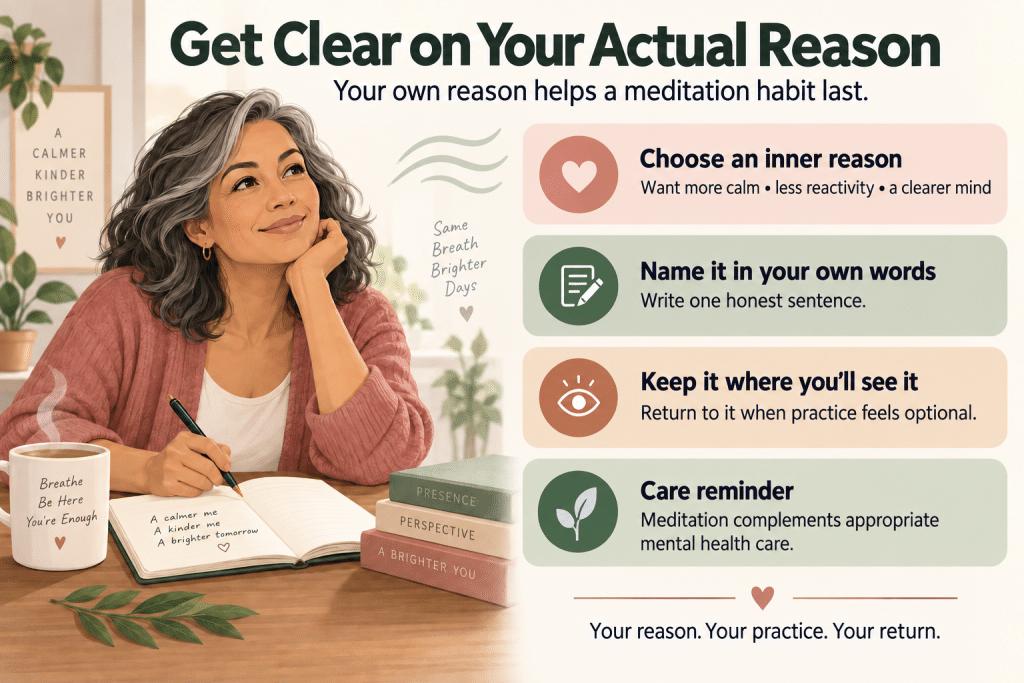
The self-directed kind of motivation is associated with habits that hold up over time; the externally imposed kind tends to fade as soon as the external pressure does. Before you build any of the structural pieces covered in the rest of this guide, take a few minutes to name your actual reason in your own words. Maybe you’re carrying more stress than you want to be carrying.
Maybe you notice you’re quicker to anger than you used to be, especially as hormonal shifts make your stress response less predictable. Maybe you’re curious what’s underneath the noise of a full schedule. Whatever it is, write it down somewhere you’ll see it again, and come back to it specifically on the days the practice feels optional.
Important: If your primary reason for wanting a meditation practice is a diagnosed anxiety, depression, or trauma-related condition, treat this practice as a complement to appropriate care, not a substitute for it.
“The women who keep this habit aren’t the ones with the most discipline. They’re the ones who can tell me, specifically, why they started. ‘I want to stop snapping at my family by 5 p.m.’ will outlast ‘I should probably meditate’ every single time.”
Terry Tateossian, Founder of The House of Rose
$200 Off All 2027 Early Bird Discount
Settle the mind, restore the body & soul back to health. Our deeply restorative 5-day retreat is for midlife women 40+ who are ready to receive abundance, feel rested, strong, clear & back in alignment with their intentions.
How Can You Practice in the Same Place Every Day?
Find a quiet spot in your home, a chair, a cushion, a corner, where you won’t be interrupted, and return to that same spot every day. If you have the room to dedicate that space to the practice alone, even better.
This isn’t just a nice-to-have suggestion. It’s grounded in a well-established finding in memory and behavioral research called context-dependent effects: your brain forms associations between a physical environment and the mental or emotional state you were in while you were there, and being back in that environment makes it easier to return to that state.
A classic study on this had divers memorize word lists either underwater or on land, then tested recall in both environments, and found recall was measurably better when the learning and testing environments matched.
The same general principle underlies stimulus control therapy, a well-established, evidence-based treatment for insomnia that instructs people to use their bed only for sleep, specifically so the brain stops associating the bed with wakeful tossing and starts associating it, again, with sleep.
Your meditation spot can work the same way in reverse: the more consistently you only sit there to practice, the faster that spot starts doing some of the settling work for you before you’ve taken a single breath.
If space is tight, improvise rather than skipping the principle entirely. A cleared corner, a closet with a stool, even a specific chair angled toward a window can serve the same function. The size of the space matters far less than the consistency of returning to it.
How Can You Practice at the Same Time Every Day?
When you practice at a fixed time, you start to anticipate it the way you anticipate a lunch break, which is a meaningfully different experience than trying to find thirty free minutes wherever they happen to fit that day.
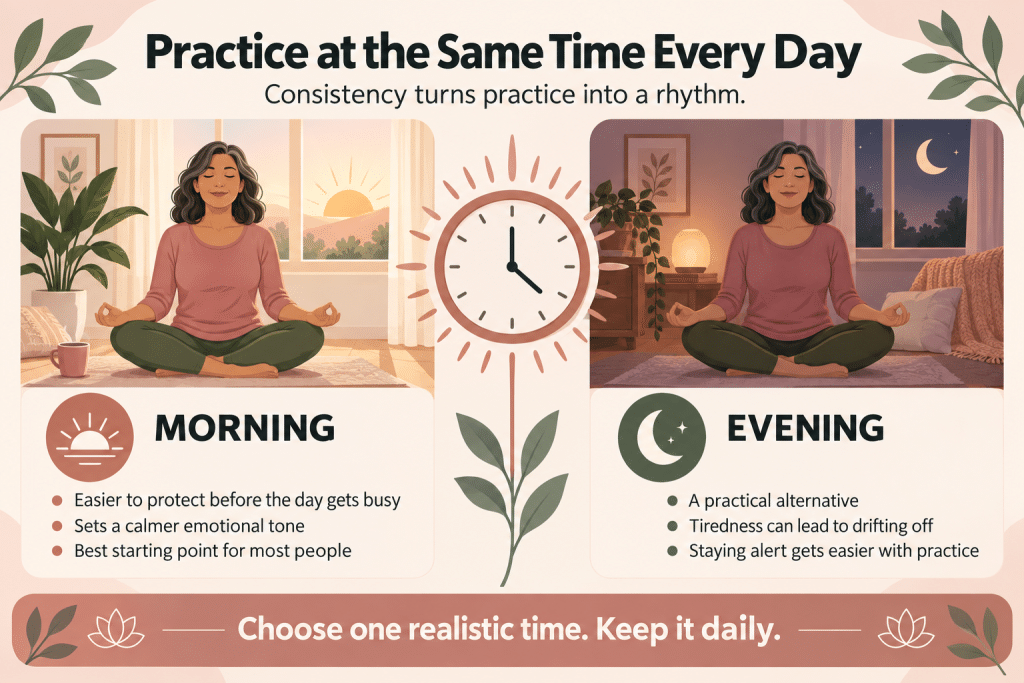
For most people, mornings work best, before the day’s demands have had a chance to fill the space a practice would otherwise occupy. A morning session also tends to set the emotional tone for what follows, which matters more in midlife, when a stressful moment can spike harder and take longer to settle than it used to.
Evening practice is a reasonable alternative, though it comes with a specific early obstacle: you’re already tired and conditioned to associate that time of day with sleep, so in the beginning you’re more likely to drift off mid-session.
That’s not a failure, it’s just a mismatch between your body’s existing associations and what you’re asking it to do; with time, many people build the capacity to stay alert through an evening practice, but starting there tends to be harder than starting in the morning.
$200 Off All 2027 Early Bird Discount
Settle the mind, restore the body & soul back to health. Our deeply restorative 5-day retreat is for midlife women 40+ who are ready to receive abundance, feel rested, strong, clear & back in alignment with their intentions.
How Can You Set the Mood With Environmental Cues?
The environment you practice in can either support the habit or quietly work against it, and a few specific, low-effort cues make a measurable difference.
- A small dedicated spot with meaning to you: This doesn’t need to be an elaborate altar. A single object, a photo, a plant, a piece of art that settles you, placed where you’ll see it each time you sit, gives your eyes and your nervous system a consistent visual cue that it’s time to shift gears.
- A consistent scent: There’s real research behind this one. Smell is unusually good at triggering specific memories and the emotional states attached to them, a phenomenon researchers have studied extensively in work on odor-evoked autobiographical memory, finding that scent-triggered memories tend to feel more vivid and emotionally immediate than memories triggered by sight or sound. Using the same incense, herb, or essential oil every time you practice means that scent gradually becomes linked to the calm state you build during practice, so lighting it becomes part of what settles you, not just a pleasant addition.
- A candle or a simple lighting ritual: Lighting a candle before you sit is a small, physical way of marking the start of practice separately from the rest of your day, a clear “this begins now” signal that a phone timer alone doesn’t provide in the same sensory way.
Why Should You Start With 3 to 5 Minutes?
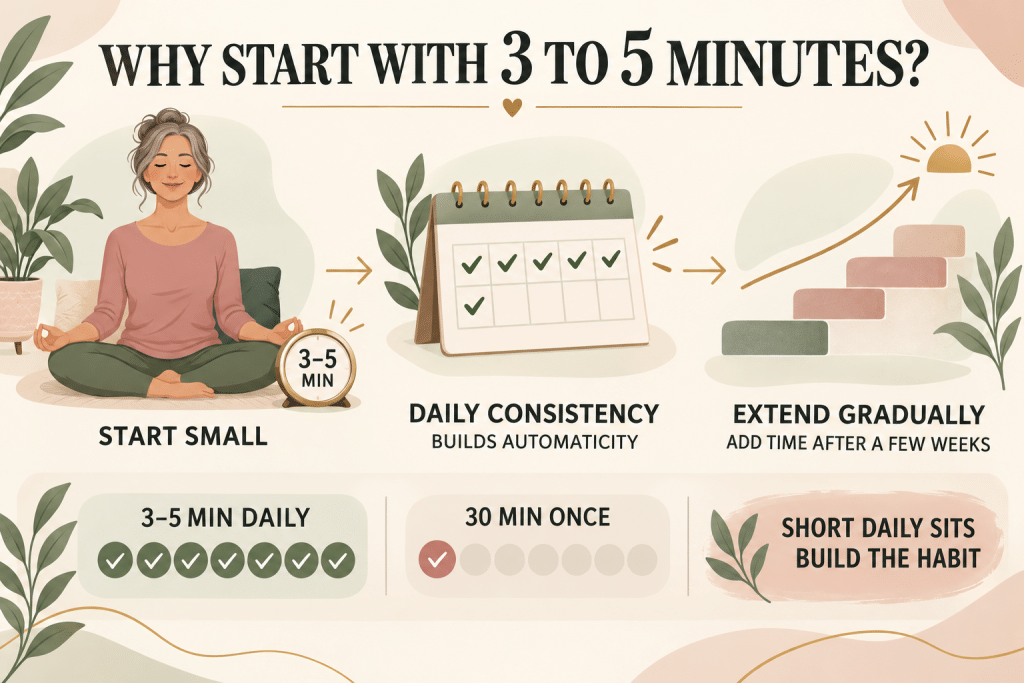
It’s far easier to sit consistently for a short session than to force yourself through thirty or sixty minutes you don’t have the appetite for yet. Three to five minutes, done every day, builds the habit faster than a half hour done once a week, because consistency, not duration, is what makes a behavior automatic.
This is the same underlying principle behind 5-minute micro-meditations, brief conscious pauses woven into your day, which that guide covers in depth. The difference here is that this is a dedicated seated session rather than a pause inside another activity; the short-duration logic is the same, but the goal is building toward a formal daily sit rather than scattering brief pauses throughout your day. The two approaches work well together, and many people use micro-meditations to support the days a full seated session doesn’t happen.
Once the daily habit itself feels automatic, typically after a few consistent weeks, you can gradually extend your session length. A useful way to deepen the practice further is setting aside one longer session a week, or every other week, while keeping the daily sessions short; the longer weekly sit reinforces the habit without requiring you to sustain that length every single day.
$200 Off All 2027 Early Bird Discount
Settle the mind, restore the body & soul back to health. Our deeply restorative 5-day retreat is for midlife women 40+ who are ready to receive abundance, feel rested, strong, clear & back in alignment with their intentions.
What Are the Benefits, Graded by How Much Evidence Supports Them?
Meditation content online tends to list benefits as one undifferentiated pile, everything from “reduces stress” to “releases energetic blockages” presented with equal confidence. They’re not equally supported, and it’s worth knowing the difference so your motivation is built on solid ground.
| Commonly Claimed Benefit | Evidence Strength | What the Research Shows |
|---|---|---|
| Reduces stress and anxiety | Strong | Consistently supported across systematic reviews of mindfulness-based interventions |
| Improves focus and attention | Strong | Documented shifts in attention-related brain networks with regular practice |
| Supports mood regulation | Moderate to strong | Well supported, particularly for mindfulness-based approaches studied alongside standard care |
| Increases feelings of well-being | Moderate | Reasonably consistent self-reported improvement across studies, though effect sizes vary |
| Supports healthy sleep habits | Moderate | Some evidence for improved sleep quality, generally stronger when combined with other sleep practices |
| Boosts immune function | Weak to emerging | A few studies suggest measurable effects; not yet a well-established, consistent finding |
| Relieves chronic pain | Weak to moderate | Some support for pain coping and perceived pain intensity; not a substitute for medical pain treatment |
| Enhances creativity | Weak | Limited, mixed evidence; plausible but not well established |
| “Releases energetic blockages” | Not a testable claim | Not a concept with a corresponding research literature; treat as a traditional or personal framing, not a clinical finding |
Important: This table isn’t meant to talk you out of a practice. Several of these benefits are well supported by real research. It’s meant to help you hold onto the ones that are, and let go of the marketing-driven claims that aren’t, so your motivation rests on something durable.
How Can You Track Your Own Changes?
A general list of benefits is one thing. Your own specific experience is more persuasive and more durable as motivation, because it’s yours rather than borrowed from a study.
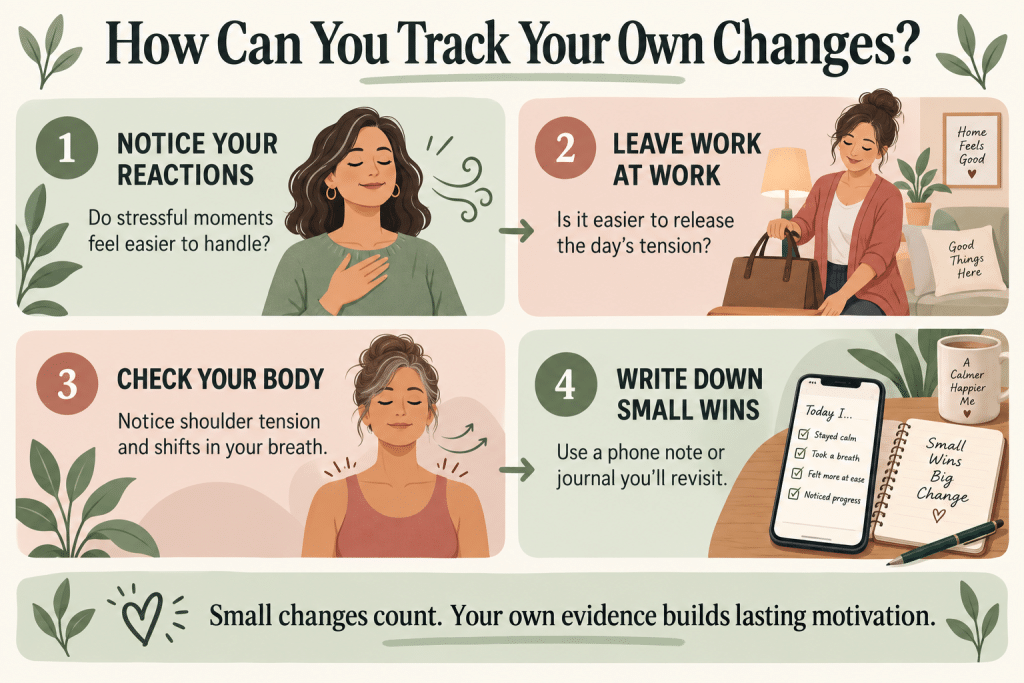
Notice whether you feel less reactive in moments that used to set you off. Notice whether it’s gotten easier to leave work at work instead of carrying the day’s tension into the evening. Notice whether you’re more aware of subtle physical sensations, tension in your shoulders, a shift in your breath, before they build into something bigger.
None of these need to be dramatic to count. When you catch even a small one, write it down somewhere you’ll revisit, a note in your phone, a line in a journal. Over months, that running list becomes far more convincing than any article’s benefits table, including the one above.
$200 Off All 2027 Early Bird Discount
Settle the mind, restore the body & soul back to health. Our deeply restorative 5-day retreat is for midlife women 40+ who are ready to receive abundance, feel rested, strong, clear & back in alignment with their intentions.
How Can You Expect Resistance and Work With It Anyway?
Any new habit that asks something of you will meet resistance, and meditation is no exception. This is the ordinary, predictable reaction to change, not a sign you’re doing something wrong or that you’re “bad at” the practice.
Resistance is what quietly ends most New Year’s resolutions well before February. Left unchecked, it talks you into skipping a single day, which becomes two, which becomes a habit you used to have. The way through isn’t forcing yourself past it through sheer willpower, which rarely holds up for long.
It’s returning to the specific reason you named in Section 1, and leaning on the structural pieces, the fixed place, the fixed time, the short session length, that make showing up require less willpower in the first place. A habit that depends on discipline alone tends to break the first time discipline runs low, which, in midlife, with a full schedule and a body going through its own changes, happens more often than any of us would like.
“I tell every woman I coach the same thing about resistance: it’s not a verdict on whether the habit is right for you. It’s just what shows up whenever you ask yourself to do something differently. Expect it, plan around it, and don’t let one missed day turn into the story you tell yourself about why this doesn’t work for you.”
Terry Tateossian, Founder of The House of Rose
What Are Your Next Steps?
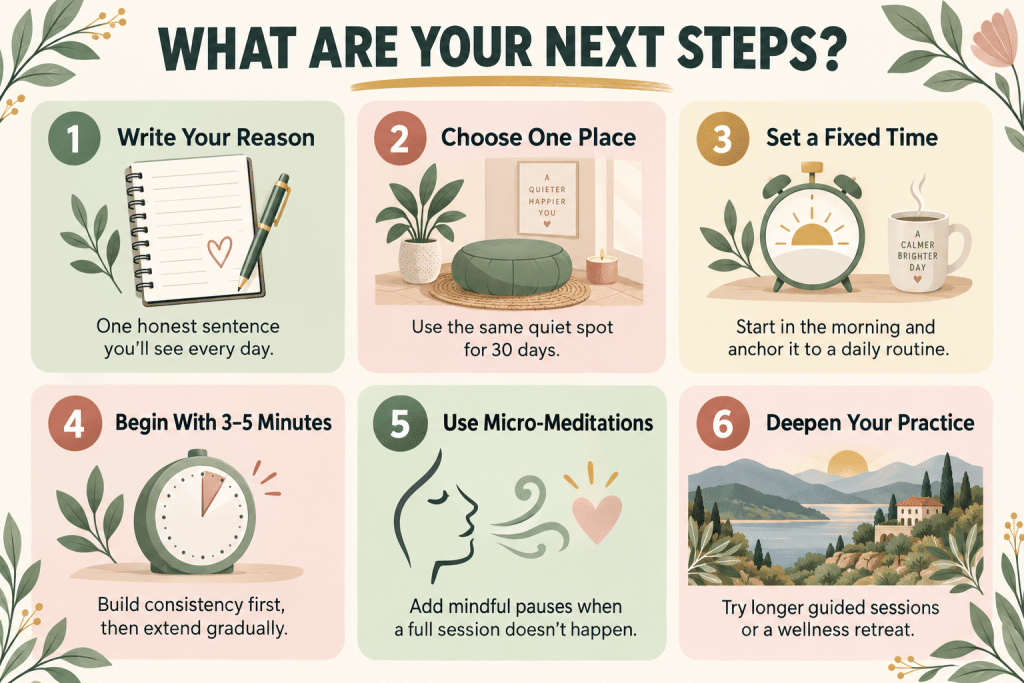
- Write down your specific reason. One sentence, in your own words, kept somewhere you’ll see it on the days the habit feels optional.
- Pick one place and commit to it for 30 days. Even a corner of a room or a repurposed closet works, based on the context-dependent memory research in Section 2.
- Choose a fixed time, morning if you’re new to this. Anchor it to something you already do daily, right after you wake up or right after you brush your teeth.
- Start at 3 to 5 minutes, not 30. Extend gradually once the daily habit itself feels automatic.
- Pair it with micro-meditations on the days a full session doesn’t happen. Short micro-meditations can help you keep the habit going by fitting mindful pauses into routines you’re already doing throughout the day.
- Consider deepening your practice at a retreat. THOR’s women’s yoga, hiking & wellness retreats include longer guided practices that give you space to experience sustained meditation before deciding how you want to bring it into your routine at home.
$200 Off All 2027 Early Bird Discount
Settle the mind, restore the body & soul back to health. Our deeply restorative 5-day retreat is for midlife women 40+ who are ready to receive abundance, feel rested, strong, clear & back in alignment with their intentions.
Frequently Asked Questions
How long does it take to build a real meditation habit?
Habit-formation research suggests it takes an average of roughly two months of consistent practice before a behavior starts feeling automatic rather than effortful, though this varies by person. Consistency matters more than any specific timeline.
Is it better to meditate in the morning or evening?
Morning tends to be easier to sustain as a new habit, since you’re not yet tired and distracted by the day. Evening practice is a valid alternative once the habit is established, though beginners often find themselves drifting off, which is a normal early obstacle rather than a failure.
Do I really need to sit in the same place every day?
It’s not strictly required, but context-dependent memory research suggests it helps, the same principle behind stimulus control therapy for insomnia. A consistent spot does some of the settling work for you before you begin.
What if I only have 5 minutes?
Five minutes done consistently every day builds the habit faster than a longer session done occasionally. Start there and extend once the daily habit feels automatic.
What’s the difference between this and a micro-meditation practice?
This guide covers building a dedicated, seated daily habit. Micro-meditations are brief pauses woven into activities you’re already doing throughout the day. They work well together, particularly on days a full seated session doesn’t happen.
Are the health benefits of meditation real?
Some are well supported by research, stress reduction and improved focus among the strongest. Others, particularly vague energetic or spiritual claims, don’t have a corresponding research base. Section 6 grades the most commonly claimed benefits by evidence strength.
What should I do about a scattered mind during practice?
A wandering mind is the normal texture of practice, not a sign you’re doing it wrong. Gently returning your attention, as many times as needed, is the practice itself.
Do I need any special equipment to start?
No. A quiet spot and a timer, even the one on your phone, are enough to begin. Cushions, altars, and candles are optional supports, not requirements.
Can scent really help build the habit?
There’s real research behind odor-evoked memory being unusually vivid and quick to trigger emotional states. Using the same scent every time you practice can help your nervous system associate that scent with the calm state you build during practice.
What if I miss a day, or several days?
Start again without treating the gap as proof the habit failed. Long-term habit research is about consistency over time, not an unbroken streak; a missed stretch doesn’t erase the progress you’d already built.
Is 3 to 5 minutes really enough to count as a real practice?
Yes. Consistency at a short duration builds the underlying habit faster than an inconsistent longer session. Length can grow once the daily habit is established.
How is this different from the neuroscience of meditation article on your site?
The Neuroscience of Meditation covers what’s happening in your brain during practice. This guide covers the practical, behavioral side of building and sustaining the habit itself.
Can I use a mantra as part of this daily practice?
Yes. Pairing a consistent time and place with a specific mantra can make the practice easier to repeat and turn it into a recognizable daily cue. The Aham mantra offers a simple starting point for building that kind of structured Sanskrit mantra practice.
What if resistance keeps winning?
Revisit your specific reason from Section 1, and check whether your structural setup, place, time, and session length, is as low-friction as it could be. Resistance usually wins when one of those pieces is still asking too much of you.
I write 3 essays per week on Lifestyle Medicine for women in midlife on what is happening in the body and what to do about it. No fluff, no hype. Free.
References
- Deci, E.L., & Ryan, R.M. (2000). The “What” and “Why” of Goal Pursuits: Human Needs and the Self-Determination of Behavior. Psychological Inquiry, 11(4), 227-268.
- Godden, D.R., & Baddeley, A.D. (1975). Context-Dependent Memory in Two Natural Environments: On Land and Underwater. British Journal of Psychology, 66(3), 325-331.
- Bootzin, R.R., & Epstein, D.R. (2011). Understanding and Treating Insomnia. Annual Review of Clinical Psychology, 7, 435-458.
- Herz, R.S. (2004). A Naturalistic Analysis of Autobiographical Memories Triggered by Olfactory, Visual, and Auditory Stimuli. Chemical Senses, 29(3), 217-224.
- Lally, P., van Jaarsveld, C.H.M., Potts, H.W.W., & Wardle, J. (2010). How Are Habits Formed: Modelling Habit Formation in the Real World. European Journal of Social Psychology, 40(6), 998-1009.
- Goyal, M., Singh, S., Sibinga, E.M.S., et al. (2014). Meditation Programs for Psychological Stress and Well-Being: A Systematic Review and Meta-Analysis. JAMA Internal Medicine, 174(3), 357-368.
- Jha, A.P., Krompinger, J., & Baime, M.J. (2007). Mindfulness Training Modifies Subsystems of Attention. Cognitive, Affective, & Behavioral Neuroscience, 7(2), 109-119.
- Hofmann, S.G., Sawyer, A.T., Witt, A.A., & Oh, D. (2010). The Effect of Mindfulness-Based Therapy on Anxiety and Depression: A Meta-Analytic Review. Journal of Consulting and Clinical Psychology, 78(2), 169-183.
- Black, D.S., & Slavich, G.M. (2016). Mindfulness Meditation and the Immune System: A Systematic Review of Randomized Controlled Trials. Annals of the New York Academy of Sciences, 1373(1), 13-24.
- Hilton, L., Hempel, S., Ewing, B.A., et al. (2017). Mindfulness Meditation for Chronic Pain: Systematic Review and Meta-Analysis. Annals of Behavioral Medicine, 51(2), 199-213.
- Gordon, J.L., Girdler, S.S., Meltzer-Brody, S.E., et al. (2015). Ovarian Hormone Fluctuation, Neurosteroids, and HPA Axis Dysregulation in Perimenopausal Depression. American Journal of Psychiatry, 172(3), 227-236.
- National Center for Complementary and Integrative Health (NCCIH). Meditation and Mindfulness: What You Need to Know.
Disclaimer: This article is educational and does not constitute medical or mental health advice. Meditation can support stress management, focus, mood, and overall well-being, but it should not replace appropriate medical or psychological care. If you have diagnosed anxiety, depression, trauma-related symptoms, chronic pain, or another health condition, consult a qualified healthcare or mental health professional about how meditation can safely fit into your care plan.
$200 Off All 2027 Early Bird Discount
Settle the mind, restore the body & soul back to health. Our deeply restorative 5-day retreat is for midlife women 40+ who are ready to receive abundance, feel rested, strong, clear & back in alignment with their intentions.

Terry Tateossian is a Menopause Lifestyle Medicine Coach, Certified Personal Trainer & Nutritionist and the Founder of THOR: The House of Rose, a wellness brand serving women over 40 through retreats, coaching, macro-nutrition and community. As 25-year founder and entrepreneur, Terry spent two and a half decades building and running successful start-up businesses, an experience that put her on the front line of founder burnout long before she could name it. After facing serious health challenges, early onset menopause, and emotional eating while running her agency and raising two children, Terry rebuilt her health in her 40s and lost more than 80 pounds through evidence-based nutrition, training, and mindset work. Today, she helps women get strong, improve confidence, support hormone health, and create a stronger second half of life. Terry has been featured in major media outlets and is available for podcasts, expert commentary, brand collaborations, and speaking engagements on midlife health, reinvention, emotional eating, menopause wellness, and strength training for longevity. Get her free macro calculator (her cookbook companion) to start your journey to back to health.