
 By Team THOR
Free 28-Day Fascia Reset Email Course
Get our Free 28-day email course series to help with 1 or 2 exercises per day to release your fascia. One short lesson per day. Two minutes to read each.
The Aham Mantra: A Simple Guide to Sanskrit Mantras, How to Use Them & How to Change Yours
Marisol is forty-six. Most mornings, she sits in her car in the driveway for five extra minutes before going inside to start the day, because it is the only quiet she gets. She has tried three different meditation apps. Each one gives her a soft voice, a timer, and a vague instruction to “just notice your breath,” and each time her mind wanders off within thirty seconds, chasing her to-do list, a text she needs to answer, something she said in a meeting last week. She has started to think meditation just is not for her.
What Marisol had not tried yet was a mantra. Not a phrase she made up, not a positive affirmation printed on a mug, but one of the oldest tools in meditation: a short sound, repeated on purpose, that gives a busy mind something simple to hold onto instead of nothing at all. The first one she learned was aham, and it took her about a week to understand why something this small could work when a guided app could not.
This article explains aham, where it comes from, how to use it, what a few other well-known Sanskrit mantras mean, and how to know if it is time to try a different one. Nothing here requires a background in Sanskrit or a lifetime of yoga study. It is written to be as clear and simple as possible.
What Is a Mantra, Really?
A mantra is a word or sound you repeat on purpose during meditation. That is the whole idea. It sounds almost too simple, but the simplicity is exactly why it works.
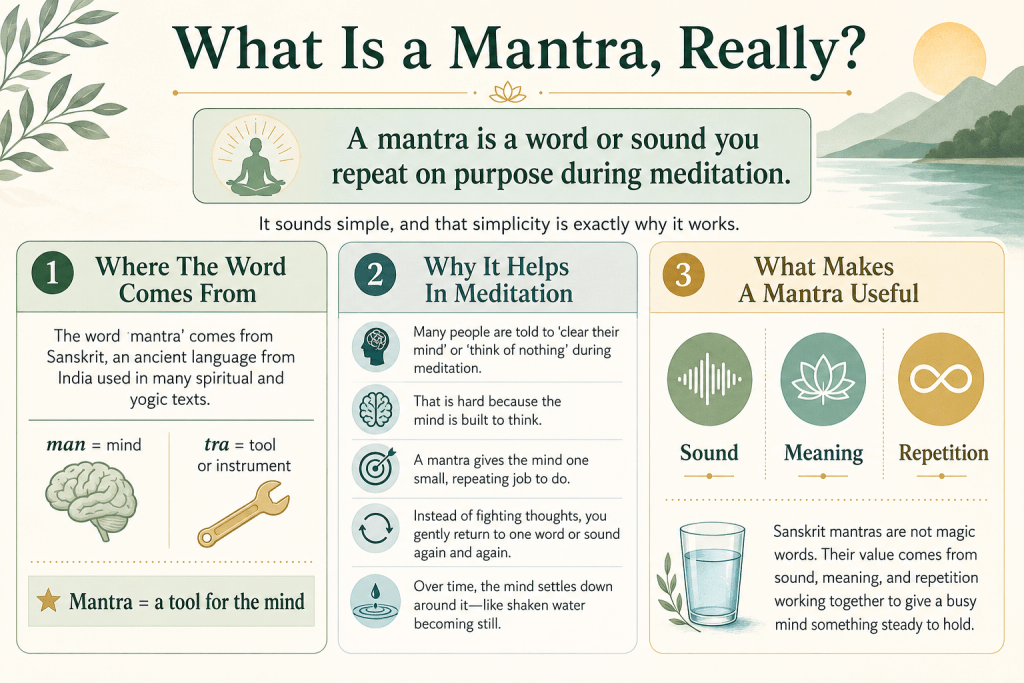
The word “mantra” comes from Sanskrit, an ancient language from India used in many spiritual and yogic texts. It combines two smaller Sanskrit parts: man, which relates to the mind, and tra, which relates to a tool or instrument. Put together, a mantra is literally a tool for the mind.
Here is why that matters. Most people who try to meditate are told to “clear their mind” or “think of nothing,” which is one of the hardest instructions a human brain can follow. Minds are built to think. A mantra gives your mind a small, repeating job to do instead of fighting it into silence. Instead of trying to think of nothing, you gently think of one thing, on purpose, over and over, until your mind settles down around it the way a glass of shaken water settles when you stop shaking it.
Sanskrit mantras are not magic words. Their value comes from a combination of sound, meaning, and repetition, all working together to give a busy mind something steady to hold.
What Is the Aham Mantra, and What Does It Mean?
Aham (pronounced like the word “aha,” with a soft “m” sound at the end) is one of the simplest and oldest mantras used in meditation.
In Sanskrit, aham means “I” or “self.” Not your name, not your job title, not the version of you that answers emails. It points to something quieter and older than all of that: the simple sense of being a self at all, the “I am” that sits underneath every thought you have ever had.
When you repeat aham slowly, again and again, something interesting happens with the meaning. Said twice in a row, it starts to sound like “aham-aham,” or “I am I.” That repetition is not an accident. It is designed to turn your attention away from your busy thoughts and back toward the simple fact of being aware in the first place, the “I” behind everything you think, feel, and notice.
This is different from most meditation instructions you may have tried. Instead of pushing thoughts away, aham gently asks a question underneath all your thoughts: who, or what, is aware of all this? That question, repeated softly, is the entire practice.
Where Does Aham Come From?
Aham comes from a branch of Indian spiritual philosophy called tantra, which is often misunderstood in Western pop culture but, in its original form, is a serious and old tradition focused on awareness, energy, and the relationship between the two.
In this tradition, aham is explained through its three sounds, and each one carries its own simple meaning.
- The “a” sound represents pure awareness, sometimes called Shiva in this tradition. Think of this as the open, quiet background of your mind, the part of you that notices things, before it labels or judges them.
- The “ha” sound represents energy, movement, and expression, sometimes called Shakti. Think of this as everything that shows up inside that quiet background: your thoughts, feelings, plans, and the busy stream of daily life.
- The “m” sound represents the point where those two things meet and become one, sometimes called the bindu, a Sanskrit word that simply means “point” or “drop”. Picture the small dot placed over certain Sanskrit letters. It stands for unity, the coming together of quiet awareness and active energy into a single, whole experience.
Put simply: aham is a tiny word that contains a big idea. It says that the quiet part of you and the busy part of you are not actually two separate things. They are one whole self, and the word aham reminds you of that every time you say it.
You do not need to memorize any of this philosophy to use the mantra. It is here so the word has meaning to you, not just sound.
Free 28-Day Fascia Reset Email Course
Get our Free 28-day email course series to help with 1 or 2 exercises per day to release your fascia. One short lesson per day. Two minutes to read each.
How Does Aham Connect With Your Breath?
Here is one of the most useful things to understand about aham: you are already saying it, all day, every day, without noticing.
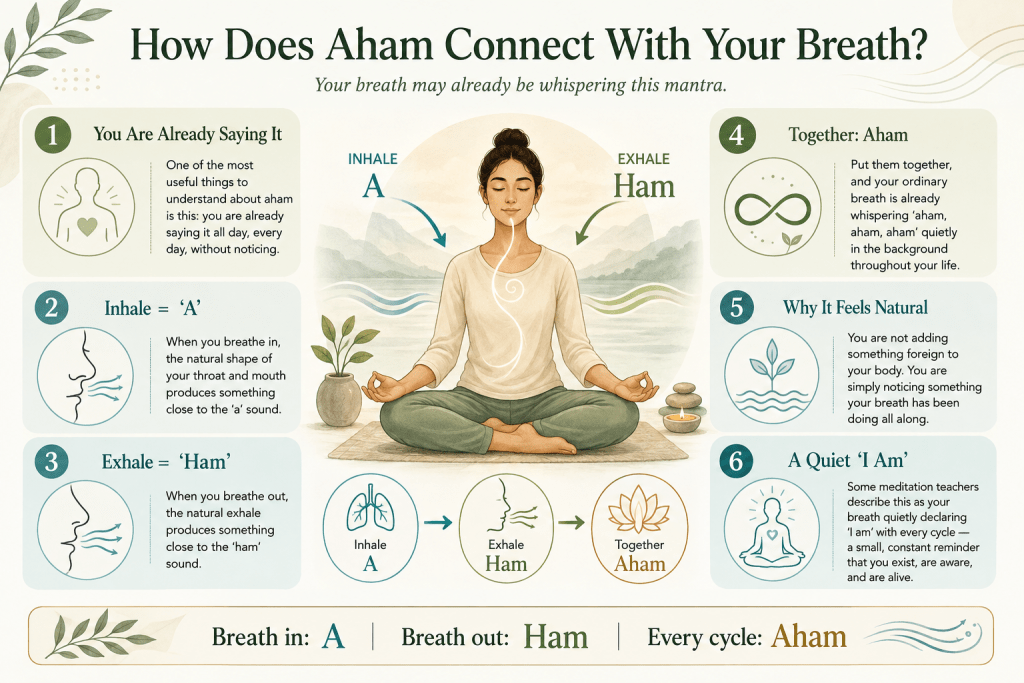
When you breathe in, the shape your throat and mouth naturally make produces something close to the “a” sound. When you breathe out, the natural exhale produces something close to the “ham” sound. Put the two together, and your ordinary breath is already whispering “aham, aham, aham,” quietly, in the background, for your entire life.
This is part of why the mantra feels natural once you try it. You are not adding something foreign to your body. You are simply noticing something your breath has been doing all along, and paying attention to it on purpose instead of letting it happen unnoticed.
Some meditation teachers describe this as your breath quietly declaring “I am” with every cycle, a small, constant reminder that you exist, are aware, and are alive, happening thousands of times a day whether you notice it or not.
“The first time someone explained to me that aham was already hiding inside my own breathing, it changed how the whole practice felt. It stopped being one more thing I had to do correctly, and started feeling like something I got to notice instead. That shift, from effort to noticing, is honestly the heart of most good meditation practices, not just this one.”
Terry Tateossian, Founder of The House of Rose
How Do You Practice the Aham Mantra Step by Step?
You do not need any equipment, an app, or prior experience. Find a quiet spot, sit comfortably, and follow these steps.
- Step 1: Get comfortable: Sit somewhere you will not be disturbed for 5 to 15 minutes. You can sit cross-legged on the floor or in a chair with your feet flat on the ground. Keep your spine reasonably tall but not stiff.
- Step 2: Settle your attention low in your body: Bring your attention to the area just below your belly button, slightly toward your spine. In yogic anatomy this spot is called the manipura chakra, a Sanskrit term for an energy center associated with personal power and steadiness. You do not need to feel anything special here. Simply resting your attention in this area is enough.
- Step 3: Notice your natural breath: Do not change how you are breathing. Just notice the breath rising and falling.
- Step 4: Add the mantra: As you breathe in, silently think the sound “a.” As you breathe out, silently think the sound “ham.” Do not say it out loud. Just think it, matched gently to the natural rhythm of your breath.
- Step 5: Notice the pauses: Pay attention to the small, natural gaps that happen right after a full inhale and right after a full exhale. You do not need to do anything with these gaps. Just notice they are there.
- Step 6: Let the words fade: After a few minutes, stop actively thinking the syllables. Instead, simply listen, as if the sound of aham were happening on its own, in the background, with each breath.
- Step 7: Rest: Once your mind feels a little quieter, let go of tracking the breath altogether. Simply rest in a relaxed, alert stillness for the remaining time.
Fifteen minutes is a reasonable goal for beginners, but even five minutes done consistently is still worthwhile. Consistency matters far more than length.
What Should You Do If Your Breath Gets Very Quiet?
Something can happen during mantra practice that surprises a lot of beginners: your breath may become very slow, very soft, or seem to pause for a moment on its own.
This is normal, and it is not something to force or chase. If it happens, do not try to make it happen again on purpose, and do not try to hurry your breath back to normal either. Simply let it be exactly as quiet or as still as it wants to be, and stay gently aware. When the breath naturally returns to its normal rhythm, let it, without any effort on your part.
If this never happens for you, that is also completely normal. Many people meditate for years and simply notice a calm, steady breath rather than any dramatic pause, and that is a full, complete practice on its own.
Free 28-Day Fascia Reset Email Course
Get our Free 28-day email course series to help with 1 or 2 exercises per day to release your fascia. One short lesson per day. Two minutes to read each.
What Are Some Other Popular Sanskrit Mantras?
Aham is one of many Sanskrit mantras used in meditation. Here is a simple, honest guide to a few of the most common ones, what they mean, and what each one tends to be used for.
- So Hum (pronounced “so hum”): This mantra means “I am That,” where “That” refers to the vast, universal awareness behind all existence, rather than your individual sense of self. It uses the same breath-based approach as aham: “so” on the inhale, “hum” on the exhale. Many teachers consider it a close companion to aham, with a slightly more expansive, less personal feel. If aham points inward to “I am,” so hum points outward to “I am part of everything.”
- Om (pronounced “aum,” a single, long syllable): Considered by many traditions to be the original sound of the universe itself, often chanted aloud rather than repeated silently. It is one of the most recognized sounds in yoga and meditation worldwide and works well as an opening or closing sound for a practice, or as a full mantra on its own for those who enjoy chanting.
- Om Namah Shivaya (pronounced “om nah-mah shee-vah-yah”): This means roughly “I bow to my true, highest self,” using the word Shiva here to refer to the inner divine self rather than only the deity of the same name. It is one of the most widely used devotional mantras and works well for anyone drawn to a slightly longer phrase with a reverent, humble tone.
- Om Mani Padme Hum (pronounced “om mah-nee pahd-may hum”): A Buddhist mantra, not originally Sanskrit but Tibetan in common use, associated with compassion. Its literal translation is debated among scholars, but it is widely understood to invoke compassion for oneself and others. A good option for anyone whose meditation goal centers on kindness rather than self-inquiry.
- Lokah Samastah Sukhino Bhavantu (pronounced “loh-kah sah-mah-stah soo-key-noh bah-vahn-too”): A longer Sanskrit phrase meaning roughly “May all beings everywhere be happy and free.” It is less commonly repeated silently and more often chanted or recited once or twice at the start or end of a practice, functioning more like a dedication or intention than a repeated mantra.
- Sat Nam (pronounced “saht nahm”): Common in Kundalini yoga practices, meaning roughly “truth is my identity” or “true name.” Popular for beginners because it is short, rhythmic, and pairs easily with simple hand movements or breath.
None of these mantras is objectively “better” than another. They simply carry different meanings and different emotional tones, which is exactly why it is worth trying more than one before settling on the mantra that feels right for you.
How Do You Choose the Right Mantra for You?
There is no single correct way to pick a mantra, but a few simple questions can help.
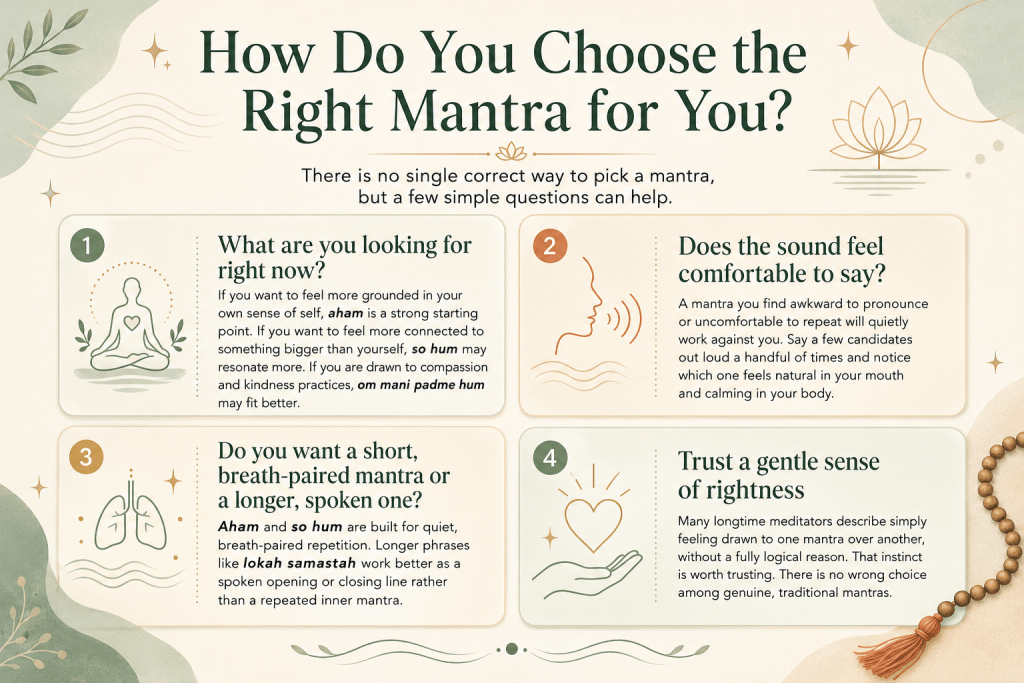
- What are you looking for right now?: If you want to feel more grounded in your own sense of self, aham is a strong starting point. If you want to feel more connected to something bigger than yourself, so hum may resonate more. If you are drawn to compassion and kindness practices, om mani padme hum may fit better.
- Does the sound feel comfortable to say?: A mantra you find awkward to pronounce or uncomfortable to repeat will quietly work against you. Say a few candidates out loud a handful of times and notice which one feels natural in your mouth and calming in your body.
- Do you want a short, breath-paired mantra or a longer, spoken one?: Aham and so hum are built for quiet, breath-paired repetition. Longer phrases like lokah samastah work better as a spoken opening or closing line rather than a repeated inner mantra.
- Trust a gentle sense of rightness: Many longtime meditators describe simply feeling drawn to one mantra over another, without a fully logical reason. That instinct is worth trusting. There is no wrong choice among genuine, traditional mantras.
Can You Change Your Mantra, and How Do You Do It?
This is one of the most common questions beginners ask, and the honest answer is simple: yes, you can change your mantra, and doing so does not undo any progress you have already made.
Why People Change Mantras
Some people start with one mantra because it was the first one they learned, then later discover that a different one fits their current season of life better. Someone going through grief, for example, may feel more drawn to a compassion-centered mantra like om mani padme hum than the more self-inquiry-focused aham.
Someone working on connecting with a larger sense of purpose may move from aham toward so hum. Needs change over time, and it is completely normal for a mantra practice to change along with them.
When It Makes Sense to Change
A good sign that it may be time to try something new is when your current mantra starts to feel flat, mechanical, or disconnected from what you actually need right now, rather than calming or centering the way it once did. This is not failure. It is simply a signal that your practice is ready to grow.
When It Does Not Make Sense to Change
If your mantra still feels calming and useful but your mind is simply having a distracted day, that is not a sign to switch mantras. Minds wander during meditation regardless of which mantra you use, and switching mantras every time a session feels hard can prevent you from building the deeper familiarity that makes a mantra more meaningful over time.
How to Make the Switch
There is no formal ritual required. Simply choose your new mantra, learn its meaning the way this article has explored aham, and begin using it in the same way: paired gently with the breath, repeated without force, and allowed to grow quieter over time.
Some people like to mark the change with a small moment of intention, such as a few minutes of silence before beginning the new practice, but this is a personal preference rather than a requirement.
You Can Also Use More Than One Mantra
Some practitioners keep two mantras in rotation. For example, you might use aham in the morning to center yourself for the day and a compassion-focused mantra like om mani padme hum in the evening to soften and unwind. There is no rule against this. The right structure is the one that genuinely supports your life.
Free 28-Day Fascia Reset Email Course
Get our Free 28-day email course series to help with 1 or 2 exercises per day to release your fascia. One short lesson per day. Two minutes to read each.
What Common Mistakes Do Beginners Make?
- Trying too hard to “do it right”: Mantra meditation is not a performance. A wandering mind, an inconsistent pace, or an imperfect pronunciation does not ruin the practice.
- Forcing the breath to slow down or stop: As covered in Section 6, any natural quieting of the breath should be allowed to happen, never forced.
- Switching mantras too often: As covered in Section 9, real familiarity with a mantra takes time. Switching every few days prevents that familiarity from developing.
- Expecting instant results: Like most practices, mantra meditation tends to deepen gradually. A single session rarely produces a dramatic experience, and that is completely normal.
- Skipping the meaning: Repeating a sound with no idea what it means still has some calming value, purely from the rhythm and repetition, but understanding what you are actually saying (as this article has tried to explain clearly for aham) tends to deepen the practice considerably.
- Only meditating when life feels calm: The real value of a mantra practice often shows up most clearly on difficult days, not easy ones. A consistent practice, even five minutes on a hard day, tends to matter more than a long practice reserved only for peaceful mornings.
How Can You Build a Simple Daily Mantra Habit?
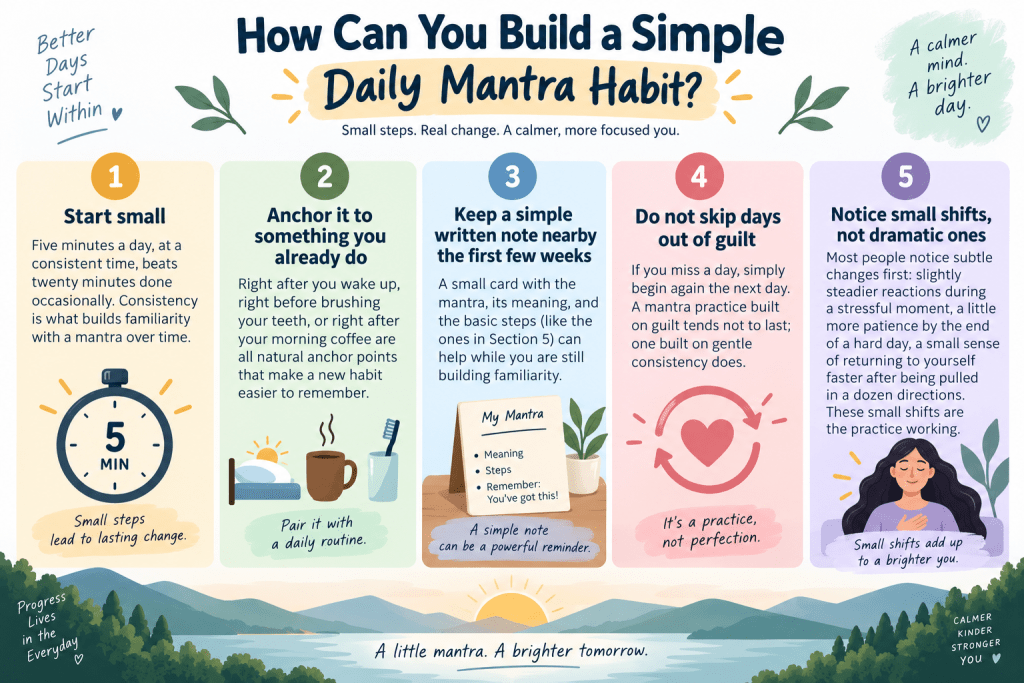
- Start small: Five minutes a day, at a consistent time, beats twenty minutes done occasionally. Consistency is what builds familiarity with a mantra over time.
- Anchor it to something you already do: Right after you wake up, right before brushing your teeth, or right after your morning coffee are all natural anchor points that make a new habit easier to remember.
- Keep a simple written note nearby the first few weeks: A small card with the mantra, its meaning, and the basic steps (like the ones in Section 5) can help while you are still building familiarity.
- Do not skip days out of guilt: If you miss a day, simply begin again the next day. A mantra practice built on guilt tends not to last; one built on gentle consistency does.
- Notice small shifts, not dramatic ones: Most people notice subtle changes first: slightly steadier reactions during a stressful moment, a little more patience by the end of a hard day, a small sense of returning to yourself faster after being pulled in a dozen directions. These small shifts are the practice working.
What Does Research Say About Mantra Meditation?
- Stress and the nervous system: Research on mantra-based meditation practices has documented reductions in markers of stress and improvements in measures of relaxation and parasympathetic (rest-and-digest) nervous system activity, consistent with the calming effects many practitioners describe anecdotally.
- Attention and focus: Studies on repetitive, sound-based meditation techniques have found associated improvements in sustained attention and a reduced tendency for the mind to wander, supporting the practical mechanism described throughout this article: giving the mind one simple, repeated thing to hold onto.
- Anxiety: Several studies on mantra-based meditation approaches have found associated reductions in self-reported anxiety symptoms, though as with most meditation research, effects vary by individual and by the consistency of practice.
- Honest limitations: Much of the research in this area involves relatively small studies, and mantra meditation should be understood as a supportive practice for general well-being and stress management rather than a treatment for diagnosed anxiety disorders or other mental health conditions, which deserve care from a qualified professional.
Free 28-Day Fascia Reset Email Course
Get our Free 28-day email course series to help with 1 or 2 exercises per day to release your fascia. One short lesson per day. Two minutes to read each.
How Can You Bring This Practice Into the Broader THOR Framework?
A mantra practice can fit naturally alongside other THOR tools that support stress relief, nervous system regulation, and deeper restorative practices.
- Pair it with nervous system support: Use mantra meditation alongside simple breathing and vagus nerve exercises to help create a calmer, more grounded daily routine. Explore these vagus nerve reset exercises for additional techniques.
- Build it into your stress routine: A five-minute mantra practice can become one small, repeatable habit for managing everyday stress. These tiny stress habits offer other practical ways to support that routine.
- Take the practice deeper in person: Guided meditation can help you become more comfortable with mantra practice and refine how you use it. THOR’s Deeply Restorative Yoga and Nature Retreat in the Smoky Mountains includes guided meditation as part of a more immersive restorative experience.
Free 28-Day Fascia Reset Email Course
Get our Free 28-day email course series to help with 1 or 2 exercises per day to release your fascia. One short lesson per day. Two minutes to read each.
Frequently Asked Questions
What does aham mean?
Aham is a Sanskrit word meaning “I” or “self.” As a mantra, it points to the simple, quiet sense of being aware, the “I am,” that sits underneath all of your individual thoughts and feelings.
How do you pronounce aham?
Like the word “aha,” followed by a soft “m” sound. Some teachers pronounce it closer to “ah-hum.”
Is aham a religious practice?
Aham comes from a spiritual and philosophical tradition (tantra) with roots in Hindu thought, but it is widely practiced today as a secular meditation tool, without requiring any particular religious belief. Many people from many different backgrounds use it simply as a calming, centering practice.
Do I need to know Sanskrit to use a mantra?
No. You only need to know how to pronounce the sound and understand its basic meaning, both of which this article explains in plain language.
How long should I meditate with a mantra?
Five to fifteen minutes is a reasonable range for most beginners. Consistency matters far more than length. A short daily practice is more valuable than an occasional long one.
Can I say the mantra out loud instead of silently?
Yes. Both approaches are traditional and valid. Silent, breath-paired repetition (as described in Section 5) tends to be easier for beginners to sustain, while spoken or chanted repetition can feel more expressive and is common with mantras like om.
Is it okay to switch mantras?
Yes. As covered in Section 9, changing mantras as your needs change is completely normal and does not undo any benefit from your previous practice.
What is the difference between aham and so hum?
Aham means “I” and points inward, toward your individual sense of self and awareness. So hum means “I am That” and points outward, toward a sense of connection with something larger than the individual self. Many people use aham first and move toward so hum later, though there is no required order.
Can mantra meditation help with anxiety?
Some research supports mantra meditation as a helpful tool for managing everyday stress and anxiety symptoms, though it should be treated as a supportive practice, not a replacement for professional mental health care when needed.
What if I forget the mantra or lose my place while meditating?
Simply notice this happened, without frustration, and gently return to the mantra. Losing your place and returning is part of the practice itself, not a mistake to avoid.
Do I need any special equipment to practice a mantra?
No. A quiet space and a few minutes of time are the only requirements. A cushion or chair for comfortable sitting is helpful but not necessary.
Can children or teenagers use mantra meditation?
Simple, short mantras can be appropriate for older children and teenagers as an introduction to mindfulness, though guidance from a parent, teacher, or qualified instructor is recommended when introducing meditation to younger practitioners.
References
- Lynch, J., Prihodova, L., Dunne, P. J., Carroll, Á., Walsh, C., McMahon, G., & White, B. (2018). Mantra meditation for mental health in the general population: A systematic review. European Journal of Integrative Medicine, 23, 101-108.
- Bormann, J. E., Thorp, S. R., Wetherell, J. L., Golshan, S., & Lang, A. J. (2013). Meditation-based mantra intervention for veterans with posttraumatic stress disorder: A randomized trial. Psychological Trauma: Theory, Research, Practice, and Policy, 5(3), 259-267.
- Wolf, D. B., & Abell, N. (2003). Examining the effects of meditation techniques on psychosocial functioning. Research on Social Work Practice, 13(1), 27-42.
- Manocha, R., Black, D., Sarris, J., & Stough, C. (2011). A randomized, controlled trial of meditation for work stress, anxiety and depressed mood in full-time workers. Evidence-Based Complementary and Alternative Medicine, 2011, 960583.
- Feuerstein, G. (1998). Tantra: The Path of Ecstasy. Shambhala Publications.
- Muktibodhananda, S. (1998). Hatha Yoga Pradipika. Yoga Publications Trust.
Disclaimer: This article is educational and does not constitute medical or mental health advice. Mantra meditation can be a supportive practice for relaxation, focus, and everyday stress, but it is not a treatment for anxiety disorders or other mental health conditions. Do not force your breathing, hold your breath, or try to create breath pauses during meditation. If meditation causes dizziness, significant discomfort, panic, or emotional distress, stop the practice and consult a qualified healthcare or mental health professional.
Free 28-Day Fascia Reset Email Course
Get our Free 28-day email course series to help with 1 or 2 exercises per day to release your fascia. One short lesson per day. Two minutes to read each.

Terry Tateossian is a Menopause Lifestyle Medicine Coach, Certified Personal Trainer & Nutritionist and the Founder of THOR: The House of Rose, a wellness brand serving women over 40 through retreats, coaching, macro-nutrition and community. As 25-year founder and entrepreneur, Terry spent two and a half decades building and running successful start-up businesses, an experience that put her on the front line of founder burnout long before she could name it. After facing serious health challenges, early onset menopause, and emotional eating while running her agency and raising two children, Terry rebuilt her health in her 40s and lost more than 80 pounds through evidence-based nutrition, training, and mindset work. Today, she helps women get strong, improve confidence, support hormone health, and create a stronger second half of life. Terry has been featured in major media outlets and is available for podcasts, expert commentary, brand collaborations, and speaking engagements on midlife health, reinvention, emotional eating, menopause wellness, and strength training for longevity. Get her free macro calculator (her cookbook companion) to start your journey to back to health.