

 By Team THOR
Free 28-Day Fascia Reset Email Course
Get our Free 28-day email course series to help with 1 or 2 exercises per day to release your fascia. One short lesson per day. Two minutes to read each.
The Neuroscience of Meditation: How Stillness Rewires the Midlife Brain
Marisol sat down to meditate for the first time in a decade the week her period didn’t come. She was forty-six, and the app on her phone promised ten minutes would clear her head. It didn’t. Her mind ran through the grocery list, an unanswered email, the strange heat that had started climbing her neck at odd hours, and a meeting she’d mishandled that morning because she’d lost her train of thought mid-sentence in front of her own team.
She opened her eyes at minute four, certain she was doing it wrong. She wasn’t doing it wrong. She had the wrong expectation. Marisol, like most people, assumed meditation meant successfully making the mind go blank, and by that standard, she failed every single session for weeks.
What she didn’t know, and what almost nobody tells you when you download a meditation app, is that the brain never actually goes empty. Not for monks with forty years of practice, not for anyone. The goal was never silence. The goal was training, and Marisol had been grading herself against a target that doesn’t exist.
That distinction, between meditation as a feeling and meditation as a mechanism, is where the real neuroscience starts. Brain imaging research over the past two decades has moved meditation from the wellness aisle into some of the most rigorously studied cognitive training available, and what it shows has real relevance for a midlife brain specifically, one that’s navigating hormonal shifts to attention, memory, and emotional regulation whether it meditates or not.
Important: This article is educational and does not replace individualized medical or psychiatric advice. Women with a history of significant trauma, dissociation, or certain psychiatric conditions should work with a qualified professional before starting an intensive meditation practice.
What Is Meditation Actually (It’s Not “Clearing Your Mind”)?
Meditation covers a family of mental training techniques built around intentionally directing attention and awareness. Across traditions and techniques, most forms combine some mix of attention regulation, body awareness, breath awareness, and conscious self-observation.
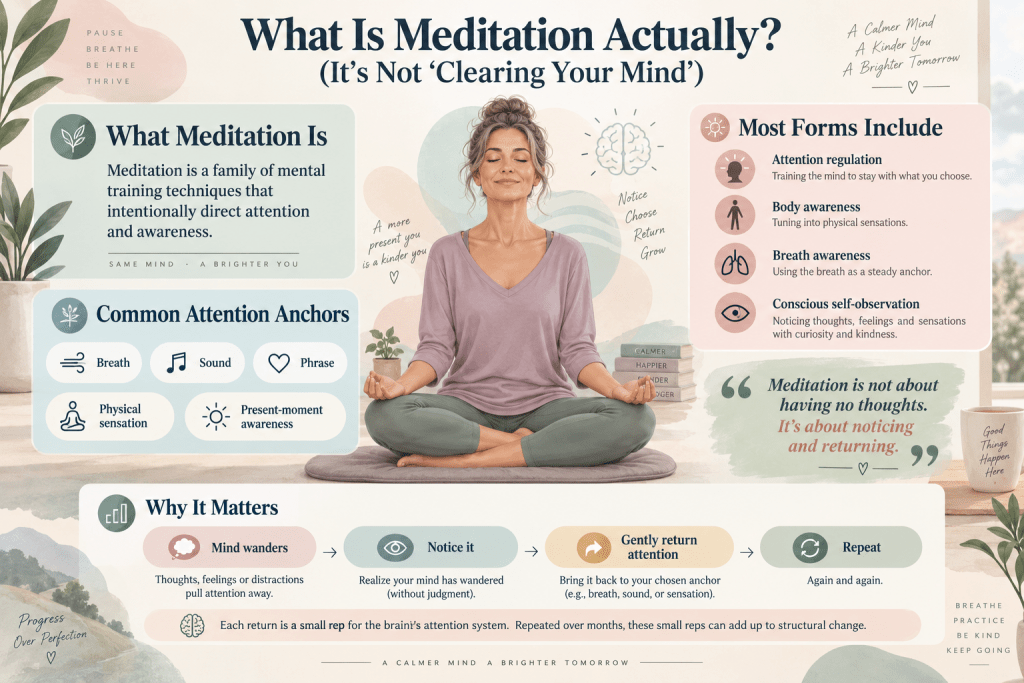
Rather than letting the mind drift unchecked from thought to thought, meditation repeatedly guides attention back to a chosen anchor, whether that’s the breath, a sound, a phrase, a physical sensation, or simple present-moment awareness.
That return, noticing the mind has wandered and gently redirecting it, sounds almost too simple to matter. Neurologically, it’s the entire mechanism. Every single redirection is a small rep for the brain’s attention system, and small reps, repeated over months, add up to structural change.
“The number one thing I tell clients starting a meditation practice is that the wandering mind isn’t the failure. The wandering mind is the exercise. Every time you notice you’ve drifted and bring yourself back, that’s the rep. People quit because they think they’re bad at it, when actually the noticing is the entire point.”
Terry Tateossian, Founder of The House of Rose
What Are the Main Types of Meditation, and What Does Each One Train?
Meditation isn’t one single technique, and different forms recruit overlapping but distinct brain circuits.
- Focused attention meditation: Anchors attention to a single object, such as the breath, a candle flame, or a repeated word. When the mind drifts, attention is gently returned. This form builds sustained attention and executive control most directly.
- Open monitoring, or mindfulness meditation: Widens awareness to observe thoughts, emotions, and sensations without judging or reacting to them, rather than narrowing focus onto one object.
- Loving-kindness and compassion practices: Deliberately generate feelings of warmth toward oneself and others, and appear to strengthen circuits involved in empathy and emotional regulation.
- Mantra meditation: Repeats a sound or phrase, using rhythm to quiet spontaneous mental chatter and build attentional stability. THOR covers this specific practice in depth in the Aham Mantra and Sanskrit Mantras Guide, including how to select and work with a mantra.
- Body scan meditation: Systematically moves awareness through different regions of the body, building interoception and autonomic self-regulation.
- Walking meditation: Pairs movement with present-moment awareness, engaging motor control, balance, and attention simultaneously.
It’s tempting to treat “meditation” as one interchangeable activity, but a woman using focused-attention practice to sharpen concentration before a demanding workday is training a different circuit than a woman using loving-kindness practice to soften self-criticism after a hard year. Matching the technique to the goal, attention, emotional regulation, or self-compassion, produces faster, more noticeable results than picking a technique at random.
Free 28-Day Fascia Reset Email Course
Get our Free 28-day email course series to help with 1 or 2 exercises per day to release your fascia. One short lesson per day. Two minutes to read each.
What Is the History of Meditation as Humanity’s Oldest Mental Training?
Meditation is among the oldest documented practices for training the mind. Seated figures in postures resembling meditation appear in artifacts from the Indus Valley Civilization dating back more than 4,000 years, though their precise purpose remains debated among historians.
The earliest widely accepted written references to contemplative discipline appear in the Rig Veda, composed roughly 1500 to 1200 BCE, which introduces ideas of focused attention, sacred chanting, and inner concentration that later traditions would build on directly.
Several centuries later, the Upanishads (roughly 800 to 300 BCE) shifted the emphasis from external ritual toward internal exploration of consciousness, describing structured stages including breath regulation, sensory withdrawal, concentration, meditation, and deep absorption.
Patanjali’s Yoga Sutras, compiled sometime between 200 BCE and 400 CE, organized centuries of existing contemplative knowledge into the Eight Limbs of Yoga, with meditation positioned as the second-to-last stage before complete absorption.
Around the same era, Siddhartha Gautama refined existing contemplative techniques into what became Buddhist mindfulness and insight meditation, built around present-moment awareness and non-judgmental observation.
Independently, early Daoist traditions in China developed their own breath and internal-awareness practices. Different cultures, working independently, arrived at a shared conclusion: repeated attention training reshapes the mind. Modern neuroscience is now confirming, with brain imaging rather than philosophy, that they were onto something real.
What Happens in the Brain During Meditation?
One of the most consistent findings across meditation neuroscience is that practice changes communication between large-scale brain networks, not just activity in a single region.
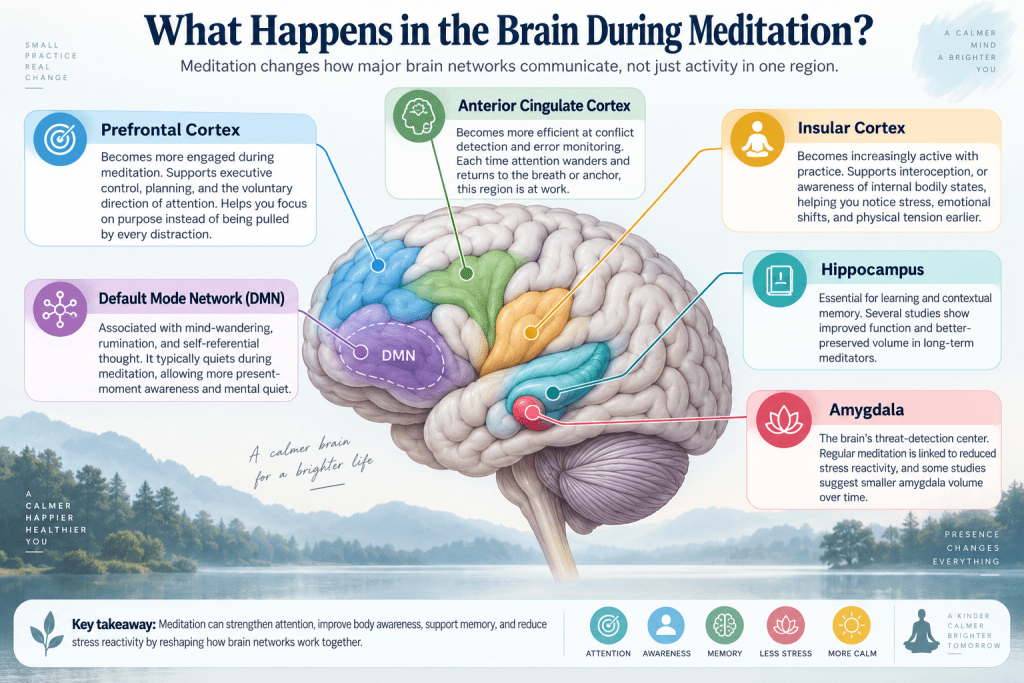
- The prefrontal cortex: Becomes more engaged during meditation, supporting executive control, planning, and voluntary direction of attention. Instead of every thought or distraction automatically capturing focus, the frontal lobes become better able to direct awareness on purpose.
- The anterior cingulate cortex: Detects conflict and monitors errors and becomes more efficient. Each time attention wanders and gets redirected back to the breath or anchor, this region is doing the work.
- The insular cortex: Central to interoception (the sense of internal bodily states), becomes increasingly active with practice. Improved interoceptive awareness often means recognizing stress, emotional shifts, or physical tension earlier, before it builds into something overwhelming.
- The hippocampus: Essential for learning and contextual memory, shows improved function and better-preserved volume in several studies of long-term meditators, a finding with direct relevance for women managing the memory and word-retrieval changes common in perimenopause.
- The amygdala: The brain’s threat-detection center responsible for fear and stress reactivity, shows reduced activation during stressful situations among regular meditators, and some studies report smaller amygdala volume with sustained practice, suggesting genuine remodeling of stress circuitry over time.
- The default mode network (DMN): The system active during mind-wandering, rumination, and self-referential thought, typically quiets down during meditation. Instead of looping through repetitive internal narratives, the brain shifts toward processing present-moment information, which is what most people describe as “mental quiet.”
Important: None of these changes happen after a single session. They reflect the cumulative effect of consistent practice over weeks and months, the same way a single workout doesn’t build visible muscle but a consistent training block does.
Free 28-Day Fascia Reset Email Course
Get our Free 28-day email course series to help with 1 or 2 exercises per day to release your fascia. One short lesson per day. Two minutes to read each.
What Do EEG Studies Show About Brain Waves During Meditation?
Electroencephalography (EEG) studies show that meditation shifts brain wave activity, though the specific pattern depends on the technique and the practitioner’s experience level.
- Alpha wave activity: Tends to increase, reflecting relaxed wakefulness and reduced sensory interference.
- Theta wave activity: Often rises during deeper meditative states, associated with internal attention, memory processing, and emotional integration.
- Gamma wave synchrony: Highly experienced practitioners have shown increases in gamma wave synchrony, linked to conscious awareness and large-scale coordination across cortical regions.
The takeaway is that meditation isn’t a passive dip in brain activity. It’s an organized shift toward more efficient, more coordinated neural processing, closer to focused training than to rest.
What Changes After Years of Meditation Practice?
The most striking findings come from studies comparing long-term meditators to non-meditators. Consistent practitioners often show increased cortical thickness in regions tied to attention, emotional regulation, and self-awareness, including the prefrontal cortex, anterior cingulate cortex, and insula. White matter connectivity, the wiring between distant brain regions, often appears stronger too, suggesting faster and more coordinated communication across the brain.
These differences reflect years of repeated practice, not a single session. The same way physical training gradually reshapes skeletal muscle, meditation appears to progressively reshape the neural networks responsible for attention and emotional regulation.
What a realistic timeline looks like:
| Practice Stage | Typical Duration | What Tends to Change First |
|---|---|---|
| Weeks 1-4 | Daily 5-10 min sessions | Noticing the wandering mind faster; small shifts in reactivity |
| Months 2-4 | Consistent daily practice | Easier return to focus; reduced rumination in daily life |
| Months 6-12 | Sustained regular practice | Measurable stress-reactivity changes; better sleep onset |
| Year 1+ | Long-term consistent practice | Structural changes documented in research (cortical thickness, connectivity) |
Free 28-Day Fascia Reset Email Course
Get our Free 28-day email course series to help with 1 or 2 exercises per day to release your fascia. One short lesson per day. Two minutes to read each.
How Does Meditation Affect the Autonomic Nervous System?
Meditation influences the autonomic nervous system directly, generally shifting the balance toward increased parasympathetic activity through improved vagal tone. Heart rate frequently decreases, breathing slows, heart rate variability often improves, and stress hormone output may decline with consistent practice.
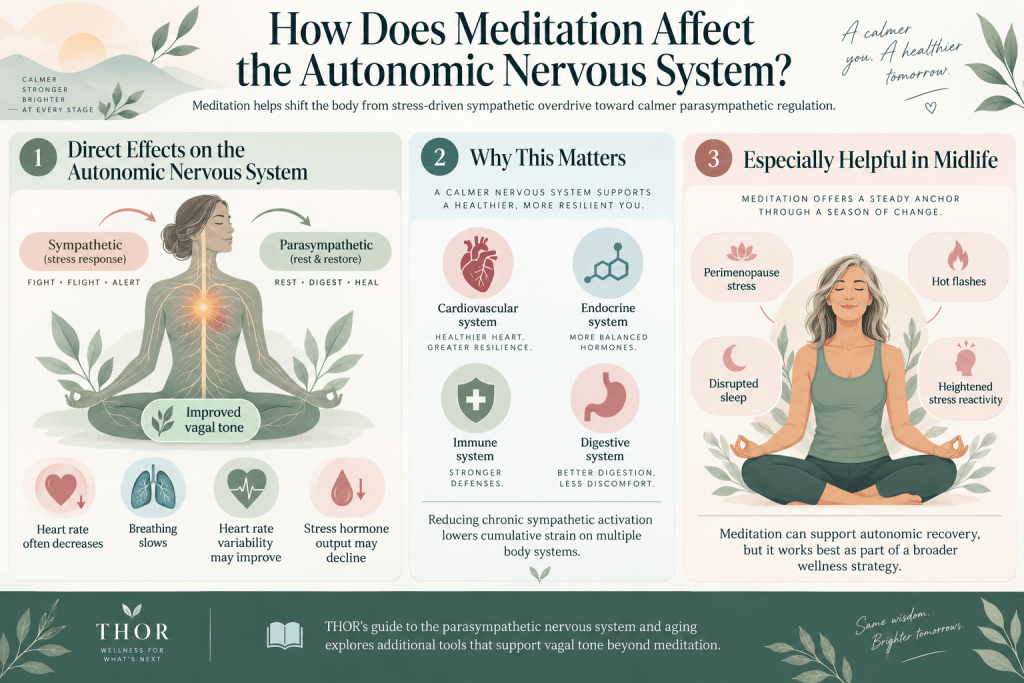
Lowering chronic sympathetic activation reduces the cumulative strain placed on the cardiovascular, endocrine, immune, and digestive systems. For women dealing with the sympathetic overdrive that often accompanies perimenopause, hot flashes, disrupted sleep, and heightened stress reactivity among them, meditation functions as one piece of a broader autonomic recovery strategy rather than a stand-alone fix.
THOR’s guide to the parasympathetic nervous system and aging covers this autonomic balance in more depth, including other tools beyond meditation that support vagal tone.
Why Does Meditation Matter More in Perimenopause and Menopause?
Estrogen has a direct relationship with several of the same brain regions meditation appears to influence, particularly the prefrontal cortex, hippocampus, and amygdala. As estrogen fluctuates and then declines through the menopause transition, many women notice exactly the symptoms tied to these regions: harder-to-sustain focus, more effortful word retrieval, increased emotional reactivity, and a startle-prone or hypervigilant stress response that wasn’t there a decade earlier.
This is part of why the timing matters. A woman navigating perimenopausal brain fog is dealing with a nervous system that’s already working harder to do what it used to do more easily. Meditation doesn’t reverse hormonal change, but it trains the exact systems, attention regulation, stress reactivity, emotional control, that hormonal shifts are placing under extra load. That overlap is why this deserves more attention in midlife wellness content than it typically gets.
“I was diagnosed with early-onset menopause at 41, and the brain fog was the symptom that scared me most, more than the hot flashes, more than the sleep disruption. Meditation didn’t erase it, but it gave me back a sense that my attention was something I could still direct on purpose, even on the days my hormones weren’t cooperating. That’s not a small thing when you’re running a company and raising two kids.”
Terry Tateossian, Founder of The House of Rose
For women managing cortisol-driven symptoms alongside cognitive changes, THOR’s 7 Tiny Stress Habits for Midlife Women pairs well with a meditation practice as a set of smaller, situational tools for the moments a full sit-down session isn’t practical.
What Does the Research Support, and Where Is the Evidence Still Early?
Because meditation trains attention and emotional regulation circuits, it has shown measurable benefit across a range of conditions. The strongest evidence currently exists for stress-related disorders, generalized anxiety, recurrent depression, chronic pain, insomnia, elevated blood pressure, and burnout.
Meditation has also shown benefit for emotional resilience in post-traumatic stress disorder when introduced carefully under professional guidance, though intensive practice can temporarily worsen symptoms in some trauma survivors if introduced too aggressively without support.
In chronic pain, benefit tends to come less from reducing pain signals directly and more from changing how the brain interprets and emotionally reacts to those signals. Mindfulness-based approaches have also shown benefit for irritable bowel syndrome, fibromyalgia, migraine, and quality of life during cancer treatment.
Research into meditation as a complementary approach for mild cognitive changes, attention difficulties, and general midlife cognitive resilience is newer and still developing, but the underlying neurological rationale, that meditation strengthens attention, autonomic regulation, and stress resilience, is well established even where the specific downstream applications are still being studied.
Important: Meditation is a complement to appropriate medical care, not a replacement for it, particularly for diagnosed anxiety, depression, or chronic pain conditions that warrant professional treatment.
Free 28-Day Fascia Reset Email Course
Get our Free 28-day email course series to help with 1 or 2 exercises per day to release your fascia. One short lesson per day. Two minutes to read each.
Why Isn’t Meditation One-Size-Fits-All?
Meditation is safe for most people, but it isn’t universally appropriate in the same form for everyone. Women with significant trauma histories, dissociative symptoms, or certain psychiatric conditions may need a modified approach under professional supervision, since prolonged silent sitting can occasionally surface uncomfortable material before it resolves into benefit.
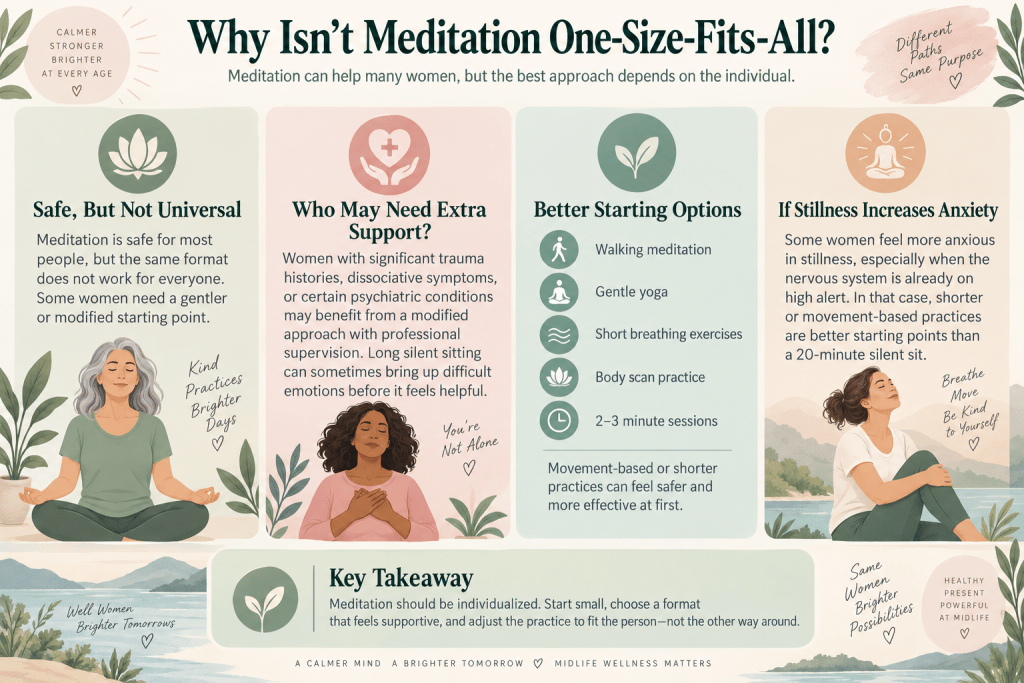
Some people do better starting with movement-based practices, like walking meditation or gentle yoga, or short breathing exercises rather than long silent sessions. Just as an exercise plan should be individualized to the person, a meditation practice should be matched to the individual too, rather than assuming one format fits everyone.
Some women find that sitting in stillness actually increases anxiety rather than easing it, at least at first, especially if the nervous system is already in a heightened state. If that’s your experience, walking meditation, body scan practice, or shorter 2 to 3 minute sessions are more effective starting points than a 20-minute silent sit. THOR’s guide on nervous system regulation when stillness makes it worse covers this exact situation and eighteen alternative tools in depth.
What Are Your Next Steps?
- Start with 5 minutes of focused-attention meditation daily for two weeks before judging whether it’s “working.”
- If sitting still increases anxiety, try walking meditation or a body scan instead of a longer silent sit.
- Pair meditation with THOR’s 7 Tiny Stress Habits for Midlife Women for situational tools between sessions.
- If mantra-based practice appeals to you, review THOR’s Aham Mantra and Sanskrit Mantras Guide for a specific starting technique.
- Track your protein and overall nutrition alongside a meditation practice using THOR’s free macro calculator, since sleep, stress, and nutrition all interact with the same nervous system this article covers.
Free 28-Day Fascia Reset Email Course
Get our Free 28-day email course series to help with 1 or 2 exercises per day to release your fascia. One short lesson per day. Two minutes to read each.
Frequently Asked Questions
Does meditation really change brain structure, or is that overstated?
Structural changes, including cortical thickness and white matter connectivity, have been documented in multiple studies of long-term meditators using MRI, though these changes reflect months to years of consistent practice rather than a few sessions.
How long before I’d notice any difference?
Many people notice small shifts in stress reactivity and attention within a few weeks of consistent daily practice, while more substantial changes, including structural brain differences, are typically studied over 8 weeks to several years of practice.
Is 5 minutes a day actually enough to matter?
Short, consistent sessions are generally more effective than occasional long sessions. Five to ten minutes daily builds the habit and the underlying attention circuit more reliably than an hour once a week.
What’s the difference between meditation and just relaxing?
Relaxation is a state; meditation is a trained skill involving active attention regulation. The two often feel similar in the moment, but meditation involves repeated, intentional redirection of attention, which is the mechanism behind its brain-level effects.
Can meditation help with menopause brain fog specifically?
Meditation trains the same attention and stress-regulation circuits that tend to feel taxed during perimenopause and menopause. It doesn’t reverse hormonal change, but it can support the systems working harder during this transition.
Do I need to sit cross-legged on the floor to meditate correctly?
No. Posture matters less than consistency. Sitting in a chair, lying down (if it doesn’t induce sleep), or even walking meditation are all valid formats.
What if my mind wanders the entire time?
That’s normal and, as covered above, is actually the mechanism of the practice rather than a sign of failure. Every redirection back to the anchor is the “rep” that builds the underlying attention circuit.
Is mindfulness meditation the same as focused attention meditation?
No. Mindfulness (open monitoring) involves broad, non-judgmental awareness of whatever arises, while focused attention narrows in on one specific anchor point. Both train related but distinct circuits.
Can meditation replace anti-anxiety medication?
No. Meditation is a complementary tool with real evidence behind it, but decisions about medication should be made with a physician or psychiatrist, not replaced by a meditation practice alone.
Does the type of meditation app or teacher matter?
Less than consistency does. A basic free app used daily will build the underlying skill more effectively than an expensive program used sporadically.
Is it too late to start meditating in my 50s or 60s?
No. Research on meditation training in older adults, including women well into midlife and beyond, shows measurable benefits to attention and stress regulation regardless of when practice begins.
How does meditation affect sleep specifically?
By increasing parasympathetic activity and lowering physiological arousal before bed, meditation can support easier sleep onset, which is particularly relevant for women experiencing menopause-related sleep disruption.
Can meditation make anxiety worse for some people?
In rare cases, particularly with unresolved trauma or certain psychiatric conditions, intensive silent meditation can temporarily increase distress. Shorter sessions, movement-based practice, or professional guidance can help work through this.
What’s the single most important factor for meditation to actually work?
Consistency. The research behind every brain change described in this article reflects regular, sustained practice, not occasional or one-off sessions.
I write 3 essays per week on Lifestyle Medicine for women in midlife on what is happening in the body and what to do about it. No fluff, no hype. Free.
References
- Brewer, J. A., Worhunsky, P. D., Gray, J. R., Tang, Y. Y., Weber, J., & Kober, H. (2011). Meditation experience is associated with differences in default mode network activity and connectivity. Proceedings of the National Academy of Sciences, 108(50), 20254-20259.
- Davidson, R. J., & McEwen, B. S. (2012). Social influences on neuroplasticity: Stress and interventions to promote well-being. Nature Neuroscience, 15(5), 689-695.
- Fox, K. C. R., et al. (2014). Is meditation associated with altered brain structure? A systematic review and meta-analysis of morphometric neuroimaging in meditation practitioners. Neuroscience & Biobehavioral Reviews, 43, 48-73.
- Goyal, M., et al. (2014). Meditation programs for psychological stress and well-being: A systematic review and meta-analysis. JAMA Internal Medicine, 174(3), 357-368.
- Hölzel, B. K., et al. (2011). Mindfulness practice leads to increases in regional brain gray matter density. Psychiatry Research: Neuroimaging, 191(1), 36-43.
- Lutz, A., Slagter, H. A., Dunne, J. D., & Davidson, R. J. (2008). Attention regulation and monitoring in meditation. Trends in Cognitive Sciences, 12(4), 163-169.
- Tang, Y. Y., Hölzel, B. K., & Posner, M. I. (2015). The neuroscience of mindfulness meditation. Nature Reviews Neuroscience, 16(4), 213-225.
- Travis, F., & Shear, J. (2010). Focused attention, open monitoring and automatic self-transcending: Categories to organize meditations from Vedic, Buddhist and Chinese traditions. Consciousness and Cognition, 19(4), 1110-1118.
- Vago, D. R., & Silbersweig, D. A. (2012). Self-awareness, self-regulation, and self-transcendence: A neurobiological model of the mechanisms of mindfulness. Annals of the New York Academy of Sciences, 1262(1), 1-35.
- Young, K. S., et al. (2018). The impact of mindfulness-based interventions on brain activity: A systematic review of functional magnetic resonance imaging studies. Neuroscience & Biobehavioral Reviews, 84, 424-433.
- National Institute of Mental Health patient education materials on mindfulness and anxiety disorders.
- Mayo Clinic patient education materials on meditation, stress reduction, and mind-body practices.
- Cleveland Clinic patient education materials on meditation and the nervous system.
- American Psychological Association resources on estrogen, cognition, and the menopause transition.
- North American Menopause Society clinical guidance on cognitive changes during perimenopause and menopause.
Disclaimer: This article is educational and does not constitute medical or mental health advice. Meditation can support attention, stress regulation, sleep, and emotional well-being, but it is not a substitute for medical or psychiatric treatment. If you have a history of significant trauma, dissociation, severe anxiety, depression, or another psychiatric condition, consult a qualified healthcare or mental health professional before beginning an intensive meditation practice.
Free 28-Day Fascia Reset Email Course
Get our Free 28-day email course series to help with 1 or 2 exercises per day to release your fascia. One short lesson per day. Two minutes to read each.

Terry Tateossian is a Menopause Lifestyle Medicine Coach, Certified Personal Trainer & Nutritionist and the Founder of THOR: The House of Rose, a wellness brand serving women over 40 through retreats, coaching, macro-nutrition and community. As 25-year founder and entrepreneur, Terry spent two and a half decades building and running successful start-up businesses, an experience that put her on the front line of founder burnout long before she could name it. After facing serious health challenges, early onset menopause, and emotional eating while running her agency and raising two children, Terry rebuilt her health in her 40s and lost more than 80 pounds through evidence-based nutrition, training, and mindset work. Today, she helps women get strong, improve confidence, support hormone health, and create a stronger second half of life. Terry has been featured in major media outlets and is available for podcasts, expert commentary, brand collaborations, and speaking engagements on midlife health, reinvention, emotional eating, menopause wellness, and strength training for longevity. Get her free macro calculator (her cookbook companion) to start your journey to back to health.