
 By Team THOR
Free 28-Day Fascia Reset Email Course
Get our Free 28-day email course series to help with 1 or 2 exercises per day to release your fascia. One short lesson per day. Two minutes to read each.
7 Tiny Science-Backed Stress Habits That Lower Cortisol in Under a Minute (For Midlife Women)
Stress rarely hits midlife women all at once. It builds through small moments: a tense email, a delayed schedule, another cup of coffee, or a jaw that stays clenched without you noticing. By evening, your nervous system may have spent hours in low-grade alert mode.
Long meditation sessions and hour-long walks can help, but they are not always realistic. What you do have are brief pauses throughout the day, such as waiting at a red light, walking to the door, or taking one breath before your next task. These seven science-backed habits take less than a minute and are designed to interrupt stress as it builds.
I am Terry Tateossian, founder of The House of Rose and a certified lifestyle medicine coach. These are practical techniques I teach midlife women through coaching and nutrition-focused wellness retreats.
Important: Speak with your healthcare provider before trying a new stress-management practice, especially if you have anxiety, PTSD, or another mental health condition. These habits can support, but should not replace, professional treatment.
Why Do Big Stress Programs Fail Midlife Women?
If you have tried a stress management program that fell apart within two weeks, you are not the problem. The design is the problem. Most stress programs are built around large time commitments that are difficult to fit into an already full day.
Why Are Big Commitments Hard to Maintain?
Many stress programs ask for practices such as:
- Twenty Minutes of Meditation: Often expected before the day has even started.
- Thirty Minutes of Journaling: Usually scheduled at night when you are already exhausted.
- Several Weekly Yoga Classes: Requiring childcare, driving, changing clothes, and attention that may already be depleted.
Each intervention can be helpful on its own. The problem is that each one requires a block of time that many midlife women simply do not have.
The result is predictable. You begin with enthusiasm, but one disruption causes you to miss a session. Another interruption follows, and within days, you may decide that you are bad at self-care.
You are not. Your schedule simply cannot absorb another twenty-minute obligation without taking time away from something else that matters.
What Makes a Stress Practice Easier to Sustain?
Habit formation research supports what many women have already experienced. Practices are more likely to stick when they have a low activation threshold, connect to an existing daily cue, and require very little decision-making.
Every habit in this article was chosen because it meets three criteria:
- It takes less than a minute. The practice does not require a separate block of time.
- It connects to an existing cue. It happens alongside something already built into your day.
- It requires almost no planning. You can complete it without deciding when, where, or how to begin.
This design principle appears in the work of behavioral scientists such as BJ Fogg and in research on implementation intentions. When a new behavior takes almost no time and is triggered by something you already do, follow-through improves dramatically compared with more ambitious plans.
Free 28-Day Fascia Reset Email Course
Get our Free 28-day email course series to help with 1 or 2 exercises per day to release your fascia. One short lesson per day. Two minutes to read each.
Why Do Midlife Women Need These Habits?
The hormonal shifts of perimenopause and menopause make stress management harder at the same time that demands on your time and energy often peak. Several factors make small, practical habits especially valuable during midlife.
- Cortisol Regulation: Cortisol may remain elevated later into the evening during perimenopause and menopause. Brief parasympathetic practices throughout the day can support a healthier stress rhythm and better sleep.
- Estrogen Decline: Lower estrogen levels reduce the nervous system’s natural buffer against stress. Small, frequent moments of nervous system regulation can help restore some of that lost resilience.
- Fragmented Sleep: Midlife sleep is often disrupted by hormonal changes, stress, hot flashes, or night sweats. Reducing sympathetic activation during the day can make it easier for the body to settle at night.
- Caregiving and Career Demands: Responsibilities involving children, aging parents, work, and finances often peak during the same decade. Micro-habits fit into a full schedule without requiring a large block of free time.
- Reduced Recovery Capacity: The body may take longer to recover from physical and emotional stress than it did in earlier years. Preventing stress from accumulating throughout the day can be more effective than trying to recover from it later.
For the deeper science on midlife nervous system biology, our article on the parasympathetic nervous system and aging in midlife women walks through the underlying research. The seven habits in this article are the practical daily-life version of the same framework.
“The coaching clients who succeed at stress management are almost never the ones who commit to an ambitious daily practice. They are the ones who choose one tiny habit and actually do it every single day. After thirty days that first habit is automatic, and then we add a second one. Two years later they have built a genuine daily nervous system practice that no wellness fantasy plan ever could have produced. Small consistency beats ambitious intention every single time in midlife.”
Terry Tateossian, Founder of The House of Rose
Free 28-Day Fascia Reset Email Course
Get our Free 28-day email course series to help with 1 or 2 exercises per day to release your fascia. One short lesson per day. Two minutes to read each.
What Does Science Say About Micro-Interruptions?
Research over the last fifteen years suggests that small, well-timed actions can meaningfully affect stress physiology. Several findings help explain why these brief interventions work.
- Slow Breathing: A 2023 study found that five minutes of daily breathwork improved mood and reduced respiratory rate. The most effective technique emphasized a long exhale after a double inhale.
- Self-Touch: A 2021 randomized trial found that self-touch reduced cortisol responses in a way comparable to receiving a hug. Most participants naturally placed one hand on the chest and the other on the abdomen.
- Emotion Labeling: A 2007 neuroimaging study found that naming an emotion reduced activity in the amygdala. It also increased prefrontal activity associated with regulating emotional responses.
- Implementation Intentions: A 2006 meta-analysis found that linking a behavior to a specific cue significantly improved follow-through. The simple structure is, “When X happens, I will do Y.”
- Work Detachment: A 2017 meta-analysis linked psychological detachment from work with better sleep and lower exhaustion. Physical rituals marking the transition from work to rest can strengthen this boundary.
- Specific Gratitude: Gratitude research found that daily practice can improve mood and well-being. Writing about a specific moment is often more effective and sustainable than listing broad categories.
Together, these findings support the seven habits below. Each habit is research-based, designed for a brief window, and connected to a cue that already exists in your day.
What 7 Daily Habits Can Calm Your Nervous System in Midlife?
Small, repeatable habits can help your body move out of chronic stress and return to a calmer parasympathetic state. The seven practices below use touch, breath, sensory awareness, emotional labeling, physical cues, and gratitude to support vagal activity, reduce tension, and make recovery easier to build into everyday life.
Habit 1: The Hand-Over-Heart Reset
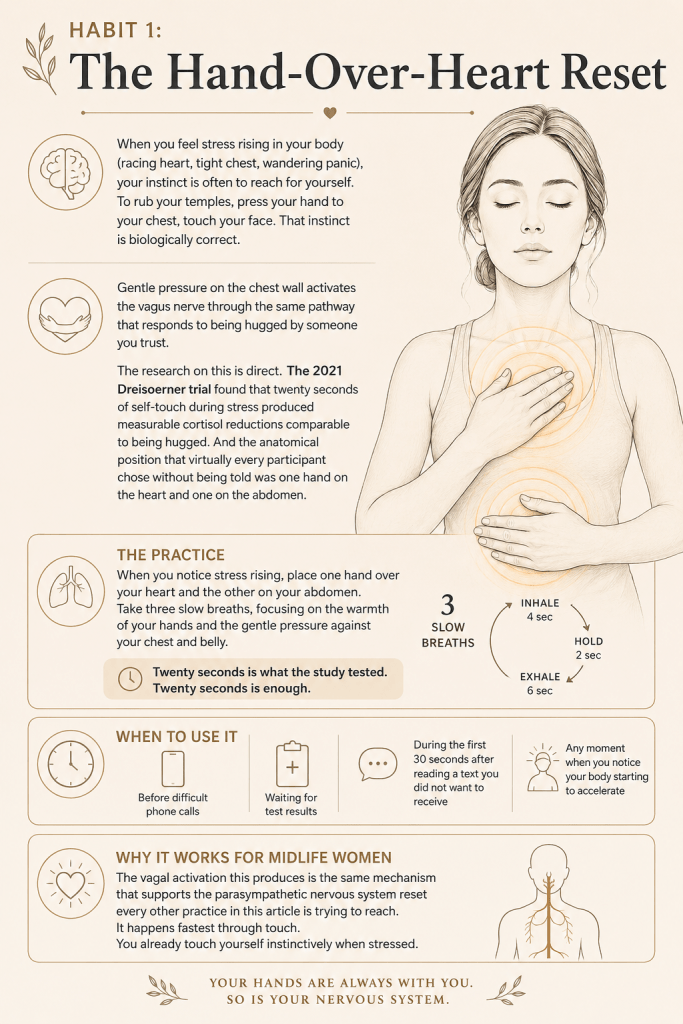
When you feel stress rising in your body (racing heart, tight chest, wandering panic), your instinct is often to reach for yourself. To rub your temples, press your hand to your chest, touch your face. That instinct is biologically correct.
Gentle pressure on the chest wall activates the vagus nerve through the same pathway that responds to being hugged by someone you trust. The research on this is direct. The 2021 Dreisoerner trial found that twenty seconds of self-touch during stress produced measurable cortisol reductions comparable to being hugged. And the anatomical position that virtually every participant chose without being told was one hand on the heart and one on the abdomen.
- The practice: When you notice stress rising, place one hand over your heart and the other on your abdomen. Take three slow breaths, focusing on the warmth of your hands and the gentle pressure against your chest and belly. Twenty seconds is what the study tested. Twenty seconds is enough.
- When to use it: Before difficult phone calls. Waiting for test results. During the first thirty seconds after reading a text you did not want to receive. Any moment when you notice your body starting to accelerate.
- Why it works for midlife women: The vagal activation this produces is the same mechanism that supports the parasympathetic nervous system reset every other practice in this article is trying to reach. It happens fastest through touch. You already touch yourself instinctively when stressed.
Free 28-Day Fascia Reset Email Course
Get our Free 28-day email course series to help with 1 or 2 exercises per day to release your fascia. One short lesson per day. Two minutes to read each.
Habit 2: The Five-and-One Grounding Practice
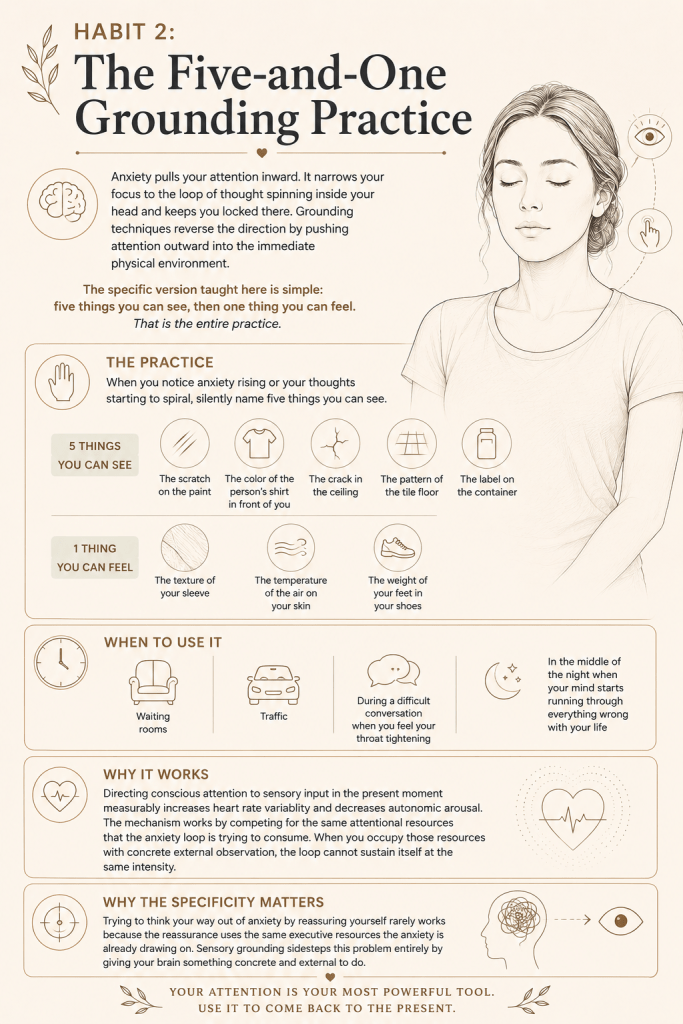
Anxiety pulls your attention inward. It narrows your focus to the loop of thought spinning inside your head and keeps you locked there. Grounding techniques reverse the direction by pushing attention outward into the immediate physical environment.
The specific version taught here is simple: five things you can see, then one thing you can feel. That is the entire practice.
- The practice: When you notice anxiety rising or your thoughts starting to spiral, silently name five things you can see. Do not analyze them. Do not judge them. Just name them. The scratch on the paint. The color of the person’s shirt in front of you. The crack in the ceiling. The pattern of the tile floor. The label on the container. Then name one thing you can physically feel. The texture of your sleeve. The temperature of the air on your skin. The weight of your feet in your shoes.
- When to use it: Waiting rooms. Traffic. During a difficult conversation when you feel your throat tightening. In the middle of the night when your mind starts running through everything wrong with your life.
- Why it works: Directing conscious attention to sensory input in the present moment measurably increases heart rate variability and decreases autonomic arousal. The mechanism works by competing for the same attentional resources that the anxiety loop is trying to consume. When you occupy those resources with concrete external observation, the loop cannot sustain itself at the same intensity.
- Why the specificity matters: Trying to think your way out of anxiety by reassuring yourself rarely works because the reassurance uses the same executive resources the anxiety is already drawing on. Sensory grounding sidesteps this problem entirely by giving your brain something concrete and external to do.
Habit 3: The One-Word Feeling Check
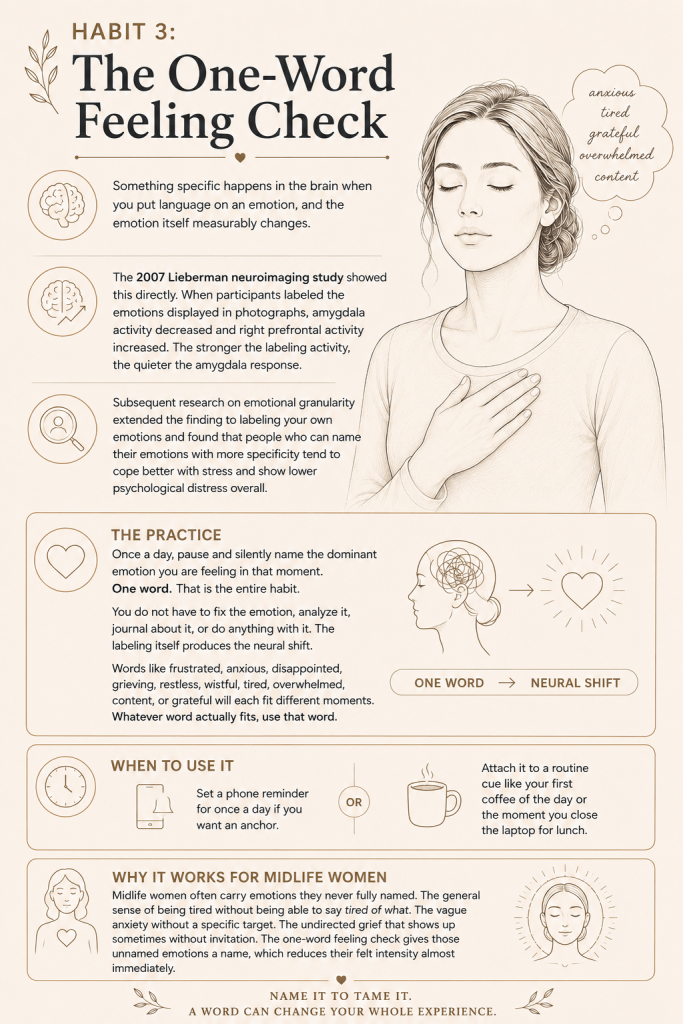
Something specific happens in the brain when you put language on an emotion, and the emotion itself measurably changes.
The 2007 Lieberman neuroimaging study showed this directly. When participants labeled the emotions displayed in photographs, amygdala activity decreased and right prefrontal activity increased. The stronger the labeling activity, the quieter the amygdala response.
Subsequent research on emotional granularity extended the finding to labeling your own emotions and found that people who can name their emotions with more specificity tend to cope better with stress and show lower psychological distress overall.
- The practice: Once a day, pause and silently name the dominant emotion you are feeling in that moment. One word. That is the entire habit. You do not have to fix the emotion, analyze it, journal about it, or do anything with it. The labeling itself produces the neural shift. Words like frustrated, anxious, disappointed, grieving, restless, wistful, tired, overwhelmed, content, or grateful will each fit different moments. Whatever word actually fits, use that word.
- When to use it: Set a phone reminder for once a day if you want an anchor. Or attach it to a routine cue like your first coffee of the day or the moment you close the laptop for lunch.
- Why it works for midlife women: Midlife women often carry emotions they never fully named. The general sense of being tired without being able to say tired of what. The vague anxiety without a specific target. The undirected grief that shows up sometimes without invitation. The one-word feeling check gives those unnamed emotions a name, which reduces their felt intensity almost immediately.
A note on specificity: The more precise the word, the stronger the effect. “Overwhelmed” is a good word. “Overwhelmed by what my mother said at lunch” is better if you have another five seconds. Precision produces the biggest neural shift.
Free 28-Day Fascia Reset Email Course
Get our Free 28-day email course series to help with 1 or 2 exercises per day to release your fascia. One short lesson per day. Two minutes to read each.
Habit 4: The Three-Breath Meal Ritual
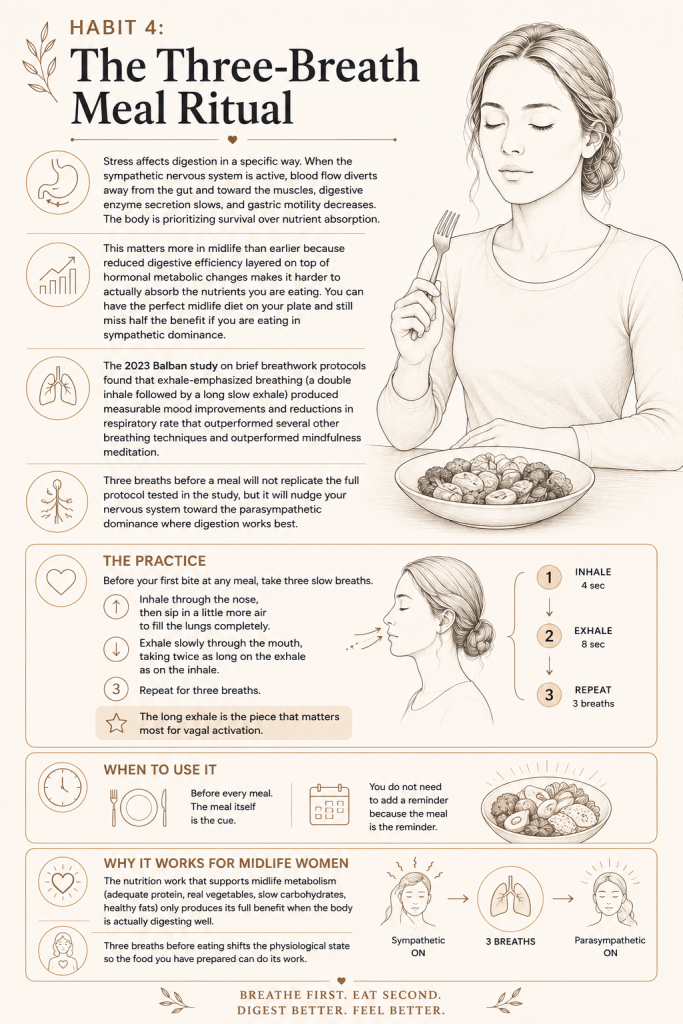
Stress affects digestion in a specific way. When the sympathetic nervous system is active, blood flow diverts away from the gut and toward the muscles, digestive enzyme secretion slows, and gastric motility decreases. The body is prioritizing survival over nutrient absorption.
This matters more in midlife than earlier because reduced digestive efficiency layered on top of hormonal metabolic changes makes it harder to actually absorb the nutrients you are eating. You can have the perfect midlife diet on your plate and still miss half the benefit if you are eating in sympathetic dominance.
The 2023 Balban study on brief breathwork protocols found that exhale-emphasized breathing (a double inhale followed by a long slow exhale) produced measurable mood improvements and reductions in respiratory rate that outperformed several other breathing techniques and outperformed mindfulness meditation.
Three breaths before a meal will not replicate the full protocol tested in the study, but it will nudge your nervous system toward the parasympathetic dominance where digestion works best.
- The practice: Before your first bite at any meal, take three slow breaths. Inhale through the nose, then sip in a little more air to fill the lungs completely. Exhale slowly through the mouth, taking twice as long on the exhale as on the inhale. The long exhale is the piece that matters most for vagal activation.
- When to use it: Before every meal. The meal itself is the cue. You do not need to add a reminder because the meal is the reminder.
- Why it works for midlife women: The nutrition work that supports midlife metabolism (adequate protein, real vegetables, slow carbohydrates, healthy fats) only produces its full benefit when the body is actually digesting well. Three breaths before eating shifts the physiological state so the food you have prepared can do its work.
Habit 5: The Red-Light Anchor
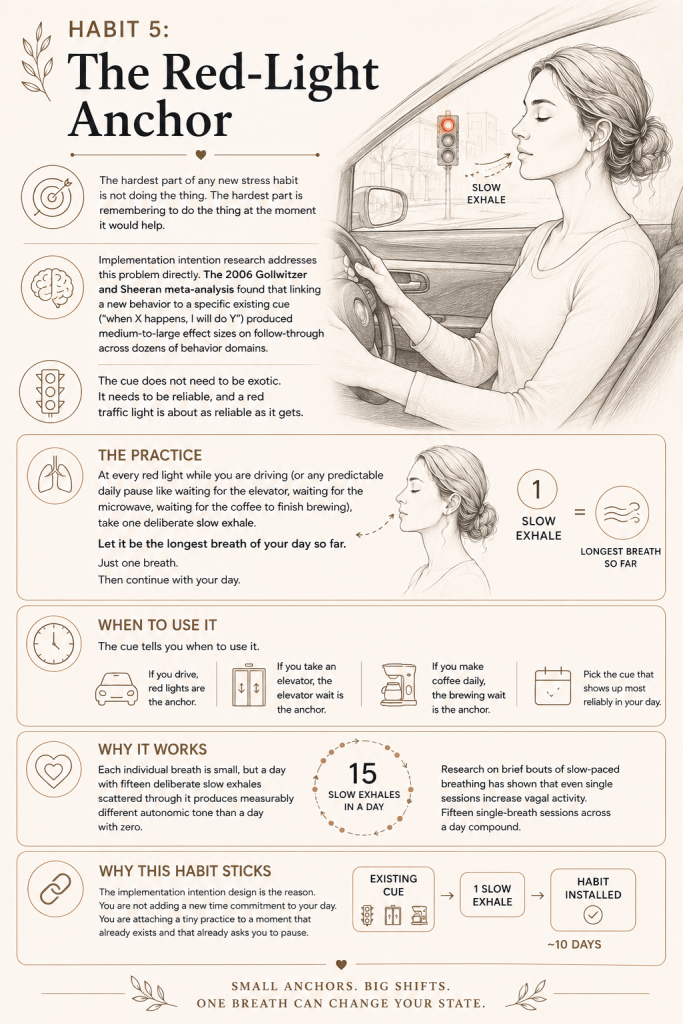
The hardest part of any new stress habit is not doing the thing. The hardest part is remembering to do the thing at the moment it would help.
Implementation intention research addresses this problem directly. The 2006 Gollwitzer and Sheeran meta-analysis found that linking a new behavior to a specific existing cue (“when X happens, I will do Y”) produced medium-to-large effect sizes on follow-through across dozens of behavior domains. The cue does not need to be exotic. It needs to be reliable, and a red traffic light is about as reliable as it gets.
- The practice: At every red light while you are driving (or any predictable daily pause like waiting for the elevator, waiting for the microwave, waiting for the coffee to finish brewing), take one deliberate slow exhale. Let it be the longest breath of your day so far. Just one breath. Then continue with your day.
- When to use it: The cue tells you when to use it. If you drive, red lights are the anchor. If you take an elevator, the elevator wait is the anchor. If you make coffee daily, the brewing wait is the anchor. Pick the cue that shows up most reliably in your day.
- Why it works: Each individual breath is small, but a day with fifteen deliberate slow exhales scattered through it produces measurably different autonomic tone than a day with zero. The compounding across a week and a month is significant. Research on brief bouts of slow-paced breathing has shown that even single sessions increase vagal activity. Fifteen single-breath sessions across a day compound.
- Why this habit sticks: The implementation intention design is the reason. You are not adding a new time commitment to your day. You are attaching a tiny practice to a moment that already exists and that already asks you to pause. The habit installs itself within about ten days for most people.
Free 28-Day Fascia Reset Email Course
Get our Free 28-day email course series to help with 1 or 2 exercises per day to release your fascia. One short lesson per day. Two minutes to read each.
Habit 6: The Shoulder-Drop Boundary
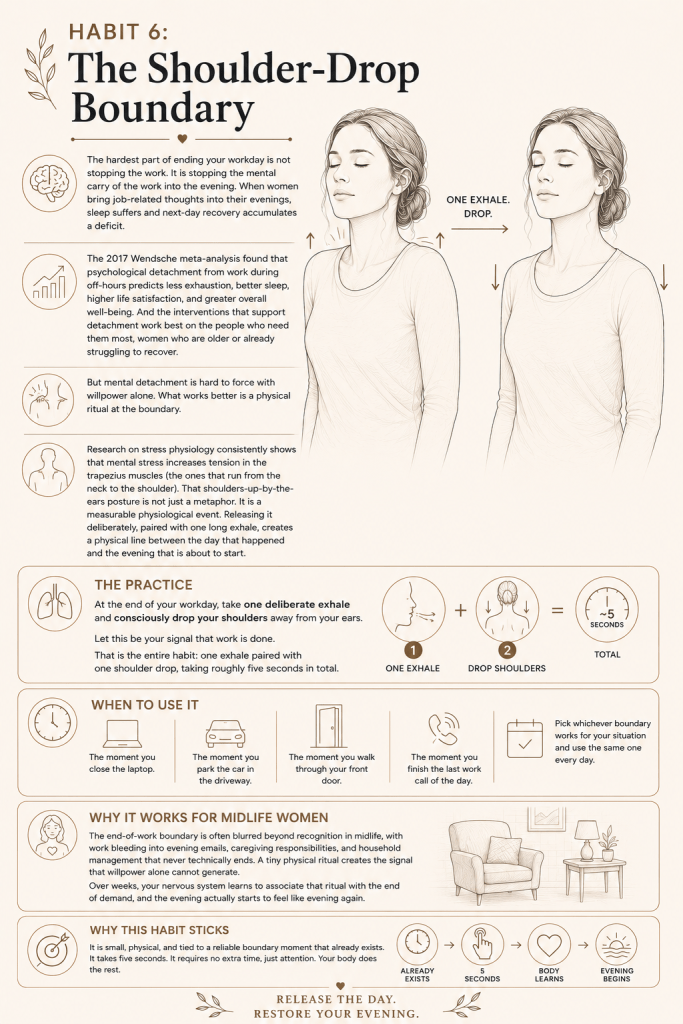
The hardest part of ending your workday is not stopping the work. It is stopping the mental carry of the work into the evening. When women bring job-related thoughts into their evenings, sleep suffers and next-day recovery accumulates a deficit.
The 2017 Wendsche meta-analysis found that psychological detachment from work during off-hours predicts less exhaustion, better sleep, higher life satisfaction, and greater overall well-being. And the interventions that support detachment work best on the people who need them most, women who are older or already struggling to recover.
But mental detachment is hard to force with willpower alone. What works better is a physical ritual at the boundary.
Research on stress physiology consistently shows that mental stress increases tension in the trapezius muscles (the ones that run from the neck to the shoulder). That shoulders-up-by-the-ears posture is not just a metaphor. It is a measurable physiological event. Releasing it deliberately, paired with one long exhale, creates a physical line between the day that happened and the evening that is about to start.
- The practice: At the end of your workday, take one deliberate exhale and consciously drop your shoulders away from your ears. Let this be your signal that work is done. That is the entire habit: one exhale paired with one shoulder drop, taking roughly five seconds in total.
- When to use it: The moment you close the laptop. The moment you park the car in the driveway. The moment you walk through your front door. The moment you finish the last work call of the day. Pick whichever boundary works for your situation and use the same one every day.
- Why it works for midlife women: The end-of-work boundary is often blurred beyond recognition in midlife, with work bleeding into evening emails, caregiving responsibilities, and household management that never technically ends. A tiny physical ritual creates the signal that willpower alone cannot generate. Over weeks, your nervous system learns to associate that ritual with the end of demand, and the evening actually starts to feel like evening again.
“The shoulder-drop habit produced the fastest measurable change for one of my coaching clients last year. She was a woman in her early fifties running a business while caring for aging parents. She had not slept properly in over two years. The habit took her about five seconds a day and she added no other interventions in the first two weeks. Her sleep quality started improving in the second week. Not because five seconds of shoulder-dropping fixed her sleep. Because that five-second ritual let her nervous system finally recognize the boundary between demand and recovery that her calendar was refusing to draw for her.”
Terry Tateossian, Founder of The House of Rose
Free 28-Day Fascia Reset Email Course
Get our Free 28-day email course series to help with 1 or 2 exercises per day to release your fascia. One short lesson per day. Two minutes to read each.
Habit 7: The One-Specific-Thing Gratitude Note
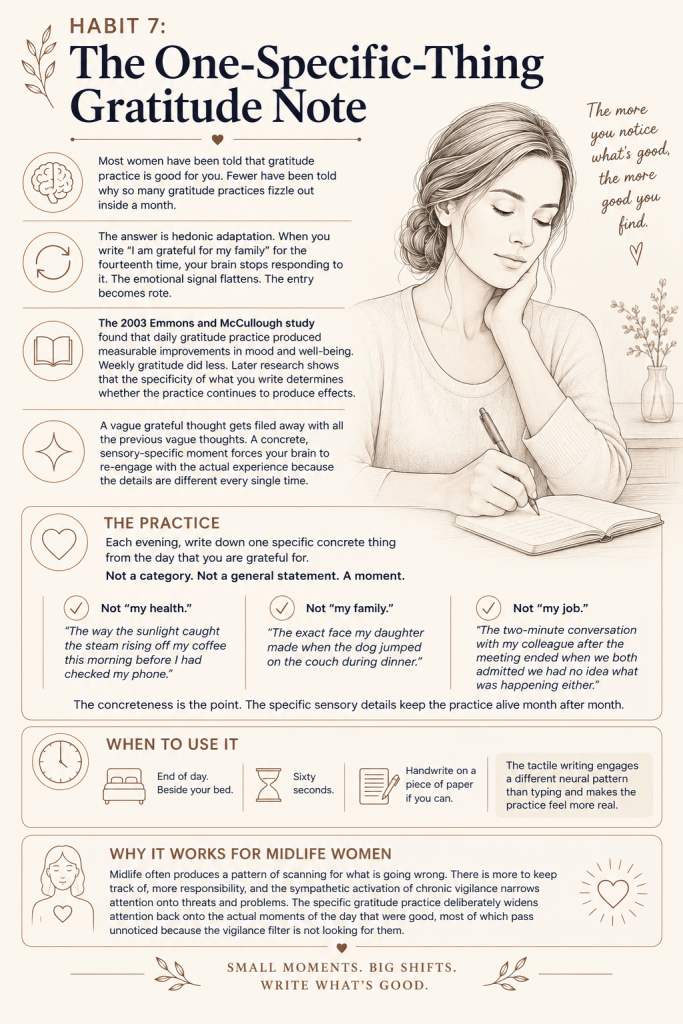
Most women have been told at some point that gratitude practice is good for you. Fewer have been told why so many gratitude practices fizzle out inside a month.
The answer is hedonic adaptation. When you write “I am grateful for my family” for the fourteenth time, your brain stops responding to it. The emotional signal flattens. The entry becomes rote. The gratitude journal ends up in a drawer next to the meditation cushion you also stopped using.
The 2003 Emmons and McCullough foundational study on gratitude interventions found that daily gratitude practice produced measurable improvements in mood and well-being. Weekly gratitude did less. But the daily practice worked, and later research consistently found that the specificity of what you write is what determines whether the practice continues to produce effects.
A vague grateful thought gets processed and filed away with all the previous vague grateful thoughts. A concrete sensory-specific moment forces your brain to re-engage with the actual experience because the details are different every single time.
- The practice: Each evening, write down one specific concrete thing from the day that you are grateful for. Not a category. Not a general statement. A moment. Not “my health.” The way the sunlight caught the steam rising off my coffee this morning before I had checked my phone. Not “my family.” The exact face my daughter made when the dog jumped on the couch during dinner. Not “my job.” The two-minute conversation with my colleague after the meeting ended when we both admitted we had no idea what was happening either. The concreteness is the point. The specific sensory details are what keep the practice alive month after month.
- When to use it: End of day. Beside your bed. Sixty seconds. Handwrite on a piece of paper if you can. The tactile writing engages a different neural pattern than typing, and the friction of getting a pen and paper out has been shown to make the practice feel more real.
- Why it works for midlife women: Midlife often produces a pattern of scanning for what is going wrong. There is more to keep track of, more responsibility, more variables, and the sympathetic activation of chronic vigilance narrows attention onto threats and problems. The specific gratitude practice deliberately widens attention back onto the actual moments of the day that were good, most of which pass unnoticed because the vigilance filter is not looking for them.
How Can You Install These Habits Successfully?
The single biggest mistake with any list of seven habits is trying to install all seven at once. This does not work. The research on habit formation is unambiguous. Adding one new habit at a time produces dramatically higher success rates than trying to add several at once.
Here is the sequence that actually works.
- Week 1: Pick one habit from the seven above. Just one. Choose the one whose cue you encounter most reliably in your day. If you eat three meals daily, the three-breath meal ritual has three built-in reminders every day. If you drive, the red-light anchor has dozens per day. If you spend evenings alone or with family after work, the shoulder-drop boundary has one very reliable cue per day. Pick the one whose cue you cannot miss.
- Week 2: Continue the one habit. Do not add a second one yet. The first habit is not automatic yet. Give it time.
- Week 3 to 4: By now the first habit is starting to feel automatic. Add a second one. Pick the next habit whose cue is easiest to attach to. Keep the first one running.
- Month 2: Add a third habit. By now the first two are running without conscious effort. The third one attaches on top.
- Months 3 to 6: Add the remaining four habits at a pace of roughly one per month. By month six you have all seven habits installed and running automatically throughout the day.
The pace feels slow, but it is genuinely faster than the alternative. Almost no one who tries to install seven habits at once has all seven installed six months later. Almost everyone who installs them one at a time has all seven by month six or seven, and the compounding effect on nervous system tone is substantially larger than any six-month program that tried to do everything at once.
The reason is simple. Once a habit is automatic, it costs almost nothing to maintain. Habit stacking research shows that automatic habits accumulate without draining willpower, while non-automatic habits compete for the same finite decision-making resource. Slowly adding one at a time keeps you inside the resource capacity your brain actually has available.
Free 28-Day Fascia Reset Email Course
Get our Free 28-day email course series to help with 1 or 2 exercises per day to release your fascia. One short lesson per day. Two minutes to read each.
How Do These Habits Fit the THOR Framework?
The seven micro-habits are one layer of the five-component lifestyle medicine framework I teach at THOR. Each layer supports the others.
- Nutrition: The free Macro Calculator provides the personalized nutrition foundation. The Macro Miracle Mediterranean Cookbook is the kitchen-side companion. Nutrition affects stress physiology directly through blood sugar regulation, inflammation, and cortisol pattern.
- Daily movement: The micro walks practice is the movement equivalent of the seven stress habits, using existing pauses in your day for tiny consistent movement instead of expecting a single large workout to carry all your movement needs.
- Sleep: Sleep is the foundation underneath every other lifestyle intervention. The seven habits support sleep by reducing baseline sympathetic activation across the day, which lets the parasympathetic system take over in the evening.
- Nervous system regulation: The seven habits are the daily-life expression of the broader nervous system framework covered in our parasympathetic nervous system and aging article, our vagus nerve and gut health article, and our fascia and lymphatic system connection article.
- Supplement foundation: Magnesium, B-complex, omega-3, and adaptogenic herbs all support the underlying biology that stress management practices work with. The foundational supplement collection covers the priorities.
For women who want sustained 1:1 support on the full framework, the Monthly Personal Training and Nutrition Coaching Program is the longer-arc option. For the immersive version, the Deeply Restorative Yoga and Nature Retreat at our Smoky Mountains property installs the full framework in a five-day concentrated experience, including all seven of these habits practiced in a supported environment.
“The reason I teach these seven habits alongside the food, the sleep, the supplements, and the strength training is that stress physiology is what determines whether all the other work lands or not. You can hit your protein target, sleep eight hours, take the perfect supplement stack, and still stall if your nervous system is running in low-grade alarm mode for most of the day. These seven tiny habits are what let the rest of the framework actually work.”
Terry Tateossian, Founder of The House of Rose
Free 28-Day Fascia Reset Email Course
Get our Free 28-day email course series to help with 1 or 2 exercises per day to release your fascia. One short lesson per day. Two minutes to read each.
What Are Your Next Steps?
If the framework in this article resonates and you want to install the seven habits into your daily life, here are the four next steps in order of friction.
- Pick one habit for this week. Choose the one whose cue shows up most reliably in your day. Commit to the one for seven days before adding anything else.
- Track completion, not intensity. A simple check mark on a calendar or in your notes app is enough. The point is the daily completion, not a rating of how well you did the habit.
- Layer the second habit in week three. Wait until the first one feels automatic. This is usually around day ten to fourteen. Then add the next habit whose cue you cannot miss.
- Build the broader framework underneath. The free Macro Calculator, the foundational supplement collection, and the daily movement practice give the stress habits something to sit on top of. For sustained 1:1 support, the Monthly Coaching Program provides personalized programming. For the immersive version, the Deeply Restorative Yoga and Nature Retreat at our Smoky Mountains property installs all seven habits during a five-day concentrated experience.
Frequently Asked Questions
Do these tiny stress habits really work?
The individual practices in this article are supported by peer-reviewed research on cortisol, heart rate variability, amygdala activity, and psychological detachment. The habits are effective when they become consistent, which is a function of installation rather than any single session. One check of the hand-over-heart reset will not transform your stress physiology. Sixty completions across sixty days will produce measurable change.
How is this different from meditation?
Meditation typically asks for a dedicated block of time. These seven habits are designed for the pauses already in your day. They are complementary rather than competitive. Women who meditate can add these habits on top and both practices reinforce each other. Women who cannot sustain a meditation practice can use these habits as a much more accessible entry point to nervous system regulation.
How long before I feel a difference?
Most women feel a subtle difference within the first ten uses of any single habit. The felt sense of having some control over your own nervous system in a hard moment is often the first noticeable change. Measurable changes in baseline stress physiology, sleep quality, and daytime energy typically show up at the four to six week mark of consistent practice. The compound benefits continue accumulating over months.
Free 28-Day Fascia Reset Email Course
Get our Free 28-day email course series to help with 1 or 2 exercises per day to release your fascia. One short lesson per day. Two minutes to read each.
Which habit should I start with?
Pick the one whose cue you encounter most reliably in your day. If you eat three meals daily, the three-breath meal ritual has three built-in reminders. If you drive, the red-light anchor has dozens. If you have a clear end-of-workday boundary, the shoulder-drop is easy. The cue reliability matters more than the habit’s felt appeal on first read.
Can I do all seven habits at once?
You can technically start all seven at once, but the research on habit formation is unambiguous that installing one at a time produces dramatically higher long-term success rates than trying to install several simultaneously. The recommended pace is one habit per two to four weeks, layering the next one once the previous ones feel automatic.
Do these habits help with menopause symptoms specifically?
Menopause symptoms and stress physiology are intertwined. Hot flashes, sleep disruption, anxiety, and mood changes are all amplified by chronic sympathetic activation, and reducing baseline sympathetic activation through these habits often produces measurable improvements in menopause symptom severity. The habits are not a substitute for medical treatment where clinically appropriate, but they are a strong complement.
Is the science really strong on self-touch?
The 2021 Dreisoerner randomized controlled trial demonstrated measurable cortisol effects from self-touch during stress, comparable in some measurements to being hugged by another person. The mechanism (vagal afferent activation through gentle chest wall pressure) is well established in autonomic nervous system physiology. The specific 20-second self-touch protocol tested in the study is what the practice in this article is built on.
Can I use these habits during panic attacks or acute anxiety?
The five-and-one grounding practice and the hand-over-heart reset are both appropriate first-line responses for rising panic or acute anxiety in most cases. If you have a diagnosed anxiety disorder, PTSD, or any mental health condition requiring clinical care, use these habits as complements to professional treatment rather than as replacements. Any acute episode that does not resolve or that keeps returning deserves evaluation by a qualified clinician.
How do these connect to cortisol and menopause weight gain?
Chronic sympathetic activation drives cortisol elevation, which contributes to abdominal fat storage, insulin resistance, and the specific weight pattern many midlife women experience. Reducing sympathetic tone through these daily habits addresses one of the upstream drivers of the metabolic dysfunction that often accompanies perimenopause and menopause. Combined with the menopause diet plan framework and adequate protein and sleep, the habits are one of the layers supporting midlife body composition work.
Should I write the gratitude entries down or just think them?
The 2003 Emmons and McCullough foundational study used written gratitude entries, and subsequent research has consistently found that writing produces stronger effects than mental gratitude alone. The friction of getting a pen or opening a notes app is part of what makes the practice register as real. Handwriting appears to produce slightly stronger effects than typing based on the available research.
What if I miss a day?
One missed day does not undo the practice. Two consecutive missed days makes recovery harder. Three or more consecutive missed days generally requires deliberately restarting the practice from week one. The single most important principle is never missing two days in a row.
Are the habits appropriate at any life stage?
The seven habits work for women in perimenopause, menopause, post-menopause, and women in earlier life stages. They also work for men. The framing in this article is specifically for midlife women because that is the THOR audience and because midlife women often benefit disproportionately from the habits due to the specific stress physiology of the menopausal transition. The habits themselves are universal.
How do these connect to sleep?
Every one of the seven habits supports better sleep by reducing baseline sympathetic activation during the day. When the daytime nervous system tone is calmer, the evening parasympathetic shift into sleep happens more easily. Women who install even two or three of the habits often report improved sleep quality within the first month, particularly when the shoulder-drop boundary and the gratitude bookmark are among the ones they choose.
Free 28-Day Fascia Reset Email Course
Get our Free 28-day email course series to help with 1 or 2 exercises per day to release your fascia. One short lesson per day. Two minutes to read each.
When should I see a healthcare professional?
If you are experiencing significant persistent anxiety, panic attacks, insomnia that does not respond to lifestyle changes, or any mental health symptoms that affect your ability to function, see a qualified clinician. These seven habits are lifestyle-medicine complements to professional care rather than substitutes for it. Always consult your healthcare provider before adding new practices if you have any medical or psychological condition that requires clinical attention.
References
- Dreisoerner, A., Junker, N. M., Schlotz, W., et al. (2021). Self-soothing touch and being hugged reduce cortisol responses to stress: A randomized controlled trial on stress, physical touch, and social identity. Comprehensive Psychoneuroendocrinology, 8, 100091.
- Lieberman, M. D., Eisenberger, N. I., Crockett, M. J., Tom, S. M., Pfeifer, J. H., & Way, B. M. (2007). Putting feelings into words: Affect labeling disrupts amygdala activity in response to affective stimuli. Psychological Science, 18(5), 421–428.
- Balban, M. Y., Neri, E., Kogon, M. M., et al. (2023). Brief structured respiration practices enhance mood and reduce physiological arousal. Cell Reports Medicine, 4(1), 100895.
- Gollwitzer, P. M., & Sheeran, P. (2006). Implementation intentions and goal achievement: A meta-analysis of effects and processes. Advances in Experimental Social Psychology, 38, 69–119.
- Wendsche, J., & Lohmann-Haislah, A. (2017). A meta-analysis on antecedents and outcomes of detachment from work. Frontiers in Psychology, 7, 2072.
- Emmons, R. A., & McCullough, M. E. (2003). Counting blessings versus burdens: An experimental investigation of gratitude and subjective well-being in daily life. Journal of Personality and Social Psychology, 84(2), 377–389.
- Hopper, S. I., Murray, S. L., Ferrara, L. R., & Singleton, J. K. (2019). Effectiveness of diaphragmatic breathing for reducing physiological and psychological stress in adults: a quantitative systematic review. JBI Database of Systematic Reviews and Implementation Reports, 17(9), 1855–1876.
- Thayer, J. F., & Lane, R. D. (2007). The role of vagal function in the risk for cardiovascular disease and mortality. Biological Psychology, 74(2), 224–242.
- Lehrer, P. M., & Gevirtz, R. (2014). Heart rate variability biofeedback: how and why does it work? Frontiers in Psychology, 5, 756.
- Fogg, B. J. (2019). Tiny Habits: The Small Changes That Change Everything. Houghton Mifflin Harcourt.
- Clear, J. (2018). Atomic Habits: An Easy and Proven Way to Build Good Habits and Break Bad Ones. Avery.
- Lally, P., van Jaarsveld, C. H. M., Potts, H. W. W., & Wardle, J. (2010). How are habits formed: modelling habit formation in the real world. European Journal of Social Psychology, 40(6), 998–1009.
- Wood, W., & Neal, D. T. (2007). A new look at habits and the habit-goal interface. Psychological Review, 114(4), 843–863.
- Maki, P. M., Kornstein, S. G., Joffe, H., et al. (2018). Guidelines for the evaluation and treatment of perimenopausal depression: summary and recommendations. Menopause, 25(10), 1069–1085.
- Bondarev, D., Sipilä, S., Finni, T., et al. (2018). The role of physical activity in the link between menopausal status and mental well-being. Menopause, 25(7), 757–765.
- Innes, K. E., Selfe, T. K., & Vishnu, A. (2010). Mind-body therapies for menopausal symptoms: a systematic review. Maturitas, 66(2), 135–149.
- Cramer, H., Lauche, R., Langhorst, J., & Dobos, G. (2018). Yoga for menopausal symptoms: a systematic review and meta-analysis. Maturitas, 109, 13–25.
- Boyle, N. B., Lawton, C., & Dye, L. (2017). The effects of magnesium supplementation on subjective anxiety and stress: a systematic review. Nutrients, 9(5), 429.
Disclaimer: Always consult with a healthcare professional before starting any new routines, programs, or nutrition plans to ensure you receive the best medical advice and strategy for your specific individual needs.
Free 28-Day Fascia Reset Email Course
Get our Free 28-day email course series to help with 1 or 2 exercises per day to release your fascia. One short lesson per day. Two minutes to read each.

Terry Tateossian is a Menopause Lifestyle Medicine Coach, Certified Personal Trainer & Nutritionist and the Founder of THOR: The House of Rose, a wellness brand serving women over 40 through retreats, coaching, macro-nutrition and community. As 25-year founder and entrepreneur, Terry spent two and a half decades building and running successful start-up businesses, an experience that put her on the front line of founder burnout long before she could name it. After facing serious health challenges, early onset menopause, and emotional eating while running her agency and raising two children, Terry rebuilt her health in her 40s and lost more than 80 pounds through evidence-based nutrition, training, and mindset work. Today, she helps women get strong, improve confidence, support hormone health, and create a stronger second half of life. Terry has been featured in major media outlets and is available for podcasts, expert commentary, brand collaborations, and speaking engagements on midlife health, reinvention, emotional eating, menopause wellness, and strength training for longevity. Get her free macro calculator (her cookbook companion) to start your journey to back to health.