

 By Team THOR
Free 28-Day Fascia Reset Email Course
Get our Free 28-day email course series to help with 1 or 2 exercises per day to release your fascia. One short lesson per day. Two minutes to read each.
The Fascia and Lymphatic System Connection: How Your Body’s Living Water Highway Actually Works (and Why It Matters in Midlife Women)
The fascia and lymphatic system connection is one of the most consequential and least understood relationships in human physiology. Most women learn about the lymphatic system as a plumbing network for waste and immune cells and about the fascia as the connective tissue web that surrounds every muscle.
Almost no one is taught that the two systems are physically inseparable, or that the health of one directly determines the function of the other. For midlife women dealing with the puffiness, brain fog, inflammation, and slow recovery that often intensify during perimenopause and menopause, this connection is where a large piece of the answer lives.
This guide explores the connection between the fascia and lymphatic systems. You’ll also learn why supporting these systems becomes especially important for women in midlife, which daily habits can benefit both, and how these practices fit into a broader lifestyle medicine approach to healthy aging.
Important: This article is general educational content, not personalized medical advice. Always consult with your healthcare provider.
What Is Fascia and What Is the Lymphatic System?
Understanding the fascia and lymphatic system connection begins with a clear picture of each system on its own.
What Fascia Is and How It Works
Fascia is the body-wide connective tissue web that surrounds every muscle, organ, blood vessel, and lymph vessel in the body. It is composed primarily of collagen fibers, elastin, ground substance (which contains water, glycosaminoglycans, and proteoglycans), and specialized cells called fibroblasts that maintain and remodel the tissue.
The fascia is not a passive wrapping. Research over the last two decades has established fascia as an active sensory tissue with mechanoreceptors, contractile properties, and a role in force transmission and communication throughout the body.
The fascia is organized into distinct but connected layers:
- Superficial Fascia: Lies directly beneath the skin and connects to the deeper fascial layers.
- Deep Fascia: Surrounds and separates muscle groups, wraps individual muscles, and continues into the tendinous connections that anchor muscles to bones.
- Visceral Fascia: Surrounds and supports the internal organs.
All of these layers are continuous with one another. Together, they form a single interconnected web that runs from the top of the head to the soles of the feet without interruption.
How the Lymphatic System Moves Fluid and Waste
The lymphatic system is a network of vessels, nodes, and organs that transports lymph (a clear fluid rich in white blood cells, proteins, and cellular waste) from the tissues back into the bloodstream. The system has three primary functions: maintaining fluid balance in tissues, supporting immune surveillance through the lymph nodes, and clearing cellular waste products that are too large for the venous system to carry.
Unlike the circulatory system, the lymphatic system has no central pump. Lymph moves through a combination of smooth muscle contraction in the vessel walls, the mechanical pressure of breathing and movement, and external stimulation.
Where Fascia and the Lymphatic System Connect
The critical anatomical fact. The lymphatic vessels do not run in open channels through the body. They run through the fascia. The two systems are physically inseparable at the tissue level. This is the point that determines everything that follows in this article.
Why Can Fascia and the Lymphatic System Not Be Separated?
The fascia and lymphatic system connection is not metaphorical or philosophical. The relationship is anatomical at the tissue level. The lymphatic vessels are embedded within the fascial matrix and depend on the fascia’s properties for their function.
How Are the Two Systems Physically Connected?
A useful mental picture is to imagine the fascia as a continuous mesh of dense but pliable fabric wrapping every structure in the body. The lymphatic vessels are like fine threads woven through that fabric.
When the fascia is loose, well-hydrated, and mobile, the vessels inside it can move freely and lymph flows efficiently. When the fascia becomes tight, dehydrated, or restricted, those vessels can become compressed and lymphatic flow slows.
This is why fascial dysfunction often contributes to lymphatic dysfunction. It also explains why treating either system in isolation may produce only temporary results. The two systems need to be addressed together because they function as one connected system with two distinct roles.
What Does the Research Suggest?
Several converging pieces of evidence support this relationship:
- Manual Lymphatic Drainage: Techniques that soften the fascia can support better lymphatic outcomes than techniques focused only on the lymph vessels.
- Fascial Stiffness: Research on the mechanical properties of fascia shows that stiffened tissue can compress nearby structures, including lymphatic vessels.
- Lymphedema Treatment: Studies involving lymphedema, the chronic swelling that can follow lymphatic system damage, suggest that fascial mobility may influence the success of lymphatic treatment protocols.
Together, these findings support the idea that lymphatic flow depends partly on the mobility, hydration, and condition of the surrounding fascial tissue.
What Does This Mean for Midlife Women?
For midlife women, the practical implication is clear. Daily practices that support both the fascia and the lymphatic system may produce better outcomes than practices targeting either one alone.
The four practices covered later in this article were chosen specifically because they engage both systems simultaneously.
Free 28-Day Fascia Reset Email Course
Get our Free 28-day email course series to help with 1 or 2 exercises per day to release your fascia. One short lesson per day. Two minutes to read each.
How Do Collagen and Fascia Generate Electrical Signals?
One of the most interesting and least discussed features of fascia is that its primary building block, collagen, is piezoelectric. Piezoelectricity is the property of certain materials to generate an electrical charge in response to mechanical pressure or deformation. The phenomenon was first documented in bone by Fukada and Yasuda in a landmark 1957 study, and subsequent research over the following decades extended the finding to collagen tissues throughout the body.
The piezoelectric properties of collagen have several practical implications for the fascia and lymphatic system connection.
Fascia’s Bioelectric Signaling
When you walk, breathe, stretch, or move in any way, the mechanical deformation of the fascial network produces small electrical currents throughout the tissue. These currents contribute to the cellular communication that regulates tissue repair, immune activity, and inflammatory tone.
- Fascia is semiconductive, meaning it can transmit electrical signals through the tissue. The collagen matrix, particularly when properly hydrated, functions as a bioelectric transmission medium. Research on bioelectric signaling in connective tissues has documented this transmission capacity and connected it to wound healing, tissue regeneration, and immune coordination.
- Piezoelectric signaling in fascia influences fibroblast activity. Fibroblasts are the cells that produce and maintain the collagen matrix. Their behavior responds to the electrical currents generated during mechanical loading. Consistent daily movement produces consistent piezoelectric signaling, which supports healthy collagen turnover and tissue maintenance.
- The piezoelectric fascia interacts with the electrical activity of the lymphatic vessels. Lymphatic vessels have their own intrinsic electrical rhythm generated by the smooth muscle in their walls (called lymphangions). The bioelectric environment of the surrounding fascia influences this rhythm, and mechanical inputs to the fascia through movement, breath, and manual stimulation produce measurable effects on lymphatic contraction rates.
The practical takeaway is that the fascia and lymphatic system are connected not only mechanically but also electrically. Movement is not just physically pumping the lymph. It is also creating the bioelectric environment that supports lymphatic function at the cellular level.
“Most women who come to me for coaching arrive thinking of their bodies in mechanical terms. Muscles here, joints there, digestion in the middle. The picture that changes everything for them is when they start to understand the body as an interconnected fluid and electrical system, with the fascia and the lymphatic system as the primary infrastructure. Once you see it this way, the daily practices stop feeling like a list of things to do and start feeling like inputs to a living system that responds to what you give it.”
Terry Tateossian, Founder of The House of Rose
How Does the Interstitium Support the Body’s Fluid Network?
In 2018, researchers at NYU School of Medicine published a paper in Scientific Reports that formally characterized a previously unrecognized anatomical structure called the interstitium.
The interstitium is a body-wide network of fluid-filled spaces embedded within the fascial network and running through virtually every tissue in the body. The paper by Benias and colleagues described it as potentially one of the largest organs in the human body by volume, although its recognition as a distinct organ remains a subject of ongoing scientific discussion.
How Does the Interstitium Connect Fascia and Lymph?
The interstitium sits directly at the intersection of the fascia and lymphatic system connection. Its fluid-filled spaces are the source of much of the lymph that eventually enters the lymphatic vessels.
When the body loses interstitial fluid balance, the entire fluid clearance system can slow down. Several factors may contribute to this disruption:
- Dehydration: Reduces the amount of fluid available to support fascial mobility and lymphatic flow.
- Chronic Inflammation: Changes the tissue environment and can interfere with normal fluid movement.
- Fascial Restriction: Compresses the spaces and vessels through which interstitial fluid and lymph move.
What Is Structured Water?
The water within the fascia and interstitium has attracted growing research attention. Gerald Pollack’s laboratory at the University of Washington has published research on what his team calls the fourth phase of water, also known as exclusion zone water.
This theory describes a structured water phase that forms near hydrophilic surfaces, including collagen. Pollack’s work proposes that this water may have different physical properties from bulk water, including differences in density, viscosity, and electrical charge.
This area of research is still developing and remains outside mainstream biophysics consensus. However, the broader concept that water bound to biological surfaces behaves differently from free water is well established across multiple scientific fields.
Why Is Fascial Hydration Important?
What is more thoroughly established is that fascia contains a significant volume of bound water and that this water is essential to fascial function.
When fascia becomes dehydrated, the tissue stiffens, the viscosity of the ground substance changes, and both fascial mobility and lymphatic flow decline. Common contributors include:
- Inadequate Fluid Intake: Limits the water available to hydrate the fascial matrix.
- Prolonged Immobility: Reduces the movement needed to circulate fluid through the tissues.
- Chronic Inflammation: Alters the composition and movement of fluid within the fascia.
- Aging: Contributes to changes in tissue hydration, elasticity, and mobility.
Rehydrating the fascia is one of the primary mechanisms through which daily movement, adequate fluid intake, and manual therapies may produce their benefits.
The practical model is simple: fascia holds a large volume of water, this water supports both fascial mobility and lymphatic flow, and daily practices that maintain fascial hydration can benefit both systems.
Free 28-Day Fascia Reset Email Course
Get our Free 28-day email course series to help with 1 or 2 exercises per day to release your fascia. One short lesson per day. Two minutes to read each.
Where Does the Lymphatic System Run in the Body?
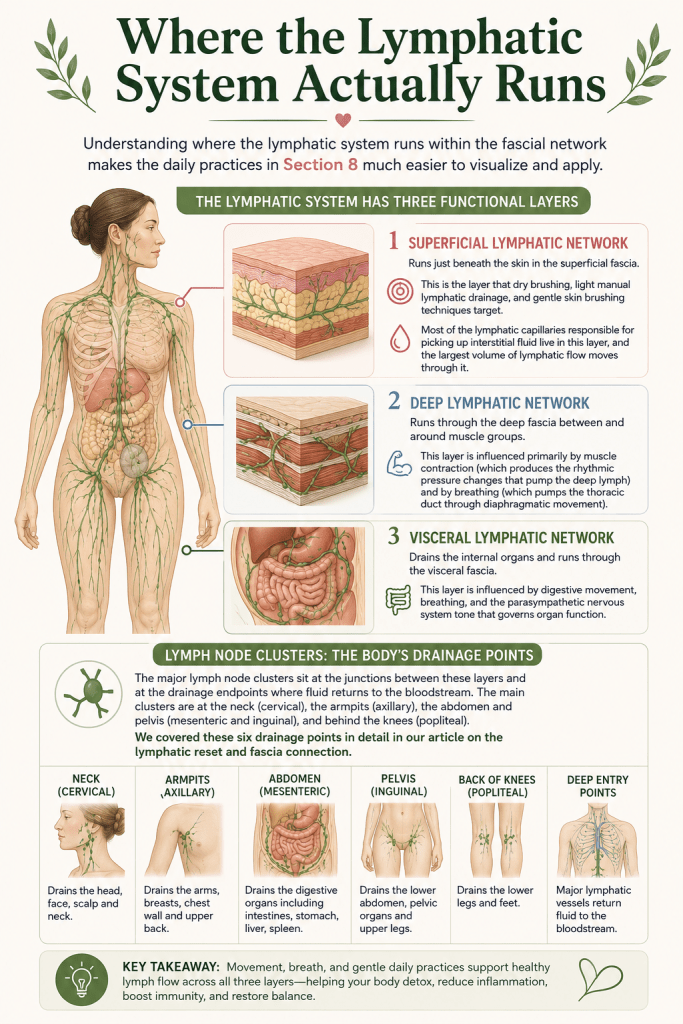
Understanding where the lymphatic system runs within the fascial network makes the daily practices in Section 8 much easier to visualize and apply.
The lymphatic system has three functional layers.
- The superficial lymphatic network runs just beneath the skin in the superficial fascia. This is the layer that dry brushing, light manual lymphatic drainage, and gentle skin brushing techniques target. Most of the lymphatic capillaries responsible for picking up interstitial fluid live in this layer, and the largest volume of lymphatic flow moves through it.
- The deep lymphatic network runs through the deep fascia between and around muscle groups. This layer is influenced primarily by muscle contraction (which produces the rhythmic pressure changes that pump the deep lymph) and by breathing (which pumps the thoracic duct through diaphragmatic movement).
- The visceral lymphatic network drains the internal organs and runs through the visceral fascia. This layer is influenced by digestive movement, breathing, and the parasympathetic nervous system tone that governs organ function.
The major lymph node clusters sit at the junctions between these layers and at the drainage endpoints where fluid returns to the bloodstream. The main clusters are at the neck (cervical), the armpits (axillary), the abdomen and pelvis (mesenteric and inguinal), and behind the knees (popliteal). We covered these six drainage points in detail in our article on the lymphatic reset and fascia connection.
For the fascia and lymphatic system connection specifically, the practical point is that different practices reach different layers of the network. Dry brushing and light skin work reach the superficial layer. Movement, strength training, and rebounding reach the deep layer. Breathwork and abdominal work reach the visceral layer. A daily practice that includes at least one input to each of the three layers produces the strongest whole-body results.
Why Does the Fascia-Lymph Connection Matter in Midlife Women?
Several biological changes make the fascia and lymphatic system connection particularly important in midlife women.
- Estrogen affects both fascia and lymphatic function. Estrogen receptors are present throughout the fascia, and estrogen supports the collagen synthesis, hyaluronic acid production, and tissue hydration that maintain fascial mobility. Estrogen also influences lymphatic vessel contractility. As estrogen declines through perimenopause and drops sharply at menopause, both systems experience a decrease in function simultaneously, and the fascia and lymphatic system connection becomes a place where the effects of hormonal change compound.
- Sedentary patterns accumulate. Midlife is often the decade when work becomes more sedentary and the accumulated effects of years of desk-based time become biologically visible. Because both the fascia and the lymphatic system depend on movement to maintain their function, sustained sitting is one of the most reliable contributors to combined fascial and lymphatic decline.
- Sleep architecture changes reduce nighttime lymphatic clearance. The glymphatic system (the brain’s specialized lymphatic network) runs most actively during deep slow-wave sleep. The fragmented sleep of perimenopause and menopause reduces this clearance window and contributes to the morning brain fog and puffiness many midlife women describe.
- Chronic sympathetic activation drives fascial tightening. The sustained low-grade stress that characterizes modern midlife life produces micro-contractions in the fascial network that gradually restrict lymphatic flow. We covered the deeper science of this in our article on the parasympathetic nervous system and aging in midlife women.
- Body weight changes affect both systems. The 10 to 15 pound weight changes that often accompany the menopausal transition add mechanical compression to the lymphatic network and increase the inflammatory load the fascia has to process. The menopause diet plan is the nutrition foundation that supports both systems.
- Recovery capacity declines. The body’s ability to recover from any insult (physical, emotional, immunological, or metabolic) depends partly on the efficient function of the fascia-lymph system. When both slow down, everything else takes longer to heal.
The combined effect is that the fascia and lymphatic system connection is being asked to do more work in midlife women (more inflammatory clearance, more immune surveillance, more waste processing) at exactly the moment when the inputs that support both systems are becoming less reliable. Deliberate daily attention to the connection is what restores the balance.
Free 28-Day Fascia Reset Email Course
Get our Free 28-day email course series to help with 1 or 2 exercises per day to release your fascia. One short lesson per day. Two minutes to read each.
What Are the Signs of Fascia-Lymph Dysfunction?
Fascia-lymph dysfunction rarely produces a single dramatic symptom. It produces a cluster of low-level issues that women learn to live with and often dismiss as normal midlife experiences. Recognizing the pattern is the first step to addressing it.
- Persistent puffiness. Particularly around the eyes in the morning, the ankles by the end of the day, the fingers in warm weather, and the face when sleep has been poor.
- Morning brain fog that takes hours to clear. Reflects incomplete overnight glymphatic clearance and general lymphatic sluggishness in the head and neck.
- Chronic joint and muscle stiffness that does not resolve with rest. The fascia is holding tension patterns that rest alone cannot release.
- Slow healing from minor injuries. Cuts, bruises, and small strains take days longer to resolve than they used to.
- Recurring low-grade illness. Colds linger. Sinuses stay slightly congested. The immune surveillance function of the lymphatic system has slowed down.
- Cellulite that has appeared or worsened. Cellulite is largely a fascial and lymphatic issue rather than a fat distribution issue.
- Digestive sluggishness and abdominal fullness. The visceral lymphatic network is not moving efficiently.
- Skin dullness and uneven tone. Reflects both fascial hydration status and lymphatic clearance in the superficial layer.
- Chronic tension holding patterns. Shoulders that never fully drop. Jaw that stays clenched. Hip flexors that stay tight.
- A general sense of being inflamed or stagnant. Often without any specific medical diagnosis that explains it.
Any single one of these can have other causes. The pattern of three or more in combination suggests the fascia and lymphatic system connection deserves attention.
Free 28-Day Fascia Reset Email Course
Get our Free 28-day email course series to help with 1 or 2 exercises per day to release your fascia. One short lesson per day. Two minutes to read each.
Which Daily Practices Support Fascia and Lymphatic Health?
The four practices below are chosen specifically because each one supports both the fascia and the lymphatic system simultaneously. Together they form the daily foundation of the fascia-lymph work I teach at THOR.
Practice 1: Gentle Movement
Movement is the most consistent input for both systems. The mechanical pressure of movement produces the piezoelectric signaling that supports fascial function and generates the rhythmic pumping that drives lymphatic flow.
The word that matters here is gentle. Aggressive high-intensity exercise stimulates the fascia and lymphatic system but also produces significant inflammatory load that both systems then have to clear. Gentle sustained movement (walking, yoga, tai chi, swimming, rebounding, light gardening, dance) supports both systems without producing the recovery demand of harder exercise.
- Minimum daily target. Thirty minutes of gentle movement distributed across the day rather than concentrated in a single session. The micro walks practice is one of the most accessible daily protocols. Additional inputs include yin yoga (covered in our 5 yin yoga poses for myofascial release article), rebounding (covered in our benefits of jumping article), and any low-intensity activity that keeps the fascia mobilized throughout the day.
- Why distributed movement works better than concentrated exercise. The fascia and lymphatic system connection responds to consistency of input rather than to intensity. Five short walks distributed across the day produce better fascia-lymph outcomes than one long walk once a week. The Dunstan research on breaking up sedentary time supports this pattern with strong evidence.
Practice 2: Real Hydration
Fascia is largely composed of water, and the lymphatic system is a fluid transport network. Both depend on adequate hydration to function. Yet most midlife women are chronically under-hydrated in ways that neither their conscious thirst nor their fluid intake tracking reveals.
- Minimum daily target. Half your body weight in ounces of water per day as a starting point, ideally from mineral-rich sources. A woman weighing 150 pounds should drink at least 75 ounces of water daily. Increase during hot weather, after exercise, and during illness.
- Quality matters as much as quantity. Plain distilled water does not fully hydrate the fascia because the body needs the minerals and electrolytes to move water into the tissues where it is needed. Mineral water, filtered water with a small amount of natural salt or electrolytes, and broths (bone broth, vegetable broth, miso soup) all support tissue hydration better than plain water alone.
- Timing. Morning hydration matters most. The body loses significant fluid overnight through respiration and skin evaporation. Starting the day with 16 to 20 ounces of water before coffee produces measurable improvements in fascial mobility and lymphatic flow within days.
- What works against hydration. Excessive caffeine, alcohol, high-sugar foods, and dehydrated ultra-processed foods all pull water out of the fascia and reduce lymphatic function. Reducing these while increasing water intake produces compound benefits.
Practice 3: Natural Light and Infrared Exposure
Light exposure is one of the most underappreciated inputs to the fascia and lymphatic system connection. The full spectrum of natural sunlight supports fascial function through several converging mechanisms.
- Infrared benefits. Infrared wavelengths penetrate deeply into tissue and support mitochondrial function in the cells embedded in the fascia. The infrared component of natural sunlight and of dedicated red light therapy panels has documented effects on inflammation, wound healing, and tissue recovery.
- Vitamin D support. Ultraviolet wavelengths support vitamin D synthesis, which is essential for immune function that flows through the lymphatic system. Vitamin D deficiency is one of the most common findings in midlife women and directly affects immune surveillance and inflammatory tone.
- Morning light benefits. Morning light exposure regulates the circadian rhythm that governs deep sleep, which is when the glymphatic system does most of its work. Morning walk outdoors produces overlapping benefits for the fascia (through movement), the lymph (through movement and mineral-rich air quality), and the glymphatic system (through circadian entrainment).
- Minimum daily target. Twenty minutes of outdoor natural light exposure per day, ideally in the morning before 10 a.m. Skin exposure produces the vitamin D benefit. Eye exposure (without sunglasses, avoiding direct sun) produces the circadian benefit. Indoor infrared exposure through red light therapy panels can supplement during winter or in low-sun climates.
- Practical implementation. Combine light exposure with the daily gentle movement practice by walking outdoors. Combine with the daily hydration practice by drinking your morning water outside. Combine with the breathwork practice below by doing your morning breathing on a porch, deck, or open window.
Free 28-Day Fascia Reset Email Course
Get our Free 28-day email course series to help with 1 or 2 exercises per day to release your fascia. One short lesson per day. Two minutes to read each.
Practice 4: Breath
Breath is one of the most direct daily inputs to both the fascia and the lymphatic system. The diaphragm’s movement during breathing directly pumps the thoracic duct (the largest single vessel in the lymphatic system) and simultaneously produces the rhythmic pressure waves that mobilize the fascial network.
- Diaphragmatic breathing (belly breathing) versus chest breathing. Most midlife women breathe primarily into the chest, which barely engages the diaphragm and produces minimal pumping of the thoracic duct. Deliberate diaphragmatic breathing (with the belly rising on the inhale and falling on the exhale) engages the full diaphragmatic movement and directly supports both fascial and lymphatic function.
- Slow breathing versus fast breathing. Slow breathing at approximately five to six breaths per minute (roughly a five to six second inhale and five to six second exhale) supports parasympathetic nervous system activation, which additionally supports both systems.
- Minimum daily target. Ten to twenty minutes of slow diaphragmatic breathing per day. Can be done in a single session (recommended before sleep) or distributed across multiple shorter sessions throughout the day.
- Practical implementation. Combine with any resting activity. Reading. Watching television. Waiting at a red light. Sitting at a desk between tasks. The point is to make the deliberate breathing pattern happen frequently enough to shift the baseline breathing pattern over time.
“The four practices I just walked through get underestimated because they sound too simple to matter. Move gently. Drink real water. Get outside in the light. Breathe deeply. But the biological picture is that these are the exact four inputs the fascia and lymphatic system have depended on for the entire evolutionary history of the human body. Modern life has stripped away three of the four for most midlife women, and the puffiness, brain fog, inflammation, and slow recovery are what happen when you take those inputs away for years. Restoring them is the single most impactful intervention I teach.”
Terry Tateossian, Founder of The House of Rose
Which Additional Practices Support Both Systems?
The four daily practices are the foundation. Several additional practices amplify the fascia and lymphatic system connection when added on top.
- Dry brushing. Natural bristle brushing on dry skin before showering supports the superficial lymphatic network and helps hydrate the superficial fascia.
- Rebounding. Light bouncing on a rebounder produces the rhythmic compression and decompression that reaches both the fascia and the deep lymphatic network. Five to ten minutes daily. Rebounding is particularly effective when done outdoors for the additional natural light benefit.
- Manual myofascial release. Foam rolling, ball rolling, and structured self-massage all support fascial hydration and mobility, which in turn supports lymphatic flow. Ten to fifteen minutes daily or every other day.
- Yin yoga. The long-hold poses of yin yoga reach the fascial layer where other yoga styles do not. Three to four sessions per week produces measurable improvements in fascial mobility.
- Infrared sauna and red light therapy. Both produce measurable benefits for tissue mobility, inflammation reduction, and recovery. Two to three sessions per week when accessible.
- Cold exposure. Brief cold water on the face and neck activates the vagus nerve and supports lymphatic function in the head and neck region. Sixty seconds at the end of a warm shower is enough.
- Supplement support for connective tissue. Vitamin C, magnesium, omega-3 fatty acids, collagen peptides, and vitamin D all support the connective tissue and immune function that the fascia and lymphatic system depend on. The foundational supplement collection covers the basics.
- Adequate protein intake. Connective tissue depends on adequate protein intake for maintenance and remodeling. Most midlife women under-eat protein significantly. The free Macro Calculator gives you your personalized starting numbers.
- Real anti-inflammatory eating. A Mediterranean-style eating pattern with adequate protein, real vegetables, healthy fats, and slow carbohydrates reduces the inflammatory load that both the fascia and the lymphatic system have to process. The Macro Miracle Mediterranean Cookbook is the kitchen-side companion.
How Are Emotions Connected to Fascia and Lymphatic Flow?
Fascia stores the chemical residue of chronic stress patterns. Years of sympathetic nervous system activation produce sustained micro-contractions in the fascial network that trap emotional and biochemical residue in the tissue. As the daily practices soften this fascia, many women experience unexpected emotional release, waves of nostalgia, tears without a specific trigger, or a general sense of clearing that they cannot fully explain.
This is not incidental. It is the fascia releasing what it has been holding. The lymphatic system’s job is partly to clear the biochemical byproducts of this release. Continuing the practices during emotional processing supports the whole clearance process rather than suppressing it.
What Mistakes Can Undermine Fascia-Lymph Health?
Five mistakes consistently reduce the effectiveness of fascia-lymph work in midlife women.
- Treating the two systems separately. Doing lymphatic drainage without fascia work, or fascia work without lymphatic attention, misses half the benefit. The two systems have to be addressed together.
- Using aggressive intensity. Both the fascia and the lymphatic system respond to gentle sustained input. Heavy foam rolling, aggressive massage, and hard cardio all produce inflammatory backlash that undermines the goal.
- Sporadic practice. Both systems respond to consistent daily input over weeks and months. Intense weekend work does not produce the tissue adaptations that daily gentle work does.
- Ignoring hydration and nutrition. The best movement practice in the world will not overcome chronic dehydration and inflammatory eating. The nutrition and hydration foundation matters as much as the movement foundation.
- Skipping breath. Breath is the most direct input to both systems and the one most often ignored. Ten minutes of slow diaphragmatic breathing per day is one of the highest-impact single interventions available.
Free 28-Day Fascia Reset Email Course
Get our Free 28-day email course series to help with 1 or 2 exercises per day to release your fascia. One short lesson per day. Two minutes to read each.
How Does Fascia-Lymph Health Fit Into the THOR Framework?
The fascia and lymphatic system connection sits at the intersection of the five-component lifestyle medicine framework I teach at THOR. The connection is supported by all five components rather than by any single one.
- Nutrition provides the raw materials for fascial maintenance (protein, vitamin C, minerals) and the anti-inflammatory foundation that keeps the lymphatic system from being overloaded.
- Daily movement is the primary mechanical input to both systems, covered in detail in Practice 1 above.
- Sleep is when tissue remodeling happens and when the glymphatic system does most of its clearance work.
- Nervous system regulation determines the fascial tension baseline and directly influences lymphatic function through vagal tone.
- Supplement foundation supports the connective tissue and immune function that both systems depend on.
For women who want sustained 1:1 support on the full framework, the Monthly Personal Training and Nutrition Coaching Program provides personalized programming. For the immersive version that installs all five components simultaneously over five days, the Deeply Restorative Yoga and Nature Retreat at our Smoky Mountains property is the concentrated option. Retreat guests receive daily yin yoga and fascia release work, manual myofascial and lymphatic drainage, dry brushing protocols, rebounding sessions, forest walks, real food, breathwork, and the six weeks of integration coaching that extend the work after they go home.
“The reason a properly built five-day retreat produces such dramatic change is that we are stacking every input the fascia and lymphatic system connection needs, simultaneously, for five consecutive days. Real food. Real sleep. Real forest. Real hydration. Real slow movement. Real hands-on work. By day three, the tissue has softened in ways that six months of inconsistent home practice cannot reach. The women look visibly different. The puffiness is gone. The skin tone has shifted. The mood has stabilized. That is what a coordinated intervention on the fascia-lymph system looks like when it is done well.”
Terry Tateossian, Founder of The House of Rose
When Should You See a Healthcare Professional?
Most midlife women can implement the four daily practices safely. Some situations require professional evaluation before starting or intensifying the work.
- Lymphedema following cancer treatment, surgery, or congenital lymphatic issues requires care from a certified manual lymphatic drainage therapist. Self-administered work may worsen lymphedema if done incorrectly.
- Active infection. Wait until the infection has resolved before doing any manual lymphatic work. Stimulation during acute infection can spread it.
- Recent surgery in any drainage region. Wait for surgical clearance before adding new fascia or lymph practices.
- Cardiovascular conditions. Consult your cardiologist before starting new practices that increase venous return.
- Active cancer treatment. Coordinate any bodywork changes with your oncology team.
- Autoimmune conditions in active flare. Lymphatic stimulation can affect immune activity. Talk with your rheumatologist or immunologist about appropriate timing.
- Unexplained lumps, swelling, or persistent symptoms. These deserve evaluation before assuming the cause is benign fascial or lymphatic stagnation.
For routine midlife puffiness, brain fog, joint stiffness, and the general fascia-lymph slowdown covered in Section 7, the daily practices are one of the most accessible interventions available.
Free 28-Day Fascia Reset Email Course
Get our Free 28-day email course series to help with 1 or 2 exercises per day to release your fascia. One short lesson per day. Two minutes to read each.
Your Next Steps
If the framework in this article resonates and you want to install the fascia and lymphatic system connection work into your daily life, here are the four next steps in order of friction.
- Start the four daily practices this week. Add just the four foundational practices (gentle movement, real hydration, natural light exposure, and daily breathwork) and confirm you can complete them within your existing schedule.
- Layer in the deeper practices in month two. Add dry brushing, rebounding, and one to two yin yoga sessions per week after the four foundational practices are habitual.
- Build the nutrition and supplement foundation underneath. The free Macro Calculator, the Macro Miracle Mediterranean Cookbook, and the foundational supplement collection provide the nutrition foundation that the daily practices sit on top of.
- Consider an immersive reset. For personalized 1:1 support, the Monthly Personal Training and Nutrition Coaching Program is the longer-arc option. For the concentrated version, the Deeply Restorative Yoga and Nature Retreat at our Smoky Mountains property installs the full framework in five days.
Frequently Asked Questions
What is the fascia and lymphatic system connection in simple terms?
The fascia is the body-wide connective tissue web that surrounds every muscle, organ, and vessel. The lymphatic vessels are physically embedded within the fascia, running through it like threads through fabric. This means fascial health directly determines lymphatic flow, and lymphatic health directly affects fascial function. The two systems are one connected system with two functional layers.
Is collagen really piezoelectric?
The piezoelectric properties of collagen are well-established science. The finding was first documented by Fukada and Yasuda in 1957 in bone tissue, and subsequent research has extended the finding to collagen tissues throughout the body. Movement of the fascia produces small electrical currents that contribute to cellular signaling and tissue maintenance.
What is the interstitium and why does it matter?
The interstitium is a body-wide network of fluid-filled spaces embedded within the fascial network, formally characterized in a 2018 paper by researchers at NYU School of Medicine. It sits at the intersection of the fascia and lymphatic system connection and contains much of the interstitial fluid that eventually becomes lymph. Its recognition as a distinct anatomical structure is still developing in the scientific literature, but its functional relevance to fluid clearance is significant.
How much water should midlife women drink for fascia and lymphatic health?
A starting target of half your body weight in ounces of water per day is appropriate for most midlife women. A woman weighing 150 pounds should drink at least 75 ounces per day. Adjust upward during hot weather, after exercise, and during illness. Mineral-rich water sources support tissue hydration better than plain distilled water.
Why is gentle movement better than intense exercise for fascia and lymph?
Both the fascia and lymphatic system respond to consistent rhythmic mechanical input. Gentle sustained movement (walking, yin yoga, rebounding, tai chi) provides this input without producing the inflammatory load that intense exercise creates. High-intensity exercise stimulates the fascia and lymphatic system but also demands significant recovery capacity from both. For midlife women dealing with declining recovery capacity, gentle daily movement produces better outcomes than occasional intense sessions.
Can dry brushing really support both fascia and lymph?
Dry brushing uses light mechanical stimulation of the skin and superficial fascia, which supports both fascial hydration and superficial lymphatic flow through the same tissue plane. The clinical research base is smaller than for manual lymphatic drainage but the safety profile is excellent and the practice is one of the most accessible daily interventions available.
Free 28-Day Fascia Reset Email Course
Get our Free 28-day email course series to help with 1 or 2 exercises per day to release your fascia. One short lesson per day. Two minutes to read each.
How does menopause affect the fascia and lymphatic system connection?
Estrogen decline reduces fascial hydration and collagen synthesis, changes lymphatic vessel contractility, disrupts sleep architecture that supports glymphatic clearance, and shifts cortisol patterns that drive fascial tightening. All of these changes act on both systems simultaneously, which is why so many midlife women experience puffiness, brain fog, joint stiffness, and slow recovery starting in perimenopause.
Are there supplements that support the fascia and lymphatic system?
Several supplements support the underlying tissue quality that both systems depend on. Vitamin C supports collagen synthesis. Magnesium supports muscle and vessel relaxation. Omega-3 fatty acids support anti-inflammatory tone. Collagen peptides support the fascia itself. Vitamin D supports immune function. The foundational supplement collection covers the priorities for midlife women.
How long does it take to see results from the four daily practices?
Most women notice reduced morning puffiness within one to two weeks. Improved energy and sleep quality typically show up within two to three weeks. Visible changes in skin tone, joint mobility, and overall body sensation become apparent at four to six weeks. Deeper structural changes in fascial pattern and habitual tension continue to compound over months.
Can the practices be done at any age?
The four practices are appropriate at every adult age. The fascia and lymphatic system connection is universal biology. Women in their thirties, forties, fifties, sixties, and seventies all benefit from the four daily practices. The specific emphasis may vary (younger women often need less deliberate hydration but more movement, older women often need more attention to breath work and light exposure), but the foundational framework applies across life stages.
Is the structured water research reliable?
The structured water concept, primarily developed by Gerald Pollack’s laboratory at the University of Washington, is an area of active research that remains outside mainstream biophysics consensus. The general principle that water bound to biological surfaces behaves differently than free water is well established. The specific claims about structured water having distinct physical properties are more debated. The practical implications for daily hydration and fascia support are consistent regardless of which theoretical framework is used.
How does this connect to the broader THOR retreat program?
The Deeply Restorative Yoga and Nature Retreat at our Smoky Mountains property installs the full fascia-lymph framework in a five-day immersion. Daily yin yoga targets the fascial layer directly. Manual myofascial and lymphatic drainage from our team accelerates the tissue work. Real food, real sleep, forest walks, breathwork, and the integration coaching that extends six weeks after the retreat all support the connection systemically. Retreat guests go home with the practices installed rather than as an idea they hope to add later.
What is the single most important daily practice?
If only one practice can be installed, gentle daily movement is the highest-impact single input. It provides mechanical stimulation for both fascia and lymph, contributes to hydration through improved circulation, integrates naturally with light exposure when done outdoors, and pairs with breath work when done at a slow steady pace. A daily 30-minute walk outdoors covers three of the four foundational practices simultaneously.
Should I see a doctor before starting?
Always consult your healthcare provider before starting any new routine, particularly if you have a history of lymphedema, cardiovascular conditions, active cancer treatment, autoimmune conditions in flare, or any chronic health concern. The general daily practices are safe for most healthy adults, but personalized medical guidance is the appropriate starting point for any specific health situation.
I write 3 essays per week on Lifestyle Medicine for women in midlife on what is happening in the body and what to do about it. No fluff, no hype. Free.
References
- Fukada, E., & Yasuda, I. (1957). On the piezoelectric effect of bone. Journal of the Physical Society of Japan, 12(10), 1158–1162.
- Benias, P. C., Wells, R. G., Sackey-Aboagye, B., et al. (2018). Structure and distribution of an unrecognized interstitium in human tissues. Scientific Reports, 8, 4947.
- Schleip, R., Mechsner, F., Zorn, A., & Klingler, W. (2014). The bodywide fascial network as a sensory organ for haptic perception. Journal of Motor Behavior, 46(3), 191–193.
- Schleip, R., & Müller, D. G. (2013). Training principles for fascial connective tissues: scientific foundation and suggested practical applications. Journal of Bodywork and Movement Therapies, 17(1), 103–115.
- Stecco, C., Pirri, C., Fede, C., et al. (2018). Dermatome and fasciatome. Clinical Anatomy, 32(7), 896–902.
- Iliff, J. J., Wang, M., Liao, Y., et al. (2012). A paravascular pathway facilitates CSF flow through the brain parenchyma and the clearance of interstitial solutes, including amyloid beta. Science Translational Medicine, 4(147), 147ra111.
- Xie, L., Kang, H., Xu, Q., et al. (2013). Sleep drives metabolite clearance from the adult brain. Science, 342(6156), 373–377.
- Nedergaard, M., & Goldman, S. A. (2020). Glymphatic failure as a final common pathway to dementia. Science, 370(6512), 50–56.
- Foldi, M., & Foldi, E. (2012). Foldi’s Textbook of Lymphology (3rd ed.). Urban and Fischer Verlag.
- Vairo, G. L., Miller, S. J., McBrier, N. M., & Buckley, W. E. (2009). Systematic review of efficacy for manual lymphatic drainage techniques in sports medicine and rehabilitation. Journal of Manual and Manipulative Therapy, 17(3), e80–e89.
- Pollack, G. H. (2013). The Fourth Phase of Water: Beyond Solid, Liquid, and Vapor. Ebner and Sons Publishers.
- Ho, M. W. (2014). The Rainbow and the Worm: The Physics of Organisms (3rd ed.). World Scientific Publishing.
- Dunstan, D. W., Kingwell, B. A., Larsen, R., et al. (2012). Breaking up prolonged sitting reduces postprandial glucose and insulin responses. Diabetes Care, 35(5), 976–983.
- Hopper, S. I., Murray, S. L., Ferrara, L. R., & Singleton, J. K. (2019). Effectiveness of diaphragmatic breathing for reducing physiological and psychological stress in adults. JBI Database of Systematic Reviews and Implementation Reports, 17(9), 1855–1876.
- Antonelli, M., Donelli, D., & Barbieri, G. (2019). Effects of forest bathing on stress and immune function. International Journal of Biometeorology, 63(8), 1117–1134.
- Magnusson, S. P., & Kjaer, M. (2019). The impact of loading, unloading, ageing and injury on the human tendon. Journal of Physiology, 597(5), 1283–1298.
- Couppé, C., Hansen, P., Kongsgaard, M., et al. (2009). Mechanical properties and collagen cross-linking of the patellar tendon in old and young men. Journal of Applied Physiology, 107(3), 880–886.
- Shaw, G., Lee-Barthel, A., Ross, M. L., et al. (2017). Vitamin C-enriched gelatin supplementation before intermittent activity augments collagen synthesis. American Journal of Clinical Nutrition, 105(1), 136–143.
- Boyle, N. B., Lawton, C., & Dye, L. (2017). The effects of magnesium supplementation on subjective anxiety and stress: a systematic review. Nutrients, 9(5), 429.
- Cramer, H., Lauche, R., Langhorst, J., & Dobos, G. (2018). Yoga for menopausal symptoms: a systematic review and meta-analysis. Maturitas, 109, 13–25.
- Hannuksela, M. L., & Ellahham, S. (2001). Benefits and risks of sauna bathing. American Journal of Medicine, 110(2), 118–126.
- Hamblin, M. R. (2017). Mechanisms and applications of the anti-inflammatory effects of photobiomodulation. AIMS Biophysics, 4(3), 337–361.
Disclaimer: Always consult with a healthcare professional before starting any new routines, programs, or nutrition plans to ensure you receive the best medical advice and strategy for your specific individual needs.
Free 28-Day Fascia Reset Email Course
Get our Free 28-day email course series to help with 1 or 2 exercises per day to release your fascia. One short lesson per day. Two minutes to read each.

Terry Tateossian is a Menopause Lifestyle Medicine Coach, Certified Personal Trainer & Nutritionist and the Founder of THOR: The House of Rose, a wellness brand serving women over 40 through retreats, coaching, macro-nutrition and community. As 25-year founder and entrepreneur, Terry spent two and a half decades building and running successful start-up businesses, an experience that put her on the front line of founder burnout long before she could name it. After facing serious health challenges, early onset menopause, and emotional eating while running her agency and raising two children, Terry rebuilt her health in her 40s and lost more than 80 pounds through evidence-based nutrition, training, and mindset work. Today, she helps women get strong, improve confidence, support hormone health, and create a stronger second half of life. Terry has been featured in major media outlets and is available for podcasts, expert commentary, brand collaborations, and speaking engagements on midlife health, reinvention, emotional eating, menopause wellness, and strength training for longevity. Get her free macro calculator (her cookbook companion) to start your journey to back to health.