
 By Cindy Adoptante
Free 28-Day Fascia Reset Email Course
Get our Free 28-day email course series to help with 1 or 2 exercises per day to release your fascia. One short lesson per day. Two minutes to read each.
Bunions, Hammer Toes, and Heel Pain Aren’t Separate Problems. Here’s the Real Link
I used to think of bunions, hammer toes, and heel pain as unrelated bad luck: you either got one or you didn’t, the way some people get gray hair earlier than others. The research tells a different story, and it’s a more useful one. These conditions aren’t independent events.
They’re downstream symptoms of the same upstream problem, a foot that has spent years, sometimes decades, unable to move the way it was built to. Once you see the mechanism, the whole list of foot diagnoses stops looking like a grab bag of separate bad breaks and starts looking like a single cascade with a identifiable starting point.
What Was the Foot Built to Do?
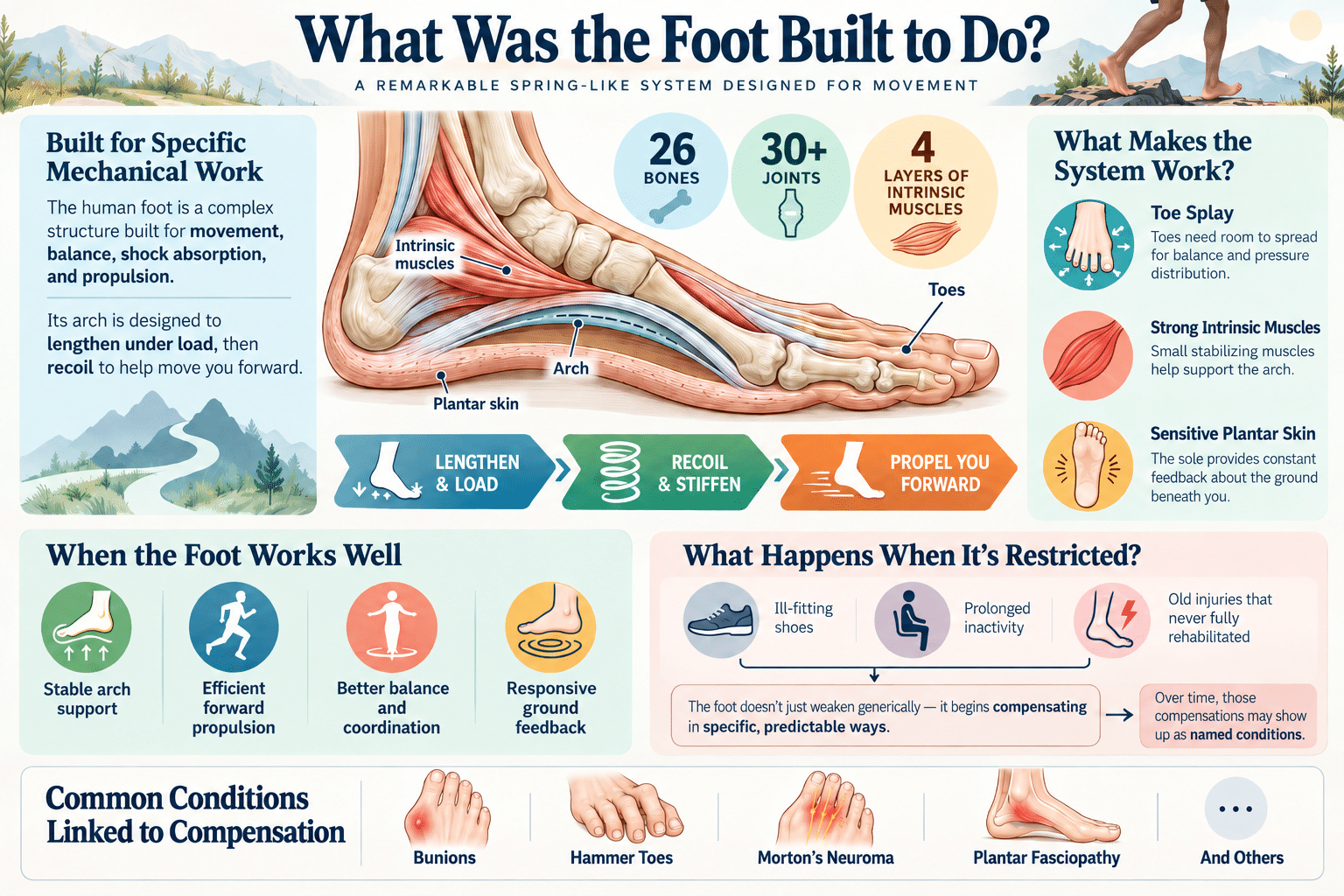
The human foot contains 26 bones, more than 30 joints, and four layers of intrinsic muscles, a structure this complex doesn’t exist by accident. It’s built to do specific mechanical work: the arch is designed to lengthen and load under weight, then recoil and stiffen to propel you forward, a spring-like function that depends on the toes being able to splay, the intrinsic muscles being strong enough to stabilize that arch, and the plantar skin being sensitive enough to feed your nervous system constant information about the ground beneath you.
When all three of those things are working, the foot does its job largely without your notice. When any one of them is chronically restricted, whether by an ill-fitting shoe, prolonged inactivity, or an old injury that never fully rehabilitated, the foot doesn’t just get weaker in a generic sense. It starts compensating in specific, predictable ways, and those compensations are what eventually show up as named diagnoses: bunions, hammer toes, Morton’s neuroma, plantar fasciopathy, and others.
How Does Footwear Trigger the First Domino?
For most adults in industrialized countries, the cascade starts with footwear, not injury or age. Three specific shoe features interfere with the foot’s designed function, and each has research behind exactly how.
A tapered toe box narrows toward the front of the shoe rather than matching the natural, splayed shape of an unshod foot. A systematic review of footwear-fit research found that in one measured sample of adult women, as many as 86% were wearing shoes narrower than their actual foot width, and reviews across multiple studies consistently link poorly fitted, narrow footwear to a higher prevalence of foot pain and structural foot disorders (Buldt & Menz, 2018).
When toes are held in a compressed, overlapping position for years at a time, the soft tissue and joint alignment gradually adapts to that shape, which is a documented contributing factor in the development of hallux valgus, the bunion deformity, and can create the compressive nerve irritation associated with conditions like Morton’s neuroma.
An elevated heel, even a modest one, changes how load distributes across the foot and up the leg. A systematic review specifically examining high-heeled footwear found consistent associations between heel height and both hallux valgus and musculoskeletal pain (Barnish & Barnish, 2016). Raising the heel shortens the calf muscles over time and shifts pressure forward onto the ball of the foot and toes, precisely the region where hammer toes and forefoot nerve irritation develop.
Excess cushioning might seem like the safest choice, but it removes a different input: sensory feedback. Foundational research on footwear and proprioception found that thicker, softer shoe soles measurably reduce a person’s ability to sense foot position and ground contact, and that this effect is more pronounced in older adults, increasing the frequency of balance loss during walking (Robbins & Waked, 1997; Waked, Robbins, & McClaran, 1997). The foot is a sensory organ as much as a mechanical one, densely packed with receptors that feed information to the brain about balance and terrain; heavy cushioning mutes that signal.
“I used to think of shoes as protection, full stop. What changed my mind was realizing that a shoe can protect your foot from a sharp rock and simultaneously be training it, every single day, to stop doing its job. Those aren’t contradictory. They’re just two different effects of the same design choice.”
Terry Tateossian, Founder of The House of Rose
Free 28-Day Fascia Reset Email Course
Get our Free 28-day email course series to help with 1 or 2 exercises per day to release your fascia. One short lesson per day. Two minutes to read each.
How Do Disuse and Muscle Atrophy Create the Second Domino?
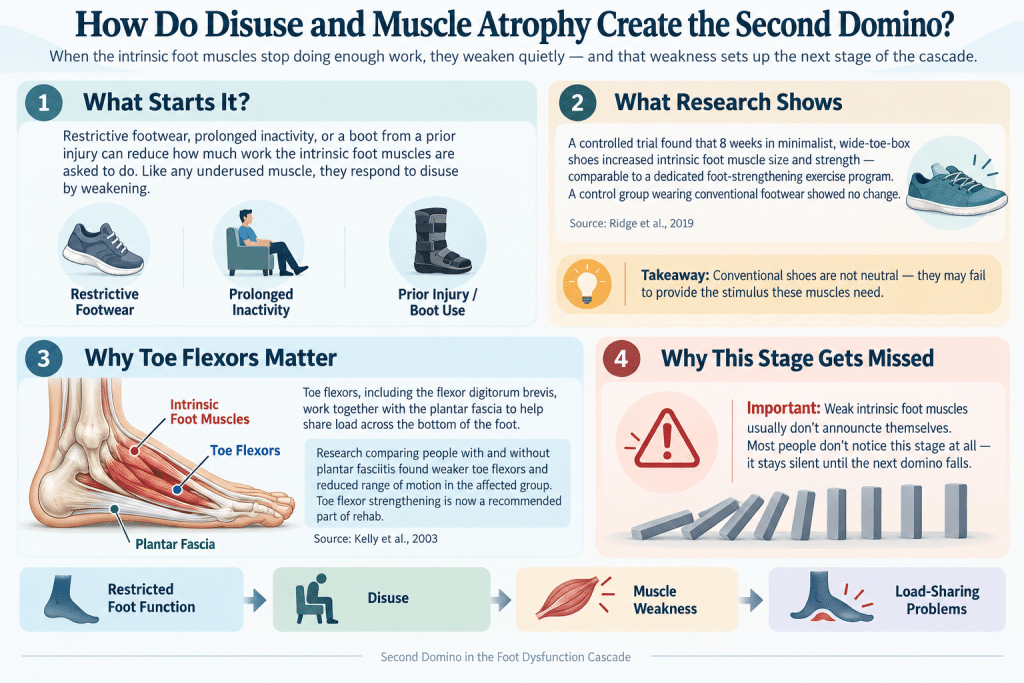
Once footwear (or prolonged inactivity, or a boot from a prior injury) restricts how much work the intrinsic foot muscles are asked to do, those muscles respond the way any muscle responds to disuse: they weaken. This isn’t a theoretical concern.
A controlled trial found that walking in minimalist, wide-toe-box shoes for eight weeks produced significant increases in intrinsic foot muscle size and strength, comparable to a dedicated foot-strengthening exercise program, while a control group wearing conventional footwear showed no change over the same period (Ridge et al., 2019). Read in reverse, that finding says something important: the conventional shoes most people already wear are not neutral. They are actively failing to provide the mechanical stimulus these muscles need to maintain their own strength.
This matters most for one specific muscle group implicated repeatedly in foot pain research: the toe flexors, including the flexor digitorum brevis, which works in direct mechanical partnership with the plantar fascia to share load across the bottom of the foot. Research comparing toe flexor strength between people with and without plantar fasciitis found measurable weakness and reduced range of motion in the affected group, a pattern significant enough that toe flexor strengthening is now a recommended component of plantar fasciitis rehabilitation (Kelly et al., 2003).
Important: Weak intrinsic foot muscles don’t announce themselves the way a weak bicep might. Most people don’t notice this stage of the cascade at all; it’s silent until the next domino falls.
Where Does the Load Go When the Third Domino Falls?
A weak, understimulated intrinsic foot musculature can’t distribute load evenly the way a strong one can. Load doesn’t disappear; it redistributes to whatever structure is available to absorb it, and this redistribution is what turns silent weakness into a named, painful diagnosis.
If the redistribution concentrates at the big toe joint under a narrow toe box, the result over time is hallux valgus, the bunion. If it concentrates between the metatarsal heads in a foot that can’t splay properly during push-off, the result is the nerve compression of a Morton’s neuroma. If the toes claw to compensate for weak intrinsic muscles trying to grip an unstable arch, the result is hammer toe deformity.
If the plantar fascia is left to absorb load that weakened toe flexors should be sharing, the result is plantar fasciopathy. None of these are separate diseases with independent causes. They are the same underlying mechanical failure, expressed at whichever specific structure happens to be the weakest link in a given person’s foot.
If you’ve been told you have one of these conditions and you’re wondering why, the more useful question isn’t “why did this specific structure fail” but “what’s been preventing my foot from doing its job for the last several years,” since that’s the input that actually predicts whether a second or third diagnosis follows the first.
Free 28-Day Fascia Reset Email Course
Get our Free 28-day email course series to help with 1 or 2 exercises per day to release your fascia. One short lesson per day. Two minutes to read each.
Why Does the Foot Show What Other Joints Hide?
One detail makes the foot unusually useful as a diagnostic window: it’s one of the only places in the body where you can visibly see the result of abnormal load without imaging. A hip or knee absorbing years of poor mechanical distribution doesn’t show a visible external deformity the way a foot does; you’d need an X-ray or MRI to see the structural change. A bunion, a hammer toe, a clawed pinky toe, these are visible evidence of a load-distribution problem that’s often been building for years before it became painful enough to notice.
This is worth sitting with, because it reframes what a bunion or hammer toe actually means. It’s not just a cosmetic issue or an unlucky inheritance. It’s closer to a visible readout of how your foot has been functioning, or failing to function, over a long period of time, and it’s worth taking seriously as a signal rather than treating purely as an isolated cosmetic problem to hide in a wider shoe.
How Does the Cascade Affect the Hips, Knees, and Back?
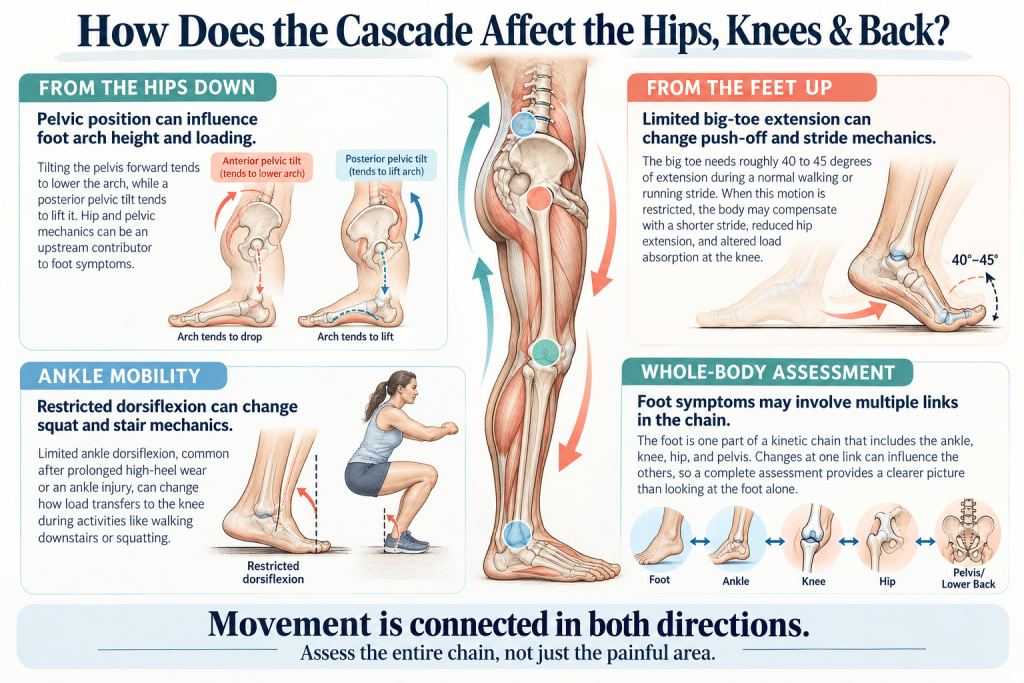
The cascade doesn’t stay contained to the foot, and it doesn’t only run downhill from footwear to foot. It also runs both directions along the kinetic chain connecting foot, ankle, knee, hip, and lower back. Pelvic position changes measurably alter arch height in real time: tilting the pelvis forward tends to drop the arch, while a posterior pelvic tilt tends to lift it, which means hip and pelvic mechanics are a legitimate upstream contributor to foot symptoms, not just a downstream consequence of them.
The relationship works in the other direction too. Restricted big toe extension, the roughly 40 to 45 degrees of motion the joint needs during a normal walking or running stride, forces compensation further up the chain: a shortened stride, reduced hip extension, and altered load absorption at the knee.
Similarly, restricted ankle dorsiflexion, common after prolonged high-heel wear or an ankle injury that never regained full range of motion, changes how load transfers to the knee during activities like walking downstairs or squatting. This is why a clinician evaluating foot pain who only looks at the foot is working with incomplete information; the foot is one link in a chain that includes the ankle, knee, hip, and pelvis in both directions.
Free 28-Day Fascia Reset Email Course
Get our Free 28-day email course series to help with 1 or 2 exercises per day to release your fascia. One short lesson per day. Two minutes to read each.
How Does the Cascade Affect Falls and Long-Term Mobility?
The long-term stakes of this cascade go well beyond cosmetic bumps or occasional discomfort. Reduced plantar sensory feedback from thick, cushioned footwear is directly implicated in fall risk research, since foot position awareness is one of the sensory inputs the body relies on most heavily for balance, and that awareness measurably declines with both age and cushioned footwear (Robbins & Waked, 1997).
Bunions and hammer toes carry documented associations with increased fall risk and decreased balance in the research literature, independent of age alone, since a foot that can’t distribute load and pressure evenly is a less stable platform to stand and walk on.
This is also where the case for daily walking becomes concrete rather than generic. A large 2022 study following more than 78,000 adults found that roughly 9,826 steps a day was associated with a 51% reduction in dementia risk, while even a more modest 3,826 steps a day was associated with a 25% reduction (Del Pozo Cruz et al., 2022). Separately, regular physical activity, including walking, has been associated with meaningfully fewer self-reported poor mental health days in large population studies (Chekroud et al., 2018).
A foot that hurts, or that has become so structurally compromised that walking itself is uncomfortable, removes access to one of the single most well-evidenced levers available for long-term brain and mental health. This is the real stakes of the cascade: it isn’t just about toe shape, it’s about whether walking remains available to you as you age.
What Does the Evidence Say About Reversing the Cascade?
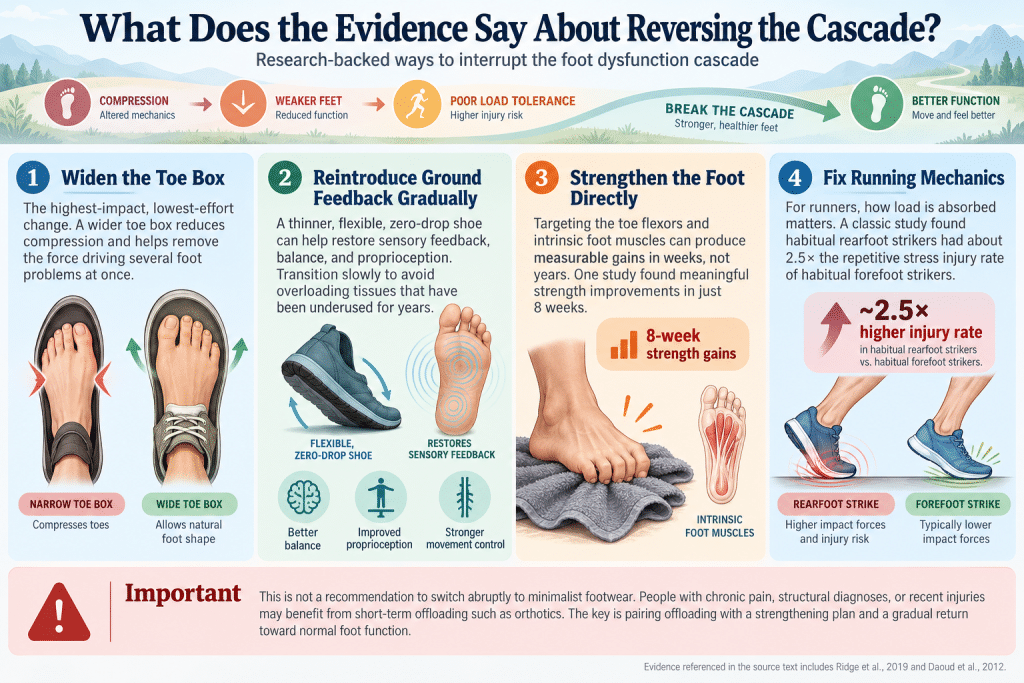
The same mechanism that creates this cascade also points toward how to interrupt it, and the research here is encouraging rather than fatalistic.
- Widening the toe box is the single highest-impact, lowest-effort change available, since it removes the compressive force driving several of these conditions simultaneously without requiring any dedicated exercise time.
- Reintroducing ground feedback gradually, through a thinner, more flexible, zero-drop shoe, gives the foot’s sensory system the input it needs to recalibrate balance and proprioception, though this needs to happen progressively rather than all at once; a foot that has been in highly cushioned, structured footwear for years needs a transition period, not an abrupt switch, to avoid overloading tissue that hasn’t been asked to work this way in a long time.
- Direct strengthening work targeting the toe flexors and intrinsic foot muscles produces measurable results in a matter of weeks, not years; the minimalist-shoe-walking trial referenced in Section 3 showed meaningful strength gains in just eight weeks (Ridge et al., 2019).
- Addressing running-specific mechanics matters for anyone whose foot pain shows up during or after running. A landmark retrospective study of collegiate distance runners found that habitual rearfoot strikers (heel-first landing, often associated with overstriding) had a repetitive stress injury rate roughly 2.5 times higher than habitual forefoot strikers (Daoud et al., 2012), which is consistent with the broader idea that how load is absorbed at initial ground contact matters as much as how much load is applied overall.
Important: none of this is an argument for immediately switching to minimalist footwear across the board, particularly for anyone with an existing structural diagnosis, chronic pain, or a recent injury. The research on offloading devices like orthotics shows real short-term benefit for acute pain; the issue the evidence points to is failing to pair that offloading with a genuine strengthening plan and an exit strategy back toward normal foot function.
Free 28-Day Fascia Reset Email Course
Get our Free 28-day email course series to help with 1 or 2 exercises per day to release your fascia. One short lesson per day. Two minutes to read each.
What Does the Evidence Show About the Foot Pain Cascade?
The following table summarizes the key mechanisms involved in the cascade, from footwear-related restrictions to long-term mobility concerns, along with the supporting research.
| Domino in the Cascade | Mechanism | Supporting Evidence |
|---|---|---|
| Narrow, tapered toe box | Compresses toes into an unnatural position over years | Buldt & Menz (2018): up to 86% of women in one sample wore shoes too narrow for their feet, linked to higher foot pain and disorder prevalence |
| Elevated heel | Shortens calf muscles, shifts load to forefoot | Barnish & Barnish (2016): heel height associated with hallux valgus and musculoskeletal pain |
| Excess cushioning | Reduces plantar sensory feedback and proprioception | Robbins & Waked (1997); Waked, Robbins, & McClaran (1997): thicker soles impair foot position awareness, increase balance loss in older adults |
| Intrinsic muscle disuse | Weakens the muscles that stabilize the arch and share load with the plantar fascia | Ridge et al. (2019): minimalist shoe walking increased intrinsic foot muscle size and strength in 8 weeks; Kelly et al. (2003): toe flexor weakness linked to plantar fasciitis |
| Load redistribution | Concentrates abnormal force at the weakest available structure | Consistent with bunion, hammer toe, and neuroma mechanics described in Sections 4 and 5 |
| Downstream mobility and fall risk | Reduced walking capacity removes access to major health-protective behavior | Del Pozo Cruz et al. (2022): ~9,826 daily steps associated with 51% lower dementia risk; Chekroud et al. (2018): regular activity linked to fewer poor mental health days |
Your Next Steps
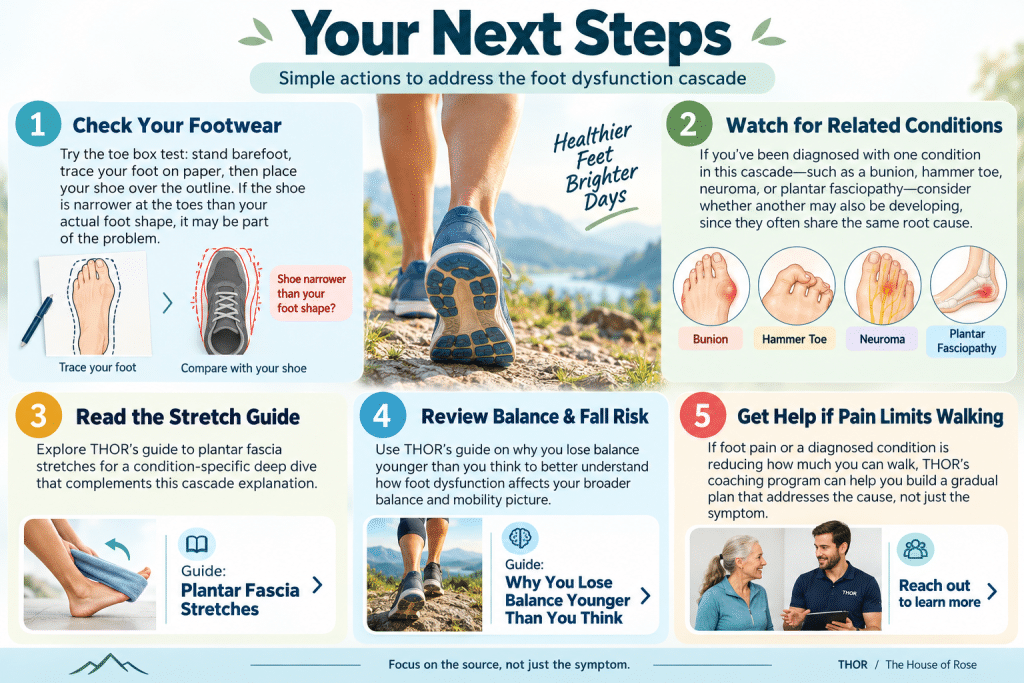
- Check your own footwear against the toe box test: standing barefoot, trace your foot’s actual outline on a piece of paper, then set your shoe on top of it. If the shoe is narrower than your traced outline anywhere along the toes, that shoe is likely part of the cascade.
- If you’ve been diagnosed with one condition from this cascade (a bunion, hammer toe, neuroma, or plantar fasciopathy), consider whether a second or third condition on this list is also quietly developing, since they share a common upstream cause.
- Read THOR’s existing guide to plantar fascia stretches at plantar fascia stretches for a condition-specific deep dive that complements this cascade explanation.
- Look at your own balance and fall-risk picture using THOR’s guide to why you lose balance younger than you think, since the foot cascade described here is a direct contributor to that broader picture.
- If foot pain or a diagnosed condition is limiting how much you can walk, THOR’s coaching program can help you build a graduated plan that addresses the cascade at its source rather than just managing the symptom. Reach out to learn more.
Free 28-Day Fascia Reset Email Course
Get our Free 28-day email course series to help with 1 or 2 exercises per day to release your fascia. One short lesson per day. Two minutes to read each.
Frequently Asked Questions
Are bunions, hammer toes, and heel pain really caused by the same thing?
Not identically in every case, since genetics, injury history, and specific activities all play a role, but the research consistently points to a shared upstream mechanism: restricted toe box width, reduced intrinsic muscle strength, and altered load distribution, expressed at whichever structure is the weakest link.
Can wearing wide toe box shoes actually reverse a bunion?
Widening the toe box removes the ongoing compressive force that contributes to the deformity’s progression, which research supports as helpful, but it is unlikely to reverse an established structural bunion on its own; it’s more accurately described as removing a contributing cause rather than a treatment for existing joint changes.
How much toe box width is actually enough?
There’s no single universal number, but the general guidance from footwear-fit research is that the widest part of the shoe should match or exceed the widest part of your actual foot, measured while standing and bearing weight, not while seated.
Do cushioned shoes actually make balance worse?
Research specifically examining shoe sole thickness found that thicker, softer soles reduce a person’s ability to sense foot position and increase the frequency of balance loss during walking, an effect more pronounced in older adults (Robbins & Waked, 1997).
Is it true that walking barefoot is better for your feet?
Walking barefoot allows the foot to function as designed, and research on minimalist footwear (which approximates some of that effect) shows measurable strength gains, but a full switch to barefoot walking on hard, man-made surfaces requires a gradual transition period; jumping in without that transition can cause its own overuse injuries.
What is a Morton’s neuroma, and why does it relate to footwear?
It’s a nerve irritation, most commonly between the third and fourth toes, that develops when the forefoot’s normal splay is restricted, concentrating pressure on the nerve tissue between the metatarsal heads, a pattern strongly associated with narrow, tapered footwear.
Why do hammer toes develop?
Hammer toe describes a clawing deformity of the toes, generally understood as a compensation pattern that develops when the intrinsic foot muscles are too weak to stabilize the toes in a neutral position, causing the long tendons that flex the toes to dominate and pull them into a clawed posture over time.
Can toe spacers actually help, or are they just a trend?
Toe spacers work by mechanically encouraging toe splay, which is consistent with the mechanism described throughout this article; they’re best understood as a tool for restoring a natural toe position rather than a standalone treatment, most useful alongside footwear changes and strengthening work rather than instead of them.
How long does it take to see results from foot-strengthening work?
A controlled trial found measurable increases in intrinsic foot muscle size and strength after 8 weeks of minimalist shoe walking, suggesting meaningful change is achievable in a period of weeks rather than years, given consistent stimulus (Ridge et al., 2019).
Does this cascade explain why I have back pain alongside my foot pain?
It can. The kinetic chain connecting the foot, ankle, knee, hip, and pelvis works in both directions, so altered foot mechanics can contribute to compensation patterns further up the chain, and conversely, hip and pelvic position can directly affect arch height and foot mechanics.
Should I stop wearing orthotics if I have foot pain?
Not necessarily, and not abruptly. The research shows orthotics can meaningfully help offload an acutely painful structure, but the evidence also suggests pairing that offloading with a genuine strengthening plan and a gradual exit strategy, rather than relying on the orthotic indefinitely without addressing the underlying weakness.
Is running actually bad for your feet if you have weak intrinsic muscles?
Running isn’t inherently the problem; how load is absorbed during running matters more. Research found that habitual heel-strikers had a repetitive stress injury rate roughly 2.5 times higher than forefoot strikers, suggesting foot strike pattern, not running itself, is a meaningful variable (Daoud et al., 2012).
At what age should someone start paying attention to foot strength?
Earlier is better, since the cascade described here compounds over years, but there’s no age at which intervention stops being useful; the minimalist-shoe-walking research showing strength gains in 8 weeks wasn’t limited to young or previously uninjured populations.
Does foot health really connect to dementia risk, or is that a stretch?
The connection isn’t that foot health directly causes or prevents dementia; it’s that impaired foot function reduces walking capacity, and walking volume specifically has a well-documented, large-scale association with lower dementia risk (Del Pozo Cruz et al., 2022). A foot that limits how much you can walk removes access to that protective behavior.
References
- Buldt, A.K., & Menz, H.B. (2018). Incorrectly Fitted Footwear, Foot Pain and Foot Disorders: A Systematic Search and Narrative Review of the Literature. Journal of Foot and Ankle Research, 11, 43.
- Barnish, M.S., & Barnish, J. (2016). High-Heeled Shoes and Musculoskeletal Injuries: A Narrative Systematic Review. BMJ Open, 6(1), e010053.
- Robbins, S., & Waked, E. (1997). Foot Position Awareness: The Effects of Prior Plantar Sensory Stimulation. Journal of the American Geriatrics Society, 45(1), 67-72.
- Waked, E., Robbins, S., & McClaran, J. (1997). Foot Position Awareness in Younger and Older Men: The Influence of Footwear Sole Properties. Journal of the American Geriatrics Society, 45(10), 1219-1224.
- Ridge, S.T., Olsen, M.T., Bruening, D.A., et al. (2019). Walking in Minimalist Shoes Is Effective for Strengthening Foot Muscles. Medicine & Science in Sports & Exercise, 51(1), 104-113.
- Kelly, L.A., Racinais, S., & Cresswell, A.G. (2003). Toe Flexors Strength and Passive Extension Range of Motion of the First Metatarsophalangeal Joint in Individuals With Plantar Fasciitis. Journal of Orthopaedic & Sports Physical Therapy, 33(8), 468-478.
- Daoud, A.I., Geissler, G.J., Wang, F., et al. (2012). Foot Strike and Injury Rates in Endurance Runners: A Retrospective Study. Medicine & Science in Sports & Exercise, 44(7), 1325-1334.
- Del Pozo Cruz, B., Ahmadi, M., Naismith, S.L., & Stamatakis, E. (2022). Association of Daily Step Count and Intensity With Incident Dementia in 78,430 Adults Living in the UK. JAMA Neurology, 79(10), 1059-1063.
- Chekroud, S.R., Gueorguieva, R., Zheutlin, A.B., et al. (2018). Association Between Physical Exercise and Mental Health in 1.2 Million Individuals in the USA. Lancet Psychiatry, 5(9), 739-746.
Disclaimer: This article is for educational purposes only and does not constitute medical advice, diagnosis, or treatment. Bunions, hammer toes, heel pain, and other foot conditions can have multiple causes, including genetics, injuries, footwear, and underlying medical conditions. Changes to footwear, barefoot walking, minimalist shoes, and foot-strengthening exercises should be introduced gradually to avoid discomfort or injury. If you have persistent foot pain, structural deformities, balance difficulties, diabetes-related foot problems, or a recent injury, consult a qualified healthcare provider or podiatrist before making significant changes to your footwear or exercise routine.
Free 28-Day Fascia Reset Email Course
Get our Free 28-day email course series to help with 1 or 2 exercises per day to release your fascia. One short lesson per day. Two minutes to read each.

Terry Tateossian is a Menopause Lifestyle Medicine Coach, Certified Personal Trainer & Nutritionist and the Founder of THOR: The House of Rose, a wellness brand serving women over 40 through retreats, coaching, macro-nutrition and community. As 25-year founder and entrepreneur, Terry spent two and a half decades building and running successful start-up businesses, an experience that put her on the front line of founder burnout long before she could name it. After facing serious health challenges, early onset menopause, and emotional eating while running her agency and raising two children, Terry rebuilt her health in her 40s and lost more than 80 pounds through evidence-based nutrition, training, and mindset work. Today, she helps women get strong, improve confidence, support hormone health, and create a stronger second half of life. Terry has been featured in major media outlets and is available for podcasts, expert commentary, brand collaborations, and speaking engagements on midlife health, reinvention, emotional eating, menopause wellness, and strength training for longevity. Get her free macro calculator (her cookbook companion) to start your journey to back to health.