
 By Team THOR
Free 28-Day Fascia Reset Email Course
Get our Free 28-day email course series to help with 1 or 2 exercises per day to release your fascia. One short lesson per day. Two minutes to read each.
Why You Lose Balance Younger Than You Think (And How to Get It Back)
Paula was forty-four when she stepped off a paddleboard and went straight down into three feet of water, no wave, no current, nothing to blame but her own body failing to make a correction it should have made automatically. She laughed it off with the friends she was with, the way you do, but she told me about it months later at a women’s yoga retreat because it had quietly bothered her ever since.
She’d always thought of herself as coordinated. Balance problems were an old-lady thing, something her mother dealt with, not something that happened to a woman still doing hot yoga three times a week. What Paula didn’t know, and what almost nobody tells women in their 40s, is that the systems responsible for balance don’t wait until your 70s to start declining.
Research on postural control and balance-related sensory systems shows measurable changes beginning decades earlier than most people assume, often well before anyone notices a problem in daily life. By the time a stumble off a paddleboard or a missed curb gets someone’s attention, the underlying decline has usually been building quietly for years.
Falls remain one of the leading causes of injury-related disability and death in older adults, but the systems that prevent falls don’t fail all at once in old age. They erode gradually, starting earlier than almost anyone expects, which means the window to catch and address that decline opens far sooner than most balance content acknowledges.
Important: This article is educational and does not replace individualized medical advice. Sudden, severe, or worsening balance problems, especially with dizziness, vertigo, or vision changes, warrant a medical evaluation rather than a self-directed exercise plan.
When Does Balance Decline Begin?
Balance isn’t a single skill. It’s the output of several sensory and physical systems working together continuously, and research measuring postural control across age groups has found that subtle changes in that coordination can begin as early as the 40s, well before most people notice any functional problem in daily life.
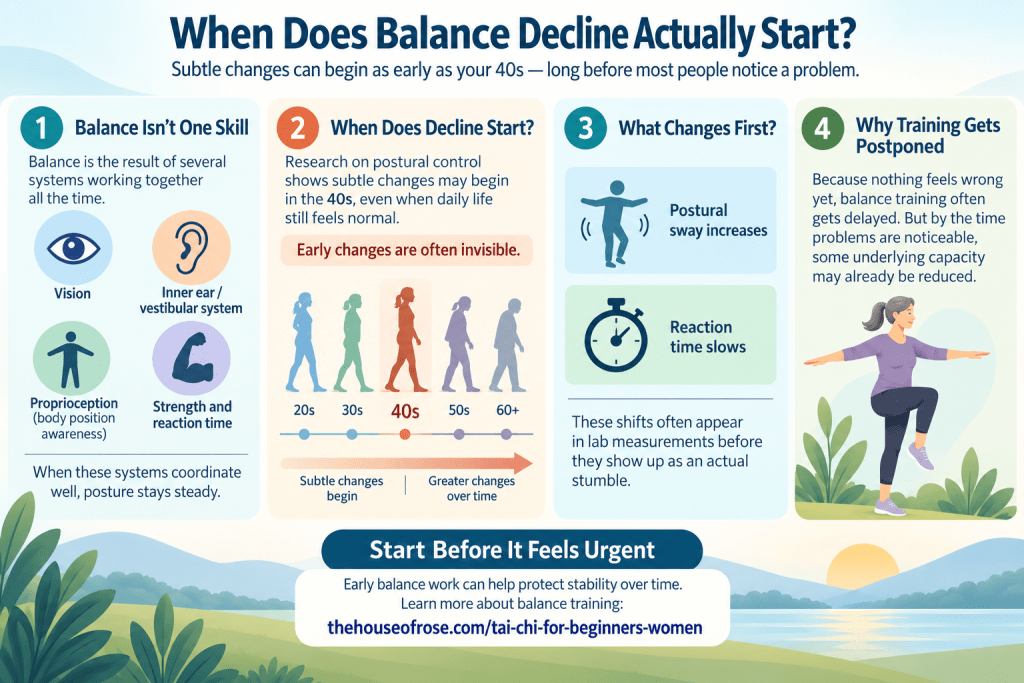
The decline is gradual and largely invisible at first, showing up in lab measures like postural sway and reaction time long before it shows up as an actual stumble.
This is part of why balance training so often gets postponed. Nothing feels wrong yet, so there’s no obvious reason to address it, and by the time something does feel wrong, a meaningful amount of underlying capacity has often already eroded.
“I’ve had more than one retreat guest in her mid-40s tell me some version of Paula’s story, a stumble that came out of nowhere, a moment on a hike or in the shower where their body just didn’t correct the way they expected. Almost every one of them had assumed balance wasn’t something they needed to think about yet. I tell them the same thing every time: the earlier you catch it, the easier it is to train.”
Terry Tateossian, Founder of The House of Rose
What Are the Three Systems That Create Balance?
Balance depends on three sensory systems sending information to the brain, plus the muscular system that acts on that information. When any one of the three is compromised, the others have to work harder to compensate, and compensation only goes so far.
- The vestibular system: Located in the inner ear, detects head position and movement and is often the first system people think of when they hear the word “balance.” It’s responsible for that specific, disorienting feeling of vertigo or dizziness when it isn’t working correctly.
- The visual system: Provides information about the body’s position relative to the surrounding environment. This is why balance often feels noticeably worse in dim lighting or with eyes closed, the visual system is doing more balance work than most people realize, even when it doesn’t feel like it.
- The proprioceptive system: Sensors in the muscles, joints, and skin (especially the feet and ankles), reports the body’s position in space without needing to look at it. This is the system responsible for knowing where your foot is on uneven ground without staring at it.
Important: Weakness or decline in any one of these three systems can often be compensated for by the other two, up to a point. This is part of why balance problems can go unnoticed for years. The compensation works, until it doesn’t, often at the exact moment an unexpected demand (a curb, a wet floor, a sudden stop) exceeds what the remaining systems can handle.
Free 28-Day Fascia Reset Email Course
Get our Free 28-day email course series to help with 1 or 2 exercises per day to release your fascia. One short lesson per day. Two minutes to read each.
What Changes Specifically in Midlife?
Several midlife-specific factors compound the general age-related decline described above.
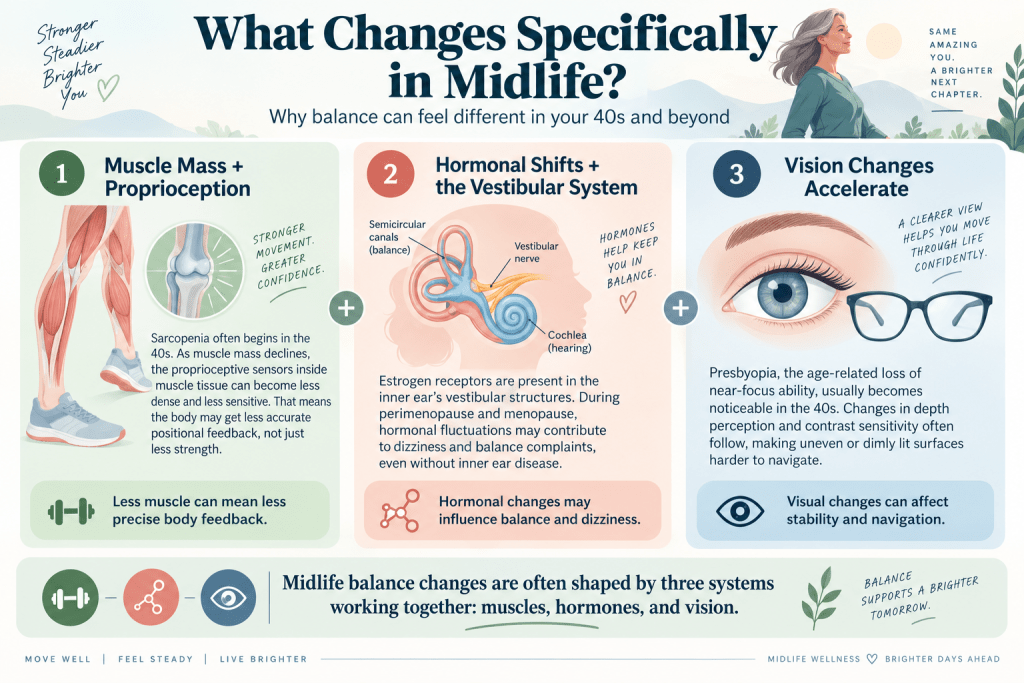
- Muscle mass and proprioceptive sensitivity decline together: Sarcopenia, the age-related loss of muscle mass that often begins in the 40s, doesn’t just reduce strength. It reduces the density and sensitivity of the proprioceptive sensors embedded in that muscle tissue, meaning less muscle often means less accurate positional feedback, not just less force production.
- Hormonal shifts affect the vestibular system too: Estrogen receptors are present in the inner ear’s vestibular structures, and some research suggests the hormonal fluctuations of perimenopause and menopause may contribute to the dizziness and balance complaints many women report during this transition, independent of any inner ear disease.
- Vision changes accelerate: Presbyopia (the age-related loss of near-focus ability) typically becomes noticeable in the 40s, and changes in depth perception and contrast sensitivity, both important for navigating uneven or dimly lit surfaces, often follow in the decade after.
The ankle is one of the most concentrated sources of proprioceptive feedback in the entire body, and ankle mobility tends to quietly decline with sedentary habits and unsupportive footwear well before it becomes noticeable.
This is part of why the sitting-rising test can reveal mobility limitations that often go unnoticed. A body can be strong through the hips and core while still carrying a meaningful, unaddressed ankle mobility gap.
What Overlooked Causes Affect Balance?
Beyond the three core systems, several common, frequently overlooked factors contribute to balance decline.
- Medications: Several common medication categories, including blood pressure medications, certain antidepressants, and sedatives, can affect balance as a side effect, sometimes subtly enough that the connection isn’t obvious. A medication review with a physician or pharmacist is a reasonable step for anyone noticing new balance changes, particularly after starting a new prescription.
- Low vitamin D: Vitamin D receptors are present in muscle tissue, and low vitamin D status has been associated with reduced muscle function and increased fall risk in multiple studies, making it a worthwhile lab value to check.
- Alcohol: Even moderate alcohol intake temporarily impairs both the vestibular system and reaction time, and the effect can persist longer than the sensation of intoxication does.
- Footwear: Unsupportive or overly cushioned footwear can dull the proprioceptive feedback from the feet, while high heels shift the body’s center of gravity forward in a way that changes the entire balance equation.
- Sedentary time: Extended periods of sitting reduce the frequency of the small, constant balance corrections that daily movement normally provides, meaning the systems involved get less practice than they would in a more active day.
Free 28-Day Fascia Reset Email Course
Get our Free 28-day email course series to help with 1 or 2 exercises per day to release your fascia. One short lesson per day. Two minutes to read each.
Why Do Falls Carry More Risk Than People Realize?
Falls are consistently reported as one of the leading causes of both fatal and non-fatal injury among older adults, and the risk profile isn’t limited to advanced age.
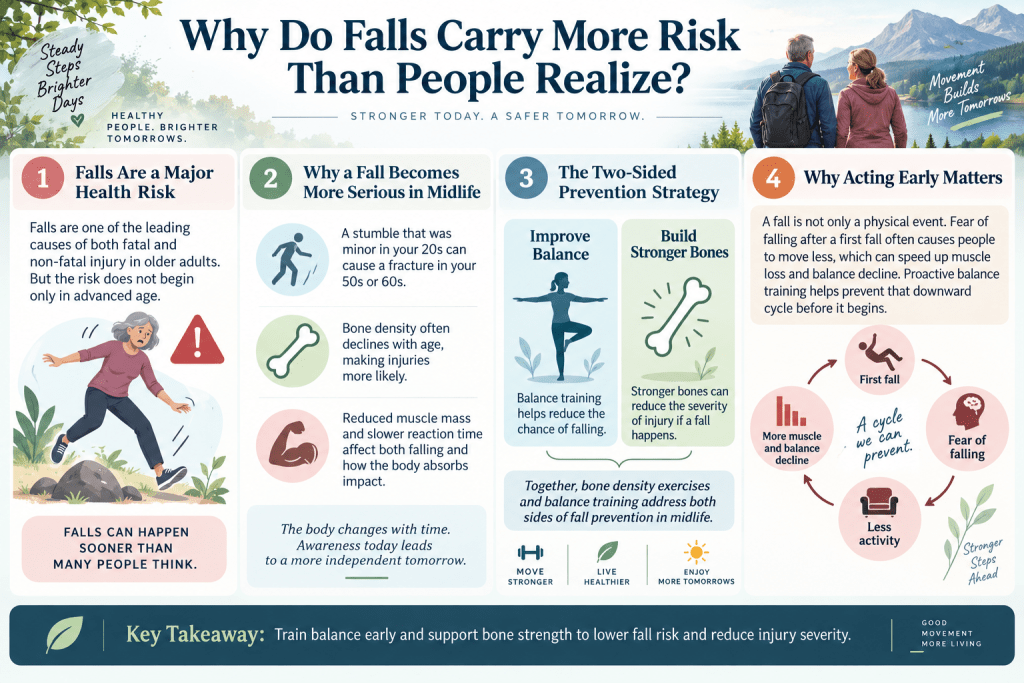
A fall that would have been a minor stumble in someone’s 20s can result in a fracture in someone’s 50s or 60s, partly because bone density has often already declined by that point and partly because the same systems responsible for the fall itself, reduced muscle mass, slower reaction time, are also involved in how the body absorbs impact.
Improving balance helps reduce the chance of falling, while stronger bones can reduce the severity of injury if a fall does happen. That is why bone density exercises pair so naturally with balance training, addressing both sides of the same midlife fall-prevention strategy.
Important: A fall isn’t only a physical event. Fear of falling after a first fall often leads people to reduce activity, which accelerates the exact muscle and balance decline that caused the fall in the first place. Addressing balance proactively, before a fall happens, avoids that entire downward cycle.
How Can You Test Your Own Balance Right Now?
Two free, one-minute tests give a useful baseline without any equipment.
- The single-leg stance test: Measures how long you can balance on one leg without support, giving you a simple snapshot of stability and control. THOR’s single-leg stance guide includes scoring thresholds and a practical progression for improving your result.
- The sitting-rising test: Uses one floor-based movement to assess strength, mobility, coordination, and balance together. The sitting-rising test can help reveal limitations that may not show up during more isolated strength or balance exercises.
Taking both tests gives a more complete picture than either alone, since a low score on one but not the other points toward a specific system (pure balance versus combined strength-and-mobility) being the priority to train first.
How Should You Train Balance by System, Not Just by Habit?
Generic balance exercises help, but targeting the specific system behind a low score produces faster results than a one-size-fits-all routine.
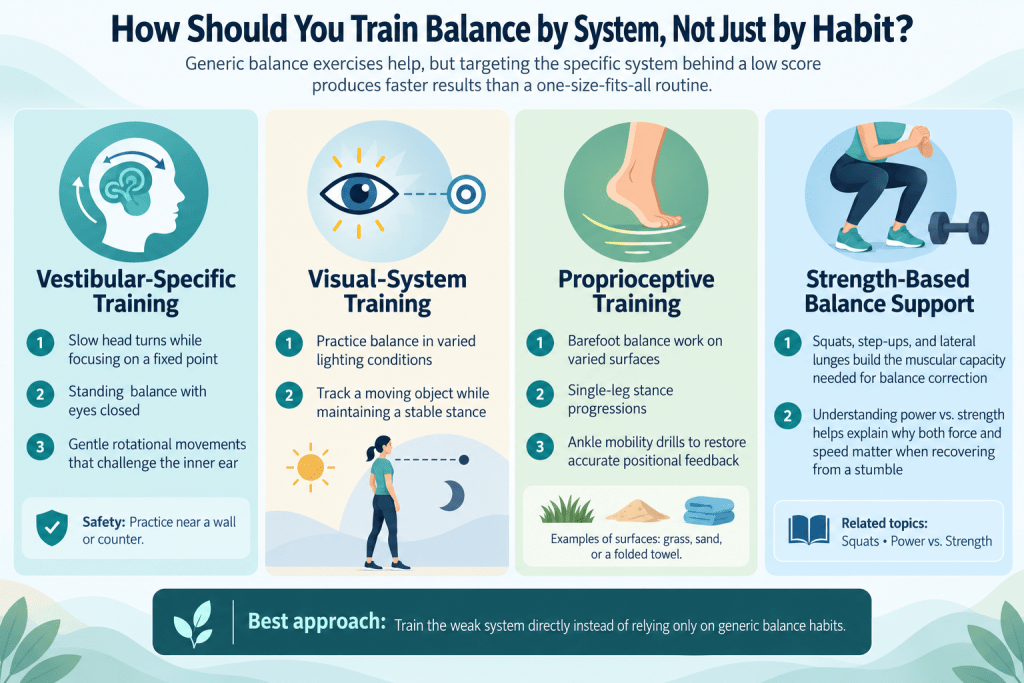
- For vestibular-specific training: Slow head turns while maintaining focus on a fixed point, standing balance with eyes closed (near a wall or counter for safety), and gentle rotational movements that challenge the inner ear without triggering dizziness.
- For visual-system training: Balance practice in varied lighting conditions, and exercises that involve tracking a moving object while maintaining a stable stance.
- For proprioceptive training: Barefoot balance work on varied surfaces (grass, sand, a folded towel), single-leg stance progressions, and ankle mobility drills that restore the range of motion needed for accurate positional feedback.
- For strength-based balance support: Squats, step-ups, and lateral lunges build the muscular capacity needed to turn sensory feedback into a quick, effective balance correction. Understanding the difference between power and strength also helps explain why both force production and the ability to use that force quickly matter for staying steady and recovering from a stumble.
This chart helps you match common balance problems with the system most involved and the exercises that can help strengthen it:
| If You Notice… | Likely System | Start Here |
|---|---|---|
| Dizziness with quick head movement | Vestibular | Slow head turns, gentle rotational drills |
| Worse balance in dim light or unfamiliar spaces | Visual | Varied-lighting balance practice |
| Trouble on uneven ground even in good light | Proprioceptive | Barefoot balance work, ankle mobility |
| Balance feels fine but strength feels weak | Muscular | Squats, step-ups, lateral lunges |
Free 28-Day Fascia Reset Email Course
Get our Free 28-day email course series to help with 1 or 2 exercises per day to release your fascia. One short lesson per day. Two minutes to read each.
How Can You Build a Weekly Balance Practice?
Balance training responds well to frequency over intensity. Three to five short sessions per week, 5 to 10 minutes each, tend to produce better results than one long weekly session, since balance is a skill that benefits from frequent, low-fatigue practice rather than occasional maximal effort.
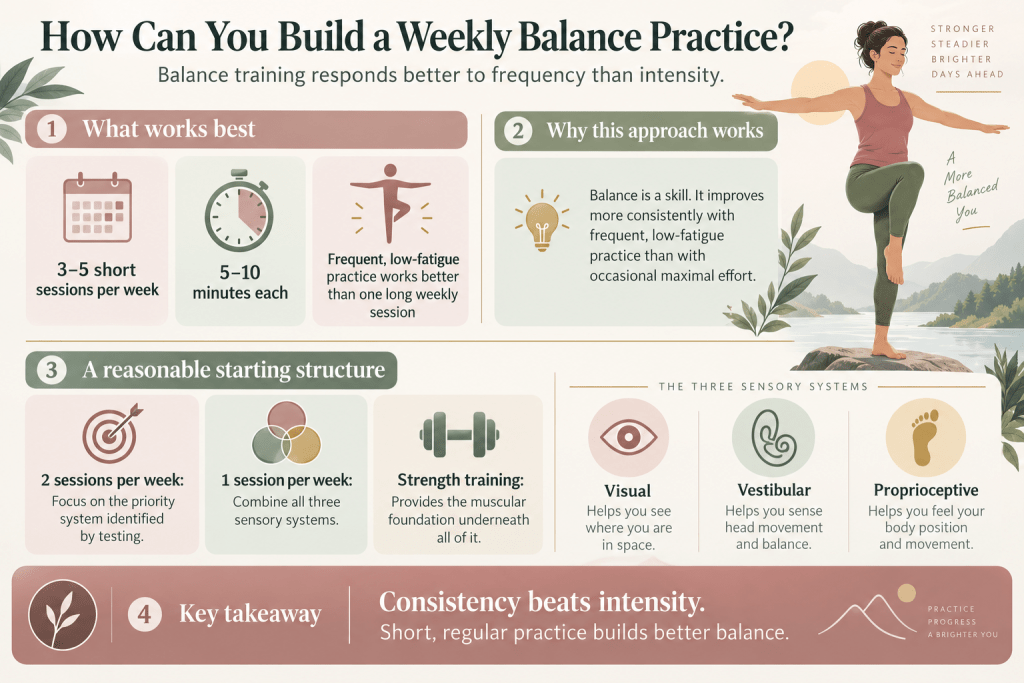
A reasonable starting structure: two sessions per week focused on whichever system the testing in Section 6 identified as the priority, one session incorporating all three sensory systems together, and general strength training (already likely part of an existing routine) providing the muscular foundation underneath all of it.
Your Next Steps
- Take both the single-leg stance test and the sitting-rising test this week to establish a baseline.
- Identify which of the three balance systems (vestibular, visual, proprioceptive) is most likely behind any deficit, using the checklist in Section 7.
- Add 3 to 5 short, targeted balance sessions to your weekly routine, prioritizing the system that needs the most work.
- Review medications, vitamin D status, and footwear for overlooked contributing factors.
- Support the muscular foundation underneath your balance training with THOR’s free macro calculator to make sure protein intake matches your training load.
For guided, in-person balance and mobility work, THOR’s women’s yoga, hiking and wellness retreats build this kind of functional training directly into the schedule.
For a personalized program built around your specific test results, THOR’s 1:1 strength coaching program can structure training around the exact system your assessment reveals.
Important: This article is educational and does not replace individualized medical advice. New, severe, or worsening balance problems, especially with dizziness or vision changes, should be evaluated by a physician.
Free 28-Day Fascia Reset Email Course
Get our Free 28-day email course series to help with 1 or 2 exercises per day to release your fascia. One short lesson per day. Two minutes to read each.
Frequently Asked Questions
At what age does balance start to decline?
Measurable changes in postural control and balance-related sensory processing can begin as early as the 40s, well before most people notice any problem in daily activities.
Why did I suddenly stumble or lose my balance when nothing seemed different?
A sudden stumble often reflects gradual, invisible decline finally exceeding what compensation from the other balance systems could handle, rather than a sudden new problem. It’s worth using as a prompt to test and train, not just brush off.
Is dizziness the same thing as a balance problem?
Dizziness is often related to the vestibular system specifically, while balance problems can stem from the vestibular, visual, or proprioceptive systems, or a combination. Persistent or severe dizziness warrants a medical evaluation.
Can menopause really affect balance?
Estrogen receptors exist in the inner ear’s vestibular structures, and hormonal changes during perimenopause and menopause may contribute to balance and dizziness complaints in some women, independent of any underlying inner ear disease.
What medications commonly affect balance?
Certain blood pressure medications, some antidepressants, and sedatives are among the categories most commonly associated with balance side effects. A medication review with a physician or pharmacist is worthwhile if balance changes coincide with a new prescription.
How quickly can balance training show results?
Many people notice improvement within a few weeks of consistent practice, though the sensory systems involved (particularly vestibular adaptation) sometimes take longer than muscular strength to fully retrain.
Should I see a doctor before starting balance exercises?
If balance problems are new, severe, associated with dizziness or vision changes, or following a fall, a medical evaluation is a reasonable first step before starting a self-directed program.
Is it normal to have worse balance in one direction or on one side?
Asymmetry is common and often reflects a previous injury, dominant-side habits, or an underlying strength imbalance. Testing both the single-leg stance and sitting-rising test can help identify whether one side is meaningfully weaker.
Does vision correction (glasses or contacts) affect balance?
Yes. Uncorrected vision changes can reduce the visual system’s contribution to balance, and an outdated prescription is a common, overlooked contributor worth ruling out.
Can I improve balance without any equipment?
Yes. All of the exercises in this article require nothing beyond a wall or counter for safety support, making balance training one of the most accessible types of training to start immediately.
How does alcohol affect balance beyond the night it’s consumed?
Alcohol’s effect on the vestibular system and reaction time can persist for longer than the felt sensation of intoxication, and frequent alcohol intake is associated with broader declines in balance-related measures over time.
What’s the connection between balance and bone density?
They address two different sides of fall risk. Balance training reduces the likelihood of a fall happening. Bone density determines how serious the consequences are if one does. Both matter together.
Is barefoot training better for balance?
For proprioceptive training specifically, yes, since footwear can dull the sensory feedback from the feet that proprioception relies on. This should be done on safe, appropriate surfaces rather than as a blanket recommendation for all activity.
Can balance decline be reversed, or only slowed?
Both are possible depending on the underlying cause and how early training begins. Muscular and proprioceptive contributions in particular tend to respond well to consistent, targeted training at any age.
I write 3 essays per week on Lifestyle Medicine for women in midlife on what is happening in the body and what to do about it. No fluff, no hype. Free.
References
- Araújo, C. G., et al. Age- and sex-specific reference values for balance and functional testing in adult populations. European Journal of Preventive Cardiology.
- Centers for Disease Control and Prevention. Older Adult Fall Prevention: facts about falls and injury statistics.
- National Institute on Deafness and Other Communication Disorders. Balance disorders: causes, vestibular system overview.
- American Academy of Otolaryngology. Patient education materials on vestibular function and age-related balance change.
- Menant, J. C., et al. Vitamin D and muscle function, falls risk in older adults, systematic review data.
- North American Menopause Society clinical guidance on vestibular and balance symptoms during the menopause transition.
- National Institute on Aging. Fall prevention and balance exercise guidance for older adults.
Disclaimer: This article is educational and does not constitute medical advice. Balance problems can have many causes, including vestibular, vision, neurological, medication-related, and musculoskeletal factors. If you experience new, severe, or worsening balance problems, dizziness, vertigo, vision changes, fainting, or symptoms following a fall, consult a healthcare provider before starting the tests or exercises in this article. Perform balance exercises near a stable support and progress only within your current abilities.
Free 28-Day Fascia Reset Email Course
Get our Free 28-day email course series to help with 1 or 2 exercises per day to release your fascia. One short lesson per day. Two minutes to read each.

Terry Tateossian is a Menopause Lifestyle Medicine Coach, Certified Personal Trainer & Nutritionist and the Founder of THOR: The House of Rose, a wellness brand serving women over 40 through retreats, coaching, macro-nutrition and community. As 25-year founder and entrepreneur, Terry spent two and a half decades building and running successful start-up businesses, an experience that put her on the front line of founder burnout long before she could name it. After facing serious health challenges, early onset menopause, and emotional eating while running her agency and raising two children, Terry rebuilt her health in her 40s and lost more than 80 pounds through evidence-based nutrition, training, and mindset work. Today, she helps women get strong, improve confidence, support hormone health, and create a stronger second half of life. Terry has been featured in major media outlets and is available for podcasts, expert commentary, brand collaborations, and speaking engagements on midlife health, reinvention, emotional eating, menopause wellness, and strength training for longevity. Get her free macro calculator (her cookbook companion) to start your journey to back to health.