
 By Team THOR
Free Macro Calculator
Personalized to your body, goals, and measurements. You will receive detailed macros for meals, sample day of eating, food selection guidance, hydration + daily supplement suggestions, and more.
Why Nutrition Advice Is So Controversial (What 4 Years of Hosting Retreats Taught Me)
Four years ago, before our first yoga retreat, I asked every guest to fill out a short dietary form. Gluten-free, dairy-free, vegan, keto, no restrictions, whatever applied. I took the forms seriously, briefed our chef, labeled every dish, planned an entire week of meals around what fourteen women told me they needed.
By day two, the gluten-free woman was asking, quietly, if there was any way to get a slice of the coffee cake we’d made for someone else’s dietary needs. The vegan was finishing her plate faster when there happened to be a little parmesan folded into the risotto.
The woman who told me she was strict keto ordered a second glass of wine and a s’more at the fire pit that night, and neither seemed to register to her as a contradiction. Nobody was lying to me. They were describing an intention, and then living a slightly different reality, the way almost all of us do around food.
I didn’t understand yet how useful that observation would become. Four years and dozens of retreats later, I’ve fed hundreds of women, collected hundreds of dietary forms, and watched hundreds of those forms diverge from what happened at the table. And somewhere in that pattern is the real answer to a question that professional nutrition science has spent decades and millions of dollars trying to solve: why can’t anyone agree on the best way to eat?
Why Does the Nutrition Debate Never End (And Why Does Everyone Sound So Sure)?
Ask a room of nutrition-minded people what the best diet for humans is and watch what happens. The keto crowd will say it’s keto. The vegans will say it’s plant-based. Someone will say Mediterranean, with the quiet confidence of a person who thinks they’re above the argument. And someone else will offer the increasingly popular non-answer: “the best diet is the one you’ll stick to,” which sounds wise until you remember that plenty of people could stick to fast food every day if given permission.
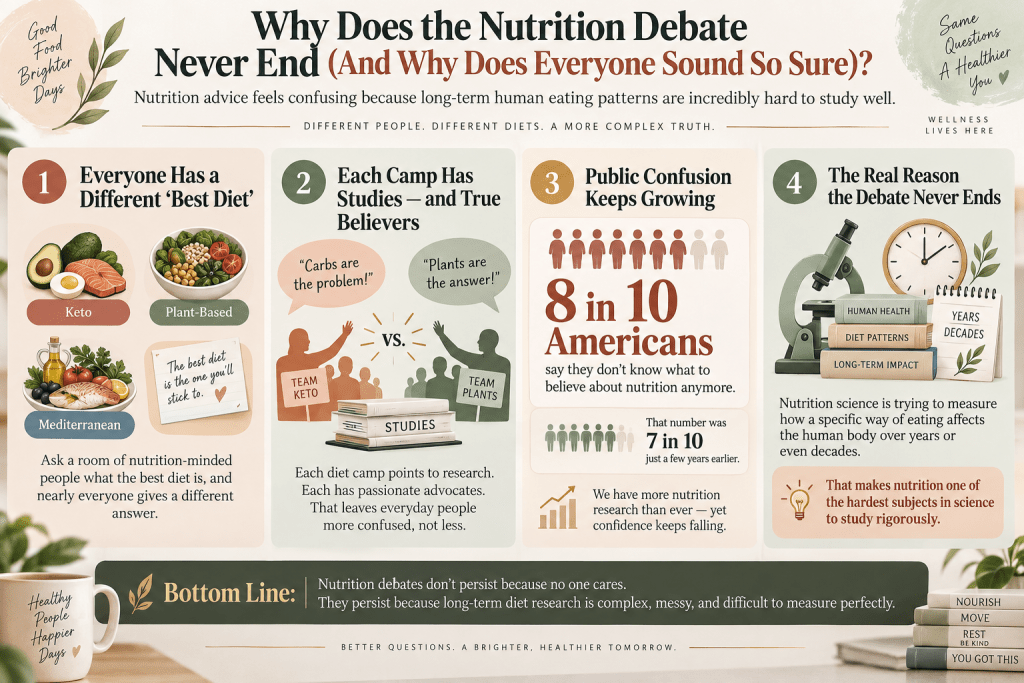
Each camp has studies. Each camp has true believers. And the rest of us are left more confused than when we started. One recent survey found that eight in ten Americans say they don’t know what to believe about nutrition anymore, because the information seems to keep changing. That number was seven in ten just a few years earlier. We have more nutrition research available than at any point in history, and confidence in it keeps dropping, not rising.
That’s not a coincidence, and it’s not because nutrition scientists are incompetent or being paid off by industry, although that occasionally happens too. It’s because the thing nutrition science is trying to measure, how a specific way of eating affects a human body over years or decades, is one of the hardest things to study rigorously in all of science.
Why Is the Definitive Nutrition Study Impossible to Run?
Here’s what a truly definitive nutrition study would require. Take a large group of genetically similar people. Lock them in a controlled facility. Assign half to eat exactly one way and half to eat exactly another way, for decades, with zero deviation. Control every other variable, exercise, sleep, stress, sunlight, alcohol. Then measure health outcomes and mortality at the end.
No ethics board on earth would approve that study, and no human being would volunteer for it. So nutrition science has to work around that impossibility using imperfect substitutes, and every one of those substitutes introduces its own blind spot.
Important: This isn’t a reason to distrust nutrition science altogether. It’s a reason to understand why any single study, especially one making headlines, deserves more skepticism than the confident headline usually invites.
Free Macro Calculator
Personalized to your body, goals, and measurements. You will receive detailed macros for meals, sample day of eating, food selection guidance, hydration + daily supplement suggestions, and more.
What Are Four Ways We Study Food, and What Does Each One Get Wrong?
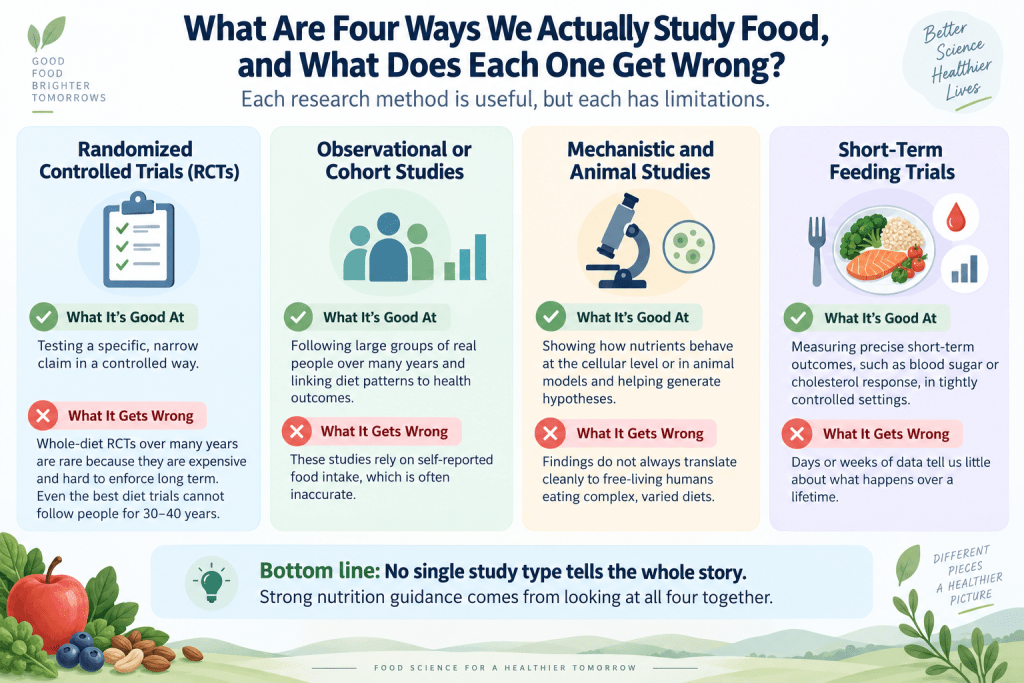
Randomized Controlled Trials (RCTs)
Randomized controlled trials are the gold standard for testing a specific, narrow claim, such as whether a supplement changes a blood marker over 12 weeks. But RCTs testing entire dietary patterns over years are rarely done because they’re enormously expensive and nearly impossible to enforce for that long.
The few large diet RCTs that do exist, including trials on the Mediterranean diet, are extremely valuable. Still, they cannot run for the 30 or 40 years it may take conditions like heart disease or cancer to fully develop.
Observational or Cohort Studies
Observational or cohort studies follow large groups of real people over years, asking them periodically what they eat and then tracking health outcomes.
These studies have shaped decades of public health guidance. Their main weakness is their reliance on self-reported food intake, which can be notoriously unreliable.
Mechanistic and Animal Studies
Mechanistic and animal studies examine how nutrients behave at the cellular level or in animal models.
They are useful for generating hypotheses, but the findings do not always translate cleanly to how the same nutrient behaves in a free-living human eating a complex, varied diet.
Short-Term Feeding Trials
Short-term feeding trials place people in controlled settings for days or weeks and measure precise outcomes such as blood sugar or cholesterol response.
These studies are highly accurate for what they measure, but a few weeks tells us relatively little about what happens over a lifetime.
This table shows the strengths and limits of each nutrition study type:
| Study Type | What It’s Good At | What It Gets Wrong |
|---|---|---|
| Randomized controlled trial | Testing one specific, narrow claim precisely | Rarely funded or feasible for whole diets over decades |
| Observational/cohort study | Tracking real people over real years | Relies on self-reported intake, which is often inaccurate |
| Mechanistic/animal study | Explaining biological mechanism | Doesn’t always translate to free-living humans |
| Short-term feeding trial | Precise measurement over days or weeks | Too short to capture long-term outcomes |
No single method gives a complete picture. Each one sees a different slice of the truth, which is part of why headlines built on a single study so often contradict each other.
What Has the Say-Do Gap Taught Me About How Women Eat at Retreats?
This is where four years of hosting yoga retreats has taught me something the research methodology section above can only gesture at: the gap between what people report eating and what they eat isn’t a minor rounding error. It’s enormous, and it’s completely unconscious.
At nearly every women’s retreat, a pattern repeats. A guest tells me on her intake form that she’s gluten-free, and by the second or third night, she’s asking for a slice of whatever gluten-containing dessert is on the table, sometimes with a small, genuine laugh about it, sometimes without seeming to register the contradiction at all.
Guests who identify as vegan will finish a plate with a little cheese folded into it and not mention it, not because they’re being dishonest, but because in the moment, the identity (“I’m vegan”) and the behavior (eating the cheese anyway) aren’t occupying the same part of their attention.
Women who describe themselves as strict keto will order dessert at the fire pit and talk about their low-carb lifestyle in the same conversation, with no apparent friction between the two.
“After four years of collecting dietary intake forms and then watching what happens at the table, I’ve stopped being surprised by the gap. What surprised me at first was how unconscious it is. Almost nobody is lying on that form. They’re describing an intention, a version of themselves they believe in, and then living a slightly different reality a few days later. If that happens over one retreat week with me watching, imagine what it looks like over months of a self-reported food diary nobody is checking.”
Terry Tateossian, Founder of The House of Rose
Free Macro Calculator
Personalized to your body, goals, and measurements. You will receive detailed macros for meals, sample day of eating, food selection guidance, hydration + daily supplement suggestions, and more.
Why Isn’t This About Willpower or Honesty?
It’s tempting to read the gluten-free-cake story as a case of weak willpower or dishonesty, but that misses what’s actually happening.
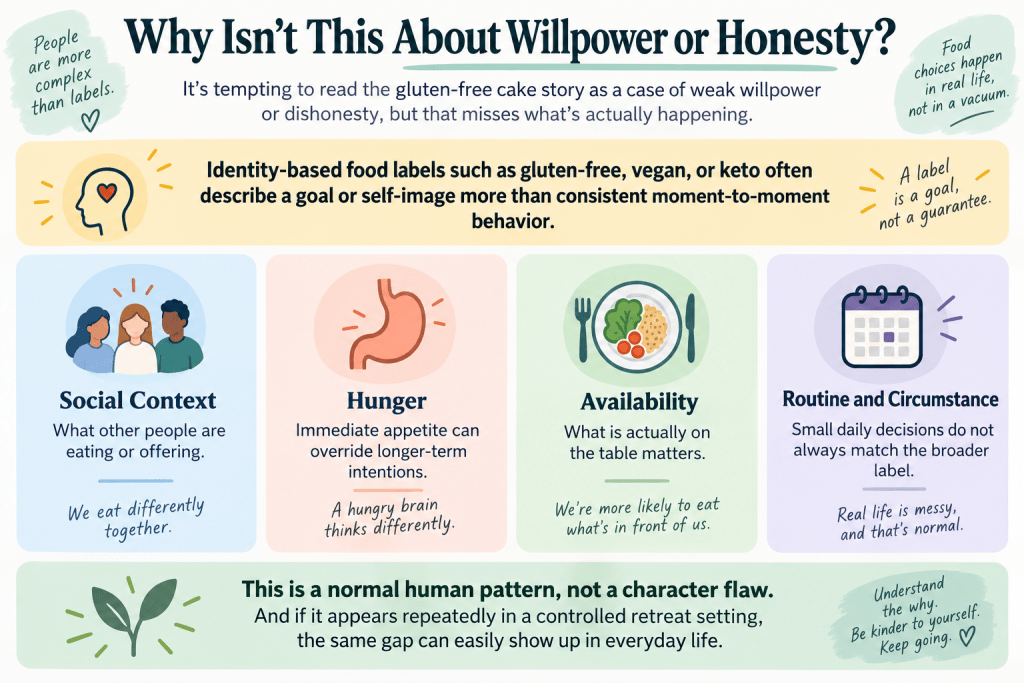
Identity-based food labels such as gluten-free, vegan, or keto often describe a goal or self-image more than consistent moment-to-moment behavior. The label can be sincere while daily eating still shifts based on:
- Social context: What other people are eating or offering.
- Hunger: Immediate appetite can override longer-term intentions.
- Availability: What is actually on the table matters.
- Routine and circumstance: Small daily decisions do not always match the broader label.
This is a normal human pattern, not a character flaw. And if it appears repeatedly in a controlled retreat setting, the same gap can easily show up in everyday life.
Why Does This Gap Skew the Research Itself?
Now connect this back to the four research methods above. Most large nutrition cohort studies rely on people accurately reporting what they eat, often through food frequency questionnaires filled out periodically over months or years.
If the gap I’ve watched play out over a single retreat week is real, and I’d argue four years of consistent, repeated observation makes a fairly strong case that it is, then imagine that same gap playing out across a self-reported diet study with tens of thousands of participants, none of whom are being watched at every meal the way retreat guests unknowingly are.
This is a big part of why nutrition epidemiology has such a difficult reputation. It’s not that the researchers are careless. It’s that the data they’re working with, self-reported human eating behavior, carries the same say-do gap I’ve watched unfold in person for four years, just at a scale no one can directly observe or correct for.
Here’s how the say-do gap can distort the data:
| What a Participant Reports | What Likely Happened | Effect on Study Data |
|---|---|---|
| “I follow a low-sugar diet” | Occasional dessert not recalled or reported | Sugar intake underestimated |
| “I rarely drink alcohol” | Social drinking underrecalled or minimized | Alcohol-related health effects harder to isolate |
| “I eat mostly plant-based” | Animal products consumed in social settings, not logged | Plant-based benefit may be over- or underestimated |
None of this means self-reported studies are worthless. It means their conclusions deserve to be read as directional evidence gathered under real-world limitations, not as precise measurements.
Free Macro Calculator
Personalized to your body, goals, and measurements. You will receive detailed macros for meals, sample day of eating, food selection guidance, hydration + daily supplement suggestions, and more.
What Is the Blind Men and the Elephant Problem With Diet Gurus?
There’s an old parable about several blind men each touching a different part of an elephant, the trunk, the ear, the leg, and each confidently describing a completely different animal based on the one part they could feel. Nutrition advice online often works the same way.
The keto researcher has spent years studying insulin and carbohydrate metabolism, so that’s the part of the elephant she’s touching, and she’s not wrong about what she’s found. The vegan researcher has spent years studying plant compounds and cardiovascular markers, and he’s not wrong about what he’s found either. Neither is lying. Neither has the whole animal.
This is why picking a single guru and following their advice as though it’s the complete picture tends to disappoint people over time. The research any one expert is fluent in is usually real, but it’s a slice, not the whole structure.
What Still Works Despite All of This?
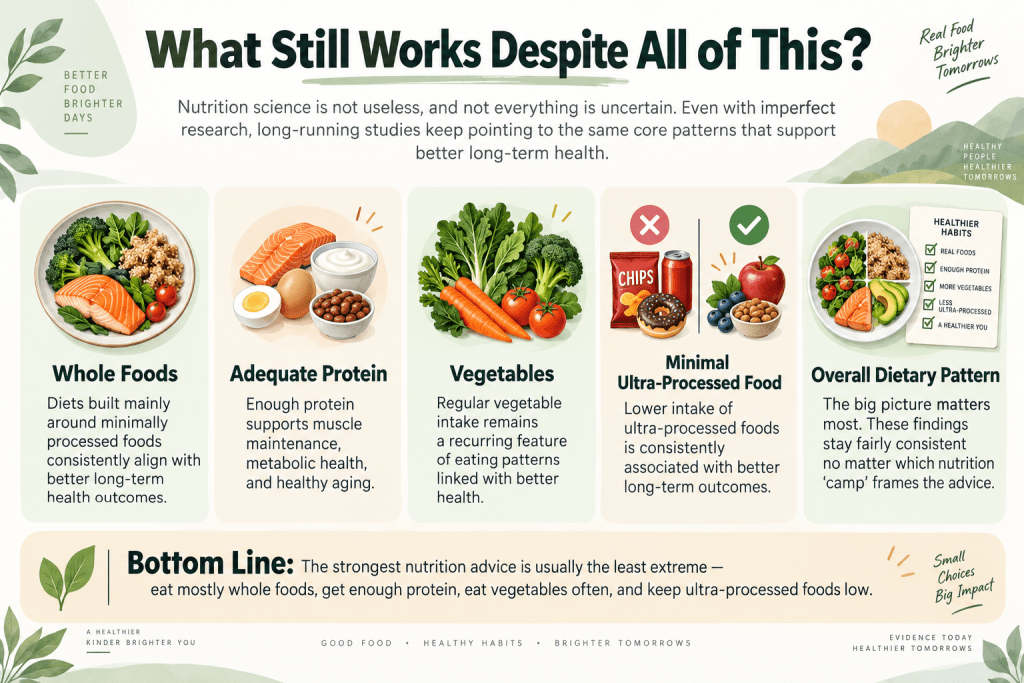
None of the above means nutrition science is useless or that nothing can be trusted. Large, long-running cohort studies, imperfect as they are, have consistently pointed toward the same handful of patterns across different populations and decades:
- Whole foods: Diets built primarily around minimally processed foods consistently align with better long-term health outcomes.
- Adequate protein: Sufficient protein supports muscle maintenance, metabolic health, and healthy aging.
- Vegetables: Regular vegetable intake remains a recurring feature of dietary patterns associated with better health.
- Minimal ultra-processed food: Lower consumption of ultra-processed foods consistently associates with better long-term outcomes.
- Overall dietary pattern: These findings remain fairly consistent regardless of which specific nutrition “camp” frames the advice.
The Mediterranean dietary pattern, in particular, has more randomized controlled trial support than almost any other whole-diet approach. That is part of why it appears so often in serious nutrition guidance rather than fad-diet content.
A Mediterranean-style diet offers one of the better-studied whole-diet frameworks for midlife women, with stronger clinical trial evidence behind it than many competing dietary approaches.
Important: Imperfect research is not the same as no research. When the overall weight of evidence across different study types consistently points in the same direction, it is more trustworthy than any single headline-grabbing study viewed in isolation.
Free Macro Calculator
Personalized to your body, goals, and measurements. You will receive detailed macros for meals, sample day of eating, food selection guidance, hydration + daily supplement suggestions, and more.
What Do I Eat (And Tell Every Client)?
After four years of watching intention and behavior diverge at my own dinner tables, and after 25 years running businesses before that, here’s the principle I use, and the one I give every client and retreat guest: track what you actually eat, not what you intend to eat, for at least a week, before deciding what “diet” you’re even following.
This is the entire logic behind THOR’s approach to macros. Not because macro tracking is magic, but because it closes the say-do gap this article is built around. A food log with real weights and real numbers doesn’t care what identity a person holds about their eating. It shows the plate as it was.
“I don’t ask clients what kind of diet they follow anymore, at least not first. I ask them to track one honest week. Almost every time, the gap between what they believed about their own eating and what the log showed was the most useful information in the entire process. That gap is the real starting point, not the label.”
Terry Tateossian, Founder of The House of Rose
Understanding where your actual intake differs from what you expected is useful, but the next step is learning how to interpret those numbers correctly. THOR’s guide to macro fundamentals after 50 explains how tracking protein, carbohydrates, fats, and overall calories can help you spot patterns and make more informed adjustments.
Your Next Steps
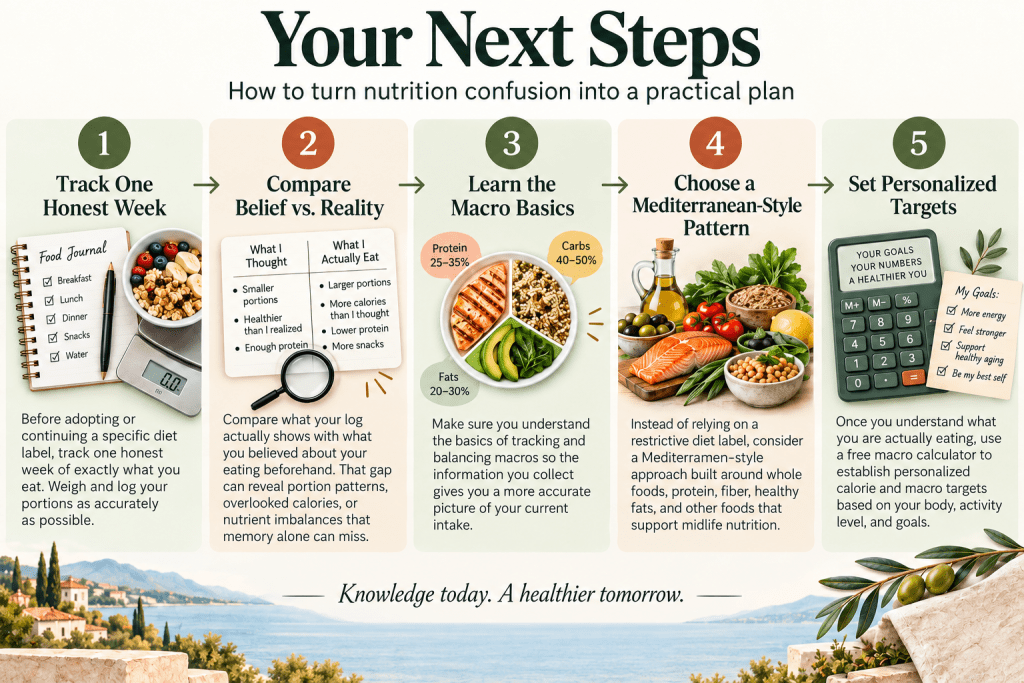
- Before adopting or continuing a specific diet label, track one honest week of exactly what you eat, weighing and logging your portions as accurately as possible.
- Compare what the log shows with what you believed about your eating beforehand. That gap can reveal portion patterns, overlooked calories, or nutrient imbalances that are difficult to spot from memory alone.
- Make sure you understand the basics of tracking and balancing macros so the information you collect gives you a more accurate picture of your current intake.
- Instead of relying on a restrictive diet label, consider a Mediterranean-style approach built around whole foods, protein, fiber, healthy fats, and other foods that support midlife nutrition.
- Once you understand what you are eating, use the free macro calculator to establish personalized calorie and macro targets based on your body, activity level, and goals.
If you’d like to experience this philosophy in practice, THOR’s women’s wellness retreats bring together structured meals, real food, movement, and nutrition support without demanding perfection at every meal.
For a more individualized approach, 1:1 coaching can turn what your food log shows into a personalized nutrition and training strategy rather than forcing your habits into a predefined diet label.
Important: This article reflects general nutrition science literacy and Terry’s personal and professional observations. It is not individualized medical or dietary advice. Women with specific medical dietary restrictions, including celiac disease or diagnosed food allergies, should continue following the recommendations provided by their healthcare professionals.
Free Macro Calculator
Personalized to your body, goals, and measurements. You will receive detailed macros for meals, sample day of eating, food selection guidance, hydration + daily supplement suggestions, and more.
Frequently Asked Questions
Why do nutrition experts disagree so often?
Because they’re often studying different slices of a very complex system using different research methods, each with real but partial evidence. No single study or expert has the complete picture, which is part of why confident-sounding advice can still conflict.
Is nutrition science reliable, or should I ignore it?
It’s reliable in aggregate, when many imperfect studies using different methods all point the same direction, and less reliable when relying on any single study, especially one behind a dramatic headline.
What is the “say-do gap” in nutrition?
It’s the difference between what people report eating and what they eat, which tends to be larger and more common than most people realize, and which research increasingly recognizes as a major source of noise in self-reported dietary studies.
Why do people say they’re gluten-free, vegan, or keto and then not fully follow it?
Usually not out of dishonesty. The label often reflects a sincere intention or identity, while day-to-day eating is shaped by context, social settings, and hunger in ways the label doesn’t always predict.
Is the Mediterranean diet better supported than other diets?
It has more randomized controlled trial evidence behind it than most whole-diet approaches, which is a meaningfully stronger evidence base than diets supported mainly by observational data or theory.
Should I trust a nutrition influencer who cites a lot of studies?
Citing studies isn’t the same as representing the full body of evidence. It’s worth asking whether the studies cited are representative of the overall body of research or a selectively chosen subset that supports a predetermined conclusion.
How can I know what I eat if my own perception is unreliable?
Structured food tracking with a scale, for at least a week, is the most reliable way to see actual intake rather than intended or remembered intake.
Does this mean calorie and macro tracking apps are more trustworthy than self-report studies?
When used consistently and accurately, yes, because they capture intake at the point of eating rather than relying on memory or self-image days or weeks later. Accuracy still depends on avoiding common tracking mistakes.
Why do some foods get blamed for cancer one year and celebrated the next?
Large-scale reviews of nutrition research have found that a striking number of common ingredients have been linked to both increased and decreased disease risk across different studies, often because observational associations are sensitive to small differences in study design and population.
Is “eat the diet you can stick to” good advice?
It’s a useful starting filter, but not a complete answer, since plenty of unsustainable eating patterns are also easy to “stick to” without producing good health outcomes. Sustainability matters, but it isn’t the same as effectiveness.
What does THOR recommend instead of picking a diet camp?
A whole-food, protein-forward, Mediterranean-influenced framework, personalized through actual tracked intake rather than self-identified labels, is the approach THOR builds all of its nutrition content around.
How long should I track before I trust what I’m seeing?
At least one full week, including a weekend, since eating patterns often shift meaningfully between structured weekdays and less structured weekends.
Does the say-do gap apply to exercise self-reporting too?
Yes, the same pattern (reported intention diverging from actual behavior) shows up in self-reported exercise data, though this article focuses specifically on the food side of it.
Is it normal to be confused about nutrition advice after years of trying to “figure it out”?
Completely normal, and the confusion is a reasonable response to a truly difficult research problem, not a sign of personal failure to understand something simple.
I write 3 essays per week on Lifestyle Medicine for women in midlife on what is happening in the body and what to do about it. No fluff, no hype. Free.
References
- International Food Information Council. Annual Food and Health Survey (public confidence in nutrition information trend data).
- Ioannidis, J. P. A. (2013). Implausible results in human nutrition research. BMJ, 347, f6698.
- Schoenfeld, J. D., & Ioannidis, J. P. A. (2013). Is everything we eat associated with cancer? A systematic cookbook review. American Journal of Clinical Nutrition, 97(1), 127-134.
- Willett, W. C., et al. Nurses’ Health Study, ongoing prospective cohort methodology and findings summary. Harvard T.H. Chan School of Public Health.
- Estruch, R., et al. (2018). Primary prevention of cardiovascular disease with a Mediterranean diet supplemented with extra-virgin olive oil or nuts (PREDIMED trial). New England Journal of Medicine, 378(25), e34.
- Subar, A. F., et al. (2015). Addressing current criticism regarding the value of self-report dietary data. Journal of Nutrition, 145(12), 2639-2645.
- Archer, E., Hand, G. A., & Blair, S. N. (2013). Validity of U.S. nutritional surveillance: National Health and Nutrition Examination Survey caloric energy intake data, 1971-2010. PLOS ONE, 8(10), e76632.
- Academy of Nutrition and Dietetics position statements on dietary pattern research and evidence hierarchy.
Disclaimer: This article is educational and does not constitute medical or individualized nutrition advice. Dietary needs vary based on health conditions, medications, allergies, intolerances, activity levels, and other personal factors. If you have celiac disease, diagnosed food allergies, diabetes, kidney disease, gastrointestinal conditions, or other medical dietary restrictions, consult a qualified healthcare provider or registered dietitian before making significant changes to your diet, calorie intake, or macronutrient targets.
Free Macro Calculator
Personalized to your body, goals, and measurements. You will receive detailed macros for meals, sample day of eating, food selection guidance, hydration + daily supplement suggestions, and more.
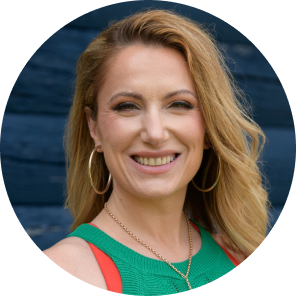
Terry Tateossian is a Menopause Lifestyle Medicine Coach, Certified Personal Trainer & Nutritionist and the Founder of THOR: The House of Rose, a wellness brand serving women over 40 through retreats, coaching, macro-nutrition and community. As 25-year founder and entrepreneur, Terry spent two and a half decades building and running successful start-up businesses, an experience that put her on the front line of founder burnout long before she could name it. After facing serious health challenges, early onset menopause, and emotional eating while running her agency and raising two children, Terry rebuilt her health in her 40s and lost more than 80 pounds through evidence-based nutrition, training, and mindset work. Today, she helps women get strong, improve confidence, support hormone health, and create a stronger second half of life. Terry has been featured in major media outlets and is available for podcasts, expert commentary, brand collaborations, and speaking engagements on midlife health, reinvention, emotional eating, menopause wellness, and strength training for longevity. Get her free macro calculator (her cookbook companion) to start your journey to back to health.