
 By Cindy Adoptante
Get 11 Sample Recipes from Our Bestselling Mediterranean Cookbook.
Get our 11 Sample Recipes from our Best Selling Mediterranean Protein Friendly Cookbook. These are the most delicious recipes our retreat guests love the most. Easy, simple with few ingredients per meal. Make delicious heart-friendly and healthy meals you enjoy every day.
How to Quiet Food Noise: 10 Habits Backed by Real Research
For years, I treated constant thoughts about food as a character flaw, something I was supposed to out-discipline. It wasn’t until I understood what was actually driving it, a stack of hormonal, neurological, and behavioral signals that get louder or quieter depending on specific, identifiable inputs, that the whole conversation with myself changed.
If food occupies more of your attention than you want it to, that volume is being turned up by something concrete: how you slept last night, how much protein was in your last meal, how stressed your body has been, how engineered the food in front of you is. None of these ten habits ask you to spend your day arguing with hunger. They work upstream of the argument, quieting the signal itself.
How Can You Anchor Every Meal With Real Protein?
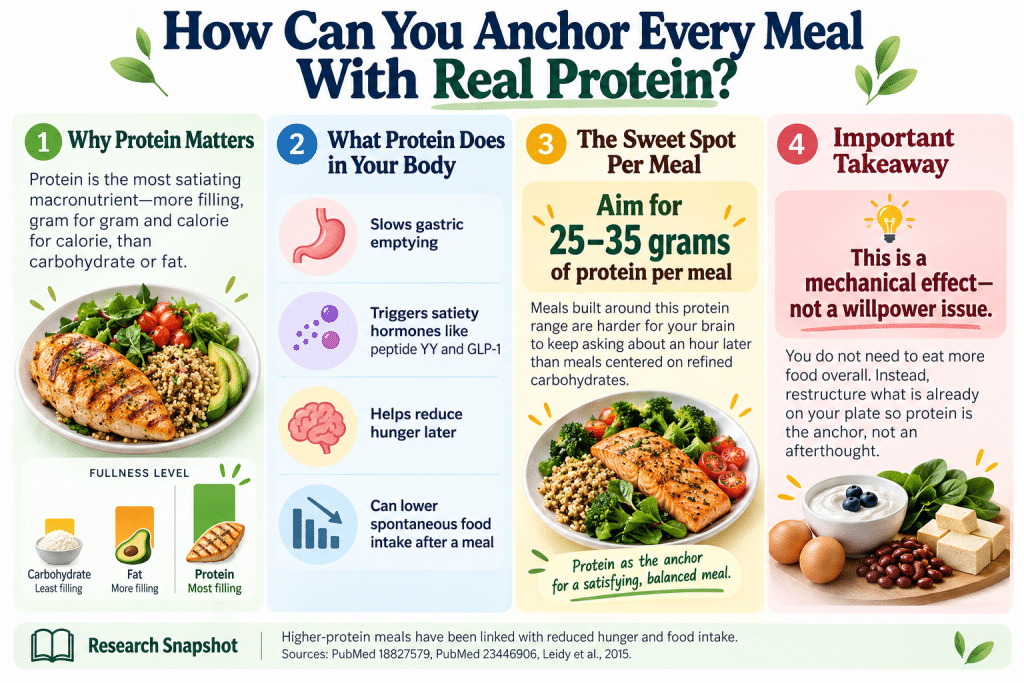
Protein is the most satiating macronutrient, gram for gram and calorie for calorie, more than carbohydrate or fat. It slows gastric emptying, triggers release of satiety hormones like peptide YY and GLP-1, and research consistently shows that higher-protein meals reduce subsequent hunger and spontaneous food intake compared to lower-protein meals of equal calories (Leidy et al., 2015).
This is a mechanical effect, not a willpower one: a meal built around 25 to 35 grams of protein is distinctly harder for your brain to keep asking about an hour later than a meal built primarily around refined carbohydrate.
Important: this isn’t about eating more food overall. It’s about restructuring what’s already on your plate so protein is the anchor, not an afterthought.
Why Should You Get Enough Fiber, Especially the Viscous Kind?
Fiber, particularly the viscous, gel-forming type found in oats, legumes, chia, and many vegetables, slows digestion and stimulates the same satiety hormone pathways that protein does, extending the feeling of fullness well past the meal itself.
Fiber also feeds the gut microbiome in ways that influence hunger signaling over the longer term, since gut bacteria produce short-chain fatty acids that interact with the same hormonal systems governing appetite.
Research reviewing fiber’s role in body weight regulation consistently finds that higher fiber intake is associated with lower spontaneous energy intake and improved satiety (Slavin, 2005).
If most of your meals are low in fiber, adding a source like beans, lentils, chia seeds, or a vegetable-forward side to your largest meal of the day is a more sustainable starting point than trying to overhaul every meal at once.
Get 11 Sample Recipes from Our Bestselling Mediterranean Cookbook.
Get our 11 Sample Recipes from our Best Selling Mediterranean Protein Friendly Cookbook. These are the most delicious recipes our retreat guests love the most. Easy, simple with few ingredients per meal. Make delicious heart-friendly and healthy meals you enjoy every day.
Why Should You Protect Your Sleep Like It’s Load-Bearing?
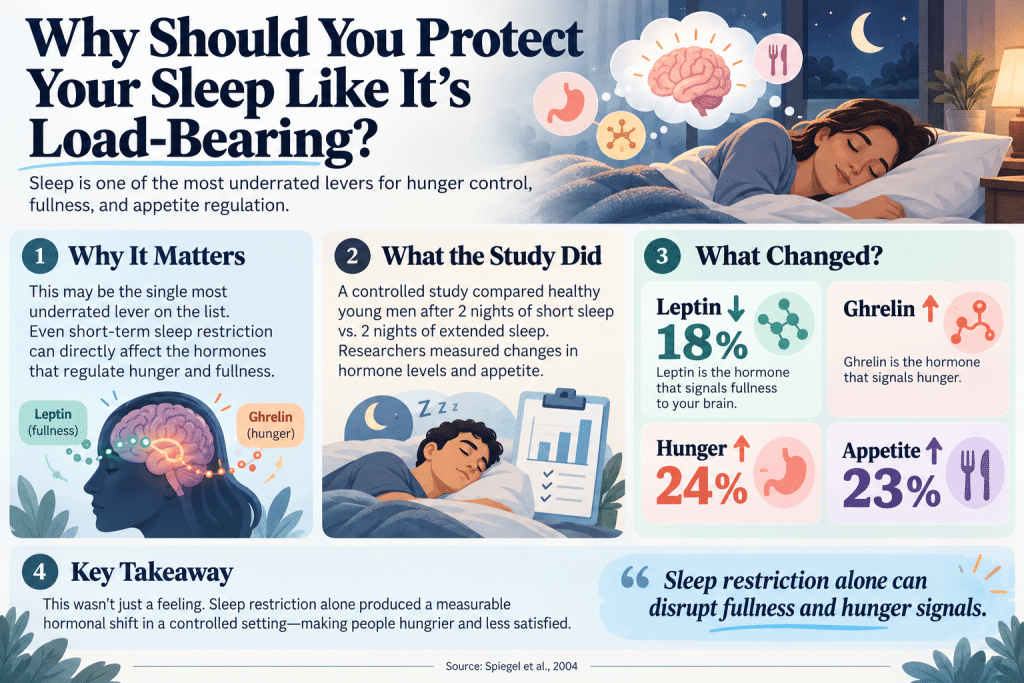
This might be the single most underrated lever in this entire list. A now-classic controlled study restricted healthy young men to two nights of short sleep and compared their hormone levels and appetite to two nights of extended sleep.
The result: sleep restriction dropped leptin, the hormone that signals fullness to your brain, by 18%, while raising ghrelin, the hormone that signals hunger, and hunger and appetite ratings rose by 24% and 23% respectively (Spiegel et al., 2004). This wasn’t a subjective, “I feel hungrier when I’m tired” effect. It was a measurable hormonal shift, produced in a controlled setting, from sleep restriction alone.
“I used to think my worst food noise days were about stress or a bad meal plan. Almost every time I actually tracked it, the real variable was how little I’d slept the night before. This is one habit I stopped negotiating with myself about.”
Terry Tateossian, Founder of The House of Rose
How Can You Keep Blood Sugar Steady Instead of Spiking It?
A meal that spikes blood sugar quickly, refined carbohydrate with little protein, fat, or fiber to slow absorption, tends to produce a rebound: a sharper subsequent drop in blood sugar that triggers hunger signaling sooner than a meal that raised blood sugar more gradually.
This is part of why a pastry and coffee can leave you thinking about food again within two hours, while a meal with a similar calorie count but a lower glycemic impact holds you longer. Pairing carbohydrate with protein, fat, or fiber, rather than eating it alone, is a practical way to blunt this spike-and-crash pattern without eliminating any food group.
Get 11 Sample Recipes from Our Bestselling Mediterranean Cookbook.
Get our 11 Sample Recipes from our Best Selling Mediterranean Protein Friendly Cookbook. These are the most delicious recipes our retreat guests love the most. Easy, simple with few ingredients per meal. Make delicious heart-friendly and healthy meals you enjoy every day.
How Can You Manage Stress Deliberately, Not Just Reactively?
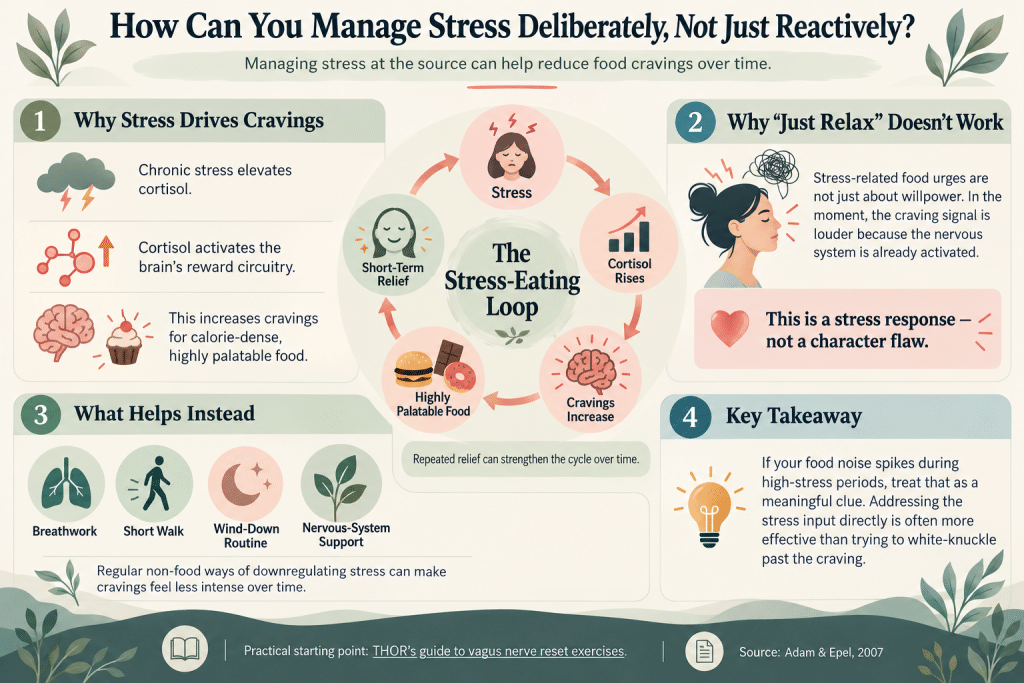
Chronic stress elevates cortisol, and elevated cortisol doesn’t just make you feel stressed, it directly stimulates the brain’s reward circuitry in ways that specifically increase craving for calorie-dense, highly palatable food. A widely cited review of the stress-eating relationship describes this as a reinforcing loop: stress raises cortisol, cortisol increases motivation toward rewarding food, eating that food provides short-term relief, and the cycle strengthens with repetition (Adam & Epel, 2007).
This is why “just relax” rarely works as advice in the moment, but building in regular, non-food ways of downregulating stress, breathwork, a short walk, a structured wind-down routine, measurably reduces how loud that craving signal gets over time.
If your food noise reliably spikes during high-stress periods, that’s a meaningful diagnostic clue, not a character flaw; addressing the stress input directly tends to be more effective than trying to white-knuckle past the resulting craving. THOR’s guide to vagus nerve reset exercises offers a practical starting point for the nervous-system side of this loop.
Why Should You Limit Engineered, Hyperpalatable Food?
Not all food is equally reinforcing to your brain’s reward system, and this isn’t a matter of willpower or taste preference alone. Research using brain imaging found that foods combining fat and refined carbohydrate together produce a supra-additive reward response, meaning the combination lights up dopamine-related reward circuitry more intensely than either fat or carbohydrate alone would predict, independent of how much a person reports liking the food (DiFeliceantonio et al., 2018).
This is a large part of why heavily engineered snack foods, built specifically around that fat-and-carbohydrate combination, are so much harder to eat “just a little” of than a whole food with a similar calorie count.
Important: this isn’t an argument for eliminating any food you enjoy. It’s context for why some foods generate persistent, looping thoughts far out of proportion to their actual nutritional weight, and why reducing regular exposure to the most engineered versions of these foods (not the occasional treat) tends to quiet that specific looping pattern.
Get 11 Sample Recipes from Our Bestselling Mediterranean Cookbook.
Get our 11 Sample Recipes from our Best Selling Mediterranean Protein Friendly Cookbook. These are the most delicious recipes our retreat guests love the most. Easy, simple with few ingredients per meal. Make delicious heart-friendly and healthy meals you enjoy every day.
Why Should You Eat Without Distraction, at Least Sometimes?
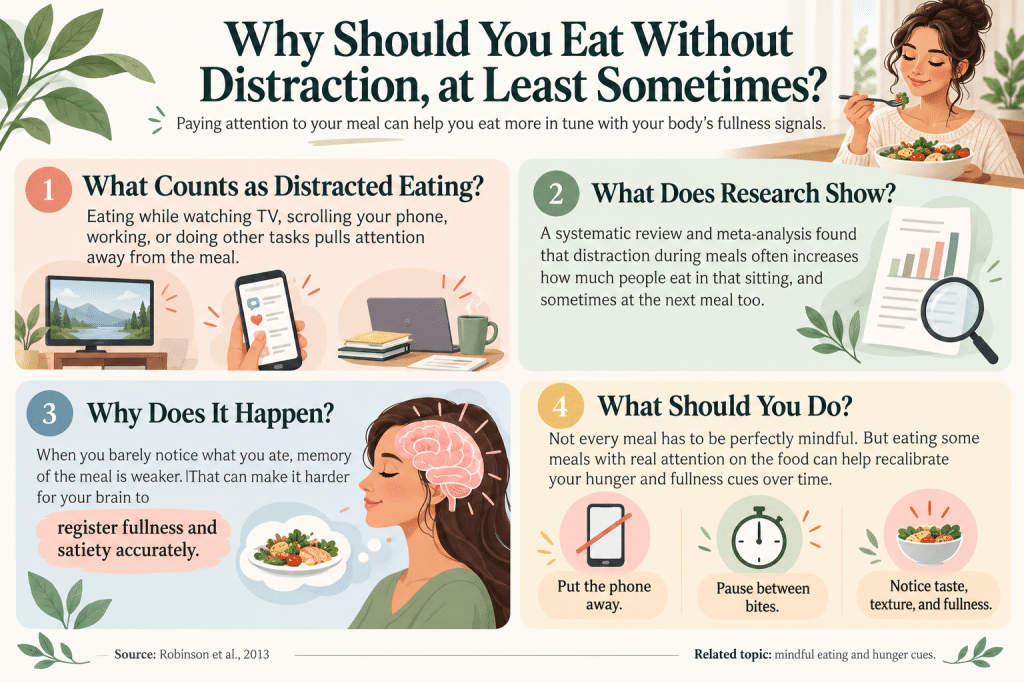
A systematic review and meta-analysis examining how attention and memory affect eating found that distraction, eating while watching television, scrolling a phone, or otherwise not attending to the meal, consistently increased how much people ate in that sitting and in some cases at the next meal as well, since being unaware of what you ate appears to weaken the internal cues that would otherwise signal fullness (Robinson et al., 2013).
This doesn’t mean every meal needs to be a silent, meditative ritual. It means that at least some meals eaten with actual attention on the food itself help recalibrate your brain’s ability to register satiety accurately, which is a skill that erodes with constant distracted eating and rebuilds with practice.
Why Should You Keep a Consistent Eating Rhythm?
Irregular eating, wildly different meal timing and frequency from day to day, appears to disrupt the same hormonal and metabolic signaling this entire list is trying to support. A controlled crossover study comparing a regular six-meals-a-day pattern against an irregular pattern (ranging from three to nine meals a day) in the same individuals found that the regular pattern produced lower energy intake, better post-meal insulin response, and improved fasting lipid profiles compared to the irregular pattern (Farshchi et al., 2005).
The specific number of meals mattered less than the consistency; your body appears to regulate hunger and metabolic response more efficiently when it can anticipate roughly when food is coming.
If your schedule makes rigid meal timing unrealistic, aiming for rough consistency, meals landing within a similar window most days, still captures much of this benefit without requiring a precise, inflexible schedule.
Get 11 Sample Recipes from Our Bestselling Mediterranean Cookbook.
Get our 11 Sample Recipes from our Best Selling Mediterranean Protein Friendly Cookbook. These are the most delicious recipes our retreat guests love the most. Easy, simple with few ingredients per meal. Make delicious heart-friendly and healthy meals you enjoy every day.
How Can You Move Your Body With Realistic Expectations?
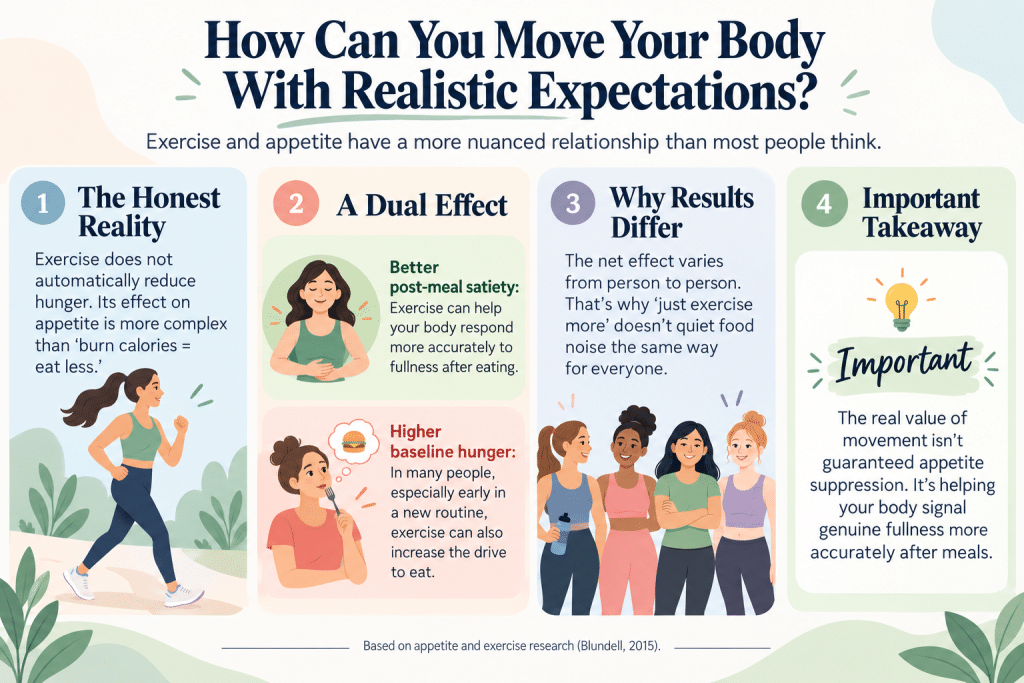
Exercise’s relationship with appetite is more complicated than “burns calories, therefore reduces hunger,” and it’s worth understanding honestly rather than oversimplifying.
Research on the topic describes a dual effect: exercise tends to improve how sensitively your body responds to food after a meal (better post-meal satiety signaling), while also, in many people, increasing baseline hunger or the drive to eat, particularly early in a new exercise routine (Blundell, 2015). The net effect varies significantly between individuals, and this variability is part of why “just exercise more” doesn’t reliably quiet food noise for everyone the same way.
Important: the value of movement here isn’t a guaranteed reduction in hunger. It’s an improvement in how accurately your body signals genuine fullness after eating, which is a different and more useful outcome than appetite suppression alone.
How Can You Separate Thirst From Hunger (With an Honest Caveat)?
This is the habit you’ll see recommended everywhere, and it deserves a more honest treatment than it usually gets. The idea that thirst is commonly mistaken for hunger is popular advice, but the research specifically testing whether drinking water reduces subsequent food intake is honestly mixed, with some studies showing a modest effect (particularly in older adults) and others showing little to no measurable impact on hunger or intake in younger populations.
Staying adequately hydrated is worth doing for its own well-established reasons, and there’s no harm in a glass of water before deciding whether you’re truly hungry. Just don’t expect it to reliably override a strong food-noise signal driven by the other nine factors on this list; the evidence for hydration as a standalone appetite lever is considerably weaker than for sleep, protein, or stress management.
Get 11 Sample Recipes from Our Bestselling Mediterranean Cookbook.
Get our 11 Sample Recipes from our Best Selling Mediterranean Protein Friendly Cookbook. These are the most delicious recipes our retreat guests love the most. Easy, simple with few ingredients per meal. Make delicious heart-friendly and healthy meals you enjoy every day.
What Does the Evidence Show?
The following table summarizes the mechanisms and evidence strength behind each of the ten habits for quieting food noise.
| Habit | Mechanism | Evidence Strength |
|---|---|---|
| Protein at every meal | Slows gastric emptying, triggers PYY/GLP-1 release | Strong |
| Adequate fiber | Slows digestion, stimulates satiety hormones, feeds gut microbiome | Strong |
| Protecting sleep | Restores leptin/ghrelin balance | Strong (controlled trial evidence) |
| Stable blood sugar | Reduces rebound hunger from glycemic spikes | Moderate to Strong |
| Deliberate stress management | Lowers cortisol-driven reward-seeking for calorie-dense food | Strong |
| Limiting hyperpalatable food | Reduces supra-additive dopamine reward response | Strong (mechanistic, brain-imaging evidence) |
| Undistracted eating | Preserves interoceptive satiety cues | Strong (meta-analysis evidence) |
| Consistent eating rhythm | Improves insulin response and hunger predictability | Moderate to Strong |
| Movement | Improves post-meal satiety signaling; effect on baseline hunger is individually variable | Moderate (mixed, dual-direction effect) |
| Hydration | Weak, inconsistent link to reduced food intake | Weak |
What Are Your Next Steps?
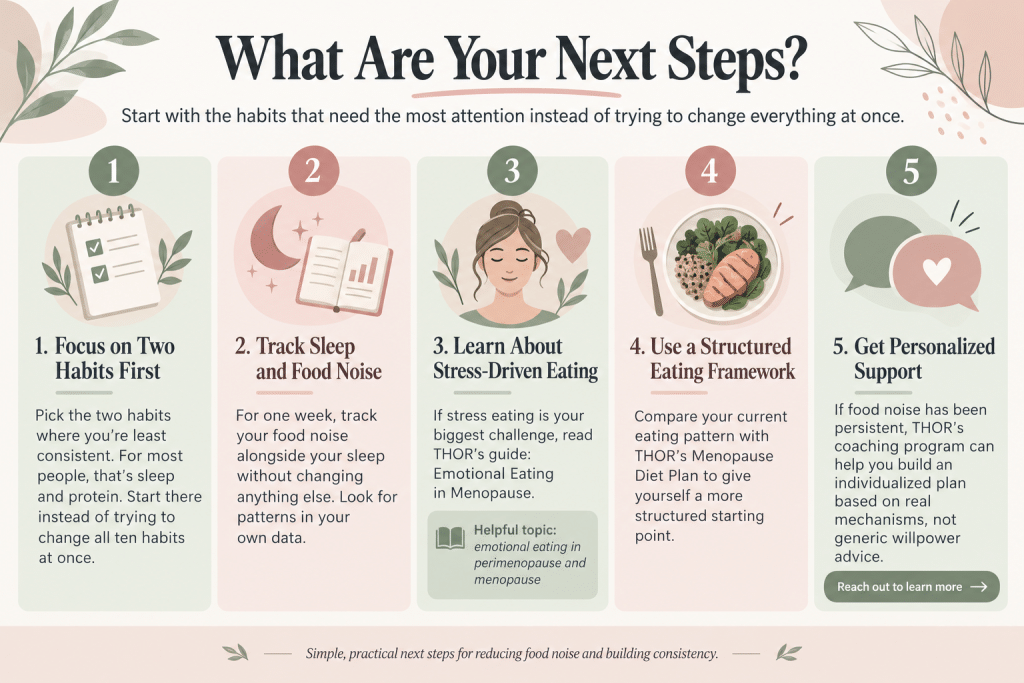
Start with the habits that need the most attention rather than trying to change everything at once. The following steps provide a practical way to apply these strategies to your current routine.
- Pick the two habits from this list where you’re furthest from consistent (most people land on sleep and protein) and focus there first, rather than trying to implement all ten simultaneously.
- Track your food noise against your sleep for one week, without changing anything else, to see whether the pattern in Section 3 shows up in your own data.
- Read THOR’s guide to emotional eating in perimenopause and menopause at Emotional Eating in Menopause if stress-driven eating specifically is your biggest challenge.
- Check how your current eating pattern lines up with a structured plan using THOR’s Menopause Diet Plan as a starting framework.
- If food noise has been a persistent, difficult pattern, THOR’s coaching program builds individualized plans around exactly these mechanisms rather than generic willpower advice. Reach out to learn more.
Get 11 Sample Recipes from Our Bestselling Mediterranean Cookbook.
Get our 11 Sample Recipes from our Best Selling Mediterranean Protein Friendly Cookbook. These are the most delicious recipes our retreat guests love the most. Easy, simple with few ingredients per meal. Make delicious heart-friendly and healthy meals you enjoy every day.
Frequently Asked Questions
What is “food noise,” exactly?
It’s the term for persistent, intrusive thoughts about food that occupy mental bandwidth beyond what hunger alone would explain, often described by people managing weight or using GLP-1 medications as background chatter about eating that doesn’t quiet down between meals.
Is food noise a real physiological phenomenon or just a lack of willpower?
It’s physiological. The habits in this article target specific, measurable hormonal and neurological signals, ghrelin, leptin, cortisol, dopamine reward response, not a character trait, and research consistently shows these signals can be shifted by specific, identifiable inputs.
What’s the single most impactful habit on this list?
Sleep has some of the strongest controlled-trial evidence behind it; a single instance of sleep restriction produced measurable shifts in both leptin and ghrelin along with a substantial jump in reported hunger and appetite (Spiegel et al., 2004).
Does eating more protein really reduce food noise, or just weight?
Both, through the same mechanism. Protein’s satiating effect works by slowing digestion and triggering hormonal satiety signals, which is precisely the pathway responsible for reducing persistent food thoughts, not a separate effect specific to weight management.
Can stress alone cause food noise even if I’m eating well otherwise?
Yes. Elevated cortisol directly stimulates reward-circuitry craving for calorie-dense food, independent of how well-structured your meals are, which is why stress management belongs on this list as its own distinct lever rather than a footnote to diet.
Is it true that thirst is often mistaken for hunger?
This is popular advice, but the research testing it directly is mixed and weaker than commonly claimed. Staying hydrated is worth doing regardless, but it’s not a reliable standalone fix for strong food noise.
Why do ultra-processed foods specifically create more food noise than whole foods?
Brain imaging research found that the specific combination of fat and refined carbohydrate, common in heavily engineered snack foods, produces a reward response in the brain greater than either component alone would predict, independent of how much a person reports liking the food (DiFeliceantonio et al., 2018).
Does intermittent fasting help quiet food noise?
This article doesn’t specifically address fasting protocols; the research reviewed here points more consistently toward eating regularity (Section 8) and meal composition as the stronger, more consistent levers.
How long does it take for these habits to reduce food noise?
This varies by habit and individual. Sleep-related hormonal shifts can occur within days, based on the controlled trial referenced in Section 3, while habits like reducing hyperpalatable food exposure or rebuilding distraction-free eating awareness likely take longer to show a noticeable shift.
Can exercise make food noise worse instead of better?
For some people, yes, at least initially. Exercise has a documented dual effect: it improves post-meal satiety signaling but can also increase baseline hunger drive, and the balance between these two effects varies significantly between individuals (Blundell, 2015).
Is food noise related to GLP-1 medications like semaglutide?
The term became widely used in conversations about GLP-1 medications because many users report a sharp reduction in these persistent food thoughts; this article addresses the same underlying satiety-hormone pathways (GLP-1, PYY) through behavioral and lifestyle habits rather than medication.
Should I try to implement all 10 habits at once?
No. Trying to change ten behaviors simultaneously is a reliable way to sustain none of them. Pick one or two, per the guidance in Your Next Steps, and build from there.
Does menopause or perimenopause change how these hormones behave?
Hormonal shifts during this life stage can affect sleep quality, stress reactivity, and metabolic signaling, all of which intersect with the mechanisms in this article, which is part of why THOR’s broader menopause-specific content on sleep, stress, and diet is worth reading alongside this piece.
What if I’ve tried most of these and food noise is still a major problem?
Persistent, significant food noise despite consistent effort on these fronts is worth discussing with a healthcare provider, since it may point toward a factor, hormonal, medication-related, or otherwise, beyond what lifestyle habits alone can address.
I write 3 essays per week on Lifestyle Medicine for women in midlife on what is happening in the body and what to do about it. No fluff, no hype. Free Subscription.
References
- Leidy, H.J., Clifton, P.M., Astrup, A., et al. (2015). The Role of Protein in Weight Loss and Maintenance. American Journal of Clinical Nutrition, 101(6), 1320S-1329S.
- Slavin, J.L. (2005). Dietary Fiber and Body Weight. Nutrition, 21(3), 411-418.
- Spiegel, K., Tasali, E., Penev, P., & Van Cauter, E. (2004). Sleep Curtailment in Healthy Young Men Is Associated With Decreased Leptin Levels, Elevated Ghrelin Levels, and Increased Hunger and Appetite. Annals of Internal Medicine, 141(11), 846-850.
- Adam, T.C., & Epel, E.S. (2007). Stress, Eating and the Reward System. Physiology & Behavior, 91(4), 449-458.
- DiFeliceantonio, A.G., Coppin, G., Rigoux, L., et al. (2018). Supra-Additive Effects of Combining Fat and Carbohydrate on Food Reward. Cell Metabolism, 28(1), 33-44.
- Robinson, E., Aveyard, P., Daley, A., et al. (2013). Eating Attentively: A Systematic Review and Meta-Analysis of the Effect of Food Intake Memory and Awareness on Eating. American Journal of Clinical Nutrition, 97(4), 728-742.
- Farshchi, H.R., Taylor, M.A., & Macdonald, I.A. (2005). Beneficial Metabolic Effects of Regular Meal Frequency on Dietary Thermogenesis, Insulin Sensitivity, and Fasting Lipid Profiles in Healthy Obese Women. American Journal of Clinical Nutrition, 81(1), 16-24.
- Blundell, J.E., Gibbons, C., Caudwell, P., Finlayson, G., & Hopkins, M. (2015). Appetite Control and Energy Balance: Impact of Exercise. Obesity Reviews, 16(S1), 67-76.
Disclaimer: This article is for educational purposes only and does not constitute medical or nutritional advice. Food noise can be influenced by hormonal changes, sleep, stress, eating patterns, medications, and underlying health conditions. The dietary and lifestyle habits discussed may affect individuals differently and should not replace personalized medical care or treatment. If you have a history of eating disorders, diabetes, persistent food-related distress, or other metabolic or hormonal conditions, consult a qualified healthcare provider or registered dietitian before making significant changes to your diet or eating routine.
Get 11 Sample Recipes from Our Bestselling Mediterranean Cookbook.
Get our 11 Sample Recipes from our Best Selling Mediterranean Protein Friendly Cookbook. These are the most delicious recipes our retreat guests love the most. Easy, simple with few ingredients per meal. Make delicious heart-friendly and healthy meals you enjoy every day.

Terry Tateossian is a Menopause Lifestyle Medicine Coach, Certified Personal Trainer & Nutritionist and the Founder of THOR: The House of Rose, a wellness brand serving women over 40 through retreats, coaching, macro-nutrition and community. As 25-year founder and entrepreneur, Terry spent two and a half decades building and running successful start-up businesses, an experience that put her on the front line of founder burnout long before she could name it. After facing serious health challenges, early onset menopause, and emotional eating while running her agency and raising two children, Terry rebuilt her health in her 40s and lost more than 80 pounds through evidence-based nutrition, training, and mindset work. Today, she helps women get strong, improve confidence, support hormone health, and create a stronger second half of life. Terry has been featured in major media outlets and is available for podcasts, expert commentary, brand collaborations, and speaking engagements on midlife health, reinvention, emotional eating, menopause wellness, and strength training for longevity. Get her free macro calculator (her cookbook companion) to start your journey to back to health.