
 By Team THOR
Free 28-Day Fascia Reset Email Course
Get our Free 28-day email course series to help with 1 or 2 exercises per day to release your fascia. One short lesson per day. Two minutes to read each.
That Ridge on Your Nail Might Be Telling You Something: What Nail Ridges Really Mean
Renee is forty-eight. She was filing her nails one evening, the way she does most Sundays, when her thumbnail caught on something. Not a snag, not a hangnail, but a fine, raised line running from the base of the nail to the tip, the kind of thing you can feel more easily than you can see.
She held her hand up to the light and noticed something else: nearly every nail had the same faint ridges, running the same direction, evenly spaced like the grooves in a vinyl record. She had never really looked this closely before. Once she started, she could not stop looking, and she could not stop wondering what it meant.
What Renee found, once she looked into it, is a small piece of anatomy that turns out to be far more interesting than it looks: your nails are not static. They are a slow-motion record of your body’s health, growing at a steady, measurable rate, and any real disruption to that growth process, whether from age, illness, or something as simple as a nutrient shortfall, tends to show up as a visible change in the nail itself. A ridge is not a flaw. It is information.
This article walks through exactly what nail ridges are, the real difference between the two main types, what each one can and cannot tell you about your health, and when a ridge is worth mentioning to a doctor.
What Is a Nail Ridge?
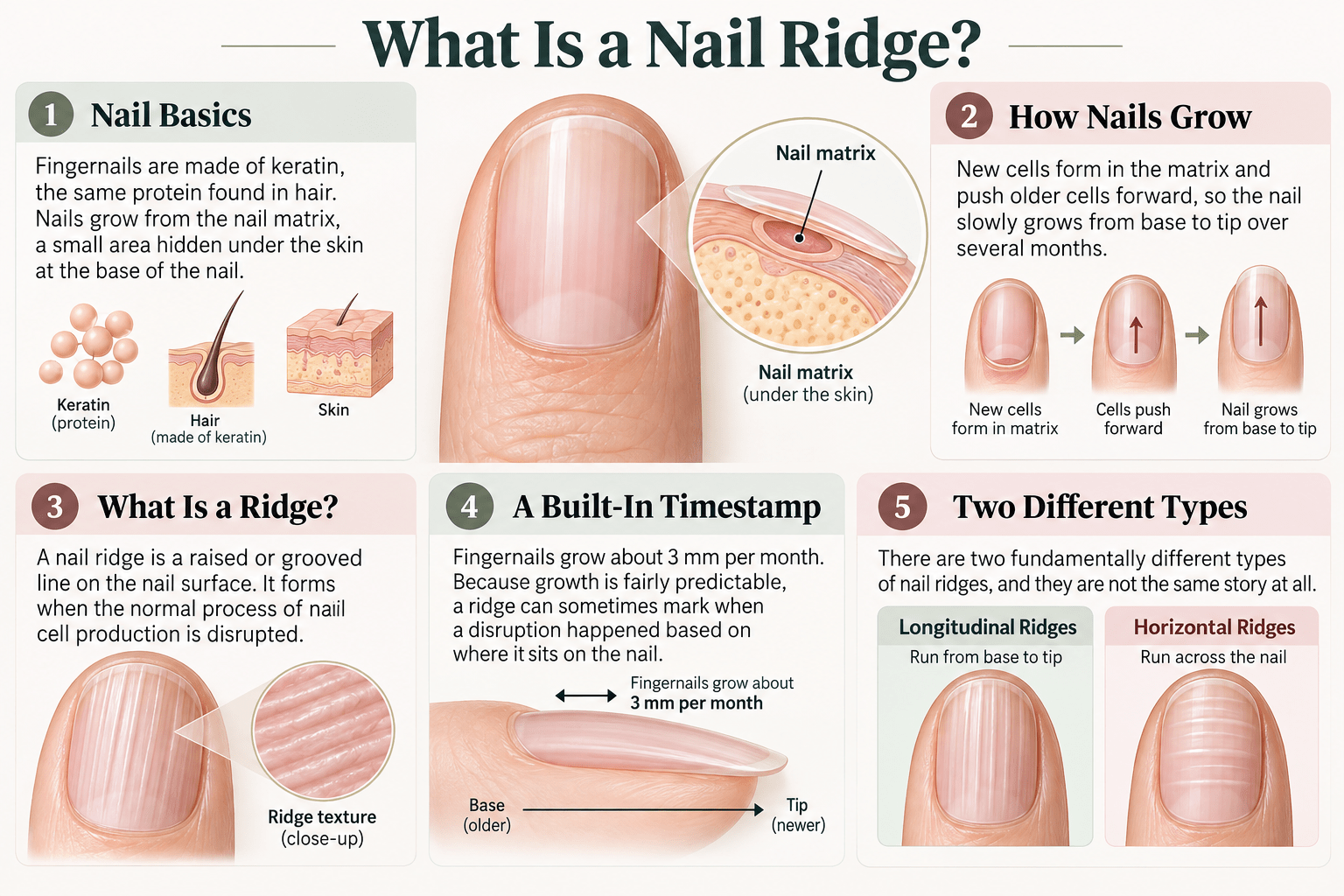
Your fingernails are made of a hardened protein called keratin, the same protein that makes up your hair. Nails grow continuously from a small area at the base of the nail, hidden just under the skin, called the nail matrix.
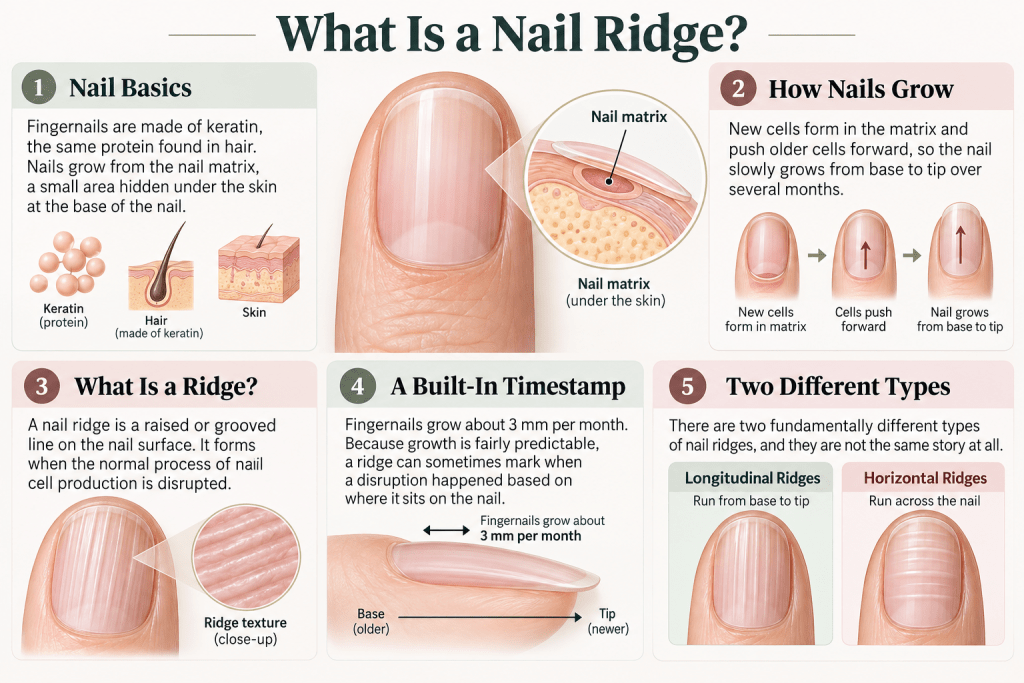
As new nail cells form in the matrix, they push the older cells forward and out, which is why a nail slowly grows from base to tip over a period of months.
A ridge is simply a change in the surface texture of the nail, a raised or grooved line rather than a perfectly flat surface. Ridges form when something disrupts the normally smooth, even process of nail cell production in the matrix, either briefly or over a longer period of time.
Because nails grow at a fairly predictable rate, roughly 3 millimeters per month for fingernails, a ridge can sometimes act like a timestamp, marking roughly when a disruption occurred based on where the ridge currently sits on the nail.
There are two fundamentally different types of ridges, and they are not the same story at all.
What Are Vertical Ridges?
Vertical ridges run lengthwise, from the base of the nail (the cuticle) to the free edge (the tip). They look like fine, raised lines running parallel to each other, and they are extremely common, especially as people get older.
The honest headline here: vertical ridges are, in the large majority of cases, a normal part of aging, not a sign of disease. They tend to become more noticeable through the 40s, 50s, and beyond, in much the same way skin develops fine lines. Nearly everyone develops some degree of vertical ridging eventually.
That said, vertical ridges are not always purely cosmetic. In some cases, they can become more pronounced with certain nutrient deficiencies, thyroid changes, or general nail dryness, all covered in the sections ahead.
The key distinction to hold onto is that vertical ridges alone, especially mild ones that have been present and stable for a long time, are rarely a reason for concern on their own.
Free 28-Day Fascia Reset Email Course
Get our Free 28-day email course series to help with 1 or 2 exercises per day to release your fascia. One short lesson per day. Two minutes to read each.
What Are Horizontal Ridges (Beau’s Lines)?
Horizontal ridges run across the nail, from one side to the other, perpendicular to the direction of growth. In medicine, these are called Beau’s lines, named after the French physician Joseph Honoré Simon Beau, who first described them in the 1800s.
Beau’s lines are a different story from vertical ridges, and this is the distinction most popular content online tends to blur. A horizontal ridge represents a temporary but real interruption in nail growth, meaning the nail matrix briefly slowed or stopped producing new cells at a normal rate.
That kind of interruption does not typically happen from ordinary aging. It usually happens because something significant occurred in the body: a high fever, a serious illness, a major nutrient deficiency, certain medications (including chemotherapy), a significant injury to the nail itself, or a period of major physical stress on the body.
This is the part of the story that makes nail ridges more than just a cosmetic curiosity: a horizontal ridge is, in a real sense, a small physical record of something your body went through, showing up weeks or months later as a visible line.
“I did not know the difference between vertical and horizontal nail ridges until I started researching this article, and once I understood it, I looked back at my own nails differently. The vertical lines I have had for years are just part of getting older, nothing more. But I remembered a single deep horizontal groove that showed up on one nail a few months after a bad flu a couple of years back, and suddenly that made complete sense. Your body keeps quiet records in strange places. This is one of them.”
Terry Tateossian, Founder of The House of Rose
How Can You Tell Vertical and Horizontal Nail Ridges Apart?
This distinction matters enough to spell out clearly.
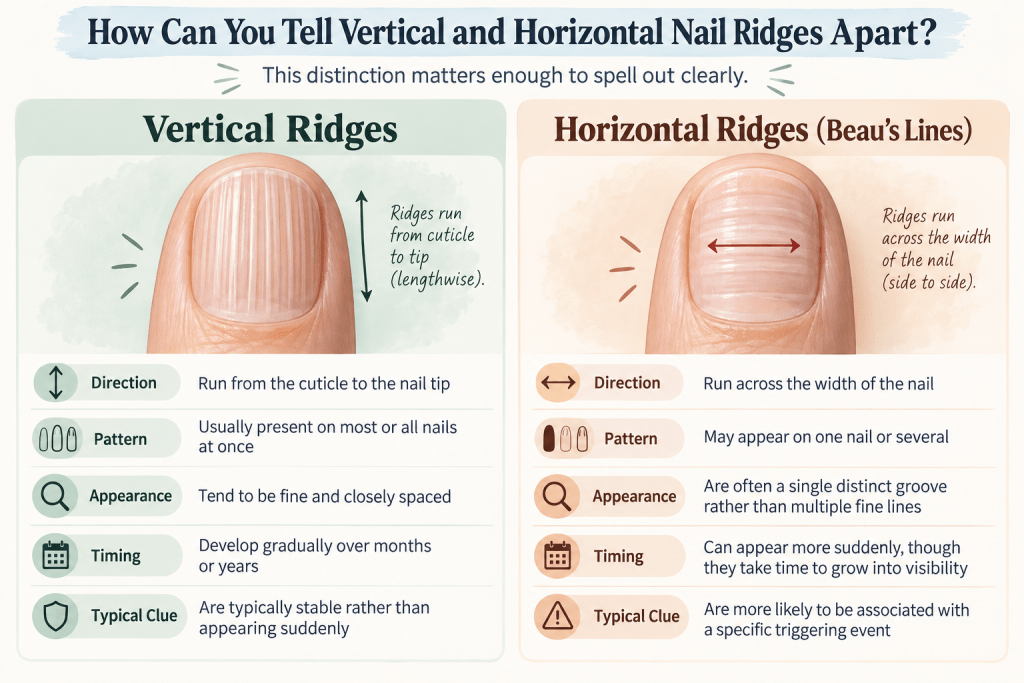
- Vertical ridges: Run from the cuticle to the nail tip, are usually present on most or all nails at once, tend to be fine and closely spaced, develop gradually over months or years, and are typically stable rather than appearing suddenly.
- Horizontal ridges (Beau’s lines): Run across the width of the nail, may appear on one nail or several, are often a single distinct groove rather than multiple fine lines, can appear more suddenly (though they take time to grow into visibility, as explained in Section 7), and are more likely to be associated with a specific triggering event.
If you are looking at your own nails right now, direction is the fastest way to tell these apart: does the line run the long way (vertical, usually normal) or the short way, across the nail (horizontal, worth a closer look)?
What Causes Vertical Ridges?
- Aging: The most common cause by far. As the nail matrix ages, its cell turnover process becomes slightly less smooth and even, producing the fine ridged texture so many people notice from midlife onward.
- Reduced moisture retention in the nail: Nails, like skin, lose some of their natural moisture and elasticity with age, which can make existing ridges more visible and nails somewhat more prone to fine cracking at the tips.
- Mild, common nutrient shortfalls: Iron, zinc, and B vitamins all play roles in healthy nail cell production, and mild shortfalls in any of these can subtly affect nail texture over time, discussed further in Section 8.
- Skin conditions affecting the nail matrix: Conditions such as eczema or psoriasis, when they affect the skin around the nail matrix, can sometimes contribute to a ridged or otherwise irregular nail texture.
- Genetics: Some people simply have a family tendency toward more pronounced vertical ridging than others, independent of any health factor.
Free 28-Day Fascia Reset Email Course
Get our Free 28-day email course series to help with 1 or 2 exercises per day to release your fascia. One short lesson per day. Two minutes to read each.
What Causes Horizontal Ridges (Beau’s Lines)?
- Significant illness or high fever: Any illness serious enough to place real physiological stress on the body, particularly one involving a sustained high fever, can temporarily slow nail matrix activity.
- Major nutrient deficiency: A significant, not mild, deficiency in nutrients like zinc or protein can interrupt normal nail growth enough to produce a visible line.
- Certain medications: Chemotherapy drugs are one of the most well documented causes of Beau’s lines, given their direct effect on rapidly dividing cells, which includes the cells of the nail matrix.
- Direct injury to the nail or nail matrix: A significant trauma to the base of the nail, such as a heavy object dropped on a finger, can produce a Beau’s line as the matrix recovers.
- Uncontrolled diabetes: Poorly controlled blood sugar can affect circulation and cell turnover broadly throughout the body, including in the nail matrix.
- Severe emotional or physical stress: While milder everyday stress is not generally considered a cause, an unusually severe period of physical or psychological stress, particularly if it disrupts sleep, nutrition, and overall physiological function significantly, has been associated with Beau’s lines in some clinical reports.
- Certain skin and autoimmune conditions: Conditions that cause significant inflammation near the nail matrix, including some autoimmune conditions, can occasionally produce this pattern.
- Peripheral vascular issues: Conditions that meaningfully reduce blood flow to the fingers or toes can, in some cases, disrupt nail matrix function enough to cause a horizontal ridge.
Can You Read a Timeline From a Beau’s Line?
This is one of the more useful, practical facts about Beau’s lines, and it is the reason a clinician might ask when you notice a particular ridge.
Because fingernails grow at a fairly predictable average rate of about 3 millimeters per month, and because a Beau’s line marks the exact moment nail growth was disrupted, you can estimate roughly how long ago the disrupting event happened by measuring how far the ridge has moved from the cuticle.
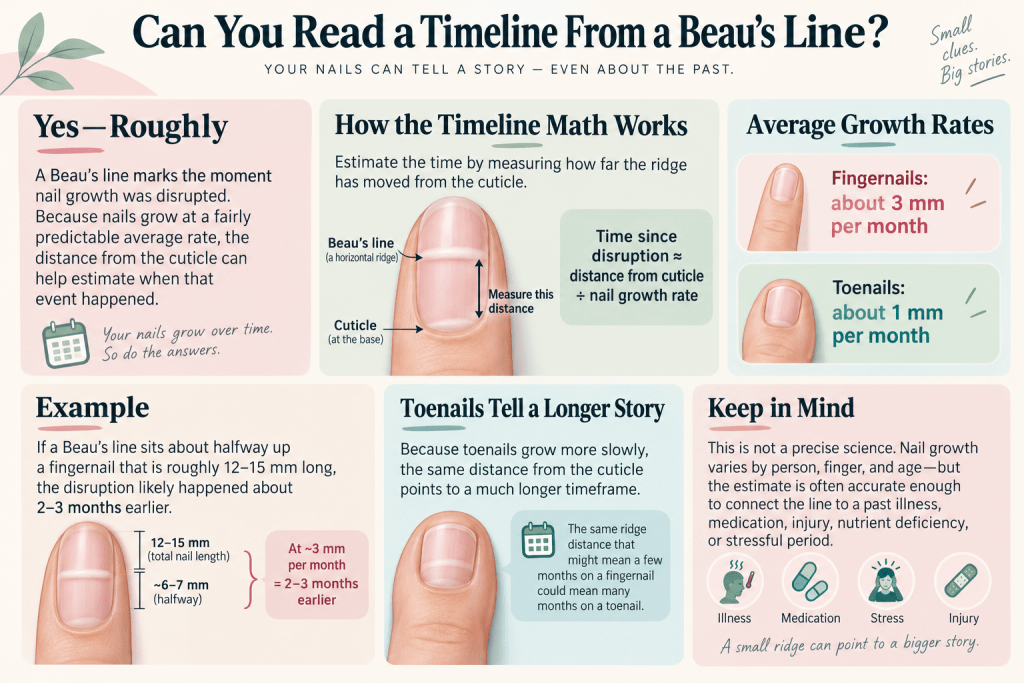
For example, a Beau’s line sitting about halfway up the nail on a finger where the full nail is roughly 12 to 15 millimeters long suggests the disrupting event happened somewhere around two to three months earlier, based on typical growth rates.
Toenails grow more slowly than fingernails, roughly 1 millimeter per month, so the same measurement approach on a toenail would suggest a considerably longer timeframe.
This is not a precise science, since growth rate varies somewhat by individual, by finger, and by age, but it is accurate enough that many people are able to look back and connect a Beau’s line to a specific illness, medication, or stressful period a few months prior, once they do the rough math.
Free 28-Day Fascia Reset Email Course
Get our Free 28-day email course series to help with 1 or 2 exercises per day to release your fascia. One short lesson per day. Two minutes to read each.
Can Vitamin or Mineral Deficiencies Cause Nail Ridges?
Nail health depends on an adequate supply of several specific nutrients, and meaningful shortfalls in any of them can affect nail texture, though it is worth being precise about how strong this connection actually is.
- Iron: Iron deficiency is one of the more well documented nutritional causes of nail changes, including ridging and, in more advanced cases, a spoon-shaped nail concavity called koilonychia. Iron deficiency is also one of the most common nutrient deficiencies in midlife women, particularly those with heavy menstrual cycles during perimenopause.
- Zinc: Zinc plays a direct role in cell division and protein synthesis, both essential to healthy nail growth, and deficiency has been associated with both vertical ridging and, in more severe cases, horizontal ridging.
- B vitamins, particularly B7 (biotin) and B12: Biotin is widely marketed for nail health, and while the evidence for biotin supplementation improving nail strength in people who are not actually deficient is limited, a genuine biotin or B12 deficiency can measurably affect nail texture and strength.
- Protein: Since nails are made of protein, inadequate overall protein intake can affect the quality of new nail growth, contributing to ridging, brittleness, or both.
- The honest caveat: Mild vertical ridging in an otherwise healthy person eating a reasonably balanced diet is far more likely to reflect ordinary aging than any specific deficiency. Nutrient-related nail changes tend to be more noticeable, often more brittle and fragile rather than simply lined, and tend to improve once the underlying deficiency is corrected, which is a meaningfully different pattern than the gradual, stable ridging most people develop with age.
Can Nail Ridges Be Related to Thyroid Health?
The thyroid gland regulates metabolism throughout the body, including the rate of cell turnover in tissues like skin, hair, and nails.
Both an underactive thyroid (hypothyroidism) and an overactive thyroid (hyperthyroidism) have been associated with nail changes, including increased brittleness, ridging, and, in some hypothyroid cases, thickened or slow-growing nails.
This connection is particularly relevant for midlife women, since thyroid conditions become more common with age and are diagnosed more frequently in women than men.
If nail ridging appears alongside other potential thyroid symptoms, including fatigue, changes in weight, hair thinning, temperature sensitivity, or mood changes, it is worth mentioning the full picture to a doctor rather than focusing on the nails in isolation.
Why Do Nail Ridges Become More Common in Midlife?
Several midlife-specific factors make nail ridging, particularly vertical ridging, more common and often more noticeable during the perimenopause and menopause transition.
- Estrogen’s role in nail health: Estrogen supports circulation and tissue hydration broadly throughout the body, and its decline through perimenopause and menopause is associated with the same kind of general tissue dryness that affects skin, and can affect nail texture and moisture as well.
- Increased prevalence of thyroid conditions: As covered above, thyroid conditions become more common with age, adding another potential contributing factor during this life stage specifically.
- Nutrient demands and absorption changes: Nutrient absorption and dietary patterns can shift with age, and as covered in Section 8, several key nail-supporting nutrients are worth paying particular attention to during this transition.
- Cumulative effect, not sudden change: Most midlife nail ridging develops gradually rather than appearing suddenly, consistent with an aging-related process rather than a single triggering event, which is an important distinction from the more sudden appearance typical of Beau’s lines.
Free 28-Day Fascia Reset Email Course
Get our Free 28-day email course series to help with 1 or 2 exercises per day to release your fascia. One short lesson per day. Two minutes to read each.
What Can You Do About Vertical Ridges?
For most people, vertical ridges do not require treatment, since they are a normal part of aging rather than a problem to solve. That said, several practical steps can improve the appearance and texture of ridged nails for those who want to address them cosmetically or support overall nail health.
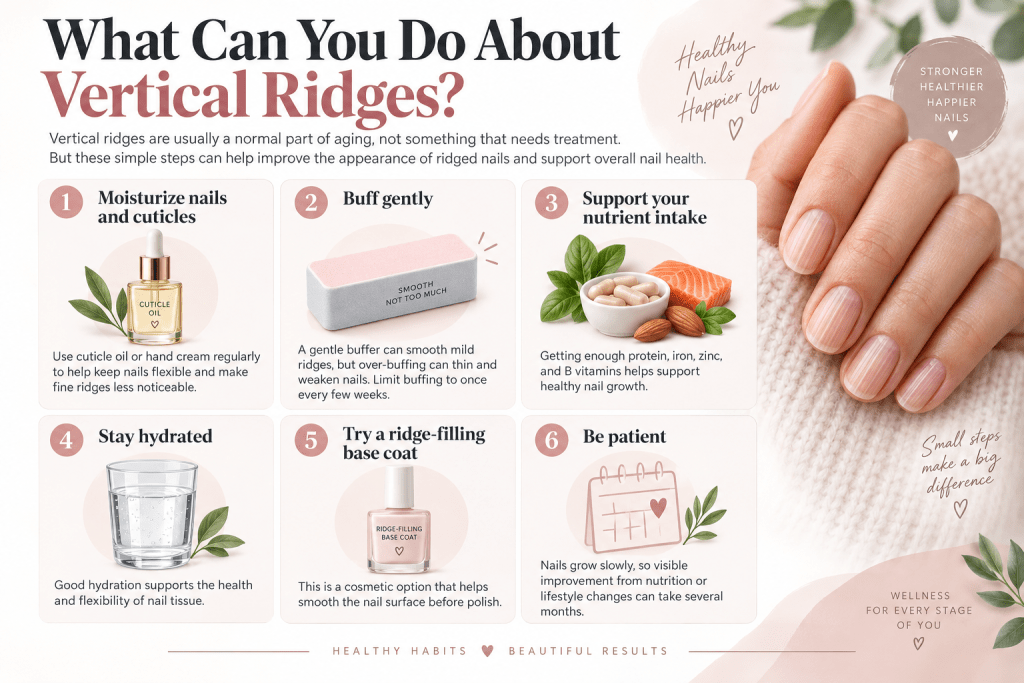
- Keep nails and cuticles well moisturized: Applying a nourishing cuticle oil or hand cream regularly helps maintain nail flexibility and can reduce the visible prominence of fine ridges.
- Buff gently, not aggressively: A gentle nail buffer can smooth the visible texture of mild vertical ridges, though over-buffing can thin and weaken the nail, so this should be done sparingly, no more than once every few weeks.
- Support your nutrient intake: Adequate protein, iron, zinc, and B vitamin intake supports healthy ongoing nail growth, particularly relevant for midlife women given the factors covered in Sections 8 and 10.
- Stay hydrated: As with skin, adequate hydration supports the overall health and flexibility of nail tissue.
- Consider a ridge-filling base coat: For those who want a purely cosmetic solution, ridge-filling base coats are widely available and effectively smooth the visual appearance of the nail surface before polish application.
- Be patient: Since nails grow slowly, any nutritional or lifestyle change will take several months to show up as a visible improvement in new nail growth, consistent with the growth-rate math covered in Section 7.
When Should You See a Doctor About Nail Ridges?
- Mild, gradual vertical ridging with no other symptoms. Generally does not require medical attention and is a normal part of aging.
- A distinct, new horizontal ridge (Beau’s line), particularly across multiple nails at once. Is worth mentioning to a doctor, especially if you cannot connect it to an obvious recent illness or injury, since it can occasionally point to an underlying condition worth investigating.
- Ridging accompanied by other symptoms: (fatigue, unexplained weight change, hair thinning, changes in nail color or shape, pain, swelling around the nail) is worth a medical evaluation of the fuller picture rather than the nail change alone.
- Sudden changes across all nails at once. Particularly in someone with a known chronic health condition or on new medication, are worth discussing with a physician, since medication side effects and systemic illness are common causes.
- Nails that are also discolored, separating from the nail bed, unusually thick, or accompanied by pain. Warrant evaluation regardless of ridging, since these can indicate infection or other nail-specific conditions outside the scope of this article.
As with the earlobe crease discussed in a related THOR article, the most useful response to noticing a nail change is not alarm. It is simply paying attention, tracking whether it is new or long-standing, and mentioning it to your doctor as one data point among your overall health picture if anything feels off.
Free 28-Day Fascia Reset Email Course
Get our Free 28-day email course series to help with 1 or 2 exercises per day to release your fascia. One short lesson per day. Two minutes to read each.
What Other Nail Changes Are Worth Knowing About?
Nail ridges are one of several nail changes that can carry health-related significance. A brief, honest overview of a few others, without turning this article into a full nail pathology guide:
- Pitting: Small, shallow depressions scattered across the nail surface, most commonly associated with psoriasis or other inflammatory skin conditions affecting the nail matrix.
- Spoon nails (koilonychia): A concave, scooped-out nail shape, most classically associated with significant iron deficiency anemia.
- Clubbing: A rounding and thickening of the fingertip and nail, associated with certain chronic lung and heart conditions, generally a more clinically significant finding than ridging.
- White spots (leukonychia): Small white marks on the nail, most commonly caused by minor trauma to the nail as it was growing, rarely a sign of any deficiency despite a persistent popular myth linking it to calcium or zinc levels.
- Yellowing: Can result from nail polish staining, fungal infection, or, less commonly, certain systemic conditions, and is worth evaluating separately from ridging.
What Are the Most Common Misconceptions About Nail Ridges?
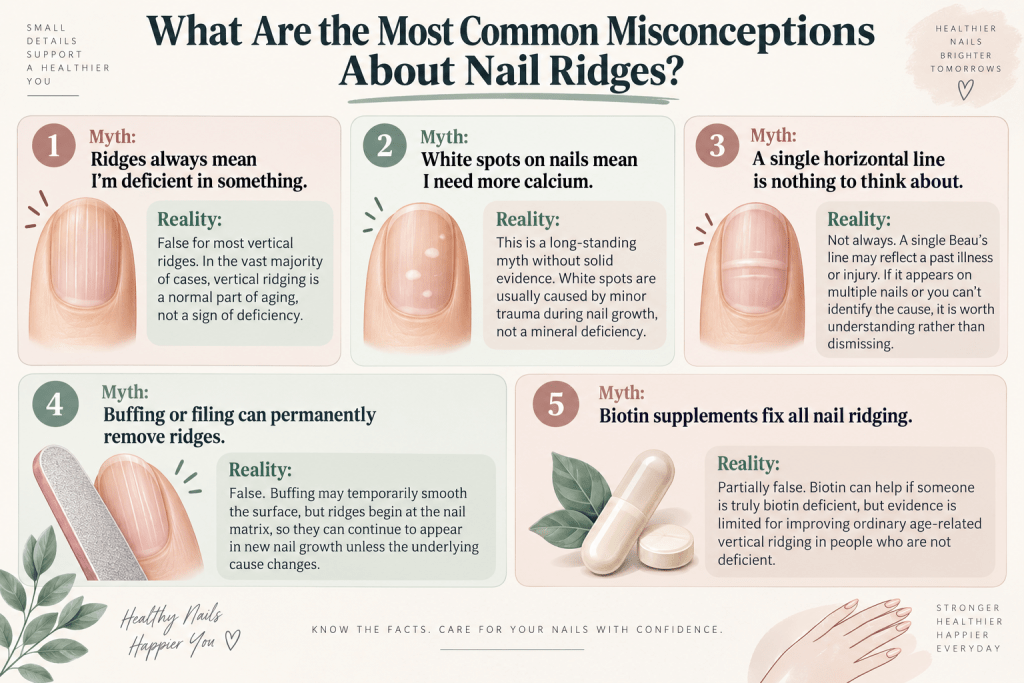
- Misconception: “Ridges always mean I’m deficient in something.” False for the vast majority of vertical ridging, which is simply a normal part of aging rather than a sign of deficiency.
- Misconception: “White spots on nails mean I need more calcium.” A long-standing popular myth without solid evidence behind it. White spots are almost always the result of minor trauma to the nail during growth, not a mineral deficiency.
- Misconception: “A single horizontal line is nothing to think about.” Not necessarily true. While an isolated Beau’s line is often traceable to a specific, already-resolved illness or injury, particularly if it appears on multiple nails at once, it is worth understanding rather than dismissing, especially if you cannot identify what caused it.
- Misconception: “Buffing or filing can permanently remove ridges.” False. Buffing can temporarily smooth the visible texture of existing nail, but since ridges originate at the nail matrix, they will continue to be present in new growth unless the underlying cause changes.
- Misconception: “Biotin supplements fix all nail ridging.” Partially false. Biotin supplementation has documented benefit specifically for people with an actual biotin deficiency, but has limited evidence for improving nail texture in people who are not deficient, which describes the majority of people with ordinary age-related vertical ridging.
This article is educational and is not a substitute for professional medical advice, diagnosis, or treatment. Always seek the advice of a qualified healthcare provider with any questions regarding a medical condition.
Free 28-Day Fascia Reset Email Course
Get our Free 28-day email course series to help with 1 or 2 exercises per day to release your fascia. One short lesson per day. Two minutes to read each.
Frequently Asked Questions
Are nail ridges normal?
Vertical nail ridges are extremely common and, in the large majority of cases, a normal part of aging rather than a sign of a health problem. Horizontal ridges (Beau’s lines) are less common and more often associated with a specific illness, deficiency, medication, or injury.
What is the difference between vertical and horizontal nail ridges?
Vertical ridges run from the cuticle to the nail tip and are usually a normal age-related change. Horizontal ridges, called Beau’s lines, run across the width of the nail and represent a temporary interruption in nail growth, often linked to illness, major stress, or nutrient deficiency.
What vitamin deficiency causes nail ridges?
Iron, zinc, biotin, and B12 deficiencies have all been associated with nail texture changes, including ridging. That said, most ordinary vertical ridging in healthy adults is related to aging rather than deficiency.
Can stress cause ridges in nails?
Ordinary daily stress is not generally considered a cause of nail ridging. However, an unusually severe period of physical or psychological stress, particularly one that disrupts overall physiological function, has been associated with Beau’s lines in some clinical reports.
Do nail ridges mean I have a thyroid problem?
Not necessarily, but thyroid conditions can contribute to nail changes, including ridging and increased brittleness. If ridging appears alongside other possible thyroid symptoms like fatigue or unexplained weight change, it is worth mentioning to your doctor.
Can you get rid of nail ridges?
Vertical ridges cannot be permanently removed since they originate at the nail matrix and will continue in new growth, though gentle buffing and a ridge-filling base coat can improve their appearance. Since nails grow continuously, once an underlying cause (like a deficiency) is corrected, new nail growth will reflect that improvement over the following months.
How fast do nails grow, and why does that matter?
Fingernails grow at roughly 3 millimeters per month on average, and toenails grow more slowly, at roughly 1 millimeter per month. This growth rate is what allows a Beau’s line’s position on the nail to serve as a rough timestamp for when a disrupting event occurred.
Is it normal for nail ridges to get worse with age?
Yes. Vertical ridging tends to become more pronounced from midlife onward as part of the same general tissue-aging process that affects skin.
Should I worry about a single horizontal line on one nail?
Usually not, particularly if you can connect it to a recent illness, fever, or minor injury. If it appears on multiple nails at once, or you cannot identify a cause, it is reasonable to mention it to your doctor.
Do biotin supplements help with nail ridges?
Biotin supplementation has clear benefit for people with an actual biotin deficiency, but limited evidence for improving nail texture in people who are not deficient, which is the case for most people with ordinary age-related ridging.
Can nail polish or gel manicures cause ridges?
Frequent gel manicures and the buffing that often accompanies them can thin the nail plate over time and may make existing ridges more visible, though they are not typically considered a direct cause of new ridging.
What do white spots on nails mean?
Despite a common myth linking them to calcium or zinc deficiency, white spots on nails are most often the result of minor trauma to the nail during growth and are rarely a sign of any nutritional deficiency.
I write 3 essays per week on Lifestyle Medicine for women in midlife on what is happening in the body and what to do about it. No fluff, no hype. Free Subscription.
Research and References
- Beau, J. H. S. (1846). Recherches sur les causes et sur les caractères de plusieurs modifications qui surviennent dans la structure des ongles. Archives Générales de Médecine.
- Fawcett, R. S., Linford, S., & Stulberg, D. L. (2004). Nail abnormalities: Clues to systemic disease. American Family Physician, 69(6), 1417-1424.
- Singal, A., & Arora, R. (2015). Nail as a window of systemic diseases. Indian Dermatology Online Journal, 6(2), 67-74.
- Cashman, M. W., & Sloan, S. B. (2010). Nutrition and nail disease. Clinics in Dermatology, 28(4), 420-425.
- Tosti, A., Piraccini, B. M., & de Farias, D. C. (2009). Dealing with melanonychia. Seminars in Cutaneous Medicine and Surgery, 28(1), 49-54.
- Iorizzo, M., Pazzaglia, M., Piraccini, B. M., Tullo, S., & Tosti, A. (2006). Brittle nails. Journal of Cosmetic Dermatology, 3(3), 138-144.
- de Berker, D. (2009). Nail anatomy. Clinics in Dermatology, 27(5), 509-514.
- Wright, K. E., Skinner, S., & Zhu, S. (2023). The musculoskeletal syndrome of menopause. Climacteric, 26(4), 366-371.
Disclaimer: This article is educational and does not constitute medical advice, diagnosis, or treatment. Nail ridges can have many causes, ranging from normal age-related changes to nutritional deficiencies, illness, medication effects, or other health conditions. Do not use nail appearance alone to diagnose a deficiency or medical problem. If you develop sudden horizontal ridges, changes across multiple nails, discoloration, pain, swelling, nail separation, or other concerning symptoms, consult a qualified healthcare provider for evaluation.
Free 28-Day Fascia Reset Email Course
Get our Free 28-day email course series to help with 1 or 2 exercises per day to release your fascia. One short lesson per day. Two minutes to read each.

Terry Tateossian is a Menopause Lifestyle Medicine Coach, Certified Personal Trainer & Nutritionist and the Founder of THOR: The House of Rose, a wellness brand serving women over 40 through retreats, coaching, macro-nutrition and community. As 25-year founder and entrepreneur, Terry spent two and a half decades building and running successful start-up businesses, an experience that put her on the front line of founder burnout long before she could name it. After facing serious health challenges, early onset menopause, and emotional eating while running her agency and raising two children, Terry rebuilt her health in her 40s and lost more than 80 pounds through evidence-based nutrition, training, and mindset work. Today, she helps women get strong, improve confidence, support hormone health, and create a stronger second half of life. Terry has been featured in major media outlets and is available for podcasts, expert commentary, brand collaborations, and speaking engagements on midlife health, reinvention, emotional eating, menopause wellness, and strength training for longevity. Get her free macro calculator (her cookbook companion) to start your journey to back to health.