
 By Team THOR
Free 28-Day Fascia Reset Email Course
Get our Free 28-day email course series to help with 1 or 2 exercises per day to release your fascia. One short lesson per day. Two minutes to read each.
Can You Sit Down and Stand Up Without Using Your Hands? What the Sitting-Rising Test Predicts
Every retreat week, there’s a moment during our floor-based movement sessions where I can tell, almost instantly, which guests are going to have the easiest week physically and which ones are going to need extra support getting in and out of certain postures. It’s not when we’re standing.
It’s the transition to and from the mat. Some women drop to the floor and spring back up without a second thought. Others lower themselves in stages, a hand here, a knee there, a small negotiation with gravity at every step, and getting back up takes visible effort and usually a piece of furniture within reach.
I used to think of this as flexibility, or maybe just a quirk of who happened to do yoga more often. After four years of watching this exact pattern repeat across dozens of women’s yoga retreats, I don’t think that anymore. What I was watching, without having the research language for it yet, was a real, measurable marker that clinicians have been studying for over two decades: how a person gets up off the floor predicts far more about their underlying health than it has any right to.
There’s a specific test built around this exact movement, and a body of published research tracking what a person’s score on it says about their long-term health. It started in a single exercise medicine clinic and has since been studied in thousands of people over more than a decade of follow-up. Here’s what it actually shows, how to score yourself, and, more usefully, what to do if your score isn’t where you’d like it to be.
Important: This article is educational and does not replace individualized medical advice. Women with joint replacements, recent surgery, significant balance impairment, or uncontrolled dizziness should consult a physician or physical therapist before attempting this test.
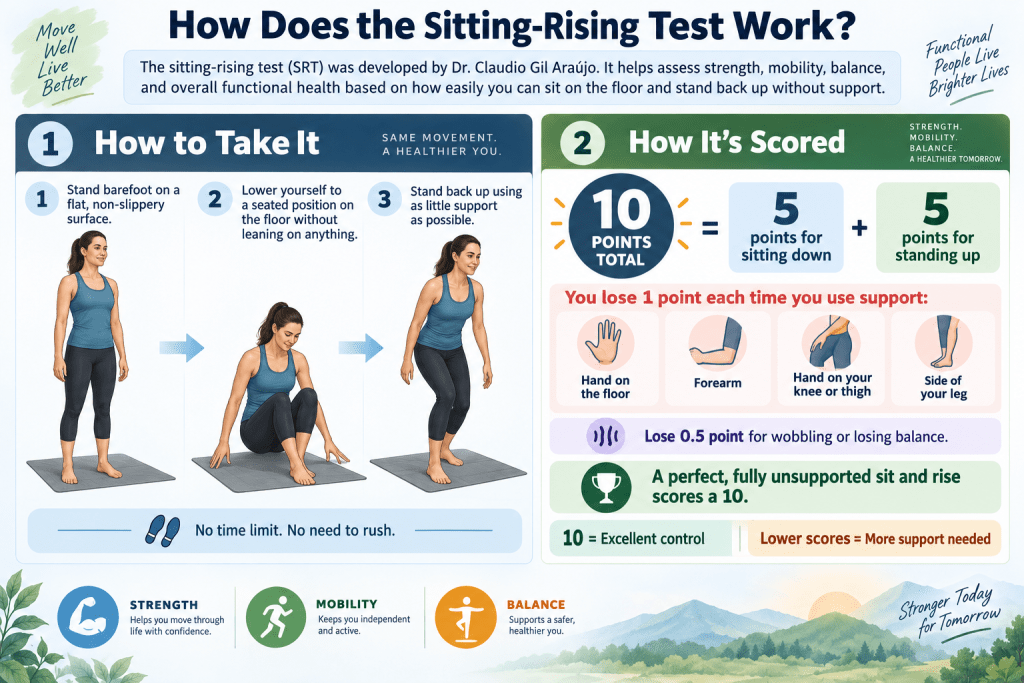
How Does the Sitting-Rising Test Work?
The sitting-rising test (SRT) was developed by Dr. Claudio Gil Araújo, a physician who runs an exercise medicine clinic in Rio de Janeiro, after he noticed a pattern among his patients: the ones who struggled to get down to the floor and back up without support tended to be the same patients whose overall health trajectory looked worse, often well before it showed up in standard lab work.
How to Take It
Stand barefoot on a flat, non-slippery surface, ideally with a carpeted or matted floor for comfort. Without leaning against anything, lower yourself to a seated position on the floor, then stand back up, using as little support as possible. There’s no time limit and no need to rush.
How It’s Scored
You start at 10 points, 5 allotted for sitting down and 5 for standing up. Each time you use a support, a hand on the floor, a forearm, a hand on your knee or thigh, or the side of your leg, you lose one point from that half of the movement. If you wobble or lose your balance at any point, you lose half a point. A perfect, fully unsupported sit and rise scores a 10.
Why Does This One Movement Reveal So Much?
Most fitness assessments test one system at a time. A treadmill test measures cardiovascular capacity. A grip strength test measures upper body strength. A flexibility screen measures range of motion.
Getting down to the floor and back up without support asks several systems to work together at once: leg strength, core strength, balance, flexibility through the hips and ankles, and coordination. If any one of those is significantly compromised, the score reflects it, because there’s no way to compensate for a weak link the way you might on a single-system test.
That’s part of why the test has held up so well across different research populations. It’s not measuring one narrow capacity. It’s measuring whether the whole functional system still works together the way it’s supposed to.
“I’ve watched women who look perfectly healthy standing up struggle to get off a yoga mat, and I’ve watched women who’d never call themselves ‘fit’ pop up like it’s nothing. It has almost nothing to do with how someone looks and almost everything to do with what’s actually happening in their hips, ankles, and core. That’s exactly why I think every woman should know her own score instead of guessing.”
Terry Tateossian, Founder of The House of Rose
Free 28-Day Fascia Reset Email Course
Get our Free 28-day email course series to help with 1 or 2 exercises per day to release your fascia. One short lesson per day. Two minutes to read each.
What Did the Research Actually Find?
The first major test of the SRT followed just over 2,000 adults aged 51 to 80 for a median of 6.3 years, tracking their SRT scores against all-cause mortality.
Participants who scored in the lowest range, 0 to 3, had a substantially higher mortality risk than those who scored in the highest range, 8 to 10, and the gap between groups was large enough that researchers reported each single-point improvement in SRT score was associated with roughly a 21% reduction in all-cause mortality risk over the follow-up period.
One fewer hand needed on the floor was measurably associated with better long-term survival odds. That study was published in the European Journal of Preventive Cardiology in 2014, and it’s been cited widely since, in part because the test costs nothing, takes under a minute, and requires no equipment.
A larger, more recent follow-up study from the same research group has since extended these findings to a bigger cohort with a longer follow-up period, and has reported that the association holds, including a specific link to cardiovascular mortality, though the precise statistics from that expanded study weren’t independently verifiable at the time of writing and are noted here directionally rather than with specific figures.
Important: An SRT score is a marker associated with mortality risk in population-level research. It is not a diagnosis, and a lower score doesn’t mean a fixed outcome. It’s a signal worth acting on, not a verdict.
How Does the Companion Single-Leg Stance Test Work?
The same research group behind the SRT also studied an even simpler assessment: standing on one leg, unsupported, for 10 seconds. In a study of roughly 1,700 adults aged 51 to 75, published in the British Journal of Sports Medicine in 2022, about one in five participants couldn’t complete the 10-second single-leg stance.
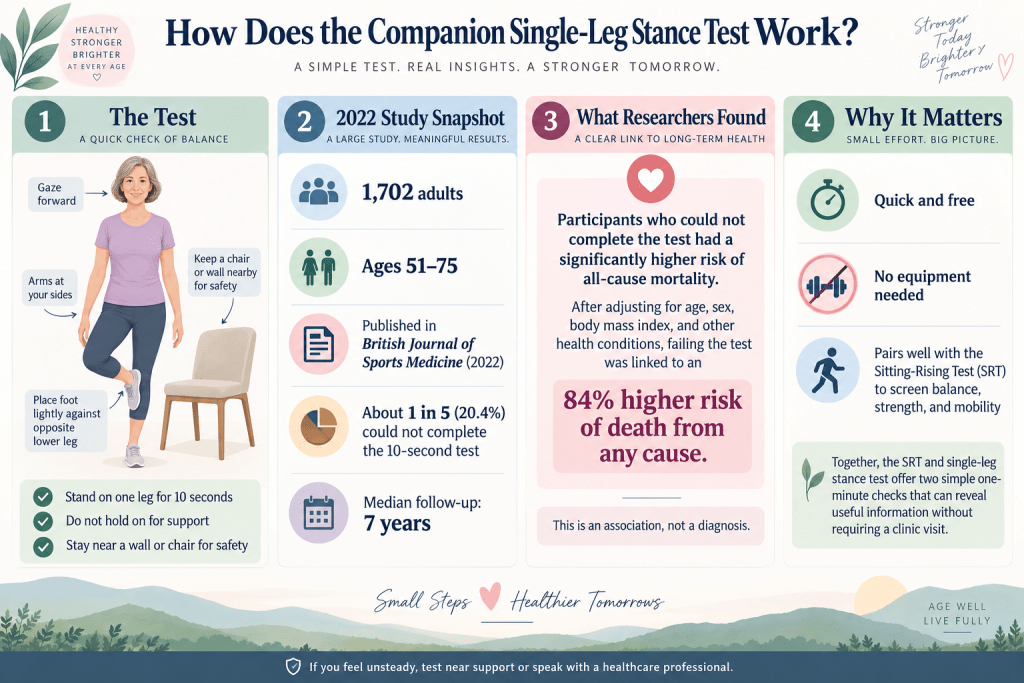
Over a median follow-up of about seven years, those who failed the test had a meaningfully higher risk of all-cause mortality than those who passed, even after adjusting for age, sex, body mass index, and other health conditions.
The single-leg stance test adds another quick way to assess balance, with clear scoring thresholds and a practical progression for improving your result. Together, the SRT and single-leg stance test provide two free, one-minute assessments that can reveal useful information about strength, mobility, and balance without requiring a clinical visit.
Free 28-Day Fascia Reset Email Course
Get our Free 28-day email course series to help with 1 or 2 exercises per day to release your fascia. One short lesson per day. Two minutes to read each.
Why Can a Simple Floor Test Outperform Some Clinical Measures?
A cardiovascular fitness test can tell you your heart and lungs are working well while saying nothing about whether your ankles have the mobility to get you off the ground. A blood panel can come back completely normal while muscle mass and balance are quietly declining in the background.
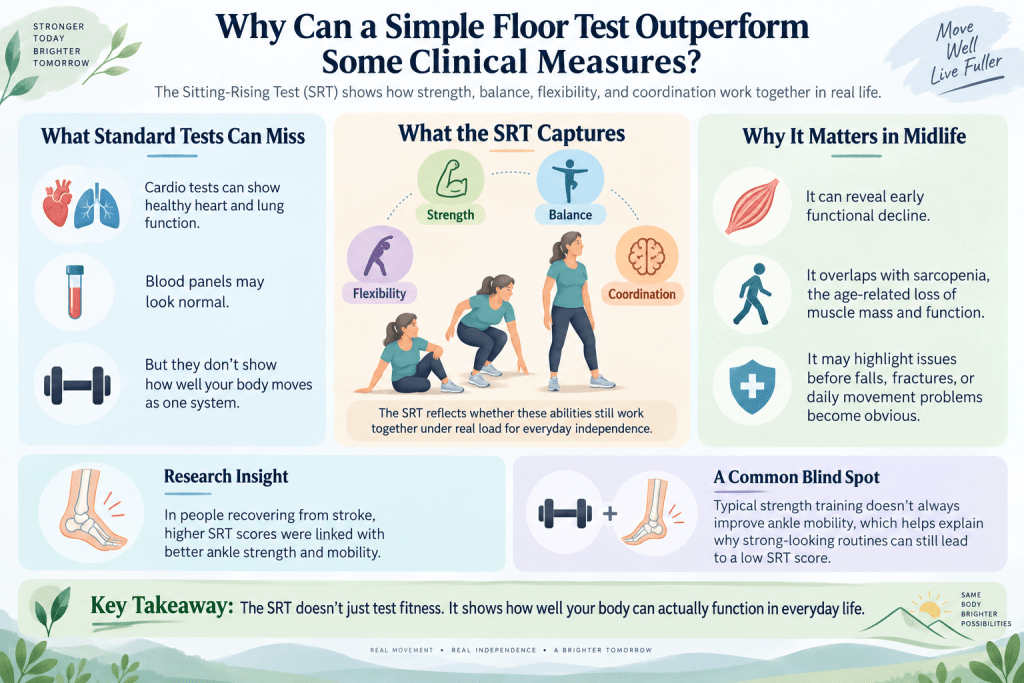
The SRT captures something those measures miss: whether strength, balance, flexibility, and coordination are all still functioning together, under real load, the way they need to for everyday independence.
This overlaps directly with sarcopenia, the age-related loss of muscle mass and function that can become increasingly important in midlife. The SRT offers one practical way to spot early functional changes in strength, mobility, and coordination before they become more obvious through falls, fractures, or difficulty with everyday movement.
Research on the SRT in populations recovering from conditions like stroke has found that rising scores correlate specifically with ankle strength and mobility, since getting up from the floor without using your hands requires meaningful work from the ankles, not just the legs and core.
Ankle mobility is rarely a focus of typical strength training, which is part of why a strong-looking training routine can still leave someone with a lower-than-expected SRT score.
What Does a Good Score Look Like by Age?
Reference data collected from thousands of non-athlete adults, organized by age and sex, gives a useful benchmark for where a given score falls relative to typical values.
| Score Range | General Interpretation |
|---|---|
| 10 | Full, unsupported sit and rise. Common in younger adults, uncommon after 55. |
| 8-9 | Strong functional capacity with minor support needed. |
| 6-7 | Moderate functional capacity; room for improvement in one or more systems. |
| 4-5 | Meaningful functional limitation; worth structured attention. |
| 0-3 | Significant functional limitation; consider professional guidance alongside training. |
A perfect score of 10 is common among younger adults but becomes uncommon after age 55, and research suggests fewer than roughly 8% of adults over 55 achieve it. The test tends to be most useful for distinguishing meaningful differences in functional capacity roughly between ages 46 and 80, which is precisely the window where catching early decline matters most for long-term independence.
It’s also worth noting that people with a lifelong habit of floor-sitting or squatting, common in some cultures and less common in Western furniture-heavy lifestyles, tend to score higher across all age groups, meaning the test reflects movement habits over a lifetime, not just current-day fitness.
Guest A shows stronger overall function, while Guest B needs more strength, mobility, and balance training.
| Guest A | Guest B | |
|---|---|---|
| Age | 54 | 54 |
| SRT Score | 9 (used one hand briefly) | 4 (needed both hands, a knee, and wobbled) |
| Likely contributing factors | Good ankle mobility, regular strength training | Limited hip/ankle mobility, minimal strength training, sedentary work |
| Suggested focus | Maintenance, refine balance | Structured strength, mobility, and balance program |
Free 28-Day Fascia Reset Email Course
Get our Free 28-day email course series to help with 1 or 2 exercises per day to release your fascia. One short lesson per day. Two minutes to read each.
How Can You Improve Your Score Based on What’s Actually Holding You Back?
Improving an SRT score isn’t about “exercising more” in a general sense. It’s about identifying which specific system cost you points and training that system directly.
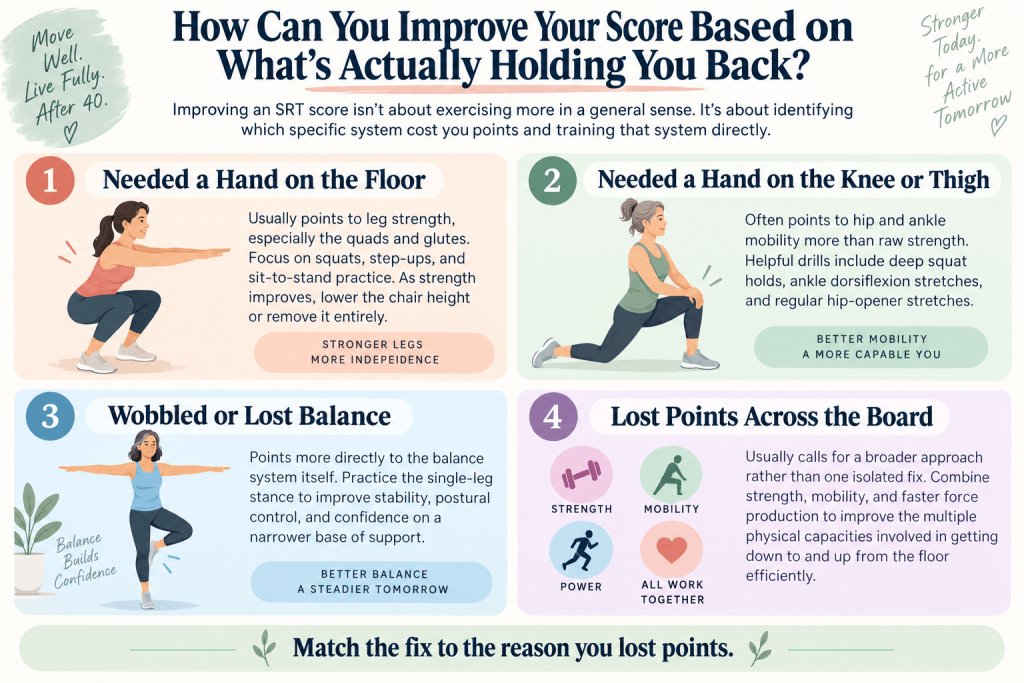
- If you lost points because you needed a hand on the floor: This usually points to leg strength, particularly the quads and glutes. Focus on squats, step-ups, and sit-to-stand practice from a chair, gradually lowering the chair height or removing it entirely as strength improves.
- If you lost points because you needed a hand on your knee or thigh: This often points to hip and ankle mobility rather than raw strength. Deep squat holds, ankle dorsiflexion stretches, and hip-opener stretches performed regularly can meaningfully improve this over several weeks.
- If you lost points because you wobbled or lost balance: This points more directly to the balance system itself. Practicing the single-leg stance gives you a simple, targeted way to work on stability, postural control, and confidence on a narrower base of support.
- If you lost points across the board: A lower score in several areas usually calls for a broader approach rather than one isolated fix. Combining strength, mobility, and faster force production—and understanding the role of power vs strength – can help address the multiple physical capacities involved in getting down to and up from the floor efficiently.
What Safety Notes Should You Know Before You Try It?
Practice near a sturdy chair or counter the first few times, especially if balance is a known concern.
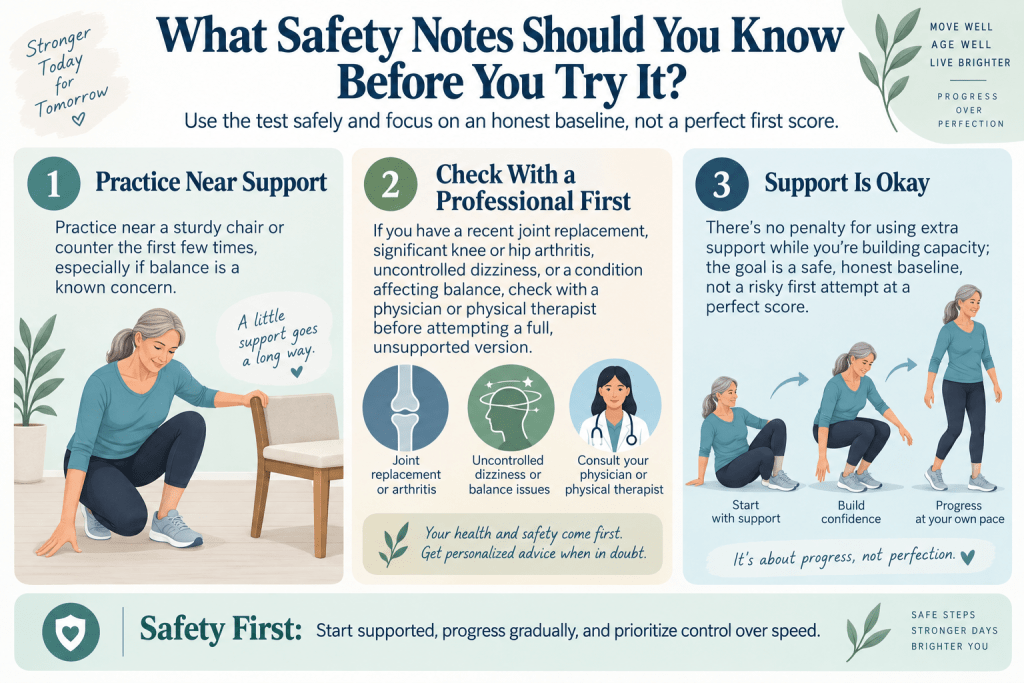
If you have a recent joint replacement, significant knee or hip arthritis, uncontrolled dizziness, or a condition affecting balance, check with a physician or physical therapist before attempting a full, unsupported version.
There’s no penalty for using extra support while you’re building capacity; the goal is a safe, honest baseline, not a risky first attempt at a perfect score.
Your Next Steps
- Take the sitting-rising test once, safely, near a chair or counter for support if needed, and record your honest score.
- Identify which system cost you points—strength, mobility, or balance—using the breakdown above.
- If balance was the main issue, use the single-leg stance as a simple way to train stability and postural control directly.
- If strength was the broader limitation, understanding the difference between power and strength can help you build a more complete training plan around both force and speed.
- Retest in 4 to 8 weeks and track your score alongside your training. You can also use the free macro calculator to make sure your calorie and protein targets are supporting the muscle you’re working to build.
For a more immersive approach, THOR’s women’s wellness & yoga retreats incorporate guided movement, mobility, and strength work into the retreat experience, giving you a supportive setting to practice the same functional skills the SRT is designed to assess.
If you want a plan built around your own results, 1:1 nutrition coaching can help translate your SRT score into a more targeted training strategy focused on the areas that need the most attention.
Important: This article is educational and does not replace individualized medical advice. Please consult a physician or physical therapist before attempting this test if you have a joint replacement, recent surgery, or a condition affecting balance.
Free 28-Day Fascia Reset Email Course
Get our Free 28-day email course series to help with 1 or 2 exercises per day to release your fascia. One short lesson per day. Two minutes to read each.
Frequently Asked Questions
What’s the difference between the sitting-rising test and the sit-to-stand test?
They’re related but distinct. The sitting-rising test (SRT), covered in this article, involves lowering all the way to the floor and standing back up. The sit-to-stand test typically refers to a chair-based assessment, often counting how many times someone can stand up and sit back down in 30 seconds, used commonly in physical therapy and geriatric settings.
What’s considered a “good” SRT score?
Generally, a score at or above the 50th percentile for your age and sex is considered a reasonable target, which for most midlife women falls somewhere in the 7 to 9 range, though this varies by age.
Can I improve my score, or is it fixed by genetics and age?
It can be improved. Strength, mobility, and balance are all trainable at any age, and the specific deficiency behind a low score (strength, mobility, or balance) points directly to what to train.
Is a low score a diagnosis of something serious?
No. It’s a marker associated with mortality risk at a population level in research studies, not an individual diagnosis. A low score is a signal to pay attention to, not a medical verdict.
How often should I retest my score?
Every 4 to 8 weeks is reasonable while actively working on the systems behind a low score, since meaningful strength and mobility changes typically take several weeks to show up.
Is it normal to lose points even if I consider myself fit?
Yes. Cardiovascular fitness and general “fitness” don’t always translate to floor mobility, since the SRT specifically tests a combination of strength, hip and ankle mobility, and balance that many training programs don’t directly address.
Does the test work the same for someone with knee or hip arthritis?
The test can still be informative, but modifications and physician guidance are appropriate, since arthritis can affect the movement independent of overall functional capacity. Don’t force a full unsupported attempt if it causes pain.
Why does ankle mobility matter so much for this test?
Getting up from the floor without using your hands requires meaningful ankle dorsiflexion (the ability to bring your shin toward your foot), a range of motion that’s rarely trained directly and tends to decline with age and sedentary habits.
Can children or very fit young adults score below 10?
Rarely, but it can happen, particularly if flexibility or coordination is limited despite good strength. The test is most useful and most differentiating in adults roughly 46 and older.
Does practicing the test itself count as training?
Practicing the movement pattern helps with coordination and confidence, but true score improvement usually requires targeting the underlying strength, mobility, or balance deficit directly, not just repeating the test.
Is the sitting-rising test culturally biased toward people who squat regularly?
To some degree, yes. People with a lifelong habit of floor-sitting or squatting tend to score higher, which researchers have noted as a limitation. It doesn’t invalidate the test’s value as a personal baseline and tracking tool, but it’s a reasonable caveat when comparing scores across very different lifestyle backgrounds.
Should I do this test alone or with someone watching?
Either works for a general self-assessment, but having someone watch the first attempt, especially if balance is a concern, adds a safety margin and can help catch small support movements you might not notice yourself doing.
How does this relate to sarcopenia?
The SRT is one practical way to catch the functional consequences of sarcopenia, age-related muscle loss, before they show up as a fall or loss of independence. THOR’s Sarcopenia guide covers the full picture of why this muscle loss happens and how to address it.
What if I can’t get to the floor at all right now?
That’s valuable information on its own and a strong reason to start with the individual components (chair-based sit-to-stand practice, hip and ankle mobility work) before attempting the full floor version, ideally with guidance from a physical therapist.
I write 3 essays per week on Lifestyle Medicine for women in midlife on what is happening in the body and what to do about it. No fluff, no hype. Free.
References
- de Brito, L. B. B., Ricardo, D. R., Araújo, D. S. M. S., Ramos, P. S., Myers, J., & Araújo, C. G. S. (2014). Ability to sit and rise from the floor as a predictor of all-cause mortality. European Journal of Preventive Cardiology, 21(7), 892-898.
- Araújo, C. G., de Souza e Silva, C. G., Laukkanen, J. A., Fiatarone Singh, M., Kunutsor, S. K., Myers, J., et al. (2022). Successful 10-second one-legged stance performance predicts survival in middle-aged and older adults. British Journal of Sports Medicine, 56(17), 975-980.
- Araújo, C. G., et al. Age- and sex-specific reference values for the sitting-rising test in a large non-athlete adult population. European Journal of Preventive Cardiology.
- National Institute on Aging patient guidance on functional fitness assessments and fall risk.
- American Physical Therapy Association clinical guidance on sit-to-stand testing in older adults.
Disclaimer: This article is educational and does not constitute medical advice. The sitting-rising test requires adequate strength, mobility, coordination, and balance, and may not be appropriate for everyone. If you have a joint replacement, recent surgery, significant knee or hip pain, dizziness, balance problems, or another condition affecting safe movement, consult a physician or physical therapist before attempting the test or following the exercises in this article.
Free 28-Day Fascia Reset Email Course
Get our Free 28-day email course series to help with 1 or 2 exercises per day to release your fascia. One short lesson per day. Two minutes to read each.

Terry Tateossian is a Menopause Lifestyle Medicine Coach, Certified Personal Trainer & Nutritionist and the Founder of THOR: The House of Rose, a wellness brand serving women over 40 through retreats, coaching, macro-nutrition and community. As 25-year founder and entrepreneur, Terry spent two and a half decades building and running successful start-up businesses, an experience that put her on the front line of founder burnout long before she could name it. After facing serious health challenges, early onset menopause, and emotional eating while running her agency and raising two children, Terry rebuilt her health in her 40s and lost more than 80 pounds through evidence-based nutrition, training, and mindset work. Today, she helps women get strong, improve confidence, support hormone health, and create a stronger second half of life. Terry has been featured in major media outlets and is available for podcasts, expert commentary, brand collaborations, and speaking engagements on midlife health, reinvention, emotional eating, menopause wellness, and strength training for longevity. Get her free macro calculator (her cookbook companion) to start your journey to back to health.