
 By Cindy Adoptante
Free 28-Day Fascia Reset Email Course
Get our Free 28-day email course series to help with 1 or 2 exercises per day to release your fascia. One short lesson per day. Two minutes to read each.
Do You Need to Be Sore to Build Muscle? What the Research Says
You take a hard hike on Saturday. The climb is brutal: heart pounding, legs burning, a few stops to catch your breath. The walk down feels easier, and you get home tired but not particularly sore. Then Monday arrives. Suddenly, walking downstairs means gripping the railing for dear life, and even sitting down becomes uncomfortable.
Most of us were told lactic acid causes this soreness, lingering in our muscles for days after exercise. It sounds reasonable, but the science tells a different story. The timing doesn’t fit, and neither does the cause. Understanding what happens raises a bigger question: do you need to feel sore for a workout to be effective?
I’m Terry Tateossian, founder of THOR – The House of Rose and a certified lifestyle medicine coach helping women in perimenopause, menopause, and post-menopause build and maintain strength at my yoga, fitness & wellness retreats in the Smoky Mountains. I often hear from women who worry when a workout doesn’t leave them sore or deliberately chase soreness as proof of progress. But the research supports neither approach.
Here’s what the science says about delayed onset muscle soreness and what it really means for muscle growth.
How Did Lactic Acid Become the Suspect?
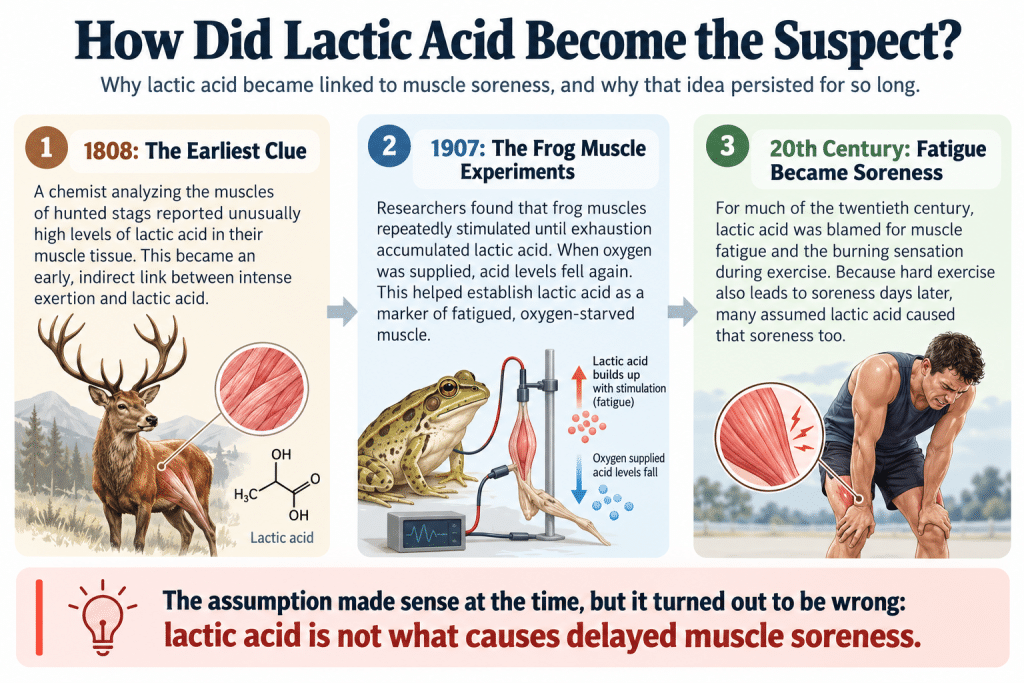
The lactic acid explanation for muscle soreness has a truly old history, which is part of why it has been so hard to dislodge.
- The earliest clue: In 1808, a chemist analyzing the muscles of hunted stags (animals that had been chased before being killed) reported unusually high concentrations of lactic acid in their muscle tissue, an early, if indirect, link between exertion and this compound.
- The frog muscle experiments: In 1907, researchers found that frog muscles stimulated to contract repeatedly until they gave out accumulated lactic acid, and that acid levels fell again when the muscles were subsequently supplied with oxygen. This work helped establish lactic acid as a marker of fatigued, oxygen-starved muscle in the scientific literature of the time.
- How the fatigue story became the soreness story: For much of the twentieth century, lactic acid was blamed for muscle fatigue and the burning sensation during exercise. Since hard exercise also causes soreness days later, it seemed logical to blame lactic acid for that ache too. That assumption turned out to be wrong.
Why Doesn’t the Timing Fit?
The most basic problem with the lactic acid explanation for delayed soreness is simply a matter of timing.
- Lactate clears quickly: After exercise ends, lactate levels in muscle and blood return to pre-exercise baseline within roughly an hour. This is well-established physiology, not a matter of scientific debate.
- The soreness timeline is completely different: Delayed onset muscle soreness (DOMS) typically begins after a pain-free window of 12 to 24 hours, peaks somewhere between one and three days post-exercise, and resolves within about a week.
- The gap these two timelines leave: By the time you were driving home from Saturday’s hike, your lactate levels had already returned to normal. Whatever is causing the ache that shows up on Monday has to be something that is still actively happening in your muscle tissue days later, since the lactate itself is long gone.
Free 28-Day Fascia Reset Email Course
Get our Free 28-day email course series to help with 1 or 2 exercises per day to release your fascia. One short lesson per day. Two minutes to read each.
What Is Lactate?
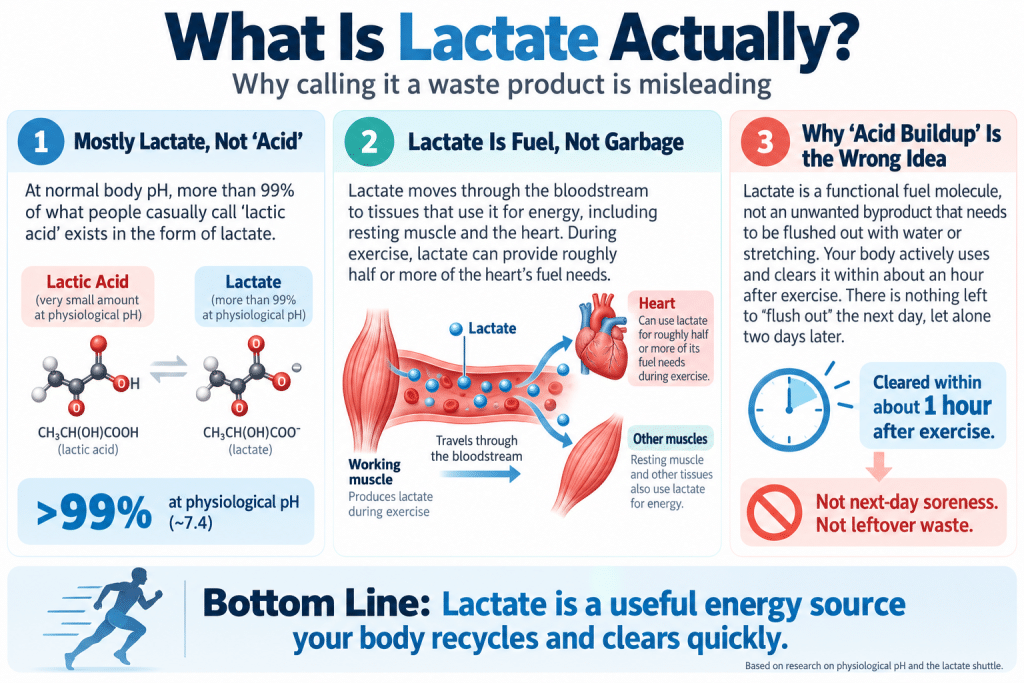
Beyond the timing problem, it helps to understand what lactate does in the body, since “waste product” is a significant misrepresentation of its role.
- Mostly lactate, not “acid,” at normal body pH: At the body’s typical physiological pH, more than 99 percent of what gets colloquially called “lactic acid” exists in the closely related form called lactate.
- Lactate is fuel, not garbage: Rather than being waste, lactate travels through the bloodstream to tissues that use it for energy, including resting muscles and the heart. Research on the lactate shuttle shows that during exercise, lactate can supply roughly half or more of the heart’s fuel needs (Gertz et al.; Brooks, lactate shuttle research).
- Why this matters for how you think about “acid buildup”: Rather than being an unwanted byproduct that needs to be flushed with water or stretching, lactate is a functional fuel molecule your body is actively using and clearing within about an hour of finishing exercise. There is nothing left to flush out by the next day, let alone two days later.
Which Experiment Broke the Lactic Acid Theory?
A specific study directly tested, and disproved, the idea that lactic acid causes delayed soreness.
- The setup: In 1983, researchers had seven participants run for 45 minutes on a level treadmill on one occasion, and 45 minutes on a treadmill set to a downhill incline on another occasion (Schwane et al., 1983).
- The metabolic demand was reversed from what you’d expect: The level run was actually the more metabolically demanding workout, requiring about 78 percent of the participants’ maximum oxygen capacity, compared with about 57 percent during the downhill run.
- The soreness result: Blood lactic acid rose significantly during the more demanding level run but remained low during the downhill run. Yet only the downhill run caused significant soreness in the thighs, calves, shins, and buttocks over the next three days. The harder run, with higher lactate, caused no meaningful soreness, while the easier run, without elevated lactate, caused substantial soreness.
- Why this result mattered: This is close to the cleanest possible disproof available: the workout most people would assume “produced more lactic acid” caused less soreness, and the workout with no lactate elevation at all caused the soreness. Lactic acid and delayed soreness were, in this study, almost entirely uncoupled from each other.
Free 28-Day Fascia Reset Email Course
Get our Free 28-day email course series to help with 1 or 2 exercises per day to release your fascia. One short lesson per day. Two minutes to read each.
Why Does Easier Exercise Cause More Pain?
If lactic acid isn’t the answer, the downhill running result points toward what actually is: the type of muscle contraction involved, not how metabolically hard the exercise felt.
Eccentric Cycling Shows the Same Pattern
Research on eccentric cycling (in which a motor drives the pedals backward against the rider, forcing the legs to lengthen while still pushing against the resistance) has found a similar pattern to the downhill running result: this type of exercise produces lower heart rate, lower oxygen consumption, and lower blood lactate than ordinary forward pedaling at a comparable effort, and participants often rate it as feeling easier in the moment, yet it reliably produces more soreness and muscle weakness in the days that follow.
Concentric Versus Eccentric Contractions
When a muscle shortens while producing force (climbing stairs, pedaling forward, curling a dumbbell toward your shoulder), that’s called a concentric contraction. When a muscle lengthens while still producing force, actively resisting being stretched rather than simply going limp (walking down stairs, the backward-driven pedal, slowly lowering a dumbbell instead of dropping it), that’s called an eccentric contraction. Eccentric contractions are how your body brakes: they’re what let you lower yourself under control rather than simply falling.
Why Downhill Walking Causes More Soreness
Climbing a hill or a flight of stairs works your thigh muscles concentrically as they shorten to lift your body. Walking down the same hill or stairs works the very same thigh muscles eccentrically, as they lengthen under your body weight to lower you down in a controlled way rather than letting gravity take over. It’s this eccentric, lengthening-under-tension pattern, not the metabolic intensity of the climb, that is most strongly associated with delayed soreness.
“This is one of my favorite pieces of exercise science to discuss because it’s so counter to what people expect. Women will tell me the incline treadmill workout that left them breathless didn’t make them sore at all, but a ‘gentle’ walk down a hill left them hobbling for three days, and they assume something is wrong with their body. Nothing is wrong. That’s exactly the pattern the research predicts, because it’s about how the muscle is working, lengthening under load versus shortening under load, not about how hard you were breathing.”
Terry Tateossian, Founder of The House of Rose
What’s Actually Happening in the Muscle?
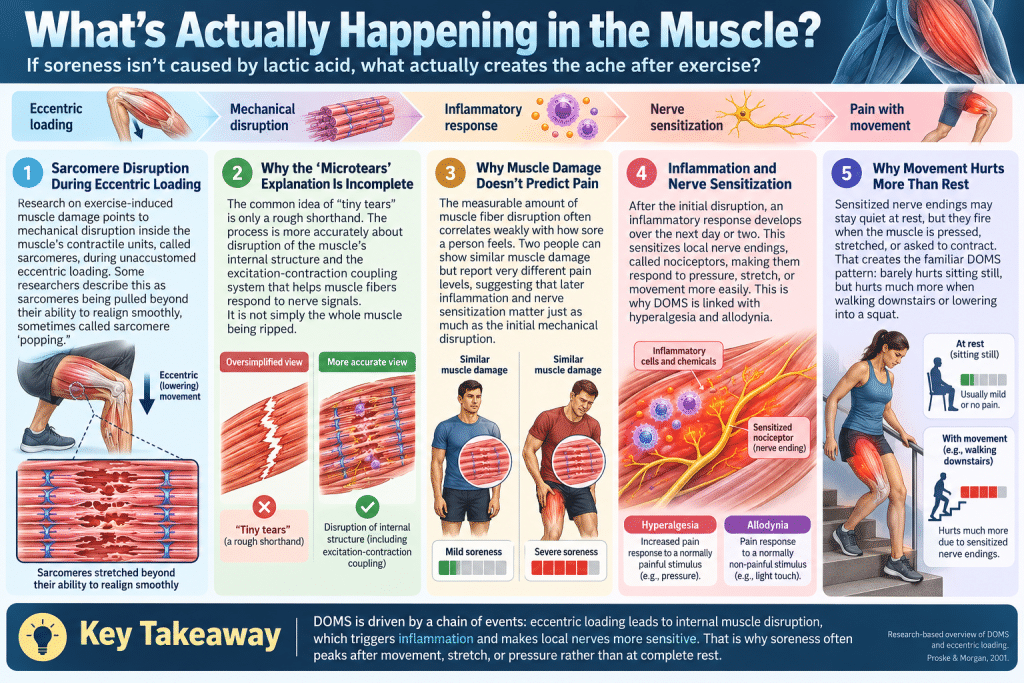
If it isn’t lactic acid, and it’s specifically tied to eccentric contraction, what is the actual mechanism producing the ache?
Sarcomere Disruption During Eccentric Loading
Modern research on exercise-induced muscle damage points to mechanical disruption within the muscle’s contractile units (sarcomeres) during unaccustomed eccentric loading, sometimes described as sarcomeres being pulled beyond their capacity to realign smoothly, a process researchers have called sarcomere “popping” (Proske & Morgan, 2001).
Why the “Micro-tears” Explanation Is Incomplete
The popular version of this explanation (“tiny tears in the muscle”) is a rough approximation of a more precise process involving disruption to the muscle’s internal structure and to the excitation-contraction coupling system that allows a muscle fiber to respond properly to a nerve signal, not literal ripping of the entire muscle.
Why Muscle Damage Doesn’t Predict Pain
One of the more counterintuitive findings in this area of research is that the measurable extent of muscle fiber disruption correlates surprisingly weakly with how much soreness a person actually reports. Two people can show a similar degree of measurable muscle damage and describe very different levels of pain, which points toward the next stage of the process (inflammation and nerve sensitization) mattering just as much as the initial mechanical disruption itself.
Inflammation and Nerve Sensitization
Following the initial mechanical disruption, an inflammatory response develops in the affected tissue over the following day or two. Part of what this inflammatory process does is sensitize the local nerve endings (nociceptors), making them fire in response to things that would not normally register as painful, like a change in pressure or a simple stretch.
This is why DOMS is often described in the research literature using the terms hyperalgesia (a heightened pain response to something that is mildly painful, like pressing on the muscle) and allodynia (pain from something that normally isn’t painful at all, like the light stretch of walking downstairs).
Why Movement Hurts More Than Rest
This sensitization explains the specific, recognizable pattern of DOMS directly: the muscle isn’t sending pain signals on its own at rest, but the sensitized nerve endings fire readily the moment the muscle is pressed, stretched, or asked to contract, which is exactly the pattern of “barely hurts sitting still, hurts a lot going down stairs.”
Free 28-Day Fascia Reset Email Course
Get our Free 28-day email course series to help with 1 or 2 exercises per day to release your fascia. One short lesson per day. Two minutes to read each.
Why Does It Take a Day or Two to Show Up?
The delay itself, one of the strangest parts of this whole experience, is a direct consequence of the mechanism described above.
- Inflammation is not instantaneous: The inflammatory and sensitization process that produces the bulk of the pain associated with DOMS takes time to build after the initial mechanical disruption, typically ramping up over the first 24 hours and peaking between one and three days later, matching the observed timeline of soreness almost exactly.
- The mechanical event and the pain event are separated in time: The eccentric loading that initiates the process (Saturday’s downhill walk) happens well before the inflammatory and sensitization cascade it triggers reaches its peak (Monday morning), which is the direct physiological explanation for why the ache waits two days rather than showing up immediately.
- Why this matters for how you interpret your own body: Feeling completely fine on Saturday evening after a hike doesn’t mean you dodged the eccentric loading that occurred on the way down. It means the downstream inflammatory process simply hasn’t caught up yet.
Do You Need to Be Sore to Build Muscle & Strength?
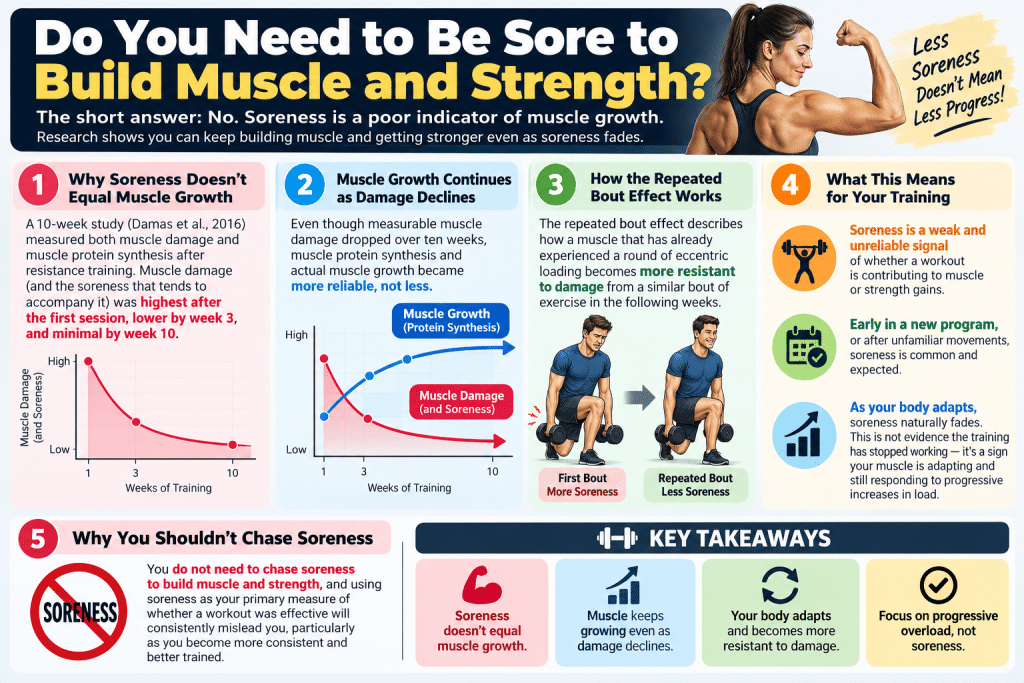
This is the practical question underneath all of the mechanism discussed above, and the research has a clear, if somewhat counterintuitive, answer.
Why Soreness Doesn’t Equal Muscle Growth
A study tracking resistance training over ten weeks measured both markers of muscle damage and the rate of new muscle protein being built (myofibrillar protein synthesis) after each of several training sessions. Muscle damage, and by extension the soreness that tends to accompany it, was highest after the very first session of a new training block, markedly lower by the third week, and minimal by the tenth week (Damas et al., 2016).
Muscle Growth Continues as Damage Declines
Despite this steep drop in measurable damage over the ten weeks, the relationship between protein synthesis and actual muscle growth became more reliable, not less, as training continued and damage decreased. In other words, the muscle kept adapting and growing even as the soreness-producing damage response faded with repeated exposure.
How the Repeated Bout Effect Works
A well-documented phenomenon called the repeated bout effect describes how a muscle that has already experienced a round of eccentric loading becomes measurably more resistant to damage from a similar bout of exercise performed again in the following weeks, one of the reasons your second hard hike of the season leaves you far less sore than your first, even at a similar or greater intensity.
What This Means for Your Training
Soreness is, at best, a weak and unreliable signal of whether a given workout is contributing to muscle or strength gains. Early in a new program, or after trying an unfamiliar movement pattern, soreness is common and expected. As your body adapts to a consistent training stimulus, soreness naturally fades, and this fading is not evidence the training has stopped working. If anything, it is consistent with your muscle successfully adapting to a stimulus it already knows how to handle while continuing to respond to progressive increases in load.
Why You Shouldn’t Chase Soreness
You do not need to chase soreness to build muscle and strength, and using soreness as your primary measure of whether a workout was effective will consistently mislead you, particularly as you become more consistent and better trained.
“I used to think that if I wasn’t sore after my workouts, did they even count? The honest answer, based on the actual research, is that soreness was never a reliable scoreboard to begin with. What I want women tracking instead is whether the weight on the bar, the number of reps, or the difficulty of the movement is trending in the right direction over weeks and months. That’s the signal that tells you strength is being built. Soreness is, at best, a side effect of novelty, not a report card.”
Terry Tateossian, Founder of The House of Rose
Free 28-Day Fascia Reset Email Course
Get our Free 28-day email course series to help with 1 or 2 exercises per day to release your fascia. One short lesson per day. Two minutes to read each.
What Reduces Soreness?
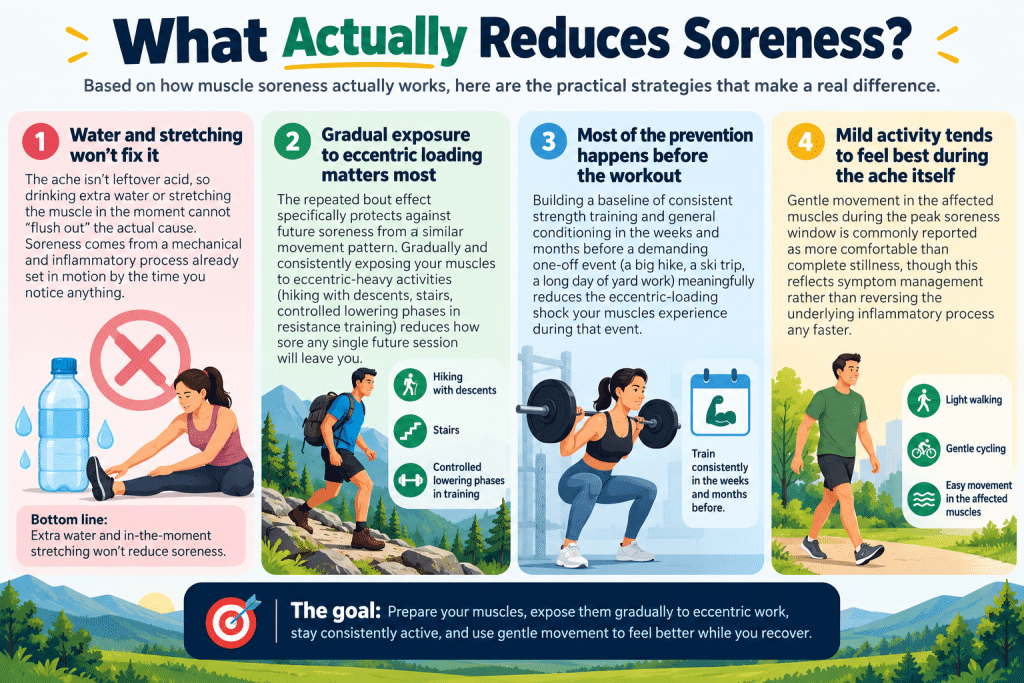
Given everything above, a few practical points follow directly from the mechanism.
- Water and stretching were never going to fix this: Since the ache isn’t leftover acid, drinking extra water or stretching the muscle in the moment cannot “flush out” the actual cause, which is a mechanical and inflammatory process already set in motion by the time you notice anything.
- Gradual exposure to eccentric loading matters most: Since the repeated bout effect specifically protects against future soreness from a similar movement pattern, gradually and consistently exposing your muscles to eccentric-heavy activities (hiking with descents, stairs, controlled lowering phases in resistance training) reduces how sore any single future session will leave you.
- Most of the prevention happens well before the workout, not during it: Building a baseline of consistent strength training and general conditioning in the weeks and months before a demanding one-off event (a big hike, a ski trip, a long day of yard work) meaningfully reduces the eccentric-loading shock your muscles experience during that event.
- Mild activity, not complete rest, tends to feel best during the ache itself: Gentle movement in the affected muscles during the peak soreness window is commonly reported as more comfortable than complete stillness, though this reflects symptom management rather than reversing the underlying inflammatory process any faster.
What Does the Evidence Show?
The following table summarizes the key claims, physiological mechanisms, and supporting research on delayed onset muscle soreness and muscle growth.
| Claim | Mechanism | Supporting Evidence |
|---|---|---|
| Lactic acid does not cause delayed soreness | Lactate clears within about an hour; soreness peaks 1 to 3 days later | Schwane et al. (1983): downhill run had no lactate elevation but caused significant soreness; level run had lactate elevation but caused no soreness |
| Lactate is fuel, not waste | Shuttled to and used by tissues including the heart during exercise | Gertz et al.; Brooks lactate shuttle research: lactate supplies roughly half or more of cardiac fuel during exercise |
| Eccentric (lengthening) contraction, not exercise intensity, drives soreness | Muscle lengthens under load, disrupting sarcomere structure | Schwane et al. (1983); eccentric cycling research showing lower lactate/heart rate/oxygen use but greater resulting soreness |
| DOMS involves inflammation and nerve sensitization, not just “tears” | Sarcomere disruption followed by inflammatory sensitization of nociceptors | Proske & Morgan (2001): mechanism review describing hyperalgesia and allodynia in DOMS |
| Muscle damage and soreness are not required for hypertrophy | Damage and soreness decline sharply with repeated training while protein synthesis and growth continue | Damas et al. (2016): damage highest at week 1, minimal by week 10, with growth continuing throughout |
Free 28-Day Fascia Reset Email Course
Get our Free 28-day email course series to help with 1 or 2 exercises per day to release your fascia. One short lesson per day. Two minutes to read each.
How Does This Fit Into the THOR Lifestyle?
Understanding real exercise physiology, rather than repeating outdated myths, is part of the broader lifestyle medicine approach taught at THOR.
- Strength training foundation: Understanding the broader principles of strength training for women over 40 helps put post-workout soreness in perspective: the goal is progressive, consistent training rather than making every session hurt. Choosing between resistance bands and dumbbells can then help you build that strength framework around your current ability, available equipment, and training goals.
- Muscle preservation through midlife: Preventing age-related sarcopenia depends far more on consistent resistance training and adequate recovery than on how sore you feel afterward. Muscle can adapt and grow even as soreness decreases with repeated exposure to the same type of training.
- Recovery-adjacent content: Light movement between harder sessions can support circulation and keep the body moving without adding another demanding workout. Understanding how exercise supports the lymphatic system adds another reason to prioritize gentle daily movement during recovery.
- Related myth-correction content: Soreness is not the only fitness assumption worth questioning. Comparing free weights and machines shows that both can have a place in an effective strength program, while understanding the minimum effective dose of HIIT reinforces the broader principle that harder and longer are not automatically better.
When Should You See a Healthcare Professional?
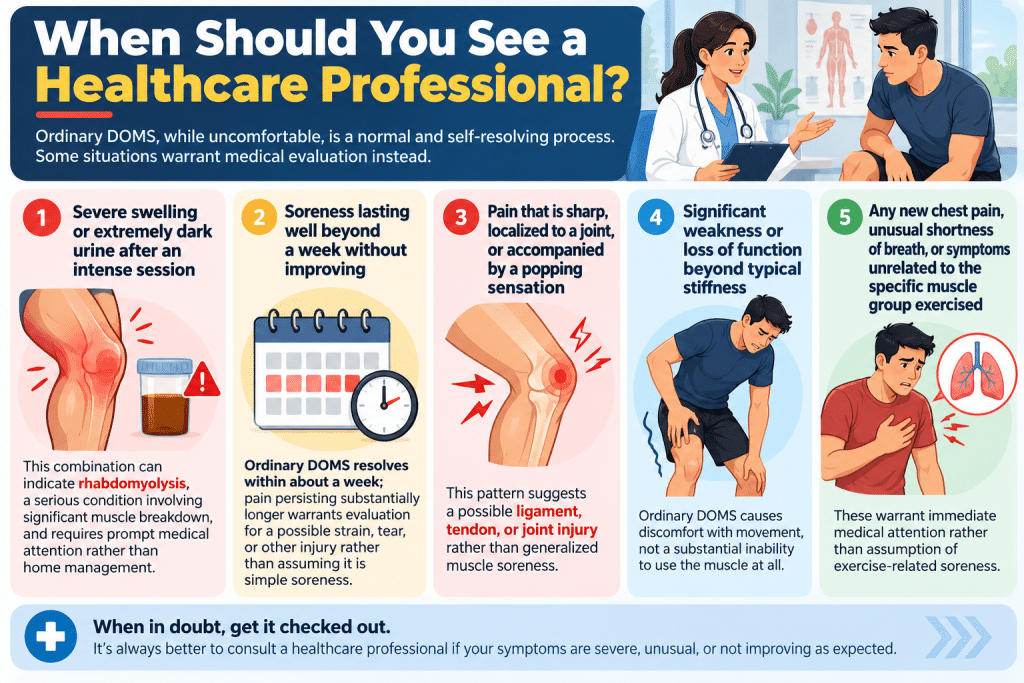
Ordinary DOMS, while uncomfortable, is a normal and self-resolving process. Some situations warrant medical evaluation instead.
- Severe swelling or extremely dark urine after an intense session: This combination can indicate rhabdomyolysis, a serious condition involving significant muscle breakdown, and requires prompt medical attention rather than home management.
- Soreness lasting well beyond a week without improving: Ordinary DOMS resolves within about a week; pain persisting substantially longer warrants evaluation for a possible strain, tear, or other injury rather than assuming it is simple soreness.
- Pain that is sharp, localized to a joint, or accompanied by a popping sensation at the time of injury: This pattern suggests a possible ligament, tendon, or joint injury rather than generalized muscle soreness.
- Significant weakness or loss of function beyond typical stiffness: Ordinary DOMS causes discomfort with movement, not a substantial inability to use the muscle at all.
- Any new chest pain, unusual shortness of breath, or symptoms unrelated to the specific muscle group exercised: These warrant immediate medical attention rather than assumption of exercise-related soreness.
Free 28-Day Fascia Reset Email Course
Get our Free 28-day email course series to help with 1 or 2 exercises per day to release your fascia. One short lesson per day. Two minutes to read each.
Frequently Asked Questions
Does lactic acid cause the soreness I feel two days after a workout?
No. Lactate returns to pre-exercise levels within about an hour of finishing exercise, while delayed onset muscle soreness typically peaks one to three days later. A classic 1983 study found that a workout producing no lactate elevation caused significant soreness, while a workout that did elevate lactate caused none, directly contradicting the lactic acid explanation.
If it’s not lactic acid, what actually causes the soreness?
Soreness is now understood to stem from mechanical disruption within the muscle’s contractile structures (particularly during eccentric, or lengthening, muscle contractions), followed by an inflammatory response that sensitizes local nerve endings over the following one to two days, making the muscle hurt when pressed, stretched, or contracted even though it may feel fine at rest.
Why did the easy walk down the trail make me sorer than the hard climb up?
Climbing works your leg muscles concentrically, as they shorten to lift your body. Walking downhill works the same muscles eccentrically, as they lengthen under your body weight to lower you down in a controlled way. Eccentric, lengthening contractions are much more strongly associated with delayed soreness than the metabolic intensity of an activity.
Do I need to be sore for a workout to build muscle or strength?
No. Research tracking muscle damage and muscle growth over ten weeks of training found that damage (and the soreness that accompanies it) was highest in the first week and became minimal by the tenth week, while muscle growth continued reliably throughout. Soreness is a poor, unreliable indicator of whether a workout is effectively building muscle or strength.
Why am I less sore after my second hard hike or workout than my first?
This reflects a well-documented phenomenon called the repeated bout effect, in which a muscle that has already experienced a bout of eccentric loading becomes measurably more resistant to damage from a similar bout performed again in the following weeks.
Can stretching or drinking more water reduce muscle soreness?
Since the underlying cause is a mechanical and inflammatory process rather than accumulated lactic acid, stretching or hydration cannot “flush out” the actual cause of soreness. Gentle movement during the soreness window is commonly reported as more comfortable, but this reflects symptom management rather than resolving the process faster.
How long should normal muscle soreness last?
Ordinary delayed onset muscle soreness typically begins 12 to 24 hours after exercise, peaks between one and three days, and resolves within about a week. Pain that persists substantially longer, or that involves severe swelling, sharp joint pain, or very dark urine, warrants medical evaluation.
Is it bad if I’m not sore after a hard workout?
No. A hard, effective workout does not have to produce noticeable soreness, particularly once your body has adapted to a given movement pattern through consistent training. Absence of soreness is not evidence that a workout failed to work.
What is an eccentric contraction, in plain terms?
An eccentric contraction happens when a muscle produces force while lengthening, rather than shortening, such as when your thigh muscles work to lower you down a flight of stairs in a controlled way, or when you slowly lower a dumbbell instead of letting it drop. This lengthening-under-tension pattern is most closely associated with delayed soreness.
Does more soreness mean I built more muscle?
No. Research specifically comparing muscle damage markers to actual muscle growth found that these two things become progressively less connected as training continues, with damage and soreness decreasing over weeks of consistent training while muscle growth continues. Soreness should not be used as a proxy for how much muscle a given workout built.
Why does pressing on a sore muscle hurt more than it would normally?
This reflects a real physiological phenomenon called hyperalgesia, in which the inflammatory process following muscle damage sensitizes local nerve endings, making them respond more strongly to pressure or stretch than they would in an unaffected muscle.
Can I prevent soreness entirely before a big hike or event?
Complete prevention isn’t realistic if the activity involves an unfamiliar amount of eccentric loading, but building a consistent base of strength training and general conditioning well before the event, and gradually including similar movement patterns (like stairs or hill walking) in your routine, meaningfully reduces how sore you’re likely to be afterward.
I write 3 essays per week on Lifestyle Medicine for women in midlife on what is happening in the body and what to do about it. No fluff, no hype. Free Subscription.
References
- Schwane, J. A., Watrous, B. G., Johnson, S. R., & Armstrong, R. B. (1983). Delayed-onset muscular soreness and plasma CPK and LDH activities after downhill running. Medicine & Science in Sports & Exercise, 15(1), 51-56.
- Proske, U., & Morgan, D. L. (2001). Muscle damage from eccentric exercise: mechanism, mechanical signs, adaptation and clinical applications. The Journal of Physiology, 537(2), 333-345.
- Damas, F., Phillips, S. M., Libardi, C. A., et al. (2016). Resistance training-induced changes in integrated myofibrillar protein synthesis are related to hypertrophy only after attenuation of muscle damage. The Journal of Physiology, 594(18), 5209-5222.
- Gertz, E. W., Wisneski, J. A., Neese, R., Bristow, J. D., Searle, G. L., & Hanlon, J. T. Myocardial lactate metabolism and the lactate shuttle during exercise, as characterized in the lactate shuttle research program of George Brooks and colleagues.
- Brooks, G. A. (2018). The science and translation of lactate shuttle theory. Cell Metabolism, 27(4), 757-785.
Disclaimer: This article is educational and does not constitute medical advice. Consult your healthcare provider regarding any exercise program, particularly if you experience severe swelling, very dark urine, or pain that does not resolve within the expected timeframe for ordinary muscle soreness.
Free 28-Day Fascia Reset Email Course
Get our Free 28-day email course series to help with 1 or 2 exercises per day to release your fascia. One short lesson per day. Two minutes to read each.

Terry Tateossian is a Menopause Lifestyle Medicine Coach, Certified Personal Trainer & Nutritionist and the Founder of THOR: The House of Rose, a wellness brand serving women over 40 through retreats, coaching, macro-nutrition and community. As 25-year founder and entrepreneur, Terry spent two and a half decades building and running successful start-up businesses, an experience that put her on the front line of founder burnout long before she could name it. After facing serious health challenges, early onset menopause, and emotional eating while running her agency and raising two children, Terry rebuilt her health in her 40s and lost more than 80 pounds through evidence-based nutrition, training, and mindset work. Today, she helps women get strong, improve confidence, support hormone health, and create a stronger second half of life. Terry has been featured in major media outlets and is available for podcasts, expert commentary, brand collaborations, and speaking engagements on midlife health, reinvention, emotional eating, menopause wellness, and strength training for longevity. Get her free macro calculator (her cookbook companion) to start your journey to back to health.