
 By Cindy Adoptante
Free 28-Day Fascia Reset Email Course
Get our Free 28-day email course series to help with 1 or 2 exercises per day to release your fascia. One short lesson per day. Two minutes to read each.
One Minute of Hard Effort: The Smallest Dose of HIIT That Still Pays Off
“I don’t have time” is the single most common reason the women I coach give for skipping exercise altogether, and it’s usually a real constraint, not an excuse. So when I tell them that a truly time-efficient workout exists, backed by controlled research rather than a fitness influencer’s claim, I want to be precise about what that means, because “short” and “easy” get confused constantly in this conversation.
The Study That Set the Bar With One Minute in a Ten-Minute Session
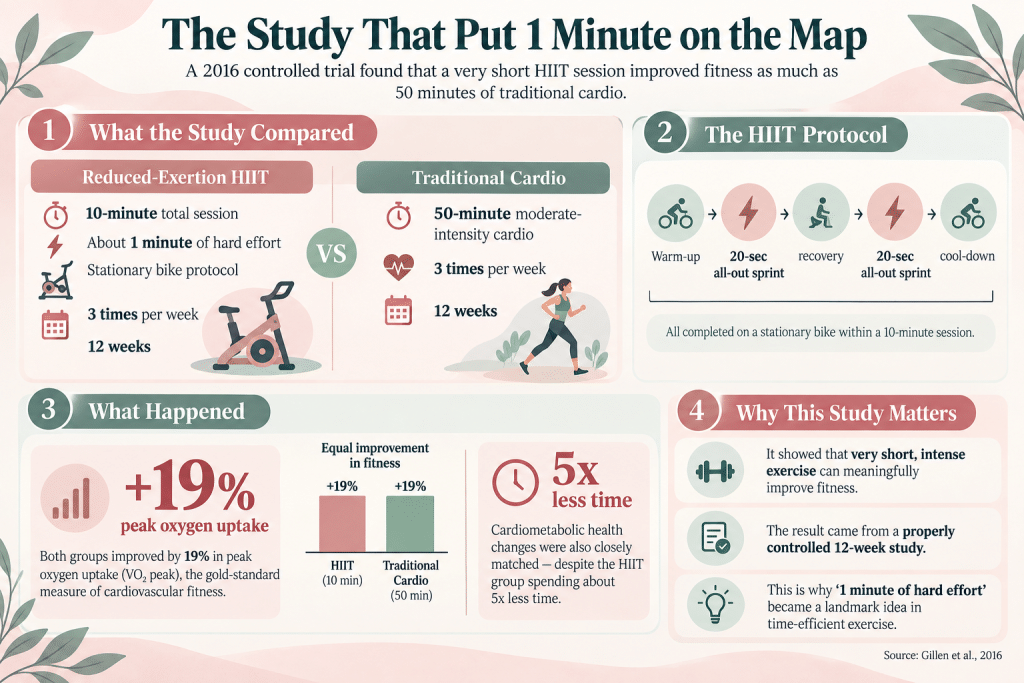
The single most cited answer to this question comes from a 2016 controlled trial that directly compared a reduced-exertion HIIT protocol, involving just one minute of intense effort spread across a 10-minute total session (including warm-up and cool-down), against 50 minutes of traditional moderate-intensity continuous cardio, performed three times a week for twelve weeks (Gillen et al., 2016).
The result: peak oxygen uptake, the gold-standard measure of cardiovascular fitness, increased by 19% in both groups, with the one-minute protocol producing indices of cardiometabolic health that closely matched the 50-minute version despite a five-fold lower time commitment.
That’s not a rounding error or a small pilot finding. It’s a truly striking result from a properly controlled study, and it’s the reason “one minute of hard effort” shows up so often in time-efficient exercise conversations. The protocol itself was specific: two 20-second all-out sprints on a stationary bike, separated by recovery periods, bookended by a warm-up and cool-down to bring the total session to 10 minutes.
“This is the study I bring up every time someone tells me they can’t fit exercise into their week. Ten minutes, three times a week, with real effort inside it, isn’t a compromise version of fitness. The research says it can get you most of the way there.”
Terry Tateossian, Founder of The House of Rose
What Happens When You Go Even Shorter to Three Minutes a Week?
An earlier study from the same research group pushed the floor even lower. In a 2014 trial, participants performed a total of just three minutes of all-out sprint effort per week, three 20-second maximal sprints per session, three sessions a week, within a total time commitment of 30 minutes including warm-up and cool-down (Gillen et al., 2014).
After six weeks, peak oxygen uptake increased by 12%, resting blood pressure dropped meaningfully, and muscle biopsies showed measurable increases in the enzymes and proteins associated with the body’s capacity to use oxygen for energy at the cellular level.
Twelve percent in six weeks, from three total minutes of hard effort per week, is a legitimately notable result. It’s smaller than the gains from the 2016 one-minute protocol, which makes sense given the shorter total training period and slightly different design, but it establishes that even at this extreme low end, the dose-response relationship for cardiorespiratory fitness hasn’t flattened out completely. There’s a real physiological signal happening in a window of time most people would consider too short to bother with.
Important: Both of these studies used all-out or near-maximal sprint effort for the “work” intervals. Neither found that a leisurely 10-minute session produced these results; the intensity of the short interval is doing nearly all the work.
Free 28-Day Fascia Reset Email Course
Get our Free 28-day email course series to help with 1 or 2 exercises per day to release your fascia. One short lesson per day. Two minutes to read each.
What Happens When You Zoom Out to Dozens of Studies?
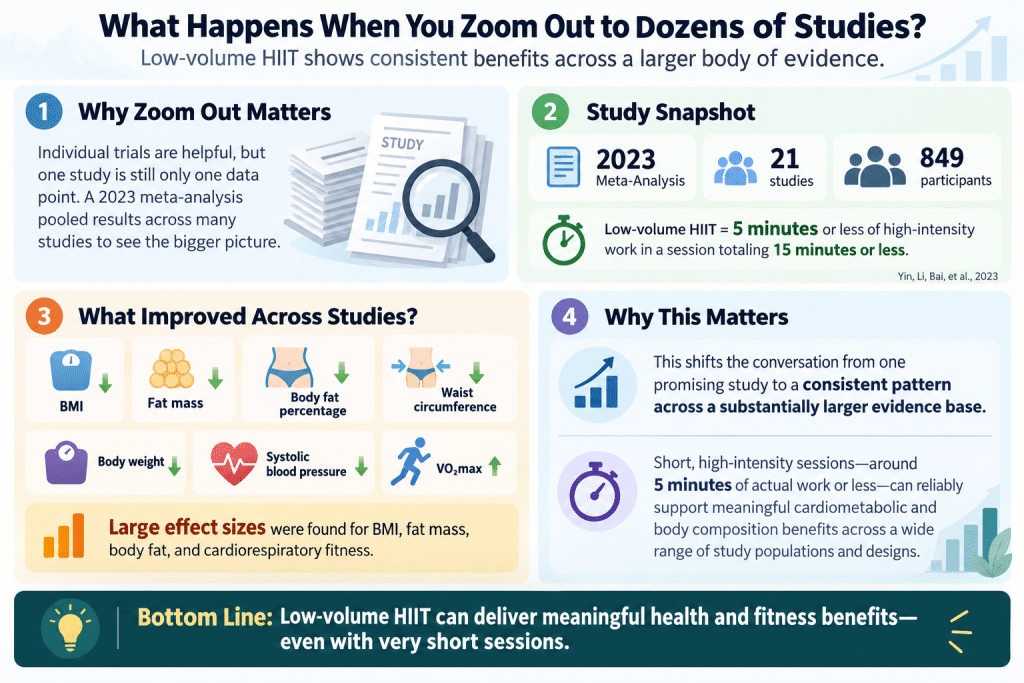
Individual trials are useful, but a single study, however well-designed, is still one data point. A 2023 meta-analysis addressed this by pooling 21 studies and 849 participants specifically examining low-volume HIIT, defined as five minutes or less of high-intensity exercise within a session totaling fifteen minutes or less (Yin, Li, Bai, et al., 2023).
Across this much larger and more diverse body of evidence, low-volume HIIT produced significant improvements in BMI, fat mass, body fat percentage, waist circumference, body weight, systolic blood pressure, and VO2max, with large effect sizes specifically for BMI, fat mass, body fat, and cardiorespiratory fitness.
This matters because it moves the conversation from “one promising study” to “a consistent pattern across a substantially larger evidence base.” Short, high-intensity sessions, in the neighborhood of five minutes of actual work time or less, reliably produce meaningful cardiometabolic and body composition benefits across a wide range of study populations and designs, not just in the specific labs that ran the original landmark trials.
What Does the 2026 Research Say About Where the Dose-Response Curve Bends?
The most precise answer currently available comes from a dose-response meta-analysis published in Sports Medicine in early 2026, which specifically modeled how exercise session duration relates to cardiorespiratory fitness improvement across both HIIT and moderate-intensity continuous training studies (Niess, Thijssen, et al., 2026).
The researchers found an inverted U-shaped relationship for HIIT work duration, meaning benefit increases as work intervals lengthen up to a point, then starts to decline again beyond it, with the peak benefit occurring around 140 seconds of work duration per interval and a work-to-recovery ratio near 0.85 (roughly equal work and recovery time).
For sprint interval training specifically, meaning very short, maximal-effort intervals rather than the slightly longer, sub-maximal intervals typical of standard HIIT, the optimal protocols identified involved sprints of 30 seconds or less with recovery periods under 97 seconds, performed three times a week.
This gives a more nuanced answer than a single number: the “shortest effective session” depends partly on whether you’re doing true all-out sprints (which can be extremely brief per interval) or a somewhat more moderate hard effort (which benefits from slightly longer work intervals, around the 140-second mark, before returns start declining).
Important: This research modeled interval and session duration specifically. It doesn’t mean fitness plateaus entirely past these points; longer sessions still produce benefit, particularly for goals beyond pure cardiorespiratory fitness. It identifies where the efficiency curve is steepest, which is a different and more useful question for anyone optimizing for limited time.
Free 28-Day Fascia Reset Email Course
Get our Free 28-day email course series to help with 1 or 2 exercises per day to release your fascia. One short lesson per day. Two minutes to read each.
What’s the Catch With Short HIIT Sessions?
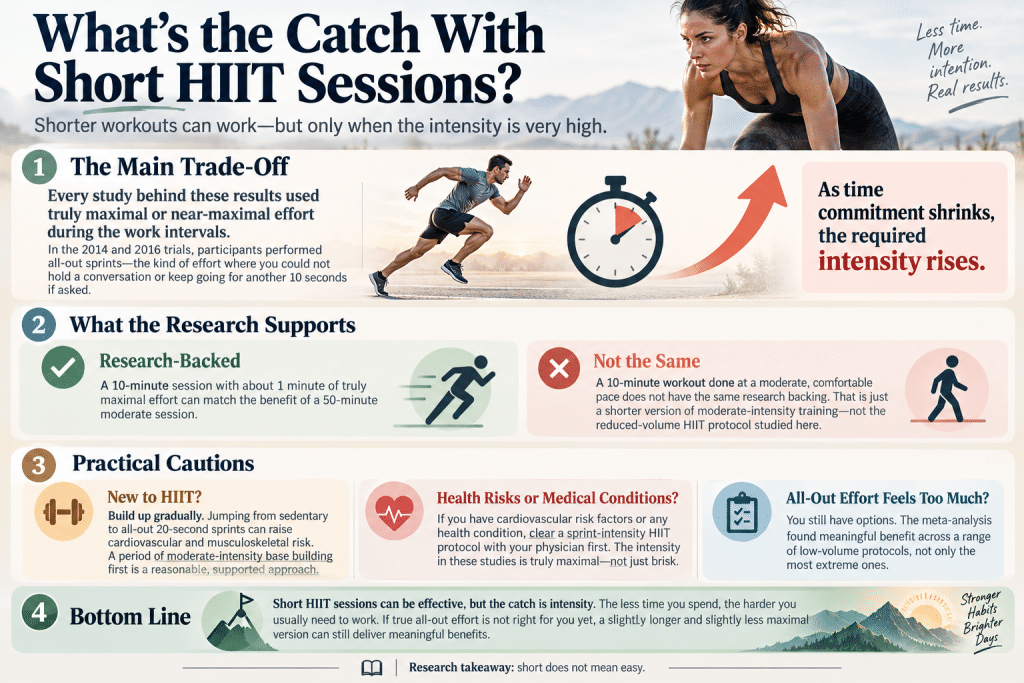
Every study behind these results used truly maximal or near-maximal effort during the work intervals. The 2016 and 2014 trials both used all-out sprints, the kind of effort where you couldn’t hold a conversation or sustain the pace for another ten seconds if asked. This is the trade-off underlying all of this research: as the time commitment shrinks, the required intensity rises to compensate.
A 10-minute session with one minute of truly maximal effort can match a 50-minute moderate session. A 10-minute session at a moderate, comfortable pace throughout does not carry the same research backing, because that’s simply a short version of moderate-intensity training, not the reduced-exertion HIIT protocol these studies actually tested.
The practical cautions depend on your current fitness, training history, and health status:
- If you’re new to high-intensity training: Build up gradually; going from sedentary directly to all-out 20-second sprints carries real cardiovascular and musculoskeletal risk, and a period of moderate-intensity base building first is a reasonable, well-supported approach before introducing true sprint efforts.
- If you have any cardiovascular risk factors or a health condition: Clear a sprint-intensity HIIT protocol with your physician first, since the intensity level in these studies is truly maximal, not merely “brisk.”
- If four minutes of true all-out effort sounds unmanageable right now: The meta-analysis in Section 3 found meaningful benefit across a range of low-volume protocols, not exclusively the most extreme ones, so a slightly longer, slightly less maximal version still carries real research support.
What Does the Evidence Show?
The major studies discussed above can be summarized by their protocols and key findings:
| Study | Protocol | Key Finding |
|---|---|---|
| Gillen et al. (2016) | 1 min all-out sprint effort within a 10-min session, 3x/week, 12 weeks | Matched 50-min moderate cardio for VO2max and cardiometabolic health (5x lower time commitment) |
| Gillen et al. (2014) | 3 min all-out sprint effort/week within 30-min total sessions, 6 weeks | VO2peak increased 12%; blood pressure and cellular oxidative capacity improved |
| Yin, Li, Bai et al. (2023) | Meta-analysis, 21 studies, low-volume HIIT (≤5 min work within ≤15 min session) | Large effect sizes for BMI, fat mass, body fat, and VO2max across a broad evidence base |
| Niess, Thijssen et al. (2026) | Dose-response meta-analysis modeling session/interval duration | Peak HIIT benefit around 140s work intervals; optimal sprint protocols use ≤30s sprints with <97s recovery, 3x/week |
Free 28-Day Fascia Reset Email Course
Get our Free 28-day email course series to help with 1 or 2 exercises per day to release your fascia. One short lesson per day. Two minutes to read each.
What Does This Mean for Your Own Schedule?
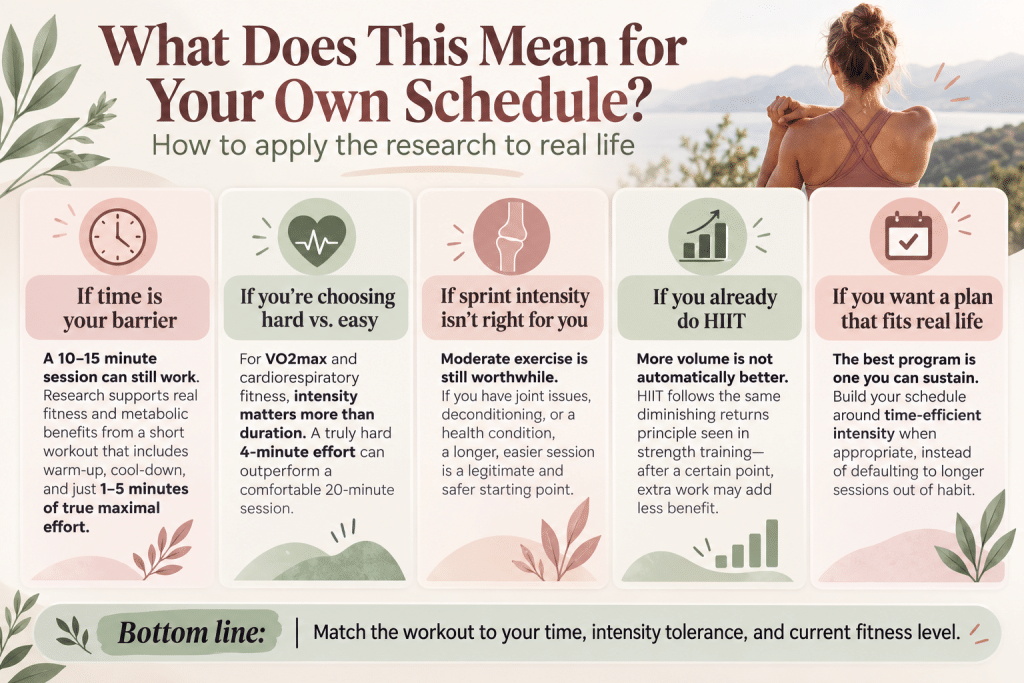
How you apply this research depends on whether your main constraint is time, intensity, current conditioning, or the type of training you’re already doing:
- If your barrier to exercise is truly time: The research in Sections 1 through 3 supports that a 10-to-15-minute session, including warm-up and cool-down, with as little as one to five minutes of true maximal effort inside it, can produce real, measurable fitness and metabolic benefit.
- If you’re deciding between a shorter, harder session and a longer, easier one: The evidence favors intensity over duration for cardiorespiratory fitness specifically; a truly hard four-minute effort will likely outperform a comfortable twenty-minute one for VO2max improvement.
- If sprint-intensity effort isn’t accessible to you right now due to joint issues, deconditioning, or a health condition: This research doesn’t mean moderate-intensity exercise is pointless; it means the minimum-time efficiency advantage specifically depends on the intensity these studies used, and a longer, more moderate session remains a legitimate and safer starting point.
- If you’re already doing HIIT and wondering whether more volume helps: THOR’s companion piece on where strength training stops paying off covers the same diminishing-returns principle applied to resistance training, and the underlying logic, more isn’t automatically better past a certain point, holds here too.
- If you want a program that fits real intensity into a real schedule: THOR’s coaching program builds time-efficient training plans around exactly this kind of evidence rather than defaulting to longer sessions by habit.
What Are Your Next Steps?
The research above can be translated into a few practical steps while keeping intensity, safety, and your current fitness level in mind:
- Try a truly short, truly hard session this week: A 10-minute total session with 1 to 2 minutes of true maximal-effort intervals, following the general structure of the Gillen et al. (2016) protocol in Section 1.
- Be honest about intensity, not just duration: The research behind these results depended on all-out effort during the work intervals, not a comfortable pace stretched into a shorter window.
- If you’re new to high intensity training, build a moderate-intensity base first: Before introducing true sprint efforts, per the caution in Section 5.
Free 28-Day Fascia Reset Email Course
Get our Free 28-day email course series to help with 1 or 2 exercises per day to release your fascia. One short lesson per day. Two minutes to read each.
Frequently Asked Questions
What’s the shortest HIIT workout that actually works, according to research?
A controlled trial found that just 1 minute of all-out sprint effort within a 10-minute total session (including warm-up and cool-down) matched 50 minutes of moderate continuous cardio for improving cardiovascular fitness and cardiometabolic health (Gillen et al., 2016).
Can 3 minutes of exercise a week really make a difference?
A separate trial found that 3 total minutes of all-out sprint effort per week, spread across three 30-minute sessions including warm-up and cool-down, increased peak oxygen uptake by 12% and improved blood pressure and cellular oxidative capacity over 6 weeks (Gillen et al., 2014).
Does a 4-minute HIIT workout actually work?
The broader research supports meaningful benefit from low-volume HIIT protocols generally in this range, though the exact benefit depends heavily on how maximal the effort is during the work intervals, not just the total duration.
Is a 10-minute HIIT workout as good as a 30 or 45-minute workout?
For the specific outcomes measured in these studies (VO2max and cardiometabolic markers), a properly structured 10-minute protocol with true maximal effort intervals has shown comparable results to a 50-minute moderate-intensity session in at least one controlled trial (Gillen et al., 2016), though this doesn’t necessarily generalize to every fitness outcome or training goal.
What intensity level is required for these short protocols to work?
All-out or near-maximal effort, the kind where you can’t sustain a conversation or continue at that pace for more than a few additional seconds. Moderate-intensity effort compressed into a short window has not shown the same results in this research.
Is it safe to jump straight into all-out sprint intervals?
Not necessarily for everyone. If you’re new to exercise, have cardiovascular risk factors, or have an underlying health condition, build a moderate-intensity base first and clear sprint-intensity training with your physician.
What’s the ideal work-to-recovery ratio for HIIT, according to the newest research?
A 2026 dose-response meta-analysis found peak benefit around a work-to-recovery ratio of approximately 0.85 (close to equal work and recovery time) for standard HIIT intervals, with true sprint interval training using shorter work periods (30 seconds or less) and shorter recovery periods (under 97 seconds) (Niess, Thijssen, et al., 2026).
How many days a week should I do short HIIT sessions?
Most of the research reviewed here used 3 sessions per week, which also aligns with the optimal frequency identified in the 2026 dose-response meta-analysis for sprint interval protocols.
Does low-volume HIIT help with weight loss, not just cardio fitness?
Yes. The 2023 meta-analysis of 21 studies found large effect sizes specifically for BMI, fat mass, and body fat percentage in addition to cardiorespiratory fitness improvements (Yin, Li, Bai, et al., 2023).
Can I get these results on any type of equipment, or does it have to be a stationary bike?
The landmark studies referenced here used stationary bikes specifically, which allow precise control of resistance and effort. The underlying dose-response principle, brief maximal effort producing meaningful adaptation, likely generalizes to other modalities like sprinting or rowing, though those specific protocols haven’t been tested as extensively as the cycling-based studies.
Is longer HIIT ever better than shorter HIIT?
The 2026 dose-response meta-analysis found an inverted U-shaped relationship, meaning benefit increases with work interval duration up to a point (around 140 seconds) before declining again, so there is a genuine sweet spot rather than “shorter is always better” or “longer is always better.”
Why does such a short workout produce meaningful results at all?
The intensity of the effort appears to be the primary driver of the physiological adaptations measured in these studies (increased oxidative capacity, improved VO2max, better blood pressure and metabolic markers), rather than total duration, which is the core premise behind minimum-effective-dose exercise research.
Is this approach appropriate for someone over 40 or in perimenopause?
The core research reviewed here wasn’t age-segmented in a way that changes the fundamental findings, though building a moderate-intensity base first and getting medical clearance for truly maximal effort becomes more relevant as cardiovascular risk factors become more common with age.
Should I replace all my longer workouts with short HIIT sessions?
Not necessarily. This research addresses cardiorespiratory fitness and certain metabolic markers specifically; strength training, mobility work, and other training goals aren’t interchangeable with HIIT, so most well-rounded programs still benefit from a mix of training types.
I write 3 essays per week on Lifestyle Medicine for women in midlife on what is happening in the body and what to do about it. No fluff, no hype. Free Subscription.
References
- Gillen, J.B., Percival, M.E., Ludzki, A., Tarnopolsky, M.A., & Gibala, M.J. (2016). Twelve Weeks of Sprint Interval Training Improves Indices of Cardiometabolic Health Similar to Traditional Endurance Training Despite a Five-Fold Lower Exercise Volume and Time Commitment. PLoS ONE, 11(4), e0154075.
- Gillen, J.B., Percival, M.E., Skelly, L.E., Martin, B.J., Tan, R.B., Tarnopolsky, M.A., & Gibala, M.J. (2014). Three Minutes of All-Out Intermittent Exercise per Week Increases Skeletal Muscle Oxidative Capacity and Improves Cardiometabolic Health. PLoS ONE, 9(11), e111489.
- Yin, M., Li, H., Bai, M., Liu, H., Chen, Z., Deng, J., Deng, S., Meng, C., Vollaard, N.B.J., & Little, J.P. (2023). Is Low-Volume High-Intensity Interval Training a Time-Efficient Strategy to Improve Cardiometabolic Health and Body Composition? A Meta-Analysis. Applied Physiology, Nutrition, and Metabolism, 49, 273-292.
- Niess, A.M., Thijssen, D.H.J., et al. (2026). Optimising Exercise Prescription: A Meta-Analysis Examining the Dose Response of Exercise Duration on Cardiorespiratory Fitness Following HIIT and MICT. Sports Medicine, 56.
Disclaimer: This article is educational and does not constitute medical advice. High-intensity interval training and all-out sprint efforts place significant demands on the cardiovascular and musculoskeletal systems and require appropriate progression. If you are new to exercise, have cardiovascular risk factors, joint problems, an underlying health condition, or are unsure whether maximal-effort training is appropriate for you, consult a qualified healthcare provider before starting the protocols described in this article.
Free 28-Day Fascia Reset Email Course
Get our Free 28-day email course series to help with 1 or 2 exercises per day to release your fascia. One short lesson per day. Two minutes to read each.

Terry Tateossian is a Menopause Lifestyle Medicine Coach, Certified Personal Trainer & Nutritionist and the Founder of THOR: The House of Rose, a wellness brand serving women over 40 through retreats, coaching, macro-nutrition and community. As 25-year founder and entrepreneur, Terry spent two and a half decades building and running successful start-up businesses, an experience that put her on the front line of founder burnout long before she could name it. After facing serious health challenges, early onset menopause, and emotional eating while running her agency and raising two children, Terry rebuilt her health in her 40s and lost more than 80 pounds through evidence-based nutrition, training, and mindset work. Today, she helps women get strong, improve confidence, support hormone health, and create a stronger second half of life. Terry has been featured in major media outlets and is available for podcasts, expert commentary, brand collaborations, and speaking engagements on midlife health, reinvention, emotional eating, menopause wellness, and strength training for longevity. Get her free macro calculator (her cookbook companion) to start your journey to back to health.