
 By Team THOR
Free 28-Day Fascia Reset Email Course
Get our Free 28-day email course series to help with 1 or 2 exercises per day to release your fascia. One short lesson per day. Two minutes to read each.
I Walked 10,000 Steps a Day for 60 Days: Here’s What Happened
For years I believed that getting healthier had to be complicated. I needed the right program, the right macros dialed in exactly, the right amount of willpower on a Monday morning. Every time I started over, I went all in for two weeks and then quietly drifted back to my old routine, the way most of us do.
The problem was never that I didn’t know what to do. I’ve built a career around knowing what to do. The problem was that I kept picking plans that required a version of me with more time, more energy, and more discipline than I actually had on any given Tuesday.
So I tried something almost embarrassingly simple. No new gym membership, no overhauled meal plan, no fitness tracker subscription with a coach attached. Just a daily step count: 10,000 steps, every day, for 60 days.
I didn’t expect much from it. What actually happened over those two months changed how I think about fitness, weight, and what “working” even means for a habit.
Why Did I Choose Something This Boring?
Most fitness plans fail for the same reason: they ask for too much change, too fast, all at once. Someone goes from sitting most of the day to committing to six workouts a week. From eating whatever’s convenient to tracking every gram.
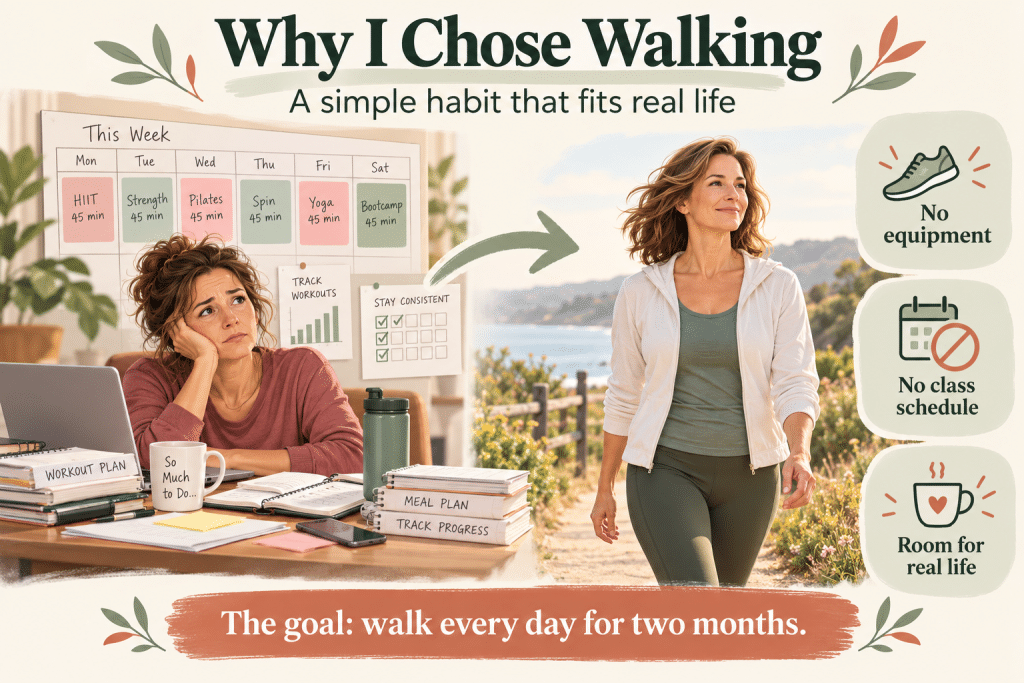
From no routine at all to a rigid schedule that has zero slack in it for a bad week, a sick kid, or a work trip. That kind of plan can work for exactly as long as life cooperates, which for most of us over 40 juggling careers, aging parents, and everything in between, is not very long.
Walking didn’t ask for any of that. It didn’t require equipment, a class schedule, or a specific window of energy I had to protect. It also didn’t leave me wiped out the way a hard training session does, which mattered more than I expected, because exhaustion is exactly what causes people to skip the next day, and the day after that becomes easier to skip too.
What I was actually testing wasn’t whether walking works. Research has answered that question for decades. What I wanted to know was whether I, specifically, with my actual life, could do it every single day for two months without quitting.
“In 25 years of building businesses and the last several years coaching women through midlife health changes, I’ve never once seen someone stick with a plan they resented. The plans that work are the boring ones nobody brags about on social media.”
Terry Tateossian, Founder of The House of Rose
What Were the Ground Rules?
I kept the experiment deliberately narrow, because I wanted to isolate what walking alone could do, not what walking combined with a strict diet could do.
| Rule | Detail |
|---|---|
| Daily minimum | 10,000 steps, tracked on my watch |
| Gym requirement | None |
| Diet changes | None mandated at the start |
| Rest days | None; steps happened every day, including travel days |
| Tracking | Steps, weight, sleep, and mood logged daily in a simple notes app |
Important: I didn’t restrict food or start counting calories at the outset. If eating habits changed, I wanted to know whether that happened naturally as a side effect of the walking itself, not because I forced it.
Free 28-Day Fascia Reset Email Course
Get our Free 28-day email course series to help with 1 or 2 exercises per day to release your fascia. One short lesson per day. Two minutes to read each.
What Happened in Weeks 1 and 2?
I assumed the first week would be easy. It wasn’t, but not for the reason I expected. The hard part wasn’t my legs. It was logistics. Trying to hit 10,000 steps forced me to confront how much of my day I actually spent sitting: scrolling my phone between meetings, answering emails at my desk, watching something after dinner without moving. I had to get intentional about time I hadn’t realized was disappearing.
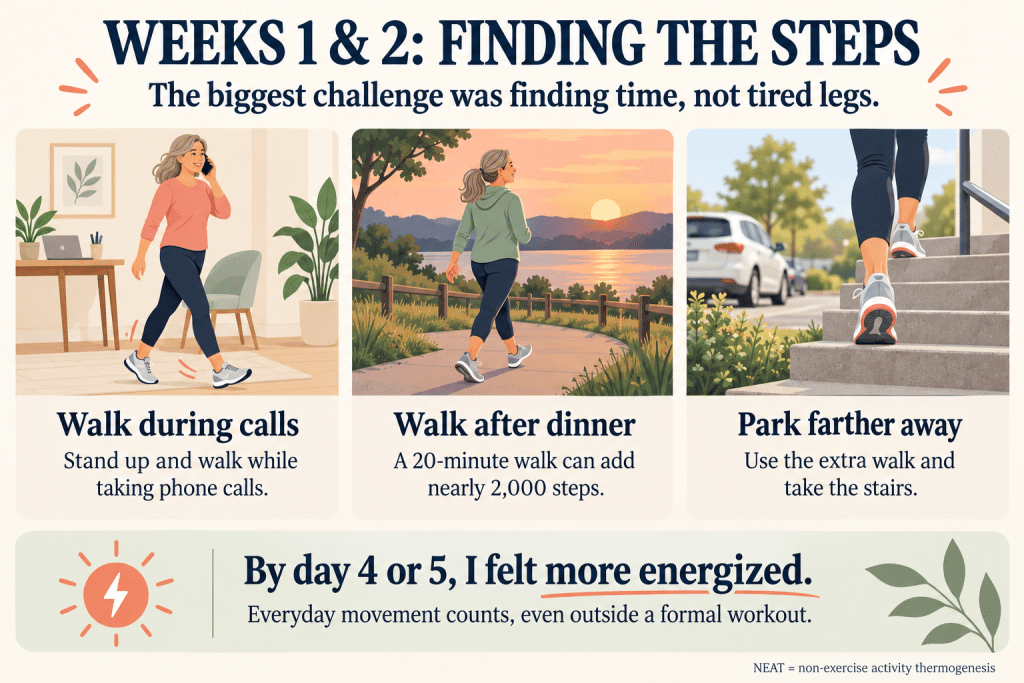
These small changes helped me fit more steps into the day:
- If your job keeps you at a desk most of the day: The fix that worked for me was taking phone calls standing up and walking around the room or the block instead of sitting through them.
- If your evenings tend to disappear into a screen: A 20-minute walk after dinner, before you sit back down, adds nearly 2,000 steps without needing a dedicated workout window.
- If you drive everywhere: Parking at the far end of the lot and taking stairs instead of elevators closes more of the gap than it seems like it should.
By day four or five, something surprised me: I felt more energized, not less. I’d braced for exercise to drain me the way an intense workout sometimes does. Instead, low-intensity movement spread across the day seemed to raise my baseline energy rather than deplete it, which tracks with what’s known about non-exercise activity thermogenesis or NEAT, the energy your body burns through movement that isn’t formal exercise.
Physiologist James Levine’s research on NEAT found that daily movement outside of structured workouts accounts for a significant and highly variable share of total energy expenditure, and that low-grade, frequent movement supports metabolic health in ways a single hour at the gym doesn’t fully replace (Levine, 2004).
How Did My Mood Change in Weeks 3 and 4?
This was the first real surprise of the experiment. My weight hadn’t moved much yet. My mood had.
I felt calmer. Less reactive to the small stuff. More focused during the parts of my day that usually felt scattered. My daily walk became the one block of time where I wasn’t multitasking, checking a notification, or half-listening to something while doing something else. Just movement, and quiet.
That’s not just a feel-good anecdote. A large cross-sectional study published in Lancet Psychiatry, analyzing over 1.2 million U.S. adults, found that people who exercised regularly reported significantly fewer poor mental health days than those who didn’t, and walking specifically was associated with meaningful reductions in reported mental health burden (Chekroud et al., 2018).
Separately, research on exercise and stress physiology has linked moderate aerobic activity like brisk walking to lower cortisol reactivity and improved mood regulation, likely through a combination of endorphin release and downregulation of the body’s stress response over time (Basso & Suzuki, 2017).
“The women I coach almost always expect the scale to move first and the mood to follow. In my own experience, and in what I hear from clients, it’s usually the reverse. Your nervous system responds to consistent movement before your body composition catches up, which is exactly why so many people quit in week two, right before the part that actually motivates them to continue shows up.”
Terry Tateossian, Founder of The House of Rose
Free 28-Day Fascia Reset Email Course
Get our Free 28-day email course series to help with 1 or 2 exercises per day to release your fascia. One short lesson per day. Two minutes to read each.
What Happened to My Weight in Weeks 5 and 6?
Most people quit before this point. I nearly did.
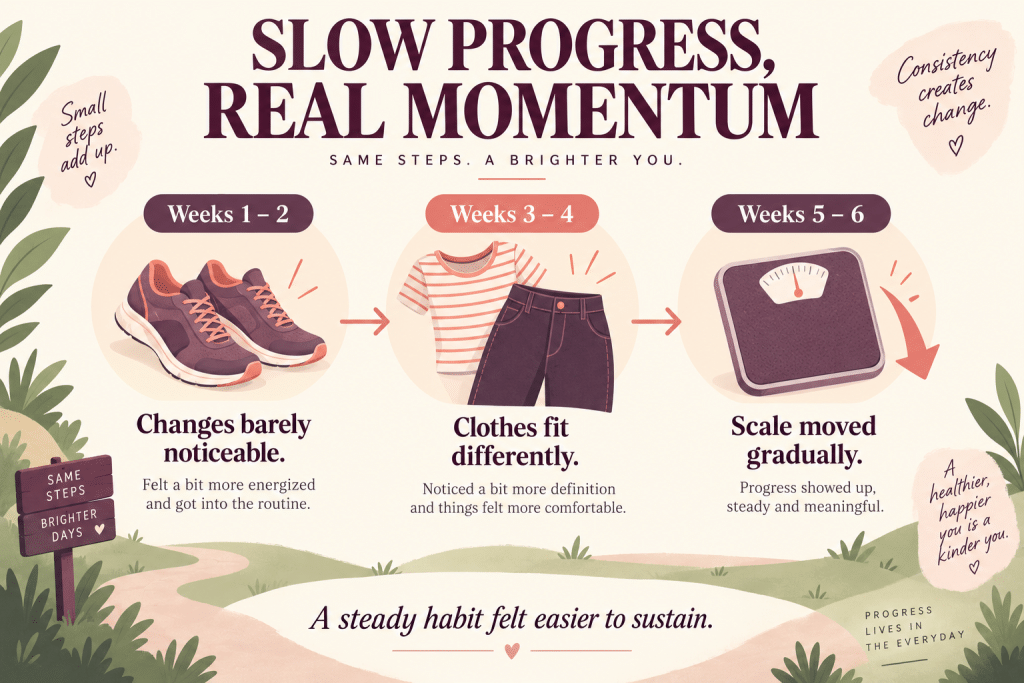
For the first two weeks, physical changes were barely noticeable, which is normal and also exactly the window where most attempts at a new habit collapse. Then, gradually, my clothes started fitting differently. The scale began moving, slowly and without the dramatic swings that come with crash dieting.
This wasn’t the rapid weight loss promised by extreme plans. It was slower. It also felt sustainable in a way rapid loss never has for me, which matters more long-term, since the research on weight regain consistently shows that faster initial loss predicts higher regain rates, while slower, behavior-based loss tends to hold better over time (Purcell et al., 2014).
How Many Steps a Day Do You Actually Need to Lose Weight?
This is the question most people actually want answered, so here’s the honest, research-backed version rather than a round number pulled from a pedometer marketing campaign decades ago.
The “10,000 steps” figure didn’t originate from a clinical study. It traces back to a 1960s Japanese pedometer marketed under the name “manpo-kei,” which translates roughly to “10,000-step meter,” chosen largely because it was a clean, memorable number (Tudor-Locke & Bassett, 2004). That doesn’t make 10,000 a bad target. It just means it’s not a magic physiological threshold, and the real research tells a more useful story.
A large 2022 study in Lancet Public Health, following over 47,000 adults, found that step count was associated with lower all-cause mortality risk up to roughly 7,000 to 9,000 steps a day, after which additional benefit leveled off, with the exact plateau point varying somewhat by age (Paluch et al., 2022).
A related 2020 JAMA study found that adults taking 8,000 or more steps a day had significantly lower mortality risk than those taking around 4,000, regardless of how fast they walked (Saint-Maurice et al., 2020). For weight loss specifically, the mechanism is simpler than any of the mortality research: steps burn calories, and enough of them create a caloric deficit when not fully offset by increased eating.
A 60-minute walk at a moderate pace for an average midlife woman burns roughly 200 to 300 calories, and reaching 10,000 steps typically requires 60 to 90 minutes of cumulative movement across the day (Hall et al., 2019).
Important: the honest answer is that there’s no single universal number. Somewhere between 7,000 and 10,000 steps a day appears to capture most of the available health benefit for most adults, and going further isn’t harmful but also isn’t necessary for everyone. What matters more than hitting an exact number is hitting a consistent one, day after day, which is the part most step-count advice skips entirely.
Free 28-Day Fascia Reset Email Course
Get our Free 28-day email course series to help with 1 or 2 exercises per day to release your fascia. One short lesson per day. Two minutes to read each.
What Benefits Did I Notice Beyond Weight Loss?
Everyone talks about walking for weight loss. Almost nobody mentions everything else that shifts alongside it. Here’s what I experienced, alongside how strong the actual research is behind each claim, since anecdote and evidence aren’t the same thing and I want to be honest about which is which.
| Benefit | What I Noticed | Evidence Strength | Supporting Research |
|---|---|---|---|
| Better sleep | Fell asleep faster, woke less overnight | Strong | Meta-analysis found consistent moderate improvements in sleep quality and onset latency from regular aerobic activity (Kredlow et al., 2015) |
| Lower stress, steadier mood | Calmer, less reactive, clearer thinking | Strong | Large cohort study linking exercise, including walking, to fewer poor mental health days (Chekroud et al., 2018) |
| More natural, less effortful healthy eating | Didn’t consciously diet, but food choices shifted | Moderate | Associational evidence links regular physical activity with improved dietary self-regulation, though causality and mechanism are less firmly established (Joseph et al., 2011) |
| Increased confidence and follow-through | Felt more capable of keeping other commitments | Moderate | Behavioral research on habit formation ties identity-level change to repeated small successes, not motivation spikes (Lally et al., 2010) |
| Weight loss | Slow, steady change starting around week 5 | Strong (dose-dependent) | Step count correlates with energy expenditure and mortality benefit up to a plateau around 7,000 to 9,000 steps/day (Paluch et al., 2022) |
The “better eating habits” line is the one I’m most cautious about, because it’s the easiest to overstate. I didn’t set out to change my diet, and I can’t rule out that simply paying closer attention to my daily routine, rather than the walking itself, influenced my food choices.
What I can say honestly is that after investing 60 to 90 minutes moving each day, undoing that effort with a poor food choice felt less appealing, not because of willpower, but because of momentum. That’s a real phenomenon in behavior change research, though it’s less rigorously studied than the sleep and mood effects above.
What Changed Week by Week Over 60 Days?
| Week | Steps Consistency | Scale Movement | Energy | Mood | Notable Shift |
|---|---|---|---|---|---|
| 1 to 2 | Inconsistent, learning logistics | None | Lower, then rising | Neutral | Realized how sedentary my baseline day actually was |
| 3 to 4 | Consistent | Minimal | Noticeably higher | Calmer, more focused | Walks became a daily reset rather than a chore |
| 5 to 6 | Consistent | Steady, gradual loss begins | Stable and high | Stable | Clothes fit differently before the scale caught up |
| 7 to 8 | Automatic, no longer requires willpower | Continued steady loss | Stable and high | Confident | Walking stopped feeling like a task on a list |
By day 60, the habit no longer required decision-making. I wasn’t asking myself each morning whether I’d walk. I was just someone who walked, which is a different and more durable place to operate from than someone trying to remember to walk.
Free 28-Day Fascia Reset Email Course
Get our Free 28-day email course series to help with 1 or 2 exercises per day to release your fascia. One short lesson per day. Two minutes to read each.
How Can You Start Your Own 10,000-Step Habit?
Start with the approach that fits your current routine and physical comfort:
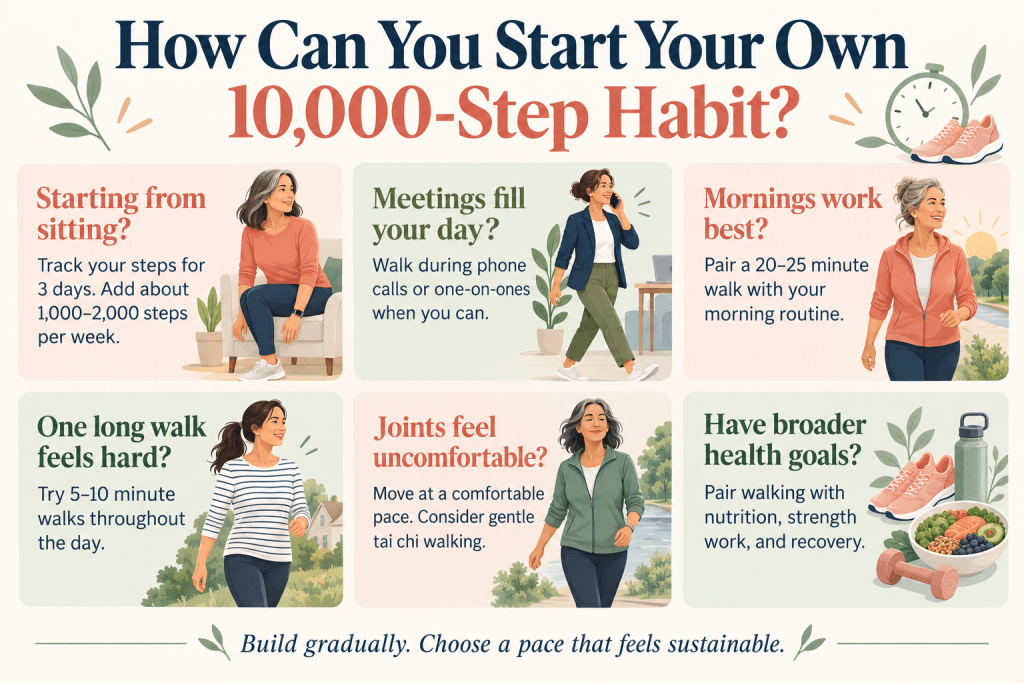
- If you’re starting from a mostly sedentary baseline: Don’t jump straight to 10,000 steps. Track your current average for three days first, then add roughly 1,000 to 2,000 steps per week until you reach a level that feels sustainable.
- If you sit through back-to-back meetings most days: Turn phone calls and one-on-ones into walking opportunities whenever possible. These small blocks of movement can add a meaningful number of steps without requiring another dedicated workout on your calendar.
- If mornings are the only predictable block in your day: Anchor a 20- to 25-minute walk to something you already do after waking, before your inbox or family responsibilities take over. Habits tied to an existing routine tend to become more automatic over time (Lally et al., 2010).
- If a full walk feels intimidating at first: Short micro walks of 5 to 10 minutes throughout the day let you accumulate meaningful step totals without needing one long, uninterrupted walking session.
- If joint discomfort makes brisk walking uncomfortable: Slower movement such as tai chi walking can keep you active while adding balance, coordination, and mobility work to your routine.
- If you want to support goals beyond your daily step count: Walking can be one part of a broader routine that includes lymphatic drainage exercises for movement and fluid-flow support, along with evidence-based weight-loss strategies that address nutrition, strength training, recovery, and other factors beyond steps alone.
What Lesson Changed How I Think About Fitness?
Most people, myself included at the start of this, approach weight loss backwards. We search for the most effective plan, the most advanced strategy, the fastest possible shortcut. But the best plan was never the one that burns the most calories in a single session. It’s the one you’ll actually still be doing in six months. Walking isn’t dramatic.
It won’t generate a before-and-after post that stops the scroll. What it did instead was stick, and a habit that sticks for 60 days straight outperforms an intense plan abandoned after two weeks, every time.
What Are Your Next Steps?
Use these steps to build a walking routine around your own schedule:
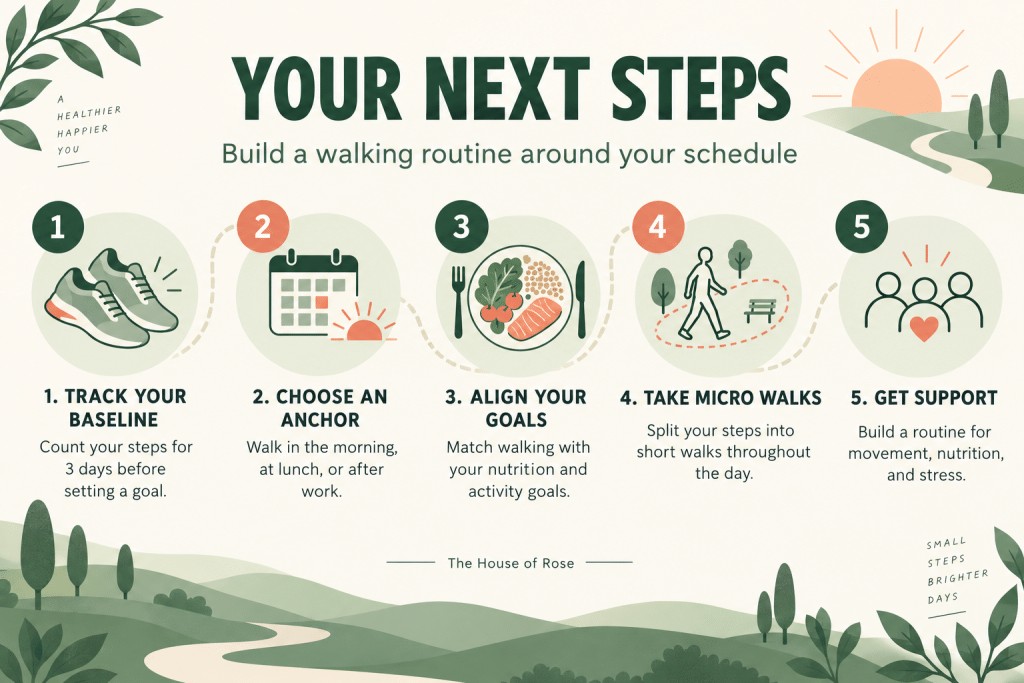
- Track your current baseline for three days: Do this before setting a step target so you know what your normal daily movement actually looks like and can build from there realistically.
- Pick one anchor point in your existing routine: Choose morning, lunch, or immediately after work and attach your walk to that time rather than relying on whenever you happen to find a free moment.
- Check how walking fits your broader goals: If you’re pairing more daily movement with nutrition changes, use the macro calculator to estimate calorie and macro targets that reflect your body, activity level, and goals.
- Break your steps into smaller blocks when needed: If one long walk doesn’t fit your schedule, several micro walks throughout the day can make consistent movement easier to maintain.
- Get structured support if you need it: If you want help turning your walking goal into a broader routine that also accounts for nutrition, training, and stress management, you can reach out to THOR for personalized support.
Free 28-Day Fascia Reset Email Course
Get our Free 28-day email course series to help with 1 or 2 exercises per day to release your fascia. One short lesson per day. Two minutes to read each.
Frequently Asked Questions
How many steps a day should I walk to lose weight?
Research suggests most of the mortality and metabolic benefit from walking appears between 7,000 and 10,000 steps a day, with returns leveling off beyond that range for most adults (Paluch et al., 2022). For weight loss specifically, consistency at whatever number you can sustain daily matters more than hitting an exact figure.
Where did the 10,000-step goal actually come from?
It originated from a 1960s Japanese pedometer product name, not a clinical recommendation, though later research has found meaningful health benefits in that general range regardless of its marketing origin (Tudor-Locke & Bassett, 2004).
How much weight can you lose by walking 10,000 steps a day?
It depends heavily on starting weight, walking pace, and whether diet changes accompany the walking. A 60 to 90 minute daily walk burns roughly 200 to 400 calories for most midlife women, which can produce gradual, steady loss over weeks without any dietary changes at all.
How long did it take to see results in this experiment?
Mood and energy changes appeared within the first two weeks. Visible physical changes and consistent scale movement didn’t start until around week five.
Do I need to walk 10,000 steps all at once?
No. Steps accumulated throughout the day count the same as steps walked in one continuous session; there’s no metabolic requirement for a single long walk versus several shorter ones.
Is walking alone enough, or do I need strength training too?
Walking supports cardiovascular health, mood, and calorie expenditure, but it doesn’t build or preserve muscle mass the way resistance training does, which becomes increasingly important after 40 as natural muscle loss accelerates. The two are complementary, not competing.
What if I can’t reach 10,000 steps because of a physical limitation?
The plateau in benefit research starts around 7,000 steps, and even lower step counts show meaningful benefit over a fully sedentary baseline (Saint-Maurice et al., 2020). Any consistent increase over your personal starting point is worth pursuing; the target should fit your body, not the other way around.
Did I change my diet during this experiment?
Not intentionally, and not at the outset. Some food choices shifted gradually as a side effect of the daily movement habit, which is discussed in Section 7 alongside how strong that specific evidence actually is.
How accurate are phone step counters compared to dedicated trackers?
Phone-based step counts are generally accurate for walking specifically but can undercount steps when the phone isn’t carried (such as during household tasks) and can occasionally overcount during activities like driving on rough roads. For tracking a walking habit specifically, phone counters are accurate enough to use consistently.
Why did my mood improve before my weight changed?
Neurochemical and stress-response changes from regular movement tend to happen faster than measurable changes in body composition, which typically take several weeks of consistent caloric deficit to become visible (Basso & Suzuki, 2017).
Is it normal for the scale not to move for the first two weeks?
Yes, and it’s one of the most common reasons people abandon a new walking habit right before it starts working. Water retention, muscle adaptation, and measurement noise commonly mask early progress on the scale specifically.
Can walking alone help with menopause-related weight gain?
Walking supports the calorie-expenditure side of the equation and has documented benefits for the stress and sleep disruption that often accompany perimenopause and menopause, both of which indirectly affect weight. It’s not a complete solution on its own for the hormonal shifts driving midlife weight changes, but it’s a meaningfully useful piece of one.
What’s the single biggest mistake people make when starting a step-count habit?
Jumping straight to 10,000 steps from a sedentary baseline instead of building up gradually. The resulting soreness, time pressure, and frustration from an unrealistic jump are the most common reasons people quit within the first ten days.
How do I stay consistent when travel or a busy week disrupts my routine?
Anchoring the walk to an existing daily routine point, rather than an open block of free time, is what made this experiment hold up through disrupted weeks. A walk attached to “right after I wake up” survives a chaotic day better than a walk that depends on finding an hour somewhere.
I write 3 essays per week on Lifestyle Medicine for women in midlife on what is happening in the body and what to do about it. No fluff, no hype. Free.
References
- Levine, J.A. (2004). Non-exercise activity thermogenesis (NEAT). Best Practice & Research Clinical Endocrinology & Metabolism, 18(4), 679-702.
- Chekroud, S.R., Gueorguieva, R., Zheutlin, A.B., et al. (2018). Association Between Physical Exercise and Mental Health in 1.2 Million Individuals in the USA. Lancet Psychiatry, 5(9), 739-746.
- Basso, J.C., & Suzuki, W.A. (2017). The Effects of Acute Exercise on Mood, Cognition, Neurophysiology, and Neurochemical Pathways. Brain Plasticity, 2(2), 127-152.
- Purcell, K., Sumithran, P., Prendergast, L.A., et al. (2014). The Effect of Rate of Weight Loss on Long-Term Weight Management. Lancet Diabetes & Endocrinology, 2(12), 954-962.
- Tudor-Locke, C., & Bassett, D.R. (2004). How Many Steps/Day Are Enough? Preliminary Pedometer Indices for Public Health. Sports Medicine, 34(1), 1-8.
- Paluch, A.E., Bajpai, S., Bassett, D.R., et al. (2022). Daily Steps and All-Cause Mortality: A Meta-Analysis of 15 International Cohorts. Lancet Public Health, 7(3), e219-e228.
- Saint-Maurice, P.F., Troiano, R.P., Bassett, D.R., et al. (2020). Association of Daily Step Count and Step Intensity With Mortality Among US Adults. JAMA, 323(12), 1151-1160.
- Hall, K.D., Heymsfield, S.B., Kemnitz, J.W., et al. (2019). Energy Balance and Its Components: Implications for Body Weight Regulation. American Journal of Clinical Nutrition, 95(4), 989-994.
- Kredlow, M.A., Capozzoli, M.C., Hearon, B.A., et al. (2015). The Effects of Physical Activity on Sleep: A Meta-Analytic Review. Journal of Behavioral Medicine, 38(3), 427-449.
- Joseph, R.J., Alonso-Alonso, M., Bond, D.S., et al. (2011). The Neurocognitive Connection Between Physical Activity and Eating Behaviour. Obesity Reviews, 12(10), 800-812.
- Lally, P., van Jaarsveld, C.H.M., Potts, H.W.W., & Wardle, J. (2010). How Are Habits Formed: Modelling Habit Formation in the Real World. European Journal of Social Psychology, 40(6), 998-1009.
Disclaimer: This article is for educational purposes only and does not constitute medical advice. Walking and increasing your daily step count can support general health, fitness, and weight-management goals, but individual results will vary based on factors such as activity level, nutrition, body weight, health conditions, and physical limitations. If you are currently sedentary, have joint or balance problems, cardiovascular concerns, chronic pain, or another medical condition that may affect exercise, consult a healthcare provider before significantly increasing your daily activity.
Free 28-Day Fascia Reset Email Course
Get our Free 28-day email course series to help with 1 or 2 exercises per day to release your fascia. One short lesson per day. Two minutes to read each.

Terry Tateossian is a Menopause Lifestyle Medicine Coach, Certified Personal Trainer & Nutritionist and the Founder of THOR: The House of Rose, a wellness brand serving women over 40 through retreats, coaching, macro-nutrition and community. As 25-year founder and entrepreneur, Terry spent two and a half decades building and running successful start-up businesses, an experience that put her on the front line of founder burnout long before she could name it. After facing serious health challenges, early onset menopause, and emotional eating while running her agency and raising two children, Terry rebuilt her health in her 40s and lost more than 80 pounds through evidence-based nutrition, training, and mindset work. Today, she helps women get strong, improve confidence, support hormone health, and create a stronger second half of life. Terry has been featured in major media outlets and is available for podcasts, expert commentary, brand collaborations, and speaking engagements on midlife health, reinvention, emotional eating, menopause wellness, and strength training for longevity. Get her free macro calculator (her cookbook companion) to start your journey to back to health.