

 By Team THOR
Free 28-Day Fascia Reset Email Course
Get our Free 28-day email course series to help with 1 or 2 exercises per day to release your fascia. One short lesson per day. Two minutes to read each.
Lymphatic Drainage Exercises for Weight Loss and Belly Fat: A Complete Guide for Midlife Women
Renata is fifty-three. Every night for the past two years, she has watched the same small drama play out in her bathroom mirror: her rings fit loosely in the morning and tightly by dinner, her ankles look sculpted before 10 a.m. and swollen by 6 p.m., and her stomach, which she has trained with planks and Pilates for a decade, still looks distended by evening in a way that has nothing to do with what she ate that day.
She assumed this was simply what forty-something bodies do. She increased her workouts. She cut carbs further. She bought a waist trainer she wore twice. None of it touched the evening puffiness, because none of it was aimed at the actual system responsible for it.
The system responsible is the lymphatic system, and it is almost never mentioned in the standard midlife weight loss conversation, which tends to stay focused on calories, macros, and strength training, all of which matter enormously and none of which move lymph. Lymph is fluid, not fat, and it depends entirely on muscle contraction and movement to circulate, because unlike blood, it has no central pump.
A body that sits for eight hours, breathes shallowly under stress, and moves through a day with minimal large-muscle contraction is a body where lymph pools, and pooled lymph shows up as exactly what Renata sees every evening: puffiness, a stubborn distended feeling in the midsection, and the sense that no amount of dieting touches a certain kind of stuck fullness.
This article is not another version of the fascia release conversation, though the two systems are closely related and we will point you to that companion piece. This is about the lymphatic system specifically: what it does, why it slows down in midlife, and the exact exercises that reliably get it moving again.
What Does the Lymphatic System Actually Do?
The lymphatic system is a network of vessels, nodes, and organs that runs parallel to the circulatory system and handles three jobs the blood system cannot do on its own:
- Drains excess fluid out of tissue and returns it to the bloodstream
- Transports immune cells throughout the body to fight infection
- Absorbs fat from the digestive tract and delivers it into circulation.
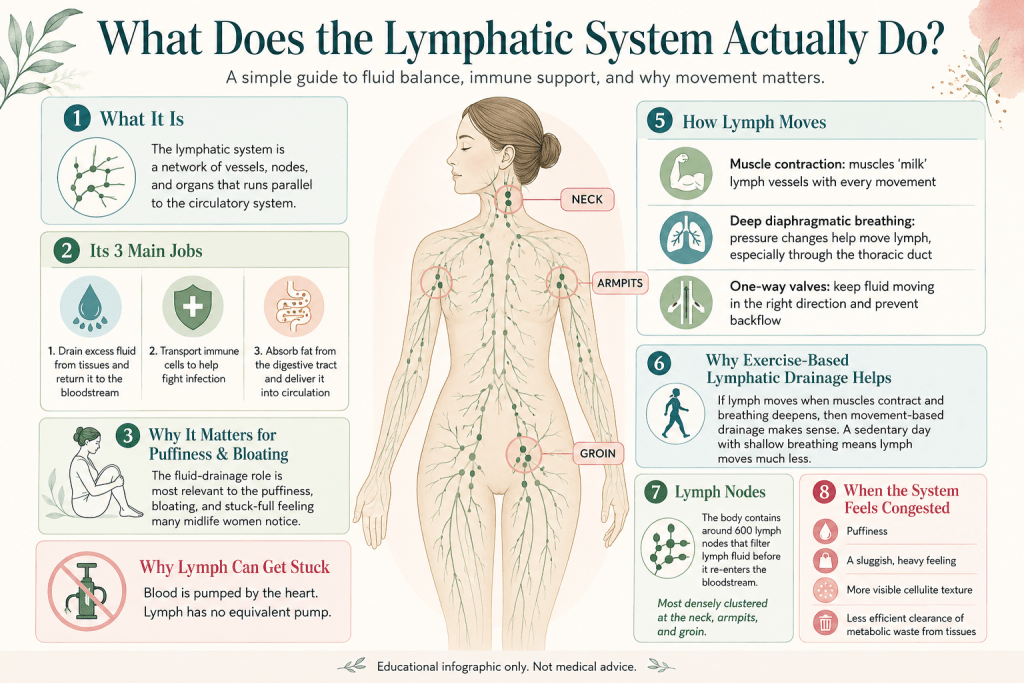
The fluid-drainage function is the one most relevant to the puffiness, bloating, and stuck-fullness feeling that so many midlife women describe. Blood is pumped by the heart under continuous pressure. Lymph has no equivalent pump.
It relies entirely on three passive mechanisms to move:
- Skeletal muscle contraction (the muscle “milks” the lymph vessels with every contraction).
- The pressure changes created by deep breathing (particularly diaphragmatic breathing, which acts on the thoracic duct, the body’s largest lymphatic vessel), and
- The one-way valves inside lymphatic vessels that prevent backflow once fluid starts moving in the right direction.
This is the entire reason exercise-based lymphatic drainage works as a category: if lymph only moves when muscles contract and you breathe deeply, then a sedentary day with shallow breathing is, quite literally, a day where lymph barely moves at all.
The lymphatic system also contains around 600 lymph nodes clustered at key locations, most densely at the neck, armpits, and groin, which filter lymph fluid before it re-enters the bloodstream.
Chronic congestion in this system does not just cause cosmetic puffiness; it is associated with a broader sense of sluggishness, more visible cellulite texture, and a compromised ability to clear metabolic waste from tissue efficiently.
Why Lymphatic Drainage Slows Down in Midlife?
- Declining estrogen affects vessel tone: Estrogen receptors are present throughout the vascular and lymphatic system, and estrogen supports the tone and permeability regulation of blood and lymph vessel walls. As estrogen declines through perimenopause and menopause, many women notice increased fluid retention and a more sluggish sense of circulation, a pattern widely reported anecdotally and consistent with estrogen’s known vascular roles, though large controlled trials isolating lymphatic-specific effects in menopause are still limited.
- Reduced daily movement: Midlife often coincides with more sedentary work patterns, whether from a desk job, caregiving responsibilities, or simply a body that moves less than it did at twenty-five. Since muscle contraction is lymph’s only real pump, less movement directly means less lymphatic circulation.
- Shallow, chest-dominant breathing under chronic stress: Diaphragmatic breathing creates the pressure differential that drives lymph through the thoracic duct. Chronic stress shifts breathing toward shallow chest breathing, which barely engages the diaphragm and significantly reduces this pumping action. Midlife women carrying high stress loads from careers, caregiving, and hormonal symptoms are disproportionately affected.
- Tight, restrictive clothing at the waist and groin: Waistbands, shapewear, and tight elastic at the hip crease compress the inguinal lymph nodes in the groin, one of the body’s major lymphatic drainage points for the legs and lower trunk. Chronic compression here can measurably slow lower-body lymphatic return.
- Visceral fat and compression: Increased visceral (abdominal) fat, common during the menopause transition due to shifting fat storage patterns, can physically compress abdominal lymphatic vessels, compounding the slowdown.
- Surgical history: Any abdominal, pelvic, or lymph-node-adjacent surgery (C-sections, hysterectomies, appendectomies, lymph node removal for cancer treatment) can disrupt local lymphatic pathways and create lasting areas of reduced drainage.
“For years I thought the bloated, tight feeling I got by the end of most days was just something my digestion was doing to me. It was not until I started paying attention to how much better I felt after a day with real movement, deep breathing, and a five-minute rebounding session that I connected the dots to my lymphatic system. This is not about digestion at all. It is about a fluid system that depends completely on muscle contraction, and most of us are not contracting nearly enough of the right muscles in the right way to keep it moving.”
Terry Tateossian, Founder of The House of Rose
Free 28-Day Fascia Reset Email Course
Get our Free 28-day email course series to help with 1 or 2 exercises per day to release your fascia. One short lesson per day. Two minutes to read each.
What Is the Difference Between Lymphatic Drainage & Fascia Release?
These two topics are closely related and frequently discussed together, including in our own content, so it is worth being precise about the distinction.
Fascia Release
Fascia is the connective tissue web that wraps every muscle, organ, and vessel in the body. Fascia release work (foam rolling, gua sha, cupping, myofascial massage) targets restrictions and adhesions in this connective tissue itself, aiming to restore glide and flexibility between tissue layers.
When the midsection feels particularly tight or restricted, incorporating fascia release exercises can support mobility, deeper breathing, lymphatic flow, and more comfortable everyday movement. These effects do not directly reduce belly fat, but they can address some of the physical restrictions that make movement and other healthy midlife habits harder to maintain.
The Lymphatic System
The lymphatic system is a fluid transport network, not a connective tissue structure. Lymphatic drainage work targets the movement of fluid through vessels and nodes, using specific movement patterns, breathing, and light directional pressure to encourage fluid flow toward the correct drainage points.
The Fascia and Lymphatic Connection
Why they overlap so much in practice. Fascia surrounds and interacts with lymphatic vessels throughout the body. Restricted, dehydrated fascia can physically compress lymphatic vessels running through it, and fascia release work often incidentally improves lymphatic flow as a side effect.
This close fascia-lymphatic connection is why practitioners, including our own team, often discuss and support both systems together.
The Focus on Lymphatic Drainage
Why this article focuses on lymphatic drainage specifically. Not every reader searching for lymphatic support wants a fascia-tool-based routine involving foam rollers or gua sha stones.
Many want body-weight, breath-based, and movement-based exercises they can do without any equipment, specifically aimed at fluid drainage rather than connective tissue release. That is the gap this article fills.
What Lymphatic Drainage Exercise Does for Weight Loss and What It Doesnt?
Honesty matters here more than almost anywhere else in wellness content, because lymphatic drainage is one of the most overhyped categories in the belly-fat-loss conversation.
What It Cant Do
Lymphatic drainage exercises do not burn fat. Lymph is fluid, not adipose tissue, and no amount of manual lymphatic work or movement-based lymph stimulation converts fat into lymph fluid or flushes fat cells out of the body. Any claim suggesting lymphatic drainage directly melts belly fat is not supported by the physiology of how the lymphatic system works.
What It Can Do
Lymphatic drainage exercises reduce fluid retention and the puffiness, bloating, and stuck-fullness sensation that fluid congestion causes, which for many women changes how their midsection looks and feels day to day, particularly by evening. This is a real and often immediately noticeable effect, distinct from fat loss.
Lymphatic work also supports the broader systems that do influence body composition indirectly: it can improve the sense of lightness and mobility that makes consistent exercise more sustainable, it supports immune function and recovery which affects training consistency, and the movement-based exercises in this routine (rebounding, brisk walking components, deep breathing under mild exertion) provide genuine caloric expenditure and cardiovascular benefit in their own right, separate from any lymphatic effect.
Think of lymphatic drainage exercises as a tool that removes a layer of fluid-related bloat and discomfort sitting on top of your actual body composition, while providing modest additional movement and stress-reduction benefits that support a broader weight management plan. It is a supportive layer, not a fat-loss mechanism in itself, and any article or product claiming otherwise is overselling the science.
Free 28-Day Fascia Reset Email Course
Get our Free 28-day email course series to help with 1 or 2 exercises per day to release your fascia. One short lesson per day. Two minutes to read each.
What Is the Complete Lymphatic Drainage Exercise Routine?
This is a body-weight, equipment-optional routine that takes 15 to 20 minutes and can be done as a complete session or split across a day.
Exercise 1: Diaphragmatic Breathing (The Foundational Lymphatic Pump)
Lie on your back, knees bent, one hand on your chest and one on your belly. Inhale slowly through your nose, letting your belly rise while your chest stays relatively still. Exhale slowly through pursed lips, letting your belly fall. 10 slow breaths. This single exercise activates the thoracic duct pump more directly than any other movement on this list and should open and close every session.
Exercise 2: Rebounding (Mini Trampoline)
Gentle bouncing on a mini trampoline, feet barely leaving the surface, for 3 to 5 minutes. The repetitive up-and-down motion creates a rhythmic pressure change throughout the entire body that is widely considered one of the most effective full-body lymphatic stimulation exercises available. If you do not have a rebounder, marching in place with exaggerated knee lifts for the same duration provides a partial substitute.
Exercise 3: Ankle Pumps and Heel Drops
Standing or seated, rise onto your toes and drop your heels firmly to the ground, 15 to 20 repetitions. This activates the calf muscle pump, which is critical for lower-leg lymphatic and venous return and is one of the most under-addressed exercises for women who notice ankle and lower-leg swelling by end of day.
Exercise 4: Arm Circles and Overhead Reaches
Large, slow arm circles forward and backward, 10 each direction, followed by 10 slow overhead reaches on each side. This stimulates the axillary (armpit) lymph nodes, a major drainage hub for the upper body.
Exercise 5: Cat-Cow Spinal Flexion
On hands and knees, alternate between arching and rounding your spine, 10 slow repetitions. This gentle spinal movement compresses and releases the abdominal cavity rhythmically, encouraging deep lymphatic flow around the digestive organs.
Exercise 6: Standing Torso Twists
Feet hip-width apart, gently rotate your torso side to side, letting your arms swing loosely, 20 total repetitions. This engages the deep abdominal and oblique muscles that surround major abdominal lymphatic pathways.
Exercise 7: Gentle Inversions (Legs Up the Wall)
Lie on your back with your legs extended up a wall for 3 to 5 minutes. This uses gravity to assist lower-body lymphatic and venous return, particularly helpful for anyone who has been standing or sitting for extended periods.
Exercise 8: Deep Squats With Arm Reaches
Slow bodyweight squats, reaching arms overhead on the way up, 10 to 15 repetitions. This combines large lower-body muscle contraction with the upper-body node stimulation from the arm reach.
Exercise 9: Brisk Walking (10 to 15 Minutes)
Simple, sustained walking at a pace that raises your breathing rate slightly. Walking is one of the most reliable, evidence-supported ways to sustain lymphatic circulation over time because it combines continuous calf and thigh muscle contraction with naturally deepened breathing.
Exercise 10: Closing Diaphragmatic Breaths
Repeat Exercise 1 for 5 slow breaths to close the session, allowing the nervous system to settle and reinforcing the deep breathing pattern you want to carry into the rest of your day.
QiGong – Morning Lymphatic Activation Sequence
Mornings matter disproportionately for lymphatic flow because overnight, while the body is horizontal and still, fluid tends to redistribute and settle, which is part of why many women notice puffiness is worst first thing in the morning.
5-Minute Morning Sequence:
- Diaphragmatic breathing, 10 breaths, before getting out of bed
- Ankle pumps and heel drops, 20 repetitions, done standing at the side of the bed
- Cat-cow, 10 repetitions
- Standing torso twists, 15 repetitions
- A brisk 5-minute walk, ideally outdoors, or in place if needed
This short sequence takes under 10 minutes and is designed to be realistic for a busy weekday morning while still hitting the major lymphatic pump mechanisms: breath, calf contraction, spinal movement, and sustained walking.
How To Support Lymphatic Drainage for the Legs and Lower Body?
Leg and ankle swelling by end of day is one of the most common lymphatic complaints among midlife women, particularly those who stand or sit for long periods at work.
Extended lower-body sequence (add 3 to 4 times per week, or daily if you notice regular ankle swelling):
- Wall sits with calf pumps: Lean against a wall in a shallow squat position, and pulse your heels up and down for 30 seconds, 3 rounds.
- Figure-4 hip openers: Lying on your back, cross one ankle over the opposite knee and gently draw the bottom leg toward your chest, 30 seconds per side. This addresses lymphatic flow through the groin, where the inguinal nodes are a major drainage point often compressed by sitting.
- Standing calf raises: 20 slow, controlled calf raises, pausing at the top for a one-second squeeze.
- Legs up the wall, extended hold: 8 to 10 minutes, ideally in the evening after a day of standing or sitting, to help clear fluid that has accumulated in the lower legs over the course of the day.
- A note on compression garments: Graduated compression socks or leggings can meaningfully support lymphatic and venous return for women who are on their feet most of the day or who travel frequently. They work with, not against, the lymphatic pump mechanisms described here, unlike tight non-graduated waistbands or shapewear, which compress lymph nodes without providing the graduated pressure gradient that actually assists flow.
Free 28-Day Fascia Reset Email Course
Get our Free 28-day email course series to help with 1 or 2 exercises per day to release your fascia. One short lesson per day. Two minutes to read each.
How Can You Support Lymphatic Drainage for the Stomach and Belly?
This is the area most searched in connection with lymphatic drainage and weight loss, and it deserves a dedicated, honest sequence.
Abdominal Breathing With Gentle Self-Massage
After completing diaphragmatic breathing (Exercise 1), place both hands flat on your lower abdomen and use very light pressure to stroke in a clockwise direction, following the path of the large intestine, for 1 to 2 minutes. Clockwise direction matters, as it follows the natural direction of digestive and lymphatic flow in the abdomen.
Seated Torso Twists With Exhale Emphasis
Seated, twist your torso to one side while exhaling fully, return to center on the inhale, alternate sides, 10 per side. The combination of rotation and a full exhale increases intra-abdominal pressure changes that support deep abdominal lymphatic flow.
Knee-to-Chest Pulses
Lying on your back, draw one knee toward your chest and gently pulse it closer 5 times, then switch legs, 3 rounds per side. This compresses and releases the abdominal cavity in a way similar to cat-cow but with more targeted pressure on one side at a time.
Standing Side Bends
Feet hip-width apart, reach one arm overhead and bend gently to the opposite side, 10 per side. This stretches and releases the lateral abdominal wall and supports lymphatic flow along the flanks.
Why “Belly Fat” and “Belly Bloat” Get Confused
Many women searching for lymphatic drainage exercises for belly fat are actually experiencing lymphatic and digestive bloat rather than an increase in adipose tissue, and the two produce a similar visual and physical sensation but respond to completely different interventions.
This routine can help address bloating and fluid retention, but changing actual body composition still depends on nutrition, strength training, and overall calorie intake. Using the Free Macro Calculator can help establish personalized calorie and macro targets, while a structured menopause diet plan can provide a practical framework for putting those targets into action.
How Can You Combine Dry Brushing With Movement?
Dry brushing, using a natural-bristle brush on dry skin before showering, is one of the most searched lymphatic drainage practices, and it works best when combined with the movement exercises above rather than used alone.
- Technique: Using light pressure, brush in long strokes always moving toward the heart: up from the feet toward the groin, up from the hands toward the armpits, and in gentle upward strokes on the abdomen toward the chest. 3 to 5 strokes per area, 2 to 3 minutes total.
- Why pair it with movement: Dry brushing provides a light mechanical stimulus to the superficial lymphatic vessels just under the skin, but it does not activate the deep muscle-pump mechanism that moves the larger volume of lymph fluid. Doing 2 to 3 minutes of dry brushing immediately before the full exercise routine in Section 5 combines the superficial stimulation with the deep muscular pump, which is a more complete approach than either practice alone.
- Frequency: 3 to 4 times per week is sufficient for most people; daily dry brushing on sensitive skin can cause irritation over time.
What Is the 5-Day Lymphatic Drainage Program?
|
Day |
Focus |
Time |
|
Day 1 |
Full 10-exercise routine (Section 5) |
15-20 min |
|
Day 2 |
Morning activation sequence + extended leg sequence (Section 7) |
15 min |
|
Day 3 |
Full 10-exercise routine + abdominal sequence (Section 8) |
20-25 min |
|
Day 4 |
Dry brushing + morning activation sequence (light day) |
10 min |
|
Day 5 |
Full 10-exercise routine + extended leg sequence |
20-25 min |
Repeat this 5-day structure weekly, treating it as an ongoing practice rather than a short-term reset. Most women notice a reduction in evening puffiness and a lighter, less distended feeling within the first 5 to 7 days of consistent practice, with the effects becoming more stable and predictable over 4 to 6 weeks as the routine becomes habitual.
What Does the Research Say?
Muscle Contraction as the Lymphatic Pump
The physiological principle that skeletal muscle contraction is the primary driver of lymphatic flow in the absence of a central pump is well established in lymphology and forms the basis of manual lymphatic drainage therapy used clinically for lymphedema management.
Diaphragmatic Breathing and the Thoracic Duct
Research on the mechanics of the thoracic duct, the body’s largest lymphatic vessel which empties into the venous system near the left subclavian vein, confirms that pressure changes from deep diaphragmatic breathing meaningfully influence lymphatic flow rate, supporting the clinical use of breathing exercises in lymphedema and post-surgical lymphatic rehabilitation protocols.
Rebounding and Lymphatic Circulation
While large-scale randomized trials specifically isolating rebounding’s effect on lymphatic flow are limited, the biomechanical principle is straightforward and well accepted: the repeated acceleration and deceleration of bouncing creates rhythmic pressure changes throughout the body’s fluid systems, and rebounding is commonly recommended in lymphedema and lymphatic health literature as a low-impact way to stimulate whole-body lymphatic circulation.
Compression Garments and Lymphatic/Venous Return
Graduated compression therapy has substantial clinical research support for improving venous and lymphatic return in the lower extremities, particularly for people who stand for long periods, supporting the practical recommendation in Section 7.
Manual Lymphatic Drainage and Post-Surgical Recovery
Manual lymphatic drainage techniques, the clinical predecessor to many self-massage approaches described in this article, have documented benefit in reducing lymphedema and swelling following certain surgeries, particularly breast cancer-related lymph node removal, which is the strongest and most rigorously studied application of lymphatic-focused manual therapy.
Honest Limitations
Much of the specific claim that lymphatic drainage exercises directly reduce belly fat outpaces what the research actually supports. What is well supported: these exercises reduce fluid-related puffiness and bloating, support general circulation and comfort, and provide legitimate movement and breathing benefits.
What is not well supported: any direct fat-burning or dramatic body composition transformation from lymphatic work alone, separate from the caloric and movement benefits the exercises themselves provide as physical activity.
Free 28-Day Fascia Reset Email Course
Get our Free 28-day email course series to help with 1 or 2 exercises per day to release your fascia. One short lesson per day. Two minutes to read each.
What Are the Signs Your Lymphatic System Needs Support?
- Consistent puffiness that is worse by evening and better after a night’s sleep
- Rings, watches, or shoes that fit differently throughout the day
- A feeling of heaviness or fullness in the legs after standing or sitting for long periods
- Skin that indents and slowly rebounds when pressed (mild pitting)
- A sense of stagnant, sluggish circulation, distinct from fatigue
- Visible cellulite texture that fluctuates noticeably day to day
- A history of abdominal or pelvic surgery with lingering localized puffiness near the scar
If swelling is significant, one-sided, sudden, or accompanied by pain, redness, or warmth, this is not a general lymphatic sluggishness issue and requires prompt medical evaluation to rule out deep vein thrombosis, infection, or a lymphatic condition requiring clinical treatment.
What Are the Contraindications, and When Should You See a Doctor?
See a doctor promptly, do not self-treat, if you notice:
- Sudden, one-sided leg or arm swelling, particularly with pain, warmth, or redness (possible DVT, a medical emergency)
- Swelling accompanied by fever
- Rapidly worsening swelling with no clear cause
- Any swelling after cancer treatment involving lymph node removal that is new or worsening (possible lymphedema requiring specialized care)
Use caution or consult a physician first if you have:
- A diagnosed heart or kidney condition (fluid retention patterns can be different and require medical guidance)
- A history of blood clots
- Active infection or cellulitis in the area you intend to work on
- Diagnosed lymphedema (work with a certified lymphedema therapist rather than a general self-guided routine)
- Pregnancy (some inversions and abdominal work should be modified or avoided; consult your provider)
General safety. For most healthy midlife women without the above conditions, the movement-based exercises in this article are low-risk and gentle by design. When in doubt, start with the breathing and walking components alone and add other exercises gradually.
Free 28-Day Fascia Reset Email Course
Get our Free 28-day email course series to help with 1 or 2 exercises per day to release your fascia. One short lesson per day. Two minutes to read each.
What Common Mistakes Undermine Lymphatic Drainage Work?

- Mistake: Skipping the breathing component: Diaphragmatic breathing is the single most powerful lever in this entire routine, and it is also the easiest to skip because it feels less “active” than movement. Do not skip it.
- Mistake: Wearing tight, restrictive clothing during and after the routine: Doing lymphatic drainage exercises and then putting on tight shapewear undoes much of the benefit by immediately recompressing the nodes you just worked to decongest.
- Mistake: Expecting fat loss instead of fluid reduction: As covered in Section 4, these exercises address bloat and fluid retention, not fat tissue. Expecting the scale to move from this routine alone leads to disappointment and, often, abandoning a practice that is actually helping with comfort and puffiness.
- Mistake: Doing it once and expecting lasting results: Like most physiological systems, lymphatic flow responds to consistent input, not a single session. A once-a-month lymphatic routine will not meaningfully change chronic congestion patterns.
- Mistake: Ignoring hydration: Lymph fluid is largely water, so even mild dehydration can make efficient fluid movement more difficult and reduce the benefits of your lymphatic routine. Avoiding common hydration mistakes after 40 can help support better fluid balance throughout the day.
- Mistake: Sitting immediately after the routine for hours: The benefit of an active lymphatic session is best sustained by breaking up long sitting periods afterward, even briefly, rather than following the routine with several uninterrupted hours at a desk.
How Can You Combine Lymphatic Drainage With the Broader THOR Framework?
- Combine with fascia release: Fascia and lymphatic vessels sit in close physical proximity, so restricted tissue can interfere with comfortable fluid movement. Adding fascia release exercises can help improve tissue mobility while complementing your lymphatic routine.
- Combine with tai chi: For a slower, more meditative approach, tai chi for lymphatic and fascia support combines gentle movement, breathing, and controlled transitions in a format that can be easier to sustain as a daily practice.
- Combine with fascia-tool work: When you want more targeted connective tissue work, cupping and gua sha provide different forms of mechanical input to the fascia. A more structured gua sha routine can also be used alongside movement-based lymphatic practices to support tissue mobility and local circulation.
- Combine with hydration: Consistent hydration supports normal fluid balance, so avoiding common hydration mistakes after 40 can complement the movement and breathing practices used in a lymphatic routine.
- Combine with nutrition: Diet also influences bloating, fluid balance, and body composition. A practical menopause diet plan can provide the broader nutrition framework, while the Free Macro Calculator helps personalize calorie and macro targets to work alongside your movement routine.
Free 28-Day Fascia Reset Email Course
Get our Free 28-day email course series to help with 1 or 2 exercises per day to release your fascia. One short lesson per day. Two minutes to read each.
Frequently Asked Questions
Do lymphatic drainage exercises actually help you lose weight?
Not directly. Lymphatic drainage exercises reduce fluid retention and bloating rather than burning fat. They can support an overall weight loss plan by improving comfort, mobility, and consistency of movement, and the exercises themselves burn some calories, but they are not a fat-loss mechanism on their own.
How often should I do lymphatic drainage exercises?
Most women see the best results with the full routine 3 to 5 times per week, or a shorter version daily. Consistency matters more than duration; a daily 10-minute practice generally outperforms an occasional 45-minute session.
What is the fastest way to reduce lymphatic swelling in the stomach?
The combination of diaphragmatic breathing, clockwise abdominal self-massage, and gentle torso rotation (Section 8) tends to produce the most noticeable short-term relief, though individual results vary based on the underlying cause of the swelling.
Is rebounding really necessary, or can I skip it?
Rebounding is one of the most efficient full-body lymphatic stimulation exercises available, but it is not strictly necessary. Brisk walking, marching in place, and the other exercises in this routine provide meaningful lymphatic benefit even without a rebounder.
Can I do lymphatic drainage exercises every day?
Yes, for most healthy people. The exercises in this routine are gentle and low-impact by design and are well suited to daily practice, particularly the breathing and walking components.
What is the difference between lymphatic drainage and a regular workout?
A regular strength or cardio workout is primarily focused on building muscle, burning calories, or improving cardiovascular fitness. Lymphatic drainage exercises are specifically selected and sequenced to maximize fluid movement through the lymphatic system, using lighter, more rhythmic, and more breath-focused movement patterns than a typical strength session.
Should I do lymphatic drainage exercises before or after my regular workout?
Either can work. Many women find a short lymphatic sequence in the morning helps reduce overnight puffiness before the day starts, while an evening sequence helps clear fluid that accumulated from a day of sitting or standing. Doing the full routine as a dedicated session, separate from a strength or cardio workout, tends to produce the most noticeable results.
Can lymphatic drainage exercises help with cellulite?
Many women report improved skin texture and reduced visible cellulite with consistent lymphatic drainage practice, likely related to reduced fluid retention in the tissue rather than any change in the fat cells themselves that contribute to cellulite’s structural appearance. Effects are generally modest and temporary rather than a permanent structural change.
Is dry brushing necessary for lymphatic drainage to work?
No. Dry brushing is a helpful complementary practice that provides light superficial stimulation, but the movement and breathing exercises in this routine are the primary drivers of deep lymphatic flow and work effectively on their own.
What if I have swelling that doesn’t respond to these exercises?
Persistent swelling that does not improve with consistent practice over several weeks, especially if it is one-sided, painful, or accompanied by other symptoms, should be evaluated by a doctor rather than continued to be self-treated. See Section 13 for specific red flags.
Can men do these lymphatic drainage exercises too?
Yes. The physiology of lymphatic drainage is not sex-specific, though this article is written with the specific hormonal and lifestyle context of midlife women in mind.
How long before I notice a difference?
Many women notice reduced evening puffiness within the first 5 to 7 days of consistent practice. More stable, predictable improvement in overall fluid balance and comfort tends to develop over 4 to 6 weeks of regular practice.
I write 3 essays per week on Lifestyle Medicine for women in midlife on what is happening in the body and what to do about it. No fluff, no hype. Free.
References
- Olszewski, W. L. (2002). The lymphatic system in body homeostasis: Physiological conditions. Lymphatic Research and Biology, 1(1), 11-24.
- Moore, J. E., & Bertram, C. D. (2018). Lymphatic system flows. Annual Review of Fluid Mechanics, 50, 459-482.
- Shields, J. D., & Levick, J. R. (2004). The effects of skeletal muscle contraction on lymphatic drainage. Journal of Physiology, 556(1), 1-15.
- Zuther, J. E. (2012). Lymphedema Management: The Comprehensive Guide for Practitioners (3rd ed.). Thieme.
- International Society of Lymphology. (2020). The diagnosis and treatment of peripheral lymphedema: 2020 consensus document of the International Society of Lymphology. Lymphology, 53(1), 3-19.
- Miller, T. A. (1998). Diaphragmatic breathing and lymphatic pump mechanisms. Journal of the American Osteopathic Association, 98(8), 449-454.
- Partsch, H. (2003). Understanding the pathophysiological effects of compression. EWMA Journal, 3(1), 8-9.
- Wright, K. E., Skinner, S., & Zhu, S. (2023). The musculoskeletal syndrome of menopause. Climacteric, 26(4), 366-371.
- Rockson, S. G. (2018). Lymphedema after breast cancer treatment. New England Journal of Medicine, 379(20), 1937-1944.
- Godoy, J. M. P., Pereira, M. R., Oliani, A. H., & Godoy, M. F. G. (2012). Synergic effect of compression therapy and controlled exercises using a facilitating device in the treatment of arm lymphedema. International Journal of Medical Sciences, 9(4), 280-284.
Disclaimer: This article is educational and does not constitute medical advice. Lymphatic drainage exercises may help support fluid movement and reduce temporary puffiness, but they do not directly burn body fat or treat medical causes of swelling. If you have heart or kidney disease, a history of blood clots, diagnosed lymphedema, an active infection, are pregnant, or have had lymph nodes removed, consult a healthcare provider before starting these exercises. Seek prompt medical care for sudden or one-sided swelling, especially when accompanied by pain, redness, warmth, or fever.
Free 28-Day Fascia Reset Email Course
Get our Free 28-day email course series to help with 1 or 2 exercises per day to release your fascia. One short lesson per day. Two minutes to read each.

Terry Tateossian is a Menopause Lifestyle Medicine Coach, Certified Personal Trainer & Nutritionist and the Founder of THOR: The House of Rose, a wellness brand serving women over 40 through retreats, coaching, macro-nutrition and community. As 25-year founder and entrepreneur, Terry spent two and a half decades building and running successful start-up businesses, an experience that put her on the front line of founder burnout long before she could name it. After facing serious health challenges, early onset menopause, and emotional eating while running her agency and raising two children, Terry rebuilt her health in her 40s and lost more than 80 pounds through evidence-based nutrition, training, and mindset work. Today, she helps women get strong, improve confidence, support hormone health, and create a stronger second half of life. Terry has been featured in major media outlets and is available for podcasts, expert commentary, brand collaborations, and speaking engagements on midlife health, reinvention, emotional eating, menopause wellness, and strength training for longevity. Get her free macro calculator (her cookbook companion) to start your journey to back to health.