
 By Cindy Adoptante
Free 28-Day Fascia Reset Email Course
Get our Free 28-day email course series to help with 1 or 2 exercises per day to release your fascia. One short lesson per day. Two minutes to read each.
How Sound Healing Recalibrates the Nervous System
In Norway in the early 1980s, a special-education researcher named Olav Skille was working with children who had severe developmental disabilities, many of them nonverbal, several with limited ability to tolerate typical sensory environments. Skille began experimenting with low-frequency sound played through speakers built directly into chairs and mats, so the children could feel the vibration through their bodies rather than only hear it through their ears.
He documented something his colleagues hadn’t expected: children who struggled to stay regulated in ordinary environments visibly calmed, their muscle tension easing, during and after these low-frequency sessions. Skille went on to coin the term “vibroacoustic therapy” for the approach, and it has since been studied, in a small but real body of clinical literature, for muscle tension, pain, and general relaxation.
I open with Skille’s work because it’s the most rigorously documented piece of a much bigger claim you’ll see all over the sound healing world: that a singing bowl, a gong, or a sound bath can “recalibrate your nervous system.”
That phrase gets used constantly, and it’s usually followed by a bundle of six different claims stacked on top of each other, some backed by real research, some backed by almost nothing beyond how convincing they sound.
Medical disclaimer: This article is for educational purposes and does not replace medical or mental health care, including trauma-focused therapy. Sound-based practices are a complement to treatment, not a substitute for it. If you have epilepsy, a seizure disorder, or a diagnosed trauma history, talk with a qualified provider before starting a new sound-based practice.
How Does the Sympathetic-to-Parasympathetic Shift Work?
Your autonomic nervous system runs on two main branches. The sympathetic branch mobilizes you, raising heart rate, redirecting blood flow to muscle, sharpening alertness, useful when you need to act fast and counterproductive when you’re just sitting in traffic. The parasympathetic branch does close to the opposite: slowing heart rate, supporting digestion, and signaling the body that it’s safe enough to stand down.
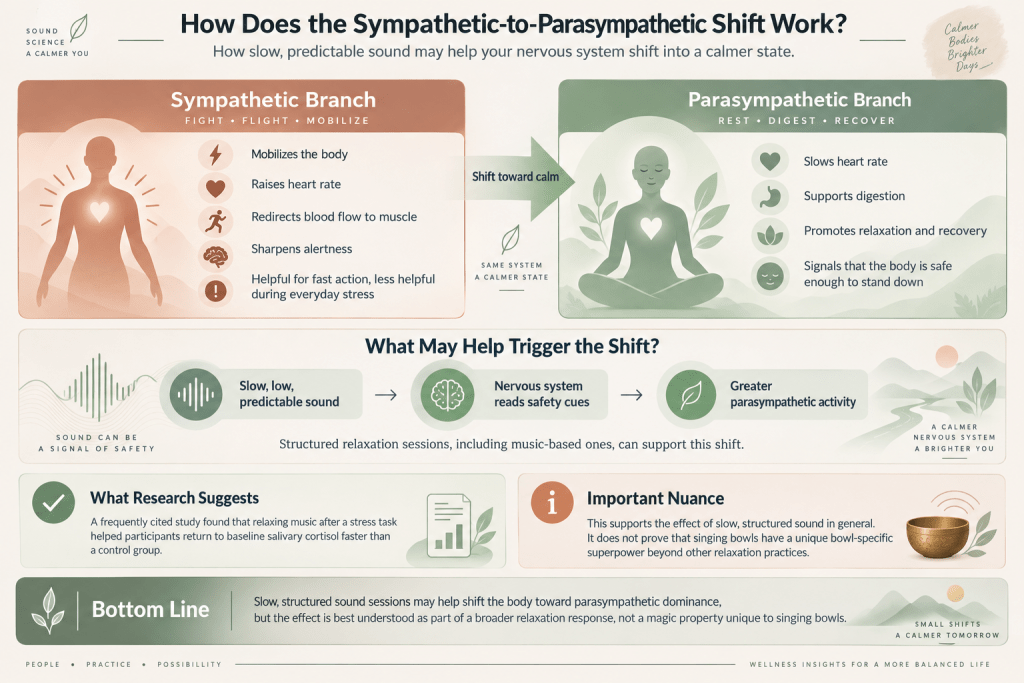
Slow, low, predictable sound is one of several inputs your nervous system uses to judge safety, and there’s a reasonable general research base for structured relaxation sessions, including music-based ones, producing measurable parasympathetic shifts. A frequently cited study found that participants listening to relaxing music after a stress task showed a faster return to baseline salivary cortisol than a control group.
That’s a real and useful finding. What it doesn’t tell you is that singing bowls specifically are doing something music in general can’t. The honest version of this claim is that slow, structured sound sessions can support a shift toward parasympathetic dominance, the same general category of effect you’d expect from any well-designed relaxation practice, not a bowl-specific superpower.
Free 28-Day Fascia Reset Email Course
Get our Free 28-day email course series to help with 1 or 2 exercises per day to release your fascia. One short lesson per day. Two minutes to read each.
What’s Proven and What’s Marketing About Brainwave Entrainment?
This is the claim most worth slowing down on because it appears constantly in sound healing marketing and often blends two different ideas together.
There is good evidence that brainwave activity changes with mental state. What is less established is the claim that a singing bowl directly forces the brain to match a specific frequency.
What Does EEG Research Actually Show?
The first part is real and well documented. Your brain’s electrical activity, measured by EEG, shifts depending on your mental state.
Busy, alert thinking tends to show more beta-range activity, while relaxed, meditative, or drowsy states tend to show more alpha and theta activity. A well-known meta-analytic review of meditation EEG research confirms this general pattern across dozens of studies.
That part is not particularly controversial.
What Does Brainwave Entrainment Research Actually Test?
The second claim is more specific: that an external sound can cause the brain to synchronize with a particular rhythm or frequency. This is often called neural entrainment or the frequency-following response.
Entrainment is a real, measurable phenomenon, but most of the clearer research has used steady, repetitive stimuli such as:
- Binaural Beats: Two slightly different tones are played separately into each ear, creating a perceived rhythmic difference.
- Isochronic Tones: A single tone pulses on and off at a steady, fixed rate.
Research reviews have found evidence of measurable EEG changes with these controlled stimuli. At the same time, study quality varies considerably, and the effects are often modest.
Does That Evidence Apply to Singing Bowls?
A singing bowl does not produce the same kind of steady, repetitive signal used in most entrainment studies. It creates a complex, gradually decaying mixture of a fundamental tone and changing overtones, acoustically closer to a bell than to an isochronic tone.
That does not mean a singing bowl session cannot help you enter a relaxed alpha- or theta-dominant state. It can create the kind of calm, low-stimulation environment that supports relaxation and meditation.
What the research does not clearly establish is that the bowl directly locks your brainwaves onto one precise frequency. Claims that a singing bowl “entrains your brain to 7.83 Hz,” or another highly specific number, go beyond what has been demonstrated for this type of sound source.
Important: This distinction matters less for whether the practice is worth trying and more for how you evaluate the claims surrounding it. A relaxing singing bowl session can be worthwhile for the relaxation itself. That is different from being sold a precise neurological mechanism that has not been clearly demonstrated for singing bowls.
“I want women to feel good about a practice without needing to believe an exaggerated version of what it does. A bowl session can calm you down. That’s worth something on its own. It doesn’t need a fake precision number attached to sound credible.”
Terry Tateossian, Founder of The House of Rose
Free 28-Day Fascia Reset Email Course
Get our Free 28-day email course series to help with 1 or 2 exercises per day to release your fascia. One short lesson per day. Two minutes to read each.
How Does Vibroacoustic Therapy Interact With Tissue?
This is where Skille’s original work becomes directly useful, because it moves the conversation away from vague language about the body “remembering its rhythm” and toward something you can actually point to: mechanoreceptors.
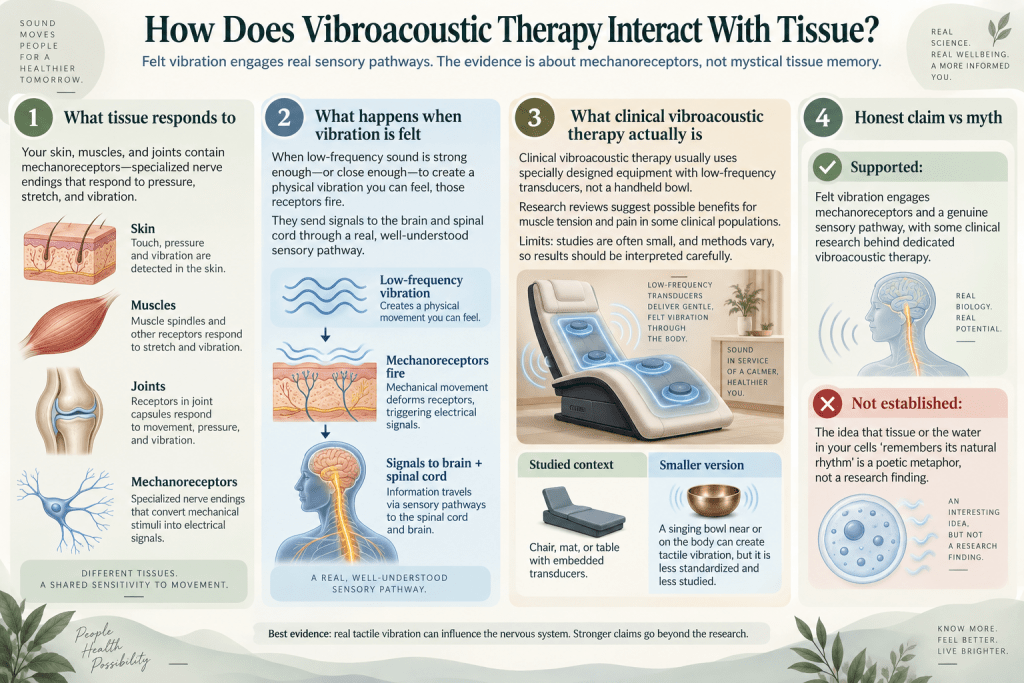
Your skin, muscles, and joints are full of specialized nerve endings called mechanoreceptors that respond specifically to pressure, stretch, and vibration. When a low-frequency sound source is loud enough or close enough to produce a physical vibration you can feel, not just hear, those receptors fire and send signals to your brain and spinal cord.
This is a real, well-understood sensory pathway, and it’s the basis of actual clinical vibroacoustic therapy, which typically uses specially built equipment (a chair, mat, or table with embedded low-frequency transducers) rather than a handheld bowl. A published review of vibroacoustic sound therapy found supportive evidence for its use in reducing muscle tension and pain in specific clinical populations, while also noting that study sizes tend to be small and methods vary a lot between studies, which limits how confidently the findings generalize.
A handheld singing bowl held near or against the body can produce a version of this tactile vibration, especially bowls placed directly on the body during certain practices, but it’s a much smaller and less standardized version of what’s actually been studied in vibroacoustic therapy research.
The honest claim is that felt vibration, not just heard sound, engages a real sensory pathway with some genuine clinical research behind it in a dedicated vibroacoustic therapy context. The claim that your tissue or the water in your cells “remembers its natural rhythm” isn’t a finding from that research. It’s a poetic metaphor that got dressed up as physiology, and this article isn’t going to repeat it as fact.
What Is the Vagus Nerve Connection?
Your vagus nerve, the primary channel of your parasympathetic nervous system, comes up constantly in sound healing content for a legitimate reason. It is involved in several of the relaxation mechanisms already covered in this article, especially those connected to breathing and vocalization.
Practices that combine humming, extended exhalation, and voice-based sound work can add an active vocal component to that nervous system response.
Is Listening to a Singing Bowl the Same as Vagus Nerve Stimulation?
One distinction is important because sound healing content frequently blurs it. There is a real clinical technique called transcutaneous auricular vagus nerve stimulation, or taVNS.
- taVNS: Uses a small electrical device against a specific area of the outer ear, one of the few places where a branch of the vagus nerve comes close enough to the skin to be stimulated this way.
- Singing Bowl Sound: Travels through ordinary auditory pathways, beginning with the cochlea and brainstem before influencing broader nervous system processes associated with hearing and relaxation.
Both mechanisms are real, but they are not the same thing.
taVNS directly applies electrical stimulation to a vagal nerve branch. Listening to a singing bowl does not. Claims suggesting that hearing a bowl works in the same way as auricular vagus nerve stimulation stretch research from one mechanism to support another that has not actually been studied in the same way.
What Sound Practices Connect More Directly to the Vagus Nerve?
Your own vocalization has a more direct connection to the mechanisms associated with vagal regulation.
Practices studied in this context include:
- Humming: Combines prolonged exhalation with vocal vibration.
- Chanting: Encourages rhythmic breathing and sustained vocalization.
- Sustained Vowel Sounds: Extend the exhale while engaging the voice and respiratory system.
These practices combine sound production with breathing patterns that can support parasympathetic activity. The companion article linked above goes deeper into how humming, chanting, and the voice can be combined with a singing bowl.
Free 28-Day Fascia Reset Email Course
Get our Free 28-day email course series to help with 1 or 2 exercises per day to release your fascia. One short lesson per day. Two minutes to read each.
How Do Heart-Breath Coherence and Resonance Frequency Breathing Work?
Your heart rate doesn’t stay perfectly steady between beats, even at rest. It naturally speeds up slightly as you inhale and slows slightly as you exhale, a pattern called respiratory sinus arrhythmia. When you breathe at a specific, individually variable rate, usually somewhere around 4.5 to 6.5 breaths per minute, that natural rhythm can synchronize with slower oscillations in your blood pressure and nervous system activity, producing a state researchers call cardiac coherence.
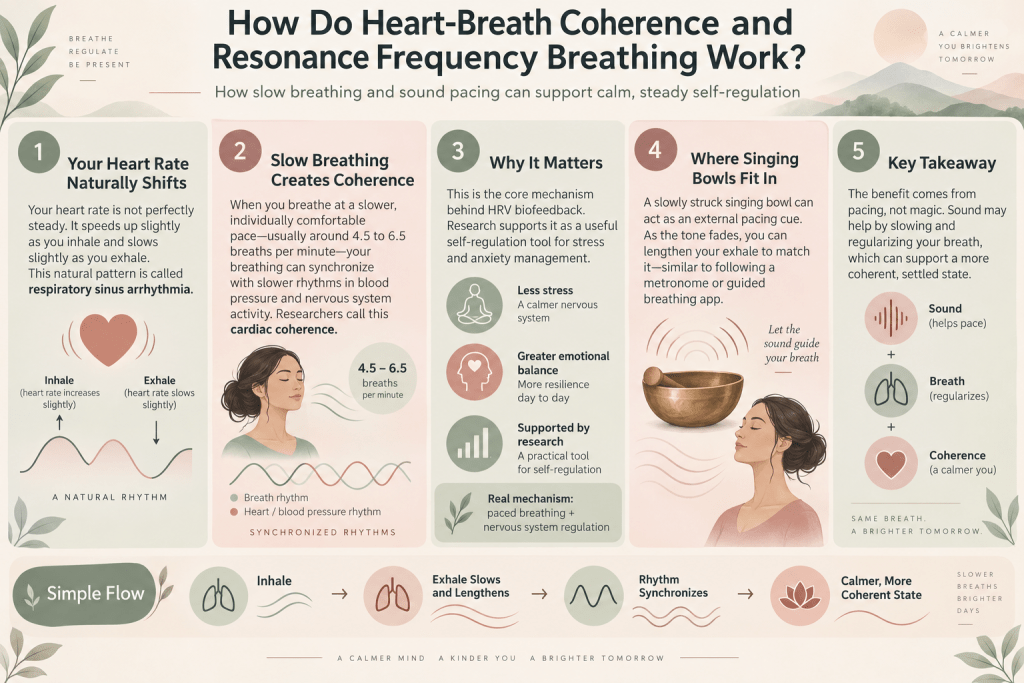
This is the underlying mechanism behind HRV biofeedback, a technique with a real and fairly substantial research base for anxiety and stress management, reviewed in depth by two of the field’s most cited researchers, who describe it as one of the more reliably effective self-regulation techniques studied to date. The connection to sound comes through pacing, not magic.
A slowly struck, slowly decaying singing bowl tone can function as an external pacer for your breath the same way a metronome or a biofeedback app does, encouraging you to slow your exhale to match the fading tone. A well-known study comparing rosary prayer with the chanting of a specific Tibetan mantra found that both practices, despite sharing no religious content, slowed breathing to almost exactly the resonance frequency range associated with coherence and improved a related measure called baroreflex sensitivity.
That study is about chanting and prayer rather than bowls specifically, but the mechanism, external pacing that slows and regularizes your breath, is the same one a bowl session can plausibly provide if you use the fading tone as your exhale cue, similar to the practice outlined in Section 4 of the companion voice and bowl guide.
How Do Safety Signaling and the Polyvagal Framework Relate to Sound Healing?
Sound healing content often draws on polyvagal theory, developed by researcher Stephen Porges. The framework proposes that the nervous system is constantly and unconsciously evaluating the environment for cues of safety or threat, a process Porges calls neuroception.
Within this framework, predictable and non-threatening sound may act as one environmental cue that helps the nervous system move away from defensive states and toward greater regulation.
How Might Sound Act as a Safety Cue?
Polyvagal theory offers one explanation for why calm, predictable, and repetitive sounds can feel regulating.
Sound may provide several types of cues:
- Predictability: Repetitive tones create fewer surprises for a nervous system that is scanning the environment.
- Gentle Volume: Softer sounds are less likely to be interpreted as sudden threats.
- Slow Rhythm: A steady pace can support slower breathing and a calmer overall environment.
- Familiarity: Recognizable or comforting sounds may reinforce a sense of safety.
This framework helps explain why some people find singing bowls, humming, chanting, and other repetitive sound practices calming.
Is Polyvagal Theory Fully Proven?
Polyvagal theory is widely influential and appears frequently in trauma-informed care, somatic therapy, and nervous system education.
At the same time, some of its more specific physiological claims remain debated within the academic research community. It is therefore better understood as an influential conceptual framework rather than a fully settled model of nervous system function.
That distinction does not make the framework useless. It simply means polyvagal theory should be presented as one lens for understanding why predictable sound may feel regulating, rather than as definitive proof of exactly how sound healing works.
Important: If you’re drawn to sound work for trauma-related reasons, use it as a supportive practice alongside qualified, trauma-informed care rather than as a substitute for treatment. The same caution applies to other body-based nervous system practices, especially when physical sensations or emotional responses become intense. Neither Terry nor THOR presents this content as trauma therapy.
“I’ve had women cry during a sound session and thank me for it, and I’ve had women fall asleep and apologize for it. Both are fine. What I won’t do is tell a woman that a bowl replaced the therapy she actually needed. It’s a support, and a good one, but I’m not going to oversell what happens in a group session at a retreat.”
Terry Tateossian, Founder of The House of Rose
Free 28-Day Fascia Reset Email Course
Get our Free 28-day email course series to help with 1 or 2 exercises per day to release your fascia. One short lesson per day. Two minutes to read each.
How Strong Is the Evidence Side by Side?
| Mechanism | What’s Claimed | Evidence Strength | What the Research Actually Supports |
|---|---|---|---|
| Sympathetic-to-parasympathetic shift | Bowls calm the stress response | Moderate | Relaxation-based sessions generally support parasympathetic shift; not shown to be bowl-specific |
| Brainwave entrainment | Bowls shift beta waves to alpha/theta | Emerging to weak | Alpha/theta increases during relaxed states are well documented; direct entrainment from bowls specifically is not well studied |
| Vibroacoustic effects | Vibration resets the body’s rhythm | Moderate (for dedicated vibroacoustic therapy equipment) | Mechanoreceptor response to felt vibration is real; clinical evidence is strongest for purpose-built vibroacoustic equipment, weaker for handheld bowls |
| Vagus nerve regulation | Sound stimulates the vagus nerve | Moderate (for voice-based practice); weak (for passive listening alone) | Vocalization has a documented vagal connection; passive listening to a bowl is not equivalent to auricular vagus nerve stimulation |
| Heart-breath coherence | Bowls synchronize heart and breath rhythm | Moderate | Paced slow breathing reliably produces coherence; bowls can serve as an external pacer, though bowl-specific studies are limited |
| Polyvagal safety signaling | Predictable sound signals safety to the nervous system | Theoretical framework, not settled fact | An influential model with academic debate around specifics; useful as a lens, not proof |
“The thing that convinced me sound work was worth including at our retreats wasn’t a study. It was watching the same pattern repeat across dozens of guests: the ones who came in the most skeptical often had the most visible physical release. I still want the research examined honestly rather than oversold, which is exactly why this article exists.”
Terry Tateossian, Founder of The House of Rose
What Are Your Next Steps?
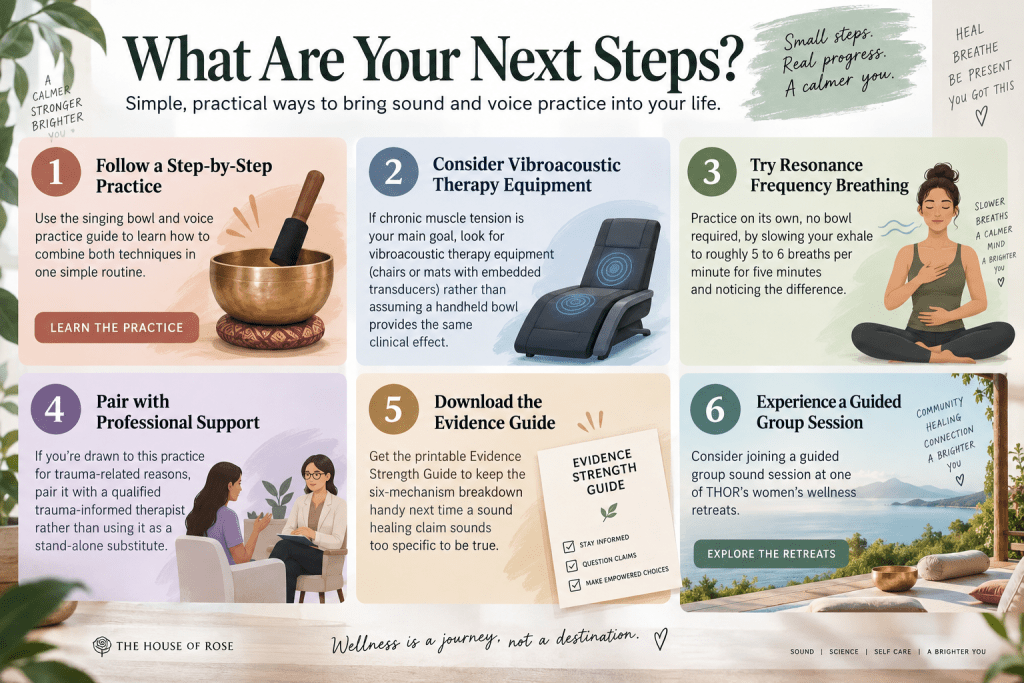
- Follow a step-by-step singing bowl and voice practice to learn how to combine both techniques in one simple routine.
- If chronic muscle tension is your main goal, look specifically for vibroacoustic therapy equipment (chairs or mats with embedded transducers) rather than assuming a handheld bowl provides the same clinical effect.
- Try resonance frequency breathing on its own, no bowl required, by slowing your exhale to roughly 5 to 6 breaths per minute for five minutes and noticing the difference.
- If you’re drawn to this practice for trauma-related reasons, pair it with a qualified trauma-informed therapist rather than using it as a stand-alone substitute.
- Download the printable Evidence Strength Guide below to keep the six-mechanism breakdown handy next time a sound healing claim sounds too specific to be true.
- Consider experiencing a guided group sound session at one of THOR’s women’s yoga & wellness retreats.
Free 28-Day Fascia Reset Email Course
Get our Free 28-day email course series to help with 1 or 2 exercises per day to release your fascia. One short lesson per day. Two minutes to read each.
Frequently Asked Questions
Is sound healing backed by real science?
Parts of it are. Slow, paced breathing reliably improves heart-breath coherence, vibroacoustic therapy has real clinical research behind it for muscle tension and pain, and relaxation-based sessions generally support a parasympathetic shift. Other frequently repeated claims, particularly precise brainwave entrainment numbers and cellular-level healing, go well past what the current research supports.
What is vibroacoustic therapy exactly?
It’s a clinical technique, developed by researcher Olav Skille in Norway in the 1980s, that uses low-frequency sound delivered through specialized equipment, typically a chair, mat, or table with embedded transducers, so the vibration is felt directly through the body rather than only heard.
Does a singing bowl provide the same effect as clinical vibroacoustic therapy?
Not to the same standardized degree. A bowl placed directly on or near the body can provide a smaller-scale version of felt vibration, but the clinical research on vibroacoustic therapy specifically studied purpose-built equipment, not handheld bowls.
Is brainwave entrainment real?
Neural entrainment, your brain’s electrical activity syncing to an external rhythmic stimulus, is a real, measurable phenomenon, most reliably demonstrated with binaural beats and isochronic tones. Whether a singing bowl’s complex, decaying overtone pattern produces the same effect is not well established in the research.
What is heart-breath coherence?
It’s a state where your heart rate variability pattern, your breathing rhythm, and related nervous system activity synchronize, typically achieved by breathing at a slow, individually specific rate, usually around 4.5 to 6.5 breaths per minute. It’s the basis of HRV biofeedback, a well-studied self-regulation technique.
What is polyvagal theory?
It’s an influential framework developed by researcher Stephen Porges proposing that your nervous system continuously and unconsciously scans your environment for safety or threat cues, and that this process shapes your physiological state. It’s widely referenced in trauma and somatic therapy circles, though some of its more specific claims remain debated among researchers.
Can sound healing help with anxiety?
It may help as a support tool, largely through the well-documented mechanisms of slow paced breathing and general relaxation response, rather than through a mechanism unique to sound itself. It should complement, not replace, appropriate anxiety treatment.
Is the vagus nerve actually stimulated by listening to a singing bowl?
Passive listening engages ordinary auditory processing rather than direct vagal stimulation. Active vocalization, humming, chanting, has a more directly documented vagal connection, covered in the companion voice practice guide.
How is this different from the how-to guide on your site?
This article focuses on the nervous system mechanisms behind sound-based practices and how strong the evidence is for each one. If you want to put those ideas into practice, a step-by-step singing bowl and voice routine shows how to combine the two in a simple, structured session.
Can this practice help trauma specifically?
It can be a supportive complement for some people, consistent with the general safety-signaling framework described in Section 6, but it is not a substitute for trauma-focused therapy from a qualified provider.
Do I need special equipment to get any of these benefits?
No. Slow paced breathing alone, without any sound, can produce heart-breath coherence. A singing bowl adds an external pacing tone and a sensory ritual many people find easier to stay consistent with.
Why do sound healing claims so often cite specific frequency numbers?
Precise numbers sound scientific and are persuasive marketing, but the entrainment research that would justify claiming a specific bowl causes a specific brainwave frequency shift generally used controlled, steady stimuli quite different from an acoustic bowl’s complex overtone pattern. Treat unusually precise claims with some skepticism.
Is this article saying sound healing doesn’t work?
No. Several of the underlying mechanisms, paced breathing, vibration on mechanoreceptors, general relaxation response, are well supported by research, and many people report real benefit. The goal is separating what’s demonstrated from what’s exaggerated, not dismissing the practice.
Where should I start if I’m new to this?
Start with a simple 10-minute singing bowl and voice practice that requires no prior experience and can be done even if you don’t own a bowl yet.
References
- Skille, O. (1989). VibroAcoustic Therapy. Music Therapy, 8(1), 61-77.
- Boyd-Brewer, C., & McCaffrey, R. (2004). Vibroacoustic Sound Therapy Improves Pain Management and More. Holistic Nursing Practice, 18(3), 111-118.
- Cahn, B.R., & Polich, J. (2006). Meditation States and Traits: EEG, ERP, and Neuroimaging Studies. Psychological Bulletin, 132(2), 180-211.
- Huang, T.L., & Charyton, C. (2008). A Comprehensive Review of the Psychological Effects of Brainwave Entrainment. Alternative Therapies in Health and Medicine, 14(5), 38-50.
- Khalfa, S., Bella, S.D., Roy, M., Peretz, I., & Lupien, S.J. (2003). Effects of Relaxing Music on Salivary Cortisol Level After Psychological Stress. Annals of the New York Academy of Sciences, 999(1), 374-376.
- Lehrer, P.M., & Gevirtz, R. (2014). Heart Rate Variability Biofeedback: How and Why Does It Work? Frontiers in Psychology, 5, 756.
- McCraty, R., & Zayas, M.A. (2014). Cardiac Coherence, Self-Regulation, Autonomic Stability, and Psychosocial Well-Being. Frontiers in Psychology, 5, 1090.
- Bernardi, L., Sleight, P., Bandinelli, G., et al. (2001). Effect of Rosary Prayer and Yoga Mantras on Autonomic Cardiovascular Rhythms: Comparative Study. BMJ, 323(7327), 1446-1449.
- Porges, S.W. (2007). The Polyvagal Perspective. Biological Psychology, 74(2), 116-143.
- Yakunina, N., Kim, S.S., & Nam, E.C. (2017). Optimization of Transcutaneous Vagus Nerve Stimulation Using Functional MRI. Neuromodulation, 20(3), 290-300.
- Gerritsen, R.J.S., & Band, G.P.H. (2018). Breath of Life: The Respiratory Vagal Stimulation Model of Contemplative Activity. Frontiers in Human Neuroscience, 12, 397.
- Streeter, C.C., Gerbarg, P.L., Saper, R.B., Ciraulo, D.A., & Brown, R.P. (2012). Effects of Yoga on the Autonomic Nervous System, Gamma-Aminobutyric-Acid, and Allostasis in Epilepsy, Depression, and Post-Traumatic Stress Disorder. Medical Hypotheses, 78(5), 571-579.
- National Center for Complementary and Integrative Health (NCCIH). Relaxation Techniques for Health.
- Perciavalle, V., Blandini, M., Fecarotta, P., et al. (2017). The Role of Deep Breathing on Stress. Neurological Sciences, 38(3), 451-458.
- Goldsby, T.L., Goldsby, M.E., McWalters, M., & Mills, P.J. (2017). Effects of Singing Bowl Sound Meditation on Mood, Tension, and Well-being: An Observational Study. Journal of Evidence-Based Complementary & Alternative Medicine, 22(3), 401-406.
- Landry, J.M. (2014). Physiological and Psychological Effects of a Himalayan Singing Bowl in Meditation Practice: A Quantitative Analysis. American Journal of Health Promotion, 28(5), 306-309.
- American Psychological Association. Stress Effects on the Body.
Disclaimer: This article is educational and does not constitute medical or mental health advice. Sound healing, singing bowls, vibroacoustic practices, breathing exercises, humming, and related techniques should be used as complementary wellness practices rather than substitutes for medical care or trauma-focused therapy. If you have epilepsy, a seizure disorder, significant hearing sensitivity, a diagnosed trauma-related condition, or another medical or neurological concern, consult a qualified healthcare provider before starting a new sound-based practice.
Free 28-Day Fascia Reset Email Course
Get our Free 28-day email course series to help with 1 or 2 exercises per day to release your fascia. One short lesson per day. Two minutes to read each.
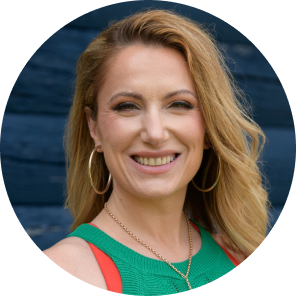
Terry Tateossian is a Menopause Lifestyle Medicine Coach, Certified Personal Trainer & Nutritionist and the Founder of THOR: The House of Rose, a wellness brand serving women over 40 through retreats, coaching, macro-nutrition and community. As 25-year founder and entrepreneur, Terry spent two and a half decades building and running successful start-up businesses, an experience that put her on the front line of founder burnout long before she could name it. After facing serious health challenges, early onset menopause, and emotional eating while running her agency and raising two children, Terry rebuilt her health in her 40s and lost more than 80 pounds through evidence-based nutrition, training, and mindset work. Today, she helps women get strong, improve confidence, support hormone health, and create a stronger second half of life. Terry has been featured in major media outlets and is available for podcasts, expert commentary, brand collaborations, and speaking engagements on midlife health, reinvention, emotional eating, menopause wellness, and strength training for longevity. Get her free macro calculator (her cookbook companion) to start your journey to back to health.