
 By Team THOR
Free 28-Day Fascia Reset Email Course
Get our Free 28-day email course series to help with 1 or 2 exercises per day to release your fascia. One short lesson per day. Two minutes to read each.
18 Ways to Regulate Your Nervous System When Stillness Makes You Worse
Dana followed the instructions exactly. Quiet room, cushion, timer set for ten minutes, eyes closed, attention on the breath, the same instructions from the same app that seemed to work fine for her sister. Within ninety seconds her heart was pounding harder than it had been before she sat down.
Her thoughts, instead of settling, sped up and got louder, circling the same three worries faster and faster with nothing else to compete for her attention. By minute four she gave up, opened her eyes, and sat there feeling worse than when she started, plus a new layer of guilt for being, in her words, “bad at meditating.”
Dana is not bad at meditating. What happened to her has a name and a real physiological explanation, and it is far more common than most meditation content ever admits. For a meaningful number of people, particularly those carrying a lot of chronic stress, unprocessed activation, or a nervous system that has spent years running hot, sudden stillness does not calm the system down.
It removes the noise and movement that had been quietly discharging some of that activation, and it turns the volume up on internal sensations the body had not been ready to sit with yet. The result is not relaxation. It is often the opposite.
This article is for exactly that experience. It does not ask you to try harder at stillness. It offers eighteen other real, workable ways to regulate your nervous system, most of which involve moving, not sitting, because for a body like Dana’s, moving is often the faster and safer road back to calm.
Why Can Stillness Backfire? The Real Physiology
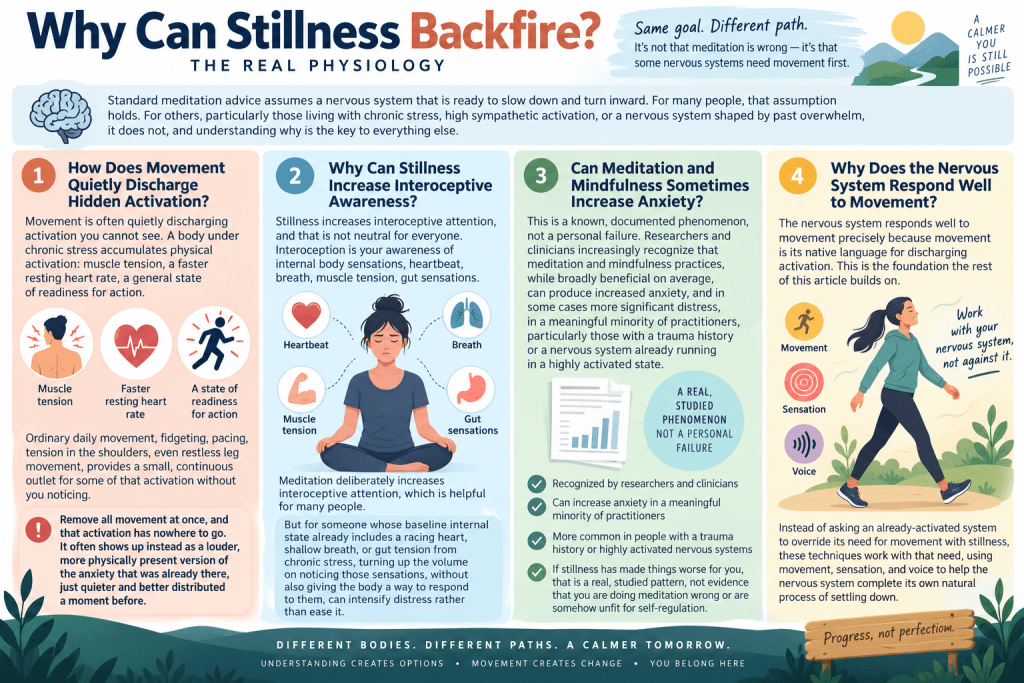
Standard meditation advice assumes a nervous system that is ready to slow down and turn inward. For many people, that assumption holds. For others, particularly those living with chronic stress, high sympathetic activation, or a nervous system shaped by past overwhelm, it does not, and understanding why is the key to everything else in this article.
How Does Movement Quietly Discharge Hidden Activation?
Movement is often quietly discharging activation you cannot see. A body under chronic stress accumulates physical activation: muscle tension, a faster resting heart rate, a general state of readiness for action. Ordinary daily movement, fidgeting, pacing, tension in the shoulders, even restless leg movement, provides a small, continuous outlet for some of that activation without you noticing.
Remove all movement at once, as stillness-based meditation asks you to, and that activation has nowhere to go. It often shows up instead as a louder, more physically present version of the anxiety that was already there, just quieter and better distributed a moment before.
Why Can Stillness Increase Interoceptive Awareness?
Stillness increases interoceptive attention, and that is not neutral for everyone. Interoception is your awareness of internal body sensations, heartbeat, breath, muscle tension, gut sensations. Meditation deliberately increases interoceptive attention, which is helpful for many people.
But for someone whose baseline internal state already includes a racing heart, shallow breath, or gut tension from chronic stress, turning up the volume on noticing those sensations, without also giving the body a way to respond to them, can intensify distress rather than ease it.
Can Meditation and Mindfulness Sometimes Increase Anxiety?
This is a known, documented phenomenon, not a personal failure. Researchers and clinicians increasingly recognize that meditation and mindfulness practices, while broadly beneficial on average, can produce increased anxiety, and in some cases more significant distress, in a meaningful minority of practitioners, particularly those with a trauma history or a nervous system already running in a highly activated state.
If stillness has made things worse for you, that is a real, studied pattern, not evidence that you are doing meditation wrong or are somehow unfit for self-regulation.
Why Does the Nervous System Respond Well to Movement?
The nervous system responds well to movement precisely because movement is its native language for discharging activation. This is the foundation the rest of this article builds on.
Instead of asking an already-activated system to override its need for movement with stillness, these techniques work with that need, using movement, sensation, and voice to help the nervous system complete its own natural process of settling down.
How Can You Know If This Is You?
Not everyone who finds meditation difficult has this specific pattern, but a few signs tend to point toward it clearly.
- Sitting still and closing your eyes makes your heart rate or breathing noticeably worse, not better
- Your thoughts get faster and louder during stillness, rather than quieter
- You feel a strong physical urge to move, get up, or open your eyes within the first few minutes
- You feel more anxious, panicky, or unsettled after a meditation or relaxation session than before it started
- Lying still (as in savasana or a body scan) feels more agitating than restful
- You have been told stillness practices “just take practice,” but repeated attempts have consistently made things worse rather than gradually better
- You generally feel calmer after movement (a walk, a workout, cleaning the house) than after trying to sit quietly
If several of these sound familiar, the tools in this article are built specifically for you.
Free 28-Day Fascia Reset Email Course
Get our Free 28-day email course series to help with 1 or 2 exercises per day to release your fascia. One short lesson per day. Two minutes to read each.
Why Does Regulation Not Require Stillness?
Nervous system regulation simply means helping your body move from a state of high alert or shutdown back toward a calm, settled baseline. Stillness-based meditation is one path to that outcome, but it is not the only one, and it is not the right starting point for every nervous system.
A concept from somatic (body-based) therapy called titration is useful here: rather than asking the body to go from high activation straight to full stillness, a titrated approach works in smaller, more manageable steps, often using brief bursts of movement or sensation to help the body discharge some activation first, before stillness becomes accessible or even desirable. Many of the tools below are built on exactly this principle.
The eighteen tools that follow are organized into four groups: movement-based tools that help discharge physical activation directly, sensory and grounding tools that use your senses to anchor you in the present without requiring stillness, voice, breath, and pressure-based tools that use sound and touch to signal safety to the nervous system, and a final section on how to build toward stillness gradually, for anyone who eventually wants that option available to them as well.
“For years I assumed I was simply bad at meditating, because every time I tried to sit still and breathe, I felt worse, not better. It took me a long time to learn that this is an actual, documented pattern, not a personal failing. Once I started using movement first, a short walk, some shaking out of my hands, even just cleaning a counter with real attention, stillness became something I could access afterward instead of something that set me off. The lesson underneath all of this is that regulation is the goal, not stillness. Stillness is just one door into that goal, and it is not the only one.”
Terry Tateossian, Founder of The House of Rose
What Are Movement-Based Regulation Tools?
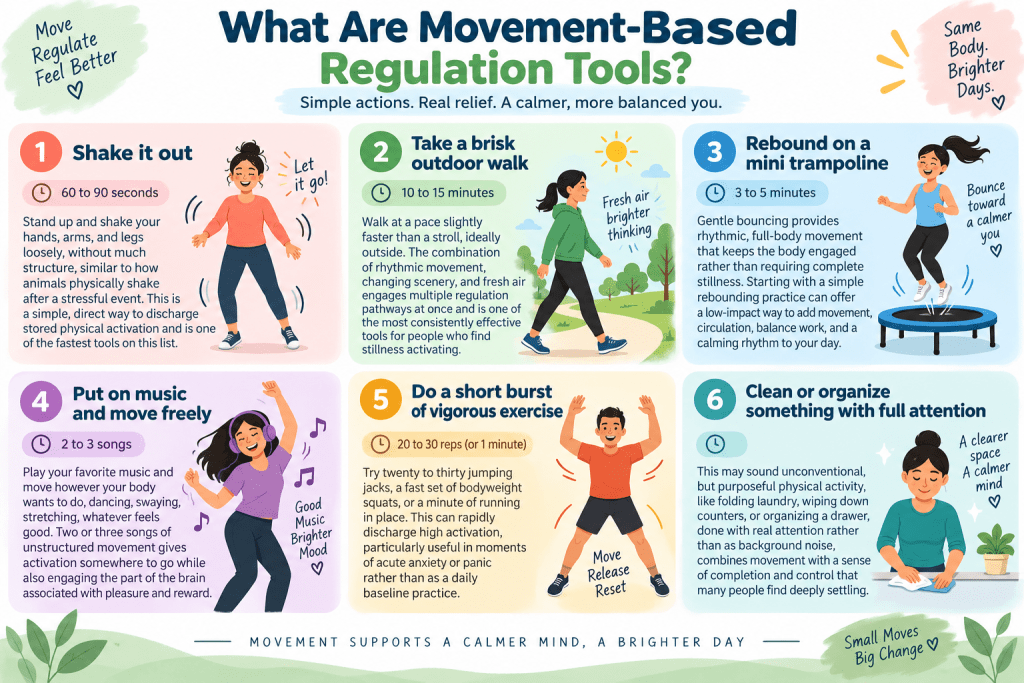
- Shake it out: Stand up and shake your hands, arms, and legs for 60 to 90 seconds, loosely and without much structure, similar to how animals physically shake after a stressful event. This is a simple, direct way to discharge stored physical activation and is one of the fastest tools on this list.
- Take a brisk outdoor walk: Ten to fifteen minutes at a pace slightly faster than a stroll, ideally outside. The combination of rhythmic movement, changing scenery, and fresh air engages multiple regulation pathways at once and is one of the most consistently effective tools for people who find stillness activating.
- Rebound on a mini trampoline: Gentle bouncing for three to five minutes provides rhythmic, full-body movement that keeps the body engaged rather than requiring complete stillness. Starting with a simple rebounding practice can offer a low-impact way to add movement, circulation, balance work, and a calming rhythm to your day.
- Put on music and move freely: Two or three songs of unstructured movement, dancing, swaying, stretching, whatever your body wants to do, gives activation somewhere to go while also engaging the part of the brain associated with pleasure and reward.
- Do a short burst of vigorous exercise: Twenty to thirty jumping jacks, a fast set of bodyweight squats, or a minute of running in place can rapidly discharge high activation, particularly useful in moments of acute anxiety or panic rather than as a daily baseline practice.
- Clean or organize something with full attention: This may sound unconventional, but purposeful physical activity, folding laundry, wiping down counters, organizing a drawer, done with real attention rather than as background noise, combines movement with a sense of completion and control that many people find deeply settling.
Free 28-Day Fascia Reset Email Course
Get our Free 28-day email course series to help with 1 or 2 exercises per day to release your fascia. One short lesson per day. Two minutes to read each.
What Are Sensory and Grounding Tools?
- The 5-4-3-2-1 senses check: Name five things you can see, four things you can hear, three things you can touch, two things you can smell, and one thing you can taste. This grounds attention in the present moment and the external environment, rather than turning attention inward the way stillness-based meditation does, making it a safer starting point for many people.
- Hold something cold: An ice pack, a cold water bottle, or running your hands under cool water for thirty seconds provides a strong, clear sensory signal that tends to interrupt spiraling thoughts and anchor attention in the body without requiring stillness.
- Splash cool water on your face: This engages what is sometimes called the mammalian dive reflex, a natural physiological response that can help slow heart rate. It is quick, requires no equipment beyond a sink, and is a well-established calming technique used in several clinical approaches to acute distress.
- Orient to the room: Slowly turn your head and look around the space you are in, naming a few objects out loud or silently. This is different from closing your eyes and turning inward; it is a grounding technique that uses the environment itself to signal safety to the nervous system.
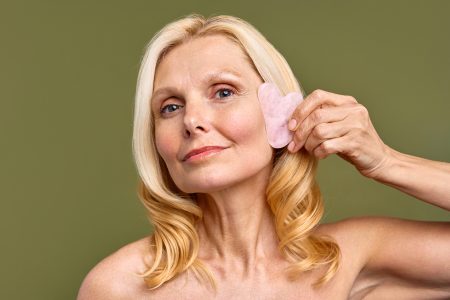
- Self-massage or fascia work: A few minutes of hands-on pressure, working your own shoulders, forearms, or scalp, or using a gua sha tool as described in our Complete Gua Sha Routine, provides calming touch input and gentle movement together.
What Are Voice, Breath, and Pressure-Based Tools?
- Hum or sing: Humming, gentle chanting, or singing along to a song engages the vagus nerve through vibration in the throat and chest, a well-documented regulation tool that involves sound and gentle vibration rather than silent stillness.
- Try active, extended-exhale breathing while moving: Rather than sitting still and focusing inward on the breath, try a longer exhale than inhale (for example, a four-count inhale and a six- to eight-count exhale) while walking or standing, so the breath work is paired with movement instead of stillness.
- Apply firm, even pressure to your body: A weighted blanket, a firm self-hug with crossed arms and a squeeze, or pressing your palms firmly together for ten seconds all provide what is sometimes called proprioceptive input, deep pressure and body awareness that many people find calming in a way gentle, passive stillness does not achieve.
- Push against something solid: Press your palms against a wall, push your feet firmly into the floor, or do a few isometric holds (like a wall sit for 20 to 30 seconds). This is an active, engaged form of stillness, using muscular effort rather than passive quiet, which some people find far more accessible than sitting with nothing to do.
Free 28-Day Fascia Reset Email Course
Get our Free 28-day email course series to help with 1 or 2 exercises per day to release your fascia. One short lesson per day. Two minutes to read each.
How Can You Build Toward Stillness Gradually?
For some readers, the eventual goal is still to access a calm, seated stillness practice, simply not as a starting point. These final three tools offer a gradual bridge.
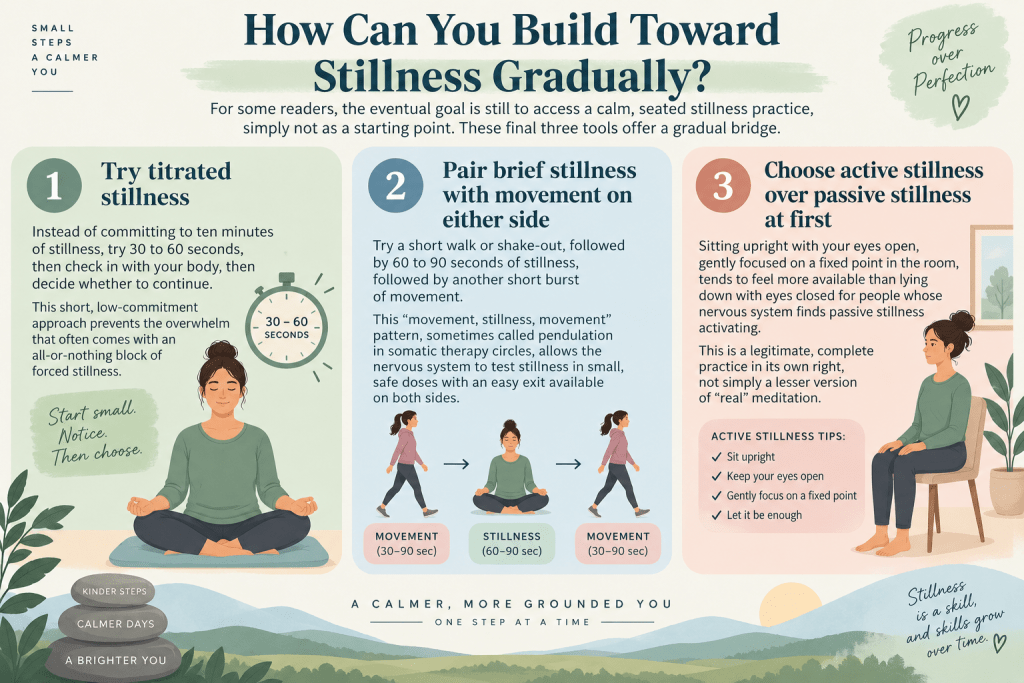
- Try titrated stillness: Instead of committing to ten minutes of stillness, try 30 to 60 seconds, then check in with your body, then decide whether to continue. This short, low-commitment approach prevents the overwhelm that often comes with an all-or-nothing block of forced stillness.
- Pair brief stillness with movement on either side: Try a short walk or shake-out, followed by 60 to 90 seconds of stillness, followed by another short burst of movement. This “movement, stillness, movement” pattern, sometimes called pendulation in somatic therapy circles, allows the nervous system to test stillness in small, safe doses with an easy exit available on both sides.
- Choose active stillness over passive stillness at first: Sitting upright with your eyes open, gently focused on a fixed point in the room, tends to feel more available than lying down with eyes closed for people whose nervous system finds passive stillness activating. This is a legitimate, complete practice in its own right, not simply a lesser version of “real” meditation.
How Can You Choose the Right Tool in the Moment?
- If you feel highly activated (racing heart, panic, restlessness): Start with movement-based tools. These discharge activation directly and tend to produce the fastest shift.
- If you feel spacey, foggy, or disconnected rather than activated: Sensory and grounding tools tend to work better, since they anchor attention in the present moment and the body.
- If you are somewhere in between, or looking for a quick reset during a normal day: Voice, breath, and pressure-based tools are often the easiest to use discreetly, at a desk, in a car, or in public.
- If your goal is eventually building a seated practice: Use a gradual, low-pressure approach that does not require you to force it before your nervous system is ready.
There is no single right tool for every person or every moment. Part of building real regulation skill is learning, through practice, which tools work best for your particular nervous system in a particular kind of moment.
Free 28-Day Fascia Reset Email Course
Get our Free 28-day email course series to help with 1 or 2 exercises per day to release your fascia. One short lesson per day. Two minutes to read each.
How Can You Build a Personal Regulation Toolkit?
- Try several tools when you are calm, not only in crisis: It is much easier to learn what works for your body during a low-stakes moment than during acute distress. Spend a few days trying two or three different tools from this list during ordinary moments of mild stress.
- Notice what actually shifts your state, not just what you think should work: Some people are surprised to discover that a technique they expected to dislike (cold water, for example) works far better for them than one that sounds more appealing on paper.
- Keep a short personal list: Once you know which three or four tools reliably help you, write them down somewhere accessible (a note on your phone, a card in your bag) so you are not trying to remember or choose under stress.
- Layer tools rather than relying on just one: A brisk walk followed by a few minutes of humming, for example, often works better than either alone, since it combines discharge (movement) with a vagal, voice-based signal of safety (humming).
- Expect this to be a practice, not a one-time fix: Like any regulation skill, these tools tend to become more effective and more automatic with repeated use over weeks and months, not from a single try.
When Should You Seek Additional Support?
The tools in this article are general wellness strategies, not a treatment for a diagnosed mental health condition. Consider reaching out to a qualified mental health professional, ideally one with training in trauma-informed or somatic approaches, if:
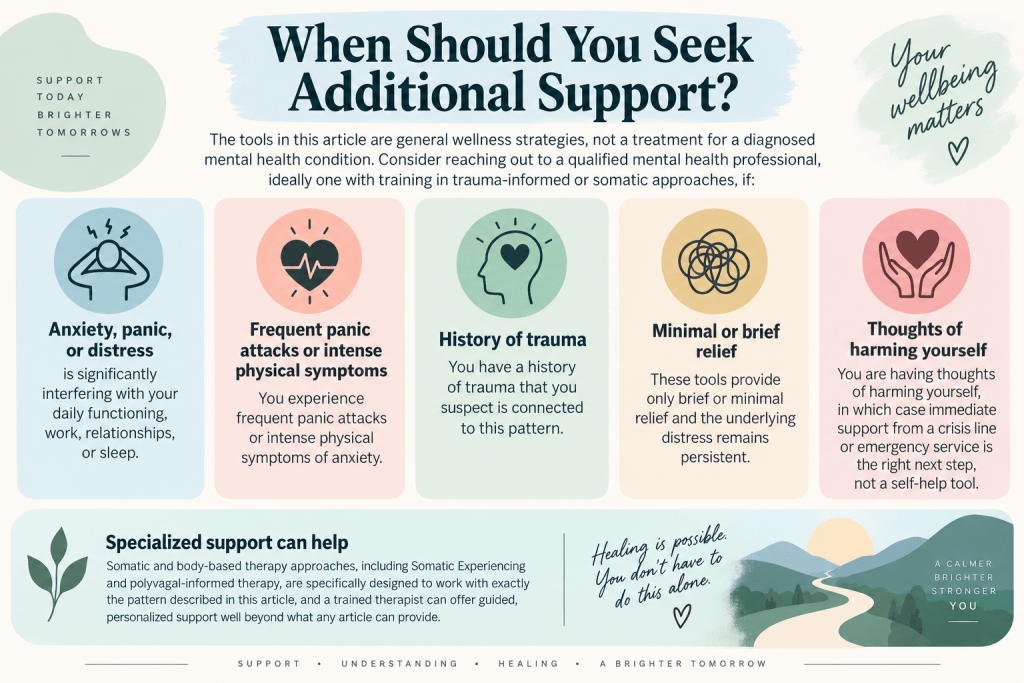
- Anxiety, panic, or distress is significantly interfering with your daily functioning, work, relationships, or sleep
- You experience frequent panic attacks or intense physical symptoms of anxiety
- You have a history of trauma that you suspect is connected to this pattern
- These tools provide only brief or minimal relief and the underlying distress remains persistent
- You are having thoughts of harming yourself, in which case immediate support from a crisis line or emergency service is the right next step, not a self-help tool
Somatic and body-based therapy approaches, including Somatic Experiencing and polyvagal-informed therapy, are specifically designed to work with exactly the pattern described in this article, and a trained therapist can offer guided, personalized support well beyond what any article can provide.
Free 28-Day Fascia Reset Email Course
Get our Free 28-day email course series to help with 1 or 2 exercises per day to release your fascia. One short lesson per day. Two minutes to read each.
What Does Research Say About Somatic Regulation?
- Meditation-related adverse effects are a real, documented phenomenon: Research examining the effects of mindfulness and meditation practices has identified a subset of practitioners who experience increased anxiety, distress, or other difficult effects, particularly among those with pre-existing high anxiety or trauma histories, supporting the honest framing throughout this article that stillness is not universally calming.
- Movement and rhythmic activity support nervous system regulation: A substantial body of research on exercise and mental health documents reductions in anxiety and stress markers following both acute bouts and regular movement, consistent with the movement-based tools in Section 4.
- Vagal tone and voice-based practices: Research on the vagus nerve, which plays a central role in regulating the parasympathetic (rest-and-digest) nervous system, supports the connection between vocalization (humming, chanting, singing) and increased vagal activity, consistent with the tools in Section 6.
- Cold exposure and the dive reflex: Research on facial cold water exposure has documented measurable reductions in heart rate through activation of the mammalian dive reflex, supporting this as a legitimate, quick regulation tool rather than folk advice.
- Deep pressure and proprioceptive input: Research in both clinical and occupational therapy literature supports deep pressure and proprioceptive input (weighted blankets, firm pressure, pushing against resistance) as effective calming tools for a range of populations, including those with high baseline anxiety.
- Polyvagal theory as a helpful framework: Polyvagal theory, developed by Dr. Stephen Porges, offers a widely referenced framework for understanding how the autonomic nervous system moves between states of safety, activation, and shutdown, and has substantially influenced the somatic and trauma-informed therapy approaches this article draws from. It is worth noting that some specific claims within polyvagal theory remain debated among researchers, and it is best understood as a useful clinical framework rather than a fully settled scientific consensus.
This article is educational and is not a substitute for professional mental health care. If you are in crisis or having thoughts of harming yourself, please contact a crisis line or emergency services immediately.
Free 28-Day Fascia Reset Email Course
Get our Free 28-day email course series to help with 1 or 2 exercises per day to release your fascia. One short lesson per day. Two minutes to read each.
Frequently Asked Questions
Why does meditation make my anxiety worse instead of better?
For some people, particularly those with chronic stress or a trauma history, sudden stillness removes the outlet that ordinary movement was providing for stored physical activation, while also increasing attention to internal body sensations before the body is ready to sit with them calmly. This is a documented pattern, not a personal failure at meditating.
Is it normal to feel worse after trying to sit still and breathe?
Yes, for a meaningful subset of people. Research on mindfulness and meditation has identified increased anxiety and distress as a real, if less commonly discussed, effect for some practitioners, particularly those with high baseline anxiety or a trauma history.
What is nervous system dysregulation?
Nervous system dysregulation refers to a state where the autonomic nervous system has difficulty moving smoothly between activation and calm, often getting stuck in high alert (fight-or-flight) or shutdown (freeze) states rather than flexibly returning to a settled baseline.
Do I have to eventually learn to sit still and meditate?
No. While Section 7 offers a gradual path toward stillness for those who want it, movement-based and sensory regulation tools are complete, legitimate practices in their own right, not lesser substitutes for “real” meditation.
How quickly do these tools work?
Many people notice a shift within a few minutes of trying movement-based or sensory tools, though individual response varies. Consistency in practicing several tools over time tends to make them more effective and more automatic.
Can I use these tools alongside therapy?
Yes. These tools work well as a complement to professional mental health support, particularly trauma-informed or somatic therapy approaches, which can offer more personalized, guided work with exactly this pattern.
What is polyvagal theory, and do I need to understand it to use these tools?
Polyvagal theory is a framework for understanding how the nervous system moves between states of safety, activation, and shutdown. It is not necessary to understand the full theory to benefit from the practical tools in this article, though it is a helpful lens if you want to go deeper.
Are these tools only for people with anxiety?
No. They are useful for anyone experiencing everyday stress, overstimulation, or a general sense of being “wired” or unable to settle, not only for those with a diagnosed anxiety condition.
Can children or teenagers use these techniques?
Many of the sensory and movement-based tools (shaking out, the 5-4-3-2-1 exercise, cold water on the face) are commonly used in child and adolescent therapy settings and can be appropriate with age-suitable guidance from a parent or professional.
What if none of these tools seem to help?
If you have tried several tools consistently and are not noticing meaningful relief, or if distress is significantly affecting your daily life, this is a good signal to seek support from a qualified mental health professional rather than continuing to rely on self-guided tools alone.
References
- Britton, W. B., Lindahl, J. R., Cooper, D. J., Canby, N. K., & Palitsky, R. (2021). Defining and measuring meditation-related adverse effects in mindfulness-based programs. Clinical Psychological Science, 9(6), 1185-1204.
- Farias, M., & Wikholm, C. (2016). Has the science of mindfulness lost its mind? BJPsych Bulletin, 40(6), 329-332.
- Porges, S. W. (2011). The Polyvagal Theory: Neurophysiological Foundations of Emotions, Attachment, Communication, and Self-Regulation. W. W. Norton & Company.
- Levine, P. A. (2010). In an Unspoken Voice: How the Body Releases Trauma and Restores Goodness. North Atlantic Books.
- Rebar, A. L., Stanton, R., Geard, D., Short, C., Duncan, M. J., & Vandelanotte, C. (2015). A meta-meta-analysis of the effect of physical activity on depression and anxiety in non-clinical adult populations. Health Psychology Review, 9(3), 366-378.
- Vickhoff, B., Malmgren, H., Åström, R., Nyberg, G., Ekström, S. R., Engwall, M., Snygg, J., Nilsson, M., & Jörnsten, R. (2013). Music structure determines heart rate variability of singers. Frontiers in Psychology, 4, 334.
- Kox, M., van Eijk, L. T., Zwaag, J., van den Wildenberg, J., Sweep, F. C., van der Hoeven, J. G., & Pickkers, P. (2014). Voluntary activation of the sympathetic nervous system and attenuation of the innate immune response in humans. Proceedings of the National Academy of Sciences, 111(20), 7379-7384.
- Chen, H. Y., Yang, H., Chi, H. J., & Chen, H. M. (2013). Physiological effects of deep touch pressure on anxiety alleviation: The weighted blanket approach. Journal of Medical and Biological Engineering, 33(5), 463-470.
- Krauss, K. E. (1987). The effects of deep pressure touch on anxiety. American Journal of Occupational Therapy, 41(6), 366-373.
Disclaimer: This article is educational and does not constitute medical or mental health advice. Nervous system regulation techniques can affect people differently, particularly those with anxiety, panic symptoms, trauma histories, cardiovascular concerns, balance problems, or recent injuries. Some practices in this article involve vigorous movement, cold exposure, breathwork, or strong sensory input, so use them gradually and stop if symptoms worsen. If distress is persistent, significantly affects daily life, or includes thoughts of self-harm, seek support from a qualified healthcare or mental health professional.
Free 28-Day Fascia Reset Email Course
Get our Free 28-day email course series to help with 1 or 2 exercises per day to release your fascia. One short lesson per day. Two minutes to read each.

Terry Tateossian is a Menopause Lifestyle Medicine Coach, Certified Personal Trainer & Nutritionist and the Founder of THOR: The House of Rose, a wellness brand serving women over 40 through retreats, coaching, macro-nutrition and community. As 25-year founder and entrepreneur, Terry spent two and a half decades building and running successful start-up businesses, an experience that put her on the front line of founder burnout long before she could name it. After facing serious health challenges, early onset menopause, and emotional eating while running her agency and raising two children, Terry rebuilt her health in her 40s and lost more than 80 pounds through evidence-based nutrition, training, and mindset work. Today, she helps women get strong, improve confidence, support hormone health, and create a stronger second half of life. Terry has been featured in major media outlets and is available for podcasts, expert commentary, brand collaborations, and speaking engagements on midlife health, reinvention, emotional eating, menopause wellness, and strength training for longevity. Get her free macro calculator (her cookbook companion) to start your journey to back to health.