
 By Cindy Adoptante
Free 28-Day Fascia Reset Email Course
Get our Free 28-day email course series to help with 1 or 2 exercises per day to release your fascia. One short lesson per day. Two minutes to read each.
How Many Sets Per Week Is Actually Enough? What New Research Shows
I get some version of this question constantly from women in my coaching program who’ve caught the strength training bug: if three sets a week is good, isn’t six better, and isn’t twelve better still? It’s a reasonable assumption. More effort generally means more results, in business and in most areas of life.
Strength training doesn’t fully follow that logic, and a meta-regression published in early 2026, the most comprehensive analysis of this question to date, finally gives a precise, research-backed answer to where the payoff actually levels off, and it’s not the same answer for building strength as it is for building muscle size.
What Is the Newest and Most Comprehensive Answer?
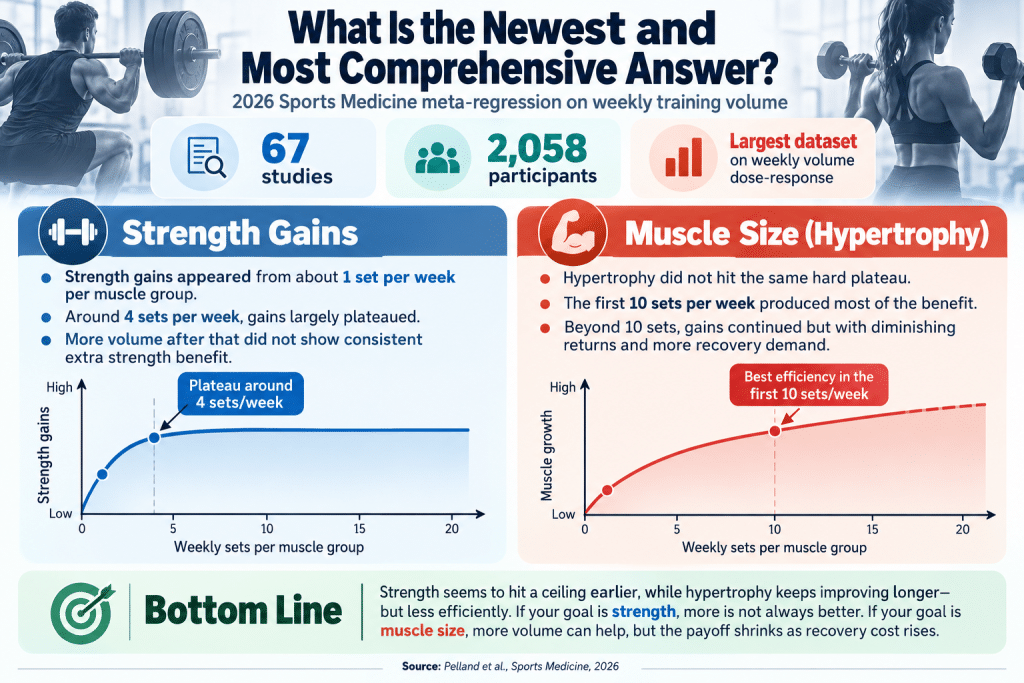
The most precise answer available right now comes from a meta-regression published in Sports Medicine in early 2026, led by Joshua Pelland and colleagues at Florida Atlantic University’s Muscle Physiology Laboratory, which pooled 67 studies and 2,058 participants to model exactly how weekly training volume relates to both strength and muscle size gains (Pelland et al., 2026).
This is the largest and most methodologically rigorous dataset ever assembled on this specific question, and it found something that earlier, smaller studies had only hinted at: strength and hypertrophy don’t follow the same dose-response curve, and they don’t hit their ceiling at the same point.
For strength specifically, the researchers found a genuine plateau. Measurable strength gains showed up starting at roughly one set per week per muscle group, and by around four sets per week, additional volume stopped producing any consistently detectable improvement in strength. Past that point, doing more sets wasn’t actively harmful in this analysis, but it also wasn’t buying you anything extra in terms of how much weight you could lift.
For muscle size, the picture was different. There wasn’t a clean plateau in the same way; instead, the researchers found a continuing, but increasingly expensive, return. The first ten sets per week per muscle group produced the bulk of the hypertrophy benefit, and each set beyond that point delivered progressively smaller gains for progressively more recovery demand. In other words, hypertrophy doesn’t hit a hard wall the way strength does, but it does hit a point of rapidly diminishing efficiency.
“This is one of those findings I wish I’d had ten years ago. I spent years assuming more volume was always the answer when a lift stalled, when the research now says that past a fairly low number of sets, the missing ingredient for strength usually isn’t more volume at all.”
Terry Tateossian, Founder of The House of Rose
Free 28-Day Fascia Reset Email Course
Get our Free 28-day email course series to help with 1 or 2 exercises per day to release your fascia. One short lesson per day. Two minutes to read each.
Why Do Strength and Muscle Size Have Different Ceilings?
This split makes more physiological sense than it first appears. Strength is partly a skill: your nervous system’s ability to recruit muscle fibers efficiently and coordinate a specific movement pattern under load. Once you’ve trained a movement enough times to groove that neural pattern, adding more sets targets a system that’s already mostly optimized, which is consistent with why the plateau for strength specifically showed up at such a low weekly volume in the Pelland et al. (2026) analysis.
Muscle size, by contrast, is a tissue-building process that responds more directly to total mechanical tension and metabolic stress accumulated over the week, which is why it kept responding, albeit with smaller and smaller returns, well past the point where strength gains had already leveled off. This distinction matters enormously for how you should actually structure a program depending on your primary goal: someone chasing a heavier deadlift and someone chasing visible muscle definition in the same body part may need meaningfully different weekly volumes to get there efficiently.
Important: “sets per muscle group per week” in this research means direct, targeted sets for that muscle, not just any exercise that incidentally involves it. A squat contributes meaningfully to quad volume; a plank contributes only marginally, if at all, and researchers account for this by weighting “indirect” sets differently than “direct” ones.
What Did the Earlier Research Already Tell Us?
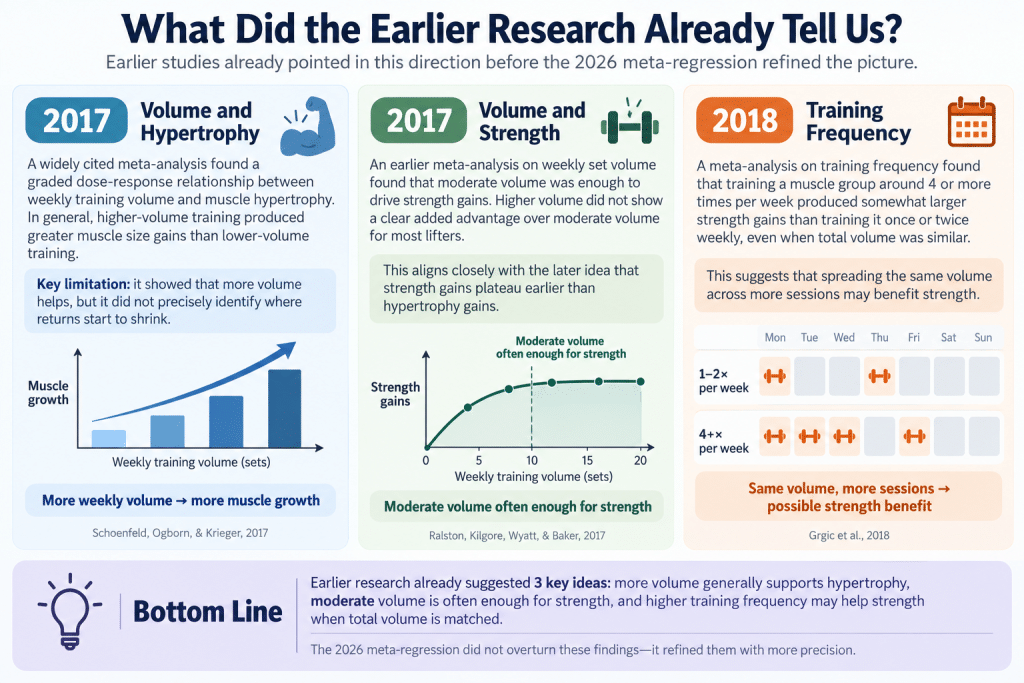
The 2026 meta-regression didn’t emerge in a vacuum; it built on and refined a body of earlier work that had already pointed in this general direction, just with less precision. A widely cited 2017 meta-analysis found a graded dose-response relationship between weekly volume and muscle hypertrophy, with higher-volume training producing meaningfully greater size gains than lower-volume training across the studies reviewed (Schoenfeld, Ogborn, & Krieger, 2017). That paper established that more volume does help hypertrophy, generally, but it wasn’t designed to pinpoint exactly where the returns started shrinking the way the newer meta-regression could.
On the strength side specifically, an earlier 2017 meta-analysis examining weekly set volume found that moderate volume was sufficient to drive strength gains, with high volume not providing a clear additional advantage over moderate volume for most lifters (Ralston, Kilgore, Wyatt, & Baker, 2017), a finding that lines up closely with the sharper four-set plateau identified in the 2026 analysis.
Separately, a 2018 meta-analysis on training frequency, meaning how often per week you train a muscle rather than how many total sets, found that higher frequency (training a muscle group roughly four or more times per week) produced somewhat larger strength gains than training it once or twice weekly, even when total volume was similar, suggesting that spreading the same volume across more sessions may itself carry some benefit for strength (Grgic et al., 2018).
Free 28-Day Fascia Reset Email Course
Get our Free 28-day email course series to help with 1 or 2 exercises per day to release your fascia. One short lesson per day. Two minutes to read each.
Where Does “Too Much” Become Actively Counterproductive?
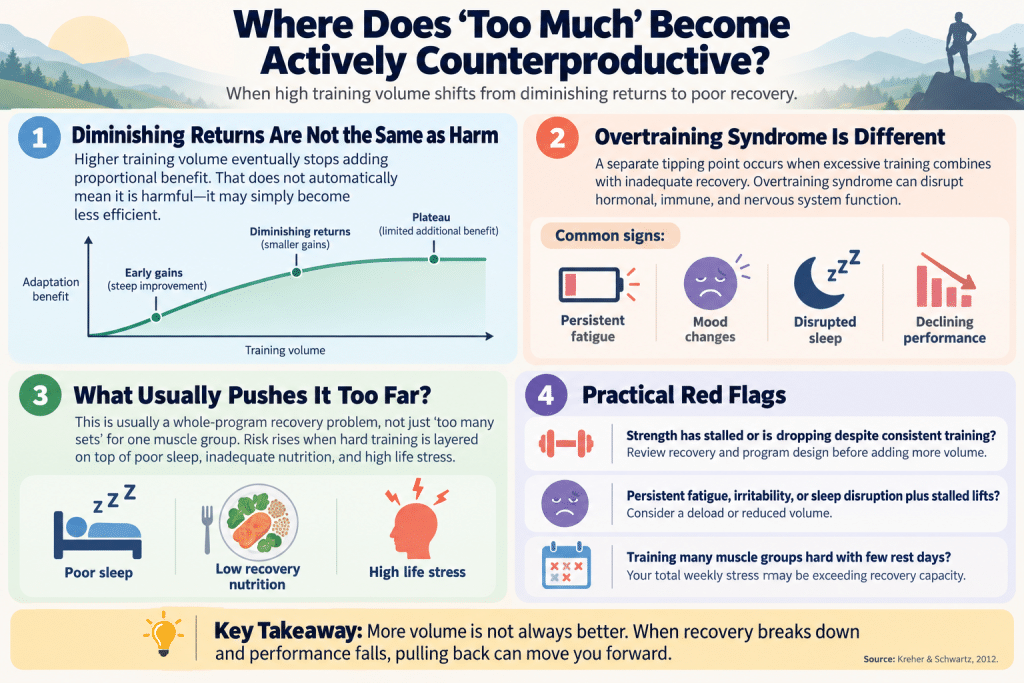
Everything above describes diminishing returns: more volume stops adding proportional benefit, but it isn’t described as actively harmful in those specific studies. There’s a separate, further point past pure inefficiency where training volume and intensity, combined with inadequate recovery, can tip into overtraining syndrome, a truly counterproductive state rather than just a wasted-effort one.
Overtraining syndrome is a recognized, if still incompletely understood, condition involving a maladaptive response to excessive training without adequate recovery, affecting hormonal, immune, and nervous system function and often presenting with persistent fatigue, mood changes, disrupted sleep, and declining performance despite continued or increased effort (Kreher & Schwartz, 2012).
This is a meaningfully different phenomenon from simply doing more sets than necessary for a specific muscle group; it typically involves a broader pattern of insufficient recovery across an entire training program, often compounded by poor sleep, inadequate nutrition, or high life stress layered on top of the training itself.
- If your strength has stalled or is declining despite consistent training: That’s a more reliable signal to investigate recovery and program design than assuming you simply need to add more volume.
- If you’re experiencing persistent fatigue, irritability, or disrupted sleep alongside a stalled or declining lift: Those are recognized early indicators worth addressing directly, through a planned deload or reduced volume, rather than pushing through with additional sets.
- If you’re training multiple muscle groups intensely with minimal rest days: The research above on per-muscle volume ceilings suggests you may be accumulating far more total weekly training stress than any single muscle group’s dose-response curve would justify.
What Does the Evidence Show?
| Outcome | What the Research Found | Ceiling / Plateau Point |
|---|---|---|
| Strength gains | Clear plateau; additional volume beyond this point shows no consistent added benefit | ~4 sets/muscle/week (Pelland et al., 2026) |
| Muscle hypertrophy | No hard plateau, but sharply diminishing returns beyond this point | ~10 sets/muscle/week deliver most of the benefit (Pelland et al., 2026) |
| General volume-hypertrophy relationship | Higher volume produces meaningfully greater size gains, in a graded, dose-dependent pattern | Confirmed across a broader volume range (Schoenfeld et al., 2017) |
| General volume-strength relationship | Moderate volume sufficient; high volume not clearly superior | Consistent with the ~4-set strength plateau (Ralston et al., 2017) |
| Training frequency (same volume, different spacing) | Higher frequency (4+ sessions/week per muscle) modestly outperforms lower frequency for strength | Effect size increased from 0.74 to 1.08 across 1 to 4+ days/week (Grgic et al., 2018) |
| Overtraining syndrome | A distinct, more serious state involving inadequate recovery across a training program, not just excess volume for one muscle | No specific volume threshold; multi-system, individual-dependent (Kreher & Schwartz, 2012) |
Free 28-Day Fascia Reset Email Course
Get our Free 28-day email course series to help with 1 or 2 exercises per day to release your fascia. One short lesson per day. Two minutes to read each.
What Does This Mean for Your Own Program?
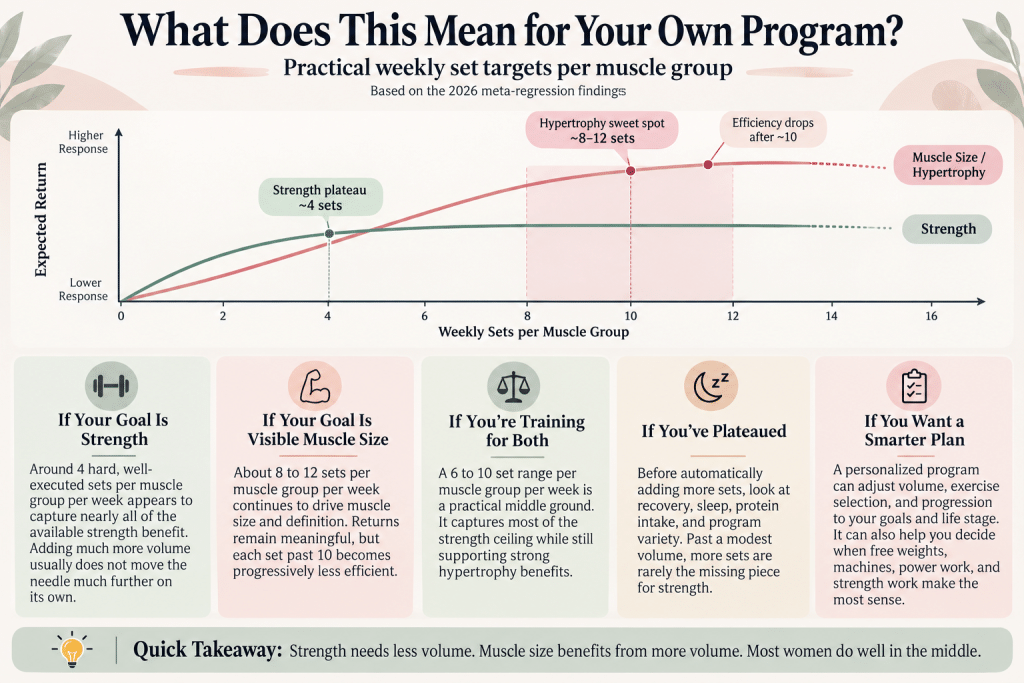
- If your primary goal is strength, roughly four hard, well-executed sets per muscle group per week appears sufficient to capture nearly all of the available benefit, based on the 2026 meta-regression; volume well beyond that is unlikely to move the needle much further on its own.
- If your primary goal is visible muscle size or definition, a higher volume, in the range of eight to twelve sets per muscle group per week, continues producing meaningful returns, though each set past ten becomes progressively less efficient, which is worth weighing against your recovery capacity and time available.
- If you’re training multiple goals at once, which describes most women in THOR’s coaching program, a volume in the six-to-ten-set range per muscle group per week is a reasonable middle ground that captures most of the strength ceiling and a solid share of the hypertrophy benefit without requiring the highest, least efficient volumes.
- If you’ve plateaued and your instinct is to simply add more sets, consider first whether recovery, sleep, protein intake, or program variety is the actual limiting factor, since the research above suggests that past a fairly modest volume, more sets are rarely the missing piece for strength specifically.
- If you want to build a program around your specific goals and life stage: A personalized approach can adjust training volume, exercise selection, and progression instead of relying on a one-size-fits-all set count. It also helps to understand when free weights or machines make the most sense and how power and strength training serve different roles in maintaining function and reducing fall risk.
What Are Your Next Steps?
- Count your current weekly sets per muscle group: Start with your highest-priority lift or muscle group and compare your current volume with the roughly 4-set strength ceiling and 10-set hypertrophy efficiency point discussed in Section 5.
- Reduce volume if more isn’t producing more: If you’re consistently well above 10 sets per muscle group each week and progress has stalled, a temporary reduction in training volume may help you recover better and make those sets more productive.
- Put your volume where it matters most: Prioritizing the muscle groups that matter most in midlife can help you decide where your limited training time and weekly sets will have the greatest functional payoff.
- Consider whether muscle preservation is the bigger goal: If age-related sarcopenia is becoming a concern, your program may need to emphasize maintaining strength and lean mass rather than simply adding more hypertrophy-focused volume.
- Get help finding your individual sweet spot: If you want a program built around your strength, hypertrophy, recovery, and life-stage goals, you can reach out to THOR for personalized guidance instead of guessing at your ideal weekly volume.
Free 28-Day Fascia Reset Email Course
Get our Free 28-day email course series to help with 1 or 2 exercises per day to release your fascia. One short lesson per day. Two minutes to read each.
Frequently Asked Questions
How many sets per week do I actually need for muscle growth?
Based on the 2026 meta-regression, the first 10 sets per muscle group per week deliver most of the available hypertrophy benefit, with additional sets beyond that continuing to help but with rapidly diminishing returns (Pelland et al., 2026).
How many sets per week do I need for strength?
Roughly 4 sets per muscle group per week appears sufficient to capture nearly all the measurable strength benefit in the current research; additional volume beyond that point showed no consistent further improvement (Pelland et al., 2026).
Is more training volume always better?
No. This is the central finding of this article: strength gains plateau at a fairly low weekly volume, and while hypertrophy continues responding to more volume, the returns diminish sharply well before most lifters assume they would.
What’s the difference between overtraining and just doing more sets than necessary?
Doing more sets than the research-supported ceiling is inefficient but not necessarily harmful on its own. Overtraining syndrome is a more serious, whole-body state involving inadequate recovery across an entire training program, typically presenting with persistent fatigue, mood disruption, and declining performance (Kreher & Schwartz, 2012).
Does training frequency matter separately from total volume?
Yes, to a modest degree. Research found that spreading the same total volume across more sessions per week (4 or more) produced somewhat better strength outcomes than concentrating it into 1 or 2 sessions (Grgic et al., 2018).
Should I train differently if my goal is strength versus muscle size?
Yes. The research suggests strength-focused training can be efficient with a lower weekly volume (around 4 sets per muscle group), while hypertrophy-focused training benefits from a higher volume (into the 8-to-12-set range), since the two outcomes follow different dose-response patterns.
What counts as a “set” toward these weekly totals?
Researchers in this area generally count sets taken close to muscular effort or failure as full value, with sets from compound exercises that only indirectly train a muscle (like a plank for the core) counted at a fraction of the value of a directly targeted set.
I’m past the plateau point and still not seeing results. What should I check first?
Recovery factors, sleep quality, protein intake, and how close to failure you’re training, are all more likely culprits than insufficient volume once you’re past the roughly 4-to-10-set range per muscle group per week.
Does this research apply to women specifically, or mostly men?
The 2026 meta-regression pooled a broad set of studies without reporting sex-specific ceilings, and while resistance training research still skews toward male-dominated samples overall, nothing in the current literature suggests the underlying dose-response pattern differs meaningfully by sex.
Is there a risk to training with too much volume, beyond just wasted time?
Excess volume without adequate recovery is one contributing factor in overtraining syndrome, though it’s rarely volume alone; sleep, stress, and nutrition typically compound the effect (Kreher & Schwartz, 2012).
How does age factor into these volume recommendations?
This specific research wasn’t age-segmented in a way that changes the core ceiling numbers, but recovery capacity does generally decline somewhat with age, which is a practical reason a midlife lifter might land toward the lower end of the effective volume range rather than the upper end.
If 4 sets is enough for strength, why do so many programs recommend more?
Many programs are built around hypertrophy or general fitness goals rather than pure strength, and higher volumes still provide real benefit for muscle size specifically, so a program combining both goals reasonably lands above the pure-strength ceiling.
Can I get both strength and hypertrophy benefits from the same sets?
Yes, there’s substantial overlap, which is why the 6-to-10-set range per muscle group per week in Section 6 is a reasonable target for most people pursuing both goals simultaneously rather than picking one exclusively.
How recent is this research, really?
The core meta-regression referenced throughout this article was published in Sports Medicine in February 2026, making it among the most current large-scale analyses available on this specific question at the time of writing.
I write 3 essays per week on Lifestyle Medicine for women in midlife on what is happening in the body and what to do about it. No fluff, no hype. Free Subscription.
References
- Pelland, J.C., Remmert, J.F., Robinson, Z.P., et al. (2026). The Resistance Training Dose Response: Meta-Regressions Exploring the Effects of Weekly Volume and Frequency on Muscle Hypertrophy and Strength Gains. Sports Medicine, 56(2), 481-505.
- Schoenfeld, B.J., Ogborn, D., & Krieger, J.W. (2017). Dose-Response Relationship Between Weekly Resistance Training Volume and Increases in Muscle Mass: A Systematic Review and Meta-Analysis. Journal of Sports Sciences, 35(11), 1073-1082.
- Ralston, G.W., Kilgore, L., Wyatt, F.B., & Baker, J.S. (2017). The Effect of Weekly Set Volume on Strength Gain: A Meta-Analysis. Sports Medicine, 47(12), 2585-2601.
- Grgic, J., Schoenfeld, B.J., Davies, T.B., Lazinica, B., Krieger, J.W., & Pedisic, Z. (2018). Effect of Resistance Training Frequency on Gains in Muscular Strength: A Systematic Review and Meta-Analysis. Sports Medicine, 48(5), 1207-1220.
- Kreher, J.B., & Schwartz, J.B. (2012). Overtraining Syndrome: A Practical Guide. Sports Health, 4(2), 128-138.
Disclaimer: This article is educational and does not constitute medical advice. Strength-training volume, frequency, and recovery needs vary based on your experience, health, age, goals, and current fitness level. Increasing weekly sets too quickly or training without adequate recovery may contribute to excessive fatigue, declining performance, or injury risk. If you have cardiovascular concerns, joint problems, recent injuries, chronic medical conditions, or symptoms of overtraining, consult a qualified healthcare or fitness professional before changing your training program.
Free 28-Day Fascia Reset Email Course
Get our Free 28-day email course series to help with 1 or 2 exercises per day to release your fascia. One short lesson per day. Two minutes to read each.

Terry Tateossian is a Menopause Lifestyle Medicine Coach, Certified Personal Trainer & Nutritionist and the Founder of THOR: The House of Rose, a wellness brand serving women over 40 through retreats, coaching, macro-nutrition and community. As 25-year founder and entrepreneur, Terry spent two and a half decades building and running successful start-up businesses, an experience that put her on the front line of founder burnout long before she could name it. After facing serious health challenges, early onset menopause, and emotional eating while running her agency and raising two children, Terry rebuilt her health in her 40s and lost more than 80 pounds through evidence-based nutrition, training, and mindset work. Today, she helps women get strong, improve confidence, support hormone health, and create a stronger second half of life. Terry has been featured in major media outlets and is available for podcasts, expert commentary, brand collaborations, and speaking engagements on midlife health, reinvention, emotional eating, menopause wellness, and strength training for longevity. Get her free macro calculator (her cookbook companion) to start your journey to back to health.