
 By Team THOR
Free 28-Day Fascia Reset Email Course
Get our Free 28-day email course series to help with 1 or 2 exercises per day to release your fascia. One short lesson per day. Two minutes to read each.
The 4 Muscle Groups That Matter Most for Aging Well in Women Over 40
Most conversations about aging well focus on supplements, protocols, and biohacking. Meanwhile, decades of longevity research point to something less glamorous and more powerful: four muscle groups that help determine whether a woman can catch herself during a stumble, rise from the floor, open a jar, and stay independent as she ages.
For women over 40, this matters even more. Estrogen decline can accelerate muscle loss, making the years between 40 and 55 an important window for building strength. Progress is still possible later, but starting in midlife creates a stronger foundation for the decades ahead.
This guide covers the four areas that matter most—quadriceps, glutes, core, and grip strength—the research behind them, and a twice-weekly program that trains all four in under three hours per week.
I am Terry Tateossian, founder of The House of Rose and a certified lifestyle medicine coach who works with women in perimenopause, menopause, and post-menopause through coaching and wellness retreats.
Important: Consult your healthcare provider before starting a new strength-training program. Exercises may need to be modified for your individual needs.
How Does Muscle Loss Progress in Midlife Women?
Muscle loss with age happens quietly. There is no dramatic event, no sudden crisis, no single moment where a woman notices the change. The process runs in the background, and the losses only become visible when they cross a functional threshold.
The rough timeline the research has established:
- Age 30 to 40: Muscle mass begins declining at approximately 0.5 to 1 percent per year for sedentary adults. Women who strength train through this decade often maintain or gain muscle. Women who do not usually see the loss show up as slightly reduced strength, slightly slower recovery, and slight body composition changes.
- Age 40 to 50: The rate of loss accelerates modestly, running about 1 to 1.5 percent per year for sedentary women. This is also the decade when perimenopause begins for most women, and the hormonal changes described in the next section start amplifying the underlying loss.
- Age 50 to 60: The menopausal transition further accelerates loss. Sedentary women can lose 3 to 5 percent of muscle mass per decade in this window, which sounds small until you notice that the losses compound.
- Age 60 to 70: Muscle loss accelerates further, reaching 3 to 8 percent per decade in the sedentary population. This is the decade when many women first notice functional changes: the stairs that produce more breathing than they used to, the jar that resists opening, the balance that feels less certain.
- Age 70 and beyond: The process continues to accelerate. Women who reach 70 with meaningful muscle reserves generally maintain independence into their eighties and nineties. Women who reach 70 with significantly depleted muscle reserves face progressively harder decisions about mobility, independence, and quality of life.
The compound math on this is worth reading twice. A sedentary woman who loses 1 percent of her muscle per year from age 30 to 50 and then 3 percent per year from age 50 to 70 has lost roughly 55 percent of her starting muscle mass by age 70.
A woman who strength trains consistently through those same decades often reaches 70 with 90 to 95 percent of her starting muscle mass intact. That difference is the difference between an independent seventy-year-old and one who is starting to lose functional capacity.
Free 28-Day Fascia Reset Email Course
Get our Free 28-day email course series to help with 1 or 2 exercises per day to release your fascia. One short lesson per day. Two minutes to read each.
Why Does Strength Matter More Than Muscle Size?
Research shows that muscle strength and muscle size are not interchangeable. The Health ABC study found that strength predicted mortality risk in older adults, while muscle size alone did not.
- Functional Strength: Adults with weaker quadriceps had a higher mortality risk, even after researchers accounted for age, activity, body size, and inflammation. The force a muscle could produce mattered more than its physical size.
- Aesthetic Training: Programs focused mainly on appearance often prioritize muscle growth without placing enough emphasis on functional strength. Building muscle can support longevity, but size alone should not be the main goal.
- Strength-Focused Training: Higher-volume workouts with moderate weights are not the same as lower-volume training with heavier weights. Strength-focused workouts generally produce greater improvements in functional force.
- Progressive Overload: The body must face gradually increasing resistance to continue getting stronger. Using the same weight indefinitely usually maintains current ability rather than creating further adaptation.
- Neuromuscular Coordination: Preventing a fall requires the brain and multiple muscles to respond together during a sudden loss of balance. Functional exercises train this coordination along with muscular strength.
- Exercise Selection: Goblet squats, deadlifts, farmer carries, and step-ups develop strength that supports daily movement and independence. These exercises generally offer more functional value than relying mainly on isolated machine movements.
For midlife women, the main goal should be functional strength rather than muscle size alone. The two often improve together, but the training emphasis determines the long-term benefits.
“The women I work with in their forties and fifties who come to strength training for the first time often expect the process to be about how their bodies look. What surprises them is how quickly the training changes how their bodies feel. The confidence of being genuinely strong. The ease of carrying groceries. The steadiness on uneven ground. The fact that stairs feel like nothing. Those functional changes show up within eight to twelve weeks of consistent training, and they change the way women think about their bodies going forward. This is why I put strength training at the center of the framework for aging well. Nothing else produces the same combination of felt sense and measurable outcomes.”
Terry Tateossian, Founder of The House of Rose
Free 28-Day Fascia Reset Email Course
Get our Free 28-day email course series to help with 1 or 2 exercises per day to release your fascia. One short lesson per day. Two minutes to read each.
Why Are Midlife Women More Vulnerable to Sarcopenia?
Sarcopenia, the age-related loss of muscle mass and function, affects everyone over time. Several overlapping biological and lifestyle factors make midlife women especially vulnerable.
- Estrogen Decline: Estrogen supports the pathways that build and maintain muscle tissue. As levels fall during perimenopause and menopause, the same diet and activity habits may no longer preserve muscle as effectively.
- Fast-Twitch Fiber Loss: Type II muscle fibers responsible for speed, power, and sudden movements decline faster with age. These are the same fibers needed to catch yourself during a stumble or rise quickly from a chair.
- Accelerated Bone Loss: Bone density often declines rapidly around menopause. Strength training supports both muscle and bone by placing healthy stress on the skeletal system.
- Reduced Recovery Capacity: The body takes longer to recover from demanding workouts with age. Two well-designed strength sessions may be more effective than several intense sessions without enough rest.
- Fragmented Sleep: Perimenopause and menopause can reduce the deep sleep needed for tissue repair. Poor sleep makes it harder for the body to turn strength training into stronger muscle.
- Chronic Stress: Long-term sympathetic activation keeps cortisol elevated, which can interfere with muscle protein synthesis. Parasympathetic practices support the recovery side of strength training.
- Low Protein Intake: Many midlife women do not eat enough protein to maintain muscle. Chronic undereating and low calorie intake can further accelerate muscle loss.
The combined effect makes strength training a foundational intervention during the forties and fifties. Building a consistent practice during midlife can support a stronger, more independent aging trajectory.
Free 28-Day Fascia Reset Email Course
Get our Free 28-day email course series to help with 1 or 2 exercises per day to release your fascia. One short lesson per day. Two minutes to read each.
Which 4 Muscle Groups Predict Healthy Aging?
The longevity research consistently identifies four muscle groups as the most predictive of how well the body carries a woman through her later decades. Each one has its own body of research, and each one plays a distinct functional role that no other muscle group can substitute for.
The four are the quadriceps (the muscles on the front of the thighs), the glutes (the largest and most powerful muscle group in the human body), the core (the muscles of the abdomen, obliques, and lower back that stabilize the spine), and the grip strength complex (the forearms and hand muscles).
Every longevity training program that works for midlife women is built around these four groups. The sections below walk through the research and the training approach for each one.
Muscle Group 1: The Quadriceps
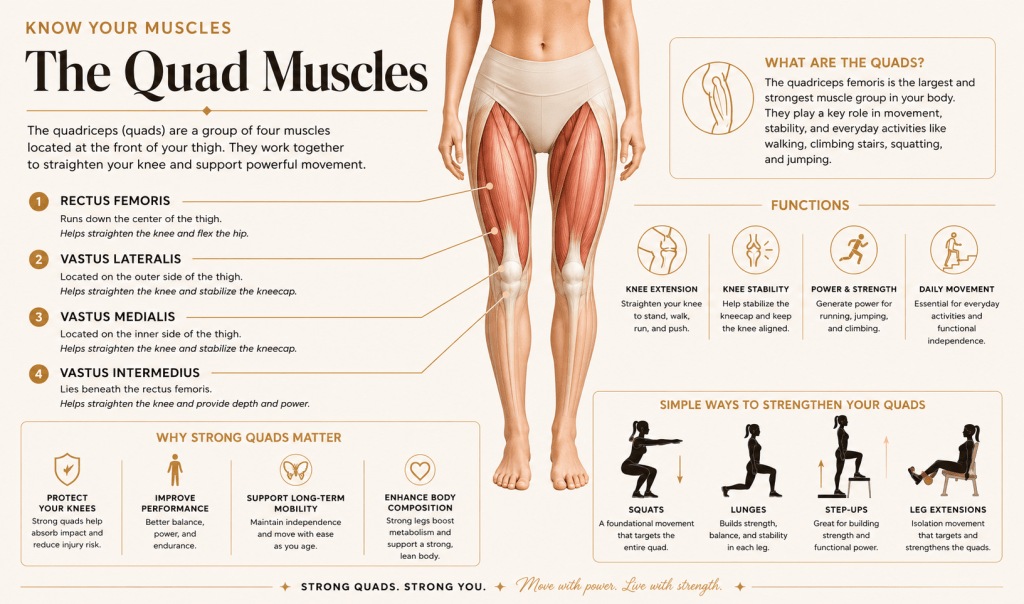
The quadriceps sit at the front of the thighs and generate the force needed to stand, climb stairs, walk uphill, and recover from a stumble. Weak quadriceps are strongly associated with functional decline in older adults.
- The Research: Studies from the Health ABC cohort found that weaker quadriceps were associated with a higher mortality risk, even after accounting for age, body composition, activity, and inflammation. Later research also linked quadriceps strength with better long-term muscle quality and less fat infiltration.
- Why the Quadriceps Matter: The quadriceps support movements used throughout daily life, including standing from a chair, climbing stairs, and catching yourself during a slip. As they weaken, everyday activities become harder and fall risk increases.
- The Training Approach: Effective quadriceps training combines compound lower-body exercises with single-leg movements. Goblet squats, front squats, step-ups, split squats, and walking lunges build strength while improving coordination and balance.
- Sample Training Block: Complete two weekly sessions with 15 to 20 minutes of quadriceps-focused work each time. Begin with bodyweight exercises, add dumbbells or kettlebells over six to eight weeks, and continue increasing resistance gradually.
Free 28-Day Fascia Reset Email Course
Get our Free 28-day email course series to help with 1 or 2 exercises per day to release your fascia. One short lesson per day. Two minutes to read each.
Muscle Group 2: The Glutes
The gluteal complex (gluteus maximus, medius, and minimus) is the largest and most powerful muscle group in the human body. The glutes drive hip extension, stabilize the pelvis during walking, and produce the force that pushes the body forward through every step. When the glutes weaken (and they weaken fast in sedentary adults, particularly those who sit for long periods), the compensations start immediately.
- Why the Glutes Matter: Weak glutes can contribute to lower back pain, tight hip flexors, knee discomfort, and reduced pelvic stability because nearby muscles and joints must absorb more of the workload. The gluteus medius is especially important for maintaining balance and controlling the pelvis during walking and single-leg movements.
- The Research: Studies show that weaker hip abductors, primarily the gluteus medius, are associated with poorer balance and a higher risk of falls. Weak hip extensors, including the gluteus maximus, are also linked to slower walking speed and greater dependence in daily activities.
- The Training Approach: Effective glute training should combine hip-extension exercises, such as deadlifts, hip thrusts, and glute bridges, with stability exercises like single-leg deadlifts, side-lying leg lifts, and resistance-band walks. Compound movements build force, while stability exercises improve coordination, balance, and movement control.
- Sample Training Block: Complete two weekly sessions with 15 to 20 minutes of glute-focused work each time. Beginners can start with bodyweight glute bridges and hip-abduction exercises before gradually progressing to weighted deadlifts and hip thrusts with proper form.
Free 28-Day Fascia Reset Email Course
Get our Free 28-day email course series to help with 1 or 2 exercises per day to release your fascia. One short lesson per day. Two minutes to read each.
Muscle Group 3: The Core
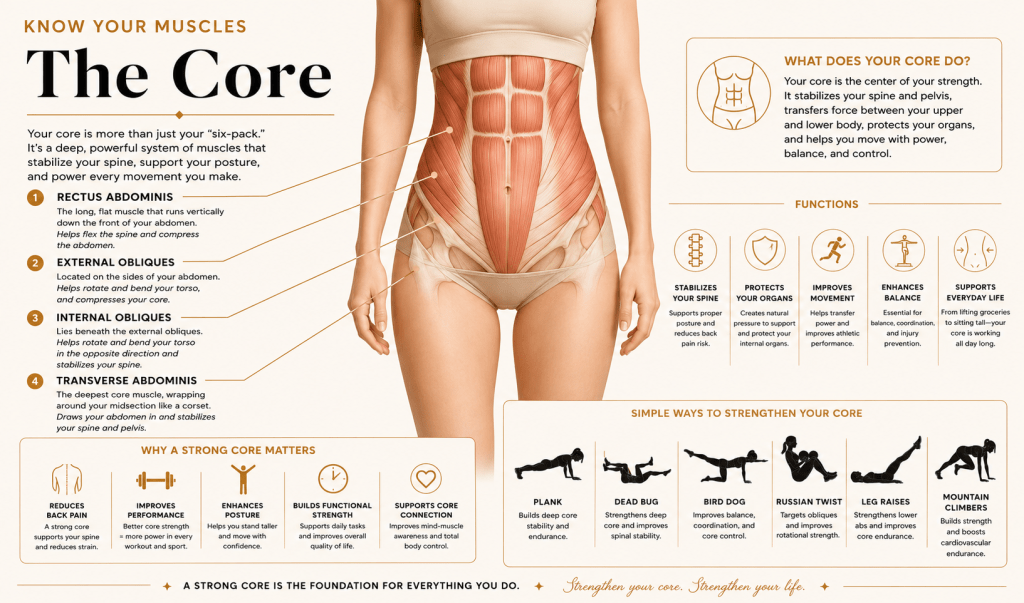
The core (abdominals, obliques, and the paraspinal muscles that run along the spine) stabilizes the spine, transfers force between the upper and lower body, and maintains posture against gravity. Core function affects every other movement pattern the body performs, and core dysfunction ripples out into back pain, altered gait, reduced athletic performance, and increased fall risk.
- Age-Related Abdominal Loss: Research from the Health ABC cohort found that the rectus abdominis lost muscle mass at roughly twice the rate of the quadriceps in older adults. Limited direct core training and reduced use may allow the abdominal muscles to weaken faster than muscles regularly used during daily activities.
- Paraspinal Compensation: The muscles running along the spine gained mass even as the abdominal muscles declined. This may reflect the paraspinal muscles working harder to stabilize the body as the anterior core becomes weaker.
- The Midlife Training Advantage: Proactive core training during the forties and fifties can prevent this imbalance from becoming established. Maintaining strong abdominals and obliques supports better posture, spinal stability, and movement quality later in life.
- The Training Approach: Effective core training combines anti-extension exercises, such as planks and dead bugs, with anti-rotation and anti-lateral flexion exercises, including Pallof presses, side planks, and carries. These movements train the core to resist unwanted motion, which is its primary role during daily activities.
- Sample Training Block: Complete two weekly sessions with 10 to 15 minutes of focused core work each time. Add the exercises at the end of strength workouts or perform them separately with controlled form and gradual progression.
Free 28-Day Fascia Reset Email Course
Get our Free 28-day email course series to help with 1 or 2 exercises per day to release your fascia. One short lesson per day. Two minutes to read each.
Muscle Group 4: Grip Strength
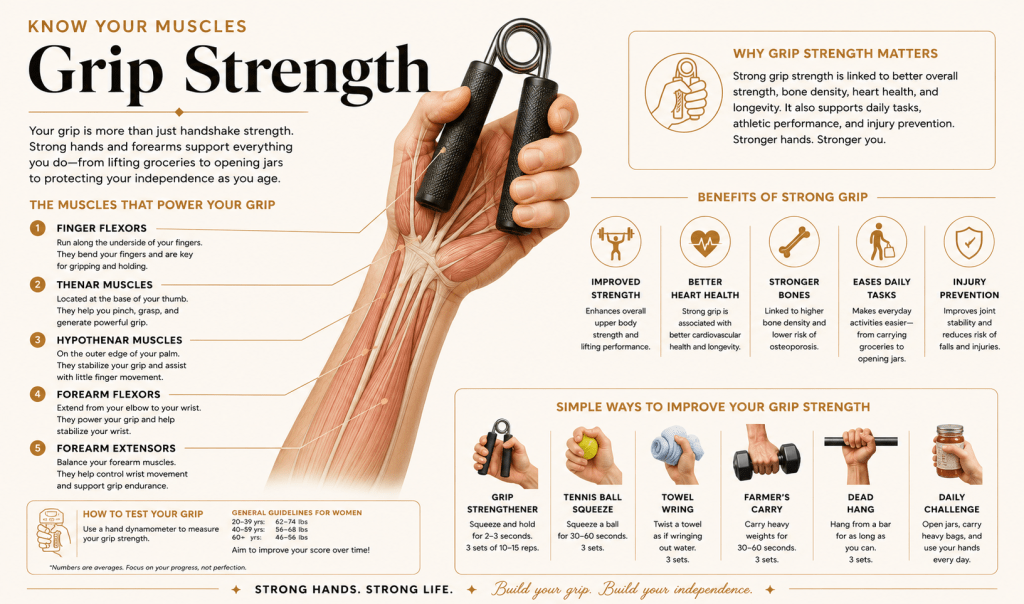
Grip strength is the most surprising entry in the four-muscle framework. On the surface, the strength of your hands and forearms seems like it should matter only for opening jars and carrying grocery bags. What the research has shown is that grip strength is one of the most powerful whole-body health predictors ever identified.
- The PURE Study: The 2015 PURE study followed nearly 140,000 adults across 17 countries and found that every 5-kilogram reduction in grip strength was associated with higher all-cause and cardiovascular mortality risk. Grip strength predicted mortality more strongly than systolic blood pressure, highlighting its value as a practical health marker.
- Whole-Body Strength Indicator: Grip strength does not directly cause a longer life, but it reflects the condition of the entire neuromuscular system. Weakening hands can be an early sign of declining muscle strength, nervous system function, and metabolic health throughout the body.
- The 2019 Research Review: A comprehensive review linked lower grip strength with fractures, falls, cognitive decline, depression, hospitalization, and mortality. Its connection with many different outcomes supports its use as a broad marker of physical resilience and healthy aging.
- The Training Approach: Farmer carries, dead hangs, plate pinches, towel wringing, and grip trainers can improve hand and forearm strength. Just three to five minutes of focused grip work during each strength session can produce measurable improvements within six to eight weeks.
- Sample Training Block: Complete two weekly sessions with five to ten minutes of grip-focused work each time. Farmer carries are especially efficient because they train grip, core stability, posture, and full-body conditioning at the same time.
“I test grip strength with almost every new coaching client using a simple hand dynamometer. Most midlife women are shocked at what their number is. The average forty-five-year-old woman is testing at levels that would have been considered clinical weakness for a woman a generation ago. And every client who works consistently on grip strength for six months tests dramatically higher, and reports feeling stronger throughout the body. Grip is the most underappreciated muscle group in midlife training. It is also the easiest one to add to any existing program.”
Terry Tateossian, Founder of The House of Rose
Free 28-Day Fascia Reset Email Course
Get our Free 28-day email course series to help with 1 or 2 exercises per day to release your fascia. One short lesson per day. Two minutes to read each.
Can Strength Training Reverse Age-Related Muscle Changes?
The most striking finding in longevity strength training research is that some biological signs of aging in muscle tissue may be partially reversible with consistent resistance training.
One of the clearest examples comes from a 2007 study by Melov and colleagues published in PLoS ONE.
What Did the Melov Study Find?
The study compared muscle tissue from healthy older and younger adults:
- Older Group: 25 adults with an average age of 70.
- Younger Group: 26 adults with an average age of 26.
- Training Program: The older adults completed standard resistance training twice per week for six months.
- Testing Method: Researchers collected muscle biopsies before and after the program and analyzed gene expression within the tissue.
After six months, the older adults’ muscle tissue had shifted toward a molecular profile closer to that of the younger group. The most noticeable changes appeared in genes related to mitochondrial function, the energy-producing machinery inside every cell.
Does This Mean Strength Training Reverses Aging?
The Melov study does not claim that resistance training reversed aging completely. It showed that six months of consistent training produced measurable changes in muscle gene expression in a direction associated with younger biological states.
This was a specific finding within muscle tissue and should not be over-interpreted. However, it clearly demonstrates that muscle remains biologically responsive to training even around age 70.
Why Does the Training Protocol Matter?
The participants followed a practical and accessible program:
- Standard Resistance Exercises: They trained using regular gym equipment rather than a specialized system.
- Two Sessions Per Week: The program did not require daily workouts or an extreme schedule.
- Six Months of Consistency: The results came from sustained training rather than a short-term intervention.
- No Complicated Extras: The study did not depend on an unusual supplement stack or intensive regimen.
This is the kind of training that many midlife women can realistically begin and maintain.
Starting strength training at 45, 55, or 65 can produce meaningful changes in the muscle tissue itself, not only improvements in strength and physical performance. Women who begin in midlife and continue through their sixties and beyond can preserve more muscle tissue and biological function than women who remain inactive.
A Practical Twice-Weekly Program for Midlife Women
Below is a twice-weekly program that trains all four longevity muscle groups over approximately 45 to 60 minutes per session. Total weekly time investment is roughly 90 minutes to 2 hours, or about 1 percent of the total hours in a week.
Session A: Lower Body Emphasis
|
Order |
Exercise |
Sets |
Reps |
Notes |
|
1 |
Goblet squat (dumbbell or kettlebell) |
3 |
10 to 12 |
Targets quadriceps and glutes |
|
2 |
Romanian deadlift (dumbbells or barbell) |
3 |
8 to 10 |
Primary glute driver |
|
3 |
Walking lunges or split squats |
3 |
8 to 10 per leg |
Unilateral quadriceps and glute work |
|
4 |
Farmer carry |
3 |
30 to 45 seconds |
Grip, core, and full-body conditioning |
|
5 |
Side plank |
2 |
20 to 40 seconds per side |
Lateral core stability |
|
6 |
Dead bug |
3 |
8 to 10 per side |
Anterior core and coordination |
Session B: Upper Body and Core Emphasis
|
Order |
Exercise |
Sets |
Reps |
Notes |
|
1 |
Dumbbell row (single-arm or bent-over) |
3 |
8 to 10 per side |
Grip, back, and posture |
|
2 |
Push-up (from floor or elevated surface) |
3 |
8 to 15 |
Chest, shoulders, and anterior core |
|
3 |
Step-up onto a bench or box |
3 |
8 to 10 per leg |
Quadriceps and glute |
|
4 |
Dead hang from a pull-up bar |
3 |
20 to 45 seconds |
Grip endurance and shoulder health |
|
5 |
Pallof press (with band or cable) |
3 |
10 per side |
Anti-rotation core |
|
6 |
Front plank |
2 |
30 to 60 seconds |
Anterior core stability |
Program Notes
These program notes will help you train safely, recover well, and build strength consistently. Use them as a simple guide for pacing each session, progressing over time, and knowing when to expect results.
- Warm-up: Five to ten minutes of gentle movement before each session. A brisk walk, gentle mobility work, and one warm-up set of the first exercise at a lighter load.
- Progressive overload: Each week, increase either the weight, the number of repetitions, or the number of sets on each exercise. Small consistent progression produces large cumulative results.
- Rest between sets: 60 to 90 seconds between sets on the strength exercises. 30 to 60 seconds on the core exercises.
- Session frequency: Two sessions per week is the minimum for meaningful progress. Three sessions per week (Session A, Session B, and Session A repeated with slightly different exercises) is the sweet spot for most midlife women who want faster progress.
- Recovery: Take at least one full rest day between sessions. Combine strength training with the daily movement practices we covered in our article on micro walks and our article on yin yoga for myofascial release for a complete framework.
- Progression timeline: Expect measurable strength gains within four to six weeks. Noticeable functional changes (stairs feel easier, balance feels more solid, jars open more easily) within eight to twelve weeks. Body composition changes (more visible muscle definition, reduced body fat percentage) within three to six months when combined with adequate protein and appropriate calories.
Free 28-Day Fascia Reset Email Course
Get our Free 28-day email course series to help with 1 or 2 exercises per day to release your fascia. One short lesson per day. Two minutes to read each.
What Nutrition Supports Strength Training After 40?
Strength training without adequate nutrition does not produce the muscle gains the program is designed to produce. Two nutritional priorities matter most.
- Protein intake: Midlife women need substantially more protein than the standard dietary recommendations suggest. The current research supports 1.0 to 1.2 grams of protein per pound of ideal body weight per day for adults over 40 who strength train. For a woman with an ideal body weight of 140 pounds, that is 140 to 168 grams of protein per day, distributed across 3 to 4 meals. Most midlife women are eating 60 to 90 grams per day. The gap is significant.
- Adequate total calories: Strength training in a semi-chronic calorie deficit works against muscle building. Women who are also trying to lose weight should work in modest deficits (200 to 400 calories per day) rather than aggressive ones (600 to 1000 calories per day), especially during the initial months of strength training when the body is building new muscle.
The free Macro Calculator gives you your personalized protein and calorie targets. The Macro Miracle Mediterranean Cookbook is the kitchen-side companion for meals designed around these targets. The foundational supplement collection supports the vitamin D, magnesium, omega-3, and creatine that strength training works with.
Which Mistakes Can Undermine Your Strength Training?
These mistakes consistently reduce the effectiveness of strength training for midlife women.
- Training too light for too long: Progressive overload requires actually increasing the load over time. Women who stay at the same weights for months do not stimulate the ongoing adaptations that produce strength gains.
- Skipping progressive overload out of caution: Fear of getting hurt sometimes leads midlife women to avoid the heavier lifting that produces the largest longevity benefits. Proper form and gradual progression manage the injury risk while still producing the training stimulus.
- Doing too much cardio and too little strength: Cardio has its place, but midlife women who prioritize cardio at the expense of strength are training in the direction of muscle loss rather than muscle preservation. The strength work has to come first.
- Undereating during strength training: Trying to lose weight aggressively while starting a strength program undermines both goals. The body needs adequate calories and protein to actually build the muscle the training is stimulating.
- Inconsistent frequency: Strength training three times one week and zero times the next produces frustration rather than adaptation. Consistency over months matters more than intensity in any single week.
- Ignoring recovery: The training produces adaptation during recovery, not during the sessions. Inadequate sleep, chronic stress, and insufficient rest between sessions all reduce the return on training time.
Free 28-Day Fascia Reset Email Course
Get our Free 28-day email course series to help with 1 or 2 exercises per day to release your fascia. One short lesson per day. Two minutes to read each.
How Does Strength Training Fit the THOR Framework?
Strength training for the four longevity muscle groups is one layer of the five-component lifestyle medicine framework I teach at THOR. Each component supports the others.
- Nutrition: Adequate protein and total calories provide the raw materials for muscle building. The Macro Calculator and Macro Miracle Mediterranean Cookbook are the foundation.
- Daily movement: Strength training is the anchor of the movement work. It combines with the micro walks practice for daily cardiovascular input, yin yoga for myofascial release for connective tissue mobility, and tai chi walking for aging well once the strength foundation is established.
- Sleep: Deep sleep is when muscle protein synthesis peaks and when the strength gains from training actually consolidate. Sleep is not optional.
- Nervous system regulation: Chronic stress opposes muscle building. The parasympathetic activation practices support the recovery side of the training equation.
- Supplement foundation: Vitamin D, magnesium, omega-3, and creatine all support the strength training work. The foundational supplement collection covers the priorities.
For women who want sustained 1:1 support on the full framework including personalized programming, the Monthly Personal Training and Nutrition Coaching Program is the primary CTA for this article. The coaching includes personalized strength training progressions and macro guidance.
For the immersive version, the Deeply Restorative Yoga and Nature Retreat at our Smoky Mountains property includes strength training sessions and the integration coaching that extends past the retreat itself.
“The retreat guests who see the fastest changes are consistently the ones who commit to the strength training piece. Not because strength training is more important than nutrition or sleep or nervous system work. But because those things work harder when the strength foundation is in place. Adding two sessions of properly programmed strength training per week is one of the top interventions I recommend for any midlife woman who wants to see her body change quickly and meaningfully. The compound effect on energy, mood, sleep, and confidence is bigger than any other single intervention I teach.”
Terry Tateossian, Founder of The House of Rose
When Should You See a Healthcare Professional?
Most midlife women can begin the twice-weekly program described above safely with appropriate progression. Some situations require professional guidance first.
- History of joint injuries or surgeries: A physical therapist can evaluate specific limitations and recommend appropriate modifications.
- Osteoporosis or significant bone density loss: Strength training is generally recommended for adults with osteoporosis, but appropriate exercise selection matters and warrants professional input.
- Cardiovascular conditions: Consult your cardiologist about appropriate exercise intensity before starting.
- Uncontrolled hypertension: Some strength training exercises transiently elevate blood pressure. Get clearance before starting.
- Recent surgery: Wait for surgical clearance before adding new strength work in the affected areas.
- Chronic pain that has not been evaluated: New pain deserves diagnosis before adding a new training program.
- Pregnancy or postpartum: Modifications are appropriate throughout pregnancy and the postpartum period. Work with a trainer certified in prenatal and postpartum programming.
Free 28-Day Fascia Reset Email Course
Get our Free 28-day email course series to help with 1 or 2 exercises per day to release your fascia. One short lesson per day. Two minutes to read each.
What Are Your Next Steps?
If the framework in this article resonates and you want to start training the four longevity muscle groups, here are the four next steps in order of friction.
- Complete one full session A workout this week. Do not wait for perfect conditions. Start with the bodyweight versions of the exercises if you do not have equipment yet. The first session breaks the inertia.
- Add session B in week two. By the end of week two, you have completed both training sessions and you have a baseline.
- Calculate your macros. The free Macro Calculator gives you your protein and calorie targets. Aim for the protein target daily starting the day you begin training. The Macro Miracle Mediterranean Cookbook makes the meals easier.
- Consider personalized programming. The Monthly Personal Training and Nutrition Coaching Program is where I do the personalized progression work with midlife women, including form review on the compound lifts and macro adjustments as your body responds. For the immersive version, the Deeply Restorative Yoga and Nature Retreat at our Smoky Mountains property installs the full framework in five days.
Frequently Asked Questions
Which muscle group should I focus on first?
If you can only train one muscle group, the glutes produce the largest downstream benefit for daily function and fall prevention. If you can train two, add the quadriceps. The full four-muscle framework produces the strongest longevity outcomes and takes only 90 minutes to 2 hours per week when done as described in the program above.
How much protein do I need to build muscle after 40?
Research supports 1.0 to 1.2 grams of protein per pound of ideal body weight per day for adults over 40 who strength train. For a woman with an ideal body weight of 140 pounds, that is 140 to 168 grams per day distributed across three to four meals. Most midlife women eat significantly less than this and see slower strength progress as a result.
Do I need to lift heavy weights to get the longevity benefits?
Progressive overload matters more than any specific weight. Beginners should start light enough to complete the recommended repetitions with good form. Progress the weight gradually over months. By six months into consistent training, most midlife women are lifting weights that would have felt impossible at the start, and this progression is what produces the largest longevity benefits.
Is bodyweight training enough?
Bodyweight training is enough to start and enough for the first four to eight weeks in most cases. Beyond that point, the body adapts to bodyweight loads and progression becomes difficult. Adding external load through dumbbells, kettlebells, or a barbell allows the progressive overload the training depends on.
Free 28-Day Fascia Reset Email Course
Get our Free 28-day email course series to help with 1 or 2 exercises per day to release your fascia. One short lesson per day. Two minutes to read each.
How long before I see results?
Strength gains show up within four to six weeks. Functional improvements (stairs feel easier, balance feels more solid, everyday tasks feel easier) become noticeable within eight to twelve weeks. Visible body composition changes usually take three to six months of consistent training combined with adequate protein.
Can I do this program during perimenopause and menopause?
The program was designed specifically for women in perimenopause, menopause, and post-menopause. The hormonal changes make strength training more important, not less, in this life stage. Some modifications for individual symptoms or conditions may be appropriate but the core framework applies.
Do I need a gym membership?
A gym membership is not required to start. The program can be done at home with a set of adjustable dumbbells, a pull-up bar (or a doorway pull-up bar for beginners), and a bench or sturdy chair for step-ups. Total equipment investment is typically under $300 for a home setup that supports years of progression.
What if I have never lifted weights before?
The program is appropriate for beginners. Start with the bodyweight versions of the compound exercises for the first two weeks while learning the movement patterns. Add light dumbbell loading in week three and continue to progress from that starting point over the following months. Working with a qualified trainer for the first four to six sessions to learn proper form is worth the investment.
Should I do cardio too?
Yes, but the strength training is the priority. Cardiovascular work through daily walking (the micro walks practice is the accessible option) plus one longer moderate-intensity cardio session per week is enough for most midlife women. Excessive cardio at the expense of strength work is a common midlife training mistake.
Can I train these muscles if I have arthritis?
In most cases, yes, and strength training is often specifically recommended for adults with arthritis. Working with a physical therapist to adapt the specific exercises to your joint history is the safest approach. The general principles (progressive overload, adequate recovery, focus on the four longevity muscle groups) still apply.
What about protein powder and creatine?
Both can be useful complements to a food-first protein intake. Whey protein or a mixed plant-based protein powder can help hit the daily protein target. Creatine monohydrate (3 to 5 grams daily) has strong research support in older adults for both strength and cognitive outcomes. The foundational supplement collection covers the priorities.
How does this connect to menopause weight gain?
The muscle loss that accelerates during perimenopause and menopause is one of the primary drivers of the metabolic changes that produce weight gain in this life stage. Preserving muscle through strength training preserves metabolic rate, protects against the visceral fat accumulation of the menopausal transition, and produces body composition outcomes that no cardio-only or diet-only approach can match. Combined with the menopause diet plan framework, strength training is the most direct intervention available for midlife weight management.
Are there any risks to strength training after 40?
Strength training carries risks like any physical activity. The most common risks are muscle strains, joint irritation, and lifting-form-related back tweaks. Proper progression, appropriate form, and adequate rest between sessions manage these risks effectively. The larger risk for midlife women is not strength training and accepting accelerated sarcopenia as the alternative.
Free 28-Day Fascia Reset Email Course
Get our Free 28-day email course series to help with 1 or 2 exercises per day to release your fascia. One short lesson per day. Two minutes to read each.
Should I train grip strength separately?
The farmer carries, dead hangs, and dumbbell rows in the program already train grip strength directly. For most midlife women, no additional dedicated grip work is needed beyond what the program includes. Women who want additional grip work can add towel wringing, plate pinches, or specific grip trainers for two to five minutes at the end of each session.
How does this fit with tai chi walking and other aging practices?
The strength training is the anchor. Tai chi walking, yin yoga, and other slower practices complement the strength work by supporting balance, connective tissue mobility, nervous system regulation, and recovery. A complete aging-well program for midlife women includes strength training as the foundation, daily walking for cardiovascular input, and one or two slow practices weekly for the recovery and coordination benefits.
References
- Newman, A. B., Kupelian, V., Visser, M., et al. (2006). Strength, but not muscle mass, is associated with mortality in the Health, Aging and Body Composition Study cohort. Journals of Gerontology Series A: Biological Sciences and Medical Sciences, 61(1), 72–77.
- Leong, D. P., Teo, K. K., Rangarajan, S., et al. (2015). Prognostic value of grip strength: findings from the Prospective Urban Rural Epidemiology (PURE) Study. The Lancet, 386(9990), 266–273.
- Melov, S., Tarnopolsky, M. A., Beckman, K., Felkey, K., & Hubbard, A. (2007). Resistance exercise reverses aging in human skeletal muscle. PLoS ONE, 2(5), e465.
- Bohannon, R. W. (2019). Grip strength: an indispensable biomarker for older adults. Clinical Interventions in Aging, 14, 1681–1691.
- Delmonico, M. J., Harris, T. B., Visser, M., et al. (2009). Longitudinal study of muscle strength, quality, and adipose tissue infiltration. American Journal of Clinical Nutrition, 90(6), 1579–1585.
- Maltais, M. L., Desroches, J., & Dionne, I. J. (2009). Changes in muscle mass and strength after menopause. Journal of Musculoskeletal and Neuronal Interactions, 9(4), 186–197.
- Sipilä, S., Törmäkangas, T., Sillanpää, E., et al. (2020). Muscle and bone mass in middle-aged women: role of menopausal status and physical activity. Journal of Cachexia, Sarcopenia and Muscle, 11(3), 698–709.
- Bauer, J., Biolo, G., Cederholm, T., et al. (2013). Evidence-based recommendations for optimal dietary protein intake in older people: a position paper from the PROT-AGE Study Group. Journal of the American Medical Directors Association, 14(8), 542–559.
- Phillips, S. M., & Van Loon, L. J. C. (2011). Dietary protein for athletes: from requirements to optimum adaptation. Journal of Sports Sciences, 29(Suppl 1), S29–S38.
- Leidy, H. J., Clifton, P. M., Astrup, A., et al. (2015). The role of protein in weight loss and maintenance. American Journal of Clinical Nutrition, 101(6), 1320S–1329S.
- Kreider, R. B., Kalman, D. S., Antonio, J., et al. (2017). International Society of Sports Nutrition position stand: safety and efficacy of creatine supplementation. Journal of the International Society of Sports Nutrition, 14, 18.
- Chilibeck, P. D., Kaviani, M., Candow, D. G., & Zello, G. A. (2017). Effect of creatine supplementation during resistance training on lean tissue mass and muscular strength in older adults: a meta-analysis. Open Access Journal of Sports Medicine, 8, 213–226.
- Peterson, M. D., Rhea, M. R., Sen, A., & Gordon, P. M. (2010). Resistance exercise for muscular strength in older adults: a meta-analysis. Ageing Research Reviews, 9(3), 226–237.
- Fragala, M. S., Cadore, E. L., Dorgo, S., et al. (2019). Resistance training for older adults: position statement from the National Strength and Conditioning Association. Journal of Strength and Conditioning Research, 33(8), 2019–2052.
- Boyle, N. B., Lawton, C., & Dye, L. (2017). The effects of magnesium supplementation on subjective anxiety and stress: a systematic review. Nutrients, 9(5), 429.
- Holick, M. F., Binkley, N. C., Bischoff-Ferrari, H. A., et al. (2011). Evaluation, treatment, and prevention of vitamin D deficiency: an Endocrine Society clinical practice guideline. Journal of Clinical Endocrinology and Metabolism, 96(7), 1911–1930.
- Roberts, H. C., Denison, H. J., Martin, H. J., et al. (2011). A review of the measurement of grip strength in clinical and epidemiological studies. Age and Ageing, 40(4), 423–429.
- Cruz-Jentoft, A. J., Bahat, G., Bauer, J., et al. (2019). Sarcopenia: revised European consensus on definition and diagnosis. Age and Ageing, 48(1), 16–31.
Disclaimer: Always consult with a healthcare professional before starting any new routines, programs, or nutrition plans to ensure you receive the best medical advice and strategy for your specific individual needs.
Free 28-Day Fascia Reset Email Course
Get our Free 28-day email course series to help with 1 or 2 exercises per day to release your fascia. One short lesson per day. Two minutes to read each.

Terry Tateossian is a Menopause Lifestyle Medicine Coach, Certified Personal Trainer & Nutritionist and the Founder of THOR: The House of Rose, a wellness brand serving women over 40 through retreats, coaching, macro-nutrition and community. As 25-year founder and entrepreneur, Terry spent two and a half decades building and running successful start-up businesses, an experience that put her on the front line of founder burnout long before she could name it. After facing serious health challenges, early onset menopause, and emotional eating while running her agency and raising two children, Terry rebuilt her health in her 40s and lost more than 80 pounds through evidence-based nutrition, training, and mindset work. Today, she helps women get strong, improve confidence, support hormone health, and create a stronger second half of life. Terry has been featured in major media outlets and is available for podcasts, expert commentary, brand collaborations, and speaking engagements on midlife health, reinvention, emotional eating, menopause wellness, and strength training for longevity. Get her free macro calculator (her cookbook companion) to start your journey to back to health.