
 By Team THOR
How Much Protein Per Day for Women Over 40. The Real Number, Not the One on the Box
Free Macro Calculator
Personalized to your body, goals, and measurements. You will receive detailed macros for meals, sample day of eating, food selection guidance, hydration + daily supplement suggestions, and more.
I’m going to start with the most common conversation I have with most women who attend my wellness & yoga etreats in their forties and fifties.
She tells me she’s eating well. Mostly clean. Salads, smoothies, the occasional grain bowl. She’s training a few times a week, sleeping okay, doing the work. But the body composition isn’t moving. Maybe slowly going the wrong direction. Strength is flat. Hair and skin are off. The midsection is more stubborn than it used to be. She’s frustrated.
I ask one question: “How much protein are you eating in a day?”
The answer is almost always somewhere between 50 and 70 grams.
She is, on average, 30 to 60 grams short.
If you take one thing from this article, take this: the protein recommendation you grew up with — 0.8 grams per kilogram of bodyweight was set decades ago, was based on the minimum needed to prevent overt deficiency in a young, healthy, sedentary person, and is dramatically inadequate for midlife women trying to maintain muscle, bone density, metabolism, satiety, and sanity through perimenopause and beyond.
The real number for women over 40 is much higher. Let’s walk through what it is, why, when to eat it, and how to actually hit it without spending your whole day in the kitchen.
How Much Protein Per Day for Women Over 40. The Short Answer
If you want the bottom line first, here’s the framework most evidence supports for women over 40:
General target: 1.6 to 2.2 grams of protein per kilogram of bodyweight per day (about 0.7 to 1.0 grams per pound).
For a 150-lb woman, that’s roughly 105 to 165 grams of protein per day.
Where you sit in that range depends on your goals:
- Maintaining muscle and supporting general health: 1.6g/kg (~0.73 g/lb)
- Recomposition (losing fat, keeping/building muscle): 1.8 to 2.0 g/kg (~0.82–0.91 g/lb)
- Active fat loss in a calorie deficit: 2.0 to 2.4 g/kg (~0.9–1.1 g/lb) — protein needs go up in a deficit, not down
- Building muscle in a deliberate building phase: 1.8 to 2.2 g/kg (~0.82–1.0 g/lb)
If math isn’t your love language, the free macro calculator for women does this for you in under a minute. Plug in your numbers, get protein, fat, and carb targets sized to your body, your activity, and your goal — already adjusted for the realities of midlife.
Why the 0.8g/kg Number Is Wrong for Women Over 40
The Recommended Daily Allowance (RDA) for protein in the United States is 0.8g/kg of bodyweight per day. That number was set in the 1970s based on nitrogen balance studies — basically, the minimum protein intake at which a person doesn’t visibly lose nitrogen (a proxy for muscle protein).
A few problems with applying that number to a 47-year-old woman who’s training, raising kids or running a business, in or approaching menopause, and trying to stay strong:
1. The studies were done in young, sedentary subjects.
Older adults have a phenomenon researchers call “anabolic resistance” — they need more protein per meal to trigger the same muscle protein synthesis response a younger person gets from less. The same dose that built muscle at 25 doesn’t build it at 50.
2. Estrogen drops change the math.
Estrogen has muscle-sparing and bone-protecting effects. As it falls in perimenopause and menopause, you lose more muscle and bone for any given level of protein and training (Maltais, Desroches & Dionne, 2009). Higher protein intake helps offset that loss.
3. The RDA is a deficiency-prevention number, not an optimization number.
It tells you the minimum to avoid overt protein-energy malnutrition. That’s a very different question from “How much protein supports muscle, bone, metabolism, and satiety in a 50-year-old training woman?”
4. Women systematically undereat protein.
Decades of being told protein is “for men” and “for bodybuilders” plus a culture of breakfast cereal, oat milk lattes, and salad-for-lunch has produced a population of midlife women eating 50–70g/day when they need 100–150g+.
The newer research-based recommendations — 1.6 to 2.2g/kg — come from systematic reviews of randomized controlled trials in adults across age groups, including women in midlife and beyond.
This isn’t fringe nutrition. This is mainstream sports nutrition science, applied to the population it actually serves.
Why Protein Matters More After 40 (Not Less)
Some women have been told that protein needs go down with age. The opposite is true.
Here’s what protein is doing for you in midlife.
Preserving muscle.
Muscle loss accelerates dramatically after 40, and again after menopause. The technical name is sarcopenia, and it’s not just an aesthetic concern — it predicts falls, fractures, metabolic disease, and mortality. Women lose roughly 3–8% of muscle mass per decade after 30, with sharper losses after menopause. Protein, paired with strength training, is the single most powerful intervention against that.
Protecting bone.
The old fear — that high protein “leaches” calcium from bones — has been thoroughly debunked. Higher protein intake is associated with better bone density and lower fracture risk in postmenopausal women. Bone is roughly 50% protein by volume; collagen is protein. You cannot build bone without it.
Supporting metabolism.
Protein has the highest thermic effect of any macronutrient — your body burns 20–30% of protein calories just digesting and processing it, compared to 5–10% for carbs and 0–3% for fat. A higher-protein diet runs hotter at rest.
Driving satiety.
Protein is the most filling macronutrient by a meaningful margin. Higher-protein meals lead to lower hunger and reduced calorie intake at subsequent meals). Most midlife women report dramatically reduced cravings within two weeks of hitting protein targets.
Preserving lean mass during fat loss.
When women over 40 try to lose weight on low-protein diets, a much higher percentage of that weight comes from muscle and bone instead of fat. Higher protein during a calorie deficit protects lean mass — which protects metabolism, strength, and how your body looks at the lower weight.
Supporting recovery, hair, skin, nails, and immune function.
Protein is the raw material for almost everything your body rebuilds — collagen, keratin, antibodies, enzymes, neurotransmitter precursors. Underate protein in midlife and the cosmetic complaints (thinning hair, brittle nails, papery skin) often quietly track back to it.
For the deeper protein-source breakdown, our protein sources nutritionist guide goes into specifics on which foods deliver the most usable protein per calorie.
Free Macro Calculator
Personalized to your body, goals, and measurements. You will receive detailed macros for meals, sample day of eating, food selection guidance, hydration + daily supplement suggestions, and more.
Anabolic Resistance: Why Older Bodies Need More Protein Per Meal
This is the concept that explains why the daily total isn’t enough – distribution matters too.
When you eat protein, your body kicks off a process called muscle protein synthesis (MPS). Younger adults respond to about 20g of high-quality protein in a meal — that’s enough to trigger MPS. Older adults need closer to 30–40g per meal to get the same MPS response.
This is why a 25-year-old can eat a yogurt for breakfast, a salad with chicken for lunch, a steak for dinner, and grow muscle just fine — while a 50-year-old eating the same pattern is barely maintaining.
The practical implication: spread your protein across 3–4 meals, with at least 30g per meal, rather than backloading 80g into dinner.
A typical midlife day of food might look like:
- Breakfast: 30–40g (Greek yogurt with whey + berries; eggs and turkey sausage; protein smoothie with whey isolate, banana, peanut butter)
- Lunch: 30–40g (chicken, fish, or tofu; bean-based salad; a high-protein wrap)
- Snack: 15–25g (cottage cheese, jerky, hard-boiled eggs, protein shake)
- Dinner: 30–40g (fish, lean beef, chicken thighs, lentil-and-quinoa bowl)
That gets you to 110–145g without trying.
And yes, this means breakfast can’t be just coffee and oatmeal. The single biggest move most midlife women can make is upgrading breakfast to 30g+ of protein. The downstream effects on hunger, energy, and cravings later in the day are dramatic.
How to Calculate Your Protein Number for Menopause Weight Loss
Get Your Free Macro Calculator
Personalized to your body, goals, and measurements. You will receive detailed macros for meals, sample day of eating, food selection guidance, hydration + daily supplement suggestions, and more.
Here’s the math step by step.
Step 1: Find your bodyweight in kg. (Pounds ÷ 2.205 = kg) – 150 lb = 68 kg – 175 lb = 79 kg – 200 lb = 91 kg
Step 2: Pick your target multiplier. – Maintenance, general health: 1.6 g/kg – Recomposition (most midlife women’s goal): 1.8–2.0 g/kg – Fat loss in a calorie deficit: 2.0–2.4 g/kg – Muscle building phase: 1.8–2.2 g/kg
Step 3: Multiply. – 150-lb woman, recomp goal: 68 × 1.9 = 129g protein/day – 175-lb woman, fat loss in deficit: 79 × 2.2 = 174g protein/day – 200-lb woman, maintenance: 91 × 1.6 = 146g protein/day
Step 4: Adjust if needed. – If you’re carrying significant excess body fat, calculate from a target weight or lean body mass instead — feeding bodyweight at 2.2 g/kg can be unnecessarily high. Most calculators (including ours) account for this. – Add a small buffer if you’re highly active or training 5+ days a week.
Do not try to do this in your head daily. Use a calculator once, get your number, and then learn to hit it.
The free macro calculator is built specifically for women over 40. It accounts for body composition, activity level, training intent, and the realities of perimenopause and menopause. It returns a target you can actually live with, not the standard internet number that’s calibrated for a 28-year-old male athlete.
For a deeper structural framework on macros, see our piece on the fundamentals of macro diet for women over 50 and our midlife nutrition hierarchy.
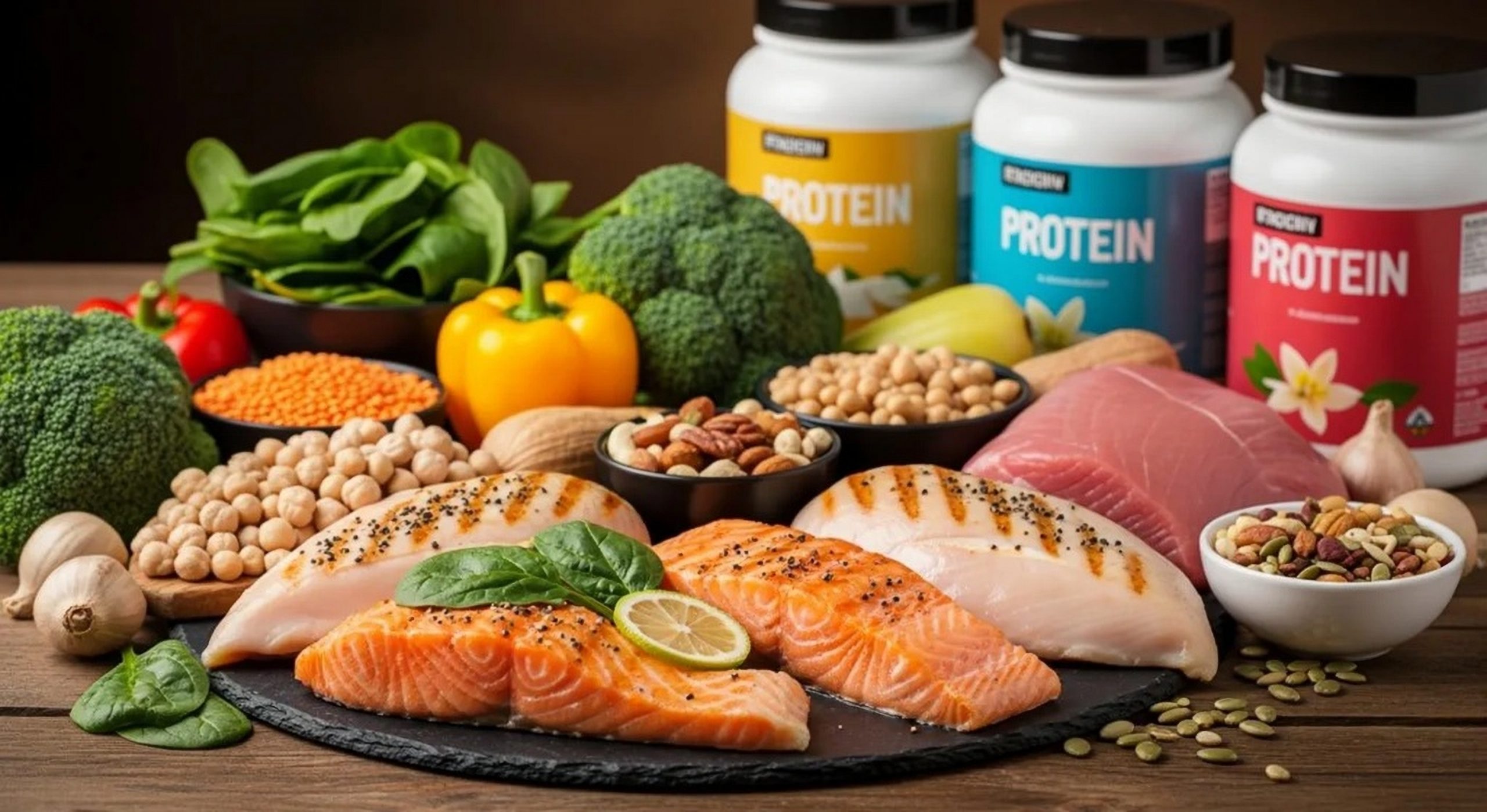
Best Protein Sources for Women Over 40: Whole Foods First
Whole-food protein has texture, fiber, micronutrients, and satiety that powders can’t fully replicate. Build the foundation here, then supplement.
Animal sources (highest protein density): – Chicken breast, turkey breast — ~30g per 4 oz – Lean beef, bison — ~25g per 4 oz – Fish: salmon, cod, tuna, sardines — 22–28g per 4 oz – Greek yogurt — 17–20g per cup – Cottage cheese — 25g per cup – Eggs — 6–7g each (whole eggs); 3.5g per egg white – Whey, casein, egg-white protein powder — 20–25g per scoop
Plant sources (need more volume + variety): – Tofu, tempeh, edamame — 15–20g per cup – Lentils, chickpeas, black beans — 15–18g per cup cooked – Quinoa — 8g per cup cooked (complete plant protein) – Hemp seeds, pumpkin seeds — 8–10g per 3 tbsp – Pea, soy, hemp, blended plant protein powders — 20–25g per scoop
For plant-based women, hitting 1.8g/kg is harder but doable — it requires more volume, more variety, and usually a daily protein powder.
For comfort-food versions of high-protein meals that don’t taste like a meal plan, see our piece on high-protein comfort foods and our 80 Macro-Friendly Mediterranean Recipes cookbook — every recipe is built around protein-first, fiber-forward eating designed for midlife.
Best Protein Powder for Women Over 40: What to Look For
Most protein powders on the market are over-engineered, under-tested, and full of additives that nobody needs. Here’s how to pick a good one.
Type of protein:
- Whey isolate protein powder – Fastest digesting, highest protein per scoop, lowest in lactose (most lactose-intolerant women tolerate isolate fine), highest leucine content per gram (leucine is the trigger amino for muscle protein synthesis). My default recommendation for women over 40 unless dairy is a problem.
- Whey concentrate – slightly cheaper, slightly more lactose, slightly less protein per scoop. Fine if isolate is too pricey.
- Casein – slow-digesting, good for nighttime to drip amino acids during sleep. Optional, not essential.
- Egg white protein – dairy-free, well-tolerated, complete amino profile.
- Plant blends (pea + rice or pea + hemp + pumpkin) – for plant-based or dairy-sensitive women. Look for blends, not single-source pea, for a more complete amino profile.
- Collagen – useful for skin, hair, nails, joint support, but it is incomplete protein (low in tryptophan and leucine) and should not be your main daily protein. Treat it as an add-on, not a base.
What to look for on the protein powder label:
- 20–25g protein per scoop
- Less than 5g sugar per scoop (some flavoring is fine, but not a candy bar)
- Short ingredient list – protein source, natural flavor, sweetener (stevia, monk fruit, sucralose all fine), maybe lecithin for mixing
- Third-party testing – NSF Certified for Sport, Informed Choice, ConsumerLab
- No proprietary blends – you want the protein source named clearly
- Mixes well with cold liquid
What to avoid:
Mega-doses of caffeine, mystery “energy” or “fat burning” blends – Ultra-long ingredient lists with thickeners, gums, and synthetic sweeteners stacked – Products that don’t disclose protein source clearly – Anything marketed primarily on “tones,” “slims,” or “shrinks” rather than “supports muscle”
For our take in product form, our Shopify line includes a Whey Protein Isolate in chocolate and vanilla formulated to be exactly this — clean, third-party-tested, midlife-appropriate.
Free Macro Calculator
Personalized to your body, goals, and measurements. You will receive detailed macros for meals, sample day of eating, food selection guidance, hydration + daily supplement suggestions, and more.
Best Protein Powder for Menopause Weight Loss: How to Use It
Protein powder is a tool. Used well, it makes hitting your protein target effortless. Used badly, it adds calories without solving anything.
The use cases that work best for midlife weight loss:
Breakfast smoothie.
This is the single biggest use case. One scoop whey isolate + 1 cup unsweetened almond milk or kefir + 1 cup frozen berries + 1 tbsp peanut or almond butter + 1 tbsp ground flaxseed + ice. ~35g protein, fiber, healthy fat, antioxidants. Done in 90 seconds. Replaces the cereal-and-coffee breakfast that most women find isn’t holding them.
Mid-afternoon protein top-up.
When you’ve underate protein at breakfast and lunch, a 20–25g shake at 3pm prevents the late-afternoon snack spiral and gets you to dinner without raiding the pantry.
Post-strength-training shake.
Within an hour of a strength session, 25–30g of fast-digesting protein is the simplest way to support recovery and muscle protein synthesis.
Recipe boost.
Stir into oatmeal, plain Greek yogurt, baked goods. Adds protein without effort.
What protein powder is not for: replacing meals long-term. The texture, satiety, and food relationship benefits of whole-food meals are lost in liquid form. Use powder strategically, not as a way to skip eating.
For women in fat-loss mode specifically, the math is straightforward: more protein, less ultra-processed food, a moderate calorie deficit (10–20% below maintenance, not crash levels), strength training 3+ times per week, sleep, fiber, hydration. Our free macro calculator sets the targets. The Mediterranean cookbook provides the food. The training delivers the body composition.
Common Mistakes Women Over 40 Make With Protein
A short list of the patterns I see all the time.
Backloading protein into dinner. 80g at 7pm is much less effective than 30g at three meals. MPS doesn’t bank.
Skipping breakfast or eating low-protein breakfast. Cereal, oatmeal, fruit, oat milk lattes — almost always the lowest-protein meal of the day. This is the easiest swap to make and the one with the biggest payoff.
Confusing “protein bar” with “protein meal.” Many bars are 8–12g of protein and 15g of sugar — basically a candy bar with a vest on. Read the label.
Counting collagen as primary protein. Collagen is incomplete and shouldn’t be your main daily protein source. Use it as a supplement, not a base.
Eating “clean” but low-protein. Salads, smoothies, grain bowls, vegan-leaning meals — all can be undersupplied with protein unless deliberately constructed.
Trying to do this in a calorie deficit on 0.8g/kg. Underprotein-ing in a deficit is the single fastest way to lose muscle and slow your metabolism. Protein needs go up during fat loss, not down.
Worrying about kidneys. In healthy women without preexisting kidney disease, higher protein intake (up to 2.2g/kg) is well-tolerated and doesn’t damage kidneys (Devries et al., 2018). If you have known kidney disease, talk to your nephrologist.
Not training. All the protein in the world without resistance training is not going to build muscle. Protein is the brick. Strength training is the construction crew. You need both.
For the strength side of the equation, see our work on strength training and the building phase for women over 40.
Sample High-Protein Day for Women Over 40
Here’s what 130g of protein looks like in a real day, eaten by a real human, without spending two hours cooking.
Breakfast (35g protein): – 1 cup plain Greek yogurt (~20g) – 1 scoop whey isolate stirred in (~22g) – ½ cup berries, 2 tbsp ground flaxseed – Coffee with cream
Lunch (35g protein): – 4 oz grilled chicken (~30g) – Big mixed salad with olive oil, lemon, herbs – ½ cup chickpeas (~7g) – ¼ avocado
Snack (20g protein): – 1 cup cottage cheese with cinnamon and a sliced pear
Dinner (40g protein): – 5 oz wild salmon (~35g) – Roasted vegetables – ½ cup quinoa (~4g) – A little dark chocolate or fruit after
Total: ~130g protein, ~1,800 calories, real food, ~30 minutes of total cooking across the day.
Adjust portions for your number, swap species and vegetables for variety, repeat patterns weekly.
When Higher Protein Isn’t the Right Call
Most women over 40 should be eating significantly more protein than they are. But there are exceptions where you should talk to your clinician before scaling up.
- Diagnosed kidney disease – protein guidance varies by stage; follow your nephrologist’s protocol.
- Certain liver conditions – same.
- Hereditary metabolic disorders affecting protein metabolism (rare, usually known by adulthood).
- Eating disorder history – macro tracking can be triggering. Work with a clinician who specializes in midlife and disordered eating before going calculator-first.
- Severe gout flares – may need to limit certain animal proteins specifically; doesn’t mean cutting protein overall.
For the rest of us, the consistent finding across studies is that 1.6–2.2g/kg is safe, effective, and meaningfully better for midlife body composition, bone, and aging than the old 0.8g/kg standard.
Free Macro Calculator
Personalized to your body, goals, and measurements. You will receive detailed macros for meals, sample day of eating, food selection guidance, hydration + daily supplement suggestions, and more.
The Bottom Line on Protein for Women Over 40
The single most underrated nutritional intervention for women in their forties and fifties is hitting a real protein target.
Not “eating clean.” Not “cutting carbs.” Not “intermittent fasting harder.” Protein.
If you want to maintain muscle and bone, run a faster metabolism, lose less hair, sleep through the afternoon hunger spikes, and actually see results from your training — eat 1.6 to 2.2 grams per kilogram of bodyweight per day, spread across 3–4 meals with at least 30g per meal, anchored to a strong breakfast.
Use the free macro calculator to get your specific number. Use the 80 Macro-Friendly Mediterranean Recipes cookbook for the food. Add a clean whey isolate when convenience calls for it. Pair it with strength training. Track it for 30 days. Watch what changes.
Most of midlife body composition isn’t a willpower problem. It’s a protein math problem. Now you have the math.
If you want a structured way to put it all together — protein target, training plan, accountability — the Age With Strength 1:1 coaching program is built around exactly this. Real food, real training, real numbers, real check-ins.
You’re not too old. Your protein number is too low. Fix that and watch.
Frequently Asked Questions: Protein for Women Over 40
How much protein per day for women over 40?
Most evidence supports 1.6 to 2.2 grams per kilogram of bodyweight per day (about 0.7 to 1.0 g/lb), depending on goal. For a 150-lb woman, that’s roughly 105–165g of protein per day, much higher than the outdated 0.8g/kg RDA.
Is there a menopause protein calculator that does this for me?
Yes — the free macro calculator on the THOR site is built specifically for midlife women. It accounts for body composition, activity, and goal, and returns a protein target you can actually live with.
What’s the best protein powder for women over 40?
Whey isolate is the strongest default — fastest digesting, highest leucine, lowest in lactose, best supported in research for muscle protein synthesis in older adults. For dairy-sensitive women, a pea + hemp + pumpkin blend or egg white protein works well. Look for third-party testing, less than 5g sugar per scoop, and a short ingredient list.
Best protein powder for women over 50?
Same answer — whey isolate is the gold standard. After 50, the case for higher-protein, higher-leucine sources gets stronger because anabolic resistance increases with age. Hit at least 2g of leucine per protein-containing meal, which whey isolate easily delivers.
Does protein powder help with menopause weight loss?
Yes, indirectly. Protein powder makes it easier to hit your daily protein target, which is what actually drives the satiety, muscle preservation, and metabolic effects that support fat loss. The powder isn’t magic; the protein hitting the right number is.
Free Macro Calculator
Personalized to your body, goals, and measurements. You will receive detailed macros for meals, sample day of eating, food selection guidance, hydration + daily supplement suggestions, and more.
Can too much protein cause weight gain?
Only if it adds calories beyond what you’re burning. Protein itself isn’t fat-storing — but adding protein on top of an already-adequate diet without removing other calories will, like any food, add to your total intake. Most women’s protein increases come at the expense of carbs or fats, which is exactly what you want.
Is high protein safe for kidneys?
In women without preexisting kidney disease, intakes up to 2.2g/kg have been shown to be well-tolerated and not damaging to kidney function (Devries et al., 2018). If you have known kidney disease, talk to your nephrologist.
Does protein cause kidney stones?
Animal protein, especially when paired with low fluid intake and inadequate calcium, can contribute to stone risk in susceptible individuals. Plant protein doesn’t carry the same association. Hydrate well, eat calcium-containing foods alongside protein, and you reduce risk substantially.
How much protein at breakfast for women over 40?
At least 30g — and ideally 35–40g. Breakfast is the most important protein meal of the day. A 30g+ breakfast reduces all-day cravings, stabilizes blood sugar, and gets you to your daily target almost effortlessly.
I’m vegan/vegetarian — can I still hit these targets?
Yes, but it requires more deliberate effort. Lean heavily on tofu, tempeh, edamame, lentils, beans, quinoa, hemp seeds, and a daily plant-based protein powder. You’ll usually need higher total food volume and a clear daily plan to hit 1.8g/kg.
Is collagen good protein for midlife women?
Collagen has benefits for skin, hair, nails, and joint comfort — but it’s incomplete protein (low in tryptophan and leucine). Don’t make it your main protein source. Use it as a supplement on top of a complete protein base.
How much protein for menopause muscle gain?
1.8–2.2 g/kg paired with progressive strength training 3–4 days per week. Distribute across 3–4 meals, with 30g+ per meal. Add creatine monohydrate (3–5g/day) — strongly evidence-based for women in midlife, see our creatine for women over 40.
What’s the protein-leucine connection?
Leucine is the amino acid that triggers muscle protein synthesis. Older adults need roughly 2g of leucine per meal to hit the threshold (Phillips, Chevalier & Leidy, 2016). Whey, dairy, eggs, beef, and chicken hit this in normal portions; many plant proteins don’t unless you eat larger amounts or use a leucine-fortified blend.
How long until I notice a difference from eating more protein?
Hunger and energy changes show up in 7–14 days. Body composition changes show up in 4–12 weeks paired with strength training. Skin, hair, and nail changes show up in 8–16 weeks because those tissues turn over more slowly.
Free Macro Calculator
Personalized to your body, goals, and measurements. You will receive detailed macros for meals, sample day of eating, food selection guidance, hydration + daily supplement suggestions, and more.
Sources & References
- Phillips, S. M., Chevalier, S., & Leidy, H. J. (2016). Protein “requirements” beyond the RDA: Implications for optimizing health. Applied Physiology, Nutrition, and Metabolism, 41(5), 565–572.
- Morton, R. W., Murphy, K. T., McKellar, S. R., Schoenfeld, B. J., Henselmans, M., Helms, E., et al. (2018). A systematic review, meta-analysis and meta-regression of the effect of protein supplementation on resistance training-induced gains in muscle mass and strength in healthy adults. British Journal of Sports Medicine, 52(6), 376–384.
- Jäger, R., Kerksick, C. M., Campbell, B. I., Cribb, P. J., Wells, S. D., Skwiat, T. M., et al. (2017). International Society of Sports Nutrition position stand: Protein and exercise. Journal of the International Society of Sports Nutrition, 14(1), 20.
- Moore, D. R., Churchward-Venne, T. A., Witard, O., Breen, L., Burd, N. A., Tipton, K. D., & Phillips, S. M. (2015). Protein ingestion to stimulate myofibrillar protein synthesis requires greater relative protein intakes in healthy older versus younger men. Journals of Gerontology Series A, 70(1), 57–62.
- Wall, B. T., Gorissen, S. H., Pennings, B., Koopman, R., Groen, B. B., Verdijk, L. B., & van Loon, L. J. (2015). Aging is accompanied by a blunted muscle protein synthetic response to protein ingestion. PLoS One, 10(11), e0140903.
- Maltais, M. L., Desroches, J., & Dionne, I. J. (2009). Changes in muscle mass and strength after menopause. Journal of Musculoskeletal and Neuronal Interactions, 9(4), 186–197.
- Bauer, J., Biolo, G., Cederholm, T., Cesari, M., Cruz-Jentoft, A. J., Morley, J. E., et al. (2013). Evidence-based recommendations for optimal dietary protein intake in older people: A position paper from the PROT-AGE Study Group. Journal of the American Medical Directors Association, 14(8), 542–559.
- Deutz, N. E., Bauer, J. M., Barazzoni, R., Biolo, G., Boirie, Y., Bosy-Westphal, A., et al. (2014). Protein intake and exercise for optimal muscle function with aging: Recommendations from the ESPEN Expert Group. Clinical Nutrition, 33(6), 929–936.
- Janssen, I., Heymsfield, S. B., & Ross, R. (2002). Low relative skeletal muscle mass (sarcopenia) in older persons is associated with functional impairment and physical disability. Journal of the American Geriatrics Society, 50(5), 889–896.
- Shams-White, M. M., Chung, M., Du, M., Fu, Z., Insogna, K. L., Karlsen, M. C., et al. (2017). Dietary protein and bone health: A systematic review and meta-analysis from the National Osteoporosis Foundation. American Journal of Clinical Nutrition, 105(6), 1528–1543.
- Groenendijk, I., den Boeft, L., van Loon, L. J. C., & de Groot, L. C. P. G. M. (2019). High versus low dietary protein intake and bone health in older adults: A systematic review and meta-analysis. Computational and Structural Biotechnology Journal, 17, 1101–1112.
- Westerterp, K. R. (2004). Diet induced thermogenesis. Nutrition & Metabolism, 1, 5.
- Leidy, H. J., Clifton, P. M., Astrup, A., Wycherley, T. P., Westerterp-Plantenga, M. S., Luscombe-Marsh, N. D., et al. (2015). The role of protein in weight loss and maintenance. American Journal of Clinical Nutrition, 101(6), 1320S–1329S.
- Cava, E., Yeat, N. C., & Mittendorfer, B. (2017). Preserving healthy muscle during weight loss. Advances in Nutrition, 8(3), 511–519.
- Longland, T. M., Oikawa, S. Y., Mitchell, C. J., Devries, M. C., & Phillips, S. M. (2016). Higher compared with lower dietary protein during an energy deficit combined with intense exercise promotes greater lean mass gain and fat mass loss. American Journal of Clinical Nutrition, 103(3), 738–746.
- Symons, T. B., Sheffield-Moore, M., Wolfe, R. R., & Paddon-Jones, D. (2009). A moderate serving of high-quality protein maximally stimulates skeletal muscle protein synthesis in young and elderly subjects. Journal of the American Dietetic Association, 109(9), 1582–1586.
- Devries, M. C., Sithamparapillai, A., Brimble, K. S., Banfield, L., Morton, R. W., & Phillips, S. M. (2018). Changes in kidney function do not differ between healthy adults consuming higher- compared with lower- or normal-protein diets: A systematic review and meta-analysis. Journal of Nutrition, 148(11), 1760–1775.

Kara Krysinski is a yoga teacher (in training) and retreats coordinator at THOR Yoga Retreats, where she brings a deep understanding of movement, nourishment and dietary sensitivity into her work. She is the co-author of The Macro Miracle Mediterranean Cookbook – 80 Macro-Friendly Recipes for Fat Loss, Strength, Metabolism & Health. Her passion lies in creating flavorful, satisfying gluten-free meals that allow people to enjoy food without compromise. After developing a severe gluten allergy that led to a seven-day hospitalization, Kara began reimagining her relationship with food from both a personal and practical standpoint. What started as necessity evolved into purpose: developing gluten-free recipes that are nourishing, accessible, and genuinely enjoyable. Many of the recipes in her cookbook are her original creations, inspired by her own journey of healing and adaptation. Kara is currently working on furthering her studies and culinary creativity using evidence-based macro-based nutrition principles, as well as strength training and growth mindset. Her work reflects a belief that dietary restrictions do not have to mean restriction in pleasure, connection or quality of life. Get her free macro calculator for her cookbook here.