
 By Team THOR
$200 Off All 2027 Early Bird Discount
Settle the mind, restore the body & soul back to health. Our deeply restorative 5-day retreat is for midlife women 40+ who are ready to receive abundance, feel rested, strong, clear & back in alignment with their intentions.
Resistance Bands vs Dumbbells: Which Is Better for Women Over 40?
Renee messaged me the week before one of our retreats asking a question I’ve now answered more times than I can count: should she buy a set of dumbbells for her apartment, or would resistance bands do the same job for less money and less space? She’d read three different articles that each gave her a confident, contradictory answer.
One said bands were basically useless. Another said they were just as good as weights. A third said it depended on your “fitness level,” without explaining what that actually meant in practice. She arrived at the retreat still not having bought anything, which meant she’d gone another six weeks without starting at all.
The honest answer isn’t that one is better than the other. It’s that they load your muscles in meaningfully different ways, and which one matters more depends on what you’re actually training for.
Here’s the real mechanical difference, what the research shows about strength outcomes, and where the two options actually diverge on something that matters more after 40 than either article Renee read seemed to know: bone density.
What Is the Core Mechanical Difference?
A dumbbell’s resistance comes from gravity acting on a fixed mass, which means the load stays constant throughout the movement, but your mechanical advantage against that load changes as you move through the exercise. In a bicep curl, for example, the hardest point is usually around the middle of the range, where your forearm is horizontal and working most directly against gravity, and the exercise gets comparatively easier near the top and bottom.
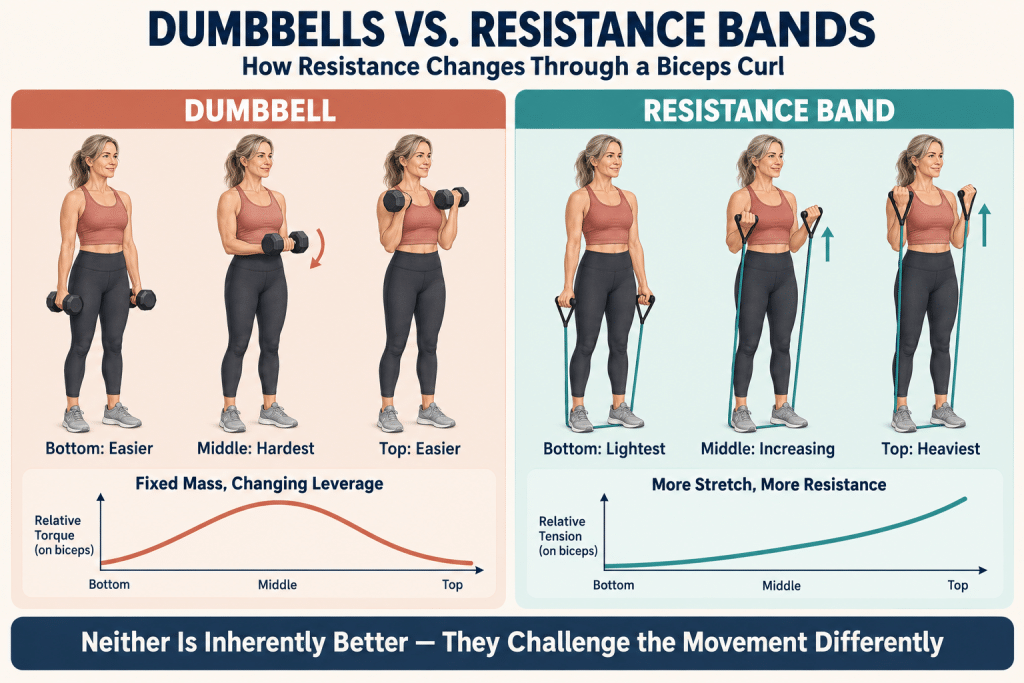
A resistance band works differently. Its resistance comes from elastic tension, which means the load is lowest when the band is slack and increases the further you stretch it, a pattern exercise scientists call variable or accommodating resistance. In that same bicep curl, a band gets progressively harder as you approach the top of the movement, the opposite pattern from a dumbbell.
Neither pattern is inherently superior. They’re just different, and that difference is the entire basis for every other distinction in this article: bands tend to underload the beginning of a movement and overload the end, while dumbbells load more evenly across a movement but can’t easily match a band’s ability to keep tension on a muscle through a full stretched position.
$200 Off All 2027 Early Bird Discount
Settle the mind, restore the body & soul back to health. Our deeply restorative 5-day retreat is for midlife women 40+ who are ready to receive abundance, feel rested, strong, clear & back in alignment with their intentions.
What Does the Research Show About Strength Gains?
Despite that mechanical difference, the strength research is fairly consistent on one point: for building measurable strength, especially for someone newer to resistance training, bands and free weights produce comparable results. A frequently cited study compared a short-term resistance program using elastic bands against one using standard weight machines in sedentary middle-aged women and found similar improvements in strength across both groups.
A separate meta-analysis comparing muscle activation during elastic-resistance exercises against traditional isotonic, or free-weight, exercises found broadly similar activation patterns across the muscle groups studied, reinforcing that a band-based program is a legitimate strength-training tool rather than a lesser substitute.
Where the two diverge more is at the higher end of a trained lifter’s strength curve. Once you’re strong enough that meaningful progress requires adding real, heavy load in small, controlled increments, dumbbells (and eventually barbells) make that progression easier to execute and track precisely: you know exactly how many pounds you added from one week to the next.
Bands can be progressed too, using thicker bands, doubling up bands, or combining a band with a dumbbell, but the resistance level is harder to quantify precisely, which matters less for a beginner and more as you advance.
Important: “Comparable strength gains” in the research generally refers to studies of weeks to a few months in sedentary or newly training populations. It’s not the same claim as “interchangeable forever regardless of training age,” and this article isn’t making that broader claim.
“The women who ask me this question are almost always comparing a hypothetical perfect dumbbell program to a hypothetical perfect band program. In real life, the equipment that actually gets used consistently beats the theoretically superior equipment gathering dust in a closet. That’s not a cop-out, it’s the single biggest factor in the research on adherence to any exercise program.”
Terry Tateossian, Founder of The House of Rose
How Do Resistance Bands & Dumbbells Compare for Bone Density?
This is the piece most comparison articles skip, and it matters more for women over 40 than general strength outcomes do. Bone responds to mechanical loading through a genuine biological signal, osteoblasts, the cells that build new bone, are activated by mechanical strain, and that strain needs to be reasonably high relative to what the bone normally experiences to trigger meaningful adaptation, a principle sometimes called the minimum effective strain threshold.
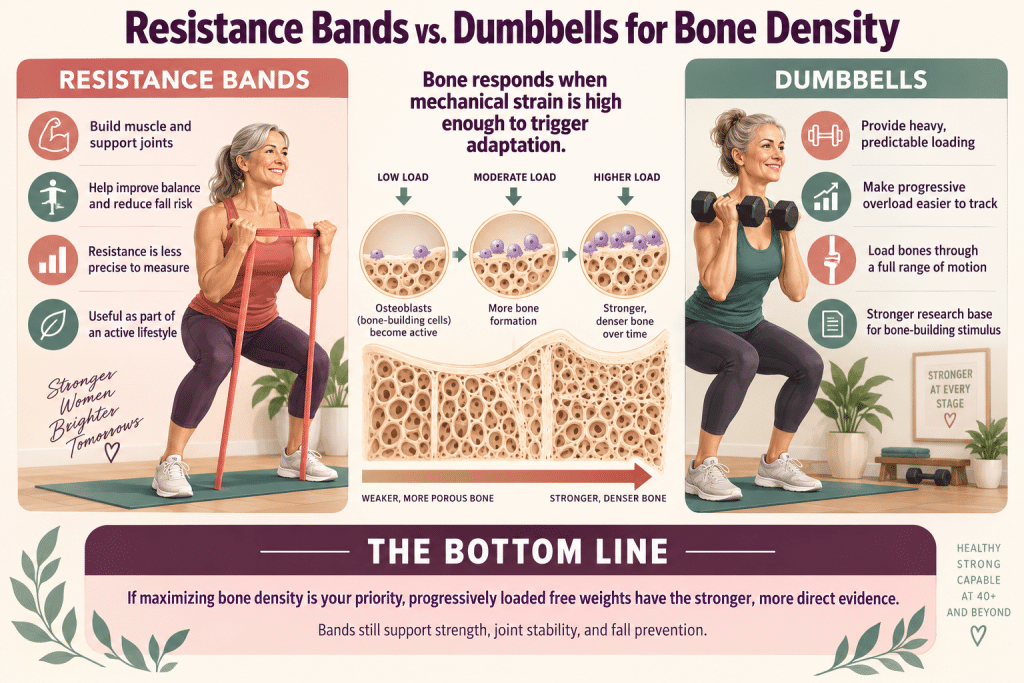
This is covered in more depth in 6 Exercises That Build Bone Density, which walks through the specific movements that apply. Here’s where the mechanical difference from Section 1 actually matters: dumbbells (and free weights generally) let you apply a heavy, predictable, progressively increasing load through a full range of motion, which is the pattern most consistently associated with osteogenic, or bone-building, stimulus in the resistance training research.
Bands can absolutely contribute to bone health as part of a broader active lifestyle, and they’re truly valuable for building the muscular strength that supports joints and reduces fall risk. But for the specific goal of maximizing bone-building mechanical stimulus, heavy, progressively loaded free-weight training has the stronger and more direct research base behind it. If bone density is your top priority, this is the deciding factor.
$200 Off All 2027 Early Bird Discount
Settle the mind, restore the body & soul back to health. Our deeply restorative 5-day retreat is for midlife women 40+ who are ready to receive abundance, feel rested, strong, clear & back in alignment with their intentions.
How Do Resistance Bands and Dumbbells Compare Head-to-Head?
| Factor | Resistance Bands | Dumbbells |
|---|---|---|
| Cost | Low ($15-$40 for a full set) | Moderate to high, scales with weight range |
| Portability | Excellent, fits in a bag | Limited, heavier sets are not travel-friendly |
| Space required | Minimal | Grows with the weight range you own |
| Joint stress | Generally lower, resistance builds gradually | Can be higher at heavier loads without good form |
| Progressive overload precision | Harder to quantify exactly | Easy to track in exact pounds |
| Bone-building stimulus | Moderate, supportive | Stronger, especially at heavier loads |
| Best for beginners | Excellent starting point | Excellent starting point, needs a small weight range |
| Best for advanced lifters | Useful as an accessory tool | Necessary for continued progression |
| Versatility for travel/home | Very high | Moderate to low depending on set size |
Who Should Choose Resistance Bands or Dumbbells?
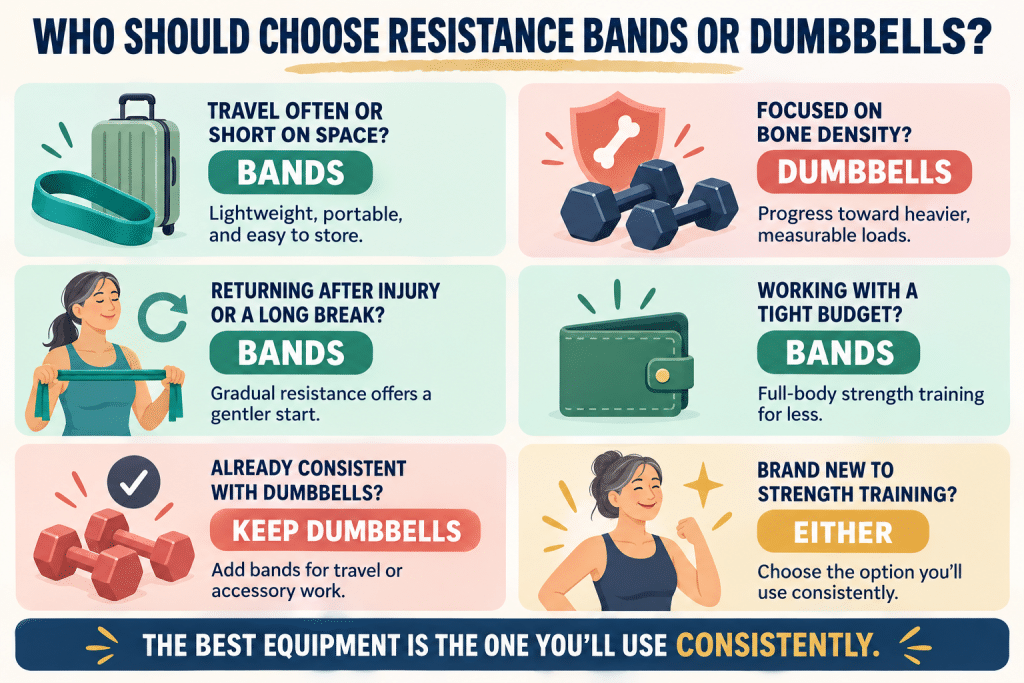
- If you travel often or have very limited space: Bands are the more practical choice. A full resistance-band set weighs under a pound and fits in a carry-on, which matters more for actual consistency than any theoretical strength advantage dumbbells might offer, since the best program is the one you actually do.
- If bone density is your primary concern: Prioritize dumbbells, and plan to progress toward real, heavy loads over time, the pattern most directly tied to osteogenic stimulus described in Section 3. Bands can supplement this work but shouldn’t replace it if bone health is the main goal.
- If you’re rebuilding strength after an injury or a long break from training: Bands are often the gentler starting point, since the resistance builds gradually through the range of motion rather than presenting a fixed load from the first inch of movement. Many physical therapists use bands for exactly this reason.
- If budget is the deciding factor: Bands deliver comparable strength-building value for a fraction of the cost of a full dumbbell set, based on the research in Section 2.
- If you already have a consistent dumbbell habit: There’s no research-backed reason to switch, and adding bands as a travel or accessory tool rather than a replacement is a reasonable next step.
- If you’re brand new to resistance training entirely: Either option is a legitimate starting point, and the research in Section 2 suggests you’ll see comparable early strength gains from either. The equipment that gets you training consistently for the next three months matters more than which one you pick today.
$200 Off All 2027 Early Bird Discount
Settle the mind, restore the body & soul back to health. Our deeply restorative 5-day retreat is for midlife women 40+ who are ready to receive abundance, feel rested, strong, clear & back in alignment with their intentions.
How Can You Progress Using Both?
| Week | Focus | Bands | Dumbbells |
|---|---|---|---|
| 1-2 | Learn the movement patterns | Squats, rows, presses with light-to-medium band | Bodyweight or very light dumbbells, focus on form |
| 3-6 | Build consistency | Increase band tension as movements feel easy | Add dumbbells for the same movement patterns, moderate weight |
| 7-12 | Progressive overload | Use bands for higher-rep accessory work | Prioritize dumbbells for primary lifts, add weight incrementally |
| Ongoing | Combined training | Bands for travel days and joint-friendly variations | Dumbbells for your main strength-focused sessions |
What Are Your Next Steps?
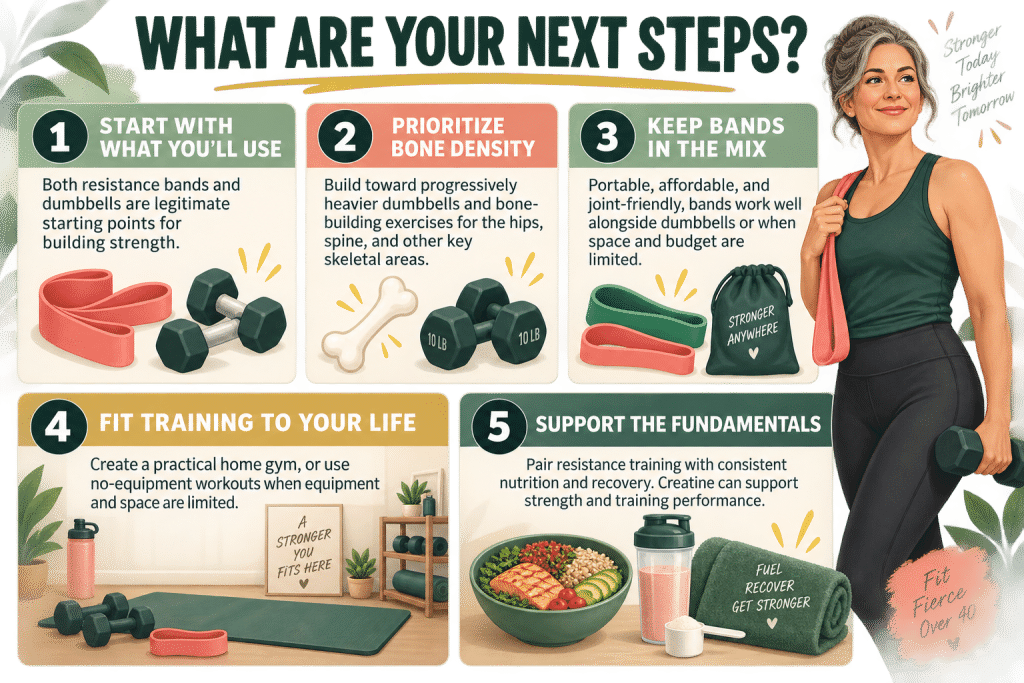
- Start with whichever equipment you’ll actually use consistently: Based on the research in Section 2, both resistance bands and dumbbells can provide a legitimate starting point for building strength.
- Prioritize dumbbells if bone density is a top concern: Build toward progressively heavier loads over time, and use bone-building exercises that place meaningful resistance through the hips, spine, and other key skeletal areas.
- Use bands as your travel and joint-friendly option: Resistance bands are portable, inexpensive, and easy to adjust, making them useful alongside dumbbells or as your primary tool when space, budget, or joint comfort limits other options.
- Build a setup that fits your actual life: A thoughtfully designed home gym can make consistent strength training easier, but you can also build strength with no-equipment workouts when equipment or space is limited.
- Support your training with the fundamentals: Consistent nutrition and recovery matter alongside resistance work. Adding creatine can support strength and training performance, while THOR’s supplement collection provides additional options for supporting broader midlife nutrition needs.
$200 Off All 2027 Early Bird Discount
Settle the mind, restore the body & soul back to health. Our deeply restorative 5-day retreat is for midlife women 40+ who are ready to receive abundance, feel rested, strong, clear & back in alignment with their intentions.
Frequently Asked Questions
Are resistance bands as effective as dumbbells?
For building measurable strength, especially for beginners, research shows comparable results between the two. They diverge more for advanced lifters and for maximizing bone-building stimulus, where dumbbells have the stronger research base.
Can resistance bands build muscle as well as weights?
Yes, particularly for newer trainees. A study comparing elastic band training to weight-machine training in middle-aged women found similar strength improvements across both groups.
Do resistance bands help with bone density?
They can contribute as part of a broader strength-training routine, but heavy, progressively loaded free-weight training has a stronger direct research base for maximizing bone-building mechanical stimulus.
What’s the main difference between how bands and dumbbells load a muscle?
Dumbbells provide a constant load throughout a movement, with your mechanical advantage changing as you move. Bands provide variable resistance, getting progressively harder as the band stretches further. Section 1 covers this in depth.
Which is better for beginners?
Either is a legitimate starting point. Bands tend to be gentler on joints since resistance builds gradually, while dumbbells make it easier to track your progress in exact weight increments.
Which is better for travel?
Resistance bands, without much competition. A full set weighs under a pound and fits easily in a bag, while a useful dumbbell range takes up real space and weight.
Can I get a full workout with just resistance bands?
Yes. Bands can train every major muscle group effectively, particularly for general strength, muscular endurance, and joint-friendly training.
How much should I spend on resistance bands vs dumbbells?
A full resistance band set typically runs $15 to $40. A useful dumbbell range, several pairs covering light to moderately heavy weights, usually costs more and requires more space, though it’s a one-time investment that lasts for years.
Do bands cause less joint stress than dumbbells?
Generally, yes, since band resistance builds gradually rather than presenting a fixed load immediately, though proper form matters more than equipment choice for joint safety either way.
Can I combine bands and dumbbells in the same workout?
Yes, and many effective programs do exactly this, using dumbbells for primary strength work and bands for accessory movements, warm-ups, or joint-friendly variations.
At what point should I switch from bands to dumbbells, or add dumbbells?
When band progressions (thicker bands, doubling bands) start feeling awkward to manage, or when you want more precise control over exactly how much weight you’re adding week to week, dumbbells become the more practical tool.
Is it true that bands are just for physical therapy, not real strength training?
No. While bands are commonly used in physical therapy for their gradual resistance curve, the research in Section 2 shows they produce real, measurable strength gains, not just rehabilitation-level benefit.
What if I have wrist or joint pain with either option?
Bands often feel more comfortable for sensitive joints due to their gradual resistance curve, but check with a physical therapist or trainer about proper form and whether a specific movement pattern, rather than the equipment itself, is the source of discomfort.
Do I need different resistance levels of bands, like a dumbbell set has different weights?
Yes. A single band tension quickly becomes too easy as you get stronger, so a set with multiple resistance levels (or the ability to combine bands) serves the same progressive-overload purpose that a range of dumbbell weights does.
I write 3 essays per week on Lifestyle Medicine for women in midlife on what is happening in the body and what to do about it. No fluff, no hype. Free Subscription.
References
- Colado, J.C., & Triplett, N.T. (2008). Effects of a Short-Term Resistance Program Using Elastic Bands Versus Weight Machines for Sedentary Middle-Aged Women. Journal of Strength and Conditioning Research, 22(5), 1441-1448.
- Aboodarda, S.J., Page, P.A., & Behm, D.G. (2016). Muscle Activation Comparisons Between Elastic and Isotonic Resistance: A Meta-Analysis. Clinical Biomechanics, 39, 52-61.
- Layne, J.E., & Nelson, M.E. (1999). The Effects of Progressive Resistance Training on Bone Density: A Review. Medicine & Science in Sports & Exercise, 31(1), 25-30.
- American College of Sports Medicine. (2009). Progression Models in Resistance Training for Healthy Adults. Medicine & Science in Sports & Exercise, 41(3), 687-708.
- Kraemer, W.J., & Ratamess, N.A. (2004). Fundamentals of Resistance Training: Progression and Exercise Prescription. Medicine & Science in Sports & Exercise, 36(4), 674-688.
- Melo, D.S., Gomes, A.L., et al. (2018). Comparative Effects of Resistance Training With and Without Elastic Bands on Muscle Strength in Older Adults. European Review of Aging and Physical Activity.
- Frost, H.M. (2003). Bone’s Mechanostat: A 2003 Update. The Anatomical Record Part A, 275(2), 1081-1101.
- National Osteoporosis Foundation. Exercise for Strong Bones.
- Westcott, W.L. (2012). Resistance Training Is Medicine: Effects of Strength Training on Health. Current Sports Medicine Reports, 11(4), 209-216.
Disclaimer: This article is educational and does not constitute medical or fitness advice. Resistance bands and dumbbells both require proper form, appropriate resistance, and gradual progression. If you have osteoporosis, low bone density, joint problems, cardiovascular concerns, chronic pain, a recent injury, or another medical condition that may affect exercise safety, consult a qualified healthcare provider or physical therapist before starting or significantly changing your resistance-training routine.
$200 Off All 2027 Early Bird Discount
Settle the mind, restore the body & soul back to health. Our deeply restorative 5-day retreat is for midlife women 40+ who are ready to receive abundance, feel rested, strong, clear & back in alignment with their intentions.

Terry Tateossian is a Menopause Lifestyle Medicine Coach, Certified Personal Trainer & Nutritionist and the Founder of THOR: The House of Rose, a wellness brand serving women over 40 through retreats, coaching, macro-nutrition and community. As 25-year founder and entrepreneur, Terry spent two and a half decades building and running successful start-up businesses, an experience that put her on the front line of founder burnout long before she could name it. After facing serious health challenges, early onset menopause, and emotional eating while running her agency and raising two children, Terry rebuilt her health in her 40s and lost more than 80 pounds through evidence-based nutrition, training, and mindset work. Today, she helps women get strong, improve confidence, support hormone health, and create a stronger second half of life. Terry has been featured in major media outlets and is available for podcasts, expert commentary, brand collaborations, and speaking engagements on midlife health, reinvention, emotional eating, menopause wellness, and strength training for longevity. Get her free macro calculator (her cookbook companion) to start your journey to back to health.