
 By Team THOR
Free 28-Day Fascia Reset Email Course
Get our Free 28-day email course series to help with 1 or 2 exercises per day to release your fascia. One short lesson per day. Two minutes to read each.
How to Increase Bone Density After 40: 6 Exercises That Work (Videos)
Denise’s mother broke her hip getting out of a bathtub. No stairs. No major fall. Her foot caught the mat, and at sixty-eight, an emergency-room X-ray revealed bone loss that had been progressing quietly for years.
Denise is fifty-one now, and her own DEXA scan shows osteopenia at the hip. She was told to do “weight-bearing exercise,” so she started walking more. A good start, but not a complete plan.
Bone is constantly remodeling. During the menopause transition, falling estrogen can allow bone breakdown to outpace bone formation, increasing the importance of exercise that gives the skeleton enough mechanical stimulus to adapt.
And not all movement does that equally. Walking supports cardiovascular health, but on its own, it usually does not provide enough load to meaningfully improve bone density. This guide covers six exercise categories supported by research, how they load bone, and how to progress them safely over time.
Important: This article is educational and does not replace individualized medical advice. Women with osteoporosis, a prior fragility fracture, or significant balance concerns should speak with a physician or physical therapist before starting a new exercise program, especially higher-impact exercise.
Why Doesn’t Walking Alone Build Bone?
Bone responds to mechanical strain above its accustomed working range, a concept researchers call the mechanostat. Below a certain threshold of strain, a movement maintains bone. Above that threshold, bone adapts by adding density.
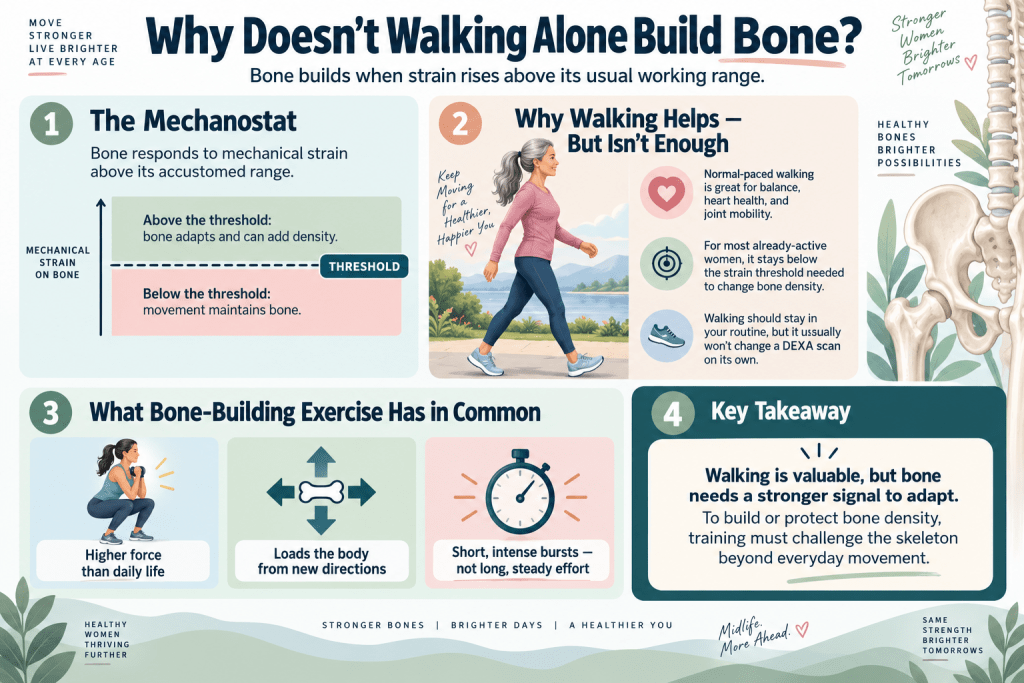
Walking at a normal pace, for most already-active women, sits below that threshold. It’s excellent for balance, cardiovascular health, and joint mobility, and it should stay part of any weekly routine, but it isn’t the lever that changes a DEXA scan on its own.
The exercises that do change bone density share three features: they load the skeleton with more force than daily life requires, they load it from directions the body isn’t used to, and they load it in short, intense bursts rather than long, steady efforts. The six categories below cover all three.
“I hear ‘I already walk 10,000 steps a day, isn’t that enough?’ constantly in coaching sessions. Walking is a wonderful habit and I’ll never discourage it, but if bone density is the specific goal, walking needs a partner, not a replacement. I learned this the hard way managing my own bone health after an early menopause diagnosis at 41. Cardio alone did nothing for my scan. Loading did.”
Terry Tateossian, Founder of The House of Rose
What Are the 6 Best Exercises for Building Stronger Bones After 40?
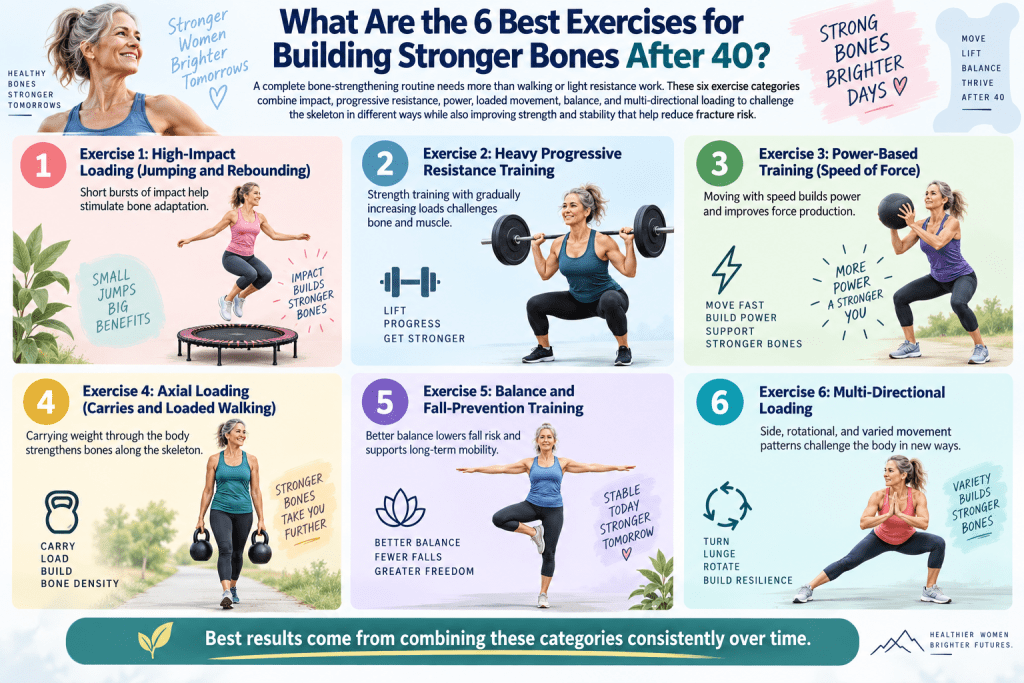
A complete bone-strengthening routine needs more than walking or light resistance work. These six exercise categories combine impact, progressive resistance, power, loaded movement, balance, and multi-directional loading to challenge the skeleton in different ways while also improving the strength and stability that help reduce fracture risk.
Exercise 1: High-Impact Loading (Jumping and Rebounding)
Why It Works
Ground reaction force, the force that travels back up through the skeleton on landing, is one of the most direct bone-building stimuli available. Jumping and rebounding generate that force in a low-injury-risk way because the landing is absorbed across both legs and, on a rebounder, across a surface with some give.
How to Do It
- Start with 10-20 small jumps or rebounder bounces, feet staying close to the mat or floor
- Progress to jumping jacks, higher-amplitude rebounder bounces, or jump rope as tolerance builds
- Aim for 2-3 sessions per week, 5-10 minutes per session
- Land softly through the whole foot, not just the toes, to protect the ankles and knees
Research on jump training protocols in postmenopausal women has found measurable hip bone density improvements from as few as 10-20 jumps performed several times per week over multiple months, with minimal injury risk when landings were performed correctly.
Important: Women with a current osteoporosis diagnosis, a recent fracture, or significant knee or hip joint damage should get clearance from a physician before beginning any jumping or rebounding protocol.
For a gradual progression from gentle health bounces to longer rebounder sessions, THOR’s rebounding guide provides a structured starting point for women in midlife.
Why Does the Rebounder Specifically Work for Sensitive Joints?
A mini trampoline absorbs a portion of the landing force before it reaches the joints, which lowers impact on the knees and hips relative to jumping on a hard floor while still generating enough ground reaction force to register as a bone-loading stimulus. This makes it a reasonable starting point for women who want the impact-loading benefit without the joint stress of running or floor-based jumping.
Free 28-Day Fascia Reset Email Course
Get our Free 28-day email course series to help with 1 or 2 exercises per day to release your fascia. One short lesson per day. Two minutes to read each.
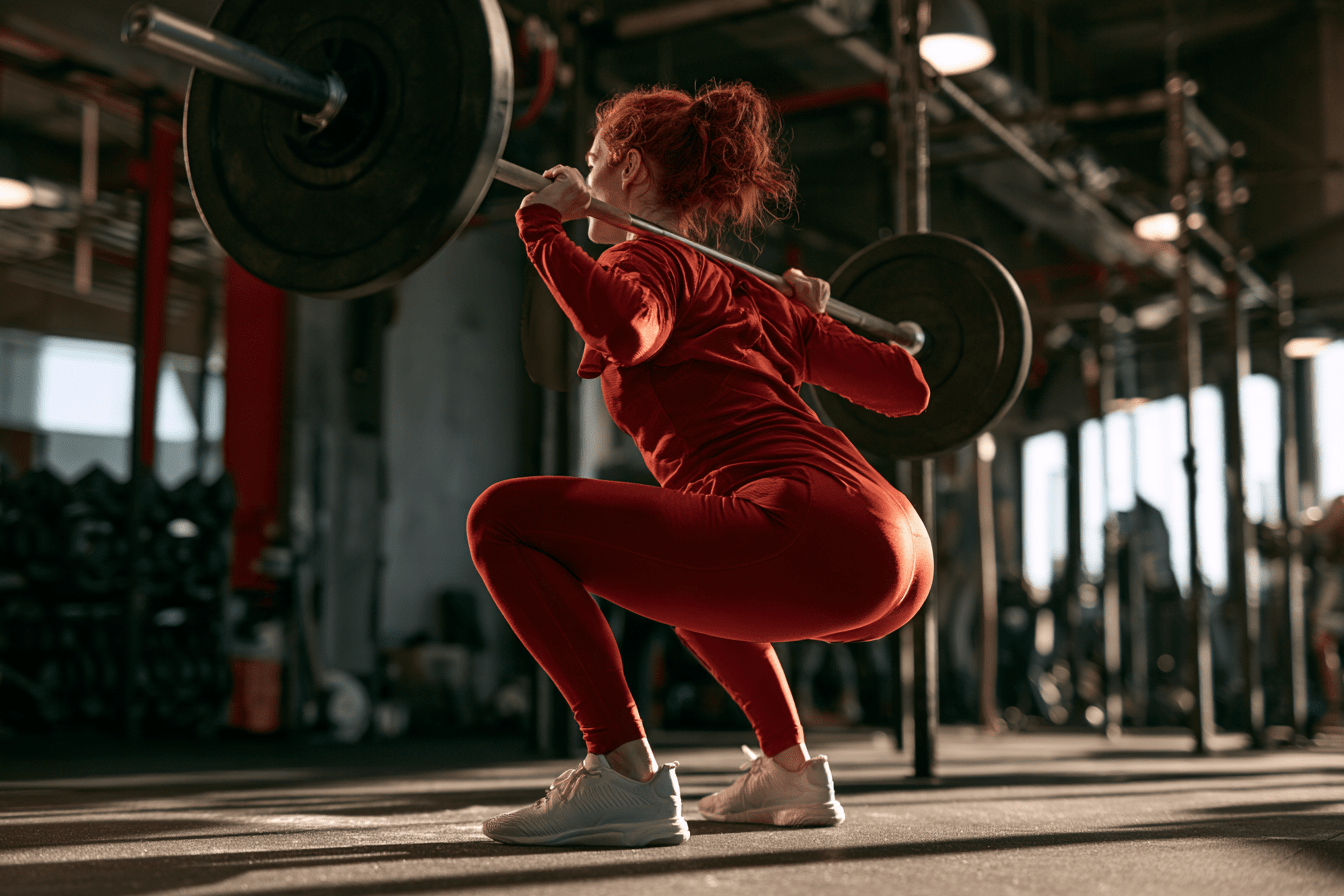
Exercise 2: Heavy Progressive Resistance Training
Why It Works
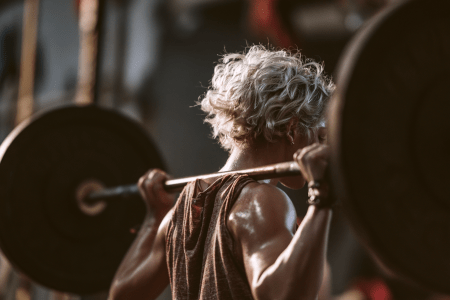
Muscle attaches to bone through tendon, and every contraction pulls on that attachment point. Heavier loads recruit more muscle fibers and pull harder on bone, which is why resistance training with real, progressively increasing weight outperforms light-weight, high-repetition training for bone density specifically.
How to Do It
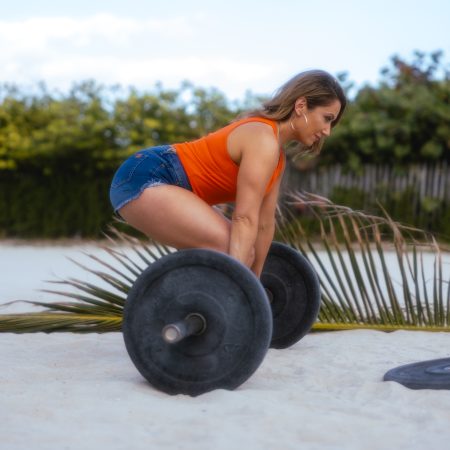
- Focus on compound, multi-joint movements: squats, deadlift patterns, rows, presses
- Work in the 6-10 repetition range with a weight that feels truly challenging by the last 2 reps
- Progress load every 2-3 weeks as the current weight starts to feel easier
- Train 2-3 times per week, allowing 48 hours between sessions for the same muscle groups
A weight that feels “fine” for 15 easy repetitions isn’t doing the same job on bone as a weight that makes rep 8 hard. This is one of the most common mistakes in home workout routines: not lifting heavy enough to register as a novel stimulus.
Creatine monohydrate can help support the strength and training adaptations that make resistance exercise more effective, indirectly strengthening the bone-loading side of the equation.
For a deeper look at the research, dosing, and midlife-specific benefits, THOR’s guide to creatine for women over 40 breaks down the evidence, while Thorne Creatine provides a straightforward creatine monohydrate option for adding it to your daily routine.
Worked Example: Choosing a Starting Weight
|
Woman |
Current Fitness |
Starting Squat Load |
Target Rep Range |
|
New to resistance training |
Never lifted weights |
Bodyweight or empty barbell (bar only) |
8-10 reps, focus on form |
|
Some experience |
Lifts occasionally, unsure of loads |
Weight that feels moderate for 12 reps |
8-10 reps, add 5 lbs when easy |
|
Regular lifter |
Trains 2x/week already |
Weight that’s truly hard by rep 8 |
6-8 reps, progressive overload |
|
Load Approach |
Typical Rep Range |
Bone-Building Signal |
|
Light resistance bands, high reps |
15-25 reps |
Low, insufficient mechanical strain |
|
Moderate dumbbells, muscle endurance focus |
12-15 reps |
Low to moderate |
|
Heavy compound lifts, progressive overload |
6-10 reps |
High, this is the target zone |
|
Bodyweight only, no added load |
Varies |
Low unless combined with impact or power work |
Free 28-Day Fascia Reset Email Course
Get our Free 28-day email course series to help with 1 or 2 exercises per day to release your fascia. One short lesson per day. Two minutes to read each.
Exercise 3: Power-Based Training (Speed of Force)
Why It Works
Power, defined as force produced quickly rather than slowly, appears to matter for bone and for fall prevention in a way that slow strength training alone doesn’t fully replicate. Moving a weight or your own bodyweight explosively, even a small amount of weight, creates a different rate of loading on bone than moving it slowly.
How to Do It
- Sit-to-stand transfers: Perform as quickly as control allows, 3 sets of 8-10.
- Step-ups: Perform with an explosive push off the working leg, 3 sets of 8 per side.
- Medicine ball chest passes: Perform against a wall, 3 sets of 10, focusing on speed of release.
- Begin with bodyweight versions: Progress to external load once control and technique are established.
This category is frequently skipped entirely in midlife fitness routines because it looks less like traditional “toning” work, but the missing piece is often speed, not weight.
Understanding the difference between power and strength helps explain why lifting heavier is only part of the equation. Power training focuses on producing force quickly, which supports faster reactions, more responsive movement, and the ability to recover from an unexpected stumble.
“Clients are often surprised that ‘explosive’ doesn’t mean advanced or dangerous. A sit-to-stand performed a little faster than usual, with good form, is a completely appropriate starting point. I’ve coached hundreds of women through this exact progression, and the ones who stick with power work are almost always the ones who feel steadiest walking down stairs a few months later.”
Terry Tateossian, Founder of The House of Rose
Exercise 4: Axial Loading (Carries and Loaded Walking)
Why It Works
Carrying weight while walking loads the spine and hips through a vertical, compressive path, which is exactly the direction hip and spine fractures tend to occur from bone weakness. This category is under-used in most fitness programming despite being simple to add to an existing walking habit.
How to Do It
- Farmer’s carries: Hold a moderately heavy dumbbell or kettlebell in each hand, walk 30-40 steps, rest, and repeat for 3-4 rounds.
- Weighted vest walking: Start with 5-10% of bodyweight added and walk your normal route.
- Single-arm suitcase carries: Use these to add a rotational stability demand.
- Progress load gradually: Increase the load the same way as any resistance exercise.
Worked Example
A 150-pound woman starting weighted vest walking might begin with a 10-12 pound vest for two 20-minute walks per week, adding roughly 2-3 pounds every few weeks as the current load stops feeling challenging by the walk’s second half.
|
Bodyweight |
Starting Vest Load (5-8%) |
Progression Pace |
|
130 lbs |
7-10 lbs |
+2 lbs every 3-4 weeks |
|
150 lbs |
8-12 lbs |
+2-3 lbs every 3-4 weeks |
|
170 lbs |
9-14 lbs |
+3 lbs every 3-4 weeks |
Free 28-Day Fascia Reset Email Course
Get our Free 28-day email course series to help with 1 or 2 exercises per day to release your fascia. One short lesson per day. Two minutes to read each.
Exercise 5: Balance and Fall-Prevention Training
Why It Works
Bone density is only half of fracture risk. The other half is whether a fall happens at all. Balance training doesn’t build bone directly, but it reduces the single largest risk factor for the fractures that bone density work is trying to prevent, which makes it inseparable from a real bone health plan.
How to Do It
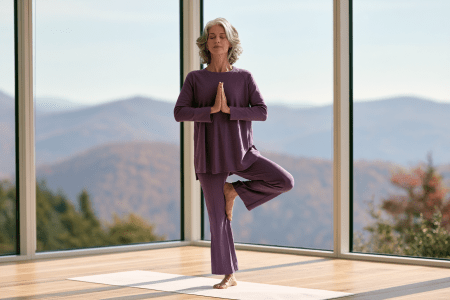
- Single-leg stance: Work toward 30 seconds per side without support.
- Tandem walking: Walk heel-to-toe across a room for 3-4 passes.
- Standing on an unstable surface: Use a folded towel or balance pad while holding light support.
- Practice near a counter or wall: Use nearby support for safety as difficulty increases.
THOR has a full testing and improvement protocol at Single-Leg Stance Test for Women Over 40, including how to track progress over time.
Why Does Balance Training Belong in a Bone Density Article?
It’s tempting to treat balance work as a separate category from “real” bone-building exercise, but the research on fracture prevention treats fall risk and bone strength as two sides of the same equation. A woman with excellent bone density who falls hard still fractures. A woman with lower bone density who never falls often doesn’t. Both matter, and neither replaces the other.
Exercise 6: Multi-Directional Loading
Why It Works
Most daily movement and most traditional exercise happens in a single plane, forward and back. Bone that’s only ever loaded in one direction adapts to that one direction and stays vulnerable to forces from the side, which is how many hip fractures actually happen, from a sideways stumble rather than a forward fall.
How to Do It
- Lateral lunges: Perform 2-3 sets of 8-10 per side.
- Diagonal step-and-reach patterns: Step at a 45-degree angle while reaching the opposite arm.
- Side-stepping with a resistance band: Place the band around the ankles and perform 2-3 sets of 10 steps in each direction.
- Curtsy lunges: Add these once basic lateral lunges feel controlled.
Muscle groups that support these multi-directional movements, particularly the hip abductors and rotators, are covered in Muscles That Matter Most for Aging Well.
Free 28-Day Fascia Reset Email Course
Get our Free 28-day email course series to help with 1 or 2 exercises per day to release your fascia. One short lesson per day. Two minutes to read each.
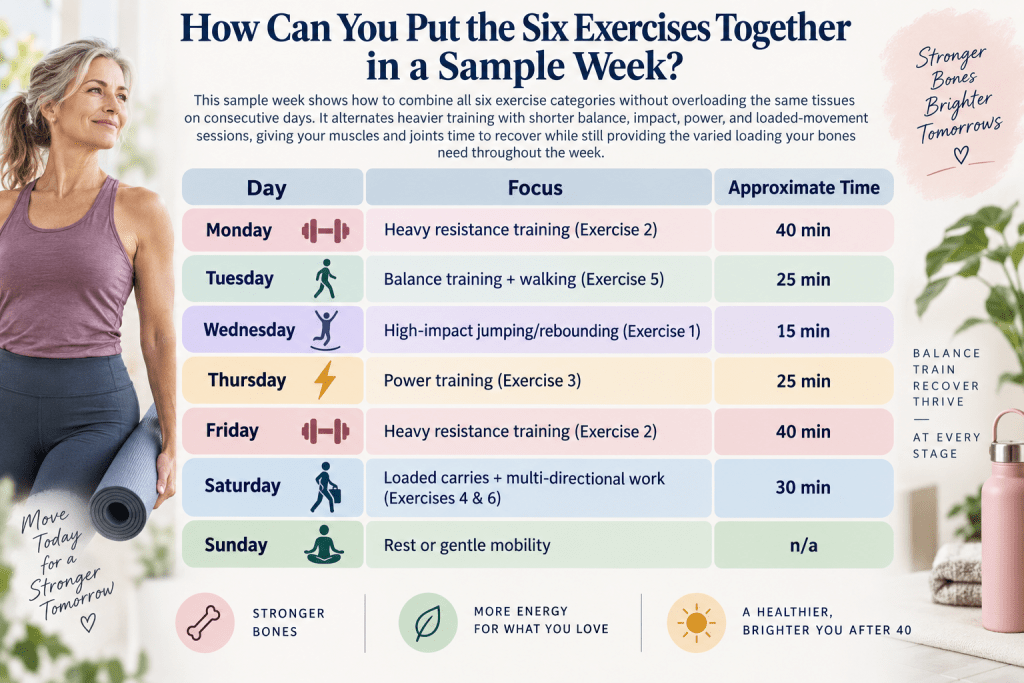
How Can You Put the Six Exercises Together in a Sample Week?
|
Day |
Focus |
Approximate Time |
|
Monday |
Heavy resistance training (Exercise 2) |
40 min |
|
Tuesday |
Balance training + walking (Exercise 5) |
25 min |
|
Wednesday |
High-impact jumping/rebounding (Exercise 1) |
15 min |
|
Thursday |
Power training (Exercise 3) |
25 min |
|
Friday |
40 min |
|
|
Saturday |
Loaded carries + multi-directional work (Exercises 4 & 6) |
30 min |
|
Sunday |
Rest or gentle mobility |
n/a |
This isn’t the only way to sequence these six categories, but it spaces heavy resistance days 48 hours apart and keeps impact work to days when joints feel fresh.
“I tell clients to think of this as a rotation, not a checklist to finish in one workout. Two categories done well on a given day beats all six done poorly. That’s the same principle I build every retreat program around at our Smoky Mountain property: fewer things, done with real intent, beats a packed schedule nobody can sustain once they go home.”
Terry Tateossian, Founder of The House of Rose
What Does the Research Actually Show?
Bone density research in midlife and postmenopausal women consistently points toward a few conclusions worth stating plainly, without overselling them:
- Multi-component programs: Combining resistance training, impact loading, and balance work shows more consistent bone density benefits at the hip and spine than any single exercise type alone.
- Loss rates during the menopause transition: These are real and measurable, but exercise-based interventions have shown the ability to slow that loss and, in some studies, modestly increase density at specific sites, particularly the hip.
- Consistency over months and years: This matters more than any single “best” exercise. Bone remodeling is slow, and meaningful DEXA-detectable change typically takes 6-12 months of consistent training, not weeks.
- Exercise does not replace medical evaluation: For women already diagnosed with osteoporosis, it’s a complement to, not a substitute for, whatever a physician recommends based on individual fracture risk and bone density scores.
Nutrition also plays a supporting role alongside training. Adequate protein intake supports the muscle side of the muscle-bone connection, and THOR’s free macro calculator can help set a personalized protein target to train against.
Free 28-Day Fascia Reset Email Course
Get our Free 28-day email course series to help with 1 or 2 exercises per day to release your fascia. One short lesson per day. Two minutes to read each.
When Should You Talk to a Doctor Before Starting?
A DEXA scan showing osteoporosis, a prior fragility fracture, significant balance problems, or any new pain during exercise are all reasons to loop in a physician or physical therapist before starting a program like this one, particularly the high-impact and power categories.
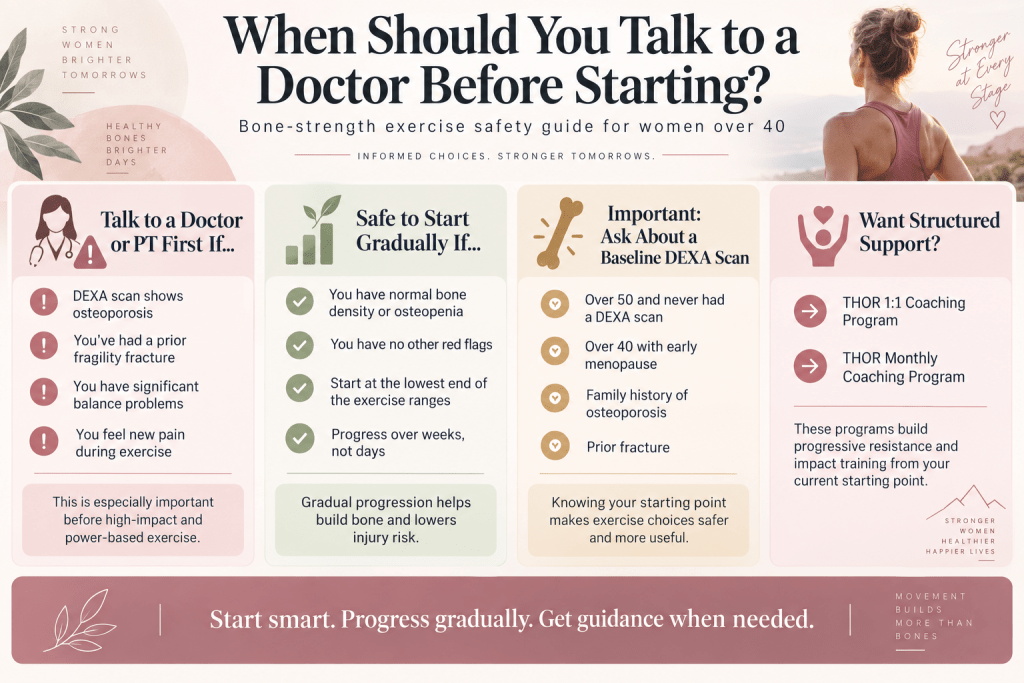
For women with normal bone density or osteopenia and no other red flags, these categories are generally considered safe to begin gradually, but “gradually” is doing real work in that sentence. Starting at the lowest end of any of the ranges above and progressing over weeks, not days, is the difference between building bone and getting hurt.
Important: If you have never had a DEXA scan and are over 50, or over 40 with early menopause, a family history of osteoporosis, or a prior fracture, ask your doctor whether a baseline scan makes sense before starting a new training program. Knowing your starting point makes every exercise choice in this article more useful.
What Are Your Next Steps?
- If you’re over 50, or over 40 with early menopause or a family history of osteoporosis, ask your doctor about a baseline DEXA scan before starting.
- Pick two of the six exercise categories to start with this week, ideally one resistance-based and one impact or balance-based.
- Use THOR’s free macro calculator to set a protein target that supports the muscle-bone connection.
- Build toward the sample week above over 4-6 weeks, adding one category at a time rather than all six at once.
- Revisit this article every few months to check your progression against the load and rep ranges listed for each exercise.
Building bone density is not a single workout, it’s a rotation practiced consistently over months. For a done-for-you approach to structuring these six categories into a weekly plan tailored to your current fitness level, THOR’s 1:1 coaching program builds progressive resistance and impact training safely from wherever you’re starting.
Supporting nutrients for bone health, including calcium, vitamin D, and vitamin K2, are covered in THOR’s Advanced Bone Support formula, and pairing a training plan with real food is easiest with THOR’s Macro Miracle Mediterranean Cookbook, which was built around the same protein-forward approach this article recommends.
If you’re weighing a longer-term reset, THOR’s women’s yoga retreats build guided strength and movement programming, including several of the six categories above, into a supported week away.
Important: This article is educational and does not replace individualized medical advice. Please consult a physician before beginning a new exercise program, especially if you have an existing bone density diagnosis, a prior fracture, or a cardiovascular or joint condition.
Free 28-Day Fascia Reset Email Course
Get our Free 28-day email course series to help with 1 or 2 exercises per day to release your fascia. One short lesson per day. Two minutes to read each.
Frequently Asked Questions
Can you really increase bone density after 40, or only slow the loss?
Both are possible, though slowing loss is the more common and more reliably documented outcome. Increases in bone density have been shown in research at specific sites, most consistently the hip, with consistent multi-component training over 6-12 months or longer.
Is rebounding as good as running for bone density?
Rebounding provides meaningful ground reaction force with lower impact on the joints than running on pavement, making it a reasonable substitute for women with joint concerns. Running on a hard surface may provide a stronger stimulus for some, but the injury tradeoff should factor into the decision.
How long before I’d see a difference on a DEXA scan?
Most research protocols run 6-12 months before rescanning, since bone remodeling is a slow process. A single month of consistent training won’t show up on a scan, but it’s still the month that starts the process.
Do I need weights, or can bodyweight exercises build bone density?
Bodyweight exercise can work for the impact and power categories (jumping, sit-to-stand speed work), but the heavy resistance category generally requires external load, since bodyweight alone stops providing a new stimulus once a woman is already strong enough to perform the movement easily.
Is walking with a weighted vest enough on its own?
It’s a strong addition to a walking habit and covers the axial loading category well, but it works best alongside resistance training and impact work rather than as a complete stand-alone bone density program.
What’s the difference between osteopenia and osteoporosis?
Osteopenia is a bone density measurement lower than normal but not low enough to meet the diagnostic threshold for osteoporosis. It’s often described as an early warning stage where lifestyle intervention, including the exercises in this article, has the most opportunity to change the trajectory before density drops further.
Can I do these exercises if I already have osteoporosis?
Some can be adapted, but high-impact jumping and certain power movements may need modification or physician clearance first, particularly if there’s been a prior fragility fracture. A physical therapist familiar with osteoporosis exercise guidelines can help tailor the six categories safely.
Does menopause hormone therapy affect how much exercise helps?
Hormone therapy addresses the estrogen side of bone loss directly, while exercise addresses the mechanical loading side. The two work through different pathways and are generally considered complementary rather than substitutes for one another, though any decision about hormone therapy should be made with a physician.
How many days a week is realistic for a beginner?
Three focused sessions a week, combining one resistance day, one impact or power day, and one balance-focused day, is a reasonable and sustainable starting point for someone new to structured bone-loading exercise.
Is it too late to start if I’m already in my sixties or seventies?
No. Research on exercise interventions in older postmenopausal women, including women in their seventies, has shown bone and fall-risk benefits from starting a structured program, though starting loads and progression pace should be more conservative and ideally supervised.
Do I need special equipment to get started?
A rebounder, a pair of moderate dumbbells, and a resistance band cover most of the six categories. None of it requires a full home gym, though a gym membership with access to a squat rack and heavier dumbbells allows more progression room over time.
What role does protein play in bone density specifically?
Protein supports the muscle mass that pulls on and loads bone during resistance and power training, making adequate intake a supporting factor rather than a direct bone-building mechanism on its own. THOR’s free macro calculator can help set a personalized target.
Should I do cardio at all if I’m focused on bone density?
Cardiovascular exercise remains important for heart health and should stay in a weekly routine, but it should sit alongside, not instead of, the six loading categories in this article if bone density is a specific goal.
Can supplements replace exercise for bone density?
No. Supplements such as calcium, vitamin D, and vitamin K2 support the raw materials bone needs to remodel, but without a mechanical loading stimulus from exercise, those raw materials have less signal telling the body where to direct them.
References
- Finkelstein, J.S., et al. “Bone mineral density changes during the menopause transition in a multiethnic cohort of women.” Journal of Clinical Endocrinology & Metabolism.
- Frost, H.M. “Bone’s mechanostat: a 2003 update.” The Anatomical Record.
- Bailey, C.A., & Brooke-Wavell, K. “Optimum frequency of exercise for bone health: randomised controlled trial of a high-impact unilateral intervention.” Bone.
- Multicomponent exercise interventions and bone mineral density outcomes in postmenopausal women, systematic review data.
- Watson, S.L., et al. “High-intensity resistance and impact training improves bone mineral density and physical function in postmenopausal women with osteopenia and osteoporosis: the LIFTMOR randomized controlled trial.” Journal of Bone and Mineral Research.
- Power training versus traditional strength training outcomes in fall risk and functional performance in older adults, comparative training studies.
- Farmer’s carry and axial loading biomechanics research on spinal and hip compressive load patterns.
- Sherrington, C., et al. “Exercise for preventing falls in older people living in the community.” Cochrane Database of Systematic Reviews.
- National Osteoporosis Foundation clinician’s guide to prevention and treatment of osteoporosis.
- Mayo Clinic patient education materials on osteoporosis exercise recommendations and safety guidelines.
- Cleveland Clinic patient education materials on bone density and weight-bearing exercise.
- Vainionpää, A., et al. “Effect of impact exercise on bone mineral density in premenopausal women: a 10-year follow-up study.” Osteoporosis International.
- Beck, B.R., et al. “Exercise and bone health in postmenopausal women.” Journal of Science and Medicine in Sport.
- Zhao, R., et al. “Efficiency of jumping exercise in improving bone mineral density among premenopausal women: a meta-analysis.” Sports Medicine.
- Giangregorio, L.M., et al. “Too Fit To Fracture: exercise recommendations for individuals with osteoporosis or osteoporotic vertebral fracture.” Osteoporosis International.
- National Institute on Aging patient guidance on exercise, balance, and fall prevention in older adults.
Disclaimer: This article is educational and does not constitute medical advice. Bone-loading exercises such as jumping, rebounding, heavy resistance training, power movements, and weighted carries require appropriate progression and may not be suitable for everyone. If you have osteoporosis, osteopenia with additional risk factors, a prior fragility fracture, significant balance problems, cardiovascular or joint conditions, or new pain with exercise, consult a physician or physical therapist before starting the framework in this article.
Free 28-Day Fascia Reset Email Course
Get our Free 28-day email course series to help with 1 or 2 exercises per day to release your fascia. One short lesson per day. Two minutes to read each.

Terry Tateossian is a Menopause Lifestyle Medicine Coach, Certified Personal Trainer & Nutritionist and the Founder of THOR: The House of Rose, a wellness brand serving women over 40 through retreats, coaching, macro-nutrition and community. As 25-year founder and entrepreneur, Terry spent two and a half decades building and running successful start-up businesses, an experience that put her on the front line of founder burnout long before she could name it. After facing serious health challenges, early onset menopause, and emotional eating while running her agency and raising two children, Terry rebuilt her health in her 40s and lost more than 80 pounds through evidence-based nutrition, training, and mindset work. Today, she helps women get strong, improve confidence, support hormone health, and create a stronger second half of life. Terry has been featured in major media outlets and is available for podcasts, expert commentary, brand collaborations, and speaking engagements on midlife health, reinvention, emotional eating, menopause wellness, and strength training for longevity. Get her free macro calculator (her cookbook companion) to start your journey to back to health.