
 By Team THOR
Free 28-Day Fascia Reset Email Course
Get our Free 28-day email course series to help with 1 or 2 exercises per day to release your fascia. One short lesson per day. Two minutes to read each.
Power vs Strength for Midlife Women: The Missing Piece of Fall Prevention (And the 5 Exercises That Build the Reflex That Saves You)
Strength is the amount of force your muscles can produce. Power is how quickly they can produce it. That difference matters more than it sounds. For midlife women, it can determine whether you recover from a stumble or end up on the ground.
Most strength programs focus on building force but overlook the speed needed to use that force when balance suddenly shifts. You can be strong, muscular, and capable in the gym and still lack the rapid response needed to stop a fall. The strength is there. What is missing is the ability to produce it fast enough when it counts.
Research on aging consistently shows that power declines faster than strength, often at roughly twice the rate across midlife and older adulthood. Women also tend to lose power faster than men. Neurological changes that affect rapid force production can appear before obvious muscle weakness, and the reflexive corrections that prevent falls depend more on fast force than maximal strength.
I am Terry Tateossian, founder of The House of Rose and a certified lifestyle medicine coach who runs nutrition-focused wellness retreats for women in perimenopause, menopause, and post-menopause in East Tennessee.
Power training is one of those missing pieces. This guide explains how power differs from strength, why it matters in midlife, how aging affects it, what the research says about fall prevention, how to assess your own power, five exercises that safely build it, and an eight-week progression designed to improve the reflexive capacity that helps keep you upright.
Important: Power training uses faster movements than traditional strength training and should be progressed carefully. If you have significant joint issues, cardiovascular concerns, balance problems, or recent injuries, consult a healthcare provider before starting. Build the foundation first and do not skip the progression.
What Is Power?
Understanding what power specifically means in physiological terms provides the foundation for the rest of the framework.
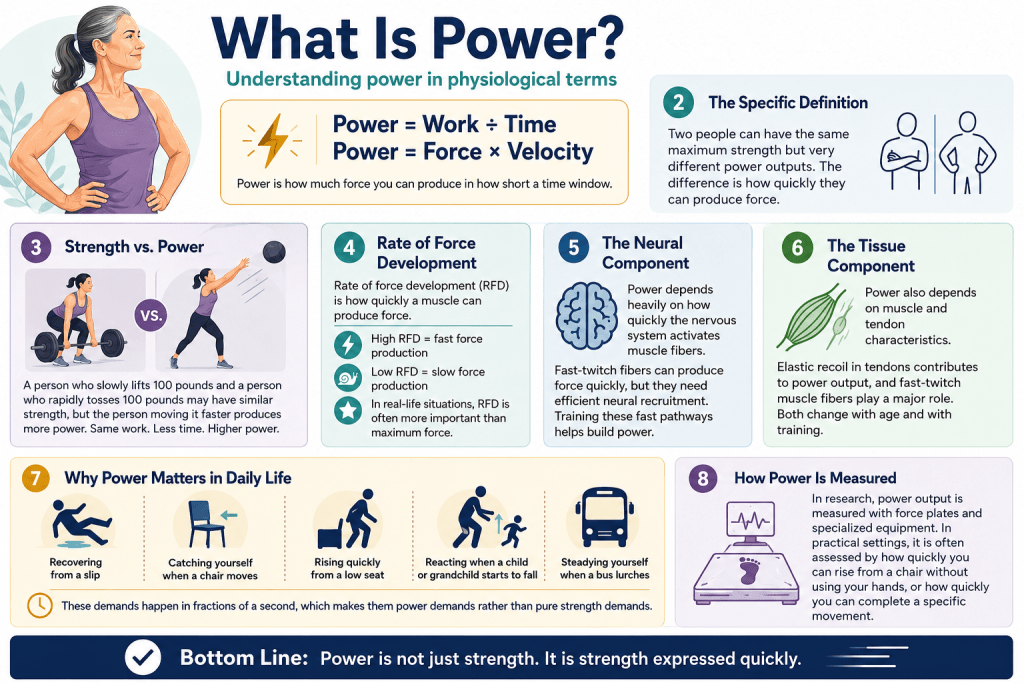
- The specific definition: Power is the amount of work done per unit of time, or force multiplied by velocity. In practical terms, power is how much force you can produce in how short a time window. Two people with the same maximum strength can have dramatically different power outputs based on how quickly they can produce that force.
- The physics analogy: A person who can slowly lift 100 pounds and a person who can rapidly toss 100 pounds have the same strength but very different power. The person tossing the weight is doing the same work in a shorter time, which means higher power output.
- The rate of force development: The technical term for how quickly a muscle can produce force is rate of force development. It is measured in force per unit of time. High rate of force development means fast force production. Low rate of force development means slow force production. In life-relevant situations, rate of force development is often more important than maximum force.
- The neural component: Power depends heavily on how quickly the nervous system can activate muscle fibers. Fast-twitch muscle fibers can produce force quickly but require specific neural signaling to be recruited efficiently. Training that specifically activates these fast neural pathways builds power.
- The tissue component: Power also depends on the specific characteristics of the muscle and tendon tissue. Elastic recoil in tendons contributes to power output. The specific fast-twitch muscle fiber population contributes to power. Both change with age and with training.
- The specific functional demands: Life presents situations that demand power on a regular basis. Recovering from a slip. Catching yourself when a chair moves unexpectedly. Rising quickly from a low seat. Reacting to a child or grandchild who is about to fall. Reaching quickly to steady yourself when a bus lurches. Each of these situations demands force produced in a fraction of a second, which is a power demand rather than a pure strength demand.
- The measurement: Power output can be measured in specific research settings using force plates and specialized equipment. In practical terms for midlife women, power is often assessed by how quickly you can rise from a chair without pushing off with your hands, or how quickly you can complete a specific movement.
How Does Power Differ From Strength?
The specific differences between power and strength go beyond the technical definitions and have practical implications for how to train each.
- Different training methods: Strength is built through lifting heavy loads slowly, typically at 70 to 90 percent of maximum for 3 to 6 repetitions. Power is built through moving lighter loads quickly, typically at 30 to 60 percent of maximum with maximum-intent speed. The training methods are related but distinct.
- Different neural adaptations: Strength training produces adaptations in force-producing capacity, muscle cross-sectional area, and neural drive to muscles. Power training produces adaptations in the speed of neural activation, the recruitment of fast-twitch fibers, and the rate of force development.
- Different tissue adaptations: Both build muscle, but power training specifically enhances the fast-twitch muscle fiber characteristics that support rapid contraction. It also affects tendon stiffness in ways that support elastic energy transfer.
- Different age-related decline patterns: Strength declines gradually with age, at approximately 1 to 2 percent per year from the fourth decade onward. Power declines at approximately 3 to 4 percent per year over the same window, roughly twice as fast. This is why many midlife women who feel strong still feel less nimble than they used to.
- Different transfer to daily function: Pure strength (maximum force) helps you lift heavy grocery bags or open a stuck jar. Power (fast force) helps you catch yourself when you stumble, react to sudden events, and move nimbly through daily life. Both matter. The specific balance depends on your life demands.
- Different recovery requirements: Traditional strength training with heavy loads requires substantial recovery between sessions. Power training with lighter loads recovers faster and can often be trained more frequently.
- Different specific safety considerations: Traditional strength training with heavy loads has specific safety considerations around form and load progression. Power training has specific safety considerations around joint impact, tissue readiness, and progression from foundational strength.
- The specific integration: The best programming for most midlife women combines both. Foundational strength provides the base capacity. Power training builds the specific speed of application. Skipping either component leaves specific capacities underdeveloped.
Free 28-Day Fascia Reset Email Course
Get our Free 28-day email course series to help with 1 or 2 exercises per day to release your fascia. One short lesson per day. Two minutes to read each.
Why the Difference Between Power & Strength Matter in Midlife?
The specific reason the power-strength distinction matters more in midlife than in earlier life stages deserves detailed attention because it explains why traditional strength training alone often does not produce the functional outcomes midlife women expect.
- The narrowing margin for error: In younger adults, general fitness provides a substantial margin for error in unexpected situations. A young adult who trips typically recovers without conscious thought because the underlying speed of neuromuscular response is fast enough to correct without deliberate action. As power declines with age, this margin narrows.
- The specific fall event: The average midlife or older adult fall is not a fall from severe weakness. It is a fall from being unable to correct fast enough after a specific triggering event (uneven pavement, unexpected shift in balance, a moment of distraction). The trigger is often ordinary. The specific reason the person could not recover is that the power response arrived too late.
- The specific research on fall biomechanics: Studies of fall biomechanics in older adults consistently document that the specific neuromuscular delay between the disturbance and the corrective response is one of the strongest predictors of whether a person recovers or falls. This delay is measured in fractions of a second. Improving the specific speed of the response reduces fall risk.
- The specific hormonal contribution in midlife women: The hormonal changes of perimenopause and menopause affect several systems relevant to power including muscle mass, sleep-dependent recovery, and various neurological factors. The specific power decline through the menopause transition can be more rapid than the strength decline over the same window.
- The specific consequences of a midlife fall: A fall at 45 typically produces bruises and pride damage. A fall at 65 or 75 can produce hip fractures, wrist fractures, traumatic brain injuries, and cascading loss of function. The specific consequences of a fall become progressively more severe with age, which makes prevention progressively more important.
- The specific reversibility: The good news is that power responds to specific training. Even older adults can improve power output substantially with appropriate training over 8 to 12 weeks. This is one of the specific health capacities most responsive to deliberate intervention.
- The specific value proposition: For midlife women who want to preserve functional independence into later life, specific power training now is one of the highest-value interventions available. It addresses the specific capacity that most directly determines whether the ordinary events of life (curbs, wet floors, moving pets, restless children) produce inconsequential moments or life-changing events.
“The specific pattern I see with coaching clients around the power question is a specific moment of recognition. A woman who has been strength training regularly for years comes in and describes feeling stronger but less nimble than she used to. She notices she is slower to catch herself. She has had a few near-falls. She feels a specific quality of stiffness in movement even though her lifts have improved. The power framework names what she has been experiencing. Once the specific power exercises are added to her existing strength program, the nimble quality often returns within eight to twelve weeks. She catches herself more easily. Her walk feels lighter. The felt-sense of her body becomes different in ways she can describe. This is not a mystery. It is the specific application of a specific principle. The reason it is not more widely known is that traditional strength training and power training are different traditions with different coaches, and most midlife women have only encountered the strength tradition. Bridging the two is what produces the full functional outcome.”
Terry Tateossian, Founder of The House of Rose
What Causes Power to Decline With Age?
Understanding the specific mechanisms of age-related power loss helps make sense of what needs to be trained to reverse or slow the decline. Power loss is not caused by one single change. It reflects changes in muscle fibers, neural function, connective tissue, energy production, hormones, and recovery.
Muscle and Fast-Twitch Fiber Changes
Several age-related changes directly affect the muscle fibers responsible for producing force quickly:
- Loss of fast-twitch muscle fibers: Muscle fibers are broadly categorized as slow-twitch (Type I, endurance-oriented, slower contraction) or fast-twitch (Type II, power-oriented, faster contraction). With age, fast-twitch fibers are preferentially lost while slow-twitch fibers are relatively preserved. Since power depends on fast-twitch fibers specifically, this selective loss reduces power output.
- Reduced pennation angle: The specific arrangement of muscle fibers within muscles (pennation angle) changes with age in ways that reduce power-producing capacity.
- Sarcopenia specifically affecting power: The general loss of muscle mass with age (sarcopenia) contributes to power loss, but the loss of specific fast-twitch fibers within the sarcopenic pattern affects power disproportionately.
Neural and Coordination Changes
Power also depends on how quickly and effectively the nervous system can activate the muscles. With age, several parts of this process become less efficient.
- Reduced neural drive to fast-twitch fibers: The neural pathways that activate fast-twitch fibers become less efficient with age. Fast-twitch fibers may still be present but not recruited effectively during rapid movements. Training that specifically stimulates fast neural activation can partially reverse this reduced efficiency.
- Reduced motor unit synchronization: Coordinated activation of multiple motor units at the same time is essential for maximum power output. This synchronization decreases with age unless specifically trained.
Tendon and Cellular Energy Changes
Muscle power also depends on the tissues that transfer force and the cellular systems that supply energy during rapid movement.
- Reduced tendon stiffness: Tendons store and release elastic energy during rapid movements. Age-related changes in tendon stiffness affect this elastic contribution to power output. Specific training can support tendon health.
- Reduced mitochondrial function in fast-twitch fibers: The energy-producing structures within fast-twitch fibers may become less efficient with age, reducing the rapid energy availability that power output requires. This decline is part of a broader connection between mitochondria and fascia that can influence tissue function, recovery, and movement quality over time.
Hormones, Sleep, and Recovery
Midlife changes outside the muscles themselves can also influence how effectively the body maintains and develops power.
- Hormonal contribution: Estrogen and other hormones affect several factors relevant to power including muscle protein synthesis, neural function, and tissue characteristics. The specific hormonal changes of perimenopause and menopause contribute to the power decline pattern in women.
- Sleep and recovery contribution: The sleep-dependent recovery that supports muscle and neural repair is often compromised in midlife. Reduced sleep quality affects both strength and power outcomes.
What Does This Mean for Training?
Because power loss involves multiple specific mechanisms, addressing it requires specific training that stimulates the fast-twitch fibers, the neural pathways, and the coordination that power depends on. General fitness activity does not typically produce sufficient stimulus for these specific adaptations.
Free 28-Day Fascia Reset Email Course
Get our Free 28-day email course series to help with 1 or 2 exercises per day to release your fascia. One short lesson per day. Two minutes to read each.
Why Women Lose Power Faster Than Men?
The specific pattern of accelerated power loss in women deserves attention because it explains why midlife women particularly benefit from specific power training.
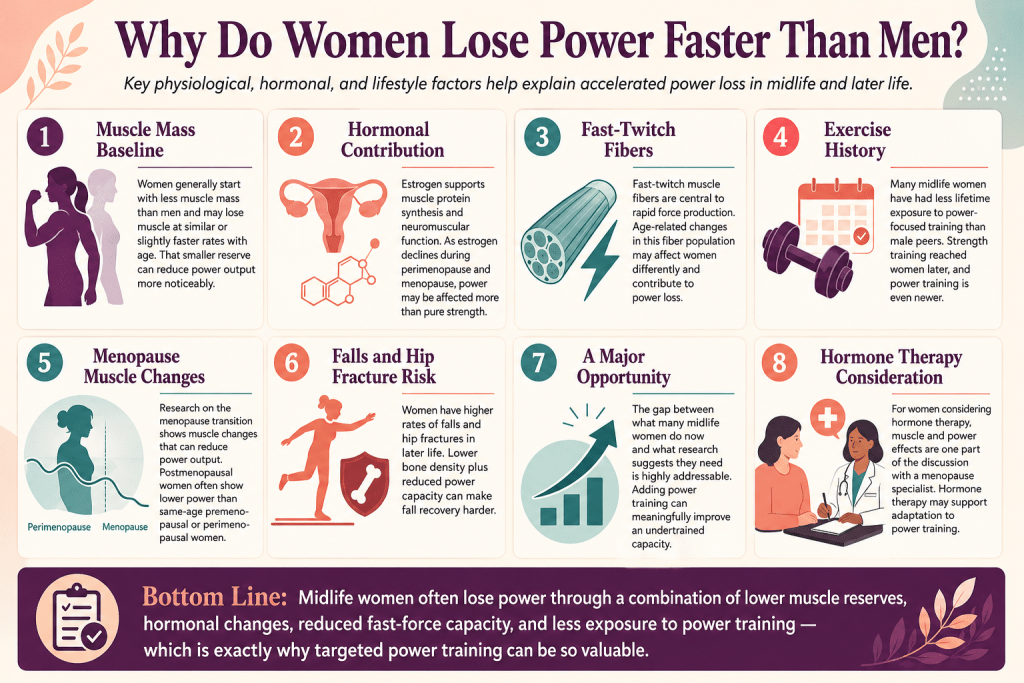
- The muscle mass baseline: Women start with less muscle mass than men on average and lose muscle at similar or slightly faster rates with age. The absolute reduction in muscle mass affects power output.
- The hormonal contribution: Estrogen supports muscle protein synthesis and various aspects of neuromuscular function. The specific decline in estrogen through perimenopause and menopause affects power more meaningfully than it affects pure strength in some research.
- The fast-twitch fiber population: Women may have a somewhat different fast-twitch fiber population than men, and the specific pattern of loss with age may affect this population differently.
- The cultural exercise history: Many midlife women in the current generation have less lifetime experience with power-focused training than their male peers. The strength training revolution reached women meaningfully later than it reached men, and the power training revolution is more recent still.
- The specific menopause muscle changes: Research on muscle changes through the menopause transition has documented specific alterations that affect power output. Postmenopausal women often have measurably reduced power output compared to same-age premenopausal or perimenopausal women.
- The specific fall statistics: Women have higher rates of falls and hip fractures than men in later life, partly explained by the combination of lower bone density and reduced power capacity that limits fall recovery. Power training addresses one specific piece of this vulnerability.
- The specific opportunity: The specific gap between what most midlife women currently do (mostly strength training if anything) and what the research suggests they need (specific power training as an addition) is one of the largest addressable interventions available. Adding specific power training to existing programs produces meaningful improvement in a capacity that most midlife women have not been specifically training.
- The specific hormone therapy consideration: For women considering hormone therapy, the specific muscle and power effects are one of several considerations to discuss with a menopause specialist. Hormone therapy may support the specific adaptations power training produces.
What the Research Says About Power Training & Fall Prevention?
The specific research on power training and fall prevention supports the case for adding specific power work to midlife women’s training.
- The specific fall risk research: Multiple studies have documented that reduced lower body power specifically predicts fall risk in older adults independently of strength. Rate of force development is one of the specific measures that predicts fall risk.
- The specific power training intervention research: Randomized trials of power training in older adults consistently show meaningful improvements in power output within 8 to 12 weeks. These improvements translate to functional benefits including reduced fall risk in some studies.
- The specific comparison with traditional strength training: Some studies have specifically compared traditional slow strength training with faster power-focused training in older adults. Power-focused training tends to produce better functional outcomes including balance, gait speed, and fall recovery capacity, even when total training volume is matched.
- The specific mechanism research: Studies of fall biomechanics have documented that the specific delay between disturbance and corrective response is one of the strongest predictors of whether a person recovers from a stumble. This delay is a power capacity, not a pure strength capacity.
- The specific integrated training research: Studies combining power training with balance training have shown particular benefit for fall prevention. Power alone helps. Balance alone helps. The combination often produces the strongest outcomes.
- The specific safety data: Appropriate power training for midlife and older adults has a strong safety record when properly progressed. The specific risks are related to progression that is too rapid or exercise selection that is inappropriate for the individual. The framework in this article emphasizes safe progression.
- The specific research on women: Studies specifically evaluating power training in midlife and older women have documented improvements in muscle power, functional capacity, and quality of life measures. The general research findings apply to women with the specific hormonal and body composition considerations relevant to this population.
- The population-level implication: Falls are a leading cause of injury, disability, and death in older adults. Fall prevention interventions that specifically address power represent one of the highest-impact public health interventions available for midlife and older adults.
Free 28-Day Fascia Reset Email Course
Get our Free 28-day email course series to help with 1 or 2 exercises per day to release your fascia. One short lesson per day. Two minutes to read each.
How To Assess Your Own Power:
Assessing your own power provides a baseline you can track over time and helps identify where you specifically need to focus. A combination of timed tests, functional challenges, and subjective observations can give you a clearer picture of your current power capacity.
Chair-Based Power Tests
Two simple chair tests can help assess lower body power and provide measurements you can track over time.
- The chair rise test: Sit in a standard chair (approximately 17 inches tall) with your arms crossed over your chest. Time how quickly you can stand up and sit down five times without using your arms. Under 10 seconds is generally considered good for adults. Longer times suggest reduced lower body power. Under 15 seconds is a reasonable target for most midlife women. Test monthly to track progress.
- The 30-second chair stand test: Sit in the chair as above. Count how many complete stands (up and back down) you can complete in 30 seconds without using your arms. Age-based norms are approximately 12 to 17 stands for adults aged 60 to 69 and reduce with age. This test integrates power and strength.
Functional Power and Balance Tests
Power also shows up in movements that require you to generate force quickly while maintaining control and balance.
- The stair climbing test: Time how long it takes to climb 10 stairs (or count how many stairs you can climb in 15 seconds). Rapid stair climbing is a specific power demand and correlates with fall risk research.
- The single-leg stand-up test: From a seated position, attempt to stand on one leg without using the other leg or your arms. This is a specific power and control challenge that many midlife women find surprising.
- The single-leg stance connection: Your single-leg stance time reflects some of the same underlying capacities as power. Both improve with related interventions.
Notice How Power Feels in Daily Life
Formal tests are useful, but your ability to respond quickly during normal activities also provides important information.
Beyond specific tests, notice how your body feels in daily situations:
- Do you catch yourself easily when you stumble?
- Do you feel nimble navigating uneven surfaces?
- Can you react quickly to unexpected situations?
The subjective sense of nimble responsiveness reflects underlying power capacity.
How Should You Interpret Your Results?
- The specific interpretation: These tests provide a functional baseline. Individual variation is significant. The trend over months matters more than any single measurement. Improvements of 20 to 40 percent over 8 to 12 weeks of appropriate training are common.
- The specific caution: If you experience pain, dizziness, or other concerning symptoms during any of these tests, stop and consult a healthcare provider before proceeding with the training framework.
What Should You Do Before Starting Power Training?
Power training builds on existing foundational strength: Skipping foundational requirements produces injuries and undermines the specific benefits.
Strength, Balance, and Joint Readiness
- The strength foundation: Before beginning specific power training, you should be able to perform bodyweight squats, chair sit-to-stands, and other basic bodyweight movements without pain or significant difficulty. Building strength in the four key muscle groups for aging well can provide the foundation needed before progressing to more explosive power work.
- The balance foundation: Reasonable single-leg stance capacity supports safer power training. If your single-leg stance time is under 10 seconds , address balance first through the balance protocol in that article.
- The joint readiness: Any significant joint pain, active injury, or recent surgery warrants medical clearance before beginning power training. Power movements involve faster loading than strength training and can aggravate specific joint issues.
- The cardiovascular clearance: Power training raises heart rate and blood pressure meaningfully. Any known cardiovascular conditions warrant medical clearance before starting.
Tissue and Equipment Preparation
- The tissue readiness: Tendons and connective tissue adapt more slowly than muscle. If you have been sedentary or have not done any resistance training in the last year, spend at least 4 to 8 weeks on basic strength training before adding power work.
- The equipment consideration: Most of the framework in this article requires no equipment. A sturdy chair, a medicine ball (5 to 8 pounds for beginners), and appropriate athletic shoes are the primary items. A safe space with no tripping hazards is essential.
- The environmental safety: Practice in a space with no rugs, cords, or obstacles. Have a wall or chair nearby for balance support. Consider practicing with a spotter for the first several sessions.
Mental and Nutrition Preparation
- The mental preparation: Power training involves faster movements than many midlife women are accustomed to. It is normal to feel some hesitation about moving fast. The specific value of power training is in the deliberate practice of fast movement. Approach it as skill development rather than as intensity increase.
- The nutrition and hydration foundation: Adequate protein intake supports the adaptations that power training produces, and a free Macro Calculator can help estimate an appropriate daily target. Consistent hydration also supports tissue function, recovery, and injury prevention.
Free 28-Day Fascia Reset Email Course
Get our Free 28-day email course series to help with 1 or 2 exercises per day to release your fascia. One short lesson per day. Two minutes to read each.
Which 5 Power Exercises Are Safe for Midlife Women?
The specific power exercises chosen for this framework are safe, effective, and require minimal equipment. Each exercise addresses a specific movement pattern relevant to daily function and fall prevention.
How Are the Exercises Designed?
- The specific design principles: The exercises emphasize the concentric (rising, pushing) phase performed with maximum intent. The specific eccentric (lowering) phase is controlled but not deliberately slow. The specific loading is typically bodyweight or moderate external load rather than heavy weight. The specific intent is to move fast within safe technique.
- The exercise selection rationale: These five exercises collectively address lower body power (Exercises 1 and 4), functional stair-climbing power (Exercise 2), upper body power (Exercise 3), and reactive balance under load (Exercise 5). Together they cover the primary power demands of daily life and fall recovery.
How Should You Approach Safety and Progression?
- The specific safety notes: Every exercise should be practiced initially at a conservative pace before progressing to full intent. Land softly. Use appropriate support. Stop if pain occurs.
- The specific progression principle: Each exercise has a specific progression from beginner to intermediate to advanced variations. The specific progression allows midlife women to enter the framework at any starting point and advance as capacity develops.
What Are the 5 Best Power Exercises for Midlife Women?
The best power exercises for midlife women train the body to produce force quickly while improving balance, coordination, and real-world movement patterns. The five exercises below target lower-body power, upper-body power, and reactive balance, with beginner through advanced variations so you can progress safely as your strength, speed, and confidence improve.
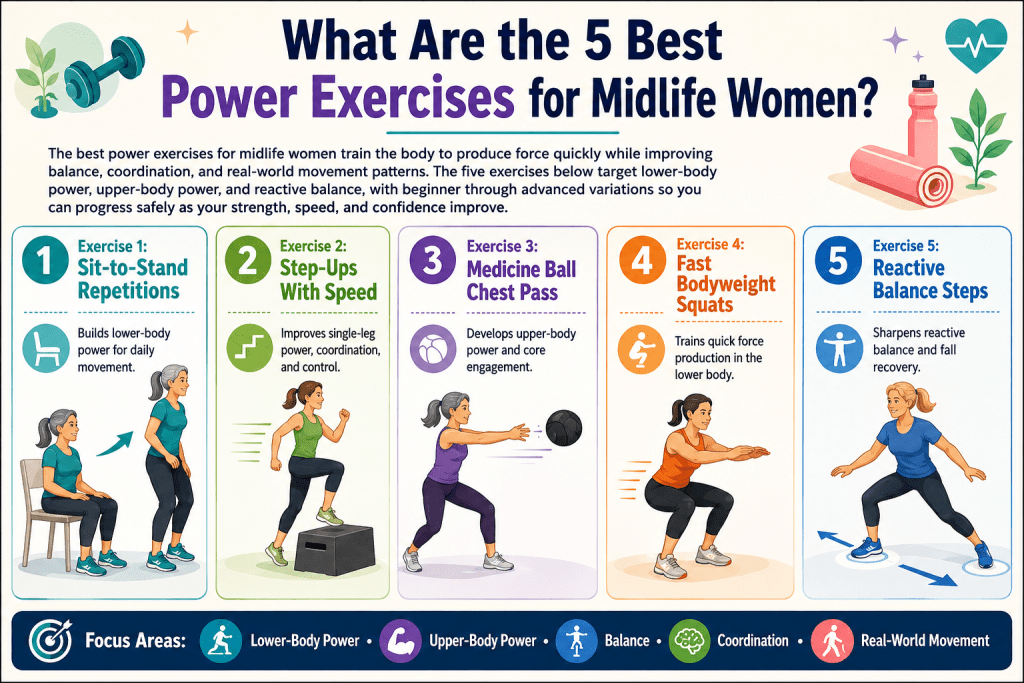
Exercise 1: Sit-to-Stand Repetitions
The sit-to-stand exercise is one of the most functionally relevant power exercises available and it is safe for almost every midlife woman.
Start with a stable chair and focus on standing with speed while maintaining control. Progress through each level only when you can perform the movement safely with clean form.
- Setup. Sit in a standard-height chair (approximately 17 inches) with feet flat on the floor and arms crossed over your chest. Sit tall.
- Execution (beginner). Stand up as quickly as you can control safely. Sit back down with a controlled pace. Repeat 8 to 12 times. Rest 60 seconds between sets. Complete 2 to 3 sets.
- Execution (intermediate). Same as beginner but with faster stand and controlled sit. Aim for the fastest safe stand you can execute with clean form.
- Execution (advanced). Add a small hop or heel raise at the top of the stand for additional power demand. Progress to 15 repetitions per set.
This exercise builds practical lower-body power by training you to stand quickly and with control. Understanding how it works, what mistakes to avoid, and when to progress helps you perform it safely and get the most functional benefit.
- How it works: Rising quickly from a chair specifically challenges the fast-twitch fibers in the hip and thigh muscles. The specific power demand of rapid standing translates directly to the power needed for stair climbing, catching yourself when stumbling, and various other daily functions.
- Common mistakes: Using arms to push off (defeats the specific power demand), rounding forward instead of standing tall, falling back into the chair without control on the sit portion.
- Why this exercise for midlife women: Sit-to-stand power directly correlates with fall recovery capacity in research. It is one of the specific exercises most consistently included in evidence-based programs for older adults.
- Progression to Level 2 of the program: When you can complete 3 sets of 15 repetitions with full intent, progress to the intermediate program.
Free 28-Day Fascia Reset Email Course
Get our Free 28-day email course series to help with 1 or 2 exercises per day to release your fascia. One short lesson per day. Two minutes to read each.
Exercise 2: Step-Ups With Speed
Step-ups train the specific power demand of climbing stairs and stepping up onto elevated surfaces.
This step-up progression builds lower-body power while reinforcing the strength and coordination needed for stairs and everyday movement. Start with a stable setup and gradually increase speed, force, or resistance as your control improves.
- Setup. Use a sturdy step, low bench, or bottom stair. Height should allow your knee to be at approximately 90 degrees when your foot is placed on the step. Have wall or handrail nearby for balance support.
- Execution (beginner). Step up quickly onto the step with your right foot. Bring the left foot up to meet it. Step back down with the right foot, then the left. Repeat 8 to 12 times leading with the right, then switch to leading with the left. Rest 60 seconds between sets. Complete 2 to 3 sets per side.
- Execution (intermediate). Same pattern but with more forceful upward drive on the step. Aim for a strong crisp step-up rather than a lazy one.
- Execution (advanced). Progress to a higher step (if safe) or add a light weight in each hand. Some women can eventually progress to slight lifts of the trailing leg at the top of the step-up.
This exercise develops the power, balance, and coordination needed for stronger stair climbing and quicker recovery from a stumble. Understanding how it works, what mistakes to avoid, and when to progress can help you perform it more safely and effectively.
- How it works: Stepping up onto an elevated surface challenges the specific power demand of vertical propulsion against gravity. The rapid execution of the step-up trains the fast-twitch fibers and neural pathways that support stair climbing and stumble recovery.
- Common mistakes: Using the trailing leg to push off from the ground (defeats the power demand on the working leg), stepping too slowly (fails to train power), inadequate balance support in the early stages.
- Why this exercise for midlife women: Stair climbing power is one of the specific measures that predicts functional independence in older adults. This exercise directly trains that capacity.
- Progression to Level 2: When you can complete the intermediate variation with full intent and no imbalance, progress to the Level 2 program.
Exercise 3: Medicine Ball Chest Pass
The medicine ball chest pass trains upper body power in a specific pattern relevant to catching yourself against a wall or reaching quickly.
This medicine ball exercise builds upper-body power by training you to produce force quickly through the chest, shoulders, and arms. Start with a manageable weight and gradually increase speed, intensity, or load as your control and strength improve.
- Setup. Stand approximately 3 to 5 feet from a sturdy wall. Hold a 5 to 8 pound medicine ball at chest height with both hands. Ensure the wall can safely absorb the impact.
- Execution (beginner). Push the ball toward the wall with a forceful chest pass. Catch it as it rebounds. Rest a moment. Repeat 8 to 10 times. Rest 60 seconds between sets. Complete 2 sets.
- Execution (intermediate). Increase the pace with less rest between throws. Increase the throw intensity. Complete 3 sets of 10 to 12 repetitions.
- Execution (advanced). Progress to a heavier ball (up to 10 to 15 pounds for advanced practitioners with appropriate strength foundation). Add a slight step forward with the throw for full-body integration.
This exercise develops upper-body power for quick, forceful movements that support balance and fall recovery. Understanding how it works, common mistakes to avoid, and when to progress can help you perform it more safely and effectively.
- How it works: Throwing a medicine ball rapidly toward a wall challenges the specific fast force production in the chest, shoulders, and arms. This translates to the power needed for catching yourself, pushing away from an unstable surface, and various other reactive movements.
- Common mistakes: Using a ball too heavy for controlled speed (defeats the power demand), standing too close to the wall (insufficient time for pattern), catching casually rather than absorbing the return.
- Why this exercise for midlife women: Upper body power is often neglected in fall prevention programs but is directly relevant for catching yourself against a wall, stopping yourself against a countertop, and pushing away from unstable surfaces.
- Progression to Level 2: When you can complete the intermediate variation with clean technique, progress to Level 2.
Free 28-Day Fascia Reset Email Course
Get our Free 28-day email course series to help with 1 or 2 exercises per day to release your fascia. One short lesson per day. Two minutes to read each.
Exercise 4: Fast Bodyweight Squats
Fast bodyweight squats train the specific power pattern of rapid lower body extension in a bilateral pattern.
This squat progression develops lower-body power by training the hips and legs to produce force quickly and safely. Begin with a comfortable range of motion, then gradually increase depth, speed, or impact as your strength and control improve.
- Setup. Stand with feet slightly wider than hip-width apart. Arms can be forward for balance or at your sides. Ensure a stable surface with no tripping hazards.
- Execution (beginner). Squat down to a comfortable depth (partial squat is fine for beginners). Stand up as quickly as you can control safely. Repeat 8 to 12 times. Rest 60 seconds between sets. Complete 2 to 3 sets.
- Execution (intermediate). Squat deeper (thighs approximately parallel to floor if safe for your body). Stand up with maximum controlled speed. Add a slight heel raise at the top.
- Execution (advanced). Progress to fast bodyweight squats with a small hop at the top (jump squats) if joint health allows. Many midlife women should not progress to jump squats due to knee, hip, or foot considerations. Consult a healthcare provider if unsure.
This exercise builds lower-body power through fast, controlled squatting movements that strengthen the legs and support everyday mobility. Understanding how it works, common mistakes to avoid, and when to progress can help you train safely while protecting your joints.
- How it works: Rapid squatting challenges the power capacity of the entire lower body in a bilateral pattern that complements the unilateral pattern of step-ups. The specific rapid extension trains fast neural drive to the quadriceps, glutes, and calves.
- Common mistakes: Descending too fast (increases injury risk), landing hard (unnecessary and increases joint stress), losing form to increase speed, progressing to hopping variations before foundational strength is adequate.
- Why this exercise for midlife women: Bilateral lower body power complements the unilateral power of step-ups and directly trains the pattern of standing up quickly from any low position.
- Progression to Level 2: When you can complete the intermediate variation with clean form, progress to Level 2. Only progress to jump squats if your provider approves and your joints tolerate it well.
Exercise 5: Reactive Balance Steps
Reactive balance steps train the specific fall recovery pattern of catching yourself with a rapid recovery step.
This reactive stepping exercise trains your body to respond quickly when your balance is unexpectedly disturbed. Begin with small, controlled weight shifts and gradually introduce greater challenges as your confidence and stability improve.
- Setup. Stand tall with feet hip-width apart in a safe open space with a wall or sturdy chair nearby for support if needed.
- Execution (beginner). Deliberately shift your weight forward to feel yourself begin to tip. Take a quick step forward with one leg to catch yourself. Return to starting position. Repeat 5 to 8 times per side, then progress to sideways and backward step reactions.
- Execution (intermediate). Practice with slightly greater weight shifts. Practice from a very light bump from a partner (with the partner ready to catch you if needed). Vary the direction of the perturbation to require different recovery step directions.
- Execution (advanced). Practice with unpredictable perturbations. Practice on unstable surfaces. Practice while performing a cognitive task simultaneously.
Reactive stepping trains your body to respond quickly when your balance is suddenly disrupted, helping you regain stability before a fall occurs. Understanding proper technique, common mistakes, safety considerations, and progression can make this exercise more effective and controlled.
- How it works: The reactive step is the specific movement that saves you from a fall. When your balance is disturbed, a rapid step in the appropriate direction reestablishes your base of support and prevents the fall. Deliberate practice of this specific movement pattern builds the neural circuit that produces automatic recovery.
- Common mistakes: Not committing to the weight shift (defeats the specific training demand), practicing without a safety margin (increases fall risk), progressing too fast before the pattern is established.
- Why this exercise for midlife women: This is the specific movement pattern that prevents falls in real life. Deliberate practice builds the reflexive pattern that is often absent in adults who have not specifically trained it.
- The specific safety note: This exercise should be practiced with appropriate safety margins. Never practice near hard corners, on slippery surfaces, or in situations where a fall could produce injury. Consider practicing with a spotter for the first several weeks.
- Progression to Level 2: When you can consistently execute crisp recovery steps in all four directions (front, back, both sides), progress to Level 2 which introduces perturbation variability.
Free 28-Day Fascia Reset Email Course
Get our Free 28-day email course series to help with 1 or 2 exercises per day to release your fascia. One short lesson per day. Two minutes to read each.
How Does the 8-Week Progressive Power Program Work?
The eight-week program combines the five exercises into a structured progressive framework that fits into 20 to 30 minutes twice per week alongside existing training.
How to Structure Each Power Session
- The general structure: Two power training sessions per week on non-consecutive days. Each session includes a warm-up, the five exercises with progression appropriate to the week, and a cool-down. Total time approximately 25 to 30 minutes per session.
- The specific interaction with other training: Power sessions can be performed on the same day as strength training if done first when nervous system is fresh. Power sessions should not be performed on the same day as long cardio sessions or immediately after high-intensity interval work.
- The specific warm-up: Every power session begins with 5 minutes of general warm-up (walking, gentle joint mobility) followed by 5 minutes of specific movement preparation for the exercises in the session. Cold muscles perform power exercises poorly and increase injury risk.
Weeks 1 to 4: Introduction and Building
- Weeks 1 and 2: Introduction. Focus on learning the movement patterns of each exercise at conservative pace. Complete 2 sets of 8 to 10 repetitions of each exercise. Emphasize technique over speed. Rest 60 to 90 seconds between sets.
- Weeks 3 and 4: Building. Progress to full-intent power on each exercise. Complete 3 sets of 8 to 10 repetitions. Rest 90 seconds between sets. Retest chair-rise power and stair-climb time at end of week 4.
Weeks 5 to 8: Progression and Integration
- Weeks 5 and 6: Progressive. Increase the difficulty of each exercise per the progression guidelines. Complete 3 sets of 10 to 12 repetitions. Rest 60 to 90 seconds between sets.
- Weeks 7 and 8: Integration. Advanced variations of each exercise. Complete 3 sets of 10 to 15 repetitions. Include some reactive balance work at each session.
What Happens After Week 8?
- After week 8: Continue with the Level 2 program (2 sessions per week of the advanced variations) or begin a periodized approach with the coaching support to maintain gains and continue progressing.
- Expected outcomes: Meaningful improvement in chair-rise time and step-up power typically appears at 4 to 8 weeks. Subjective improvements in nimble movement often appear at 6 to 12 weeks. Continued gains develop over months of consistent practice.
When Should You Retest Your Power?
Retesting schedule. Retest the chair rise test, 30-second chair stand test, and stair climbing test at the end of week 4 and week 8.
- Note the specific numbers.
- Compare to baseline.
“The specific results I see with coaching clients who complete an 8-week power program are consistently interesting. Chair-rise times often improve 30 to 50 percent from baseline. Stair-climbing power measurably improves. The specific subjective quality of being nimble often returns to a level women had not felt in years. And critically, the specific quality of catching themselves during small stumbles becomes reliable in a way it had not been. One of the most satisfying moments in coaching work is when a client mentions in passing that she caught herself easily during a moment of imbalance that would have produced a fall a year earlier. That specific outcome is what the power framework is for. It is not about performance metrics. It is about the specific reflexive capacity that keeps midlife women upright and independent for the next several decades.”
Terry Tateossian, Founder of The House of Rose
What Common Mistakes Can Undermine Your Power Training Progress?
Six specific mistakes commonly reduce the effectiveness of power training for midlife women.
- Skipping the warm-up: Cold muscles cannot produce power safely. The specific injury risk of skipping warm-up in power training is meaningful. Always include the specific movement preparation before the working sets.
- Practicing with insufficient intent: Power training only works when the specific concentric phase is performed with maximum controlled speed. Lazy execution defeats the training purpose. Focus on fast intent on every repetition of the working sets.
- Progressing too fast: The eight-week framework is designed with specific progression built in. Skipping ahead to advanced variations before foundational patterns are established increases injury risk and typically produces worse outcomes than following the progression.
- Ignoring joint pain: Power training should not produce joint pain. Muscle soreness after sessions is normal. Sharp joint pain during or after sessions is a signal to modify the exercise or consult a healthcare provider.
- Skipping the balance component: Reactive balance steps are one of the most functionally important exercises in the framework and are often the exercise midlife women skip because it feels unusual. Do not skip it. The specific reflexive pattern it trains is often the specific difference between recovery and fall.
- Not tracking progress: Without specific measurement, progress is easy to miss. Track the chair-rise time, 30-second chair stand count, and subjective nimbleness monthly. Compare to baseline.
- Assuming strength training is enough: Strength and power are related but distinct. Traditional strength training does not produce the specific power adaptations. If the goal includes fall prevention and nimble movement, specific power training is necessary in addition to strength training.
Free 28-Day Fascia Reset Email Course
Get our Free 28-day email course series to help with 1 or 2 exercises per day to release your fascia. One short lesson per day. Two minutes to read each.
How Does Power Training Fit With Strength and Balance Training?
The specific integration of power training with strength and balance training produces better outcomes than any single component alone.
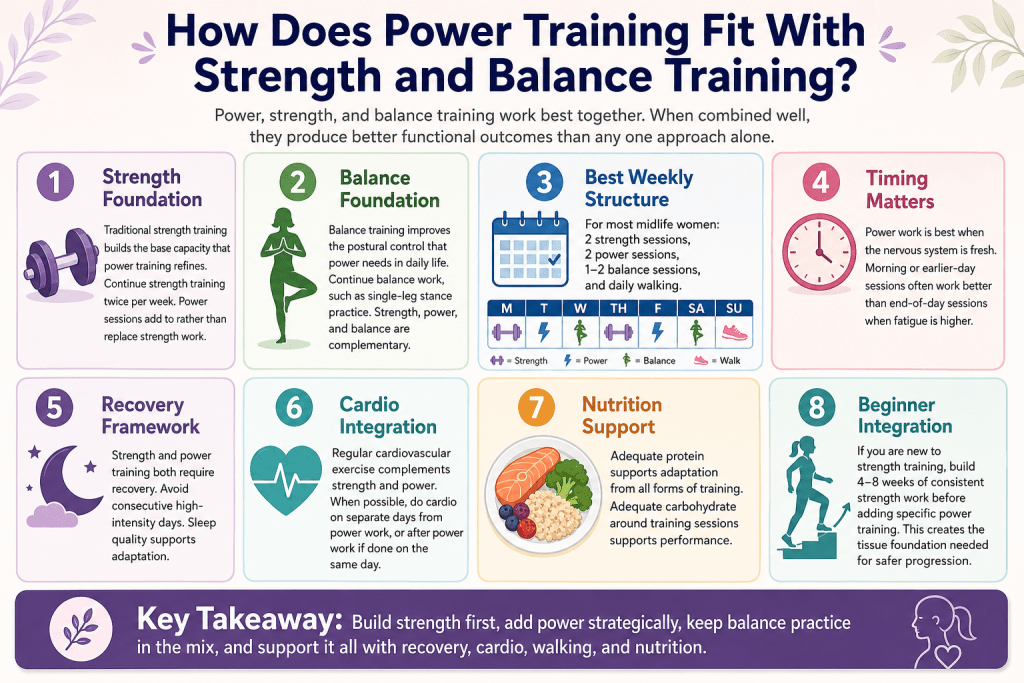
- The strength foundation: Traditional strength training builds the base capacity that power training refines. Continue your strength training twice per week. Power sessions add to rather than replace strength work.
- The balance foundation: Balance training develops the postural control needed to express power safely and effectively in daily life. A single-leg stance framework can help build and maintain this stability, making balance work a natural complement to strength and power training.
- The specific weekly structure: For most midlife women, a weekly structure combining 2 strength sessions, 2 power sessions, 1 to 2 balance sessions, and daily walking produces the strongest functional outcomes.
- The specific timing considerations: Power work is best performed when the nervous system is fresh. Morning sessions or sessions early in the day generally work better than end-of-day sessions when fatigue is higher.
- The specific recovery framework: Both strength and power training require adequate recovery. Consecutive high-intensity days should be avoided. Sleep quality supports adaptations from both.
- The specific cardio integration: Regular cardiovascular exercise complements strength and power. Time cardio sessions on separate days from power work when possible, or after power work if on the same day.
- The nutrition support: Adequate protein intake supports adaptations from all forms of training, and a free Macro Calculator can help estimate your daily protein and macronutrient needs. Adequate carbohydrate intake around training sessions can also help support performance and recovery.
- The specific integration for beginners: Women new to strength training should establish 4 to 8 weeks of consistent strength work before adding specific power work. This builds the tissue foundation that power training safely builds on.
How Does Power Training Fit Into the Broader THOR Framework?
Power training is one component of the broader lifestyle medicine framework I teach at THOR.
Core Nutrition, Strength, and Balance Foundations
These foundational areas support your ability to train for power safely and effectively.
- Nutrition foundation: Knowing your protein needs is an important part of supporting strength and power adaptations, and the free Macro Calculator can help establish a daily target. The Macro Miracle Mediterranean Cookbook can then make those nutrition goals easier to apply in everyday meals.
- Strength foundation: Building the four key muscle groups for aging well creates the strength base that supports safer, more effective power training.
- Balance foundation: Improving stability alongside power is equally important, and the single-leg stance test offers a simple way to assess and track the balance skills that complement power training.
Movement, Sleep, and Nervous System Support
Power training also works alongside movement, sleep, and recovery practices that support overall function and training adaptations.
- Movement layer: A well-rounded movement routine can include micro walks throughout the day, tai chi walking for seniors, and other forms of regular movement that support mobility, coordination, and overall function.
- Sleep foundation: Strategies such as menopause sleep remedies and a consistent midlife sleep stack can help create the restorative sleep foundation needed to support recovery and training adaptations.
- Nervous system regulation: Incorporating vagus nerve reset exercises can encourage parasympathetic activity and support the nervous system recovery that complements strength and power training.
Foundational Supplements and Personalized Support
The broader THOR framework also includes nutrition and lifestyle support for women who want to build on their training foundation. The THOR foundational supplement collection brings together key supplement priorities, while creatine can offer more targeted support for strength, power, and training adaptations.
For women who want more individualized guidance, the Monthly Personal Training and Nutrition Coaching Program provides 1:1 support for integrating power training with the broader lifestyle medicine framework. A more immersive option is the Deeply Restorative Yoga and Nature Retreat at our Smoky Mountains property, where movement, recovery, nutrition, and restorative practices come together over five days.
Free 28-Day Fascia Reset Email Course
Get our Free 28-day email course series to help with 1 or 2 exercises per day to release your fascia. One short lesson per day. Two minutes to read each.
When Should You See a Healthcare Professional?
Power training is generally safe for midlife women without specific contraindications, but certain situations warrant professional evaluation.
- Any known cardiovascular disease: Coronary artery disease, uncontrolled blood pressure, arrhythmia, or heart failure require physician clearance before starting power training.
- Recent joint or spine surgery: Wait for surgical clearance and typically for physical therapy progression before starting power work.
- Osteoporosis with high fracture risk: Some power exercises may need modification. Discuss with your provider.
- Significant balance concerns or fall history: Work with a physical therapist for individualized guidance before starting independent power training.
- Any acute pain: New pain during or after power sessions warrants evaluation before continuing.
- Persistent fatigue that does not improve with rest: May indicate underlying conditions warranting evaluation.
- Consideration of hormone therapy: The hormone therapy question and its interaction with training benefits is a specific discussion for a menopause specialist.
- Any concerning symptoms during training: Chest pain, severe dizziness, or other alarming symptoms warrant immediate medical evaluation.
Free 28-Day Fascia Reset Email Course
Get our Free 28-day email course series to help with 1 or 2 exercises per day to release your fascia. One short lesson per day. Two minutes to read each.
Frequently Asked Questions
What is the difference between power and strength?
Strength is the maximum force your muscles can produce. Power is the amount of force your muscles can produce in a short time window (force multiplied by velocity). Two people with the same maximum strength can have dramatically different power outputs based on how quickly they can produce that force. For midlife women, power is often more functionally relevant than pure strength for daily function and fall prevention.
Why does power decline faster than strength with age?
Power depends heavily on fast-twitch muscle fibers and the neural pathways that activate them quickly. Both are selectively affected by aging in ways that pure strength is not. Fast-twitch fibers are preferentially lost, and neural activation speed decreases. This is why power declines at approximately twice the rate of strength through midlife and older adulthood.
Do women lose power faster than men?
On average, yes. Multiple factors contribute including differences in baseline muscle mass, hormonal changes through the menopause transition, historically less exposure to power-focused training, and specific fast-twitch fiber population changes. The specific implication is that midlife women particularly benefit from specific power training.
Can I improve my power at 60 or 70?
Yes. Research consistently shows that older adults can improve power output substantially with appropriate training over 8 to 12 weeks. Even adults in their 70s and 80s show meaningful improvements with specific power training. This is one of the most responsive health capacities to deliberate training regardless of age.
Do I have to do jumping exercises to train power?
No. The framework in this article specifically emphasizes power exercises that do not require jumping. Sit-to-stand, step-ups, medicine ball throws, and reactive balance steps all train power without the joint impact of jumping. For midlife women with joint concerns, this framework provides substantial power benefits without requiring jump training.
How often should I do power training?
Two sessions per week is a reasonable target for most midlife women. This can be added to existing strength training and balance work rather than replacing them. Power training recovers faster than heavy strength training and can be performed more frequently, though most women do well with the twice-weekly frequency.
Can I do power training if I have arthritis?
For most midlife women with mild to moderate arthritis, appropriate power training is safe and often beneficial. Some exercises may need modification. Avoid exercises that produce joint pain. Work with a physical therapist for individualized guidance if arthritis is significant.
Is power training the same as HIIT?
No. High-intensity interval training (HIIT) is a specific cardiovascular training approach that emphasizes short bursts of high effort. Power training specifically focuses on fast force production in resistance exercises. Both have value but they train different capacities through different mechanisms.
How long before I see results?
Meaningful improvement in chair-rise time and step-up power typically appears at 4 to 8 weeks. Subjective improvements in nimble movement often appear at 6 to 12 weeks. Continued gains develop over months of consistent practice.
Do I need a coach for power training?
Working with a qualified coach or trainer can accelerate progress and reduce injury risk, particularly for women new to power-focused training. Self-directed practice using the framework in this article is also reasonable if you have foundational strength and follow the progression carefully.
Can power training help with menopause symptoms?
Power training addresses the specific muscle and neural changes of the menopause transition and produces the functional outcomes (nimble movement, fall recovery, general physical confidence) that many midlife women want to preserve or restore. It complements the broader menopause framework covered throughout the THOR content library.
Should I do power training before or after strength training?
If on the same day, power training should typically come first when the nervous system is fresh. Traditional strength training after power work is well-tolerated. If on separate days, either order works.
Free 28-Day Fascia Reset Email Course
Get our Free 28-day email course series to help with 1 or 2 exercises per day to release your fascia. One short lesson per day. Two minutes to read each.
What equipment do I need?
The framework in this article requires minimal equipment: a sturdy chair, a low step or bench, a medicine ball (5 to 8 pounds for beginners), and a safe open space. Total equipment investment is minimal. A wall or sturdy chair for balance support is also useful for the earliest weeks.
Is power training safe if I have osteoporosis?
Some power exercises may need modification for women with significant osteoporosis and high fracture risk. Discuss with your provider. Many aspects of power training can be modified safely for this population. The specific value of power training for bone health and fall prevention often outweighs the specific modifications required.
How does power training relate to fall prevention?
Power (specifically rate of force development) is one of the specific measures that predicts fall risk in older adults independently of strength. The specific reflexive capacity to catch yourself when you stumble depends on power rather than pure strength. Combined with balance training, power training is one of the most evidence-supported fall prevention interventions available.
References
- Reid, K. F., & Fielding, R. A. (2012). Skeletal muscle power: a critical determinant of physical functioning in older adults. Exercise and Sport Sciences Reviews, 40(1), 4–12.
- Byrne, C., Faure, C., Keene, D. J., & Lamb, S. E. (2016). Ageing, muscle power and physical function: a systematic review and implications for pragmatic training interventions. Sports Medicine, 46(9), 1311–1332.
- Bassey, E. J., Fiatarone, M. A., O’Neill, E. F., et al. (1992). Leg extensor power and functional performance in very old men and women. Clinical Science, 82(3), 321–327.
- Skelton, D. A., Kennedy, J., & Rutherford, O. M. (2002). Explosive power and asymmetry in leg muscle function in frequent fallers and non-fallers aged over 65. Age and Ageing, 31(2), 119–125.
- Fielding, R. A., LeBrasseur, N. K., Cuoco, A., et al. (2002). High-velocity resistance training increases skeletal muscle peak power in older women. Journal of the American Geriatrics Society, 50(4), 655–662.
- Ramírez-Campillo, R., Castillo, A., de la Fuente, C. I., et al. (2014). High-speed resistance training is more effective than low-speed resistance training to increase functional capacity and muscle performance in older women. Experimental Gerontology, 58, 51–57.
- Tschopp, M., Sattelmayer, M. K., & Hilfiker, R. (2011). Is power training or conventional resistance training better for function in elderly persons? A meta-analysis. Age and Ageing, 40(5), 549–556.
- Cadore, E. L., Pinto, R. S., Bottaro, M., & Izquierdo, M. (2014). Strength and endurance training prescription in healthy and frail elderly. Aging and Disease, 5(3), 183–195.
- Fragala, M. S., Cadore, E. L., Dorgo, S., et al. (2019). Resistance training for older adults: position statement from the National Strength and Conditioning Association. Journal of Strength and Conditioning Research, 33(8), 2019–2052.
- Peterson, M. D., Rhea, M. R., Sen, A., & Gordon, P. M. (2010). Resistance exercise for muscular strength in older adults: a meta-analysis. Ageing Research Reviews, 9(3), 226–237.
- Sipilä, S., Törmäkangas, T., Sillanpää, E., et al. (2020). Muscle and bone mass in middle-aged women: role of menopausal status and physical activity. Journal of Cachexia, Sarcopenia and Muscle, 11(3), 698–709.
- Sherrington, C., Fairhall, N. J., Wallbank, G. K., et al. (2019). Exercise for preventing falls in older people living in the community. Cochrane Database of Systematic Reviews, 1(1), CD012424.
- Robinovitch, S. N., Feldman, F., Yang, Y., et al. (2013). Video capture of the circumstances of falls in elderly people residing in long-term care: an observational study. The Lancet, 381(9860), 47–54.
- Rogers, M. E., Rogers, N. L., Takeshima, N., & Islam, M. M. (2003). Methods to assess and improve the physical parameters associated with fall risk in older adults. Preventive Medicine, 36(3), 255–264.
- Distefano, G., Standley, R. A., Zhang, X., et al. (2018). Physical activity unveils the relationship between mitochondrial energetics, muscle quality, and physical function in older adults. Journal of Cachexia, Sarcopenia and Muscle, 9(2), 279–294.
- Bauer, J., Biolo, G., Cederholm, T., et al. (2013). Evidence-based recommendations for optimal dietary protein intake in older people: a position paper from the PROT-AGE Study Group. Journal of the American Medical Directors Association, 14(8), 542–559.
- Karvinen, S., Jergenson, M. J., Hyvärinen, M., et al. (2019). Menopausal status and physical activity are independently associated with cardiovascular risk factors of healthy middle-aged women. Frontiers in Endocrinology, 10, 589.
- Studenski, S., Perera, S., Patel, K., et al. (2011). Gait speed and survival in older adults. JAMA, 305(1), 50–58.
- Guralnik, J. M., Ferrucci, L., Simonsick, E. M., et al. (1995). Lower-extremity function in persons over the age of 70 years as a predictor of subsequent disability. New England Journal of Medicine, 332(9), 556–561.
- North American Menopause Society. (2022). The 2022 hormone therapy position statement of The North American Menopause Society. Menopause, 29(7), 767–794.
Disclaimer: This article is educational and does not constitute medical advice. Power training involves faster movements than traditional strength training and requires appropriate progression and foundational strength. If you have significant joint issues, cardiovascular concerns, balance problems, or recent injuries, consult a healthcare provider before starting the framework in this article.
Free 28-Day Fascia Reset Email Course
Get our Free 28-day email course series to help with 1 or 2 exercises per day to release your fascia. One short lesson per day. Two minutes to read each.

Terry Tateossian is a Menopause Lifestyle Medicine Coach, Certified Personal Trainer & Nutritionist and the Founder of THOR: The House of Rose, a wellness brand serving women over 40 through retreats, coaching, macro-nutrition and community. As 25-year founder and entrepreneur, Terry spent two and a half decades building and running successful start-up businesses, an experience that put her on the front line of founder burnout long before she could name it. After facing serious health challenges, early onset menopause, and emotional eating while running her agency and raising two children, Terry rebuilt her health in her 40s and lost more than 80 pounds through evidence-based nutrition, training, and mindset work. Today, she helps women get strong, improve confidence, support hormone health, and create a stronger second half of life. Terry has been featured in major media outlets and is available for podcasts, expert commentary, brand collaborations, and speaking engagements on midlife health, reinvention, emotional eating, menopause wellness, and strength training for longevity. Get her free macro calculator (her cookbook companion) to start your journey to back to health.