
 By Team THOR
Free 28-Day Fascia Reset Email Course
Get our Free 28-day email course series to help with 1 or 2 exercises per day to release your fascia. One short lesson per day. Two minutes to read each.
Sauna and Cold Plunge Together: What’s the Right Order and Protocol for Midlife Women?
Angela is fifty. She had read enough about cold plunging to be excited to try it, so on her first visit to a wellness studio that offered both a sauna and a cold tub, she did what felt logical: cold first, to “wake up,” then sauna, to warm back up and relax afterward.
She left feeling worse than when she arrived, lightheaded, oddly shaky, and cold in a way that didn’t resolve for the rest of the afternoon. She assumed contrast therapy just was not for her body.
It turned out Angela had the order backward, and the order is not a minor detail. Sauna and cold plunge are not interchangeable halves of a routine you can sequence however feels intuitive in the moment.
Each step prepares the body for the next in a specific physiological way, and doing it in reverse does not simply produce a weaker version of the same benefits. It can produce a noticeably different, less comfortable, and in some cases less safe experience, which is exactly what happened to Angela.
This article answers the question directly and completely: what is the right order, how long should each phase last, how many rounds make sense, and what does a full contrast therapy protocol look like specifically for a midlife woman’s body.
What’s the Short Answer on Sauna & Cold Plunge Order?
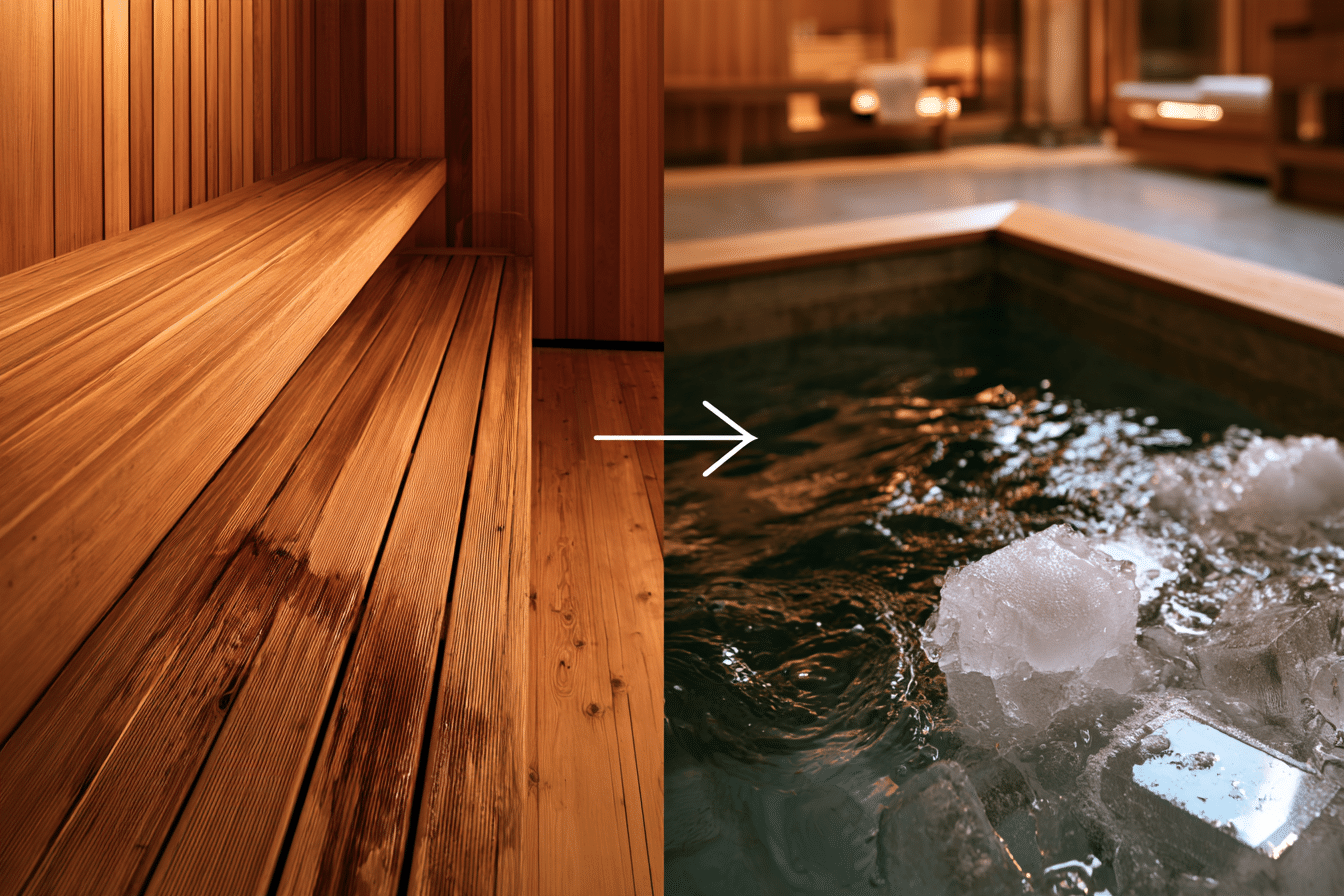
For nearly every healthy adult, the correct order is heat first, then cold: sauna (or another heat source) followed by cold plunge, not the reverse.
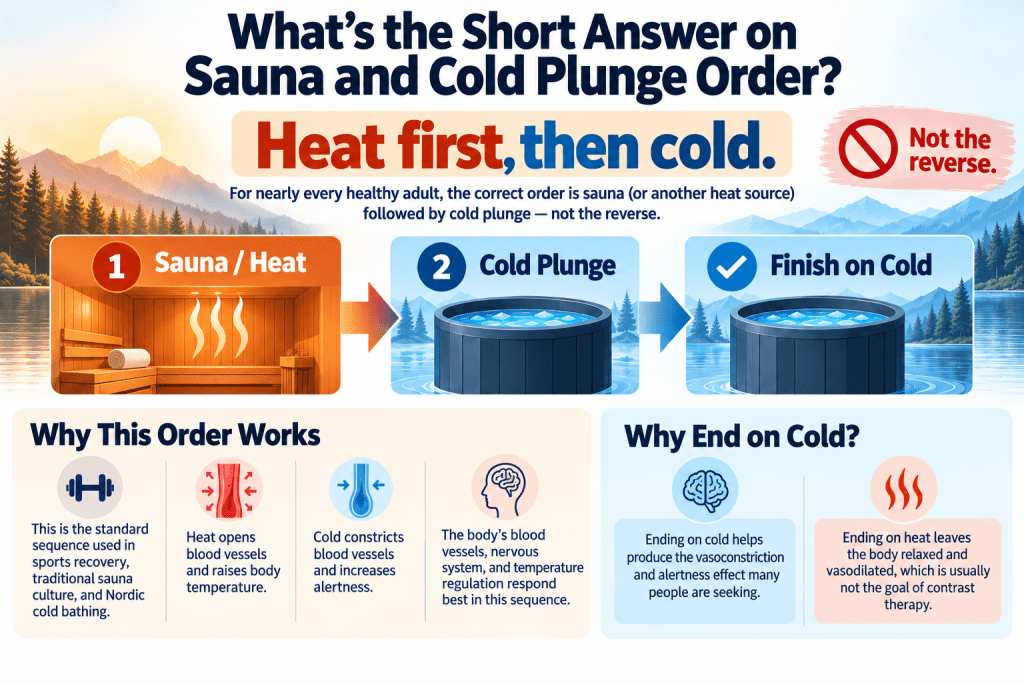
This is the standard sequence recommended across sports medicine, recovery science, and traditional practices like Finnish sauna culture and Nordic cold bathing, and it is not a matter of preference or intuition.
It reflects how the body’s blood vessels, nervous system, and temperature regulation actually respond to heat and cold, covered in detail in the next section. The full session typically ends on cold, not heat, which is the opposite of what many beginners assume.
Ending on a short, final cold exposure produces the vasoconstriction and alertness effect most people are seeking from the practice, while ending on heat leaves the body still in a relaxed, vasodilated state that is not what most contrast therapy protocols are designed to produce.
Why Does the Order Matter, and What’s Happening in Your Body?
Heat Dilates. Cold Constricts
When you sit in a sauna, your blood vessels widen (vasodilation) to help release heat, increasing blood flow to your skin and muscles. When you enter cold water, your blood vessels rapidly narrow (vasoconstriction), pushing blood back toward your core to protect vital organs.
Alternating between these two states, in the right order, creates a kind of pumping action in your circulatory system, sometimes described as a “vascular workout,” that neither heat nor cold alone can fully produce.
Starting With Heat Prepares the Body for Cold in a Way That Reduces Shock
Entering a sauna first raises your core and skin temperature and increases blood flow to your extremities.
This means that when you then move to cold water, your body has a larger temperature buffer to work with, and the cold exposure, while still intense, tends to feel more tolerable and produces a cleaner, more complete vasoconstriction response.
Starting With Cold First Removes That Buffer
If you begin with cold water while your body is still at a normal or lower baseline temperature, the shock to your system is more abrupt, your body has less thermal reserve to draw on, and the experience (as Angela discovered) can leave you feeling depleted, lightheaded, or unable to warm back up efficiently, rather than invigorated.
Ending on Cold Produces the Effect Most People Want From the Practice
The alertness, mental clarity, and mood lift many people associate with contrast therapy is strongly tied to the physiological response of the final cold exposure: a surge of norepinephrine and a shift toward sympathetic nervous system activation.
Ending on heat instead leaves the body in a more parasympathetic, relaxed state, which is a fine goal in its own right but is a different goal than what most people mean when they ask about “the protocol.”
“I made the exact same mistake Angela did when I first started, cold before heat, because it felt like the more intense way to begin. It took feeling completely depleted afterward, more than once, before I actually looked into the physiology and understood why the order matters as much as it does. Heat first gives your body a running start. Skipping that step does not make the practice more hardcore. It just makes it harder on your system for no real benefit.”
Terry Tateossian, Founder of The House of Rose
Free 28-Day Fascia Reset Email Course
Get our Free 28-day email course series to help with 1 or 2 exercises per day to release your fascia. One short lesson per day. Two minutes to read each.
What Is Contrast Therapy, and Why Is It More Than Sauna Plus Cold Plunge?
Contrast therapy is the deliberate practice of alternating between heat and cold exposure in a structured sequence, rather than simply moving from a sauna to a cold plunge once.
A full contrast therapy protocol typically includes multiple rounds of heat and cold. This repeated alternation creates a stronger cycle of vasodilation and vasoconstriction, producing a more pronounced circulatory “pumping” effect than a single heat-to-cold transition.
For example, one sauna session followed by one cold plunge is still a valid form of heat and cold exposure, but it is better described as a single transition. A complete contrast therapy session generally involves two or more rounds, with each period of heat followed by a controlled period of cold.
If you currently sauna once, cold plunge once, and finish there, you can still gain benefits from combining the two. However, gradually progressing to multiple rounds creates the structured alternating pattern that defines a full contrast therapy protocol.
What Is the Complete Contrast Therapy Protocol, Step by Step?
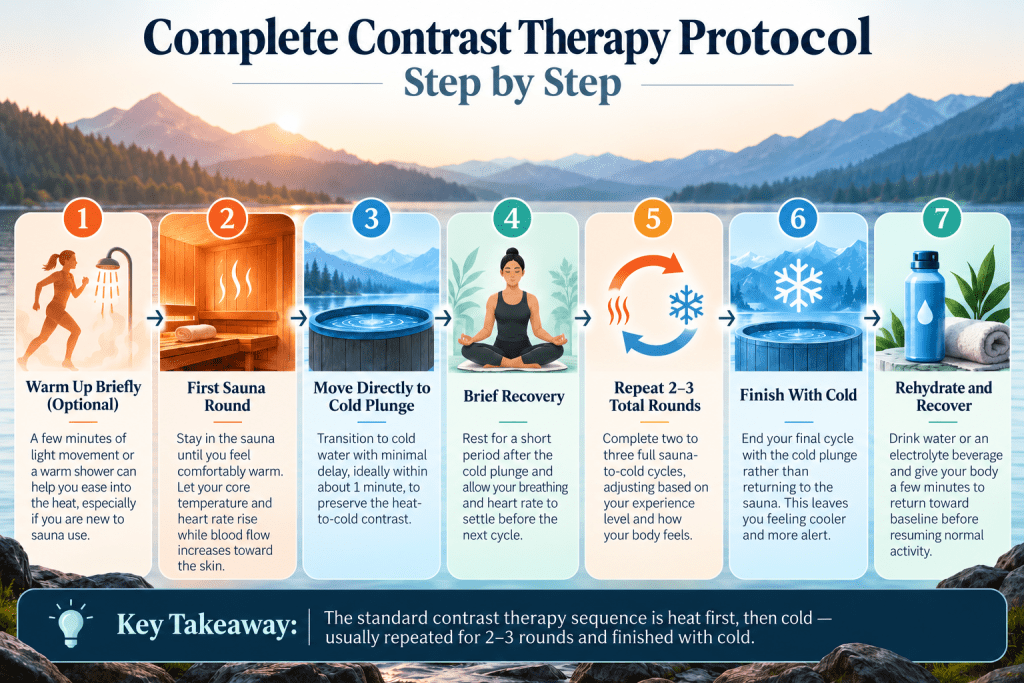
- Step 1: Warm up briefly before the sauna (optional but helpful): A few minutes of light movement or a warm shower can help your body ease into the heat more comfortably, especially if you are new to sauna use.
- Step 2: Complete your first sauna round: Stay in the sauna long enough to become comfortably warm, allowing your core temperature and heart rate to rise while blood flow increases toward the skin.
- Step 3: Move directly into the cold plunge: Transition from the sauna to cold water with minimal delay, ideally within about a minute. This preserves the heat-to-cold contrast and creates the rapid shift from vasodilation to vasoconstriction that defines contrast therapy.
- Step 4: Take a brief recovery period: After the cold plunge, rest for a short period and allow your breathing and heart rate to settle before beginning the next cycle.
- Step 5: Repeat for two to three total rounds: Complete two to three full sauna-to-cold cycles, adjusting the number of rounds to your experience level and how your body responds that day.
- Step 6: Finish with cold exposure: Complete your final cycle with the cold plunge rather than returning to the sauna. This leaves the body in the cooler, more alert state commonly associated with finishing a contrast session.
- Step 7: Rehydrate and recover: Drink water or an electrolyte beverage after the session and give your body several minutes to return toward baseline before resuming normal activity.
Free 28-Day Fascia Reset Email Course
Get our Free 28-day email course series to help with 1 or 2 exercises per day to release your fascia. One short lesson per day. Two minutes to read each.
How Long, How Hot, and How Cold Should Each Phase Be?
Sauna Temperature and Duration
A traditional sauna is typically kept between 150 and 195 degrees Fahrenheit. For contrast therapy specifically, 10 to 15 minutes per round is a reasonable range for most healthy adults, shorter (5 to 8 minutes) for beginners or anyone new to sauna use.
Cold Plunge Temperature and Duration
Cold plunge temperatures for contrast therapy typically range from 50 to 59 degrees Fahrenheit. Duration is intentionally much shorter than the heat phase: 1 to 3 minutes per round is standard, and beginners often start with as little as 30 to 60 seconds.
There is no benefit to staying in cold water longer once the vasoconstriction response has occurred; longer is not better here, and pushing duration too far increases risk without added benefit.
The Heat-to-Cold Time Ratio
As a general guideline, heat exposure per round should be noticeably longer than cold exposure, often on the order of five to ten times longer. This reflects both physiological need (heat takes longer to produce its full vasodilation effect) and safety (extended cold exposure carries more risk than extended heat exposure for most people).
How Many Rounds Should You Do?
- Beginners: one to two rounds. If you are new to either sauna or cold plunge individually, or new to combining them, start with a single heat-cold cycle and assess how your body responds before adding more.
- Intermediate practitioners: two to three rounds: This is the range most commonly recommended in recovery science and among experienced practitioners, providing meaningful compounding benefit without excessive physical demand.
- Advanced practitioners: three to four rounds: Some highly experienced practitioners extend to four rounds, though additional rounds beyond three tend to produce diminishing returns relative to the added physical demand, and this range is not necessary for most people to experience the core benefits of the practice.
- More rounds is not automatically better: As with cold plunge duration, there is a point of diminishing return, and pushing round count higher primarily increases physical strain rather than proportionally increasing benefit.
Free 28-Day Fascia Reset Email Course
Get our Free 28-day email course series to help with 1 or 2 exercises per day to release your fascia. One short lesson per day. Two minutes to read each.
What Should You Do Between Rounds?
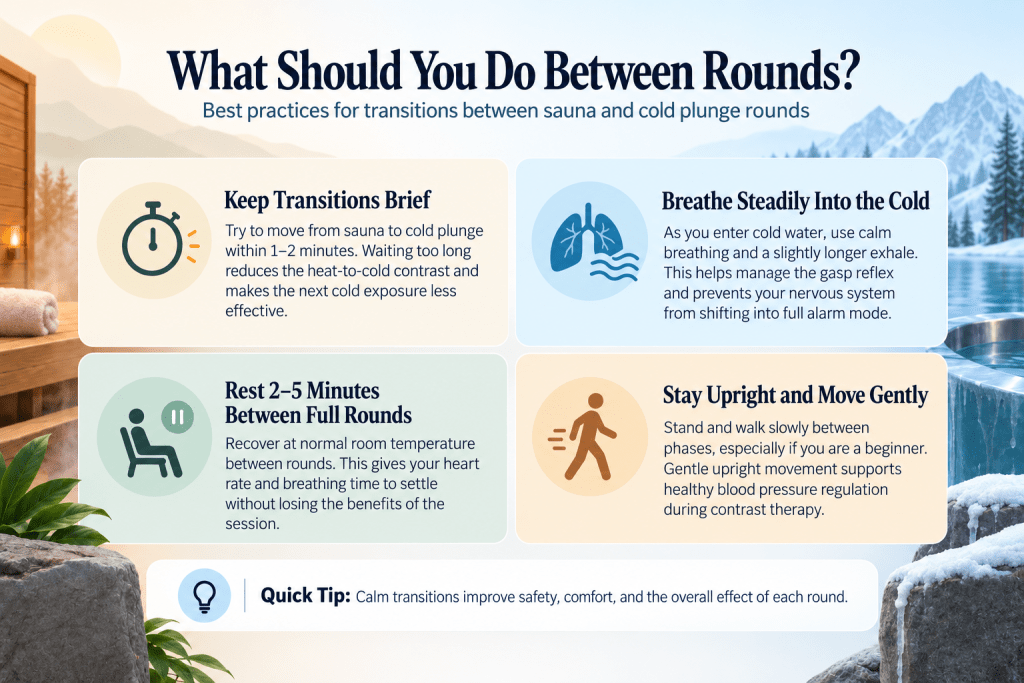
- Keep transitions brief: A gap of more than a minute or two between sauna and cold plunge allows your body to lose some of the thermal buffer built up during the heat phase, reducing the effectiveness of the following cold exposure.
- Breathe steadily, especially entering the cold: A controlled, slightly extended exhale as you enter cold water helps manage the initial gasp reflex and keeps your nervous system from spiking into full alarm mode.
- Rest 2 to 5 minutes between full rounds, at normal room temperature: This allows your heart rate and breathing to settle somewhat before beginning the next heat phase, without losing so much of the accumulated effect that each round feels like starting over.
- Stay upright and move gently between phases: Especially for beginners, standing and walking slowly between the sauna and the cold plunge (rather than lying down) supports healthy blood pressure regulation during a practice that asks a lot of your circulatory system in a short period.
When Is It Okay to Reverse the Order?
The heat-then-cold sequence is the standard recommendation for the alertness- and circulation-focused version of contrast therapy described throughout this article, but there are a few legitimate exceptions worth knowing.
If Your Only Goal Is Deep Relaxation and Sleep Preparation, Ending on Heat Can Make Sense
A single sauna session, with or without a preceding brief cold exposure, ending on heat rather than cold, tends to produce a more parasympathetic, sleepy, relaxed state. This is a different goal than the alert, activated feeling most contrast therapy protocols are built around, and it is a perfectly valid way to use heat and cold for an evening wind-down routine rather than a morning or midday energizing practice.
If Cold Plunge Alone (With No Sauna) Is Your Practice, the “Order” Question Does Not Apply
Cold plunging can also be used on its own without pairing it with sauna. A standalone cold plunge practice can be built gradually around appropriate water temperature, exposure time, recovery, and individual tolerance, especially during perimenopause and menopause.
If You Are Using Cold Specifically for Acute Inflammation or Injury, Timing May Follow Different Clinical Guidance
Using cold water immersion for a specific injury or acute inflammation is a different application than general wellness contrast therapy, and in that context, timing relative to heat exposure should follow guidance from a physical therapist or physician familiar with your specific situation.
Outside of these specific cases, heat first, cold last, remains the standard, evidence-supported sequence for general wellness contrast therapy.
Free 28-Day Fascia Reset Email Course
Get our Free 28-day email course series to help with 1 or 2 exercises per day to release your fascia. One short lesson per day. Two minutes to read each.
How Does Contrast Therapy Apply to Midlife Women Specifically?
Cardiovascular Considerations
Regular sauna use in midlife has been associated with benefits for blood pressure, vascular function, and overall cardiovascular health, which becomes especially relevant as cardiovascular risk shifts through the menopause transition.
Pairing sauna with cold plunge adds a more abrupt cycle of vasodilation and vasoconstriction, placing a stronger acute demand on the cardiovascular system than either practice alone. Because cold immersion can temporarily increase heart rate and blood pressure, it is best to build contrast therapy gradually rather than starting with an advanced protocol.
Hot Flashes and Temperature Regulation
Some women in perimenopause and menopause find the intensity of alternating heat and cold either deeply soothing, offering a structured, controlled experience of temperature extremes rather than the unpredictable nature of hot flashes, or, for others, an uncomfortable amplification of an already sensitive temperature regulation system.
This is highly individual, and starting with shorter, gentler rounds is the best way to find out which category you fall into.
Bone Density and Joint Considerations
The temperature and pressure changes involved in contrast therapy are generally well tolerated by the joints and skeletal system, though anyone with significant osteoporosis or joint conditions should consult their physician regarding any new intense physical practice, including this one.
Stress and Cortisol
The controlled, voluntary stress of contrast therapy differs meaningfully from chronic, unwanted stress, and many practitioners describe it as a way of practicing nervous system resilience in a structured setting.
That said, for anyone already dealing with significant chronic stress or cortisol dysregulation, starting gently and paying close attention to how your body responds is more important than pushing for an advanced protocol quickly.
What Common Mistakes Undermine the Protocol?
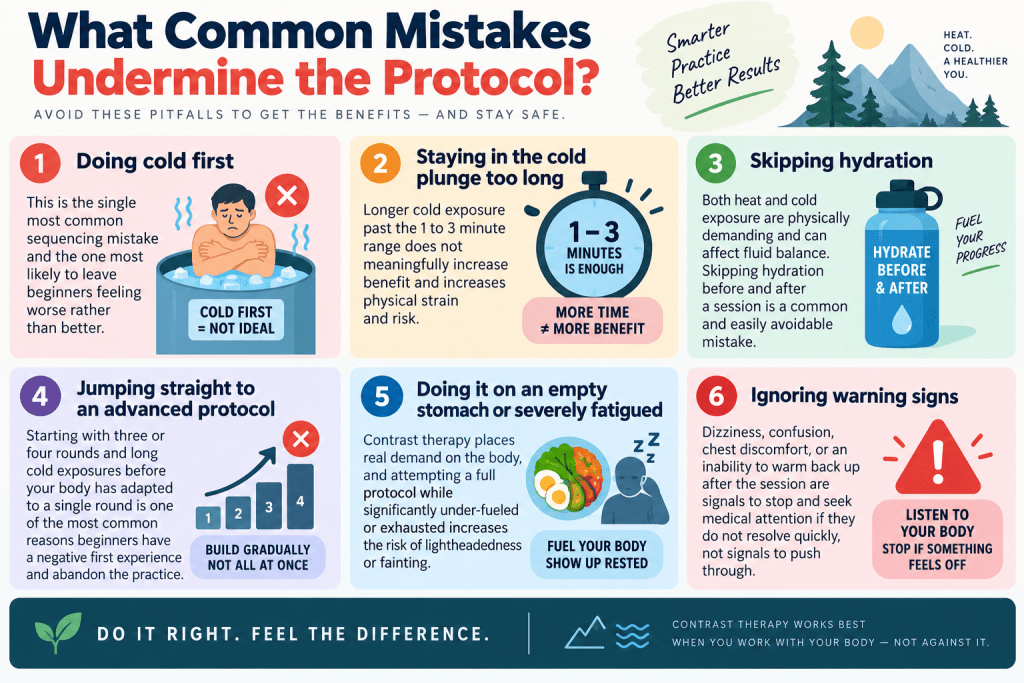
- Doing cold first: As covered throughout this article, this is the single most common sequencing mistake and the one most likely to leave beginners feeling worse rather than better.
- Staying in the cold plunge too long, chasing a feeling of toughness: Longer cold exposure past the 1 to 3 minute range does not meaningfully increase benefit and increases physical strain and risk.
- Skipping hydration: Both heat and cold exposure are physically demanding and can affect fluid balance. Skipping hydration before and after a session is a common and easily avoidable mistake.
- Jumping straight to an advanced protocol: Starting with three or four rounds and long cold exposures before your body has adapted to a single round is one of the most common reasons beginners have a negative first experience and abandon the practice.
- Doing it on an empty stomach or severely fatigued: Contrast therapy places real demand on the body, and attempting a full protocol while significantly under-fueled or exhausted increases the risk of lightheadedness or fainting.
- Ignoring warning signs: Dizziness, confusion, chest discomfort, or an inability to warm back up after the session are signals to stop and seek medical attention if they do not resolve quickly, not signals to push through.
Free 28-Day Fascia Reset Email Course
Get our Free 28-day email course series to help with 1 or 2 exercises per day to release your fascia. One short lesson per day. Two minutes to read each.
How Should You Build a Weekly Contrast Therapy Routine?
- Beginners: 1 to 2 sessions per week: Allow your body time to adapt between sessions, particularly in the first month of practice.
- Established practitioners: 2 to 4 sessions per week: This range is common among regular practitioners and allows for consistent benefit without excessive physical demand.
- Listen to your body over any fixed schedule: Days of significant fatigue, illness, or unusual stress are reasonable days to skip or shorten a planned session, since contrast therapy adds physical demand rather than reducing it in the moment.
Who Should Not Do Contrast Therapy?
Consult a physician before starting if you have:
- Any diagnosed heart condition, arrhythmia, or history of heart attack or stroke
- Uncontrolled high or low blood pressure
- Raynaud’s disease or another significant circulatory condition
- A pacemaker or other implanted cardiac device
- Are pregnant
- Have a seizure disorder
- Have any condition affecting your ability to sense temperature accurately (certain types of neuropathy, for example)
Use particular caution, and consider starting with heat or cold alone before combining them, if you:
- Are new to both practices individually
- Have a history of fainting or lightheadedness
- Are currently dealing with significant illness, dehydration, or exhaustion
Never practice contrast therapy alone if you are new to cold water immersion, particularly cold plunge, given the small but real risk of an unexpected physical response in unfamiliar cold water. Practicing with another person present, at least during your first several sessions, is a reasonable safety precaution.
Free 28-Day Fascia Reset Email Course
Get our Free 28-day email course series to help with 1 or 2 exercises per day to release your fascia. One short lesson per day. Two minutes to read each.
What Does the Research Say?
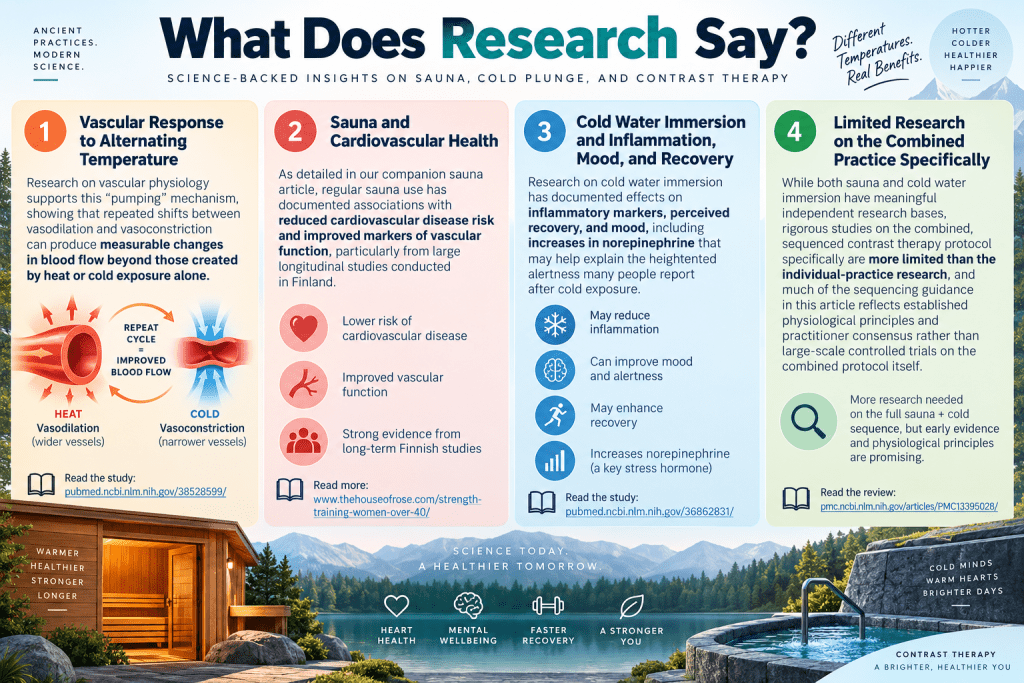
- Vascular response to alternating temperature: Research on vascular physiology supports this “pumping” mechanism, showing that repeated shifts between vasodilation and vasoconstriction can produce measurable changes in blood flow beyond those created by heat or cold exposure alone.
- Sauna and cardiovascular health: As detailed in our companion sauna article, regular sauna use has documented associations with reduced cardiovascular disease risk and improved markers of vascular function, particularly from large longitudinal studies conducted in Finland.
- Cold water immersion and inflammation, mood, and recovery: Research on cold water immersion has documented effects on inflammatory markers, perceived recovery, and mood, including increases in norepinephrine that may help explain the heightened alertness many people report after cold exposure.
- Limited research on the combined practice specifically: While both sauna and cold water immersion have meaningful independent research bases, rigorous studies on the combined, sequenced contrast therapy protocol specifically are more limited than the individual-practice research, and much of the sequencing guidance in this article reflects established physiological principles and practitioner consensus rather than large-scale controlled trials on the combined protocol itself.
What Are Your Next Steps?
If you are new to heat or cold exposure, start by learning the basics of sauna use in midlife or building a safe cold plunge practice before combining the two. This gives you time to understand how your body responds to each stressor individually before moving into contrast therapy.
For a more immersive recovery experience, THOR’s Smoky Mountains retreat brings together restorative movement, nervous system support, bodywork, and recovery practices, with options including infrared sauna and cold-water exposure.
If you want help fitting contrast therapy into a larger exercise and nutrition routine, personalized coaching can provide structured training, nutrition guidance, regular check-ins, and ongoing support around your broader midlife wellness goals.
This article is educational and is not a substitute for professional medical advice. Consult your physician before beginning any new heat or cold exposure practice, particularly if you have a cardiovascular condition or other relevant health history.
Free 28-Day Fascia Reset Email Course
Get our Free 28-day email course series to help with 1 or 2 exercises per day to release your fascia. One short lesson per day. Two minutes to read each.
Frequently Asked Questions
Should I do sauna before or after cold plunge?
Sauna first, cold plunge second, for nearly all healthy adults practicing general wellness contrast therapy. This order allows your body to build a thermal buffer that makes the cold exposure more tolerable and produces a more complete physiological response than doing it in reverse.
How long should I stay in the sauna before cold plunging?
10 to 15 minutes per round for most healthy adults, shorter (5 to 8 minutes) for beginners.
How cold should the water be, and for how long?
Typically 50 to 59 degrees Fahrenheit for 1 to 3 minutes per round. Beginners often start with 30 to 60 seconds.
How many rounds of sauna and cold plunge should I do?
Two to three rounds is standard for most practitioners. Beginners should start with one round and build up gradually.
Is it ever okay to do cold plunge before sauna?
For general wellness contrast therapy focused on circulation and alertness, no, heat first is the recommended sequence. The main exception is if you are practicing cold plunge as a fully separate, standalone practice with no sauna involved, in which case the “order” question does not apply.
Can contrast therapy help with menopause symptoms?
Some women find contrast therapy helpful for stress management, sleep, and a sense of structured control over their body’s temperature regulation, though individual response varies, and it should be approached as a complementary wellness practice rather than a treatment for menopause symptoms specifically.
Is contrast therapy safe for someone with high blood pressure?
Anyone with uncontrolled high blood pressure or another cardiovascular condition should consult a physician before beginning contrast therapy, given the acute cardiovascular demand of alternating heat and cold exposure.
What should I eat or drink before a contrast therapy session?
Stay well hydrated and avoid attempting a session on a completely empty stomach or in a significantly fatigued state, both of which increase the risk of lightheadedness.
Can I do contrast therapy every day?
Most practitioners do well with 2 to 4 sessions per week rather than daily practice, allowing the body time to recover between sessions, particularly for anyone newer to the practice.
What if I feel dizzy or unwell during or after a session?
Stop the session, sit or lie down safely, and rehydrate. If dizziness, confusion, or chest discomfort does not resolve quickly, seek medical attention.
Do I need a professional facility, or can I do this at home?
Both are viable. A home setup (a personal sauna and cold plunge tub or a cold shower alternative) works well once you understand the protocol, though a supervised facility can be a good way to learn the practice safely for your first several sessions.
I write 3 essays per week on Lifestyle Medicine for women in midlife on what is happening in the body and what to do about it. No fluff, no hype. Free.
References
- Laukkanen, T., Khan, H., Zaccardi, F., & Laukkanen, J. A. (2015). Association between sauna bathing and fatal cardiovascular and all-cause mortality events. JAMA Internal Medicine, 175(4), 542-548.
- Bleakley, C. M., & Davison, G. W. (2010). What is the biochemical and physiological rationale for using cold-water immersion in sports recovery? A systematic review. British Journal of Sports Medicine, 44(3), 179-187.
- Šrámek, P., Šimečková, M., Janský, L., Šavlíková, J., & Vybíral, S. (2000). Human physiological responses to immersion into water of different temperatures. European Journal of Applied Physiology, 81(5), 436-442.
- Kox, M., van Eijk, L. T., Zwaag, J., van den Wildenberg, J., Sweep, F. C., van der Hoeven, J. G., & Pickkers, P. (2014). Voluntary activation of the sympathetic nervous system and attenuation of the innate immune response in humans. Proceedings of the National Academy of Sciences, 111(20), 7379-7384.
- Wright, K. E., Skinner, S., & Zhu, S. (2023). The musculoskeletal syndrome of menopause. Climacteric, 26(4), 366-371.
- Hussain, J., & Cohen, M. (2018). Clinical effects of regular dry sauna bathing: A systematic review. Evidence-Based Complementary and Alternative Medicine, 2018, 1857413.
Disclaimer: This article is educational and does not constitute medical advice. Sauna and cold plunge contrast therapy places significant demands on your cardiovascular and temperature-regulation systems and should be approached gradually. If you have heart disease, blood pressure concerns, circulation problems, a history of fainting or seizures, are pregnant, have reduced temperature sensation, or have another relevant medical condition, consult a healthcare provider before starting the protocols in this article.
Free 28-Day Fascia Reset Email Course
Get our Free 28-day email course series to help with 1 or 2 exercises per day to release your fascia. One short lesson per day. Two minutes to read each.

Terry Tateossian is a Menopause Lifestyle Medicine Coach, Certified Personal Trainer & Nutritionist and the Founder of THOR: The House of Rose, a wellness brand serving women over 40 through retreats, coaching, macro-nutrition and community. As 25-year founder and entrepreneur, Terry spent two and a half decades building and running successful start-up businesses, an experience that put her on the front line of founder burnout long before she could name it. After facing serious health challenges, early onset menopause, and emotional eating while running her agency and raising two children, Terry rebuilt her health in her 40s and lost more than 80 pounds through evidence-based nutrition, training, and mindset work. Today, she helps women get strong, improve confidence, support hormone health, and create a stronger second half of life. Terry has been featured in major media outlets and is available for podcasts, expert commentary, brand collaborations, and speaking engagements on midlife health, reinvention, emotional eating, menopause wellness, and strength training for longevity. Get her free macro calculator (her cookbook companion) to start your journey to back to health.