
 By Cindy Adoptante
Free Macro Calculator
Personalized to your body, goals, and measurements. You will receive detailed macros for meals, sample day of eating, food selection guidance, hydration + daily supplement suggestions, and more.
Why Tracking Macros Isn’t Working: 6 Common Mistakes
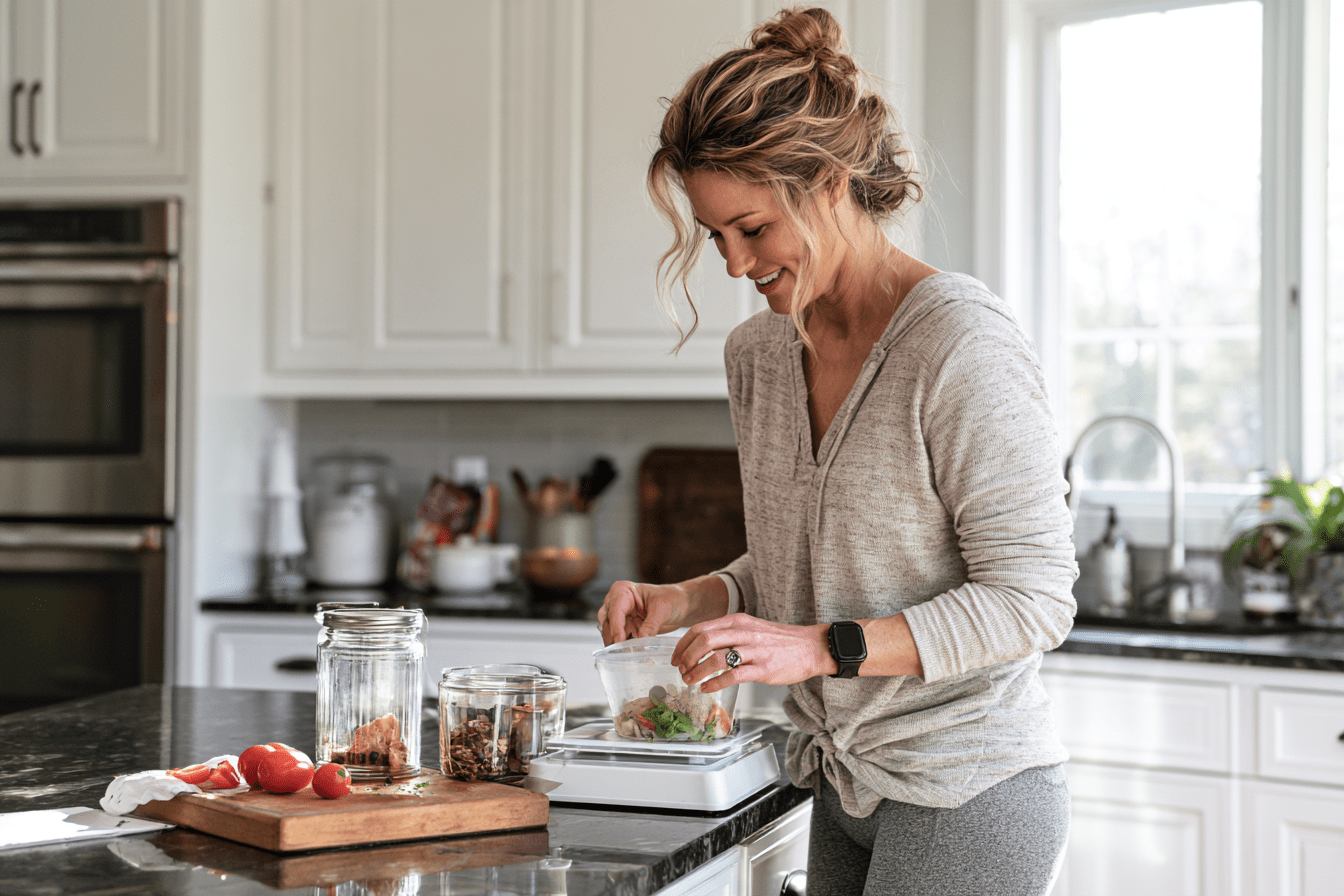
Wendy is fifty-two, and by every measure on her phone, she was doing everything right. Four weeks of logging her food daily, macros hitting her targets more nights than not, protein numbers she’d worked hard to get comfortable with. The scale hadn’t moved. Not up, not down, just a flat line that made her wonder if her body had simply stopped responding to anything at all.
It hadn’t. What Wendy had was a tracking practice that looked accurate and wasn’t, in a handful of specific, fixable places. She was logging chicken breast at the raw weight printed on the package, then cooking and eating the smaller, denser, higher-calorie-per-gram cooked portion.
She was deciding what to eat about ten minutes before she ate it, which meant her days were a chain of reasonable-sounding choices that didn’t add up to the numbers she thought they did. Neither mistake would show up as an error in the app. Both were quietly moving her actual intake away from her logged intake, day after day, for a month.
This is the pattern behind most macro tracking that “isn’t working.” It’s rarely about willpower, and it’s almost never about the app being wrong. It’s about a small number of specific, common errors that make logged numbers diverge from real numbers, invisibly, until someone points them out. Here are the six that matter most.
Important: This article is educational and does not replace individualized nutrition guidance. Women with a history of disordered eating should approach macro tracking cautiously and ideally alongside a registered dietitian or therapist, since precise food logging can be a difficult format for some people in recovery.
Are You Tracking Cooked Weight as Raw Weight or Vice Versa?
The Mistake
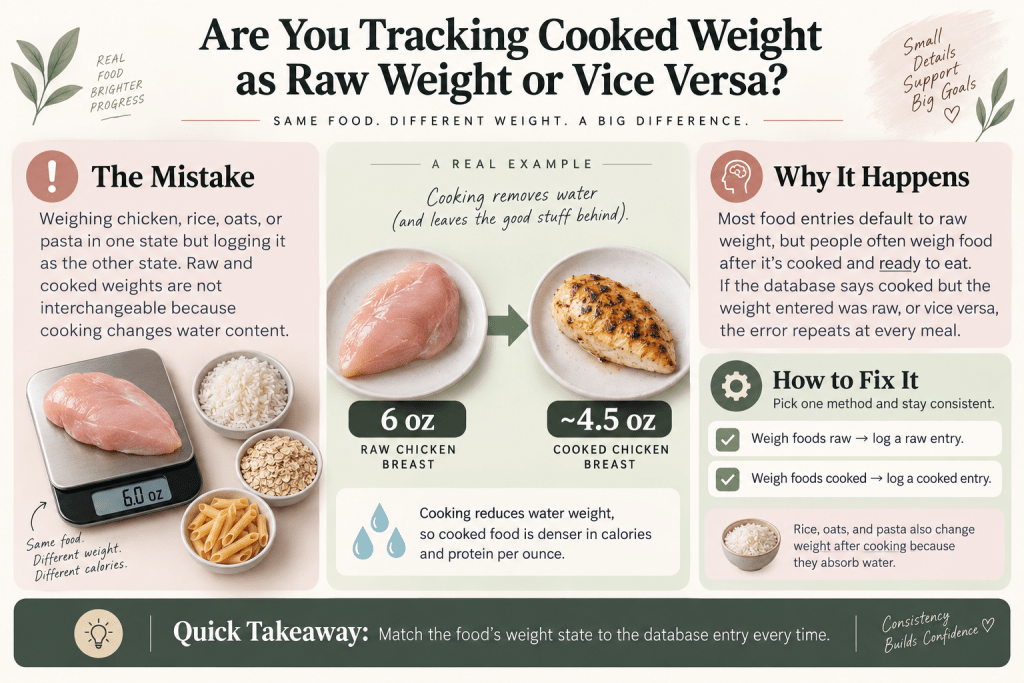
Weighing chicken, rice, oats, or pasta at one state (raw) and logging it under a database entry meant for the other state (cooked), or the reverse. Because cooking changes water content, cooked and raw weights of the same food carry meaningfully different calorie and macro density per gram.
A 6-ounce raw chicken breast becomes roughly 4.5 ounces once cooked, since it loses water weight during cooking, meaning the cooked chicken is denser in protein and calories per ounce than the raw version.
Why It Happens
Most food database entries default to raw weight for meats and dry goods like rice and oats, but people naturally weigh their food after it’s cooked and ready to eat, since that’s the moment they’re actually holding a plate.
If the app entry says “cooked” but the number logged was actually the raw weight, or the reverse, the error compounds at every single meal that includes that food.
How to Fix It
Pick one method and use it consistently: either weigh every meat and grain raw before cooking and log the raw-weight database entry, or weigh everything cooked and make sure the specific database entry selected says “cooked.” Rice, oats, and pasta follow the same rule, since they absorb water and roughly double or triple in weight once cooked.
| Food | Raw Weight | Cooked Weight | Approx. Change |
|---|---|---|---|
| Chicken breast | 6 oz | 4.5 oz | Loses ~25% weight (water) |
| White rice | 1/2 cup dry | 1.5 cups cooked | Gains ~200% weight (water) |
| Oats | 1/2 cup dry | 1 cup cooked | Gains ~100% weight (water) |
| Ground beef (85/15) | 4 oz | 3 oz | Loses ~25% weight (water and fat) |
Important: If a recipe or database entry doesn’t specify raw or cooked, assume raw unless labeled otherwise, since that’s the more common default, and confirm before logging a new food for the first time.
Are You Pre-Planning Meals Before the Day Starts?
The Mistake
Deciding what to eat meal by meal, in the moment, rather than roughly mapping out the day’s meals in advance. This seems like a minor logistics issue, but it’s one of the biggest drivers of “surprise” macro overages, since reactive eating decisions are made under time pressure, hunger, or convenience constraints that don’t leave room to check how a choice fits the day’s remaining targets.
Why It Happens
Pre-planning takes a few extra minutes that feel unnecessary when someone already knows their target numbers. But knowing the target and having a plan for hitting it are different skills, and without a plan, the day tends to drift toward whatever’s easiest in the moment, then gets logged after the fact as a surprise.
How to Fix It
Spend five minutes each morning, or the night before, roughly mapping meals against the day’s targets. This doesn’t require a rigid recipe-level plan. Even a loose outline (breakfast: eggs and toast, lunch: chicken and rice bowl, dinner: flexible based on remaining macros) prevents the common trap of eating a good breakfast and lunch, then discovering at 6 p.m. that dinner has to fit into 300 remaining calories.
“The clients who struggle most with macros aren’t the ones who lack discipline. They’re the ones treating tracking as an after-the-fact record instead of a same-day plan. I tell every client the same thing: log tomorrow’s rough plan tonight, even if it changes. A five-minute plan beats a perfect memory every time.”
Terry Tateossian, Founder of The House of Rose
Why Does Pre-Planning Matter More in Midlife Than It Did at 25?
Hunger and fullness signals shift during perimenopause and menopause, often becoming less reliable cues for portion size than they once were. A meal plan that leans on “eating until satisfied” without a rough target in mind is more likely to under- or overshoot macros in midlife than it would have a decade earlier, which makes the five-minute planning habit more valuable now, not less.
Free Macro Calculator
Personalized to your body, goals, and measurements. You will receive detailed macros for meals, sample day of eating, food selection guidance, hydration + daily supplement suggestions, and more.
Are You Eyeballing Portions Instead of Weighing Them?
The Mistake
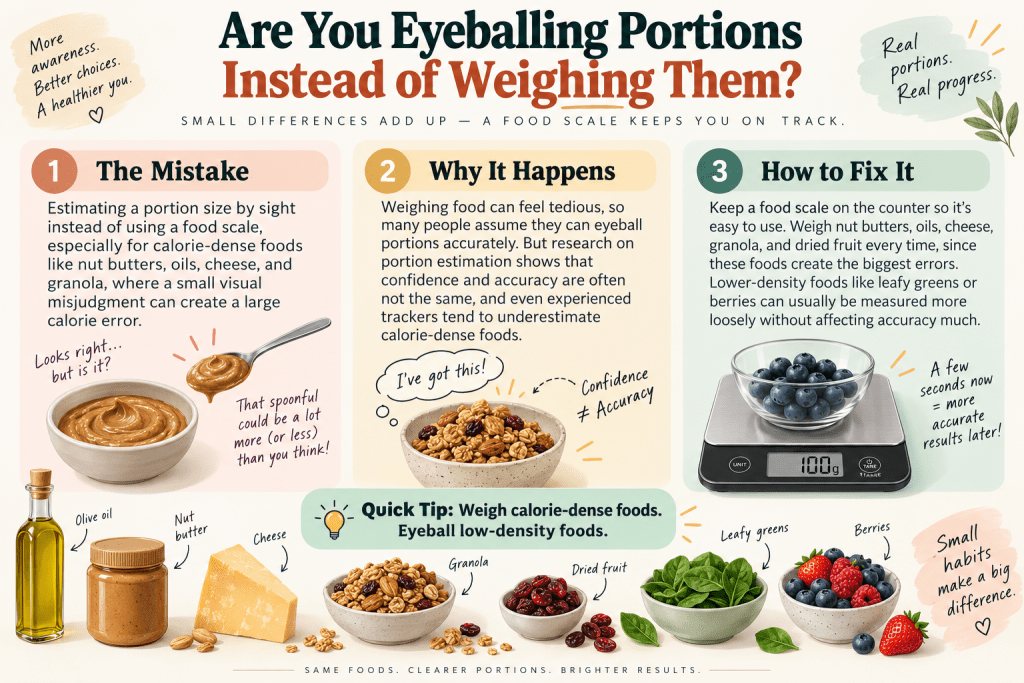
Estimating a portion size by sight (“that looks like about a cup”) rather than using a food scale, especially for calorie-dense foods like nut butters, oils, cheese, and granola, where a small visual misjudgment translates into a large calorie error.
Why It Happens
Weighing food feels tedious, and after a while, most people feel confident they can eyeball portions accurately. Research on portion estimation consistently shows that confidence and accuracy are not well correlated, and even experienced trackers tend to underestimate calorie-dense foods specifically.
How to Fix It
Keep a food scale on the counter, not in a cabinet, since visibility drives use. Weigh nut butters, oils, cheese, granola, and dried fruit every time, since these are the foods where eyeballing causes the largest errors. Lower-density foods like leafy greens or berries can be measured more loosely without meaningfully affecting accuracy.
How Does a Small Eyeballing Error Compound?
| Food | Estimated Portion | Actual Weight | Calorie Difference |
|---|---|---|---|
| Peanut butter | “A tablespoon” (eyeballed) | 1.5 tbsp actual | +50 calories |
| Olive oil for cooking | “A drizzle” | 2 tbsp actual | +240 calories |
| Shredded cheese | “A handful” | 1.5 oz actual | +60 calories |
| Daily total if repeated | +350 calories/day |
Three small eyeballing errors, repeated daily, can add up to a few hundred calories a day, enough to stall progress even when every logged number looks accurate on paper.
Are You Forgetting the Small Stuff Like Oils, Sauces, and Drinks?
The Mistake
Logging the main components of a meal (protein, starch, vegetable) accurately while forgetting the cooking oil, salad dressing, condiments, coffee creamer, or beverages consumed alongside it.
Why It Happens
These items feel like afterthoughts rather than “real food,” so they’re mentally filed as not worth logging, even though many of them are calorically dense. A tablespoon of olive oil used in a pan, two tablespoons of ranch dressing, and a flavored coffee creamer can together add several hundred unlogged calories to a day that otherwise looks perfectly tracked.
How to Fix It
Log cooking oil at the point of adding it to the pan, not after cooking (it’s easy to forget once it’s absorbed into the food). Measure sauces and dressings the same way as any other food. Treat beverages, including alcohol, cream in coffee, and sports drinks, as loggable items rather than exceptions.
Important: Alcohol in particular is frequently under-tracked and interacts with the body’s fat-burning priority, since the body processes alcohol before fat, effectively pausing fat oxidation until the alcohol is cleared. This doesn’t mean alcohol can’t fit into a tracked plan, but it should be logged accurately rather than treated as a free pass.
Free Macro Calculator
Personalized to your body, goals, and measurements. You will receive detailed macros for meals, sample day of eating, food selection guidance, hydration + daily supplement suggestions, and more.
Are You Recalculating as Weight and Activity Change?
The Mistake
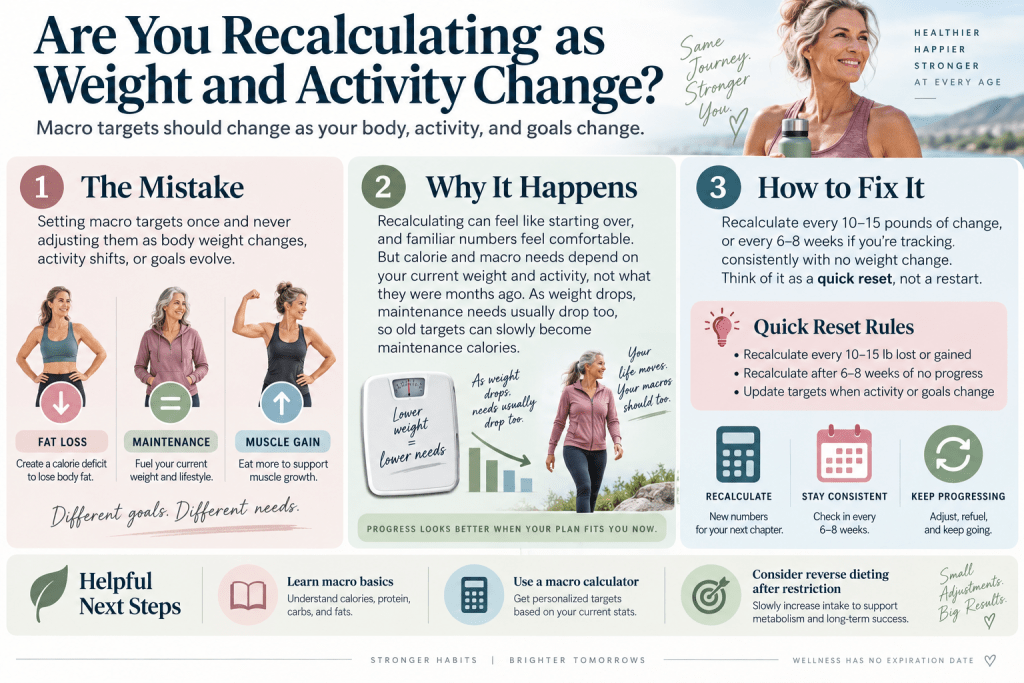
Setting macro targets once, at the start of a tracking journey, and never adjusting them as body weight changes, activity level shifts, or the original goal (fat loss, maintenance, muscle gain) evolves.
Why It Happens
Recalculating feels like starting over, and once a routine feels comfortable, most people are reluctant to change the numbers they’ve gotten used to hitting. But calorie and macro needs are a function of current body weight and activity, not the numbers from three months ago.
As weight drops, so does the number of calories needed to maintain the new, lower weight, which means the same targets that drove initial progress can quietly become a maintenance-level intake over time.
How to Fix It
Recalculate targets every 10-15 pounds of change, or every 6-8 weeks of consistent tracking without a weight change despite accurate logging elsewhere. THOR’s free macro calculator makes this a five-minute reset rather than a guessing exercise.
As your body, activity level, and goals change over time, your nutrition targets may need to change with them. Understanding the fundamentals of macros after 50 provides the foundation for adjusting protein, carbohydrates, fats, and overall calorie intake.
After a period of restriction, reverse dieting offers a structured way to increase calories gradually, while a more detailed reverse diet after 50 can help guide those adjustments step by step.
“I see this constantly with clients who lost the first fifteen pounds fast, then stalled for months while still ‘eating the same as before.’ The same numbers that created a deficit at 180 pounds are often close to maintenance at 165. Nothing about their tracking got worse. Their body just changed, and the targets didn’t follow it.”
Terry Tateossian, Founder of The House of Rose
Are You Tracking Weekdays Only and Calling It a Full Week?
The Mistake
Logging food diligently Monday through Friday, then tracking loosely or not at all on weekends, while still evaluating weekly progress as though the whole week was tracked consistently.
Why It Happens
Weekday routines tend to be more structured, with regular meal timing and fewer social eating occasions, which makes tracking easier. Weekends bring restaurants, gatherings, and looser schedules, all of which make tracking feel harder to maintain, so it often quietly drops.
How to Fix It
Weekend tracking doesn’t need to be as precise as weekday tracking to still be useful. A reasonable estimate logged for a restaurant meal is far more valuable than no log at all, since even an estimate keeps the week’s overall pattern visible.
If full tracking on weekends isn’t realistic, at minimum log a rough calorie estimate for restaurant or social meals rather than skipping the log entirely.
Free Macro Calculator
Personalized to your body, goals, and measurements. You will receive detailed macros for meals, sample day of eating, food selection guidance, hydration + daily supplement suggestions, and more.
What Does a Sample Day Done Correctly Look Like?
| Meal | What’s Logged | Common Error Avoided |
|---|---|---|
| Breakfast | Oats (logged as cooked weight, consistent with database entry) + berries + coffee with creamer (measured) | Mistake 1 (cooked vs. raw) and Mistake 4 (forgetting creamer) |
| Lunch | Pre-planned chicken and rice bowl, chicken weighed cooked, rice weighed cooked, dressing measured | Mistake 2 (pre-planning) and Mistake 3 (weighing, not eyeballing) |
| Snack | Greek yogurt + measured tablespoon of nut butter | Mistake 3 (weighing calorie-dense foods) |
| Dinner | Flexible based on remaining macros, but planned that morning, oil logged when added to the pan | Mistake 2 (pre-planning) and Mistake 4 (logging cooking oil) |
| Weekly review | Targets checked against current weight every 2 weeks; weekend restaurant meal estimated and logged | Mistake 5 (recalculating) and Mistake 6 (weekend consistency) |
What Does the Research Say About Tracking Accuracy?
Research on self-reported dietary intake consistently finds a gap between what people log and what they actually consume, with under-reporting most common for calorie-dense, less “photogenic” foods like oils, sauces, and alcohol, and portion-size misjudgment more common for energy-dense foods generally.
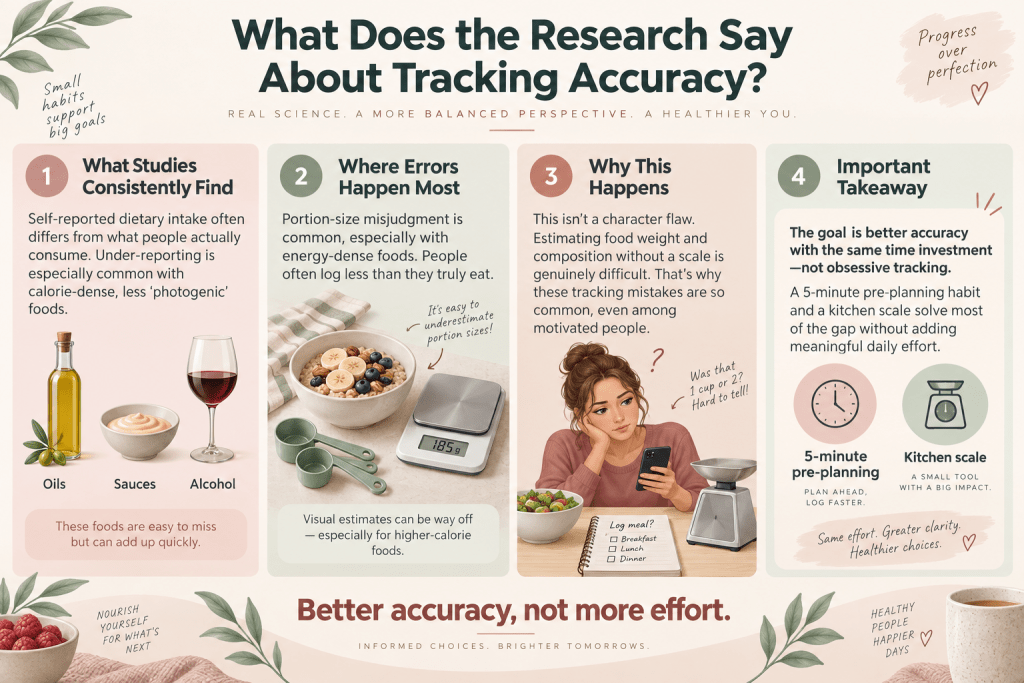
This isn’t a character flaw. It reflects genuine perceptual and logistical limits in estimating food weight and composition without a scale, and it’s exactly why the six mistakes above are so common even among motivated, consistent trackers.
Important: None of this is meant to suggest tracking should become obsessive. The goal of fixing these six mistakes is better accuracy with the same time investment, not more time spent tracking. A five-minute pre-planning habit and a kitchen scale solve most of the gap without adding meaningful daily effort.
What Are Your Next Steps?
- Pick one meat or grain you eat regularly and confirm whether you’re weighing and logging it consistently as raw or cooked.
- Spend five minutes tonight roughly planning tomorrow’s meals against your targets.
- Move your food scale to the counter and commit to weighing calorie-dense foods for the next week.
- Check whether it’s been more than 6-8 weeks, or 10-15 pounds, since your macros were last recalculated. If so, revisit THOR’s free macro calculator.
- Review THOR’s fundamentals of a macro diet for women over 50 for the full nutritional framework behind these numbers.
Accurate tracking is easiest to sustain with a food plan built around it. THOR’s Macro Miracle Mediterranean Cookbook provides pre-calculated recipes that remove the guesswork this article covers, since every recipe already accounts for cooked weights and hidden extras like oil and dressing.
For women who want a coached, personalized approach to building and adjusting a tracking practice over time, THOR’s 1:1 coaching program includes ongoing macro recalculation and troubleshooting as part of the process.
Supplement gaps that support a tracked nutrition plan, including protein and fiber options, are covered on THOR’s vitamins and supplements page.
Important: This article is educational and does not replace individualized nutrition guidance. Please consult a registered dietitian if you have a history of disordered eating before beginning detailed food tracking.
Free Macro Calculator
Personalized to your body, goals, and measurements. You will receive detailed macros for meals, sample day of eating, food selection guidance, hydration + daily supplement suggestions, and more.
Frequently Asked Questions
Should I weigh food cooked or raw?
Either works, as long as it’s consistent and matched to the correct database entry. The error happens when the weighing method and the logged database entry don’t match (weighing cooked chicken but logging it under a raw-weight entry, for example).
How much does the cooked-vs-raw mistake actually matter?
For protein sources like chicken, it can shift logged calories and protein by 20-25% per serving, which compounds significantly across a week of regular meals containing that food.
Do I really need to weigh everything, or just some foods?
Calorie-dense foods (oils, nut butters, cheese, granola, dried fruit) benefit most from weighing, since small volume misjudgments translate into the largest calorie errors. Lower-density foods like vegetables can be measured more loosely.
Is it normal for the scale not to move even when I’m tracking accurately?
Short plateaus (1-2 weeks) are normal due to water retention and other factors. Longer plateaus (4+ weeks) despite consistent tracking are the signal to check for one of the six mistakes above, particularly Mistake 5 (needing a recalculation).
How often should I recalculate my macros?
Every 10-15 pounds of weight change, or every 6-8 weeks if weight hasn’t changed despite accurate tracking, whichever comes first.
Does alcohol really affect fat loss if it fits my macros?
Yes, independent of whether it “fits.” Alcohol is processed before fat, temporarily pausing fat oxidation, so frequent alcohol intake can slow progress even when calories and macros are logged accurately.
What’s the easiest mistake to fix immediately?
Moving the food scale to the counter (Mistake 3) and pre-planning the next day the night before (Mistake 2) are both immediate, low-effort fixes that most people can implement the same day.
Do restaurant meals ruin accurate tracking?
Not if estimated and logged rather than skipped. Most tracking apps have restaurant menu databases, and even a rough estimate keeps the week’s pattern visible.
Should beginners track every single day, including weekends?
Ideally yes, though weekend tracking can be less precise than weekday tracking. The key is logging something rather than nothing, even a rough restaurant estimate.
Can I trust my hunger cues instead of tracking at all?
Hunger and fullness cues can shift during perimenopause and menopause, making them a less reliable stand-alone guide than they may have been earlier in life. Tracking, even loosely, provides a more consistent reference point during this transition.
Is a food scale really necessary, or can measuring cups work?
Measuring cups work reasonably well for dry goods but are less accurate for irregularly shaped or dense foods. A scale is more precise and often faster once the habit is established.
What if my app’s database entry doesn’t specify raw or cooked?
Assume raw unless labeled otherwise, since that’s the more common default in most food databases, and verify by checking the calorie count against a known reference for that food.
How long does it take to build an accurate tracking habit?
Most people notice a meaningful accuracy improvement within 1-2 weeks of implementing the fixes for these six mistakes, though building the pre-planning habit specifically tends to take a bit longer to feel automatic.
Does tracking macros work differently for women in perimenopause versus younger women?
The mechanics of tracking are the same, but the context around it changes: shifting hunger cues, changing body composition, and evolving activity levels mean the recalculation habit (Mistake 5) matters more, and more often, in midlife than it typically did a decade earlier.
References
- Academy of Nutrition and Dietetics patient education materials on accurate portion measurement and food logging.
- Poslusna, K., et al. (2009). Misreporting of energy and micronutrient intake estimated by food records and 24-hour recalls, control and adjustment methods in practice. British Journal of Nutrition, 101(S2), S73-S85.
- Champagne, C. M., et al. (2002). Energy intake and energy expenditure: a controlled study comparing dietitians and non-dietitians. Journal of the American Dietetic Association, 102(10), 1428-1432.
- Livingstone, M. B. E., & Black, A. E. (2003). Markers of the validity of reported energy intake. Journal of Nutrition, 133(3), 895S-920S.
- Burke, L. E., et al. (2011). Self-monitoring in weight loss: a systematic review of the literature. Journal of the American Dietetic Association, 111(1), 92-102.
- Ravussin, E., & Bogardus, C. (1989). Relationship of genetics, age, and physical fitness to daily energy expenditure and fuel utilization. American Journal of Clinical Nutrition, 49(5), 968-975.
- Suter, P. M. (2005). Is alcohol consumption a risk factor for weight gain and obesity? Critical Reviews in Clinical Laboratory Sciences, 42(3), 197-227.
- North American Menopause Society clinical guidance on appetite regulation and body composition changes during the menopause transition.
- Mayo Clinic patient education materials on food tracking accuracy and portion control.
Disclaimer: This article is educational and does not constitute medical or individualized nutrition advice. Macro tracking can be a useful tool, but calorie and nutrient needs vary based on body composition, activity level, health conditions, medications, and personal goals. If you have a history of disordered eating, are recovering from an eating disorder, or find detailed food tracking distressing or obsessive, consult a registered dietitian, therapist, or qualified healthcare provider before using the strategies in this article.
Free Macro Calculator
Personalized to your body, goals, and measurements. You will receive detailed macros for meals, sample day of eating, food selection guidance, hydration + daily supplement suggestions, and more.
Terry Tateossian is a Menopause Lifestyle Medicine Coach, Certified Personal Trainer & Nutritionist and the Founder of THOR: The House of Rose, a wellness brand serving women over 40 through retreats, coaching, macro-nutrition and community. As 25-year founder and entrepreneur, Terry spent two and a half decades building and running successful start-up businesses, an experience that put her on the front line of founder burnout long before she could name it. After facing serious health challenges, early onset menopause, and emotional eating while running her agency and raising two children, Terry rebuilt her health in her 40s and lost more than 80 pounds through evidence-based nutrition, training, and mindset work. Today, she helps women get strong, improve confidence, support hormone health, and create a stronger second half of life. Terry has been featured in major media outlets and is available for podcasts, expert commentary, brand collaborations, and speaking engagements on midlife health, reinvention, emotional eating, menopause wellness, and strength training for longevity. Get her free macro calculator (her cookbook companion) to start your journey to back to health.