
 By Team THOR
Get 11 Sample Recipes from Our Bestselling Mediterranean Cookbook.
Get our 11 Sample Recipes from our Best Selling Mediterranean Protein Friendly Cookbook. These are the most delicious recipes our retreat guests love the most. Easy, simple with few ingredients per meal. Make delicious heart-friendly and healthy meals you enjoy every day.
6 Healthy Habits From Japan I Wish More Midlife Women Would Copy
I went to Japan for three weeks this year to scout locations for a future THOR yoga & hiking retreat, the kind of trip where you tell yourself you’re there for work and end up learning far more than you planned to. I’d heard the usual things: that Japan changes how you see health, that the food is incredible, that you hardly see anyone struggling with the weight and metabolic issues so common back home.
I’ve heard versions of that claim about plenty of countries, so I kept my expectations modest. Within the first few days, I understood why people say it about Japan specifically. What struck me wasn’t anything exotic. It was how ordinary healthy living looked there, woven into the day so quietly that nobody seemed to be trying.
When I got home, I did a routine body composition scan, the same one I run every few months to track how my own midlife body is holding up. I’d braced for bad news. Three weeks of walking and hiking with almost no structured strength training should have cost me muscle, not gained it.
Instead, I’d lost body fat and gained a small amount of lean mass. My own trainer’s reaction was some version of “whatever you did over there, keep doing it.” What I’d actually done was nothing dramatic. I want to walk you through the five habits behind that result, because none of them require moving to Japan, and every one of them has real research behind why they work.
Ichiju-Sansai: What a Balanced Meal Looks Like
The word is ichiju-sansai, which translates to “one soup, three dishes.” It’s the basic structural idea behind most home-cooked Japanese meals: a bowl of rice, a small soup, a portion of fish or meat, and a couple of small side dishes of vegetables, pickles, tofu, or egg.
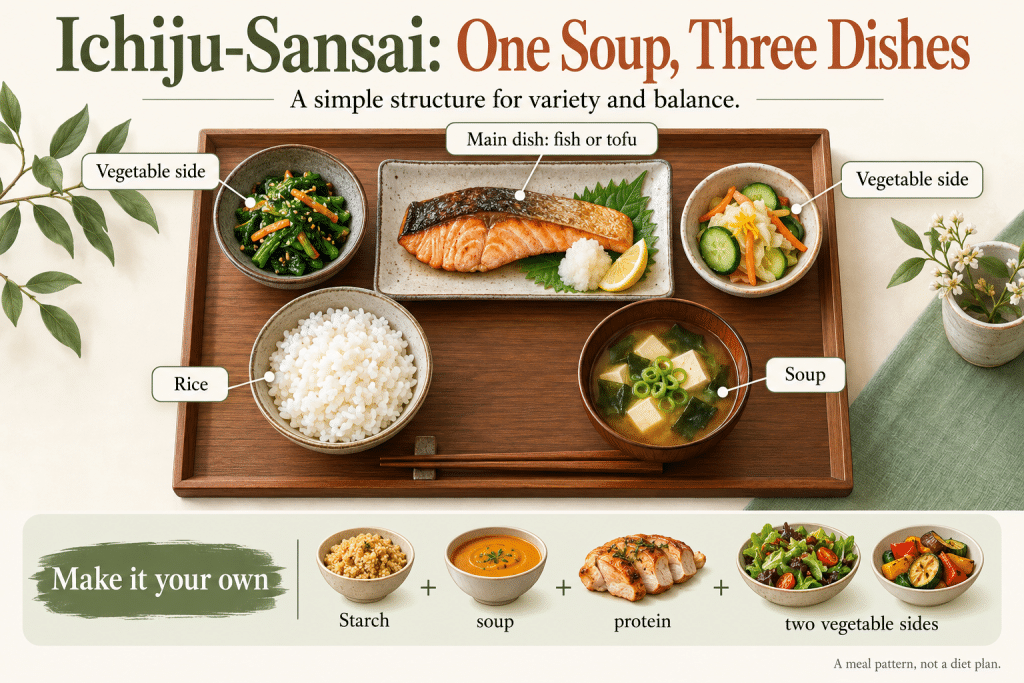
Nobody sits down and calculates macros to build a plate like this. It’s just what a normal meal looks like, and it happens to land close to an actually balanced ratio of protein, carbohydrate, fiber, and micronutrients without anyone trying.
Compare that to how a lot of us default to eating in the US: one large central item carrying the whole plate, whether that’s a burger, a mountain of pasta, or a bowl of rice buried under curry. That default isn’t a personal failing.
It’s a structural one, built from portion norms and food marketing that reward size over balance. Japan’s obesity rate sits under 5%, compared to roughly 19% in Germany and well over 40% in the US, and while no single habit explains a national statistic, meal structure is one of the more concrete, replicable differences (OECD, 2023).
Important: ichiju-sansai isn’t a diet plan and doesn’t require Japanese ingredients specifically. The structure, a modest portion of protein, a modest portion of starch, and at least one to two vegetable-forward sides, translates directly onto a Western plate.
Get 11 Sample Recipes from Our Bestselling Mediterranean Cookbook.
Get our 11 Sample Recipes from our Best Selling Mediterranean Protein Friendly Cookbook. These are the most delicious recipes our retreat guests love the most. Easy, simple with few ingredients per meal. Make delicious heart-friendly and healthy meals you enjoy every day.
Konbini: Making the Healthy Choice the Easy One
Konbini means convenience store, and in Japan they’re everywhere: 7-Eleven, FamilyMart, Lawson, often multiple per block. What surprised me wasn’t that healthy options existed there. It’s that they weren’t the exception.
Alongside the fried snacks and instant noodles you’d expect, the shelves were stacked with onigiri, boiled eggs, salads, grilled chicken, yogurt, and full bento boxes built around real protein and vegetables, plus a whole aisle of functional drinks: vitamin shots, protein gels, fiber drinks. On a return trip through the same store, I probably grabbed a protein-forward snack or a vitamin shot as often as I grabbed coffee.
This is a behavior design principle before it’s a nutrition one. When the fastest, cheapest, most visible option at every corner happens to be reasonably healthy, you don’t need willpower to eat well; you need to do nothing differently at all.
Behavioral economics research on food environment calls this the “default effect”: people overwhelmingly choose whatever requires the least friction, regardless of what they’d choose if forced to deliberate (Thaler & Sunstein, 2008). In most American convenience stores and gas stations, the default is reversed, which means the same instinct to grab whatever’s closest works against you instead of for you.
“I tell the women I coach constantly: stop trying to out-willpower a bad environment. If the easiest snack in your kitchen or your desk drawer is a protein-forward one, you don’t need discipline to eat it. You just need to be the one who stocked the drawer.”
Terry Tateossian, Founder of The House of Rose
Hara Hachi Bu: Eating Until 80% Full
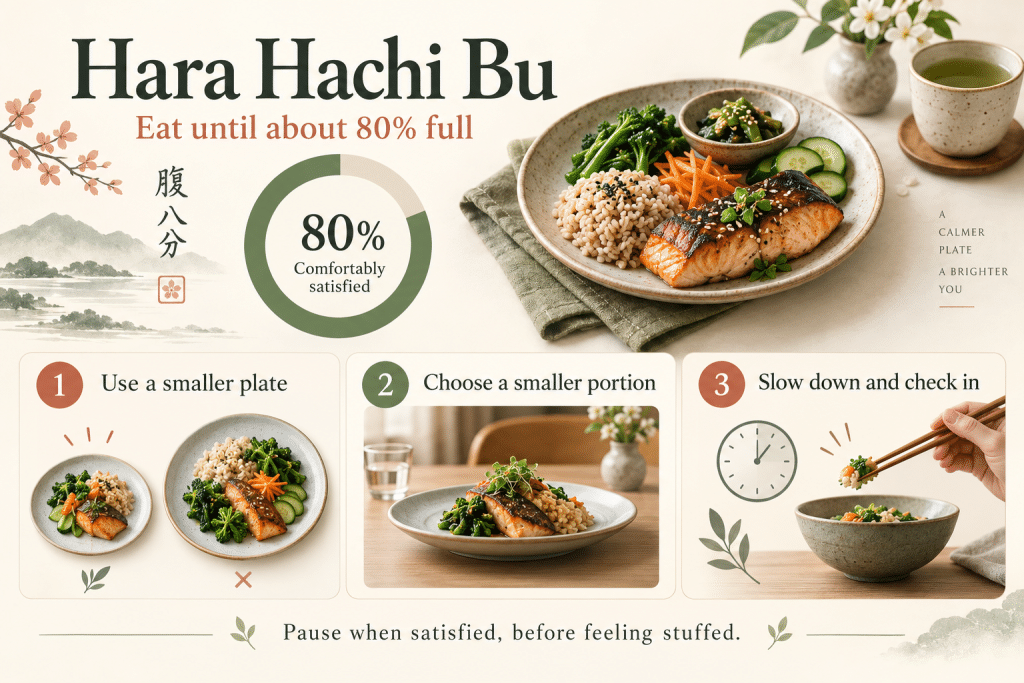
This is probably the single most quoted Japanese health concept, and for good reason: eat until you’re about 80% full, not stuffed. The idea is most associated with Okinawa, where researchers studying the region’s unusually high concentration of centenarians identified moderate, self-imposed caloric restriction, hara hachi bu among them, as one of several contributing factors to the population’s longevity (Willcox et al., 2007).
What’s easy to miss is that hara hachi bu is much easier to practice in Japan because the portions themselves are already calibrated for it. It’s not a jumbo burger you have to summon self-control to leave half of.
Restaurant portions run smaller by default, and many restaurants display extremely realistic plastic food replicas, called shokuhin sampuru, right outside, so you know exactly what you’re getting before you order. There’s no guessing, no plate that’s secretly twice the size the menu photo implied.
You can apply the idea in a few different situations:
- If your household defaults to large serving dishes: Using a smaller plate for meals at home is one of the more well-supported ways to reduce mindless overeating without tracking anything; a controlled study on plate size found that portion sizes served, and consumed, scaled directly with plate diameter, independent of hunger (Wansink & van Ittersum, 2013).
- If you eat out frequently: Ordering the smaller portion size when it’s offered, or splitting an entree, mimics the built-in portion calibration that makes hara hachi bu nearly automatic in Japan.
- If you struggle to identify “80% full” in the moment: Eating more slowly helps close the gap between when you’re actually satisfied and when your brain registers it; satiety signals from the gut typically take 15 to 20 minutes to reach the brain, which means fast eating reliably overshoots fullness before the signal even arrives (Robinson et al., 2014).
Get 11 Sample Recipes from Our Bestselling Mediterranean Cookbook.
Get our 11 Sample Recipes from our Best Selling Mediterranean Protein Friendly Cookbook. These are the most delicious recipes our retreat guests love the most. Easy, simple with few ingredients per meal. Make delicious heart-friendly and healthy meals you enjoy every day.
Arukeru Machi: Walking Built Into the Day, Not Added to It
I already average high step counts when I travel, and Japan still added thousands more without me trying. Japanese cities are built at a scale and density that make walking the path of least resistance rather than something you have to schedule intentionally.
Tokyo’s extensive train network requires genuine walking between platforms, exits, connections, and final destinations before you’ve even thought about exercise. Most people aren’t consciously trying to “get their steps in.” Walking is simply built into getting to work, running errands, meeting friends, and moving through the city.
That everyday accumulation is also what makes a daily step habit so practical. Instead of relying on one dedicated workout, consistent low-intensity movement gets distributed naturally across the day through dozens of smaller opportunities to walk.
Japan creates much of that movement through its environment. If your daily life revolves around cars, desks, and less walkable neighborhoods, intentionally adding micro walks can recreate some of the same pattern by breaking movement into short, repeatable blocks throughout the day.
Onsen and Sento: Rest and Recovery as Routine, Not Reward
After enough walking and eating, recovery becomes necessary, and this is the part of Japanese culture I think gets the least attention outside the country: the hot springs (onsen) and neighborhood bathhouses (sento). I’d already spent time in German sauna culture before this trip, so some of it felt familiar: the same seriousness about washing before entering, the same ritual of pouring water over hot stones to build steam.
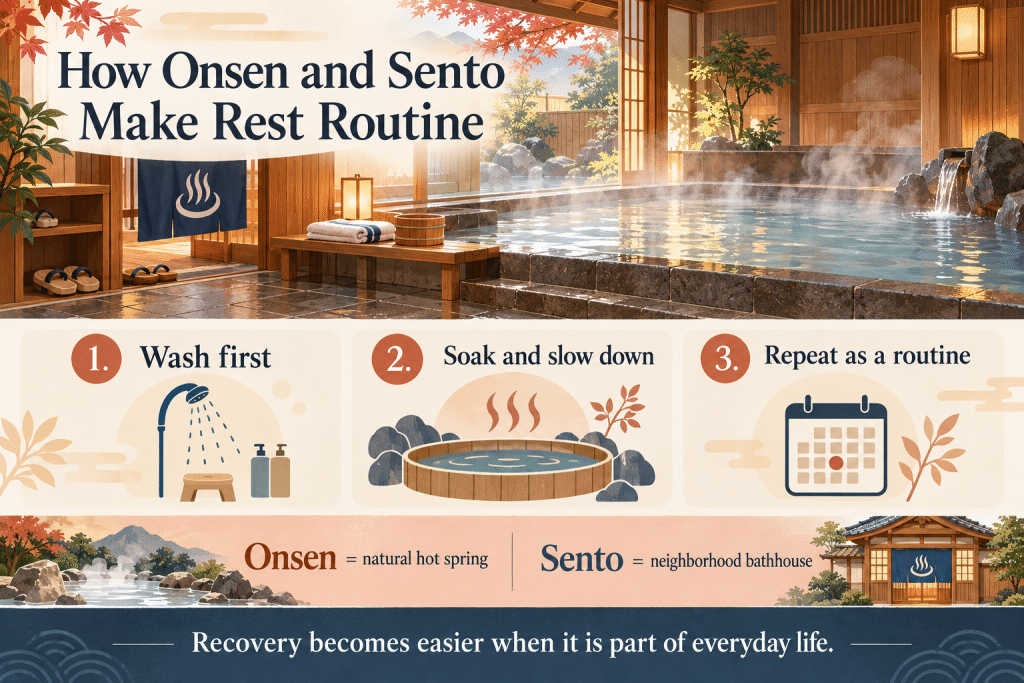
But the framing was different. In Japan, an onsen visit isn’t a special spa day. It’s a routine part of the week, priced closer to a coffee than a treatment, and often open past midnight for people coming from work, school, or sports practice.
That framing matters more than the water temperature. Heat exposure through sauna and hot bathing has real, replicated research behind it: regular sauna use is associated with reduced cardiovascular mortality and improved recovery markers after physical exertion, largely through heat shock protein activation and improved vascular function (Laukkanen et al., 2015).
THOR’s own sauna and cold plunge protocol guide covers the mechanics of how to sequence heat and cold exposure for recovery. What Japan adds isn’t a different mechanism. It’s proof that the habit holds up better long-term when it’s treated as ordinary maintenance rather than an occasional indulgence you have to justify.
Get 11 Sample Recipes from Our Bestselling Mediterranean Cookbook.
Get our 11 Sample Recipes from our Best Selling Mediterranean Protein Friendly Cookbook. These are the most delicious recipes our retreat guests love the most. Easy, simple with few ingredients per meal. Make delicious heart-friendly and healthy meals you enjoy every day.
Shokuiku: Why None of This Requires Willpower
I only learned the word shokuiku from a conversation with a local guide partway through the trip, and it reframed everything else I’d noticed. It means food and nutrition education, but in Japan it goes well beyond telling kids to eat their vegetables.
Healthy eating is introduced structurally from childhood through school lunch programs, called kyushoku, which serve balanced, locally sourced meals instead of vending machines or pre-packaged food. Meals are treated as part of the curriculum itself, not separate from it.
Students learn where their food comes from, what nutritional balance actually looks like on a plate, and how to eat and clean up together as a shared, unhurried activity rather than something rushed between classes. They absorb the concept of a balanced meal the same way they absorb language: before they’re old enough to turn it into a rule they have to follow.
That’s the linchpin behind everything else in this article. The smaller portions, the balanced convenience-store defaults, the walkable cities, none of it comes from Japanese adults consciously tracking macros and step counts.
It comes from a culture that installed the underlying pattern before adulthood, so the healthy choice never had to compete with willpower in the first place. That’s a distinctly different starting point than most of us have, and it’s worth naming honestly rather than implying anyone is simply more disciplined.
What Does the Evidence Actually Support?
Travel essays about “what a country does right” tend to blur observation and research together. Here’s what’s actually well-supported behind each habit above, and where the evidence is thinner.
| Habit | What’s Well-Supported | Evidence Strength |
|---|---|---|
| Ichiju-sansai (balanced meal structure) | Structured, protein-and-vegetable-forward meals support better nutrient adequacy than single-item, carbohydrate-heavy plates | Moderate to Strong |
| Hara hachi bu (80% full) | Moderate caloric restriction and slower eating both associate with better long-term weight and metabolic outcomes | Strong |
| Konbini (default food environment) | Food environment and default options measurably shift consumption patterns, independent of willpower or nutrition knowledge | Strong |
| Arukeru machi (built-in walking) | Daily step volume correlates with lower mortality risk and better metabolic health up to a plateau around 7,000 to 9,000 steps/day | Strong |
| Onsen/sento (routine heat exposure) | Regular sauna and heat exposure associates with cardiovascular and recovery benefits in observational and some interventional studies | Moderate to Strong |
| Overall Okinawa/blue zone longevity claims | Multiple contributing factors (diet, movement, social connection, genetics) make it difficult to isolate any single habit as causal | Moderate (multifactorial) |
Important: the longevity statistics tied to Okinawa specifically come from a defined, aging cohort studied over decades, and Japan’s national statistics reflect a mix of genetics, healthcare access, and culture that can’t be fully separated from lifestyle alone. The individual habits above still hold up on their own evidence, even without crediting them for the entire national longevity picture.
Get 11 Sample Recipes from Our Bestselling Mediterranean Cookbook.
Get our 11 Sample Recipes from our Best Selling Mediterranean Protein Friendly Cookbook. These are the most delicious recipes our retreat guests love the most. Easy, simple with few ingredients per meal. Make delicious heart-friendly and healthy meals you enjoy every day.
How Can You Bring These Habits Home Without Moving to Japan?
Start with whichever change fits your daily routine. These examples show how to adapt the habits at home:
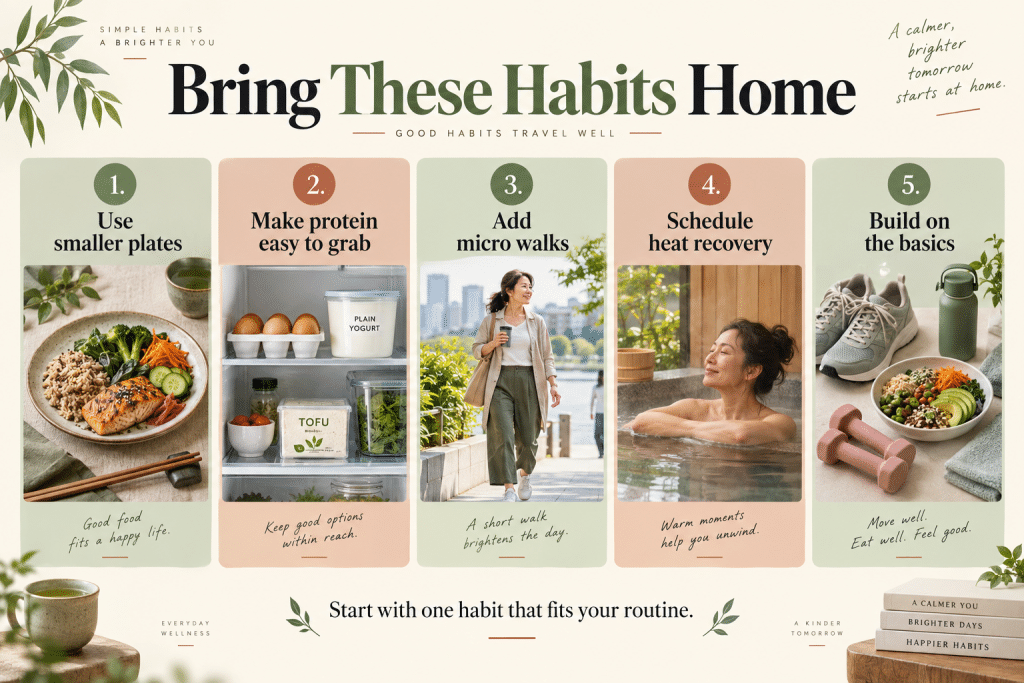
- If your plates and bowls are oversized: Downsizing your everyday dinnerware is a simple way to make moderate portions feel more natural without tracking every bite.
- If your kitchen defaults to whatever’s fastest to grab: Keep a protein-forward, ready-to-eat option in the most visible part of your fridge or pantry. This recreates some of the convenience of a konbini by making the better choice the easiest one.
- If your days don’t naturally include walking: Attach short walks to transitions that already happen, such as phone calls, coffee breaks, or the walk to and from your car. Building in regular micro walks makes daily movement easier to accumulate without carving out a full hour.
- If recovery feels like something you have to earn: Treat a weekly sauna, hot bath, or heat-and-cold routine as part of your normal recovery habits rather than something reserved only for especially hard weeks.
- If you’re also working toward fat loss or body composition goals: Keep these daily habits as the foundation, then add targeted practices where they make sense. Gentle lymphatic drainage exercises can support movement and fluid balance alongside the nutrition, strength training, and activity habits that drive longer-term body composition changes.
What Are Your Next Steps?
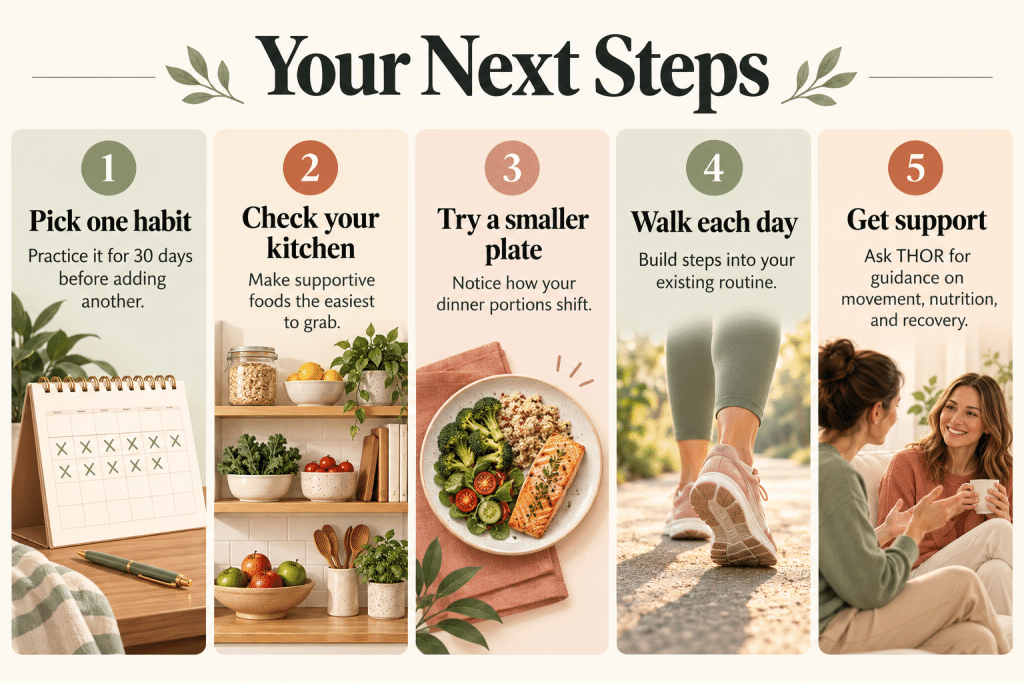
- Pick one habit from this list: Give it 30 days before adding another. Building one change into your routine consistently is more sustainable than trying to overhaul five habits at once.
- Audit your food environment: Look at what is fastest and easiest to grab in your kitchen right now. Then ask whether those default choices support the way you want to eat or make it harder.
- Downsize one plate or bowl: Use it regularly for dinner and simply notice whether your portions begin to shift without needing to track every meal.
- Start with walking if that feels easiest: A consistent daily step habit can be one of the simplest ways to add more movement without restructuring your entire schedule.
- Get support if you want more structure: If you want help turning small changes like these into a sustainable routine around movement, nutrition, and recovery, you can reach out to THOR for personalized guidance.
Get 11 Sample Recipes from Our Bestselling Mediterranean Cookbook.
Get our 11 Sample Recipes from our Best Selling Mediterranean Protein Friendly Cookbook. These are the most delicious recipes our retreat guests love the most. Easy, simple with few ingredients per meal. Make delicious heart-friendly and healthy meals you enjoy every day.
Frequently Asked Questions
What does hara hachi bu mean?
It’s a Japanese practice, most associated with Okinawa, of eating until you feel about 80% full rather than completely stuffed. It’s tied to the region’s research on longevity and moderate, self-directed caloric restriction (Willcox et al., 2007).
What is the Okinawa diet exactly?
It’s less a specific diet plan than a pattern: smaller portions, a high proportion of vegetables and legumes, moderate fish intake, and comparatively low overall caloric intake, studied extensively in the Okinawa Centenarian Study for its association with regional longevity.
Is the blue zone diet the same as the Okinawa diet?
Okinawa is one of five recognized “blue zones,” regions with unusually high concentrations of centenarians, alongside Sardinia, Nicoya, Ikaria, and Loma Linda. The broader “blue zone diet” draws on dietary patterns common across all five, of which Okinawa’s is one specific version.
What does ichiju-sansai mean?
It translates to “one soup, three dishes” and describes the traditional structure of a balanced Japanese meal: a bowl of rice, a small soup, a protein source, and one or two vegetable-forward side dishes.
Can I practice hara hachi bu without changing what I eat?
Yes. It’s primarily about portion and pace rather than food choice specifically. Eating more slowly and using smaller dishes are two of the most evidence-supported ways to approximate it without restricting any particular food.
Why do Japanese convenience stores have healthier food than American ones?
It largely comes down to what food retailers and manufacturers have built their default product lines around culturally, plus different regulatory and marketing norms around processed food. It’s a structural, industry-level difference more than an individual one.
How many steps do people in Japan walk on average compared to the US?
Japan’s urban density and public transit infrastructure make incidental daily walking substantially higher than in most car-dependent American cities, though exact national averages vary by source and city. The mechanism matters more than the specific number: walking built into transit and errands adds up without requiring a dedicated workout.
Is Japan’s low obesity rate mostly genetic?
Genetics play some role, but researchers generally attribute a meaningful share of the difference to dietary patterns, portion norms, and activity built into daily life rather than genetics alone, since dietary habits and obesity rates shift when Japanese populations relocate to environments with different food and activity defaults.
What is shokuiku?
It’s Japan’s food and nutrition education framework, introduced from early childhood through school lunch programs, which teaches nutritional balance, food origins, and shared eating habits as part of standard education rather than treating nutrition as separate, optional knowledge.
Do onsens and saunas actually help with recovery, or is that just relaxation?
Both. Regular sauna and heat exposure have documented associations with improved cardiovascular markers and recovery from physical exertion, in addition to the subjective relaxation effect (Laukkanen et al., 2015).
How is a sento different from an onsen?
An onsen uses naturally occurring hot spring water, often mineral-rich, while a sento is a public bathhouse using regular heated tap water. Both follow similar bathing etiquette and social norms.
I don’t live somewhere walkable. Can I still get the benefit of arukeru machi?
Yes, although it takes more intention when your environment doesn’t naturally encourage walking. Anchoring short micro walks to transitions that already happen during your day can help recreate some of the consistent, low-intensity movement that walkable cities build in automatically.
Which of these five habits matters most for someone just starting out?
There’s no single correct order, but portion structure (ichiju-sansai) and environment design (konbini) tend to be the easiest to implement immediately, since they don’t depend on external infrastructure like walkable cities or bathhouse culture.
Does this apply differently for women going through perimenopause or menopause?
The underlying mechanisms, portion regulation, movement volume, and recovery, are all relevant to managing the body composition and metabolic shifts common in midlife, though none of these habits are a substitute for addressing hormonal changes directly where they’re a significant factor.
I write 3 essays per week on Lifestyle Medicine for women in midlife on what is happening in the body and what to do about it. No fluff, no hype. Free.
References
- OECD (2023). Obesity Update. Organisation for Economic Co-operation and Development.
- Thaler, R.H., & Sunstein, C.R. (2008). Nudge: Improving Decisions About Health, Wealth, and Happiness. Yale University Press.
- Willcox, B.J., Willcox, D.C., Todoriki, H., et al. (2007). Caloric Restriction, the Traditional Okinawan Diet, and Healthy Aging: The Diet of the World’s Longest-Lived People and Its Potential Impact on Morbidity and Life Span. Annals of the New York Academy of Sciences, 1114(1), 434-455.
- Wansink, B., & van Ittersum, K. (2013). Portion Size Me: Plate-Size Induced Consumption Norms and Win-Win Solutions for Reducing Food Intake and Waste. Journal of Experimental Psychology: Applied, 19(4), 320-332.
- Robinson, E., Almiron-Roig, E., Rutters, F., et al. (2014). A Systematic Review and Meta-Analysis Examining the Effect of Eating Rate on Energy Intake and Hunger. American Journal of Clinical Nutrition, 100(1), 123-151.
- Laukkanen, T., Khan, H., Zaccardi, F., & Laukkanen, J.A. (2015). Association Between Sauna Bathing and Fatal Cardiovascular and All-Cause Mortality Events. JAMA Internal Medicine, 175(4), 542-548.
Disclaimer: This article is educational and does not constitute medical, nutritional, or professional health advice. The eating, walking, portion-control, and heat-exposure habits discussed here are general lifestyle practices, and individual results will vary. If you have cardiovascular concerns, mobility limitations, metabolic conditions, heat sensitivity, or another medical condition, consult a healthcare provider before making significant changes to your diet, activity level, sauna use, or hot-bathing routine.
Get 11 Sample Recipes from Our Bestselling Mediterranean Cookbook.
Get our 11 Sample Recipes from our Best Selling Mediterranean Protein Friendly Cookbook. These are the most delicious recipes our retreat guests love the most. Easy, simple with few ingredients per meal. Make delicious heart-friendly and healthy meals you enjoy every day.

Kara Krysinski is a yoga teacher (in training) and retreats coordinator at THOR Yoga Retreats, where she brings a deep understanding of movement, nourishment and dietary sensitivity into her work. She is the co-author of The Macro Miracle Mediterranean Cookbook – 80 Macro-Friendly Recipes for Fat Loss, Strength, Metabolism & Health. Her passion lies in creating flavorful, satisfying gluten-free meals that allow people to enjoy food without compromise. After developing a severe gluten allergy that led to a seven-day hospitalization, Kara began reimagining her relationship with food from both a personal and practical standpoint. What started as necessity evolved into purpose: developing gluten-free recipes that are nourishing, accessible, and genuinely enjoyable. Many of the recipes in her cookbook are her original creations, inspired by her own journey of healing and adaptation. Kara is currently working on furthering her studies and culinary creativity using evidence-based macro-based nutrition principles, as well as strength training and growth mindset. Her work reflects a belief that dietary restrictions do not have to mean restriction in pleasure, connection or quality of life. Get her free macro calculator for her cookbook here.