

 By Team THOR
Free 28-Day Fascia Reset Email Course
Get our Free 28-day email course series to help with 1 or 2 exercises per day to release your fascia. One short lesson per day. Two minutes to read each.
5 Science-Backed Ways to Lose Weight That Don’t End in a Binge, a Plateau, or a Rebound
Almost every weight loss plan runs into the same three walls, in roughly the same order, regardless of which diet a person started with. First, hunger climbs, quietly and then not so quietly, until it starts driving decisions the plan never accounted for.
Then progress stalls, the same eating pattern that produced steady loss for weeks suddenly produces nothing at all, for reasons that feel arbitrary but are not. And eventually, for a large share of people, some or all of the lost weight finds its way back, often with a side of guilt that has nothing to do with what actually happened in the body.
Most weight loss content treats each of these three moments as a personal failure: not enough discipline, not enough willpower, the wrong mindset. That framing gets the story backward.
Hunger climbing, progress stalling, and weight returning are not signs that a plan failed because a person lacked resolve. They are the predictable, well-documented output of specific physiological mechanisms, and each one has a specific, evidence-based countermeasure.
This article walks through five approaches built directly around those three collision points, so that hitting one of them can be treated as expected terrain to work through, not a verdict on your character.
Why Do Weight Loss Plans Collide With the Same Three Walls?
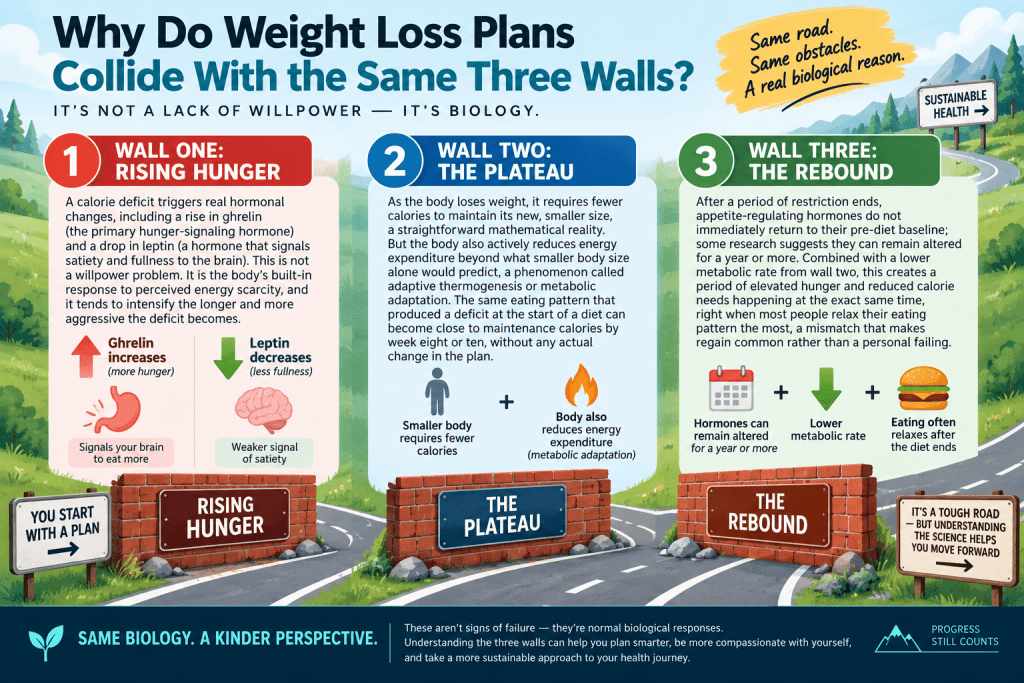
- Wall One: Rising Hunger. A calorie deficit triggers real hormonal changes, including a rise in ghrelin (the primary hunger-signaling hormone) and a drop in leptin (a hormone that signals satiety and fullness to the brain). This is not a willpower problem. It is the body’s built-in response to perceived energy scarcity, and it tends to intensify the longer and more aggressive the deficit becomes.
- Wall Two: The Plateau. As the body loses weight, it requires fewer calories to maintain its new, smaller size, a straightforward mathematical reality. But the body also actively reduces energy expenditure beyond what smaller body size alone would predict, a phenomenon called adaptive thermogenesis or metabolic adaptation. The same eating pattern that produced a deficit at the start of a diet can become close to maintenance calories by week eight or ten, without any actual change in the plan.
- Wall Three: The Rebound. After a period of restriction ends, appetite-regulating hormones do not immediately return to their pre-diet baseline; some research suggests they can remain altered for a year or more. Combined with a lower metabolic rate from wall two, this creates a period of elevated hunger and reduced calorie needs happening at the exact same time, right when most people relax their eating pattern the most, a mismatch that makes regain common rather than a personal failing.
Each of the five ways below targets one or more of these three walls directly, rather than offering another version of “eat less, move more” that ignores why the first attempt at exactly that advice already stopped working.
Why Use Diet Breaks, Not Diet Endings?
- The Mechanism: Continuous, uninterrupted caloric restriction appears to produce more pronounced metabolic adaptation than restriction broken up by planned periods of eating at maintenance calories. A structured diet break, typically one to two weeks at maintenance intake every six to ten weeks of active dieting, gives appetite hormones and metabolic rate a chance to partially normalize before the next restriction phase begins.
- The Research Behind It: A notable Australian study (sometimes referred to as the “MATADOR” study) compared continuous dieting to a matched intermittent approach with two-week maintenance breaks built in. The intermittent group lost significantly more fat over the same total dieting time, with less of the metabolic slowdown seen in the continuous group, supporting diet breaks as a legitimate performance strategy rather than a compromise.
- How to Use It: Plan a maintenance-calorie break of 7 to 14 days after every 6 to 10 weeks of active caloric restriction, using this time to eat at your estimated maintenance calories (not to binge or abandon structure entirely) before resuming your deficit. This turns what many people experience as an uncontrolled binge, driven by accumulated restriction, into a planned, structured part of the process instead.
Free 28-Day Fascia Reset Email Course
Get our Free 28-day email course series to help with 1 or 2 exercises per day to release your fascia. One short lesson per day. Two minutes to read each.
How Can Protein and Fiber Blunt the Hunger Climb?
- The Mechanism: Protein is the most satiating macronutrient per calorie, both through direct effects on satiety hormones and through a well-documented pattern where inadequate protein intake can drive continued eating, of any food, until a target protein intake is met, even after calorie needs are otherwise satisfied. Fiber adds to this effect by slowing digestion, increasing stomach distension, and supporting the release of additional satiety signals.
- The Research Behind It: Multiple controlled studies comparing higher-protein to lower-protein diets at matched calorie levels show measurably lower hunger ratings and reduced spontaneous calorie intake in the higher-protein groups, supporting protein intake as a direct lever against wall one rather than simply a muscle-preservation strategy.
- How to Use It: Prioritize 25 to 40 grams of protein per meal across three to four meals daily, and pair it with fibrous vegetables at most meals. This can help manage hunger during a calorie deficit more effectively than simply cutting calories further, which tends to make wall one worse rather than better. Your personalized macro targets can give you a clearer daily protein goal based on your body, activity level, and objectives.
How Can Preserving Muscle Protect Your Metabolic Rate?
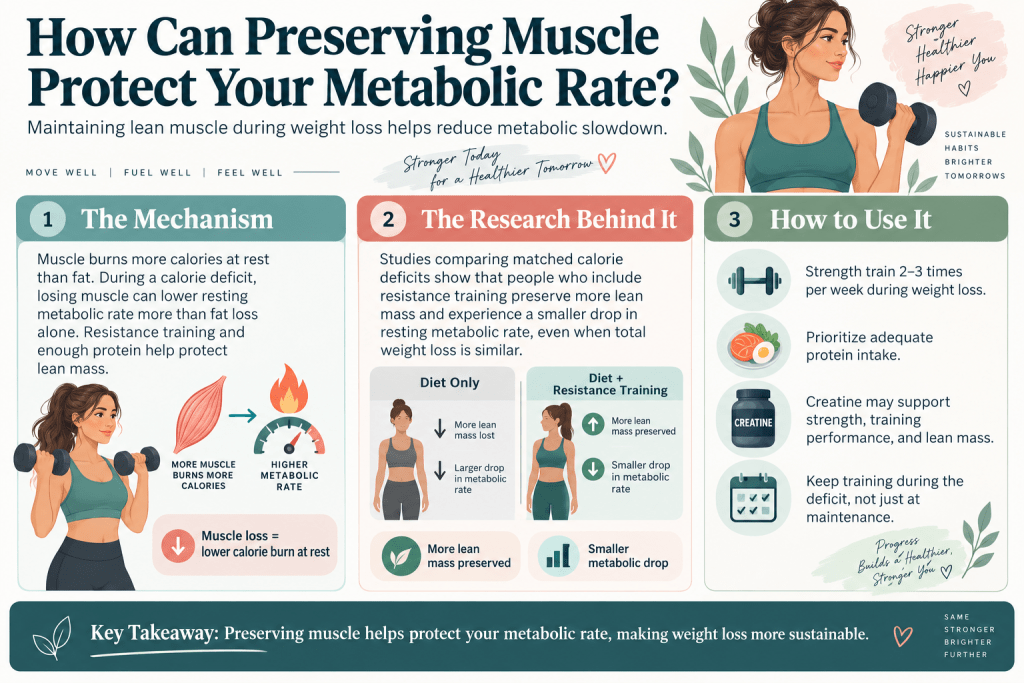
- The Mechanism: Muscle tissue is metabolically active, meaning it burns more calories at rest than fat tissue does. A calorie deficit without adequate resistance training and protein intake tends to draw a meaningful share of the total weight lost from muscle rather than fat, which directly lowers resting metabolic rate beyond what fat loss alone would produce, accelerating wall two.
- The Research Behind It: Studies comparing weight loss with and without resistance training, at matched calorie deficits, consistently show that the resistance training groups preserve significantly more lean mass and experience a smaller drop in resting metabolic rate, even when total weight lost is similar between groups.
- How to Use It: Keep resistance training in your routine two to three times per week throughout a weight loss phase, not just once you reach maintenance. Consistent strength training after 40 helps preserve lean muscle while you lose weight, which is especially important when addressing the metabolic slowdown described in wall two. Pairing that training with creatine can provide additional support for strength, training performance, and lean mass during a calorie deficit.
“For years I thought a plateau meant I needed to eat even less. It took understanding the actual mechanism, that the body slows down partly in response to lost muscle, not just lost weight, to realize I had it backward. Protecting muscle during a deficit through resistance training and enough protein is not a nice-to-have on top of weight loss. It is one of the most direct ways to keep your metabolism from working against you.”
Terry Tateossian, Founder of The House of Rose
Free 28-Day Fascia Reset Email Course
Get our Free 28-day email course series to help with 1 or 2 exercises per day to release your fascia. One short lesson per day. Two minutes to read each.
Why Should You Plan the Maintenance Phase Before You Need It?
- The Mechanism: Wall three, the rebound, is made significantly worse when a period of restriction ends abruptly, with an immediate jump back to prior eating habits, right at the moment when hunger hormones are still elevated and metabolic rate is still suppressed from the diet just completed. A gradual, planned increase in calories back toward true maintenance, rather than an abrupt stop, allows the body’s systems to recalibrate in step with the returning food intake instead of being overwhelmed by a sudden shift.
- The Research Behind It: This is the foundational logic behind reverse dieting, a structured, gradual increase in calorie intake following a diet phase, and it is supported by the broader body of research on metabolic adaptation and post-diet weight regain, which consistently points to abrupt, unplanned transitions out of a deficit as a major contributor to rapid regain.
- How to Use It: Rather than treating the end of a diet as a finish line, transition back toward maintenance gradually by increasing calories in small, measured steps and monitoring how your weight, energy, hunger, and training respond. Understanding the basics of reverse dieting can help you structure that transition, while a more detailed reverse diet after 50 provides a practical week-by-week framework for midlife women.
Why Should You Build the Habit Layer Before You Cut Calories?
- The Mechanism: Adherence to any eating plan depends heavily on factors most diet plans never address directly: sleep quality, chronic stress and cortisol, environmental food cues, and the underlying emotional relationship with food. A calorie target layered on top of poor sleep, high unmanaged stress, and an environment full of easy defaults toward less helpful choices is fighting an uphill battle regardless of how well-designed the macros are.
- The Research Behind It: Research on sleep deprivation shows direct effects on next-day hunger hormones and food choices, independent of any calorie target. Similarly, chronic stress and elevated cortisol are associated with increased preference for calorie-dense, highly palatable foods, meaning the “willpower” framing common in diet culture often obscures a genuine physiological headwind rather than a character issue.
- How to Use It: Before or alongside starting a calorie deficit, strengthen the foundational habits that make the plan easier to sustain. Prioritize consistent, adequate sleep by building a practical midlife sleep routine, and weave a few tiny stress-management habits into your day rather than relying on occasional recovery efforts. It also helps to understand how cortisol affects midlife weight, especially when stress, disrupted sleep, hunger, and changing hormones are working against your weight-loss efforts. This groundwork gives the first four strategies in this article a more stable foundation to work from.
Free 28-Day Fascia Reset Email Course
Get our Free 28-day email course series to help with 1 or 2 exercises per day to release your fascia. One short lesson per day. Two minutes to read each.
How Can You Put the Five Ways Together in a Sample Framework?
|
Phase |
Duration |
Focus |
|
Foundation |
Weeks 1-2 |
Establish sleep, stress, and protein habits (Way 5) before adding a significant deficit |
|
Active Phase 1 |
Weeks 3-8 |
Moderate calorie deficit, protein and fiber prioritized (Way 2), resistance training 2-3x/week (Way 3) |
|
Diet Break |
Weeks 9-10 |
Return to maintenance calories, continue resistance training (Way 1) |
|
Active Phase 2 |
Weeks 11-16 |
Resume deficit, same structure as phase 1 |
|
Weeks 17-20+ |
Gradual calorie increase back to maintenance over several weeks (Way 4) |
This is a framework to adapt to your own timeline and goals, not a fixed prescription, but it illustrates how the five ways function as a connected system rather than five separate, unrelated tips.
What Does a Normal Plateau Look Like vs. a Sign to Adjust?
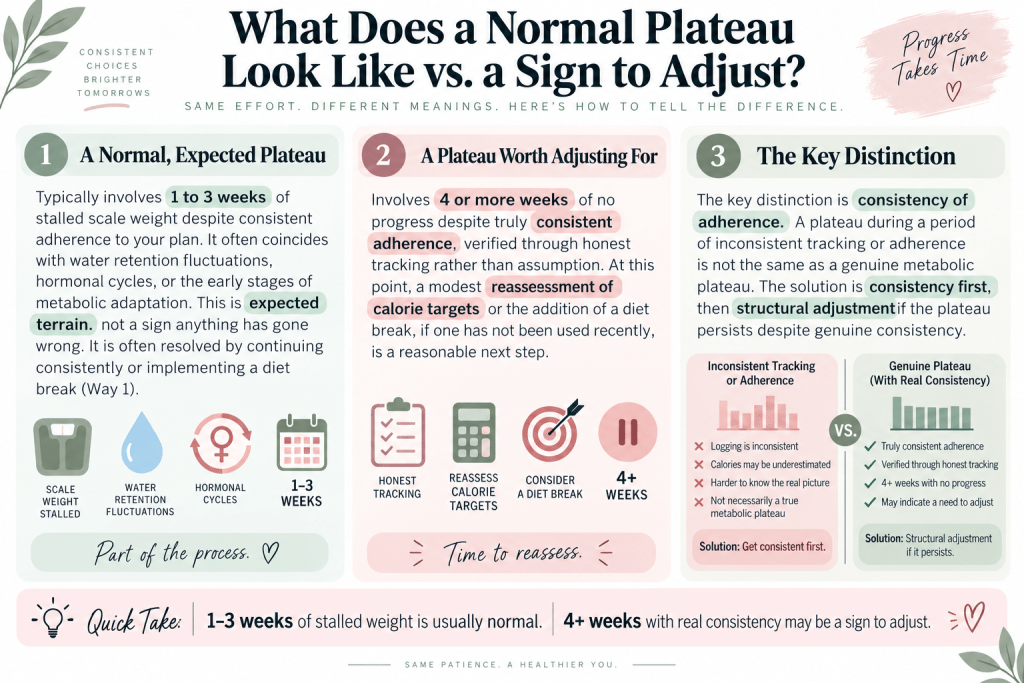
- A normal, expected plateau: Typically involves 1 to 3 weeks of stalled scale weight despite consistent adherence to your plan, often coinciding with water retention fluctuations, hormonal cycles, or the early stages of metabolic adaptation described in Section 1. This is expected terrain, not a sign anything has gone wrong, and is often resolved by continuing consistently or implementing a diet break (Way 1).
- A plateau worth adjusting for: Involves 4 or more weeks of no progress despite truly consistent adherence, verified through honest tracking rather than assumption. At this point, a modest reassessment of calorie targets (accounting for a lower body weight and any metabolic adaptation) or the addition of a diet break, if one has not been used recently, is a reasonable next step.
- The key distinction: Is consistency of adherence. A plateau during a period of inconsistent tracking or adherence is not the same phenomenon as a genuine metabolic plateau, and addressing the two requires different responses: consistency first, then structural adjustment if the plateau persists despite genuine consistency.
Free 28-Day Fascia Reset Email Course
Get our Free 28-day email course series to help with 1 or 2 exercises per day to release your fascia. One short lesson per day. Two minutes to read each.
Why Does This Matter More in Perimenopause and Menopause?
The three walls described in Section 1 do not appear only in midlife, but several factors make them more pronounced during the menopause transition specifically.
- Declining estrogen affects fat distribution and insulin sensitivity: As estrogen changes through perimenopause and menopause, body fat tends to shift toward the abdomen while glucose regulation and insulin sensitivity can also change. These metabolic shifts help explain why weight loss can feel different in midlife, making the broader pattern of perimenopause weight gain important to understand when adjusting nutrition, movement, and recovery strategies.
- Sleep disruption from night sweats and hormonal shifts compounds Way 5 directly: Since disrupted sleep independently worsens hunger hormone regulation on top of whatever a calorie deficit is already doing.
- Muscle loss becomes increasingly important through the menopause transition: Declining estrogen and age-related changes in muscle function can make preserving lean mass more challenging in midlife, which makes Way 3—resistance training to protect muscle and metabolic health—especially important during this stage of life.
- Cortisol and stress patterns often shift during this period: Adding another layer to Way 5 that a midlife dieter is more likely to be navigating than a dieter in their twenties.
None of this means weight loss is not achievable in midlife. It means the five ways in this article, particularly Ways 3 and 5, deserve more emphasis, not less, during this specific life stage.
What Common Mistakes Undo These Strategies?
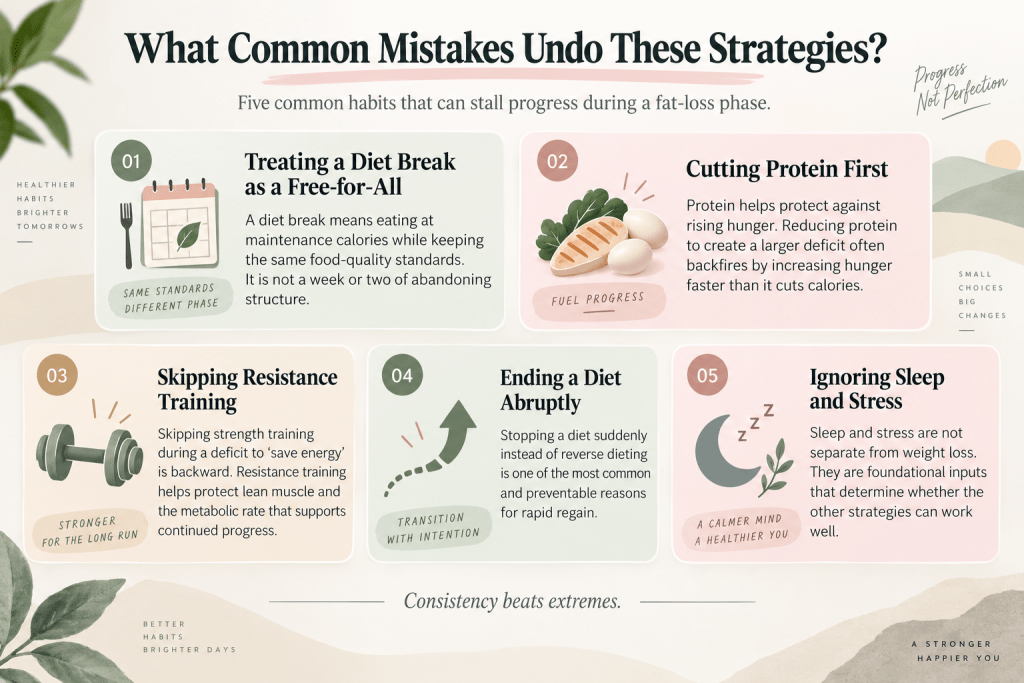
- Treating a diet break as a free-for-all: A diet break means eating at maintenance calories with the same food quality standards, not abandoning structure entirely for one to two weeks.
- Cutting protein first when trying to reduce calories further: Protein is the macronutrient most protective against wall one; reducing it to create a larger deficit tends to backfire by increasing hunger faster than it reduces calories.
- Skipping resistance training “to save energy” during a deficit: This is precisely backward; resistance training during a deficit is what protects the metabolic rate that makes continued progress possible.
- Ending a diet abruptly instead of reverse dieting: As covered in Way 4, this is one of the most common and most preventable contributors to rapid regain.
- Ignoring sleep and stress as “separate issues” from the diet itself: As covered in Way 5, these are not separate from weight loss; they are foundational inputs that determine whether the other four ways can work as intended.
This article is educational and is not a substitute for personalized medical or nutritional advice. Consult a physician or registered dietitian before making significant changes to your eating pattern, particularly if you have an existing health condition.
Free 28-Day Fascia Reset Email Course
Get our Free 28-day email course series to help with 1 or 2 exercises per day to release your fascia. One short lesson per day. Two minutes to read each.
Frequently Asked Questions
Why does weight loss always seem to hit a plateau?
Plateaus result from a combination of a smaller body needing fewer calories to maintain itself and adaptive thermogenesis, where the body actively reduces energy expenditure beyond what smaller size alone predicts. This is a normal, well-documented physiological response, not a sign that your plan or effort has failed.
How long should a diet break last?
Most research-supported protocols use 7 to 14 days at maintenance calories, taken after every 6 to 10 weeks of active caloric restriction.
Why do I get hungrier the longer I diet?
Caloric restriction triggers a rise in ghrelin (hunger hormone) and a drop in leptin (satiety hormone), an evolved response to perceived energy scarcity. This tends to intensify with the length and aggressiveness of the deficit, which is part of why moderate, sustainable deficits combined with adequate protein tend to outperform very aggressive ones over time.
Is weight regain after dieting inevitable?
No, but it is common, particularly when a diet ends abruptly rather than transitioning gradually into a planned maintenance phase (reverse dieting). Regain is best understood as a predictable risk to plan around, not an inevitability.
Why is resistance training important for weight loss, not just muscle building?
Muscle tissue is metabolically active, and preserving it during a calorie deficit protects your resting metabolic rate. Weight loss without resistance training tends to come from a mix of fat and muscle, which lowers metabolic rate more than fat loss alone would.
What is reverse dieting?
Reverse dieting provides a structured way to transition out of a prolonged calorie deficit by gradually increasing food intake toward maintenance. Following a reverse dieting approach can help you make those increases in small, measured steps while monitoring hunger, energy, weight trends, and training performance along the way.
How much protein do I need to reduce hunger during a diet?
Research generally supports 25 to 40 grams of high-quality protein per meal, across three to four meals daily, as an effective target for supporting satiety during a caloric deficit.
Does stress really affect weight loss?
Yes. Chronic stress and elevated cortisol are associated with increased preference for calorie-dense, highly palatable foods and can influence fat storage patterns, making stress management a genuine, evidence-based part of a sustainable weight loss approach rather than a secondary concern.
Is it harder to lose weight during perimenopause and menopause?
Several factors, including declining estrogen’s effects on fat distribution and insulin sensitivity, accelerated muscle loss, and sleep disruption from hormonal changes, can make weight loss more challenging during this transition, which is part of why muscle preservation and sleep management (Ways 3 and 5) deserve extra emphasis during this life stage.
What should I do if I’ve been consistent but still haven’t seen progress in a month?
After verifying genuine consistency (through honest tracking, not assumption), a reasonable next step is reassessing your calorie target to account for your current, lower body weight and any accumulated metabolic adaptation, or implementing a diet break if you have not used one recently.
I write 3 essays per week on Lifestyle Medicine for women in midlife on what is happening in the body and what to do about it. No fluff, no hype. Free.
References
- Byrne, N. M., Sainsbury, A., King, N. A., Hills, A. P., & Wood, R. E. (2018). Intermittent energy restriction improves weight loss efficiency in obese men: The MATADOR study. International Journal of Obesity, 42(2), 129-138.
- Sumithran, P., Prendergast, L. A., Delbridge, E., Purcell, K., Shulkes, A., Kriketos, A., & Proietto, J. (2011). Long-term persistence of hormonal adaptations to weight loss. New England Journal of Medicine, 365(17), 1597-1604.
- Weigle, D. S., Breen, P. A., Matthys, C. C., Callahan, H. S., Meeuws, K. E., Burden, V. R., & Cummings, D. E. (2005). A high-protein diet induces sustained reductions in appetite, ad libitum caloric intake, and body weight despite compensatory changes in diurnal plasma leptin and ghrelin concentrations. American Journal of Clinical Nutrition, 82(1), 41-48.
- Trexler, E. T., Smith-Ryan, A. E., & Norton, L. E. (2014). Metabolic adaptation to weight loss: Implications for the athlete. Journal of the International Society of Sports Nutrition, 11, 7.
- Josse, A. R., Atkinson, S. A., Tarnopolsky, M. A., & Phillips, S. M. (2011). Increased consumption of dairy foods and protein during diet- and exercise-induced weight loss promotes fat mass loss and lean mass gain in overweight and obese premenopausal women. Journal of Nutrition, 141(9), 1626-1634.
- Wing, R. R., & Phelan, S. (2005). Long-term weight loss maintenance. American Journal of Clinical Nutrition, 82(1 Suppl), 222S-225S.
- Spiegel, K., Tasali, E., Penev, P., & Van Cauter, E. (2004). Brief communication: Sleep curtailment in healthy young men is associated with decreased leptin levels, elevated ghrelin levels, and increased hunger and appetite. Annals of Internal Medicine, 141(11), 846-850.
- Tomiyama, A. J. (2019). Stress and obesity. Annual Review of Psychology, 70, 703-718.
- Wright, K. E., Skinner, S., & Zhu, S. (2023). The musculoskeletal syndrome of menopause. Climacteric, 26(4), 366-371.
Disclaimer: This article is educational and does not constitute medical or nutritional advice. Weight loss strategies involving calorie restriction, diet breaks, protein targets, resistance training, or changes in eating patterns should be individualized based on your health, medications, activity level, and nutritional needs. If you have a medical condition, a history of disordered eating, are pregnant or breastfeeding, or experience persistent fatigue, dizziness, weakness, or other concerning symptoms while attempting weight loss, consult a physician or registered dietitian before following the strategies in this article.
Free 28-Day Fascia Reset Email Course
Get our Free 28-day email course series to help with 1 or 2 exercises per day to release your fascia. One short lesson per day. Two minutes to read each.

Terry Tateossian is a Menopause Lifestyle Medicine Coach, Certified Personal Trainer & Nutritionist and the Founder of THOR: The House of Rose, a wellness brand serving women over 40 through retreats, coaching, macro-nutrition and community. As 25-year founder and entrepreneur, Terry spent two and a half decades building and running successful start-up businesses, an experience that put her on the front line of founder burnout long before she could name it. After facing serious health challenges, early onset menopause, and emotional eating while running her agency and raising two children, Terry rebuilt her health in her 40s and lost more than 80 pounds through evidence-based nutrition, training, and mindset work. Today, she helps women get strong, improve confidence, support hormone health, and create a stronger second half of life. Terry has been featured in major media outlets and is available for podcasts, expert commentary, brand collaborations, and speaking engagements on midlife health, reinvention, emotional eating, menopause wellness, and strength training for longevity. Get her free macro calculator (her cookbook companion) to start your journey to back to health.