
 By Team THOR
Free 28-Day Fascia Reset Email Course
Get our Free 28-day email course series to help with 1 or 2 exercises per day to release your fascia. One short lesson per day. Two minutes to read each.
The Single-Leg Stance Test for Women Over 40: What Your Time Means, the Three-Level Improvement Protocol, and Your Monthly Tracking Framework
The single-leg stance test is one of the most useful assessments for women over 40. A 2022 study published in the British Journal of Sports Medicine followed adults aged 51 to 75 for about seven years. After accounting for age, sex, body composition, and cardiovascular risk factors, researchers found that people who could not balance on one leg for 10 seconds had about twice the risk of death from any cause during the follow-up period.
The test takes only 30 seconds and requires no equipment, clinician, or laboratory. It reflects how well several neurological and physical systems work together, including balance, strength, coordination, vision, and sensory awareness. For women between 40 and 75, the amount of time you can hold the position provides a simple but meaningful snapshot of your current physical trajectory.
I am Terry Tateossian, founder of The House of Rose and a certified lifestyle medicine coach. I work with women in perimenopause, menopause, and post-menopause through online nutrition coaching and in-person yoga retreats at our Smoky Mountains property in East Tennessee. After experiencing early-onset menopause at 41, I built THOR to help women take practical control of their long-term health.
The single-leg stance test is one of the assessments I use with coaching clients because it provides a clear starting point and a measurable goal. This guide explains what the test measures, how to perform it correctly, what different times mean by age, and how to improve your balance through a three-level protocol. You will also receive a monthly tracking framework to help you monitor progress over time.
Important: This article is educational and does not replace medical evaluation. Speak with a healthcare professional if you experience falls, severe unsteadiness, dizziness, sudden balance changes, or symptoms that interfere with daily life. Balance problems can be linked to inner ear disorders, neurological conditions, cardiovascular issues, medication side effects, and other conditions that require proper assessment.
Why Is Balance a Longevity Marker?
Understanding why a simple balance measurement predicts longevity outcomes matters because it explains why this specific test deserves attention rather than dismissal as just another fitness metric. Balance reflects how well several major neurological and physical systems work together, making it a useful indicator of overall health and functional capacity.
Balance Requires Multiple Systems to Work Together
Balance is not a single-system function. Standing on one foot requires the simultaneous and coordinated operation of several systems, including:
- The vestibular system in the inner ear
- The somatosensory system that reports joint and muscle position
- The visual system
- The cerebellum and other brain regions that integrate sensory input
- The motor system that sends corrective signals to specific muscles
- The executive attention needed to oversee the entire process
When any one component begins to deteriorate, balance is often one of the first places the decline becomes observable. Reduced balance can reveal a loss of integrated capacity even before any single system has failed noticeably on its own.
Balance Can Reflect Brain and Vascular Health
Brain imaging research has consistently shown that people with reduced balance capacity are more likely to have subclinical cerebrovascular changes, including small vessel disease and silent microbleeds. These vascular changes can affect balance because maintaining a stable position requires healthy brain tissue to receive, interpret, and coordinate several streams of information at once.
A balance measurement may therefore reveal something about brain health that a routine physical examination does not always capture. It is not diagnosing a vascular condition, but it can act as a visible sign that the systems supporting neurological coordination are not functioning as efficiently as they once did.
Neuromuscular Quality Influences Balance
Beyond the vascular contribution, balance depends on the quality of neural signaling from the body to the brain and back to the muscles. The brain must receive accurate information about body position and then send rapid corrective instructions to the appropriate muscle groups.
As muscle mass declines with age through sarcopenia and peripheral neural signaling becomes less efficient, balance performance can drop. This makes balance measurement a useful proxy for the broader neuromuscular quality that supports mobility, stability, and long-term functional independence.
Proprioception Provides an Early Warning
Proprioception is the body’s ability to sense where it is positioned in space without needing to look. It allows you to know whether your knee is bent, how your weight is distributed, and whether your body is beginning to lean away from a stable position.
Animal research has documented that the peripheral neurons responsible for proprioception begin degrading in middle age. This dysfunction may become measurable before the muscles connected to those nerves show obvious weakness, which means balance testing may detect early proprioceptive deterioration that strength testing alone could miss.
Balance Acts as a Composite Health Measure
Because balance depends on so many systems, the measurement effectively becomes a composite quality-of-organism score. Different systems decline at different rates from one person to another, and the body can often compensate for weakness in one area for a period of time.
For example, strong vision may temporarily compensate for reduced proprioception, or strong muscles may help offset slower neural signaling. However, when a second or third system begins to decline, those compensatory strategies become less effective. Because balance requires all of these systems to work together, it may identify composite decline earlier than a test that evaluates only one system.
Balance Is Especially Relevant During Midlife
The perimenopause and menopause transition can produce meaningful shifts in several systems that influence balance, including:
- Muscle mass and strength
- Cardiovascular function
- Cognitive processing
- Joint stability
- Reaction speed
- Neurological coordination
Tracking balance through this transition provides one specific and repeatable way to observe how the overall physical trajectory is unfolding. Changes in performance can also provide a practical signal that strength, mobility, coordination, or medical support may need greater attention.
What Did the 2022 Landmark Study Find?
The study that brought the single-leg stance test into wider awareness was published in 2022 in the British Journal of Sports Medicine. Researchers followed nearly 1,700 adults between the ages of 51 and 75 for an average of seven years.
The central finding was that an inability to complete a 10-second single-leg stance was associated with an 84 percent higher risk of all-cause mortality. This association remained after the researchers adjusted for age, sex, body mass index, and several cardiovascular risk factors, including:
- Coronary artery disease
- Hypertension
- Dyslipidemia
- Diabetes
The single-leg stance measurement predicted mortality independently of the other factors the researchers were able to statistically control. This does not mean poor balance directly causes earlier death.
It means balance appears to capture the combined condition of several systems that are also connected to long-term health and survival.
What Does the Single-Leg Stance Test Measure?
The specific mechanics of what happens in the body during a single-leg stance make the test measure integrated function rather than any single component.
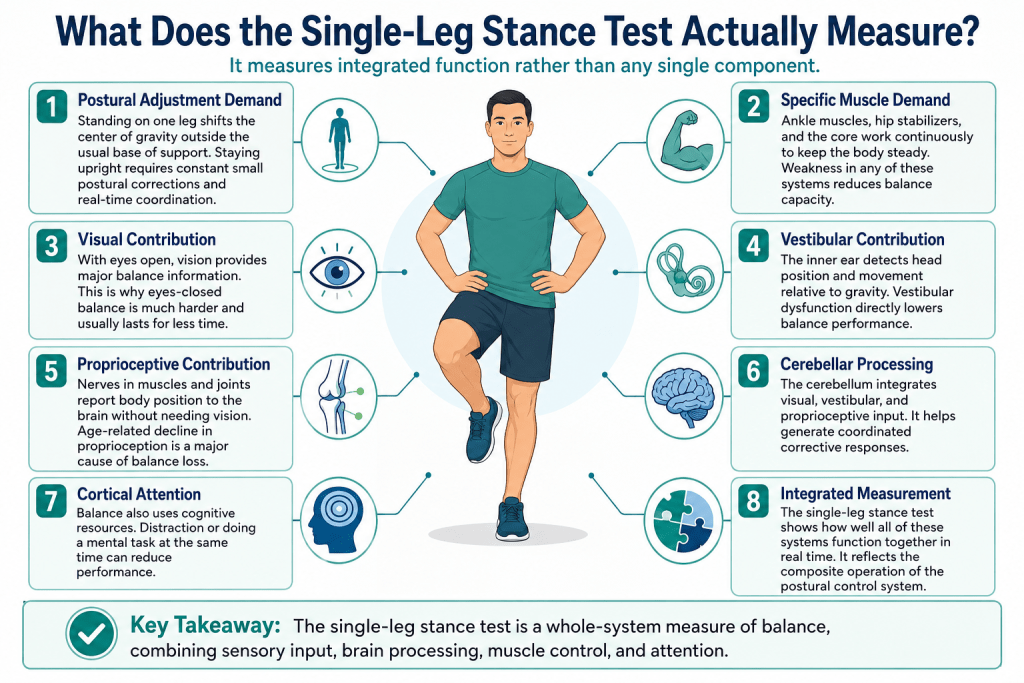
- The postural adjustment demand: When you shift weight to one leg, your center of gravity moves outside the normal base of support (both feet on the ground). Maintaining that shifted position requires continuous small postural adjustments in response to natural body sway. These adjustments happen automatically through neural circuits that require the vestibular, visual, proprioceptive, cerebellar, and motor systems to operate in real-time coordination.
- The specific muscle demand: The muscles of the standing ankle (particularly the tibialis anterior, peroneal muscles, and calf) make continuous small corrections. The hip stabilizers (gluteus medius, gluteus minimus, deep hip rotators) work continuously to prevent the pelvis from dropping. The core musculature stabilizes the trunk. Weakness in any of these systems reduces balance capacity.
- The visual contribution: Under normal test conditions with eyes open, visual input provides significant balance information. This is why the test with eyes closed (a variation used in some clinical assessments) is significantly harder and produces substantially shorter times than the standard eyes-open version.
- The vestibular contribution: The inner ear detects head position and movement through specialized structures. Vestibular signals inform the balance system about head orientation relative to gravity. Vestibular dysfunction (which increases with age and with specific inner ear conditions) directly reduces balance performance.
- The proprioceptive contribution: Specialized nerve endings in muscles and joints continuously report body position to the brain. This proprioceptive input allows the balance system to know where limbs are without needing to look at them. Declining proprioception with age is one of the largest contributors to balance loss.
- The cerebellar processing: The cerebellum integrates vestibular, visual, and proprioceptive input and generates coordinated corrective responses. Cerebellar function is required for balance and is affected by various neurological conditions and by aging.
- The cortical attention: Even balance requires some cognitive resources. Performing balance while distracted or while performing cognitive tasks reduces balance capacity. This is why one of the more advanced balance assessments involves doing balance while performing a cognitive task simultaneously.
- The integrated measurement: The single-leg stance test measures how well all of these systems are functioning together in real time. This is why the measurement is so informative. It is not measuring any one thing. It is measuring the composite operation of the entire postural control system.
Free 28-Day Fascia Reset Email Course
Get our Free 28-day email course series to help with 1 or 2 exercises per day to release your fascia. One short lesson per day. Two minutes to read each.
Which Six Systems Does the Single-Leg Stance Test Assess Simultaneously?
Naming the six systems explicitly helps midlife women understand why balance is such a strong predictor of overall trajectory.
- System 1: The vestibular system. The inner ear structures (semicircular canals, otolith organs) detect head position and movement. Vestibular function tends to decline with age and can be affected by specific inner ear conditions, medications, and various pathologies.
- System 2: The visual system. Vision provides significant balance information. Age-related visual changes (reduced acuity, contrast sensitivity, and peripheral vision) affect balance capacity. Cataracts, glaucoma, and other eye conditions have particular relevance.
- System 3: The proprioceptive system. Muscle spindles, Golgi tendon organs, and joint receptors continuously report body position to the brain. Peripheral neuropathy from diabetes, chemotherapy, chronic alcohol use, or nutrient deficiencies affects this system.
- System 4: The cerebellum and central integration. Brain regions integrate the sensory inputs and generate coordinated motor responses. Small vessel disease, previous strokes, and various neurological conditions affect this integration.
- System 5: The motor output system. The muscles and their neural connections must respond to the corrective signals quickly and with appropriate force. Sarcopenia, joint disease, and peripheral neurological changes affect this system.
- System 6: The cognitive-attentional system. Executive function and attention are required to maintain balance, particularly during dual-task situations. Cognitive decline, medication effects, and simple distraction reduce balance capacity.
Balance requires all six systems working reasonably well simultaneously.
Any single system can be compensated for by the others up to a point.
But as multiple systems degrade, the compensation becomes insufficient and balance fails.
The perimenopause and menopause transition affects several of these systems (muscle mass, sleep-dependent cognition, potentially cerebrovascular health). Tracking balance through this transition provides a specific integrated measure of how these interacting systems are trending.
“The specific value of the single-leg stance test for coaching clients is that it produces a specific number that both they and I can watch over months. Most other health metrics for midlife women are either invisible (blood pressure, cholesterol, bone density) and require lab work to see, or they are hard to quantify precisely (energy, mood, sleep quality). Balance produces a specific second count that can be measured in 30 seconds on a kitchen floor. When a coaching client can hold a stance for 8 seconds in month one and 25 seconds in month four, that specific numerical improvement tells us that multiple systems have improved together. That is meaningful information. It also tells the client something concrete about her trajectory that most other measures do not. This is one of the specific measurements I recommend every midlife woman track quarterly as part of her general health baseline.”
Terry Tateossian, Founder of The House of Rose
Why Does Balance Decline on a Cliff Rather Than a Slope?
Understanding the specific pattern of balance decline through the adult lifespan matters because it changes how the assessment should be interpreted.
- The typical age curve: Balance performance across large adult populations tends to remain fairly stable through the fourth and fifth decades of life. Around age 55 to 60, the average population performance begins declining more noticeably. From age 60 onward, the decline accelerates in a way that is often described as more of a cliff than a slope.
- The population data: In the specific 2022 mortality study cohort, the proportion of adults who could not complete a 10-second single-leg stance rose dramatically with age. Approximately 5 percent of adults in their early fifties failed the test. By the early sixties, approximately 18 percent failed. By the late sixties, approximately 37 percent failed. By the early seventies, more than half of the cohort could not complete the 10-second test.
- Why the cliff pattern is different: Strength tends to decline more linearly with age from the fourth decade onward. Walking speed changes relatively little until later life. Balance is different because it depends on the integrated function of multiple systems that may each be tolerable in isolation but that produce failed integration when they degrade together. The cliff pattern reflects the accumulating vulnerability of the composite system.
- The specific implication: Because balance declines on a cliff pattern, catching the decline early matters. A midlife woman who tests her balance in her early forties and sixties and sees deterioration between the two measurements has time to intervene. A midlife woman who ignores balance until it has already fallen significantly has more work to do to recover.
- The reversibility question: The good news is that balance responds well to specific training. Studies of balance interventions in older adults consistently show meaningful improvements over 6 to 12 weeks of practice. This is one of the specific health capacities where deliberate training produces measurable improvement across age groups.
- The specific relevance for perimenopause: The perimenopause and menopause transition often coincides with the beginning of the balance-decline window. This makes the transition a specific opportunity to build the balance capacity that will support functional independence into later life.
Free 28-Day Fascia Reset Email Course
Get our Free 28-day email course series to help with 1 or 2 exercises per day to release your fascia. One short lesson per day. Two minutes to read each.
What Does the Research Show About the Single-Leg Stance Test?
The specific research supporting the single-leg stance test as a longevity marker is worth understanding in detail because it justifies the attention this test deserves.
The 2022 Landmark Study
Araujo et al. published in the British Journal of Sports Medicine followed 1,702 adults aged 51 to 75 in Brazil from 2008 to 2020. Baseline measurements included the single-leg stance test performed with hands hanging at the sides and eyes open, holding for 10 seconds.
The study reported the following findings:
- Participants were followed for an average of 7 years.
- A total of 123 participants, or 7.2 percent, died during the follow-up period.
- Inability to complete the 10-second stance was associated with 84 percent higher all-cause mortality.
- The reported hazard ratio was 1.84 after adjustment for age, sex, BMI, and multiple cardiovascular risk factors.
The Dose-Response Relationship
Prior research has shown that longer single-leg stance times are associated with lower mortality risk. The 10-second threshold is a specific commonly used cutoff, but the underlying relationship appears to be dose-response, with longer times associated with better outcomes across the range.
The Brain and Cognitive Associations
The single-leg stance test may reveal changes connected to both vascular and non-vascular aspects of brain health.
The brain imaging research has associated poor balance performance with silent cerebrovascular disease on brain MRI. Adults with poor balance are more likely to show:
- White matter lesions
- Silent microbleeds
- Small vessel changes without noticeable symptoms
This provides a mechanistic explanation for why balance predicts mortality: it is picking up subclinical vascular disease.
Research has also associated poor balance with cognitive performance independently of the vascular changes. This suggests that balance is picking up both vascular and non-vascular contributors to overall brain and body health.
The Fall Risk Relationship
Beyond the mortality association, single-leg stance time is a well-established predictor of fall risk in older adults. Since falls are a leading cause of injury, disability, and death in older adults, the balance measure is doubly relevant.
The Physical Function Relationship
Balance is correlated with performance on other physical function measures, including:
- Walking speed
- Chair stand time
- Functional independence measures
Balance is one of the several composite measures used in geriatric assessment for general functional trajectory.
The Response to Balance Training
Research on balance training interventions consistently shows that specific balance training produces measurable improvements within weeks. The specific programs studied vary but consistently include:
- Single-leg practice
- Dynamic balance work
- Dual-task training in some programs
The Specific Caution About Interpretation
The single-leg stance test is a strong predictor at the population level. At the individual level, a single measurement is one data point that reflects both underlying trajectory and specific factors on the day of testing, including fatigue, medication effects, and distraction.
Individual performance should be interpreted as one data point rather than as a definitive prognosis.
How Do You Take the Single-Leg Stance Test Correctly at Home?
The specific procedure for taking the test correctly matters because inconsistent methodology produces unreliable results.
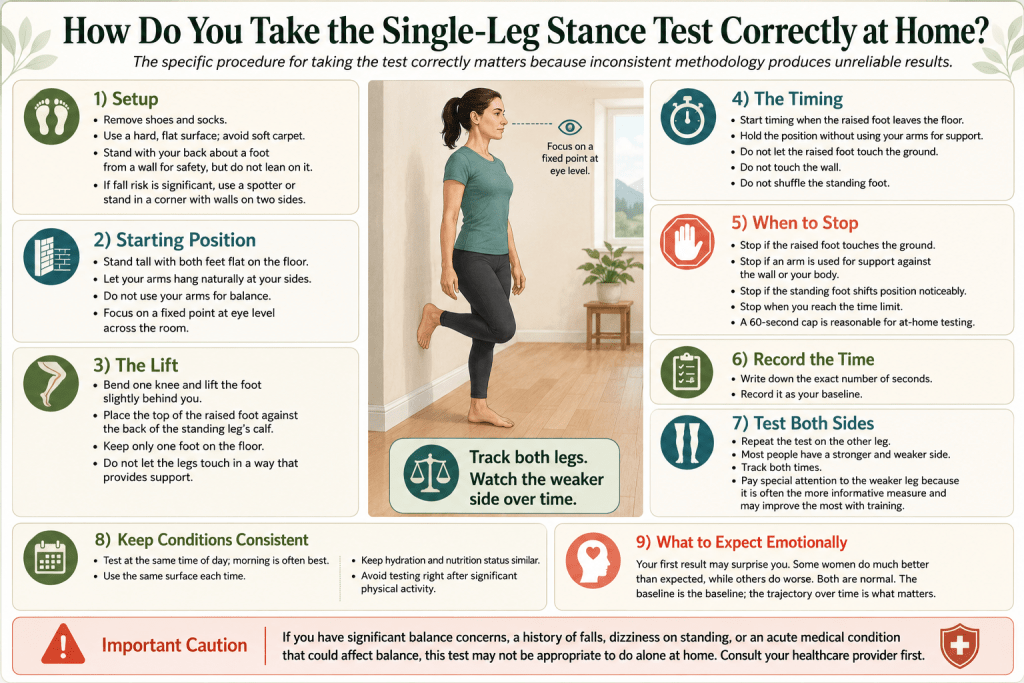
- Setup: Remove shoes and socks. Choose a hard flat surface (avoid soft carpet, which changes the demand). Stand with your back within about a foot of a wall so you have something to catch yourself if needed, but do not lean on the wall. If you have significant fall risk concerns, have a spotter present or stand in a corner with walls on two sides.
- Starting position: Stand tall with both feet flat on the floor. Arms hang naturally at your sides. Do not use your arms for balance during the test. Choose a fixed point across the room at approximately eye level and focus on it.
- The lift: Bend one knee and lift the foot slightly behind you, placing the top of the raised foot against the back of the standing leg’s calf. Both feet should not be on the floor. Your two legs should not be touching in a way that provides support.
- The timing: Start a stopwatch or count aloud when the raised foot is off the floor. Continue holding the position without letting your arms come off your sides for support, without letting the raised foot touch the ground, without touching the wall, and without shuffling the standing foot.
- When to stop: The test ends when any of the following occurs: the raised foot touches the ground, an arm is used for support against the wall or your body, the standing foot shifts position noticeably, or you reach a predetermined time limit (60 seconds is a reasonable cap for at-home testing since much longer times begin measuring different qualities).
- Record the time: Note the specific number of seconds you held the position. Record this as your baseline.
- Test both sides: Repeat the test on the other leg. Most people have a stronger and weaker leg. Note both times. Track the weaker leg specifically because it is often the more informative measure and the one where the largest improvements can be made with training.
- Test conditions matter: For consistent tracking over months, test at the same time of day (morning is often best because fatigue is minimal), on the same surface, with similar hydration and nutrition status, and without significant recent physical activity that might reduce performance.
- What to expect emotionally: Some midlife women find their first test surprising in one direction or the other. Some perform much better than they expected. Some perform significantly worse. Both responses are common. The baseline is the baseline. The trajectory over time is what matters.
- A specific caution: If you have significant balance concerns, a history of falls, dizziness on standing, or acute medical conditions that could affect balance, the test may not be appropriate for at-home use without medical supervision. Consult your healthcare provider first.
Free 28-Day Fascia Reset Email Course
Get our Free 28-day email course series to help with 1 or 2 exercises per day to release your fascia. One short lesson per day. Two minutes to read each.
What Are the Age-Based Single-Leg Stance Thresholds?
The specific age-based thresholds for interpreting your single-leg stance time provide the context for what your specific number means.
|
Age Range |
Excellent (top quartile) |
Average |
Concerning (bottom quartile) |
|
40 to 49 |
45+ seconds |
30 to 45 seconds |
Under 20 seconds |
|
50 to 54 |
40+ seconds |
25 to 40 seconds |
Under 15 seconds |
|
55 to 59 |
35+ seconds |
20 to 35 seconds |
Under 12 seconds |
|
60 to 64 |
30+ seconds |
15 to 30 seconds |
Under 10 seconds |
|
65 to 69 |
22+ seconds |
10 to 22 seconds |
Under 7 seconds |
|
70 to 74 |
15+ seconds |
5 to 15 seconds |
Under 4 seconds |
- The published research norms: The following times represent published reference values combined with the 2022 mortality study cutoffs. These are best used as general orientation rather than as strict clinical cutoffs.
- The specific 10-second threshold: The 2022 mortality study used 10 seconds as a specific dichotomous cutoff because it was easy to measure and produced a meaningful mortality signal. Women in the 51 to 75 age range who could not hold 10 seconds had substantially higher mortality risk than those who could. If you are in this age range and cannot hold 10 seconds, this is a specific signal that the underlying systems your balance depends on may need attention.
- The eyes-open versus eyes-closed distinction: The reference table above is for eyes-open testing. Eyes-closed single-leg stance is significantly more demanding and produces times that are typically 30 to 60 percent of eyes-open times. For general tracking, eyes-open testing is the more useful measure.
- The specific interpretation caveats: Individual variation is significant. A specific time is one data point among many that contribute to overall health assessment. Do not interpret a single measurement as definitive prognosis. Track the trend over time to see whether the trajectory is improving, stable, or declining.
- The trajectory matters more than the number: A woman with a baseline of 8 seconds who improves to 25 seconds over 6 months of training is doing better than a woman with a baseline of 45 seconds who has not tested since. Consistent improvement matters more than any specific static number.
What Does Your Single-Leg Stance Score Mean?
Interpreting your specific score in the context of the age-based thresholds and the underlying research helps midlife women understand what action is warranted.
- If your time is in the excellent range for your age: Your integrated postural control system is functioning very well. The specific action is to maintain your current activity and consider whether additional balance training could push the number higher. Balance is worth maintaining because the cliff pattern of decline can appear suddenly in later life without preparation.
- If your time is in the average range for your age: You are performing similarly to your peers. This is a fine baseline. The specific action is to consider whether you want to intentionally build additional balance capacity now to prepare for the later-life window where balance becomes more precious. Two to three balance training sessions per week over 8 weeks can meaningfully improve your time.
- If your time is in the concerning range for your age: This is a specific signal to prioritize balance training and to evaluate the broader factors that might be affecting your integrated postural control system. This includes cardiovascular health, muscle mass, cognitive function, medication effects, vision, and inner ear health. Consider both the direct balance training and a general checkup with your healthcare provider.
- If you cannot hold 10 seconds and you are between 51 and 75: The 2022 research identified this cutoff as associated with substantially higher mortality risk. This does not mean you are going to die soon. It means you have specific information that warrants both direct balance training and broader attention to your overall health foundation. Discuss with your healthcare provider.
- If there is a large asymmetry between your two legs: Significant asymmetry (e.g., 40 seconds on one side and 8 seconds on the other) often indicates a specific unilateral issue with joint, muscle, or neural function on the weaker side. This warrants attention. The specific training outlined here addresses both sides but the weaker side may benefit from additional focused work.
- If your time is dramatically different from what you expected: Both surprisingly good and surprisingly poor performance are worth noting. The baseline is the baseline. What matters is what you do with the information.
- If your time on retesting has declined significantly: Meaningful decline in a stable adult without an obvious explanation (specific injury, illness, medication change) warrants evaluation. Progressive decline in balance capacity can indicate underlying changes worth investigating.
Free 28-Day Fascia Reset Email Course
Get our Free 28-day email course series to help with 1 or 2 exercises per day to release your fascia. One short lesson per day. Two minutes to read each.
How Does the Three-Level Balance Improvement Protocol Work?
The specific improvement framework organized into three progressive levels allows midlife women to build balance capacity systematically from any starting point.
The General Philosophy
Balance improves with specific practice. General fitness helps, but specific balance training produces the largest specific improvements. The protocol is designed to fit into existing daily routines rather than requiring dedicated gym time.
The Three Progressive Levels
- Level 1: Foundation (Weeks 1 to 2). The foundation level establishes the baseline habit of practicing balance daily with modifications appropriate for the current starting point. The specific goal is consistency and safety at this stage rather than dramatic improvement.
- Level 2: Progressive Loading (Weeks 3 to 8). The progressive level increases the challenge systematically as capacity improves. Longer holds, more variations, and specific progressions build the underlying systems.
- Level 3: Advanced Integration (Week 9 and Beyond). The advanced level incorporates balance into broader movement patterns and adds dual-task challenges that reflect real-life balance demands.
Time Commitment and Expected Progress
The time commitment. Each level requires approximately 5 to 10 minutes of dedicated practice per day plus incorporation into existing activities. The dedicated practice is not long. Consistency across the weeks is what produces the improvement.
The expected timeline. Meaningful improvement in single-leg stance time typically appears within 4 to 8 weeks of consistent daily practice. Continued improvement continues over months as the underlying systems continue to adapt. This is one of the specific health capacities where deliberate training produces measurable improvement across age groups.
Retesting and Moving Between Levels
The retest schedule. Retest your single-leg stance time at the end of week 2, the end of week 8, and monthly thereafter. Record the specific numbers in the tracking framework in Section 14. Improvement should be visible if the practice has been consistent.
When to progress:
- Move from Level 1 to Level 2 when you can consistently hold 15 seconds without safety concerns.
- Move from Level 2 to Level 3 when you can consistently hold 30 seconds and have addressed both sides.
- These are guidelines rather than strict cutoffs.
How Can You Improve Your Single-Leg Stance in Three Progressive Levels?
Improving your single-leg stance requires consistent practice that gradually challenges your balance, strength, coordination, and confidence. The following three-level protocol begins with supported foundational exercises, progresses to more demanding movements, and eventually integrates balance into complex daily activities. Follow each stage at your own pace, prioritize safety, and use the scheduled retests to measure your improvement over time.
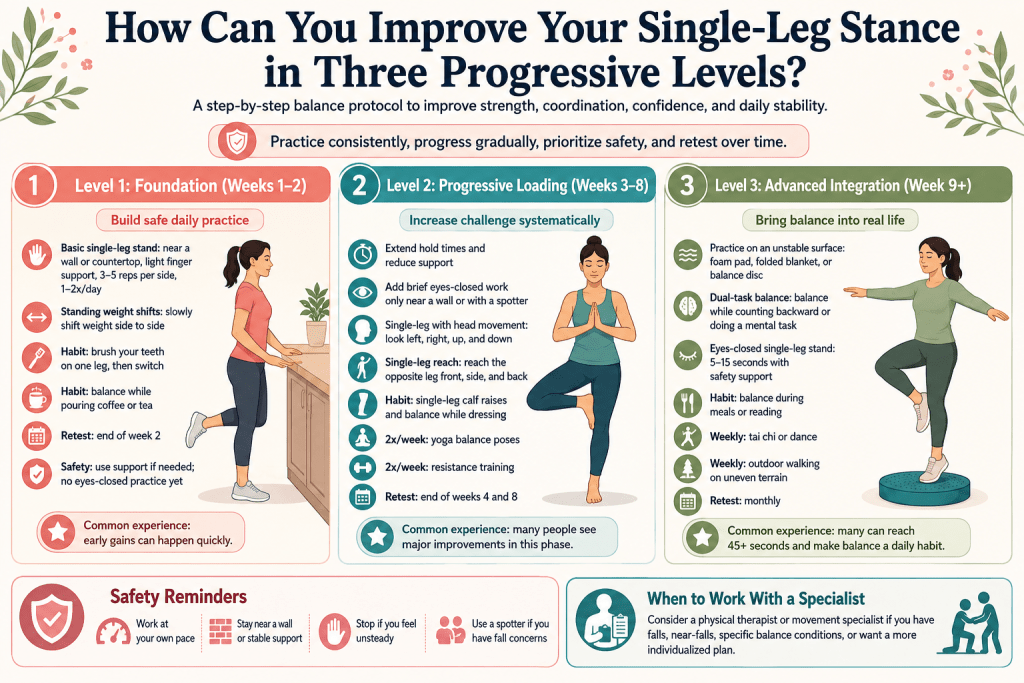
Level 1: Foundation (Weeks 1 to 2)
The foundation level establishes the daily practice with appropriate modifications for safety.
- Daily practice: Basic single-leg stand: Stand near a wall or countertop with light finger contact for balance support. Lift one foot off the floor. Hold as long as feels safe. Rest and repeat on the other side. Perform three to five repetitions per side, once or twice per day. If you can hold for 30 seconds with light finger support, work on gradually reducing the support until you can do the same duration without touching.
- Daily practice: Standing weight shifts: Stand tall with feet hip-width apart. Shift your weight slowly onto one leg, then the other, spending several seconds on each side. This is a preparatory exercise that trains the postural adjustments required for full single-leg stance.
- Habit integration: Brushing teeth on one leg: Every time you brush your teeth (morning and evening), stand on one leg for the first half of brushing and the other leg for the second half. This alone provides several minutes of daily balance practice built into an existing routine. Use light finger support against the sink at the start if needed.
- Habit integration: One-leg stance while pouring coffee: When you pour your morning coffee or tea, do it while standing on one leg. Use the other leg to switch during the process. This adds practice without adding time to your day.
- Retest at end of week 2: Perform the full single-leg stance test using the procedure in Section 6. Note whether your time has improved. If you have practiced consistently, some improvement should be visible even at two weeks.
- Safety notes for Level 1: If you feel unsteady, use light finger support at all times. Do not attempt eyes-closed variations at this level. Do not test near hard surfaces or sharp edges without appropriate spacing. If you have a history of falls or acute balance concerns, work with a physical therapist rather than practicing independently.
- Common experience at Level 1: Many midlife women who have not practiced balance in years are surprised at how quickly performance improves in the first two weeks. This is typical. The neural pathways activate quickly, and initial gains are often significant.
Free 28-Day Fascia Reset Email Course
Get our Free 28-day email course series to help with 1 or 2 exercises per day to release your fascia. One short lesson per day. Two minutes to read each.
Level 2: Progressive Loading (Weeks 3 to 8)
The progressive loading level builds on the foundation with specific variations that increase demand systematically.
- Daily practice: Extended single-leg stand: Continue the daily single-leg practice. Progress by increasing hold times, reducing wall support until you can hold without touching, and eventually starting to close your eyes for brief periods (5 to 10 seconds only, and only with a safety spotter or near a wall for support).
- Daily practice: Single-leg with head movement: Once you can hold 30 seconds without support and eyes open, add gentle head movements. Turn your head slowly to look left, then right, then up, then down while maintaining the balance. Head movements challenge the vestibular system.
- Daily practice: Single-leg reach: Stand on one leg. Reach the opposite leg forward, then to the side, then behind you in a slow controlled movement. Keep the standing leg stable. This progression trains dynamic postural control.
- Habit integration: Single-leg calf raises: During any waiting activity (waiting for coffee, standing in line, during phone calls), practice slow calf raises on one leg while balanced on the other. This adds strength and balance work simultaneously.
- Habit integration: Balance during dressing: Practice putting on socks, shoes, or pants while standing on one leg (with a wall or chair nearby for safety). This transfers balance capacity into functional daily activities.
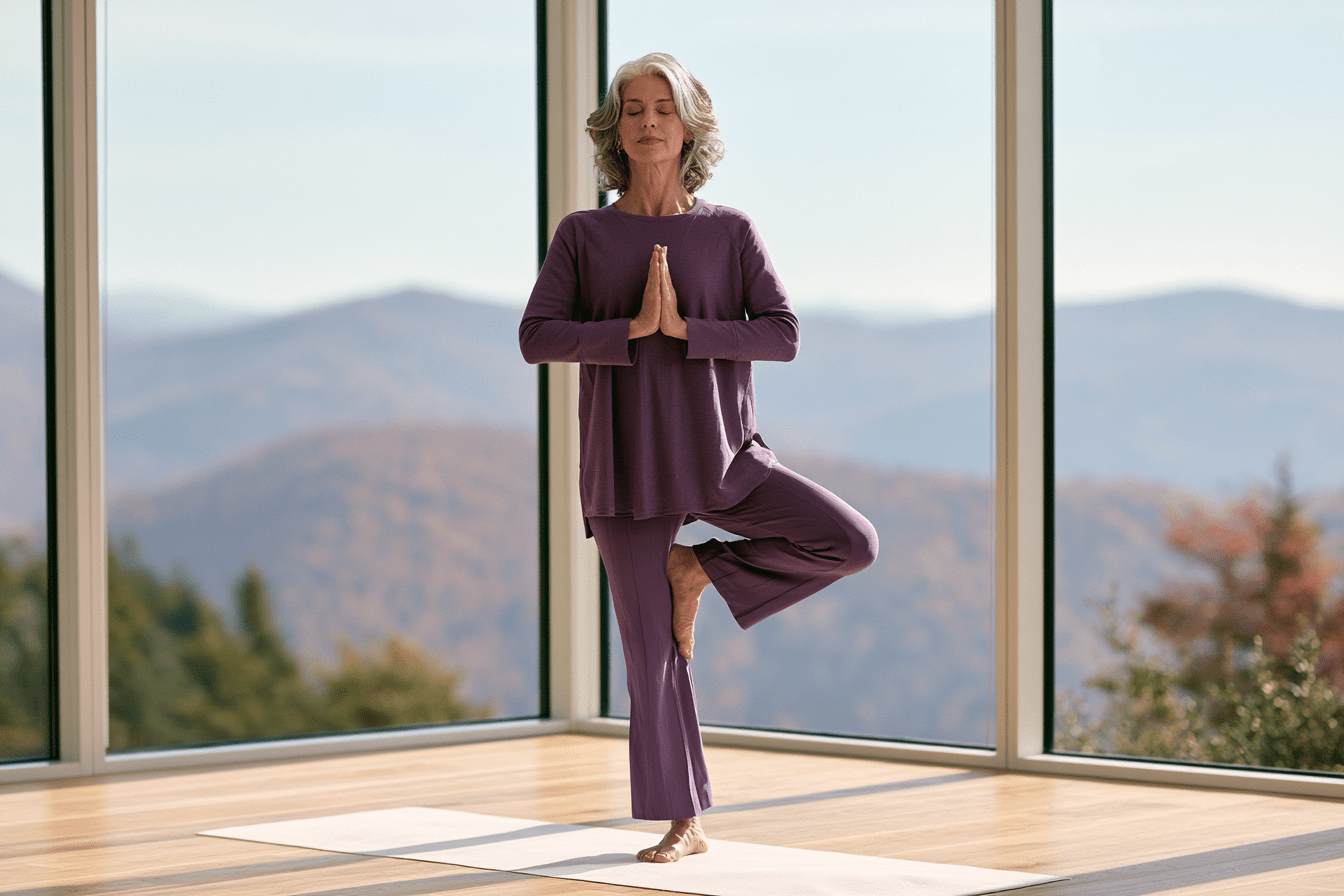
- Twice weekly: Yoga balance sequences: Add two 15 to 20 minute yoga sessions per week that include specific balance postures like tree pose, warrior 3, or extended hand-to-big-toe pose.
- Twice weekly: Strength training: Continue or start twice-weekly resistance training focused on the four major muscle groups. Resistance training supports balance by ensuring the muscles can execute the corrections the balance system requires.
- Retest at end of week 4 and week 8: Perform the full single-leg stance test at these intervals. Note improvements. Adjust the practice if progress has stalled.
- Common experience at Level 2: Most midlife women see meaningful improvement in single-leg stance times during this phase. Improvements of 100 percent or more over baseline are common when practice has been consistent. The gains reflect real improvement in the underlying integrated systems.
Level 3: Advanced Integration (Week 9 and Beyond)
The advanced integration level moves balance from isolated practice into more complex real-life demands.
- Daily practice: Unstable surface: Add practice on soft foam pad, folded blanket, or (with appropriate safety) a balance disc. Unstable surface adds proprioceptive demand and challenges the balance system in new ways.
- Daily practice: Dual-task balance: Practice balance while performing a cognitive task simultaneously. Count backward from 100 by 7s while balancing on one leg. Recite a poem, name state capitals, or perform any specific cognitive task. Dual-task performance is particularly important because it reflects real-life demands where balance must happen while attention is elsewhere.
- Daily practice: Eyes-closed single-leg stand: With appropriate safety precautions (near a wall, with a spotter, or on a mat), practice single-leg stance with eyes closed for 5 to 15 seconds. Eyes-closed practice trains the vestibular and proprioceptive systems by removing visual input.
- Habit integration: Balance during meals or reading: Practice standing on one leg during specific portions of meals or during a specific part of reading time. Alternate legs at set points. This builds balance capacity into activities that require attention.
- Weekly: Tai chi or dance: Once weekly, add a tai chi class, dance class, fascia release exercises or specific balance-oriented movement class. Group balance activities add motivation and provide instruction that individual practice does not offer.
- Weekly: Outdoor walking on varied terrain: Once weekly, walk on uneven terrain (hiking trail, grass, gravel path) rather than only on smooth surfaces. Varied terrain challenges the balance system in ways that flat surfaces do not.
- Retest monthly: Continue monthly retests using the tracking framework in Section 14. Look for continued improvement or maintenance of gains.
- Common experience at Level 3: By this stage, many midlife women can hold single-leg stance for 45 seconds or more, and the practice has become integrated into daily life rather than requiring specific dedicated time. Continued attention prevents regression.
- When to consider working with a specialist: If you have specific balance-related conditions, if you experience falls or near-falls, or if you want optimized advanced training, working with a physical therapist or a movement specialist provides individualized guidance beyond the general framework in this article.
Free 28-Day Fascia Reset Email Course
Get our Free 28-day email course series to help with 1 or 2 exercises per day to release your fascia. One short lesson per day. Two minutes to read each.
How Can You Build Balance Training Into Existing Daily Habits?
The specific habit-integration approach is worth emphasizing because dedicated practice time is often the limiting factor. Building balance into activities you already do produces cumulative benefit without adding time to your day.
Morning Routine Integrations
Each of these activities adds 30 seconds to 3 minutes of daily balance practice:
- Brush your teeth on one leg, as already covered.
- Pour your first drink while balancing.
- Put on clothes while balancing.
- Wait for your kettle or coffee maker while balancing.
- Practice tree pose during your morning skincare routine.
Kitchen Integrations
You can practice balance during several common kitchen activities:
- Chop vegetables while standing on one leg, with the cutting board on a stable counter.
- Wait for water to boil while balancing.
- Reach into overhead cabinets while balancing.
- Load or unload the dishwasher while alternating legs.
Workday Integrations
Balance practice can also be incorporated throughout the workday:
- Stand on one leg during phone calls, with a wall nearby.
- Practice balance while microwaving lunch.
- Take balance breaks between meetings.
- If you work at a standing desk, practice weight shifts and brief single-leg stands throughout the day.
Evening Routine Integrations
Your evening routine provides additional opportunities to practice:
- Balance while preparing dinner.
- Practice tree pose while dinner cooks.
- Balance during commercial breaks if you watch television.
- Add balance practice to your wind-down routine.
Weekend Integrations
Weekend activities can build balance while supporting other areas of health:
- Hiking on varied terrain builds balance while providing exercise and nature exposure.
- Yoga classes with balance postures provide instruction.
- Dance classes, whether formal or informal, build balance and coordination.
- Gardening involves specific balance demands.
The Habit Stacking Principle
Each of these integrations follows the principle of habit stacking: attaching a new behavior to an existing behavior anchor. This is more sustainable than trying to add a new dedicated practice window to an already-full day.
The Cumulative Effect
If you accumulate 5 to 10 minutes of balance practice throughout the day through habit integration, you are matching or exceeding what most dedicated balance programs recommend. Consistency across weeks and months produces the improvement.
Safety Principles
Always integrate balance in situations where a loss of balance would not cause injury:
- Practice near a wall or countertop.
- Stay away from sharp corners.
- Do not balance while holding hot beverages or fragile items.
- Do not practice while descending stairs.
- Common sense applies.
How Should You Track Your Balance Progress Each Month?
The specific tracking framework allows midlife women to see progress over time and adjust practice based on actual data rather than impressions.
- Baseline measurement: Record your specific baseline single-leg stance times for both legs, using the procedure in Section 6. Include the date, time of day, and any relevant conditions.
- The specific measurements to track: For each monthly test, record: right leg eyes-open time, left leg eyes-open time, right leg eyes-closed time (once you are at Level 2 or beyond), left leg eyes-closed time, and notes about the specific conditions of the test.
- The specific frequency of testing: Test monthly for the first six months, then quarterly. More frequent testing produces noise from day-to-day variation. Less frequent testing may miss meaningful trends. Monthly is a reasonable balance.
- The specific format: A simple printable worksheet with a row for each month works well. Alternatively, a note in your phone with dated entries provides the same tracking capability. Consistency matters more than the specific format.
- Notes to record: Beyond the specific times, note any factors that might affect performance including recent illness, medication changes, sleep quality, stress load, and specific injuries. This context helps interpret the numbers.
- The specific patterns to watch for: Progressive improvement over months suggests the practice is working. Stability suggests maintenance is happening. Progressive decline warrants investigation of underlying factors. Sudden large changes warrant investigation of specific causes.
- Sharing the data: Bring your tracking log to healthcare appointments. Physicians increasingly recognize balance as a meaningful health indicator. Having specific data over months provides better clinical context than a single in-office measurement.
- The 12-month review: After a year of tracking, review the whole record. Look for trends. Note what practice patterns produced the largest improvements. Adjust the next year’s approach based on what has worked.
- The specific value of tracking: The specific value of tracking beyond the improvements themselves is that it makes the improvement visible. Many midlife women report that seeing specific numbers improve over months is highly motivating in a way that vague sense of fitness improvement is not.
“The specific value of tracking a single-leg stance number over months in coaching work is that it makes visible progress that would otherwise be invisible. A coaching client who cannot see her cardiovascular health improving day to day (because the changes are internal and slow) can see her balance improving from 7 seconds to 22 seconds over three months. That specific visible improvement builds confidence that the broader work is producing results even when other measures are harder to see. The balance number becomes a proxy for the general trajectory. When it is improving, most other things are likely also improving. When it is stagnating, that is often a signal to look at the broader framework. Track the number. Watch the trend. Let it guide your practice.”
Terry Tateossian, Founder of The House of Rose
Free 28-Day Fascia Reset Email Course
Get our Free 28-day email course series to help with 1 or 2 exercises per day to release your fascia. One short lesson per day. Two minutes to read each.
Which Common Mistakes Can Undermine Balance Progress?
Six specific mistakes commonly reduce the effectiveness of balance training for midlife women.
- Practicing inconsistently: Balance responds to daily practice. Sporadic practice produces sporadic results. Consistency matters more than duration. Five minutes daily produces more benefit than an hour once a week.
- Skipping the weaker side: Most people practice more on their stronger side because it feels more successful. The weaker side needs more practice, not less. Deliberately train both sides equally with attention to the weaker one.
- Ignoring the underlying foundation: Balance depends on strength, cardiovascular health, cognitive function, vision, and vestibular function. Trying to improve balance while ignoring these foundational systems produces limited results. See the broader THOR framework in Section 17.
- Overloading with dedicated time before habits are established: Adding 30 minutes of daily balance practice as a completely new commitment often produces initial enthusiasm followed by abandonment. Habit integration through existing routines is more sustainable.
- Not tracking progress: Without specific measurement, progress is easy to miss. Track monthly. Look at the trend over quarters and years. See what patterns emerge.
- Practicing in unsafe conditions: Balance training near sharp corners, on wet floors, or when significantly fatigued increases fall risk. Safety matters. Common sense placement of the practice avoids injury.
- Assuming balance is a fitness issue when it may be medical: Some balance problems reflect underlying medical conditions (inner ear disorders, cardiovascular issues, neurological conditions, medication effects) that require medical evaluation. If your balance is worse than expected or is declining despite consistent practice, consult a healthcare provider.
When Do Balance Problems Warrant Medical Evaluation?
Certain patterns of balance problems warrant medical evaluation beyond the framework in this article.
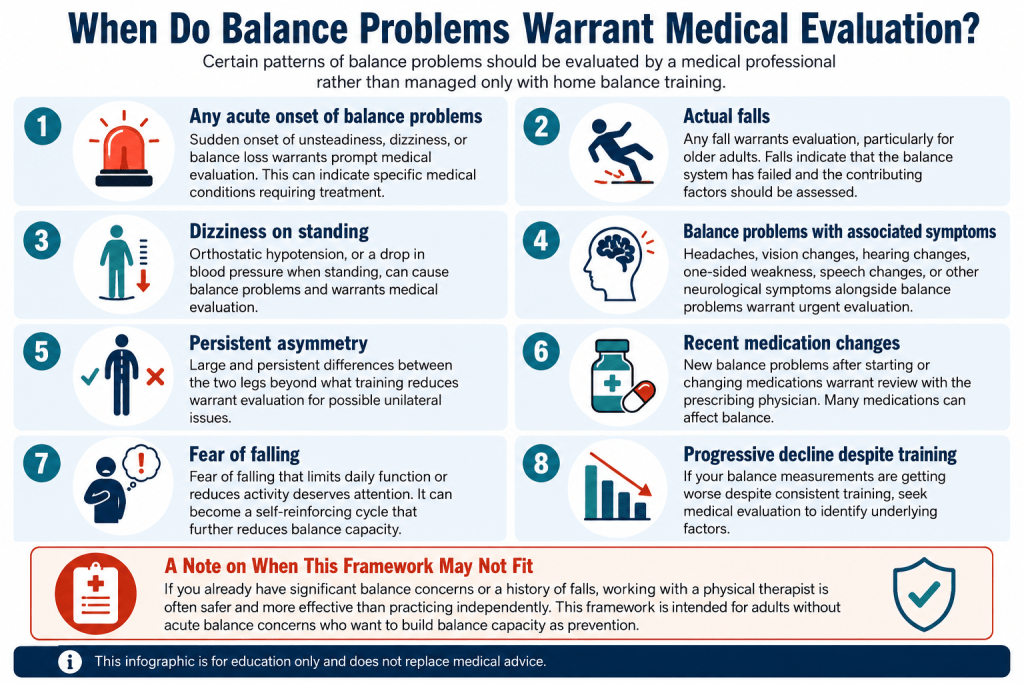
- Any acute onset of balance problems: Sudden onset of unsteadiness, dizziness, or balance loss warrants prompt medical evaluation. This can indicate specific medical conditions requiring treatment.
- Actual falls: Any fall warrants evaluation, particularly for older adults. Falls indicate that the underlying balance system has failed and require assessment of the specific factors involved.
- Dizziness on standing: Orthostatic hypotension (drop in blood pressure on standing) can produce balance problems and warrants medical evaluation.
- Balance problems with associated symptoms: Headaches, vision changes, hearing changes, muscle weakness on one side, changes in speech, or other neurological symptoms alongside balance problems warrant urgent medical evaluation.
- Persistent asymmetry: Large and persistent asymmetry between the two legs beyond what training reduces warrants evaluation for unilateral issues.
- Recent medication changes: New balance problems after starting or changing medications warrants review with the prescribing physician. Many medications affect balance.
- Fear of falling: Fear of falling that is affecting daily function and reducing activity warrants attention. This can become a self-reinforcing cycle that reduces balance capacity further.
- Progressive decline despite training: If your balance measurements are declining despite consistent training, this warrants medical evaluation to identify underlying factors.
- A note on when this framework may not fit: If you have significant existing balance concerns or a history of falls, working with a physical therapist rather than practicing independently is safer and often more effective. The framework in this article is designed for adults without acute balance concerns who want to build capacity as prevention.
Free 28-Day Fascia Reset Email Course
Get our Free 28-day email course series to help with 1 or 2 exercises per day to release your fascia. One short lesson per day. Two minutes to read each.
Free 28-Day Fascia Reset Email Course
Get our Free 28-day email course series to help with 1 or 2 exercises per day to release your fascia. One short lesson per day. Two minutes to read each.
Frequently Asked Questions
How long should a woman over 40 be able to stand on one leg?
For adults aged 40 to 49, holding a single-leg stance for 30 to 45 seconds is average with 45 seconds or more considered excellent. For adults 50 to 54, average is 25 to 40 seconds. For adults 55 to 59, average is 20 to 35 seconds. For adults 60 to 64, average is 15 to 30 seconds. Individual variation is significant, and the specific number matters less than the trend over time. Inability to hold 10 seconds in the 51 to 75 age range has been associated with substantially higher all-cause mortality risk in research.
What does the single-leg stance test measure?
The test measures the integrated function of six systems simultaneously: the vestibular system in the inner ear, the visual system, the proprioceptive system that reports body position, the cerebellum and other brain regions that integrate these inputs, the muscle and neural systems that execute corrections, and the cognitive attention that oversees the whole process. Because it measures the integration of all these systems, single-leg stance time is a strong predictor of general functional trajectory and, in research, of all-cause mortality risk.
Is inability to balance on one leg dangerous?
Inability to balance on one leg is a signal that the underlying systems responsible for postural control may need attention. It is not itself dangerous unless it produces actual falls in daily life. The 2022 research showing higher mortality in adults who could not hold 10 seconds does not mean the balance loss caused the mortality. It means the balance loss reflected underlying vulnerabilities in multiple systems that produce the mortality risk. Addressing the underlying systems (through the broader lifestyle framework and through balance training itself) is the appropriate response.
Can balance be improved after 60?
Yes. Research on balance training interventions consistently shows measurable improvement in balance capacity across age groups including in older adults. The specific improvements from consistent daily practice over 6 to 12 weeks are typically substantial. Balance is one of the specific health capacities most responsive to deliberate training regardless of age.
How often should I practice balance?
Daily practice produces the best results. The dedicated practice time can be as short as 5 to 10 minutes per day. Additional balance built into existing daily routines through habit integration adds cumulative benefit without adding time to the day. Consistency matters more than duration.
What is the best exercise to improve balance?
Single-leg standing practice is the most specific and directly relevant exercise. Beyond dedicated single-leg practice, yoga (particularly balance postures like tree pose), tai chi, dance, and hiking on varied terrain all support balance development. The specific value comes from consistent practice across weeks and months.
Should I close my eyes when practicing balance?
Eyes-closed practice trains the vestibular and proprioceptive systems by removing visual input. This is significantly harder than eyes-open practice and should be added at Level 2 or beyond with appropriate safety (near a wall, with a spotter, on a mat). Start with 5 to 10 second holds only.
Why does one leg feel much weaker than the other?
Asymmetry between the two legs is common and often reflects specific patterns in how you use your body. Handedness, previous injuries, work postures, and specific muscle imbalances all contribute. The weaker side benefits from more focused practice. Persistent or worsening asymmetry warrants evaluation.
Can I do balance training if I have knee issues?
Most people with mild to moderate knee issues can practice balance safely with modifications. Practice near a wall or countertop for safety. Reduce the depth of any accompanying movements. Skip any exercise that produces knee pain. Work with a physical therapist for personalized guidance if knee issues are significant.
How long does it take to see improvement?
Meaningful improvement in single-leg stance time typically appears within 4 to 8 weeks of consistent daily practice. Some improvement often shows up in as little as 2 weeks. Continued improvement continues over months as underlying systems adapt.
Is balance related to menopause?
The perimenopause and menopause transition affects several systems relevant to balance including muscle mass, sleep-dependent cognition, and cardiovascular function. Balance training through this transition is particularly valuable because it addresses the composite decline that these hormonal changes can accelerate.
Can I test my balance if I have a history of falls?
If you have a history of falls, work with a physical therapist or medical professional rather than testing independently. The framework in this article is designed for adults without acute balance concerns. Fall history warrants professional evaluation and personalized guidance.
Free 28-Day Fascia Reset Email Course
Get our Free 28-day email course series to help with 1 or 2 exercises per day to release your fascia. One short lesson per day. Two minutes to read each.
What if I cannot hold 10 seconds?
If you cannot hold 10 seconds and you are between 51 and 75, the research indicates this warrants attention. Begin with the Level 1 foundation practice in this article using wall or countertop support. Consider consulting your healthcare provider for a broader evaluation. Track your progress monthly. Meaningful improvement is typically possible with consistent practice.
Does yoga help with balance?
Yoga trains balance through postures like tree pose, warrior 3, extended hand-to-big-toe pose, and various others. Regular yoga practice supports balance development alongside other capacities.
Should I bring my balance measurements to my doctor?
Yes. Balance is a meaningful health indicator that physicians increasingly recognize. Bringing specific tracked measurements to appointments provides better clinical context than a single in-office measurement. Physicians can use this data to assess your general trajectory and identify concerns warranting further evaluation.
References
- Araujo, C. G., de Souza e Silva, C. G., Laukkanen, J. A., et al. (2022). Successful 10-second one-legged stance performance predicts survival in middle-aged and older individuals. British Journal of Sports Medicine, 56(17), 975–980.
- Springer, B. A., Marin, R., Cyhan, T., Roberts, H., & Gill, N. W. (2007). Normative values for the unipedal stance test with eyes open and closed. Journal of Geriatric Physical Therapy, 30(1), 8–15.
- Michikawa, T., Nishiwaki, Y., Takebayashi, T., & Toyama, Y. (2009). One-leg standing test for elderly populations. Journal of Orthopaedic Science, 14(5), 675–685.
- Vellas, B. J., Wayne, S. J., Romero, L., et al. (1997). One-leg balance is an important predictor of injurious falls in older persons. Journal of the American Geriatrics Society, 45(6), 735–738.
- Tabara, Y., Okada, Y., Ohara, M., et al. (2015). Association of postural instability with asymptomatic cerebrovascular damage and cognitive decline: the Japan Shimanami health promoting program study. Stroke, 46(1), 16–22.
- Sherrington, C., Fairhall, N. J., Wallbank, G. K., et al. (2019). Exercise for preventing falls in older people living in the community. Cochrane Database of Systematic Reviews, 1(1), CD012424.
- El-Khoury, F., Cassou, B., Charles, M. A., & Dargent-Molina, P. (2013). The effect of fall prevention exercise programmes on fall induced injuries in community dwelling older adults: systematic review and meta-analysis of randomised controlled trials. BMJ, 347, f6234.
- Lelard, T., Ahmaidi, S. (2015). Effects of physical training on age-related balance and postural control. Neurophysiologie Clinique, 45(4-5), 357–369.
- Fragala, M. S., Cadore, E. L., Dorgo, S., et al. (2019). Resistance training for older adults: position statement from the National Strength and Conditioning Association. Journal of Strength and Conditioning Research, 33(8), 2019–2052.
- Wayne, P. M., & Fuerst, M. L. (2013). The Harvard Medical School Guide to Tai Chi. Shambhala Publications.
- Huang, Z. G., Feng, Y. H., Li, Y. H., & Lv, C. S. (2017). Systematic review and meta-analysis: tai chi for preventing falls in older adults. BMJ Open, 7(2), e013661.
- Distefano, G., Standley, R. A., Zhang, X., et al. (2018). Physical activity unveils the relationship between mitochondrial energetics, muscle quality, and physical function in older adults. Journal of Cachexia, Sarcopenia and Muscle, 9(2), 279–294.
- Peterson, M. D., Rhea, M. R., Sen, A., & Gordon, P. M. (2010). Resistance exercise for muscular strength in older adults: a meta-analysis. Ageing Research Reviews, 9(3), 226–237.
- Sipilä, S., Törmäkangas, T., Sillanpää, E., et al. (2020). Muscle and bone mass in middle-aged women: role of menopausal status and physical activity. Journal of Cachexia, Sarcopenia and Muscle, 11(3), 698–709.
- Bowman, J. M., & Fritzsche, K. B. (2016). Assessment of balance in older adults: an evaluation of standardized instruments. Physical Therapy Reviews, 21(3-6), 191–199.
- Ambrose, A. F., Paul, G., & Hausdorff, J. M. (2013). Risk factors for falls among older adults: a review of the literature. Maturitas, 75(1), 51–61.
- Rogers, M. E., Rogers, N. L., Takeshima, N., & Islam, M. M. (2003). Methods to assess and improve the physical parameters associated with fall risk in older adults. Preventive Medicine, 36(3), 255–264.
- Studenski, S., Perera, S., Patel, K., et al. (2011). Gait speed and survival in older adults. JAMA, 305(1), 50–58.
- Cesari, M., Kritchevsky, S. B., Newman, A. B., et al. (2009). Added value of physical performance measures in predicting adverse health-related events: results from the Health, Aging and Body Composition Study. Journal of the American Geriatrics Society, 57(2), 251–259.
- Cooper, R., Kuh, D., & Hardy, R. (2010). Objectively measured physical capability levels and mortality: systematic review and meta-analysis. BMJ, 341, c4467.
Disclaimer: This article is educational and does not constitute medical advice. If you have significant balance concerns, a history of falls, dizziness, or acute onset of balance problems, consult a qualified healthcare professional before starting any new balance training program. Do not test balance in unsafe conditions.
Free 28-Day Fascia Reset Email Course
Get our Free 28-day email course series to help with 1 or 2 exercises per day to release your fascia. One short lesson per day. Two minutes to read each.

Terry Tateossian is a Menopause Lifestyle Medicine Coach, Certified Personal Trainer & Nutritionist and the Founder of THOR: The House of Rose, a wellness brand serving women over 40 through retreats, coaching, macro-nutrition and community. As 25-year founder and entrepreneur, Terry spent two and a half decades building and running successful start-up businesses, an experience that put her on the front line of founder burnout long before she could name it. After facing serious health challenges, early onset menopause, and emotional eating while running her agency and raising two children, Terry rebuilt her health in her 40s and lost more than 80 pounds through evidence-based nutrition, training, and mindset work. Today, she helps women get strong, improve confidence, support hormone health, and create a stronger second half of life. Terry has been featured in major media outlets and is available for podcasts, expert commentary, brand collaborations, and speaking engagements on midlife health, reinvention, emotional eating, menopause wellness, and strength training for longevity. Get her free macro calculator (her cookbook companion) to start your journey to back to health.