
 By Team THOR
Free 28-Day Fascia Reset Email Course
Get our Free 28-day email course series to help with 1 or 2 exercises per day to release your fascia. One short lesson per day. Two minutes to read each.
Ayurveda Yoga: The Complete Guide to Practicing the Two Sister Traditions Together for Midlife Women
Ayurveda and yoga are living traditions rooted in South Asian civilization, not Western wellness inventions. This article offers a respectful educational introduction from the perspective of a modern midlife women’s health coach, not an Ayurvedic vaidya or lineage-trained yoga teacher. Where traditional teachings and modern evidence align, that overlap is highlighted. Where they differ, the distinction is made clear.
Ayurveda yoga describes the traditional pairing of these two sister disciplines within the broader Vedic wisdom tradition. Ayurveda focuses on life and health, while yoga focuses on consciousness and liberation. They share a philosophical foundation and were traditionally practiced as complementary parts of a complete approach to living.
For midlife women, combining the two can make yoga more personal and effective. A practice shaped by your constitutional pattern, current imbalances, life stage, and season may be more supportive than a generic routine, especially during hormonal and metabolic changes.
Important: This article is for educational purposes only and does not constitute medical advice. Consult a qualified healthcare provider before beginning supplements, intensive practices, or major changes to your routine. For specific health concerns, seek care from a properly trained and credentialed Ayurvedic practitioner or yoga therapist.
What Is Ayurveda Yoga?
Ayurveda yoga is not a specific style of yoga (like Vinyasa or Ashtanga). It is a framework for practicing yoga (any style) in a way that is informed by ayurvedic principles about individual constitution, current state of balance, life stage, and season. Understanding this distinction matters because it affects how you interpret the recommendations that follow.
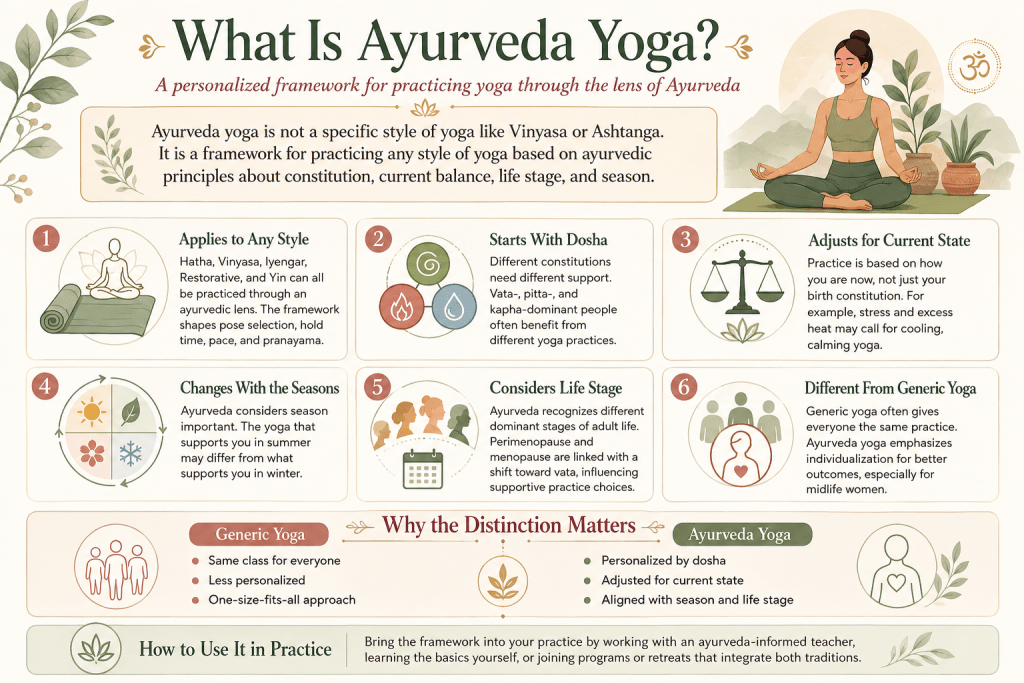
- The framework applies to any style: You can practice Hatha yoga, Vinyasa yoga, Iyengar yoga, Restorative yoga, or Yin yoga through an ayurvedic lens. The lens shapes which specific poses you emphasize, how long you hold them, the pace of the practice, and which pranayama (breath work) you include.
- The dosha starting point: The ayurvedic framework begins with the assumption that different people have different constitutional patterns (doshas) and benefit from different specific practices. A woman with a vata-dominant constitution generally benefits from different yoga practices than a woman with a pitta-dominant constitution. Both may be doing “yoga,” but the specific practices that support them differ.
- The current-state adjustment: Beyond birth constitution, ayurveda considers your current state of balance. A pitta-dominant woman experiencing acute stress with elevated cortisol and racing thoughts may need cooling calming yoga practices rather than the more vigorous practices that would suit her when she is balanced. This attention to current state is one of the specific values of the framework.
- The seasonal adjustment: Ayurveda considers season an important variable. The yoga practices that suit summer are not the same as those that suit winter. This seasonal awareness supports the natural rhythms the body responds to.
- The life-stage adjustment: Ayurveda divides adult life into stages with different dominant doshas. Perimenopause and menopause represent a shift into the vata-dominant later life stage, which affects which yoga practices support the body most.
- The distinction from generic yoga: Generic yoga practice treats all students similarly and offers the same practice regardless of individual differences. Ayurveda yoga assumes that individualization is essential. The specific value is that individualized practice produces better outcomes than generalized practice, particularly for midlife women whose hormonal changes make one-size-fits-all approaches less effective.
In the modern West, most yoga classes do not explicitly use the ayurvedic framework. Bringing the framework to your own practice requires either working with an ayurveda-informed teacher, learning enough of the framework yourself to make informed choices, or attending a women’s yoga retreat or program that integrates the two traditions.
Why Do Ayurveda and Yoga Belong Together?
The specific reasons ayurveda and yoga belong together historically and practically are worth understanding because they explain why the combined framework produces more benefit than either practice alone.
- Shared philosophical roots: Both practices emerged from the same broader Vedic tradition and share the same underlying assumptions about the nature of consciousness, the interconnection of mind and body, the role of individual constitution in health and disease, and the importance of daily and seasonal rhythms.
- Complementary domains: Traditionally, ayurveda addresses the physical body, nutrition, herbal medicine, and daily routines. Yoga addresses the mind, breath, consciousness, and the deeper practices of meditation and self-realization. The two together form a more complete framework for human flourishing than either alone.
- The physical body as foundation: Ayurveda takes physical body health seriously as the foundation for the mental and spiritual work of yoga. Without a well-tended physical body (through appropriate nutrition, sleep, daily routine, and constitution-appropriate practice), the deeper work of yoga becomes more difficult.
- Yoga as a health practice within ayurveda: In the classical framing, yoga is one of the specific practices ayurveda recommends for health. Yoga postures address specific bodily systems. Yoga breath work supports the pranic energy that ayurveda considers foundational to health. Yoga meditation supports the mental clarity that ayurveda considers essential.
- The constitutional matching: Ayurveda provides the framework that tells you which specific yoga practices support your specific body and situation. Without this framework, yoga practice is generic. With it, yoga practice becomes personalized in a way that produces more benefit for less effort.
- The practical convergence in midlife: For midlife women, the two traditions converge on the practical recommendations most useful in this life stage: daily rhythm, appropriate nutrition, grounding practices to counter the vata-excess pattern of perimenopause, quality sleep, and gentle sustainable movement. These are the specific practices that produce the largest benefits in this window.
- The teacher and lineage tradition: Historically, learning yoga from a qualified teacher included learning at least the basics of ayurveda because the teacher would consider the student’s constitutional pattern when designing the practice. Modern separation of the two disciplines has produced yoga instruction that is often generic. Reuniting them (at least in your own home practice) restores a piece of the traditional wisdom.
“The specific value of ayurveda yoga for coaching clients is not that it produces some special extra benefit beyond what regular yoga does. The value is that it removes the guesswork about which yoga practices suit their specific body and life stage. Midlife women who are dealing with vata-excess patterns like sleep disruption, anxiety, and joint dryness often make themselves worse by pushing into vigorous vinyasa flows that further deplete an already dry system. Once they understand that their pattern needs grounding warm slow yoga instead, and once they get permission to practice that way, the results appear quickly. The framework is not exotic. It is a specific and useful set of principles that helps women choose their practice intelligently. For coaching clients who have been doing yoga for years without seeing the results they expected, the ayurveda yoga reframe is often the specific missing piece.”
Terry Tateossian, Founder of The House of Rose
Free 28-Day Fascia Reset Email Course
Get our Free 28-day email course series to help with 1 or 2 exercises per day to release your fascia. One short lesson per day. Two minutes to read each.
How Does the Dosha Framework Apply to Yoga Practice?
The ayurvedic framework organizes individual patterns into three doshas: vata, pitta, and kapha. Each reflects different physical, mental, and energetic tendencies, as well as the types of yoga practice that may be most supportive.
What Are the Three Dosha Patterns?
- Vata Pattern: Vata is the pattern of movement, space, and change. Vata-dominant people tend to be thin, quick, creative, and dry, and they become anxious, scattered, and depleted under stress. In yoga terms, vata bodies tend toward light, quick movement, difficulty with sustained holds, joint dryness, and a tendency to overextend. They benefit from yoga that is grounding, warming, slow, sustained, and stable.
- Pitta Pattern: Pitta is the pattern of transformation, fire, and metabolism. Pitta-dominant people tend to be medium build, ambitious, intelligent, and warm, and they become irritable, critical, and burned out under stress. In yoga terms, pitta bodies tend toward pushing too hard, competitive practice, overheating, and burning out. They benefit from yoga that is cooling, moderate, less competitive, and softer in effort.
- Kapha Pattern: Kapha is the pattern of structure, stability, and cohesion. Kapha-dominant people tend to have a larger frame and be patient, loyal, and grounded. Under stress, they can become lethargic, stuck, and depressed-in-heaviness. In yoga terms, kapha bodies tend toward reluctance to move, a preference for stillness that becomes stagnation, and difficulty starting practice. They benefit from yoga that is warming, energizing, more active, and more challenging.
How Do Constitution and Current State Affect Practice?
Meaningful ayurveda yoga practice considers both your birth constitution and your current state of balance. It also accounts for the fact that most people do not fit neatly into one dosha category.
- Current State Versus Constitution: Your birth constitution, or prakriti, is stable. Your current state of balance, or vikriti, fluctuates. A pitta-dominant woman experiencing high stress and vata-excess symptoms may temporarily benefit from a vata-balancing practice, even though her overall constitution is pitta.
- Dual and Tri-Doshic Patterns: Most people are dual-dominant, such as vata-pitta, pitta-kapha, or vata-kapha, rather than single-dosha dominant. Some are tri-doshic, meaning they are relatively balanced across all three. Practice recommendations for dual constitutions blend elements from both dominant doshas.
- Self-Assessment Challenges: Accurately determining your constitution is harder than most online quizzes suggest. Working with a qualified ayurvedic practitioner produces a more reliable assessment. For self-directed practice, observing your patterns across many dimensions over several weeks can build a working understanding that is more useful than a single quiz result.
What Type of Yoga Is Best for Vata?
Vata-dominant women benefit from a specific set of yoga qualities that address the pattern of movement, dryness, and dispersal that characterizes vata excess.
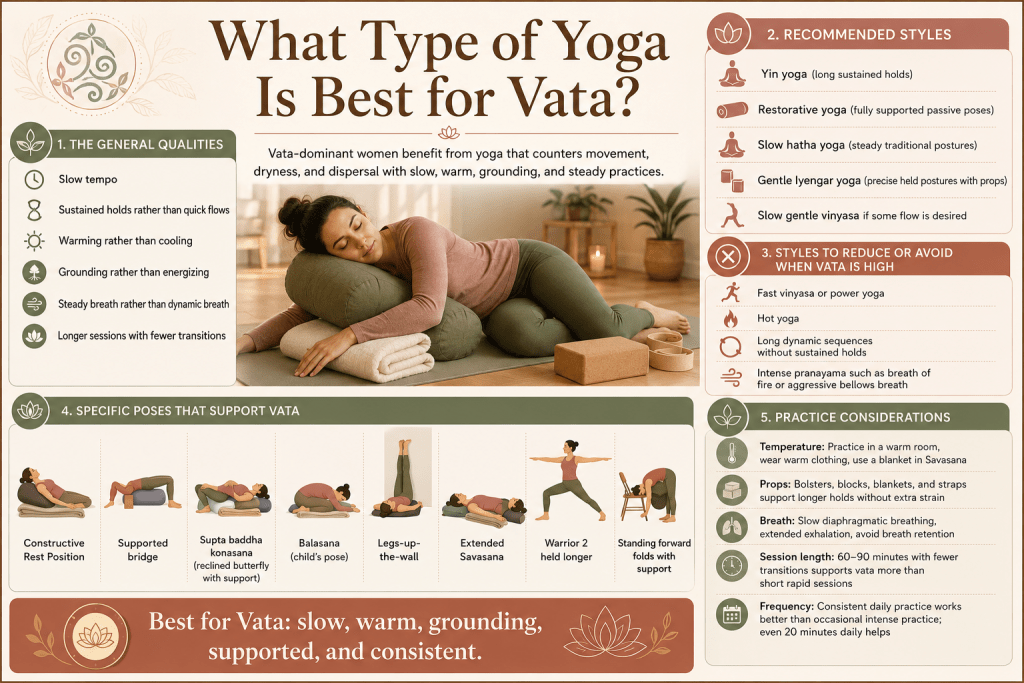
- The general qualities: Slow tempo. Sustained holds rather than quick flows. Warming rather than cooling. Grounding rather than energizing. Steady breath rather than dynamic breath. Longer sessions with fewer transitions rather than short sessions with many transitions.
- Recommended styles: Yin yoga (long sustained holds). Restorative yoga (fully supported passive poses). Slow hatha yoga (steady traditional postures). Gentle iyengar yoga (precise held postures with props). Slow gentle vinyasa if the practitioner wants some flow.
- Styles to reduce or avoid when vata is high: Fast vinyasa or power yoga (increase movement and depletion). Hot yoga (increases dryness). Long dynamic sequences without sustained holds. Intense pranayama practices (breath of fire, aggressive bellows breath).
- Specific poses that support vata: Constructive Rest Position. Supported bridge. Supta baddha konasana (reclined butterfly with support). Balasana (child’s pose). Legs-up-the-wall. Savasana (extended). Warrior 2 held for longer periods. Standing forward folds with support.
- The temperature consideration: Vata bodies tend to be cold. Practicing in a warm room, wearing warm clothing during rest phases, and covering with a blanket during Savasana all support the vata pattern.
- The prop consideration: Props (bolsters, blocks, blankets, straps) support the sustained holds that vata bodies benefit from without requiring the muscular effort that further depletes the pattern. Generous prop use is a specific vata-supporting adaptation.
- The breath consideration: Slow diaphragmatic breathing throughout the practice. Extended exhalation. Avoiding breath retention practices that can further disperse vata.
- The session length consideration: Longer sessions (60 to 90 minutes) with fewer transitions tend to support vata more than shorter sessions (30 minutes) with rapid changes. The sustained container of a longer practice grounds the pattern.
- The frequency consideration: Vata benefits from consistent daily practice more than occasional intense practice. Even 20 minutes daily at the same time each day produces more vata-balancing effect than 90 minutes once a week.
Free 28-Day Fascia Reset Email Course
Get our Free 28-day email course series to help with 1 or 2 exercises per day to release your fascia. One short lesson per day. Two minutes to read each.
What Type of Yoga Is Best for Pitta?
Pitta-dominant women benefit from yoga qualities that address the pattern of heat, intensity, and drive that characterizes pitta excess.
- The general qualities: Cooling rather than warming. Moderate effort rather than pushing to maximum. Non-competitive rather than achievement-oriented. Softer transitions rather than sharp precision. Attention to inner experience rather than external form.
- Recommended styles: Moon-cycle yin yoga (cooling and receptive). Restorative yoga. Gentle hatha. Water-based flow or slow vinyasa. Yoga nidra as regular practice.
- Styles to reduce or avoid when pitta is high: Hot yoga (obvious). Power yoga or intense vinyasa when overheated or burned out. Competitive practice environments. Yoga that emphasizes perfect alignment in a way that produces self-criticism.
- Specific poses that support pitta: Child’s pose. Legs-up-the-wall. Supported reclined poses. Gentle forward folds (cooling). Cooling twists. Moon salutations (versus sun salutations). Extended Savasana with a cool cloth on the forehead.
- The temperature consideration: Pitta bodies tend to run warm. Practicing in a cool room, wearing cooler clothing, and using a cool cloth on the forehead during rest all support the pitta-cooling intention.
- The self-criticism consideration: Pitta-dominant women often push themselves too hard and criticize themselves during practice. A specific pitta-balancing practice involves noticing and softening these tendencies. Working with a teacher who does not emphasize achievement or perfection helps.
- The competitive setting consideration: Group classes with visible ability comparisons can trigger pitta-driven competition. Home practice or one-on-one instruction may support the pitta-balancing intention better than large group classes.
- The time of day consideration: Pitta hours (roughly 10 AM to 2 PM and 10 PM to 2 AM) are not ideal for intense practice. Practicing during vata or kapha hours (early morning or late afternoon) is often more supportive.
- The breath consideration: Cooling pranayama practices (Sitali or Sitkari, which are specific cooling breath techniques traditionally used to reduce heat). Avoid intense heating pranayama like Bhastrika when pitta is high.
What Type of Yoga Is Best for Kapha?
Kapha-dominant women benefit from yoga qualities that address the pattern of stagnation, heaviness, and inertia that characterizes kapha excess.
- The general qualities: Warming rather than cooling. Energizing rather than calming. More dynamic movement. Longer sequences with continuous flow. Emphasis on getting up and moving even when the impulse is to stay still.
- Recommended styles: Vinyasa yoga (flowing sequences). Ashtanga yoga (structured energizing practice). Sun salutations. Warmer more active hatha. Rocket yoga or other energizing modern styles.
- Styles to reduce for kapha: Excessive restorative yoga (which can reinforce the stagnation pattern). Extended Savasana beyond what supports the practice.
- Specific poses that support kapha: Sun salutations. Standing sequences. Warrior sequences held with active engagement. Inversions where safe. Twists that squeeze and release. Backbends that open the chest and energize.
- The temperature consideration: Kapha bodies tend to be cool and damp. Practicing in a warm room supports the warming intention. Adding heating pranayama can help.
- The inertia consideration: Kapha-dominant women often resist starting practice even when they know it will help. Building strong environmental cues (specific practice space, specific time of day, mat visible and ready) supports overcoming the inertia.
- The frequency consideration: Kapha benefits from more frequent movement rather than long occasional sessions. Multiple shorter sessions per day (a morning practice plus an afternoon walk plus an evening stretch) often works better than one long session.
- The time of day consideration: Kapha hours (roughly 6 AM to 10 AM and 6 PM to 10 PM) are the times when the kapha quality is naturally present. Practicing during kapha hours provides a specific energizing counterbalance.
- The breath consideration: Energizing pranayama (Kapalabhati, Bhastrika when appropriate) supports kapha. Slow deep passive breathing may reinforce the stagnation pattern.
Free 28-Day Fascia Reset Email Course
Get our Free 28-day email course series to help with 1 or 2 exercises per day to release your fascia. One short lesson per day. Two minutes to read each.
How Can Midlife Women Balance Multiple Doshas?
Understanding the multi-dosha reality is essential for practical application of the framework.
What Are the Common Dual-Dosha Patterns?
- The common patterns: Vata-pitta, pitta-kapha, and vata-kapha are the three most common dual constitutions. Each requires blending elements from both dominant doshas.
- Vata-pitta women: Combine elements of vata practice (grounding, sustained holds) with elements of pitta practice (cooling, non-competitive). Often need to modulate between the two based on which is currently in excess.
- Pitta-kapha women: Combine elements of pitta practice (cooling, softer effort) with elements of kapha practice (energizing, more active). Often benefit from moderately active cooling practices.
- Vata-kapha women: Combine elements of vata practice (grounding, sustained) with elements of kapha practice (warming, energizing). Often benefit from grounding warming practice that is neither too depleting nor too stagnating.
How Does Midlife Affect Dosha Balance?
- The specific midlife pattern: Regardless of birth constitution, most women in perimenopause and menopause develop some vata excess as part of the transition. This means that even pitta-dominant or kapha-dominant women often benefit from more vata-balancing practices during this specific life stage than they would have benefited from earlier.
- The seasonal modulation: Beyond individual constitution, the current season affects which practices are most supportive. This is covered in Section 10.
How Can You Choose a Practice Based on Your Current State?
More useful than any theoretical constitutional assessment is the practical observation of how you feel today.
- If you feel scattered, dry, anxious, and unable to settle, vata-balancing practice will help regardless of your dominant constitution.
- If you feel hot, irritable, driven, and burned out, pitta-balancing practice will help.
- If you feel heavy, stuck, sluggish, and unmotivated, kapha-balancing practice will help.
When Should You Work With a Teacher?
For meaningful personalization, working with a teacher who understands the ayurvedic framework produces better results than self-guided interpretation. The Deeply Restorative Yoga and Nature Retreat at our Smoky Mountains property offers this kind of personalized approach.
How Can Ayurveda Yoga Support Perimenopause and Menopause?
Perimenopause and menopause represent a specific life stage that the ayurvedic framework addresses directly. Understanding the framework for this period of time is one of the most useful applications of ayurveda yoga.
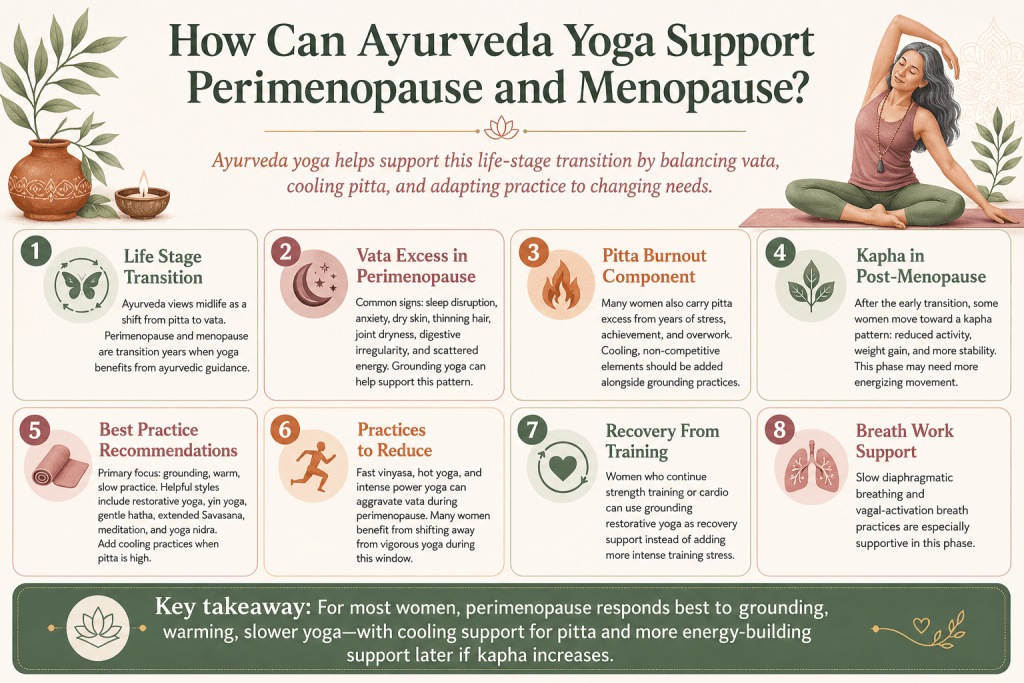
- The life stage transition: Ayurveda considers midlife adulthood a pitta stage (transformation, achievement) and later life a vata stage (drying, thinning, more nervous system activity). Perimenopause and menopause represent the transition from the pitta stage into the vata stage. This transition is one of the specific times when yoga practice benefits most from ayurvedic informing.
- The vata excess of perimenopause: The specific pattern that most midlife women develop in perimenopause aligns with vata excess: sleep disruption, anxiety, dry skin, thinning hair, joint dryness, digestive irregularity, and general felt-sense of scattered energy. Yoga that addresses this vata excess pattern supports the transition significantly.
- The pitta burnout component: Many midlife women are also carrying pitta excess from decades of high achievement, driving personalities, and accumulated stress. This shows up alongside the vata excess and requires cooling pitta-balancing elements alongside the grounding vata-balancing work.
- The kapha component in post-menopause: After the initial vata-excess perimenopause window, some women settle into a more kapha-dominant post-menopause pattern with reduced activity, weight gain, and more stability. This phase may benefit from more energizing practices to counter the kapha stagnation.
- The specific practice recommendations: The primary framework for perimenopause and menopause is grounding warm slow practice. Restorative yoga. Yin yoga. Gentle hatha. Extended Savasana. Meditation. Yoga nidra. Cooling practices as needed for pitta excess.
- The specific practices to reduce: Fast vinyasa, hot yoga, and intense power yoga often make the vata-excess pattern of perimenopause worse. Many midlife women who have practiced vigorous yoga for years benefit from shifting to more grounding practice during this window.
- The recovery-from-training angle: Women who continue to do strength training or cardio (as they should for muscle preservation, benefit from adding grounding restorative yoga as recovery practice rather than adding more intense yoga on top of the training stress.
- The breath work: Slow diaphragmatic breathing and specific vagal-activation breath practices are particularly supportive in this window.
“The single biggest reframe I offer coaching clients around yoga in perimenopause and menopause is permission to practice differently than they used to. So many women arrive believing that if they were doing hot vinyasa at 35, they should be doing hot vinyasa at 55 to prove they are still strong. The truth is that their body is asking for something different in this window, and pushing into the old pattern often makes the sleep, anxiety, and burnout worse rather than better. Once they get permission to practice slow warm sustained yoga instead, and once they see the felt-sense change within a few weeks, they typically become converts to the ayurveda yoga framework. Strength training in the gym for muscle preservation. Restorative and yin yoga for nervous system regulation and fascial mobility. That is the specific pairing that works for most midlife women, and it is what the retreat programming reflects.”
Terry Tateossian, Founder of The House of Rose
Free 28-Day Fascia Reset Email Course
Get our Free 28-day email course series to help with 1 or 2 exercises per day to release your fascia. One short lesson per day. Two minutes to read each.
What Is the Best Time of Day to Practice Ayurveda Yoga?
Ayurveda considers time of day an important variable because each part of the day has a dominant dosha quality that shapes what practices are most supportive.
- The daily cycle: Roughly 6 AM to 10 AM is kapha time (heavy, slow, structured). 10 AM to 2 PM is pitta time (hot, metabolic, active). 2 PM to 6 PM is vata time (light, mobile, dispersive). 6 PM to 10 PM is kapha time again. 10 PM to 2 AM is pitta time. 2 AM to 6 AM is vata time.
- Morning practice: Traditional yoga practice happens in the early morning during the transition from vata time (2 AM to 6 AM) into kapha time (6 AM onward). This transition window is considered optimal for practice because the mind is clear and the body is ready. Morning practice tends to set the nervous system tone for the day.
- Late afternoon practice: Vata time (2 PM to 6 PM) can be a good time for grounding practice for vata-dominant or vata-excess bodies. The specific vata-balancing effect of yoga in this window is meaningful.
- Evening practice: Evening practice (roughly 6 PM to 8 PM) supports the wind-down toward sleep. Restorative and gentle practices in this window help transition from activity to rest. Avoid intense practice too close to bedtime.
- The specific pattern for midlife women: For women dealing with the vata-excess of perimenopause and menopause, morning grounding practice plus evening restorative practice is often the most supportive combination. The morning practice grounds the nervous system for the day. The evening practice supports sleep.
- The practical reality: Time of day matters less than consistency. A yoga practice you do at 8 PM produces more benefit than a theoretical morning practice you skip. Find the time that works for your life and practice consistently.
How Should You Adjust Ayurveda Yoga for Each Season?
Ayurveda considers season an important variable because each season has a dominant dosha quality that affects what practices are most supportive.
- Fall and early winter (vata season): Cool, dry, windy weather aggravates vata. Yoga practices in this season benefit from being warming, grounding, sustained, and slower. This is the season for restorative and yin yoga, extended Savasana, and warm clothing during practice.
- Late winter and spring (kapha season): Cool damp weather aggravates kapha. Yoga practices in this season benefit from being warming, energizing, more dynamic, and clearing. This is the season for vinyasa flow, energizing pranayama, and moving practices that clear the winter accumulation.
- Summer (pitta season): Hot weather aggravates pitta. Yoga practices in this season benefit from being cooling, less intense, softer in effort, and non-competitive. This is the season for moon-cycle yin, cooling forward folds, and yoga during cooler parts of the day.
- Seasonal transitions: The specific weeks around each equinox and solstice are considered periods of heightened vulnerability where practice benefits from extra attention. Simplified practice during transition weeks supports the body’s own adjustment.
- The regional variation: Actual weather matters more than calendar season. A cool wet summer requires different practice than a hot dry summer. Attending to your actual climate produces better results than following a generic seasonal template.
- The specific midlife layer: For women in perimenopause and menopause, the vata-excess pattern is often present regardless of season. This means that even in kapha season (which would normally call for more energizing practice), the individual midlife woman may still benefit from primarily grounding practices with only modest kapha-balancing additions. Individualization always beats generalization.
Free 28-Day Fascia Reset Email Course
Get our Free 28-day email course series to help with 1 or 2 exercises per day to release your fascia. One short lesson per day. Two minutes to read each.
Which Pranayama Practices Are Best for Each Dosha?
Pranayama (breath work) is one of the core practices of yoga, and it is one of the specific areas where the ayurvedic framework produces the most direct benefit.
Breath Work for Vata Excess
Practices that support vata excess include:
- Slow diaphragmatic breathing
- Extended exhalation
- Nadi Shodhana (alternate nostril breathing) done slowly
- Ujjayi breath at a slow pace
Avoid intense retention practices when vata is high.
Breath Work for Pitta Excess
Practices that support pitta excess include:
- Cooling breath practices like Sitali (curled-tongue cooling breath)
- Sitkari (teeth-drawn cooling breath)
- Slow diaphragmatic breathing
Avoid heating practices like Bhastrika when pitta is high.
Breath Work for Kapha Excess
Practices that support kapha excess include:
- Warming, energizing practices like Kapalabhati (skull-shining breath)
- Bhastrika (bellows breath) when appropriate
- Faster Nadi Shodhana
Avoid overly slow, passive breathing that reinforces stagnation.
Breath Work for Menopause
Slow diaphragmatic breathing with extended exhalation is broadly supportive for the vata excess of the perimenopause and menopause window.
- Left nostril breathing (Chandra Bhedana) is calming and often helpful for the sleep disruption of this window.
- Cooling breath practices help with hot flashes.
Building a Daily Practice
Even five to ten minutes of daily pranayama produces meaningful benefit. Combined with a physical yoga practice, the breath work amplifies the effects. Daily breath work alone, without physical yoga, still produces significant nervous system benefit.
Important Safety Considerations
Intense pranayama practices should be learned with a qualified teacher before being practiced independently. Some practices can produce dizziness or discomfort if done incorrectly. Slow breath practices are generally safe for self-directed practice.
How Can You Build an Ayurveda Yoga Practice at Home?
The practical application of the ayurveda yoga framework for most midlife women is a home practice they can install and sustain. Building this practice thoughtfully produces better results than sporadic class attendance.
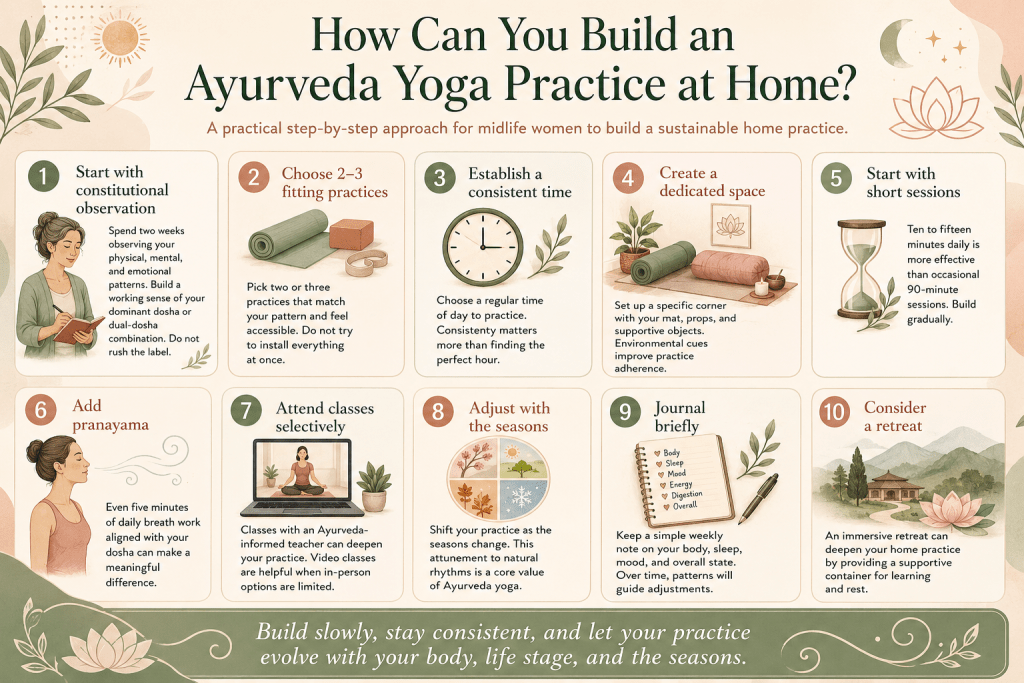
- Start with the constitutional observation: Spend two weeks observing your specific patterns across physical, mental, and emotional dimensions. Build a working sense of your dominant dosha or dual dosha combination. Do not rush to a specific label.
- Choose two or three practices that fit your pattern: From the practice recommendations for your dosha, choose two or three that appeal to you and are accessible. Do not try to install everything at once.
- Establish a consistent time: Choose a specific time of day when you will practice. Consistency of timing produces stronger benefits than any specific timing choice.
- Create a dedicated space: A specific corner of a room with your mat, props, and any traditional objects that support your practice. Environmental cues significantly improve practice adherence.
- Start with short sessions: Ten to fifteen minutes daily produces more benefit than sporadic 90-minute sessions. Build gradually.
- Add pranayama: Even five minutes of daily breath work aligned with your dosha produces meaningful benefit.
- Attend classes selectively: In-person classes with an ayurveda-informed teacher deepen your practice significantly. Video classes are useful when in-person is not available.
- Adjust with seasons: Change your practice as the seasons change. This attunement to natural rhythms is one of the specific values of the ayurveda yoga framework.
- Journal briefly: Keep a simple weekly note about how the practice is affecting your body, sleep, mood, and general state. Over months, patterns emerge that inform practice adjustments.
- Consider a retreat: An immersive retreat setting deepens home practice by providing an in-person container for learning. The Deeply Restorative Yoga and Nature Retreat at our Smoky Mountains property offers this kind of immersive setting.
Free 28-Day Fascia Reset Email Course
Get our Free 28-day email course series to help with 1 or 2 exercises per day to release your fascia. One short lesson per day. Two minutes to read each.
What Should You Look for in an Ayurveda Yoga Teacher?
If you want to work with a teacher who integrates the two traditions, several factors distinguish qualified instruction from generic yoga wrapped in ayurveda vocabulary.
- Formal training: Look for teachers who have completed formal training in both yoga and ayurveda. Yoga Alliance registration is a baseline for yoga teaching. Ayurveda credentials vary, but formal training through a recognized program is a positive signal.
- Explicit framework use: A qualified teacher will describe their approach in terms of the specific ayurvedic principles they use. Generic language about “balance” and “energy” without specific reference to doshas, seasons, or the underlying tradition suggests looser use of the framework.
- Individualization: A qualified teacher will ask about your constitution, current state, life stage, and specific concerns before recommending a practice approach. Cookie-cutter recommendations without this individualization suggest the teacher is not applying the framework.
- Cultural humility: A qualified teacher will honor the South Asian origins of both traditions and speak about them with appropriate respect. Teachers who present ayurveda yoga as a Western wellness invention or who commodify the traditions without acknowledgment are missing something important.
- Realistic claims: A qualified teacher will not claim that ayurveda yoga cures serious medical conditions or replaces medical care. Grandiose claims are a warning sign.
- Coordination with Western medicine: A qualified teacher will support your continued relationship with your Western physicians rather than positioning ayurveda yoga against modern medicine.
- Comfort with your questions: A qualified teacher will welcome questions and explain their reasoning rather than deflecting or invoking mystique.
- A note on availability: Qualified ayurveda-informed yoga teachers are relatively rare in the West. If you cannot find one locally, video instruction from respected teachers plus your own study of the tradition can substitute reasonably well. Look for teachers trained through recognized programs like the National Ayurvedic Medical Association (NAMA) or lineage-based yoga schools.
What Are the Most Common Misconceptions About Ayurveda Yoga?
Several common misconceptions circulate about ayurveda yoga and are worth naming directly.
- Ayurveda yoga is not a brand of yoga: It is a framework for practicing any style of yoga with awareness of ayurvedic principles. Anyone teaching a specific “Ayurveda Yoga” class as a proprietary brand may be simplifying or commodifying the framework.
- The dosha framework is not a personality quiz: Doshas are functional physiological patterns, not Buzzfeed-style personality types. Reducing them to superficial personality frames trivializes the traditions.
- Ayurveda yoga does not require becoming an ayurveda practitioner: You can apply the basic dosha framework to your yoga practice without extensive training. Deeper ayurvedic care is a separate decision.
- Ayurveda yoga is not a religion: It emerges from a specific cultural and philosophical context that includes religious elements, but the practice itself can be undertaken by people of any religious background.
- The framework does not replace medical care: Ayurveda yoga is one supportive practice within a broader health framework. It does not substitute for appropriate medical evaluation and treatment of specific conditions.
- Your dosha does not lock you into one type of practice forever: Constitution is stable, but current state fluctuates. Practice adjusts accordingly. Rigidly practicing one way regardless of current state misses the point.
- Not all ayurvedic yoga content online is accurate: Wellness content varies widely in accuracy. Consult reliable sources including books by qualified authors and teachers from recognized lineages rather than relying on Instagram or blog content.
- Ayurveda yoga cannot fix everything: Some conditions require medical intervention. Some require lifestyle changes far beyond yoga. Ayurveda yoga is one supportive layer within a broader framework, not a stand-alone solution.
- Free 28-Day Fascia Reset Email Course
Get our Free 28-day email course series to help with 1 or 2 exercises per day to release your fascia. One short lesson per day. Two minutes to read each.
When Should You Consult a Healthcare Professional?
Ayurveda yoga is generally safe but certain situations warrant professional evaluation.
- Acute or severe medical conditions: Cardiovascular disease, uncontrolled blood pressure, recent surgery, and other significant conditions warrant physician clearance before starting or intensifying practice.
- Pregnancy: Some yoga practices need modification during pregnancy. Work with a prenatal-certified teacher.
- Severe pelvic floor issues: Work with a pelvic floor physical therapist for individualized guidance.
- Any chronic condition requiring management: Discuss with your provider before starting significant new practice.
- Any intense practice: Advanced pranayama, extended fasting, or intensive retreats should involve consultation with both a qualified teacher and your healthcare provider.
- Any concerning symptoms during practice: Dizziness, chest pain, unusual fatigue, or other alarming symptoms warrant medical evaluation.
Free 28-Day Fascia Reset Email Course
Get our Free 28-day email course series to help with 1 or 2 exercises per day to release your fascia. One short lesson per day. Two minutes to read each.
What Are Your Next Steps?
If the framework in this article resonates and you want to install an ayurveda yoga practice, here are the four next steps in order of friction.
- Observe your patterns for two weeks. Use the dosha framework in Sections 3 through 6 to build a working sense of your dominant constitution and current state. Do not rush to a specific label.
- Choose two practices that fit your pattern. From the recommendations for your dosha, choose one physical practice and one breath practice to install daily. Fifteen minutes total is plenty to start.
- Establish consistency. Same time each day. Same space. Same brief practice. Consistency matters more than duration.
Frequently Asked Questions
What is ayurveda yoga?
Ayurveda yoga is a framework for practicing yoga in a way that is informed by ayurvedic principles about individual constitution (dosha), current state of balance, life stage, and season. It is not a specific style of yoga but rather a way of choosing which yoga practices support your specific body and situation. The two traditions emerged together from the broader Vedic wisdom framework and share the same underlying philosophy.
What is the difference between yoga and ayurveda?
Yoga is a system of physical, mental, and spiritual practice. Ayurveda is a system of medicine and health. Traditionally the two are sister disciplines within the same broader tradition. Yoga is one of the practices ayurveda recommends for health. Ayurveda provides the framework that tells you which yoga practices support your specific body.
What is dosha yoga?
Dosha yoga refers to yoga practice adapted to your specific constitutional pattern (vata, pitta, or kapha). Vata-dominant people generally benefit from grounding warm slow practice. Pitta-dominant people benefit from cooling less intense practice. Kapha-dominant people benefit from warming energizing more active practice. Most people have a dual-dosha pattern and blend elements from both.
What yoga is best for vata dosha?
Vata-dominant women benefit from yoga that is grounding, warming, slow, and sustained. Yin yoga, restorative yoga, slow hatha, and gentle iyengar are supportive. Avoid fast vinyasa, hot yoga, and long dynamic sequences without sustained holds when vata is high.
What yoga is best for pitta dosha?
Pitta-dominant women benefit from yoga that is cooling, moderate, and non-competitive. Moon-cycle yin yoga, restorative yoga, gentle hatha, and slower vinyasa are supportive. Avoid hot yoga, competitive practice environments, and pushing yourself to maximum effort when pitta is high.
What yoga is best for kapha dosha?
Kapha-dominant women benefit from yoga that is warming, energizing, and more active. Vinyasa flow, sun salutations, and moving hatha are supportive. Avoid excessive restorative practice that reinforces stagnation when kapha is high.
Free 28-Day Fascia Reset Email Course
Get our Free 28-day email course series to help with 1 or 2 exercises per day to release your fascia. One short lesson per day. Two minutes to read each.
Can ayurveda yoga help with menopause?
Yes, ayurveda yoga is particularly well-suited to the perimenopause and menopause transition. Most midlife women develop some vata excess during this window, which responds well to grounding warm slow yoga practices. Combined with the broader lifestyle medicine framework, ayurveda yoga is a supportive intervention for many menopause symptoms including sleep disruption, anxiety, and physical stiffness.
How is ayurveda yoga different from regular yoga?
Regular yoga generally treats all students similarly. Ayurveda yoga adjusts the practice to your specific constitution, current state, life stage, and season. The individualization is the specific value that makes the framework produce better outcomes than one-size-fits-all approaches.
Do I need to know my dosha to practice ayurveda yoga?
Having a working understanding of your dominant dosha or dual constitution helps significantly. Perfect knowledge is not required. Observing your patterns across physical, mental, and emotional dimensions over a few weeks builds a functional understanding that is more useful than rushing to a specific label.
Can I learn ayurveda yoga at home?
Yes, self-directed home practice with the framework in this article can produce meaningful benefit. For deeper personalization, working with an ayurveda-informed teacher produces stronger results. Books by qualified authors like David Frawley and Vasant Lad support home learning. An immersive retreat setting deepens the practice further.
What time of day should I practice ayurveda yoga?
Early morning practice (roughly 6 AM to 8 AM) is traditionally considered optimal because it sets the nervous system tone for the day. Evening practice supports sleep. The practical answer is whatever time you can practice consistently. Consistency matters more than perfect timing.
Does ayurveda yoga work for women over 40?
Yes, and it is particularly well-suited to this life stage. The specific patterns of perimenopause and menopause align with the vata-excess pattern that ayurveda yoga addresses. Many midlife women who have been practicing generic yoga for years find that shifting to ayurveda-informed practice produces significantly better results.
What is the best pranayama for menopause?
Slow diaphragmatic breathing with extended exhalation is broadly supportive. Left nostril breathing (Chandra Bhedana) is calming and often helps with sleep disruption. Cooling breath practices (Sitali, Sitkari) help with hot flashes.
How long should an ayurveda yoga session be?
Fifteen to twenty minutes of consistent daily practice produces significant benefit. Longer sessions (45 to 75 minutes) allow deeper practice when time is available. Consistency is more important than duration.
Do THOR retreats include ayurveda yoga?
The Deeply Restorative Yoga and Nature Retreat at our Smoky Mountains property includes yoga programming aligned with dosha-informed principles appropriate for midlife women. THOR is not an ayurvedic clinic and does not offer formal ayurvedic care, but the yoga and nutrition programming reflects broader ayurvedic principles.
References
- Frawley, D., & Kozak, S. S. (2001). Yoga for Your Type: An Ayurvedic Approach to Your Asana Practice. Lotus Press.
- Frawley, D. (2000). Ayurvedic Healing: A Comprehensive Guide (2nd ed.). Lotus Press.
- Lad, V. (2002). Textbook of Ayurveda: Fundamental Principles (Vol. 1). The Ayurvedic Press.
- Feuerstein, G. (2001). The Yoga Tradition: Its History, Literature, Philosophy, and Practice. Hohm Press.
- Iyengar, B. K. S. (2005). Light on Life. Rodale Books.
- Farhi, D. (2003). Bringing Yoga to Life: The Everyday Practice of Enlightened Living. HarperCollins.
- Cook, C. (2013). Ayurvedic Yoga Therapy. Lotus Press.
- Sharma, H., Chandola, H. M., Singh, G., & Basisht, G. (2007). Utilization of Ayurveda in health care: an approach for prevention, health promotion, and treatment of disease. Part 1—Ayurveda, the science of life. Journal of Alternative and Complementary Medicine, 13(9), 1011–1019.
- Streeter, C. C., Gerbarg, P. L., Saper, R. B., et al. (2012). Effects of yoga on the autonomic nervous system, gamma-aminobutyric-acid, and allostasis in epilepsy, depression, and post-traumatic stress disorder. Medical Hypotheses, 78(5), 571–579.
- Field, T. (2011). Yoga clinical research review. Complementary Therapies in Clinical Practice, 17(1), 1–8.
- Cramer, H., Lauche, R., Langhorst, J., & Dobos, G. (2013). Yoga for depression: a systematic review and meta-analysis. Depression and Anxiety, 30(11), 1068–1083.
- Ross, A., & Thomas, S. (2010). The health benefits of yoga and exercise: a review of comparison studies. Journal of Alternative and Complementary Medicine, 16(1), 3–12.
- Zope, S. A., & Zope, R. A. (2013). Sudarshan Kriya Yoga: breathing for health. International Journal of Yoga, 6(1), 4–10.
- Innes, K. E., Bourguignon, C., & Taylor, A. G. (2005). Risk indices associated with the insulin resistance syndrome, cardiovascular disease, and possible protection with yoga: a systematic review. Journal of the American Board of Family Practice, 18(6), 491–519.
- Woolery, A., Myers, H., Sternlieb, B., & Zeltzer, L. (2004). A yoga intervention for young adults with elevated symptoms of depression. Alternative Therapies in Health and Medicine, 10(2), 60–63.
- Woodyard, C. (2011). Exploring the therapeutic effects of yoga and its ability to increase quality of life. International Journal of Yoga, 4(2), 49–54.
- Ross, A., Friedmann, E., Bevans, M., & Thomas, S. (2013). National survey of yoga practitioners: mental and physical health benefits. Complementary Therapies in Medicine, 21(4), 313–323.
- Payyappallimana, U., & Venkatasubramanian, P. (2016). Exploring Ayurvedic knowledge on food and health for providing innovative solutions to contemporary healthcare. Frontiers in Public Health, 4, 57.
- Ranade, S., Deshpande, R. R., & Chobhe, S. (2011). Ayurveda and Marma Therapy: Energy Points in Yogic Healing. North Atlantic Books.
- Svoboda, R. E. (1998). Prakriti: Your Ayurvedic Constitution (2nd ed.). Lotus Press.
Disclaimer: Always consult with a qualified healthcare professional before making significant changes to your practice or starting any new intensive practice, particularly if you have chronic medical conditions or are pregnant. This article is educational and does not constitute medical advice.
Free 28-Day Fascia Reset Email Course
Get our Free 28-day email course series to help with 1 or 2 exercises per day to release your fascia. One short lesson per day. Two minutes to read each.

Terry Tateossian is a Menopause Lifestyle Medicine Coach, Certified Personal Trainer & Nutritionist and the Founder of THOR: The House of Rose, a wellness brand serving women over 40 through retreats, coaching, macro-nutrition and community. As 25-year founder and entrepreneur, Terry spent two and a half decades building and running successful start-up businesses, an experience that put her on the front line of founder burnout long before she could name it. After facing serious health challenges, early onset menopause, and emotional eating while running her agency and raising two children, Terry rebuilt her health in her 40s and lost more than 80 pounds through evidence-based nutrition, training, and mindset work. Today, she helps women get strong, improve confidence, support hormone health, and create a stronger second half of life. Terry has been featured in major media outlets and is available for podcasts, expert commentary, brand collaborations, and speaking engagements on midlife health, reinvention, emotional eating, menopause wellness, and strength training for longevity. Get her free macro calculator (her cookbook companion) to start your journey to back to health.