
 By Team THOR
Free 28-Day Fascia Reset Email Course
Get our Free 28-day email course series to help with 1 or 2 exercises per day to release your fascia. One short lesson per day. Two minutes to read each.
Jyotish, the Nine Grahas, Nakshatras, and Human Physiology: A Complete Guide for Midlife Women Exploring the Vedic Framework
Important upfront framing: Jyotish is a philosophical and cultural tradition, not a scientifically validated method for predicting health, personality, or life events. Some of its ideas about time, natural rhythms, and human physiology overlap with modern chronobiology. However, claims that planetary positions at birth determine disease risk or personal outcomes have not been supported by controlled research.
This article approaches Jyotish as a longstanding philosophical framework while clearly distinguishing tradition from science. THOR is not a Vedic astrology practice, and nothing here should be interpreted as an astrological reading or prediction.
Jyotish is the traditional Vedic system for understanding time, cycles, and the relationship between cosmic patterns and human life. Often translated as the “science of light,” it developed within the wider Vedic tradition alongside Ayurveda and yoga.
Classical Jyotish includes detailed calculations, historical texts, formal training, and a philosophical system that has been practiced in South Asia for more than two thousand years.
Jyotish has become a growing topic among women already exploring Ayurveda and other Vedic traditions. This guide explains the nine Grahas, the twenty-seven Nakshatras, karma, human physiology, chronobiology, common misconceptions, and how to approach the tradition thoughtfully. For additional background, see our guide to Ayurveda for women over 40.
Important: This article is for educational purposes only and does not provide spiritual, religious, medical, or mental health advice. Jyotish is not a substitute for qualified medical care. If astrological content causes distress or interferes with daily life, speak with a licensed mental health professional.
What Is Jyotish?
Jyotish is the traditional Vedic framework for observing celestial cycles and interpreting them symbolically as reflections of the quality of time. Understanding what the framework claims and what it does not claim is the starting point for thoughtful engagement.
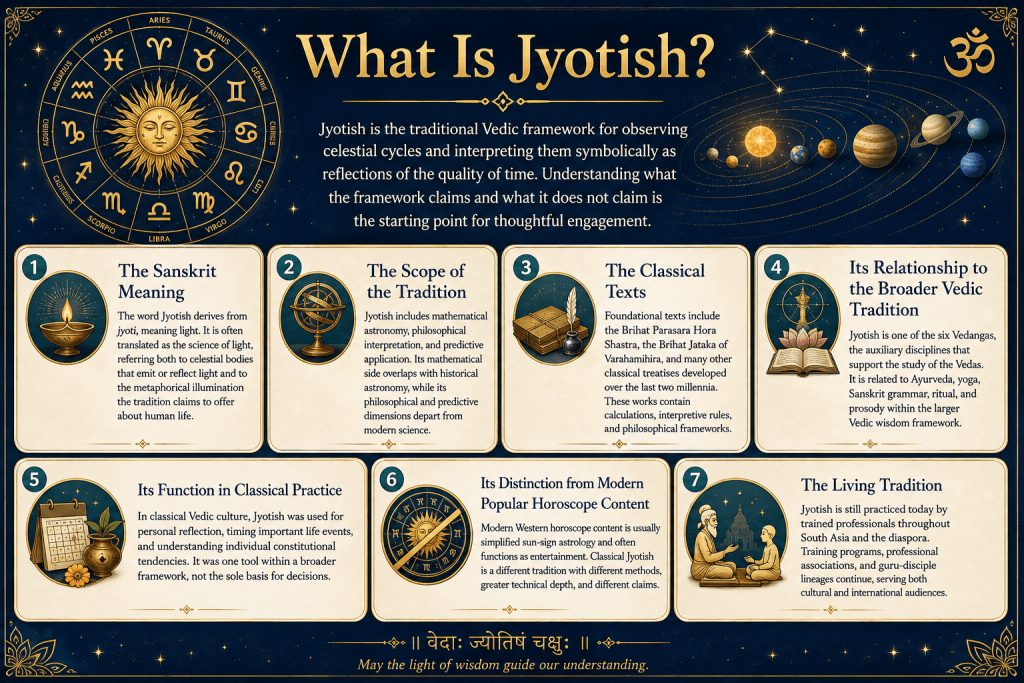
- The Sanskrit meaning: The word Jyotish derives from jyoti, meaning light. The tradition is often translated as the science of light, referring both to the study of celestial bodies that emit or reflect light and to the metaphorical illumination the tradition claims to offer about human life.
- The scope of the tradition: Jyotish encompasses mathematical astronomy (calculating planetary positions), philosophical interpretation (what the positions symbolically represent), and predictive application (how the patterns might unfold over time). The mathematical component overlaps substantially with historical astronomy. The philosophical and predictive components are where the tradition departs from modern science.
- The classical texts: The foundational texts of Jyotish include the Brihat Parasara Hora Shastra, the Brihat Jataka of Varahamihira, and numerous other classical treatises composed over the last two millennia. These are extensive technical works with detailed calculations, interpretive rules, and philosophical framework.
- Its relationship to the broader Vedic tradition: Jyotish is one of the six Vedangas, or auxiliary disciplines that support the study of the Vedas. It is a sister tradition to Ayurveda (medicine), yoga (spiritual practice), Sanskrit grammar, ritual, and prosody. The full Vedic wisdom framework treats these disciplines as interconnected.
- Its function in classical practice: In classical Vedic culture, Jyotish was consulted for personal reflection, timing of important life events (marriage, business ventures, medical procedures, religious ceremonies), and understanding of individual constitutional tendencies. It was one tool within a broader framework rather than the sole determinant of decisions.
- Its distinction from modern popular horoscope content: Popular horoscope content in Western media is generally based on simplified sun-sign astrology, has little relationship to the sophisticated technical apparatus of classical Jyotish, and often functions as entertainment. Jyotish is a different tradition with different methods and different claims.
- The living tradition: Jyotish is practiced today by trained professionals throughout South Asia and, increasingly, in the diaspora. Formal training programs, professional associations, and traditional guru-disciple lineages all continue. Some practitioners work primarily within cultural and religious contexts. Others engage with Western clients seeking exposure to the tradition.
How Does Jyotish Differ From Western Astrology?
Both Jyotish and Western astrology use the movements of celestial bodies to construct interpretive frameworks. However, the two traditions differ in their zodiac systems, interpretive priorities, philosophical foundations, and cultural applications.
Zodiac Systems and Lunar Divisions
One of the clearest differences between the two traditions is how they divide and interpret the zodiac.
- Different zodiac systems: Western astrology uses the tropical zodiac, which is aligned with the seasons based on the position of the sun at the spring equinox. Jyotish uses the sidereal zodiac, which is aligned with the actual constellations as observed against the fixed stars. Because of axial precession, the two systems have drifted apart by approximately 24 degrees, meaning that most people have different sun signs in the two systems.
- Different emphasis on the moon: Jyotish gives central importance to the moon and the moon sign specifically. In practice, the moon sign is often considered more revealing of personality than the sun sign, which reverses the common Western emphasis.
- The Nakshatras: Jyotish divides the zodiac into twenty-seven Nakshatras, or lunar mansions. These divisions provide an additional layer of interpretation that is not present in most forms of Western astrology.
Timing and Predictive Methods
The traditions also use different systems for interpreting how celestial patterns unfold over time.
- The Dasha system: Jyotish uses an elaborate system of planetary time periods, known as Dashas, that unfold over the course of a person’s life. These periods give specific interpretive weight to different Grahas during different phases.
- Western transit methods: Western astrology generally focuses more heavily on planetary transits and progressions. It does not typically employ the Vimshottari Dasha system that structures many Jyotish predictions.
Philosophical and Cultural Foundations
Jyotish is also connected to a broader spiritual and cultural framework that differs from the more varied foundations of Western astrology.
- The philosophical grounding: Jyotish is grounded in the broader Vedic worldview, which includes karma, reincarnation, and specific frameworks of consciousness. Western astrology is more eclectic in its philosophical background and does not typically presume the same specific worldview.
- The role of remedial measures: Jyotish often includes recommendations for remedial actions, such as mantras, gemstones, charitable acts, and ritual practices, intended to work with challenging planetary influences. Western astrology less commonly includes this component.
- The role in cultural life: In South Asian cultural contexts, Jyotish plays a role in marriage matching, the timing of major life events, and religious observance. Western astrology does not typically occupy the same formal cultural role in Western societies.
Free 28-Day Fascia Reset Email Course
Get our Free 28-day email course series to help with 1 or 2 exercises per day to release your fascia. One short lesson per day. Two minutes to read each.
Why Are Midlife Women Drawn to Jyotish Now?
The rising interest in Jyotish specifically among midlife women reflects broader patterns worth understanding.
- The Ayurveda connection: Many midlife women who have engaged with Ayurveda over the last decade become curious about its sister tradition. Jyotish is often the next stop for women who have adopted Ayurvedic dietary and lifestyle principles and are interested in the broader philosophical framework.
- The interior turn of midlife: The perimenopause and menopause transition often produces a shift toward interior reflection, meaning-making, and philosophical engagement. Frameworks that address life-stage transitions, cycles, and the qualitative dimension of time speak to this shift.
- The pattern-recognition capacity of midlife: By midlife, women have accumulated enough life experience to see cyclical patterns across time. A framework that names and interprets these cycles often resonates because it articulates what has already been observed.
- The specific menopause context: The hormonal transitions of perimenopause and menopause are themselves cyclical shifts. Frameworks that offer interpretive vocabulary for life-stage transitions can provide meaning-making support during a window that many women describe as needing new interpretive frames.
- The wellness industry adaptation: Some of the current interest reflects wellness-industry marketing that has adapted Jyotish into products, programs, and readings sold at premium prices. This is worth naming honestly. Some contemporary teachers offer thoughtful engagement. Others produce content that has more marketing than substance.
- The desire for framework without medicalization: Some midlife women are seeking interpretive frameworks that treat their experience as meaningful rather than pathological. Jyotish provides one such framework, though it is important not to substitute philosophical engagement for appropriate medical care when medical care is needed.
- The cultural globalization: The increasing global availability of practitioners from within the tradition (particularly through online consultation) has made Jyotish more accessible than it was to Western audiences a generation ago.
“The women who come to Jyotish thoughtfully often describe it as offering interpretive vocabulary that Western frameworks did not provide. The naming of life-stage transitions. The recognition of cyclical time. The idea that different periods of life have qualitatively different character. These are useful frames whether one accepts the literal metaphysical claims of the tradition or engages with the framework as philosophical prompt. My caution is that Jyotish content in the current wellness market ranges from truly thoughtful and lineage-based to shallow commercial adaptation. Engaging with trained practitioners from within the tradition and primary source material produces different value than following wellness-influencer content that repackages the tradition for entertainment. If a midlife woman wants to explore Jyotish, my recommendation is to read serious introductory works by respected authors, consider a consultation with a properly credentialed traditional practitioner, and hold the material lightly as philosophical framework rather than as literal prediction about her health or life outcomes.”
Terry Tateossian, Founder of The House of Rose
What Is the Vedic Concept of Time (Kala)?
One of the foundational concepts underlying Jyotish is the Vedic understanding of time, or Kala, which differs meaningfully from the modern scientific concept of time.
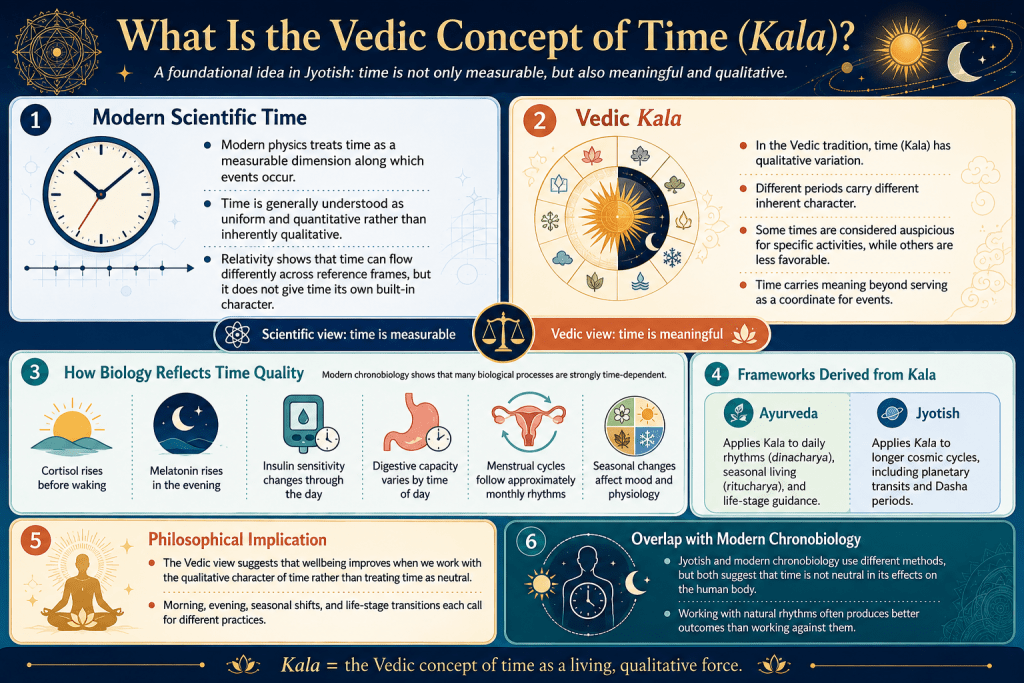
- Modern scientific time: Modern physics treats time as a dimension along which events occur. Time is measurable, uniform, and does not have inherent qualitative variation. The physics of relativity added the observation that time flows at different rates in different reference frames, but this does not add qualitative character to time itself.
- Vedic Kala: The Vedic tradition treats time as having qualitative variation. Different periods have different inherent character. Certain times are considered auspicious for specific activities and inauspicious for others. Time itself carries meaning beyond its role as a coordinate for events.
- The relationship to biology: The Vedic observation that time has qualitative variation aligns with modern chronobiology research showing that biological processes are strongly time-dependent. Cortisol rises before waking. Melatonin rises in the evening. Insulin sensitivity fluctuates through the day. Digestive capacity varies with time of day. Menstrual cycles operate on approximately monthly rhythms. Seasonal changes in mood and physiology are well-documented.
- The specific frameworks derived from Kala: Ayurveda applies the Kala concept to daily rhythms (dinacharya, covered in our Ayurveda article), seasonal recommendations (ritucharya), and life-stage frameworks. Jyotish applies the Kala concept to longer cosmic cycles including planetary transits and Dasha periods.
- The philosophical implication: The Vedic view suggests that human wellbeing benefits from working with the qualitative character of time rather than treating time as neutral. Morning practices support different physiological states than evening practices. Seasonal foods support different bodies than year-round eating. Life-stage transitions call for different practices than the practices that supported earlier decades.
- The overlap with modern chronobiology: While Jyotish and modern chronobiology arrive at their conclusions through very different methods, they share the general observation that time is not neutral in its effects on the human body. Working with natural rhythms produces better outcomes than working against them.
Free 28-Day Fascia Reset Email Course
Get our Free 28-day email course series to help with 1 or 2 exercises per day to release your fascia. One short lesson per day. Two minutes to read each.
How Does a Birth Chart Function as a Cosmic Snapshot?
Central to Jyotish practice is the birth chart, a mathematical representation of the sky at the moment and place of a person’s birth.
How Is the Chart Constructed?
A Jyotish birth chart plots the positions of the nine Grahas (planetary influences) against the sidereal zodiac and the Nakshatras (lunar mansions) at the specific latitude, longitude, and time of birth. The mathematical apparatus involves precise astronomical calculations.
What Is the Chart Claimed to Represent?
In the Jyotish framework, the birth chart is interpreted as a symbolic representation of the person’s constitutional tendencies, life patterns, and potential trajectory. It is not typically presented as literal determinism but as an indication of tendencies that unfold through interaction with life circumstances and personal choices.
What Is the Important Distinction?
The birth chart is understood within the tradition as a symbolic reflection of the qualitative character of the moment of birth rather than as a causal producer of the person’s characteristics.
The analogy sometimes used within the tradition is a clock: the clock does not cause the time; it reflects the time.
How Does the Predispositional Framing Work?
Many contemporary Jyotish practitioners describe planetary positions as indicating predispositions or tendencies rather than certainties. This framing has some structural resemblance to the modern concept of genetic predisposition, which similarly identifies tendencies that unfold through interaction with environment and behavior.
The two frameworks operate through entirely different proposed mechanisms and rest on entirely different evidence bases, but both distinguish predisposition from destiny.
What Does the Scientific Evidence Show About Birth Charts?
Multiple controlled studies over decades have investigated whether birth chart interpretations correspond to measurable personality traits, life events, or health outcomes beyond what would be expected by chance. The general finding across this research is that specific astrological predictions have not been validated by controlled research.
This does not mean the framework has no value as reflective philosophy. It does mean that the specific claim that birth position determines specific life outcomes has not been supported by scientific testing.
How Can Someone Engage With the Birth Chart Concept?
How to engage with the birth chart concept depends on one’s philosophical orientation. Thoughtful contemporary students may engage with it in several ways:
- As a literal metaphysical framework
- As a symbolic prompt for reflection
- As a cultural tradition worth preserving without accepting specific predictive claims
All three orientations are represented among thoughtful contemporary students.
What Are the Nine Grahas?
Jyotish focuses on nine planetary influences called the Navagraha, which differs from the twelve zodiac signs of most Western astrology. Understanding the nine Grahas provides the foundation for the rest of the framework.
Which Grahas Are Included in the Navagraha?
The traditional nine include:
- The Sun (Surya)
- The Moon (Chandra)
- Mars (Mangala)
- Mercury (Budha)
- Jupiter (Guru or Brihaspati)
- Venus (Shukra)
- Saturn (Shani)
- Rahu (the ascending lunar node)
- Ketu (the descending lunar node)
Are All Nine Grahas Astronomical Planets?
Not all are astronomical planets. The Sun and Moon are not technically planets in modern astronomical terms. Rahu and Ketu are not physical bodies at all but rather calculated points where the Moon’s orbit intersects the ecliptic plane.
In classical Jyotish, all nine are considered Grahas because they exert symbolic influence within the framework, regardless of their modern astronomical classification.
What Qualities Are Associated With Each Graha?
In the tradition, each Graha is associated with specific psychological qualities, physiological tendencies, life themes, and archetypal principles:
- The Sun: Vitality, leadership, and the self
- The Moon: The mind, emotions, and the mother
- Mars: Energy, action, and courage
- Mercury: Communication and intellect
- Jupiter: Wisdom and expansion
- Venus: Love, beauty, and relationships
- Saturn: Discipline, karma, and time
- Rahu and Ketu: Transformation and karmic themes
How Should These Associations Be Interpreted?
The associations between Grahas and life themes are symbolic and interpretive rather than mechanical. The tradition does not typically claim that Mars literally emits energy that affects a person.
Instead, it claims that the position of Mars in a chart symbolically reflects the quality of Martian energy in the person’s constitution. This is a philosophical distinction that matters for how the framework is engaged with.
Which Grahas Have Modern Scientific Relevance?
The Sun and Moon are the two Grahas whose influences on human physiology are supported by substantial modern research. The remaining Grahas have symbolic meaning within the tradition but do not have documented direct physiological effects on humans through their gravitational, electromagnetic, or radiative properties at the intensities that reach the Earth.
Free 28-Day Fascia Reset Email Course
Get our Free 28-day email course series to help with 1 or 2 exercises per day to release your fascia. One short lesson per day. Two minutes to read each.
How Does the Sun Relate to Modern Sun-Health Research?
Of the nine Grahas, the Sun is the one whose actual physiological effects on humans are most extensively documented by modern research. This intersection is worth exploring in detail because it is one of the specific places where ancient observation and modern research meaningfully align.
- The Jyotish view of the Sun: In the tradition, the Sun represents vitality, life force, the self, leadership, digestion, and the fire principle. It is one of the two most important Grahas in most interpretive systems. Ayurveda specifically links the Sun to Agni, the metabolic fire that governs digestion and cellular energy production.
- The modern research on sun exposure: Multiple lines of research support the observation that sunlight exposure has significant effects on human physiology. Circadian rhythm regulation depends on light exposure to the retina. Melatonin production is suppressed by evening light and supported by darkness. Vitamin D synthesis depends on ultraviolet exposure to the skin. Seasonal changes in sunlight affect mood in seasonal affective disorder. Serotonin production increases with morning light. Cortisol rhythm is anchored by early-day light exposure.
- The specific circadian mechanism: Light entering the retina reaches the suprachiasmatic nucleus of the hypothalamus, the body’s master circadian clock. This clock coordinates thousands of downstream physiological rhythms including sleep-wake cycles, hormone production, metabolism, immune function, cognitive performance, and cellular repair processes.
- The specific menopause application: The circadian disruption common in perimenopause and menopause contributes to sleep problems, mood changes, metabolic shifts, and various other symptoms. Consistent morning light exposure is one of the most practical interventions for supporting circadian rhythm during the transition. See our menopause sleep remedies article and midlife sleep stack article for the specific application.
- The specific practical framework: Regardless of one’s philosophical engagement with Jyotish, the modern research supports specific practices that align with the ancient observation of solar importance. Morning outdoor light exposure within an hour of waking. Reduced evening screen light. Consistent sleep and wake times. Time outdoors during the day. Vitamin D adequacy through sun exposure or supplementation.
- The overlap and the difference: The overlap is that both frameworks recognize the profound influence of solar rhythms on human health. The difference is that modern research operates through documented physiological mechanisms while the Jyotish tradition operates through symbolic and metaphysical framework. Both point toward similar practical recommendations.
How Does the Moon Relate to Modern Moon-Body Research?
The Moon is the second of the two most important Grahas in Jyotish and is closely associated with the mind, emotions, and physiological rhythms. The modern research on moon-body relationships is more complex and less conclusive than the sun-health research.
The Jyotish View of the Moon
The Moon represents the mind, emotions, memory, adaptability, nurturing, and fluid regulation. In Ayurvedic terms, the Moon is closely linked to the cerebrospinal fluid, the mind (manas), and emotional stability.
The Moon is considered particularly important for mental health, sleep, and psychological resilience.
What Does Modern Research Say About Lunar Influence?
The evidence base on lunar influence on human biology is mixed. Several potential lunar effects have been investigated:
- Sleep architecture: Some studies have documented modest correlations between lunar phase and sleep parameters, particularly reduced deep sleep around the full moon, while other studies have found no such relationship. Recent research using large samples suggests small but real effects on sleep in some populations, though the effect sizes are modest.
- Menstrual cycles: Historical anecdotal accounts of lunar synchronization of menstrual cycles have been investigated in modern research with mixed findings. Some studies show weak correlation, while others show no relationship. The historical claim of universal lunar-menstrual synchronization is not supported by controlled research.
- Mood and psychiatric symptoms: Correlations between lunar phase and psychiatric admissions, mood, and behavior have been repeatedly investigated. Most rigorous research does not find consistent relationships, though occasional studies suggest small effects in specific populations.
- Marine biology: Documented lunar synchronization is much stronger in various marine organisms whose reproductive cycles are meaningfully tied to lunar tides. This is a real biological phenomenon in these species.
What Is the Honest Picture?
The Moon does have some documented physical effects on Earth, including tides and some light-based effects. It also has biological effects on some organisms, particularly marine species.
The specific claim that the Moon at birth determines personality or health outcomes has not been supported by controlled research. Some modest effects on human sleep exist and are being investigated further.
The Practical Application for Midlife Women
Regardless of the specific research on lunar effects, the general practice of attending to interior state, emotional patterns, and psychological rhythms is well-supported by other lines of research.
The tradition of paying attention to the interior life, which Jyotish frames as attention to the Moon, is philosophically valuable regardless of the specific astrological interpretation.
A Caution About Modern Lunar Health Claims
Some contemporary content extends the traditional lunar associations into elaborate claims about lunar cycling for menstrual health, hormonal timing, or menopause management. These claims typically exceed what the research supports.
Engage with them with appropriate skepticism while attending to the underlying good practice of interior attention.
Free 28-Day Fascia Reset Email Course
Get our Free 28-day email course series to help with 1 or 2 exercises per day to release your fascia. One short lesson per day. Two minutes to read each.
What Do Mars, Mercury, Jupiter, Venus, and Saturn Represent in Jyotish?
The remaining traditional planets in the Jyotish framework represent additional symbolic principles that structure the tradition’s interpretive apparatus.
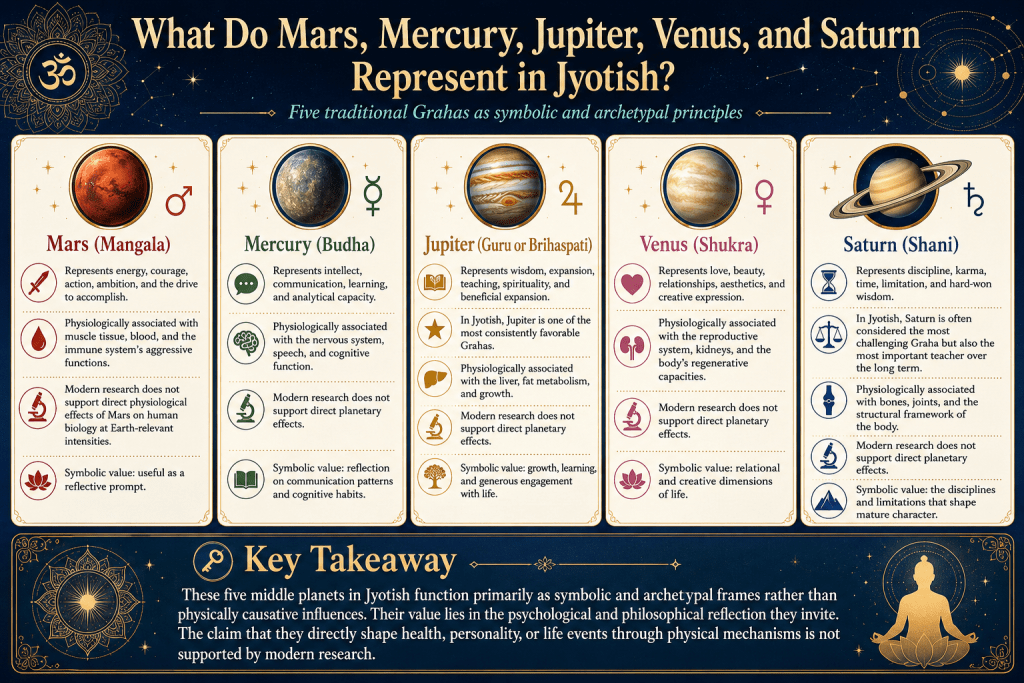
- Mars (Mangala): Represents energy, courage, action, ambition, and the drive to accomplish. In physiological terms, Mars is associated with muscle tissue, blood, and the immune system’s aggressive functions. Modern research does not support direct physiological effects of Mars on human biology at Earth-relevant intensities. The symbolic framework may be useful as reflective prompt.
- Mercury (Budha): Represents intellect, communication, learning, and analytical capacity. Physiologically associated with the nervous system, speech, and cognitive function. Modern research does not support direct planetary effects. The symbolic framework may be useful for reflection on communication patterns and cognitive habits.
- Jupiter (Guru or Brihaspati): Represents wisdom, expansion, teaching, spirituality, and beneficial expansion. In Jyotish, Jupiter is one of the most consistently favorable Grahas. Physiologically associated with the liver, fat metabolism, and growth. Modern research does not support direct planetary effects. The symbolic framework often points toward growth, learning, and generous engagement with life.
- Venus (Shukra): Represents love, beauty, relationships, aesthetics, and creative expression. Physiologically associated with the reproductive system, kidneys, and the body’s regenerative capacities. Modern research does not support direct planetary effects. The symbolic framework often points toward relational and creative dimensions of life.
- Saturn (Shani): Represents discipline, karma, time, limitation, and hard-won wisdom. In Jyotish, Saturn is often considered the most challenging Graha but also the most important teacher over the long term. Physiologically associated with bones, joints, and the structural framework of the body. Modern research does not support direct planetary effects. The symbolic framework often points toward the disciplines and limitations that shape mature character.
The five middle planets in the Jyotish framework function primarily as symbolic and archetypal frames rather than as physically causative influences. Their value is in the psychological and philosophical reflection they invite. The specific claim that they causally shape health, personality, or life events through physical mechanisms is not supported by modern research.
What Are Rahu and Ketu, the Lunar Nodes?
Two of the nine Grahas are not physical bodies at all but rather calculated points in space. Understanding what these are and how they function in the tradition matters for accurate understanding of Jyotish.
What Are Rahu and Ketu Physically?
Rahu and Ketu are the ascending and descending lunar nodes: the points where the Moon’s orbit around the Earth intersects the plane of the Earth’s orbit around the Sun. These are astronomically real reference points but are not physical objects.
Their astronomical significance includes:
- The lunar nodes are where solar and lunar eclipses occur.
- When the Sun, Moon, and Earth align at or near the nodes, the geometry of eclipses becomes possible.
- This astronomical connection is why the nodes have been observed and named across cultures.
What Do Rahu and Ketu Mean in Jyotish?
In the tradition, Rahu represents ascending karmic themes, worldly desire, obsession, and dramatic transformation. Ketu represents descending karmic themes, detachment, spirituality, and past-life patterns. Together they are often associated with cycles of transformation and the karmic dimensions of a life.
How Does Vedic Mythology Explain the Lunar Nodes?
In Vedic mythology, Rahu and Ketu are the head and body of a demon who tried to drink the elixir of immortality and was decapitated by Vishnu. The head (Rahu) and body (Ketu) became the two nodes that periodically swallow the Sun and Moon, creating eclipses. This mythological framing is culturally significant within the tradition.
What Is Their Modern Relevance?
The nodes have no direct physical effect on human physiology through gravitational or radiative means. They are calculated reference points rather than physical bodies. Their significance within Jyotish is entirely symbolic within the tradition’s interpretive framework.
For thoughtful engagement with Jyotish, the nodes function as symbolic prompts for reflection on:
- Themes of transformation
- Karma
- Worldly desire and detachment
- The patterns of a life
They can be useful for reflective purposes regardless of one’s stance on the underlying metaphysical claims.
Free 28-Day Fascia Reset Email Course
Get our Free 28-day email course series to help with 1 or 2 exercises per day to release your fascia. One short lesson per day. Two minutes to read each.
What Are the Twenty-Seven Nakshatras?
Beyond the nine Grahas, Jyotish uses the framework of twenty-seven Nakshatras, or lunar mansions, that divide the zodiac into finer segments than the twelve signs provide.
What Are the Nakshatras?
The Nakshatras are twenty-seven divisions of the sidereal zodiac, each spanning approximately 13 degrees 20 minutes of celestial longitude. Each Nakshatra is named after a specific star or star group and is associated with:
- A mythological figure
- A specific quality
- A ruling deity
- A ruling Graha
How Are the Nakshatras Used in Interpretation?
In Jyotish, the Moon’s Nakshatra at the time of birth is considered one of the most personally significant placements. It is thought to reveal specific aspects of temperament, karmic pattern, and life themes that are more detailed than what a zodiac sign alone would indicate.
What Is the Historical Origin of the Nakshatras?
The Nakshatra system predates the twelve-sign zodiac in Vedic literature. Earlier Vedic texts refer to Nakshatras but not to the twelve signs.
The system reflects the older observation of the Moon’s monthly journey through fixed star groups.
What Are the Twenty-Seven Nakshatras Called?
The twenty-seven Nakshatras have specific names, beginning with:
- Ashwini
- Bharani
- Krittika
- Rohini
- Mrigashira
- Ardra
The sequence continues through all twenty-seven Nakshatras, with each one having associated qualities within the tradition. Detailed study of the specific Nakshatras is beyond the scope of an introductory article, but a thoughtful practitioner or classical text is worth engaging with for those interested.
What Is Their Scientific Status?
Like the broader astrological framework, the specific claim that Nakshatras affect personality or life outcomes has not been supported by controlled research. The framework has cultural and philosophical significance within the tradition rather than validated predictive power.
Is There a Modern Parallel?
The Nakshatras represent an ancient attempt to notice and name fine variations within the zodiac. This tradition of careful observation and naming has value as a cultural framework whether or not one accepts the specific interpretive claims.
How Do Karma, Samskaras, and Predisposition Relate to Jyotish?
The Jyotish framework operates within the broader Vedic understanding of karma and samskaras. Understanding these concepts is essential for engaging thoughtfully with the tradition.
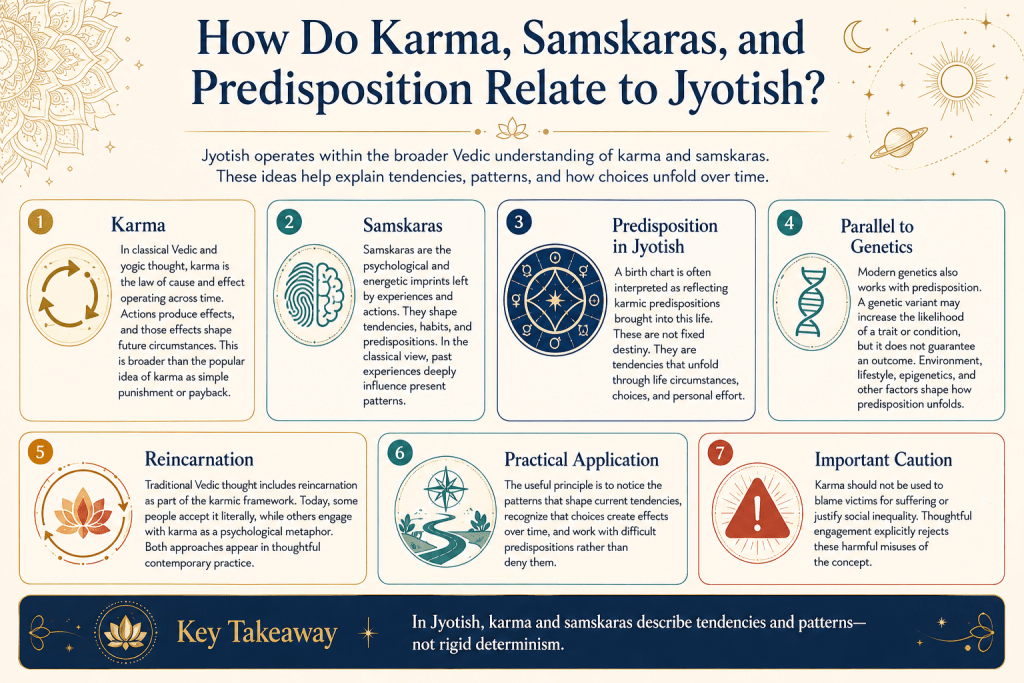
- What karma means in the classical sense: In classical Vedic and yogic thought, karma refers to the law of cause and effect operating across time. Actions produce effects, and the pattern of effects shapes future circumstances. This is broader than the popular Western use of karma to mean simple retribution or punishment.
- Samskaras: Samskaras are the psychological and energetic imprints left by experiences and actions. They shape tendencies, habitual patterns, and predispositions. In the classical framework, samskaras from earlier in life (and, in traditions that accept reincarnation, from earlier lives) shape current tendencies.
- The predispositional framing: Within Jyotish, the birth chart is often interpreted as reflecting the karmic predispositions that a person is bringing into this life. These are understood not as fixed determinism but as tendencies that unfold through interaction with life circumstances and personal choices.
- The specific parallel to genetic predisposition: Modern genetics identifies specific genetic variants that increase predisposition to certain conditions or traits. The presence of a variant does not guarantee the associated outcome. Environmental factors, epigenetics, lifestyle, and various other variables shape whether and how the predisposition unfolds. The two frameworks (karmic predisposition and genetic predisposition) share the structural feature of identifying tendency without determining outcome, though their proposed mechanisms are entirely different.
- The reincarnation question: Traditional Vedic thought includes reincarnation as part of the karmic framework. Contemporary engagement with the tradition varies. Some practitioners and students accept reincarnation as literal metaphysical framework. Others engage with the karmic concept as psychological metaphor without literal reincarnation. Both approaches are represented within thoughtful contemporary practice.
- The practical application: Regardless of one’s stance on the literal metaphysical claims, the psychological principle underlying the karmic framework has practical value. Attention to the patterns and imprints that shape current tendencies. Recognition that choices produce effects over time. Willingness to work with rather than deny difficult predispositions. These are practically useful frames.
- The specific caution: The concept of karma can be misapplied to blame victims for suffering (they must have done something in a past life to deserve this) or to justify social inequality (the current suffering of oppressed groups is their karma). Thoughtful engagement with the tradition explicitly rejects these applications, which represent misuse of the concept.
Free 28-Day Fascia Reset Email Course
Get our Free 28-day email course series to help with 1 or 2 exercises per day to release your fascia. One short lesson per day. Two minutes to read each.
Where Does Modern Chronobiology Meet Vedic Observations?
The specific overlap between Vedic observations about cosmic cycles and modern chronobiology research is one of the most interesting territories for thoughtful engagement.
- The circadian rhythm foundation: Modern chronobiology has documented that virtually every physiological system in the human body operates on approximately 24-hour cycles anchored primarily by light exposure. Hormone production, metabolism, cognition, immune function, and cellular repair all follow predictable daily patterns.
- The seasonal rhythm foundation: Modern research has documented seasonal variation in mood (seasonal affective disorder), immune function, hormone production, and various other physiological systems. The ancient observation that seasons matter for health is supported by extensive modern research.
- The monthly rhythm reality: Menstrual cycles in premenopausal women follow approximately monthly rhythms that are well-documented. The specific role of moon phase in these cycles is less established, but the general reality of monthly biological rhythms is clear.
- The life-stage rhythm reality: Perimenopause and menopause represent a specific life-stage rhythm shift. Puberty, pregnancy, and other reproductive transitions represent additional life-stage shifts. The ancient framework of life stages as qualitatively different periods aligns with modern understanding of these transitions.
- The specific menopause research context: Circadian rhythm disruption is increasingly recognized as a significant factor in menopause symptoms. Sleep disruption, mood changes, and metabolic shifts all have chronobiological components. Interventions that support circadian rhythm (consistent sleep timing, morning light exposure, evening light reduction) often produce meaningful improvement in menopause symptoms. See our menopause sleep remedies article and midlife sleep stack article for the specific application.
- The philosophical convergence: Both Jyotish and modern chronobiology arrive at the general observation that time has qualitative character that affects human biology. The philosophical convergence is meaningful even though the proposed mechanisms differ significantly. Thoughtful engagement can honor both frameworks in their respective domains.
Where Does Modern Research Not Support Astrological Claims?
Being honest about where modern research does not support specific astrological claims matters for maintaining intellectual integrity in engaging with the tradition.
- Birth chart determinism: Multiple controlled studies over decades have investigated whether birth chart interpretations predict measurable outcomes better than chance. The general finding is that specific predictions from birth charts have not been validated by controlled research at rates better than would be expected by chance combined with confirmation bias.
- Planetary influence on individual physiology: The claim that specific planets exert influence on individual human physiology through gravitational, electromagnetic, or radiative means has not been supported by physics or physiology research. The gravitational effect of the doctor delivering a baby is greater than the gravitational effect of Mars at that moment.
- Twin studies: Identical twins born minutes apart with nearly identical charts consistently show different personalities, health outcomes, and life trajectories. If birth chart specifically determined outcomes, twin outcomes would be more similar than they in fact are.
- Nakshatra-specific claims: Specific claims about the Nakshatras affecting personality or life outcomes have similarly not been supported by controlled research.
- Predictive accuracy studies: Studies comparing predictions made by professional astrologers to control conditions have generally not shown professional astrological prediction to exceed chance levels of accuracy.
- The scientific consensus: The mainstream scientific consensus on astrology as a predictive system is that it does not have empirical support for its specific predictive claims. This applies to both Western astrology and Jyotish.
- What this does and does not mean: This does not mean the tradition has no value as philosophy, culture, or reflective framework. It does mean that specific predictive claims about health, personality, or life events should not be accepted as reliable guides to decision-making about important life matters. Use Jyotish content for reflective purposes if you find it meaningful. Use evidence-based frameworks for making actual health decisions.
Free 28-Day Fascia Reset Email Course
Get our Free 28-day email course series to help with 1 or 2 exercises per day to release your fascia. One short lesson per day. Two minutes to read each.
What Are the Common Misinterpretations and Wellness-Marketing Distortions of Jyotish?
Several specific misinterpretations and distortions of Jyotish circulate in contemporary wellness content and are worth naming directly.
- Distortion 1: The predictive determinism. Some contemporary practitioners present Jyotish as capable of reliable prediction of specific life events (illness, marriage, career outcomes). This oversells what the tradition can honestly deliver and often leads clients into unnecessary anxiety or unwarranted confidence about specific outcomes.
- Distortion 2: The expensive remedial products. Some contemporary practitioners sell expensive gemstones, mantras, ritual products, or specialty programs claimed to remediate negative planetary influences. The specific effectiveness of these remedial measures has not been supported by controlled research. Approach expensive remedial recommendations with skepticism.
- Distortion 3: The blame-the-chart framing. Some interpretations use the birth chart to explain difficult circumstances in ways that shift responsibility from actual causes (behavior, environment, systemic factors) onto astrological positioning. This can be disempowering rather than illuminating.
- Distortion 4: The health-decision substitution. Some content encourages using Jyotish to make decisions about medical treatment, timing of medical procedures, or whether to seek care. This substitutes astrological interpretation for medical judgment and can produce serious harm.
- Distortion 5: The relationship compatibility overclaim. Traditional Jyotish marriage compatibility calculations have real cultural significance within their tradition but have not been shown in research to predict marriage outcomes. Using astrological compatibility as the primary basis for major relationship decisions is overreliance.
- Distortion 6: The Western wellness repackaging. Some contemporary content presents oversimplified sun-sign material as if it were Jyotish, or blends Jyotish with unrelated New Age content in ways that misrepresent the tradition. Serious engagement requires reading primary source material and working with credentialed practitioners.
- Distortion 7: The urgency and scarcity marketing. Some marketing presents specific planetary periods as urgent windows requiring immediate purchase of programs or consultations. Legitimate practitioners typically do not use urgency and scarcity tactics.
Read serious introductory works by respected authors like David Frawley or lineage-based practitioners. Work with credentialed practitioners from within the tradition. Continue evidence-based medical care alongside any philosophical engagement. Be skeptical of urgency, scarcity, and expensive remedial products. Distinguish between reasonable reflective use of the tradition and unreasonable predictive or medical claims.
“The specific engagement I recommend for coaching clients who are curious about Jyotish is to read primary source material, consider a single consultation with a well-credentialed traditional practitioner if truly interested, and hold the material lightly as philosophical framework rather than as literal prediction. What I actively discourage is substituting astrological interpretation for medical decisions, spending significant money on expensive remedial products, or letting astrological content produce anxiety that affects daily function. The tradition has genuine philosophical value when engaged thoughtfully. It can also produce harm when engaged uncritically or through commercial content that oversells what the framework can deliver. Distinguishing between thoughtful engagement and problematic engagement is the specific skill that lets midlife women benefit from the tradition without being harmed by its contemporary distortions.”
Terry Tateossian, Founder of The House of Rose
How Can Midlife Women Engage With Jyotish Thoughtfully?
For midlife women interested in engaging with Jyotish honestly, several specific practices support thoughtful engagement.
Seek Reliable Sources and Practitioners
- Read serious primary and secondary sources: David Frawley’s introductory works on Vedic astrology, Hart deFouw and Robert Svoboda’s Light on Life, and various classical texts in translation provide serious foundational reading. Wellness-influencer content and simplified apps typically do not provide adequate depth for informed engagement.
- Work with credentialed practitioners: If you decide to have a consultation, work with a practitioner trained in the traditional lineage (BAMS-adjacent training in India or graduates of recognized programs) rather than with wellness-industry practitioners who have adopted Jyotish vocabulary without traditional training.
Use Jyotish for Reflection, Not as a Replacement for Care
- Attend to your own reactions: Notice which specific elements of the framework resonate with your experience and which do not. Not everything within the tradition needs to be accepted or rejected wholesale. Selective and thoughtful engagement is possible.
- Distinguish reflective use from predictive use: Using Jyotish as a prompt for reflection on cycles, life stages, and personal tendencies is different from using it as a literal prediction of future events. The reflective use has genuine philosophical value. The predictive use has significantly less support.
- Continue appropriate medical and mental health care: Do not substitute astrological interpretation for medical judgment on health matters. Do not stop or change medications based on astrological readings. Continue seeing your healthcare providers regardless of your engagement with the tradition.
Maintain a Critical and Practical Perspective
- Maintain critical thinking: Ask specific questions. Notice when claims exceed what the framework can honestly deliver. Be skeptical of dramatic predictions or urgent recommendations for expensive interventions.
- Hold the framework lightly: Even for those who find genuine value in the tradition, the healthiest engagement holds the framework as one useful lens rather than as the sole determinant of decisions. Life is complex enough that no single framework captures the whole.
- Attend to the practical implications: Where the tradition points toward practical actions (daily routine, seasonal eating, attention to interior state, respect for cycles), the practical implications are often supported by other lines of research and are worth acting on regardless of the specific philosophical framework.
Free 28-Day Fascia Reset Email Course
Get our Free 28-day email course series to help with 1 or 2 exercises per day to release your fascia. One short lesson per day. Two minutes to read each.
When Should You See a Healthcare or Mental Health Professional?
Jyotish is not a substitute for appropriate professional care. Certain situations warrant care beyond philosophical engagement.
- Any acute or persistent health symptoms: Any physical or mental health symptoms that impair daily function warrant medical or mental health evaluation. Do not use astrological content as a reason to defer appropriate care.
- Anxiety or preoccupation from astrological content: If engagement with astrological readings produces significant anxiety about predicted outcomes, obsessive checking, or preoccupation that affects your daily function, consult a mental health provider.
- Major life decisions: Major decisions about medical treatment, marriage, career, or family matters warrant appropriate professional consultation (medical, therapeutic, legal, financial) beyond astrological guidance.
- Involvement in exploitative practices: If a practitioner or program requires large financial contributions, discourages outside consultation, promises specific outcomes, or claims exclusive spiritual authority, seek outside perspective. These are warning signs of exploitation.
- Persistent spiritual crisis: Persistent existential distress or spiritual crisis often benefits from working with a qualified therapist, spiritual director, or counselor experienced in this territory.
- Confusion with mental health symptoms: Some experiences of expanded consciousness, unusual perceptions, or intense preoccupation with cosmic themes can indicate mental health conditions requiring evaluation. If you have concerns, consult a mental health professional familiar with spiritual and religious experience.
Free 28-Day Fascia Reset Email Course
Get our Free 28-day email course series to help with 1 or 2 exercises per day to release your fascia. One short lesson per day. Two minutes to read each.
Frequently Asked Questions
What is Jyotish?
Jyotish is the traditional Vedic framework for understanding time, cosmic cycles, and their symbolic correspondence with human life. The Sanskrit word translates roughly as “science of light.” Jyotish uses precise astronomical calculations combined with interpretive philosophical framework to construct birth charts and predict cycles. It is a living tradition practiced by trained professionals throughout South Asia and increasingly worldwide.
How is Vedic astrology different from Western astrology?
Vedic astrology (Jyotish) uses the sidereal zodiac (aligned with actual constellations), gives central emphasis to the Moon and Moon sign, includes twenty-seven Nakshatras (lunar mansions) beyond the twelve signs, uses the Dasha system of planetary time periods, and operates within a broader Vedic philosophical framework including karma. Western astrology uses the tropical zodiac (aligned with seasons), tends to emphasize the Sun sign more, and has more eclectic philosophical grounding.
What are the nine planets in Vedic astrology?
The nine Grahas of Vedic astrology are the Sun (Surya), Moon (Chandra), Mars (Mangala), Mercury (Budha), Jupiter (Guru), Venus (Shukra), Saturn (Shani), Rahu (ascending lunar node), and Ketu (descending lunar node). Rahu and Ketu are not physical bodies but calculated points where the Moon’s orbit intersects the ecliptic plane.
What are Nakshatras?
Nakshatras are the twenty-seven lunar mansions that divide the zodiac into finer segments than the twelve signs provide. Each Nakshatra spans approximately 13 degrees 20 minutes of celestial longitude, is named after a specific star or star group, and has associated qualities within the tradition. The Moon’s Nakshatra at birth is considered particularly significant in Jyotish interpretation.
Is Jyotish scientifically proven?
No. The specific predictive claims of Jyotish (that birth charts predict personality, health, or life events) have been tested repeatedly in controlled research and have not been shown to correspond to measurable outcomes at rates better than chance. Some underlying observations that Jyotish articulates (that time has qualitative variation, that cosmic cycles correspond to biological cycles) intersect with modern chronobiology research in meaningful ways. The framework operates as philosophy and cultural tradition rather than as science.
Can Jyotish predict my health?
No. The specific claim that birth charts predict health outcomes has not been supported by controlled research. Do not use Jyotish interpretations as a basis for medical decisions. Continue evidence-based medical care. Some Jyotish practitioners offer general recommendations about lifestyle timing that may align with modern chronobiology, but specific health predictions should be treated with appropriate skepticism.
What is a Nakshatra reading?
A Nakshatra reading is an interpretation of a person’s chart focusing on the Nakshatra (lunar mansion) where the Moon was located at birth. In traditional Jyotish, the Moon’s Nakshatra is considered particularly personally significant. The specific interpretations vary by tradition and practitioner.
What is karma in Vedic tradition?
Karma in classical Vedic and yogic thought refers to the law of cause and effect operating across time. Actions produce effects, and patterns of effects shape future circumstances. This is broader than the popular Western use of karma to mean simple retribution. In traditions that accept reincarnation, karma is understood to operate across lifetimes. Contemporary students engage with the concept in various ways from literal metaphysical framework to psychological metaphor.
Should I get a Vedic astrology reading?
Whether to get a reading is a personal decision. Approach it as one thoughtful exploration rather than as decision-making authority. If you decide to have a reading, seek a credentialed practitioner from within the traditional lineage. Approach the reading as reflective prompt rather than as literal prediction. Continue evidence-based professional care regardless of what the reading suggests.
How does Jyotish relate to Ayurveda?
Jyotish and Ayurveda are sister traditions within the broader Vedic wisdom framework. Ayurveda focuses on health, medicine, daily routine, and nutrition. Jyotish focuses on time, cycles, and cosmic patterns. The two traditions share the same underlying philosophical framework and often complement each other in traditional practice.
Can Jyotish help with menopause?
Jyotish can provide philosophical framework for understanding menopause as a specific life-stage transition and for engaging with the cyclical dimension of the experience. It is not a substitute for evidence-based menopause care. The specific interventions that support menopause (hormone therapy where appropriate, nutrition, movement, sleep, nervous system regulation) rest on modern research rather than astrological framework. Use both if you find both valuable, but do not substitute one for the other.
What are the Navagraha?
Navagraha is the collective name for the nine Grahas (planetary influences) of Jyotish: Sun, Moon, Mars, Mercury, Jupiter, Venus, Saturn, Rahu, and Ketu. The word combines nava (nine) and graha (grasper or seizer, meaning something that has interpretive influence within the framework).
Free 28-Day Fascia Reset Email Course
Get our Free 28-day email course series to help with 1 or 2 exercises per day to release your fascia. One short lesson per day. Two minutes to read each.
Do THOR retreats include Vedic astrology?
No. The Women’s Yoga Retreats at our Smoky Mountains property does not include Jyotish readings or predictions. The retreat programming focuses on evidence-based lifestyle medicine including nutrition, yoga, meditation, nervous system regulation, and nature exposure. The retreat setting supports the contemplative practice that engagement with philosophical frameworks like Jyotish invites, but the framework itself is not part of the specific retreat curriculum.
Where does modern research meet Jyotish?
The specific intersection is in chronobiology. Modern research has documented that time has qualitative effects on human biology through circadian rhythms, seasonal cycles, and life-stage transitions. This general observation aligns with the ancient Vedic recognition that time has qualitative character. The specific proposed mechanisms differ substantially, but the general observation is shared.
Are there risks to engaging with astrological content?
For most people, thoughtful engagement is safe. Risks include developing anxiety or preoccupation from negative predictions, substituting astrological interpretation for appropriate medical or mental health care, spending significant money on expensive remedial products or programs, and involvement in exploitative practices. These risks are avoidable through the thoughtful engagement practices outlined in Section 16.
References
- Frawley, D. (1995). Astrology of the Seers: A Guide to Vedic (Hindu) Astrology. Lotus Press.
- deFouw, H., & Svoboda, R. E. (2003). Light on Life: An Introduction to the Astrology of India. Lotus Press.
- Braha, J. T. (1986). Ancient Hindu Astrology for the Modern Western Astrologer. Hermetician Press.
- Charak, K. S. (2001). Elements of Vedic Astrology (Vols. 1–2). UMA Publications.
- Rao, K. N. (2003). Predicting through Karakamsa and Jaimini’s Mandooka Dasa. Vani Publications.
- Feuerstein, G. (2001). The Yoga Tradition: Its History, Literature, Philosophy, and Practice. Hohm Press.
- Zysk, K. G. (1996). Medicine in the Veda: Religious Healing in the Vedic Tradition. Motilal Banarsidass.
- Lad, V. (2002). Textbook of Ayurveda: Fundamental Principles (Vol. 1). The Ayurvedic Press.
- Panda, S. (2016). The Circadian Code: Lose Weight, Supercharge Your Energy, and Transform Your Health from Morning to Midnight. Rodale.
- Roenneberg, T. (2012). Internal Time: Chronotypes, Social Jet Lag, and Why You’re So Tired. Harvard University Press.
- Foster, R. G., & Kreitzman, L. (2004). Rhythms of Life: The Biological Clocks That Control the Daily Lives of Every Living Thing. Yale University Press.
- Cajochen, C., Altanay-Ekici, S., Münch, M., et al. (2013). Evidence that the lunar cycle influences human sleep. Current Biology, 23(15), 1485–1488.
- Casiraghi, L., Spiousas, I., Dunster, G. P., et al. (2021). Moonstruck sleep: synchronization of human sleep with the moon cycle under field conditions. Science Advances, 7(5), eabe0465.
- Foster, R. G., & Roenneberg, T. (2008). Human responses to the geophysical daily, annual and lunar cycles. Current Biology, 18(17), R784–R794.
- Wehr, T. A., Duncan, W. C., Sher, L., et al. (2001). A circadian signal of change of season in patients with seasonal affective disorder. Archives of General Psychiatry, 58(12), 1108–1114.
- Levitin, D. J. (2020). The Changing Mind: A Neuroscientist’s Guide to Ageing Well. Penguin.
- Bak, T. H., & Chandran, S. (2012). What wires together dies together: verbs, actions and neurodegeneration in motor neuron disease. Cortex, 48(7), 936–944.
- Kripke, D. F., Elliott, J. A., Youngstedt, S. D., & Rex, K. M. (2007). Circadian phase response curves to light in older and young women and men. Journal of Circadian Rhythms, 5, 4.
- Pontzer, H., Yamada, Y., Sagayama, H., et al. (2021). Daily energy expenditure through the human life course. Science, 373(6556), 808–812.
- Barr, C. S. (2000). Living with Time (No specific citation—include here as textbook example of qualitative time in cultural context).
- Iyengar, B. K. S. (2005). Light on Life. Rodale Books.
Disclaimer: This article is educational and does not constitute spiritual, religious, medical, or mental health advice. Jyotish is a philosophical and cultural tradition and is not a substitute for appropriate professional care. Do not make medical, mental health, or other significant life decisions based on astrological interpretations alone. Continue evidence-based professional care regardless of philosophical engagement. If astrological content produces distress that affects your function, consult a qualified mental health professional.
Free 28-Day Fascia Reset Email Course
Get our Free 28-day email course series to help with 1 or 2 exercises per day to release your fascia. One short lesson per day. Two minutes to read each.

Terry Tateossian is a Menopause Lifestyle Medicine Coach, Certified Personal Trainer & Nutritionist and the Founder of THOR: The House of Rose, a wellness brand serving women over 40 through retreats, coaching, macro-nutrition and community. As 25-year founder and entrepreneur, Terry spent two and a half decades building and running successful start-up businesses, an experience that put her on the front line of founder burnout long before she could name it. After facing serious health challenges, early onset menopause, and emotional eating while running her agency and raising two children, Terry rebuilt her health in her 40s and lost more than 80 pounds through evidence-based nutrition, training, and mindset work. Today, she helps women get strong, improve confidence, support hormone health, and create a stronger second half of life. Terry has been featured in major media outlets and is available for podcasts, expert commentary, brand collaborations, and speaking engagements on midlife health, reinvention, emotional eating, menopause wellness, and strength training for longevity. Get her free macro calculator (her cookbook companion) to start your journey to back to health.