
 By Team THOR
$200 Off All 2027 Early Bird Discount
Settle the mind, restore the body & soul back to health. Our deeply restorative 5-day retreat is for midlife women 40+ who are ready to receive abundance, feel rested, strong, clear & back in alignment with their intentions.
The 5-Minute Meditation (or 5-Second) Practice That Sticks
Diane signed up for a meditation app in January, the kind with the soothing narrator and the streak counter. She was consistent for eleven days. Then her mother had a fall, her work calendar filled back in, and the app notification became one more thing she swiped away without opening. By March she’d deleted it, and she told me she felt like she’d failed at the one thing that was supposed to make the rest of her life easier to carry.
She hadn’t failed. The model had failed her. Thirty uninterrupted minutes on a cushion is a real practice and a real privilege, and it assumes a version of a day that most women in their 40s and 50s, managing a household, a job, aging parents, and a body going through its own upheaval, simply do not have. What Diane needed wasn’t more discipline. She needed a version of the practice that could survive contact with her actual life.
That version exists, and it has a name: micro-meditations, brief conscious pauses dropped into the middle of ordinary activity rather than scheduled around it. This guide covers what they are, the real behavioral science behind why brief, cue-triggered practices tend to stick better than long, unanchored ones, and a full working set of examples you can start using today.
What Is a Micro-Meditation?
A micro-meditation is a short period of focused, conscious attention, anywhere from a single breath to five minutes, performed in the middle of your day rather than set apart from it. It can happen while you’re doing something else entirely: showering, driving, waiting for a kettle to boil, walking from your car to a building. The defining feature isn’t length. It’s that the practice travels with you instead of requiring you to stop your life to access it.
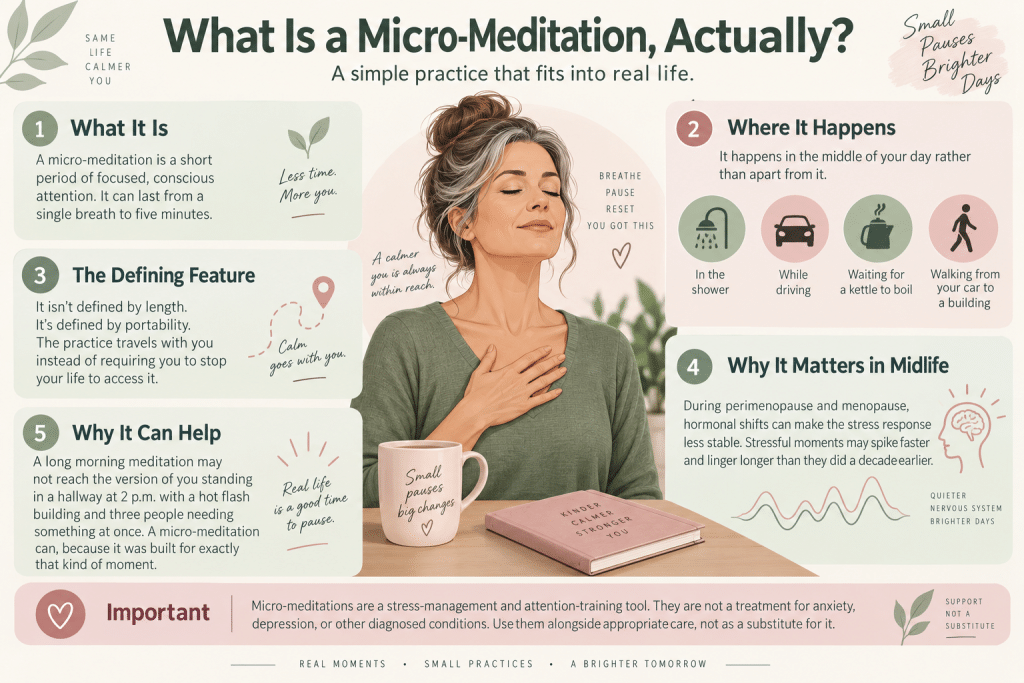
This matters more in midlife than most meditation content acknowledges. Hormonal shifts during perimenopause and menopause are associated with a measurably less stable stress response, meaning a stressful moment can spike and linger longer than it did a decade earlier.
A single long morning session, however good, doesn’t reach the version of you standing in a hallway at 2 p.m. with a hot flash building and three people needing something from you at once. A micro-meditation can, because it was built to live inside exactly that kind of moment.
Important: Micro-meditations are a stress-management and attention-training tool, not a treatment for anxiety, depression, or other diagnosed conditions. Use them alongside appropriate care, not as a substitute for it.
“I hear the same story from almost every woman I coach: she tried meditation, it didn’t stick, and she decided she’s ‘just not someone who can meditate.’ What actually happened is she was handed a format that assumes a spacious, uninterrupted life. Give her a version that fits into the fifteen seconds she has between hanging up one call and starting the next, and something completely different happens.”
Terry Tateossian, Founder of The House of Rose
Why Do Short, Cue-Triggered Practices Stick Better?
There’s a real behavioral science reason micro-meditations tend to outlast the thirty-minutes-a-day resolution, and it has nothing to do with willpower.
Habits form most reliably when a specific, existing cue in your environment gets linked to a specific, small response, a principle behavior researcher BJ Fogg built an entire habit-design method around: attach the new behavior to something you already do every day, and make the new behavior small enough that it doesn’t require motivation to execute.
A widely cited 2010 study on habit formation found that behaviors performed consistently in response to a stable daily cue became automatic, meaning they stopped requiring conscious effort, in an average of about 66 days, though the range across participants and behaviors was wide, from 18 days for simpler habits to well over 200 for more complex ones. The mechanism that made the difference wasn’t intensity. It was consistency tied to a reliable trigger.
That’s the exact structure a micro-meditation practice uses. Instead of relying on remembering to carve out thirty free minutes, a specific daily moment you already experience, your first sip of coffee, the walk from your car, the sound of your phone unlocking, becomes the cue, and a ten-second pause becomes the response. Over weeks, the pause stops requiring a decision. It becomes part of what that moment already means to you.
Longer seated practice can help build the same attentional skills through sustained stillness, which the neuroscience of meditation helps explain in more depth. Here, the focus is on carrying that quality of attention into everyday life, especially when your surroundings, schedule, and responsibilities refuse to stay still.
$200 Off All 2027 Early Bird Discount
Settle the mind, restore the body & soul back to health. Our deeply restorative 5-day retreat is for midlife women 40+ who are ready to receive abundance, feel rested, strong, clear & back in alignment with their intentions.
What Are Some Micro-Meditations for Your Morning?
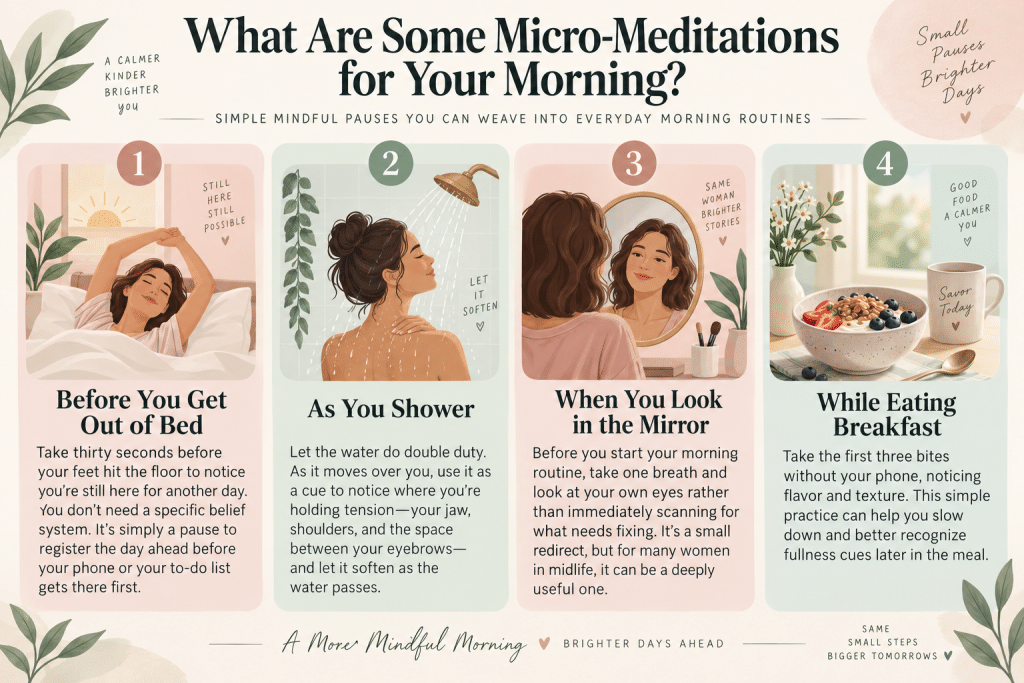
- Before you get out of bed: Take thirty seconds before your feet hit the floor to notice you’re still here for another day. You don’t need a specific belief system for this one. It’s simply a pause to register the day ahead before your phone or your to-do list gets there first.
- As you shower: Let the water do double duty. As it moves over you, use it as a physical cue to notice where you’re holding tension, jaw, shoulders, the space between your eyebrows, and let it soften as the water passes. This takes the same amount of time as an ordinary shower; it just adds a layer of attention to something you were doing anyway.
- When you look in the mirror: Before you start your morning routine, take one breath and look at your own eyes rather than immediately scanning for what needs fixing. It’s a small redirect, and for many women in midlife, whose relationship with the mirror has gotten complicated, an actually useful one.
- While eating breakfast: Take the first three bites without your phone, noticing flavor and texture specifically. This one has a practical bonus beyond the meditative value: eating the first portion of a meal with attention is associated with better recognition of fullness cues later in the meal.
What Are Some Micro-Meditations for Work and Transitions?
- Before answering the phone or starting a call: Take one breath before you say hello. It costs you less than two seconds and it changes the tone you lead with, especially on a day that’s already stacked with back-to-back calls.
- As you start your car: Before you pull out of the driveway, take one breath and set an intention for how you want to show up in whatever is next, rather than immediately replaying whatever just happened.
- When you sit down to start work: Take a moment to notice your posture and your breath before opening your first email or message. This is the moment most likely to get skipped entirely, which makes it one of the more valuable ones to anchor deliberately.
- Between meetings or appointments: Use the gap, even sixty seconds, as a hard reset rather than an extension of the last conversation or a preview of the next one. Close your eyes if you can, take three slow breaths, and let your shoulders drop before you move to whatever’s next.
$200 Off All 2027 Early Bird Discount
Settle the mind, restore the body & soul back to health. Our deeply restorative 5-day retreat is for midlife women 40+ who are ready to receive abundance, feel rested, strong, clear & back in alignment with their intentions.
What Are Some Micro-Meditations for Movement and the Body?
- During a workout: Let a few minutes of your session become moving meditation. Notice that your legs are moving, your lungs are expanding, and your heart is working, largely without your conscious direction, the same way digestion happens without you managing it. You don’t have to control the process to benefit from paying attention to it.
- After a workout: Before you rush to the next task, take sixty seconds to simply sit in what your body just did, rather than immediately moving into recovery logistics or the rest of your to-do list.
- When you get home: Before you walk through the door into whatever’s waiting, whether it’s kids, a partner, or an empty house that has its own demands, take thirty seconds in the car or on the porch to arrive fully in your body before you arrive in the house.
What Are Some Micro-Meditations for Hard Emotions?
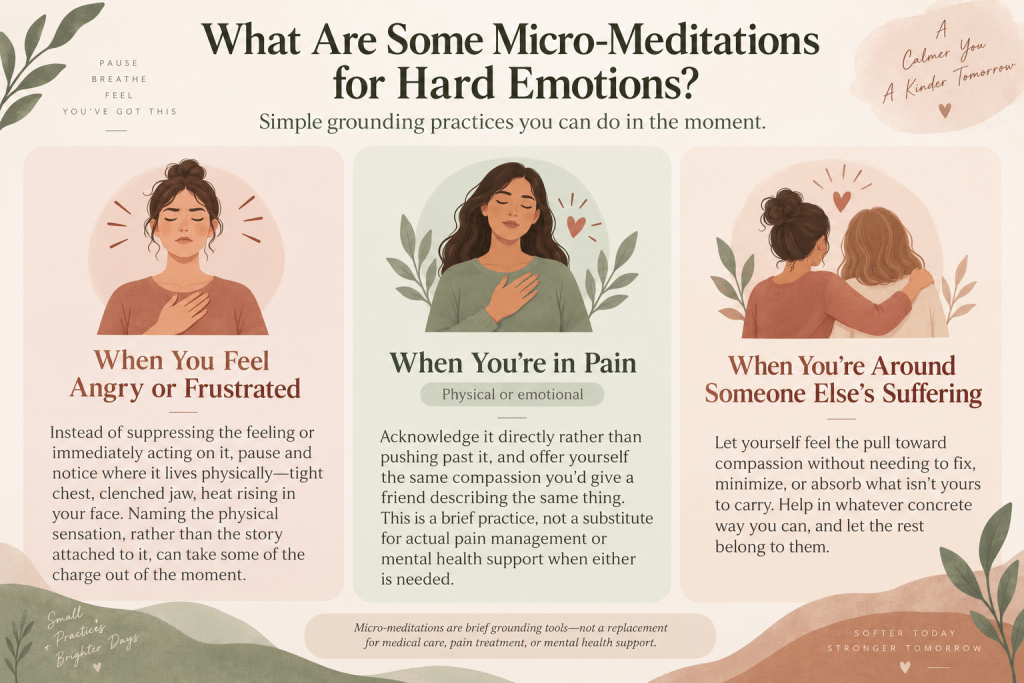
- When you feel angry or frustrated: Instead of suppressing the feeling or immediately acting on it, pause and notice where it lives physically, a tight chest, a clenched jaw, heat rising in your face. Naming the physical sensation, rather than the story attached to it, tends to take some of the charge out of the moment.
- When you’re in pain, physical or emotional: Acknowledge it directly rather than pushing past it, and extend yourself the same compassion you’d offer a friend describing the same thing. This is a brief practice, not a substitute for actual pain management or mental health support when either is needed.
- When you’re around someone else’s suffering: Let yourself feel the pull toward compassion without needing to fix, minimize, or absorb what isn’t yours to carry. Help in whatever concrete way you’re able to, and let the rest be theirs.
$200 Off All 2027 Early Bird Discount
Settle the mind, restore the body & soul back to health. Our deeply restorative 5-day retreat is for midlife women 40+ who are ready to receive abundance, feel rested, strong, clear & back in alignment with their intentions.
What Are Some Micro-Meditations for Connection and Evening?
- When hugging someone you love: Stay in the hug two seconds longer than usual, and actually notice that you’re there, rather than already mentally moving to the next thing.
- When watching a sunset, or any view that stops you: Let yourself take it in without reaching for your phone to photograph it first. The moment is available to you directly; the photo is a record of it after the fact.
- When lying down to sleep: Take a moment to register the day that just happened, without reviewing every item on the to-do list you didn’t finish. One thing that went right is enough.
How Can You Build Triggers So You Remember?
The single biggest obstacle to this practice isn’t the practice itself. It’s forgetting. A full day can pass before you notice you haven’t taken one conscious breath, and that’s not a personal failing, it’s what happens by default in an environment designed to keep your attention elsewhere.
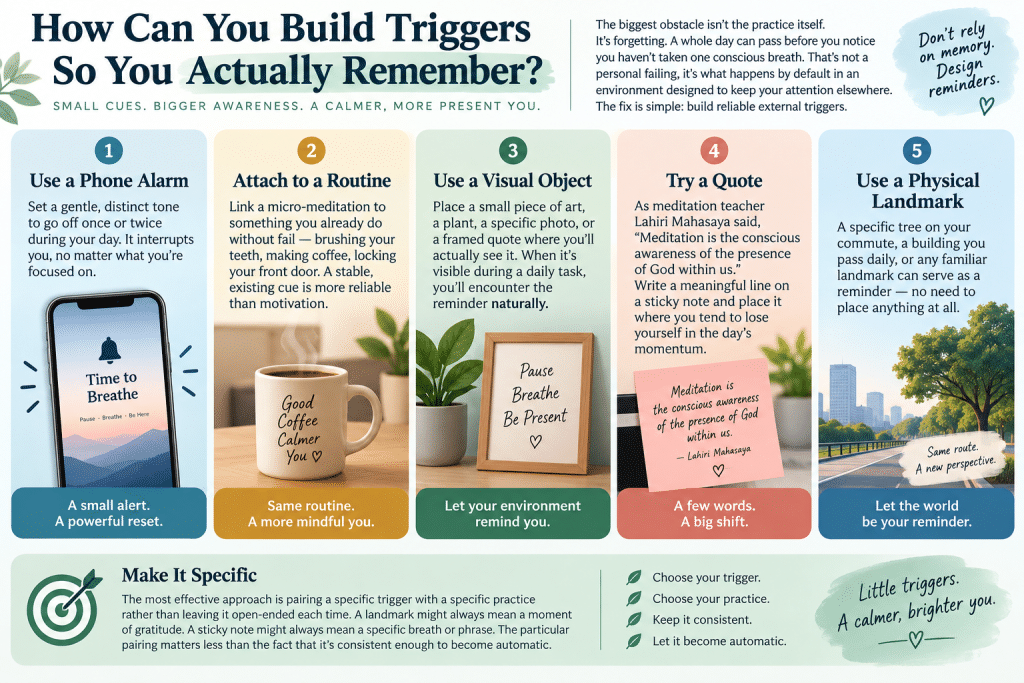
The fix is building reliable external triggers rather than relying on remembering. A phone alarm with a distinct, calming tone set to go off once or twice during your day works well because it interrupts you regardless of what you’re focused on. Attaching a micro-meditation to a routine you already do without fail, brushing your teeth, making coffee, locking your front door, works for the same reason the 2010 habit research pointed to: a stable, existing cue is more reliable than motivation.
A visual object placed somewhere you’ll actually see it, a small piece of art, a plant, a specific photo, a framed quote, can work as well; keeping one where it’s visible during a task you do daily means you’ll encounter the reminder without having to remember to look for it.
As the meditation teacher Lahiri Mahasaya put it, “Meditation is the conscious awareness of the presence of God within us,” a line worth writing on a sticky note near wherever you tend to lose yourself in the day’s momentum, whatever word you’d use in place of God. A physical landmark on a regular route, a specific tree on your commute, a building you pass daily, can serve the same function without you having to place anything at all.
The most effective approach is pairing a specific trigger with a specific practice rather than leaving it open-ended each time. A landmark might always mean a moment of gratitude. A sticky note might always mean a specific breath or phrase. The particular pairing matters less than the fact that it’s consistent enough to become automatic, the same principle that made the habit-formation research findings hold up across such a wide range of behaviors.
$200 Off All 2027 Early Bird Discount
Settle the mind, restore the body & soul back to health. Our deeply restorative 5-day retreat is for midlife women 40+ who are ready to receive abundance, feel rested, strong, clear & back in alignment with their intentions.
What Are Your Next Steps?
- Pick one trigger to start with. Don’t try to install all fourteen examples at once; choose one moment you already experience daily and attach a single micro-meditation to it this week.
- Set one phone reminder. A single daily alarm with a calming tone is enough to start building the habit loop described in Section 2.
- Give it the full runway. Based on the habit-formation research cited above, expect it to take weeks, not days, before the pause starts happening without you deciding to do it.
- Pair it with a longer practice if you want one. Micro-meditations can complement a seated practice by helping you carry mindful attention into the rest of your day, while understanding the neuroscience of meditation can give you more context for what longer periods of stillness add.
- Bring the practice into a retreat setting. THOR’s women’s yoga, hiking & wellness retreats weave guided moments of mindfulness and restorative practice throughout the day, giving you a supportive way to experience cue-based attention before building your own routine at home.
$200 Off All 2027 Early Bird Discount
Settle the mind, restore the body & soul back to health. Our deeply restorative 5-day retreat is for midlife women 40+ who are ready to receive abundance, feel rested, strong, clear & back in alignment with their intentions.
Frequently Asked Questions
What’s the difference between a micro-meditation and regular mindfulness?
Mindfulness is the broader skill of paying attention on purpose; a micro-meditation is one specific, brief way of practicing it, anchored to a particular moment or trigger rather than an open-ended state you try to maintain all day.
How long should a micro-meditation last?
Anywhere from a single breath to about five minutes. The length matters less than the consistency of the trigger you attach it to.
Do I need to sit down or close my eyes?
No. Many of the examples in this guide happen while you’re doing something else entirely, showering, driving, working out. Eyes-closed stillness is one option, not a requirement.
Can micro-meditations replace a longer meditation practice?
Micro-meditations can stand on their own, and for many women they’re the only practice that consistently survives a busy season. They also pair well with longer seated sessions, where the neuroscience of meditation helps explain the additional benefits of sustained attention and stillness beyond what brief pauses can provide.
How do I remember to do this?
Build a trigger rather than relying on memory: a phone alarm, a visual cue placed somewhere you’ll see it, or attaching the practice to a routine you already do without fail. Section 8 covers this in depth.
How long does it take before this becomes a real habit?
Based on habit-formation research, expect an average of around 66 days of consistent practice before it starts happening automatically, though this varies widely by person and by how simple the specific practice is.
Is this connected to any particular religion?
No specific religious belief is required. The language in this guide uses words like Presence or Spirit in places, and you’re welcome to substitute whatever term fits your own framework, including a purely secular one focused on attention and the present moment.
Can micro-meditations help with hot flashes or menopause-related stress spikes?
There’s no research isolating micro-meditations specifically for hot flashes. What’s reasonably well supported is that brief attention and breath practices can help you meet a stress spike, including the kind that can accompany a hot flash, without adding a layer of panic on top of the physical sensation.
What if I try a trigger and it doesn’t work?
Switch it. Not every cue sticks for every person. If a phone alarm gets ignored, try attaching the practice to a physical routine instead, or vice versa.
Can I do this with kids or a busy household around me?
Yes, several of the examples, the shower pause, the pre-call breath, the post-workout moment, work specifically because they don’t require a quiet room or uninterrupted time.
Is a single breath really enough to count as meditation?
A single conscious breath, done with genuine attention, meets the definition used in this guide. Depth of attention matters more than duration.
What if I forget for several days in a row?
Start again without treating the gap as a failure. The habit-formation research this guide draws on is about consistency over time, not an unbroken streak.
Do I need a meditation app or special equipment?
No. Every example in this guide uses something you already have: your breath, an ordinary daily activity, and a trigger you set up yourself.
Can this practice be combined with sound-based practices like a singing bowl?
Yes. A singing bowl or a few minutes of humming can become both the cue and the practice itself, making sound an easy trigger for a brief mindful pause. A simple singing bowl and voice practice can help you turn that idea into a repeatable routine without needing a long meditation session.
I write 3 essays per week on Lifestyle Medicine for women in midlife on what is happening in the body and what to do about it. No fluff, no hype. Free.
References
- Fogg, B.J. (2019). Tiny Habits: The Small Changes That Change Everything. Houghton Mifflin Harcourt.
- Lally, P., van Jaarsveld, C.H.M., Potts, H.W.W., & Wardle, J. (2010). How Are Habits Formed: Modelling Habit Formation in the Real World. European Journal of Social Psychology, 40(6), 998-1009.
- Wood, W., & Neal, D.T. (2007). A New Look at Habits and the Habit-Goal Interface. Psychological Review, 114(4), 843-863.
- Cahn, B.R., & Polich, J. (2006). Meditation States and Traits: EEG, ERP, and Neuroimaging Studies. Psychological Bulletin, 132(2), 180-211.
- Robinson, E., Aveyard, P., Daley, A., et al. (2013). Eating Attentively: A Systematic Review and Meta-Analysis of the Effect of Food Intake Memory and Awareness on Eating. American Journal of Clinical Nutrition, 97(4), 728-742.
- National Center for Complementary and Integrative Health (NCCIH). Meditation and Mindfulness: What You Need to Know.
- Gordon, J.L., Girdler, S.S., Meltzer-Brody, S.E., et al. (2015). Ovarian Hormone Fluctuation, Neurosteroids, and HPA Axis Dysregulation in Perimenopausal Depression. American Journal of Psychiatry, 172(3), 227-236.
- Kabat-Zinn, J. (1994). Wherever You Go, There You Are: Mindfulness Meditation in Everyday Life. Hyperion.
- Jha, A.P., Krompinger, J., & Baime, M.J. (2007). Mindfulness Training Modifies Subsystems of Attention. Cognitive, Affective, & Behavioral Neuroscience, 7(2), 109-119.
- Creswell, J.D. (2017). Mindfulness Interventions. Annual Review of Psychology, 68, 491-516.
- Gardner, B., Lally, P., & Wardle, J. (2012). Making Health Habitual: The Psychology of Habit-Formation and General Practice. British Journal of General Practice, 62(605), 664-666.
- American Psychological Association. Mindfulness Meditation: A Research-Proven Way to Reduce Stress.
Disclaimer: This article is educational and does not constitute medical or mental health advice. Micro-meditations are intended as stress-management and attention-training practices, not as treatment for anxiety, depression, chronic pain, hot flashes, or other diagnosed conditions. Use these practices alongside appropriate professional care when needed, and avoid closing your eyes or doing any exercise that distracts you while driving, operating equipment, or performing activities that require your full attention.
$200 Off All 2027 Early Bird Discount
Settle the mind, restore the body & soul back to health. Our deeply restorative 5-day retreat is for midlife women 40+ who are ready to receive abundance, feel rested, strong, clear & back in alignment with their intentions.

Terry Tateossian is a Menopause Lifestyle Medicine Coach, Certified Personal Trainer & Nutritionist and the Founder of THOR: The House of Rose, a wellness brand serving women over 40 through retreats, coaching, macro-nutrition and community. As 25-year founder and entrepreneur, Terry spent two and a half decades building and running successful start-up businesses, an experience that put her on the front line of founder burnout long before she could name it. After facing serious health challenges, early onset menopause, and emotional eating while running her agency and raising two children, Terry rebuilt her health in her 40s and lost more than 80 pounds through evidence-based nutrition, training, and mindset work. Today, she helps women get strong, improve confidence, support hormone health, and create a stronger second half of life. Terry has been featured in major media outlets and is available for podcasts, expert commentary, brand collaborations, and speaking engagements on midlife health, reinvention, emotional eating, menopause wellness, and strength training for longevity. Get her free macro calculator (her cookbook companion) to start your journey to back to health.