
 By Team THOR
$200 Off All 2027 Early Bird Discount
Settle the mind, restore the body & soul back to health. Our deeply restorative 5-day retreat is for midlife women 40+ who are ready to receive abundance, feel rested, strong, clear & back in alignment with their intentions.
OM and the Bija Mantras: A Beginner’s Guide to Chanting Through the Chakras
OM shows up at the beginning of an enormous number of mantras across yogic, Buddhist, and tantric traditions. Om Mani Padme Hum. Om Namah Shivaya. Om Shanti, Shanti, Shanti. It’s tempting to treat that repetition as decorative, a kind of spiritual throat-clearing before the “real” mantra begins. It isn’t.
OM is built from three distinct sounds that correspond to three different physical resonance points in your own body, which means the sound itself, independent of anything you believe about it, does something measurable and specific when you chant it out loud.
This guide covers what OM is, where the seven bija, or seed, mantras come from, and a simple, accessible practice for chanting through the traditional chakra points, deliberately kept gentle and beginner-appropriate rather than presented as an advanced or intensive technique.
Medical disclaimer: This article is for educational purposes and does not replace medical or mental health care. Chanting practices are a complement to appropriate care, not a substitute for it. If you have epilepsy or a seizure disorder, talk with your provider before starting a new breath or sound practice.
What Is OM: A-U-M?
Written in Sanskrit, OM (sometimes spelled AUM) is a single syllable built from three distinct sounds pronounced in sequence: “ah,” a rounded “oh-oo” made by bringing the lips into an oval shape, and a final nasal “m” or “ng” sound, technically called anusvara. Chanted slowly and out loud, each of those three sounds resonates in a distinctly different part of your body, which you can feel directly rather than needing to take on faith.
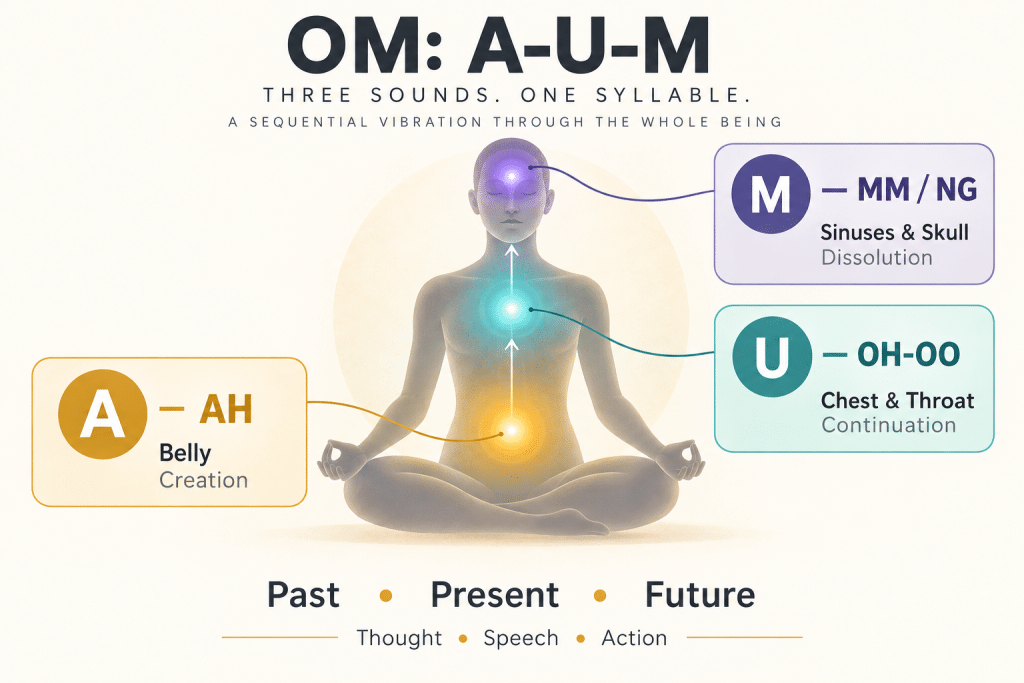
The “ah” sound resonates lowest, around the belly. The “oh-oo” sound moves the resonance up into the chest and throat. The final nasal “m” or “ng” sound pulls the vibration up into the sinuses, the roof of the mouth, and the skull, an effect that’s noticeably stronger when you use the nasal “ng” ending rather than a closed-lip English “m.”
Philosophically, the tradition treats these three sounds as representing a repeating cycle, creation, continuation, and dissolution, and by extension other three-part patterns: past, present, and future; thought, speech, and action. You don’t need to adopt any particular belief about that philosophy for the physical part to be real. The three-sound structure and where each part resonates in your body is simply how the syllable is constructed and pronounced.
$200 Off All 2027 Early Bird Discount
Settle the mind, restore the body & soul back to health. Our deeply restorative 5-day retreat is for midlife women 40+ who are ready to receive abundance, feel rested, strong, clear & back in alignment with their intentions.
What Are Bija Mantras?
Bija means “seed” in Sanskrit, and bija mantras are short, single-syllable sounds traditionally used within chakra and yogic practices.
Common bija mantras include LAM, VAM, RAM, YAM, and HAM. These sounds are often associated with the seven chakras, using the same energy-center framework introduced in singing bowl and voice healing, which includes the full table of chakras and their associated bija sounds.
How Are Bija Mantras Traditionally Used?
Bija mantras are commonly connected with both chakras and specific elemental qualities:
- LAM: Traditionally associated with earth.
- VAM: Traditionally associated with water.
- RAM: Traditionally associated with fire.
- YAM: Traditionally associated with air.
- HAM: Traditionally associated with space.
Traditional texts do not always treat these sounds as belonging exclusively to one chakra. Their elemental associations make the framework more flexible than it is sometimes taught.
This means you can work with a bija mantra when its associated quality feels relevant rather than viewing each sound as permanently locked to one specific location in the body.
Where Should Beginners Start?
For beginners, the simpler and more familiar approach is to use one bija sound with each traditional chakra location.
Following the chakra-and-bija table referenced above provides an easy structure without making the practice unnecessarily complicated. As you become more familiar with the sounds, you can explore their broader elemental associations and use them with greater flexibility.
“I keep this practice simple for the women I coach. You don’t need to master an entire tantric system to get something real out of ten minutes of chanting. Start with one sound, notice what happens in your body, and let that be enough before you go looking for the next layer.”
Terry Tateossian, Founder of The House of Rose
$200 Off All 2027 Early Bird Discount
Settle the mind, restore the body & soul back to health. Our deeply restorative 5-day retreat is for midlife women 40+ who are ready to receive abundance, feel rested, strong, clear & back in alignment with their intentions.
How Can You Practice Simple Chakra Chanting?
This practice is intentionally simple. It’s meant as a gentle introduction, not a comprehensive technical system, and it works whether you’re chanting out loud or silently.
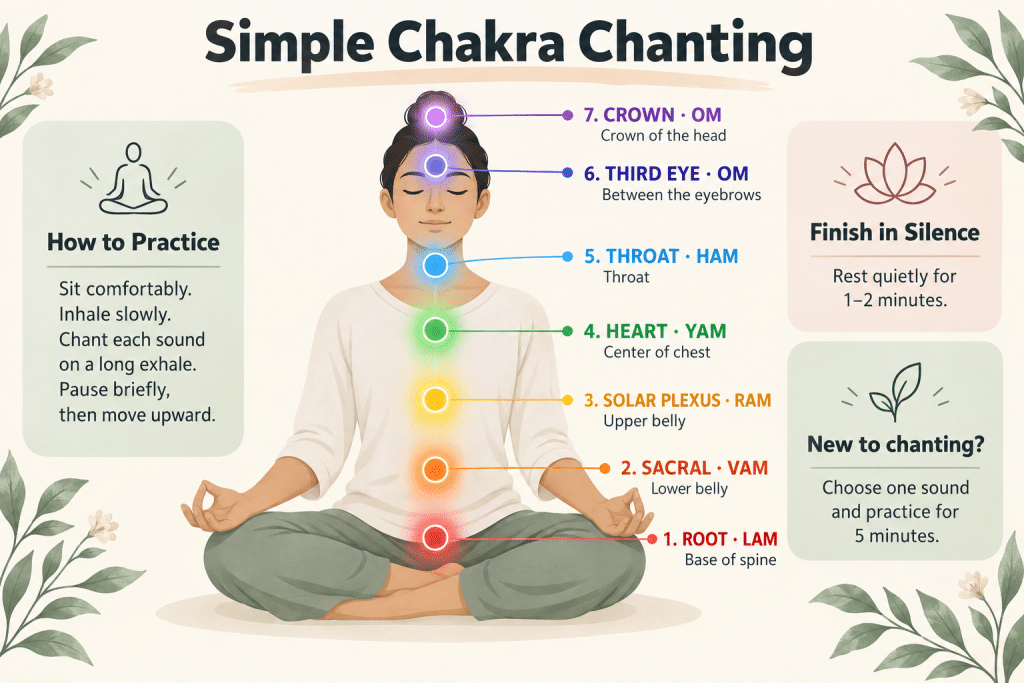
Sit comfortably and take a few slow breaths to settle. Bring your attention to the base of your spine, and on a slow exhale, chant LAM, either out loud or internally, letting the sound last the length of your exhale. Pause briefly in the quiet after the sound fades before moving on. Bring your attention up to your lower belly and chant VAM on the next exhale, then pause again.
Continue this same pattern moving upward: RAM at the upper belly, YAM at the center of your chest, HAM at your throat, and OM at your forehead, between your eyebrows. Finish at the crown of your head with one final OM, then sit in silence for a minute or two before opening your eyes.
If working through all seven points feels like a lot for a first attempt, simplify further: choose just one location and one sound, and spend five minutes chanting that single syllable on each exhale, noticing whatever you notice without needing anything specific to happen. There’s no requirement to feel a dramatic shift for the practice to be worthwhile. A subtler settling, or simply a few minutes of focused attention on your breath and voice, is a complete outcome on its own.
For a more structured practice, combining your voice with a singing bowl can help you work with rhythm, breath, and sound at the same time.
A guided singing bowl and voice practice also shows how the different bija mantras can be paired with the chakras in an easy-to-follow format.
What Does the Research Say About Chanting?
The physiological case for chanting does not depend on the chakra framework. Much of the measurable effect appears to come from what chanting does to the breath, especially the slow, controlled, voiced exhale that naturally happens when you sustain a sound.
What Have Chanting Studies Found?
Two widely cited studies help explain the physiological effects:
- Om Chanting and Brain Activity: A 2011 neuroimaging study had participants chant “Om” during an MRI scan and compared their brain activity with a control sound. During the Om condition, researchers observed reduced activity in brain regions associated with stress and threat responses.
- Slow Breathing and Cardiovascular Regulation: A 2001 study found that both mantra chanting and rosary recitation slowed breathing to a similar rate and improved baroreflex sensitivity, a measure involved in cardiovascular self-regulation.
The common thread was not necessarily the specific word, mantra, or religious tradition. Both practices naturally encouraged slow, rhythmic breathing with a prolonged voiced exhale, one of the key mechanisms behind how sound can influence the nervous system.
Do You Need to Believe in Chakras for Chanting to Work?
That is what makes the research especially useful. You do not need to adopt a particular spiritual belief for the physiological effects of chanting to occur.
Whether or not the chakra framework resonates with you, sustaining a chant naturally slows the breath and lengthens the exhale. That breathing pattern creates measurable effects on the nervous system and helps shift the body toward a calmer, more regulated state.
$200 Off All 2027 Early Bird Discount
Settle the mind, restore the body & soul back to health. Our deeply restorative 5-day retreat is for midlife women 40+ who are ready to receive abundance, feel rested, strong, clear & back in alignment with their intentions.
How Can You Keep the Practice Gentle?
Some traditions teach much more intensive versions of chakra-based chanting and breathwork, often described using language like energy rising, kundalini awakening, or dramatic shifts in consciousness. This guide deliberately does not walk through those more intensive techniques.
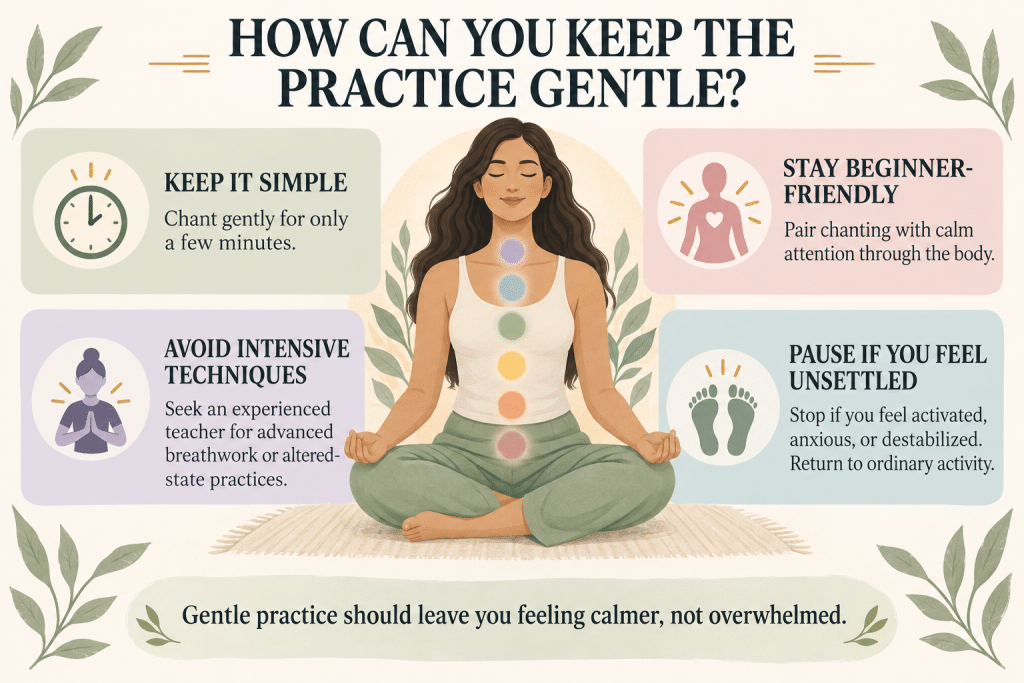
Practices oriented toward inducing strong altered-state experiences are generally taught in person, over time, by an experienced teacher who can respond to what comes up for a specific student, and attempting that kind of intensive practice from a written guide alone is not something THOR recommends.
What’s covered here is a gentle, beginner-level introduction: a few minutes of chanting paired with attention moving through the body, nothing more intensive than that.
If a session ever leaves you feeling unusually activated, anxious, or destabilized rather than calmer, stop the practice and return to ordinary activity; that reaction is uncommon with a gentle practice like this one but worth taking seriously if it happens.
“I’ve watched plenty of well-meaning content online turn a plainly calming practice into something that sounds like it requires a guru and a decade of training. It doesn’t. Chanting one sound for five minutes with your eyes closed is a complete practice. Save the more advanced material for an actual teacher, in person, if you ever want to go further.”
Terry Tateossian, Founder of The House of Rose
What Are Your Next Steps?
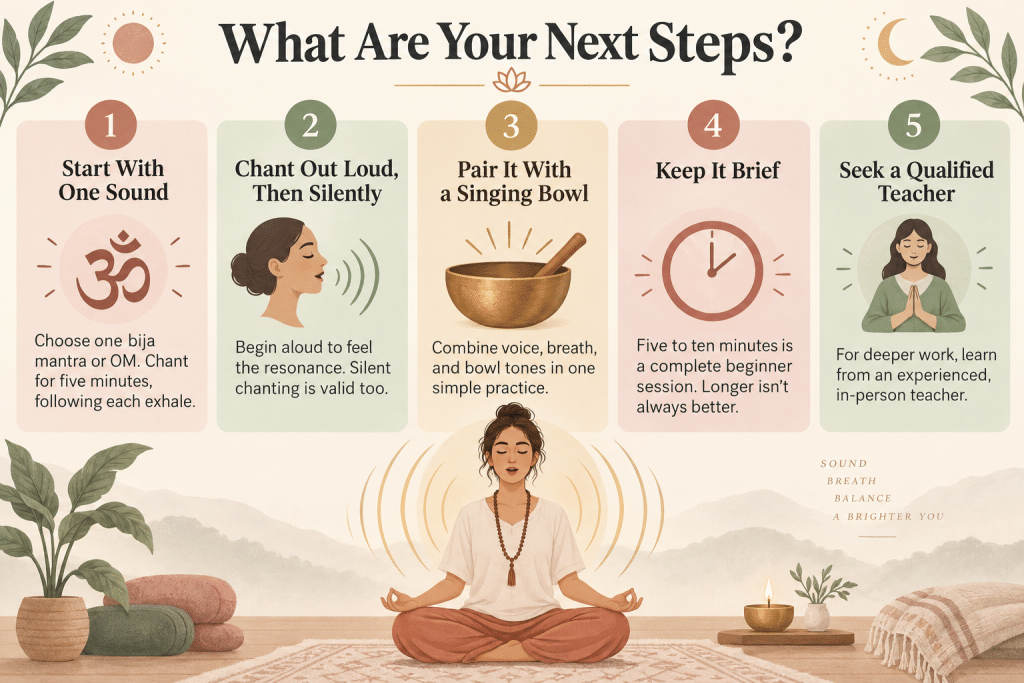
- Start with one sound: Pick a single bija mantra or OM itself and spend five minutes chanting it on each exhale before attempting the full seven-point sequence.
- Chant out loud first, then try it silently: Both are valid; audible chanting makes the physical resonance easier to feel when you’re first learning.
- Pair it with the singing bowl practice: A guided singing bowl and voice routine can help you combine vocalization, breath, and bowl tones in one simple step-by-step practice.
- Keep it brief: Five to ten minutes is a complete session; longer isn’t automatically better, especially when you’re new to the practice.
- Seek a qualified teacher for deeper work: If this practice resonates and you want to go further than what’s covered here, an experienced, in-person teacher is the appropriate next step, not a more intensive written guide.
$200 Off All 2027 Early Bird Discount
Settle the mind, restore the body & soul back to health. Our deeply restorative 5-day retreat is for midlife women 40+ who are ready to receive abundance, feel rested, strong, clear & back in alignment with their intentions.
Frequently Asked Questions
What does OM mean?
OM is a single Sanskrit syllable built from three sounds, “ah,” “oh-oo,” and a nasal “m” or “ng,” traditionally understood to represent a repeating cycle of creation, continuation, and dissolution. Each of the three sounds resonates in a different part of the body when chanted aloud.
What is a bija mantra?
Bija means “seed” in Sanskrit. Bija mantras are short, single-syllable sounds, such as LAM, VAM, RAM, YAM, and HAM, traditionally associated with the chakra system and, more specifically, with the five elements.
Do I have to believe in chakras for this practice to do anything?
No. The breathing mechanism behind chanting, a slow, controlled, voiced exhale, has real research behind it independent of any belief about the chakra framework itself.
How long should a chanting session last?
Five to ten minutes is a complete session, especially for beginners. There’s no requirement to extend the practice to get value from it.
Is it better to chant out loud or silently?
Both are valid. Chanting out loud makes it easier to feel the physical resonance described in Section 1, particularly when you’re first learning. Many people move to a quieter or internal chant once the practice feels familiar.
What if I don’t feel anything during the practice?
That’s a normal outcome, not a sign you’re doing it wrong. A few minutes of focused attention on your breath and voice is a complete result on its own, with or without a dramatic sensation.
Is this the same as kundalini yoga?
No. Kundalini-oriented practices are generally more intensive, often involve specific breathwork and are taught in person over time by an experienced teacher. This guide is a gentle, beginner-level introduction and doesn’t cover that more intensive territory.
Can chanting help with stress specifically?
The slow, controlled exhale involved in chanting is associated with a shift toward parasympathetic nervous system activity, the general mechanism behind stress-reduction benefits from many breath-based practices.
What’s the difference between this and the singing bowl practice on your site?
If you want to combine chanting with an external sound, a singing bowl and voice practice can add another layer of rhythm and resonance. This guide keeps the focus on chanting by itself, so you can practice without any equipment.
Should I feel the sound in a specific place in my body?
For OM specifically, yes, the three-part sound structure described in Section 1 does produce noticeably different resonance locations. For the bija mantras, sensations vary by person, and there’s no single correct experience to aim for.
Can I make up my own sound instead of using a traditional bija mantra?
The traditional sounds are the focus here, but a simple sustained hum can create a similar slow-exhale pattern if your main goal is the breathing response. That same sound-based nervous system mechanism helps explain why humming can feel calming even without using a specific mantra.
Is there a wrong way to pronounce these mantras?
Approximate pronunciation is fine for this level of practice. The phonetic guidance in this guide (for example, the “a” in the bija mantras sounding closer to the “u” in “rum”) is a reasonable starting point.
What if I want to go deeper into this practice than what’s covered here?
Seek an experienced, in-person teacher. More intensive chakra and breathwork techniques are generally taught individually, over time, with someone who can respond to your specific experience, which isn’t something a written guide can safely replicate.
I write 3 essays per week on Lifestyle Medicine for women in midlife on what is happening in the body and what to do about it. No fluff, no hype. Free.
References
- Kalyani, B.G., Venkatasubramanian, G., Arasappa, R., et al. (2011). Neurohemodynamic Correlates of ‘OM’ Chanting: A Pilot Functional Magnetic Resonance Imaging Study. International Journal of Yoga, 4(1), 3-6.
- Bernardi, L., Sleight, P., Bandinelli, G., et al. (2001). Effect of Rosary Prayer and Yoga Mantras on Autonomic Cardiovascular Rhythms: Comparative Study. BMJ, 323(7327), 1446-1449.
- Gerritsen, R.J.S., & Band, G.P.H. (2018). Breath of Life: The Respiratory Vagal Stimulation Model of Contemplative Activity. Frontiers in Human Neuroscience, 12, 397.
- Telles, S., Nagarathna, R., & Nagendra, H.R. (1995). Autonomic Changes During “OM” Meditation. Indian Journal of Physiology and Pharmacology, 39(4), 418-420.
- Streeter, C.C., Gerbarg, P.L., Saper, R.B., Ciraulo, D.A., & Brown, R.P. (2012). Effects of Yoga on the Autonomic Nervous System, Gamma-Aminobutyric-Acid, and Allostasis in Epilepsy, Depression, and Post-Traumatic Stress Disorder. Medical Hypotheses, 78(5), 571-579.
- National Center for Complementary and Integrative Health (NCCIH). Meditation and Mindfulness: What You Need to Know.
- Perciavalle, V., Blandini, M., Fecarotta, P., et al. (2017). The Role of Deep Breathing on Stress. Neurological Sciences, 38(3), 451-458.
Disclaimer: This article is educational and does not constitute medical or mental health advice. Chanting, breathwork, and chakra-based practices should complement appropriate care rather than replace it. If you have epilepsy, a seizure disorder, significant respiratory concerns, or experience unusual anxiety, dizziness, or distress during practice, stop and consult a qualified healthcare provider before continuing.
$200 Off All 2027 Early Bird Discount
Settle the mind, restore the body & soul back to health. Our deeply restorative 5-day retreat is for midlife women 40+ who are ready to receive abundance, feel rested, strong, clear & back in alignment with their intentions.

Terry Tateossian is a Menopause Lifestyle Medicine Coach, Certified Personal Trainer & Nutritionist and the Founder of THOR: The House of Rose, a wellness brand serving women over 40 through retreats, coaching, macro-nutrition and community. As 25-year founder and entrepreneur, Terry spent two and a half decades building and running successful start-up businesses, an experience that put her on the front line of founder burnout long before she could name it. After facing serious health challenges, early onset menopause, and emotional eating while running her agency and raising two children, Terry rebuilt her health in her 40s and lost more than 80 pounds through evidence-based nutrition, training, and mindset work. Today, she helps women get strong, improve confidence, support hormone health, and create a stronger second half of life. Terry has been featured in major media outlets and is available for podcasts, expert commentary, brand collaborations, and speaking engagements on midlife health, reinvention, emotional eating, menopause wellness, and strength training for longevity. Get her free macro calculator (her cookbook companion) to start your journey to back to health.