
 By Team THOR
Free 28-Day Fascia Reset Email Course
Get our Free 28-day email course series to help with 1 or 2 exercises per day to release your fascia. One short lesson per day. Two minutes to read each.
Why Your Muscles Start Shaking During Isometric Holds (And What TRE Does With It)
During a chair-based strength session at one of our yoga retreats, a guest stopped mid-wall-sit and asked, half laughing, half concerned, whether her legs shaking meant she was doing something wrong. She wasn’t.
Her legs were shaking because her muscles were working exactly the way they’re supposed to under that kind of sustained load, and by the end of that same retreat week, after we’d introduced a floor-based practice built specifically around that tremor response, several guests were asking a different question: why does deliberately letting the body shake like that feel so noticeably calming afterward?
That second question points to something worth understanding properly, both the ordinary physiology behind why isometric holds make muscles shake, and a specific practice, called Tension and Trauma Releasing Exercises, or TRE, that deliberately works with that same tremor mechanism.
The two are related but not identical, and separating the well-established science from the parts that are still truly unproven matters, especially for a topic that touches the nervous system.
Important: This article is educational and does not replace individualized medical or mental health care. Women with a significant trauma history, PTSD, dissociative symptoms, or other psychiatric conditions should work with a qualified, trauma-informed practitioner before using TRE as a self-directed practice, not attempt it alone based on this article.
Why Do Isometric Holds Make Your Muscles Shake?
Isometric exercise, holding a muscle under tension without changing its length, like a wall sit, a plank, or a long yoga hold, reliably produces trembling as the hold continues. This is well-understood exercise physiology, not a sign of weakness or malfunction.
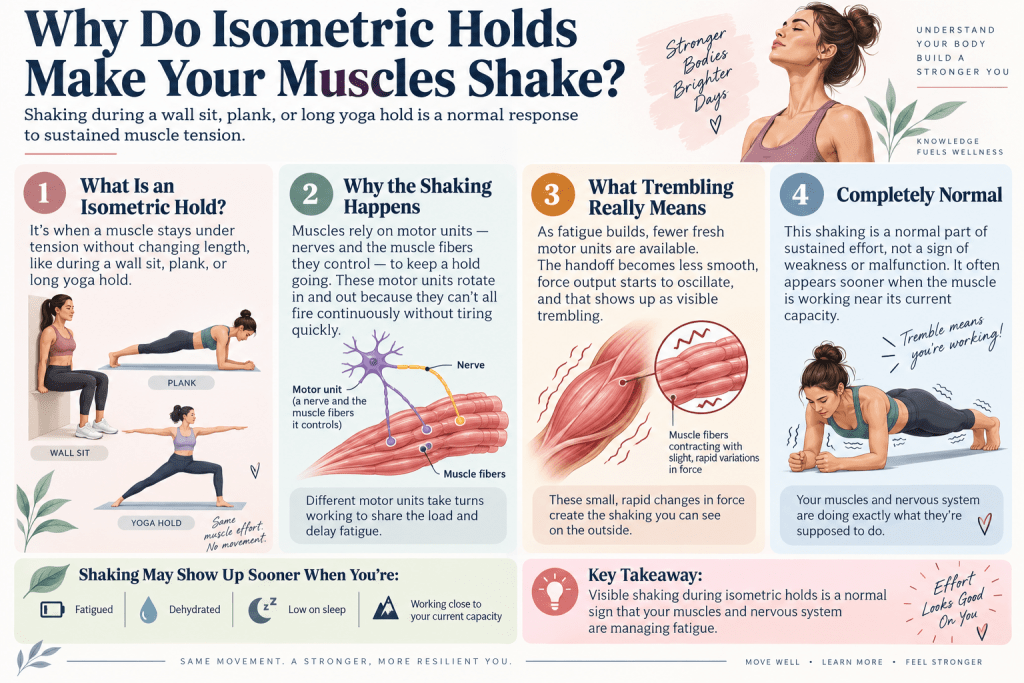
When a muscle holds a sustained contraction, the individual motor units (a nerve and the muscle fibers it controls) can’t all fire continuously without fatiguing quickly. Instead, the nervous system rotates the workload, cycling different motor units in and out of activity to keep the overall contraction going.
As fatigue builds and fewer fresh motor units remain available, that handoff becomes less smooth, and the muscle’s force output starts to oscillate rather than stay steady. That oscillation is what shows up as visible trembling.
This is a completely normal part of how muscles manage sustained effort, and it tends to show up sooner in muscles that are working close to their current capacity, which is part of why a wall sit that felt easy last month might produce noticeable shaking today if fatigue, dehydration, or reduced sleep have lowered available capacity.
Important: Ordinary exercise-induced trembling during or shortly after a hold is expected and not a cause for concern. Persistent tremor unrelated to recent exertion, or tremor accompanied by weakness, numbness, or coordination changes, is a different matter and warrants medical evaluation, covered further in Section 6.
Free 28-Day Fascia Reset Email Course
Get our Free 28-day email course series to help with 1 or 2 exercises per day to release your fascia. One short lesson per day. Two minutes to read each.
What Does TRE Add on Top of That?
TRE, developed by Dr. David Berceli, takes that same underlying tremor mechanism and works with it deliberately rather than treating it as an incidental side effect of exercise.
The practice involves a short sequence of positions, including a wall sit among them, designed to fatigue specific muscle groups, particularly the hip flexors and the muscles surrounding the pelvis, until a spontaneous, fine trembling begins and is allowed to continue for a period of time while lying down, rather than being stopped as soon as the exercise portion ends.
The premise behind TRE is that many mammals visibly shake or tremble after a stressful or threatening event, a pattern often observed in animals returning to a calm state after a startle response, and that humans have largely learned to suppress this same reflex through social conditioning.
TRE is built on the idea that deliberately allowing this tremor response to occur, in a safe, controlled setting, may help the body settle out of a heightened stress state.
“I’ve watched this exact pattern play out at retreats more than once. A guest does a truly challenging hold, hips shaking, clearly fatigued, and instead of immediately standing up and shaking it off with a laugh the way most of us do out of habit, we let them stay with it for a minute longer. Almost every time, they come out of that noticeably calmer than when they went in. I can’t tell you the full mechanism behind that, but I’ve seen the pattern often enough to take it seriously.”
Terry Tateossian, Founder of The House of Rose
What Is the Proposed Mechanism Behind Neurogenic Tremor and the Nervous System?
The specific type of trembling TRE aims to produce is sometimes referred to as neurogenic tremor, a fine, involuntary tremor originating from the nervous system’s own regulatory activity rather than simple muscular fatigue alone.
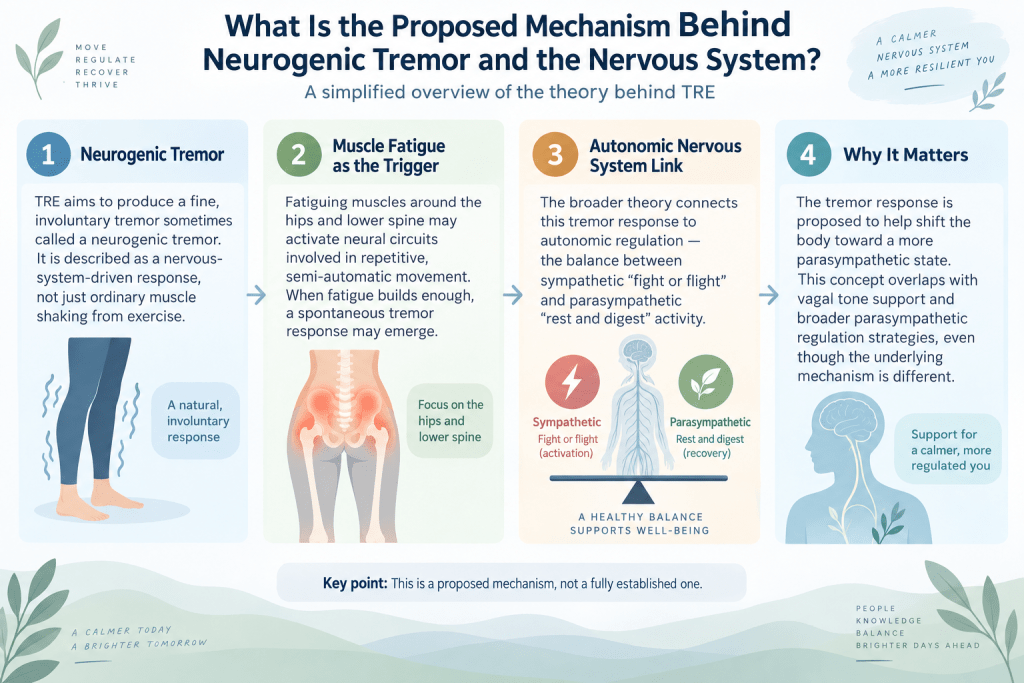
The proposed mechanism is that fatiguing certain muscle groups, particularly around the hips and lower spine, activates neural circuits involved in generating repetitive, semi-automatic movement patterns, and that this activation can extend into a spontaneous tremor response once the muscle is sufficiently fatigued.
The broader theory connects this tremor response to autonomic nervous system regulation, specifically the balance between sympathetic (“fight or flight”) and parasympathetic (“rest and digest”) activity.
The idea is that the tremor response may help shift the nervous system toward a more parasympathetic state. This overlaps conceptually with practices that support vagal tone and broader strategies for strengthening parasympathetic regulation, even though the underlying mechanism is different.
Important: This mechanism, while biologically plausible and consistent with some established principles of stress physiology, has not been definitively confirmed through the same volume or rigor of research as more established nervous-system practices like breathwork or meditation. It should be understood as a reasonable working theory, not settled science.
Free 28-Day Fascia Reset Email Course
Get our Free 28-day email course series to help with 1 or 2 exercises per day to release your fascia. One short lesson per day. Two minutes to read each.
What Do the Actual Exercises Involve?
TRE sessions typically begin with a short series of positions intended to progressively fatigue the hip flexors, inner thighs, and surrounding muscles.
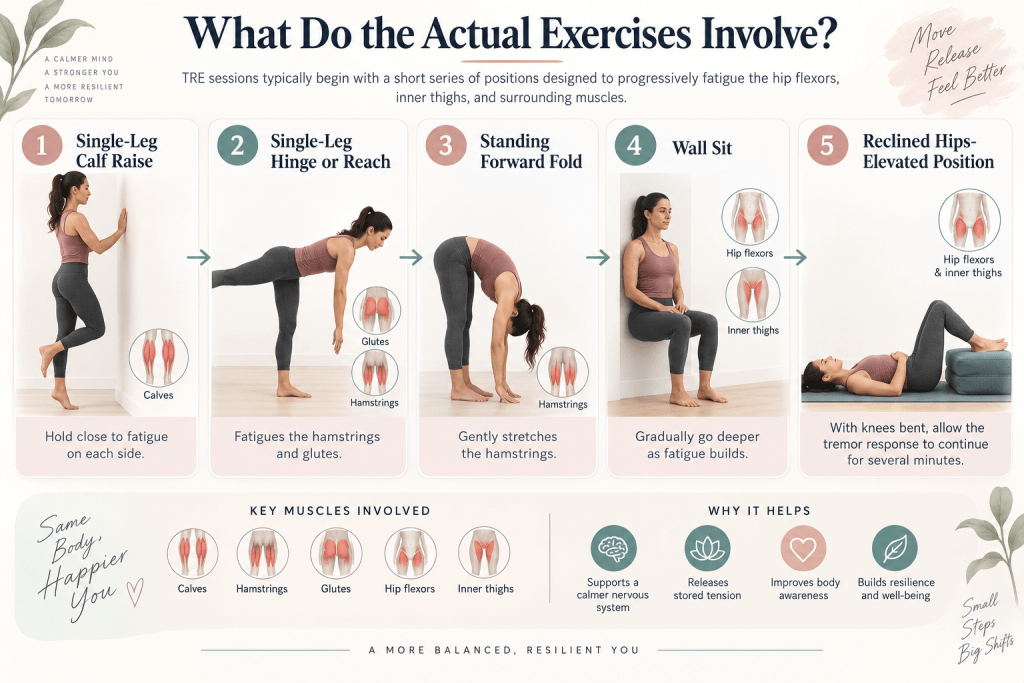
A typical sequence includes:
- A single-leg calf raise held close to fatigue, on each side.
- A single-leg hinge or reach position that fatigues the hamstrings and glutes.
- A standing forward-fold or hamstring stretch.
- A wall sit, gradually adjusted deeper as fatigue builds.
- A final reclined position with the hips elevated and knees bent, where the tremor response, once triggered, is allowed to continue for several minutes.
The tremor itself, when it begins, is usually described as a fine trembling, most often starting in the legs and hips, rather than a large or dramatic movement. Sessions are typically kept short for beginners, in the range of a few minutes, with the length increased gradually over weeks as tolerance and familiarity build.
A quick shake of the arms or legs after a tough set is a brief, voluntary movement most people do instinctively. TRE is a more sustained, deliberately extended version of the body’s own tremor response, held for minutes rather than seconds, which is part of why it’s approached as its own structured practice rather than something to casually add to the end of a workout without guidance.
What Does the Evidence Actually Show?
Research specifically on TRE remains limited and preliminary compared to more established mind-body practices. A small number of published pilot studies have examined TRE’s effects on measures like perceived stress and self-reported anxiety in specific populations, with some reporting modest improvements, but sample sizes in this research have generally been small, and independent replication remains limited.
It’s worth being direct about what this means in practice: TRE has a plausible physiological rationale and growing practitioner interest, but its evidence base is still much smaller than that of more established practices such as structured breathwork and mindfulness meditation, which have been studied more extensively across stress regulation, attention, and nervous system function.
Claims connecting TRE to resolution of specific medical conditions should be treated as anecdotal rather than established, since they haven’t been confirmed through controlled research.
Important: TRE is not a substitute for evidence-based treatment of diagnosed anxiety, depression, PTSD, or other psychiatric conditions. It may be a reasonable complementary practice for some people, ideally alongside, not instead of, appropriate professional care.
Free 28-Day Fascia Reset Email Course
Get our Free 28-day email course series to help with 1 or 2 exercises per day to release your fascia. One short lesson per day. Two minutes to read each.
How Do Normal Exercise Tremor, TRE, and Warning Signs Differ?
It’s worth clearly distinguishing three different things that can all look similar from the outside.
| Type | What It Looks Like | What It Means |
|---|---|---|
| Ordinary exercise fatigue tremor | Shaking during or right after a hold, subsides within minutes | Normal motor unit fatigue, not a concern |
| TRE neurogenic tremor | Fine trembling triggered deliberately, continues for minutes in a reclined position | Proposed nervous system response, generally considered safe for most people |
| Concerning tremor | Shaking unrelated to recent exertion, or with weakness, numbness, slurred speech, or coordination loss | Warrants prompt medical evaluation |
Important: Any tremor accompanied by weakness, numbness, difficulty speaking, vision changes, or loss of coordination is a medical concern requiring prompt evaluation and is not something to address through TRE or any self-directed exercise practice.
Who Should Work With a Practitioner First?
TRE’s developer and experienced practitioners consistently recommend working with a trained, trauma-informed practitioner rather than starting alone for anyone who identifies as carrying significant unresolved trauma.
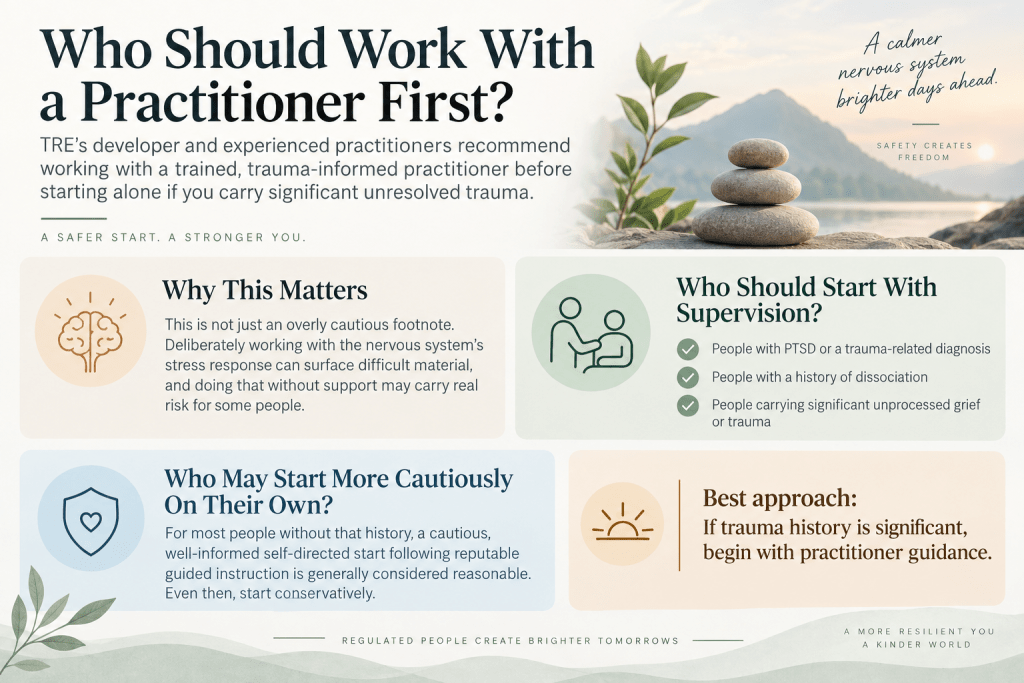
This isn’t an overly cautious footnote, it reflects a real consideration: deliberately working with the nervous system’s stress response can surface difficult material, and doing that without support carries real risk for some people.
Reasonable candidates for a supervised, practitioner-guided introduction rather than a self-directed start include anyone with PTSD or a trauma-related diagnosis, a history of dissociation, or significant unprocessed grief or trauma.
For most people without that history, a cautious, well-informed self-directed start following reputable guided instruction is generally considered reasonable, though starting conservatively is still the right approach.
Free 28-Day Fascia Reset Email Course
Get our Free 28-day email course series to help with 1 or 2 exercises per day to release your fascia. One short lesson per day. Two minutes to read each.
How Can You Try It Safely?
Start with short sessions, a few minutes at most, and stop if anything feels overwhelming rather than simply uncomfortable. There’s a meaningful difference between physical fatigue discomfort and genuine emotional distress, and the second is a reason to pause and seek guidance, not push through.
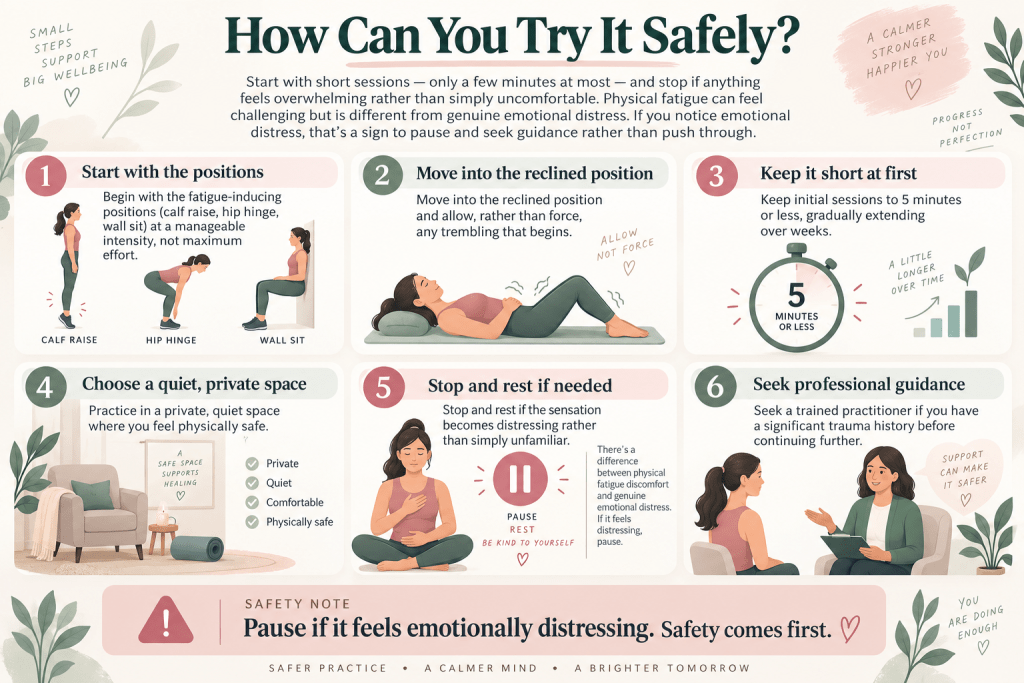
- Begin with the fatigue-inducing positions (calf raise, hip hinge, wall sit) at a manageable intensity, not maximum effort.
- Move into the reclined position and allow, rather than force, any trembling that begins.
- Keep initial sessions to 5 minutes or less, gradually extending over weeks.
- Practice in a private, quiet space where you feel physically safe.
- Stop and rest if the sensation becomes distressing rather than simply unfamiliar.
- Seek a trained practitioner if you have a significant trauma history before continuing further.
Your Next Steps
- If you’re simply curious about the physiology, notice the trembling during your next wall sit or long isometric hold and recognize it as a normal response to muscular fatigue rather than something that automatically signals a problem.
- If you want to explore TRE specifically, start with short, conservative sessions and reputable guided instruction so you can become familiar with the response gradually.
- If you have a significant trauma history or feel easily overwhelmed by body-based practices, consider working with a trained, trauma-informed practitioner rather than experimenting on your own.
- Broaden the nervous system side of the practice with simple vagus nerve exercises that support relaxation and parasympathetic activity through breathing and other calming inputs.
- Support the muscular demands of isometric training by using the free macro calculator to estimate calorie and protein targets that better match your activity level and training goals.
For a more immersive introduction to body-based nervous system support, THOR’s women’s yoga, hiking & wellness retreats combine guided movement, restorative practices, and nervous system regulation in a structured in-person setting.
Important: This article is educational and does not replace individualized medical or mental health care. Please consult a physician or a trauma-informed practitioner before starting TRE if you have a significant trauma history, a psychiatric diagnosis, or any concerns about how your body might respond.
Free 28-Day Fascia Reset Email Course
Get our Free 28-day email course series to help with 1 or 2 exercises per day to release your fascia. One short lesson per day. Two minutes to read each.
Frequently Asked Questions
Is the shaking during TRE the same as shaking from a hard workout?
They share the same underlying fatigue-related tremor mechanism, but TRE deliberately extends and works with that tremor in a reclined position rather than treating it as an incidental side effect of exercise.
Is TRE scientifically proven?
The evidence base is preliminary. Small pilot studies suggest possible benefits for perceived stress, but the research volume and rigor don’t yet match more established practices like meditation or structured breathwork.
Can TRE cure anxiety, IBS, or autoimmune conditions?
No condition-specific cure has been established through controlled research. Anecdotal reports describing a wide range of effects exist, but they should be treated as unverified individual experiences, not established outcomes.
Is it normal for the tremor to feel strange or unfamiliar at first?
Yes. Most people aren’t used to consciously allowing this kind of movement, since social conditioning generally teaches suppression of visible trembling, so it commonly feels unusual before it feels familiar.
How long should a beginner TRE session last?
A few minutes is a reasonable starting point, with gradual increases over several weeks as familiarity builds, rather than starting with a long session.
Should I do TRE if I have a significant trauma history?
Work with a trained, trauma-informed practitioner rather than starting alone. This is a widely echoed recommendation among TRE practitioners and a reasonable safety precaution.
Can TRE replace therapy or psychiatric treatment?
No. It may be a reasonable complementary practice for some people but should not replace evidence-based treatment for diagnosed mental health conditions.
Why do my legs specifically shake more than other muscle groups during isometric holds?
The hip flexors and leg muscles are large, heavily used, and frequently fatigued muscle groups in everyday movement, which is part of why they’re a common site for both ordinary exercise tremor and the tremor response TRE aims to trigger.
Is shaking during a wall sit a sign I’m not strong enough?
No. Trembling during a challenging isometric hold reflects normal motor unit fatigue and is expected as the hold approaches your current capacity, not a sign of inadequate strength.
Does TRE require any equipment?
No. The exercises use bodyweight and a wall for the wall-sit position, along with a mat or comfortable floor surface for the reclined portion.
How often can TRE be practiced?
Many practitioners suggest starting with a few sessions per week and adjusting frequency based on how the body responds, since individual tolerance varies.
Can men and women both practice TRE, or is it different by sex?
The practice itself isn’t sex-specific, though hormonal factors during perimenopause and menopause may influence baseline nervous system reactivity, which is part of why starting conservatively is a reasonable approach for women navigating this transition.
What if nothing happens during my first session?
This is common and doesn’t mean the practice isn’t working. Response varies significantly between individuals and even between sessions for the same person.
Is TRE the same thing as somatic experiencing or other trauma-focused body therapies?
They share some conceptual overlap (working with the body’s stress response rather than only the mind) but are distinct approaches with different specific techniques and training requirements.
I write 3 essays per week on Lifestyle Medicine for women in midlife on what is happening in the body and what to do about it. No fluff, no hype. Free.
References
- Berceli, D. The Revolutionary Trauma Release Process: Transcend Your Toughest Times. Namaste Publishing (foundational TRE methodology text).
- Berceli, D., Salmon, M., Bonifas, R., & Ndefo, N. (2014). Effects of self-induced unclassified therapeutic tremors on quality of life among non-professional caregivers: a pilot study. Global Advances in Health and Medicine, 3(5), 45-48.
- Enders, G. Clinical overview of neurogenic and physiological tremor classification. Movement disorder reference literature.
- National Institute of Neurological Disorders and Stroke. Patient education materials on tremor types and when to seek evaluation.
- Porges, S. W. Polyvagal theory and autonomic nervous system regulation, foundational stress physiology framework.
- American College of Sports Medicine position materials on motor unit recruitment and fatigue during isometric exercise.
Disclaimer: This article is educational and does not constitute medical or mental health advice. Tension and Trauma Releasing Exercises (TRE) intentionally work with the body’s tremor response and may not be appropriate for everyone. If you have PTSD, significant unresolved trauma, dissociative symptoms, a psychiatric condition, or concerns about how your nervous system may respond, consult a qualified trauma-informed practitioner or healthcare provider before trying TRE. Seek medical evaluation for tremors that occur without recent exertion or are accompanied by weakness, numbness, vision or speech changes, or loss of coordination.
Free 28-Day Fascia Reset Email Course
Get our Free 28-day email course series to help with 1 or 2 exercises per day to release your fascia. One short lesson per day. Two minutes to read each.

Terry Tateossian is a Menopause Lifestyle Medicine Coach, Certified Personal Trainer & Nutritionist and the Founder of THOR: The House of Rose, a wellness brand serving women over 40 through retreats, coaching, macro-nutrition and community. As 25-year founder and entrepreneur, Terry spent two and a half decades building and running successful start-up businesses, an experience that put her on the front line of founder burnout long before she could name it. After facing serious health challenges, early onset menopause, and emotional eating while running her agency and raising two children, Terry rebuilt her health in her 40s and lost more than 80 pounds through evidence-based nutrition, training, and mindset work. Today, she helps women get strong, improve confidence, support hormone health, and create a stronger second half of life. Terry has been featured in major media outlets and is available for podcasts, expert commentary, brand collaborations, and speaking engagements on midlife health, reinvention, emotional eating, menopause wellness, and strength training for longevity. Get her free macro calculator (her cookbook companion) to start your journey to back to health.