
 By Cindy Adoptante
Free 28-Day Fascia Reset Email Course
Get our Free 28-day email course series to help with 1 or 2 exercises per day to release your fascia. One short lesson per day. Two minutes to read each.
Free Weights or Machines: Does the Equipment Change Your Results?
A woman I coach told me last year that she felt like a fraud in the gym because she gravitated toward the machines instead of the squat rack. She’d absorbed the idea, somewhere between fitness influencers and old gym-bro folklore, that machines are the “easy mode” version of real training, and that if she wasn’t loading a barbell, she wasn’t really building strength.
I hear a version of this constantly, from women just starting out and from women who’ve been training for years but still feel like they’re doing it wrong. So I want to dive into this directly, using what the research says rather than gym culture opinion, because the answer surprises most people.
What Did the Most Recent Research Find?
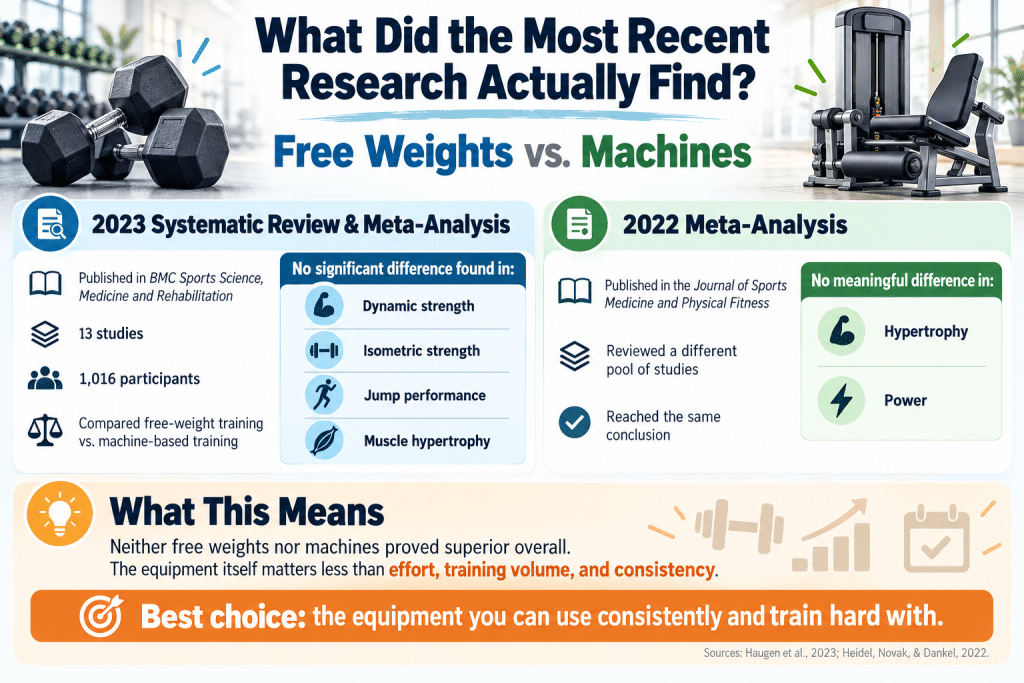
The most comprehensive answer available right now comes from a 2023 systematic review and meta-analysis published in BMC Sports Science, Medicine and Rehabilitation, which pooled thirteen studies and 1,016 participants comparing free-weight training against machine-based training (Haugen et al., 2023).
The headline finding is one that surprises most people who’ve absorbed gym culture’s assumption that free weights are inherently superior: there was no significant difference between free weights and machines for dynamic strength, isometric strength, jump performance, or, most importantly for anyone training with a body composition goal, muscle hypertrophy.
That finding wasn’t a fluke or a one-off study. A separate 2022 meta-analysis published in the Journal of Sports Medicine and Physical Fitness, examining changes in muscle size, strength, and power across a different pool of studies, reached the same conclusion: no meaningful difference in hypertrophy or power between the two training modalities (Heidel, Novak, & Dankel, 2022). When two independent meta-analyses pooling different sets of studies land on the same answer, that’s about as solid as exercise science evidence gets on a debate this contested.
Important: neither of these papers found machines superior to free weights, either. The finding isn’t “machines win.” It’s that the equipment itself isn’t the variable driving your results nearly as much as effort, volume, and consistency are.
What Is the Training Specificity Nuance?
The one place the research did find a real difference is worth understanding, because it explains why this debate persists despite the overall finding of equivalence. The Haugen et al. (2023) meta-analysis found that strength gains were somewhat specific to how they were tested: people who trained with free weights showed significantly greater improvement when their strength was subsequently tested using a free-weight movement, while people who trained on machines showed the advantage when tested on machines (SMD: -0.210, p = 0.023). The earlier Heidel et al. (2022) meta-analysis found a similar pattern, with a moderate effect size (ES: 0.655) favoring free-weight training specifically when strength was measured with a free-weight test.
In plain terms, this is a measurement effect, not a muscle-building effect. If you train on a leg press machine for three months and then someone tests your squat with a barbell, you may score lower than someone who trained with the barbell directly, not because you built less muscle or strength, but because the barbell squat requires coordination, balance, and stabilization skills that are specific to that movement pattern and weren’t practiced during machine training. The underlying strength and muscle tissue you built are comparable. What differs is how well that strength transfers to an unfamiliar, less stable movement.
“This is the part I wish more women heard before they wrote off machines. Your muscle doesn’t know or care whether the resistance came from a barbell or a cable stack. What it responds to is tension, effort, and progressive overload. The equipment is just the delivery mechanism.”
Terry Tateossian, Founder of The House of Rose
Free 28-Day Fascia Reset Email Course
Get our Free 28-day email course series to help with 1 or 2 exercises per day to release your fascia. One short lesson per day. Two minutes to read each.
What Does This Mean Specifically for Women Over 40?
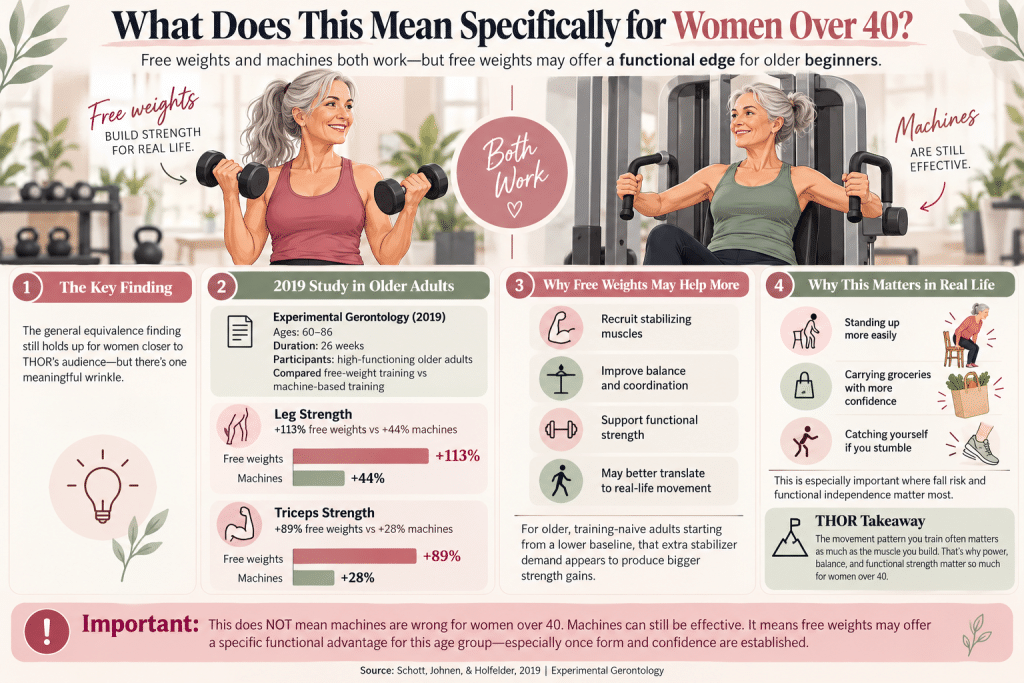
The general equivalence finding holds up in a population closer to THOR’s own community, though with one meaningful wrinkle. A 2019 study in Experimental Gerontology followed high-functioning older adults, ages 60 to 86, through 26 weeks of either free-weight or machine-based training and found that the free-weight group showed substantially larger percentage increases in leg strength (113% versus 44%) and triceps strength (89% versus 28%) compared to the machine group (Schott, Johnen, & Holfelder, 2019).
This doesn’t contradict the broader meta-analyses so much as it adds a layer specific to older training-naive populations. Free-weight movements recruit stabilizing muscles and challenge balance and coordination in a way that pure machine training doesn’t, and for an older adult rebuilding strength from a lower baseline, that additional stabilizer demand appears to translate into a larger measured strength improvement, particularly for functional movements like standing up, carrying groceries, or catching yourself if you stumble.
This is also the population where fall risk and functional independence matter most, which is exactly the argument THOR has made in its coverage of power versus strength training for fall prevention: the movement pattern you train often matters as much as the muscle you build.
Important: this doesn’t mean machines are wrong for women over 40. It means free weights carry a specific functional advantage for this age group that’s worth weighing intentionally, especially once your form and confidence are established.
What Does the Research Say About Joint Discomfort and Injury Risk?
One of the more common assumptions is that machines are safer and free weights are riskier, largely because machines control the range of motion for you. The most direct recent test of this came from a 2023 randomized controlled trial in Medicine & Science in Sports & Exercise, which put 38 resistance-trained men through an 8-week program using either free weights or machines for the squat, bench press, prone bench pull, and shoulder press, with training variables held identical between groups (Hernandez-Belmonte et al., 2023).
The result: free-weight and machine-based training were similarly effective for strength and hypertrophy, and critically, there was no meaningful difference in joint discomfort between the two groups.
Separately, injury risk data on this comparison remains distinctly mixed and harder to pin down than the strength and hypertrophy findings; some observational data has found a higher reported injury rate associated with free weights, though a substantial portion of those incidents were tied to equipment (a dropped or falling weight) rather than the exercise technique itself, and properly coached resistance training of either type carries a low overall injury rate.
- If you’re new to lifting or returning after a long break: machines reduce the number of things you need to coordinate at once (balance, bar path, and load, all at the same time), which lowers the learning curve while you build confidence.
- If you have an existing joint issue you’re managing: a machine’s fixed path can reduce compensatory movement that might aggravate a sensitive joint, though this should be confirmed with your physical therapist or physician for your specific situation rather than assumed universally.
Free 28-Day Fascia Reset Email Course
Get our Free 28-day email course series to help with 1 or 2 exercises per day to release your fascia. One short lesson per day. Two minutes to read each.
What About the Stabilizer Muscle Argument, and Where Does It Matter?
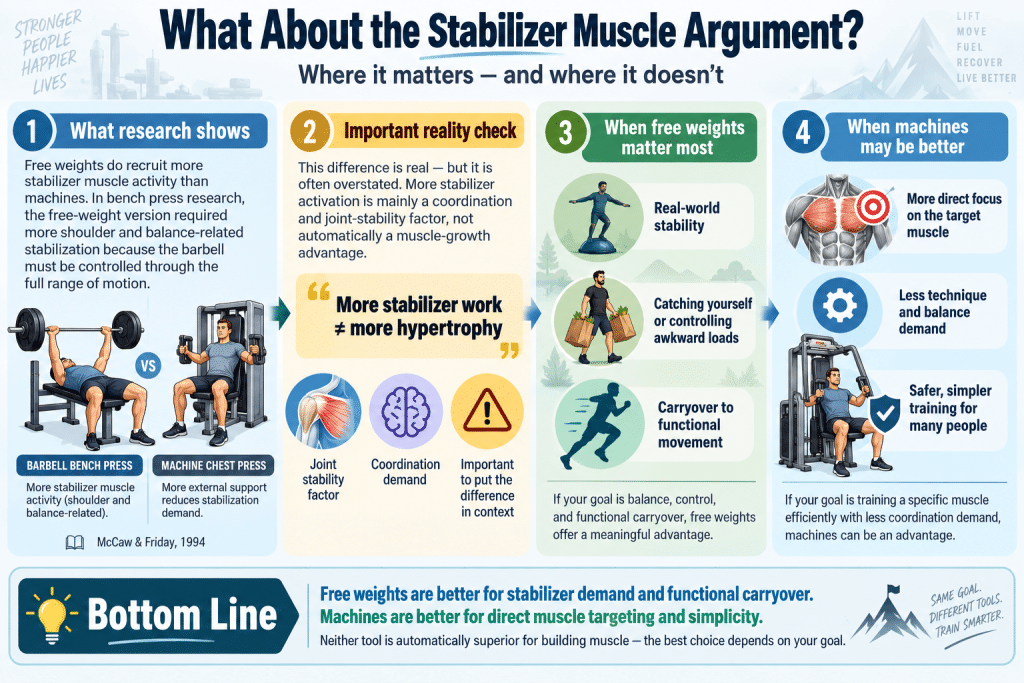
The classic argument for free weights is that they recruit more stabilizer muscle activity, and this one holds up well in the electromyography research. A frequently cited EMG study comparing free-weight and machine bench press found that free-weight training recruited stabilizing musculature, particularly around the shoulder, to a greater degree than the guided machine version, since the barbell has to be actively balanced through the entire range of motion in a way a fixed machine track doesn’t require (McCaw & Friday, 1994).
This is real and worth factoring into a program, but it’s also frequently overstated as an argument for “which builds more muscle.” The stabilizer activation difference is a coordination and joint-stability variable, not primarily a hypertrophy variable, which is consistent with why the larger meta-analyses above still found equivalent muscle growth between modalities.
Where it matters most is functional carryover: if your goal includes real-world stability (not falling, catching yourself, carrying an awkward load), the stabilizer demand of free weights is doing something a machine isn’t. If your goal is building a specific muscle as directly and safely as possible with minimal technique risk, that same “downside” of machines (less stabilizer demand) becomes an advantage, since more of your effort goes directly into the target muscle rather than into balancing the load.
What Does the Evidence Show?
Here’s how the evidence compares across the major outcomes examined in the research:
| Outcome | What the Research Found | Evidence Strength |
|---|---|---|
| Muscle hypertrophy | No significant difference between free weights and machines | Strong (2 independent meta-analyses) |
| General dynamic/isometric strength | No significant difference | Strong |
| Strength on the specific tested modality | Free weights favor free-weight-tested strength; machines favor machine-tested strength | Strong (consistent across 2 meta-analyses) |
| Older-adult functional strength gains | Free weights showed notably larger gains over 26 weeks in one trial | Moderate (single study, specific population) |
| Joint discomfort | No significant difference | Moderate to Strong (1 RCT directly testing this) |
| Stabilizer muscle activation | Free weights recruit more stabilizer activity | Strong (EMG data, though mechanistic, not outcome-based) |
| Overall injury risk | Distinctly mixed; equipment-related incidents (not technique) account for a share of free-weight injuries | Weak to Moderate (limited controlled data) |
Free 28-Day Fascia Reset Email Course
Get our Free 28-day email course series to help with 1 or 2 exercises per day to release your fascia. One short lesson per day. Two minutes to read each.
So Which Should You Use?
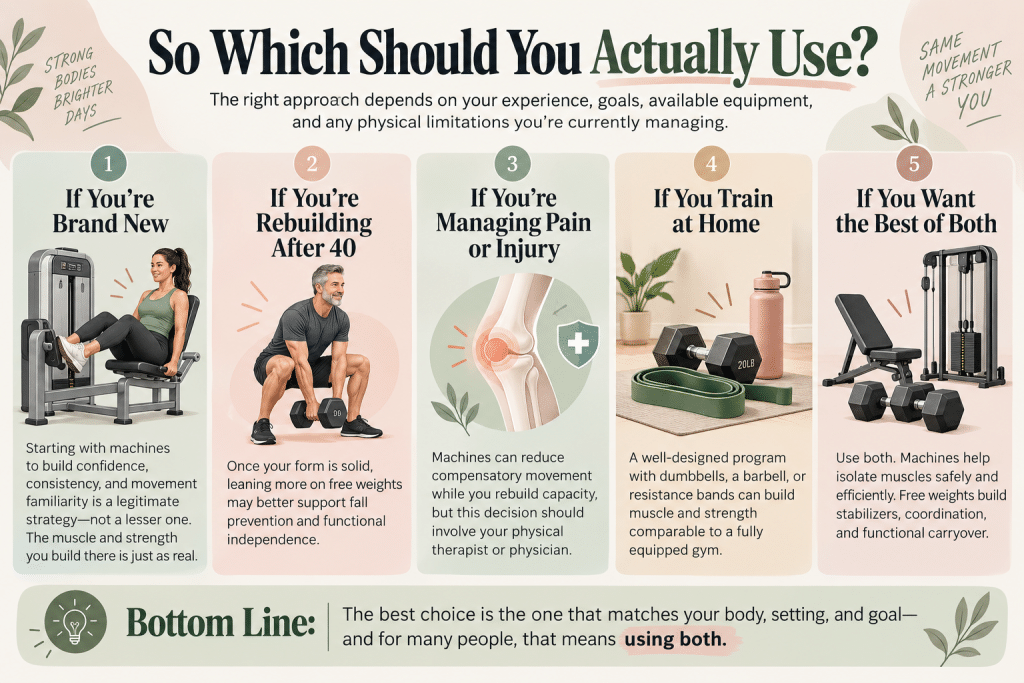
The right approach depends on your experience, goals, available equipment, and any physical limitations you’re currently managing.
- If you’re brand new to strength training: starting with machines to build a base of confidence, consistency, and movement familiarity is a legitimate strategy, not a lesser one; the muscle and strength you build there is just as real as what a free-weight beginner builds.
- If you’re rebuilding strength after 40 with a specific eye toward fall prevention and functional independence: weighting your program more heavily toward free weights, once your form is solid, draws on the strongest evidence specific to that goal from Section 3.
- If you’re managing a joint issue or recovering from an injury: machines can reduce compensatory movement while you rebuild capacity, though this decision should involve your physical therapist or physician rather than a general rule.
- If you train at home or somewhere without a full machine setup: the equivalence findings in Sections 1 and 2 are truly reassuring: a well-designed program with dumbbells, a barbell, or even resistance bands can build comparable muscle and strength to a fully equipped commercial gym.
- If you want the best of both: most of the researchers behind this body of evidence land on the same practical recommendation: use both. Machines for isolating specific muscles safely and efficiently, free weights for the stabilizer, coordination, and functional carryover that machines can’t replicate. This combined approach is consistent with how THOR frames strength training more broadly for the muscle groups that matter most for aging well.
What Are Your Next Steps?
- Audit your current program and notice whether it leans entirely toward one modality; a mix of free weights and machines, matched to your goals from Section 7, covers more ground than either alone.
- If you’re intimidated by free weights, start with one or two machine-based sessions to build baseline strength and confidence before introducing a barbell or dumbbell movement pattern.
- If you’re over 40 and focused on fall prevention, read THOR’s guide to power versus strength training for how movement selection factors into that specific goal.
- Check whether your current split covers the key muscle groups for long-term function using THOR’s guide to the 4 muscle groups that matter most for aging women.
- If you want a program built around your specific goals and any joint considerations, THOR’s coaching program can help you structure a free-weight and machine mix that fits your body and your life. Reach out to learn more.
Free 28-Day Fascia Reset Email Course
Get our Free 28-day email course series to help with 1 or 2 exercises per day to release your fascia. One short lesson per day. Two minutes to read each.
Frequently Asked Questions
Do free weights build more muscle than machines?
No. Two independent meta-analyses found no significant difference in muscle hypertrophy between free-weight and machine-based training (Haugen et al., 2023; Heidel et al., 2022).
Are machines just as effective as free weights for strength?
For general strength gains, yes, with one caveat: strength improvements are somewhat specific to the equipment you trained on, so machine training produces the biggest gains when tested on machines, and free-weight training produces the biggest gains when tested with free weights.
Is it true that free weights are more functional than machines?
There’s real evidence for this specifically around stabilizer muscle recruitment and balance demands (McCaw & Friday, 1994), and it showed up clearly in an older-adult study where free-weight training produced notably larger real-world strength gains (Schott et al., 2019). It’s a legitimate advantage, not just gym folklore.
Are machines safer than free weights?
The evidence on overall injury risk is distinctly mixed. A direct 2023 trial found no difference in joint discomfort between the two modalities (Hernandez-Belmonte et al., 2023), though machines do reduce the number of things you need to coordinate at once, which can lower risk for beginners specifically.
Should beginners start with machines or free weights?
Either is a legitimate starting point. Machines lower the technical learning curve, which some beginners find helpful for building confidence, while others do fine learning free-weight technique from the start with proper coaching.
I’m over 40. Should I prioritize free weights?
The strongest evidence specific to this age group (Schott et al., 2019) found meaningfully larger strength gains from free weights over 26 weeks, largely tied to the functional, stabilizer-muscle demands they place on the body. It’s worth weighting your program toward free weights once your form is solid, though machines still have a legitimate role.
Can I build the same amount of muscle at home with dumbbells as I could at a gym with machines?
Based on the equivalence findings across multiple studies, yes, provided your program applies adequate volume and progressive overload regardless of equipment.
What does “training specificity” mean in this context?
It means the strength you build transfers best to whatever movement pattern and equipment you trained with. Train on a leg press, and your leg press strength improves most; train with a barbell squat, and your squat strength improves most, even if the underlying muscle and strength gains are comparable.
Do machines recruit fewer stabilizer muscles?
Yes, that part of the research is well-supported. A fixed machine path reduces the balance and coordination demand compared to a free-weight movement, which is both a limitation (less functional carryover) and a benefit (more directed effort on the target muscle, less risk from balance errors) depending on your goal.
Is it “cheating” to only use machines?
No. The muscle and strength adaptations from machine training are real and measurable, and the meta-analyses in Section 1 found no hypertrophy difference between the two. The idea that machines are a lesser form of training isn’t supported by the current evidence.
What’s the best split between free weights and machines in a weekly program?
There’s no single research-backed ratio, but a common practical approach is using free weights for foundational compound movements (squats, presses, hinges) and machines for isolation or accessory work, which the researchers behind this literature generally support as a sensible combined strategy.
Does this research apply to resistance bands too?
Not directly; the studies referenced here compared free weights specifically to machines. THOR’s separate comparison of resistance bands versus dumbbells covers that specific equipment question.
Why does gym culture treat machines as inferior if the research doesn’t support that?
Likely a combination of outdated bodybuilding-era assumptions, the visual association of free weights with “serious” training, and the training-specificity finding in Section 2 being misread as “machines don’t work” rather than “machines build modality-specific strength,” which is a different and more accurate conclusion.
Do these findings apply to both men and women equally?
The meta-analyses pooled mixed-sex samples (Haugen et al.’s 1,016 participants included 219 women), and nothing in the current literature suggests the core equivalence finding differs meaningfully by sex, though most individual trials still skew toward male participants, which is a limitation worth acknowledging.
I write 3 essays per week on Lifestyle Medicine for women in midlife on what is happening in the body and what to do about it. No fluff, no hype. Free Subscription.
References
- Haugen, M.E., Varvik, F.T., Larsen, S., Haugen, A.S., van den Tillaar, R., & Bjornsen, T. (2023). Effect of Free-Weight vs. Machine-Based Strength Training on Maximal Strength, Hypertrophy and Jump Performance: A Systematic Review and Meta-Analysis. BMC Sports Science, Medicine and Rehabilitation, 15, 105.
- Heidel, K.A., Novak, Z.J., & Dankel, S.J. (2022). Machines and Free Weight Exercises: A Systematic Review and Meta-Analysis Comparing Changes in Muscle Size, Strength, and Power. Journal of Sports Medicine and Physical Fitness, 62(8), 1061-1070.
- Hernandez-Belmonte, A., Martinez-Cava, A., Buendia-Romero, A., Franco-Lopez, F., & Pallares, J.G. (2023). Free-Weight and Machine-Based Training Are Equally Effective on Strength and Hypertrophy: Challenging a Traditional Myth. Medicine & Science in Sports & Exercise, 55(12), 2316-2327.
- Schott, N., Johnen, B., & Holfelder, B. (2019). Effects of Free Weights and Machine Training on Muscular Strength in High-Functioning Older Adults. Experimental Gerontology, 122, 15-24.
- McCaw, S.T., & Friday, J.J. (1994). A Comparison of Muscle Activity Between a Free Weight and Machine Bench Press. Journal of Strength and Conditioning Research, 8(4), 259-264.
Disclaimer: This article is educational and does not constitute medical or fitness advice. Both free-weight and machine-based strength training require appropriate technique, progression, and resistance based on your current fitness level. If you have significant joint issues, balance problems, cardiovascular concerns, osteoporosis, a recent injury or surgery, or another condition that may affect exercise safety, consult a healthcare provider or qualified fitness professional before starting or changing your strength-training program.
Free 28-Day Fascia Reset Email Course
Get our Free 28-day email course series to help with 1 or 2 exercises per day to release your fascia. One short lesson per day. Two minutes to read each.

Terry Tateossian is a Menopause Lifestyle Medicine Coach, Certified Personal Trainer & Nutritionist and the Founder of THOR: The House of Rose, a wellness brand serving women over 40 through retreats, coaching, macro-nutrition and community. As 25-year founder and entrepreneur, Terry spent two and a half decades building and running successful start-up businesses, an experience that put her on the front line of founder burnout long before she could name it. After facing serious health challenges, early onset menopause, and emotional eating while running her agency and raising two children, Terry rebuilt her health in her 40s and lost more than 80 pounds through evidence-based nutrition, training, and mindset work. Today, she helps women get strong, improve confidence, support hormone health, and create a stronger second half of life. Terry has been featured in major media outlets and is available for podcasts, expert commentary, brand collaborations, and speaking engagements on midlife health, reinvention, emotional eating, menopause wellness, and strength training for longevity. Get her free macro calculator (her cookbook companion) to start your journey to back to health.