

 By Team THOR
Free 28-Day Fascia Reset Email Course
Get our Free 28-day email course series to help with 1 or 2 exercises per day to release your fascia. One short lesson per day. Two minutes to read each.
The Seven Hermetic Principles: A Guide for Women Exploring Ancient Philosophical Frameworks
The seven hermetic principles are a philosophical framework, not scientific laws. Some ideas, such as cycles, cause and effect, and the influence of mental state on experience, overlap with modern research. Others are metaphysical claims that science has not evaluated. This article explores the framework seriously while clearly separating philosophy from scientific evidence. THOR is not a spiritual teaching organization, and this guide does not promote any specific belief or practice.
The principles were formally presented in the 1908 book The Kybalion, published anonymously by “Three Initiates” and commonly linked to New Thought writer William Walker Atkinson. Tradition traces them to Hermes Trismegistus, a symbolic figure combining the Greek god Hermes and the Egyptian god Thoth. Although their exact origins remain debated, the principles have influenced Western esoteric thought for more than a century and reflect older Egyptian, Greek, and gnostic traditions.
For midlife women exploring reflection, personal growth, or ancient wisdom, the framework offers useful questions about consciousness, inner and outer experience, emotional states, opposites, cycles, responsibility, and complementary energies. The principles may be approached as metaphors, prompts for reflection, or metaphysical beliefs, depending on the reader’s perspective.
I am Terry Tateossian, founder of The House of Rose and a certified lifestyle medicine coach. I support women in perimenopause, menopause, and post-menopause through yoga and wellness focused women’s retreats in East Tennessee. After experiencing early-onset menopause at 41 and spending 25 years in a corporate environment that caused burnout, I created THOR to help women navigate midlife with greater clarity and support.
This guide explains what each principle means, its historical context, where modern research connects with its underlying ideas, where it remains philosophical, common misunderstandings to avoid, and practical ways to explore the framework without falling into misleading wellness claims.
Important: This article is for educational purposes only and does not provide spiritual, religious, medical, or mental health advice. Philosophical frameworks are not substitutes for professional care. Anyone experiencing significant emotional distress, unresolved trauma, or an acute mental health concern should seek support from a qualified professional.
What Are the Seven Hermetic Principles?
The seven hermetic principles are a set of philosophical statements about the nature of reality, consciousness, energy, and the relationship between inner and outer experience. Understanding what they are before engaging with each matters because it affects how you interpret the material.
- The specific seven: The principles are traditionally named Mentalism, Correspondence, Vibration, Polarity, Rhythm, Cause and Effect, and Gender. Each is stated in a compact classical formula and then unpacked into broader philosophical implications.
- Their source text: The Kybalion, published in 1908, is the specific written source that codified these seven principles into their modern form. The book presents itself as based on ancient hermetic teachings, though scholars generally attribute its actual composition to William Walker Atkinson or a small circle of writers associated with the New Thought movement of the early twentieth century.
- Their claimed lineage: The principles are attributed by the Kybalion tradition to Hermes Trismegistus, a legendary figure combining Greek and Egyptian religious traditions. Whether Hermes Trismegistus existed as a specific historical person or represents a syncretic composite is debated by scholars. What is clearer is that hermetic writings from late antiquity (particularly the Corpus Hermeticum, compiled around the second and third centuries CE) contain themes that the seven principles later systematized.
- Their nature as philosophical framework: The principles are best understood as philosophical statements about how the world works rather than as scientific claims about physical mechanisms. Some principles describe observations that intersect with modern research (cycles, cause-and-effect, mental influence on experience). Others describe metaphysical claims that modern science does not evaluate.
- Their function in practice: For practitioners, the principles function as prompts for reflection, ethical guidance, and framework for interpreting personal experience. They can be studied intellectually, contemplated in meditation, or applied practically to daily life decisions. Different traditions and practitioners emphasize different combinations of these approaches.
- Their relationship to other traditions: The seven principles overlap in various ways with other philosophical and religious frameworks including certain interpretations of Buddhist mind training, Jungian psychology, Advaita Vedanta, and various stoic and platonic traditions. The seven principles are one specific formulation within a broader family of related ideas across cultures.
- The specific New Thought lineage: In practical modern application, the seven principles are often taught alongside ideas from the New Thought movement, which emphasizes the power of thought to shape experience. Some of these applications have been criticized as oversimplified or as producing victim-blaming when applied to serious life circumstances. Thoughtful engagement with the principles avoids these specific distortions.
Why Are Midlife Women Drawn to This Framework Now?
The recent renewed interest in hermetic principles among midlife women deserves attention because it reflects broader patterns in this life stage.
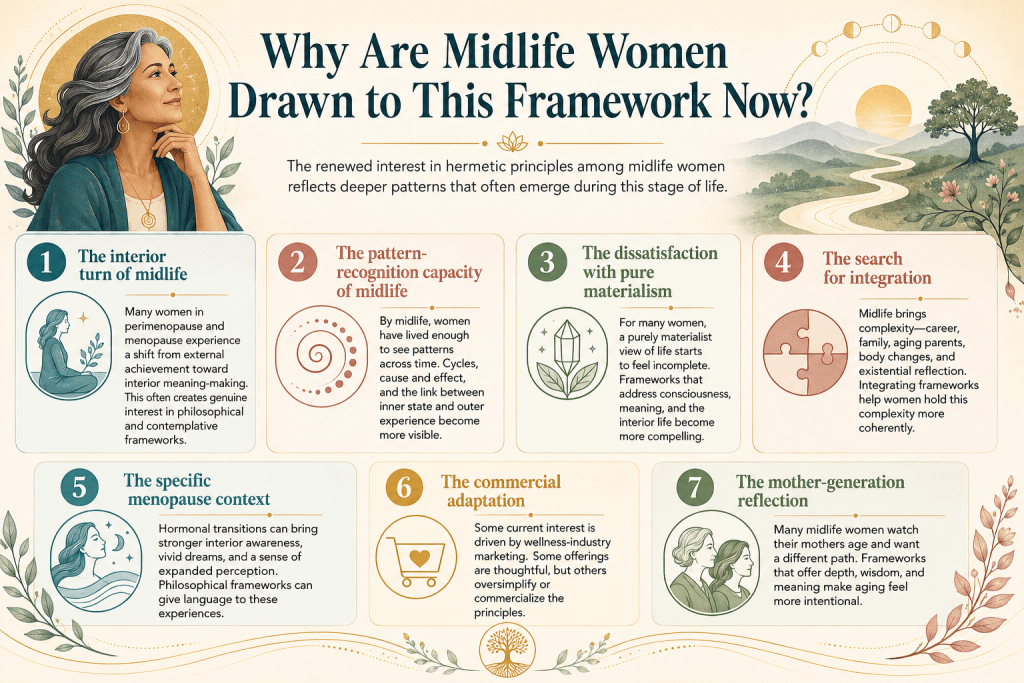
- The interior turn of midlife: Many women in perimenopause and menopause describe a specific interior turn, a movement of attention from external achievement toward interior meaning-making. This shift often produces genuine interest in philosophical and contemplative frameworks that were less compelling in earlier decades.
- The pattern-recognition capacity of midlife: By midlife, women have accumulated enough life experience to see patterns across time. Cycles, causes and effects, the relationship between inner state and outer experience all become more visible with the perspective of decades. A framework like the seven principles that names these patterns often resonates because it articulates what has already been observed.
- The dissatisfaction with pure materialism: Many midlife women describe reaching a point where the pure materialist frame (life is only what can be measured and explained by current science) feels incomplete. Philosophical frameworks that address consciousness, meaning, and the interior life directly become more compelling.
- The search for integration: The complexity of midlife (career, family, aging parents, changing body, existential reflection) often produces a search for integrating frameworks. A philosophy that connects inner experience to outer life offers one way to hold this complexity coherently.
- The specific menopause context: The hormonal transitions of perimenopause and menopause produce increased interior awareness, more vivid dreams for some women, and sometimes a specific sense of expanded consciousness or perception. Philosophical frameworks that address these experiences give language to something that midlife women often experience but do not always have vocabulary for.
- The commercial adaptation: Some of the current interest in hermetic principles reflects wellness-industry marketing that has adapted these frameworks into products and programs. This is worth naming honestly. Some of the marketing is thoughtful. Much of it is oversimplified or exploits the principles for commercial purposes.
- The mother-generation reflection: Many midlife women watch their mothers navigate later life and want to age differently. Philosophical frameworks that offer a specific vision of aging with depth and wisdom rather than just decline become attractive precisely because they offer that alternative.
“The specific value I see the seven hermetic principles offering coaching clients is not that they are literally scientific laws but that they are useful reflective prompts that produce specific insights when engaged honestly. A midlife woman who spends a month contemplating the principle of rhythm often notices patterns in her own life that pure achievement-oriented thinking had obscured. A midlife woman who engages the principle of correspondence often begins to notice how her interior state does affect her experience of external circumstances in ways she had underappreciated. The framework works as reflective practice regardless of whether one accepts the underlying metaphysical claims. My caution is that some interpretations of these principles slip into magical thinking, victim-blaming, or oversimplified manifestation content that does harm rather than good. Engaging the principles as philosophical prompts rather than as literal cosmic rules avoids these distortions.”
Terry Tateossian, Founder of The House of Rose
Free 28-Day Fascia Reset Email Course
Get our Free 28-day email course series to help with 1 or 2 exercises per day to release your fascia. One short lesson per day. Two minutes to read each.
What Is the Honest History of the Hermetic Tradition?
Understanding the honest history of the hermetic tradition helps contextualize the seven principles and separates authentic historical context from wellness-marketing exaggeration. The tradition developed across several distinct historical periods, from the ancient hermetic writings to their modern reinterpretation through The Kybalion and contemporary wellness culture.
The Ancient Hermetic Writings
A body of Greek and Latin philosophical and religious texts known collectively as the Corpus Hermeticum was compiled roughly between the second and third centuries of the Common Era in Roman Egypt. These texts blend several intellectual and spiritual traditions, including:
- Greek philosophy
- Egyptian religious themes
- Gnostic elements
The texts are attributed to Hermes Trismegistus, whose historical status is debated but who was widely revered as a wisdom teacher in late antiquity.
The Renaissance Revival
The Corpus Hermeticum was rediscovered in Europe during the fifteenth century and translated into Latin by Marsilio Ficino. His translations had a significant influence on Renaissance humanism, art, philosophy, and science.
Figures who engaged with hermetic material during this period included:
- Giordano Bruno
- Isaac Newton
- Various Renaissance philosophers and scholars
The Nineteenth-Century Revival
Hermetic themes were taken up again in the nineteenth century by several occult, mystical, and philosophical movements. These movements played a major role in shaping the modern reception of hermetic philosophy.
Prominent examples included:
- Theosophy, associated with Helena Blavatsky
- The Hermetic Order of the Golden Dawn, whose members included William Butler Yeats
- Other occult and mystical traditions influenced by Western esotericism
The Kybalion and the New Thought Movement
The book The Kybalion was published in 1908 by “Three Initiates” and is widely attributed to William Walker Atkinson. It represents a specific modern American systematization of hermetic ideas into the seven principles as they are commonly known today.
The Kybalion is not itself an ancient text. It is a modern text that draws on ancient themes to produce a specific and accessible formulation.
The book emerged from the New Thought movement of the late nineteenth and early twentieth centuries. This movement emphasized the power of the mind to affect personal experience and outcomes. That historical context shapes both the strengths and limitations of The Kybalion’s presentation of hermetic principles.
The Scholarly Distinction
Academic scholars of religion and philosophy generally distinguish between two different bodies of work:
- The ancient hermetic writings, which are historical texts with established scholarly study
- The Kybalion, which is a modern popular systematization of hermetic ideas
Both can be engaged with as philosophical material, but they should not be conflated or presented as coming from the same historical period.
The Contemporary Revival
The current interest in the seven principles reflects a broader contemporary interest in ancient wisdom traditions. It also reflects the commercial repackaging of spiritual and philosophical ideas by the wellness industry.
Some contemporary teachers offer thoughtful engagement with hermetic philosophy. Others produce content that contains more marketing than historical or philosophical substance.
A Specific Caution About Modern Claims
Some contemporary marketing claims that the seven principles are “ancient secret laws” that have been hidden or that only initiates can access. This is largely marketing framing.
Several historical facts challenge these claims:
- The Kybalion has been publicly available for over a century.
- Ancient hermetic texts have been publicly studied for over five hundred years since the Renaissance.
- There is no evidence that specific hidden hermetic knowledge exists beyond what is publicly available.
Recognizing this distinction does not make the hermetic tradition less valuable. It simply allows the principles to be explored without relying on exaggerated claims about secrecy, ancient origins, or exclusive access.
What Are the 7 Hermetic Principles and How Can Midlife Women Apply Them?
The seven Hermetic principles offer a philosophical framework for exploring consciousness, recurring patterns, emotional balance, natural cycles, personal responsibility, and the relationship between action and receptivity. Each principle can provide practical insight for midlife women when approached thoughtfully, with a clear distinction between useful psychological observations, metaphysical ideas, and claims that are not supported by modern science.
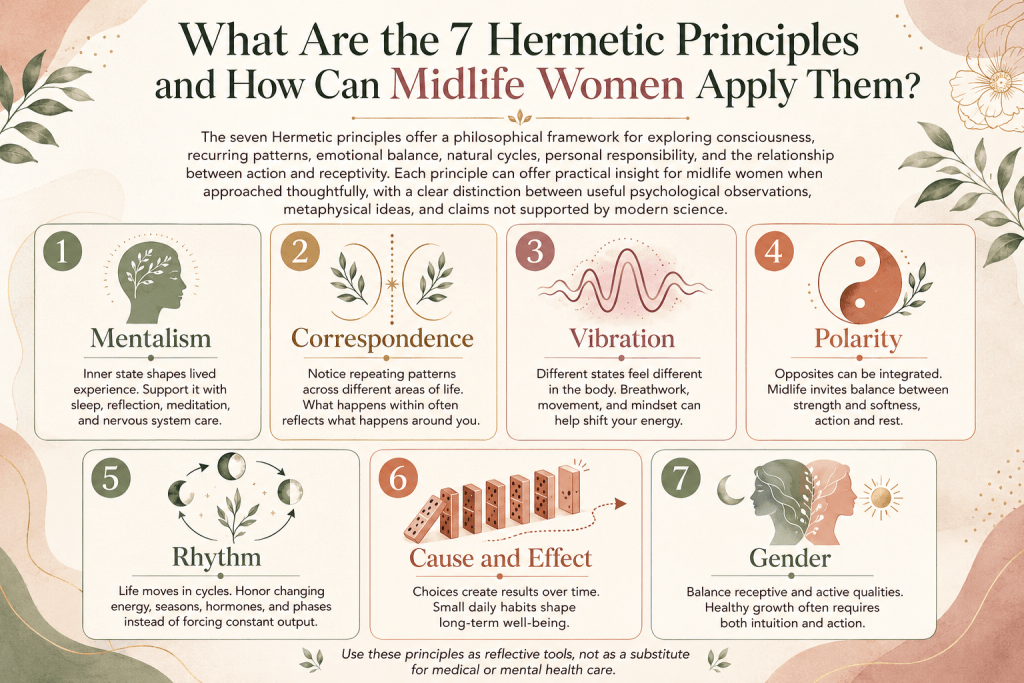
Principle 1: Mentalism
The first principle addresses the primacy of consciousness in shaping experience. Understanding what the principle claims and how it differs from oversimplified interpretations matters for thoughtful engagement.
- The classical statement: The principle of mentalism holds that the fundamental substrate of reality is consciousness or mind, and that the phenomenal world is a manifestation of this underlying consciousness. In the Kybalion formulation, this is expressed as “The All is Mind; the Universe is Mental.”
- What this means: This principle is a metaphysical claim about the fundamental nature of reality. It aligns with philosophical positions known as idealism, which holds that mind or consciousness is fundamental and matter derives from it, rather than the more common modern position of materialism, which holds the opposite.
- The practical application: In practice, this principle is often taken to mean that internal mental states affect the experience of external reality. A person in a chronically anxious mental state experiences the world differently than the same person in a chronically settled mental state. This practical observation is well-supported by modern research on cognitive appraisal, perception, and emotional regulation.
- Where modern research intersects: Research on cognitive behavioral therapy, mindfulness-based interventions, and the effect of mental state on stress physiology all support the practical observation that internal mental state significantly affects lived experience. This does not prove the metaphysical claim of idealism, but it does support the practical claim about mental influence on experience.
- Where the framework becomes problematic: Some oversimplified interpretations of this principle produce the claim that thoughts literally create physical reality (that you can think yourself into or out of specific external circumstances). Taken to extremes, this becomes victim-blaming (people cause their own illnesses, poverty, or misfortunes through their thoughts) and produces genuine harm. Thoughtful engagement distinguishes between the reasonable observation that mental state affects experience and the unreasonable claim that thought literally creates circumstances.
- Application for midlife women: The practical value of engaging this principle is the recognition that internal state matters and can be worked with. Sleep quality, nervous system regulation, and mental patterns all shape midlife experience.
Free 28-Day Fascia Reset Email Course
Get our Free 28-day email course series to help with 1 or 2 exercises per day to release your fascia. One short lesson per day. Two minutes to read each.
Principle 2: Correspondence
The second principle addresses the relationship between different levels of reality and the specific observation that patterns at one level often correspond to patterns at other levels.
- The classical statement: The principle of correspondence is often expressed as “as above, so below; as within, so without.” This suggests a fundamental correspondence between different scales and dimensions of reality.
- What this means: The principle holds that patterns observable at one level of reality (personal, social, natural, cosmic) tend to reflect patterns at other levels. Understanding one level can therefore inform understanding of other levels.
- The practical application: In practice, this principle is often applied to the relationship between internal and external experience. Interior patterns (relationships with oneself, mental habits, emotional patterns) tend to be reflected in external circumstances (relationships with others, life outcomes, felt-sense of one’s world).
- Where modern research intersects: Systems theory, complexity science, and various observations in biology (fractal patterns, network structures across scales) show that similar organizational patterns do appear at multiple levels of natural systems. This does not prove the metaphysical claim of universal correspondence but does support the general observation that patterns recur across scales in ways worth attending to.
- The specific psychological application: Psychodynamic and systemic approaches to therapy have long observed that patterns in one relationship often repeat in other relationships, that interior conflicts often play out in external circumstances, and that healing at one level supports healing at other levels. This aligns with the general observation of the principle.
- Application for midlife women: The practical value of engaging this principle is the recognition that internal work often produces external changes over time, and that patterns in one area of life often repeat in other areas. This is a useful frame for noticing patterns without becoming rigid about them.
- The specific caution: As with the principle of mentalism, this principle can be misapplied. The claim that all external circumstances directly mirror internal patterns produces victim-blaming when applied to circumstances outside a person’s control (illness, systemic injustice, accidents). Thoughtful engagement distinguishes between the useful observation about patterns and the unreasonable claim about direct universal correspondence.
Principle 3: Vibration
The third principle addresses the observation that everything in existence is in motion and carries a specific quality or frequency.
- The classical statement: The principle of vibration holds that nothing rests, that everything moves and vibrates, and that different phenomena differ in their specific vibrational qualities.
- What this means: In its most literal reading, this principle aligns with modern physics, which does show that all matter is in constant motion at the atomic and subatomic level, that different frequencies of electromagnetic radiation produce different phenomena, and that everything from thermal energy to sound to light involves specific frequencies.
- The metaphorical extension: The Kybalion tradition extends this observation into a metaphorical claim that thoughts, emotions, and states of being also carry specific vibrational qualities that affect experience and interact with the vibrational qualities of other phenomena. This extension is philosophical rather than scientific.
- Where modern research intersects: Research on emotional contagion (the tendency of moods to spread between people in proximity), research on the effect of environment on mood, and research on the physiological effects of specific practices (meditation, music, breath work) all support the general observation that different states have different qualities that affect experience and interaction. Whether this constitutes literal vibration in the physical sense or is a useful metaphor is a philosophical question.
- The practical application: In practice, this principle is often applied to the observation that the qualities one cultivates in oneself (calm, focus, warmth, curiosity) tend to be reflected in one’s experience and interactions with others. This is a useful practical observation regardless of how one interprets the underlying metaphysics.
- Application for midlife women: The practical value of engaging this principle is the recognition that specific internal states can be cultivated deliberately through specific practices, and that these cultivated states affect subsequent experience. Nervous system regulation practices, meditation, and specific movement traditions like yoga and tai chi all cultivate specific internal qualities.
- The specific caution: Some contemporary content about “vibrational healing” makes claims about specific frequencies affecting specific physical conditions that are not supported by evidence. Distinguishing between the reasonable philosophical observation and unfounded claims about specific vibrational medicine is important.
Free 28-Day Fascia Reset Email Course
Get our Free 28-day email course series to help with 1 or 2 exercises per day to release your fascia. One short lesson per day. Two minutes to read each.
Principle 4: Polarity
The fourth principle addresses the observation that apparent opposites are often two poles of the same underlying continuum rather than genuinely separate phenomena.
- The classical statement: The principle of polarity holds that everything has two opposite poles, that opposites are of the same nature but different in degree, and that all paradoxes may be reconciled through the understanding of this principle.
- What this means: The principle observes that many apparent opposites (hot and cold, light and dark, love and hate) are in fact points along a continuum rather than absolutely separate categories. Understanding this continuous nature allows integration of opposites rather than rigid separation.
- The practical application: In practice, this principle is often applied to the recognition that emotional states we consider opposites are often related in specific ways. Grief and love are related. Fear and courage are related. What we resist about ourselves often reflects what we most need to integrate.
- Where modern research intersects: Research on emotional complexity, the coexistence of positive and negative emotions, and the integration of shadow material in psychological therapy all support the general observation that emotional opposites are not as separate as they appear. Jungian psychology in particular has extensively developed the practical application of integrating opposites.
- The specific application to midlife: Midlife often produces the specific experience of holding apparent contradictions. Grief about aging alongside gratitude for accumulated life. Fear about the future alongside acceptance of finite time. Longing for the past alongside relief at moving past it. The principle of polarity offers a frame for holding these coexisting opposites without needing to resolve them prematurely.
- Application for midlife women: The practical value of engaging this principle is the recognition that shadow material, unwanted emotions, and difficult experiences are not enemies to be eliminated but are part of a fuller integration. The specific pattern of midlife self-reckoning often benefits from this frame.
- The specific caution: The principle can be misapplied to minimize genuine suffering (all suffering is really joy in disguise) or to require premature integration of trauma (your abuse is really a spiritual gift). Thoughtful engagement respects the reality of difficult experience while acknowledging the potential for integration over time.
Principle 5: Rhythm
The fifth principle addresses the observation that all natural processes move in cycles, tides, and rhythmic patterns rather than in constant linear progression.
- The classical statement: The principle of rhythm holds that everything flows in and out, has its tides, and moves in cyclical patterns of ebb and flow.
- What this means: The principle observes that natural systems including biological processes, seasons, day and night, tides, and even social and personal patterns move in cyclical rather than linear ways. Understanding this cyclical nature allows working with rhythms rather than against them.
- Where modern research intersects: Circadian biology has extensively documented the reality of daily rhythms in nearly every physiological system. Seasonal rhythms in mood, metabolism, and behavior are well-established. Menstrual cycles in premenopausal women, hormonal cycles more broadly, and even ultradian rhythms within the day are all well-documented cyclical patterns. The principle of rhythm points to observations that modern research has repeatedly confirmed.
- The practical application for midlife women: The specific value of engaging this principle in midlife is the recognition that not all phases of one’s power look the same. The high-productivity mode that dominated earlier career years is not the only valuable mode. Rest, receptivity, integration, and quiet contemplation are equally important phases. Perimenopause and menopause produce shifts that often benefit from working with rather than against these rhythms.
- The specific menopause application: The perimenopause and menopause transition itself can be understood as a specific rhythmic shift in life stages. Ayurvedic frameworks explicitly frame this transition as a shift from one dominant life phase to another. Working with the new phase rather than against it is one of the specific practical applications of the rhythm principle.
- Application for daily life: The specific value for daily life is honoring different phases of the day, week, month, and year. Not every day is a high-output day. Not every season is a growing season. Working with these natural rhythms rather than pushing constantly produces better long-term results than trying to override them.
- The specific caution: The principle can be misused to justify avoidance of appropriate effort (I am in a receptive phase, so I do not have to do the work). The honest application distinguishes between honoring appropriate cycles and using cycles as excuses.
Free 28-Day Fascia Reset Email Course
Get our Free 28-day email course series to help with 1 or 2 exercises per day to release your fascia. One short lesson per day. Two minutes to read each.
Principle 6: Cause and Effect
The sixth principle addresses the observation that all events have causes and produce effects, and that apparent randomness typically reflects causes that are not visible rather than genuine causelessness.
- The classical statement: The principle of cause and effect holds that every effect has a cause and every cause has an effect, that chance is merely a name for unrecognized causes, and that nothing escapes this principle.
- What this means: The principle observes that human events unfold according to causal chains, that our choices and actions produce specific effects, and that responsibility for our life circumstances lies in significant part with our own patterns of choice.
- Where modern research intersects: Behavior change research, cognitive behavioral therapy, and various fields of psychology all support the general observation that our choices and patterns produce predictable effects over time, and that changing our patterns produces changed outcomes. The general framework of causal responsibility for behavior is well-established in modern practice.
- The practical application for midlife women: The specific value of engaging this principle in midlife is the recognition that where you are now is significantly the result of choices and patterns accumulated over decades, and that where you will be in ten or twenty years is significantly determined by choices and patterns you are establishing now. This is a specific call to responsibility that many midlife women find both sobering and empowering.
- The specific application to health: Health outcomes in midlife are significantly (though not entirely) affected by choices about nutrition, movement, sleep, and stress management accumulated over decades. This is one of the most direct applications of the cause-and-effect principle in a domain with real research support.
- The specific caution: The principle can be misapplied to blame people for circumstances outside their control. Genetic conditions, systemic injustice, accidents, and various circumstances involve significant factors beyond individual choice. The reasonable interpretation of the principle acknowledges the significant role of individual choice within the reality of factors that lie beyond it.
- Application for daily life: The specific value for daily life is the recognition that small choices compound. What you eat this week affects your body months from now. What you practice today affects your capacity years from now. The compounding nature of choice is one of the most practically powerful applications of the principle.
Principle 7: Gender
The seventh principle addresses the observation that certain complementary energetic qualities are present in all natural systems, traditionally described as feminine and masculine energies.
- The classical statement: The principle of gender holds that everything has both masculine and feminine principles, that these are energetic qualities rather than biological categories, and that all creation and manifestation requires both.
- What this means: The principle uses gendered language to describe complementary qualities. The feminine energy is traditionally associated with receptivity, intuition, inward focus, gestation, and being. The masculine energy is traditionally associated with action, focus, outward projection, initiation, and doing. These are described as archetypal qualities present in every person regardless of biological sex or gender identity.
- The specific note about language: The gendered language of this principle is culturally inherited and can be confusing or off-putting in contemporary contexts where gender is understood differently than it was in early twentieth-century writings. The underlying observation about complementary energies (receptive and active, intuitive and analytical, being and doing) can be engaged with regardless of whether one is comfortable with the specific gendered terminology.
- The practical application: In practice, this principle is often applied to the observation that healthy living requires both being and doing, both receptivity and action, both rest and effort. A life that is only doing burns out. A life that is only being drifts. Integration of both qualities produces sustainable functioning.
- Where modern research intersects: Various frameworks in psychology and behavioral science support the general observation that healthy functioning requires balance between multiple opposing capacities including work and rest, focus and openness, effort and receptivity. The Jungian anima and animus concepts articulate similar territory in psychological terms.
- The specific application for midlife women: The specific pattern many midlife women experience is having spent decades in predominantly masculine-energy mode (doing, achieving, producing, focusing outward) with insufficient attention to feminine-energy modes (receiving, resting, integrating, focusing inward). The midlife invitation to rebalance these qualities often produces significant growth. This is not about changing biological sex or performing femininity in traditional ways. It is about integrating capacities.
- The specific caution: The principle can be misused to reinforce traditional gender roles or to make normative claims about how women or men should be. Thoughtful engagement uses the framework as a description of energetic qualities without importing conservative gender essentialism.
Free 28-Day Fascia Reset Email Course
Get our Free 28-day email course series to help with 1 or 2 exercises per day to release your fascia. One short lesson per day. Two minutes to read each.
How Do the Seven Hermetic Principles Work Together?
The specific value of the seven principles as a framework is not in any single principle in isolation but in how they work together to describe a coherent worldview.
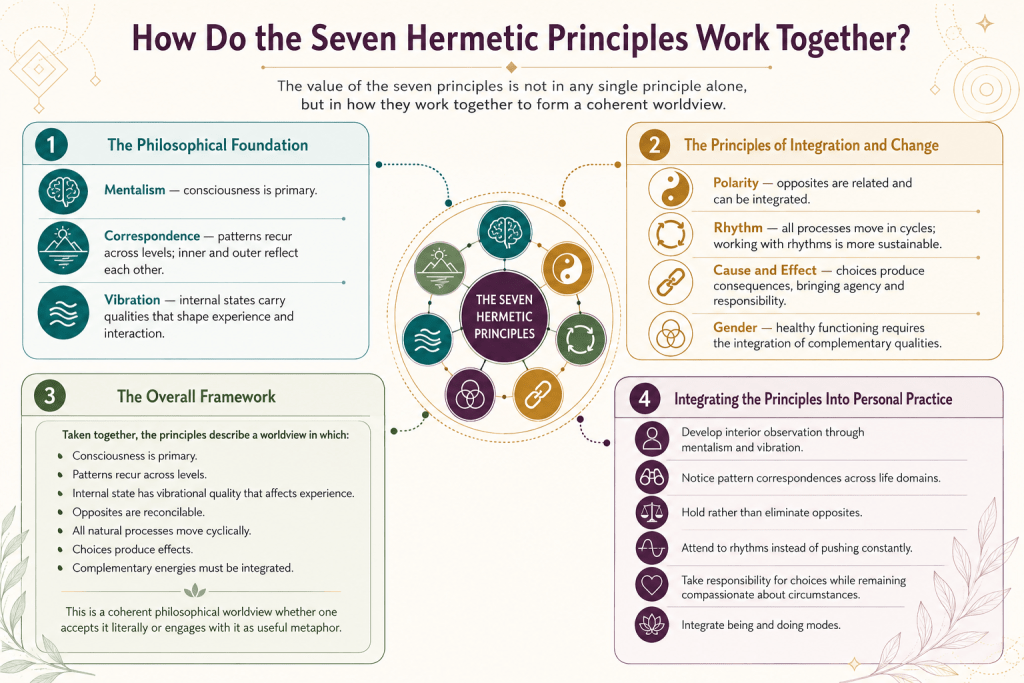
The Philosophical Foundation
- The principle of mentalism provides the philosophical foundation. Reality is understood as fundamentally consciousness-based rather than fundamentally material.
- The principle of correspondence establishes the specific claim that patterns at one level reflect patterns at other levels, so internal work has external implications and vice versa.
- The principle of vibration establishes that different states have different qualities that affect experience and interaction, providing the mechanism by which internal state affects external reality.
The Principles of Integration and Change
- The principle of polarity establishes that apparent opposites are related, so integration rather than elimination becomes the goal of personal work.
- The principle of rhythm establishes that all processes move in cycles, so working with rhythms produces sustainable results.
- The principle of cause and effect establishes that choices matter and produce effects, giving both agency and responsibility.
- The principle of gender establishes that healthy functioning requires integration of complementary qualities.
The Overall Framework
Taken together, the principles describe a worldview in which:
- Consciousness is primary.
- Patterns recur across levels.
- Internal state has vibrational quality that affects experience.
- Opposites are reconcilable.
- All natural processes move cyclically.
- Choices produce effects.
- Complementary energies must be integrated.
This is a coherent philosophical worldview whether one accepts it literally or engages with it as useful metaphor.
Integrating the Principles Into Personal Practice
The specific work of integrating the seven principles into personal practice involves:
- Developing capacity for interior observation through mentalism and vibration.
- Noticing pattern correspondences across life domains through correspondence.
- Holding rather than eliminating opposites through polarity.
- Attending to rhythms rather than pushing constantly through rhythm.
- Taking responsibility for choices while being compassionate about circumstances through cause and effect.
- Integrating being and doing modes through gender.
What Does Modern Research Support About the Seven Hermetic Principles?
Being honest about the intersection of the hermetic principles with modern research helps midlife women engage with the framework thoughtfully rather than through wellness-marketing distortion.
What Modern Research Supports
Modern research supports several practical observations associated with the seven hermetic principles:
- Mentalism: Mental state significantly affects lived experience.
- Correspondence: Patterns recur across levels of natural systems, particularly in the study of complexity.
- Vibration: Different physiological states have different measurable qualities.
- Polarity: Emotional states we consider opposites are related and can be integrated.
- Rhythm: Natural systems and human physiology move in cycles.
- Cause and effect: Choices produce effects over time.
- Gender: Healthy functioning requires balance between multiple capacities.
What Modern Research Does Not Support or Has Not Evaluated
Modern research does not support, or has not evaluated, several of the principles’ broader metaphysical claims:
- The claim that consciousness is the fundamental substrate of reality. Idealism is a philosophical position, not a scientific finding.
- The literal claim that thoughts create physical circumstances. The practical influence of mental state on experience is real, but it does not extend to the literal manifestation of external objects.
- The claim that specific vibrational frequencies produce specific healing effects. Most such claims lack evidence.
- The claim that all events have identifiable causes accessible to human understanding. This is a philosophical position rather than an empirical finding.
The Specific Distinction That Matters
The reasonable engagement with the principles treats them as a philosophical framework with practical value while remaining honest about what modern research does and does not support.
The unreasonable engagement treats them as literal scientific laws when they are not, or dismisses them entirely because they are not scientific when they are also not making scientific claims.
The Academic Scholarly View
Academic scholars of religion, philosophy, and the history of esoteric traditions engage with hermetic material as historically important without necessarily endorsing its metaphysical claims. This is a reasonable model for engagement.
The Commercial Claims to Avoid
Some contemporary content presents the seven principles as backed by quantum physics, neuroscience, or other modern research in ways that misrepresent the actual research.
When someone claims that quantum physics proves the principle of mentalism or that neuroscience proves the principle of vibration, they are typically overstating what the research shows. Approach such claims with appropriate skepticism.
Free 28-Day Fascia Reset Email Course
Get our Free 28-day email course series to help with 1 or 2 exercises per day to release your fascia. One short lesson per day. Two minutes to read each.
What Does Research Say About Heart Coherence?
The claim that the heart’s electromagnetic field is significantly stronger than the brain’s electromagnetic field appears frequently in contemporary hermetic-principles content. This claim deserves honest examination.
- The specific research base: The HeartMath Institute has conducted extensive research on heart-brain interactions, heart rate variability, and what they term “heart coherence.” Their research has documented specific measurable effects of coordinated breathing on heart rate variability, and specific interactions between heart and brain electromagnetic activity.
- The specific claim to evaluate: The often-cited claim that the heart’s electromagnetic field is 5,000 times stronger than the brain’s field is a specific claim from HeartMath research. This specific figure references the strength of the magnetic component of the heart’s electromagnetic field relative to the magnetic component of the brain’s field, as measurable at a short distance from the body.
- What this means: The heart does produce a measurable electromagnetic field that extends beyond the body. This is real. The specific practical implications of this for consciousness, healing, or manifestation are less clearly established than some contemporary content claims. The measured field exists. What it does at a distance and how it interacts with other bodies is an active area of research and interpretation.
- The specific caution: Some contemporary content extends the heart electromagnetic field research into claims about literal broadcasting of intentions into a quantum field, energy exchange between people at distance, and specific healing effects. These extended claims typically go beyond what the research demonstrates. Engaging with the research honestly means acknowledging both what it shows (real measurable heart-brain interactions) and where extended claims exceed the evidence.
- The practical application: Regardless of the specific metaphysical framing, practices that support heart coherence (slow diaphragmatic breathing, extended exhalation, focused attention on positive emotional states) do produce measurable improvements in heart rate variability, cortisol regulation, and subjective well-being. These vagus nerve reset practices are worth pursuing whether or not one accepts the broader metaphysical interpretation.
What Are the Most Common Misinterpretations of the Seven Hermetic Principles?
Being clear about the specific misinterpretations and distortions of the seven principles helps midlife women engage with the framework productively rather than being led into problematic applications.
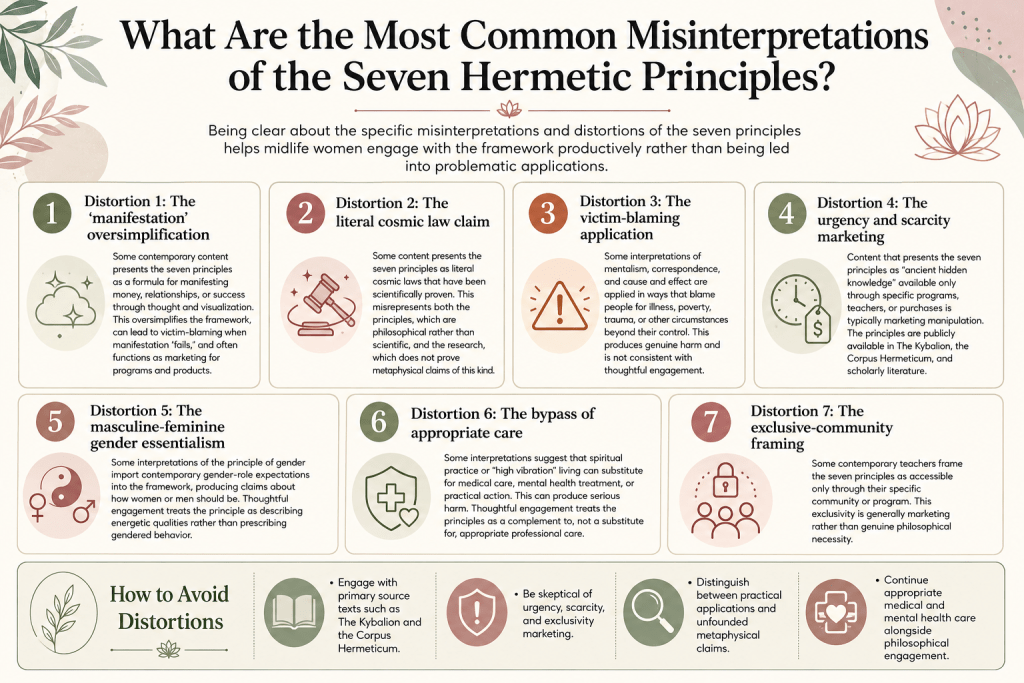
- Distortion 1: The “manifestation” oversimplification. Some contemporary content presents the seven principles as a formula for manifesting specific desired outcomes (money, relationships, success) through thought and visualization. This oversimplifies the philosophical framework, tends toward victim-blaming when manifestation “fails,” and often functions as marketing for programs and products.
- Distortion 2: The literal cosmic law claim. Some content presents the seven principles as literal cosmic laws that have been scientifically proven. This misrepresents both the principles (which are philosophical rather than scientific) and the research (which does not prove metaphysical claims of this kind).
- Distortion 3: The victim-blaming application. Some interpretations of principles 1, 2, and 6 (mentalism, correspondence, cause and effect) are applied in ways that blame people for circumstances beyond their control including illness, poverty, or trauma. This produces genuine harm and is not consistent with thoughtful engagement with the tradition.
- Distortion 4: The urgency and scarcity marketing. Content that presents the seven principles as “ancient hidden knowledge” available only through specific programs, teachers, or purchases is typically marketing manipulation. The principles are publicly available in The Kybalion, in the Corpus Hermeticum, and in extensive scholarly literature.
- Distortion 5: The masculine-feminine gender essentialism. Some interpretations of the principle of gender import contemporary gender-role expectations into the framework, producing normative claims about how women or men should be. Thoughtful engagement treats the principle as describing energetic qualities rather than prescribing gendered behavior.
- Distortion 6: The bypass of appropriate care. Some interpretations of the principles suggest that spiritual practice or “high vibration” living can substitute for appropriate medical care, mental health treatment, or practical action. This can produce serious harm when applied to real health situations. Thoughtful engagement treats the principles as complement to, not substitute for, appropriate professional care.
- Distortion 7: The exclusive-community framing. Some contemporary teachers frame the seven principles as accessible only through their specific community or program. This exclusivity is generally marketing rather than genuine philosophical necessity.
- How to avoid distortions. Engage with primary source texts (The Kybalion, the Corpus Hermeticum) alongside contemporary interpretations. Be skeptical of urgency, scarcity, and exclusivity marketing. Distinguish between reasonable practical applications and unfounded metaphysical claims. Continue appropriate medical and mental health care alongside philosophical engagement.
“The specific engagement I recommend for coaching clients who are interested in these principles is to read The Kybalion directly, contemplate the principles as reflective prompts over time, notice which principles resonate with their own experience, and apply the practical implications without importing the metaphysical overclaiming that often accompanies contemporary content. A midlife woman who spends six months genuinely contemplating the principle of rhythm often notices patterns in her own life that reshape her decisions in useful ways. A midlife woman who purchases a fifteen-hundred-dollar program promising to teach her the ancient secret hermetic manifestation code usually gets neither ancient secrets nor useful application. The framework is real. The commercial packaging of the framework often is not. Engaging directly with the source material and applying the practical implications honestly is what produces the value that the framework can offer.”
Terry Tateossian, Founder of The House of Rose
Free 28-Day Fascia Reset Email Course
Get our Free 28-day email course series to help with 1 or 2 exercises per day to release your fascia. One short lesson per day. Two minutes to read each.
How Can Midlife Women Apply the Seven Hermetic Principles?
The specific practical applications of the seven principles for midlife women are worth articulating clearly because thoughtful application is what produces value.
Practical Application of Mentalism
Attend to internal mental state as a foundational input to lived experience. Practices that support internal state, including meditation, nervous system regulation, adequate sleep, and appropriate nutrition, produce meaningful effects on overall well-being.
Dive Depper into:
Practical Application of Correspondence
Notice patterns across life domains. When a pattern appears in multiple areas of your life, the pattern itself is worth attending to rather than each instance in isolation. Address the pattern at its source for more sustainable results.
Practical Application of Vibration
Cultivate specific internal qualities deliberately through specific practices. Meditation, breath work, movement traditions like yoga and tai chi, time in nature, and quality relationships all cultivate specific qualities.
Dive Depperr:
Practical Application of Polarity
Integrate shadow material rather than eliminating it. Grief, anger, fear, and other difficult emotions are part of a full human life. Work with these emotions rather than against them.
Practical Application of Rhythm
Honor natural cycles rather than pushing against them. Not every day is a high-output day. Perimenopause and menopause represent a specific life-stage shift that benefits from working with rather than against these natural changes.
Practical Application of Cause and Effect
Take responsibility for choices while being compassionate about circumstances. Small daily choices compound over time.
Practical Application of Gender
Rebalance being and doing modes. Many midlife women have spent decades in predominantly doing mode. Integrating being modes can often produce significant growth, including:
- Rest
- Receptivity
- Contemplation
- Quiet time in nature
See our Deeply Restorative Yoga and Nature Retreat as one specific setting that supports this integration.
The Specific Integration for Midlife
The specific value of engaging all seven principles in midlife is the coherent framework they provide for the interior work that this life stage often calls for. Individual midlife women will resonate with different principles at different times. Following that resonance while maintaining the discipline of continued reflection produces value over months and years.
Free 28-Day Fascia Reset Email Course
Get our Free 28-day email course series to help with 1 or 2 exercises per day to release your fascia. One short lesson per day. Two minutes to read each.
When Should You See a Healthcare or Mental Health Professional?
Philosophical frameworks including this one are one component of a broader life. Certain situations warrant professional care beyond philosophical engagement.
- Any acute mental health crisis: Active suicidal thinking, severe depression, severe anxiety, dissociation, or psychosis warrant immediate mental health care. Philosophical engagement does not substitute for appropriate clinical care.
- Persistent unexplained physical symptoms: Physical symptoms that impair daily function warrant medical evaluation. Do not use philosophical frameworks as a reason to avoid appropriate medical care.
- Significant unresolved trauma: Trauma benefits from working with qualified trauma-informed therapists. Some philosophical engagement can complement therapy, but is not a substitute.
- Grief and major life transitions: Loss of loved ones, divorce, job loss, or other major transitions often benefit from professional support alongside personal reflection.
- Persistent existential distress: Ongoing existential distress that affects daily function warrants exploration with a qualified therapist, spiritual director, counselor experienced in this territory or an online women’s wellness coach.
- Confusion about mystical or spiritual experiences: If you experience unusual mental phenomena that concern you or affect your ability to function, consult a mental health provider familiar with spiritual and religious experience. Some experiences are healthy expansions. Others may warrant clinical evaluation.
- Involvement in exploitative groups: If you find yourself in a group or program that discourages contact with outside people, requires large financial contributions, or claims exclusive access to spiritual truth, these are warning signs of exploitation. Seek outside perspective.
Your Next Steps
If the framework in this article resonates and you want to engage with the seven hermetic principles thoughtfully, here are the four next steps in order of friction.
- Read The Kybalion directly. The original text is short (under 200 pages), publicly available (out of copyright), and worth reading before engaging with contemporary interpretations. Reading the source material puts you in a better position to evaluate contemporary content.
- Contemplate one principle per week. Rather than trying to engage with all seven at once, spend a week with each principle. Notice how it shows up in your life. Journal briefly. Do not rush.
- Apply the practical implications. The value of the principles is in application, not in intellectual accumulation. Whichever principles resonate most, install the practical implications in your daily life over months.
Free 28-Day Fascia Reset Email Course
Get our Free 28-day email course series to help with 1 or 2 exercises per day to release your fascia. One short lesson per day. Two minutes to read each.
Frequently Asked Questions
What are the seven hermetic principles?
The seven hermetic principles are Mentalism, Correspondence, Vibration, Polarity, Rhythm, Cause and Effect, and Gender. They were codified in written form in the 1908 book The Kybalion and are attributed by tradition to the legendary figure Hermes Trismegistus. They articulate a philosophical worldview about consciousness, patterns across levels, energy, opposites, cycles, causation, and complementary qualities.
Where do the seven hermetic principles come from?
The specific formulation in the modern seven-principles form comes from the 1908 book The Kybalion, published anonymously by “Three Initiates” and widely attributed to American writer William Walker Atkinson. The underlying themes draw on much older material including the Corpus Hermeticum from late antique Roman Egypt (roughly second and third centuries CE) and various philosophical and religious traditions. The seven-principles formulation itself is a modern systematization of older material.
Is The Kybalion an ancient text?
No. The Kybalion is a modern text published in 1908 that draws on ancient hermetic themes. Some contemporary marketing presents it as an ancient text, which is not accurate. The underlying philosophical themes have older sources, but the specific book is a modern American publication from the New Thought movement of the early twentieth century.
Are the seven hermetic principles scientifically proven?
No. The principles are philosophical statements, not scientific findings. Some observations the principles describe (cycles, cause and effect, the influence of mental state on experience) do intersect with modern research. Others are metaphysical claims that modern science does not evaluate. Some contemporary content overstates the scientific support for the principles.
What is the principle of mentalism?
The principle of mentalism holds that consciousness or mind is the fundamental substrate of reality, and that internal mental states significantly affect lived experience. It aligns with philosophical idealism (which holds that mind is fundamental) rather than materialism (which holds that matter is fundamental). The practical observation that mental state affects experience is well-supported by modern research.
What does “as above, so below” mean?
This is the compact statement of the principle of correspondence. It suggests a fundamental correspondence between different levels of reality, such that patterns at one level tend to reflect patterns at other levels. Practically applied, it suggests that patterns in one area of life often show up in other areas, and that internal work has external implications.
Can hermetic principles help with menopause?
The principles function as philosophical framework for reflection rather than as menopause-specific interventions. Some practical applications (attention to interior state, honoring cycles, integrating shadow material, taking responsibility for choices while being compassionate about circumstances) intersect meaningfully with what many midlife women want to work with. The philosophical framework complements rather than replaces evidence-based practices for menopause.
Is the principle of gender the same as biological sex?
No. The principle of gender uses gendered language to describe complementary energetic qualities (feminine as receptive, intuitive, being; masculine as active, focused, doing). These qualities are present in every person regardless of biological sex or gender identity. Thoughtful engagement uses the framework as description of energetic qualities without importing biological or normative gender essentialism.
Are hermetic principles a religion?
No. Hermetic principles are a philosophical framework rather than a religion. They can be studied and applied by people of any religious background including Christian, Jewish, Muslim, Buddhist, Hindu, secular, or other. Some contemporary spiritual traditions incorporate hermetic themes, but the philosophy itself is not a religion requiring specific religious belief or affiliation.
Can I really manifest anything I want using the seven principles?
No. The oversimplified “manifestation” reading of the principles is a distortion that oversells what the framework claims. Internal mental state does affect lived experience meaningfully. Choices do produce effects over time. Neither of these supports the strong claim that thought literally creates external circumstances. Approach manifestation content with appropriate skepticism.
What is the electromagnetic heart field?
The heart produces a measurable electromagnetic field that extends beyond the body. HeartMath Institute research has documented specific interactions between heart and brain electromagnetic activity and the effects of specific practices (coordinated breathing, focused emotional states) on heart rate variability. The specific claims about literal broadcasting of intentions or specific quantum-level effects go beyond what the research demonstrates. The measurable effects on heart rate variability are well-established and worth pursuing regardless of broader interpretation.
How is Hermeticism different from other spiritual traditions?
Hermeticism is a specific Western esoteric tradition with roots in late antique Egypt and Greece and later developments in Renaissance Europe and modern American New Thought. It shares themes with various other traditions (Buddhist mind training, Advaita Vedanta, certain Christian contemplative traditions, Kabbalah, Sufi mysticism) but has its own specific history, texts, and lineage. Thoughtful comparative study can enrich understanding of any single tradition.
Free 28-Day Fascia Reset Email Course
Get our Free 28-day email course series to help with 1 or 2 exercises per day to release your fascia. One short lesson per day. Two minutes to read each.
Should I read The Kybalion or start with contemporary teachers?
Reading The Kybalion directly is a reasonable starting point because it puts you in a better position to evaluate contemporary teachers who claim to be teaching the framework. The book is short, publicly available, and out of copyright. Contemporary teachers vary widely in quality. Reading the source material first provides context for evaluating them.
Are the seven hermetic principles connected to yoga or meditation?
The specific hermetic tradition is distinct from yoga and meditation traditions, but there are overlapping themes. Contemplative practice generally supports the interior work that engagement with hermetic principles calls for. Practices from yoga, ayurveda yoga, or meditation traditions can complement philosophical engagement with the hermetic framework.
Is engagement with hermetic principles safe?
For most people, intellectual and reflective engagement with the seven principles is safe and can be valuable. For people with certain mental health conditions (severe depression, psychosis, dissociative disorders), intensive engagement with metaphysical material without appropriate professional support may not be advisable. Discuss with a mental health professional if you have concerns about your specific situation. Avoid programs or teachers that discourage contact with outside people or that make exclusive claims to spiritual truth.
References
- Three Initiates. (1908). The Kybalion: A Study of the Hermetic Philosophy of Ancient Egypt and Greece. Yogi Publication Society.
- Copenhaver, B. P. (Trans.). (1992). Hermetica: The Greek Corpus Hermeticum and the Latin Asclepius in a New English Translation, with Notes and Introduction. Cambridge University Press.
- Faivre, A. (1994). Access to Western Esotericism. State University of New York Press.
- Hanegraaff, W. J. (2012). Esotericism and the Academy: Rejected Knowledge in Western Culture. Cambridge University Press.
- Yates, F. A. (1964). Giordano Bruno and the Hermetic Tradition. University of Chicago Press.
- Fowden, G. (1993). The Egyptian Hermes: A Historical Approach to the Late Pagan Mind. Princeton University Press.
- Ebeling, F. (2007). The Secret History of Hermes Trismegistus: Hermeticism from Ancient to Modern Times. Cornell University Press.
- McCraty, R., Atkinson, M., Tomasino, D., & Bradley, R. T. (2009). The coherent heart: heart-brain interactions, psychophysiological coherence, and the emergence of system-wide order. Integral Review, 5(2), 10–115.
- McCraty, R., & Zayas, M. A. (2014). Cardiac coherence, self-regulation, autonomic stability, and psychosocial well-being. Frontiers in Psychology, 5, 1090.
- Kok, B. E., Coffey, K. A., Cohn, M. A., et al. (2013). How positive emotions build physical health: perceived positive social connections account for the upward spiral between positive emotions and vagal tone. Psychological Science, 24(7), 1123–1132.
- Porges, S. W. (2011). The Polyvagal Theory: Neurophysiological Foundations of Emotions, Attachment, Communication, and Self-Regulation. W. W. Norton.
- Jung, C. G. (1959). The Archetypes and the Collective Unconscious. Princeton University Press.
- Jung, C. G. (1958). Psychology and Religion: West and East. Princeton University Press.
- Emmons, R. A., & McCullough, M. E. (2003). Counting blessings versus burdens: an experimental investigation of gratitude and subjective well-being in daily life. Journal of Personality and Social Psychology, 84(2), 377–389.
- Fredrickson, B. L. (2004). The broaden-and-build theory of positive emotions. Philosophical Transactions of the Royal Society B: Biological Sciences, 359(1449), 1367–1378.
- Kabat-Zinn, J. (2003). Mindfulness-based interventions in context: past, present, and future. Clinical Psychology: Science and Practice, 10(2), 144–156.
- Frawley, D. (1997). Ayurveda and the Mind: The Healing of Consciousness. Lotus Press.
- Feuerstein, G. (2001). The Yoga Tradition: Its History, Literature, Philosophy, and Practice. Hohm Press.
- Wilber, K. (2000). A Theory of Everything: An Integral Vision for Business, Politics, Science, and Spirituality. Shambhala.
- Grof, S. (2008). The Cosmic Game: Explorations of the Frontiers of Human Consciousness. State University of New York Press.
Disclaimer: This article is educational and does not constitute spiritual, religious, medical, or mental health advice. Philosophical frameworks including this one complement rather than replace appropriate professional care. If you are dealing with significant emotional distress, unresolved trauma, or any acute mental health situation, please work with a qualified mental health professional. Do not stop or change any medication or professional treatment based on engagement with philosophical material alone.
Free 28-Day Fascia Reset Email Course
Get our Free 28-day email course series to help with 1 or 2 exercises per day to release your fascia. One short lesson per day. Two minutes to read each.

Terry Tateossian is a Menopause Lifestyle Medicine Coach, Certified Personal Trainer & Nutritionist and the Founder of THOR: The House of Rose, a wellness brand serving women over 40 through retreats, coaching, macro-nutrition and community. As 25-year founder and entrepreneur, Terry spent two and a half decades building and running successful start-up businesses, an experience that put her on the front line of founder burnout long before she could name it. After facing serious health challenges, early onset menopause, and emotional eating while running her agency and raising two children, Terry rebuilt her health in her 40s and lost more than 80 pounds through evidence-based nutrition, training, and mindset work. Today, she helps women get strong, improve confidence, support hormone health, and create a stronger second half of life. Terry has been featured in major media outlets and is available for podcasts, expert commentary, brand collaborations, and speaking engagements on midlife health, reinvention, emotional eating, menopause wellness, and strength training for longevity. Get her free macro calculator (her cookbook companion) to start your journey to back to health.